
Dan Curtis often said that the idea for Dark Shadows came to him in a dream about a girl with long black hair taking a journey by train. When he persuaded ABC-TV to let him make a pilot for a series, the most difficult part of the casting process was finding the actress who would embody that girl, whose name came to be Victoria Winters. Alexandra Isles, then still known as Alexandra Moltke, finally emerged as the one person who combined the right physical appearance with a mysterious, otherworldly quality that suggests a figure from a dream.

Mrs Isles’ casting had an immediate effect on the underlying story in Art Wallace’s original series bible, Shadows on the Wall. Wallace projected a puzzle about Vicki’s origins that would be resolved when it was revealed that she was the child of an extramarital liaison between Paul Stoddard, the long-missing husband of matriarch Elizabeth Collins Stoddard, and some unknown woman. Liz’ guilty feelings about Paul would explain her concern for Vicki and her decision to bring her to the great house of Collinwood as governess for her nephew, strange and troubled boy David Collins. Since Vicki would not be a blood relative of the Collins family, it would also leave an option for Vicki to develop a romance with David’s father, Liz’ brother Roger.

Wallace did include a note saying that if it was more story-productive, it could turn out that Liz was Vicki’s mother. Liz was played by Joan Bennett, whom Mrs Isles strongly resembled. When Bennett first saw Mrs Isles, she famously mistook her for her own daughter. From the first episode on, the show heavily signaled that Vicki was Liz’ daughter by a man other than Paul. Liz soon treats Vicki so much like a daughter that the only events that would follow from confirming the relationship would be to make some changes to Liz’ will. Since the business aspects of the characters’ lives ceased to generate action after the first few months, that would have been a severe anti-climax. So they wound up dropping the question altogether.
For the first 39 weeks of Dark Shadows, Vicki was its main protagonist. Not many of the storylines worked in those days; the only scenes that reliably clicked were those between Vicki and David. Even though their dialogue was as dreary as anything else in those early scripts, Mrs Isles and David Henesy managed to use their physical movements and the spaces they occupied to tell the story of a young woman persuading a boy to trust her. That version of the show ended with #191, when David ran from the mother who was trying to lure him to his death and flung himself into Vicki’s arms. That completed their story, and left neither character with a clear path forward.

After #191, the show was on course for the introduction of vampire Barnabas Collins. Vicki kept trying to get close to Barnabas; she even invited herself to spend the night at his house in #285 and #286. But he wouldn’t bite her, and she couldn’t get a foothold in the A-story otherwise. There was an odd meta-fictional side to Vicki in this phase. In-universe, she didn’t know that Barnabas was a vampire, and she certainly didn’t know that she was a character on a soap opera that was coming to be all about him. But her behavior made sense only if she did know those things and was making an effort to reestablish herself as a central figure in the action. I don’t know whether Mrs Isles or any other particular person was lobbying the writers to present her that way, or if it was a response to fan mail. It happened so often and led to so little that it did seem to be coming from somewhere outside the usual creative process behind the scripts.
In November 1967, Vicki came unstuck in time and found herself in the year 1795. She took the audience with her, and for several months the show was a costume drama set in the late eighteenth century. On balance, the result was a triumph. By the time Vicki and the show came back to contemporary dress in March 1968, Dark Shadows had become a real hit, and Barnabas had become one of the major pop culture phenomena of the 1960s. But Vicki did not benefit from that success. When the costume drama insert started, fans had every reason to expect it would revive her character. Barnabas spent most of his time in 1967 scrambling to impersonate a native of the twentieth century; Jonathan Frid would always say that it was in that scramble that he found Barnabas, and that he thought of him first and foremost as a liar. When Vicki turns up in Barnabas’ original period, we look forward to seeing her doing what he did, and trying to pass as his little sister’s governess. Remembering how well Mrs Isles did during the 39 weeks she carried the show on her shoulders, we look forward to her showing us what Vicki can do when she has to think fast.
But that was not to be. Instead, Curtis and his staff chose to write Vicki as an intolerable moron. She introduced herself to every new person by telling them that they are being played by actors who had other parts in the first 73 weeks of the show. Tedious as that habit was, it was compounded when she made one inexplicably idiotic decision after another as she failed utterly to adapt to her new surroundings. That would have been a difficult role to make appealing even if she had shared her screen time with a partner as capable as David Henesy. It became utterly impossible when Vicki made the least intelligible move of all and fell in love with her jailer/ lawyer/ boyfriend/ accomplice Peter Bradford, played by the abusive and shouty Roger Davis. Marooned in scene after scene with Mr Davis, Mrs Isles withered and Vicki became a cipher. By the time the court sentenced Vicki to be put to death for her many crimes, half the audience was on their side.
Shortly after Vicki returned to the 1960s, Barnabas finally bit her. Each of Barnabas’ victims reacted to his bite differently; Vicki’s reaction was perhaps the most unexpected, and certainly the funniest. She was just sort of chill about the whole thing. She showed up when Barnabas summoned her and didn’t object when he told he her she would become his vampire bride for all eternity, but first she had some errands to run, and she was irritated with him when he tried to get her to skip them. When a doctor saw the bite marks on her neck, she did not react with the fear or defensiveness of other victims, but innocently asked “Why are they bad?” She seemed to regard them as just another hickey, the result of Barnabas’ peculiar make-out technique.
Unfortunately, Peter came back to life and ruined Vicki’s relationship with Barnabas. He jumped out in the road in front of her car while she was driving off with Barnabas, causing her to crash. Vicki and Barnabas were taken to the hospital. There, one of the doctors turned out to be a mad scientist who cured Barnabas of vampirism. Once the cure took hold, Vicki forgot all about her time as Barnabas’ victim, and she sunk into a relationship with the irredeemably repellent Peter. Every time we’ve seen her in recent months, she has dragged Peter back to our attention. Mrs Isles has found ways to liven up Vicki’s scenes; she always projected a forceful personality when she was standing near the clock in the foyer of the great house of Collinwood, and she has even managed to coax Roger Davis into playing a couple of scenes competently. Mr Davis never had quite as much to offer as did the clock, but when Mrs Isles could raise her voice and fix him with a steely stare it does seem to have come back to him that he had had a lot of acting lessons and could deliver dialogue interestingly.
Today is Mrs Isles’ last day on the job. We open with a reprise of the end of yesterday’s episode, when Vicki finds the corpse of a strangled woman in the closet in Peter’s room. Peter assures her he doesn’t know how the corpse got there. She tells him they have to call the police. He says he needs time to figure out what happened before they can involve the police; she points out that delaying will only make him look guiltier in their eyes. He tells her that she should leave so that her name won’t be connected with the case; she tells him it is too late for that. We can see why Vicki has faded- she is thinking like a rational person from our world, not like anyone you would meet in Soap Opera Land.
Vicki goes home to Collinwood and tells permanent houseguest Julia Hoffman that Peter is in jail, suspected of murder. She explains that the dead person is a woman Peter knew only as Eve. Julia reacts with shock to the name; Vicki asks if she knew Eve. Julia says of course not, and Vicki tells her she will go wake Roger and ask him to help arrange bail for Peter. She goes into the door leading to the bedrooms, never to be seen again.
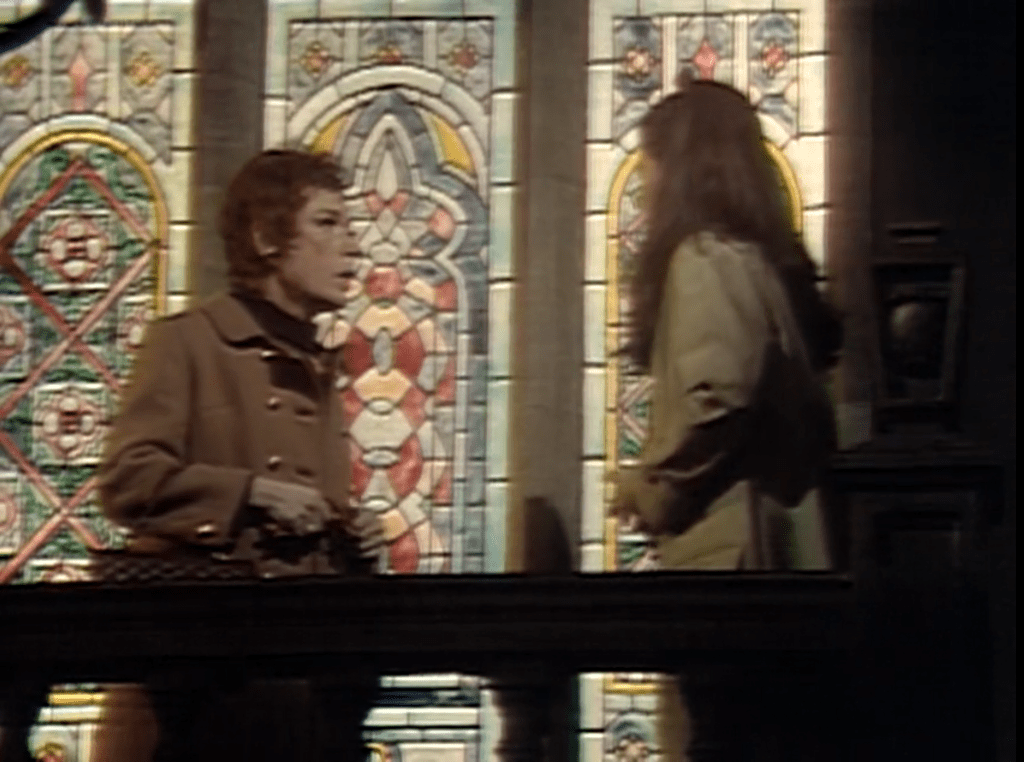
Viewers who have been with the show from the beginning will see a loop closing in the idea of Vicki going to Roger’s bedroom while he sleeps. In #4, Roger had tried to let himself into Vicki’s bedroom at night, only to be caught with his hand on the doorknob by Liz. In response to Liz’ threats, Roger told her not to bother him about his “morals,” a choice of words that made it clear that his intentions with regard to Vicki were of a sexual nature. Later in the episode, he and Vicki bantered flirtatiously after he offered her a snifter of brandy; for the first and last time, Vicki sounded like what she was supposed to have been, a street kid from NYC. Roger has long since been stripped of all his villainous qualities; in #585, he and Vicki even shared a scene in her bedroom while she was in her nightgown, and it was all perfectly innocent. In that scene, we not only saw that the old menacing Roger was gone forever, but that Vicki was also reduced to such a humdrum status that a man can enter her bedroom at night without raising an eyebrow. Now that Julia sees nothing out of the ordinary in Vicki dropping in on Roger while he sleeps, that humdrum status is reinforced.
When Vicki first arrived in the village of Collinsport in #1, she met her original love interest, dashing action hero Burke Devlin. Burke told her she had found her way to “the beginning and the end of the world.” We are reminded of the beginning of the world since we know that the man who killed Eve was named Adam. This Adam and Eve are no one’s parents; they share nothing but hostility and death. The episode ends with the wicked Angelique trying to summon up the Devil, a symbol of the end of the world. She herself disappears, apparently destroyed. Burke’s description is finally fulfilled.
The part of Vicki will be recast twice in the months ahead, but those actresses never had a chance to breathe any life into her. The character had lost any reason to be on the show long before Mrs Isles’ departure. In #87, David had trapped Vicki and left her to die; wondering where she was, Roger said, “She came to us from nowhere, and now it seems she has disappeared into nowhere.” And so, at last, it has come to be. The long-haired girl from Dan Curtis’ dream, the image that started it all, has vanished, never to be seen again.
 Dark Shadows Commentary