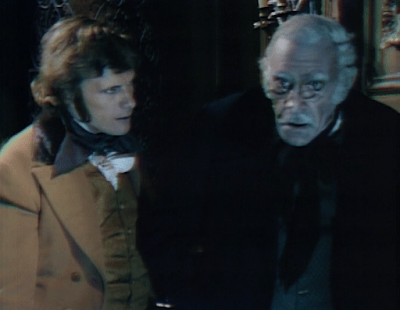
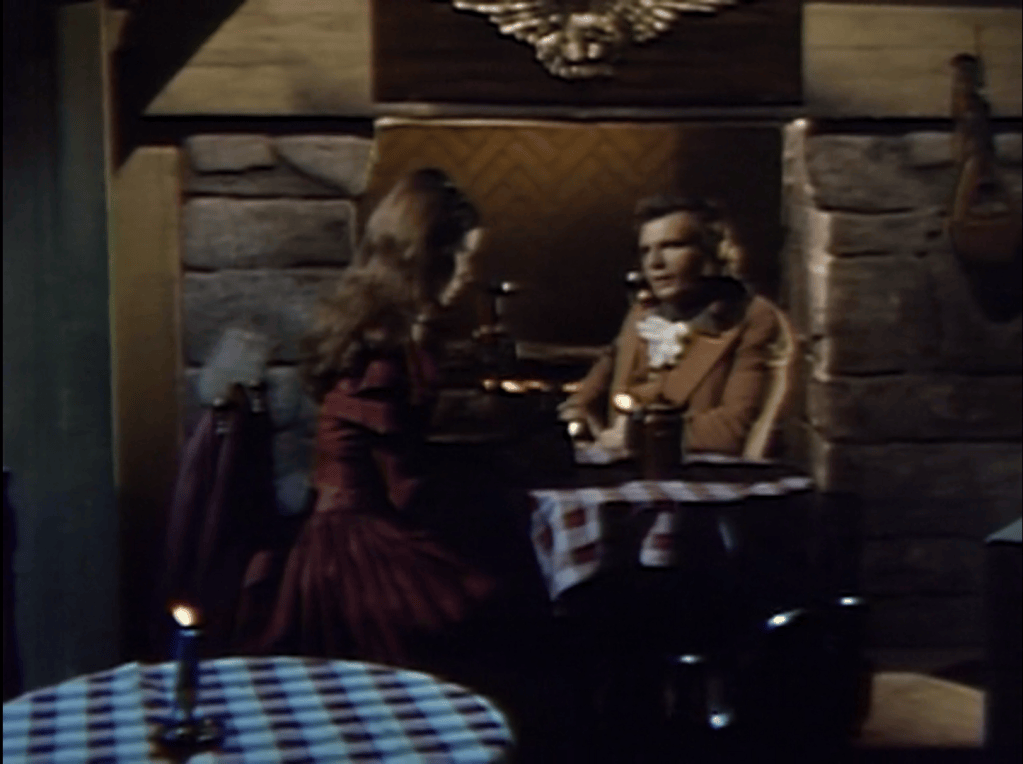
Dark Shadows featured several long costume drama segments depicting stories of time travel. From November 1967 to March 1968, well-meaning governess Victoria Winters bumbled around in the years 1795 and 1796, convincing the people of Collinsport that they should hang her. Meanwhile, we learned how old world gentleman Barnabas Collins first became a vampire.
From March to November 1969, Barnabas was the one making poor decisions in an era not his own when he found himself in the year 1897. Those eight months were by most measures the show’s most successful period. From March to July 1970, the show traveled sideways in time to an alternate universe where Barnabas and his friend, mad scientist Julia Hoffman, meddled in the problems of the family who lived on that version of the estate of Collinwood. The show insisted on calling that alternate universe “Parallel Time.”
Now, Julia and Barnabas have made their way to the year 1840. They know that something or other happened in that year that would lead to the destruction of the great house of Collinwood and its residents in 1970. They have no very clear idea what that fateful event was, and it is becoming increasingly clear that the writers don’t have any good ideas about it either.
While Barnabas, Julia, and the writers cast about in the darkness, we keep meeting characters who remind us of earlier phases of the show. Early on, we met Ben Stokes and Daniel Collins, two people left over from the 1790s segment. Ben helped Julia and Barnabas establish themselves with the current crop of Collinses by corroborating their story that they were cousins from England (or Philadelphia, whichever.) Daniel, who was a boy in the 1790s and is now the master of Collinwood, greeted them warmly and invited Barnabas to stay in the Old House at Collinwood as long as he liked. The presence of Daniel and Ben not only helped graft Barnabas and Julia onto the new stories, but also told longtime viewers that the 1840 segment will be a sequel to the 1790s segment.
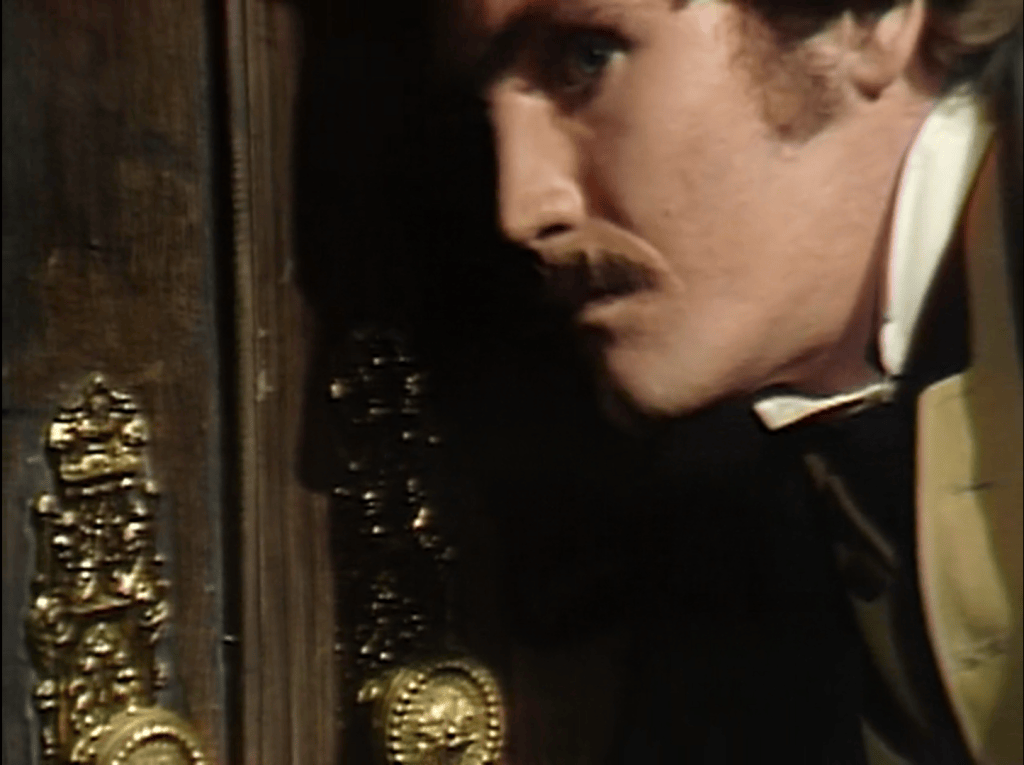
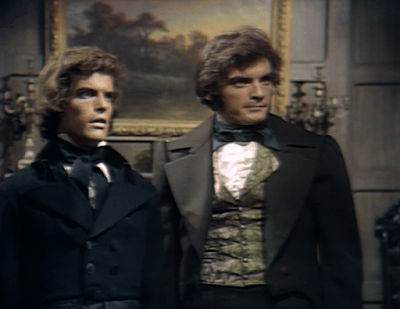
We also see mergers of characters from the 1897 segment with those from Parallel Time. For example, charming rogue Quentin Collins became a huge breakout star in 1897; in Parallel Time, Quentin’s counterpart was the grumpy and irascible master of Collinwood. In 1840, Quentin is Daniel’s older son and sole heir, in charge of the house due to his father’s many problems. He is again grumpy and irascible, again in a loveless marriage. But like the 1897 Quentin, he is fascinated by the occult and creates trouble by his reckless involvement with it. Quentin’s best friend and fellow occultist is his cousin Desmond Collins, played by John Karlen. Desmond shares the irresponsibility of Karlen’s 1897 character, inveterate prankster Carl Collins. But Desmond has none of the extreme childlike quality that it made seem Carl had a cognitive impairment of some sort. He has the manner and bearing of Karlen’s Parallel Time character, drunken novelist Will Loomis.
Will was married to Carolyn Collins Stoddard, played by Nancy Barrett. In 1897, Miss Barrett played a villain named Charity Trask who fell afoul of evil sorcerer Count Petofi. Petofi erased Charity’s personality and replaced it with that of Cockney showgirl/ mentalist Pansy Faye. Carl had brought Pansy to Collinwood as his fiancée. Pansy was killed before she ever met Charity, who never had any use for Carl. Carl himself was killed before Petofi took Charity’s body away from her and gave it to Pansy. Miss Barrett’s acting style is to throw herself completely into each of her roles, so we quickly accepted her as Pansy. But when we heard Miss Barrett’s Pansy pine for her poor lost Carl, we were reminded that Petofi had murdered Charity and reanimated her form with Pansy’s mind.
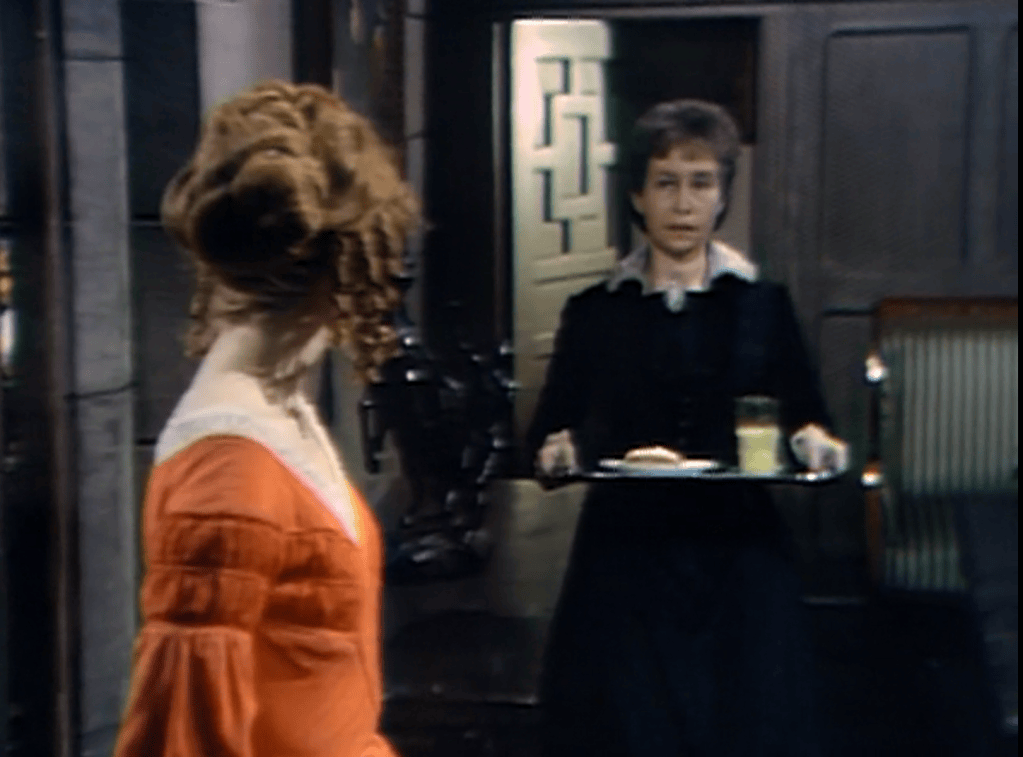
In 1840, Miss Barrett is Leticia Faye, who is barely distinguishable from Pansy. She was brought to Collinwood by the evil Gerard Stiles to play some part in his never-explained scheme to cheat the Collilnses out of their money. When we first saw her, Leticia confronted Gerard over her suspicions that if he ever did get his hands on any of the Collins money, she wouldn’t see any of it. Then Gerard humiliated her by marrying Quentin’s widow Samantha, which promptly redounded to his own humiliation when Quentin turned up alive and well. Leticia confronted him again, brandishing her own pain and mocking his in what sounded very much like the sorts of things Carolyn used to say to Will. Now, Leticia has set her cap for Desmond, but also become involved in his occult mischief.
Most of the action in the 1790s was driven by wicked witch Angelique. A maniacal villain then, Angelique appeared in 1897 and became a multilayered personality. Angelique rejoined the cast of characters at the end of yesterday’s episode. We saw her enter the hidden chamber where Barnabas’ chained coffin was kept from the 1790s on and discover that it was no longer there.
Angelique’s counterpart in Parallel Time had a sidekick, a housekeeper modeled on Mrs Danvers from Rebecca who was herself Julia’s Doppelgänger. We didn’t get to see a great deal of that relationship, since Grayson Hall was off for principal photography for the feature film House of Dark Shadows during most of the first half of the Parallel Time segment. Today, we see that we will be getting another look at how Angelique handles a sidekick. Angelique Model 1840 has a servant, a man named Laszlo Ferrari.
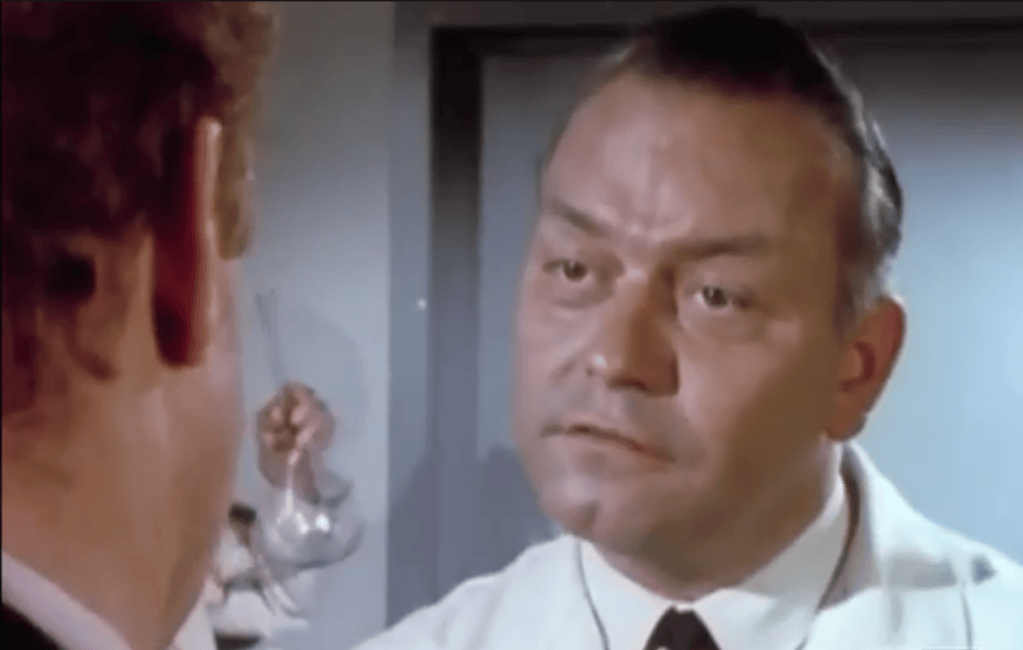
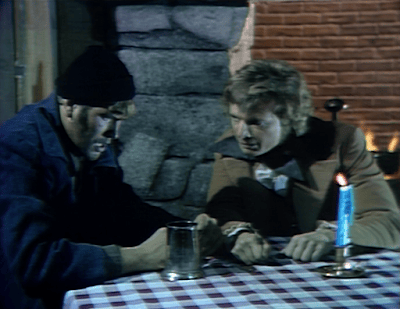
Laszlo’s appearance evokes the 1897 segment. He is played by Michael Stroka, wearing the astrakhan hat that he wore when we first saw him as Aristide, servant of Count Petofi. His attitude towards Angelique is very much like Aristide’s towards Petofi, asking a question in a vaguely belligerent tone, occasionally making a show of defiance, and quickly collapsing into cringing obedience. So he asks Angelique why they keep coming to the tomb every year, and why she isn’t as happy as she usually is when she emerges from the secret room. She snaps at him in response, saying that she would have expected him to stop asking her questions by now, since she has never yet given him any answers. She orders him to go to the great house at Collinwood and find out if a man named Barnabas Collins has been around recently. Reluctant to go, he asks who Barnabas is. She says he is the only man she ever loved. He says “Other than me, of course!” and she agrees in a sarcastic tone. It’s all in very joking, but he scurries away to obey her. All that is missing is him addressing her as “Excellency!” and her remarking on his good looks, and we’d be right back with Aristide and Petofi.
At Collinwood, Laszlo meets Quentin’s younger brother, Gabriel Collins. Gabriel is amused by Laszlo’s attempt to persuade him that he can see into the future, and tells him that the pressing need is for someone who can see into the present. There is a headless body wandering the estate killing people, and if Laszlo can tell them how to put a stop to that he’ll be onto something. Barnabas shows up and scowls at Laszlo, who leaves.
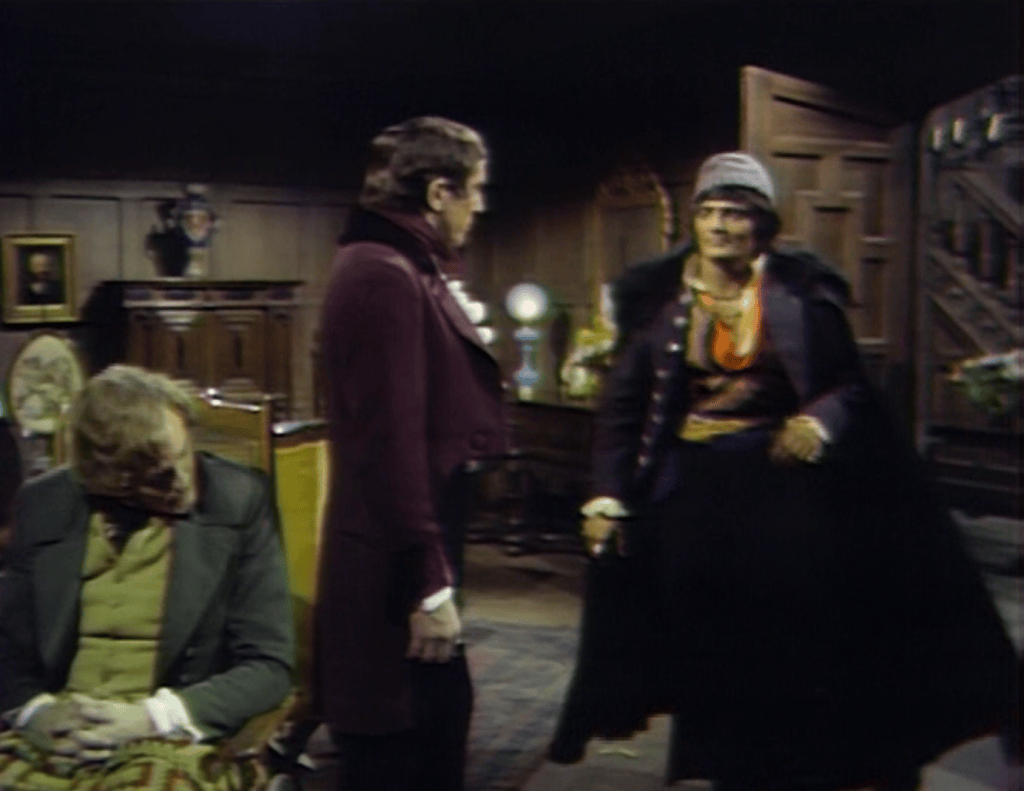
Meanwhile, we learn that Leticia knows a great deal about the headless body. It used to be attached to a severed head that Desmond brought back from Macau as a gift for Quentin. That separates Desmond from Carl, who brought Pansy back from Atlantic City to be his own bride. Leticia is now keeping the head in her own room, and is acting under its influence.
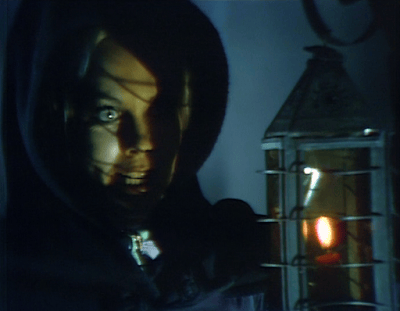
The head and body are those of warlock Judah Zachery, executed in 1692. The head has turned up occasionally in the years since, each time figuring in a series of brutal murders. Apparently the situation will get even worse if the head can be reattached to the body. This also harks back to Petofi, whose hand had been cut from his wrist in the 1790s and had carried on its own career of malignity in the years before Petofi stuck it back onto the end of his arm in 1897. Since Angelique joined forces with Barnabas and Julia to fight Petofi then, showing a new and extremely engaging side of her character, longtime viewers may hope that she and Laszlo will be part of an alliance with our protagonists against Judah Zachery in this period.
Laszlo’s name evokes the movie Casablanca, in which the most morally upright character is French Résistance leader Victor Laszlo while the most morally debased character is crime boss Signor Ferrari. We can imagine Jerry Lacy breaking his character as overbearing undertaker Lamar Trask, putting on his celebrated Humphrey Bogart imitation, and saying of Angelique that “Of all the temporal anomalies in all the multiverse, she had to walk into mine.”
The Petofi/ Aristide relationship was based on one memorialized in another Humphrey Bogart film, Gutman and Wilmer in The Maltese Falcon. As Sydney Greenstreet played Ferrari in Casablanca, so he played Gutman in The Maltese Falcon. It may have been a bit on-the-nose to cast portly gentleman Thayer David as an analogue of Greenstreet, a criticism which cannot be leveled at the choice of the svelte and dazzling Lara Parker. In another departure from the Petofi/ Aristide model, Laszlo is a member of the Romani or Sinti people, the ethnicities often slurred as “Gypsies.” Petofi was vulnerable to certain Romani, and was deathly afraid of all of them.
Aristide was a lot of fun. Stroka came back in 1970 as two characters very like Aristide, first in the original continuity as a hitman known only as Bruno, then in Parallel Time as failed composer Bruno Hess, a member of a little cult that had grown up around that universe’s version of Angelique. The two Brunos were so similar to each other and to Aristide that regular viewers might be disappointed to see Stroka working the old stand one more time.
The essence of Aristide and the Brunos was an insecurity that rode very close to the surface of the character. Each man sneers as he asserts himself against his victims or puffs himself up as he attempts to assert himself against his superiors, then dissolves immediately into frantic backpedaling when he encounters opposition. Stroka made as much as anyone could of those parts, and I had hoped to see him in a role where the insecurity lies deeper in the character’s personality. I wanted to see him as an authority figure whose pompous self-satisfaction can withstand a fair amount of battering and whose eventual defeats prompt a more complex response from him than Aristide/ Bruno’s hectic flailing.
The two characters we have seen who meet that description were Joshua Collins in the 1790s segment and Edward Collins in the 1897 segment, both played brilliantly by Louis Edmonds. In 1840, Edmonds plays Daniel, who is the legal owner of the Collins fortune but whose mental and physical infirmities keep him from exercising much authority. In #1074 and #1076, an ancestor called Abner Collins was associated with the events of 1840; I wish that Barnabas and Julia had found that Abner, rather than Quentin, was Daniel’s eldest son and was in charge of Collinwood and the businesses. Quentin would then be free to be the insouciant wastrel who was such a hit in 1897, rather than a retread of the foul-tempered sourpuss who was a consistent downer in Parallel Time.
As Abner, Stroka could have taken advantage of his striking facial resemblance to William F. Buckley, Junior, making clever-sounding but specious arguments in defense of the family’s most objectionable business practices, littering his speech with seldom-heard polysyllabic words and, when he makes what he believes to be a persuasive argument, leaning way back in his chair and fluttering his eyelids. Buckley was a prominent figure nationally and especially in NYC in 1970. He had been hosting a nationally syndicated television show ever since his unsuccessful bid for mayor of New York in 1965, and in 1970 his brother James would defeat the Democratic and Republican nominees to be elected to the US Senate from New York as the candidate of the Buckley family’s Conservative Party. A spoof of him would therefore be something that grownups in the audience would likely find amusing, and that the New York based makers of the show would surely have enjoyed creating.
In the early days of the show, the most prominent supernatural presences were the ghosts of The Widows, women who flung themselves to their deaths after their husbands were lost at sea due to the inhumane practices of the Collins whaling fleet. The story of The Widows came forward as the first explanation of the origin of the Collins family curse. The whaling industry in New England was approaching its zenith in 1840; it was in the following decades that it finally surpassed cod fishing in the region’s economy. It would close the loop on that early story to present Abner as the man who ensured that the Collinses would be enormously rich for a long time to come by switching the focus of the fleet from a mature market to a rapidly growing one, but who also ensured that they would be the object of undying wrath among many in Collinsport by switching from a decentralized business in which many men had a realistic chance of becoming independent operators to a capital-intensive one in which a handful of magnates control everyone else’s destiny. Abner could become callous to conditions on the whaling ships, because he would see the men as easily replaceable parts of a single machine, not as professionals who had to use their judgment to track down the fish and who might at any time strike out on their own as his colleagues or competitors.
The switch from cod fishing to whaling and its consequences for the life of the village would hark back not only to The Widows, but also to the business stories incorporated in the early storyline of “The Revenge of Burke Devlin.” The theme of those stories was that the Collinses had trapped the people of Collinsport in a situation where the only way for an ambitious young man to improve his lot in life was to leave town. If the 1840 story went on long enough, they might have been able to explore that theme in some depth. Not only would that have appealed to the taste for social and political relevance that was so much in the air in the early 1970s, but by depicting Collinsport as a place full of people who are involved in the story it would also relieve the claustrophobia that stems from the all-Collins episodes that come up so often in the later phases of the show.