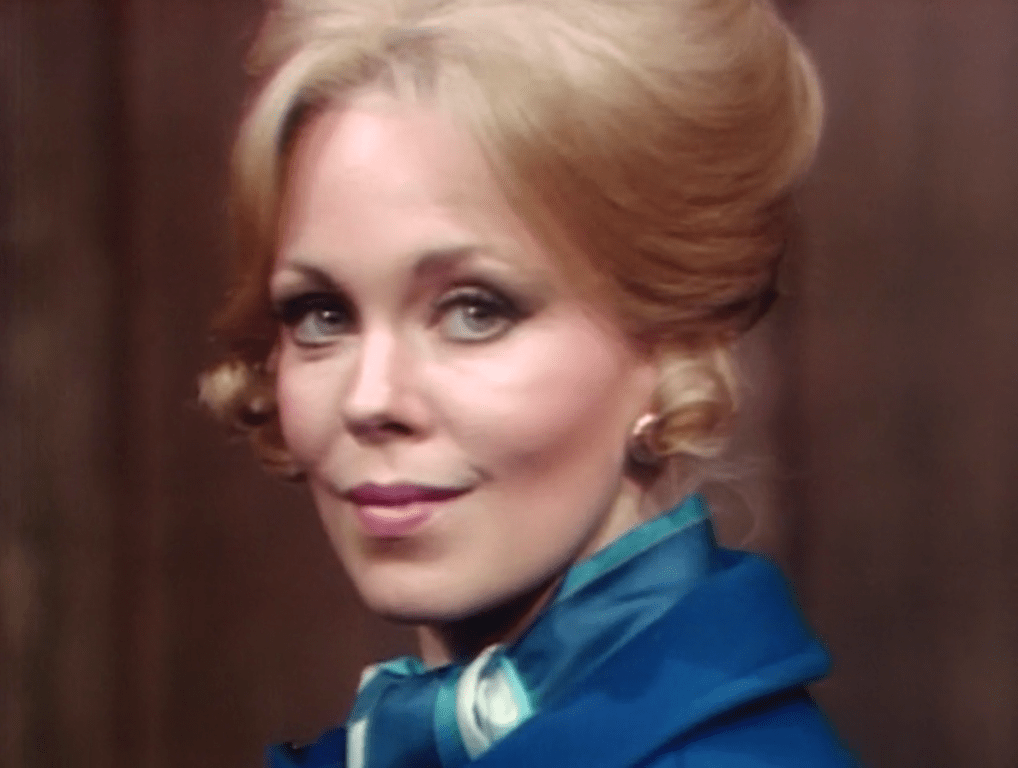
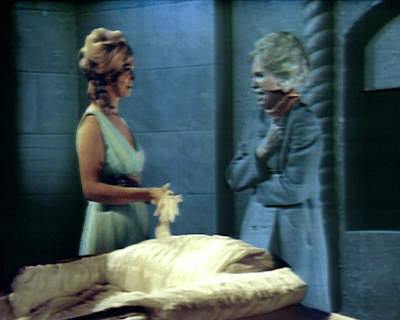
We open in the room atop the tower of the great house on the estate of Collinwood. Wicked witch Angelique, enemy of the mysterious Barnabas Collins, confronts Will Loomis, Barnabas’ henchman. She demands Will tell her Barnabas’ secret. Returning viewers know that Barnabas is a vampire, and Will is his blood thrall. When Will tells Angelique that he is incapable of betraying Barnabas, we know that he is making a literal statement of fact. But Angelique has power over Will, too. Caught between these opposing forces, Will does the only thing he can. He opens the window and flings himself to his death.
John Karlen plays Will, Lara Parker Angelique. In his post about this episode at his great Dark Shadows Every Day, Danny Horn observes that Karlen approached all of his parts as if he were in a play by Tennessee Williams. In a comment I left under that post, I said that while most of Karlen’s scene partners stuck with their own distinctive styles of acting while playing opposite him, resulting in surprisingly effective mashups of techniques that you wouldn’t think could coexist on any stage, Parker followed his volcanic lead in today’s first act. Will’s anguish and Angelique’s vehemence both go way over the top, but the result is far from hammy. Orson Welles famously said that hamminess is not overacting, it is false acting. There is nothing false between Will and Angelique today.
Just before Will jumped out the window, Julia Hoffman entered the room. Furious that Will has died without telling her what sort of creature Barnabas is, Angelique accuses Hoffman of startling him and ruining everything. Wondering if Will may have survived his fall, she orders Hoffman to accompany her to the foot of the tower. Hoffman kneels down and says that Will’s spinal cord snapped on impact resulting in instant death. Angelique says that she is intrigued by Hoffman’s diagnosis. “Have you a medical degree?”
Unknown to Angelique, the true answer would be yes. Angelique believes herself to be with Hoffman the housekeeper, her most fanatical devotee. In fact, the woman is Hoffman’s counterpart from an alternate universe, Dr Julia Hoffman, MD. Julia has followed her best friend Barnabas into this continuity and is assisting Barnabas in his battle against Angelique. Julia killed Hoffman and assumed her identity. Julia responds to Angelique’s puzzlement with a story about an incident when she saw a man fall from a roof and land in the same twisted position Will now holds. She remembered the words the doctor said when examining that man and merely repeated them when she saw Will’s distorted neck. Angelique compliments Julia on her extraordinary memory, and proceeds as if she were telling the truth. There seems little else she could do.
I remembered the line “Have you a medical degree?” from the first time Mrs Acilius and I watched Dark Shadows. Angelique has noticed that Julia is different from the Hoffman she knows, and has been showing signs of impatience with her. But she has not suspected she is a different person, only that she is going soft on her enemies. “Have you a medical degree?” makes it seem that might be changing. Julia may be in grave danger before long.
Barnabas rises from his coffin in the basement of Will’s house. He goes upstairs and finds Angelique waiting for him. She says she came, not to see him, but to console the widow Loomis. Thus Barnabas learns that Will has died.
Barnabas tells Angelique that he will avenge Will’s death upon her, but she tells him that he is the one to blame. It was because his power over Will matched hers that Will could respond to her commands only by killing himself.
Angelique’s counterpart in Barnabas’ own universe placed the curse that first made him a vampire. She was also wholly or partially responsible for the deaths of his mother, sister, aunt, uncle, fiancée, and many other people he cared about. So he reacts to the sight of this Angelique with barely controlled rage. For her part, she has no idea who he is, and does not know why he is hostile to her. She, therefore, is much cooler. The contrast is fascinating to watch, far more interesting than are the scenes between Barnabas and the other Angelique and one of the joys of the “Parallel Time” segment.
Julia and Barnabas are busy with a science project. They have learned that Angelique returned from the grave because her father, evil barfly Tim Stokes, somehow established a remote connection between her and a woman named Roxanne whom he keeps in the back room of his apartment. This connection, whatever it is, drains most of the “life force” from Roxanne into Angelique. This creates a delicate situation. If Roxanne dies, all of her “life force,” including that which animates Angelique, will vanish. But if she regains any of the force that has been taken from her, even enough to flutter her eyelids, Angelique will collapse and, unless Roxanne is brought back down to the prescribed level of debility, re-die.
When Julia and Barnabas first came upon Roxanne, they planned to kill her to finish Angelique off. Barnabas put the kibosh on that when he saw how pretty Roxanne was. Then they thought of destroying Angelique by reviving Roxanne, but, for reasons too silly to explain, they’ve decided they want to keep Angelique around. So now Barnabas has decreed that they will manipulate Roxanne’s condition to slow Angelique down. They have taken her from Stokes’ place and put her on a table in Will’s basement, somewhere away from the coffin. They have connected her to a lot of mad science equipment that is supposed to act on the “life force.” Longtime viewers know all about this equipment, because Julia had it in 1968 when she was building a Frankenstein’s monster as part of a project to cure Barnabas of vampirism.
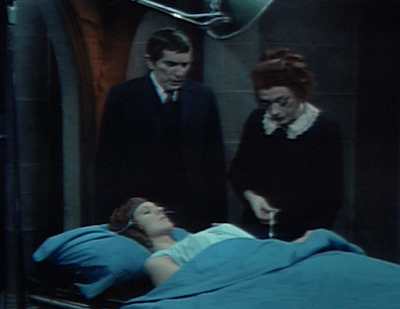
Julia runs the equipment. Roxanne’s condition does not change. Julia tells Barnabas that Angelique is expecting her back at the great house. In her absence, Barnabas takes Roxanne’s hand and stares at her. She opens her eyes and sits up. In the great house, Angelique weakens and collapses.
Many fans wonder where Julia could have got the “life force” equipment. In her own universe, she is a medical doctor and the head of a private hospital, so she could order anything she needed from a medical supply house. Here, her only identity is her imposture as Hoffman the housekeeper, who did not have a prescription pad.
I don’t see why people are so concerned with this. In 1968, the equipment originally belonged, not to Julia, but to another mad scientist, Dr Eric Lang. Barnabas and Julia simply stole it from Dr Lang’s house after he died. In this continuity, we haven’t heard about Dr Lang, but we hadn’t heard about him in the main continuity either until Barnabas fell into his clutches, at which point he already had all of his equipment. So we can presume Barnabas and Julia just found out when his counterpart would be out of the house and raided the place.
Will’s death marks his final appearance, but John Karlen will be back in a couple of months as Willie Loomis, the version of him we met in the main continuity. He will play other characters later, when the show will be set in other periods.
In November 1967, well-meaning governess Victoria Winters participated in a séance. She came unstuck in time and found herself in the year 1795. For the next four months, Dark Shadows was a costume drama set in the late eighteenth century. Viewers made the acquaintance of wicked witch Angelique and learned how old world gentleman Barnabas Collins first became a vampire.
Vicki herself learned nothing from her trip back in time. She spent the first part of it telling the actors about the parts they had played in the first 73 weeks of the show. After that incredibly stupid habit had burned away any goodwill the audience had for the character, Angelique framed Vicki for her own acts of sorcery. Vicki at first refused to take these charges seriously, an inexplicable response given both her knowledge of the period in which she found herself and her extensive experience with the supernatural in her own time, then kept looking for the most idiotic possible means of defending herself until she was sent to the gallows. In the nick of time, she was whisked back to the séance and to the 1960s, rope burns already visible on her neck. Vicki never regained the audience’s sympathy, and was written out later that year. Maggie Evans succeeded Vicki both as governess at Collinwood and as the perpetually imperiled heroine.
Now Barnabas has traveled in time, not backward, but sideways. He is in an alternate universe, which the show insists on calling “Parallel Time.” Here, Maggie’s counterpart is married to foul-tempered sourpuss Quentin Collins, the master of Collinwood. Angelique’s counterpart is Quentin’s late first wife, returned from the grave and scheming to get Maggie out of the way so that she can remarry her widower. Angelique casts a spell today that leads Quentin to confront Maggie and announce that he is certain that she is a witch.
The 1790s segment was in some ways one of the show’s greatest triumphs, but nothing about Vicki’s part in it was very good. So seeing this Angelique reenact the story that culminated in the witchcraft trial will bring a sinking feeling to longtime viewers. It doesn’t help that Maggie has made a number of inexplicably foolish decisions and quailed in the face of opposition she would seem to be able to overcome easily.
Moreover, Quentin is such a miserable husband to Maggie that we have no rooting interest in their marriage. He is being relatively nice to her at the beginning of the episode, because she was just abducted and imprisoned by a madman, and he feels vaguely guilty that he had jumped to the conclusion that she left voluntarily and berated everyone who suggested she might be in trouble. But even in those nice moments he maintains a paternalistic, condescending tone towards Maggie. When she wonders aloud what other crimes her abductor might have committed, he insists that there could not have been any others and becomes exasperated with her for raising the topic. That led my wife to yell at the screen “Quentin, you are the worst husband! There may be others who are also the worst, but you are the worst!”
When Quentin so quickly flips from acting like he is indulging the moods of his silly child-bride to accusing Maggie of witchcraft, he not only confirms Mrs Acilius’ assessment that he is “the worst.” Coming so shortly after the abduction story, he seems to be a man blaming his wife for being raped. Indeed, the man who abducted her had in #1022 and #1023 jumped her and sexually assaulted her in a dark alley, and she explained her decision to keep quiet about that attack by saying she was afraid Quentin would blame her. This is an important theme, but it would be a tricky one to explore on a show about witches and vampires and time travel and parallel universes where the median viewer is about ten years old.
Perhaps it would have been possible to have another take on the themes of the 1790s segment that would not have led us to this particular dead end. I think of a comment left in 2017 on Danny Horn’s great Dark Shadows Every Day:
You know, [Parallel Time] might have had a very different feel with the following changes:
Alexandra [Moltke Isles] takes the role of Quentin’s evil first wife, Victoria Stokes Collins. There is no nice twin. She dabbles in “the black arts” but is not a full-on witch. She and Quentin have a son, David.
Lara Parker takes the role of Quentin’s new wife, Angelique “Angela” Evans. She’s kind-hearted and traditional and a romantic. She has no witchcraft powers. But not quite the pushover as time goes on.
And Kathryn Leigh Scott plays Margaret “Maggie” Evans still, but she’s now Angela’s sister and Cyrus’ lab assistant. She’s a modern woman — middle class, educated, confident, reluctant in matter of love.
Maggie and Angela are different — Maggie is the more confident, assertive, cynical of the two — but they are close and both “good” girls. Maggie doesn’t like Quentin.
Lisa Richards is looking for other work.
So in this version, there was a seance two years ago but instead of a murder, Victoria just simply vanished when the lights went out. They never learned what happened. There is no portrait. No one mentions her by name.
When Barnabas enters parallel time, Quentin has just brought Angela home, with Roger and Hoffman treating her like crap.
After about two weeks of establishing all these new relationships, they recreate the seance.
The lights go out, and when they come back on, there’s Victoria in clothing from the late 1700s. She has no memory of what happened — and doesn’t really care. She wants her rightful place as mistress of Collinwood back. (Explanation for her vanishing and returning: Daddy Stokes playing with I-Ching wands. Victoria kills her father when she learns he did that).
Can you imagine the shock for the audience to have “Vicky” just show up like that? And in the same manner RT Vicky did. And then to be evil?
That really could have been fun.
Comment left 29 July 2017 by “William” on “Episode 1056: The Parallel Sky,” Danny Horn, Dark Shadows Every Day.
I like this idea very much. When she played Angelique’s identical twin Alexis, Lara Parker created a character who was not murderous, but far from a naif, and it is easy to imagine that a person like that would have stood up well enough to the kind of stresses that the wicked witch would bring against her to keep the drama going for some time. And it would be a nice inversion, not only to see the evil Vicki persecuting the innocent Angelique, but also to have his unresolved feelings for Vicki render the time traveler Barnabas as clueless in the evil Vicki’s proper world as the well-meaning Vicki was in Barnabas’ native time.
Moreover, these last two weeks the barrier between the universes has been getting leaky. So when the evil Vicki is finally thwarted here, she might escape into the original continuity and wreak havoc there. That would pick up on a road not taken in #872, when sorcerer Count Petofi escaped from the year 1897 and made his way to the Collinwood of the present day, only to be snatched back to the past after a few minutes.
I can’t wish that all of “William’s” dreams had come true. I like Lisa Blake Richards, so I’d want to leave her in the Jekyll and Hyde story and come up with another storyline to feature Kathryn Leigh Scott, either as Maggie or as another character. And it is a gift to viewers who have been with the show from the beginning that David Henesy’s character in Parallel Time is called Daniel Collins rather than David Collins, the name of his part in the other continuity, since the point was made in #153 and referenced later that David’s name was the result of events that wouldn’t have happened here. And while the séance gimmick is too good not to do, I would still like to see Mrs Isles play twins- the evil Victoria and her non-evil sister Veronica.*
*Mrs Acilius doesn’t like the name “Veronica” for this character. She’d rather call her Vanessa or Vivian.
Elizabeth Collins Stoddard is fretting about her brother Quentin’s childish behavior. Quentin’s wife, the former Maggie Evans, has left the house abruptly, without her purse, and has been away for some time. Liz is sure something bad has happened to Maggie, but Quentin refuses to look for her.
Liz tries to interest Alexis Stokes, identical twin sister of Quentin’s late first wife Angelique, in Quentin and Maggie’s troubles. She does not know that the person she is talking to is not Alexis at all, but Angelique herself. Angelique rose from the dead, murdered Alexis, and took Alexis’ place as a permanent houseguest in the great house of Collinwood as part of her plan to win Quentin back. To that end, Angelique is conspiring with a man she knows as John Yaeger. He has abducted Maggie and is holding her in a dungeon out in the country, hoping that after enough time alone with him she will forget all about Quentin and fall in love with him.
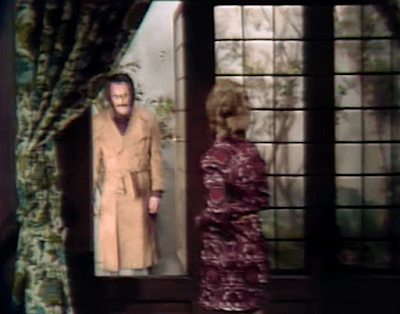
“Alexis” is pacing around the drawing room while Liz talks about Maggie and Quentin. She is half listening when she approaches a window and sees Yaeger waiting outside. She suddenly tells Liz that she is going to go out herself and look for Maggie. Liz tells her this is too dangerous, but she rushes out. She confers with Yaeger in the gazebo.* Yaeger is despairing of his plan, much to Angelique’s annoyance.
There is no such person as Yaeger, any more than there is a living Alexis Stokes. The man is really Cyrus Longworth in disguise. Maggie and Quentin think of Cyrus as a friend, a mild-mannered scientist who means well, though he is sometimes strangely naive. Cyrus has developed a potion which changes his appearance so drastically that not even those who know him best can recognize him when he is under its influence. After Cyrus tried to rape Maggie last week while disguised as Yaeger, he threw the potion away. But he then transformed spontaneously, without drinking it. Since he cannot re-Jekyllize himself without it, we are left wondering if he will remain in his Yaeger form permanently. We may also wonder what he will do if he reverts to his usual appearance in front of Maggie. He has admitted to himself that he and Yaeger are not separate people, but still seems to want to hold onto some sense that they are. He can’t very well do that if Maggie knows he is the one keeping her locked up.
Liz stays in the drawing room after “Alexis” leaves. Roger Collins enters and helps himself to some brandy. Liz picks up with her brother where she had left off with “Alexis.” Roger doesn’t even pretend to care about Maggie. He was fixated on Angelique when she was alive, and cannot forgive Maggie for not being her. He is glad Maggie is gone, and nothing Liz says about her can stir his interest. Joan Bennett and Louis Edmonds played different versions of these characters starting in #1, and it is always great to see them together.
Angelique has a problem of her own. She can stay out of the tomb only so long as she finds living bodies to drain of their warmth. She’s already killed three people that way. The first two were Alexis, whom she is successfully impersonating, and a handyman named Fred, who was expected to leave town anyway. Neither of them has been missed. The third, lawyer Larry Chase, caused puzzlement when his ice cold corpse was found in front of her, but as an isolated occurrence no one seems to have found a way to start solving that puzzle. So “Alexis” is not currently suspected of being a vampiric creature.
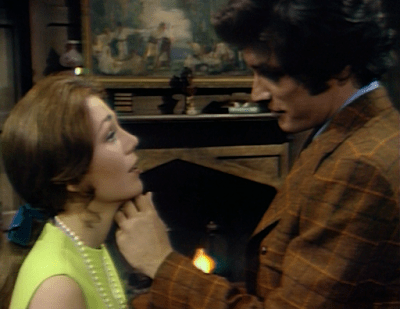
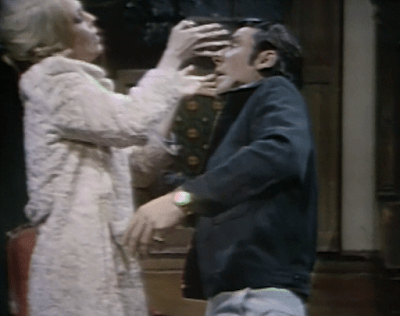
The need for warmth suddenly comes over Angelique. She goes to the drawing room and huddles in front of the fire. Roger sees her and remarks on how much she, “Alexis,” reminds him of Angelique. She says she doesn’t want to talk about her sister, then approaches Roger and embraces him. He says he feels terribly cold. She asks him to kiss her. That’s all it took to kill Fred and Larry, and a lot more contact than it took to kill Alexis. Roger is about to do it when Liz enters. They break their clinch and Angelique makes haste to go out. Roger is still feeling extreme cold, but he has no idea his sister just saved his life.
We see Angelique in the apartment of her (step?)father, Tim Stokes. She tells him she killed some stranger on her way over. By this time, his body will have been discovered, so cold that it will be assumed he had been dead for days. She tells Stokes that it was his occult prowess that enabled her to return from the dead, and asks if he can free her of her heat vampirism. He says that he cannot, and that he is so much the greatest expert in this sort of thing that there is no point in looking for anyone else who might be able to do so. She presses, and he mentions that someone else was involved in the process. She demands to see this person; he tells her the person is in the back room of the apartment. She eagerly goes to the door, unbothered by his pained refusal to accompany her.
Stokes’ apartment is laid out like the apartment of Professor Timothy Eliot Stokes, his counterpart in the parallel universe where Dark Shadows was set for its first 196 weeks. Two people had important connections with that other Stokes’ back room. One was Frankenstein’s monster Adam, who was last seen going in there. Adam’s creation was a means of freeing another vampire of his curse; longtime viewers may therefore wonder if we are about to meet his counterpart. The other was Paul Stoddard, ex-husband of Liz’ counterpart, who was attacked and killed in that room by a murderous shape-shifter who, like Cyrus Longworth/ John Yaeger, was played by Christopher Pennock. Perhaps whoever is waiting for Angelique in the room is somehow connected with Cyrus/ Yaeger.
There are other possibilities. Angelique’s counterpart in the other continuity was for a time subordinated to suave warlock Nicholas Blair. We have not seen a counterpart of Nicholas here; my wife, Mrs Acilius, thinks that we will meet another Nicholas tomorrow.
*Which she pronounces “ga-ZAY-bo,” a bit of Collinsport English Lara Parker introduced way back in #489. It’s fun to hear it again.
Maggie Evans is depressed about her marriage to drunken sourpuss Quentin Collins. In #1016, Maggie was getting ready to call a lawyer so she could put an end to their joyless union, but she changed her mind and decided to give it one more try. That has not worked out, and she has gone from contemplating divorce to attempting suicide. She is about to fling herself to her death from a window high in the great house of Collinwood when Quentin’s sister Elizabeth Collins Stoddard enters the room and talks her out of it. For its first 196 weeks, Dark Shadows was set in an alternate universe, which is in some ways a mirror image of this one. This incident is a case in point. In the original continuity, it was Liz’ counterpart whom people kept interrupting while she was trying to do away with herself,* so she takes the reversed position in this universe.
Most of the episode is devoted to the activities of a visitor from the main continuity, Barnabas Collins. The only thing Barnabas has a motivation to do is to try to get back home, but he seems to have decided he’d rather meddle in the problems the people in this alien universe are having. He suspects that the houseguest at Collinwood who is generally accepted as Alexis Stokes, identical twin sister of Quentin’s late first wife Angelique, is in fact Angelique herself risen from the dead. He also suspects that Maggie’s suicide attempt was the consequence of spells Angelique cast on her.
Barnabas is right about these things, but his grounds for believing them are thin. Angelique’s counterpart in his universe is a wicked witch who has long been the bane of his existence, and so he simply assumes that a woman with her face and voice will be the same. But for three weeks, Alexis really was staying at Collinwood, and Angelique really was in her tomb. Alexis looked and sounded exactly like Angelique. We saw that, while Alexis may not have been a one-dimensional innocent, she was not a witch and was not a direct threat to anyone’s life or liberty. Had Barnabas met Alexis before Angelique came back to life and murdered her, he would have had exactly the same suspicions about her that he has now about Angelique. It is purely a matter of luck that his suspicions coincide with the truth.
In the main continuity, Barnabas’ best friend and most frequent accomplice in his many crimes is mad scientist Julia Hoffman, MD. Julia’s counterpart here is the housekeeper at Collinwood. Miss Julia Hoffman is as devoted to Angelique as the original Julia is devoted to Barnabas. As the first Julia shows great reluctance when Barnabas is about to murder someone and shows even greater efficiency in getting rid of the bodies afterward, so this Julia protested yesterday that she would have nothing to do with Angelique’s plan to drive Maggie to her death, but was waiting outside the room when she was about to jump.
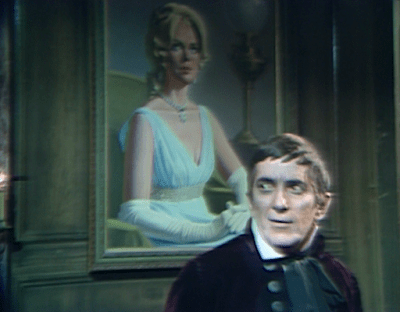
After confronting Julia and Angelique, needlessly revealing to them his suspicions, Barnabas decides to get some hard evidence. So he goes to Angelique’s old bedroom and stares really hard at the portrait of her that hangs there. She is in another part of the house, but grows agitated. She runs to the room and screams at him to stop staring into her eyes. He breaks into a triumphant… not grin, exactly, it’s more of a simper. It may be the only triumphant simper ever seen. That suits the occasion. He knows he was right, but Angelique knows that he knows, and it is not clear what he either can do to fight her or what reason he has to want to fight her.
Jonathan Frid’s invention of a facial expression previously thought to be impossible is one of several bits of conspicuously good acting in this episode. He also gets to deliver brief enigmatic responses to a number of questions, such as “Perhaps” and “Did I?,” and he makes each of those words materialize in space in such an arresting way that even his scene partners can’t help but show how impressed they are. As Liz fussing over Maggie, Joan Bennett shows a maternal quality that brings her hitherto undefined character into a very sharp focus. Grayson Hall also adds greatly to Hoffman’s depth. Standing by while Maggie is trying to kill herself, she is bland and detached. When she tells Angelique that it really is better for them that Maggie did not succeed, she is the opposite, torn between a number of emotions, including relief that she has avoided responsibility for a death.
Angelique has several comic lines, for example a wistful lament that she doesn’t get to see Maggie’s corpse mangled on the rocks below her window. And she puts real fervor into her spellcasting directed at Maggie. My wife, Mrs Acilius, remembered that when Lara Parker first joined the cast she wished she were playing an ingenue, so much so that Frid had to keep reminding her that she was the villain. But now she has settled in and become part of the group. So when Angelique abuses Maggie, Parker and her friend Kathryn Leigh Scott turn into two little girls playing make-believe, and they have so much fun at it that they are irresistible to watch, no matter how miserable Maggie is.
When Dark Shadows began in June 1966, its biggest draw was movie star Joan Bennett as reclusive matriarch Elizabeth Collins Stoddard. Liz was highly capable, and Bennett made her compelling to watch. When in #25 Liz’ brother, high-born ne’er-do-well Roger Collins, grudgingly complimented her on her “neat way of managing people,” we could see that he was putting it mildly. But the show didn’t handle Liz’ storyline very well, and she soon became a blocking figure. As the owner of the estate of Collinwood and of the Collins family businesses, as a central player in all the stories they had started with, and as the powerful personality Bennett had created, Liz was such an important part of the show that when she became a brake on the action, there was a constant danger that it would be impossible for anything to happen ever again.
The arrival of Roger’s estranged wife Laura Murdoch Collins in #123 marked Dark Shadows’ transformation into a supernatural thriller. By the time Laura went up in smoke in #191, her story had absorbed two of the four original narrative themes, “The Revenge of Burke Devlin” and well-meaning governess Vicki’s growing friendship with strange and troubled boy David, and had undercut whatever interest we might still have had in the other two, the mystery of Liz’ decision to become a recluse and Vicki’s quest to learn her true identity. The emerging Dark Shadows 2.0 had little room for Liz, and she subsided to the margins. When the show traveled back in time and became a costume drama from November 1967 to March 1968 and again from March to November 1969, Bennett played other characters and was able to make a substantial contribution, but Liz would never again be a suitable vessel for her great talents.
For the last eight weeks, the show has been in another time travel segment. Now it has traveled, not back in time, but sideways. They are in an alternate universe. The show insists on calling this universe “Parallel Time.” It is 1970 here, as it is in the original continuity, but a different 1970 where people with the names and faces we already know are living very different lives.
The Elizabeth Collins Stoddard of Parallel Time is not the mistress of Collinwood or an effective businesswoman. This Liz entrusted her inheritance to her brother Roger, who turned out to be just as feckless as his counterpart in the original continuity. As the penniless Roger we met in 1966 lives in Liz’ house as her guest and works in Liz’ business as her employee, so this Liz and Roger both live at Collinwood as the dependents of their brother, drunken sourpuss Quentin Collins.
In the original continuity, Quentin was not Liz and Roger’s brother, nor did he own anything. We got to know him when Dark Shadows was set in 1897, and he was a charming rogue, the younger brother of Judith and Edward Collins, who like Liz and Roger were played by Joan Bennett and Louis Edmonds. So the parallel lines representing the two versions of 1970 take a bit of a swerve into that other epoch.
Today, Liz is busy organizing a costume ball to be held in the great house of Collinwood. They had such a ball every year at this time when Quentin was married to his first wife, the late Angelique Stokes Collins, and Liz thinks that having another one would be the perfect occasion for Quentin to introduce all of his friends to his new wife, the former Maggie Evans. Liz needs help getting this party going. She comes bustling into the drawing room today and addresses herself to Angelique’s identical twin sister, Alexis Stokes, announcing that the party is tonight and 14 of the guests have failed to RSVP. She bemoans her inability to get anything organized and pleads with Alexis to help her. Alexis agrees to do so and excuses herself from a chess game she had been playing with Barnabas Collins, a man who recently showed up and introduced himself as a distant cousin of the Collinses of Collinwood.
Quentin enters the drawing room and orders Liz to cancel the ball. She says that it is too late to do that. Quentin stalks off and goes outside. Liz turns to Barnabas and asks him to reason with Quentin. Barnabas is unsure that he is the right person, but he goes to the door anyway. He opens it just in time to hear Quentin peeling away in his car. Maggie appears at the head of the stairs and asks if Quentin has gone. Barnabas has to say that he has, and Maggie looks crushed. Liz is unable to help in any way.
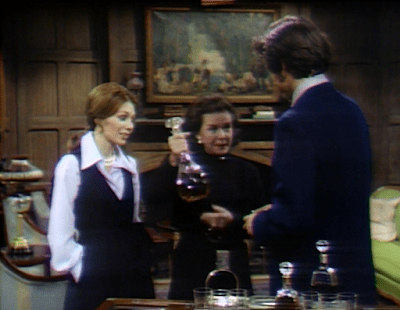
Later, Liz returns to the drawing room in the middle of a conversation between Quentin and Maggie. She is carrying an enormous decanter containing some sherry and congratulating herself on calming the cook’s nerves by her bartending. Quentin excuses himself to go get into his costume.
Liz finds that Maggie has not yet chosen a costume. She urges her to do so at once. Maggie says she supposed that Angelique always picked out her costume weeks in advance. Liz knows that Maggie is intimidated living in Angelique’s shadow, and does not know what to say in response to that remark. She quickly changes the subject. She brightens, and says that Alexis has brought many lovely dresses down from the attic. She urges Maggie to go to Alexis’ room and choose one of them.
As the time for the guests to arrive comes near, Liz and Barnabas meet in the foyer. A portrait of the Barnabas Collins who died in 1830 hangs on the spot on the wall next to the front door where earlier this week we had seen a metal doodad that looks like a coat of arms. Barnabas is wearing the same outfit, and looks just like the man in the portrait. Liz is wearing a dress of the same vintage. She is overjoyed, and tells Barnabas that the period suits him. He thanks her, and returns the compliment. Quentin is wearing a blue federal coat; Liz and Barnabas tell him that he, too, is suited to the early 1800s. Alexis comes downstairs in a blue dress, and she receives the same commendation. Lastly Maggie makes her appearance. When Quentin sees her dress, he becomes very tense. He tells her to take it off, orders her never to wear it again, and smashes his glass on the floor. The camera pans from Barnabas’shocked expression to a flickering look of pleasure on Alexis’ face; Liz stands between them, and unfortunately we only see the top of her head.
What Liz does not know is that the person she thinks is Alexis is in fact Angelique risen from the grave. Angelique murdered Alexis, took her place, and is conspiring with housekeeper Julia Hoffman to drive Maggie and Quentin apart. The story is a souped-up version of Daphne Du Maurier’s Rebecca, in which the dead first wife is not only a memory that triggers anxiety in her successor but a supernatural being who rises from the dead to torment her directly. There is a scene with Maggie looking out the window of the drawing room that is an exact recreation of a shot in Alfred Hitchcock’s 1940 film of Rebecca, and when Angelique and Hoffman trick Maggie into wearing the same dress Angelique wore to last year’s ball, prompting Quentin’s outburst, most grownups in the original audience would remember the same thing happening to the second Mrs de Winter in that film.
Angelique is the villain, and Maggie is the heroine. Still, we rather like Angelique. The sister-murdering is bad, of course, but Quentin is such a lousy husband that she is doing Maggie a big favor by trying to bring their intolerable marriage to its end as soon as possible. For example, today Quentin finds Maggie reading his old love letters to Angelique. He might justifiably have objected that those are private and say he wished she’d asked before reading them, but he doesn’t do that or anything else one adult would do when disappointed in another. Instead, he flies into a rage, accuses her of a variety of things she hasn’t done, and orders her to, and I quote, “Go to your room!”
Later, in the room they share, Quentin is still scolding Maggie for failing to admit that she was lying about how she found the letters. We know she had in fact told the truth. When she tells him so, he dismisses her with a shake of the head. When she brings up the fact that it is the anniversary of his wedding to Angelique, he shouts that she is forbidden to discuss the subject, then storms out and slams the door. This is when he goes downstairs, tells Liz to cancel the party, and drives away. We have never seen Maggie have a happy day with Quentin. He sometimes manages to be pleasant in the intervals between his tantrums, but even then he can’t let go of his habit of talking to Maggie as if she were a child and he were her somewhat weary guardian. If Angelique can hasten their final split, Maggie will owe her an enormous debt of gratitude.
Barnabas is not in fact a descendant of the man whose portrait now hangs in the foyer. He is a visitor from the main continuity. Angelique’s counterpart there is his great enemy, so it is fun to see him talking with this Angelique and playing chess with her.
David Selby has a problem with one of his lines, when Quentin winds up saying “I wonder where I got the illusion that an hour or two alone would settle one’s all of problems.” This is a fairly minor stumble by Dark Shadows standards, but it comes when Angelique is in closeup and Lara Parker’s left eyelid twitches when she hears “one’s all of problems.” That reaction is worth a laugh.
The opening voiceover tells us that vampire Barnabas Collins is about to “find an innocent victim, who will not only add to his grief and guilt, but also to his immediate peril.” Innocent victims can be so inconsiderate that way.
Barnabas has taken barmaid Buffie Harrington back to her apartment. She asks if she can give him a drink. He moves closer, and she takes him in her arms. He takes a drink, all right. She screams and collapses. As she hits the floor, Cyrus Longworth, MD, lets himself into the room and makes eye contact with Barnabas.
Barnabas claims that he ran into the room when he heard Buffie’s scream, which is not one of his more convincing lies. Cyrus insists on examining Buffie. In the nick of time, Buffie wakes up. She agrees with Barnabas that she is fine. Barnabas offers to stay with her. Cyrus does the same, to which Barnabas replies that he must have some business to attend to if he is in this part of town so late at night. Cyrus can’t deny that, and leaves.
Barnabas gives his new blood thrall some quick instructions, including strict orders to stay away from Cyrus. The next evening, Cyrus drops by Buffie’s place again, and she is as cold and unfriendly as Barnabas could have wished. As Cyrus is going, Buffie asks if he has heard from his friend John Yaeger lately. He says he hasn’t, but that she will be the first to know if he does. He leaves.
Barnabas materializes. Buffie is surprised that he was eavesdropping. Now that he knows Cyrus is close to Yaeger, he rescinds his order for her to avoid him. He says that Yaeger knows where his coffin is, and he wants to know everything he can about Yaeger for his own protection.
The next evening, Cyrus is back at Buffie’s. He is surprised she invited him. She says she hadn’t meant to be so rude the evening before. She asks about Yaeger, explaining that she has some things of his and is keen to get them back to him as soon as possible. Cyrus says only that he is sure Yaeger will be back soon. He leaves, and Buffie asks herself why Cyrus is protecting Yaeger.
Returning viewers know what Buffie and Barnabas do not. Yaeger does not exist. Cyrus has developed a potion which alters his appearance so drastically that even those closest to him do not recognize him when he is under its influence. Thus disguised, he calls himself “John Yaeger” and indulges his sadistic impulses. With this episode, the show sets Barnabas and Cyrus on a collision course. Dr Jekyll and Mr Hyde meet Dracula, here we come.
In the great house of Collinwood, another bizarre imposture is underway. Angelique Stokes Collins, the late wife of Quentin Collins, has returned from the dead, murdered her identical twin sister Alexis, and taken Alexis’ place as a houseguest. Her goal is to alienate Quentin from his new wife, the former Maggie Evans, and return to her previous place as mistress of Collinwood.
“Alexis” has been telling everyone that Angelique was murdered, which she in fact believes herself to have been. Since the coroner’s report ruled Angelique’s death the result of a stroke, Quentin does not take this idea seriously. “Alexis” has managed to persuade Maggie to do so, however, and when first we see them they are having a testy exchange over the question.
“Alexis” is happy to overhear this conversation. When the drawing room doors open, she presents Maggie with a bunch of flowers she has picked from the gardens on the grounds of the estate. Since the estate belongs to Maggie and Quentin, this is rather a childish gesture, but it pleases Maggie. “Alexis” goes to fetch a vase.
Cyrus shows up. Maggie goes upstairs while Cyrus and Quentin go to the drawing room. The men talk about Larry Chase, an attorney who represented both of them. Larry died in the foyer at Collinwood yesterday. At that time Quentin and Maggie were out together, so Larry was alone with “Alexis.” Cyrus says that Larry somehow froze to death in the foyer.
Angelique is alone with the flowers. She casts a spell causing them to shrivel and die. She then turns to the camera, looks directly at the audience, and gives her best “Ain’t I a stinker?” look.
In #346, Barnabas touched a bouquet of flowers, causing them to shrivel and die. That embarrassed Barnabas, as if he had lost control of his gastrointestinal system for a moment. It also alarmed well-meaning governess Vicki, but she never mentioned it again, and it certainly didn’t tip her off that Barnabas was a vampire. This incident shocks and befuddles Quentin and Maggie, but when he brings it up in their bedroom later she has already forgotten all about it and he agrees it wasn’t very important.
Even if it had made as big an impression as Angelique was hoping it would, destroying the flowers would probably not have advanced her goal of making Quentin suspect that Maggie is a supernatural force of darkness. He does notice the similarity to what happened to Larry, but since Angelique was with Larry when he died and Quentin and Maggie were together somewhere else, and since Angelique was in contact with the flowers for far longer than Maggie was, any suspicion it would raise would most logically be directed at herself.
“Alexis” has more success persuading Maggie to suspect Quentin of the murder of Angelique. Maggie has a dream about the séance at which Angelique died. It ends with Quentin choking Angelique. She wakes up screaming that he shouldn’t have murdered his wife.
In fact, Quentin did choke Angelique at the séance, but Angelique has discounted that as a possible cause of her death. She thinks that someone else drove a pin into her head while Quentin was busy strangling her. How the autopsy missed that, she hasn’t told us.
Last week the show credited its videotape editors for the first time, the team of Danny Rosenson and Robert Steinback. Today is the first credit for another pair of videotape editors, Chuck Gardner and Indra Sadoo.
The music under the closing credits sounds quite different than it has the last couple of years. We were wondering if it was an old tape, and then, about halfway through, came the voice that used to end every episode- ABC staff man Bob Lloyd intoning “Dark Shadows… is a Dan Curtis Production.” I was delighted to hear him again, if only on an old recording used by mistake.
Angelique Stokes Collins has risen from the dead, but her renewed existence may end within seconds. She is overwhelmingly cold, and can warm up only by draining the heat from the body of a living person. Someone is coming in the front door, just in time to be her victim and die in her stead. She wonders who it will be.
Almost all the characters currently on Dark Shadows are either so important to an ongoing story that their deaths would end a major arc or have so many connections to everyone else that their deaths would start a new one. So if she kills mad scientist Cyrus Longworth, his fiancée Sabrina Stuart, or barmaid Buffie Harrington, Angelique will be ending the Jekyll and Hyde story, or at least shifting it into a radically new phase. If she kills drunken sourpuss Quentin Collins, his wife Maggie Evans Collins, or housekeeper Julia Hoffman, she will be ending the adaptation of Rebecca. If she kills Carolyn Loomis or her husband Will, she will be ending the restaging of Who’s Afraid of Virginia Woolf?
If Angelique kills woebegone homebody Elizabeth Collins Stoddard or her brother, sardonic dandy Roger Collins, she won’t be ending any ongoing stories. But Liz and Roger are the counterparts of characters who were central to the life of the great house of Collinwood in the first 196 weeks of Dark Shadows, when it was set in another universe, and are played by actors who have substantial followings. If either of them is murdered, the audience will expect major consequences. Angelique’s son Daniel Collins and Daniel’s cousin Amy Collins aren’t doing much just now, but if Angelique kills a child, especially her own son, the ABC network’s office of Standards and Practices would join the audience in insisting she face a serious reckoning that would take up a lot of screen time. This fit of heat vampirism came on Angelique too suddenly to make sense as the start of a new arc, so we can rule all of those candidates out.
There are also a couple of characters who were introduced to fill in for actors who were away the previous couple of months filming their parts in the theatrical feature House of Dark Shadows. Among those are Angelique’s Aunt Hannah and butler Mr Trask. They are possibilities, but are both played by actors who have enough going for them that it would be a bit surprising to bring them back just to kill them off. There are also a few miscellaneous day players whose characters would have no reason to let themselves into the great house of Collinwood- a bartender we saw in #991, a landlady we saw in #997, etc.
So it would seem that there are only two people who could be Angelique’s next meal. One is sleazy musician Bruno Hess, a former boyfriend of hers who lives in the cottage on the grounds of Collinwood and is friends with Cyrus, but who has been neither seen nor missed for some time. The other is Larry Chase, attorney at law.
Bruno is played by the dynamic Michael Stroka, who twice made a mark when cast in stories set in the other universe. Larry was written into the show as a last-minute substitute for a part played by an actor whose health problems made it impossible for him to continue. They didn’t have time for auditions, so they drafted associate director Ken McEwen for the part. McEwen was in the building, and he had a guild card because of some small parts he’d taken in TV shows he’d worked on in the 1950s. When he has enough time to rehearse, which is to say when he has had more time to rehearse than actors usually got on a show like Dark Shadows, McEwen gets his lines right, except for adding “Well…” at the beginning of every single one. You can tell he is making a sincere effort not to ruin the show. But that’s about all you can say for him. Even at his best he’s stiff and distracted, and when he hasn’t been able to get his part down, he disintegrates completely. So it isn’t much of a surprise that Larry is the one who opens the door. It wasn’t a surprise to me, I should say; writing these posts keeps all the details fresh in my mind. My wife, Mrs Acilius, looked at him for about thirty seconds and asked “Who’s that?”
Larry plays the same scene with Angelique that her second victim, Fred the transient handyman, had played with her in #1003, right down to telling her that he had wanted to hold her since he first saw her. Fred was played by Edmond Hashim, and anyone who sees the two versions of this scene side by side will come away with a new appreciation for Hashim’s talents as an actor. This is McEwen’s final on-screen appearance, though he will pinch hit as the opening narrator in three upcoming episodes. He will continue as an associate director through episode 1179/1180 in December.
Will enters to find Angelique screaming and Larry dead. Angelique, who is impersonating her late identical twin sister Alexis, claims that Larry was just standing there when he had an attack of some kind and dropped dead. Will touches the corpse and says that he is so cold he must have been dead for hours. “Alexis” insists he just died a moment before. Will calls Cyrus, who is the Collins family physician.
Cyrus is in his lab, looking at the potion which turns him into the Mr Hyde-like John Yaeger. He is about to capitulate to his craving when the telephone rings. Will tells him that Larry is dead and asks him to come to Collinwood. Cyrus puts the potion back in his safe and rejoices that he is “Saved!” Larry was Cyrus’ lawyer and apparently a social friend as well. We’ve already seen Cyrus do enough horrible things that this sociopathic reaction is no shock.
Back at Collinwood, Will and “Alexis” are talking with Barnabas Collins. Unknown to “Alexis,” Barnabas is a visitor from the other universe. Her counterpart in his world was the wicked witch who turned him into a vampire, so Barnabas cannot keep a hostile edge out of his voice and manner when he is talking to her. Will is one of Barnabas’ victims, and knows all of his secrets.
When they are alone in the drawing room, “Alexis” questions Will about Barnabas. Will denies knowing him particularly well. Barnabas is staying at Will’s house, and several years ago Will wrote a biography of Barnabas’ counterpart in this universe, a man who lived a quiet life and died a natural death in 1830. Barnabas claims to be a descendant of that Barnabas Collins, and to have come to Collinwood to meet the author of the biography. Will becomes more and more disturbed as “Alexis” presses him harder and harder for information. She is perplexed that he won’t tell her anything. Lara Parker and John Karlen have both been on the show for a long time, but this is the first substantial two scene between them, and it is terrific. Their acting styles were very different, but they couldn’t have meshed better.
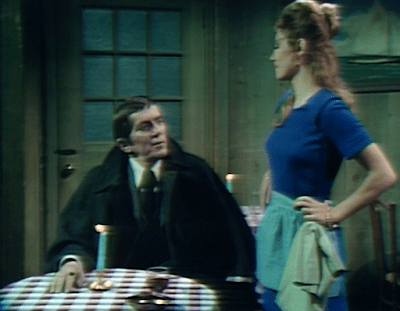
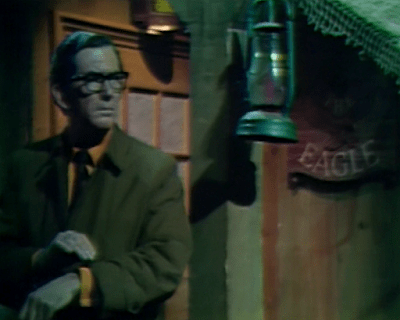
Barnabas is sitting at a table in the Eagle tavern. There is a glass of reddish liquid in front of him. In view of his condition, one wonders what that liquid might be.
Barnabas invites Buffie to sit with him. Since there are no other customers, she agrees. He tells her he is from South America. The son of this universe’s Barnabas Collins whom he claims as his great-grandfather went to Peru; when he introduced himself to the family, he said that his forebear did not die in that country. But evidently his imaginary descendants stayed on the continent, somewhere.
The Eagle is the counterpart of the Blue Whale in the other continuity. In #3, Burke Devlin was sitting at a table in the Blue Whale with hard-working young fisherman Joe Haskell when he said that his success in life began when a strange man picked him up in a bar in Montevideo. That was the show’s only reference to Uruguay, but Burke, the Blue Whale, and Brazil came to be strongly associated with each other. The song “Aquarela do Brasil,” a big hit in the English speaking world in the 1960s under the title “Brazil,” played on the jukebox at the Blue Whale, and it became Burke’s theme song. Ultimately Burke would die on a business trip to Brazil. Barnabas and Burke were enemies; when he sits at this table and claims to have a South American background, longtime viewers may wonder if he is thinking that the new universe is a place where he can try out a new personality and maybe he will start by imitating Burke’s.
Burke was a dashing action hero, attractive to women. Barnabas’ attempt to imitate him breaks down almost immediately. He winds up mimicking another prominent bachelor from his native universe, Professor Timothy Eliot Stokes, when he asks Buffie if she’s ever heard of the theory of “Parallel Time.”
Buffie shakes her head no. Barnabas says that some people believe that there are many universes, and that a copy of each of us can be found in each of them. They may look the same, but they lead different lives because they have made different choices. Buffie laughs and says that she hopes her other selves are having more fun than she is. She hastens to say that she doesn’t mean she isn’t having fun at the moment, sharing a table with Barnabas; she means that her life in Collinsport, as viewed from the most all-encompassing perspective and analyzed in the most thorough philosophic manner, well and truly sucks shit. Barnabas says that the other Buffies in the multiverse might have left Collinsport* and had wonderful adventures.
Longtime viewers saw one of those other Buffies in #951, when we were still in the original continuity. She had a different name; she went by Nelle Gunston. And as befits a mirror universe, she moved in the opposite direction. Rather than leaving Collinsport to look for something new as Buffie wishes she had done, Nelle left her parents’ home in Virginia and went to Collinsport because she had joined a cult dedicated to the destruction of the human race and its replacement by a loathsome breed of Elder Gods known as the Leviathan People. Barnabas had been the leader of the Leviathan cult, and when Nelle came to town she sat with him by the same table where Buffie and Barnabas sit today. They even take the same seats.
Buffie is charmed by Barnabas’ talk; between the suavity that Jonathan Frid brings to his part today and the energy with which Elizabeth Eis presents Buffie’s enthusiasm for him, it is far easier than it usually is to believe that Barnabas is a sexy dude. Maybe we are supposed to think that role-playing as Burke has enabled him to loosen up.
The conversation is really warming up when the bell attached to the front door rings. “Customer,” Buffie ruefully says to Barnabas as she rises. It is Cyrus.
Barnabas invites Cyrus to sit with them. He declines, saying that he came only to ask Buffie if she had seen John Yaeger lately. She tenses up. Yaeger used to beat her up and force her to help him with his crimes. She says that Cyrus himself had told Buffie that Yaeger wouldn’t be back in Collinsport. Cyrus says that he did, but that he is worried he might not be able to predict Yaeger’s movements as well as he thought he could. He offers Barnabas a lift back to Collinwood. That’s a bit surprising, since Cyrus got uptight when he saw Barnabas. As Yaeger, Cyrus discovered that there is a coffin in the basement of Will and Carolyn’s house, and he suspects that Barnabas spends his days there. But longtime viewers can remember the days Barnabas and Burke had conversations at the Blue Whale that were just as tense as the one he and Cyrus have in the Eagle, and Burke never failed to observe the small graces. It’s just the done thing, I suppose.
Cyrus leaves, and Buffie remains standing. She and Barnabas keep talking. He gets close, and goes in for a bite. He stops himself at the last second, to her surprise and disappointment. She was apparently ready for a kiss on the neck. He says he has to go. She is even more disappointed by that, but he promises to come back at closing. He asks to walk her home, and she happily agrees.
Will and Cyrus are in the drawing room at Collinwood. Will urges Cyrus to join him in a drink. When Cyrus declines, Will reminisces about the old days at Collinwood, when the party would just be getting started at this hour. In those days, people would leave the great house in the small hours of the morning and continue their revels at the Eagle. Cyrus says he won’t find much company there tonight. When he says that the only people in the place earlier were “the girl who works there” and Barnabas, Will looks alarmed. All of his mannerisms that suggest drunkenness drop away, and he rushes out.
Will gets to the tavern, and finds Buffie alone. The alcoholic author is obviously one of her favorite and most lucrative customers, so even though she has already blown out the candles she tells him he is in time for last call. To her amazement, he is not interested in a drink. He asks her where Barnabas is. She says he’ll be back and that he is taking her home. He says no, and she asks what’s wrong. Before he can answer, Will hears Barnabas’ voice behind him, echoing Buffie’s question. Laboring under the vampire’s power, Will has no choice but to leave Buffie alone with Barnabas.
Nelle, too, had agreed left the tavern with Barnabas. She expected to meet the leader of the Leviathans at his place, and was unhappy to find that the two of them were alone. Buffie is again an inverted mirror image of her counterpart. She takes Barnabas to her place, and is quite happy to be alone with him. The two close in for an embrace. He bites her neck, and she collapses. He had bitten Nelle, too. At that moment, Cyrus enters the room.
Cyrus does not exactly have a counterpart in the other continuity, but Christopher Pennock did play the Leviathan leader whom Nelle expected to meet. Like Cyrus, that character was a murderous shape-shifter. So Cyrus’ unexpected arrival mirrors the Leviathan leader’s unexpected absence.
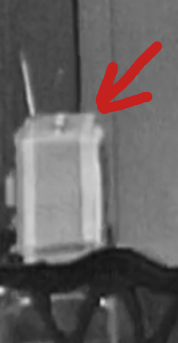
When we first cut to Buffie’s room, the camera lingers for several seconds on an extremely unusual prop. It is a television set. The only other time we have seen a television set on Dark Shadows was in #27, in the other universe, when Burke visited investigator Stuart Bronson in a hotel room in Bangor, Maine where there was a small portable unit. It looks like it might be the same set.
Bronson’s TVBuffie’s TV
The shot goes on so long, and the set is such an odd thing to see in the context of the show, that they must be making some kind of point with it. We have wondered why Buffie submitted to Yaeger’s abuse, when she is such a strong and intelligent person. Her reflection in Nelle suggests a partial answer. Nelle was drawn to the Leviathans, who offered to destroy her and all other humans. We can assume that Buffie, too, was following a self-destructive urge when she went along with Yaeger. Associated with her, the television is a symbol of the annihilation of the self. Turn the idiot box on, turn your mind off. If you aren’t careful, you may even wind up spending your weekdays staring glassy-eyed at ABC’s daytime lineup.
*He actually says “Collinwood.” Which is a blooper, but since Buffie mentioned in her first episode that she used to work at Collinwood it is kind of an interesting one. Maybe when another Buffie left her position as an upstairs maid or whatever she was, she got further than the nearest tavern.
The name “Barnabas Collins” has been coming up in the oddest circumstances around the estate of Collinwood. The only person of that name known to drunken sourpuss Quentin Collins, the master of the great house, was an ancestor of his who lived a long dull life and died a natural death in 1830. Quentin has decided that it is time to ask Barnabas’ spirit what’s going on. He wants housekeeper Julia Hoffman to join him and his late wife Angelique’s identical twin sister, Alexis Stokes, in a séance.
Hoffman is reluctant to participate, and when the invocation prompts theremin music to start playing in the background she breaks the circle of fingers and runs out of the drawing room. But Hoffman is not the most problematic participant. Alexis is not in fact present. Angelique returned from the dead, murdered her, and took her place. Unknown to Hoffman or to Quentin, it is the undead Angelique who is at the table with them.
“Alexis” tells Quentin that she felt a presence before Hoffman broke the circle, but that it is gone now. Suddenly a figure appears in the corner of the room. He identifies himself as the ghost of Joshua Collins, father of Barnabas. Joshua addresses his remarks to Quentin, ignoring “Alexis.” He says that Quentin knows all he needs to know about his son Barnabas, but that there is another entity at Collinwood, an evil that is at once living and dead. “Alexis” looks shocked and says “Living and dead? How can that be possible?” I suppose we should praise Lara Parker for resisting the temptation to pad her part by visibly squirming and playing up the fact that this describes her character precisely. She is giving the audience credit for the brains needed to make that connection. But if I wanted a show that gave me credit for brains, I wouldn’t watch Dark Shadows every evening, so I’m disappointed. I wish she were tugging on her collar and fidgeting like a Hank Azaria character on The Simpsons.
Joshua can’t be any more specific. This might have been OK had he just flickered into view for a few seconds, uttered his vague warning, and flickered out. We would then be left thinking of the awe-inspiring improbability of even the most fleeting communication between the living and the dead. But as Joshua, Louis Edmonds stands there for several minutes, in the same light as the other actors. They’ve had trouble with one of the microphones lately, occasionally making one actor sound like they are far away from the person standing next to them, but that microphone isn’t used in this scene. Both the audio and the video make it clear Joshua is occupying the same space as Quentin and “Alexis.” The result is an embarrassment for which writer Gordon Russell and director Henry Kaplan must share the blame.
This embarrassment is particularly disappointing under the circumstances. The scene is Edmonds’ first appearance since going off to play his part in the feature House of Dark Shadows after #990, and the first appearance of this Joshua Collins. Edmonds played another version of Joshua from November 1967 to March 1968, when Dark Shadows was set in a different universe. That Joshua figured in a costume drama segment set in the 1790s. He emerged as the central figure in a tragedy in the course of which his son Barnabas became a vampire and he had to decide what to do about him.
This Joshua never dealt with such a curse. The audience knows, if only because the opening voiceover told us, that the vampire Barnabas has crossed over into this universe, into this year 1970, and that he is at present trapped in a chained coffin in the basement of the home where the Joshua we meet today raised that other, luckier Barnabas. We last saw the other Joshua in #623, and longtime viewers will be excited at the idea of seeing Edmonds reprise the character who was perhaps his greatest triumph. To see him in such a debacle lets us down hard.
After Joshua leaves, Quentin and “Alexis” talk for a moment. Then Quentin’s brother Roger enters. Roger is also played by Louis Edmonds, but neither Quentin nor “Alexis” notices that he looks like Joshua. This works well enough, since Edmonds takes a very different posture and tone as Roger than he had as Joshua. Joshua was erect and stentorian, Roger curls to his left as he sits on the couch and purrs about how tedious it is to read about the life of the late Barnabas.
Quentin exits, and Roger talks with “Alexis.” He says that despite her resemblance to her sister, he never for a moment thought she was Angelique. In fact, when he first met the real Alexis he was utterly shocked, certain she was Angelique, and she had to work hard to bring him around. But Angelique doesn’t know about that, and Roger doesn’t want to remember it, so she just looks at him placidly while he goes on and on about how unlike anyone else Angelique was and how he knew her more intimately than anyone else could, even though she was married to Quentin.
I suppose Russell may have been trying to make a point by juxtaposing Joshua’s long pointless speech in which he keeps referring to Quentin’s responsibilities as the master of Collinwood with Roger’s long pointless speech in which he keeps referring to his mystical connection with his brother’s late wife. We saw in the 1790s segment that the Joshua of the other continuity was the victim of his own virtues. A forceful, dynamic man devoted to his family and its honor, he became a tyrant in pursuit of his worthy goals, and saw everyone he loved destroyed in part because of his haughtiness. As generation followed generation, Joshua’s misguided strength and brittle courage would yield to ever weaker, ever-softer descendants. Perhaps in the contrast between this Joshua’s attempt to help his successor use the authority he once held when he cannot impart any useful information and Roger’s fatuous pretense to have known Angelique uniquely well when he cannot recognize that he is talking to her we can see the same decline in this iteration of the Collins family.
The Legal Eagle
Meanwhile, mad scientist Cyrus Longworth has a problem of his own. Cyrus has developed a potion which, when he drinks it, transforms his appearance so drastically that even those closest to him cannot recognize him. When thus disguised, he calls himself “John Yaeger,” spends a lot of money, and beats people up. This makes him very happy, but now chemist Horace Gladstone, his connection for one of the potion’s vital ingredients, has learned his secret. Gladstone will not supply him with more of the ingredient or keep his mouth shut about Cyrus’ crimes unless he gets $10,000 in cash.
Cyrus’ lawyer, Larry Chase, comes to his laboratory. On Cyrus’ instructions, Larry has drawn up a will naming “Yaeger” as the sole beneficiary of Cyrus’ estate. Larry has met “Yaeger” and been appalled by him. He urges Cyrus to reconsider. Cyrus signs the papers and invites Larry to a late supper. Larry declines, saying that Horace Gladstone called him earlier and wants to meet him outside the Eagle tavern at 10 PM.
Larry was in the drawing room at Collinwood going over some papers with Quentin when he got Gladstone’s call. Cyrus’ newly drafted will fell out of Larry’s briefcase, and Quentin read through it while Larry was looking for another document. Quentin asked some questions about the will. Larry responded to the first by saying that he couldn’t talk about it, but thereafter blabbed away, revealing everything Quentin could want to know. With that level of regard for a client’s confidential communications, we aren’t surprised when Larry tells Cyrus who he is going to meet at what time in what place.
After Larry goes, Cyrus takes the potion, that is, puts on his disguise. He goes to the alley next to the Eagle, in which the sign for the Greenfield Inn hangs. He corners Gladstone there. He beats Gladstone to the pavement with his heavy cane. Gladstone begs for mercy, and Cyrus sneers at him. He releases the bayonet from inside the cane, stabbing Gladstone with it. The first time Cyrus took the potion, he had amnesia after he resumed his normal appearance, and we could believe that he was less than fully responsible for what he did while under its influence. But he has had his full memories on each subsequent occasion, and has shown pleasure when told of the harm “Yaeger” has done and the fear he inspires. By this point, we can classify Cyrus’ killing of Gladstone as nothing other than premeditated murder.
Cyrus doesn’t really surprise us by this act. It is Larry who does something we would not have expected. While Gladstone is in the alley, Larry is already in front of the tavern. We see enough of the set that we cannot believe he is more than 30 or 40 feet away from Gladstone, just around the corner. Gladstone cries out when “Yaeger” attacks him. We cut to Larry, and see him react to that cry and start towards the alley. “Yaeger” stands over Gladstone and pontificates for a minute or two before stabbing him. Even after that, “Yaeger” still has time to get most of the way out of the alley before Larry finally arrives. It took Joshua Collins less time to get from the abode of the dead to the drawing room at Collinwood than it takes Larry to walk the few steps from the sidewalk to the alley. Maybe he had to stop somewhere along the way to make some more announcements about a client’s business.
There are a number of buildings on the estate of Collinwood. There is the Old House, a big mansion where the Collinses lived until the 1790s, and the great house, an even bigger mansion where they have lived since. These days, the Old House is home to hard-drinking writer William H. Loomis and his wife, the former Carolyn Collins Stoddard. Sometimes the place is called “Loomis House” in recognition of its inhabitants. We learn today that the Loomises have a servant. His name is Wilfred Block, but everyone knows him as Fred.
Fred hears some noise coming from the attic. He goes up there and finds two kids who belong at the great house. They are Amy Collins and her cousin, Daniel Collins. Amy is out cold, and Fred asks Daniel what he did to her. Daniel claims to be innocent. He says that Amy just looked at a portrait and fainted. That’s the sort of thing the Collinses do all the time, so Fred accepts it. He carries Amy back to the great house. Daniel follows.
There, Daniel tells his father, Quentin Collins, the same story he told Fred. Fred tells Quentin that he couldn’t get any answers out of Amy. She just kept repeating the words “chained” and “trapped.” Quentin thanks Fred.
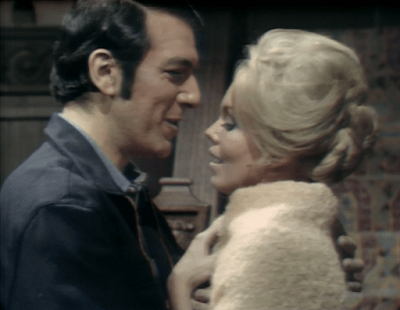
On his way out, Fred sees a woman whom he greets as “Miss Alexis.” He tells Alexis that he misses her visits to the Loomis House. She walks up very close to him and says she is feeling cold. He says he knows what to do about that, and hugs her. She holds the embrace for quite a while. He says he’s wanted to do that ever since he first saw her. She tells him to kiss her. Before he can comply, they hear Quentin coming. They separate and look nonchalant. Quentin is surprised Fred is still there. Fred hastens out.
Later, Alexis’ aunt, Hannah Stokes, would go to Fred at the Loomis House and ask him to come to her place, telling him Alexis wanted to see him there. That scene took place out of our view. The next time we do see Fred, Hannah is leading him into her parlor. Fred tells Alexis that he’d been planning to see her at Collinwood, but she says it is better at Hannah’s. Hannah leaves them alone together. They embrace, and Fred kisses Alexis. He feels cold. She tells him he will go on feeling cold, but bids him embrace her again. He does. He collapses.
Hannah was close to one of her nieces, Quentin’s late wife Angelique Stokes Collins. But she never got along with Angelique’s identical twin sister Alexis. Angelique had shared Hannah’s interest in the occult, and had been her pupil in that area, while Alexis scorned such matters. Alexis came to stay at Collinwood four and a half weeks ago, and spoke to Hannah only once during that time, when Hannah invited herself to the great house. That was a tense meeting which ended with Alexis all but ordering Hannah to go.
Hannah is taken aback today when she answers her door. She sees Alexis. She makes sarcastic remarks about Alexis, which do not deter her visitor from entering. The visitor asks Hannah to tell her fortune. Hannah resists, but the visitor keeps telling her it is something she wants very much. Hannah starts laying out the Tarot, but the first two cards disturb her so deeply she stops and cannot be persuaded to resume. She tells her visitor that they mean that she has no future. The visitor responds with a placid look and an insistence that Hannah read her palm. Hannah does not want to see the same message there, but the visitor will not be denied. When she looks at her palm, Hannah has a realization. “You are not Alexis! You are Angelique!”
Hannah is horrified that Angelique has returned from the dead. She does not want to know how it was done. Angelique seems eager to tell her everything; if Hannah were willing to listen, she might even volunteer that she murdered Alexis by draining the warmth from her body to heat her own undead frame. Angelique asks Hannah to bring her up to date on some things that happened while Alexis was at Collinwood and she was in the tomb. She then explains that her own death was also a murder, and that she wants to avenge it, though she does not yet know who the murderer was. She also has plans for Quentin, though she does not make it clear at this time what those are. She tells Hannah to bring Fred to her so that she can drain the warmth from him. Hannah protests, but Angelique tells her she has no choice. If she does not deliver Fred to her, she will haunt Hannah as long as Hannah lives.
After Fred collapses, Angelique calls her aunt back to the parlor. She tells her that she is all right now. Hannah finds that Fred is dead. Angelique agrees that he is, and repeats that she is warm again. She goes on: “That’s the way it must be now. This is the way I will live now. And when Quentin comes to join me, he will live this way, too. For eternity.” Evidently she is now a vampire, only instead of blood she drains heat from her victims. Also, she will be killing someone every 24 hours. Collinsport has been established as a very small town, so if she and Quentin are both going to be keeping up that pace it’s hard to see how it can last even for a year, let alone for eternity.
Quentin Collins
Quentin does not suspect that Angelique has risen from the dead, killed her sister, and taken her place. He has problems of his own. At the beginning of today’s episode, he is standing at the door to Angelique’s old bedroom in the east wing of Collinwood, where Alexis stayed during her visit and which Angelique now occupies again under Alexis’ name. He is looking into the room, but does not see it. Instead, he sees an entirely different space. Unlike Angelique’s richly decorated room, it is bare and dark.
Quentin sees two children in the room. They look and sound exactly like Daniel and Amy, though they are wearing clothing he does not recognize. He calls the names Daniel and Amy, but even though they are just a few feet away from him they do not seem to hear him or to be aware of his presence. An invisible barrier of some kind keeps him from entering the room.
Though the children cannot hear Quentin, he can hear what they are saying. The boy says that according to his father, “Dr Hoffman” said that “Barnabas got caught” in the room. The girl is alarmed and says that she does not want to get caught. She does not want to be in the room at all, but would rather be asleep in bed.
Quentin keeps calling the names Daniel and Amy. After a moment, he hears Daniel’s voice coming from somewhere other than the room. He turns, and sees Daniel and Amy standing behind him in the hallway. They don’t know what he is talking about when he asks them if they have been in the room, and he doesn’t know how to explain what he saw.
The Hoffman likeliest to come to Quentin’s mind is Julia Hoffman, Angelique’s fanatically devoted servant, who is the housekeeper at the great house of Collinwood and is certainly not a doctor. The only Barnabas he can think of is Barnabas Collins, an ancestor who died in 1830 and who was the subject of a biography Will Loomis wrote five years ago. Amy has told him that Will has started another book about that Barnabas. Quentin read Will’s original book, and was puzzled as to what could possibly be left to be said about its subject. So the conversation he has overheard makes no more sense to him than does the setting in which it took place.
Quentin shoos the children away and goes into the room. It is furnished as it always is. Angelique, whom he believes to be Alexis, is lounging in the middle of it. He tries to explain the phenomenon to her, and she does not take him at all seriously. He tells her enough that she should know that if it was an hallucination, it was a remarkably involved one, the sort that occurs only to people with grave mental illnesses. Even so, she could not be less interested in it. She wants to know what Quentin is doing to investigate her murder. He says that he doesn’t believe Angelique was murdered, to which she replies that he is a fool. This conversation does not have an obvious track forward, and Quentin quickly excuses himself.
Barnabas Collins
Barnabas Collins went to the island of Martinique in the 1790s on a business trip for his father’s shipping concern. While there, he met two lovely young women. One was Josette DuPrés, daughter of the richest sugar planter on the island. He was captivated by Josette, but did not believe she could love him. Josette’s aunt, the exiled Countess DuPrés, had brought a lady’s maid with her when she escaped from the French Revolution. This maid, named Angelique, was quite as beautiful as Josette, and made it clear that she was available to Barnabas. He consoled the sadness that he felt when he supposed Josette to be unreachable in a light-hearted love affair with Angelique. When it turned out that Josette was not unreachable at all, he forgot about Angelique and turned to her. Soon, he and Josette were engaged to be married.
When Josette and her father came to Collinwood for the wedding in 1795, the countess and Angelique came along. Angelique was sure that Barnabas was marrying Josette only to conceal his true intention, which was to keep her as his real partner. When she discovered that this was not the case, Angelique vowed to do something about it. She had learned black magic, and was ready to wreak a terrible vengeance.
Angelique managed to end Barnabas’ engagement to Josette, and had caused many disasters by the time Barnabas agreed to marry her. Before long, he discovered that she was a witch. He made several farcically inept attempts to kill her. When he shot her with a gun, she thought he had succeeded. As she lay bleeding, Angelique cursed Barnabas to become a vampire. It turned out her wounds were only superficial, but the curse was not. Barnabas was eventually trapped and chained in his coffin until 1967, when he was accidentally freed once more to prey upon the living.
That Barnabas Collins was not the one Will wrote his 1965 book about, and that Angelique is not the one who has returned from her coffin to stay in Quentin’s house. They were residents of a parallel universe. It was in their universe that the first 196 weeks of Dark Shadows took place. There, the east wing of Collinwood has long been vacant and disused. Barnabas happened to be there when the bare dark room Quentin sees today was replaced by Angelique’s room from this universe. He and several other residents of the original continuity saw the phenomenon a number of times over the next few days.
Barnabas became preoccupied with the forlorn hope that if he could enter the other “time-band,” he might be freed of the vampire curse and become human again. His closest friend, mad scientist Julia Hoffman, MD, tried to dissuade him from this plan, but he was nothing daunted. Barnabas finally did manage to find a way through the barrier.
Once in “Parallel Time,” Barnabas’ hopes were instantly disappointed. He was still a vampire. The first person he met was Carolyn Stoddard Loomis. He bit her and made her his thrall. Will found out about this very shortly after, and trapped Barnabas in a chained coffin. He is using him as a source of material for a new book.
The children Quentin saw talking about Barnabas were not Daniel and Amy Collins, but David Collins and Amy Jennings from the main continuity. They don’t know that Barnabas is a vampire; so far as they are concerned, he is their kindly cousin from England, an old world gentleman with some eccentric habits.
Amy Collins
Amy had stayed with the Loomises for a few days recently when there was some trouble in the great house. She took Daniel to their attic because she wanted him to join her in her favorite pastime while she was there, going through the trunks. Daniel declares that only girls would be interested in an activity like that. Amy doesn’t refute his claim when she says that the trunks have all sorts of interesting old stuff in them, such as dolls.
Daniel asks Amy about the basement of the Loomis House. She tells him that Will has the only key, and that he refuses to let even Carolyn go down there. We know that the basement is where Will keeps Barnabas’ coffin. Daniel says that there is a tunnel that leads from the beach right into the basement, and that he likes to play there. He says that it has been sealed up lately, but suggests Amy come with him to unseal it and explore. She says “Not at night,” and turns away. He calls her a scared-y-cat. Longtime viewers know that the same tunnel exists in the main continuity and that it has been a hugely important part of the story more than once, and will wonder if they can again match the excitement associated with it in those past episodes.
Amy tells Daniel that there is a sword somewhere in the attic, a real one. This does not exactly thrill Daniel, but at least he asks if it is a saber or a fencing foil, which is more than he had to offer in response to the prospect of digging up some antique dolls. He goes to look for the sword behind some paintings. When he turns up the portrait of Barnabas Collins, he hears a heartbeat. Longtime viewers will remember that characters have several times heard a heartbeat when looking at the portrait of Barnabas in the main continuity, and that this means that Barnabas is going to be on the show before much longer. Amy can’t hear the heartbeat, but she does have a strong reaction. It is at this point that she faints and the ill-fated Fred enters.
Regular viewers know that Amy’s muttering of the words “chained” and “trapped” mean that she has a mystical perception of Barnabas’ situation. But Quentin doesn’t have the slightest idea what to make of it. Amy comes to in the drawing room and tells Quentin that when she saw the eyes in the portrait of Barnabas, she realized he needed help. Quentin says that Barnabas has been dead for a very long time.* Amy says she knows, and leaves it at that.
Ben Stokes
In the 1790s, the Barnabas of the main continuity befriended much-put-upon indentured servant Ben Stokes. Barnabas’ father, haughty overlord Joshua Collins, made Ben’s life miserable. Barnabas took pity on Ben, teaching him to read and write and standing up for him when he was wrongly accused of misconduct. In return, Ben gave Barnabas his absolute loyalty.
When Angelique came to Collinwood in 1795 and hatched her evil schemes, she decided she needed a henchman. She chose Ben. She pretended to find Ben attractive. He matter-of-factly walked up to her and took hold of her, as if women who look like movie stars come on to indentured servants every day. She soon used his excitement to cast her spell on him. He found himself helping Angelique to do great harm to Barnabas and everyone he cared about, grieving him very deeply.
Eventually, Ben broke free of Angelique. He went on to be freed from his indenture and to have children. One of his descendants is Professor Timothy Eliot Stokes, an expert on the occult and a frequent ally of Barnabas and Dr Hoffman.
Fred’s response to Angelique today reminds us of Ben so long ago. Once Ben gathered that Angelique was propositioning him, he didn’t see any need to talk at all. They both had work to get back to, so he was ready to get down to business straightaway. But Fred keeps telling Angelique how beautiful she is and how he always hoped something would develop between them. His dialogue and Edmund Hashim’s delivery of it are as realistic and unadorned as Angelique’s lines and Lara Parker’s style are florid and over the top. The contrast is deliberate, as the contrast between the monosyllabic working-class “Fred” and the ornate and ethereal “Angelique” is deliberate. Just as Ben did not know what kind of world he had stumbled into when he reached for the original Angelique, Fred has no idea that he lives in a place where beings such as this Angelique can exist.
When Barnabas first came to this universe, Carolyn Loomis told him that Angelique and Alexis were the daughters of “Tim Stokes,” the counterpart of his old acquaintance Timothy Eliot Stokes. We have yet to see Tim Stokes, but we can be sure he will played by Thayer David. We know what Thayer David looks like. Alexandra Moltke Isles, who was in 333 episodes as well-meaning governess Victoria Winters, dated critic John Simon in the 1970s. Simon was a college classmate of Thayer David, and told her that in their day David was “the handsomest man at Harvard.” When I mention that to my wife, Mrs Acilius, she says that those must have been rough days for Harvard. David may have been better looking before he put on weight, but he never bore anything that could be mistaken for a family resemblance to the dazzling Lara Parker.
Longtime viewers, thinking back to what we saw when the show was set in 1795, might have an idea. Will’s book proves that the timelines diverged in the 1790s, when the Barnabas of the current timeline left Angelique alone and had a happy marriage with Josette. Perhaps in that continuity Ben really did pair off with Angelique. If so, Angelique and Alexis might be their descendants. They were lucky to inherit all of the genes governing their appearance from her.
The thought of the counterparts of Ben and Angelique as the forebears of the Stokes family in the current continuity might shed some light on its members. We’ve heard not only that Hannah and Alexis had no use for each other, but that Alexis and her father have not spoken for a long time. Like Hannah, Tim shared Angelique’s interest in the occult and doted on Angelique, while scorning Alexis. The new Angelique certainly qualifies as the Evil Twin, and is very much a continuation of the Angelique we already know from the main continuity. From what we know about them, Hannah and Tim seem to be the sort of people Angelique would naturally turn to for help in her deadly doings.
As for Alexis, she seems to have set her cap for Quentin, and succeeded in driving Quentin’s current wife Maggie out of Collinwood when she caught Alexis and Quentin in rather a compromising position. Alexis kept saying it would be easier for the new Mrs Collins to come home if she were to leave, but she never did leave. On a conventional soap, Alexis would have the makings of a Vixen, but it takes more than husband-stealing to join the ranks of the villains on Dark Shadows. Alexis would seem to take more after Ben, who had been indentured because he was a thief and was bewitched by Angelique because he disregarded sexual morality. She may have those sorts of flaws, but compared to the evils around her they seem like minor foibles indeed.
Edmund Hashim
Fred is played by character actor Edmund Hashim, making his only appearance on Dark Shadows. Hashim does a fine job. Fred had to be played with strict naturalism, so that the only resource Hashim could draw on to hold anyone’s attention against the flamboyant Parker was skilled and truthful acting. He pulls it off. It’s a shame we won’t see him again. He died in 1974 at the age of 41, one of the first cast members to pass away. The only ones who predeceased him were Fred Stewart (1970, aged 64,) House Jameson (1971, aged 68) George Mitchell (1972, aged 66) and Patrick McVey (1973, aged 63.)
*In fact, he says that Barnabas has been dead for “over 200 years.” It’s 1970, as the wardrobe makes unmistakably clear, and they have explicitly said that the Barnabas Quentin has heard of died in 1830. So he’s bad at math.
Wealthy socialite Alexis Stokes is looking at her identical twin sister, the late Angelique Stokes Collins. Angelique has been dead and in her coffin these six months, but hasn’t decayed visibly. This has led Angelique’s widower, drunken sourpuss Quentin Collins, to the conclusion that Angelique is an uncanny being whose remains must be burned. Quentin’s friend, foolish scientist Cyrus Longworth, heartily concurs with this opinion. Alexis sits by the coffin and tells her late sister that she has, with great regret, come to share Quentin and Cyrus’ conclusion. She touches Angelique’s shoulder. At this, Angelique’s eyes pop open. She speaks, and tells Alexis that she is half right. Someone must be destroyed, but it will be Alexis, not Angelique.
Angelique and Alexis stand facing each other in the tomb. Angelique explains that all she needed to come back to life was a touch. Now that Alexis has given her that, the warmth has begun to drain from her body into Angelique’s. Soon all of Alexis’ body heat will be transferred to Angelique. She will then die, and Angelique will trade places with her. The “heat vampire” idea was one the show explored briefly in April 1969, when undead blonde fire witch Laura Murdoch Collins drained the warmth from the bodies of the living to keep herself alive. Now Angelique will return from the grave as another heat vampire. Alexis will lie in the coffin, and Angelique will move back in to the great house of Collinwood, where Alexis has for the last three weeks been staying as Quentin’s guest.
Footage of the dress rehearsal for this scene survives. The only other surviving videotape from any episode of Dark Shadows not originally released for broadcast are the opening slates of the episodes.* The confrontation between Alexis and Angelique not only involves the most complicated videotape editing they’ve done so far, it also requires Lara Parker to do some intricate acting work as she plays off a version of herself she can neither see nor hear. In the rehearsal footage, she several times breaks character and turns to director Lela Swift to report on things that aren’t going right. We can hear Swift’s responses over the control room microphone. Some crew members are in and out of the shot, and at the end two people come to help Parker out of the coffin. It’s fascinating for hard-core fans, a must-watch:
By the time Mr Trask, the butler in the great house at Collinwood, comes to the mausoleum to see what’s taking so long, Angelique has changed into Alexis’ short bluish gray suit and chignon hairstyle with a tight spiral twist at the back, the look that the mysterious Madeleine wore in Alfred Hitchcock’s Vertigo. She has changed Alexis into her own gown and loose hairdo, and has put Alexis into her coffin. She is closing the lid of the coffin when Trask enters. Trask asks if she is ready to return to Collinwood, and she says she is looking forward to it.
We cut to the drawing room at Collinwood, where Quentin is yelling at the wind. He is convinced that it is really a ghost expressing discontent, and he demands to know what the trouble is. He doesn’t get any answers.
Angelique and Trask enter the house. Posing as Alexis, Angelique dismisses Trask, and tells Quentin she now agrees with him and Cyrus. The body in the tomb must be destroyed.
Cyrus is in his laboratory. He is talking with his lawyer, Quentin’s cousin Chris Collins. Chris has questions about Cyrus’ instructions to open a bank account in the name of John Yaeger and deposit $5000 in it. He asks if Yaeger is a pseudonym Cyrus is planning to use. Cyrus denies this, and says that Yaeger is a man he met recently who is helping him with his current experiments. In #985, Cyrus responded to Chris’ questions about these experiments with a lot of mad scientist ravings that alarmed him. Since Cyrus offers no information about Yaeger aside from his connection to this dubious project, Chris is reluctant to comply with Cyrus’ directives. Cyrus agrees that Chris should meet Yaeger first. Chris says “I’m looking forward to meeting him. See you, Cyrus,” and exits. This is the last time we will ever see Chris. Actor Don Briscoe’s health problems were catching up to him, and he was not able to return to the show.
While Quentin and Cyrus burn the coffin, Angelique is in her old bedroom. Alexis had been staying there, so Angelique is right at home. Trask tells her it is as if Angelique never left. Later, Quentin comes to invite her to join him and Cyrus for a drink downstairs. She declines, saying she would like to be alone.
Lara Parker’s performance as the newly returned Angelique is marvelous, her best work so far. We can see that she is a different person than the one who left the house earlier in the evening, and we can believe that the other characters don’t see it. In a closeup, she wrinkles her face like the Grinch, suggesting that Angelique has come to steal Christmas. The supernatural element of her confrontation with Alexis suggests Edgar Allan Poe’s “Ligeia,” which the show has been drawing on for the last few weeks, and reminds longtime viewers of Laura’s April 1969 storyline. But the idea of a woman killing her identical twin and taking her place would have been familiar to much of the audience from the 1964 film Dead Ringer, in which Bette Davis played the sisters in that sad situation. Bette Davis is one of the people frequently mentioned when film buffs name The Greatest Screen Actor of All Time, but not even she could have done better than Parker does today.
In the drawing room, Cyrus is alone. He was reluctant to accept Quentin’s invitation to stay for a drink, and is pacing and fidgeting. What Quentin does not know is that Cyrus is in the middle of a Jekyll and Hyde project, and he wants to get back to his lab to take the potion and change himself into the brutal John Yaeger. He revels in Yaeger’s cruelty and is addicted to the transformation.
Music begins playing on the soundtrack we have not heard before, a jagged piano theme. Cyrus suddenly feels the pains that he has felt after taking the potion. He sees Yaeger’s dark hair springing into place on his arms. He looks in the mirror and sees that he has become Yaeger, without taking the potion. He goes to flee the house, but realizes Quentin is already approaching. He retreats to the drawing room and locks the door. Quentin knocks, asking what on earth is wrong with Cyrus.
This is not only the first time Cyrus has changed without drinking the potion, it is also the first time he has appeared without a putty appliance precariously attached to the bridge of his nose. He looks far more convincing without it, though of course he is even more instantly recognizable as Cyrus.
In his post about the episode at his great Dark Shadows Every Day, Danny Horn points out both that the videotape editing is extremely ambitious today, with the confrontation between Alexis and Angelique at the beginning and the pretaped sequence of the Cyrus-to-Yaeger transformation at the end, and that that the editing in between these heroic shots looks ragged. The jump cut to Cyrus and Quentin’s approach to the mausoleum makes it look like Cyrus’ laboratory opens onto the cemetery, the first sequence of Angelique in her old room begins and ends with unusually long sequences of her pruning some extremely unhealthy looking flowers, and Cyrus spends a surprisingly large amount of time in the drawing room pacing about. Danny guesses that they did not know how long the process shots would run, so they inserted filler that could be removed if they went long.
That could be, but I like the episode the way it is. The jump cuts give the whole thing a dreamlike quality that works well with the subject matter. That’s certainly the case with the cut to the cemetery- we don’t know where Cyrus’ lab is, but we do know that only death is likely to come from the work being done there, so that jump makes a grim symbolic sense. Moreover, the actors use the sequences Danny identifies as filler to shed light on the characters and situate the scenes in the story. Angelique is so absorbed in her plant that you can believe she came back from the dead specifically to work on it, and nothing Trask or Quentin has to say is going to distract her for long. Cyrus’ pacing makes it clear he feels trapped at Collinwood, which adds considerably to the force of the moment when, as Yaeger, he has to hide from Quentin.
*I should mention that we have the dress rehearsal for #584. What we don’t have is a finished episode- they never made one. They just sent the tape of the dress rehearsal to the ABC network, and that was broadcast.