Special Post: A different- better?- Parallel Time

At the end of March 1070, Dark Shadows left the universe in which the action had been set up to that point. It spent sixteen weeks in another continuity, which the show insists on calling “Parallel Time.”

The Parallel Time segment has so much good stuff in it that I can’t wish it had been different in any way. But if we could have access both to these eighty episodes as they are and to a version of Dark Shadows streamed from an alternate universe in which the show had a bigger writing staff and a more forgiving production schedule, there are some differences I’d like to see.

After the first two weeks of “Parallel Time,” principal photography began on the feature film House of Dark Shadows. For six weeks after that, most of the actors familiar to longtime viewers were away in Tarrytown, New York while the show kept taping in Manhattan. That had its advantages. Several of those actors had contracts that required them to be cast in a certain number of episodes every month, so that the writing staff had to plan the show out like a jigsaw puzzle. Without them, they were free to feature newer cast members like Elizabeth Eis and Michael Stroka as often as they pleased.

That might have led to a new infusion of life into the show. But in fact, the first two weeks concentrated heavily on the established players, and the less familiar faces were parachuted in abruptly when the old favorites became unavailable. They would disappear as abruptly when the regulars returned to NYC. Worse yet, several characters reappeared for an episode or two after weeks or months unseen and unmentioned. That made the stories so choppy that it was hard to trust that anything would come together in a satisfying resolution.

What is more, they never give us any reason to root for the central relationship between Quentin (David Selby) and Maggie Collins. Quentin is a foul-tempered sourpuss, an unstable man-child whose tantrums are as predictable as they are pointless. Maggie, after initially showing some signs of self-respect, winds up taking his abuse with a dismal meekness. When arch-villainess Angelique tried to break the two of them up, we couldn’t help but notice that she was in fact doing Maggie the biggest possible favor.

Writing my posts about the sixteen weeks of the Parallel Time segment, I found that I kept slipping in bits about how the story might have been shaped differently. Those bits got to be long and distracting. I finally decided that the only way to present them coherently was to write them up in the form of a story bible. I don’t make any great claims for what follows, but I can say that I have found writing it to be a useful exercise for me. Getting all of this out of my system removed an obstacle that was making it hard for me to write my episode commentaries, and I have a much easier time imagining what the writers had to do when they drew up the “flimsies” for the thirteen week cycles on which the show was planned.

Prologue

In the lead-up to Parallel Time, the characters in the original continuity kept going to a room in the long-disused east wing of the great house of Collinwood and finding that there was an invisible barrier in the doorway. They could not pass through the barrier, but they could see and hear what was happening on the other side. It was the room in the other universe where their counterparts were exchanging information about the story that was going on over there. The portrait of the first Mrs Quentin Collins dominated the room, and several of the characters were in the habit of carrying on one-sided conversations with it.

I’d keep that basic format, with a couple of changes. There would be no portrait, because we would be in suspense for the first week of the Parallel Time segment as to who the first Mrs QC was. I’d add a scene where Professor Timothy Eliot Stokes (Thayer David) is investigating the phenomenon and sees his own counterpart, a wizard known as Tim (Thayer David.) This other Stokes has come to the room with his sister Hannah (Paula Laurence) to claim some things that belonged to Stokes’ late daughter, the first Mrs Quentin Collins. They talk about Quentin’s remarriage, and make some obscure remarks about the deceased.

Week One

In the actually existing show, Barnabas Collins (Jonathan Frid) crosses over to the other continuity and takes the audience with him. To his disappointment, his curse has followed him and he is still a vampire there. The first people he meets are Carolyn Loomis (Nancy Barrett,) counterpart of his distant cousin and one-time victim Carolyn Collins Stoddard, and her husband, alcoholic novelist Will (John Karlen,) counterpart of his other-times victim Willie Loomis. The Loomises live in the Old House on the estate of Collinwood. Barnabas bites Carolyn, but Will finds out about him, traps him in his coffin, and tries to use him as a source of material for a new book.

The only change I would make to this part would come after Will has trapped Barnabas. In the actually existing show, Carolyn is still in the house, still under Barnabas’ influence, the whole time Will is forcing him to give an oral history. I would have Will send Carolyn off to a sanitarium a hundred miles north of town. After the “Parallel Time” segment ends, the show mentions a psychiatric facility called Stonecrest; I’ll use that name for it.

Continue reading “Special Post: A different- better?- Parallel Time”
Episode 1059: Who will ever light this light?

Sixteen weeks ago Dark Shadows crossed over to a different universe than the one where the first 196 weeks of the action took place. The show insists on calling this segment “Parallel Time.”

The only villain left standing in this next-to-last installment of “Parallel Time” is the evil Tim Stokes, whom we did not see and barely heard of until the tenth week of the segment, and who did not start acting on his own initiative until the last few days. Thayer David does a great job playing Stokes, and the character evokes his earlier parts in interesting ways. But he is obviously a last-minute addition meant to keep the story going while they take care of some loose ends they were in too much of a hurry to tie up in a natural way.

Desperate to get vampire Barnabas Collins and mad scientist Julia Hoffman out of Parallel Time, writer Gordon Russell resorts to what Roger Ebert used to call an “Idiot Plot,” a series of events that can take place if and only if every character is dumber than any member of the audience.

Barnabas has fallen in love with and bitten a non-character named Roxanne, who, in lieu of a personality, has psychic powers. Yesterday Barnabas gave Roxanne a scarf that belonged to Julia’s counterpart in this universe, and Roxanne told him its owner was dead. Only today, when Maggie speaks the name of that other Julia Hoffman with revulsion, does Barnabas remember that there are two of them, and that the scarf belonged to the one whom he already knew to be dead.

Barnabas and Roxanne know that Stokes is on the loose and that he has vowed to take revenge on everyone. So she walks home alone, and finds Stokes waiting for her there. He finds Barnabas’ bite marks on her neck, and realizes that he is a vampire. Stokes decides he must lock Roxanne up. A man of his evil ways must know of any number of places where he could lock Roxanne up, many of which would take Barnabas a long time to find, but he choose to stick her in her closet. Minutes after his departure, Barnabas comes to the house and lets her out.

Barnabas takes Roxanne back to the Old House on the estate of Collinwood, where Maggie has the suitcase Julia brought with her when she came to this universe five weeks ago. Roxanne takes a piece of costume jewelry and confirms that its owner is alive. She leads them to the basement of the great house on the estate. They hear Julia weeping in the dungeon behind a bookcase where Angelique trapped her a few days before her own destruction. This weeping sound will bring back memories for longtime viewers. In the first months of the show, several characters heard the sound of a woman weeping behind a wall in the basement of the great house, a sound strongly implied to be of ghostly origin. They eventually gave that sound an explanation that was neither supernatural nor consistent with what we had seen up to that point, and then never mentioned it again. But it’s good to be reminded of it regardless.

Barnabas, Roxanne, and Maggie eventually find Julia and take her back to the Old House, where they give her a large brandy. Barnabas, Maggie, and Julia then go to the police station, leaving Roxanne alone in the house so that Stokes can get at her. She threatens him with a dagger, and he withdraws. Maggie then goes from the police station to the great house by herself so that Stokes can grab her.

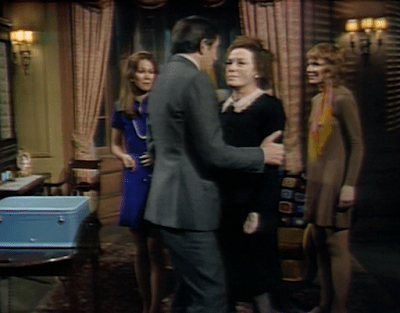
A joyous reunion. Screenshot by Dark Shadows Before I Die.

Episode 1057: Not even a memory

Wicked witch Angelique has died, again. While she still dwelt among the living, Angelique locked Julia Hoffman up in a dungeon and left her to die of thirst. Julia’s buddy Barnabas Collins and a dimwitted policeman called Inspector Hamilton are looking for her. She is struggling to stay awake. The episode devotes so much time to a go-nowhere story about a non-character named Roxanne that we can sympathize with this struggle.

Julia nods off just as Barnabas and the inspector pass by the hidden wall of her dungeon. She does not hear them, and by the time she wakes up and starts calling out they are gone.

While asleep, Julia has a dream in which Barnabas and Roxanne decide that she must be dead. They are going to leave for the alternate universe from which Julia and Barnabas originally came. Julia has given up everything in her life to help Barnabas, and she has an unrequited love for him. For his part, Barnabas has conceived a mad passion for Roxanne, who is young and pretty but has no personality. Roxanne’s short red hair, pale complexion, and strong chin make her look like she could be Julia’s daughter. Indeed, when first we saw her it seemed likely she would be revealed to be the daughter of Julia’s counterpart in this universe. Barnabas is so thoughtless about throwing other women in Julia’s face that it would be like him to cast her aside for the daughter she might have had, Grayson Hall would have done a great job playing the anguish this would have inflicted on Julia, and it would have given Donna Wandrey something to work with as Roxanne. It’s a shame they didn’t run with it.

This is Colin Hamilton’s final appearance as Inspector Hamilton. It is always a bad sign when writers give a character the actor’s name; it suggests they don’t trust him to answer to anything else. They may have been right about Colin Hamilton. He will be back as a doctor in #1219. That is the only episode of Dark Shadows of which no video survives. There is an audio recording, so we can hear that Hamilton delivered the doctor’s dialogue in the same bored, impatient tone he used for the inspector.

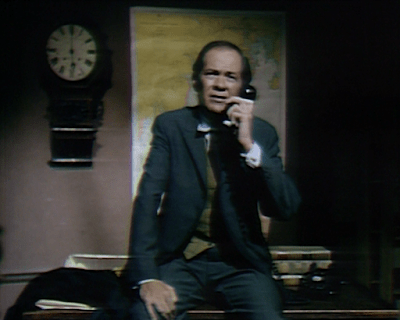
Inspector Hamilton in his office. Screenshot by Dark Shadows Before I Die.

Episode 1037: An uncertain and frightening journey

In November 1967, well-meaning governess Victoria Winters participated in a séance. She came unstuck in time and found herself in the year 1795. For the next four months, Dark Shadows was a costume drama set in the late eighteenth century. Viewers made the acquaintance of wicked witch Angelique and learned how old world gentleman Barnabas Collins first became a vampire.

Vicki herself learned nothing from her trip back in time. She spent the first part of it telling the actors about the parts they had played in the first 73 weeks of the show. After that incredibly stupid habit had burned away any goodwill the audience had for the character, Angelique framed Vicki for her own acts of sorcery. Vicki at first refused to take these charges seriously, an inexplicable response given both her knowledge of the period in which she found herself and her extensive experience with the supernatural in her own time, then kept looking for the most idiotic possible means of defending herself until she was sent to the gallows. In the nick of time, she was whisked back to the séance and to the 1960s, rope burns already visible on her neck. Vicki never regained the audience’s sympathy, and was written out later that year. Maggie Evans succeeded Vicki both as governess at Collinwood and as the perpetually imperiled heroine.

Now Barnabas has traveled in time, not backward, but sideways. He is in an alternate universe, which the show insists on calling “Parallel Time.” Here, Maggie’s counterpart is married to foul-tempered sourpuss Quentin Collins, the master of Collinwood. Angelique’s counterpart is Quentin’s late first wife, returned from the grave and scheming to get Maggie out of the way so that she can remarry her widower. Angelique casts a spell today that leads Quentin to confront Maggie and announce that he is certain that she is a witch.

The 1790s segment was in some ways one of the show’s greatest triumphs, but nothing about Vicki’s part in it was very good. So seeing this Angelique reenact the story that culminated in the witchcraft trial will bring a sinking feeling to longtime viewers. It doesn’t help that Maggie has made a number of inexplicably foolish decisions and quailed in the face of opposition she would seem to be able to overcome easily.

Moreover, Quentin is such a miserable husband to Maggie that we have no rooting interest in their marriage. He is being relatively nice to her at the beginning of the episode, because she was just abducted and imprisoned by a madman, and he feels vaguely guilty that he had jumped to the conclusion that she left voluntarily and berated everyone who suggested she might be in trouble. But even in those nice moments he maintains a paternalistic, condescending tone towards Maggie. When she wonders aloud what other crimes her abductor might have committed, he insists that there could not have been any others and becomes exasperated with her for raising the topic. That led my wife to yell at the screen “Quentin, you are the worst husband! There may be others who are also the worst, but you are the worst!”

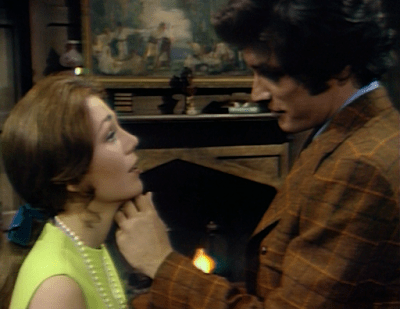
Quentin pets Maggie. Screenshot by Dark Shadows Before I Die.

When Quentin so quickly flips from acting like he is indulging the moods of his silly child-bride to accusing Maggie of witchcraft, he not only confirms Mrs Acilius’ assessment that he is “the worst.” Coming so shortly after the abduction story, he seems to be a man blaming his wife for being raped. Indeed, the man who abducted her had in #1022 and #1023 jumped her and sexually assaulted her in a dark alley, and she explained her decision to keep quiet about that attack by saying she was afraid Quentin would blame her. This is an important theme, but it would be a tricky one to explore on a show about witches and vampires and time travel and parallel universes where the median viewer is about ten years old.

Perhaps it would have been possible to have another take on the themes of the 1790s segment that would not have led us to this particular dead end. I think of a comment left in 2017 on Danny Horn’s great Dark Shadows Every Day:

You know, [Parallel Time] might have had a very different feel with the following changes:

Alexandra [Moltke Isles] takes the role of Quentin’s evil first wife, Victoria Stokes Collins. There is no nice twin. She dabbles in “the black arts” but is not a full-on witch. She and Quentin have a son, David.

Lara Parker takes the role of Quentin’s new wife, Angelique “Angela” Evans. She’s kind-hearted and traditional and a romantic. She has no witchcraft powers. But not quite the pushover as time goes on.

And Kathryn Leigh Scott plays Margaret “Maggie” Evans still, but she’s now Angela’s sister and Cyrus’ lab assistant. She’s a modern woman — middle class, educated, confident, reluctant in matter of love.

Maggie and Angela are different — Maggie is the more confident, assertive, cynical of the two — but they are close and both “good” girls. Maggie doesn’t like Quentin.

Lisa Richards is looking for other work.

So in this version, there was a seance two years ago but instead of a murder, Victoria just simply vanished when the lights went out. They never learned what happened. There is no portrait. No one mentions her by name.

When Barnabas enters parallel time, Quentin has just brought Angela home, with Roger and Hoffman treating her like crap.

After about two weeks of establishing all these new relationships, they recreate the seance.

The lights go out, and when they come back on, there’s Victoria in clothing from the late 1700s. She has no memory of what happened — and doesn’t really care. She wants her rightful place as mistress of Collinwood back. (Explanation for her vanishing and returning: Daddy Stokes playing with I-Ching wands. Victoria kills her father when she learns he did that).

Can you imagine the shock for the audience to have “Vicky” just show up like that? And in the same manner RT Vicky did. And then to be evil?

That really could have been fun.

Comment left 29 July 2017 by “William” on “Episode 1056: The Parallel Sky,” Danny Horn, Dark Shadows Every Day.

I like this idea very much. When she played Angelique’s identical twin Alexis, Lara Parker created a character who was not murderous, but far from a naif, and it is easy to imagine that a person like that would have stood up well enough to the kind of stresses that the wicked witch would bring against her to keep the drama going for some time. And it would be a nice inversion, not only to see the evil Vicki persecuting the innocent Angelique, but also to have his unresolved feelings for Vicki render the time traveler Barnabas as clueless in the evil Vicki’s proper world as the well-meaning Vicki was in Barnabas’ native time.

Moreover, these last two weeks the barrier between the universes has been getting leaky. So when the evil Vicki is finally thwarted here, she might escape into the original continuity and wreak havoc there. That would pick up on a road not taken in #872, when sorcerer Count Petofi escaped from the year 1897 and made his way to the Collinwood of the present day, only to be snatched back to the past after a few minutes.

I can’t wish that all of “William’s” dreams had come true. I like Lisa Blake Richards, so I’d want to leave her in the Jekyll and Hyde story and come up with another storyline to feature Kathryn Leigh Scott, either as Maggie or as another character. And it is a gift to viewers who have been with the show from the beginning that David Henesy’s character in Parallel Time is called Daniel Collins rather than David Collins, the name of his part in the other continuity, since the point was made in #153 and referenced later that David’s name was the result of events that wouldn’t have happened here. And while the séance gimmick is too good not to do, I would still like to see Mrs Isles play twins- the evil Victoria and her non-evil sister Veronica.*

*Mrs Acilius doesn’t like the name “Veronica” for this character. She’d rather call her Vanessa or Vivian.

Episode 953: Every move unwise

For most of 1968, Dark Shadows was a shapeless mess. The makers of the show had caught on that the audience liked monsters, so they kept tossing one monster after another into the mix, hoping to repeat the popular success they had had with vampire Barnabas Collins the year before. One of the storylines that ended up disappointing this hope most completely was that centering on 6’4″ Frankenstein’s monster Adam; another was the “Dream Curse” that was supposed to revive Barnabas’ vampirism after it had been put into remission by the mad scientists who created Adam.

Suave warlock Nicholas Blair was on the show in those days. Nicholas appeared to be a regional manager for Satan’s operations in upper New England. He found out about Adam and came up with the idea of using him as the progenitor of a new species that would displace humankind and win the Earth for his master. Adam met heiress Carolyn Collins Stoddard and fell hard for her. He also developed an interest in the writings of Sigmund Freud. But he never clicked with the audience, and Nicholas’ plan didn’t make any sense in the context of the show. So the plan flopped and Nicholas was called to the main office. He’s back today.

The A story for the last fourteen weeks has been the effort of the Leviathan People, a race of Elder Gods, to use a 6’4″ shape-shifting monster as the progenitor of a new species that will displace humankind and win the Earth for them. The monster, who once invited people to call him Jabe, met Carolyn and fell hard for her. The Leviathans want Jabe to take Carolyn as his bride and turn her into a creature like himself, but he would rather be human and take Carolyn out on dates. Jabe isn’t the reader Adam was. Adam might be interested in Jabe’s current projects, though. When he was growing into his adult form, Jabe’s foster parents were antique dealers Philip and Megan Todd. He has now arranged to kill Philip, and as we open today he is passionately kissing Megan.

The door opens, and Nicholas enters. He tells Jabe that he is his boss, and that the Leviathan takeover of the Earth was his idea. It is the same idea that didn’t work last time he was on the show, and when he tells Jabe that he failed that time he adds that he does not intend to be punished for failing again.

Nicholas bullies Jabe into going to his room and turning into the inhuman monster he really is. Henchman Bruno shows up to consult with Nicholas while Jabe is in the room. Nicholas tells Bruno it is his responsibility to see to it that Jabe doesn’t kill anyone else. Nicholas leaves, and Bruno goes into Jabe’s room. Less than a minute after Nicholas told him to keep Jabe from further killing, Bruno is standing before the monster, apparently about to be killed.

Bruno manages to get out of the room alive. Jabe returns to human form and follows him. Bruno gasps that Jabe was going to kill him. Jabe replies that he wasn’t, “it was.” Adam might have found significance in this remark. One of Freud’s central concepts was a division between the ego (from the Latin pronoun equivalent to the English “I”) and the id (from the Latin for “it.”) People repress their unacceptable urges and attribute them to something separate from themselves. So, I don’t want to kill my father and marry my mother, it does. Bruno tells Jabe that in the room, he is “it,” and moreover that he himself, as a devotee of the Leviathans, wants to become something like “it.” Evidently the Leviathans’ promise to their followers is that they will replace their ambiguous and divided personalities with pure unreasoning id.

Jabe tells Bruno that he wants to be human. Bruno is horrified by this, commanding “Don’t even say that!” Indeed, Nicholas had said that for the Leviathan People, wanting to be human is the ultimate sin. That suggests a backstory which, if developed, might make the Leviathans scarier than they are. All tales of Elder Gods who want to take the Earth back raise the question of how they lost it in the first place. If our remote ancestors figured out a way to take it from them, surely we, who can learn everything they knew and add to it knowledge they lacked, will be able to prevail against them at least as easily.

But if it was envy of early humans that wrecked the Leviathan world order, a couple of possibilities open up. It could be that some of them defected to join us, so that their final defeat was mostly a struggle between Leviathans with our forebears as helpless on-lookers. In that case, it would remain to be seen whether humans could beat Leviathans. It could also be that the Leviathans who joined the human side have descendants among humans today, and that some of those descendants are vulnerable to co-optation by the Leviathans who are trying to reclaim their former position. There is a hint today that this might turn out to be the case- Bruno asks Nicholas why the estate of Collinwood is so important, and Nicholas, looking uncomfortable, tells him that there is a reason, but that he cannot explain it. Perhaps the members of the Collins family have some Leviathan blood that makes them at once receptive to the appeals of their estranged kinfolk and peculiarly dangerous to them if they are antagonized.

Nicholas is a logical choice to represent the idea that the greatest weakness of the Leviathan People is the temptation to become human. At the zenith of his power in 1968, he would reprove his subordinate Angelique for her romantic feelings for Barnabas, sneering that they made her “so human.” His downfall began when he fell in love with Maggie Evans, The Nicest Girl in Town, and found himself being humanized. So if Jabe is going to meet his doom because his desire for Carolyn makes him renounce his Leviathan form, he is going to remind longtime viewers of Nicholas, and we may as well have Nicholas on the show.

They may have had another reason to want Humbert Allen Astredo back in the cast. Lara Parker used to say that none of her acting lessons really took, and that it was only when Astredo would explain various techniques to her between rehearsals of their scenes as Nicholas and Angelique in 1968 that it all finally clicked for her. I’m sure Parker was exaggerating to make a self-deprecating joke, but it is undeniably true that her performances improved greatly after she had been working with Astredo for a while. So maybe the producers were hoping that some of the less experienced actors in the cast would benefit from time with this outstanding teacher.

The Dream Curse involved more than a dozen repetitions of a sequence over a period of months while one character after another had the same basic nightmare. The sequence involved opening a bunch of doors and seeing enigmatic images. Each time another character had the dream a little bit was added. At the end, it turned out that the curse was not able to renew Barnabas’ vampirism, so there was no point to any of it. For some reason, this did not go over very well with the fans.

Lately, Carolyn has been having a recurring nightmare. We see it for the third time today. The first time she had it, Jabe told her all about himself, and she saw that he had killed someone. Not too long after she woke up, her distant cousin Quentin came by and told her that Jabe had murdered her father Paul. The next time she went to sleep, she had the dream again, and it was clearer that Paul was one of the people Jabe had murdered. This time she even opens Paul’s coffin. She can’t figure out what the dream means. Too bad Adam isn’t around, by now he must have read Freud’s Interpretation of Dreams and enough of the case studies to apply his technique. If she told him the dream, he would be able to explain to her that the dream means that she is an hysterical female who needs to keep coming to him at least twice a week.

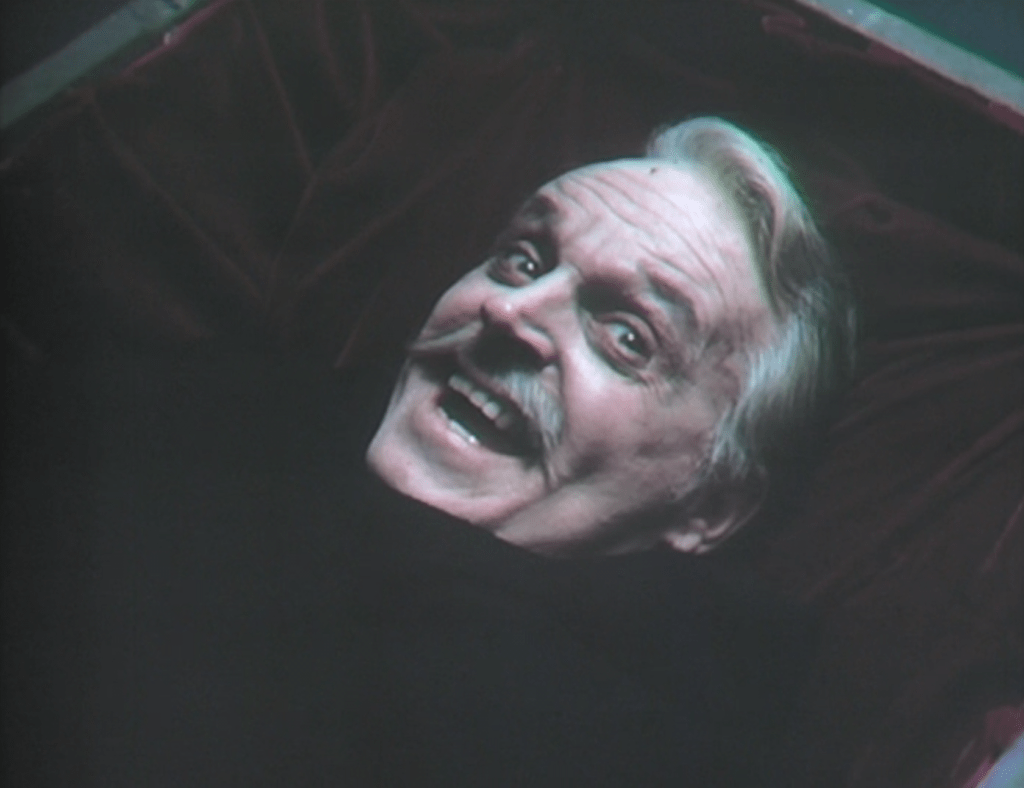
Jabe visits Carolyn, who tells him all about the dream. Not being trained in psychoanalysis, Jabe doesn’t tell her about her unresolved Electra complex or even send her a bill. He just rushes out to exhume Paul’s coffin. This leads to one of the most extraordinary images in Dark Shadows. They wanted to show that Paul’s body was there, but actor Dennis Patrick was by this time in California, producing and taking a role in the movie Joe. So they superimpose a photo of Patrick’s face on a still of a plush-lined box. The resulting image defies all description:

Screenshot by Dark Shadows Before I Die.

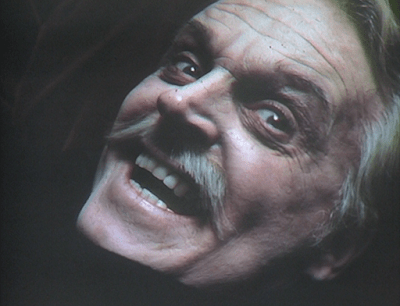
I’d remembered this as an image they flashed on the screen for a moment, but no, they hold it for quite a while. And then they go in for a closeup! Which is the last thing we see before the credits roll!

Screenshot by Dark Shadows Before I Die.

An old friend of mine has a brother who was hung up on Dark Shadows for a while, he apparently got the DVDs and watched them obsessively for months. When I told him that I was writing this blog, he claimed that this picture of Paul was the only thing he remembered about the show. I can believe it, really. I often try to figure out what they were thinking when they put the episodes together; as you can see with my speculation above about how the Leviathans lost the power they used to have over the Earth, sometimes I resort to some fairly elaborate fanfic to try to puzzle it out. But why they believed it was appropriate to put this image on national television, let alone to linger over it, cut back to it in closeup, and leave it as the climactic episode-ender, that stumps me completely.

Episode 899: How well I remember that charm of yours

When Dark Shadows debuted in June 1966, matriarch Elizabeth Collins Stoddard (Joan Bennett) had not left the estate of Collinwood in eighteen years. We soon gathered that Liz was afraid that if she strayed far from the house someone might open the locked room in the basement and discover that her husband Paul was buried there, dead of a blow she dealt him when he was trying to run off with a chunk of her patrimony.

Liz’ reclusiveness was a major theme of Dark Shadows‘ first 55 weeks. After the show committed itself to becoming a supernatural thriller with the story of Laura the humanoid Phoenix, which ran from December 1966 to March 1967, they brought in Paul’s old friend and partner in crime Jason McGuire (Dennis Patrick) as an in-betweener to sweep away the few miscellaneous this-worldly narrative threads not already subsumed in the Laura story and to help introduce the next uncanny Big Bad, vampire Barnabas Collins.

It turned out Jason was the one who agreed to bury Paul for Liz, in return for the money Paul had been trying to steal from her. Upon his return to Collinwood, Jason blackmailed Liz with this information. Time and again she caved in to his demands. Liz let him stay in the great house, gave him money, hired him for a lucrative non-job in the family business, let his rapey sidekick Willie Loomis stay in a room just down the hall from those occupied by her daughter Carolyn Stoddard and her all-but-acknowledged daughter, well-meaning governess Victoria Winters, and was in the middle of a wedding ceremony meant to unite her with Jason when she finally burst out with the truth. When she did that, Carolyn dropped the loaded pistol with which she had planned to prevent Jason becoming her stepfather. For his part, Jason said that Paul wasn’t dead, and that he hadn’t buried him. Perhaps the whole thing started when Jason said “cranberry sauce,” and Liz misheard it as “I buried Paul.” With that, the wedding was off, and a few days later Barnabas killed Jason. Since Jason was on his way out of town and had no friends left, no one missed him. He has barely been mentioned since.

Now, Paul himself has come back. Like Jason, he is played by Dennis Patrick. He has charmed Carolyn into thinking he had nothing to do with faking his own death, and she is falling over herself in her eagerness to establish a relationship with the father who left the family when she was an infant. Carolyn and Liz are on their way out the front door of the great house, heading to a committee in charge of raising funds for the hospital, when the phone rings. It is Paul, asking Carolyn to come to his hotel room at once. She agrees. She gives her mother a vague excuse, irking her, and the women leave the house separately.

In the hotel room, Paul tells Carolyn that he is in some kind of trouble that he can’t explain. Someone is trying to do something terrible to him, but he does not know who or what. Carolyn takes a firm tone when she urges him to tell her what he does know, and when she tells him that whatever is happening she will help him.

Father and daughter embrace, and Liz enters. She is furious to see Paul. She demands Carolyn leave the room. Only when Paul says that he and Liz need a moment together does Carolyn comply. The ex-spouses have a confrontation in which Liz gets to voice her righteous indignation with Paul. She tells him that she expects him to be on the next train out of town. She lists some of the people she will call if he isn’t. Among these is the proprietor of the hotel, who will presumably throw him out in the street at her behest.

In its first months, Dark Shadows tended to attract an aging audience, largely composed of people who still thought of Joan Bennett as the star she was in the late 1930s and early 1940s. Now, with its cast of vampires and werewolves and witches and ghosts and zombies and mad scientists and heaven knows what, it is more of a kid’s show. By the end of the costume drama segment set in the year 1897 that ran from March to November of 1969, viewers over the age of twelve would find themselves reacting to more and more episodes with little more than an indulgent chuckle.

Now that they have returned to contemporary dress, they have swung sharply back towards an adult audience. Carolyn was supposed to be a teenager when the show started; Nancy Barrett was significantly older than the character, and they let Carolyn catch up to her age after a while. But having her spend her evenings serving alongside her mother on the hospital’s fundraising board suggests that they’ve aged her up quite a bit further than that, foreclosing any youth-oriented stories. The conventionally soapy situation the Stoddards find themselves in today is of course something that will be of little interest to the elementary school students who are running home to see the show at this period. And while the main overall story is supernatural, about a cult controlled by unseen beings called the Leviathans that assimilates to itself one character after another, it is understated in tone, allegorical in development, and densely allusive in its relation to its literary antecedents. However many older viewers the show may have lost in the second half of the 1897 segment, they are in danger of shaking off an even larger number of their very young fans if they continue down this road.

In Art Wallace’s original story bible for Dark Shadows, titled “Shadows on the Wall,” the blackmail story was to be followed immediately by Paul’s return. Wallace called for Paul to be a man pursued by dark forces from his past. They made major changes to “Shadows on the Wall” long before they taped the first episode, and it has been almost entirely forgotten for years now. Indeed writer Ron Sproat, who was with the show from October 1966 to January 1969, said that executive producer Dan Curtis told him when he joined the staff that they were going to be leaving “Shadows on the Wall” behind and never let him see it. But they did dip into it in the case of Paul’s return- he is indeed being pursued by dark forces from his past. The Leviathan cult is after him.

After his confrontation with Liz, we see Paul sitting at the bar in the Blue Whale tavern. The jukebox plays a tune familiar from the early days of the show, when the Blue Whale was a frequent set and there were usually extras dancing in the background. Today the only people we see there are Paul and a middle aged sailor sitting next to him.

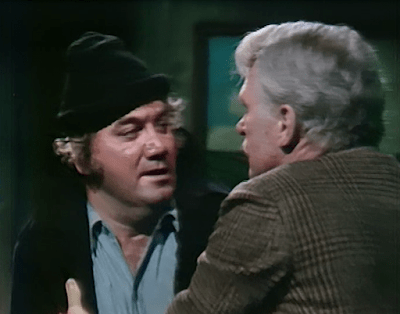
The sailor keeps looking at Paul. We hear Paul’s thoughts as he wonders if the sailor is “one of them.” Paul irritably asks him why he is looking at him. The sailor says that he wants to buy Paul a drink. Paul angrily snaps back that “I buy my own drinks!” After some sharp words, the two men warm to each other. They wind up getting handsy with each other and disappear for some private time together.

Paul and his new fella. Screenshot by Dark Shadows Before I Die.

This scene turns out to be motivated by the two men’s mutual awareness of the Leviathan cult. Over the years, I’ve seen lots of guys in bars interact with each other in exactly this way. I don’t know what that’s all about, maybe the Leviathans are real.

Since I mentioned “Shadows on the Wall” above, I should say that the tavern figures in there as well. Only it isn’t called “The Blue Whale,” but “The Rainbow Bar.” I don’t know, somehow I think Paul and the sailor might not have got off to such a rocky start if the show had gone with that name. Sounds friendlier, somehow, at least to lonesome sailors and the mature men for whom they want to buy drinks.

Paul’s new buddy, unnamed in the dialogue, is identified in the closing credits as “Jack Long.” He is played by Kenneth McMillan, in his first screen credit. In the 1970s and 1980s, McMillan was one of the busiest television actors in the USA. I always mixed him up with Dolph Sweet, who was a similar physical type. Sweet appeared on Dark Shadows once, in #99. He played Ezra Hearne, the most loyal employee at Liz’ cannery. Sweet was a tremendous actor, McMillan a very good one, and they occasionally worked together. So long as they are doing normal soap opera stuff, it would have been nice if they could have had a little story about Ezra’s reunion with his long-lost cousin Jack. Maybe Jack could have introduced Paul to Ezra, we could have seen how he’d fit in with the family.

Episode 875: Barnabas, Quentin, and the difficulty of being oneself

This is the first episode credited to Peter Miner as line producer. Dark Shadows was being taped way out of sequence at this period, so Robert Costello’s name will appear in the credits several more times in the next few weeks. The role of the line producers is one of the most under-discussed aspects of the show’s history; writer Ron Sproat, for example, was in a 1985 festival appearance unable to remember ever receiving any input from Costello. So far as he could recall, the writers interacted exclusively with executive producer Dan Curtis.

Even if Sproat’s memory were accurate, I suspect that much of Curtis’ own time working on the show was spent in meetings with Costello. He was there from the beginning, and was around throughout the long periods when Curtis was away in London and other places working on other projects. When the show makes deep cuts into its early stages of development, referring to story points that played out long before any of the current staff of writers came aboard, I always suspect it was Costello who suggested the idea. Now that he is leaving, we will see if those references become rarer. If they don’t, maybe it is Curtis’ own memory that has been at work. On the other hand, even if they do dry up it may just be that they had run out of things to say about those old themes. Whatever happens, Costello had a hard job and clearly did it better than almost anyone else could have, it’s sad to see him go.

Today’s story is about the results of a spell that 150 year old sorcerer Count Petofi cast a few weeks ago. Petofi forcibly swapped bodies with handsome young Quentin Collins. I refer to the villainous Petofi who looks like Quentin as Q-Petofi, and to the forlorn Quentin who looks like Petofi as P-Quentin.

Yesterday, maidservant Beth Chavez found out about the body swap. In love with Quentin and terrified of Petofi, she was horrified by it. Today, she searches desperately for someone she can trust, and makes the singularly unfortunate choice of weak-willed schoolteacher turned unscrupulous adventurer Tim Shaw. She goes to Tim’s hotel room, tells him the story, and asks for help. Uncharacteristically, he does not look for a way to sell the information Beth gives him. He simply goes to Q-Petofi, whom he believes to be Quentin, in what can only be a sincere effort to do the right thing. He brings Q-Petofi back to his room, where Beth is waiting. She soon manages to escape, and Q-Petofi chases her.

For his part, P-Quentin made a happy discovery yesterday and the day before. When Petofi executed the body swap, he took his powers with him into Quentin’s form. But now P-Quentin finds that the powers have returned to Petofi’s own rightful body, which is to say to him. After consulting with his friend and distant cousin, recovering vampire Barnabas Collins, P-Quentin decides to will himself back into his own body.

This works. Quentin awakes as himself, in the woods on Widows’ Hill. He finds Beth at the summit of the hill, near the cliff from which so many people have leapt or fallen to their deaths. She thinks he is Petofi, and flees to the edge while he tries to reassure her of his true identity. The closing cliffhanger leaves her inches from death.

A few years ago, I posted a fanfic idea in the comments on Danny Horn’s post about this episode at his great Dark Shadows Every Day. I still like it:

This is one of the episodes that could have been novelized by “Marilyn” Ross under the title “Barnabas, Quentin, and the Dumbest Possible Plan.” Rather than will himself into his own body right away, thus returning Petofi to his body and for all they know to his full powers, a character with brains might have tried swapping places with someone relatively harmless. Beth would seem to be the obvious person. If she comes to in Petofi’s body, Beth would seem to be the person most likely to accept the situation and least likely to use the powers of Petofi to destroy Our Heroes. Playing Quentin may have been just the challenge Terry Crawford really needed to show off her acting talents, and I’m sure Thayer David would have done wonders as Beth.

Quentin/ Beth/ Petofi could have been the first in a whole series of body swaps. Some of those swaps could have led to villains getting their comeuppance, helping to clear the decks for the end of the 1897 segment. So, while inhabiting the body of a villain, Quentin tries to do something heroic, winds up in mortal peril, and at the last second snaps back to his previous host, just in time for the villain to be the one who dies.

Comment posted 6 December 2020 on Danny Horn, “Episode 875: Switchback,” Dark Shadows Every Day, 8 June 2016.

Fans if the original Star Trek will recognize the source of my inspiration. The episode titled “Return to Tomorrow” features a malevolent alien squatting in Mr Spock’s body. Spock hides his consciousness in the brain of Nurse Christine Chapel, whom the alien once controlled, as Petofi once controlled Beth, and who has a crush on Spock as Beth does on Quentin. And Spock and Nurse Chapel, as a composite being, deliver the fatal blow that kills the alien.

Episode 855: The winds of change

The Point of Return

Barnabas Collins went into a trance at the end of February 1969 and came to in March 1897, a time when he was a vampire. Barnabas took the audience with him, so that Dark Shadows has been a costume drama set in 1897 ever since. We’ve had a few glimpses of 1969- we can see that time is passing there, that twelve year old David Collins has been saved from death, that the ghosts of rakish libertine Quentin Collins and maidservant Beth Chavez have stopped haunting the great house of Collinwood, and that Barnabas’ physical body has vanished, leaving him no avenue of return to the 1960s. We’ve also had indications at several points that the show was about to put the 1897 segment into its climactic crisis, each of which was followed by a restart of that segment. Some of those false signs probably reflected long-range plans that were abandoned when they saw how popular 1897 was.

Now, they are in a position when they can go back to 1969 whenever they wish. There are only a few unresolved story points in 1897. Most of those can be wrapped up quickly, and the rest can be forgotten. If they wanted to, they could write a single slam-bang episode in which the evil Gregory Trask is forced to accept the annulment of his marriage to Judith Collins and to relinquish control of Collinwood, the family is persuaded that Barnabas never really was a vampire after all, and Kitty Soames, the dowager countess of Hampshire, turns into Barnabas’ lost love Josette and finds a way to leave him that will make him even more miserable than he already is. Sorcerer Count Petofi might be left watching helplessly as Barnabas, his friend Julia Hoffman, and the living Quentin all escape into the future. We could then assume that the rest of the characters just toddled off and led quiet lives.

They could equally well take another tack on their way back to contemporary dress. Barnabas and Julia came to 1897 separately; there is no reason why they, or any other characters, should have to go to 1969 together. Today, Petofi is performing some kind of mumbo-jumbo that is supposed to lead to a body swap that will cause him to trade forms with Quentin. After that, he is confident he will travel to 1969 and be safe from his foes, the Rroma people. He seems to be succeeding. So perhaps a Petofi who looks and sounds like Quentin will appear in 1969, in a Collinwood based on the events that have taken place so far in 1897.

In that pocket universe, Collinwood would be known as Traskwood. Its owner in 1969 would be Trask’s son by a subsequent marriage. Call him Gregory, Junior. It would be unclear at first what happened to Judith and to her presumptive heir, her twelve year old nephew Jamison. The revelation of their fates could set us up for some big twists and the introduction of new characters with familiar faces.

Since Gregory, Junior would be in his sixties, he could have a couple of adult children who would carry on some story points. Gregory III could be played by Jerry Lacy without old age makeup, and could be a morally ambiguous character who might emerge as a protagonist and would certainly become prominent in the pages of the fan magazines. None of the Trasks would have any legal obligation to let Quentin stay in any of their houses or to work for any of their businesses, nor would any surviving Collinses. Moreover, everyone in the area would know full well that there used to be a vampire on the estate named Barnabas Collins, and no one would ever have heard of Julia.

Petofi begins his incantation. Screenshot by Dark Shadows Before I Die.

If the show goes that direction, we could spend half of each week with Petofi-as-Quentin while he makes a place for himself in that pocket universe version of 1969, while we would spend the other half with Barnabas and perhaps Julia back in 1897, where they are in an uneasy alliance with wicked witch Angelique as they try to set history right. Kitty’s Josettification would threaten to destroy this alliance, since Barnabas is obsessed with his love for Josette and Angelique is equally obsessed with her hatred for her.

The body-swap theme of today’s episode, along with the emphasis on the procedure Petofi is following, will remind longtime viewers of The Experiment, a theme that ran from April to May 1968. Barnabas and Julia built a Frankenstein’s monster with the intention of killing Barnabas and bringing him to life again in the new body. Some viewers may have wondered if Jonathan Frid was actually going to leave the show, and if the actor playing the monster was going to take over the role of Barnabas.

This time a larger fraction of the viewers are likely to think the transfer might work, since it would not require a popular star to leave the show. On the contrary, casting David Selby as Petofi in an altered twentieth century would give him the chance to wear up-to-date clothing, have magical powers, inflict cruel punishments on people who get in his way, run con games, hint at an ambiguous sexual orientation, and generally have a wonderful time. Since Mr Selby had by this point become the pin-up of a huge percentage of America’s teenaged and preteen girls, that sounds like a recipe for sky-high ratings. Meanwhile, casting Thayer David as a Quentin estranged from his body and his social environment would present an expert character actor with a challenge worthy of his skills.

It might sound like it would be too confusing to intercut between a parallel version of 1969 and a continuation of 1897, but the show will try almost exactly the same tactic a couple of years from now, as they set up for the storyline that carries the series through its final nine weeks. That closing bit is not widely regarded as one of the better phases of Dark Shadows, but the intercutting timelines that lead to it are an intriguing gambit. Maybe the idea for it came when they were trying to figure out how to get from 1897 back to 1969, in which case it is possible that the scenario I have outlined above may be very much like what the writers had in mind at some point in the development of the story.

Corridors of Trial and Error

We do get a few hints today about what we might see in the 1897 half of the show if it does split. Broad ethnic stereotype Magda Rákóczi shows up for the first time since #834, before Julia came to 1897. We had begun to fear we wouldn’t see her again. It’s good to have her back, but since Magda is also played by Grayson Hall, it raises the possibility that Julia might go away for a long time. Maybe the action will be split between 1897 and 1969 for some months, and during those months Julia will be in 1969, running her hospital, entirely unaware that there ever was a Barnabas Collins.

Beth is a servant of Petofi’s now, and she spends the episode bickering with her colleague Aristide. It turns out that she still has feelings for Quentin. At the end, she runs out of Petofi’s lair to try to help Quentin. This suggests that Beth’s conflicted loyalties will be a source of drama. Aristide shouts after her not to go, then says that “You’ll ruin everything.” He delivers this line in such a mild tone that the resulting laugh must have been intentional. This raises the possibility of Aristide emerging as a source of laughs. In the hands of actor Michael Stroka, that is a distinct possibility.

Quentin rambles into the Blue Whale, the tavern in the village of Collinsport. It’s after hours, and the only person in the barroom to tell him to stop knocking on the door is cabaret performer Pansy Faye, whose body Quentin first met when it was occupied by Trask’s daughter Charity. He still calls her Charity, which she overlooks because she has the hots for him. Pansy lets Quentin in, and invites him to her place.

Charity lived at Collinwood with her father, and after Pansy took over she stayed on there for some time. The other day she talked about wanting to leave Collinwood and go “home,” but it was not at all clear what that meant. Her invitation to Quentin is the first time she explicitly says that she has her own apartment now. Perhaps, if we stay in 1897, we will see that apartment. Maybe when Thayer David takes over the part of Quentin, Pansy’s psychic gifts will enable her to recognize who he really is, and she will take him in. In those days, of course, a man and a woman would have to get married to rent a lodging, so presumably that would have involved a wedding. Since Quentin would appear to be Petofi, Pansy would thereby become a countess, Kitty’s equal in rank. It already makes Kitty exceedingly uncomfortable to be around Pansy, so that would be an occasion for a great deal of comedy. Moreover, any viewer who saw that both women had the same title and both were involved in supernatural changes of personality would be convinced that the writers had planned that phase of their story all along.

Pansy goes into her act. She sings her song; Quentin is seized with a fit of brio. He gives a little speech addressed to the absent bartender, picks Pansy up, spins her around, kisses her passionately, then sits down at the piano and bangs out the tune of her song. She admires his piano playing and he says that he used to be able to play quite well, before “they” came. Then he suddenly sinks back into his previous depression. He denies that he ever played the piano in his life. We know that it was Petofi who had that moment of brightness, and that Petofi’s mood darkened when he remembered the Rroma who cut his hand off 100 years before. Quentin has no recollection of anything his body does or says when Petofi is using it.

A piano is prominently featured in the drawing room at Collinwood in the 1960s- perhaps there will also be one there when the estate is renamed Traskwood, and when Petofi, as played by David Selby, wangles an invitation to the great house, he will play it. That might set us up for a moment when Quentin returns to his proper body, tries to explain what has happened, and finds that his inability to play the piano marks him as an impostor. You could build a lot of story on that- you might make it look for a while like Quentin could find a home in the Traskwood universe, then show that no, the people back in 1897 have to reset the past before anything can work again.

Episode 816: David Collins, who lives in the year 1969

From December 1968 to through February 1969, strange and troubled boy David Collins (David Henesy) and his friend Amy Jennings (Denise Nickerson) were falling under the power of the malign ghost of Quentin Collins. Occasionally the children were possessed by the spirits of David’s grandfather Jamison and great-aunt Nora; at other times they were possessed by Quentin’s own spirit and that of Quentin’s sometime lover, maidservant Beth. In those same days, Amy’s brother Chris (Don Briscoe) was suffering from a curse that made him a werewolf.

As Quentin’s power over David and Amy grew, so did the frequency and duration of Chris’ spells in lupine form. By #700, Quentin so dominated the great house on the estate of Collinwood that its residents fled to the Old House on the estate, home of their distant cousin Barnabas Collins. David, entirely possessed by Jamison, was close to death. For his part, Chris was stuck in wolf form, apparently permanently, and Barnabas had locked him in a secret room in the old Collins family mausoleum.

Desperate to remedy the situation, Barnabas and his associate, occult expert Timothy Eliot Stokes (Thayer David,) searched Quentin’s old room in the long-deserted west wing of the great house. They found some I Ching wands there. Under Stokes’ direction, Barnabas threw the wands, meditated on them, and found himself transported back in time to 1897. In that year, Quentin, Beth, Jamison, and Nora are alive, and Barnabas is a vampire.

Barnabas had no idea what led Quentin to become a malevolent ghost or what first brought the werewolf curse on Chris, but he had reason to believe that 1897 was an important year in the events leading up to both of those unhappy circumstances. So once he arrived in that period, he spent his nights meddling in all the affairs of the Collins family he found there. Vampires are not problem-solvers; their function in a story is to create problems that other characters will have to solve. So all of Barnabas’ well-intentioned interventions backfired badly. Even disregarding the many murders he committed for his own selfish ends, including the murder of Quentin’s brother Carl Collins, his trip would by any standard have to be considered a disaster.

Now, evil sorcerer Count Petofi (Thayer David) has found that Barnabas is a visitor from the future and is determined to go with him when he returns to 1969. When he demanded Barnabas tell him his secret, Barnabas quite truthfully told him he had no idea what was going on when he found himself transported from one period to another. Petofi did not believe him, and is trying to extort the information he wants by summoning the spirit of David to come from 1969 and possess Jamison (David Henesy) in 1897.

Not only is this an intriguing reversal of the 1968-1969 story in which the ghost of Quentin caused Jamison’s spirit to possess David, it also picks up on some recent hints that they might retcon the whole “Haunting of Collinwood” story to put Quentin’s ghost under the control of Petofi. Even if he can’t hitch a ride with Barnabas, perhaps Petofi will find a way to use Quentin to go back to 1969 with us.

Nora (Denise Nickerson) is with her brother Jamison when the possession takes hold. She is puzzled that he insists on calling her “Amy” and himself “David” and that he tells her to call Quentin on the telephone, even though he is in the house. When Quentin shows up, he recognizes the name David Collins from something Barnabas has told him about the future. But Barnabas has not told Quentin that he is fated to become a family-annihilating ghost, and so Quentin cannot understand how David knows who he is.

Meanwhile, a man named Tim Shaw (Don Briscoe) comes to the house and visits Nora in her room. Tim is Amy’s former teacher, and she considers him a friend. She does not know that since she first knew him, he has lost his moral compass, found the severed Hand of Count Petofi, stolen it, and used its magical powers to make a small fortune in New York City. Evidently all working-class Collinsport boys get rich quick when they go to NYC. In 1961, ex-fisherman Burke Devlin got out of prison and went to that city. By the time he returned to Collinsport in 1966, Burke was a big-time corporate raider who had to think for a moment when David Collins asked him if he’d already made his first $100,000,000. He answered “Not yet.” If he’d had the Hand, no doubt he would have passed that milestone long before.

A couple of days ago, Tim asked Nora to hide a box for him. Unknown to her, the box contained the Hand. Tim asks Nora to return the box to him. She tells him Jamison has it, and he flies into a rage. He gets very rough with her. Briscoe and Nickerson were both good actors, and we’ve seen them share tender moments both as Nora and Tim and as Amy and Chris, so the resulting scene is as uncomfortable as it needs to be to show us that Tim is no longer the long-suffering nice guy we once knew. Moreover, longtime viewers who recognize Tim’s echo of Burke and remember that Burke, though sometimes villainous, was always good with David, will be shocked that Tim does not mirror the earlier character’s consistent soft spot for children.

Tim roughs Nora up. Screenshot by Dark Shadows Before I Die.

Tim goes downstairs and sees Quentin coming out of the drawing room. He demands to see Jamison. Quentin tells him that Jamison is ill, and it will be impossible for anyone to talk to him. Tim starts to get ugly about it, and Quentin cuts him off, saying that Jamison doesn’t have the Hand. Tim is shocked that Quentin knows about the Hand, but recovers sufficiently to ask who does. Quentin cheerfully tells Tim that if he goes to the abandoned mill at the end of the North Road, he will find his onetime acquaintance Aristide, and that Aristide will direct him to the man who has the Hand.

Tim knows Aristide only slightly, but he has a grudge against him. Aristide attacked Tim’s girlfriend Amanda and demanded she tell him where the Hand was. Even after he realized Amanda did not know what he was talking about, he beat her and threatened to kill her, forcing her to tell him whatever she did know that would help him retrace Tim’s steps. When Tim found Amanda, Aristide had left her unconscious, and Tim feared at first she might be dead.

We cut to the hideout in the mill, where Tim is waiting with a pistol and thinking that he would be justified in killing Aristide for what he did to Amanda. When Aristide comes, Tim holds him at gunpoint and demands the Hand be returned to him. Aristide tells him that is not possible. They quarrel until another man enters. It is Petofi, who shows Tim that the Hand has resumed its place at the end of his right arm.

That suffices to show Tim that the Hand is no longer available to him. Petofi tells him he should consider himself lucky that the Hand, which followed no one’s commands, chose to make him rich and happy. Tim says he is not happy, and will not be until he can take revenge on the hypocritical Rev’d Gregory Trask and lawyer/ Satanist Evan Hanley. This again reminds longtime viewers of Burke, whose original goal in returning to Collinsport was to wreak vengeance on Roger Collins. As Trask and Evan involved Tim in a homicide when he was not in his right mind and tried to make him alone pay the legal penalty for it, so Roger killed someone with Burke’s car while Burke was passed out drunk in the back seat and saw to it that the court concluded that Burke was driving.

Petofi laughs and congratulates Tim on his choice of enemies. Tim brightens and asks if Petofi will join with him in bringing Trask and Evan down. Petofi explains that he does nothing without a price. Tim says he has a lot of money, and Petofi says he doesn’t have any use for money. Petofi brings up Amanda, only to say that he doesn’t have a use for her either, at least not at the moment. He sends Tim along his way.

Aristide is talking when Petofi dismisses him. He tells him that two visitors are coming, and that he wants to be alone when they arrive. He will not explain further, and so Aristide is in rather a huff when he leaves.

The visitors are Quentin and Jamison/ David. Quentin is carrying his nephew/ great-great-nephew. He demands that Petofi cure Jamison of the possession, which seems to be killing him. Petofi refuses. When Jamison/ David calls Quentin by name, Petofi asks him how a boy who lives in 1969 knows who he is. Quentin’s bewildered reaction leaves us wondering how he will respond if Barnabas ever tells him just why he went to the past.

In the opening teaser, Petofi stood over the coffin in which he has trapped Barnabas. He told Aristide that he and Barnabas have been at war for what even he, at his immense age, considers to be a very long time. He says that they are now engaged in the final battle of that war.

Petofi’s remarks make absolutely no sense whatever in the context of what we have seen. It has been clear so far that Petofi’s presence at Collinwood is an accident, that Barnabas never heard of him before, and that Petofi only just learned that Barnabas has traveled through time. Many of the oddest dead ends on the show were left over from advance plans that hadn’t worked out; so when they were drawing up broad outlines six months before taping, or when they were writing episode summaries (called “flimsies”) thirteen weeks before, they would often include ideas that depended on story points that they never got around to making happen or characters who never worked out. Once in a while, the writers tasked with filling in the flimsies wouldn’t be able to make up a complete 22 minute script without incorporating some of this irrelevant material. So perhaps at some point in the planning process they meant to have stories about Barnabas going back to the eighteenth century and fighting Petofi there. They may still have been kicking that idea around when they shot this installment.

Danny Horn closes his post about this episode at Dark Shadows Every Day with this little poem, which he attributes to Petofi (though it may remind some of Puck from Shakespeare’s Midsummer Night’s Dream):

If Dark Shadows has offended,
Think but this, and all is mended —
That you have but slumbered here
While these visions did appear.
And now, a word from All Temperature Cheer.

Danny Horn, “Episode 816: Midsummer,” posted 1 February 2016 at Dark Shadows Every Day.

Episode 809: Back from your evening revels

Charity Trask finds Quentin Collins unconscious and disheveled in the woods. She kneels beside him in a show of concern, then notices a woman on the ground near him. The woman’s face is covered with what on a black and white television look like slash marks and her clothing is badly torn. She regains consciousness just long enough to say Quentin’s name. Charity notices that Quentin is holding a scrap of cloth that matches the woman’s dress, and realizes that he is the werewolf who has been terrorizing the area.

Quentin comes to, and Charity tells him they must get help for the injured woman. Quentin’s response is to threaten to kill Charity if she says anything to anyone about what she has seen. He says that he will look after the woman, and repeats his death threats to Charity.

Charity goes home to the great house of Collinwood, where her father, the overbearingly evil Gregory Trask, orders her to marry Quentin by the end of the week. She is horrified and tells him she will not. She cannot explain why. Before Gregory can corner Charity and force her to give him information, twelve year old Jamison Collins enters. Jamison reports seeing the injured woman in the woods, and says that Gregory must go to her at once if she is to survive. Gregory dismisses this as a “tall tale” and says he will not be distracted from punishing Jamison for his long unexplained absence from the house. Charity, on the point of sobbing, urges Trask to take Jamison seriously, and he reluctantly goes to see if there really is a woman in the woods.

We know more than do Charity or Trask. We saw Jamison meet Quentin in the woods next to the woman’s body, and talk to him in an amiable and condescending tone about the possibility of turning this unfortunate incident to their mutual advantage. He also makes it clear that, despite his appearance, he is not simply Jamison. He is a sorcerer named Count Petofi, in possession of Jamison and acting through his body. When Charity asks Jamison/ Petofi if the woman was alone when he found her, he replies that of course she was. Smiling, he asks who she thought he might have seen. Terribly agitated, she soon excuses herself and goes into the foyer. Jamison/ Petofi looks directly into the camera and smiles. David Henesy was the first actor on Dark Shadows to use this technique, back in 1966 when he was playing strange and troubled boy David Collins. He’s been doing it a lot lately, and is still very good at using it to unsettle the audience.

He looks young for 150, but he’s grown quite a bit since 1966. Screenshot by Dark Shadows Before I Die.

Quentin comes down the staircase, wearing a tidy new suit. Charity is shocked that he did nothing to help the injured woman; he resumes his menacing tone and demands to know whether she kept her side of the bargain. He eventually deduces that she did not tell what she saw, and allows her to go upstairs to her bedroom. Quentin is usually charming, often funny, and occasionally aligned with good against evil, but even before he became a monster he was established as a homicidal maniac. When we first met Quentin, he was a ghost haunting Collinwood in the late 1960s and he kept killing people there. The first week of our trip back in time to 1897, we saw him trying to strangle his grandmother in her bed. And his sister-in-law turned him into a werewolf as revenge after he murdered his wife Jenny. Since we are focused on the horror of Charity’s situation as her father is pressuring her to marry Quentin, of course his bloodthirstiness is the aspect of his personality we see most clearly today.

Trask returns, carrying the injured woman. Quentin asks if she was conscious. Trask says she is not conscious. Quentin specifies that he wants to know if she has been conscious at any point while with Trask. This arouses Trask’s suspicions; Quentin protests that it is information he will need when he telephones the doctor. Trask says that she was not, and carries her upstairs.

Quentin goes to the drawing room. Jamison/ Petofi is there, and has some business to discuss. Quentin is too unsettled by the fact of the possession to talk candidly. Jamison/ Petofi decides to humor him. “I’ll become that beautiful child you so want to see… Can we play a game, Uncle Quentin?” Quentin is stunned by Jamison/ Petofi’s sudden change of tone and bearing. It is indeed impressive to see David Henesy drop his mimicry of Thayer David as Petofi and resume his usual approach to the role of Jamison. We’d forgotten just how deeply he had come to inhabit that imitation.

Jamison/ Petofi declares that they will have a treasure hunt. He gives Quentin a series of clues in the form of cryptic rhymes. Quentin is completely stumped by all of them. Finally Jamison/ Petofi just points at the desk drawer he wants Quentin to open and tells him there is a document in it that he can use against Trask. Quentin opens the drawer and pulls out heap after heap of paper, then declares “There’s no paper here!”

Quentin is not especially brainy; much of his appeal comes from the joy David Selby, Ph.D., took in playing a character who at no point says or does anything to demonstrate intellectual prowess. But we are not supposed to believe that he is stupid, at least not so stupid that it is plausible that “There’s no paper here!” was the scripted line. Maybe it was a blooper for “There’s no paper like that here!” or “There’s no paper here I haven’t seen before!” or something like that.

A document bearing a wax seal and a couple of signatures materializes on top of the papers Quentin has pulled out of the desk. He reads it, and sees that it is a full confession to the murder of Trask’s first wife, signed by Trask and lawyer Evan Hanley. All Jamison/ Petofi has to say is “It can be very useful, can’t it? Especially since it’s true… Aren’t games fun, Uncle Quentin?” and Quentin catches on that the document gives him power he can use against Trask.

Meanwhile, the injured woman has briefly regained consciousness in the upstairs bedroom where Trask and Charity are attending her. She spoke Quentin’s name, and Trask sent Charity to fetch him. Trask confronts Quentin about this. Quentin says that the woman’s name is Tessie, that he talked to her a couple of times when they ran into each other at the Blue Whale tavern, and that he knows nothing more about her. He admits he didn’t call the police after he called the doctor; he claims he simply forgot, in the confusion of the moment. Trask says that he will go and make the call. In an accusing tone, he asks “Most unfortunate, isn’t it, that you were the one who forgot?” He leaves Quentin alone with Tessie.

Tessie regains consciousness, looks at Quentin, and reacts with dismay. He tells her he didn’t mean to do it. She moans and dies. As she flops over, her right breast comes perilously close to springing out of her décolletage. When he realizes she has died, Quentin says “Tessie!” with a note of exasperation, as if she’s always doing inconvenient things like that. Mrs Acilius and I laughed out loud.

Downstairs, we see that Trask did not call the police after all. Charity is doing it from the telephone in the drawing room. Quentin enters through the secret panel behind her. We first saw him use this panel in #685, when it was 1969 and he was a silent but peculiarly corporeal ghost. He let himself into the drawing room and strangled silversmith Ezra Braithwaite, played by Abe Vigoda. A bit of an eldritch moment that the killer of Tessie is also the killer of a character played by the actor who would go on to play Tessio in the 1972 film The Godfather.

In Vigoda’s last scene in that movie, Tessio and Corleone Family consigliere Tom Hagen are at pains to assure each other that Tessio’s impending murder and the events that led up to it were strictly business, and that Tessio and his murderers still have the warmest regards for each other. Quentin’s attempt to deny his guilt to Tessie is of that same sort- he didn’t have any hostility towards her, his nature as a werewolf simply required that he kill the nearest person.

By contrast, Quentin’s interaction with Charity is intensely personal and intensely unpleasant. He takes the telephone out of her hand, something that men often do to women on Dark Shadows when they are trapping them, and moves deep into her personal space as he demands to know why she would want to call the police. She tells him her father ordered her to make the call; he says that Tessie will tell the police nothing now, because she is dead. Charity shouts that he killed Tessie, and that she will tell everything.

Danny Horn devotes much of his post about the episode at his great blog Dark Shadows Every Day to the absurdity of Quentin making a date with Tessie on a night when the Moon was full. In a comment, I pointed out that we have no reason to think he did make a date with her:

I don’t think it’s so hard to explain why Tessie was in the woods at dawn, though it does require a little fanfic.

Charity was in Quentin’s room in 806, inviting him to go for a walk on the beach when he’s busy getting drunk and listening to the same dreary little waltz over and over. To get Tessie into the woods, all we have to do is assume that shortly after that scene Quentin ran out of booze before he was drunk enough to stop caring about the upcoming full moon. Not wanting to deal with the Trasks, he didn’t go to the mansion’s liquor pantry, but staggered down to the Blue Whale.

There, Quentin met Tessie. She was upset with him for missing several dates in the last few days. He can’t very well explain what he’s been doing lately, and his refusal to answer Tessie’s questions angers her. She’s about to give Quentin a piece of her mind when he realizes that it will be dark soon, and rushes from the bar.

Now Tessie is really furious. She follows Quentin to the estate. Once there, she sees him change into the werewolf, and hides in terror for most of the night. Shortly before dawn, she thinks he is gone and leaves her hiding place. The werewolf appears and slashes away at her for a few minutes before changing back into human form and collapsing beside her.

And that’s when Charity finally takes her walk, and finds out.

Comment left 17 November 2020 by “Acilius” on Danny Horn, “Episode 808: Twice Burned,” Dark Shadows Every Day, 18 January 2016

Tessie is played by Deborah Loomis, and is the earliest screen credit on her IMDb page. Her next role listed there was in Hercules in New York, a 1970 film which also featured fellow Dark Shadows day player Erica Fitz Mears, who appeared in #594 and #595 as Leona Eltridge. Neither Miss Loomis nor Mrs Mears stuck with acting after the middle of the 1970s, but the two top billed members of the cast worked steadily for some years after. The first name in the credits was comedian Arnold Stang, who was best known at the time for a series of TV commercials for window screens ending with the tag “Arnold Stang says don’t get stung!” Second billed was Arnold Strong, a bodybuilder from Austria making his acting debut. Under his birth name of Arnold Schwarzenegger, Arnold Strong would go on to roles in several later films. I know of no evidence he ever auditioned for a part on Dark Shadows.