Episode 1050: How to bring you half alive

Late in 1968, the ghost of Quentin Collins began haunting the great house on the estate of Collinwood. The ghost gradually waxed more powerful and more malevolent, killing some people and tormenting others. By March of 1969, the great house had become altogether uninhabitable. Old world gentleman Barnabas Collins, trying to contact Quentin, traveled back in time to 1897, when Quentin was a living being. During the eight months the show was set in that year, we got to know a Quentin who was selfish, cowardly, untrustworthy, cruel, and supremely charming. Barnabas’ interventions changed history. In the revised timeline, Quentin did not become a malevolent ghost. He didn’t even die. A spell was cast on him that immunized him against aging, so that when the show returned to a contemporary setting in November 1969 he was alive, well, and to all appearances 28 years old.

In 1969 and 1970, Quentin still had all the lovableness that came from being played by David Selby. But the writers were stumped when it came time to give Quentin something to do. They kept him in a holding pattern for a month or so with a case of amnesia, and used him and one of his girlfriends to tell a version of the story of Orpheus and Eurydice. When Barnabas and his best friend, mad scientist Julia Hoffman, were doing battle with an unseen race of monsters from beyond space and time, they occasionally turned to Quentin for help. When Barnabas’ old nemesis, wicked witch Angelique, grew jealous of his interest in governess Maggie Evans, she cast a spell to cause Quentin and Maggie to conceive a wild passion for each other, something which came and went and which Barnabas never noticed. None of that activity made an impression on the audience or gave the character room to grow.

The evil but irresistible Quentin of 1897 had a great deal in common with high-born ne’er-do-well Roger Collins, who was in 1966 the show’s first true villain. As played by Louis Edmonds, Roger was so much fun to watch that it was soon out of the question to follow the original plan and kill him off when his crimes were exposed, so they nerfed him. Roger turned into a sarcastic but harmless snob. When in November 1967 the show went back in time to 1795, Edmonds played haughty overlord Joshua Collins, a man as strong as Roger was weak. In a tragic turn Aristotle would have admired, it was Joshua’s virtues that led to disaster for himself and everyone he loved. In the 1897 segment, Edmonds played the stuffy but lovable Edward Collins, who had many faults but was devoted to his family and committed to doing the honorable thing. Under the influence of these roles, Roger himself had by the time the show was done with him transformed into an upright family man.

The makers of the show have apparently decided that if traveling in time and casting Edmonds in other roles could change Roger so profoundly, finding a setting where they can present us with a different version of Quentin might be a path to reinvigorating that character. To that end, they have traveled, not backward in time, but sideways in time. We are now in a different universe than the one where the first 196 weeks of the show took place. The show insists on calling this universe “Parallel Time.”

Here, Quentin is the master of Collinwood and Maggie is his wife. This Quentin is something his counterpart never was, an authority figure. But authority does not come naturally to him, as it did to Joshua and Edward. He holds onto it in his relationship with Maggie by treating her as a child, with the result that their marriage is all but dead. He ignores his son Daniel, caves in to the servants when they stand their ground against him, and throws tantrums and runs away when he encounters serious opposition. In those moments he reminds us of the cowardice Quentin showed in 1897. On occasion, however, he has shown physical courage, as when he stood up to an evil man called John Yaeger. As Joshua suffered from the overgrowth of his virtues, so Quentin’s better deeds seem to be the accidental byproduct of his vices. What we have seen in Parallel Time makes it easy to imagine that when we get back to the main continuity, we will see Quentin as a sometime action hero who must at all costs be kept from taking charge of anything. Had the segment caught on as 1795 and 1897 did and been expanded beyond the bounds originally planned for it, who knows what other paths it might have opened for the character.

Angelique was Quentin’s first wife, who was murdered nine months ago but has risen from the dead, assumed the identity of her identical twin sister Alexis, and set about taking revenge on her killer. She doesn’t know who that was, though for now she is operating on the assumption it was Quentin.

Roger and the matronly Elizabeth Collins Stoddard are Quentin’s siblings. While in the main continuity Liz kept her share of the inheritance as Roger was squandering his, here she entrusted her money to Roger, so that they are both penniless dependents on Quentin.

Barnabas and Julia have crossed over from the main continuity. Barnabas is pretending to be a long-lost cousin of the Collinses, while Julia is impersonating her own counterpart. That other Julia Hoffman was the housekeeper at Collinwood and Angelique’s most fanatical devotee until Julia showed up, beat her to death, and stole her French maid outfit.

At this point, Quentin is on the run from the law, suspected of the murder of sleazy musician Bruno Hess. He was choking Bruno shortly before his death, but is in a sense innocent of the crime, since it was a spell Angelique cast that completed the fatal strangulation. Liz’ daughter Carolyn is in mourning for her husband Will, who found himself caught between Angelique’s magical powers and Barnabas’ and could do nothing but fling himself to his death from a high window. Yesterday Carolyn announced that she knew and could prove who had killed Angelique. She went to the room on top of the tower attached to the great house. A man entered. She greeted him. He drew a knife and she screamed.

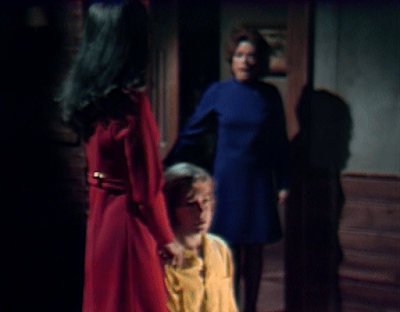
Today, Roger tells Liz and Julia that he heard Carolyn’s scream, ran to the tower room, and found her stabbed to death. Presumably the same man killed her who killed Angelique. The three current suspects are Roger himself, Quentin, and butler Mr Trask.

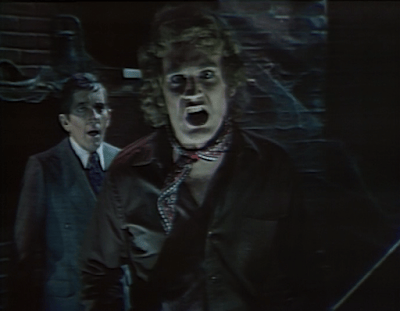
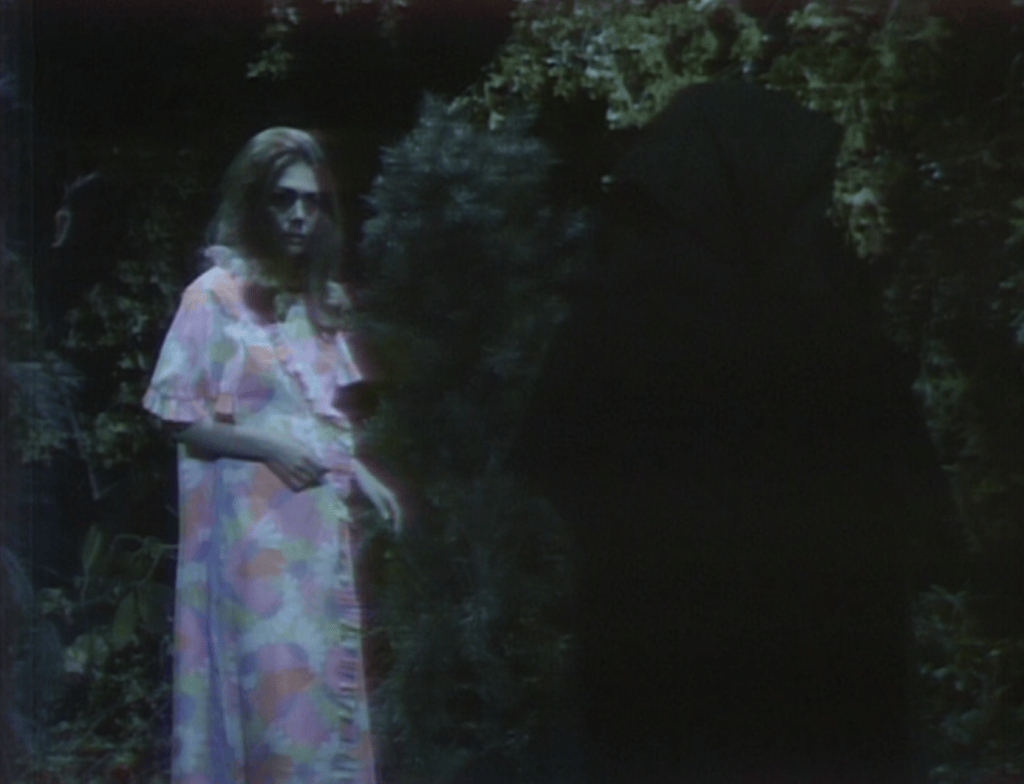
Yesterday’s episode hinted heavily that Trask was the culprit, and Liz says that he has been missing since Carolyn was killed. We had not seen or heard of Trask in more than eight weeks, and in none of the handful of episodes in which he appeared before that hiatus was it suggested he might have killed Angelique. If it does turn out that the butler did it, therefore, it would be obvious that the show had originally planned to pin the crime on a major character and chickened out at the last minute. We do see a man lurking about today who might be Trask and almost certainly is the mysterious and terrible “Claude North” whom we have heard about recently; if Trask and North are one and the same, that might lead somewhere, but it would hardly be a logical culmination of what we have seen so far.

The whole point of the “Parallel Time” segment is to reconceive Quentin. Making him the killer of Angelique might fit with that. The Quentin of the main continuity murdered his wife Jenny in 1897,* and Angelique is much less sympathetic than Jenny was. Quentin does not have to be admirable, or even defensible. He just has to be attractive. If they can find a way to occasionally make his vices into motives for good deeds, all the better. But Carolyn’s counterpart in the main continuity has been a central figure on the show since the first week, and like all characters played by Nancy Barrett she is a fan favorite. If this Quentin deliberately kills Carolyn, especially by hacking her to bits with a kitchen knife, it is hard to see how the Quentin of the main continuity will benefit. It is true the present Quentin is such a gloomy sourpuss and such a miserable failure as a husband to Maggie that he has already alienated the audience, so they might have decided they had nothing to lose by turning him into Jack the Ripper.

That leaves Roger. He has been painted in the colors of his counterpart as he was in 1966, making him a possible murderer. Even at his coldest, the Roger of the main continuity was close to Carolyn, whom he called “Kitten.” But when we first saw the characters from the current universe in #975, they were hostile and impatient with each other, and Roger took a menacing tone with his niece. The only person for whom this iteration of Roger has any affection is Angelique, and all of that flows to a version of her that exists only in his imagination. Roger seems to be describing himself in both universes when he tells Liz that “The sum total of my life seems to be that I can never help anyone.” So we can certainly believe he killed both Angelique and Carolyn, and that he might kill again.

Liz and Roger’s counterparts have been on the fringes of the action in the main continuity for years, and today we see that this Liz and Roger are also excluded from much that is happening. They visit the Collins family mausoleum in the old cemetery north of town scouting out potential resting places for Carolyn. Unknown to them, there is a hidden chamber in the back of this mausoleum, and Claude North is lurking there, a dagger in his hand, while they chat in the publicly visible part. They then go to Carolyn’s home, the Old House on the grounds of Collinwood, to look for anything she might have written that would give a clue as to who killed her. Unknown to them, Julia is in the basement of the house, conducting a mad science procedure to weaken Angelique by reviving a woman named Roxanne on whose “life force” she is feeding. One wonders where else they will stop on their way home, and of what other uncanny doings they will be oblivious while there.

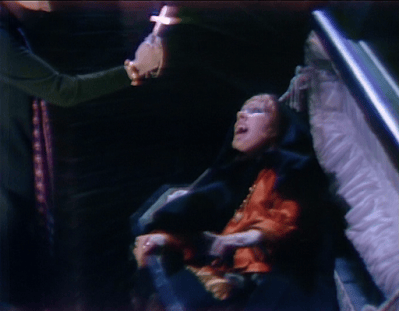
We hear Julia’s thoughts as she is preparing to revive Roxanne. She tells herself that this is the procedure that brought Adam and Eve to life. She is not thinking of some obscure midrash about the book of Genesis, but about two Frankenstein’s monsters she loosed upon the world in 1968.

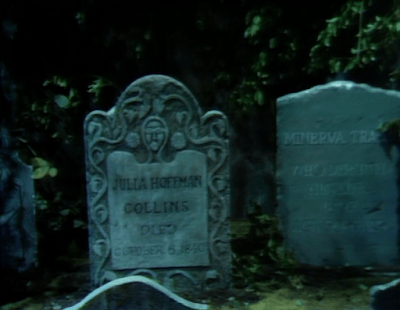
*Jenny must have been in someone’s mind when they were making this episode. We catch a glimpse of a gravestone in her name during a cemetery scene:

Poor Jenny, bright as a penny. Screenshot by Dark Shadows Every Day.

Episode 1047: Extraordinary enemies

Evil wizard Tim Stokes combined medicine with black magic to connect his late daughter Angelique with a woman named Roxanne. The connection drains most of the “life force” from Roxanne into Angelique. This rendered Roxanne comatose and allowed Angelique to move among the living so long as Roxanne neither dies nor gets even a tiny bit better.

Vampire Barnabas Collins and mad scientist Julia Hoffman are interlopers from another dimension. They know what Stokes has done and want to defeat Angelique. They made off with Roxanne and were keeping her in the Old House on the grounds of the estate of Collinwood, planning to use some mad science equipment to revive her. Roxanne did perk up after the first treatment, and Barnabas took her on a date to his favorite place, the old cemetery north of town, where she showed some signs of recognizing her surroundings.

Yesterday, Stokes went to the Old House to search for Roxanne while Barnabas was out. When Barnabas got home, Roxanne was nowhere to be found. We learn today that Stokes does not have her. He turns to a man named Claude North for help in finding her. Yesterday he told Angelique that he was most reluctant to contact North; only after an incantation calling upon all the spiritual forces of darkness fails to solve their problem does he consider turning to him. He told Angelique that North was no ordinary man, and he is evidently more unpleasant to deal with than are Satan and his minions. But he answers when Stokes picks up the telephone and calls him.

Barnabas is also familiar with “Claude North” as the name of someone linked to Roxanne. He found a drawing of her signed by North in the secret chamber in the back room of the mausoleum in the cemetery. He goes back to the cemetery twice tonight. The first time, he goes into the secret chamber and finds evidence that a man with the initials “CN” has been staying there. He takes this as confirmation that it is Claude North’s roost. It does not seem likely that it is North’s only residence, since there is no sign of a telephone there. Stokes is spying on Barnabas while he does this. He is disturbed that Barnabas knows about the secret chamber, and wonders if he has been keeping Roxanne there.

Barnabas goes back to the Old House and finds Stokes talking with the lady of the house, Carolyn Loomis. Angelique killed Carolyn’s husband Will the other day because he would not reveal Barnabas’ secret, and Carolyn has been drinking steadily ever since. Barnabas tells Stokes that since he has extended his condolences to Carolyn, he can leave now. Stokes takes his time about going. He says that Will thought that Barnabas might have a girl someplace. “Is he right, Mr Collins? Do you have a girl someplace?” Thayer David delivers this line with an urgency that elevates it from mildly clever to almost brilliant. Jonathan Frid responds with a slow burn that brings the exchange to perfection. Barnabas knows that Stokes neither has Roxanne nor knows that he does not have her, but he also knows that Stokes, as a native of this universe, is likelier to find her than he is.

“Do you have a girl someplace?” Screenshot by Dark Shadows Before I Die.

Barnabas goes back to the cemetery and finds Roxanne there. She is kneeling at a gravestone. It marks the grave of Claude North, who lived from 1814 to 1866.

In his own world, Barnabas was trapped in the counterpart of the secret chamber in the mausoleum for 171 years. So regular viewers think of that chamber as a place for vampires. North’s tombstone suggests that he might be such a creature.

Moreover, the drawing of Roxanne evokes Charles Delaware Tate, an artist who was a character on the show in 1969. Tate had the magical power to bring people to life by drawing them. He became obsessed with a woman he created in that way. As my wife, Mrs Acilius, points out, Tate’s erotic preoccupation with a product of his own imagination is as much a metaphor for extreme selfishness as is the vampire. So if the answer to the question of Roxanne’s origin is that she sprang into being as the result of North’s drawing of her, it would only be appropriate if North were also a vampire.

There is a scene in the room on top of the tower at the great house of Collinwood. Carolyn goes there and looks at the window from which Will fell to his death. To her surprise, sourpuss Quentin Collins enters the room. Quentin is a fugitive from justice, having assaulted a policeman and fled from jail because he was under arrest for murder. He makes menacing remarks demanding her silence; she’s so drunk that it doesn’t seem likely she will remember he was there. In the other continuity, the Collinses had a habit of using the tower room, which is entirely enclosed in windows that can be seen from every part of the estate, as a hiding place; we can see that their counterparts here maintain the same self-defeating tradition.

Episode 1046: Such a fearful unreality

Writer Gordon Russell takes bits of old episodes and mixes them as if he were rotating a kaleidoscope. There is a plot involved also, but the screen iconography is the main thing.

The show has been operating on the principle of the kaleidoscope for some time. They’ve traveled back in time repeatedly. Now they have traveled sideways in time and taken us to an alternate universe, which they insist on calling “Parallel Time.” Each of these segments represents a turn of the kaleidoscope, rearranging the actors, sets, musical cues, curse stories, imaginary geography of the estate of Collinwood and village of Collinsport, and other elements to create new patterns that shed unexpected light on familiar material.

Evil wizard Tim Stokes has used a combination of black magic and medical science to establish a remote connection between a woman named Roxanne and his late daughter, Angelique Stokes Collins. This connection drains the “life force” from Roxanne into Angelique, reanimating her and leaving Roxanne comatose. To sustain this circumstance, Roxanne must remain in precisely her current condition. If she dies, all of her “life force” will vanish, returning Angelique to the tomb. Whenever she recovers even a tiny bit of her lost strength, Angelique collapses, possibly to die.

Vampire Barnabas Collins and mad scientist Julia Hoffman are visiting from the main continuity, and they are determined to stop Angelique’s evil plans. They have learned what Stokes has done, and have taken Roxanne into their own custody. As we open, Julia has just given up on an attempt to revive Roxanne and gone back to the great house at Collinwood, where she is impersonating her own Doppelgänger, the housekeeper. This woman, also named Julia Hoffman, was Angelique’s most fanatical devotee until Julia killed her, stole her French maid outfit, and assumed her identity.

Alone with Roxanne in the secret room behind the bookcase in the front parlor of the Old House on the grounds of the estate, Barnabas gives a soliloquy about his feelings for her. She opens her eyes and sits up.

In the spring of 1968, Julia took charge of an experimental procedure another mad scientist had devised to free Barnabas of his vampirism. The core of this procedure was the creation of a Frankenstein’s monster named Adam. In #490, Julia ran the apparatus and was disappointed when Adam seemed still to be inanimate. She and Barnabas left the lab, and Adam came to life. Her disappointment and departure are repeated in this scene, though Barnabas is there to see Roxanne open her eyes.

When Roxanne comes to, we cut to the great house and see Angelique collapse. She crawls around on the floor, trying to make her way to a telephone. This action is shown in quick cuts, but not quite quick enough. It is so much the sort of melodramatic business that was overdone in movies in the 1940s and 1950s and parodied in sketches on The Carol Burnett Show in the 1960s and 1970s that it raises a bad laugh.

Barnabas takes Roxanne out of the secret room, to the parlor. He finds that she cannot speak. He shows her a drawing of her that he found in another secret room, the chamber in the back of the Collins family mausoleum in the old cemetery north of town. It is signed “Claude North.” Roxanne reacts to the drawing with delight and to the name “Claude North” with dismay.

In the summer of 1969, the show was set in the year 1897. One of the characters we got to know in that year was the mysterious Amanda Harris. It turned out that Amanda had popped into existence when an artist thought her up and made a sketch of her. This artist, a repellent little man named Charles Delaware Tate, had no idea he was endowed with the power to bring his fancies to life by drawing them until he met Amanda, at which point he developed an exceedingly unpleasant obsession with her.

Roxanne’s origins are at this point as unknown to us as Amanda’s were when we first got to know her. So the drawing will suggest to longtime viewers that “Claude North” will turn out to be this universe’s version of Tate. When Stokes tells Angelique that he might be able to bring Roxanne back by contacting North, the thought of having further dealings with the man is abhorrent to him. Like Roxanne’s own display of distaste at North’s name, that fits with the idea that he might be a version of the loathsome Tate.

In the great house, Maggie Collins, current wife of Angelique’s widower Quentin, finds Angelique crawling on the floor and picks up the telephone to call the doctor. Angelique says that she needs her father, not the doctor, puzzling Maggie. While they contact Stokes, Barnabas takes Roxanne to the mausoleum and shows her the secret room in an attempt to restore her memory and her power of speech.

In #283, the original continuity’s version of Maggie was a mental patient at Windcliff, a private hospital Julia controls. She had succumbed to amnesia, reverted to early childhood, and become largely nonverbal after an ordeal as Barnabas’ victim. In that episode, Julia took Maggie on a trip to the mausoleum, where Barnabas had tortured her, in an attempt to restore her memory and power of speech. Now, the relatively benevolent Barnabas is taking Roxanne to this universe’s version of the same location in the same hope.

Stokes attends to Angelique in her room. He gives her some medicine to keep her alive until they can find Roxanne. He warns her that if Roxanne manages to speak, her first word will send Angelique back to the grave. He performs an incantation to summon the spiritual forces of darkness to come to their aid. When Mrs Acilius and I were watching this on Amazon Prime, Stokes’ incantation was interrupted by an ad for Chipotle. I’d always thought calling on the Devil and his minions was likelier to bring Taco Bell upon you, but I don’t suppose Chipotle is all that different.

Stokes DoorDashes Chipotle. Screenshot by Dark Shadows Before I Die.

During the 1897 segment, we saw a new version of a character from an earlier phase of the show, undead blonde fire witch Laura Murdoch Collins. That iteration of Laura was a heat vampire who drained the warmth from the living to remain animated. They’ve given the current version of Angelique the same condition, though we haven’t seen it lately. In #737, Laura was in a bad way. She lay in bed and her thrall Dirk Wilkins cozied up to her in the most sex-like interaction we had seen on the show up to that point (or up to this point, come to that.) Angelique’s bedroom is laid out the same way today as Laura’s was then, and as Dirk was on Laura’s right, Stokes is on her right. Earlier episodes made it clear that there was something deeply weird about the relationship between Stokes and Angelique. In the contrast between this scene and the one between Laura and Dirk, longtime viewers can see that Angelique and Stokes’ particular weirdness does not involve incest per se. Rather, it is their shared dedication to evil for its own sake that warps everything between them.

Back in the Old House, Barnabas puts Roxanne to bed on her table in the secret room. He goes into the parlor. A car pulls up. It is Carolyn Loomis, wife of his late blood thrall Will Loomis. Carolyn chatters happily about some shopping she did and asks for Will. Barnabas realizes she does not know that Will has died. He breaks the news to her. He says that Angelique killed him, which is part of the truth. Carolyn says it is because of Barnabas that Will was killed, which is the other part of the truth. Barnabas seems to have a whole speech prepared about how he will avenge Will’s death by defeating Angelique, but Carolyn keeps interrupting to ask who will avenge it by defeating him

Elsewhere in the 1897 segment, Barnabas’ enemies had killed his blood thrall Sandor Rákóczi. In #798, Sandor’s wife Magda blamed Barnabas for her husband’s death. She told him she would avenge Sandor by killing him. She then despaired of that and offered herself to him as his next victim. Barnabas grandly replied, “No, Magda, you will not kill me, and I will not harm you. We will grieve together.” Carolyn does not allow Barnabas to speak so loftily.

Carolyn goes to the great house. She is just about to reveal Barnabas’ secret to Maggie when Barnabas himself shows up. While he defuses the situation, Stokes realizes that the Old House is vacant. He slips out to search for Roxanne there. When Barnabas returns, Roxanne is nowhere to be found.

It may seem unlikely that the show will resolve this cliffhanger in the obvious way, by showing us that Stokes took Roxanne from the secret room. They usually go for surprise. Nonetheless, longtime viewers will be inclined to expect this to happen, even though it is so on-the-nose. This room was first seen in #113, when crazed handyman Matthew Morgan opened it as a dungeon for well-meaning governess Victoria Winters. Not even Vicki’s charge, strange and troubled boy David Collins, knew of the room’s existence, and David knew the Old House better than any other character on the show at that point. The room is therefore uniquely Matthew’s territory.

Like Matthew, Stokes is played by Thayer David. Stokes’s ancestor was eighteenth century indentured servant Ben Stokes, whose counterpart we saw in the 1790s segment as a commentary on Matthew, an example of the good and sane man Matthew might have been had he not grown up in the shadow of the ancient curses of Collinwood. Once those curses had been in operation for a little while, Ben started turning into Matthew. As Matthew inadvertently killed a man because of his unbounded devotion to matriarch Elizabeth Collins Stoddard, Ben inadvertently killed a man because of his unbounded devotion to Barnabas. As Matthew set out to cover up his accidental homicide by killing Vicki, who was played by an actress whose father was a Danish count, so Ben deliberately committed a murder to cover up his own accidental killing, and his victim was a lady with the title “Countess.” As a descendant of Ben and therefore a reflection of Matthew, it is a matter of course that Stokes knows about the room. Barnabas’ decision to hide Roxanne in the room is just one more case of a severe misreading of Dark Shadows by someone who didn’t watch the 1966 episodes.

Episode 1039: This is the body

Dark Shadows spent yesterday and the day before showing us how much her relationship with vampire Barnabas Collins has cost Dr Julia Hoffman. Once a superlatively capable, masterfully poised scientist, Julia has become so ragged and dependent that she reacts to the sight of Barnabas rising from his coffin with a puppyish delight. She has followed him into an alternate universe, cutting herself off from everyone she knows and everything she has. Once in that universe, her first act was to kill her own Doppelgänger, leaving her face to face with a dead version of herself. She has set out to gather intelligence that might help Barnabas in his madcap schemes by impersonating that Doppelgänger, who was the housekeeper at the great house of Collinwood. In that persona, she wears a French maid outfit and disclaims all of her professional and educational attainments. Yesterday, Barnabas was briefly impressed by how much Julia had sacrificed for him; for a second or two, it looked like her love for him might be requited, at least to the extent of one kiss. But he turned his attention elsewhere, and now they are busy on a monster-slaying expedition.

The monster is Angelique Stokes Collins, undead first wife of foul-tempered sourpuss Quentin Collins, master of Collinwood. Angelique’s father, a wizard known as Tim (but he’ll always be “Stokes” to us,) has somehow established an invisible connection between her and a woman he keeps in the back room of his apartment. We learn in the closing credits that this woman’s name is Roxanne. Roxanne is in a coma. Stokes has drained most of Roxanne’s “life-force” into Angelique. Occasionally Roxanne perks up a bit and regains some of her strength. When this happens, Angelique weakens. If Roxanne gets too vigorous, Angelique will die, but that will also happen if Roxanne herself dies. Stokes keeps busy trying to maintain Roxanne in her precise state of debility.

We find Julia and Barnabas in the room with Roxanne. They have learned the secret and come here to kill Roxanne, finishing off Angelique. They talk for a moment about Stokes, who is likely to find another way to revive Angelique if they kill Roxanne. They imply that they will kill him, too. That raises a question. Yesterday Julia saw Angelique collapse and become altogether helpless when Roxanne gained just a tiny bit of strength. If they are going to kill Stokes anyway, why not do that first? Then they can neutralize Angelique by giving Roxanne a little TLC and drop her off at the hospital on their way back to their native universe.

Barnabas doesn’t think of that, but neither does he go through with the murder. He sees Roxanne, raves about her looks, and says in a world full of ugliness they have no right to destroy such beauty. Julia just keeps insisting that they finish her off, and says that if they don’t the blood of Angelique’s future victims will be on Barnabas. That is further evidence of what Julia has lost in her time at Barnabas’ side. Up to this point, she has consistently shown reluctance when he was planning a murder.

Barnabas says that he has never seen a face like Roxanne’s. He’s the only one. With her short red hair, pale skin, and strong chin, Roxanne looks very much like Julia. Indeed, the fans sometimes refer to Donna Wandrey as “Grayson Hall, Junior.” When we see the two together, we wonder if it will turn out that Roxanne is the daughter of the late housekeeper Julia Hoffman. It would be typical of Barnabas to reward Julia’s extreme devotion to him by forgetting all about her and chasing after a girl whose mother she might have been.

Meet Junior.

There’s also a lot of business today about two minor villains, sleazy musician Bruno Hess and high-born ne’er-do-well Roger Collins. Michael Stroka and Louis Edmonds were always fun to watch, but Roger and Bruno are absent and unmentioned for such long stretches that it is hard to believe that anything important is at stake in what they do. Like most of the characters, Bruno believes Angelique’s cover story that she is her identical twin sister Alexis. Acting under this impression, he smacks her around a couple of times. So we can see that he is going to be dead soon, though she will likely make him wish it were a lot sooner.

Roger announces that he has been named executor of the estate of the late Dr Cyrus Longworth. This means he will be coming into some money and perhaps learning some secrets. Quentin’s current wife, the former Maggie Evans, is lonely because her husband is a hopeless jerk. She tries to be friendly to Bruno, and he gets fresh. While he is grabbing her, Roger enters and sneers at Maggie.