Wicked witch Angelique has died, again. While she still dwelt among the living, Angelique locked Julia Hoffman up in a dungeon and left her to die of thirst. Julia’s buddy Barnabas Collins and a dimwitted policeman called Inspector Hamilton are looking for her. She is struggling to stay awake. The episode devotes so much time to a go-nowhere story about a non-character named Roxanne that we can sympathize with this struggle.
Julia nods off just as Barnabas and the inspector pass by the hidden wall of her dungeon. She does not hear them, and by the time she wakes up and starts calling out they are gone.
While asleep, Julia has a dream in which Barnabas and Roxanne decide that she must be dead. They are going to leave for the alternate universe from which Julia and Barnabas originally came. Julia has given up everything in her life to help Barnabas, and she has an unrequited love for him. For his part, Barnabas has conceived a mad passion for Roxanne, who is young and pretty but has no personality. Roxanne’s short red hair, pale complexion, and strong chin make her look like she could be Julia’s daughter. Indeed, when first we saw her it seemed likely she would be revealed to be the daughter of Julia’s counterpart in this universe. Barnabas is so thoughtless about throwing other women in Julia’s face that it would be like him to cast her aside for the daughter she might have had, Grayson Hall would have done a great job playing the anguish this would have inflicted on Julia, and it would have given Donna Wandrey something to work with as Roxanne. It’s a shame they didn’t run with it.
This is Colin Hamilton’s final appearance as Inspector Hamilton. It is always a bad sign when writers give a character the actor’s name; it suggests they don’t trust him to answer to anything else. They may have been right about Colin Hamilton. He will be back as a doctor in #1219. That is the only episode of Dark Shadows of which no video survives. There is an audio recording, so we can hear that Hamilton delivered the doctor’s dialogue in the same bored, impatient tone he used for the inspector.
Wicked witch Angelique Stokes Collins has cast a spell on Maggie Collins, compelling Maggie to shoot her husband Quentin. Angelique herself dwells among the living because of another spell, one cast by her father, a wizard known as Tim. This spell drains the “life force” from a woman named Roxanne into Angelique, revivifying her after Quentin’s brother Roger drove a hatpin into her brain nine months ago. Angelique has kept her identity secret, in part because Quentin and a friend of his had a panic attack some time ago and destroyed her coffin, keeping the physical evidence from telling its tales. They were two loonies, quelling caskets.
Occasionally Roxanne manages to reclaim enough of her “life force” to make Angelique weak and cold. When this happens, Angelique can perk herself up by hugging a man and kissing him, thereby making all of his body heat flow into her, leaving him an icy corpse. The kiss appears to have become essential to this transfer; her kissing equates coolness. Yesterday she gave Roger this treatment, avenging her own murder.
The spell on Roxanne will break when she speaks, and her pushy ex-boyfriend Claude is about to make her do that. So Angelique has only moments to live. Quentin is on the run from the law, charged with the murder of a man named Bruno. Angelique’s enemy, Barnabas Collins, demands she sign a confession admitting that Bruno was actually killed by a spell she cast using a cravat of his. Quentin is innocent in these loose necktie squallings.
Angelique refuses to sign any such document. Later, Barnabas will tell the whole story to a police inspector whose incredulous response makes it clear that it would not have persuaded anyone had she done so. More urgent is a question he puts to her about the whereabouts of his faithful companion, Julia Hoffman. Angelique has locked Julia in a dungeon and left her to die of thirst. The door to this chamber swings shut silently, and apparently it does not let Julia’s cries for help be heard outside. Many of the places of confinement we have seen on Dark Shadows are the looniest squeaking cells you could imagine, but this one is grimly soundproof.
Roxanne speaks and Angelique dies, defiant to the end. Cloaking queenliest loss, her refusal to bend invests the character with a perverse grandeur.
Barnabas remembers an Angelique who lived on the island of Martinique. For him, all the other Angeliques are just successors to what she brewed up there, Antilles cooking sequels, as it were. Screenshot by Dark Shadows Before I Die.
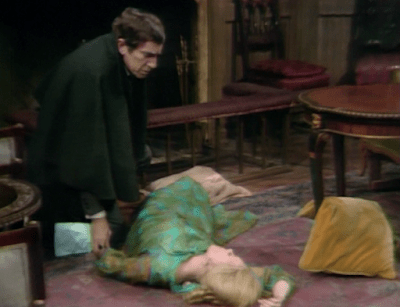
With Angelique’s death, her spell over Maggie breaks. Maggie collapses and drops the revolver she had trained on Quentin. One of the themes of the show has been that a person who casts a spell creates an alternate version of herself and that version takes possession of the person against whom they direct it. Lara Parker and Kathryn Leigh Scott play Angelique and Maggie’s collapses in the same way; seeing these back to back, we cannot miss the point that what we are really seeing is the simultaneous death of two Angeliques. Sometimes the alternate selves created by the spells outlive the spellcaster, and there is no telling where they will drive the victim. The accursed who wander about the earth, whether they became vampires like Barnabas or zombies like his uncle Jeremiah, are lockless antique legions, unrestricted in their physical movement, unlimited in the duration of their afflictions, uncounted in their numbers.
Miffed that Maggie pointed a gun at him, Quentin leaves the room. He finds Barnabas, who explains everything that has been going on. Quentin goes back to Maggie. She says that she realizes he could never love her or any other woman as he loved Angelique when she was alive. He tells her he never loved Angelique, but that he “hated the ground she walked on” and never shared a happy day with her because she was so cruel to him when they were married. When the same scene played out between Maxim de Winter and his second wife in Daphne Du Maurier’s Rebecca and in Alfred Hitchcock’s film based on the novel, we could take it as grounds for hoping that their marriage would take a turn for the better. But Quentin seems never to have loved Maggie, and we have never seen them share a happy day. They speak lovely words as they embrace; kissing allots eloquence. But Quentin’s declaration that he wasn’t any happier in his first marriage than he has been in his second comes only as confirmation of our suspicion that things will only go from bad to worse as long as he and Maggie stay together.
Barnabas and the inspector look for Roxanne. They don’t find her, and the inspector dismisses Barnabas’ whole story. The law moves a lot faster in Soap Opera Land than it does in our world, but only the looniest legal quickness could get Quentin out of trouble in the time that seems to be remaining in this storyline. Later, the inspector catches up to Quentin and arrests him, and Barnabas finds Claude stabbed to death in the woods.
This episode marks the final appearance of Angelique Stokes Collins. Lara Parker, that member of the queenliest looking class, will be back later as another witch named Angelique. It is also the final appearance of actor Brian Sturdivant and of the character Claude North. Sturdivant’s performance has many problems, most obviously his wildly uncertain accent. At times he manages to enunciate a few words in the old “mid-Atlantic accent” stage performers were trained to use in the first half of the twentieth century, but he never keeps it up for a whole line.
The police are looking into the murder of Angelique Stokes Collins. Angelique has risen from the grave and is available to assist with the investigation, though Inspector Hamilton, like most of the other people in the village of Collinsport and on the estate of Collinwood, thinks she is her identical twin sister Alexis.
Hamilton is impatient with everyone, a bad quality in an investigator. So when he accuses “Alexis” of helping Angelique’s widower Quentin to burn Angelique’s body in order to cover up evidence that Quentin murdered her, she responds with a more or less true account of what happened, omitting only that it was Alexis’ body Quentin burned. Hamilton cuts her off in mid-sentence, proclaiming that he won’t listen to any more of it.
Hamilton was once a close friend of Julia Hoffman, the housekeeper at the great house on the estate and Angelique’s most fanatical devotee. What neither he nor Angelique knows is that Hoffman is dead. Her Doppelgänger has come from an alternate universe, killed her, and assumed her identity. This other Julia Hoffman is working in concert with another interloper from the same universe, vampire Barnabas Collins, to defeat Angelique and end her presence among the living.
Hamilton questions Julia about the night of Angelique’s death. That was many months ago and Hoffman was not present at the scene, so Julia is able to fake her way through the questioning without major slips. But when Hamilton starts talking about old times, Julia is at a total loss. Hamilton mentions to “Alexis” that she does not seem like the Julia Hoffman he knows. Since Angelique has begun to notice differences in Julia’s behavior from what she would expect of Hoffman, this indiscreet remark represents a considerable danger to her.
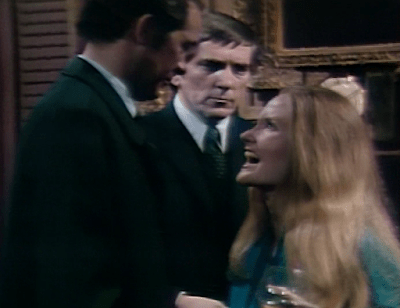
At the Old House on the estate, Hamilton questions Carolyn Loomis. Carolyn’s husband was caught between Angelique’s powers and Barnabas’ the other day, and all he could do to resolve the strain was to fling himself to his death from a high window. Carolyn is hugely drunk. She raves at Hamilton that “Collinwood is not exactly a picture book house by the sea. There’s a skeleton in every closet, and there are a lot of closets, baby! Let me put it this way, Inspector- Collinwood is a nice place to visit, but you would not want to live there.” He seems to regard this as the sort of unseemly thing it is best to pass over in silence.
Carolyn is not overawed by the dignity of Hamilton’s badge. Screenshot by Dark Shadows Before I Die.
There are several strong hints today, as there have been over the last couple of weeks, that Carolyn’s uncle Roger Collins murdered Angelique. They can drop as many hints to that effect as they like, and longtime viewers will still be surprised if it turns out to be true. For its first 196 weeks, Dark Shadows was set in the universe from which Julia and Barnabas came. Roger’s counterpart there was indeed a potentially deadly villain in the first months of the show, but he was eventually nerfed. By the time we decamped for this continuity, it had been more than three years since he was a menace to anyone. They’ve been painting this character in the colors of the 1966 Roger, and his languidly sarcastic manner combines with his relationship to the portrait of Angelique to remind us of Waldo Lydecker in the 1944 film Laura. But we saw so much of Roger the harmless gay uncle in 1967 and Roger the conscientious family man in 1968 and 1969 that it is still hard to imagine that he will turn out actually to be a killer.
The show was done live to tape for years, and even after post-production editing became an important part of it they were slow to credit the videotape editors. They’ve been making up for that lately, though. Today they credit their fourth pair of editors, Alex Moskovic and Rene Labat. Still other teams will be named in the weeks ahead, but Moskovic and Labat are the last ones I will mention here, unless there is something special about the cutting of a given episode.
From its first episode, one of the principal sets on Dark Shadows has been the drawing room of the great house of Collinwood. So every violent death on the show has been pregnant with the possibility of a scene in which the characters gather on that set and a detective says that he supposes they are probably wondering why he asked them to join him there. We come as close to that scene today as we ever will.
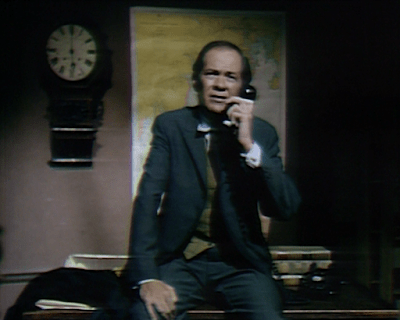
The detective is Inspector Hamilton of the Collinsport police. That is itself a disappointment to regular viewers. In #1034, a detective played by Philip R. Allen made an appearance. He had little to do, but Allen was such a dynamic actor that it was gripping to watch him do it. When we heard that the police were on their way, we might have been excited to see Allen again. Inspector Hamilton is played by Colin Hamilton. It’s always a bad sign when the producers don’t trust an actor to answer to any name other than his own, and Hamilton’s performance is a case in point. The only note he strikes today is languid annoyance. Perhaps he had watched the Thin Man movies and been impressed by the use William Powell and Myrna Loy made of that note in their portrayals of Nick and Nora Charles in their drawing room reveals, but if so he had forgotten that Powell and Loy did other things as well.
Making matters worse, Inspector Hamilton does not actually have much to contribute. Sleazy musician Bruno Hess gave him photostats of a couple of pages of the journal of the late Cyrus Longworth, homicidal maniac, in which Cyrus speculates that his friend Quentin Collins murdered Angelique, his first wife. But Cyrus did not see Quentin commit that crime, so the papers are in no sense evidence.
Quentin gets very angry with Bruno. Standing next to Inspector Hamilton, he declares that Bruno will never make trouble for him again and that he will put a stop to him “with my bare hands!” He then rushes out of the house. At length, Inspector Hamilton moseys over to Bruno’s place.
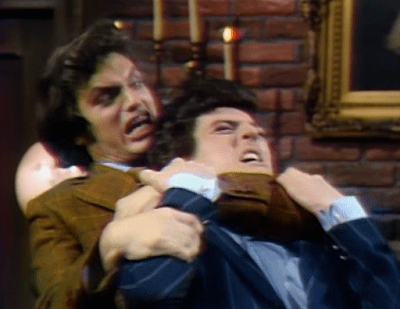
The camera gets there before Inspector Hamilton does. We find Quentin crushing Bruno’s throat in his elbow. He releases him and shouts that he isn’t “worth killing!” A moment later, Bruno starts choking and falls to the floor. Quentin ridicules him, then kneels down and finds that he really seems to be unconscious. Inspector Hamilton then enters and says that he hopes for Quentin’s sake that Bruno isn’t dead. This line is a bit surprising; it would have fit with Colin Hamilton’s lazy performance had Inspector Hamilton said that he hopes Bruno is alive so he won’t have to stay up late doing paperwork.
As it happens, Angelique has returned from the grave and is impersonating her identical twin sister Alexis. None of the other characters in today’s episode are onto her. We see her flash a self-satisfied grin every time Quentin annoys Inspector Hamilton by proclaiming his intention of killing Bruno. We also see her cast the spell that causes Bruno to choke and die.
Bruno’s death is no great shock. He smacked Angelique around yesterday, a sure sign of a short and unhappy future, and had been absent from the action and unmentioned on screen for more than six weeks before he came back on Tuesday. Actor Michael Stroka will be back later as another character.
Angelique could be fairly sure that Quentin was in Bruno’s cottage and that Inspector Hamilton was on his way there when she was casting the spell, but she has no powers of remote viewing. For all she knew, Quentin may have been choking Bruno while she was casting the spell. Had that been the case, we would have been presented with a puzzle in logic. Bruno would have died of strangulation while Quentin was strangling him, but there would be a sense in which we could say that Quentin was not the strangler. That sense might not have made much difference to Quentin’s felony exposure, though Angelique would also be guilty of the killing.
This scenario should remind viewers who have been with the show from the beginning of the first murder mystery on Dark Shadows, the vehicular homicide of a man known only as Hansen. Hansen was walking by the road one night in 1956 when a car hit him and continued on. The owner of the car, Burke Devlin, was convicted of manslaughter and sent to prison for five years. It later turned out that Burke had been blacked out drunk when he started driving the car away from a restaurant, and that he gave the keys to his passenger, Roger Collins, after they had gone some way. Roger was also heavily intoxicated, and he was behind the wheel when the car hit Hansen.
Burke claimed that Roger’s role in Hansen’s death exonerated him of guilt. But since Burke knew that Roger had had as much to drink as he had, handing the keys to him was scarcely more responsible than operating the vehicle himself. Indeed, by the time of the collision Burke had passed out, so if he had kept the keys the car would not have been moving and Hansen would have had nothing to fear. The fact that Roger was also guilty of a crime does nothing to clear Burke. Remembering that, we may wonder whether Angelique’s participation really clears Quentin.
The version of Quentin that became a major breakout hit was the one we saw in 1969, when the show was a costume drama set in the year 1897. That Quentin had all of the vices Roger had in 1966, and like Roger was witty and full of joie de vivre. The easygoing 27 year old David Selby had a sex appeal that reached young viewers who did not respond to Louis Edmonds in that way, and the show was free to make villains into permanent parts of the cast of characters at that point, so Quentin became what Roger might have been.
After the show returned to a contemporary setting in late 1969, it struggled to find a place for Quentin. Now they have crossed over into an alternate universe, and they have dabbled with the idea of turning his counterpart into an action hero like Burke. That hasn’t worked at all, but then Burke’s own arc of development fizzled out, so I suppose we can say that Parallel Quentin really is a mashup of Burke and Roger.