Episode 1040: Probably wondering

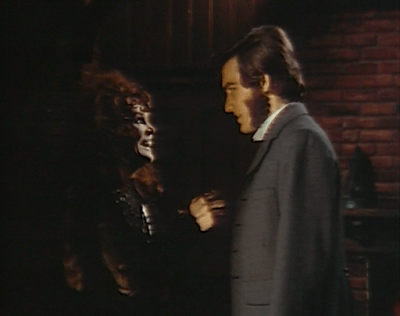
From its first episode, one of the principal sets on Dark Shadows has been the drawing room of the great house of Collinwood. So every violent death on the show has been pregnant with the possibility of a scene in which the characters gather on that set and a detective says that he supposes they are probably wondering why he asked them to join him there. We come as close to that scene today as we ever will.

The detective is Inspector Hamilton of the Collinsport police. That is itself a disappointment to regular viewers. In #1034, a detective played by Philip R. Allen made an appearance. He had little to do, but Allen was such a dynamic actor that it was gripping to watch him do it. When we heard that the police were on their way, we might have been excited to see Allen again. Inspector Hamilton is played by Colin Hamilton. It’s always a bad sign when the producers don’t trust an actor to answer to any name other than his own, and Hamilton’s performance is a case in point. The only note he strikes today is languid annoyance. Perhaps he had watched the Thin Man movies and been impressed by the use William Powell and Myrna Loy made of that note in their portrayals of Nick and Nora Charles in their drawing room reveals, but if so he had forgotten that Powell and Loy did other things as well.

Making matters worse, Inspector Hamilton does not actually have much to contribute. Sleazy musician Bruno Hess gave him photostats of a couple of pages of the journal of the late Cyrus Longworth, homicidal maniac, in which Cyrus speculates that his friend Quentin Collins murdered Angelique, his first wife. But Cyrus did not see Quentin commit that crime, so the papers are in no sense evidence.

Quentin gets very angry with Bruno. Standing next to Inspector Hamilton, he declares that Bruno will never make trouble for him again and that he will put a stop to him “with my bare hands!” He then rushes out of the house. At length, Inspector Hamilton moseys over to Bruno’s place.

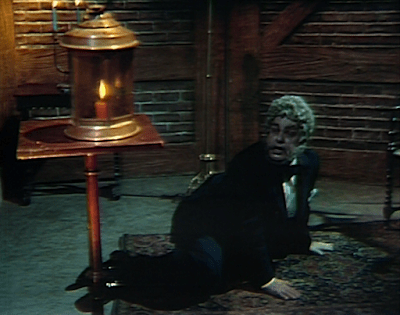
The camera gets there before Inspector Hamilton does. We find Quentin crushing Bruno’s throat in his elbow. He releases him and shouts that he isn’t “worth killing!” A moment later, Bruno starts choking and falls to the floor. Quentin ridicules him, then kneels down and finds that he really seems to be unconscious. Inspector Hamilton then enters and says that he hopes for Quentin’s sake that Bruno isn’t dead. This line is a bit surprising; it would have fit with Colin Hamilton’s lazy performance had Inspector Hamilton said that he hopes Bruno is alive so he won’t have to stay up late doing paperwork.

As it happens, Angelique has returned from the grave and is impersonating her identical twin sister Alexis. None of the other characters in today’s episode are onto her. We see her flash a self-satisfied grin every time Quentin annoys Inspector Hamilton by proclaiming his intention of killing Bruno. We also see her cast the spell that causes Bruno to choke and die.
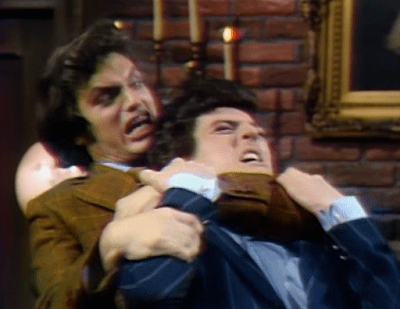
Quentin being innocent of strangling Bruno. Screenshot by Dark Shadows Before I Die.

Bruno’s death is no great shock. He smacked Angelique around yesterday, a sure sign of a short and unhappy future, and had been absent from the action and unmentioned on screen for more than six weeks before he came back on Tuesday. Actor Michael Stroka will be back later as another character.

Angelique could be fairly sure that Quentin was in Bruno’s cottage and that Inspector Hamilton was on his way there when she was casting the spell, but she has no powers of remote viewing. For all she knew, Quentin may have been choking Bruno while she was casting the spell. Had that been the case, we would have been presented with a puzzle in logic. Bruno would have died of strangulation while Quentin was strangling him, but there would be a sense in which we could say that Quentin was not the strangler. That sense might not have made much difference to Quentin’s felony exposure, though Angelique would also be guilty of the killing.

This scenario should remind viewers who have been with the show from the beginning of the first murder mystery on Dark Shadows, the vehicular homicide of a man known only as Hansen. Hansen was walking by the road one night in 1956 when a car hit him and continued on. The owner of the car, Burke Devlin, was convicted of manslaughter and sent to prison for five years. It later turned out that Burke had been blacked out drunk when he started driving the car away from a restaurant, and that he gave the keys to his passenger, Roger Collins, after they had gone some way. Roger was also heavily intoxicated, and he was behind the wheel when the car hit Hansen.

Burke claimed that Roger’s role in Hansen’s death exonerated him of guilt. But since Burke knew that Roger had had as much to drink as he had, handing the keys to him was scarcely more responsible than operating the vehicle himself. Indeed, by the time of the collision Burke had passed out, so if he had kept the keys the car would not have been moving and Hansen would have had nothing to fear. The fact that Roger was also guilty of a crime does nothing to clear Burke. Remembering that, we may wonder whether Angelique’s participation really clears Quentin.

The version of Quentin that became a major breakout hit was the one we saw in 1969, when the show was a costume drama set in the year 1897. That Quentin had all of the vices Roger had in 1966, and like Roger was witty and full of joie de vivre. The easygoing 27 year old David Selby had a sex appeal that reached young viewers who did not respond to Louis Edmonds in that way, and the show was free to make villains into permanent parts of the cast of characters at that point, so Quentin became what Roger might have been.

After the show returned to a contemporary setting in late 1969, it struggled to find a place for Quentin. Now they have crossed over into an alternate universe, and they have dabbled with the idea of turning his counterpart into an action hero like Burke. That hasn’t worked at all, but then Burke’s own arc of development fizzled out, so I suppose we can say that Parallel Quentin really is a mashup of Burke and Roger.
Episode 992: What form she has, I do not know

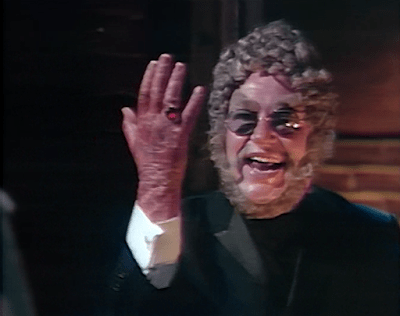
We meet Hannah Stokes, aunt of identical twins Alexis Stokes and Angelique Stokes Collins. Hannah is in the cottage on the grounds of the estate of Collinwood, home to sleazy musician Bruno Hess. When we first see her, Hannah is casting a horoscope. Later she reads tarot cards. Still later she sprinkles some bone meal on a stolen handkerchief and says an incantation over it. The point of all this mumbo-jumbo is to determine whether the blonde woman living in the great house on the estate is Angelique or Alexis. Since Angelique died six months previously, this question would seem to have an obvious answer, but Bruno and Hannah seem to know that death is seldom a major disability among characters on Dark Shadows.

Hannah laughs at Bruno, who shares her hairstyle but does not appreciate her talents.

Hannah goes to the great house to see her niece. Alexis hated Hannah, so if she is the woman she could be expected to receive the visit coldly. Angelique was close to her, but knew of Alexis’ attitude. So if she is the woman, she could be expected to behave in exactly the same way. Indeed, the episode began with Angelique’s son Daniel and her widower Quentin noticing little things Alexis did just as her sister would do them, prompting her to point out that they were raised by the same mother and picked up many habits from her. So if a resurrected Angelique is trying to imitate Alexis, she has enough material to work with that not even her aunt can tell them apart.

Hannah goes back to the cottage. None of her black magic answers the question of which sister is living in the great house, but she is sure that Angelique is present on the estate in some form, perhaps visible, perhaps ghostly. Bruno is convinced Angelique is present in her own form and using Alexis’ name. Quentin overhears their conversation and believes for a moment that Bruno is right, before talking himself out of it. Later, he and Alexis see Angelique’s piano playing itself in her old bedroom, and Alexis believes that Angelique’s ghost is playing it.

The most interesting thing about this episode is Paula Laurence’s turn as Hannah. Her whole performance today is an imitation of Lara Parker as Angelique. Laurence was such a different physical type from Parker I couldn’t put my finger on what she was doing until she was about to exit the cottage at the end of her first scene and she laughed at Bruno. She recreated the very distinctive laugh Parker uses as Angelique. At that, my wife and I simultaneously said “The same laugh!” From then on, it was impossible to miss the imitation. It comes across as a family resemblance, of a piece with Alexis and Angelique trimming plants the same way or humming the same tune while fluffing pillows.

The cottage is the place for spooky doings. We are in a different universe today than the one where the show was based for its first 196 weeks. In the main continuity, we first saw the cottage as the home of crazed handyman Matthew Morgan, who would be scared to death by ghosts. Matthew was succeeded as a resident of the cottage by undead blonde fire witch Laura Murdoch Collins. Laura was central to the storyline that picked up where the ghosts who killed Matthew left off. Most of the major narrative loose ends, such as the “Revenge of Burke Devlin” arc, were wrapped up as points within her story, while the ghosts were pulled out of the unseen back-world behind the action and brought into the spotlight. By the time Laura went up in smoke, the back-world of uncanny beings and the front-world of business stories and estranged spouses had reversed their places, and Dark Shadows had become a supernatural thriller.

The cottage was vacant for a long time after Laura. The next inhabitant was werewolf Chris Jennings. He was haunted there by the ghost of the main continuity’s counterpart of Quentin, who had lived and died in 1897. Quentin’s ghost seemed to have greater power in the cottage than elsewhere on the grounds of the estate. When the show traveled back in time to 1897, we found that Quentin and his fellow Satanist Evan Hanley had spent time there working black magic. At one point Quentin and Evan asked for a spirit to come from Hell to join them in an evil plan, and the one who appeared was Angelique’s counterpart, who like Laura was an undead blonde fire witch. Also in 1897, we learned that Quentin had been entangled with another iteration of Laura, and that the cottage had been one of their places.

Vague as Hannah’s findings are, they combine with Angelique’s iconography and that of the cottage to assure us that her ghost is active on the estate and that she will be returning in physical form. They are still keeping us guessing about how Alexis fits into all of that, but it seems more and more likely that she is at least sincere in her belief that she is not Angelique. Maybe she is an entirely separate entity who will eventually meet her reanimated sister, or maybe it will turn out that she and Angelique are inhabiting the same body. The spirits of the dead have been known to sublet space from the living on Dark Shadows, so that is one of many possible outcomes.

Episode 977: Before dawn

An information management day. Old world gentleman Barnabas Collins has told his distant cousin, Roger Collins, about a parallel universe that is occasionally visible in a room in the long disused east wing of the great house of Collinwood. Today, Roger tells his sister Elizabeth about the room. Liz owns the house. We might wonder if she will have questions about what effect the presence of a spare universe on the premises will have on her property taxes.

Roger talks about the phenomenon while standing in the room with permanent houseguest Julia Hoffman, MD. He is incredulous when he notices that Julia is not listening to him. She cannot tell him what has distracted her. Unknown to Roger and Liz, Barnabas is a vampire. Julia has devised a treatment that is supposed to put this curse in remission, but it is not working at all. She has given him the last of the injections, and the only difference in Barnabas is that he is getting sick and feeling an unusually intense bloodlust.

Caretaker Chris Jennings, another distant cousin, comes stumbling home to his cottage on the grounds of the estate. He finds his girlfriend and ex-fiancée Sabrina Stuart waiting for him. Chris is another patient Julia has been unable to help. He is a werewolf. There was a full moon last night. Sabrina tells Chris he killed a man named Bruno. Chris is distressed that he killed anyone, but Sabrina points out that Bruno knew of his secret and was trying to use him to kill others. He was holding her and a man named Rumson prisoner, and when the police searched Bruno’s premises after his death they found Sabrina and Rumson imprisoned there. Sabrina keeps telling Chris she wants to marry him. Most of the time they will live ordinary lives, but one night out of 28 she will just have to lock him up in a special cell. Chris won’t hear of this.

My wife, Mrs Acilius, is a great one for love stories and an admirer of actress Lisa Blake Richards. Chris and Sabrina have run out of road on Dark Shadows, and are obviously going to be written out soon. Mrs Acilius wishes they could ride off into the sunset accompanied by the sound of wedding bells. So when Chris refused to marry Sabrina, she exclaimed “Stupid man!” I pointed out something Chris knows but does not mention to Sabrina, that his curse is hereditary. Any male descendants he has will also be werewolves. Mrs A conceded that this does complicate matters.

Roger saw Chris at Bruno’s place when he rescued him and Carolyn shortly before moonrise last night. Chris was at that time in the throes that precede his transformation. Chris ran off before Roger or Carolyn could see what became of him. Roger comes to the cottage to check on him.

Chris is in the back changing out of his bloody clothes, so Sabrina answers the door. She tells Roger that Chris is there and that she was with him all night, watching over him because he was ill. After what he saw of Chris at Bruno’s, Roger has no doubt that Chris needed a nurse, and he tells Sabrina that he is glad he had such a charming one. The audience can understand that Sabrina wants to conceal Chris’ lycanthropy from Roger, but surely it cannot be wise for her to claim that she was in the cottage overnight. Not only are her true whereabouts known to everyone who was in or around the police station the night before, but since Roger was the one who found Bruno’s body and he found it on the grounds of Collinwood, even police as inept as the ones in Collinsport are likely to follow up with him. Besides, her imprisonment with Rumson is a sensational story, of interest to the press. Maybe we will move on to the next phase of the show before the facts come to light, but Sabrina can’t know that.

Sabrina is determined to persuade Chris to resume their engagement. She goes to the one person whose opinion Chris seems to respect, Barnabas. When she knocks on his door, Barnabas hides behind a partition. When Sabrina first arrived, she had seen Barnabas through the window of his front parlor, so she lets herself in. He finally gives up on hiding and pleads with her to leave. She ignores what he is saying and keeps talking. She plows ahead with her idea about how Barnabas can help her and Chris become a happy married couple. Barnabas struggles to resist his urge for blood, but cannot. He bites Sabrina, much to her surprise. Miss Richards’ understated exclamation of “Barnabas!” when he shows his fangs and goes for her neck is very nicely done, it really sounds like a woman puzzled that a trusted friend is violating her personal space.

Sabrina staggers back to Chris’ cottage. She collapses in his chair, and he sees the puncture wounds on her neck. They are much bigger than the marks we’ve seen on Barnabas’ previous victims. I suppose he really was a lot hungrier than usual. Chris doesn’t know that Barnabas is a vampire, and the cliffhanger leaves us wondering whether he can avoid finding out.

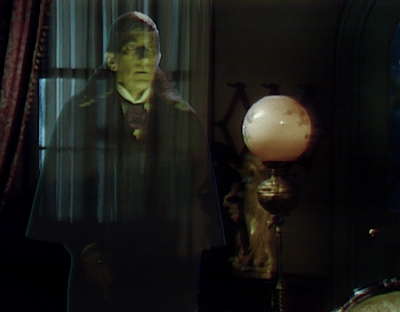
Probably the most memorable shot in the episode is a very impressive bit of videotape editing. Roger and Barnabas are standing at the door to the Parallel Time room, watching Roger’s counterpart interact with Liz’ and Chris’. Parallel Roger walks toward the door. He exits the room, not into the space Roger and Barnabas occupy, but into the hallway as it exists in Parallel Time. He vanishes from their view, and the effect also winks out in the room, leaving Roger and Barnabas looking into the bare, dark chamber it is in the house they know.

Screenshot by Dark Shadows Before I Die.

The videotape editors do not yet figure in the closing credits, which is a shame. They really are the stars of today’s show.

Episode 857: Champagne for Wanda

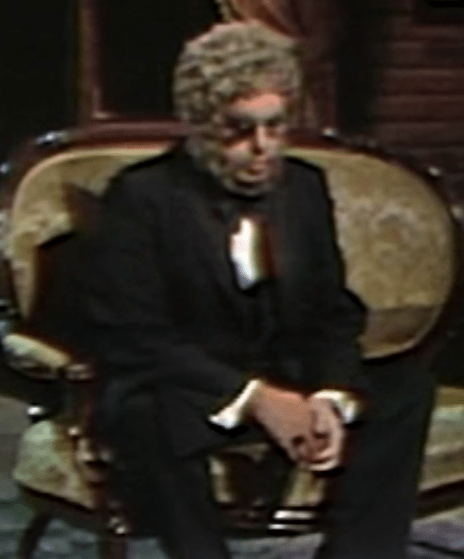
Sorcerer Count Petofi is wearing the body of rakish libertine Quentin Collins as a disguise, while Quentin is trapped in Petofi’s own aging and pudgy form. I will call the villainous Petofi played by David Selby Q-Petofi, and the forlorn Quentin as played by Thayer David P-Quentin.

We open with Q-Petofi at the front door of the great house of Collinwood. Yesterday we saw P-Quentin on the same spot, and heard David Selby’s voice articulating the miserable thoughts that showed on Thayer David’s face. Today the roles are reversed, and we see Mr Selby looking exultant while the voice of Thayer David talks about the glories of his situation.

We see that Q-Petofi is accompanied by his henchman, Aristide. He dismisses Aristide’s fear that he will somehow reveal his true identity to the occupants of the great house. He twits Aristide for a little while, pretending that he will use him as a guinea pig in a dangerous experiment he has planned for later in the evening, then sends him off to find someone else to serve that purpose.

Q-Petofi walks in on an argument in the drawing room between stuffy Edward Collins and the overbearing Gregory Trask. Trask is in charge of the house while his wife, Edward’s sister Judith, is in a mental hospital. Trask is going over the household accounts and complaining that Edward is spending too much on his houseguest, Kitty Soames, the dowager countess of Hampshire. Edward asks Q-Petofi to explain Collinwood’s tradition of hospitality to Trask, setting Trask off with a rant about Quentin’s relationship with Trask’s own former houseguest, the lovely and mysterious Amanda Harris. Q-Petofi’s indifference to the whole discussion strikes both Trask and Edward as odd, but it really is quite typical of the old Quentin.

After Trask exits, Edward tells Q-Petofi that he thinks he can subdue Trask by marrying Kitty. He says that it takes money to run Collinwood, and the late Earl’s estate gives Kitty ownership of half the county of Hampshire. Returning viewers know that the Earl died bankrupt, and so far from owning great swathes of southern England Kitty doesn’t even have train fare to get from Collinwood in central Maine to her mother’s house in Pennsylvania. So we have confirmation that Kitty has been less than fully honest with Edward. On the other hand, Kitty is under the impression that Edward is rich, while in fact their grandmother left every penny to Judith. So neither is leveling with the other about their financial status. Q-Petofi knows all of this, but it has nothing to do with his plans, and so he struggles to feign interest.

For his part, P-Quentin is sitting in the caretaker’s cottage on the estate. It seems right to longtime viewers that a character played by Thayer David should seek refuge here. When we first saw the cottage, it belonged to handyman Matthew Morgan, who was at that time played by George Mitchell. In #38, Mitchell was replaced in the part of Matthew by Thayer David, in the first of the many roles he would play on Dark Shadows. When Matthew had to leave the cottage for the last time in #112, his whole world fell apart. So when Aristide comes in and brutally evicts him, we can feel the full weight of the disaster that has befallen P-Quentin.

With nowhere else to go, P-Quentin returns to the great house. Once again it is Thayer David’s turn to look soulfully at the camera while David Selby’s voice speaks desperate words in voiceover. He tells himself that his brother Edward will have to believe him when he tells him the truth.

As it happens, Edward likes Petofi and is glad when he believes he is receiving a visit from him. Based on Edward’s earlier remarks about Collinwood’s tradition of hospitality, we could be quite sure that if P-Quentin presented himself as Petofi, Edward would be glad to offer him a place to stay. But P-Quentin plunges right in and tries to tell Edward the whole story. Of course Edward is not convinced. He treats it as a joke in questionable taste, and offers P-Quentin a brandy. When P-Quentin tells him to forget the brandy, he says that if he really were Quentin, he would never forget the brandy.

P-Quentin insists on going ahead with the lunatic tale, and keeps clutching at Edward’s arm. Edward finds the whole experience revolting, and firmly escorts him to the door. If it has occurred to P-Quentin to tell Edward any of the little stories of childhood that only he and Edward would know, it is too late now to do so. Edward orders P-Quentin to stop talking and go home. Little does he know that P-Quentin has no home to go to.

At the waterfront, the fog machine is working overtime, and so is one of the locals. In a comment on Danny Horn’s post about the episode at his great Dark Shadows Every Day, user “Goddess of Transitory” remarks:

I was remarking to my husband about the really remarkable size and relative wealth of the hooker population of Collinsport. They may hang at the docks (makes sense in a port town–you troll for lonely sailors) but they all have really nice clothes and jewelry and no matter how many of them Barnabas et al. tear through, there’s always more.

Makes you wonder what modern day Collinsport’s main economic generator really is…

Comment by “Goddess of Transitory,” left 7 April 2021 on Danny Horn, “Episode 857: All of Him,” 5 May 2016, Dark Shadows Every Day.

We find today’s well-bathed, well-coiffed, well-made-up young woman of professionally agreeable disposition drinking from a flask. Aristide emerges from the fog and takes the flask from her. When she protests, he says that if she follows him, she will be drinking champagne, and her protests subside. Her name is Wanda Paisley.

Aristide takes Wanda to the cottage, where Q-Petofi is waiting. Wanda is quite pleased at the prospect of sharing her favors with two handsome young men at once, but less pleased when Q-Petofi says that before the festivities get underway she will have to throw some I Ching wands and meditate on them. He assures her that she will be well paid for whatever services she may render, and asks her to agree that this is what really matters. Wanda’s agreement is not forthcoming. When Q-Petofi keeps yammering on about the wands and the hexagrams and the trance and the doors, it dawns on Wanda that this evening is not going to be what she signed up for, and she gets up to leave. Aristide grabs her, and Q-Petofi uses his magical powers to coerce her into cooperating.

Wanda casts the wands and meditates on them. She has a vision of a skeleton with big plastic eyeballs reaching its arm bones out to her. She screams. Where she had been sitting is another skeleton with big plastic eyeballs, this one also wearing a dress and a wig. Q-Petofi tells Aristide that “beyond the door anything is possible.”

Her turn as Wanda today marks Karen Lynn’s only appearance on Dark Shadows. She’s very good, it’s a shame they couldn’t find more for her. Her only other screen credit is a 1963 feature called The Orgy at Lil’s, which an IMDb reviewer says made history as “the first roughie.” I don’t know what a “roughie” is, and based on the description of The Orgy at Lil’s I rather doubt that my education in cinematic history would be significantly deepened by finding out. At any rate, it sounds like Miss Lynn was well-prepared to portray Wanda’s enthusiastic response when Q-Petofi first joined her and Aristide.

I made a contribution of my own to the comment thread on Danny’s post:

This has to be the archetypal Dark Shadows episode. It has Jerry Lacy modeling the style of acting he and Lara Parker invented for the show, Louis Edmonds being sarcastic, a squabble about control of Collinwood, people drinking brandy, a prostitute picked up on the docks while the [fog] machine runs, several kinds of supernatural mumbo-jumbo presented as if we will of course understand them, a dream sequence, and a skeleton in a wig. The next episode opens with a grave-digging scene, which is pretty nearly the only thing missing from this one.

Comment left by “Acilius,” 3 December 2020, on Danny Horn, “Episode 857: All of Him,” 5 May 2016, Dark Shadows Every Day.

It’s true no actors blow their lines, none of the boom mic shadows obstruct our view of anything crucial, and there is only one audible cough from a crew member, so it is an unusual episode in some ways. But I could have mentioned another very typical thing- a practical effect they try for the first time. I believe the split screen shot of Q-Petofi in the drawing room and P-Quentin at the cottage is the first time the show has used this device. It doesn’t work very well, but they were always pushing to do something new:

P-Quentin (Thayer David) and Q-Petofi (David Selby.) Screenshot by Dark Shadows Before I Die.

Episode 856: Like a new man

Evil sorcerer Count Petofi has cast a spell causing his mind to take over the body of rakish Quentin Collins, while Quentin is confined to Petofi’s own body. So David Selby begins playing a youthful and handsome Petofi, while Thayer David plays an aging and pudgy Quentin.

In their post about the episode on Dark Shadows Before I Die, John and Christine Scoleri use a wide variety of expressions to refer to the characters Thayer David and David Selby play today. I will just call Thayer David’s character P-Quentin and David Selby’s Q-Petofi.

Both of those actors give superb performances today; David Selby makes Q-Petofi’s preening arrogance suitably repellent, while the 42 year old Thayer David shows us P-Quentin reduced to the total helplessness of a despised man in extreme old age. There is a scene that Mrs Acilius and I found particularly hard to watch when Q-Petofi’s henchman Aristide takes the thick glasses without which P-Quentin is effectively blind and holds them away from him.

Q-Petofi and Aristide’s gleeful cruelty to P-Quentin make us wonder how the count and his henchman feel about the body they are looking at. The show’s earlier body swap story, in which vampire Barnabas Collins had hoped to die and come back to life in the form of Frankenstein’s monster Adam, led Adam to ask Barnabas in #587 “How could you hate yourself so much that you wanted to change your body?” We hadn’t known that that the count hated himself at all until we saw this scene, but he must have done to take such delight in tormenting P-Quentin, and Aristide’s revelry shows that he, too, harbors more hostility to his master than he ever dared expose.

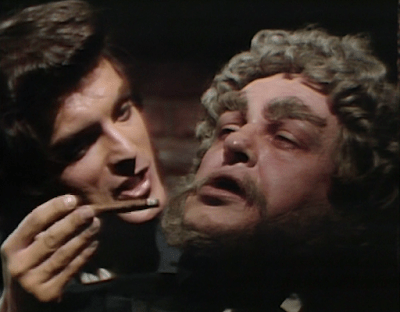
Q-Petofi taunts P-Quentin. Screenshot by Dark Shadows Before I Die.

P-Quentin staggers away from the lair of Q-Petofi and Aristide and meets broad ethnic stereotype Magda Rákóczi in the woods. He tries to explain his true identity to Magda, who has experience with magic and has for some time now been his ally. But Magda’s fear of the count keeps her from listening to the far-fetched tale, and she rushes off.

P-Quentin makes his way to the door of his home, the great house of Collinwood. He stands there, and we hear his thoughts, in David Selby’s voice. He tells himself he cannot go in, because no one there would believe him if he told them who he was. He slinks off to the caretaker’s cottage, where he meets maidservant Beth, who is his sometime fiancée. He tries to tell her the story, but she too is terrified of the count. When Q-Petofi shows up, she leaves with him.

Magda is a wonderful character, and what we have seen has given us every reason to hope she will be a substantial part of the show for a while yet. Unfortunately, this is her final on-screen appearance. We will hear her voice once more, six weeks from now. The show has always been visually ambitious, and lately they’ve managed to pull some neat tricks with videotape that led me to hope we would see at least one scene in which Grayson Hall appears opposite herself as both Magda and time-traveling physician Julia Hoffman. When Hall appeared in the 1970 film End of the Road, she said that it was a relief from playing Julia, to whom she apparently referred as “that tight-ass doctor.” Magda is earthy enough that it would have been fun to see how Hall would have used her to demonstrate the same attitude towards Julia, even if she had to stick to words approved by the ABC network’s Standards and Practices office, and Julia’s reaction to Magda would doubtless have been just as much fun.

Episode 814: The hand knows what it must do

One night in 1797, nine Rroma men trapped the sorcerer Count Petofi in the forest of Ojden and cut off his right hand. With it, the count lost most of his magical powers. Sometime after, Petofi learned that he could live for exactly one hundred years without his hand. If he was reunited with it in that time, he would become immortal; if he was not, he would die.

Now, it is 1897, and the hundred years are almost up. Petofi has vacated his body and has for some weeks been operating in the person of twelve year old Jamison Collins. He has regained the hand, but as Petofi is dying, so is Jamison. Jamison/ Petofi collapses in the woods carrying the hand back to the place where his servant Aristide is waiting with Petofi’s own body. Jamison/ Petofi passes out shortly after Jamison’s uncle, the rakish Quentin Collins, catches up to him. Quentin carries Jamison/ Petofi and the hand to the caretaker’s cottage on the grounds of the estate of Collinwood, where he confers with his distant cousin, Barnabas Collins the vampire.

Quentin and Barnabas decide that if Petofi dies, Jamison will die as well. Therefore they have no choice but to take the hand to Aristide. Barnabas does get Aristide to promise that once Petofi has the hand, he will use his powers to cure Quentin’s werewolf curse, but no one seems to regard Aristide’s word as valuable. Barnabas makes a menacing move towards Aristide; Aristide wards him off with a cross. Aristide puts the hand on Petofi’s chest, says some magic words, and waits a little over an hour. During this time, he needles Barnabas by offering him tea, which he must know is not part of a vampire’s diet. Then Petofi comes out of his room, laughing his evil laugh and showing off his reattached hand.

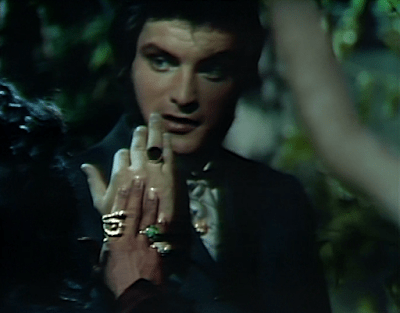
“At last my arm is complete again!” Screenshot by Dark Shadows Before I Die. (Caption by Stephen Sondheim.)

In #767, Jamison had a dream in which Quentin told him that his doom was sealed when the one person he truly loved turned against him. It was already clear at that point that this person was Jamison, but today Quentin tells Jamison in so many words that he is the only person he ever really loved. So we can take this as an announcement that the climactic crisis of the part of Dark Shadows set in 1897 is approaching.

Episode 754: A place with special people

Twelve year old Jamison Collins has run away from the unspeakably horrible boarding school where he has been imprisoned, and erstwhile lady’s maid Beth Chavez thinks he might be in the woods on the grounds of the great estate of Collinwood. Beth knows that her boyfriend, Jamison’s uncle Quentin, is in those woods. She also knows that Quentin is a werewolf, so she has gone out with a gun to protect Jamison from him. She does not know that the gun will stop a werewolf only if it fires silver bullets, so she is in trouble when she comes face to face with Quentin in his lupine form.

Luckily for Beth, Jamison’s father, the stuffy Edward, and his distant cousin, the mysterious and recently arrived Barnabas, happen by. They distract the werewolf, and Barnabas beats him with the silver head of his cane. The werewolf runs off, and Barnabas gives chase. Edward calls him back. Edward tells Barnabas he will need a gun to fight the werewolf, and Barnabas replies that the head of the cane will be enough. Edward demurs, saying that will work only once. Barnabas can’t very well tell the quotidian Edward that silver is the only weapon that is effective against werewolves, still less that he learned this while fighting a werewolf in the year 1969 and that he has traveled back in time to 1897 to stop the werewolf curse at its origin. Even if he somehow convinced Edward of this lunatic story, he would only increase the likelihood that a further uncanny truth would be revealed, namely that he himself is a vampire. So Barnabas helps Edward carry Beth back to the great house on the estate.

There, Barnabas decides that Jamison has probably gone to visit his mother Laura, who is staying in the groundskeeper’s cottage due to her estrangement from Edward. Indeed, we have seen Jamison there, talking with Laura about going away from Collinwood with her. Barnabas suspects what the audience is in a position to know, that Laura is an undead blonde fire witch who periodically incinerates herself and her children so that she, but not they, may rise and live again as a humanoid Phoenix. Another iteration of Laura was on Dark Shadows from December 1966 to March 1967, when the show took place in a contemporary setting. When Laura tells Jamison about the place to which she will take him, longtime viewers will hear echoes of what that other Laura told her son David in #140 about a land that “some call Paradise.”

A bat squeaks outside the window of the cottage, and Barnabas materializes inside. They haven’t tried this effect in quite a while. When they did it in #341, they superimposed the image of Barnabas in the wrong place on the screen, so that he looked like he was about four feet tall. That Mini-Bar was not very intimidating. But they get it right this time, and it makes for an effective moment.

Barnabas materializes inside the cottage. Screenshot by Dark Shadows Before I Die.

Laura emerges from the bedroom, and is indignant to see Barnabas. He bluntly tells her that he knows she is a mortal threat to her children, Jamison and his sister Nora. He tells her he will take them from her. She says she is sure that he is capable of “tricks,” but says that she has some of her own. She causes him to suffer intense heat. He recovers, and a groggy Jamison comes staggering out of the bedroom. Barnabas grabs Jamison and sets out for the great house. When Laura again mentions her “tricks,” he replies menacingly that “You have not known mine!” Laura vows to have her revenge.

The original 1966-1967 Laura story was the first plot on Dark Shadows to be driven by a supernatural character from beginning to end, and it did involve some confrontations between Laura and the ghost of the gracious Josette. But it was nearly as slow-paced, understated, and heavily atmospheric as were the relatively naturalistic stories that preceded it. That other Laura was the right menace for a show like that. She did not come with the established imagery of familiar movie monsters like vampires and werewolves, nor was there any reason to expect her to generate a lot of violent confrontations or special effects. Despite her association with fire, Laura was a cool presence on screen. She fit with a sedate tone and appealed to an adult audience interested in the long arcs of character development. When the 1897 Laura zaps a vampire who himself just fought a werewolf, there is no coolness anywhere. The show is meant primarily for children now, and they want the heat action and imagery generate when they are packed tight into each minute. Diana Millay is certainly up to the job, though it is a shame she doesn’t have the same opportunities she had in early 1967 to display her gifts for dry comedy and subtle psychological drama.

Episode 740: A doll without pins in it. How unusual.

Laura Murdoch Collins, estranged wife of the stuffy Edward, is settling into the cottage on the estate of Collinwood. Broad ethnic stereotype Magda Rákóczi is acting as her servant. Laura talks quite openly with Magda about Edward’s rakish brother Quentin. When Quentin was banished from Collinwood the year before, that is to say in 1896, Laura followed him to Alexandria, Egypt. That occasioned her estrangement from Edward.

Laura knows that Quentin uses the cottage for rendezvous with the various women in his life, and has Magda go through the place looking for things of his to box up and send to him. They find a doll and a deck of tarot cards; Laura tells Magda that no one knows how thoroughly Quentin is obsessed with the occult. Magda is an expert tarot reader, and Laura asks her to read the cards for her.

Magda lays out the cards, and they keep indicating death. Laura is initially distressed by this, but brightens at the thought that they might mean that Quentin will soon die. When Magda says that the death to which the cards pertain is one that has already taken place, Laura loses all patience and dashes the cards from the table. We know that Laura is an undead fire witch who periodically incinerates herself and reemerges as a humanoid Phoenix, and so it would seem that she is upset that the cards are confirming Quentin’s story that he saw her burn to death the previous year in Alexandria.

A recently arrived, quite distant cousin of Edward’s, the mysterious Barnabas Collins, comes calling on Laura. Barnabas has come with a present. Laura at first believes that this means that her evening has taken a turn for the better, and tells Barnabas that she is glad to think they might become friends. When she unwraps the present and finds an eighteenth century oil painting that appears to be a portrait of her, she is caught off guard. She at first acknowledges the resemblance, saying that she might have sat for it herself; Barnabas agrees that she might have. When she tries to backtrack and asks Magda if her chin looks like the one in the portrait, Magda replies “They look the same to me.” After Barnabas leaves, Laura orders Magda to put the portrait in a closet.

We know that Barnabas is a vampire, who has traveled back in time to 1897 to prevent Quentin from dying and becoming a ghost who will ruin things for everyone at Collinwood in 1969. We also know that he was acquainted with Laura in the eighteenth century, when he was alive. In the early part of the episode, Magda reproached Barnabas with his carelessness, telling him he must want people to know about him. Showing Laura the portrait would seem to prove that Magda was right. It serves no purpose but to arouse her suspicions. All the more so since Barnabas’ own eighteenth century portrait hangs in the foyer of the great house at Collinwood. He has used it as evidence that he is a descendant of an ancient member of the family, and Laura has apparently accepted it as such. But now that he has confronted her with her own portrait from the same epoch, she has every reason to search for another explanation.

Laura was Dark Shadows‘ first supernatural menace, from December 1966 to March 1967. In those days a lot of details were established about her previous incarnations, many of which they have been retconning away with some violence over the last few episodes. We learned then that in each of her appearances, Laura’s maiden name was Murdoch. It is confirmed today that when Edward met her she was Laura Murdoch. We also learned then that in the eighteenth century Laura Murdoch married into the Stockbridge family, one of the most prominent in the area, and that she and her young son David Stockbridge died (by fire!) in 1767. We saw her tomb in a crypt belonging to the Stockbridges and still maintained, two centuries later, by an old caretaker.

Today, Barnabas and his blood thrall, Magda’s husband Sandor, go to the same set. But it does not represent a freestanding building, nor does it have a staff. It is in the basement of “the old meeting house.” And the stone panel sealing Laura’s tomb is quite different. The one we saw in #154 and #157 read “Here Lyes Buried The Body Of L. Murdoch Stockbridge, Born 1735, Died 1767.” Just the initial L because, as the Caretaker explained repeatedly, “The Stockbridges cared nothing for first names!” But this panel is inscribed “In Memory of Laura Stockbridge Collins, Who died in 1785.” The name “Collins” is because the show has neglected to develop any other elites in the Collinsport area, so if Laura is going to keep coming back and marrying into a leading family, she’s going to have to pick a Collins every time.

From #154. Screenshot by Dark Shadows Before I Die (picture quality modified for easier reading.)
From today’s episode. Screenshot by Dark Shadows Before I Die.

The date 1785 is just mystifying. Barnabas said yesterday that he was ten when Laura came along. In November 1968 we flashed back to the year 1795, when he was still human. Actor Jonathan Frid was just about to celebrate his 43rd birthday at that time; if Barnabas is the same age as his player, he would therefore have been born in 1752. That would make him 15 in 1767. That would give him five years to have known Laura before she took her son with her into the flames. It would also be plausible that she would not have been startled when she met Barnabas Wednesday, seeing only the resemblance to the person whom he claims was his ancestor. But if he were born in 1752 and she lived until 1785, she would certainly have realized she was looking at the same person.

It seems that the show really wants us to think that Barnabas was in his twenties in 1795. Of course life was hard back then, but the 43 year old Jonathan Frid was not going to pass for any age much less than his own.

Barnabas orders Sandor to open the wall. In the cottage, Laura can hear the chisel tapping at the stone. Magda can hear nothing. Barnabas orders Sandor to open the coffin; Laura rushes out of the cottage, leaving a bewildered Magda behind. Laura reacted when they messed with her tomb in 1967 as well, so they’ve preserved that much of the continuity, at least.

Episode 731: Your greatest weakness

One of the first “Big Bads” on Dark Shadows was crazed handyman Matthew Morgan, played by Thayer David. Matthew was the most devoted employee of reclusive matriarch Elizabeth Collins Stoddard (Joan Bennett.) Matthew took his devotion to Liz to such an extreme that he was a menace to everyone else. In November and December of 1966, we learned that Matthew had decided that Liz’ second most dedicated employee, plant manager Bill Malloy, was a threat to her. Matthew had tried to put a stop to Bill’s doings. Not knowing his own strength, Matthew accidentally killed Bill. When well-meaning governess Victoria Winters discovered what had happened, Matthew abducted Victoria, held her prisoner in the long-deserted Old House on the grounds of the estate of Collinwood, and was about to murder her when a bunch of ghosts emanated from the show’s supernatural back-world and scared him to death.

In those days, Dark Shadows was a slow-paced “Gothic” drama set in contemporary times. From November 1967 to March 1968, it was a costume drama set in the 1790s, and its plot often moved at a breakneck speed. Among the characters then was much-put-upon indentured servant Ben Stokes, who like Matthew was played by Thayer David. At first Ben made a stark contrast with Matthew. He was as relaxed, friendly, and reasonable as Matthew was tense, forbidding, and paranoid. But when his one ally among the Collins family, scion Barnabas, was cursed to become a vampire, Ben’s devotion made him resemble Matthew ever more closely. In his development, we saw a retrospective reimagining of Matthew. The curses that were placed on Barnabas and the rest of the Collinses from the 1790s on had burdened the village of Collinsport, and people who grew up there labored under the consequences of those curses and of the Collinses’ attempts to conceal them. Ben was what Matthew might have been had he not been warped by the evil that began when black magic was first practiced in the area so many generations before.

In January 1969, the show briefly returned to 1796, to a time coinciding with the last days of the earlier flashback. We saw that by that point, the curses had already transformed life on and around the great estate. In that period, Ben’s efforts to protect Barnabas led him inadvertently to kill a man, not knowing his own strength, and then to cover that crime up by killing a woman, not at all inadvertently. He had become Matthew. The curse placed on Barnabas had become the curse of all those who work for the Collinses and all of those who live in the shadow of their wealth and power.

Before Matthew, Dark Shadows‘ chief villain was high-born ne’er-do-well Roger Collins (Louis Edmonds); after, it was Roger’s estranged wife, undead blonde fire witch Laura Murdoch Collins (Diana Millay.) In this episode, the makers of the show take a page from its 1790s flashbacks. They have Edmonds and Millay reconceive the Roger and Laura of that atmospheric, sometimes almost action-free soap as characters appropriate to the fast-paced supernatural thriller it now is.

Since #701, Dark Shadows has been set in the year 1897. Louis Edmonds plays Roger’s grandfather Edward; Diana Millay plays Edward’s estranged wife, undead blonde fire witch Laura Murdoch Collins. In his days as a villain, Roger’s defining characteristic was his unnatural lack of family feeling. He had squandered his entire inheritance, a fact which did not bother him in the least. When his sister Liz confronted him in #41 about the difficulties he had created by putting his half of the family business up for sale, he airily replied that he had enjoyed his inheritance. When in #273 Liz and Roger discussed a blackmail plot of which she had been the victim, Roger admitted that had he known her terrible secret, he probably would have used it to force her to give him her half of the estate so that he could squander that, as well.

It wasn’t only the family’s material possessions and Liz’ right to them to which Roger was indifferent. He openly hated his son, strange and troubled boy David Collins (David Henesy.) He continually insulted David, badgered Liz to send David away, and in #83 coldly manipulated David’s fears to lead him to try to murder Victoria.

In the 1897 segment, Edward is as stuffily serious about the family business as Roger was in 1966 nihilistically apathetic about it. Edward loves his children, twelve year old Jamison (David Henesy) and nine year old Nora, but his rage at Laura has come between himself and them. Laura left Edward the year before to run after Edward’s brother, breezy libertine Quentin (David Selby.) Edward tried to conceal the fact that his brother cuckolded him. He has repeatedly declared that Laura “No longer exists!” and has forbidden her name to be mentioned in the house.

Edward trapped between the enigmatic Laura and the exuberant Quentin. Screenshot by Dark Shadows Before I Die.

For his part, Quentin bears a striking similarity to the early, wicked Roger. He wants money only to spend it, a fact which he cheerfully admits. He tried to forge a will in his grandmother Edith’s name to cheat his sister Judith (Joan Bennett) out of her inheritance, having previously threatened to kill Edith. He does have great affection for Jamison, but since he often uses the boy as a pawn in Satanic ceremonies, his fondness for his nephew is not much of an improvement over Roger’s hatred for his son. Indeed, Quentin’s resemblance to Roger connects the 1897 segment not only to the early months of the show, but also to the weeks immediately preceding it. Early in 1969, Quentin’s ghost had taken possession of David Collins and was causing him to die. When we see that Quentin is now what Roger was originally, David’s ordeal takes on a new dimension. He is dying for the sins of his father.

In this episode, Laura has returned. Edward has offered her a great deal of money to go away and never come back; she refuses. She threatens to tell the world about her relationship with Quentin if Edward does not let her stay at Collinwood. Edward buckles to this blackmail. Laura tells him that “Family pride is your greatest weakness,” making him Roger’s exact opposite.

When Laura was at Collinwood from December 1966 to March 1967, her old boyfriend Burke Devlin kept pestering her with his suspicion that he, not Roger, was David Collins’ father. Burke was not the first character to bring this idea up. Roger had mentioned it to Liz in #32, when they were talking about an attempt David had made to kill Roger. At that time, Liz was horrified that Roger seemed to want to believe that David was Burke’s natural son.

It seems unlikely that Quentin is Jamison’s father. They have been firm about 1870 as Quentin’s date of birth, and in 1897 Jamison is quite plainly twelve. Laura may have gone on to marry her own grandson, but it would be a bit of a stretch for her to have started sleeping with her brother-in-law when he was fifteen, even if he did look like David Selby.

But Roger’s anger and jealousy about Burke and Laura do mirror Edward’s about Quentin and Laura. It was abundantly clear that Roger and Burke’s deepest pain regarding Laura was that their intense attachment to each other was disrupted when she left Burke for Roger; Diana Millay used her gift for dry comedy to make this explicit in a scene the three of them played in the groundskeeper’s cottage in #139. Likewise, Edward’s frustration with and disappointment in his brother is at least as deep a source of anguish to him as is his loss of Laura’s love.

Laura, too, is quite different this time around. The first Laura story took shape gradually over a period of weeks, as Laura herself emerged from the mist. Now Laura is a forceful presence from her first appearance. Originally we heard that Laura had married into several of the leading families of the Collinsport region; now they have given up on the idea of developing other leading families, and Laura just keeps coming back to the Collinses. In the first story, they laid great emphasis on the interval of precisely one hundred years between her appearances; now, the number of years doesn’t seem to have any particular significance. As we go, we will see an even more important difference. When we first met Laura, she was utterly determined to make her way into a pyre so that she could rise as a humanoid Phoenix; now she is unhappy about the whole thing, and angry with people who have helped her on her fiery way.

Edward lets Laura live in the cottage where Roger and Liz would put her in 1966. In the final scene, she goes there and finds Quentin, drunk and trying to conjure up an evil spirit. Quentin keeps telling Laura that she is dead. Frustrated with her persistent refusal to concur with this statement, Quentin puts his hands around her neck and announces that whether or not she is dead now, she will be by the time he gets through with her.

Roger was uncharacteristically sober at the beginning of his three-scene in the cottage with Burke and Laura in #139, but he did enter brandishing a fire-arm. So Quentin’s homicidal intentions on this set further cement his affiliation with his great-nephew in the eyes of longtime viewers.

Millay and Edmonds are not the only actors whose screen iconography the show turns to advantage today. We first saw Kathryn Leigh Scott and Don Briscoe together in #638, when she was playing ex-waitress Maggie Evans and he was playing mysterious drifter Chris Jennings. They met in the foyer at Collinwood. Maggie was angry with Chris, and Chris was guilt-ridden. Today, Miss Scott plays governess Rachel Drummond and Briscoe plays teacher Tim Shaw. They meet in the foyer at Collinwood. Rachel is angry with Tim, and Tim is guilt-ridden.

Though the same actors are playing the same basic emotions on the same set, the situations are different, and the characters are very different. Maggie is Dark Shadows‘ principal representative of the working class of the village of Collinsport. She speaks directly and bluntly, using the plainest language she can to dare Chris to try to excuse his inexcusable behavior. Chris occupies a lowly and unsettled place in the world, and he dodges her gaze and evades her questions, saying as little as he can, almost mumbling.

But Rachel is a neurotic intellectual, and she expresses her anger in complex sentences featuring vocabulary that only a very well-read person would have used in 1897 (for example, the word “sadist.”) Tim retreats from her anger into a defense of his job that quickly devolves into the tiredest platitudes imaginable. At one point he actually intones “It is better to light one candle than to curse the darkness.” Miss Scott makes Rachel’s highly literate onslaught on Tim as forceful as was Maggie’s unvarnished challenge to Chris, and Briscoe makes Tim’s pompous posturing as pitiable as was Chris’ broken burbling. Writer Gordon Russell must have been delighted that the actors did such good work with his ambitious pages.

Episode 720: The big, bad wolf

From #701, the episode in which Dark Shadows first became a costume drama set in the year 1897, they have been strongly hinting that Jenny Collins, the madwoman locked in the room on top of the tower in the great house of Collinwood, is the estranged wife of stuffy Edward Collins. Today, Jenny gets loose, and confronts Edward’s brother, rakish Quentin. It is only then that we learn that she is in fact Quentin’s wife. All of the clues that had led us to the other conclusion take on new meanings in that moment, making it one of the most effective twists on the show.

Man and wife, reunited, til death do them part. Screenshot by Dark Shadows Before I Die.

Edward is the father of two children whom we have seen, twelve year old Jamison and nine year old Nora. Jenny has been preoccupied with some dolls she has with her in her prisons, which she calls “my babies.” She is afraid someone will take her “babies” from her.

We came to 1897 along with well-meaning adventurer/ bloodsucking ghoul Barnabas Collins, who in 1969 encountered the ghosts of Quentin and of maidservant Beth. Quentin’s ghost had made the great house uninhabitable and was in the process of killing strange and troubled boy David when Barnabas decided to resort to the mumbo-jumbo that has brought him back to this period. In 1969, Barnabas was not only trying to contain the damage Quentin’s ghost was doing; he was also trying to help drifter Chris Jennings, who was a werewolf. Beth’s ghost appeared to Chris and led him to an unmarked grave containing the remains of an infant wearing an amulet meant to ward off werewolves. This proved that there was a werewolf at Collinwood when Beth and Quentin were alive, and suggested that Chris’ curse was inherited from that person.

When Barnabas first met the living Beth in # 703, he asked if there were any children in the house other than Jamison and Nora. She said that there were not. He wondered if the newborn to whose grave Beth’s ghost led Chris had already died and been buried. But now that we know that Jenny is Quentin’s wife, we remember that in that same episode Quentin caught Beth with $300 and that in #707 we heard that she had taken the money to a “Mrs Fillmore” in town. Perhaps Jenny really did have babies who were taken from her, and perhaps Mrs Fillmore is taking care of them. Perhaps, too, the “Jennings” in Chris’ name indicates that he is a descendant of Jenny, and therefore of Quentin. We have already seen Quentin dabbling in black magic- perhaps he brings the curse of the werewolf on his descendants by means of it.

Jenny’s meeting with Quentin today does not come to a happy ending as far as he is concerned. She leaves him on the floor, with a dagger stuck in his chest.

While the search is on for Jenny, Beth tells another servant that Edward and Quentin’s sister Judith has searched the west wing and is now searching the east wing. This is only the second time the dialogue has made it unequivocally clear that there are two wings extending from the main house, and the first time it is established that the east wing exists prior to the twentieth century. There was a time when the writers had not settled on which side of the house the long-deserted wing lay; the first couple of appearances of the phrase “east wing” dated from then. Subsequently, there were slips of the tongue by actors who were supposed to say “west wing.” We may wonder when, if ever, the writers will find a use for this other part of the house.