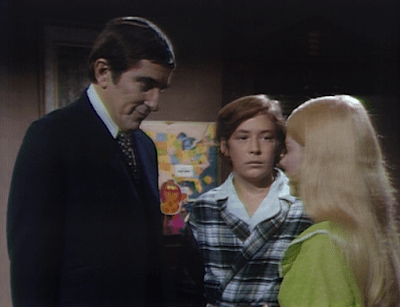
Grouchy New England teen David Collins and his live-in girlfriend Hallie Stokes go to a playroom for small children that intermittently manifests itself in a space otherwise occupied by a linen closet in the west wing of the great house of Collinwood. Hallie is possessed by the spirit of a girl named Carrie, who died in 1841. David hasn’t caught on that Hallie isn’t herself, and in his exasperation he asks her to “stop acting like the world’s number-one weirdo.” Carrie is puzzled by the word “weirdo.” She recognizes it as a derivative of “weird,” but claims that “the addition of the letter O makes it completely incomprehensible.” Evidently Carrie wasn’t all that quick on the uptake. If someone called me a “peculiar-Z,” I might not know why the letter Z was added, but it would be perfectly clear to me what they were saying. Historians of American English often say that the 1830s and 1840s were the single busiest period for the invention of new slang terms the USA has ever seen, so that if Carrie were as stumped by the “O” on “weirdo” as she claims to be, she would likely have been unable to conduct a conversation with many of her contemporaries.
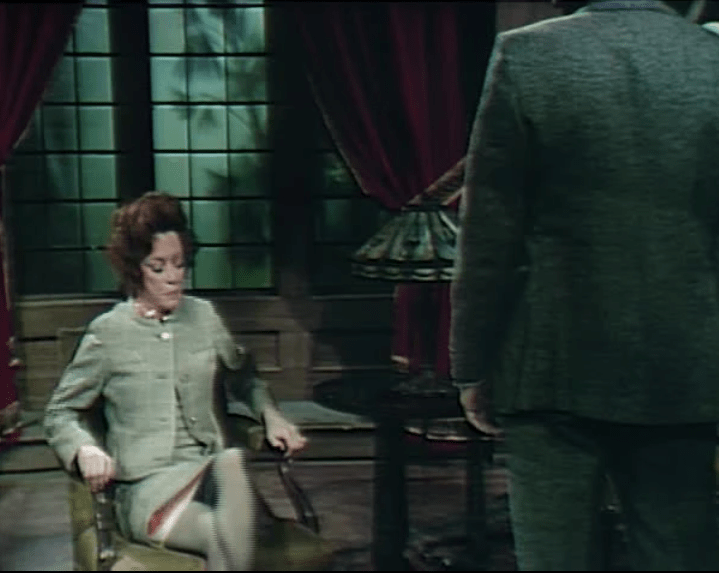
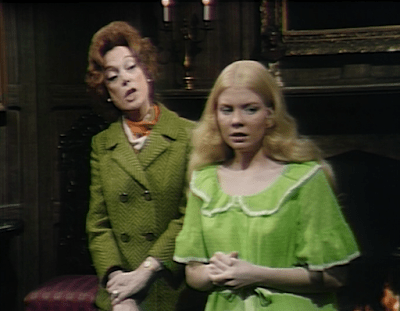
David’s realistic 1970 dialogue and Carrie’s antiquated verbiage bounce off each other to produce some intentional comedy; my wife, Mrs Acilius, thought the scene was really funny. It is certainly more appealing than the rest of the episode, which is yet another series of events that take place only because the characters cannot bring themselves to tell each other what’s going on. Because the ghosts won’t let them, yes yes yes, we’ve been through all that many times before. The fansites seem bored enough by the whole thing that one of biggest points of discussion is whether it is reasonable to say that, because a bit of Grayson Hall’s slip is visible under her skirt at one point, we can say that we see her “underwear.” I guess the slip is “underwear” in the sense that she is wearing it under something else, and it probably wasn’t supposed to be visible, but you’d have to be a very specific kind of person to get excited about it.
Feast your eyes, pervs.
Hall plays Julia Hoffman, MD. Julia is a psychiatrist, among other things. She tells Quentin Collins that the ghost of Daphne Harridge, a governess who like her charge Carrie died in 1841, fills the room with the scent of lilacs when she is near. Quentin is so obviously lying when he tells Julia that he has not smelled that scent that we are probably supposed to assume that Julia is onto him.
For the first six months of Dark Shadows, reclusive matriarch Elizabeth Collins Stoddard kept the story from moving by refusing to tell anyone what she knew about the major storylines. With the introduction of undead blonde fire witch Laura Murdoch Collins in #123, the show became a supernatural thriller. The characters driving the new storylines took care to exclude Liz from the action by never letting her find out what was going on.
Now, old world gentleman Barnabas Collins and mad scientist Julia Hoffman have returned to 1970 after a visit to 1995. They have told Liz and others what they saw in that future year, warning that a terrible disaster is impending that will destroy the great house of Collinwood and everyone in it. Julia and Barnabas are not sure just what will happen or when, but they know it will occur before the year is out and that it will center on teenagers David Collins and Hallie Stokes.
The adults have decided to keep the relevant information from Hallie and David themselves. That’s the whole problem today- a series of uncanny events occur that David and Hallie would recognize as signs of the disaster and about which they would be able at least to sound the alarm had they been given the relevant information. Since they have been kept in the dark, they are helpless and the events are pointless.
Not only are the characters not learning from each other, Liz and David have forgotten a great deal that they used to know. From the first week of the show, David was on intimate terms with the ghosts of Collinwood. But today he mentions to Hallie that when he saw a ghost he was not afraid, and he cannot understand why he wasn’t afraid. Liz’ daughter Carolyn mentions that she found Hallie wearing an antique dress. Liz responds that putting on an antique dress can hardly precipitate the kind of disaster Barnabas is talking about. Yet precisely the kind of disaster Barnabas is talking about already befell Collinwood in March 1969, and the first step towards it came when David and his friend Amy Jennings played dress-up, wearing antique clothes under the influence of the malign ghost who would eventually drive everyone out of the great house.
At moments, the script seems to acknowledge that the whole episode is a waste of time. Liz asks Carolyn if she believes in astrology. Carolyn says she doesn’t believe in anything, so she might as well pay attention to her horoscope. It’s no more meaningless than anything else.
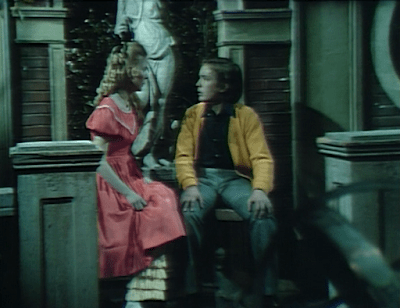
The opening scene, in which David and Hallie spend what seems like an hour hanging around the gazebo and talking about the fact that she doesn’t remember putting on her dress, is particularly bad. I’m reluctant to complain about any of the actors, since the conditions under which they had to work were extremely difficult. I’m especially reluctant to single out performers like Kathleen Cody, who gets a lot of negative comment from fandom. But she is very bad in this scene, just terrible, loud and fake and hard to put up with. Not that I can see what anyone could have done to make the scene interesting, but the situation is so slight it cannot for one moment bear the emotional load Miss Cody piles on it.
There are a few moments of unintentional comedy today revolving around wardrobe. David wears a sweater over a sports shirt and a pair of trousers with the belt fastened somewhere above his navel. David Henesy is in his late 60s now; he still isn’t old enough to wear that outfit. But combined with David’s grouchy attitude, the costume makes him seem like some old guy from New England.
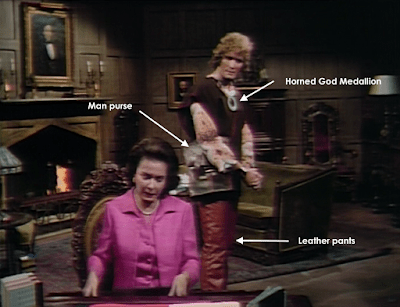
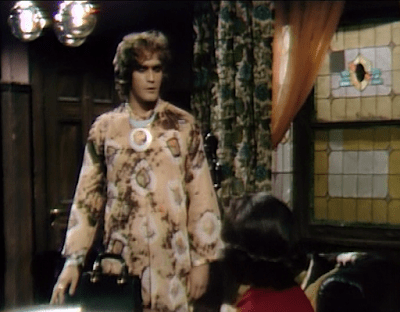
Chris Pennock shows up as astrologer Sebastian Shaw. Sebastian’s costume was bizarre even by the very generous standards of 1970. John and Christine Scoleri labeled some of its more unusual features in their post about it at Dark Shadows Before I Die:
The utter preposterousness of Sebastian’s getup goes some way towards relieving another bad taste in the mouths of longtime viewers. Pennock also played Carolyn’s late husband Jabe, whom everyone insisted on calling Jeb. When Carolyn first sees Sebastian, she is shocked at the resemblance. The show first went all-in on its repertory approach to casting in November 1967, when well-meaning governess Vicki traveled back in time to the 1790s. She found that the characters she met in that epoch were played by actors she knew from the first 73 weeks of the show, and tried everyone’s patience by telling them about their previous parts. That unbelievably stupid habit marred the 1790s segment and utterly destroyed the audience’s interest in Vicki. Carolyn’s recognition that Pennock was Jeb before he was Seb brings that unpleasant memory back, and any distraction from it is welcome.
At one point Liz finds David standing over Hallie while she is in bed in the small hours of the morning. Liz demands to know what he’s doing there, and is particularly indignant that he is “still dressed.” Mrs Acilius and I laughed out loud at that. It’s better he should be naked?
Old world gentleman Barnabas Collins and his friend, Dr Julia Hoffman, MD, have returned to 1970 after an inexplicable journey through time. During a sojourn in 1995, they learned that a mysterious disaster is about to befall the great house of Collinwood. They have told several people about this disaster and withheld the information from several others.
Among those Julia and Barnabas have told is matriarch Elizabeth Collins Stoddard. We see Liz in the drawing room discussing the matter with governess Maggie Evans. Maggie is hurt that Barnabas hasn’t seen her since he returned. When Barnabas departed, there was a story brewing about a possible romance between him and Maggie; we might have thought the show would have forgotten this narrative thread, and some fans would prefer it had done so. But evidently it isn’t quite gone yet.
Among those Barnabas and Julia have not told is grouchy New England teen David Collins. David enters the room as Liz and Maggie are talking about the idea that something might happen. He says that something is happening, all right. Liz asks what it is and he says he will tell them what he knows if they tell him what they know. Liz huffily declares that the matter at hand has to do with a theory he could not possibly understand, and that she knows he could not understand it because she doesn’t understand it, either. Unimpressed by this logic, David stands his ground. He says it’s time they stop treating him like he is four and a half years old. Liz tells him that if he knows something they ought to know, he should tell them about it. How he is supposed to know what they ought to know when they won’t tell him anything is unclear. The exchange ends in a stalemate.
Julia and Barnabas have also tried to keep the relevant information from the other teen in the house, Hallie Stokes. Hallie eavesdropped on a conversation yesterday and picked up some ominous-sounding remarks with no context. David had a dream that night in which he saw Hallie wearing an old-fashioned long orange dress with puffy sleeves. Later, the same dress materialized on Hallie’s bed.
What neither Hallie nor David knew was that Barnabas and Julia saw that dress in 1995. The girl wearing it looked exactly like Hallie, but was named Carrie. She danced a minuet at the gazebo on the grounds of Collinwood with a boy who looked exactly like David but was named Tad.
When Hallie sees the dress at the beginning of today’s episode, she wonders how it got there. Maggie knocks on the door and Hallie hides it under her bedclothes. After Maggie goes, Hallie wonders why she didn’t just ask her about it. Longtime viewers have seen enough supernatural storylines start on Dark Shadows to know that a compulsion to withhold information is often the first step towards doom. It is frustrating that Liz, who has been central to the show since episode 1 premiered on 27 June 1966, hasn’t learned that lesson yet and applied it to her dealings with David.
David goes to Hallie’s room and tells her about his dream. She says that lots of boys dream about her; he says that unlike the others, he tried to go back to sleep afterward. David doesn’t specify what the other boys are doing with the image of Hallie in the middle of the night, but he lets her draw the conclusion that she isn’t up to his standards in that wise. When he tells her about the dress, she freaks out and accuses him of playing tricks on her. He doesn’t know what she’s talking about and doesn’t care enough about her to stick around until she clarifies it. He grumbles that he’ll never understand women and stalks off.
Later, David gets a note telling him to go to the gazebo at midnight. He sees Hallie emerge from the bushes, wearing the dress. He suddenly realizes that she is not Hallie at all. Carrie has made her appearance.
The gazebo set is decorated with an armillary sphere that is prominently featured today. From the first appearance of this doodad in #737, we might have wondered if the show was going to incorporate astrology into its stories. Two of the cryptic phrases Julia and Barnabas collected as clues during their visit to 1995 were “the night of the sun and the moon” and “the unfinished horoscope,” indicating that the time is coming for this to occur.
Liz is in a strange quiet mood today; Joan Bennett plays her very deep. She speaks softly, rarely makes eye contact, and often gives little signs of deep, somber thought. She mutters to Maggie that no one can know the future, “unless…” When Maggie asks unless what, she refuses to answer.
Liz telephones a man named Sebastian Shaw, who is wearing a piece of clothing that was ridiculous even by the standards of 1970. Actor Chris Pennock would later say that he retained absolutely no memory of ever having played a character named Sebastian; if I had worn that garment on national television, I think I would have blocked out the recollection as well.
Sebastian gets very prickly when people do not accept him as a serious professional. Screenshot by Dark Shadows Before I Die.
Sebastian is an astrologer. He agrees to cast a full horoscope for the rest of 1970 for Liz. Since Barnabas and Julia told Liz that an unfinished horoscope is one of the signs that doom is near, it would seem rather bold of her to start an astrologer casting an elaborate chart.
Teen orphan Hallie Stokes has gone to stay in the great house of Collinwood, a logical place for her since an ancestor of hers was an indentured servant there 174 years ago. I’m not sure where my ancestors were indentured servants 174 years ago, but now that I know the information comes with free room and board in mansions you can bet I’ll be looking into it.
Hallie was eavesdropping on a conversation among some adults in the drawing room. Old world gentleman Barnabas Collins recently returned from an inexplicable journey through time and space with warnings of an undefined disaster that will be happening later in this year, 1970. Hallie has gone to visit the other teenager in the house, grouchy New Englander David Collins. David greets her with a warning that if his governess catches them alone in his bedroom after dark, “I’m in for it.” David has been on the show from week one, and this indication that there are rules against him having sleepovers with girls is the first acknowledgment that he is not a small child.
Hallie reports on the conversation she heard, much to David’s irritation. She then says she can’t shake the feeling that someone is watching her. At that, Barnabas’ voice comes from the door asking who she thinks is watching her. She is afraid of Barnabas and wants to get back to her own room as quickly as possible. That’s a sign of healthy instincts, since Barnabas is a vampire, but he really did find evidence that a disaster is coming and he really is trying to save everyone by preventing it. He lets Hallie go, and bids a relaxed good night to David.
When Barnabas and his friend, Dr Julia Hoffman, returned from the distant future year of 1995, the first people they met were matriarch Elizabeth Collins Stoddard and roguishly handsome anomaly Quentin Collins. They told Liz and Quentin everything they knew right away, and today Barnabas gives another complete debriefing to Hallie’s uncle, Professor Timothy Eliot Stokes. So we might think that the characters have finally learned that keeping secrets unnecessarily just prevents people working together to solve their problems and we are finally going to let the story flow. But no such luck. Liz’ daughter Carolyn was a pivotal figure in 1995, but for no reason they bother to specify Barnabas decides to withhold all information from her today.
They do give a reason for Barnabas’ failure to tell Hallie anything about what he saw in 1995. Quentin told Barnabas yesterday that Hallie is psychologically fragile and couldn’t take any disturbing news. But since she just winds up eavesdropping and getting some alarming facts with no context and no indication that there is anything she can do to help the situation, this backfires. What is more, it was predictable it would happen. David scolds Hallie for eavesdropping, prompting her to point out that he is an inveterate eavesdropper himself. Everyone in the house has known this about David for four years, so there is simply no excuse for expecting that the adolescents will stay in the dark about what is being discussed in the drawing room.
Perhaps the oddest moment of the episode comes when Barnabas is talking to Stokes. He tells him that he and Julia saw Hallie’s ghost in 1995, looking exactly as she does now, suggesting that her death is imminent if she remains at Collinwood. Stokes, who seems remarkably cheerful about the whole thing, says with a bright smile “Perhaps I should take her away!” Barnabas says that no, “I wouldn’t do that.” He explains that it might upset Liz if they did so. Since he just told Liz the whole horrible story yesterday, it seems a bit late to make shielding her from distressing news one’s top priority, but Stokes goes along with it.
David has a dream in which Hallie is wearing an old-fashioned long orange dress with puffy sleeves. He does not know it, but this was the dress Julia and Barnabas saw a girl wearing in 1995. This girl was a ghost who looked exactly like Hallie but was named Carrie, and who danced a minuet with a boy who looked exactly like David but was named Tad. Later, Hallie finds Carrie’s dress laid out on her bed.
In late 1968 and early 1969, Quentin was an evil ghost who took control of David and his friend Amy Jennings as the first step towards driving everyone out of the house. In the course of that, there was a lot of monkey business about moving clothes in and out of closets. The original “Haunting of Collinwood” segment had its strengths and led to the trip back in time to 1897 that turned out to be Dark Shadows‘ greatest triumph. But the time spent worrying about where various items of clothing were being kept and why did not make for gripping television, and longtime viewers will wince to see that the incipient Re-Haunting of Collinwood is going to recapitulate that element.
Quentin Collins comes to the drawing room of the great house of Collinwood to deliver some bad news to his distant cousin, Elizabeth Collins Stoddard. He was peering into the room in the east wing of the house through which an alternate universe is occasionally visible. He saw the room as it is in that other timeline, engulfed in smoke and occupied by a young woman calling the name “Barnabas.” Since Liz and Quentin’s distant cousin, Barnabas Collins, and Barnabas’ dear friend Julia Hoffman crossed over into the alternate universe some time ago and the aperture in the east wing is the only place where transits between the universes are known to be possible, Quentin proclaims to Liz that the “only conclusion” one can reach is that “we shall never see them again!” No sooner has he got those words out than the drawing room doors open to reveal Julia and Barnabas standing side by side, smiling happily, and saying “Elizabeth! Quentin! We’ve returned!”
One might think this would cure Quentin of the idea that he knows what the “only conclusion” is at which one might reasonably arrive, but no such luck. He tells Barnabas and Julia that today’s date is 3 August 1970. They say that was the date when they left the other universe, and that they then spent over a week in the year 1995, when they saw a bleak and horrifying future that resulted from a disaster that will occur later in 1970 unless they can somehow prevent it. Quentin says their experience in the future must have been an hallucination, because they can’t have come back to 3 August in one year from any date other than 3 August in another year. Julia and Barnabas share detailed recollections of their experience in the future, and have already met a living person in 1970 whom they saw for the first time as a ghost in 1995, but this argument shakes their confidence.
Quentin’s claim, nonsensical as it is to new viewers, actually does fit in with a notion the show has been developing since it first committed to being a supernatural thriller in late 1966 and early 1967. Since the laws of nature that science studies do not apply, they have to find other predictive models that will make it possible to build suspense. So they had well-meaning governess Victoria Winters figure out that women named Laura Murdoch incinerated their young sons named David at intervals of “exactly one hundred years!!!,” and therefore that Laura Murdoch Collins would soon present a mortal danger to her young son David Collins.
From that point on, the power of anniversaries has been a tremendously potent force in the metaphysics of Dark Shadows. Barnabas traveled back to the 1790s in #661 by going to a grave on the anniversary of its occupant’s death and shouting at the deceased for a while (shouting is also a potent metaphysical force.) Quentin himself first joined the cast of characters as the malevolent ghost of a man who died in 1897 and in 1968 and 1969 returned to haunt Collinwood, kill several people, and drive the survivors from the house. Barnabas traveled back to 1897 and bungled around until someone else changed history to prevent Quentin dying or even aging. On the anniversary of that change, the haunting broke, just in time to allow David to return from the dead. But when Quentin showed up as a living being late in 1969, everyone who had lived through the ten months of the haunting remembered it. So apparently the reality of Dark Shadows is a composite of all the various, mutually inconsistent timelines, and the consequences of the actions not taken are just as real as are those of the ones taken. The power of anniversaries is the thread that binds these unmatched events into a cosmic crazy quilt.
As the aperture between universes was a door to a room in the east wing, so the aperture from 1995 to 1970 was a door inside a room in the west wing. Barnabas and Julia were trapped in a mysterious playroom there when the ghost of a blonde teenager known to them as Carrie appeared, beckoned to them, and walked through the wall. A moment later, a door materialized in the spot through which Carrie had exited. Julia and Barnabas went through the door and found themselves on a staircase. They followed the staircase to another door. It was the door through which they had entered the playroom, but the corridor outside was in good repair, not in ruins as it was in 1995. They saw a girl there who appeared to be Carrie, though she was wearing different clothes, was alive, and demanded to know who they were.
Barnabas and Julia gave the girl their thanks for her help, and she repeated that she had no idea who they were or what they were talking about. She said that she was not named Carrie, but Hallie, Hallie Stokes, niece of Professor Timothy Eliot Stokes. She told them Liz was in the drawing room, Liz’ brother Roger was in Europe, and the year was 1970.
Later, Julia questions Hallie about some names and phrases she heard in 1995. Grayson Hall delivers all of these questions as if she were playing a Gestapo interrogator in a very bad World War Two movie. Even when Hallie says it is her bedtime, Hall enunciates the lines “All right, Hallie. Good night” while standing rigidly still and peering at the girl from under a single ruffled eyelid, as if the next words were going to be “Dream uff ze Fazzerlahnt, und uff ze famlee you shtill haff zere!”
Hallie is terrified of Julia, a perfectly natural reaction which Grayson Hall seems to think she needed to explain by turning into a villain from Hogan’s Heroes. Screenshot by Dark Shadows Before I Die.
The script calls for Hallie to hear something sinister in Julia’s voice, and Hall was an extraordinarily accomplished actress who should easily have been able to make us understand why a friendly series of questions might sound that way to a nervous person. This exaggerated performance cannot be explained as an ordinary failure. She also failed atypically last week when required to show that Julia was secretly under the control of the evil spirit. There was zero subtlety in her performance, leaving it inexplicable that Barnabas didn’t instantly catch on. Those episodes, like this one, were directed by Henry Kaplan, a hack. Kaplan’s idea of working with actors involved poking them with a stick and tying them up with gaffer tape. Hall’s misfires may not have been a protest against Kaplan’s brutishness and incompetence, but he certainly did not do anything to help her correct them.
When Julia and Barnabas left for the alternate universe, Quentin was still living somewhere in the village of Collinsport; it was implied Julia was paying his rent. At some point since, he has relocated to the great house. We see today that he has moved back into his old room. This is as hilarious for longtime viewers as was the instant refutation of Quentin’s claim that the only logical conclusion from the available facts is that they will never see Barnabas and Julia again. During the 1968-1969 “Haunting of Collinwood” segment, Quentin’s room served the same function the mysterious playroom served in the excursion to 1995 and in this incipient Re-Haunting of Collinwood. It was a place known at first only to the children, who visited it, fell under the power of the ghosts of its former occupants, and thereby became the instruments of general destruction. But he’s even brought his old stuff with him, including his haunted phonograph.
When we got to know Quentin as a living being during the eight months the show was set primarily in 1897, we saw that he had the same vices and the same appeal Roger had when he was introduced as a villain at the beginning of the series. Roger was eventually nerfed into a harmless snob who made sarcastic remarks and sipped brandy, and then reinvented again as an upright family man. Throughout those personality shifts, Roger continued to be one of the “Logical Explanation People.” No matter what he saw or experienced, he would reject any supernatural account and insist “There must be a logical explanation!” Quentin has followed Roger’s character progression to the point where he, a former student of black magic who conjured up demons from a fireplace, who turned into a zombie the first time he died and into a werewolf after he was resurrected, who died again and became a ghost, whose second death was then averted when he became half of a magical dyad including an enchanted oil painting, and who is now a hundred years old even though to all outward appearances he is about 30, is insisting that There Must Be a Logical Explanation.
As if that were not enough, when we see Quentin in his room he is wearing a dressing gown, an article of attire Roger favored in his first months on the show. Roger drifted to the margins of the action as he lost his capacity for villainy; he made his final appearance in #979. The show has had so much difficulty figuring out what to do with Quentin since it returned from 1897 that we may well fear he is headed for the same fate, and these resonances do nothing to assuage that fear.
Hallie comes in to see Quentin. She asks if Barnabas and Julia are good people. He hesitates to answer. He knows that Barnabas is a vampire and Julia is a mad scientist. Nonetheless, they are his friends, and he believes that they are motivated by a sincere desire to prevent the disasters they think they have foreseen. So he might answer truthfully by saying that they are locked in a three-way tie with him for the title of Most Dangerous Person You Have Ever Met, but that he likes them, and so long as Barnabas doesn’t start looking at her neck and Julia doesn’t try to strap her to a table and hook her up to an apparatus including Tesla coils she will probably survive her encounter with them. But he’s more interested in reassuring her than he is in adhering to strict literal accuracy, and so he says “Now look, now you listen to me. Barnabas and Julia are very fine people, and you don’t have to be afraid of them or of anything else. Now you believe that.” None of the other actors is having a good day at the office with this episode, but David Selby is on top form, and he delivers this little speech with a note of urgency that makes him sound like he is telling the truth, but with a panicked flicker in his eyes that makes it clear he is desperate for Hallie to accept a lie that might keep Julia and Barnabas from murdering her.
Hallie tells Quentin that she saw Barnabas and Julia emerge from a door in the west wing. He calls Barnabas to his room and tells him that since the aperture to the other universe is in the east wing, that causes Quentin to think there might be something to their story after all. Barnabas leads him to the door, and says that the playroom was behind it in 1995. Quentin says that there is no playroom there and never has been. Barnabas himself knew that full well when first he opened the door and saw the room in 1995, but for some reason is shocked today when sees that it is a linen closet. Quentin says that there cannot possibly ever be a playroom there, since the other wall is to the outside. Evidently it is perfectly in order for an entire alternate universe to intermittently fit into a room in the east wing, but the west wing doesn’t swing that way.
In his post about the episode on his great Dark Shadows Every Day, Danny Horn complains about Kathleen Cody’s performance as Hallie, claiming that she renders the next several weeks of the show unwatchable. I agree that in adopting a constant tone of freaked-out disbelief, Miss Cody made an acting choice that left her nowhere to go. If you’re already at the limit of the amount of bizarreness you can accept in your life, that’s it for you as a character on Dark Shadows.
I can see why Miss Cody thought that was the only way to go, though. This is her first substantive appearance on the show, and Quentin warns Barnabas not to tell anything disturbing to Hallie, because “She’s a very sensitive child… She frightens quite easily.” Everything else in the script reinforces the idea that Hallie is on the brink of a panic attack, so that’s how she plays it today. That’s the angle subsequent scripts are going to stick with, so I can see that Miss Cody felt she had no choice but to stay in the corner she had painted herself into.
When actors find themselves in a jam like that, a director might be expected to offer some kind of helpful guidance. That wasn’t going to happen with Henry Kaplan at the helm, and even principal director Lela Swift, an outstanding visual artist, was not an enthusiastic director of actors. John Karlen said that the only direction Lela Swift ever gave him was the single word “Go!” So once an actor took a wrong turn on Dark Shadows, they could find themselves trapped in a dead end. Many of the cast members who joined the show without much experience have spoken with gratitude about guidance they received from their veteran cast-mates; Karlen, Joan Bennett, Jonathan Frid, Clarice Blackburn, and Humbert Allen Astredo are most often mentioned as gifted teachers of acting. The only director any of the actors mentioned as a source of productive suggestions was John Sedwick, who left the show in June 1968. So unless Miss Cody could get some help from one of her cast-mates, it was very likely that her initial mistakes would doom her whole performance.
In the first months of Dark Shadows, characters several times shared meals in the kitchen in the great house on the estate of Collinwood. In that intimate setting, they would often exchange information that made it possible for them to advance the story. As time went on, the show developed more ways to get knowledge flowing, and the kitchen lost its importance. We haven’t seen it since #208.
Now, the show is set in an alternate universe, which it calls “Parallel Time.” We see the kitchen in this reality’s Collinwood today, the last glimpse we get of the room in any version of the place. Young Amy Collins visits butler Mr Trask there while he is sharpening a large knife. She tells him a man is living in the tower room. He leaves to investigate, leaving the knife on the countertop. The camera zooms in on the implement, lingering over it while an ominous cue plays on the soundtrack.
Later, Amy returns to the kitchen with the matronly Elizabeth Collins Stoddard. Liz is upset that dinner is not ready and Trask is nowhere to be found. Amy notices that the knife is not where Trask left it hours before. Liz is unimpressed with this fact, as anyone would be who had not seen the zoom shot and heard the melodramatic music. We cut to the tower room, where Liz’ daughter Carolyn Loomis greets someone we cannot see. We cut to a hand holding a knife very much like the one Trask had sharpened. The hand brings the knife down, and Carolyn screams.
It is Carolyn who is the main source of information for the other characters in today’s show. Carolyn’s husband was killed the other day in a conflict between two supernatural beings. The other characters in today’s episode have no idea that such beings dwell among them, and think that those two in particular are simply members of their extended family. Carolyn has had all she can take of this situation. She claims “to know all the secrets” of Collinwood, and is far too drunk to keep many of them to herself.
Trask learned several secrets from Carolyn in Act One, when he was leaning up against the door to the drawing room, his ear pressed hard to it, eavesdropping ferociously on her conversation with her uncle, Roger Collins. Carolyn taunts Roger with his failure to recognize someone he loves desperately. She declares that she can prove that the houseguest who has been staying in the great house lately is not Alexis Stokes, but Alexis’ identical twin sister, Angelique Stokes Collins.
Roger rejects this claim. Since Angelique died last year, one might expect Roger to be confident in his rejection, but he is high-strung and defensive about it. Carolyn does not deny that Angelique is dead. Indeed, she says that if anyone were to look at the base of “Alexis'” skull, they would find a scar where the killer drove in the hatpin that killed Angelique, proving that “Alexis” is Angelique’s reanimated corpse. This makes more sense to Roger than one might expect. When he first saw Alexis in #990 she had to give him her hand and talk soothingly to him for some time before he would accept that she was not Angelique risen from the grave.
As it happens, Carolyn is right. Two weeks after she met Roger, Alexis saw Angelique lying in the tomb. Alexis touched her sister to bid her a final farewell, only to find that all of the heat was draining from her body into Angelique’s. Moments later, Alexis was dead and Angelique was standing over her icy corpse. Angelique put on Alexis’ clothes, did her hair in the style Alexis wore, and met Trask, who accompanied her to the great house. Ever since, Angelique has been passing herself off as Alexis.
Amy interrupted Trask while he was eavesdropping. He ordered her to leave him alone, getting quite surly about it. If he can hear everything Carolyn and Roger are saying, we wonder why they can’t hear him being nasty to a member of the family. But apparently they can’t. She goes away, and he presses himself even closer to the door.
Carolyn is still talking to Roger and Trask is still eavesdropping when “Alexis” comes by. She reproves Trask, opens the doors to the drawing room, and exposes him to Roger and Carolyn. Roger is too shocked by the sight of “Alexis” and Carolyn is too amused by it all for either of them to do anything about Trask’s misconduct.
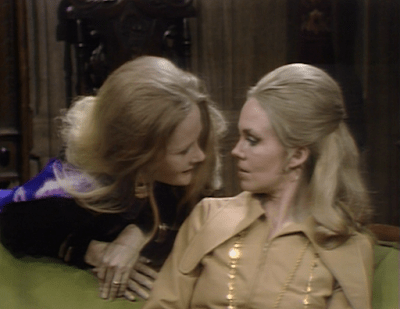
Later, Carolyn returns to the drawing room and finds her mother talking with “Alexis.” She leans down way into “Alexis'” personal space, making her hilariously uncomfortable.
“Alexis” leaves them alone. Carolyn tells her mother that she knows who murdered Angelique. She says that she had suspected her, and is greatly relieved to know that she was wrong. Roger eavesdrops on this conversation, and turns around to see the shadow of yet another eavesdropper.
Carolyn tells Liz that she not only knows who the murderer is, she has talked to “him” recently. That doesn’t narrow it down. She has talked to all three current suspects, and all of them are men. Roger gets very agitated whenever the topic of Angelique’s murderer comes up; his reaction is one of many heavy-handed clues the show has been giving lately that he did it. They had not suggested Trask might be the culprit when he was last on the show, in #1004, but they couldn’t be more obvious about it today. The third suspect is Quentin Collins, brother to Roger and Liz, who is currently a fugitive from justice, having escaped from jail after he was charged with another murder. Quentin is the man living in the tower room; Carolyn saw him there the other day, and he took a threatening tone with her. So any of those three men might be the one wielding the knife in the final shot.
This is a day for final appearances. Not only do we bid the kitchen adieu, but also Carolyn Loomis, Mr Trask, and Amy Collins. Nancy Barrett and Jerry Lacy will be back as other characters, but Denise Nickerson is gone from the cast as of today. After a great run in her first couple of months on the show, she was criminally underused. Still, whenever they did put her on she was typically the highlight of the day, so it is sad to lose her.
Liz mentions someone named “Dr Blum” today. We never see Dr Blum. The only character in the whole series who seems to be Jewish is Dr Julia Hoffman, who like the unseen Dr Blum is a psychiatrist. It was less than a year after this episode aired, on 26 May 1971, that President Richard Nixon said in a conversation with his chief of staff H. R. Haldeman that the reason he was unpopular with Jewish voters was that “Most of them are psychiatrists.” Ever since the tape of that conversation was released in 2002, people have been trying to figure out what Nixon meant to say. Perhaps the White House taping system malfunctioned, and picked up some audio not from the Richard Nixon of our universe, but from one who lived in one of the universes where Dark Shadows took place. There, he might have been making a simple statement of fact.
Barmaid Buffie Harrington sees a man assaulting a woman in the alley next to the tavern. She recognizes the man as ruffian John Yaeger. Yaeger used to buy Buffie gifts, then beat her and laugh at her bruises. She recognizes the woman as her childhood friend Maggie Evans. Maggie moved away from the village of Collinsport when she was very young, and came back recently as the wife of Quentin Collins, drunken sourpuss and master of the estate of Collinwood. Buffie orders Yaeger to unhand Maggie. He sneers at the women, threatening to make a stink if they go to the police. Buffie stands her ground, and at length Yaeger backs down and leaves.
Buffie and Maggie see Yaeger off.
Maggie goes to Quentin’s friend Cyrus Longworth in his laboratory. She tells Cyrus that Buffie rescued her from Yaeger. She asks Cyrus if it is true that Yaeger is his friend. Cyrus looks pained, and says that for some time he has considered Yaeger his enemy. Maggie had never seen Yaeger before; she was at the docks because he called her anonymously and promised her some information relevant to her suspicion that Quentin murdered his first wife, Angelique Stokes Collins. Nor did he identify himself to her. Buffie did not call him by name. So Maggie and Buffie must have had a conversation afterward in which she told him who Yaeger was and that he and Cyrus are connected to each other.
What neither Buffie nor Maggie knows is that Yaeger does not exist. He is simply a disguise Cyrus assumes when he wants to hurt someone. Cyrus never meant to tell Maggie anything about Quentin; he called Maggie to meet him at the docks because he wanted to rape and abduct her. Cyrus has devised a potion that causes his hair to turn darker and sprout all over his body, his shoulders to broaden, and his skin tone to change. John Yaeger is the alias he uses when in this disguise. After Maggie leaves, he tells himself that he and Yaeger are the same person, and that he is responsible for all of Yaeger’s crimes. He smashes up his lab equipment and burns his notes. All he really needed to do was pour out the potion. One of the essential ingredients is a compound he can’t make himself. He murdered the only known supplier, so once it is gone, it will be gone for good.
Cyrus is only the first character today to use Maggie’s need for information about Quentin to trap and hurt her. Quentin’s brother, high-born ne’er-do-well Roger Collins, keeps baiting her with references to the cause of Quentin’s current fit of bad temper. She finally insists he tells her what he means, and he says it is the anniversary of his wedding to Angelique.
The other character is Angelique herself. Unknown to any other character in today’s episode, Angelique has risen from the grave, murdered her identical twin sister Alexis, and taken Alexis’ place as Quentin’s houseguest in his mansion, the great house of Collinwood.
Maggie turns to “Alexis” for information about Quentin and Angelique’s marriage. When she asks if Angelique often wrote her when she was living in Florence, “Alexis” replies “Not often, but when she did she made up for it.” We know this is a lie, and Maggie should too. When the real Alexis first came to the Collinwood, housekeeper Julia Hoffman asked if she received the letter she sent informing her of Angelique’s death. She said she did not. It turned out that the last address Angelique had for Alexis was in Tangier, a city she had left some time before moving to Florence. Maggie takes “Alexis'” statement at face value, and also believes her when she says that Angelique wrote only of how wonderful her marriage to Quentin was. Further, she believes that Angelique was telling the truth in those supposed letters. Since her own marriage to Quentin has been miserable from the first day we saw them together, this depresses Maggie.
Maggie goes to sleep, and Angelique casts a spell to send her a dream. In the dream, Maggie goes to Angelique’s old bedroom and opens a hidden compartment in a small table. She finds a packet of letters there. She wakes up, goes to the room, and finds not only that there is such a compartment but that it does contain the letters. Presumably she will read these and add to her misery.
As Yaeger’s former punching bag and current blood thrall of vampire Barnabas Collins, Buffie is central to two of the ongoing stories. When she rescues Maggie, we can assume that they will renew their friendship, putting her close to the heart of all the other stories. The episode thus promises to usher in the Age of Buffie. But in fact, this is the character’s final appearance.
I suspect that the writers and producers were impressed with Elizabeth Eis’ performance and expanded Buffie’s part beyond what they originally intended. There were several cast members whom Dan Curtis Productions was contractually obligated to use in a certain number of episodes per month, and for the first weeks of the current segment most of those were off in Tarrytown, New York, doing principal photography on the feature House of Dark Shadows. That gave the show a greater flexibility with new performers than they have now that those people are back.
Moreover, the writers projected the plot out thirteen weeks at a time, in documents divided into 65 parts for the 65 episodes of that period. These projections were known in the soap opera business as “flimsies.” The show would scrap its plans completely when a story drew a different reaction from the audience than they had expected, most famously when Barnabas was introduced in April 1967 and was such a hit that they dropped the original idea to stake him at the end of a number of weeks. But Buffie isn’t that kind of a hit, and with the return to the jigsaw puzzle they have to solve every day to get the name actors their required appearances, the writers have to stick close to the flimsies for a while. By the time they could find room for Eis, the story had moved on and Buffie was no longer particularly relevant. Eis will be back later, when the show is set in a different version of Collinsport, playing a character who shows up in only three episodes.
An information management day. Old world gentleman Barnabas Collins has told his distant cousin, Roger Collins, about a parallel universe that is occasionally visible in a room in the long disused east wing of the great house of Collinwood. Today, Roger tells his sister Elizabeth about the room. Liz owns the house. We might wonder if she will have questions about what effect the presence of a spare universe on the premises will have on her property taxes.
Roger talks about the phenomenon while standing in the room with permanent houseguest Julia Hoffman, MD. He is incredulous when he notices that Julia is not listening to him. She cannot tell him what has distracted her. Unknown to Roger and Liz, Barnabas is a vampire. Julia has devised a treatment that is supposed to put this curse in remission, but it is not working at all. She has given him the last of the injections, and the only difference in Barnabas is that he is getting sick and feeling an unusually intense bloodlust.
Caretaker Chris Jennings, another distant cousin, comes stumbling home to his cottage on the grounds of the estate. He finds his girlfriend and ex-fiancée Sabrina Stuart waiting for him. Chris is another patient Julia has been unable to help. He is a werewolf. There was a full moon last night. Sabrina tells Chris he killed a man named Bruno. Chris is distressed that he killed anyone, but Sabrina points out that Bruno knew of his secret and was trying to use him to kill others. He was holding her and a man named Rumson prisoner, and when the police searched Bruno’s premises after his death they found Sabrina and Rumson imprisoned there. Sabrina keeps telling Chris she wants to marry him. Most of the time they will live ordinary lives, but one night out of 28 she will just have to lock him up in a special cell. Chris won’t hear of this.
My wife, Mrs Acilius, is a great one for love stories and an admirer of actress Lisa Blake Richards. Chris and Sabrina have run out of road on Dark Shadows, and are obviously going to be written out soon. Mrs Acilius wishes they could ride off into the sunset accompanied by the sound of wedding bells. So when Chris refused to marry Sabrina, she exclaimed “Stupid man!” I pointed out something Chris knows but does not mention to Sabrina, that his curse is hereditary. Any male descendants he has will also be werewolves. Mrs A conceded that this does complicate matters.
Roger saw Chris at Bruno’s place when he rescued him and Carolyn shortly before moonrise last night. Chris was at that time in the throes that precede his transformation. Chris ran off before Roger or Carolyn could see what became of him. Roger comes to the cottage to check on him.
Chris is in the back changing out of his bloody clothes, so Sabrina answers the door. She tells Roger that Chris is there and that she was with him all night, watching over him because he was ill. After what he saw of Chris at Bruno’s, Roger has no doubt that Chris needed a nurse, and he tells Sabrina that he is glad he had such a charming one. The audience can understand that Sabrina wants to conceal Chris’ lycanthropy from Roger, but surely it cannot be wise for her to claim that she was in the cottage overnight. Not only are her true whereabouts known to everyone who was in or around the police station the night before, but since Roger was the one who found Bruno’s body and he found it on the grounds of Collinwood, even police as inept as the ones in Collinsport are likely to follow up with him. Besides, her imprisonment with Rumson is a sensational story, of interest to the press. Maybe we will move on to the next phase of the show before the facts come to light, but Sabrina can’t know that.
Sabrina is determined to persuade Chris to resume their engagement. She goes to the one person whose opinion Chris seems to respect, Barnabas. When she knocks on his door, Barnabas hides behind a partition. When Sabrina first arrived, she had seen Barnabas through the window of his front parlor, so she lets herself in. He finally gives up on hiding and pleads with her to leave. She ignores what he is saying and keeps talking. She plows ahead with her idea about how Barnabas can help her and Chris become a happy married couple. Barnabas struggles to resist his urge for blood, but cannot. He bites Sabrina, much to her surprise. Miss Richards’ understated exclamation of “Barnabas!” when he shows his fangs and goes for her neck is very nicely done, it really sounds like a woman puzzled that a trusted friend is violating her personal space.
Sabrina staggers back to Chris’ cottage. She collapses in his chair, and he sees the puncture wounds on her neck. They are much bigger than the marks we’ve seen on Barnabas’ previous victims. I suppose he really was a lot hungrier than usual. Chris doesn’t know that Barnabas is a vampire, and the cliffhanger leaves us wondering whether he can avoid finding out.
Probably the most memorable shot in the episode is a very impressive bit of videotape editing. Roger and Barnabas are standing at the door to the Parallel Time room, watching Roger’s counterpart interact with Liz’ and Chris’. Parallel Roger walks toward the door. He exits the room, not into the space Roger and Barnabas occupy, but into the hallway as it exists in Parallel Time. He vanishes from their view, and the effect also winks out in the room, leaving Roger and Barnabas looking into the bare, dark chamber it is in the house they know.
In #808, set in the year 1897, the chief villain was sorcerer Count Petofi. Petofi’s henchman Aristide threatened an enemy with “the mysterious shadow he can cast, the shadow that isn’t your own that follows you.” That suggested a borrowing from George MacDonald’s once-famous 1858 novel Phantastes, one of the forerunners of the “fantasy” genre. MacDonald’s protagonist, Anodos (whose name comes from the Greek for “No Way,”) travels through Fairyland. Anodos falls afoul of an ash tree, which uses its magical powers to plague him with an autonomous shadow. The shadow comes and goes as Anodos makes his journey; at times he finds himself morbidly attached to it, at other times full of despair at the sight of it. In a climactic section, he is trapped in a tower, alone with the shadow and afraid he will remain solitary forevermore. He is freed of the shadow in the end.
Though MacDonald’s popularity faded as the years went on, he was still quite popular in some circles in the 1960s, a beneficiary of the enthusiastic endorsements of writers like C. S. Lewis, J. R. R. Tolkien, and W. H. Auden, who admired not only his manner of evoking a dream but also his intense Christian fervor. He still has a following today. Writer Meredith Finch and artists Christine Norrie and Andrew Pepoy adapted Phantastes into a graphic novel in 2022.
Shortly after the shadow is attached to him, Anodos happens upon a cottage in the woods. He enters, and meets a wise woman. She tells him what has happened:
The woman never raised her face, the upper part of which alone I could see distinctly; but, as soon as I stepped within the threshold, she began to read aloud, in a low and not altogether unpleasing voice, from an ancient little volume which she held open with one hand on the table upon which stood the lamp. What she read was something like this:
“So, then, as darkness had no beginning, neither will it ever have an end. So, then, is it eternal. The negation of aught else, is its affirmation. Where the light cannot come, there abideth the darkness. The light doth but hollow a mine out of the infinite extension of the darkness. And ever upon the steps of the light treadeth the darkness; yea, springeth in fountains and wells amidst it, from the secret channels of its mighty sea. Truly, man is but a passing flame, moving unquietly amid the surrounding rest of night; without which he yet could not be, and whereof he is in part compounded.”
As I drew nearer, and she read on, she moved a little to turn a leaf of the dark old volume, and I saw that her face was sallow and slightly forbidding. Her forehead was high, and her black eyes repressedly quiet. But she took no notice of me. This end of the cottage, if cottage it could be called, was destitute of furniture, except the table with the lamp, and the chair on which the woman sat. In one corner was a door, apparently of a cupboard in the wall, but which might lead to a room beyond. Still the irresistible desire which had made me enter the building urged me: I must open that door, and see what was beyond it. I approached, and laid my hand on the rude latch. Then the woman spoke, but without lifting her head or looking at me: “You had better not open that door.” This was uttered quite quietly; and she went on with her reading, partly in silence, partly aloud; but both modes seemed equally intended for herself alone. The prohibition, however, only increased my desire to see; and as she took no further notice, I gently opened the door to its full width, and looked in. At first, I saw nothing worthy of attention. It seemed a common closet, with shelves on each hand, on which stood various little necessaries for the humble uses of a cottage. In one corner stood one or two brooms, in another a hatchet and other common tools; showing that it was in use every hour of the day for household purposes. But, as I looked, I saw that there were no shelves at the back, and that an empty space went in further; its termination appearing to be a faintly glimmering wall or curtain, somewhat less, however, than the width and height of the doorway where I stood. But, as I continued looking, for a few seconds, towards this faintly luminous limit, my eyes came into true relation with their object. All at once, with such a shiver as when one is suddenly conscious of the presence of another in a room where he has, for hours, considered himself alone, I saw that the seemingly luminous extremity was a sky, as of night, beheld through the long perspective of a narrow, dark passage, through what, or built of what, I could not tell. As I gazed, I clearly discerned two or three stars glimmering faintly in the distant blue. But, suddenly, and as if it had been running fast from a far distance for this very point, and had turned the corner without abating its swiftness, a dark figure sped into and along the passage from the blue opening at the remote end. I started back and shuddered, but kept looking, for I could not help it. On and on it came, with a speedy approach but delayed arrival; till, at last, through the many gradations of approach, it seemed to come within the sphere of myself, rushed up to me, and passed me into the cottage. All I could tell of its appearance was, that it seemed to be a dark human figure. Its motion was entirely noiseless, and might be called a gliding, were it not that it appeared that of a runner, but with ghostly feet. I had moved back yet a little to let him pass me, and looked round after him instantly. I could not see him.
“Where is he?” I said, in some alarm, to the woman, who still sat reading.
“There, on the floor, behind you,” she said, pointing with her arm half-outstretched, but not lifting her eyes. I turned and looked, but saw nothing. Then with a feeling that there was yet something behind me, I looked round over my shoulder; and there, on the ground, lay a black shadow, the size of a man. It was so dark, that I could see it in the dim light of the lamp, which shone full upon it, apparently without thinning at all the intensity of its hue.
“I told you,” said the woman, “you had better not look into that closet.”
“What is it?” I said, with a growing sense of horror.
“It is only your shadow that has found you,” she replied. “Everybody’s shadow is ranging up and down looking for him. I believe you call it by a different name in your world: yours has found you, as every person’s is almost certain to do who looks into that closet, especially after meeting one in the forest, whom I dare say you have met.”
Here, for the first time, she lifted her head, and looked full at me: her mouth was full of long, white, shining teeth; and I knew that I was in the house of the ogre. I could not speak, but turned and left the house, with the shadow at my heels. “A nice sort of valet to have,” I said to myself bitterly, as I stepped into the sunshine, and, looking over my shoulder, saw that it lay yet blacker in the full blaze of the sunlight. Indeed, only when I stood between it and the sun, was the blackness at all diminished. I was so bewildered—stunned—both by the event itself and its suddenness, that I could not at all realise to myself what it would be to have such a constant and strange attendance; but with a dim conviction that my present dislike would soon grow to loathing, I took my dreary way through the wood.
The Visionary Novels of George MacDonald: Lilith and Phantastes, edited by Anne Fremantle (Noonday Press, 1954) pages 311-314*
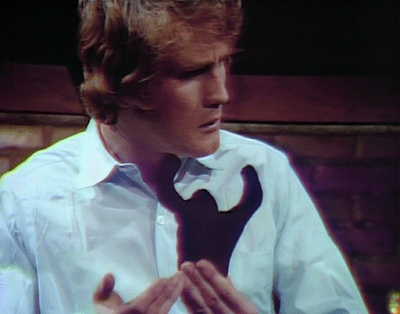
Petofi never got round to casting the mysterious shadow on any of his enemies or doing anything else to remind people of MacDonald’s works. But today wicked witch Angelique picks up on Aristide’s suggestion. One-man wrecking crew Jeb Hawkes, alias Jabe, comes home to the carriage house on the estate of Colllinwood and finds Angelique waiting for him. She tells Jabe she blames him for something that happened to her husband. He denies responsibility. Ignoring his protests, she trims a piece of black construction paper into a crude figure. She places the figure on his chest and tells him it will spell his doom.
Jabe has no idea how this could be. Angelique thinks aloud for a moment about keeping him guessing, then decides she may as well tell him. She instructs him to look into the fire. When he does, he has a vision of himself asleep in bed (fully clothed, of course, it’s Collinsport) when a shadow in the form of Angelique’s cutout appears, engulfs him, and makes him scream. We cut back to the carriage house, where Jabe keeps telling Angelique that she while she may be able to make him have visions, she can’t cause such a thing to happen in reality. She assures him she can.
The carriage house is a cottage in the woods, so in this scene Angelique combines the roles of the wise woman who explains the shadow curse to Anodos and the ash tree that places it. The cutout is a much sillier visual than was the image Anodos saw in chapter four of Phantastes, when his curse began:
When [the Moon] shone out again, with a brilliancy increased by the contrast, I saw plainly on the path before me—from around which at this spot the trees receded, leaving a small space of green sward—the shadow of a large hand, with knotty joints and protuberances here and there. Especially I remarked, even in the midst of my fear, the bulbous points of the fingers. I looked hurriedly all around, but could see nothing from which such a shadow should fall. Now, however, that I had a direction, however undetermined, in which to project my apprehension, the very sense of danger and need of action overcame that stifling which is the worst property of fear. I reflected in a moment, that if this were indeed a shadow, it was useless to look for the object that cast it in any other direction than between the shadow and the moon. I looked, and peered, and intensified my vision, all to no purpose. I could see nothing of that kind, not even an ash-tree in the neighbourhood. Still the shadow remained; not steady, but moving to and fro, and once I saw the fingers close, and grind themselves close, like the claws of a wild animal, as if in uncontrollable longing for some anticipated prey. There seemed but one mode left of discovering the substance of this shadow. I went forward boldly, though with an inward shudder which I would not heed, to the spot where the shadow lay, threw myself on the ground, laid my head within the form of the hand, and turned my eyes towards the moon. Good heavens! what did I see? I wonder that ever I arose, and that the very shadow of the hand did not hold me where I lay until fear had frozen my brain. I saw the strangest figure; vague, shadowy, almost transparent, in the central parts, and gradually deepening in substance towards the outside, until it ended in extremities capable of casting such a shadow as fell from the hand, through the awful fingers of which I now saw the moon. The hand was uplifted in the attitude of a paw about to strike its prey. But the face, which throbbed with fluctuating and pulsatory visibility—not from changes in the light it reflected, but from changes in its own conditions of reflecting power, the alterations being from within, not from without—it was horrible. I do not know how to describe it. It caused a new sensation. Just as one cannot translate a horrible odour, or a ghastly pain, or a fearful sound, into words, so I cannot describe this new form of awful hideousness. I can only try to describe something that is not it, but seems somewhat parallel to it; or at least is suggested by it. It reminded me of what I had heard of vampires; for the face resembled that of a corpse more than anything else I can think of; especially when I can conceive such a face in motion, but not suggesting any life as the source of the motion. The features were rather handsome than otherwise, except the mouth, which had scarcely a curve in it. The lips were of equal thickness; but the thickness was not at all remarkable, even although they looked slightly swollen. They seemed fixedly open, but were not wide apart. Of course I did not remark these lineaments at the time: I was too horrified for that. I noted them afterwards, when the form returned on my inward sight with a vividness too intense to admit of my doubting the accuracy of the reflex. But the most awful of the features were the eyes. These were alive, yet not with life.
They seemed lighted up with an infinite greed. A gnawing voracity, which devoured the devourer, seemed to be the indwelling and propelling power of the whole ghostly apparition. I lay for a few moments simply imbruted with terror; when another cloud, obscuring the moon, delivered me from the immediately paralysing effects of the presence to the vision of the object of horror, while it added the force of imagination to the power of fear within me; inasmuch as, knowing far worse cause for apprehension than before, I remained equally ignorant from what I had to defend myself, or how to take any precautions: he might be upon me in the darkness any moment. I sprang to my feet, and sped I knew not whither, only away from the spectre. I thought no longer of the path, and often narrowly escaped dashing myself against a tree, in my headlong flight of fear.
The Visionary Novels of George MacDonald: Lilith and Phantastes, edited by Anne Fremantle (Noonday Press, 1954) pages 284-286
The only images of the sky we ever see on Dark Shadows are stock footage and stills; a massive translucent figure looming in front of the moon, an immense shadow itself casting a shadow on the ground below, is far beyond anything they have attempted. So we can understand why they decided to go to the opposite extreme, and try to build an initially unprepossessing prop into something powerful. Moreover, the show at this point has an audience consisting very largely of elementary school students, so the sight of a major character using scissors to trim a figure out of construction paper will be relatable.
The shadow that follows Anodos does not develop the ability to cause physical harm to him. It wears him down psychologically, and is the Reverend MacDonald’s allegory for anxiety resulting from sin. Jabe’s vision tells us that this story will deviate from the source material, and that his shadow will grow in size and intensity until it kills Jabe.
Of course, a story about a dark shadow involves the show making reference to its own title. Around the time Dark Shadows was on the air, it was a fad for teenagers in movie theaters to cheer whenever a character said the title of the film. I wonder if the appearances of Jabe’s unwanted companion prompted many members of the original audience to cheer.
Closing Miscellany
There is a moment that may not mean much to first-time viewers, but that will astonish confirmed fans. Jabe goes into the drawing room of the great house of Collinwood. Matriarch Elizabeth Collins Stoddard introduces him to Angelique, whom she knows only as a fellow rich lady. When Liz starts telling Jabe about Angelique’s stately home, Angelique volunteers that Jabe has been there and that he is close to her husband. Throughout the preceding 193 weeks, characters have been able to count on their enemies to keep their secrets for them. Disclosing information relevant to the plot to Liz is particularly inconceivable, even in the most desperate circumstances. When Angelique disregards these rules, she is going so far against the grain that my wife, Mrs Acilius, wondered for a second if Lara Parker had decided to throw the script away and blow up the show.
Today marks the final appearance of two actors on Dark Shadows. Roger Davis first appeared in #404 as an unpleasant man named Peter Bradford; today he is Peter’s ghost. Mr Davis played several other parts in the interval, all of them selfish, handsy men with an irritating habit of shouting their lines in a voice rising, not from the diaphragm, but from tightened rectal sphincters. Making matters even worse, Mr Davis is a highly trained, accomplished actor who is capable of doing excellent work. Once in a rare while, he deigns to put his skills to use on Dark Shadows, and he was part of one or two of the best scenes on the show. But most of the time, he chooses to put all of that aside and instead assaults his female scene partners on camera and subjects us to his unvarying anal screech. When Angelique dismisses him, we forgive her all her past misdeeds. Mr Davis will be back as the juvenile lead in the feature House of Dark Shadows, but at least we no longer have to dread 4:00 PM on weekdays.
Christopher Bernau also makes his departure as Philip Todd, Jabe’s onetime foster father. The part of Philip didn’t give Bernau much to work with, and he compounded the difficulties by playing him as if he were Jack Benny. But Bernau, too, was a very capable actor, and he was a true professional. A few times he has shown us what he can do, and he will be missed. Later in the 1970s Bernau achieved fame in two parts that harked back to Dark Shadows. He played Dracula on Broadway in 1977. That same year, he joined the cast of The Guiding Light as womanizing rogue Alan Spaulding, a part he played for several years until his death, of AIDS, in 1989. I reminisced about Bernau’s Alan Spaulding on Danny Horn’s great Dark Shadows Every Day:
I was a kid when Bernau joined GUIDING LIGHT. My mother watched that show, and I had several times attempted to watch it with her, but it always defeated me after 5 or 10 minutes. It just seemed like a window into the deepest level of Hell, the frozen cavern where absolutely nothing happens. But Bernau caught my imagination. I could watch entire episodes if he was in them.
Years later, when I watched DARK SHADOWS on the Sci-Fi Channel, I realized what made Bernau so compelling on GUIDING LIGHT. He was doing a Jonathan Frid imitation. Within moments of first seeing Barnabas, I exclaimed “Alan Spaulding!” It was only years later that I learned Bernau had been on DARK SHADOWS.
Comment left 10 December 2020 by Acilius, on Danny Horn, “Episode 888: Little Shop,” 26 June 2016, Dark Shadows Every Day.
Alan Spaulding was such a hit for Bernau that there can be no doubt a Jonathan Frid imitation was a better starting place for him than was a Jack Benny imitation, at least in daytime.
The closing credits run over a view of the landing at the top of the foyer stairs. We see this space straight-on, an unusual angle. Typically they tilt the camera way back and look up at it. Perhaps they are showing off some new equipment.
*I first heard of Phantastes from a January 2022 episode of God and Comics, a podcast that three Episcopal priests did until shortly after one of them flaked off and became a Roman Catholic. When they talked about Anodos’ shadow, I wished I had a Dark Shadows blog, so I could tell people about the connection to this story.
My copy of The Visionary Novels of George MacDonald is one I came across at a charity book sale in May of 2025. I’ve had it on the table next to the spot where I sit when I write these posts ever since. It isn’t my kind of writing. I usually enjoy dry, matter-of-fact prose, while MacDonald was rarely less florid than in the passages above. Besides which, MacDonald was a sometime clergyman whose evangelistic zeal led even the Reverend Misters hosting God and Comics to admit that his books reminded them too much of their day jobs for their taste. For my part, I say there’s a place for everything, and the proper place for MacDonald’s heavy-handed style of preaching is a pulpit in a church I don’t attend.
**As the saying goes, people who call Twitter “X” would have turned you in to the Stasi.
Julia Hoffman, MD, has followed her friend, vampire Barnabas Collins, on an uncertain and frightening journey into the past. They are now in the year 1897, where Barnabas hopes to prevent disasters that would befall the Collins family in 1969. Today, Julia is in their hiding place, the old rectory on Pine Road, trying to replicate the experimental treatment that put Barnabas’ vampirism into remission for a while early in 1968. A knock comes at the door.
It is Julia and Barnabas’ current arch-nemesis, sorcerer Count Petofi. Julia reacts to the sight of him with fear. Petofi assures Julia that he does not now have any intention of making another attempt on her life. He tells her that she is alive thanks to the incompetence of his henchman Aristide and to Barnabas’ bravery, but that if she finds herself in danger again she must not count on Barnabas to save her. When he tells her that this is because a woman drove a stake through Barnabas’ heart, Julia reacts with shock. She asks if Petofi plans to hand her back over to Aristide for another try; he says that his plan is rather to keep her under constant surveillance so that when she returns to 1969, he will go along with her.
Julia learns that Barnabas is dead, and not just because it is daytime. Screenshot by Dark Shadows Before I Die.
Julia’s displays of fear and bravery are a bit of an attention-getter for returning viewers. Last week she learned that it is only her “astral body” that is in 1897, while her physical body is in 1969. She is therefore immune to any physical harm. It is tactically sound to keep this information from Petofi, of course, but characters on Dark Shadows do not always have sufficient discretion to observe this basic rule of gamesmanship. Barnabas particularly is in the habit of showing all his cards to his enemies while hiding everything from those who would like to help him, and even Julia, who is the smartest character on the show, has done the same thing from time to time. The most celebrated example is probably #619, when she marched into a hostile warlock’s living room, told him everything he wanted to know, and somehow walked away the winner. But today not only does she keep shtum during the scene, the show doesn’t even let the audience in on what she’s doing. First time viewers are as much in the dark as Petofi is.
Later, Julia goes to the great house of Collinwood to tell rakish libertine Quentin Collins that Barnabas had asked her to take a message to him in the event that he died. Quentin is in terrible danger from Petofi, and must flee at once. Quentin says that he has already come to that conclusion, and urges her to do the same. Julia tells him that she cannot. Barnabas left several tasks uncompleted that must be attended to for the future of the Collins family to take its necessary shape. She assures Quentin that she is not in as much danger as he is. She says that Petofi thinks she is his ticket to 1969, and that he will not kill her. Again, she does not even hint at her immunity to physical harm.
Earlier in the episode, Petofi had ordered Quentin to keep watch on Julia. When he resisted, Petofi reminded him that if it were not for his intervention, Quentin would be a werewolf and the lovely Amanda Harris, whom Quentin has asked to run off with him, would be lethally mauled the next time she is in his vicinity during a full Moon. Quentin has betrayed Barnabas and Julia on Petofi’s orders before, and we have little doubt that he will do so again.
Barnabas knew that Quentin was under Petofi’s control, and he shared his information with Julia. The other day he told Quentin where his coffin was kept during the day, leading directly to his staking. Longtime viewers may have taken this as another example of Barnabas showing his cards to his enemies. Those watching closely will have noticed an enigmatic look Barnabas gave Quentin as he was leaving the room at the end of that conversation, and will have asked if he was up to something. That Julia holds back the fact that she cannot be killed in 1897 suggests that she knows that whatever she tells Quentin will get back to Petofi. This will prompt us to ask the same question.
Last week, Julia made an agreement with wicked witch Angelique to fight Petofi together. Angelique would not tell her what her plan of action was, but when Julia looked in the mirror and saw, not her own reflection, but Angelique’s, she said that she understood what the plan was and knew that it would work. So if we have been watching regularly, we are likely confident that Julia, Angelique, and Barnabas have a surprise in store for Petofi.
One of Petofi’s vulnerabilities is prominently featured today. As a supervillain, he is committed to the idea of exercising as much control as possible over the world. With that commitment comes a blind spot. He is slow to understand events that take place outside anyone’s control. When he learned that Barnabas and Julia had traveled through time while meditating on I Ching wands, he himself cast such wands, meditated on them, and had a terrifying experience. He was convinced Julia had directed that experience, and it was when she could not tell him how she had done so or how to subject the consequences of meditation to his will that he ordered Aristide to kill her.
Petofi has now learned that Julia was telling the truth when she said that the effects of the meditative state were not within her power. But he is still experimenting with the wands, trying to develop a technique to subdue the power that meditation on them unlocks. He uses a man named Tim Shaw as the subject of his experiment today; Tim has a vision in which a masked man, who turns out to be Quentin, kills Amanda.
Tim had come to Petofi with the news of Barnabas’ death, hoping to collect some kind of reward from him. Petofi was quite cheerful at the news, but uninterested in the details until Tim told him that the killer was a woman he knows by the name Charity Trask. That threw Petofi for a loop, and he went to Quentin.
Petofi had ordered Quentin to stake Barnabas. He congratulated him on manipulating Charity into doing it for him, and was visibly disconcerted when Quentin said it was an accident Charity followed him- he hadn’t even known she was there. Again, Petofi’s overestimation of the efficacy of plans reveals a soft spot. If Angelique, Julia, and Barnabas can strike him there, they have an excellent chance of bringing him down.