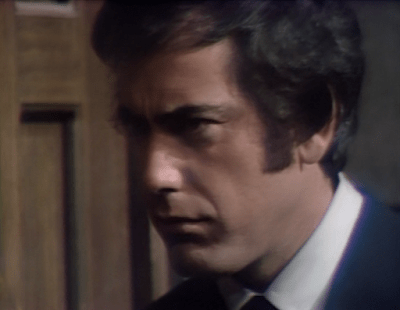
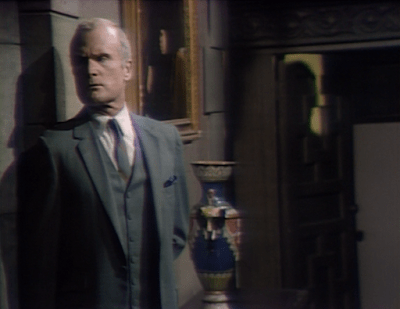
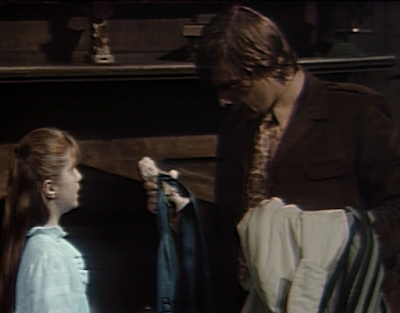
In the first months of Dark Shadows, characters several times shared meals in the kitchen in the great house on the estate of Collinwood. In that intimate setting, they would often exchange information that made it possible for them to advance the story. As time went on, the show developed more ways to get knowledge flowing, and the kitchen lost its importance. We haven’t seen it since #208.
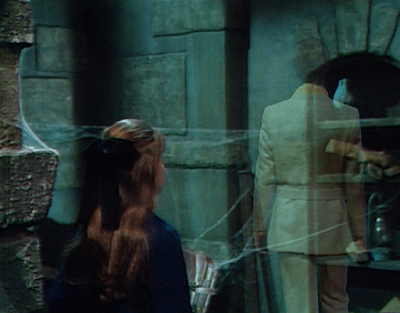
Now, the show is set in an alternate universe, which it calls “Parallel Time.” We see the kitchen in this reality’s Collinwood today, the last glimpse we get of the room in any version of the place. Young Amy Collins visits butler Mr Trask there while he is sharpening a large knife. She tells him a man is living in the tower room. He leaves to investigate, leaving the knife on the countertop. The camera zooms in on the implement, lingering over it while an ominous cue plays on the soundtrack.
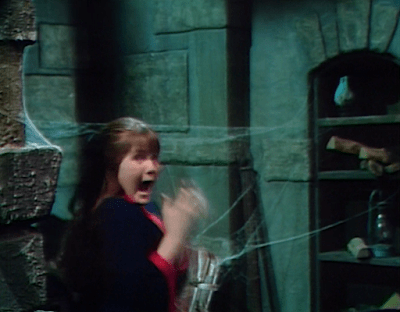
Later, Amy returns to the kitchen with the matronly Elizabeth Collins Stoddard. Liz is upset that dinner is not ready and Trask is nowhere to be found. Amy notices that the knife is not where Trask left it hours before. Liz is unimpressed with this fact, as anyone would be who had not seen the zoom shot and heard the melodramatic music. We cut to the tower room, where Liz’ daughter Carolyn Loomis greets someone we cannot see. We cut to a hand holding a knife very much like the one Trask had sharpened. The hand brings the knife down, and Carolyn screams.
It is Carolyn who is the main source of information for the other characters in today’s show. Carolyn’s husband was killed the other day in a conflict between two supernatural beings. The other characters in today’s episode have no idea that such beings dwell among them, and think that those two in particular are simply members of their extended family. Carolyn has had all she can take of this situation. She claims “to know all the secrets” of Collinwood, and is far too drunk to keep many of them to herself.
Trask learned several secrets from Carolyn in Act One, when he was leaning up against the door to the drawing room, his ear pressed hard to it, eavesdropping ferociously on her conversation with her uncle, Roger Collins. Carolyn taunts Roger with his failure to recognize someone he loves desperately. She declares that she can prove that the houseguest who has been staying in the great house lately is not Alexis Stokes, but Alexis’ identical twin sister, Angelique Stokes Collins.
Roger rejects this claim. Since Angelique died last year, one might expect Roger to be confident in his rejection, but he is high-strung and defensive about it. Carolyn does not deny that Angelique is dead. Indeed, she says that if anyone were to look at the base of “Alexis'” skull, they would find a scar where the killer drove in the hatpin that killed Angelique, proving that “Alexis” is Angelique’s reanimated corpse. This makes more sense to Roger than one might expect. When he first saw Alexis in #990 she had to give him her hand and talk soothingly to him for some time before he would accept that she was not Angelique risen from the grave.
As it happens, Carolyn is right. Two weeks after she met Roger, Alexis saw Angelique lying in the tomb. Alexis touched her sister to bid her a final farewell, only to find that all of the heat was draining from her body into Angelique’s. Moments later, Alexis was dead and Angelique was standing over her icy corpse. Angelique put on Alexis’ clothes, did her hair in the style Alexis wore, and met Trask, who accompanied her to the great house. Ever since, Angelique has been passing herself off as Alexis.
Amy interrupted Trask while he was eavesdropping. He ordered her to leave him alone, getting quite surly about it. If he can hear everything Carolyn and Roger are saying, we wonder why they can’t hear him being nasty to a member of the family. But apparently they can’t. She goes away, and he presses himself even closer to the door.
Carolyn is still talking to Roger and Trask is still eavesdropping when “Alexis” comes by. She reproves Trask, opens the doors to the drawing room, and exposes him to Roger and Carolyn. Roger is too shocked by the sight of “Alexis” and Carolyn is too amused by it all for either of them to do anything about Trask’s misconduct.
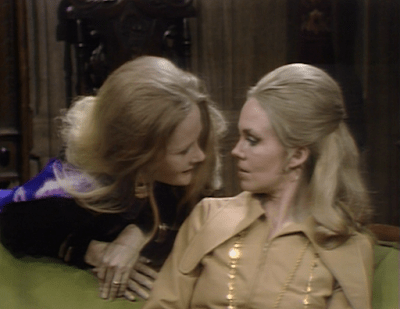
Later, Carolyn returns to the drawing room and finds her mother talking with “Alexis.” She leans down way into “Alexis'” personal space, making her hilariously uncomfortable.
“Alexis” leaves them alone. Carolyn tells her mother that she knows who murdered Angelique. She says that she had suspected her, and is greatly relieved to know that she was wrong. Roger eavesdrops on this conversation, and turns around to see the shadow of yet another eavesdropper.
Carolyn tells Liz that she not only knows who the murderer is, she has talked to “him” recently. That doesn’t narrow it down. She has talked to all three current suspects, and all of them are men. Roger gets very agitated whenever the topic of Angelique’s murderer comes up; his reaction is one of many heavy-handed clues the show has been giving lately that he did it. They had not suggested Trask might be the culprit when he was last on the show, in #1004, but they couldn’t be more obvious about it today. The third suspect is Quentin Collins, brother to Roger and Liz, who is currently a fugitive from justice, having escaped from jail after he was charged with another murder. Quentin is the man living in the tower room; Carolyn saw him there the other day, and he took a threatening tone with her. So any of those three men might be the one wielding the knife in the final shot.
This is a day for final appearances. Not only do we bid the kitchen adieu, but also Carolyn Loomis, Mr Trask, and Amy Collins. Nancy Barrett and Jerry Lacy will be back as other characters, but Denise Nickerson is gone from the cast as of today. After a great run in her first couple of months on the show, she was criminally underused. Still, whenever they did put her on she was typically the highlight of the day, so it is sad to lose her.
Liz mentions someone named “Dr Blum” today. We never see Dr Blum. The only character in the whole series who seems to be Jewish is Dr Julia Hoffman, who like the unseen Dr Blum is a psychiatrist. It was less than a year after this episode aired, on 26 May 1971, that President Richard Nixon said in a conversation with his chief of staff H. R. Haldeman that the reason he was unpopular with Jewish voters was that “Most of them are psychiatrists.” Ever since the tape of that conversation was released in 2002, people have been trying to figure out what Nixon meant to say. Perhaps the White House taping system malfunctioned, and picked up some audio not from the Richard Nixon of our universe, but from one who lived in one of the universes where Dark Shadows took place. There, he might have been making a simple statement of fact.
The whole idea of the supernatural is that what appears to be weak is able to overcome what appears to be strong. So, as far as we can tell the dead are infinitely weaker than the living, yet it is two dead characters, vampire Barnabas Collins and wicked witch Angelique Stokes Collins, who dominate all the living people they interact with today. Even dead characters who barely appear utterly outclass live ones. In the opening sequence, Barnabas and his blood thrall Will Loomis hear the voice of late housekeeper Julia Hoffman. Hoffman’s ghost does not manifest visibly; she is such a subtle presence that Will can’t tell the difference between her and a stray piece of purple cloth. Even so, he is helpless against the dead Hoffman. Only the equally dead Barnabas can talk her into getting out of their way.
As far as we can tell, people have more influence over each other when they are close together than when they are far away, and if one person is going to resuscitate another they have to be in physical contact. But Angelique’s father, a wizard known as Tim, somehow connected her to a girl named Roxanne when Roxanne was in the back room of his apartment and Angelique was sealed up in her tomb, miles away. That unexplained connection drained most of the “life force” from Roxanne into Angelique, allowing Angelique to move among the living and reducing Roxanne to a vegetative state. Roxanne must remain in precisely her current state of debility, or Angelique will die again. Whenever Roxanne regains even a minuscule amount of strength, Angelique collapses. If Roxanne were herself to die, the whole of the “life-force,” including the share which animates Angelique, would vanish. The first and third letters of Roxanne’s name specify what she is to Angelique, the ℞ prescribed for her.
As far as we can tell, the actions we take in our lives have consequences while the actions we do not take have none. But 13 weeks ago Barnabas crossed over into an alternate universe where counterparts of the people he knows are living with the consequences of actions he did not take when he met his universe’s counterpart of Angelique in the 1790s. In his life, Barnabas had an affair with Angelique, then spurned her when he found that the gracious Josette was available to him. In revenge, Angelique turned him into a vampire and brought death and misfortune to many others. In this continuity, Barnabas’ counterpart left Angelique alone, married Josette, lived a quiet life, and died a natural death.
Hoffman’s counterpart in Barnabas’ native universe is as devoted to him as Hoffman was to Angelique. This Julia Hoffman is a medical doctor and a mad scientist. She has crossed over to the current continuity, killed her counterpart, and assumed her identity. She is working with Barnabas against Angelique.
Barnabas and Will take Roxanne from Stokes’ apartment to Will’s house on the grounds of the estate of Collinwood. Barnabas wants to control Angelique by periodically stimulating Roxanne a little, knocking Angelique out each time he does so. His original plan was to revive her altogether, destroying Angelique, but he has decided that if he does this he will have less of a chance of proving that Angelique, not foul-tempered sourpuss Quentin Collins, was responsible for the death of a man called Bruno Hess. As far as we can tell, people who can move around and talk are better able to defend their reputations than are those who are rotting in their graves, but Barnabas seems to think that it is the other way around in Angelique’s case.
Julia has refused to aid Barnabas in this nonsensical scheme, but now that Roxanne is in the house she acquiesces. Before she can get to work, they hear a knock on the front door. Will leaves Julia and Barnabas with Roxanne in the secret room behind the bookcase in the front parlor. Angelique herself is the visitor, asking to see Barnabas. Will tells her that Barnabas is not in and that he won’t be back for some time. She goes to the bookcase and appears to be reaching for the lever that exposes the secret room, but simply takes a book. She sits down to read while she is waiting for Barnabas. Will claims that he has resolved to stop drinking and resume his work as a writer, and that he has to be alone to do so. Angelique can’t think of anything to say to that, so she goes.
Once Angelique has returned to the great house, Quentin’s young cousin Amy Collins comes to her in the drawing room to say that she saw a man scurry across the grounds and climb in through a window, and that a few minutes later she heard a man outside her bedroom door. She could not see the man, but thinks he might be Quentin. Angelique tries to persuade her she did not see what she saw. Amy has given up when Angelique grows faint, the result of what is happening to Roxanne. When Angelique’s head clears, she asks Amy in a very serious tone to repeat exactly what she told her. Any inclination the girl may have had to believe that she was mistaken vanishes with this.
We next see Amy exploring the long-disused west wing of the house. She hears someone moving around among the cobwebs and bric-a-brac. She does not find this person, but does discover the statuette Angelique used as a voodoo doll when she cast the spell that killed Bruno, Bruno’s scarf still tied around its neck.
Julia, masquerading as Hoffman, returns to the great house. Angelique scolds her for neither being at hand when she wanted her nor keeping close enough track of Barnabas to prevent him taking Roxanne away from her father’s apartment. Julia answers the first of these complaints by referring to her other duties. She answers the second by trying to say that another of Angelique’s enemies might have made off with Roxanne. Angelique has no patience with either of these statements.
Will comes to the great house. Amy tells him about the man she saw on the lawn, says that she believes he was Quentin, and shows him the statuette with the scarf around its neck. Regular viewers not only remember Angelique using the statuette to strangle Bruno from afar, but will also remember that her counterpart in the main continuity used the same statuette in the same way to cast a choking spell on her husband Sky Rumson in #955, when Sky was trying to set fire to her (theirs was an imperfect marriage.) But out of that context, there does not appear to be anything sinister about the statuette. That isn’t a flaw in the prop- it’s the whole point. As a supernatural intervention, the voodoo doll is not supposed to look like it could have anything to do with the consequences of the spell it is used to cast.
Will recognizes the statuette as a voodoo doll, as his wife Carolyn had done when Maggie showed it to her the other day. That’s a breach of faith with the audience. Science fiction writer Arthur C. Clarke famously said that any sufficiently advanced form of technology is indistinguishable from magic. If the implements of witchcraft are things that could be sent off to the police lab for forensic analysis, they are not sufficiently advanced to stay outside the category of technology, and you are not telling a story about magic at all.
Will retraces Amy’s steps through the west wing, hoping to find Quentin and offer him his support. He makes his way to the tower room. The door opens, and he is startled to see who is entering.
Denise Nickerson was a splendid young actress. When she first joined the cast as Amy Jennings in the main continuity, she was central to the plot for months, and did a great job. We remember those days when she goes to the west wing looking for Quentin. It was Amy Jennings who, on her first night in the great house, entered the west wing and went straight to the room where the ghost of that universe’s version of Quentin was waiting for her. But she has been seen less and less. This is Nickerson’s first appearance in eight weeks, and it is hard to be optimistic that we will see much more of her in the future.
There are a number of buildings on the estate of Collinwood. There is the Old House, a big mansion where the Collinses lived until the 1790s, and the great house, an even bigger mansion where they have lived since. These days, the Old House is home to hard-drinking writer William H. Loomis and his wife, the former Carolyn Collins Stoddard. Sometimes the place is called “Loomis House” in recognition of its inhabitants. We learn today that the Loomises have a servant. His name is Wilfred Block, but everyone knows him as Fred.
Fred hears some noise coming from the attic. He goes up there and finds two kids who belong at the great house. They are Amy Collins and her cousin, Daniel Collins. Amy is out cold, and Fred asks Daniel what he did to her. Daniel claims to be innocent. He says that Amy just looked at a portrait and fainted. That’s the sort of thing the Collinses do all the time, so Fred accepts it. He carries Amy back to the great house. Daniel follows.
There, Daniel tells his father, Quentin Collins, the same story he told Fred. Fred tells Quentin that he couldn’t get any answers out of Amy. She just kept repeating the words “chained” and “trapped.” Quentin thanks Fred.
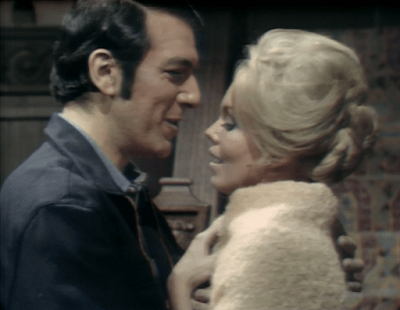
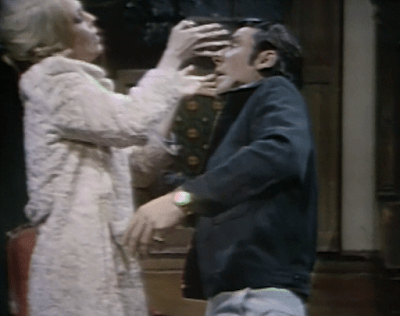
On his way out, Fred sees a woman whom he greets as “Miss Alexis.” He tells Alexis that he misses her visits to the Loomis House. She walks up very close to him and says she is feeling cold. He says he knows what to do about that, and hugs her. She holds the embrace for quite a while. He says he’s wanted to do that ever since he first saw her. She tells him to kiss her. Before he can comply, they hear Quentin coming. They separate and look nonchalant. Quentin is surprised Fred is still there. Fred hastens out.
Later, Alexis’ aunt, Hannah Stokes, would go to Fred at the Loomis House and ask him to come to her place, telling him Alexis wanted to see him there. That scene took place out of our view. The next time we do see Fred, Hannah is leading him into her parlor. Fred tells Alexis that he’d been planning to see her at Collinwood, but she says it is better at Hannah’s. Hannah leaves them alone together. They embrace, and Fred kisses Alexis. He feels cold. She tells him he will go on feeling cold, but bids him embrace her again. He does. He collapses.
Hannah was close to one of her nieces, Quentin’s late wife Angelique Stokes Collins. But she never got along with Angelique’s identical twin sister Alexis. Angelique had shared Hannah’s interest in the occult, and had been her pupil in that area, while Alexis scorned such matters. Alexis came to stay at Collinwood four and a half weeks ago, and spoke to Hannah only once during that time, when Hannah invited herself to the great house. That was a tense meeting which ended with Alexis all but ordering Hannah to go.
Hannah is taken aback today when she answers her door. She sees Alexis. She makes sarcastic remarks about Alexis, which do not deter her visitor from entering. The visitor asks Hannah to tell her fortune. Hannah resists, but the visitor keeps telling her it is something she wants very much. Hannah starts laying out the Tarot, but the first two cards disturb her so deeply she stops and cannot be persuaded to resume. She tells her visitor that they mean that she has no future. The visitor responds with a placid look and an insistence that Hannah read her palm. Hannah does not want to see the same message there, but the visitor will not be denied. When she looks at her palm, Hannah has a realization. “You are not Alexis! You are Angelique!”
Hannah is horrified that Angelique has returned from the dead. She does not want to know how it was done. Angelique seems eager to tell her everything; if Hannah were willing to listen, she might even volunteer that she murdered Alexis by draining the warmth from her body to heat her own undead frame. Angelique asks Hannah to bring her up to date on some things that happened while Alexis was at Collinwood and she was in the tomb. She then explains that her own death was also a murder, and that she wants to avenge it, though she does not yet know who the murderer was. She also has plans for Quentin, though she does not make it clear at this time what those are. She tells Hannah to bring Fred to her so that she can drain the warmth from him. Hannah protests, but Angelique tells her she has no choice. If she does not deliver Fred to her, she will haunt Hannah as long as Hannah lives.
After Fred collapses, Angelique calls her aunt back to the parlor. She tells her that she is all right now. Hannah finds that Fred is dead. Angelique agrees that he is, and repeats that she is warm again. She goes on: “That’s the way it must be now. This is the way I will live now. And when Quentin comes to join me, he will live this way, too. For eternity.” Evidently she is now a vampire, only instead of blood she drains heat from her victims. Also, she will be killing someone every 24 hours. Collinsport has been established as a very small town, so if she and Quentin are both going to be keeping up that pace it’s hard to see how it can last even for a year, let alone for eternity.
Quentin Collins
Quentin does not suspect that Angelique has risen from the dead, killed her sister, and taken her place. He has problems of his own. At the beginning of today’s episode, he is standing at the door to Angelique’s old bedroom in the east wing of Collinwood, where Alexis stayed during her visit and which Angelique now occupies again under Alexis’ name. He is looking into the room, but does not see it. Instead, he sees an entirely different space. Unlike Angelique’s richly decorated room, it is bare and dark.
Quentin sees two children in the room. They look and sound exactly like Daniel and Amy, though they are wearing clothing he does not recognize. He calls the names Daniel and Amy, but even though they are just a few feet away from him they do not seem to hear him or to be aware of his presence. An invisible barrier of some kind keeps him from entering the room.
Though the children cannot hear Quentin, he can hear what they are saying. The boy says that according to his father, “Dr Hoffman” said that “Barnabas got caught” in the room. The girl is alarmed and says that she does not want to get caught. She does not want to be in the room at all, but would rather be asleep in bed.
Quentin keeps calling the names Daniel and Amy. After a moment, he hears Daniel’s voice coming from somewhere other than the room. He turns, and sees Daniel and Amy standing behind him in the hallway. They don’t know what he is talking about when he asks them if they have been in the room, and he doesn’t know how to explain what he saw.
The Hoffman likeliest to come to Quentin’s mind is Julia Hoffman, Angelique’s fanatically devoted servant, who is the housekeeper at the great house of Collinwood and is certainly not a doctor. The only Barnabas he can think of is Barnabas Collins, an ancestor who died in 1830 and who was the subject of a biography Will Loomis wrote five years ago. Amy has told him that Will has started another book about that Barnabas. Quentin read Will’s original book, and was puzzled as to what could possibly be left to be said about its subject. So the conversation he has overheard makes no more sense to him than does the setting in which it took place.
Quentin shoos the children away and goes into the room. It is furnished as it always is. Angelique, whom he believes to be Alexis, is lounging in the middle of it. He tries to explain the phenomenon to her, and she does not take him at all seriously. He tells her enough that she should know that if it was an hallucination, it was a remarkably involved one, the sort that occurs only to people with grave mental illnesses. Even so, she could not be less interested in it. She wants to know what Quentin is doing to investigate her murder. He says that he doesn’t believe Angelique was murdered, to which she replies that he is a fool. This conversation does not have an obvious track forward, and Quentin quickly excuses himself.
Barnabas Collins
Barnabas Collins went to the island of Martinique in the 1790s on a business trip for his father’s shipping concern. While there, he met two lovely young women. One was Josette DuPrés, daughter of the richest sugar planter on the island. He was captivated by Josette, but did not believe she could love him. Josette’s aunt, the exiled Countess DuPrés, had brought a lady’s maid with her when she escaped from the French Revolution. This maid, named Angelique, was quite as beautiful as Josette, and made it clear that she was available to Barnabas. He consoled the sadness that he felt when he supposed Josette to be unreachable in a light-hearted love affair with Angelique. When it turned out that Josette was not unreachable at all, he forgot about Angelique and turned to her. Soon, he and Josette were engaged to be married.
When Josette and her father came to Collinwood for the wedding in 1795, the countess and Angelique came along. Angelique was sure that Barnabas was marrying Josette only to conceal his true intention, which was to keep her as his real partner. When she discovered that this was not the case, Angelique vowed to do something about it. She had learned black magic, and was ready to wreak a terrible vengeance.
Angelique managed to end Barnabas’ engagement to Josette, and had caused many disasters by the time Barnabas agreed to marry her. Before long, he discovered that she was a witch. He made several farcically inept attempts to kill her. When he shot her with a gun, she thought he had succeeded. As she lay bleeding, Angelique cursed Barnabas to become a vampire. It turned out her wounds were only superficial, but the curse was not. Barnabas was eventually trapped and chained in his coffin until 1967, when he was accidentally freed once more to prey upon the living.
That Barnabas Collins was not the one Will wrote his 1965 book about, and that Angelique is not the one who has returned from her coffin to stay in Quentin’s house. They were residents of a parallel universe. It was in their universe that the first 196 weeks of Dark Shadows took place. There, the east wing of Collinwood has long been vacant and disused. Barnabas happened to be there when the bare dark room Quentin sees today was replaced by Angelique’s room from this universe. He and several other residents of the original continuity saw the phenomenon a number of times over the next few days.
Barnabas became preoccupied with the forlorn hope that if he could enter the other “time-band,” he might be freed of the vampire curse and become human again. His closest friend, mad scientist Julia Hoffman, MD, tried to dissuade him from this plan, but he was nothing daunted. Barnabas finally did manage to find a way through the barrier.
Once in “Parallel Time,” Barnabas’ hopes were instantly disappointed. He was still a vampire. The first person he met was Carolyn Stoddard Loomis. He bit her and made her his thrall. Will found out about this very shortly after, and trapped Barnabas in a chained coffin. He is using him as a source of material for a new book.
The children Quentin saw talking about Barnabas were not Daniel and Amy Collins, but David Collins and Amy Jennings from the main continuity. They don’t know that Barnabas is a vampire; so far as they are concerned, he is their kindly cousin from England, an old world gentleman with some eccentric habits.
Amy Collins
Amy had stayed with the Loomises for a few days recently when there was some trouble in the great house. She took Daniel to their attic because she wanted him to join her in her favorite pastime while she was there, going through the trunks. Daniel declares that only girls would be interested in an activity like that. Amy doesn’t refute his claim when she says that the trunks have all sorts of interesting old stuff in them, such as dolls.
Daniel asks Amy about the basement of the Loomis House. She tells him that Will has the only key, and that he refuses to let even Carolyn go down there. We know that the basement is where Will keeps Barnabas’ coffin. Daniel says that there is a tunnel that leads from the beach right into the basement, and that he likes to play there. He says that it has been sealed up lately, but suggests Amy come with him to unseal it and explore. She says “Not at night,” and turns away. He calls her a scared-y-cat. Longtime viewers know that the same tunnel exists in the main continuity and that it has been a hugely important part of the story more than once, and will wonder if they can again match the excitement associated with it in those past episodes.
Amy tells Daniel that there is a sword somewhere in the attic, a real one. This does not exactly thrill Daniel, but at least he asks if it is a saber or a fencing foil, which is more than he had to offer in response to the prospect of digging up some antique dolls. He goes to look for the sword behind some paintings. When he turns up the portrait of Barnabas Collins, he hears a heartbeat. Longtime viewers will remember that characters have several times heard a heartbeat when looking at the portrait of Barnabas in the main continuity, and that this means that Barnabas is going to be on the show before much longer. Amy can’t hear the heartbeat, but she does have a strong reaction. It is at this point that she faints and the ill-fated Fred enters.
Regular viewers know that Amy’s muttering of the words “chained” and “trapped” mean that she has a mystical perception of Barnabas’ situation. But Quentin doesn’t have the slightest idea what to make of it. Amy comes to in the drawing room and tells Quentin that when she saw the eyes in the portrait of Barnabas, she realized he needed help. Quentin says that Barnabas has been dead for a very long time.* Amy says she knows, and leaves it at that.
Ben Stokes
In the 1790s, the Barnabas of the main continuity befriended much-put-upon indentured servant Ben Stokes. Barnabas’ father, haughty overlord Joshua Collins, made Ben’s life miserable. Barnabas took pity on Ben, teaching him to read and write and standing up for him when he was wrongly accused of misconduct. In return, Ben gave Barnabas his absolute loyalty.
When Angelique came to Collinwood in 1795 and hatched her evil schemes, she decided she needed a henchman. She chose Ben. She pretended to find Ben attractive. He matter-of-factly walked up to her and took hold of her, as if women who look like movie stars come on to indentured servants every day. She soon used his excitement to cast her spell on him. He found himself helping Angelique to do great harm to Barnabas and everyone he cared about, grieving him very deeply.
Eventually, Ben broke free of Angelique. He went on to be freed from his indenture and to have children. One of his descendants is Professor Timothy Eliot Stokes, an expert on the occult and a frequent ally of Barnabas and Dr Hoffman.
Fred’s response to Angelique today reminds us of Ben so long ago. Once Ben gathered that Angelique was propositioning him, he didn’t see any need to talk at all. They both had work to get back to, so he was ready to get down to business straightaway. But Fred keeps telling Angelique how beautiful she is and how he always hoped something would develop between them. His dialogue and Edmund Hashim’s delivery of it are as realistic and unadorned as Angelique’s lines and Lara Parker’s style are florid and over the top. The contrast is deliberate, as the contrast between the monosyllabic working-class “Fred” and the ornate and ethereal “Angelique” is deliberate. Just as Ben did not know what kind of world he had stumbled into when he reached for the original Angelique, Fred has no idea that he lives in a place where beings such as this Angelique can exist.
When Barnabas first came to this universe, Carolyn Loomis told him that Angelique and Alexis were the daughters of “Tim Stokes,” the counterpart of his old acquaintance Timothy Eliot Stokes. We have yet to see Tim Stokes, but we can be sure he will played by Thayer David. We know what Thayer David looks like. Alexandra Moltke Isles, who was in 333 episodes as well-meaning governess Victoria Winters, dated critic John Simon in the 1970s. Simon was a college classmate of Thayer David, and told her that in their day David was “the handsomest man at Harvard.” When I mention that to my wife, Mrs Acilius, she says that those must have been rough days for Harvard. David may have been better looking before he put on weight, but he never bore anything that could be mistaken for a family resemblance to the dazzling Lara Parker.
Longtime viewers, thinking back to what we saw when the show was set in 1795, might have an idea. Will’s book proves that the timelines diverged in the 1790s, when the Barnabas of the current timeline left Angelique alone and had a happy marriage with Josette. Perhaps in that continuity Ben really did pair off with Angelique. If so, Angelique and Alexis might be their descendants. They were lucky to inherit all of the genes governing their appearance from her.
The thought of the counterparts of Ben and Angelique as the forebears of the Stokes family in the current continuity might shed some light on its members. We’ve heard not only that Hannah and Alexis had no use for each other, but that Alexis and her father have not spoken for a long time. Like Hannah, Tim shared Angelique’s interest in the occult and doted on Angelique, while scorning Alexis. The new Angelique certainly qualifies as the Evil Twin, and is very much a continuation of the Angelique we already know from the main continuity. From what we know about them, Hannah and Tim seem to be the sort of people Angelique would naturally turn to for help in her deadly doings.
As for Alexis, she seems to have set her cap for Quentin, and succeeded in driving Quentin’s current wife Maggie out of Collinwood when she caught Alexis and Quentin in rather a compromising position. Alexis kept saying it would be easier for the new Mrs Collins to come home if she were to leave, but she never did leave. On a conventional soap, Alexis would have the makings of a Vixen, but it takes more than husband-stealing to join the ranks of the villains on Dark Shadows. Alexis would seem to take more after Ben, who had been indentured because he was a thief and was bewitched by Angelique because he disregarded sexual morality. She may have those sorts of flaws, but compared to the evils around her they seem like minor foibles indeed.
Edmund Hashim
Fred is played by character actor Edmund Hashim, making his only appearance on Dark Shadows. Hashim does a fine job. Fred had to be played with strict naturalism, so that the only resource Hashim could draw on to hold anyone’s attention against the flamboyant Parker was skilled and truthful acting. He pulls it off. It’s a shame we won’t see him again. He died in 1974 at the age of 41, one of the first cast members to pass away. The only ones who predeceased him were Fred Stewart (1970, aged 64,) House Jameson (1971, aged 68) George Mitchell (1972, aged 66) and Patrick McVey (1973, aged 63.)
*In fact, he says that Barnabas has been dead for “over 200 years.” It’s 1970, as the wardrobe makes unmistakably clear, and they have explicitly said that the Barnabas Quentin has heard of died in 1830. So he’s bad at math.
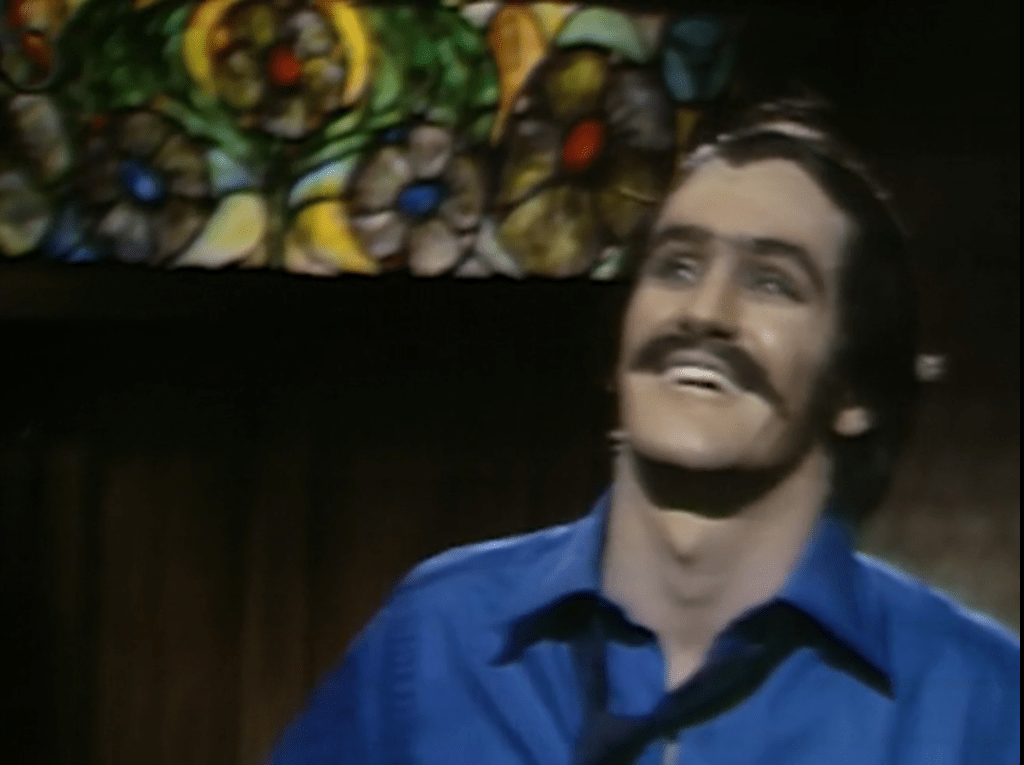
Medical researcher Cyrus Longworth has invented a potion which, when he drinks it, darkens his hair, causes him to grow more of it, and adds to his muscle mass. When he is in this state, Cyrus calls himself “John Yaeger.” Yaeger serves Cyrus as a very effective disguise. The other day, he ran into his old friend Quentin Collins while he was presenting himself as Yaeger. Quentin did not suspect that the man he was talking to was Cyrus.
Cyrus uses Yaeger to escape responsibility for violent crimes. He has started a couple of bar fights in the Eagle tavern. Barmaid Buffie Harrington has drawn Cyrus’ special attention; he hit her, twisted her arm, choked her, and threatened worse when he was alone in the tavern with her, and he has since taken an apartment in her boarding house. Cyrus has also beaten Buffie’s sometime boyfriend Steve so severely that he put him in the hospital. Cyrus was choking Steve when he heard a police whistle and ran away. It looked like he would probably have murdered him if the police had been a minute later. When Buffie saw Cyrus in his undisguised form and told him of the cruelty she and Steve had suffered at Yaeger’s hands, Cyrus barely bothered to conceal his pleasure. When Buffie asked Cyrus if Yaeger worked for him, Cyrus was delighted to say that he did.
We open in the drawing room of the great house of Collinwood, where Cyrus is waiting for Quentin. All of a sudden Cyrus starts to transform into Yaeger. This is the first time the transformation has taken place spontaneously, without a fresh dose of the potion. Cyrus leaves a note, then jumps out the window and runs away.
In his laboratory, Cyrus is about to drink the antidote to restore his usual appearance. He decides he would rather have some more fun as Yaeger first and puts the antidote back. His fiancée and lab assistant Sabrina Stuart comes downstairs. She has not seen Cyrus as Yaeger before, and is completely fooled by the disguise. She has heard the name John Yaeger in connection with recent strange behavior on Cyrus’ part, and is stern with him. Regular viewers know how brutal Cyrus is with Buffie, and we fear that he will mete the same treatment out to Sabrina. But he does not do so, not this time. He insists that Cyrus wants him to wait in the laboratory, and Sabrina leaves him alone there. After Sabrina exits, he takes a painting from the wall and goes.
Cyrus takes the painting to the apartment he has rented in the name of Yaeger. Buffie comes to him there. He harries her about her visit to him when he looked like his usual self and she knew him as Cyrus. He says she told Cyrus she likes a quiet man. He walks up to her, talking all the while about how quiet he can be. He gets quieter and quieter until he brings his hand across her face with full force. The next we see, she is bruised and cut, her clothing badly torn. Christopher Pennock and Elizabeth Eis play these moments very well. They are really hard to watch.
Cyrus gives Buffie the painting from his laboratory. He asks her if she wants him to take her someplace nice, with good food and a sophisticated atmosphere. She perks up and is enthusiastic. He then points out that she is covered in bruises and abrasions and wearing damaged clothing. He ridicules the idea that she could be seen anywhere looking like that, and taunts her with imprecations to take better care of herself. She leaves, hanging her head and carrying the painting. Cyrus laughs, relishing the misery he has inflicted on Buffie.
Cyrus rejoices to have battered and humiliated Buffie.
As Cyrus, whether he has red hair, a white coat, and a diffident manner, or black hair, a mustache, and a sadistic swagger, Pennock has a relatively straightforward job to do. He is to embody a total rat bastard, one who pretends to be nice when he might be held accountable for his actions and who exults in hurting people when he thinks he can get away with it.
Eis has a trickier assignment. When we first saw Buffie, she was cheerfully fending off Steve’s clumsy advances. Even after she had seen Cyrus, as Yaeger, outfight many strong men, she still stood up to him and spoke her mind. But now he has harmed her again and again, and she just keeps coming back for more. It would be depressing to see anyone fall into that pattern, but it strips us of all hope when we know the person to be so lively and dynamic. That’s the point, I think, and Eis doesn’t let us off the hook. Buffie still holds her head up, she still looks Cyrus in the face, she still speaks in a mature tone of voice when she protests against his abuse. But even so, whatever masochistic fascination is at work has such a grip on Buffie that she will not walk away from a situation that is already intolerably bad and can only get worse.
A Window Into This World From That
We are currently several weeks into a segment set in a different continuity than the one where Dark Shadows spent its first 196 weeks. Vampire Barnabas Collins brought us here. Barnabas discovered that a room in the long-disused east wing of the great house of Collinwood was the site of an inexplicable phenomenon. When he opened the doors to the room, he usually saw it as it was in his universe, a dark space with bare floors and undecorated walls. But once in a while, it appears to be brilliantly lit, fully furnished, and the setting of frequent meetings among people who look and sound just like his acquaintances, but who are living different lives. Through an invisible barrier, Barnabas could see and hear those people, but he could neither pass through the barrier nor attract the people’s notice.
Barnabas became obsessed with the forlorn hope that if he could pass into the other universe, he might be free of his curse and become a living man once more. Other characters from the main continuity joined him in watching their counterparts in the other world; few of these knew that Barnabas was a vampire, but all of them could see that the phenomenon had some obscure significance special to him, and were concerned that he was going to do something dangerous. In #980, Barnabas managed to make his way through the barrier, only to find that he was still a vampire. He bit the first person he met, and shortly after was chained in a coffin by her husband. He has been trapped there ever since.
The room on which Barnabas and others in the main continuity had been spying in the days before he crossed over has been a major set in the “Parallel Time” segment, and every time we see it we wonder if those others are still watching. Today, we intercut with the original “time-band.” Quentin goes to the room, and finds the bare dark space it represents in the main continuity. He sees two children there, whom he takes to be his son Daniel Collins and Daniel’s cousin Amy Collins. The boy is telling the girl that “Dr Hoffman” told his father that Barnabas got caught in that room. The girl responds that she certainly does not want to get caught, and she wants to leave at once. Quentin calls Daniel and Amy’s names, and is puzzled that the children do not react. He hears Daniel’s voice coming from behind him. He turns and sees Daniel and Amy standing in the hallway, asking why he is calling their names.
This is the first indication we have had that the main continuity is ever visible from this one. We are left wondering if the traffic between the universes can go both ways, and if so whether this continuity and the original one will in some way merge together. Cyrus’ attack on Buffie and her response to it were so difficult to watch that, done as well as the scenes were done today, they left us reluctant to tune back in tomorrow. The story of Buffie’s degradation at Cyrus’ hands can only become more depressing as it goes. But this new information about how “Parallel Time” works suggests such a wide variety of possible next steps that it sets our imaginations into overdrive, and we can’t wait to see which way we will turn next.
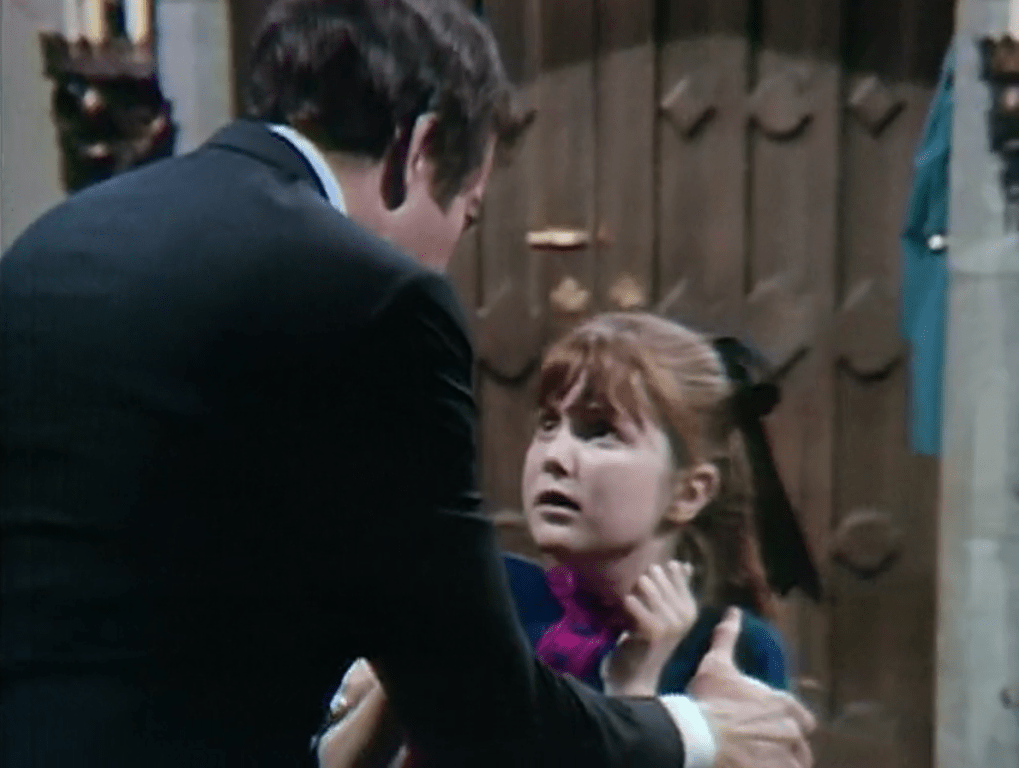
Trask the butler is surprised to see young Amy Collins in the great house of Collinwood. Amy’s cousin Quentin, the master of Collinwood, sent her to stay in the Old House on the estate, home to Will and Carolyn Loomis. The visibly uncomfortable Trask tells Amy she is not supposed to come back until Quentin sends for her. Amy says that she can’t stand it at the Loomises. Trask snaps at her for making life more complicated “at a time like this.” Amy asks what’s so unusual about this time, and Trask claims that he just means that he has been working hard. After an awkward silence, Amy asks if there has been any news about someone called Dameon Edwards. At Edwards’ name, Trask flies out of control. He grabs Amy by the shoulders, leans down so that his nose is in her face, and shouts that she has seen Edwards again. Terrified, she says she hasn’t. He shakes her and shouts louder, she freezes tighter and tighter. It’s getting pretty disturbing when the front door opens. Quentin enters, with two other adults, and demands to know what Trask thinks he’s doing.
Trask goes berserk.
Jerry Lacy and Denise Nickerson do a great job in this scene, which comes as no surprise to longtime viewers. For much of 1969, Dark Shadows was a costume drama set in 1897. In that segment, Nickerson and Mr Lacy played Nora Collins and the evil Gregory Trask. They were terrific together then, as they are today.
Gregory was cruel to children, including Nora. Gregory’s goal was to take control of Collinwood and all its residents, and for a time he seemed to be succeeding. As such, Gregory’s abuse of Nora left us feeling helpless. This Trask is not in control of anything, least of all himself. We don’t know exactly what secret he is frantically trying to keep in connection with Edwards, but we know he believes that it might be exposed at any moment and that when it is he will be ruined. He is acting from panic. Outrageous as Trask’s attack on Amy is, we can see that it is not likely to be repeated and it does not fill us with despair.
Quentin takes Amy to the drawing room and talks with her privately. She is absorbed in her dislike of the Loomises’ house. She says she has a feeling that something terrible is happening there, but she can’t give any reason why she should feel that way. She says that Will spends all of his time writing a new book. This surprises Quentin, who says that Will hasn’t written a word in five years. Amy says that he is busy now, and mentions that she stole a couple of pages from his wastebasket. Quentin asks if she still has them. She hands them over, and he reads them avidly.
Quentin is so enthusiastic about joining Amy in spying on Will’s new project that he forgets all about Trask. Amy seems to have forgotten him as well. When Quentin walked in and found Trask getting rough with her, it looked like he was going to dismiss him on the spot, but now it seems Trask will keep his job for a while longer.
The two who entered with Quentin were Cyrus Longworth and Alexis Stokes. Alexis is the identical twin sister of Quentin’s late wife, Angelique. Cyrus was a friend of Angelique’s, and is a fool. He is a scientist by occupation, and unknown to any of the other characters in today’s episode has been taking a potion of his own devising to turn himself into a hairier and more openly sadistic version of himself. That Jekyll and Hyde potion was the end product of an idea he got from Angelique. Cyrus tells Alexis today that Angelique was his teacher in matters of the occult, with which he is fascinated.
Quentin, Cyrus, and Alexis have returned from Angelique’s tomb. Alexis went there to try to prevent the men from unsealing the tomb and opening the coffin. They were so caught up in the idea that she was really Angelique come back to life that there was no point in her trying to talk sense to them. When they had done their work, they were astounded to find, not only that Angelique’s body was where it was supposed to be, but that it was perfectly preserved six months after her death. Quentin twice asked Cyrus how that could be, first appealing to his expertise as a scientist, then to his studies in occult lore, and each time Cyrus responded with a declaration that what they were seeing could not possibly exist.
The men are now convinced that Alexis is not Angelique, and they tell Trask this. He never thought she was, and is entirely absorbed in his fears about Dameon Edwards. All he says in reply is that he believes there is an evil presence in the house.
Quentin and Cyrus want to cremate Angelique’s body. They announced this plan while they were still in the tomb, prompting Alexis to remind them that her sister’s will specified that she be buried and to threaten to take them to court if they go against Angelique’s wishes.
Cyrus talks with Alexis in Angelique’s old bedroom, telling her that the body’s extraordinarily uncorrupted state has persuaded him that Angelique survives in some uncanny way. He urges her to let the body be destroyed. She continues to demur.
Cyrus says that when she was alive, Angelique had a “rapport with the unnatural” that inclines him to believe she might come “back from the death.” These awkward phrases were probably just line bobbles by Christopher Pennock, but they suit Cyrus well. He’s supposed to be an intellectual who spends little time talking to anyone, and such people do indeed tend to stumble over their words.
Later, Alexis summons Trask. She asks him to drive her to the cemetery and to keep their trip there a secret from Quentin. He acquiesces.
At the mausoleum, Trask is worried about an impending storm. He says he will go back to the car to get an umbrella, but Alexis tells him to forget about that. He is simply to wait for her in the car. She plans to spend only ten minutes with her sister’s remains.
Alexis looks in the coffin and talks to Angelique. She has bad news for her:
I don’t know what your secret was, Angelique, or why you still look as you did in life. I only know that it is wrong. It goes against the natural order of things. I don’t want to do what I have to do now. Quentin and Cyrus are right. Your body must be destroyed.
Distraught, Alexis puts her hand on Angelique’s shoulder, touching her sister one last time. We cut to a closeup of Angelique lying in her coffin. Her eyes pop open, and her lips curl into a smile. For a half a second, these motions look like they might be mechanical reflexes taking place within a dead body as it begins to decompose. But then she speaks: “My dear Alexis, you were always so right. Someone must be destroyed, but it won’t be me. It will be you.”
The show has kept us in suspense for three weeks as to whether Alexis was Angelique. Now, they’ve settled that question, and we know who Alexis is. Unfortunately for her, it seems we just have time to say goodbye.
In our world, bodies do sometimes turn up long after death showing no visible signs of decay. There were several vampire panics in Europe in the early modern era when exhumed corpses were found still looking fresh after months in the grave. Cyrus does not know of any such events in his world’s history, so he and Quentin have to come up with the idea of a panicked response on their own.
It has also been traditional in many branches of Christianity to regard a long-uncorrupted corpse as a count in favor of putting the person on the calendar of saints. Dostoevsky was hugely fashionable in the USA in the Cold War years of the 1950s and 1960s, and it is probable that the writing staff had at least a nodding acquaintance with The Brothers Karamazov. One of the central episodes of that novel comes when the admirers of the godly Father Zosima insist on leaving his body unburied for a long period, certain that it will remain uncorrupt and prove that the anniversary of his passing should be kept as a feast day. To their horror, his remains rot in the usual way. We’ve only been in this particular universe for four weeks, and the only indication we have so far had that Christianity even exists here came early on, when Will used the sign of the cross to immobilize and trap a vampire. So it is no surprise that Quentin, Cyrus, and Alexis never consider that the perfect preservation of Angelique’s body might suggest that she has taken a place among the saints.
Amy Collins twice sees the ghost of Dameon Edwards, whom she and others at the great house of Collinwood apparently knew when he was alive a year or so previously. At that time, Dark Shadows was set in a different universe than the one it has been showing us for the last few weeks, so the first thing the audience has ever heard about Dameon is that he is dead. Nor do we learn much more about him today. He looks at people with a vaguely sad expression, wanders off, and vanishes into thin air, never speaking a word. His part reminds me of G. K. Chesterton’s line that “Journalism consists largely in saying ‘Lord Jones is dead’ to people who never knew Lord Jones was alive.”
When Amy sees Dameon the second time, he leads her to the basement of Collinwood. This is a bit of a treat for longtime viewers. We may only have been in this universe for a few weeks, but the house is supposed to be laid out similarly to the one where we spent the previous 196 weeks, and the basement of that house was a significant set in the first year of the show. We haven’t been to that basement since #273, when it was revealed that reclusive matriarch Elizabeth Collins Stoddard was mistaken in her belief that she had killed her husband Paul and that he was buried in a locked storeroom there. It turned out Paul wasn’t dead at all. Liz was so embarrassed when her mistake was revealed that no one ever mentioned it again.
Dameon reminds us of that storeroom when he leads Amy, not to the spot where it was, but to an alcove in the wall opposite it. Amy’s cousin Daniel’s bedroom is a mirror image of his counterpart David’s bedroom in the other continuity. If the basement is a mirror image as well, the alcove to which Dameon leads Amy corresponds to the locked storeroom. Dameon turns towards the door, and vanishes as he walks into it. Amy screams.
Dameon is completely new to the audience, and the story of Liz’ belief that Paul was buried in the basement is so old that the reference will be lost on anyone who hasn’t been writing up notices about every episode of the show for the last few years. So the whole thing is pretty ineffective. Indeed, while Amy is screaming Denise Nickerson is visibly struggling not to laugh out loud.
I’m sure this episode is the result of a failed plan. Dameon must represent a character who would have meant something to us. Since most of the people we have seen in the last few weeks have the same names and are played by the same actors as counterparts from the original continuity, that character would likely have been a familiar face. The one face that would have brought the locked room in Liz’ basement to the minds of longtime viewers would have been that of Dennis Patrick. Patrick was in #273 as Jason McGuire, the seagoing con man who first convinced Liz that Paul was buried in her basement and then returned to exploit that belief by blackmailing her, and returned late in 1969 as Paul himself. Liz’ counterpart in the current universe is named Mrs Stoddard, so Paul must have existed there as well.
Patrick and his wife Barbara Cason were at this time in Tarrytown, New York, playing supporting roles in the feature film House of Dark Shadows. Patrick’s role as the sheriff puts him in only a few scenes, and Dan Curtis may well have hoped that once he’d got Patrick back to the East Coast he would be able to persuade him to return to the show for a short stint as Parallel Paul’s ghost. But Patrick was based in Los Angeles at this time, busy there as a producer and in demand as an actor, and he had no interest in coming back to a daytime drama taped in NYC for any length of time. So Dameon may have been a last-minute patch to cover Parallel Paul’s absence.
If Plan A had been that today’s ghost would represent Parallel Paul, Plan B appears to have been that he would remind longtime viewers of Quentin’s counterpart in the main continuity. Quentin was introduced late in 1968 as a ghost who did not speak. He first appeared to the children at Collinwood. Those were Amy’s counterpart, Amy Jennings, and her friend, strange and troubled boy David Collins, whose counterpart here is Daniel. Quentin’s ghost beckoned Amy and David into hidden rooms where they would, as they called it, “play the game.” When Dameon beckons Amy to the basement today, she asks if this is another of the games he used to play with her and Daniel.
The echo of the “Haunting of Collinwood” story is clear. But a revisiting of it that would have been effective would have taken some time to set up, especially since there is a living, speaking Quentin at the center of the show now. By the time they got to this topic, David Henesy had left to start his own stay in Tarrytown for House of Dark Shadows, so we won’t be seeing Daniel for a while. The most they can do is what we see here.
The upshot of these two aborted plans is a situation that does not seem to belong on the show at all, and it is no wonder Nickerson can’t keep a straight face. Even more than it reminds me of “Lord Jones is dead,” this installment reminds me of Edna St. Vincent Millay’s 1920 poem “The Penitent“:
I had a little Sorrow,
Born of a little Sin,
I found a room all damp with gloom
And shut us all within;
And, “Little Sorrow, weep,” said I,
“And, Little Sin, pray God to die,
And I upon the floor will lie
And think how bad I’ve been!”
Alas for pious planning —
It mattered not a whit!
As far as gloom went in that room,
The lamp might have been lit!
My Little Sorrow would not weep,
My Little Sin would go to sleep —
To save my soul I could not keep
My graceless mind on it!
So up I got in anger,
And took a book I had,
And put a ribbon on my hair
To please a passing lad.
And, “One thing there’s no getting by —
I’ve been a wicked girl,” said I;
“But if I can’t be sorry, why,
I might as well be glad!”
I don’t know if Amy had been a wicked girl, but the other characters today all seem to have secrets that it would behoove them to feel sorry for when Dameon shows up. There is drunken sourpuss Quentin Collins, who like Amy sees Dameon twice; sleazy musician Bruno Hess, whom Quentin suspects of having killed Dameon; and butler Mr Trask, who, when Quentin mentions Dameon, frantically denies knowing anything about him, and who, when Amy says she saw Dameon, squeezes a drinking glass so tightly it shatters in his hand.
This is the first time we see Mr Trask. He is the fourth character played by Jerry Lacy. Mr Lacy first joined the cast in the fall of 1967 to do his celebrated Humphrey Bogart imitation as lawyer Tony Peterson before finding immortality as overheated witch-hunter Reverend Trask in the 1790s flashback that ran from November 1967 to March 1968. That first Trask came to his end sealed in a basement alcove not so different from the one into which Dameon disappears today. That incident made a big impression, and was referenced several times on the show and time and again in spin-offs of Dark Shadows in other media. Mr Trask’s debut today may, in the original, never-developed plan, have been intended to remind viewers of it. Perhaps Mr Trask would be the one to open the alcove and find Parallel Paul’s remains. That would be a fitting way to join the story that introduced the idea of a basement burial to Dark Shadows with the famous story that showed one taking place.
Mr Lacy matched his triumph as the first Trask when he returned as his hypocritical descendant Gregory in the 1897 segment that spanned most of 1969. Today’s Mr Trask is in part a placeholder for sinister housekeeper Miss Hoffman. Quentin explains today that he sent Miss Hoffman to visit her friends. Mr Lacy was in one scene of House of Dark Shadows, a funeral sequence shot on the first day of principal photography, and unlike Dennis Patrick he was still living in NYC. So he was available for a couple of weeks of fill-in work. The role is thin on paper, but Mr Lacy gives the part a lot of life.
In #949, eleven year old Amy Jennings saw twenty-nine year old Quentin Collins. She reacted with terror, certain that he was the ghost of her great grandfather, the ghost who had persecuted her and everyone else at the great house of Collinwood from December 1968 to September 1969. Heiress Carolyn Collins laughed at Amy and told her that he was not a ghost, but was a cousin of theirs, another descendant of Quentin’s. In fact, Quentin was Amy’s great-grandfather and Carolyn’s great-great-uncle, but he wasn’t a ghost, and he meant no harm to Amy.
Amy refused to accept Carolyn and Quentin’s assurances that he was “not that Quentin Collins.” That refusal highlighted Quentin’s convoluted backstory. The show went back in time in March 1969 to the year 1897, and during an eight-month costume drama segment it introduced us to Quentin as he was before he died. He was a charming rascal who immediately became a huge breakout star. During the 1897 segment, they showed history being changed so that Quentin never died and was the beneficiary of a magic spell that immunized him against aging. Ever since early 1967, Dark Shadows has been operating on a model of the cosmos in which the usual laws of cause and effect are replaced with anniversaries. So in #839, we saw that Quentin’s haunting of Collinwood had gone on for ten months and had finally resulted in the death of strange and troubled boy David Collins. But that day was also the 72nd anniversary of the change in history which prevented Quentin’s death, so the haunting broke and David came back to life. When Quentin showed up in 1969 as a living being, everyone remembered the haunting. Most characters accepted Quentin’s claim to be his own great-grandson, but Amy saw the truth, that he and the ghost were two continuations of one man.
The show’s metaphysics probably didn’t bother anyone who watched it the first time it was broadcast. The characters just take them for granted, as in our world we take hard-to-explain phenomena like gravity and magnetism for granted, and the story keeps on going as if they somehow made sense. What the writers were worried about when Amy saw the living Quentin was not that their model of the universe lacked plausibility, but that they hadn’t found a way to keep Quentin at the center of the story. He’d made a hit in the 1897 segment because he was connected to everyone and was naturally involved in everything that was happening, but in 1969 and 1970 he is a visitor, a distant relative who has come wandering in from who knows where. When Amy tries to figure out in what sense he is “that Quentin Collins,” she is trying to solve a puzzle that the show has to solve to keep him generating heat in the ratings.
Now, Dark Shadows has crossed over to an alternate universe. Here, we have met yet another iteration of Quentin. This Quentin Collins is the Master of Collinwood. Amy lives in the house in this continuity as well, but she really is Quentin’s cousin, and her last name is Collins.
Parallel Quentin hasn’t thought to tell Amy that there is a houseguest staying at Collinwood. She is Alexis Stokes, identical twin sister of his late wife Angelique. Since there are a lot of people around the estate who keep saying that Angelique is going to come back to life, the sight of Alexis comes as quite a shock to everyone. Amy sees Alexis today, and reacts with terror, certain that she is the ghost of Angelique. She does not accept Quentin’s belated explanations, anymore than her counterpart accepted Carolyn’s. Amy Jennings had specialized in looking directly into the camera; as Amy Collins, Denise Nickerson has a moment after Quentin and Alexis have explained the situation to her when it looks like she is about to make this move, but she does not.
Amy has two more scenes today. She opens the front door and lets Angelique’s associate, sleazy musician Bruno Hess, into the house. Amy greets Bruno with “She’s upstairs.” He asks how she knows who he came to see, and she tells him he always came to see “her” before. She wonders if “they” will make Bruno call the woman “Alexis.” Perhaps she thinks all adults are in on this scam, pretending that the dead can be counted on to leave the living alone. Later, she gives Quentin a telegram. When he scolds her for having opened it, she is at once sincerely remorseful about what she has done and indignant about what is going on upstairs. She says that while opening other people’s mail is indeed bad, what “she” has done is even worse.
On Friday, the show hinted that Alexis might be Angelique. Today, Bruno starts an investigation to check up on Alexis’ report that she arrived in New York from Genoa a couple of days before. They spend enough time on Bruno’s activities that it would be surprising if her story simply held up, so that keeps the question alive.
Quentin’s new wife, the former Maggie Evans, left him and went to her sister Jennifer’s place in New York on Friday. She was fed up with Quentin’s high-handed attitude, with everyone’s preoccupation with Angelique, and with Alexis’ presence in the house. Quentin picks up a telephone today, says “Operator, this is a person to person call. Mrs Collins!” And they connect him to Jennifer’s place! In spite of this magical power, he still can’t persuade Maggie to come to the phone. By the end of the call, he and Jennifer are mad at each other, too.
When this episode was taped, principal photography was underway for the feature film House of Dark Shadows. Many of the best-known members of the cast are going to be in Tarrytown, New York for the next six weeks. When Quentin talks to Jennifer Evans, he offers to go to Maggie in New York- we might assume he means NYC, but I suppose Jennifer might live in Tarrytown, and Maggie’s real reason for staying with her is that she doesn’t want to be separated from Kathryn Leigh Scott.
As Quentin and Alexis, David Selby and Lara Parker are the biggest names currently on Dark Shadows, and they are playing characters quite different from those that made them famous. This Quentin intermittently displays the charm which the one from the main continuity exudes so effortlessly, but he is a downer at least half the time, and his position as Master of Collinwood keeps him from being the lovable rascal who has been a fixture on the cover of the fan magazines for a year now. And even if Alexis is Angelique, she is an Angelique who has not gone through any of the development that has held the fans’ attention for over two years. Angelique was a story dynamo from her introduction at the end of 1967, but what has made her indispensable in arc after arc is that she usually knows everything the audience knows about what is happening and has some crazy scheme that no one else would have thought of as to how she can make it all much worse. And over the last year, she has shown an ability to learn and grow that has made her a much more interesting character. A new Angelique, starting from scratch, won’t match the audience’s understanding of the situation, and won’t remember anything that gave her new depth in 1969 and early 1970.
You may wonder if these two can carry the show for a month and a half. The writers certainly did, as witness a conversation between Alexis and Quentin today. She goes on at length about how difficult it was to grow up in her sister’s shadow, saying that she tried to imitate Angelique but could never make it. The harder she tried to copy the habits that attracted everyone to Angelique, the more embarrassed their reactions were.
Not only does Alexis tell us explicitly that she isn’t as appealing as Angelique, Quentin couldn’t be less interested what she is saying. He is preoccupied with a dispute he is having with Bruno. That dispute, were Alexis aware of it, would probably interest her as little as what she is saying interests Quentin. In their scene together, Alexis does not give any sign that she recognizes Bruno. After he leaves, she looks at a picture of him on some sheet music he composed, as she would do if she never had seen him before. So, if she is Angelique returned from the grave, she would appear to have lost her memory of Bruno along the way. And whoever she is, her attitude towards him throughout is one of amused tolerance. We can’t imagine her being particularly invested in a conflict about whether Bruno has a right to live in the caretaker’s cottage on the grounds of Collinwood. So the scene between Angelique and Quentin, in which neither has anything to say that is of concern to the other, seems to be something like the opposite of a programmatic statement. Rather than telling us what they plan to do, the writers are telling us what they are afraid we will think they have done.
Not that they have despaired of making it work. By the end, Quentin and Alexis have drawn each other’s attention sufficiently to do some pretty firm smooching. Maggie has been a fan favorite from episode #1, and many of the nine year old girls in the audience probably identify with her and are excited about the idea of her being married to Quentin. The image of him cheating on Maggie with the wicked witch will outrage them enough to keep them tuning in.
The prospect of an affair between Quentin and Alexis presents something of a puzzle in logic. If she really is who she says she is, he is cheating on Maggie with her. But if she is Angelique, he has been cheating on her with Maggie, albeit unknowingly. One way or another, it is far from gentlemanly behavior on his part. As for Alexis, what we know so far would tend to confirm our initial assumption that Angelique is an Evil Twin, but seeing her go after Maggie’s husband will keep regular viewers from labeling her the Good Twin.
When Dark Shadows premiered in June 1966, strange and troubled boy David Collins (David Henesy) was obsessed with his absent mother and determined to get rid of his new governess, the well-meaning Victoria Winters. In #15, David had tampered with his father Roger’s car. As he stood at the window and watched Roger drive down the narrow, twisting mountain road away from the great house of Collinwood, he said “He’s going to die, mother, he’s going to die!” When Roger survived and it was discovered that someone had removed the bleeder valve from his braking system, David planted the valve in Vicki’s room in an attempt to frame her for the murder attempt. Later, Roger would come to fear that Vicki was about to expose a dark secret of his own, and would encourage David to try to kill her.
David eventually gave up on homicide, and dropped his hostility to Vicki. One of the more benevolent influences on him was his best friend, the ghost of the gracious Josette. In #102, we saw David in the Old House on the grounds of Collinwood, carrying on a conversation with the portrait of Josette that hung above the mantel. We could not hear Josette’s side of the conversation, but it certainly sounded like David could. We already knew at that point that Josette was real- we saw her emanate from the portrait, walk out of the house, and dance among the columns outside it in #70, when David first took Vicki to the Old House. In #126, we would see and hear Josette when she led the ghosts of Collinwood in rescuing Vicki from crazed handyman Matthew Morgan. That rescue was not only a good deed for Vicki, but also a favor to David, who had stumbled upon Vicki in the secret room where Matthew had her tied up and, in a panic, left her to her fate.
In #153, we learned that David’s mother, the former Laura Murdoch, was the one who chose his name, one which no previous Collins had borne. Roger had wanted to call David “Charles Andrew,” in honor of some Collins ancestors. In #181, Vicki and her allies learned that two previous women given the name Laura Murdoch at birth had died by fire, one in 1867 and the other in 1767, each accompanied by her young son, and that each of those boys was named David. It would eventually become clear that Laura was an undead fire witch, a humanoid Phoenix who went into a pyre with her sons at intervals of exactly 100 years, gaining immortality for herself, though not for the Davids. In #288, they had forgotten the lore about David’s name, and mentioned a previous David Collins, but in #685 and #767, it was back to being a first in the family. Between those two episodes, from #729 to #760, another iteration of Laura was on the show, suggesting that the writers brushed up on their knowledge of her original storyline.
By the time Vicki saved David from Laura, he had moved out of the villain category altogether. When his third cousin Amy Jennings (Denise Nickerson) moved into Collinwood at the end of 1968, David was as pleasant to her as one could expect. But his behavior towards her and others changed when the two of them stirred up the ghost of Quentin Collins, Amy’s great-grandfather and David’s great-great-uncle. As Quentin gathered strength, he intermittently possessed first one child and then the other. While David was under Quentin’s control in #679, he twisted Amy’s arm to force her to go to a secret room and join in their vengeful ancestor’s evil plans for their governess, Vicki’s successor Maggie Evans (Kathryn Leigh Scott.) The camera lingered on that act of bullying, meant to shock us with evidence that Quentin’s dire influence had overwhelmed David’s kindly nature.
The arm-twisting incident made an impression on the viewers. In #813, set in the year 1897 when Quentin was alive, Henesy and Nickerson played brother and sister Jamison and Nora Collins, nephew and niece of Quentin, grandfather and great-aunt to David. Jamison, possessed by sorcerer Count Petofi, twisted Nora’s arm to force her to give him information, a reference which shows that the writers were confident that many viewers would see David Henesy’s character abusing Denise Nickerson’s in that way and read it as a sign that he is under the power of an outside force.
Now, it is 1970, but we are not in the main continuity at all. We have traveled to an alternate universe, which on Dark Shadows is known as “Parallel Time.” In this “time-band,” to use another bit of Collinsport English, Quentin is alive and the master of Collinwood. His first wife, the counterpart of wicked witch Angelique, has died, and he has remarried. The new Mrs Collins is the former Maggie Evans (Kathryn Leigh Scott.) Quentin and Angelique’s son, strange and troubled boy Daniel (David Henesy,) is obsessed with his absent mother and determined to get rid of his new stepmother.
Apparently the writers still remember the connection between David’s name and the first Phoenix story, because Daniel is the only character we have yet seen in Parallel Time answering to a different first name than his counterpart in the main continuity. Angelique and Quentin gave him the name of the Collins ancestor whom Mr Henesy played in early 1968, when the show was set in the year 1796. We know that the timelines diverged in that period, so it follows that it was the counterpart of the eighteenth and nineteenth century Daniel who was this Daniel’s namesake.
When we first saw Daniel, he was carrying on a one-sided conversation with his mother’s portrait, which hangs in her old bedroom. Today, he devises a plan to use the portrait to frighten Maggie. The plan requires the cooperation of his cousin, Amy Collins (Denise Nickerson.) When Amy refuses, he twists her arm until she agrees to go to a secret room and sing, making Maggie think the portrait is coming to life. This attack is shown only for a few seconds, and Amy’s arm is out of frame. They have already established that Daniel is cruel, and do not need to dwell on the act of abuse.
Daniel claims that his father often goes to Angelique’s room to meditate and talk to the portrait. That lures Maggie to the room, where Daniel is waiting. They have a confrontation. When she says she wishes she could “make him understand-,” he interrupts her and asks if what she wants him to understand is that his mother is dead and is never coming back. She looks at him and answers with a flat “Yes.” He tells her she is wrong, and pleads with the portrait to sing to him. Maggie says she can’t stand to see him like this, and turns to go. Before she gets out of the room, we hear a woman’s voice singing a lullaby. Maggie and Daniel hear it too. She turns around, shocked, and runs from the room. Daniel laughs that his plan worked so well.
Amy comes rushing into the room. Daniel congratulates her on her performance, and asks how she got in from the secret room so quickly. She explains that she never went to the secret room- her brother Chris intercepted her before she could do so. It wasn’t her voice Daniel and Maggie heard. He absorbs her message, and looks at the portrait in wonderment.
The audience could tell it wasn’t Denise Nickerson singing- she had such a high-pitched voice when she was twelve that she had to work hard to keep it in a range that would sound good on television, while the pre-recorded voice we heard singing was definitely that of a grown woman. Angelique was played by Lara Parker; Parker did some very distinctive things with her voice on Dark Shadows, none of which shows up in the lullaby, so I’m sure it wasn’t her. Several fansites attribute the singing to Joan Bennett, who is in this episode, but I’ve heard Bennett sing and she didn’t get from one note to another the way this voice does. I think the singer must be Kathryn Leigh Scott.
Early in the episode, Daniel and Amy had a scene in his bedroom. David’s bedroom was a frequent set in the first 38 weeks of the show, and was occasionally seen thereafter. Daniel’s room is the same set, with the same furnishings and decorations, but they are arranged in the opposite direction from the pattern we see in David’s. His bed is at stage right rather than stage left, and everything else is also transposed. Seeing this mirror image, regular viewers will appreciate this reminder that we are in a Mirror Universe.