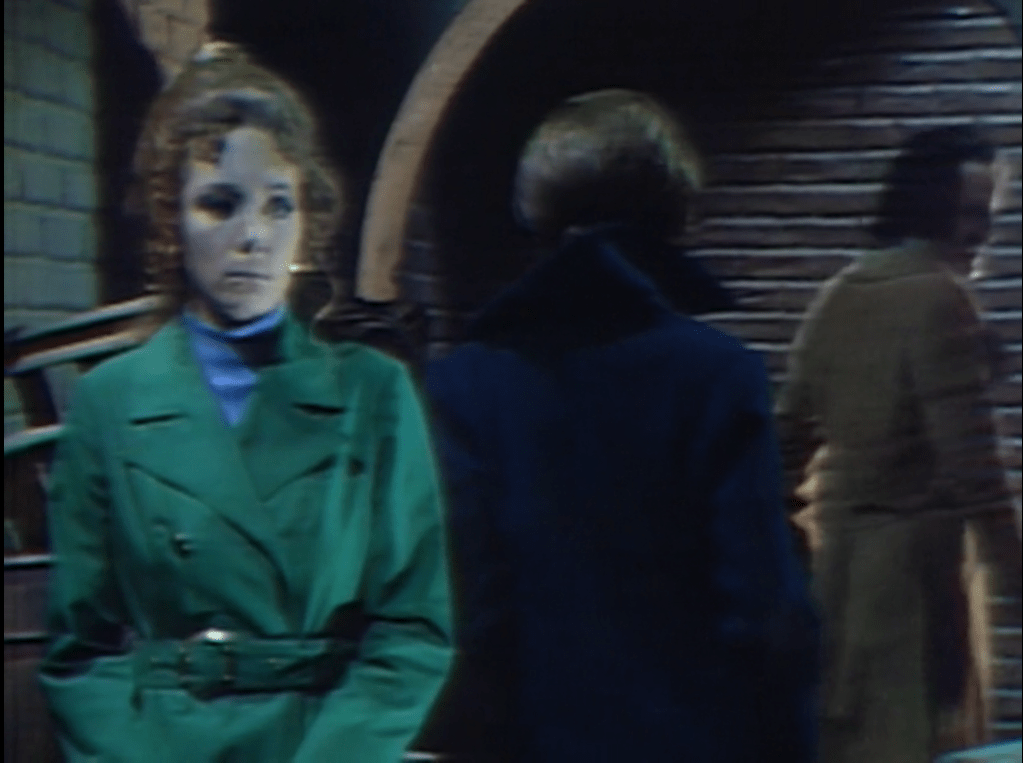
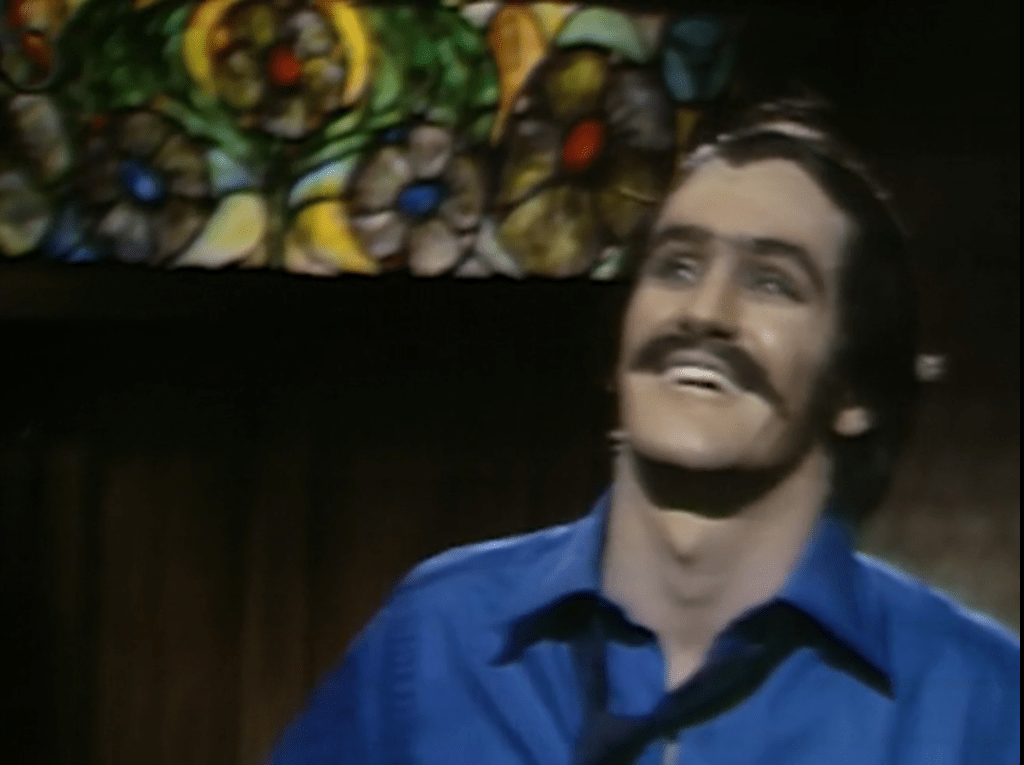
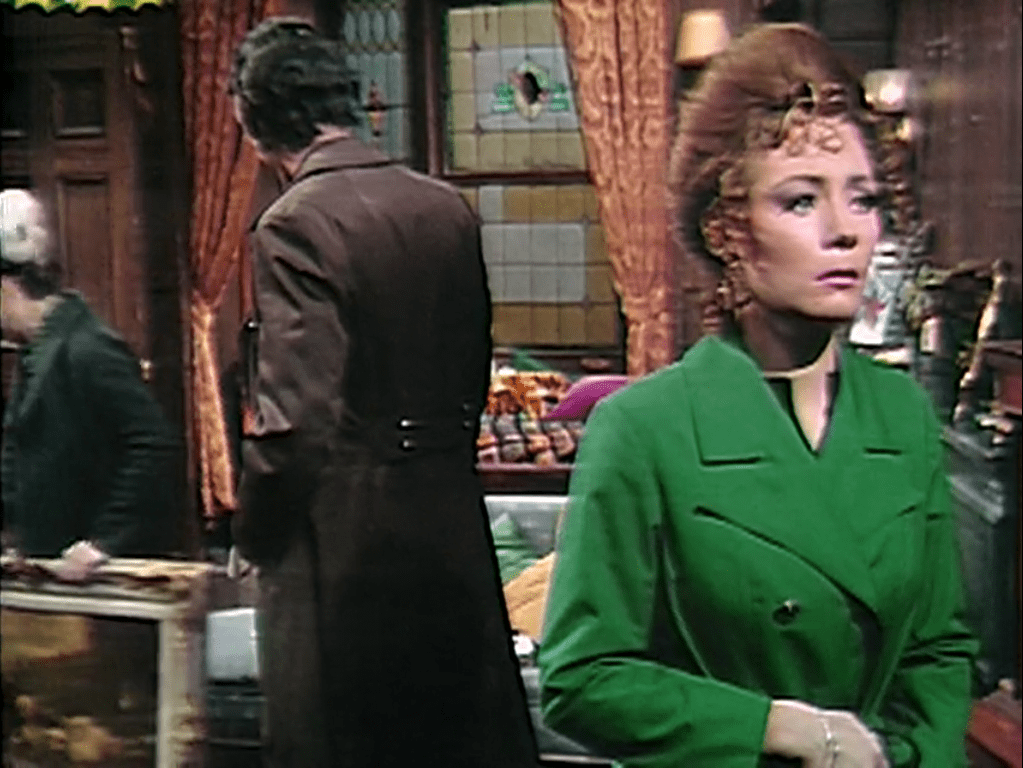
Barmaid Buffie Harrington sees a man assaulting a woman in the alley next to the tavern. She recognizes the man as ruffian John Yaeger. Yaeger used to buy Buffie gifts, then beat her and laugh at her bruises. She recognizes the woman as her childhood friend Maggie Evans. Maggie moved away from the village of Collinsport when she was very young, and came back recently as the wife of Quentin Collins, drunken sourpuss and master of the estate of Collinwood. Buffie orders Yaeger to unhand Maggie. He sneers at the women, threatening to make a stink if they go to the police. Buffie stands her ground, and at length Yaeger backs down and leaves.
Buffie and Maggie see Yaeger off.
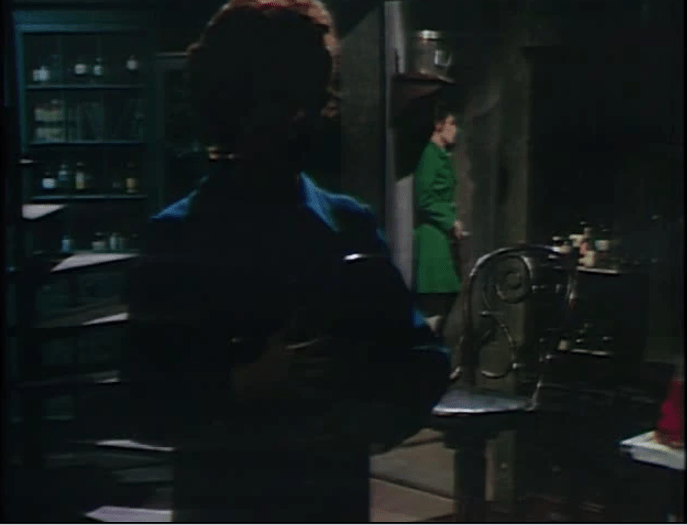
Maggie goes to Quentin’s friend Cyrus Longworth in his laboratory. She tells Cyrus that Buffie rescued her from Yaeger. She asks Cyrus if it is true that Yaeger is his friend. Cyrus looks pained, and says that for some time he has considered Yaeger his enemy. Maggie had never seen Yaeger before; she was at the docks because he called her anonymously and promised her some information relevant to her suspicion that Quentin murdered his first wife, Angelique Stokes Collins. Nor did he identify himself to her. Buffie did not call him by name. So Maggie and Buffie must have had a conversation afterward in which she told him who Yaeger was and that he and Cyrus are connected to each other.
What neither Buffie nor Maggie knows is that Yaeger does not exist. He is simply a disguise Cyrus assumes when he wants to hurt someone. Cyrus never meant to tell Maggie anything about Quentin; he called Maggie to meet him at the docks because he wanted to rape and abduct her. Cyrus has devised a potion that causes his hair to turn darker and sprout all over his body, his shoulders to broaden, and his skin tone to change. John Yaeger is the alias he uses when in this disguise. After Maggie leaves, he tells himself that he and Yaeger are the same person, and that he is responsible for all of Yaeger’s crimes. He smashes up his lab equipment and burns his notes. All he really needed to do was pour out the potion. One of the essential ingredients is a compound he can’t make himself. He murdered the only known supplier, so once it is gone, it will be gone for good.
Cyrus is only the first character today to use Maggie’s need for information about Quentin to trap and hurt her. Quentin’s brother, high-born ne’er-do-well Roger Collins, keeps baiting her with references to the cause of Quentin’s current fit of bad temper. She finally insists he tells her what he means, and he says it is the anniversary of his wedding to Angelique.
The other character is Angelique herself. Unknown to any other character in today’s episode, Angelique has risen from the grave, murdered her identical twin sister Alexis, and taken Alexis’ place as Quentin’s houseguest in his mansion, the great house of Collinwood.
Maggie turns to “Alexis” for information about Quentin and Angelique’s marriage. When she asks if Angelique often wrote her when she was living in Florence, “Alexis” replies “Not often, but when she did she made up for it.” We know this is a lie, and Maggie should too. When the real Alexis first came to the Collinwood, housekeeper Julia Hoffman asked if she received the letter she sent informing her of Angelique’s death. She said she did not. It turned out that the last address Angelique had for Alexis was in Tangier, a city she had left some time before moving to Florence. Maggie takes “Alexis'” statement at face value, and also believes her when she says that Angelique wrote only of how wonderful her marriage to Quentin was. Further, she believes that Angelique was telling the truth in those supposed letters. Since her own marriage to Quentin has been miserable from the first day we saw them together, this depresses Maggie.
Maggie goes to sleep, and Angelique casts a spell to send her a dream. In the dream, Maggie goes to Angelique’s old bedroom and opens a hidden compartment in a small table. She finds a packet of letters there. She wakes up, goes to the room, and finds not only that there is such a compartment but that it does contain the letters. Presumably she will read these and add to her misery.
As Yaeger’s former punching bag and current blood thrall of vampire Barnabas Collins, Buffie is central to two of the ongoing stories. When she rescues Maggie, we can assume that they will renew their friendship, putting her close to the heart of all the other stories. The episode thus promises to usher in the Age of Buffie. But in fact, this is the character’s final appearance.
I suspect that the writers and producers were impressed with Elizabeth Eis’ performance and expanded Buffie’s part beyond what they originally intended. There were several cast members whom Dan Curtis Productions was contractually obligated to use in a certain number of episodes per month, and for the first weeks of the current segment most of those were off in Tarrytown, New York, doing principal photography on the feature House of Dark Shadows. That gave the show a greater flexibility with new performers than they have now that those people are back.
Moreover, the writers projected the plot out thirteen weeks at a time, in documents divided into 65 parts for the 65 episodes of that period. These projections were known in the soap opera business as “flimsies.” The show would scrap its plans completely when a story drew a different reaction from the audience than they had expected, most famously when Barnabas was introduced in April 1967 and was such a hit that they dropped the original idea to stake him at the end of a number of weeks. But Buffie isn’t that kind of a hit, and with the return to the jigsaw puzzle they have to solve every day to get the name actors their required appearances, the writers have to stick close to the flimsies for a while. By the time they could find room for Eis, the story had moved on and Buffie was no longer particularly relevant. Eis will be back later, when the show is set in a different version of Collinsport, playing a character who shows up in only three episodes.
Angelique Stokes Collins, late wife of gloomy sourpuss Quentin Collins, has risen from the grave, murdered her identical twin sister Alexis, and taken Alexis’ place as Quentin’s houseguest in his mansion, the great house of Collinwood. Impersonating Alexis, she has been busy with a lot of cackhanded schemes to drive a wedge between Quentin and his new wife, the former Maggie Evans. As recently as yesterday, Quentin and Maggie were keeping their cool and showing signs that they might catch on to what “Alexis” was up to, but today they both melt down completely. Quentin has a fit when he sees Maggie reading a book about witchcraft that Angelique left in the drawing room, and Maggie goes to Quentin’s friend Cyrus Longworth to ask some questions about Quentin’s role in Angelique’s death.
Cyrus is pretty nutty himself. He is a mad scientist who has developed and become addicted to a Jekyll and Hyde potion. When he drinks it, his appearance changes so drastically that even the people closest to him cannot recognize him. Thus disguised, he goes by the name “John Yaeger” and indulges his sadistic impulses.
Cyrus assures Maggie that Quentin did not murder Angelique. She leaves his laboratory feeling relieved. She forgets her gloves. He picks them up, and spends eight seconds rubbing them on his face, sniffing them, and looking ecstatic. Eight seconds is quite a long period to devote to that particular pastime.
Buffie Harrington comes to Cyrus’ lab. When he is masquerading as Yaeger, Cyrus’ favorite hobby has been beating Buffie and ridiculing her. She has a self-destructive streak that led her to submit to that treatment. Unknown to Cyrus and unmentioned in today’s episode, Buffie has a new dominator. Vampire Barnabas Collins has bitten her, made her his slave, and ordered her to find out whatever she can about Yaeger from Cyrus.
Buffie is very much in charge of her scene with Cyrus. She runs through a long list of emotions- anger and impatience with Cyrus, attraction to him and pity for him, contempt for Yaeger and admiration for him, pity and anger towards herself, all portrayed clearly and convincingly by Elizabeth Eis. Returning viewers who realize that Buffie is on a mission from Barnabas to get Cyrus to tell her what he knows about Yaeger will be impressed that Buffie is as good an actress as Eis was. She is looking for the note that will crack the glass holding Cyrus’ secrets, and striking each one perfectly.
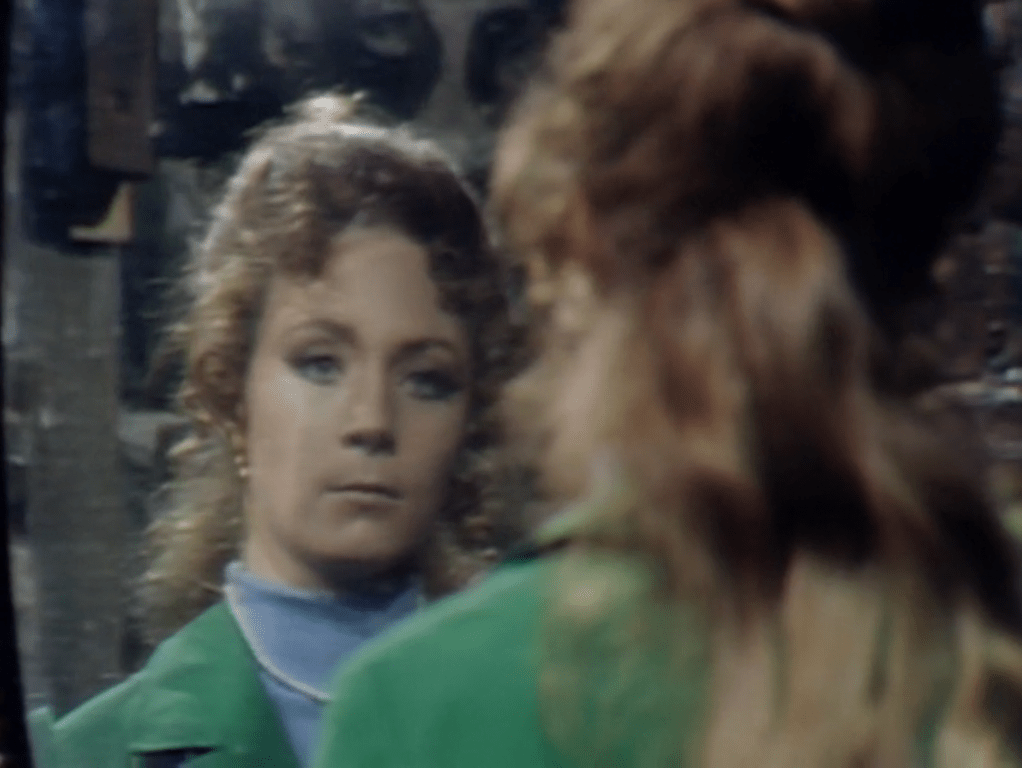
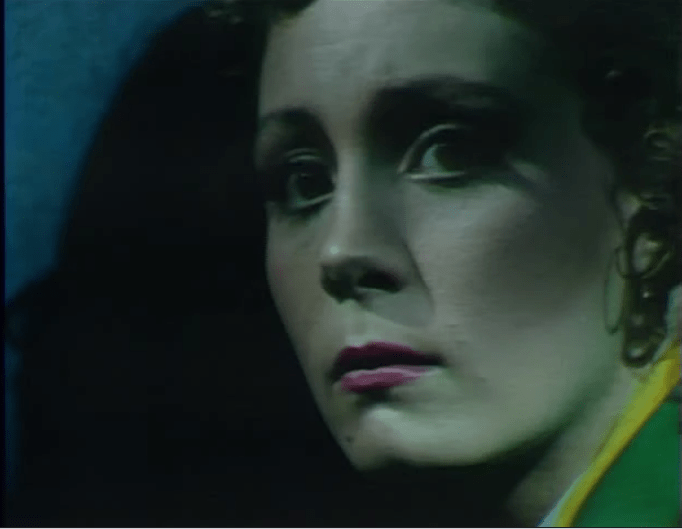
When Buffie finds out that the gloves are Maggie’s, she mentions that she knew Maggie when they were growing up in the village of Collinsport. She says that Maggie was always a special person, obviously destined for greater things. Looking at herself in the mirror, Buffie says that Maggie probably doesn’t hate herself when she sees her reflection. Buffie may still be acting, trying to elicit Cyrus’ sympathy, but we don’t see his reaction when she says these things, only two images of her face. And her words do fit with the self-destructive streak she has shown in her relationship with “Yaeger.” Not only Elizabeth Eis’ extraordinary good looks, but also her forceful and intelligent manner, make it shocking to see Buffie looking at herself and hear her saying such things. The show never explains where Buffie’s urge to destroy herself came from, but Eis makes us both believe that it keeps overwhelming her and wish that she could escape it.
Buffie doesn’t like what she sees.
Cyrus stops by Collinwood to return Maggie’s gloves. When she sees him, Maggie brightens up and starts moving fluidly from the hips up in a way that suggests sexual attraction. She is disappointed he won’t stay. Considering how close Cyrus got to Maggie when they were in his lab and how he gazed longingly into her eyes until she asked him if something were wrong, it’s hard to see how he can fail to find her excitement encouraging.
Cyrus drinks his potion. Once Yaegerized, he telephones Maggie. He refuses to identify himself, but says that if she meets him at the docks at 6 PM sharp he will give her information about Angelique’s death. Maggie is initially appalled by the idea of a strange man asking her to meet him at the docks, but she is still carried away with the suspicions Angelique planted in her mind that Quentin is a wife-killer. She can’t resist.
Yaeger is at the docks when Buffie happens by on her way to work at the Eagle tavern. She speaks to him. He jeers at her until she leaves. Cyrus keeps telling himself what Buffie told him in their scene today, that Yaeger enjoys life. All I can say is that there are far more enjoyable things to do with a beautiful young woman than to beat her, insult her, and drive her away. Yaeger seems to me to be an utterly miserable sort, as strongly bent away from life towards death as is Buffie.
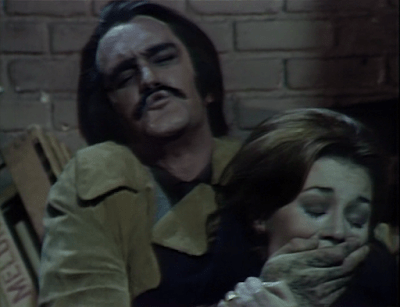
Maggie shows up shortly after Buffie has gone. Yaeger doesn’t tell her anything she doesn’t know. He moves in close and starts talking about wanting her favors. She says she will be going, and he grabs her from behind. He puts his hand over her mouth to stifle her screams while he does a series of pelvic thrusts. His facial expression gets more and more distorted until his tongue pops out.
I suppose Cyrus/ Yaeger is rather an intelligent depiction of a rapist. He craves cruelty for its own sake. Any sexual thrill he may get is a side effect of the pleasure he derives from hurting women. Cyrus is engaged to a lovely young woman who is devoted to him, his lab assistant Sabrina Stuart. Sabrina’s name doesn’t even come up today. When Buffie was under his influence, she would have gone along with just about any sort of relationship he wanted to develop, either as Cyrus or in the guise of Yaeger. All he wanted to do was use her as a punching bag and then laugh at the bruises he left on her. Maggie is clearly attracted to Cyrus today, and however loyal she may be to Quentin is at the least available for some very pleasant flirting. But all Cyrus can think to do is to conceal his identity so that he can humiliate her in the alley where the streetwalkers pick up their johns.
The conceit that Cyrus and Yaeger are different people helps writer Joe Caldwell make today’s script into an essay about rape. Had Maggie recognized Cyrus in the alley, he might have claimed that he took her earlier response to him to be an invitation to sex. It is certainly easy to imagine a husband as uncharitable as Quentin taking such a claim seriously. But when Cyrus disguises himself as Yaeger, he shows that he has no wish to accept an invitation of any kind from Maggie. All he wants is to avoid punishment for the crime he is planning to commit against her. Indeed, when she sees Cyrus as Yaeger, Maggie shows nothing but distaste and a desire to flee. Cyrus evidently prefers those reactions to the enthusiasm Maggie showed for him when he was being sweet and friendly.
The Yaeger makeup is not very consistent from day to day. This time, the hairline is so high that he kept making me think of John Cazale as Fredo Corleone. Also, Christopher Pennock’s acting is not up to its usual standard; he overacts so severely that he keeps stumbling over his words. He even botches the opening voiceover. Perhaps he was too nice a guy to really get into a character who is the distilled essence of Rapist. At this point, Cazale had done only one TV show, a guest spot on NYPD, a series made in New York that featured Dark Shadows cast members in about half its episodes. Maybe Cazale would have been available for the role of Cyrus/ Yaeger. He too was a famously nice guy, but was perhaps a more accomplished actor than Pennock and better able to handle a part like this one.
Angelique Stokes Collins has risen from the dead, but her renewed existence may end within seconds. She is overwhelmingly cold, and can warm up only by draining the heat from the body of a living person. Someone is coming in the front door, just in time to be her victim and die in her stead. She wonders who it will be.
Almost all the characters currently on Dark Shadows are either so important to an ongoing story that their deaths would end a major arc or have so many connections to everyone else that their deaths would start a new one. So if she kills mad scientist Cyrus Longworth, his fiancée Sabrina Stuart, or barmaid Buffie Harrington, Angelique will be ending the Jekyll and Hyde story, or at least shifting it into a radically new phase. If she kills drunken sourpuss Quentin Collins, his wife Maggie Evans Collins, or housekeeper Julia Hoffman, she will be ending the adaptation of Rebecca. If she kills Carolyn Loomis or her husband Will, she will be ending the restaging of Who’s Afraid of Virginia Woolf?
If Angelique kills woebegone homebody Elizabeth Collins Stoddard or her brother, sardonic dandy Roger Collins, she won’t be ending any ongoing stories. But Liz and Roger are the counterparts of characters who were central to the life of the great house of Collinwood in the first 196 weeks of Dark Shadows, when it was set in another universe, and are played by actors who have substantial followings. If either of them is murdered, the audience will expect major consequences. Angelique’s son Daniel Collins and Daniel’s cousin Amy Collins aren’t doing much just now, but if Angelique kills a child, especially her own son, the ABC network’s office of Standards and Practices would join the audience in insisting she face a serious reckoning that would take up a lot of screen time. This fit of heat vampirism came on Angelique too suddenly to make sense as the start of a new arc, so we can rule all of those candidates out.
There are also a couple of characters who were introduced to fill in for actors who were away the previous couple of months filming their parts in the theatrical feature House of Dark Shadows. Among those are Angelique’s Aunt Hannah and butler Mr Trask. They are possibilities, but are both played by actors who have enough going for them that it would be a bit surprising to bring them back just to kill them off. There are also a few miscellaneous day players whose characters would have no reason to let themselves into the great house of Collinwood- a bartender we saw in #991, a landlady we saw in #997, etc.
So it would seem that there are only two people who could be Angelique’s next meal. One is sleazy musician Bruno Hess, a former boyfriend of hers who lives in the cottage on the grounds of Collinwood and is friends with Cyrus, but who has been neither seen nor missed for some time. The other is Larry Chase, attorney at law.
Bruno is played by the dynamic Michael Stroka, who twice made a mark when cast in stories set in the other universe. Larry was written into the show as a last-minute substitute for a part played by an actor whose health problems made it impossible for him to continue. They didn’t have time for auditions, so they drafted associate director Ken McEwen for the part. McEwen was in the building, and he had a guild card because of some small parts he’d taken in TV shows he’d worked on in the 1950s. When he has enough time to rehearse, which is to say when he has had more time to rehearse than actors usually got on a show like Dark Shadows, McEwen gets his lines right, except for adding “Well…” at the beginning of every single one. You can tell he is making a sincere effort not to ruin the show. But that’s about all you can say for him. Even at his best he’s stiff and distracted, and when he hasn’t been able to get his part down, he disintegrates completely. So it isn’t much of a surprise that Larry is the one who opens the door. It wasn’t a surprise to me, I should say; writing these posts keeps all the details fresh in my mind. My wife, Mrs Acilius, looked at him for about thirty seconds and asked “Who’s that?”
Larry plays the same scene with Angelique that her second victim, Fred the transient handyman, had played with her in #1003, right down to telling her that he had wanted to hold her since he first saw her. Fred was played by Edmond Hashim, and anyone who sees the two versions of this scene side by side will come away with a new appreciation for Hashim’s talents as an actor. This is McEwen’s final on-screen appearance, though he will pinch hit as the opening narrator in three upcoming episodes. He will continue as an associate director through episode 1179/1180 in December.
Will enters to find Angelique screaming and Larry dead. Angelique, who is impersonating her late identical twin sister Alexis, claims that Larry was just standing there when he had an attack of some kind and dropped dead. Will touches the corpse and says that he is so cold he must have been dead for hours. “Alexis” insists he just died a moment before. Will calls Cyrus, who is the Collins family physician.
Cyrus is in his lab, looking at the potion which turns him into the Mr Hyde-like John Yaeger. He is about to capitulate to his craving when the telephone rings. Will tells him that Larry is dead and asks him to come to Collinwood. Cyrus puts the potion back in his safe and rejoices that he is “Saved!” Larry was Cyrus’ lawyer and apparently a social friend as well. We’ve already seen Cyrus do enough horrible things that this sociopathic reaction is no shock.
Back at Collinwood, Will and “Alexis” are talking with Barnabas Collins. Unknown to “Alexis,” Barnabas is a visitor from the other universe. Her counterpart in his world was the wicked witch who turned him into a vampire, so Barnabas cannot keep a hostile edge out of his voice and manner when he is talking to her. Will is one of Barnabas’ victims, and knows all of his secrets.
When they are alone in the drawing room, “Alexis” questions Will about Barnabas. Will denies knowing him particularly well. Barnabas is staying at Will’s house, and several years ago Will wrote a biography of Barnabas’ counterpart in this universe, a man who lived a quiet life and died a natural death in 1830. Barnabas claims to be a descendant of that Barnabas Collins, and to have come to Collinwood to meet the author of the biography. Will becomes more and more disturbed as “Alexis” presses him harder and harder for information. She is perplexed that he won’t tell her anything. Lara Parker and John Karlen have both been on the show for a long time, but this is the first substantial two scene between them, and it is terrific. Their acting styles were very different, but they couldn’t have meshed better.
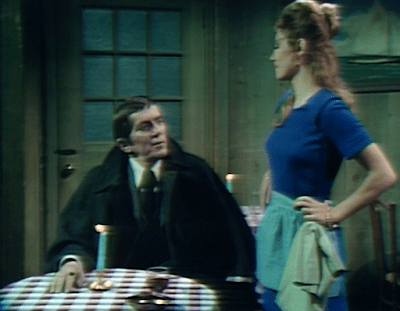
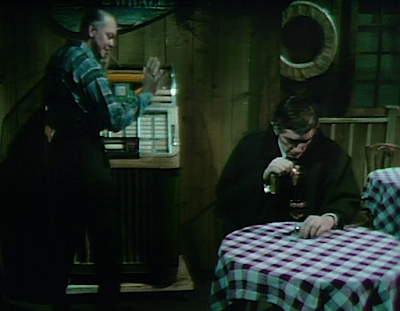
Barnabas is sitting at a table in the Eagle tavern. There is a glass of reddish liquid in front of him. In view of his condition, one wonders what that liquid might be.
Barnabas invites Buffie to sit with him. Since there are no other customers, she agrees. He tells her he is from South America. The son of this universe’s Barnabas Collins whom he claims as his great-grandfather went to Peru; when he introduced himself to the family, he said that his forebear did not die in that country. But evidently his imaginary descendants stayed on the continent, somewhere.
The Eagle is the counterpart of the Blue Whale in the other continuity. In #3, Burke Devlin was sitting at a table in the Blue Whale with hard-working young fisherman Joe Haskell when he said that his success in life began when a strange man picked him up in a bar in Montevideo. That was the show’s only reference to Uruguay, but Burke, the Blue Whale, and Brazil came to be strongly associated with each other. The song “Aquarela do Brasil,” a big hit in the English speaking world in the 1960s under the title “Brazil,” played on the jukebox at the Blue Whale, and it became Burke’s theme song. Ultimately Burke would die on a business trip to Brazil. Barnabas and Burke were enemies; when he sits at this table and claims to have a South American background, longtime viewers may wonder if he is thinking that the new universe is a place where he can try out a new personality and maybe he will start by imitating Burke’s.
Burke was a dashing action hero, attractive to women. Barnabas’ attempt to imitate him breaks down almost immediately. He winds up mimicking another prominent bachelor from his native universe, Professor Timothy Eliot Stokes, when he asks Buffie if she’s ever heard of the theory of “Parallel Time.”
Buffie shakes her head no. Barnabas says that some people believe that there are many universes, and that a copy of each of us can be found in each of them. They may look the same, but they lead different lives because they have made different choices. Buffie laughs and says that she hopes her other selves are having more fun than she is. She hastens to say that she doesn’t mean she isn’t having fun at the moment, sharing a table with Barnabas; she means that her life in Collinsport, as viewed from the most all-encompassing perspective and analyzed in the most thorough philosophic manner, well and truly sucks shit. Barnabas says that the other Buffies in the multiverse might have left Collinsport* and had wonderful adventures.
Longtime viewers saw one of those other Buffies in #951, when we were still in the original continuity. She had a different name; she went by Nelle Gunston. And as befits a mirror universe, she moved in the opposite direction. Rather than leaving Collinsport to look for something new as Buffie wishes she had done, Nelle left her parents’ home in Virginia and went to Collinsport because she had joined a cult dedicated to the destruction of the human race and its replacement by a loathsome breed of Elder Gods known as the Leviathan People. Barnabas had been the leader of the Leviathan cult, and when Nelle came to town she sat with him by the same table where Buffie and Barnabas sit today. They even take the same seats.
Buffie is charmed by Barnabas’ talk; between the suavity that Jonathan Frid brings to his part today and the energy with which Elizabeth Eis presents Buffie’s enthusiasm for him, it is far easier than it usually is to believe that Barnabas is a sexy dude. Maybe we are supposed to think that role-playing as Burke has enabled him to loosen up.
The conversation is really warming up when the bell attached to the front door rings. “Customer,” Buffie ruefully says to Barnabas as she rises. It is Cyrus.
Barnabas invites Cyrus to sit with them. He declines, saying that he came only to ask Buffie if she had seen John Yaeger lately. She tenses up. Yaeger used to beat her up and force her to help him with his crimes. She says that Cyrus himself had told Buffie that Yaeger wouldn’t be back in Collinsport. Cyrus says that he did, but that he is worried he might not be able to predict Yaeger’s movements as well as he thought he could. He offers Barnabas a lift back to Collinwood. That’s a bit surprising, since Cyrus got uptight when he saw Barnabas. As Yaeger, Cyrus discovered that there is a coffin in the basement of Will and Carolyn’s house, and he suspects that Barnabas spends his days there. But longtime viewers can remember the days Barnabas and Burke had conversations at the Blue Whale that were just as tense as the one he and Cyrus have in the Eagle, and Burke never failed to observe the small graces. It’s just the done thing, I suppose.
Cyrus leaves, and Buffie remains standing. She and Barnabas keep talking. He gets close, and goes in for a bite. He stops himself at the last second, to her surprise and disappointment. She was apparently ready for a kiss on the neck. He says he has to go. She is even more disappointed by that, but he promises to come back at closing. He asks to walk her home, and she happily agrees.
Will and Cyrus are in the drawing room at Collinwood. Will urges Cyrus to join him in a drink. When Cyrus declines, Will reminisces about the old days at Collinwood, when the party would just be getting started at this hour. In those days, people would leave the great house in the small hours of the morning and continue their revels at the Eagle. Cyrus says he won’t find much company there tonight. When he says that the only people in the place earlier were “the girl who works there” and Barnabas, Will looks alarmed. All of his mannerisms that suggest drunkenness drop away, and he rushes out.
Will gets to the tavern, and finds Buffie alone. The alcoholic author is obviously one of her favorite and most lucrative customers, so even though she has already blown out the candles she tells him he is in time for last call. To her amazement, he is not interested in a drink. He asks her where Barnabas is. She says he’ll be back and that he is taking her home. He says no, and she asks what’s wrong. Before he can answer, Will hears Barnabas’ voice behind him, echoing Buffie’s question. Laboring under the vampire’s power, Will has no choice but to leave Buffie alone with Barnabas.
Nelle, too, had agreed left the tavern with Barnabas. She expected to meet the leader of the Leviathans at his place, and was unhappy to find that the two of them were alone. Buffie is again an inverted mirror image of her counterpart. She takes Barnabas to her place, and is quite happy to be alone with him. The two close in for an embrace. He bites her neck, and she collapses. He had bitten Nelle, too. At that moment, Cyrus enters the room.
Cyrus does not exactly have a counterpart in the other continuity, but Christopher Pennock did play the Leviathan leader whom Nelle expected to meet. Like Cyrus, that character was a murderous shape-shifter. So Cyrus’ unexpected arrival mirrors the Leviathan leader’s unexpected absence.
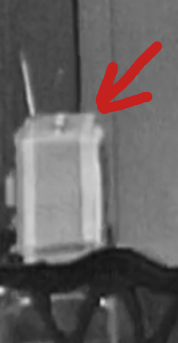
When we first cut to Buffie’s room, the camera lingers for several seconds on an extremely unusual prop. It is a television set. The only other time we have seen a television set on Dark Shadows was in #27, in the other universe, when Burke visited investigator Stuart Bronson in a hotel room in Bangor, Maine where there was a small portable unit. It looks like it might be the same set.
Bronson’s TVBuffie’s TV
The shot goes on so long, and the set is such an odd thing to see in the context of the show, that they must be making some kind of point with it. We have wondered why Buffie submitted to Yaeger’s abuse, when she is such a strong and intelligent person. Her reflection in Nelle suggests a partial answer. Nelle was drawn to the Leviathans, who offered to destroy her and all other humans. We can assume that Buffie, too, was following a self-destructive urge when she went along with Yaeger. Associated with her, the television is a symbol of the annihilation of the self. Turn the idiot box on, turn your mind off. If you aren’t careful, you may even wind up spending your weekdays staring glassy-eyed at ABC’s daytime lineup.
*He actually says “Collinwood.” Which is a blooper, but since Buffie mentioned in her first episode that she used to work at Collinwood it is kind of an interesting one. Maybe when another Buffie left her position as an upstairs maid or whatever she was, she got further than the nearest tavern.
Mad scientist Cyrus Longworth has devised a potion that alters his appearance so that even the people who know him best, including his fiancée Sabrina Stuart and his attorney Larry Chase, cannot recognize him. When he is thus disguised he calls himself “John Yaeger” and indulges his sadistic impulses. One of his favorite hobbies is beating and intimidating a woman named Buffie Harrington, who submits to his abuse for psychological reasons the show never explains, but for clues to which Elizabeth’s Eis’ performance keeps us watching closely. Buffie does not know that Yaeger is really Cyrus. As Sabrina and Larry have not recognized Cyrus when they saw him as Yaeger, so Buffie has not recognized Cyrus when she has met him undisguised.
The only person who has so far figured out Cyrus’ secret is chemist Horace Gladstone. Cyrus bought a vital ingredient for his potion from Gladstone, who knows that it can be used to change a person’s appearance. He has had dealings with Cyrus when he was presenting himself as Yaeger, has seen his handwriting in both states, and has questioned both Sabrina and Buffie. Combined with several other pieces of evidence, Gladstone was able to build an overwhelming case that Yaeger is merely Cyrus in disguise. Yesterday he demanded Cyrus pay him $10,000 in return for a continued supply of the ingredient and his silence. Cyrus responded by drinking the potion to assume his disguise, going to a dark alley where he had gleaned from an indiscretion on Larry’s part Gladstone would be waiting, and murdering him. Larry arrived at the scene a moment later and pursued “Yaeger” on foot from the alley to the courtyard behind Cyrus’ place. He saw “Yaeger” jump the fence into the courtyard.
As Yaeger, Cyrus enters his laboratory through the door in the courtyard. He is about to take the antidote to change his appearance back to normal when he hears Sabrina and Larry coming downstairs. He hastens out the way he came. Eavesdropping through the courtyard door, he is relieved to hear Larry say that he did not get a good enough look at him to be able to make a positive identification. He hears Larry place a call to the police, and exits.
Cyrus goes back to the alley where he killed Gladstone. Buffie enters, getting off her shift as a barmaid at the Eagle tavern. The tavern abuts the alley, but evidently the police didn’t think it was necessary to bother her with news of the murder. He demands she do him a favor. She says she is too tired to do anything tonight; he says it’s better to be tired than dead. Whatever it is that compels Buffie to keep coming back to Cyrus in his Yaeger form is strong enough that this death threat does not drive her away. She protests that she does not have a criminal record and wants to keep it that way; he tells her she won’t get caught. He gives her the keys to his lab and the combination to his safe and orders her to take the bottle containing the antidote. He tells her to bring the bottle to him in a cave on the beach below the estate of Collinwood.
Buffie goes to the courtyard door. She is about to open it when she hears Sabrina and Larry inside the lab, talking about Gladstone’s murder. When the name “John Yaeger” comes up as a suspect, she looks down. We can see a forlornness in her face. She is as much addicted to his hard domination of her as Cyrus is addicted to violence, but she still does not want to think of herself as a criminal, certainly not as an accessory to murder.
Buffie hears about Yaeger as a murder suspect. Screenshot by Dark Shadows Wiki.
When Sabrina and Larry go upstairs, Buffie lets herself in to the lab. She has removed the painting that covers the safe and is starting to turn the dial for the combination when she hears Sabrina tell Larry she has to go back downstairs to retrieve something she left in the lab. Buffie hides by the door while Sabrina collects her purse. The purse is right next to the painting, but the room is dark. We are in suspense whether Sabrina will see it. She doesn’t, she leaves, and Buffie gets the bottle.
In the cave, Cyrus notices footprints going up to a pile of stones that appear to be a natural part of the cave wall. He realizes that the stones must be hiding a secret passage. He is curious where it leads, and figures it will be at least half an hour before Buffie comes. So he starts pulling the stones down.
Cyrus follows the path into the basement of the Old House on the grounds of Collinwood. This house is currently occupied by writer Will Loomis and his wife, the former Carolyn Collins Stoddard. Cyrus realizes where he is, and finds a chained coffin. He wonders what secret Will might be hiding from the world. He decides that if the secret is shameful enough, it might come in handy. He breaks the first chain, intending to open the coffin.
The opening voiceover, delivered arrestingly by Eis, told us what is in the coffin. It is a visitor from a parallel universe. He is named Barnabas Collins, and he is a vampire. Will is holding Barnabas prisoner in the coffin and taking an oral history from him, which he plans to use as the basis of his next book. Longtime viewers of Dark Shadows are familiar with Barnabas’ native universe; the first 196 weeks of the show were set there. As Will put chains on Barnabas’ coffin in the hope of finding a fortune in his stories, Will’s counterpart, dangerously unstable ruffian Willie Loomis, took the chains off Barnabas’ coffin in hopes of finding a fortune in jewels. In his universe, Barnabas is the master of the Old House and he keeps his coffin in the space where Will has it here. It has occasionally been opened by intruders; the first time we saw that happen was in #275, when Willie’s sometime friend, seagoing con man Jason McGuire, lifted the lid at sunset, only to be greeted by Barnabas’ hand darting out and crushing his throat. If Cyrus gets the coffin open, Gladstone’s death might be avenged sooner than anyone could expect.
Gladstone’s death marks the final appearance of John Harkins. Harkins’ first appearance was in #174, in which he played Lieutenant Costa of the Arizona State Police. The most famous of his dozens of screen roles was in The Mary Tyler Moore Show, when he played the clergyman who officiates at the funeral of Chuckles the Clown. He also had a recurring role on Cagney & Lacey as Mansfield the drug kingpin. Harkins didn’t have any scenes with John Karlen, who was a regular both on that show and on Dark Shadows.
The Dark Shadows Wiki tells us that this is one of only six episodes with no cast member who appeared in 200 or more episodes. It lists the others as 168, 172, 180, 1141, and 1182. It also says that there is no one in it who joined the cast before David Selby’s debut as Quentin, but since Harkins was on almost two years before Mr Selby that is not so.
The show has been spending a lot of time lately trying to interest us in the ghost of Dameon Edwards, a man who doesn’t seem to have had much going for him even when he was alive. They went through the motions of a murder mystery concerning Dameon’s death. The episode that introduced him also hinted that he was killed by sleazy musician Bruno Hess with the complicity of butler Mr Trask, and those hints are confirmed today. So the mystery was never much of a puzzle. Besides, Bruno and Trask are the counterparts of homicidal villains whom we saw in the universe where Dark Shadows was set for its first 196 weeks, so we’ve expected all along that they would turn out to have someone’s blood on their hands. And neither of them is the central figure in an ongoing story, so even if they had been brought to justice for their crimes it would only be an easy way for the writers to dispose of characters who were going to be written out anyway.
Today, wicked witch Angelique finds Dameon’s skeleton sealed up in an alcove in the basement of the great house of Collinwood. She summons his ghost and dismisses him. That’s it for Dameon. What will happen to the skeleton, or to Bruno, or to Trask, or to the alcove, we don’t yet know.
The sight of the skeleton standing in the alcove does remind us of one of Trask’s alternate universe counterparts, a fanatical witchfinder who was sealed up in a basement alcove elsewhere on the estate in 1796. Since Trask is involved in this little arc, it’s a nice touch to connect it to that other Trask.
Most of the episode is devoted to a far more interesting story, an adaptation of Jekyll and Hyde. They’ve been focusing on the addiction angle. Mad scientist Cyrus Longworth is hooked on the potion that changes his appearance and allows him to fool even people who know him well into believing that he is a separate person by the name of John Yaeger. He enjoys the violence that he commits as Yaeger.
Today, three people try to save Cyrus from himself. Lawyer Larry Chase resists Cyrus’ instructions to transfer $5000 to Yaeger and to rewrite his willin Yaeher’s favor; chemist Horace Gladstone is reluctant to keep selling Cyrus a volatile synthesis he needs for the potion, and figures out that he and Yaeger are one and the same; and Buffie Harrington, who is exploring her masochistic side by submitting to beatings from Cyrus as Yaeger but still thinks the two are different people, goes to Cyrus to urge him to be more careful in his dealings with Yaeger. Dark Shadows has dealt intelligently and sensitively with the theme of addiction from its earliest days, and today’s focus on people who care about the addict trying to help him achieves a real poignancy.
We may wonder if drug abuse was a particularly timely topic behind the scenes of Dark Shadows at this point. Larry is a substitute for the character of Chris Collins, who was played by Don Briscoe. Briscoe would eventually be diagnosed with bipolar personality disorder, and in 1970 was trying to self-medicate with street drugs.
The makers of the show didn’t give up on Briscoe until the absolute last minute. This episode was taped very close to airtime, after episodes that would be broadcast weeks later were already in the can, giving Briscoe as much time as possible to get himself together. The part of Larry was played by Ken McEwen. McEwen joined the show in August 1968 as an associate director. He had a guild card due to small parts he had taken in a couple of TV shows in the 50s, but had never been an actor full-time. And he clearly hasn’t had much time to learn his dialogue. He is perfectly competent in the first of his two scenes, when Larry is in The Eagle tavern with Yaeger, Gladstone, and Buffie. There are no major bobbles and you can tell exactly what is on his mind. But when Larry returns and meets with Cyrus in his laboratory, McEwen stumbles over every line and never develops a coherent attitude.
The music is interesting today. The Eagle in the current universe corresponds to the Blue Whale, Collinsport’s tavern in the main continuity, and while we are there we hear the jukebox music that was prominent in the show’s first year. There is a scene between Gladstone and Buffie in her apartment; when that opens, we hear some music I don’t believe we’ve heard before. If they’ve written a theme for Buffie, it gives us hope we will see a lot more of Elizabeth Eis’ excellent performance in this role.
The original videotape master of this episode was lost. We have it on a kinescope. I love the kinescopes; I wish all the episodes were available in that format, as well as the videotapes. We haven’t seen one since #813, and will see only one more, #1017. You can always set the options on your device to display in black and white, but the kinescope comes with some visual blurring and sound distortions. Those are usually flaws, of course, but when the show has already given you the feeling that you are catching a glimpse of another reality they can add to the eeriness and yearning for what might have been.
Medical researcher Cyrus Longworth has invented a potion which, when he drinks it, darkens his hair, causes him to grow more of it, and adds to his muscle mass. When he is in this state, Cyrus calls himself “John Yaeger.” Yaeger serves Cyrus as a very effective disguise. The other day, he ran into his old friend Quentin Collins while he was presenting himself as Yaeger. Quentin did not suspect that the man he was talking to was Cyrus.
Cyrus uses Yaeger to escape responsibility for violent crimes. He has started a couple of bar fights in the Eagle tavern. Barmaid Buffie Harrington has drawn Cyrus’ special attention; he hit her, twisted her arm, choked her, and threatened worse when he was alone in the tavern with her, and he has since taken an apartment in her boarding house. Cyrus has also beaten Buffie’s sometime boyfriend Steve so severely that he put him in the hospital. Cyrus was choking Steve when he heard a police whistle and ran away. It looked like he would probably have murdered him if the police had been a minute later. When Buffie saw Cyrus in his undisguised form and told him of the cruelty she and Steve had suffered at Yaeger’s hands, Cyrus barely bothered to conceal his pleasure. When Buffie asked Cyrus if Yaeger worked for him, Cyrus was delighted to say that he did.
We open in the drawing room of the great house of Collinwood, where Cyrus is waiting for Quentin. All of a sudden Cyrus starts to transform into Yaeger. This is the first time the transformation has taken place spontaneously, without a fresh dose of the potion. Cyrus leaves a note, then jumps out the window and runs away.
In his laboratory, Cyrus is about to drink the antidote to restore his usual appearance. He decides he would rather have some more fun as Yaeger first and puts the antidote back. His fiancée and lab assistant Sabrina Stuart comes downstairs. She has not seen Cyrus as Yaeger before, and is completely fooled by the disguise. She has heard the name John Yaeger in connection with recent strange behavior on Cyrus’ part, and is stern with him. Regular viewers know how brutal Cyrus is with Buffie, and we fear that he will mete the same treatment out to Sabrina. But he does not do so, not this time. He insists that Cyrus wants him to wait in the laboratory, and Sabrina leaves him alone there. After Sabrina exits, he takes a painting from the wall and goes.
Cyrus takes the painting to the apartment he has rented in the name of Yaeger. Buffie comes to him there. He harries her about her visit to him when he looked like his usual self and she knew him as Cyrus. He says she told Cyrus she likes a quiet man. He walks up to her, talking all the while about how quiet he can be. He gets quieter and quieter until he brings his hand across her face with full force. The next we see, she is bruised and cut, her clothing badly torn. Christopher Pennock and Elizabeth Eis play these moments very well. They are really hard to watch.
Cyrus gives Buffie the painting from his laboratory. He asks her if she wants him to take her someplace nice, with good food and a sophisticated atmosphere. She perks up and is enthusiastic. He then points out that she is covered in bruises and abrasions and wearing damaged clothing. He ridicules the idea that she could be seen anywhere looking like that, and taunts her with imprecations to take better care of herself. She leaves, hanging her head and carrying the painting. Cyrus laughs, relishing the misery he has inflicted on Buffie.
Cyrus rejoices to have battered and humiliated Buffie.
As Cyrus, whether he has red hair, a white coat, and a diffident manner, or black hair, a mustache, and a sadistic swagger, Pennock has a relatively straightforward job to do. He is to embody a total rat bastard, one who pretends to be nice when he might be held accountable for his actions and who exults in hurting people when he thinks he can get away with it.
Eis has a trickier assignment. When we first saw Buffie, she was cheerfully fending off Steve’s clumsy advances. Even after she had seen Cyrus, as Yaeger, outfight many strong men, she still stood up to him and spoke her mind. But now he has harmed her again and again, and she just keeps coming back for more. It would be depressing to see anyone fall into that pattern, but it strips us of all hope when we know the person to be so lively and dynamic. That’s the point, I think, and Eis doesn’t let us off the hook. Buffie still holds her head up, she still looks Cyrus in the face, she still speaks in a mature tone of voice when she protests against his abuse. But even so, whatever masochistic fascination is at work has such a grip on Buffie that she will not walk away from a situation that is already intolerably bad and can only get worse.
A Window Into This World From That
We are currently several weeks into a segment set in a different continuity than the one where Dark Shadows spent its first 196 weeks. Vampire Barnabas Collins brought us here. Barnabas discovered that a room in the long-disused east wing of the great house of Collinwood was the site of an inexplicable phenomenon. When he opened the doors to the room, he usually saw it as it was in his universe, a dark space with bare floors and undecorated walls. But once in a while, it appears to be brilliantly lit, fully furnished, and the setting of frequent meetings among people who look and sound just like his acquaintances, but who are living different lives. Through an invisible barrier, Barnabas could see and hear those people, but he could neither pass through the barrier nor attract the people’s notice.
Barnabas became obsessed with the forlorn hope that if he could pass into the other universe, he might be free of his curse and become a living man once more. Other characters from the main continuity joined him in watching their counterparts in the other world; few of these knew that Barnabas was a vampire, but all of them could see that the phenomenon had some obscure significance special to him, and were concerned that he was going to do something dangerous. In #980, Barnabas managed to make his way through the barrier, only to find that he was still a vampire. He bit the first person he met, and shortly after was chained in a coffin by her husband. He has been trapped there ever since.
The room on which Barnabas and others in the main continuity had been spying in the days before he crossed over has been a major set in the “Parallel Time” segment, and every time we see it we wonder if those others are still watching. Today, we intercut with the original “time-band.” Quentin goes to the room, and finds the bare dark space it represents in the main continuity. He sees two children there, whom he takes to be his son Daniel Collins and Daniel’s cousin Amy Collins. The boy is telling the girl that “Dr Hoffman” told his father that Barnabas got caught in that room. The girl responds that she certainly does not want to get caught, and she wants to leave at once. Quentin calls Daniel and Amy’s names, and is puzzled that the children do not react. He hears Daniel’s voice coming from behind him. He turns and sees Daniel and Amy standing in the hallway, asking why he is calling their names.
This is the first indication we have had that the main continuity is ever visible from this one. We are left wondering if the traffic between the universes can go both ways, and if so whether this continuity and the original one will in some way merge together. Cyrus’ attack on Buffie and her response to it were so difficult to watch that, done as well as the scenes were done today, they left us reluctant to tune back in tomorrow. The story of Buffie’s degradation at Cyrus’ hands can only become more depressing as it goes. But this new information about how “Parallel Time” works suggests such a wide variety of possible next steps that it sets our imaginations into overdrive, and we can’t wait to see which way we will turn next.
We are in the fourth week of an arc set in a different universe than the one we saw in the first 196 weeks of Dark Shadows. This universe, which the show insists on calling “Parallel Time,” was originally introduced as a realm populated by Doppelgänger of the characters we have known. They are the same people, but have made different choices and are therefore living different lives.
Some of the Parallel Time characters fit this description. So, we have known matriarch Elizabeth Collins Stoddard and her brother Roger Collins from episode #1. In the early days of the show, much was made of the Collinses’ straitened financial circumstances, the result of Roger squandering the half of the family’s assets he had inherited and Liz scrambling to keep control of the business. Roger lived in Liz’ house as her guest and worked in the business as her employee, and she kept a wary eye on any move he made to get his hands on her money. In #981, Parallel Liz mentions that she used to be quite wealthy, but that she entrusted her share of the Collins fortune to Roger, and as a result they are both penniless. Original Liz saw that fate as a distinct possibility, every time Roger was in the same wing of the house as her bank account information.
Parallel Liz and Parallel Roger live in the great house of Collinwood as the guests of their brother Quentin. Parallel Quentin is not at all the same person as Original Quentin. He is an entirely different person. Original Quentin was born in 1870, died in 1897, became a ghost haunting Collinwood in 1968 and 1969, and as the result of a time travel storyline in 1969 was both spared death and immunized against aging. Original Quentin was a riff on the early conception of Roger as a villain, and he was a huge hit with the viewing public during the part of the show set in 1897. Ever since Dark Shadows returned to contemporary dress in late 1969, they’ve been at a loss what to do with him. Parallel Quentin is an attempt to reinvent the character to let him keep enough of his vices that he retains the roguish charm that the fans liked, but at the same time use those vices as motivation for him to act the part of the hero from time to time.
There is need for an action hero today. Quentin’s friend, dippy mad scientist Cyrus Longworth, has invented a Jekyll-and-Hyde potion and taken a swig of it. As the darkly mustachio’d John Yaeger, he has been persecuting barmaid Buffie Harrington and Buffie’s unlucky boyfriend, big galoot Steve. We open with Yaeger choking Buffie and telling her she needs to be beaten into submission. Later, Yaeger gets the jump on Steve in a dark alley behind the Greenfield Inn, an establishment that also fronts a sinister alley in the main continuity. He threatens him with his sword cane. Steve manages to get that weapon away from him, but Yaeger beats him down. Yaeger is choking Steve, apparently with the intention of murdering him, when he hears a police whistle and runs away.
Cyrus Longworth and John Yaeger are played by Christopher Pennock.* In the main continuity, Pennock played a character who asked to be called Jabe but wound up answering to “Jeb.” Jabe appeared to be a man in his twenties, but was in fact a shape-shifting monster who was only a few months old when he was destroyed. We’ve heard a good deal about what Cyrus was doing six months ago and more, and there are diplomas on the walls of his laboratory that show his history is nothing like Jabe’s.
Among the very few choices in Jabe’s short life was an attempt to renounce his shape-shifting abilities so that he could remain in human form at all times. In that way, he is the opposite of Cyrus, who chooses to take his potion knowing it will change him into Yaeger.
Also, Jabe was so obnoxious that even people brainwashed to regard him as a divine being come to fulfill a plan that more than justified the extermination of the human race found his personality too much to take and turned against him after a few encounters. But by the end of Jabe’s time on the show, it had become undeniable that there was a kernel of sweetness in his personality. In this regard, too, Cyrus is the opposite of Jabe. We hear his soft voice and see his diffident manner, and we assume that the single-minded scientist in his lab coat, toiling all hours on a project that he keeps saying will benefit humankind, is a well-meaning sort, though perhaps dangerously naïve. Cyrus’ dutiful assistant and devoted fiancée, the lovely Sabrina Stuart, encourages us in that assumption, insisting that Cyrus is thoroughly good, if hopelessly unworldly. But as the initially insufferable Jabe turned out to be endearing at the end, so the apparently innocent Cyrus is deliberately choosing to turn himself into Yaeger even after he knows what Yaeger is capable of. What’s more, he refuses to let anyone at all help him with his experiment, meaning there is no one to restrain Yaeger’s sprees.
Sabrina’s counterpart in the main continuity was the fiancée, not of Jabe, but of another dangerous shape-shifter. She was engaged to werewolf Chris Jennings. As this Sabrina is convinced Cyrus is good, so that one kept insisting Chris was good, even after she had learned that he repeatedly refused to be restrained on nights of the full Moon, so that the killings he committed in his lupine form were premeditated murders on his part. This Sabrina does not know the nature of Cyrus’ work, and she believes that Yaeger is an enemy of his who is holding him prisoner. Sabrina would appear to stand with Roger and Liz as a character who is in a meaningful sense the same person in both timelines, so we are in suspense as to how she might react if she finds out the truth about her man.
Sabrina’s part makes us wonder if the original plan were to cast Don Briscoe, who plays Chris in the main continuity, as Cyrus and Yaeger. At this time Briscoe was struggling with bipolar disorder. He was trying to self-medicate with street drugs, which not only made matters worse in itself, but also led him to get a severe beating one night while trying to score a fix in Central Park. Briscoe appears in Parallel Time as lawyer Chris Collins and has a small part in the concurrently filmed feature House of Dark Shadows, but his health problems ruled out a part as crucial as the lead in the Jekyll and Hyde story.
Buffie is played by Elizabeth Eis, who appeared in one episode set in the main continuity as Nelle Gunston. Nelle was a young woman from Virginia, bored by life with her parents, who had joined the cult that was meant to serve Jabe and the world-wrecking plan to which he was central. When she was asked if she would commit murder if that was what the cult required, she smiled pleasantly and said “Even that.” Nelle was killed before she could meet Jabe.
Buffie is not at all the same person as Nelle. She is not from Virginia, for one thing. When she thinks about leaving Collinsport to get away from Yaeger, she realizes she has only $13.40 to her name, and laughs at herself for a plan that wouldn’t get her any further than Worcester, Massachusetts. Naming Worcester as a synonym for “nowhere” would suggest that she is a New England girl, which would fit with her employment in a bar in a fishing village in central Maine. Buffie is the opposite of what they originally told us the characters in Parallel Time would be- she is not Nelle after she has made a different choice, she is a person who began differently than Nelle and is making a similar choice.
Buffie is in her room when her landlady, Mrs Duvall, comes for the rent. Buffie has a check ready. Mrs Duvall thanks Buffie for recommending her boarding house to a gentleman who has rented her four best rooms at a very handsome price. She tells Buffie that the man is a big step up from Steve. Buffie has no idea what she is talking about. Yaeger shows up, and Buffie realizes he is Mrs Duvall’s new prize boarder. Buffie is horrified, and demands her rent check back. Mrs Duvall refuses to return it. Yaeger points to a print hanging on the wall and instructs Mrs Duvall to take it away and burn it. She is doing so when Buffie protests that it is hers. At that, Mrs Duvall stops short of the door, but she does not put the print back on the wall. Eventually, Mrs Duvall does take Buffie’s print, and leaves her with Yaeger.
Mrs Duvall leaves with Buffie’s print.
The telephone rings. It is Quentin, asking Buffie about Yaeger. Yaeger stands next to her and forces her to answer Quentin’s questions with lies. Later, Steve will come to Buffie’s room. She will tell him to give up on her and not to take any more beatings from Yaeger on her behalf. Steve asks if Yaeger is a superman; Buffie widens her eyes and says that he might be. This brings us back to Nelle, who renounced her life in Virginia and her connection to the human race because she was looking for a superman and thought she would find one in Jabe. Steve may not have had much to offer, but it’s a cinch he wasn’t as bad as Yaeger, and he’s gone from Buffie’s life after this scene.
The emptiness of Buffie’s life is represented today by a prop we have seen only once before on Dark Shadows, a television set. There was a set in a motel room in Bangor in #27; we never do see one in the Collinsport or the Collinwood of the main continuity. Perhaps the makers of the show are suggesting that people who have nothing better to do than to watch the idiot box are likely to fall prey to any fella who offers physical abuse and verbal intimidation.
Mrs Duvall is played by Camila Ashland. Ashland was a very distinguished stage actress who appeared in #928 as someone called Mrs Hutchins. A man from the cult around Jabe hired Mrs Hutchins to tell some lies to throw mad scientist Julia Hoffman off their trail. That didn’t work, but Julia admired Mrs Hutchins’ performance, as we suspect Grayson Hall admired Ashland’s. When the man from the cult paid Mrs Hutchins for her work, he was unpleasantly surprised at her questions and the uneasy conscience it reflected, responding roughly that she is being paid for a job and should leave it at that. He didn’t realize he was dealing with an artist. Mrs Duvall’s eagerness to please the obviously horrible Yaeger shows that she really is the crude mercenary the man from the cult assumed Mrs Hutchins was.
We cut to Cyrus’ laboratory. Yaeger has fled there from the police. He is about to take the re-Jekylling formula when Quentin shows up and demands to know where Cyrus is. We end with them in that standoff.
*Billed twice in the closing credits- as Christopher Pennock for Cyrus, and as Chris Pennock for Yaeger. Adorable!
The first expert in forbidden lore to join the cast of characters on Dark Shadows was Dr Peter Guthrie of Dartmouth College, parapsychologist. Guthrie was chief scientific advisor to well-meaning governess Victoria Winters as she assembled the forces of good and led them in battle against undead blonde fire witch Laura Murdoch Collins. In #184, Guthrie confronted Laura. He told her that he had figured out she was “The Undead,” the first appearance of that expression on Dark Shadows. He also offered to help her if she would desist from her plan to murder her young son David. Guthrie was nervous about making this offer, apparently fearing Laura might draw him into her web of evil. He needn’t have worried about that- she responded, not by corrupting Guthrie, but by killing him.
The second such expert was a straightforward mad scientist. She was Julia Hoffman, MD, who in #291 offered to cure vampire Barnabas Collins of his curse. Though Julia made it a condition of her offer that Barnabas stop preying on the living, as Guthrie had conditioned his offer to Laura on her allowing David to live, we could already see that Julia was far more deeply compromised than Guthrie had been. She had learned of Barnabas’ existence while treating his victim, Maggie Evans, and she could gain the time to make her experiment work only by betraying Maggie’s trust and preventing her from regaining her memory of what Barnabas was and what he had done to her. Before long, Julia acquiesced to Barnabas’ pressure and joined him in murdering her old medical school classmate, Dr Dave Woodard. Eventually, she and Barnabas would become the parents of a Frankenstein’s monster named Adam. The shocking abuse they heaped on Adam in his infancy left no doubt that as a mad scientist, Julia is as much a symbol of extreme selfishness as is a vampire.
Adam was the product of an experiment designed by another mad scientist, Dr Eric Lang. Lang was even more flagrantly evil than Julia. When he needed a head for the monster, he tied his assistant down and set about cutting his head off. Granted, the assistant was a character played by Roger Davis, so the audience could see where Lang was coming from. In fact, the writers themselves eventually got so fed up with Mr Davis they cut the head off the final character he introduced. Still, Lang’s impatient response to the assistant’s complaints showed that he was utterly lacking in human compassion.
Now, we are in a different universe than the one where Dark Shadows spent its first 196 weeks. The resident mad scientist in this “Parallel Time” is Dr Cyrus Longworth. Cyrus has developed a potion that turns him into a real jerk. That may not sound like much of an achievement compared to building a Frankenstein’s monster or curing vampirism or whatever it was Guthrie wanted to do for Laura. But that’s to be expected. By the time Guthrie came to the great estate of Collinwood early in 1967, monsters and black magic and the like had been fixtures there for over 171 years. It appears that such things are relatively new to this version of Collinwood, so Cyrus is doing the sort of modest project that tends to characterize a field when it is first starting.
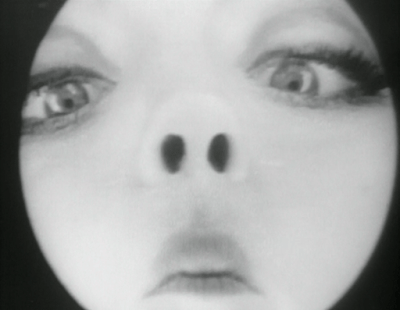
When Cyrus drinks his potion, his red hair turns black, he grows a lot more of it, and a putty appliance materializes, dangling precariously from the bridge of his nose. In this form, he calls himself “John Yaeger.”
That nose may not be made of Silly Putty, but it certainly isn’t a serious putty. Screenshot by Dark Shadows Before I Die.
As Yaeger, he goes to the Eagle, a tavern in the village of Collinsport, where barmaid Buffie Harrington is fending off the advances of her boyfriend Steve. Steve keeps coming up behind Buffie and grabbing her by the waist, a move that doesn’t leave a lot to the imagination. Buffie seems to be at once excited by Steve’s aggressiveness and irritated that he is keeping her from getting her work done. When Yaeger shows up and orders Steve to vacate the premises, Buffie’s evening goes from complicated to disastrous. The men fight, Steve loses, and Yaeger bodily ejects him from the tavern. Buffie confronts Yaeger about the wreck he has made of the place.
Later, Yaeger returns with a check to cover the damages. Buffie sees that the check is signed “Cyrus Longworth.” She explains that she used to work for the Collins family, and she knows who Cyrus is. She doesn’t believe that Cyrus would be friendly with Yaeger, and is sure he wouldn’t give him a check to cover the expenses he had incurred in a bar fight. Yaeger tells her the check is legitimate, and insists she keep quiet about his connection to Cyrus. He leaves.
Later, Quentin Collins finds the battered Steve and brings him into the tavern. Steve refuses to call the police, vowing to find Yaeger and settle the score himself. He leaves, and Quentin asks Buffie what she knows about the man who beat Steve. She says she doesn’t know much about him, but that a friend of Quentin’s does. She shows him the check with Cyrus’ signature. Perplexed, Quentin leaves.
Suddenly, Yaeger appears from nowhere. He tells Buffie that she promised not to tell of his connection to Cyrus. He starts choking her.
This is Elizabeth Eis’ first appearance as Buffie. Eis was on Dark Shadows once when it was set in the main continuity, playing Nelle Gunston, a devotee of a sinister cult who met Barnabas in the Blue Whale, a bar that corresponds to the Eagle in that universe. Barnabas killed Nelle before her only episode was over. It’s good to have Eis back, she was fun as Nelle and is a commanding presence today.
George Strus plays Steve, in his first and only role on the show. Strus was primarily a stunt performer, but he had lines in a few productions, most notably as a tough in Shaft. His last imdb credit was as a stunt performer in Spike Lee’s Malcolm X, made in 1991, twenty years after Shaft. Steve is supposed to be a big dumb galoot, and Strus pulls that off satisfactorily.
Christopher Pennock’s name appears in the closing credits for the role of Cyrus. He is credited as “Chris Pennock” for Yaeger, adorably enough.
Old world gentleman Barnabas Collins has fallen afoul of a shape-shifting monster from beyond time and space who once hoped people would call him “Jabe.” The monster, who has settled for the name “Jeb,” turns Barnabas back into what he was from the 1790s until 1968, a vampire.
Re-vamped, Barnabas suddenly gets a lot of gray in his hair and a much darker complexion. Makeup artist Vince Loscalzo deserves a lot of credit for these bits of color, they are placed perfectly to emphasize the look of anguish as Barnabas realizes what has happened to him and struggles to resist his urges. The actors’ faces were the medium of Loscalzo’s art, and he outdid himself with these complements to Jonathan Frid’s face.
People talk endlessly about the heroic makeup work Dick Smith did with Jonathan Frid one week in October 1967 and again on a feature film, but Vince Loscalzo did great stuff like this day in and day out for years. Screenshot by Dark Shadows Before I Die.
We see Barnabas sitting at a table in The Blue Whale, the tavern in the village of Collinsport. He is the only patron in the room. He has a glass of reddish liquid in front of him, and the bartender is moving around the room. The bartender looks at Barnabas, as if to ask, “How do you like your glass of AB negative, Mr Collins?” But he turns away and moves on.
A young woman enters. Barnabas invites her to join him at his table. He sees that she is wearing a pendant that identifies her as a member of the secret cult that serves Jabe and other creatures who intend to seize control of the Earth, supplanting humankind. Barnabas introduces himself, and says that he was the one who made it possible for Jabe to come to life. This is true, but it is also true that he has become disaffected from the cult. Even after Jabe turned him back into a vampire, Barnabas is still determined to thwart it.
The young woman introduces herself as Nelle Gunston, who was recruited into the cult while living a dreary life with her parents in Virginia. Nelle tells Barnabas that everything has changed for her since she joined the cult. She says that she will gladly do anything she can to advance its objectives, including murder. They have this conversation in nice loud voices while the bartender is nearby.
Barnabas’ friends, mad scientist Julia Hoffman and recovering werewolf Quentin Collins, enter. He introduces them to Nelle, then explains to them that he and Nelle have a private matter to discuss. Quentin and Julia go to the bar, where Quentin orders brandies. They talk about Nelle’s pendant and their fear that Barnabas is falling back under the power of the cult while the bartender is in their space serving them drinks. Evidently they’ve learned to rely on his discretion. They are still deep in conversation when Barnabas leaves with Nelle.
Barnabas takes Nelle back to his place on the pretext that Jabe will meet them there. She asks him why it is so dark in there; he asks her how she got into the cult. She catches on that Jabe is not coming and that Barnabas is not loyal to him. She draws a knife and is about to stab Barnabas when he bares his fangs to her.
Quentin and Julia let themselves into Barnabas’ house. They find Nelle dead on the floor and Barnabas wallowing in self-pity next to her. Julia takes a second look at Nelle and sees the puncture wounds on her neck. She tells Barnabas she will renew the treatments that first put his vampirism into remission two years before; he says there is something else he has to do first. After he rushes out, Quentin and Julia talk about how they will hide Nelle’s body.
Nelle was the perfect victim for Barnabas- no one in town knew her, no one expected her to come, no one will notice she is missing. And he is determined to weaken the cult, so reducing its numbers by one fits his goals.
Barnabas goes to the antique shop in the village. Jabe is in an upstairs room; Barnabas is convinced that Jabe can assume his true form and lay it down only in that room. We saw him do that in a house on an island many miles away in #946, and he told Barnabas that he had done so in #947, but apparently that doesn’t count, somehow. Jabe is far more powerful in his true form than he is when he is man-shaped, but he cannot mingle with humans in that form. So Barnabas believes that he will limit Jabe’s options if he destroys the room. He pours gasoline all around the first floor of the shop and sets a match to it.
Nelle is played by Elizabeth Eis, in her first appearance on Dark Shadows. They say that the first thing actors have to do to work effectively is to pay attention to each other. Eis shows how far this can take you. She listens ravenously to everything Frid says and never takes her eyes off him. The script doesn’t give her a huge amount to work with, but simply by giving her scene partner her total attention she creates a sensational performance. The producers noticed; she will be back later this year in two quite different roles.
This episode is the last time we see either the Blue Whale or Bob O’Connell as the Bartender. The Blue Whale was an important part of the show from its debut in June 1966 until the first costume drama insert began in November 1967. O’Connell appeared as the Bartender in 60 episodes (three of them as other bartenders in other periods of history) and had speaking parts in 6. It’s too bad he doesn’t get to say anything today, but at least he is in the closing credits.
Hail and farewell to Bob the Bartender, the jukebox, and the tavern. Screenshot by Dark Shadows Before I Die.
In 281 of the posts that follow, I link to comments I made on Danny Horn’s blog, “Dark Shadows Every Day.”
Not all of these comments were absolutely unique. A number of times I argued that Danny and other contributors to the discussion threads were unduly harsh in their assessments of various actors on Dark Shadows, especially Alexandra Moltke Isles (who played Victoria Winters) and David Henesy (who played David Collins and various other members of the Collins families.)
I always liked Alexandra Moltke Isles; her scenes with David are not only the only things that work in the first two hundred episodes, they are also the purest example in the whole series of performers overcoming weak writing. Even when the scene begins with David accurately describing something that we, and Vicki, saw happen a few moments before and Vicki replying “That’s! Not! True!,” the two of them still manage to display deep enough emotions to carry us through. Her relatively quiet style doesn’t give her much scope as the show goes on and the “Go back to your grave!” school of acting becomes mandatory, but she always makes the most of whatever chances she has.
Nor are her performances in the first 42 weeks of the show all I find to praise in Mrs Isles’ work. I say that she made the most of the few opportunities the scripts gave her in the period of the show I call “Monster Mash” (episodes 466-626):
I’m not at all sure you’re being fair to Alexandra Moltke. She turns in some nice little performances in her scenes in this part of the series. She’s arrestingly fierce in her confrontations with Cassandra-lique, and in the confusion of her references to what she kind of remembers from 1795 she finds a kind of music. Each time she brings up her half-memory that the original Barnabas never went to England, but died in 1795, it’s a theme that resonates a little differently with everything else around it. Yes, Vicki was a dead-end character after the end of the Phoenix storyline, but I do wish the Countess had done a bit more screen acting.
Furthermore, I wish Vicki and Adam had a number of scenes together. The only thing that worked in the first 209 episodes was the relationship between Vicki and David, a theme crowned by the Phoenix storyline. Alexandra Moltke Isles and David Henesy made it work because they are both actors who excel at precisely crafted, quietly realized little scenes, and it was in scenes of that sort that the story of David learning to trust Vicki moved forward. When the vampire comes in and the overwrought style of acting (“Go back to your grave!”) takes over, the show doesn’t have room for many scenes like that. So often Isles and Henesy seem like chamber violinists trying to accompany a heavy metal band. Robert Rodan is of the same type.
As I say above, I believe Isles found a way to have an impact on a heavy metal concert with her chamber violin, and the others did as well. But it would have been satisfying in a different way if the chamber musicians had been paired with each other on a regular basis. Scenes with Vicki helping Adam could have been as compelling as the first season scenes of Vicki giving David his lessons were, as could scenes of David interacting with Adam.
I amplified my point about the Phoenix storyline (a.k.a. “Meet Laura,” episodes 126-192) here:
I liked the original Phoenix storyline… it was the payoff of the only thing that worked in the first 210 episodes, which was the development of a friendship between Vicki and David. The scene on the cliff, when David is clutching Vicki while Vicki urges him to go to Laura, is among the most emotionally powerful in the whole series because it shows us how far this development has come.
I wasn’t Mrs Isles’ only defender in the comment threads. Another commenter suggested a doozy of a rewrite of the “Meet Another Angelique” storyline (episodes 969-1060, also known as “1970 Parallel Time) in which Mrs Isles would play the villain and Lara Parker the damsel in distress, reversing their roles from the original “Meet Angelique” storyline (episodes 365-466, set in the year 1795.) Several people, including me, replied to that suggestion, all of us with an enthusiasm that showed our certainty that Mrs Isles could play the part brilliantly.
Like Mrs Isles, Mr Henesy was ill-served by the scripts and the house acting style that prevailed after the vampire was introduced (the “Go back to your grave!” style.) That ill service created a major problems later in the series. The “Haunting of Collinwood” storyline (episodes 639-700, which I usually group as part of the “Meet Amy” segment) turns on complex feelings of anxiety and dread that grip David Collins and Amy Jennings (played by Denise Nickerson.) The scenes between David and Amy work well enough; these two young actors not only convey the intricate malaise of people driven by obsession and fear, but even manage to find unexpected humor in their roles, turning into a grumpy old married couple after a few scenes together. But when Mr Henesy plays opposite an adult actor he often finds himself in an impossible situation. I give an example in this comment on episode 680:
This episode shows what Joel Crothers was talking about when he said he was glad to leave Dark Shadows because they had started spending so much time setting up special effects that the actors could no longer rehearse properly. You see it in the confrontation between David and Maggie, after he finds her waiting for him in his room. Kathryn Leigh Scott doesn’t have many lines, and only one emotion to express, sternness. She does a great job. But David Henesy has lots of complicated lines, and is trying to show us a character who is lying and who feels conflicted about lying. It would take a lot of practice for any actor to figure out a way to get all that across, and he doesn’t seem to have had the chance for it. Compare that scene with the many times he and Alexandra Moltke Isles overcame the drab dialogue they had to work with in their scenes together in the same setting, and it’s hard not to lament the missed opportunity.
Things got even worse for Mr Henesy when he was cast as Tad Collins in the 1840 segment of the show, for reasons I try to explain:
The writing isn’t the whole problem with Tad.
David and Vicki becoming friends is the only story that works in the first 42 weeks of the show, and it works in spite of the fact that the writers give the actors nothing at all to work with. We cut from a drawing room scene where Roger loudly declares to Vicki that “Yes, I’ve always HATED David!” to a scene where David looks up from his desk and tells Vicki “My father hates me,” and she responds “David, THAT’S! NOT! TRUE!” But whatever idiotic lines the script may require them to speak to each other, the body language and tone of voice between David Henesy and Alexandra Moltke Isles gets steadily warmer as the weeks go on, and you really believe that they are learning to care about each other. By the time Laura shows up, it makes perfect sense that Vicki is the referee between David and his mother, and it is inevitable that Vicki will be the one to pull him out of the burning shack.
As Tad, Henesy didn’t have the screen time it took to triumph over the writing like that, and frankly neither Kathleen Cody nor Kate Jackson was the sort of partner he needed to pull it off. Alexandra Isles worked very much from the inside out, feeling her way into the character’s emotions and letting them out through whatever parts of her were on camera, while the two K’s worked outside in, starting with the dialogue and putting the words on display. That may have made them a more natural fit for the Dark Shadows house style of acting (“Go back to your grave!”,) but it left everyone high and dry when the scripts stank.
For all that was against him, Mr Henesy did manage to create some bright spots in the later episodes. For example, his performance as evil sorceror Count Petofi speaking through the body of young Jamison Collins features some terrific moments, as I note in this comment on episode 803:
Much is asked of David Henesy in this episode. There are moments when he has to do a Thayer David impression. Those he carries off splendidly- “mineral water, for the digestion.”
At other moments, Petofi is tricking people into thinking that Jamison is free of his influence. That requires him not only to show the other characters a convincing likeness of Jamison, but also to show the audience the wheels turning in his devious mind. Sometimes that works- when he tricks Edward into letting him kiss him, he does create suspense as we wait to see his evil plan work itself out. Other times it doesn’t. When he tells Beth that “I just want people to like me,” he sounds so much like David Collins circa December 1966 that it just seems like he’s forgotten that he’s supposed to be possessed.
From time to time I spoke up in favor of other much-maligned cast members. In addition to the favorable reference to him above, I several times listed Robert Rodan among those I wished we had seen more on the show, and those references sometimes brought enthusiastic agreement from other commenters, suggesting that the negative remarks others made about him had more to do with the dead-end his character, the Frankenstein’s monster-like Adam, found himself written into than with the late Mr Rodan’s interpretation of the role.
Other actors may have left something to be desired from time to time, but did turn in good performances. I tried to call attention to those positive moments when others were venting about the less successful ones. For example, Lisa Blake Richards’ turn as Sabrina Stuart before and after the 1897 storyline is not widely admired, but I thought she was a substantial asset to the show in the “Meet Another Angelique” period.
Terry Crawford’s turn as Beth Chavez during the 1897 storyline is the object of a great deal of very harsh criticism, most of it justified. How many women could there have been who could not convince an audience that they were attracted to the young David Selby? But she did have one or two good moments then, and when she returned as Edith Collins in the 1840 segment she was very nearly competent.
An actress who tends to be, not indeed denounced, but simply overlooked, is Elizabeth Eis. That puzzles me; I think she was phenomenal in all three of the parts she played. She had a one-episode spot as a devotee of the sinister Leviathan cult in #951; the character isn’t much, a cliched hillbilly teenager cribbed from Tobacco Road, and her main function is to serve as breakfast for the vampire. But in Elizabeth Eis’ hands, she bursts off the screen.
And another fine moment from Elizabeth Eis. Quentin, who is in jail on suspicion of strangling someone, grabs the constable’s wife through the bars of his cell and starts strangling her. The part of “person being strangled” isn’t an easy one to play, as Dark Shadows shows us two or three times a week, and she does it as well as any of them. You can see her cycle through about a half dozen emotions while she’s struggling for breath.
Compare her scene getting strangled by Gerard in this episode with her scene getting strangled by Quentin last week… In the scene with Quentin, she cycles through a half dozen emotions while being choked; in this one, she digs down deep and shows a very specific form of terrified disbelief.