Episode 1020: The last of the bachelors

Angelique Stokes Collins has risen from the dead, but her renewed existence may end within seconds. She is overwhelmingly cold, and can warm up only by draining the heat from the body of a living person. Someone is coming in the front door, just in time to be her victim and die in her stead. She wonders who it will be.

Almost all the characters currently on Dark Shadows are either so important to an ongoing story that their deaths would end a major arc or have so many connections to everyone else that their deaths would start a new one. So if she kills mad scientist Cyrus Longworth, his fiancée Sabrina Stuart, or barmaid Buffie Harrington, Angelique will be ending the Jekyll and Hyde story, or at least shifting it into a radically new phase. If she kills drunken sourpuss Quentin Collins, his wife Maggie Evans Collins, or housekeeper Julia Hoffman, she will be ending the adaptation of Rebecca. If she kills Carolyn Loomis or her husband Will, she will be ending the restaging of Who’s Afraid of Virginia Woolf?

If Angelique kills woebegone homebody Elizabeth Collins Stoddard or her brother, sardonic dandy Roger Collins, she won’t be ending any ongoing stories. But Liz and Roger are the counterparts of characters who were central to the life of the great house of Collinwood in the first 196 weeks of Dark Shadows, when it was set in another universe, and are played by actors who have substantial followings. If either of them is murdered, the audience will expect major consequences. Angelique’s son Daniel Collins and Daniel’s cousin Amy Collins aren’t doing much just now, but if Angelique kills a child, especially her own son, the ABC network’s office of Standards and Practices would join the audience in insisting she face a serious reckoning that would take up a lot of screen time. This fit of heat vampirism came on Angelique too suddenly to make sense as the start of a new arc, so we can rule all of those candidates out.

There are also a couple of characters who were introduced to fill in for actors who were away the previous couple of months filming their parts in the theatrical feature House of Dark Shadows. Among those are Angelique’s Aunt Hannah and butler Mr Trask. They are possibilities, but are both played by actors who have enough going for them that it would be a bit surprising to bring them back just to kill them off. There are also a few miscellaneous day players whose characters would have no reason to let themselves into the great house of Collinwood- a bartender we saw in #991, a landlady we saw in #997, etc.

So it would seem that there are only two people who could be Angelique’s next meal. One is sleazy musician Bruno Hess, a former boyfriend of hers who lives in the cottage on the grounds of Collinwood and is friends with Cyrus, but who has been neither seen nor missed for some time. The other is Larry Chase, attorney at law.

Bruno is played by the dynamic Michael Stroka, who twice made a mark when cast in stories set in the other universe. Larry was written into the show as a last-minute substitute for a part played by an actor whose health problems made it impossible for him to continue. They didn’t have time for auditions, so they drafted associate director Ken McEwen for the part. McEwen was in the building, and he had a guild card because of some small parts he’d taken in TV shows he’d worked on in the 1950s. When he has enough time to rehearse, which is to say when he has had more time to rehearse than actors usually got on a show like Dark Shadows, McEwen gets his lines right, except for adding “Well…” at the beginning of every single one. You can tell he is making a sincere effort not to ruin the show. But that’s about all you can say for him. Even at his best he’s stiff and distracted, and when he hasn’t been able to get his part down, he disintegrates completely. So it isn’t much of a surprise that Larry is the one who opens the door. It wasn’t a surprise to me, I should say; writing these posts keeps all the details fresh in my mind. My wife, Mrs Acilius, looked at him for about thirty seconds and asked “Who’s that?”

Larry plays the same scene with Angelique that her second victim, Fred the transient handyman, had played with her in #1003, right down to telling her that he had wanted to hold her since he first saw her. Fred was played by Edmond Hashim, and anyone who sees the two versions of this scene side by side will come away with a new appreciation for Hashim’s talents as an actor. This is McEwen’s final on-screen appearance, though he will pinch hit as the opening narrator in three upcoming episodes. He will continue as an associate director through episode 1179/1180 in December.

Will enters to find Angelique screaming and Larry dead. Angelique, who is impersonating her late identical twin sister Alexis, claims that Larry was just standing there when he had an attack of some kind and dropped dead. Will touches the corpse and says that he is so cold he must have been dead for hours. “Alexis” insists he just died a moment before. Will calls Cyrus, who is the Collins family physician.

Cyrus is in his lab, looking at the potion which turns him into the Mr Hyde-like John Yaeger. He is about to capitulate to his craving when the telephone rings. Will tells him that Larry is dead and asks him to come to Collinwood. Cyrus puts the potion back in his safe and rejoices that he is “Saved!” Larry was Cyrus’ lawyer and apparently a social friend as well. We’ve already seen Cyrus do enough horrible things that this sociopathic reaction is no shock.

Back at Collinwood, Will and “Alexis” are talking with Barnabas Collins. Unknown to “Alexis,” Barnabas is a visitor from the other universe. Her counterpart in his world was the wicked witch who turned him into a vampire, so Barnabas cannot keep a hostile edge out of his voice and manner when he is talking to her. Will is one of Barnabas’ victims, and knows all of his secrets.

When they are alone in the drawing room, “Alexis” questions Will about Barnabas. Will denies knowing him particularly well. Barnabas is staying at Will’s house, and several years ago Will wrote a biography of Barnabas’ counterpart in this universe, a man who lived a quiet life and died a natural death in 1830. Barnabas claims to be a descendant of that Barnabas Collins, and to have come to Collinwood to meet the author of the biography. Will becomes more and more disturbed as “Alexis” presses him harder and harder for information. She is perplexed that he won’t tell her anything. Lara Parker and John Karlen have both been on the show for a long time, but this is the first substantial two scene between them, and it is terrific. Their acting styles were very different, but they couldn’t have meshed better.

Barnabas is sitting at a table in the Eagle tavern. There is a glass of reddish liquid in front of him. In view of his condition, one wonders what that liquid might be.
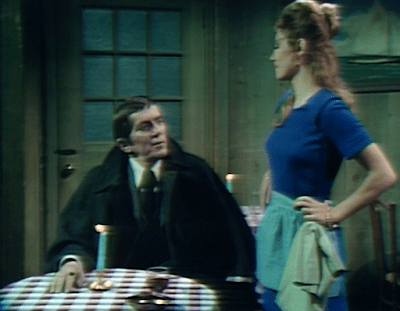
Enjoying your AB Negative, Mr Collins? Screenshot by Dark Shadows Before I Die.

Barnabas invites Buffie to sit with him. Since there are no other customers, she agrees. He tells her he is from South America. The son of this universe’s Barnabas Collins whom he claims as his great-grandfather went to Peru; when he introduced himself to the family, he said that his forebear did not die in that country. But evidently his imaginary descendants stayed on the continent, somewhere.

The Eagle is the counterpart of the Blue Whale in the other continuity. In #3, Burke Devlin was sitting at a table in the Blue Whale with hard-working young fisherman Joe Haskell when he said that his success in life began when a strange man picked him up in a bar in Montevideo. That was the show’s only reference to Uruguay, but Burke, the Blue Whale, and Brazil came to be strongly associated with each other. The song “Aquarela do Brasil,” a big hit in the English speaking world in the 1960s under the title “Brazil,” played on the jukebox at the Blue Whale, and it became Burke’s theme song. Ultimately Burke would die on a business trip to Brazil. Barnabas and Burke were enemies; when he sits at this table and claims to have a South American background, longtime viewers may wonder if he is thinking that the new universe is a place where he can try out a new personality and maybe he will start by imitating Burke’s.

Burke was a dashing action hero, attractive to women. Barnabas’ attempt to imitate him breaks down almost immediately. He winds up mimicking another prominent bachelor from his native universe, Professor Timothy Eliot Stokes, when he asks Buffie if she’s ever heard of the theory of “Parallel Time.”

Buffie shakes her head no. Barnabas says that some people believe that there are many universes, and that a copy of each of us can be found in each of them. They may look the same, but they lead different lives because they have made different choices. Buffie laughs and says that she hopes her other selves are having more fun than she is. She hastens to say that she doesn’t mean she isn’t having fun at the moment, sharing a table with Barnabas; she means that her life in Collinsport, as viewed from the most all-encompassing perspective and analyzed in the most thorough philosophic manner, well and truly sucks shit. Barnabas says that the other Buffies in the multiverse might have left Collinsport* and had wonderful adventures.

Longtime viewers saw one of those other Buffies in #951, when we were still in the original continuity. She had a different name; she went by Nelle Gunston. And as befits a mirror universe, she moved in the opposite direction. Rather than leaving Collinsport to look for something new as Buffie wishes she had done, Nelle left her parents’ home in Virginia and went to Collinsport because she had joined a cult dedicated to the destruction of the human race and its replacement by a loathsome breed of Elder Gods known as the Leviathan People. Barnabas had been the leader of the Leviathan cult, and when Nelle came to town she sat with him by the same table where Buffie and Barnabas sit today. They even take the same seats.

Buffie is charmed by Barnabas’ talk; between the suavity that Jonathan Frid brings to his part today and the energy with which Elizabeth Eis presents Buffie’s enthusiasm for him, it is far easier than it usually is to believe that Barnabas is a sexy dude. Maybe we are supposed to think that role-playing as Burke has enabled him to loosen up.

The conversation is really warming up when the bell attached to the front door rings. “Customer,” Buffie ruefully says to Barnabas as she rises. It is Cyrus.

Barnabas invites Cyrus to sit with them. He declines, saying that he came only to ask Buffie if she had seen John Yaeger lately. She tenses up. Yaeger used to beat her up and force her to help him with his crimes. She says that Cyrus himself had told Buffie that Yaeger wouldn’t be back in Collinsport. Cyrus says that he did, but that he is worried he might not be able to predict Yaeger’s movements as well as he thought he could. He offers Barnabas a lift back to Collinwood. That’s a bit surprising, since Cyrus got uptight when he saw Barnabas. As Yaeger, Cyrus discovered that there is a coffin in the basement of Will and Carolyn’s house, and he suspects that Barnabas spends his days there. But longtime viewers can remember the days Barnabas and Burke had conversations at the Blue Whale that were just as tense as the one he and Cyrus have in the Eagle, and Burke never failed to observe the small graces. It’s just the done thing, I suppose.

Cyrus leaves, and Buffie remains standing. She and Barnabas keep talking. He gets close, and goes in for a bite. He stops himself at the last second, to her surprise and disappointment. She was apparently ready for a kiss on the neck. He says he has to go. She is even more disappointed by that, but he promises to come back at closing. He asks to walk her home, and she happily agrees.

Will and Cyrus are in the drawing room at Collinwood. Will urges Cyrus to join him in a drink. When Cyrus declines, Will reminisces about the old days at Collinwood, when the party would just be getting started at this hour. In those days, people would leave the great house in the small hours of the morning and continue their revels at the Eagle. Cyrus says he won’t find much company there tonight. When he says that the only people in the place earlier were “the girl who works there” and Barnabas, Will looks alarmed. All of his mannerisms that suggest drunkenness drop away, and he rushes out.

Will gets to the tavern, and finds Buffie alone. The alcoholic author is obviously one of her favorite and most lucrative customers, so even though she has already blown out the candles she tells him he is in time for last call. To her amazement, he is not interested in a drink. He asks her where Barnabas is. She says he’ll be back and that he is taking her home. He says no, and she asks what’s wrong. Before he can answer, Will hears Barnabas’ voice behind him, echoing Buffie’s question. Laboring under the vampire’s power, Will has no choice but to leave Buffie alone with Barnabas.

Nelle, too, had agreed left the tavern with Barnabas. She expected to meet the leader of the Leviathans at his place, and was unhappy to find that the two of them were alone. Buffie is again an inverted mirror image of her counterpart. She takes Barnabas to her place, and is quite happy to be alone with him. The two close in for an embrace. He bites her neck, and she collapses. He had bitten Nelle, too. At that moment, Cyrus enters the room.

Cyrus does not exactly have a counterpart in the other continuity, but Christopher Pennock did play the Leviathan leader whom Nelle expected to meet. Like Cyrus, that character was a murderous shape-shifter. So Cyrus’ unexpected arrival mirrors the Leviathan leader’s unexpected absence.

When we first cut to Buffie’s room, the camera lingers for several seconds on an extremely unusual prop. It is a television set. The only other time we have seen a television set on Dark Shadows was in #27, in the other universe, when Burke visited investigator Stuart Bronson in a hotel room in Bangor, Maine where there was a small portable unit. It looks like it might be the same set.
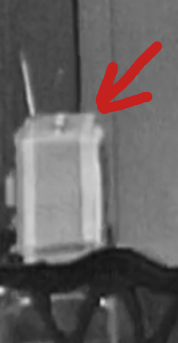

The shot goes on so long, and the set is such an odd thing to see in the context of the show, that they must be making some kind of point with it. We have wondered why Buffie submitted to Yaeger’s abuse, when she is such a strong and intelligent person. Her reflection in Nelle suggests a partial answer. Nelle was drawn to the Leviathans, who offered to destroy her and all other humans. We can assume that Buffie, too, was following a self-destructive urge when she went along with Yaeger. Associated with her, the television is a symbol of the annihilation of the self. Turn the idiot box on, turn your mind off. If you aren’t careful, you may even wind up spending your weekdays staring glassy-eyed at ABC’s daytime lineup.

*He actually says “Collinwood.” Which is a blooper, but since Buffie mentioned in her first episode that she used to work at Collinwood it is kind of an interesting one. Maybe when another Buffie left her position as an upstairs maid or whatever she was, she got further than the nearest tavern.
Episode 1006: The meaning of adventure

The show has been spending a lot of time lately trying to interest us in the ghost of Dameon Edwards, a man who doesn’t seem to have had much going for him even when he was alive. They went through the motions of a murder mystery concerning Dameon’s death. The episode that introduced him also hinted that he was killed by sleazy musician Bruno Hess with the complicity of butler Mr Trask, and those hints are confirmed today. So the mystery was never much of a puzzle. Besides, Bruno and Trask are the counterparts of homicidal villains whom we saw in the universe where Dark Shadows was set for its first 196 weeks, so we’ve expected all along that they would turn out to have someone’s blood on their hands. And neither of them is the central figure in an ongoing story, so even if they had been brought to justice for their crimes it would only be an easy way for the writers to dispose of characters who were going to be written out anyway.

Today, wicked witch Angelique finds Dameon’s skeleton sealed up in an alcove in the basement of the great house of Collinwood. She summons his ghost and dismisses him. That’s it for Dameon. What will happen to the skeleton, or to Bruno, or to Trask, or to the alcove, we don’t yet know.

The sight of the skeleton standing in the alcove does remind us of one of Trask’s alternate universe counterparts, a fanatical witchfinder who was sealed up in a basement alcove elsewhere on the estate in 1796. Since Trask is involved in this little arc, it’s a nice touch to connect it to that other Trask.

Most of the episode is devoted to a far more interesting story, an adaptation of Jekyll and Hyde. They’ve been focusing on the addiction angle. Mad scientist Cyrus Longworth is hooked on the potion that changes his appearance and allows him to fool even people who know him well into believing that he is a separate person by the name of John Yaeger. He enjoys the violence that he commits as Yaeger.

Today, three people try to save Cyrus from himself. Lawyer Larry Chase resists Cyrus’ instructions to transfer $5000 to Yaeger and to rewrite his willin Yaeher’s favor; chemist Horace Gladstone is reluctant to keep selling Cyrus a volatile synthesis he needs for the potion, and figures out that he and Yaeger are one and the same; and Buffie Harrington, who is exploring her masochistic side by submitting to beatings from Cyrus as Yaeger but still thinks the two are different people, goes to Cyrus to urge him to be more careful in his dealings with Yaeger. Dark Shadows has dealt intelligently and sensitively with the theme of addiction from its earliest days, and today’s focus on people who care about the addict trying to help him achieves a real poignancy.

We may wonder if drug abuse was a particularly timely topic behind the scenes of Dark Shadows at this point. Larry is a substitute for the character of Chris Collins, who was played by Don Briscoe. Briscoe would eventually be diagnosed with bipolar personality disorder, and in 1970 was trying to self-medicate with street drugs.

The makers of the show didn’t give up on Briscoe until the absolute last minute. This episode was taped very close to airtime, after episodes that would be broadcast weeks later were already in the can, giving Briscoe as much time as possible to get himself together. The part of Larry was played by Ken McEwen. McEwen joined the show in August 1968 as an associate director. He had a guild card due to small parts he had taken in a couple of TV shows in the 50s, but had never been an actor full-time. And he clearly hasn’t had much time to learn his dialogue. He is perfectly competent in the first of his two scenes, when Larry is in The Eagle tavern with Yaeger, Gladstone, and Buffie. There are no major bobbles and you can tell exactly what is on his mind. But when Larry returns and meets with Cyrus in his laboratory, McEwen stumbles over every line and never develops a coherent attitude.

The music is interesting today. The Eagle in the current universe corresponds to the Blue Whale, Collinsport’s tavern in the main continuity, and while we are there we hear the jukebox music that was prominent in the show’s first year. There is a scene between Gladstone and Buffie in her apartment; when that opens, we hear some music I don’t believe we’ve heard before. If they’ve written a theme for Buffie, it gives us hope we will see a lot more of Elizabeth Eis’ excellent performance in this role.

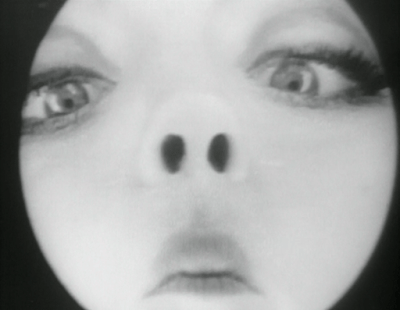
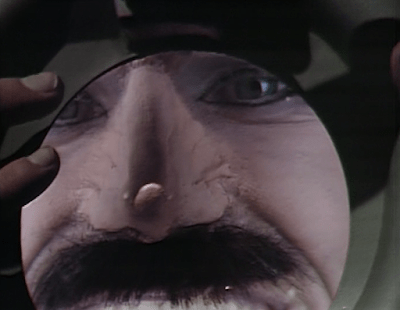
Buffie plays with the magnifier in Cyrus’ lab. Screenshot by Dark Shadows Before I Die.

The original videotape master of this episode was lost. We have it on a kinescope. I love the kinescopes; I wish all the episodes were available in that format, as well as the videotapes. We haven’t seen one since #813, and will see only one more, #1017. You can always set the options on your device to display in black and white, but the kinescope comes with some visual blurring and sound distortions. Those are usually flaws, of course, but when the show has already given you the feeling that you are catching a glimpse of another reality they can add to the eeriness and yearning for what might have been.

Episode 996: His divided nature

The first expert in forbidden lore to join the cast of characters on Dark Shadows was Dr Peter Guthrie of Dartmouth College, parapsychologist. Guthrie was chief scientific advisor to well-meaning governess Victoria Winters as she assembled the forces of good and led them in battle against undead blonde fire witch Laura Murdoch Collins. In #184, Guthrie confronted Laura. He told her that he had figured out she was “The Undead,” the first appearance of that expression on Dark Shadows. He also offered to help her if she would desist from her plan to murder her young son David. Guthrie was nervous about making this offer, apparently fearing Laura might draw him into her web of evil. He needn’t have worried about that- she responded, not by corrupting Guthrie, but by killing him.

The second such expert was a straightforward mad scientist. She was Julia Hoffman, MD, who in #291 offered to cure vampire Barnabas Collins of his curse. Though Julia made it a condition of her offer that Barnabas stop preying on the living, as Guthrie had conditioned his offer to Laura on her allowing David to live, we could already see that Julia was far more deeply compromised than Guthrie had been. She had learned of Barnabas’ existence while treating his victim, Maggie Evans, and she could gain the time to make her experiment work only by betraying Maggie’s trust and preventing her from regaining her memory of what Barnabas was and what he had done to her. Before long, Julia acquiesced to Barnabas’ pressure and joined him in murdering her old medical school classmate, Dr Dave Woodard. Eventually, she and Barnabas would become the parents of a Frankenstein’s monster named Adam. The shocking abuse they heaped on Adam in his infancy left no doubt that as a mad scientist, Julia is as much a symbol of extreme selfishness as is a vampire.

Adam was the product of an experiment designed by another mad scientist, Dr Eric Lang. Lang was even more flagrantly evil than Julia. When he needed a head for the monster, he tied his assistant down and set about cutting his head off. Granted, the assistant was a character played by Roger Davis, so the audience could see where Lang was coming from. In fact, the writers themselves eventually got so fed up with Mr Davis they cut the head off the final character he introduced. Still, Lang’s impatient response to the assistant’s complaints showed that he was utterly lacking in human compassion.

Now, we are in a different universe than the one where Dark Shadows spent its first 196 weeks. The resident mad scientist in this “Parallel Time” is Dr Cyrus Longworth. Cyrus has developed a potion that turns him into a real jerk. That may not sound like much of an achievement compared to building a Frankenstein’s monster or curing vampirism or whatever it was Guthrie wanted to do for Laura. But that’s to be expected. By the time Guthrie came to the great estate of Collinwood early in 1967, monsters and black magic and the like had been fixtures there for over 171 years. It appears that such things are relatively new to this version of Collinwood, so Cyrus is doing the sort of modest project that tends to characterize a field when it is first starting.

When Cyrus drinks his potion, his red hair turns black, he grows a lot more of it, and a putty appliance materializes, dangling precariously from the bridge of his nose. In this form, he calls himself “John Yaeger.”

That nose may not be made of Silly Putty, but it certainly isn’t a serious putty. Screenshot by Dark Shadows Before I Die.

As Yaeger, he goes to the Eagle, a tavern in the village of Collinsport, where barmaid Buffie Harrington is fending off the advances of her boyfriend Steve. Steve keeps coming up behind Buffie and grabbing her by the waist, a move that doesn’t leave a lot to the imagination. Buffie seems to be at once excited by Steve’s aggressiveness and irritated that he is keeping her from getting her work done. When Yaeger shows up and orders Steve to vacate the premises, Buffie’s evening goes from complicated to disastrous. The men fight, Steve loses, and Yaeger bodily ejects him from the tavern. Buffie confronts Yaeger about the wreck he has made of the place.

Later, Yaeger returns with a check to cover the damages. Buffie sees that the check is signed “Cyrus Longworth.” She explains that she used to work for the Collins family, and she knows who Cyrus is. She doesn’t believe that Cyrus would be friendly with Yaeger, and is sure he wouldn’t give him a check to cover the expenses he had incurred in a bar fight. Yaeger tells her the check is legitimate, and insists she keep quiet about his connection to Cyrus. He leaves.

Later, Quentin Collins finds the battered Steve and brings him into the tavern. Steve refuses to call the police, vowing to find Yaeger and settle the score himself. He leaves, and Quentin asks Buffie what she knows about the man who beat Steve. She says she doesn’t know much about him, but that a friend of Quentin’s does. She shows him the check with Cyrus’ signature. Perplexed, Quentin leaves.

Suddenly, Yaeger appears from nowhere. He tells Buffie that she promised not to tell of his connection to Cyrus. He starts choking her.

This is Elizabeth Eis’ first appearance as Buffie. Eis was on Dark Shadows once when it was set in the main continuity, playing Nelle Gunston, a devotee of a sinister cult who met Barnabas in the Blue Whale, a bar that corresponds to the Eagle in that universe. Barnabas killed Nelle before her only episode was over. It’s good to have Eis back, she was fun as Nelle and is a commanding presence today.

George Strus plays Steve, in his first and only role on the show. Strus was primarily a stunt performer, but he had lines in a few productions, most notably as a tough in Shaft. His last imdb credit was as a stunt performer in Spike Lee’s Malcolm X, made in 1991, twenty years after Shaft. Steve is supposed to be a big dumb galoot, and Strus pulls that off satisfactorily.

Christopher Pennock’s name appears in the closing credits for the role of Cyrus. He is credited as “Chris Pennock” for Yaeger, adorably enough.

Episode 991: It wasn’t all mushy

In December 1966 and January 1967, strange and troubled boy David Collins was unwilling to believe that a woman who had come to the estate of Collinwood was his long-absent mother, Laura Murdoch Collins. He had troubling dreams about her. In #150, we saw him asleep in his bed when Laura appeared in the corner of his room. He opened his eyes and looked at her while she made a speech. This is not generally considered a dream sequence, since David appears to wake up at the beginning of it. But Laura turns out to be a humanoid Phoenix. The Phoenix is a creature first described in the Histories of Herodotus. As is typical in ancient Greek literature, all dreams in Herodotus take the form of a person materializing at the foot of the dreamer’s bed and delivering a speech while the dreamer appears to be awake. So I think we have to consider that the first dream sequence dramatized on Dark Shadows.

Laura appears in David’s room, #150.

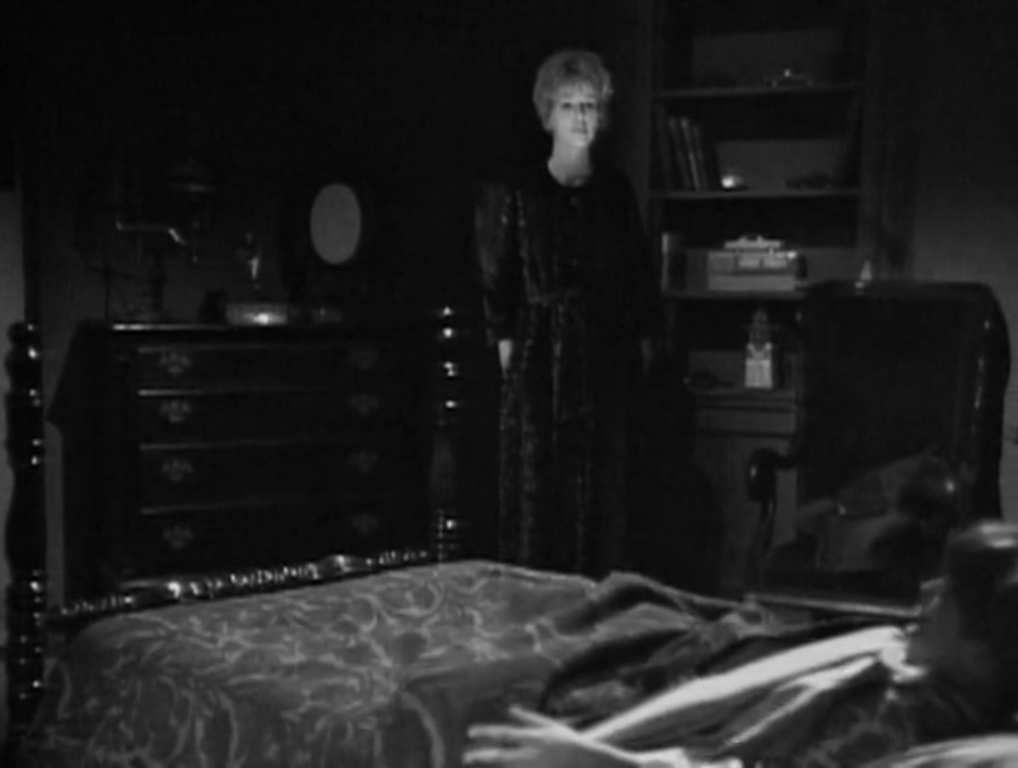
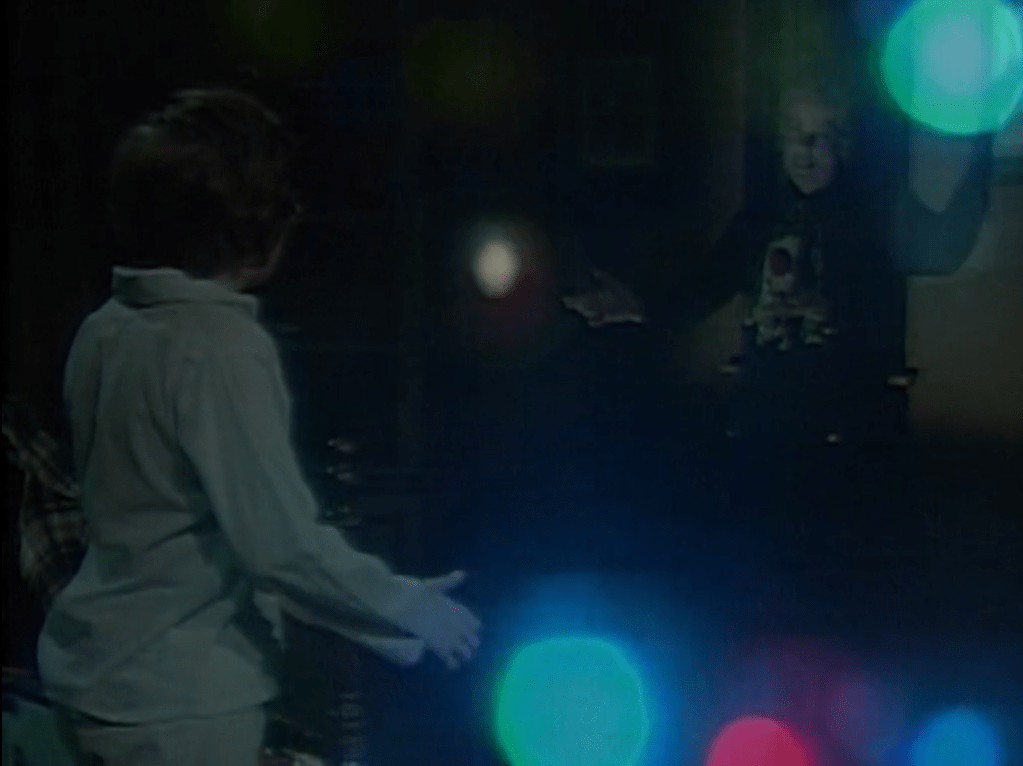
Now, we have crossed over into an alternate universe, which the show insists on calling “Parallel Time.” David’s counterpart is strange and troubled teenager Daniel Collins. Daniel is unwilling to believe that a woman who has come to the estate of Collinwood is not his late mother, Angelique Stokes Collins. We see him asleep in his bedroom. As Daniel’s problem is the mirror image of David’s, so his room is the mirror image of David’s. Daniel’s bed is at stage right while David’s is at stage left on the same set. Daniel has a troubling dream in which Angelique appears to him. Dark Shadows is a lot more definite now than it was in its first year, so they have a special effect to show that even though Daniel is opening his eyes and getting out of bed, it is still a dream sequence. It is 1970, so that special effect is a disco glitter ball throwing colored lights.

Daniel thrashes about in bed, and the visitor, who has been patiently trying to explain to everyone that she is Angelique’s identical twin sister Alexis, comes rushing in. Daniel awakes, and asks her to promise to tell him the truth. He in turn promises to keep her secret. He asks her if she is his mother. She is silent, apparently stunned by the question. At that moment, Daniel’s father Quentin appears in the doorway.

Laura turned out to be an undead blonde fire witch come to burn David alive that she might renew her own unnatural existence. Angelique’s counterpart in the main continuity is also an undead blonde fire witch, and for a time she was David’s stepmother and represented a considerable danger to him. So regular viewers will understand Daniel’s confusion.

There is a scene today in the tavern in the village of Collinsport. In the main continuity, this tavern was called the Eagle in the eighteenth and nineteenth centuries, but the Blue Whale in the twentieth. In this universe, it is still called the Eagle. The bartender in the Blue Whale is usually played by Bob O’Connell. The bartender in the Eagle today is played by Kenneth McMillan. McMillan was a very distinguished actor and does a fine job telling a long story, but Bob O’Connell is a favorite of longtime viewers and I think we are all disappointed we didn’t get another chance to see him.

Episode 982: Keep the bottle full

In #210, dangerously unstable ruffian Willie Loomis found a coffin wrapped in chains in an old mausoleum and jumped to the conclusion that it was full of jewels. He broke the chains and opened the coffin, only to find that it actually contained vampire Barnabas Collins. Barnabas bit Willie and enslaved him.

Now, Barnabas has traveled to an alternate universe. In this “Parallel Time,” Willie’s counterpart is a writer, the author of several novels and of a biography of Barnabas’ own counterpart, who died a natural death in 1830. This Will Loomis lives in the Old House on the estate of Collinwood, which corresponds to Barnabas’ home in his own universe. Will’s wife, the former Carolyn Collins Stoddard, was the first person Barnabas met upon arriving in Parallel Time. Barnabas took Carolyn as his blood thrall, and he has shown her a room in the basement of the Old House that she never knew existed. He stashed a coffin there.

Three of Will’s novels were bestsellers made into feature films, but he and Carolyn are now acutely short of funds. We see why today. Carolyn explains to Barnabas that Will won’t be home until the Eagle closes. Barnabas asks what the Eagle is. He should know- that was the name of the tavern in his Collinsport in the 1790s and again in 1897, and he knew it in both eras. The same place was called the Blue Whale in the 1960s in the main continuity, but evidently it kept its old name here.

Will comes staggering home. He recognizes Barnabas’ profile from a sketch of the subject of the biography he wrote. Carolyn explains that Barnabas is that man’s descendant. When Barnabas says that he read Will’s book and admires it, Will brightens, as authors do, and says that the occasion calls for a drink. At first he insists on putting Barnabas up as a houseguest, free of charge, but Carolyn persuades him to let Barnabas pay rent. It’s anyone’s guess how Barnabas will be paying for anything- he stumbled into “Parallel Time” quite inadvertently, without stuffing his pockets or putting on a money belt or making any other preparations. But Will and Carolyn have an extensive discussion about charging Barnabas rent in this scene, and they bring it up again later. Evidently the writers want us to think about it.

The next day, Will suggests that he and Carolyn go to the great house on the estate to meet the new mistress, the bride of Carolyn’s uncle Quentin. Carolyn pleads a migraine, and Will goes by himself. Housekeeper Julia Hoffman is about to introduce him when he cuts her off. He tells the new Mrs Collins that he knew her father. She is the former Maggie Evans. The past tense about her father Sam is news to returning viewers- yesterday Sam was mentioned in terms that left it unclear whether he was still alive, and we might have hoped to see him. In the main continuity, Sam was killed by a Frankenstein’s monster in June 1968, but that monster would not have existed in this universe.

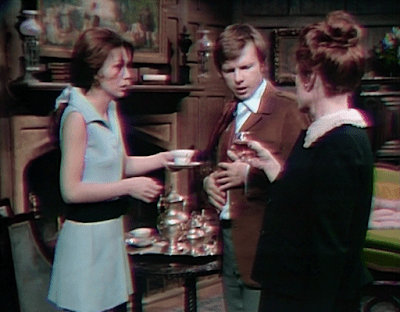
Will says that he and Sam spent many a night drinking together at the Eagle. The new Mrs Collins is not visibly pleased to be reminded of her father’s drinking habit. She offers Will a cup of tea, and he refuses. He avers that tannic acid is bad for the health. Hoffman is at hand with a glass of brandy, and she chuckles when she agrees with him that she can tell Maggie his views about beverages. Hoffman leaves, and Will urgently whispers to Maggie that he must not trust Hoffman.

Will does not approve of tannic acid. Screenshot by Dark Shadows Before I Die.

Later, Maggie will go to Angelique’s old room in the east wing of the house and overhear Hoffman telling the portrait of Angelique that hangs there that she has her on the run. Hoffman cackles with glee at Maggie’s discomfort. Maggie opens the door and asks her what’s going on; Hoffman quickly composes herself and says that the staff hasn’t had a chance to tidy up the east wing sufficiently to welcome the new mistress.

Back in the Old House, Will wonders why Carolyn seems so weak. She passes out, and he sees the puncture wounds on her neck. At daybreak, Will waiting for Barnabas by the coffin. He holds him at bay with a large cross and forces him to explain who he is and where he came from. Barnabas tells Will to let him die. Will says he has other plans. He orders Barnabas to open the coffin. There is an even larger cross mounted inside the lid. He says that he will get a book out of Barnabas, and that that book will be his salvation. He makes Barnabas get in the coffin, and chains it shut. To the extent that this universe is a mirror image of the one we have known, we might have expected that Will would believe he could obtain a fortune by putting chains on the coffin, as Willie thought he could obtain one by smashing them off.

The scene between Will and Maggie brings out several of the problems with the current A story, a reworking of Daphne Du Maurier’s Rebecca in which Maggie is the second Mrs de Winter and Hoffman is Mrs Danvers. Maggie Prime has an iconography that goes back to #1, which makes it hard for us to believe that would be overwhelmed by the subtle intimidations that overwhelm Du Maurier’s anxiety-ridden heroine. When we met the Sam of the original continuity in June 1966, he was an alcoholic. Even after the story that was supposed to make Sam’s alcoholism interesting fizzled out and he was retconned as a social drinker, Maggie retained many Adult Child of an Alcoholic traits, such as beginning each utterance with an irrelevant laugh. So Maggie’s reaction to Will’s reminiscence about boozing it up with Parallel Sam goes a long way to confirming that this is the same ol’ Maggie we’ve known all along and leads us to expect her to be as capable as Maggie would be of meeting the challenges before her.

Also, while Kathryn Leigh Scott is a wonderful actress and a great asset to the show, she makes a bad choice in playing Maggie Collins. In the costume drama segment set in 1897, Miss Scott started out as neurotic intellectual Rachel Drummond. Rachel was terribly fragile, the survivor of an abusive childhood that left her with paralyzingly low self-esteem. Miss Scott went small as Rachel, taking a subtle approach that required us to watch her closely as we tried to figure out what she was feeling and thinking. But as Maggie Collins, Miss Scott cycles through five or six facial expressions per minute and crafts a distinctive emphasis on multiple syllables per sentence. The directors famously didn’t give the actors much guidance on Dark Shadows– John Karlen said that when he first took on the role of Willie, all Lela Swift told him was “Go!” But either Swift or today’s helmsman, Henry Kaplan, should have taken Miss Scott aside and told her she was overacting and giving Maggie Collins too vivid a personality.

Further, Will is only one of many allies who present themselves to Maggie in her showdown with the memory of Quentin’s first wife, the glamorous Angelique. The second Mrs de Winter feels herself all alone at the estate of Manderley, but Maggie can’t very well feel that way at Collinwood. Not only do people who live there keep making it clear they are on her side, she has a sister to whom she starts writing a letter today, who represents support from and connection with the outside world.

Worst of all, Hoffman is absolutely transparent. In the novel, it is not clear until the very end whether Mrs Danvers is even hostile to the second Mrs de Winter. Du Maurier keeps us guessing for 400 pages whether the whole thing is in the protagonist’s fevered imagination. But the cackling Maggie overhears when Hoffman is having her conversation with the portrait is not even the most flagrant sign she has so far given of her plans.

I outlined these and other objections in a long comment on Danny Horn’s post about this episode on his great Dark Shadows Every Day in January 2021. I still agree with most of what I wrote there, and will be coming back to the topic many times over the next few months.