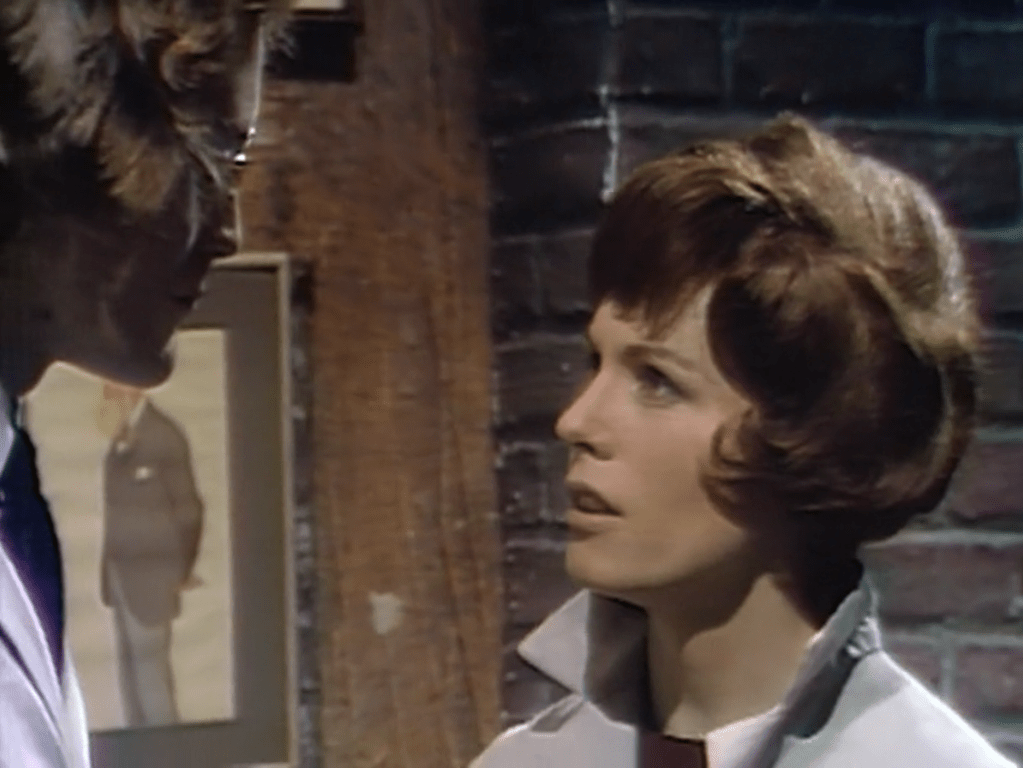
Episode 1009: Remember the dead

The Graves of All Those Who Once Lived Here

The name “Barnabas Collins” has been coming up in the oddest circumstances around the estate of Collinwood. The only person of that name known to drunken sourpuss Quentin Collins, the master of the great house, was an ancestor of his who lived a long dull life and died a natural death in 1830. Quentin has decided that it is time to ask Barnabas’ spirit what’s going on. He wants housekeeper Julia Hoffman to join him and his late wife Angelique’s identical twin sister, Alexis Stokes, in a séance.

Hoffman is reluctant to participate, and when the invocation prompts theremin music to start playing in the background she breaks the circle of fingers and runs out of the drawing room. But Hoffman is not the most problematic participant. Alexis is not in fact present. Angelique returned from the dead, murdered her, and took her place. Unknown to Hoffman or to Quentin, it is the undead Angelique who is at the table with them.

“Alexis” tells Quentin that she felt a presence before Hoffman broke the circle, but that it is gone now. Suddenly a figure appears in the corner of the room. He identifies himself as the ghost of Joshua Collins, father of Barnabas. Joshua addresses his remarks to Quentin, ignoring “Alexis.” He says that Quentin knows all he needs to know about his son Barnabas, but that there is another entity at Collinwood, an evil that is at once living and dead. “Alexis” looks shocked and says “Living and dead? How can that be possible?” I suppose we should praise Lara Parker for resisting the temptation to pad her part by visibly squirming and playing up the fact that this describes her character precisely. She is giving the audience credit for the brains needed to make that connection. But if I wanted a show that gave me credit for brains, I wouldn’t watch Dark Shadows every evening, so I’m disappointed. I wish she were tugging on her collar and fidgeting like a Hank Azaria character on The Simpsons.

Joshua can’t be any more specific. This might have been OK had he just flickered into view for a few seconds, uttered his vague warning, and flickered out. We would then be left thinking of the awe-inspiring improbability of even the most fleeting communication between the living and the dead. But as Joshua, Louis Edmonds stands there for several minutes, in the same light as the other actors. They’ve had trouble with one of the microphones lately, occasionally making one actor sound like they are far away from the person standing next to them, but that microphone isn’t used in this scene. Both the audio and the video make it clear Joshua is occupying the same space as Quentin and “Alexis.” The result is an embarrassment for which writer Gordon Russell and director Henry Kaplan must share the blame.

This embarrassment is particularly disappointing under the circumstances. The scene is Edmonds’ first appearance since going off to play his part in the feature House of Dark Shadows after #990, and the first appearance of this Joshua Collins. Edmonds played another version of Joshua from November 1967 to March 1968, when Dark Shadows was set in a different universe. That Joshua figured in a costume drama segment set in the 1790s. He emerged as the central figure in a tragedy in the course of which his son Barnabas became a vampire and he had to decide what to do about him.

This Joshua never dealt with such a curse. The audience knows, if only because the opening voiceover told us, that the vampire Barnabas has crossed over into this universe, into this year 1970, and that he is at present trapped in a chained coffin in the basement of the home where the Joshua we meet today raised that other, luckier Barnabas. We last saw the other Joshua in #623, and longtime viewers will be excited at the idea of seeing Edmonds reprise the character who was perhaps his greatest triumph. To see him in such a debacle lets us down hard.

After Joshua leaves, Quentin and “Alexis” talk for a moment. Then Quentin’s brother Roger enters. Roger is also played by Louis Edmonds, but neither Quentin nor “Alexis” notices that he looks like Joshua. This works well enough, since Edmonds takes a very different posture and tone as Roger than he had as Joshua. Joshua was erect and stentorian, Roger curls to his left as he sits on the couch and purrs about how tedious it is to read about the life of the late Barnabas.

Quentin exits, and Roger talks with “Alexis.” He says that despite her resemblance to her sister, he never for a moment thought she was Angelique. In fact, when he first met the real Alexis he was utterly shocked, certain she was Angelique, and she had to work hard to bring him around. But Angelique doesn’t know about that, and Roger doesn’t want to remember it, so she just looks at him placidly while he goes on and on about how unlike anyone else Angelique was and how he knew her more intimately than anyone else could, even though she was married to Quentin.

I suppose Russell may have been trying to make a point by juxtaposing Joshua’s long pointless speech in which he keeps referring to Quentin’s responsibilities as the master of Collinwood with Roger’s long pointless speech in which he keeps referring to his mystical connection with his brother’s late wife. We saw in the 1790s segment that the Joshua of the other continuity was the victim of his own virtues. A forceful, dynamic man devoted to his family and its honor, he became a tyrant in pursuit of his worthy goals, and saw everyone he loved destroyed in part because of his haughtiness. As generation followed generation, Joshua’s misguided strength and brittle courage would yield to ever weaker, ever-softer descendants. Perhaps in the contrast between this Joshua’s attempt to help his successor use the authority he once held when he cannot impart any useful information and Roger’s fatuous pretense to have known Angelique uniquely well when he cannot recognize that he is talking to her we can see the same decline in this iteration of the Collins family.

The Legal Eagle

Meanwhile, mad scientist Cyrus Longworth has a problem of his own. Cyrus has developed a potion which, when he drinks it, transforms his appearance so drastically that even those closest to him cannot recognize him. When thus disguised, he calls himself “John Yaeger,” spends a lot of money, and beats people up. This makes him very happy, but now chemist Horace Gladstone, his connection for one of the potion’s vital ingredients, has learned his secret. Gladstone will not supply him with more of the ingredient or keep his mouth shut about Cyrus’ crimes unless he gets $10,000 in cash.

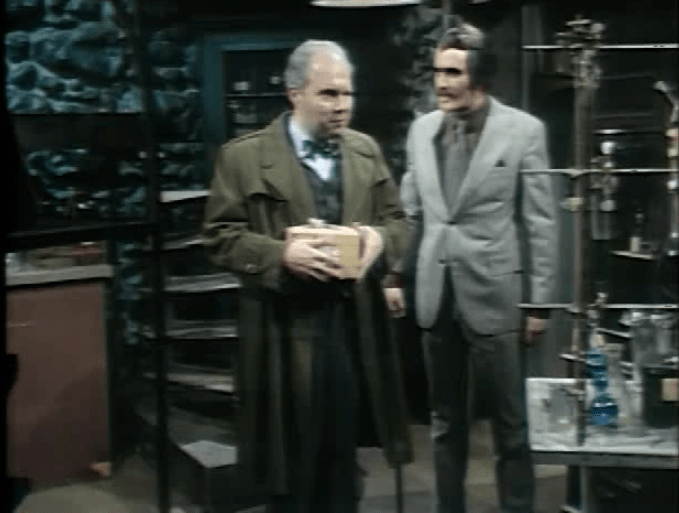
Cyrus’ lawyer, Larry Chase, comes to his laboratory. On Cyrus’ instructions, Larry has drawn up a will naming “Yaeger” as the sole beneficiary of Cyrus’ estate. Larry has met “Yaeger” and been appalled by him. He urges Cyrus to reconsider. Cyrus signs the papers and invites Larry to a late supper. Larry declines, saying that Horace Gladstone called him earlier and wants to meet him outside the Eagle tavern at 10 PM.

Larry was in the drawing room at Collinwood going over some papers with Quentin when he got Gladstone’s call. Cyrus’ newly drafted will fell out of Larry’s briefcase, and Quentin read through it while Larry was looking for another document. Quentin asked some questions about the will. Larry responded to the first by saying that he couldn’t talk about it, but thereafter blabbed away, revealing everything Quentin could want to know. With that level of regard for a client’s confidential communications, we aren’t surprised when Larry tells Cyrus who he is going to meet at what time in what place.

After Larry goes, Cyrus takes the potion, that is, puts on his disguise. He goes to the alley next to the Eagle, in which the sign for the Greenfield Inn hangs. He corners Gladstone there. He beats Gladstone to the pavement with his heavy cane. Gladstone begs for mercy, and Cyrus sneers at him. He releases the bayonet from inside the cane, stabbing Gladstone with it. The first time Cyrus took the potion, he had amnesia after he resumed his normal appearance, and we could believe that he was less than fully responsible for what he did while under its influence. But he has had his full memories on each subsequent occasion, and has shown pleasure when told of the harm “Yaeger” has done and the fear he inspires. By this point, we can classify Cyrus’ killing of Gladstone as nothing other than premeditated murder.

Cyrus doesn’t really surprise us by this act. It is Larry who does something we would not have expected. While Gladstone is in the alley, Larry is already in front of the tavern. We see enough of the set that we cannot believe he is more than 30 or 40 feet away from Gladstone, just around the corner. Gladstone cries out when “Yaeger” attacks him. We cut to Larry, and see him react to that cry and start towards the alley. “Yaeger” stands over Gladstone and pontificates for a minute or two before stabbing him. Even after that, “Yaeger” still has time to get most of the way out of the alley before Larry finally arrives. It took Joshua Collins less time to get from the abode of the dead to the drawing room at Collinwood than it takes Larry to walk the few steps from the sidewalk to the alley. Maybe he had to stop somewhere along the way to make some more announcements about a client’s business.
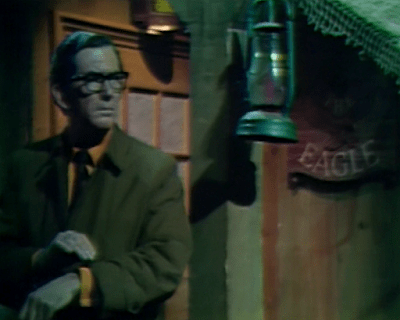
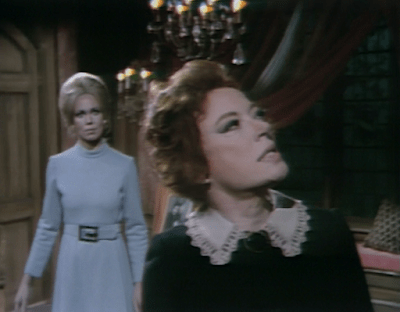
Larry hears a cry for help. Screenshot by Dark Shadows Before I Die.

Episode 1007: Accumulating guilts

Chemist Horace Gladstone has been selling a strange and powerful synthesis of his own invention to Cyrus Longworth, an independent medical researcher. Cyrus refuses to tell Gladstone what he is using the synthesis for. Gladstone has now figured it out for himself. Cyrus has concocted a potion which he drinks to change his appearance, disguising him so effectively that even the people who know him best do not recognize him. In that disguise, Cyrus calls himself “John Yaeger,” spends a lot of money, and indulges his sadistic impulses.

Gladstone comes to Cyrus’ lab and tells him what he knows. Cyrus tries to deny that he is Yaeger, and Gladstone lists the evidence he has collected proving that he is. Gladstone tells Cyrus that he doesn’t believe he can do without the thrills he gets from his activities as Yaeger. The story has been crafted as an account of addiction, so returning viewers are sure Gladstone is right. He says he will go on serving as Cyrus’ connection for the drug he craves, but the price has gone up. He demands $10,000.

Cyrus first learned Gladstone’s name from his late friend Angelique Stokes Collins. Angelique was a woman of vast learning in a variety of fields, much like the title character in Edgar Allan Poe’s story “Ligeia.” Also like Ligeia, Angelique has returned from the dead. She is now back in the great house of Collinwood, impersonating the identical twin sister whom she murdered on the night of her resurrection, and occupying her old room as the guest of her widower, drunken sourpuss Quentin Collins.

Cyrus calls Gladstone a blackmailer. In reply, Gladstone makes a cryptic remark: “Why do you think my number was in Angelique Collins’ phone book? She’s led many lives. Each person only gets one. Good night.” We have indeed been wondering how Angelique came to know Gladstone, and now we wonder if he is aware of just how literally true it is that “She’s led many lives.” It doesn’t make any sense to follow “She’s led many lives” with “Each person only gets one,” but actor John Harkins was so precise in his delivery that I’m sure that was the scripted line. If there was a slip, it came from Sam Hall’s typewriter, not from Harkins’ tongue.

If it isn’t a slip, I think we would have to go out on a limb to explain what Gladstone could mean. Angelique built up a cult around herself, including several people who were firmly convinced that she was going to rise from the dead. When her sister Alexis came to Collinwood, housekeeper Julia Hoffman, sleazy musician Bruno Hess, and Angelique and Quentin’s son Daniel were certain that the prophecy had been fulfilled and they were seeing Angelique redivivus. This was also the first thought that came to Cyrus, to Quentin’s brother Roger, and to Angelique’s Aunt Hannah, though they were more easily persuaded that Alexis was a separate person. The cultists are impressive enough in their certainty that even people outside their ranks were sure Alexis was Angelique returned from the grave. Daniel’s cousin and playmate Amy Collins was horrified to see her for that reason, and Quentin’s second wife, the former Maggie Evans, fled the house in part because she could not shake her belief that Alexis was Angelique.

If Gladstone is familiar with Angelique’s cult and has been involved with it, he might be saying that each person gets to participate in only one of Angelique’s lives. We’ve already seen that is not the case, but that doesn’t mean he doesn’t think it is. Angelique may at some point have taught her followers a doctrine like that. While Hoffman, Bruno, and Daniel expected Angelique to come back and rejoin them, Cyrus, Roger, and Hannah were unsure they would see her again, even though they were certain that she was not simply dead. Indeed, Angelique is still telling her most of her devotees that she is Alexis. The only one to whom she has fully revealed herself is Hannah. Perhaps she had a plan to transcend death, but did not know just how it would work. Or perhaps she has decided the rest are not yet ready to be initiated into the esoteric truth of her return.

Sam Hall was a serious Lutheran, so much so that he insisted Shirley Grossman convert from Judaism before she married him and became Grayson Hall. Christian studies in twentieth century academic institutions were largely taken up with speculation about differences of opinion in the church before the codification of the New Testament and the formulation of the creeds. This sort of thing is still prominent in divinity schools today, and is often heard from pulpits in mainline Protestant denominations. Hall must have been familiar with it, so he probably gave it some thought when he spent Easter season 1970 writing scripts about a figure whose followers sort of expected her to rise from the dead and who surprised them by the way in which she actually did so. I doubt he was making any particular point about the various schools of thought that seminary professors postulate in the primitive church, but when he presents Angelique’s cult as divided into several strains of opinion from the start he is developing an idea that he did not have to invent himself.

We cut from the scene between Cyrus and Gladstone to the basement of Collinwood. Angelique leads Quentin to a little chamber hidden behind an alcove. A human skeleton stands in the chamber. You may wonder how a skeleton can stand, but Quentin doesn’t. He is too busy being surprised that he didn’t realize this chamber was in his basement.

The skeleton is that of Dameon Edwards, a friend of Angelique’s who went missing about a year before. Dameon’s ghost has been haunting the place for a couple of weeks. Angelique tells Quentin that Hannah found the skeleton and exorcised the ghost. Yesterday, we saw Angelique exorcise the ghost. Returning viewers know that she is giving credit to Hannah because she is masquerading as Alexis, who did not share her sister’s interest in the occult or her aunt’s. Quentin thinks that Bruno probably killed Dameon. Indeed, the ghost confirmed this yesterday. Quentin very much wants to get rid of Bruno, so you might think he would be interested in bringing a murder charge against him. But he decides that would be too much trouble, and it hurts his feelings when “Alexis” snaps at him that he shouldn’t be wasting his time reporting Dameon’s murder when he isn’t doing anything to investigate Angelique’s. So he calls Cyrus, and the two of them bury the bones on the grounds of the estate.

Meanwhile, two long-absent characters have returned from trips out of town. Quentin sent Hoffman to visit friends of hers in Boston because she kept antagonizing Maggie. Quentin’s sister Elizabeth Collins Stoddard also went away for a long stay in New York, where she visited Maggie. In off-screen reality, Grayson Hall and Joan Bennett were both in Tarrytown, New York with several other cast members, working on the feature film House of Dark Shadows. Liz complains that Hoffman didn’t meet her at the train station with a car, and Hoffman explains that she just got back herself.

Hoffman says she missed Collinwood terribly while she was in Boston; Liz says she can’t understand that. If she were in Quentin’s place, she would sell the house and move to the city. That will interest longtime viewers. For its first 196 weeks, Dark Shadows was set in a parallel universe, where Liz’ counterpart owned Collinwood. When the show started, she was a recluse who hadn’t left the house for eighteen years. Her brother Roger often urged her to sell the place so that they could live someplace less gloomy, but even after she stopped being a recluse Liz wouldn’t hear of that. She was a symbol of the family’s commitment to the house. We have already seen that this Liz is the opposite of her counterpart in other ways, and now we wonder how far they will take that mirror image motif.

Angelique is in the foyer, talking on the telephone to Hannah. Villains on Dark Shadows have remarkably little sense of OpSec, and this is a case in point. Quentin, Liz, and Hoffman are a few feet away from her in the drawing room, and each of them knows that Alexis and Hannah couldn’t stand each other. All Angelique has to do is call Hannah by name and she will raise their suspicions. Yet not only does she use Hannah’s name several times, she uses one incriminating expression after another about how no one will suspect what they are up to. If any of them listens in, or of anyone else in the house happens by on their way to the front door, Angelique will have tipped her hand.

It is Hoffman who eavesdrops on the call. After Angelique catches her, they have an awkward exchange and Hoffman goes upstairs. Angelique then stands at the door to the drawing room and eavesdrops on a conversation between Liz and Quentin. Liz wants Quentin to go to New York and ask Maggie to come home, he throws a tantrum and says that Maggie is too childish for him to do such a thing.

Hoffman is in Angelique’s old room, talking to the portrait of her that hangs there. The members of Angelique’s cult make a practice of coming to the room and carrying on conversations with the portrait; when Alexis was staying in the room, she sometimes walked in on them while they were confiding their thoughts to it. Angelique eavesdrops on the last part of Hoffman’s account that when she was in Boston, she felt a mystic assurance that when she returned to Collinwood she would find Angelique come back to life. When Hoffman says that everything seems to be the same as it was when she left, she is close to tears.

The resurrected Angelique eavesdrops on Hoffman’s conversation with the dead Angelique. Screenshot by Dark Shadows Before I Die.

Angelique takes a step forward, and Hoffman realizes she is not alone with the portrait. She apologizes to “Alexis,” and Angelique says she needs a friend she can trust. Hoffman claims to be such a friend. “Alexis” then launches into her reasons for believing that Angelique was murdered. After the first couple of sentences, returning viewers know what she is going to say, so we dissolve to Quentin and Cyrus in the drawing room.

Quentin and Cyrus have just buried the skeleton, prompting Quentin to feel sorry for himself. He then tries to explain to Cyrus something extremely weird he saw the other evening. He went to Angelique’s old room to see Alexis. He opened the door, and saw a space that lacked the room’s furniture, lights, and decor. He saw two children whom he took to be Daniel and Amy, and they said something about Barnabas Collins. The only person of that name of whom Quentin or Cyrus is aware died in 1830, but the children were talking about someone they knew. An invisible barrier kept Quentin from entering the room, and he could not attract the children’s attention. Regular viewers know that Quentin was catching a glimpse of the other continuity, and that the children were not Daniel and Amy Collins, but their counterparts David Collins and Amy Jennings. Cyrus hasn’t been watching the show, so all he can do is suggest Quentin take a vacation.

They’ve been experimenting with videotape editing, and they make a jump cut from the drawing room scene with Quentin and Cyrus to Quentin walking up to the doors of Angelique’s room. The effect is startling, I suspect intentionally so. Quentin opens the doors, and again sees the other universe.

This time Quentin sees the counterparts of Liz and Hoffman. As David and Amy had been, they are talking about Barnabas, who was last seen in this room. Hoffman, whom Liz addresses as Julia, says that they must keep the room open so that Barnabas will have a chance to return to them. She says she wants to stay there, because it makes her feel close to Barnabas. Liz excuses herself, and Julia calls out to Barnabas. As Hoffman had grown emotional talking to the Angelique whom she believed to be absent, Julia grows emotional when she talks to the missing Barnabas. She looks at the hallway, seeing not Quentin but the dark, empty space that is there in her universe. She asks if Barnabas is there, watching her. Grayson Hall plays these two scenes so similarly that we can have no doubt that whatever the one Julia Hoffman feels for Barnabas, the other feels for Angelique.

Quentin calls out to Hoffman’s counterpart, as he had called to Daniel and Amy’s counterparts. As the children had been unaware of his presence, so this other Julia Hoffman is unaware of him. And as Daniel and Amy had come to the hallway and asked why he was shouting for them, Hoffman comes to the hallway and asks why he is shouting for her.

Episode 1006: The meaning of adventure

The show has been spending a lot of time lately trying to interest us in the ghost of Dameon Edwards, a man who doesn’t seem to have had much going for him even when he was alive. They went through the motions of a murder mystery concerning Dameon’s death. The episode that introduced him also hinted that he was killed by sleazy musician Bruno Hess with the complicity of butler Mr Trask, and those hints are confirmed today. So the mystery was never much of a puzzle. Besides, Bruno and Trask are the counterparts of homicidal villains whom we saw in the universe where Dark Shadows was set for its first 196 weeks, so we’ve expected all along that they would turn out to have someone’s blood on their hands. And neither of them is the central figure in an ongoing story, so even if they had been brought to justice for their crimes it would only be an easy way for the writers to dispose of characters who were going to be written out anyway.

Today, wicked witch Angelique finds Dameon’s skeleton sealed up in an alcove in the basement of the great house of Collinwood. She summons his ghost and dismisses him. That’s it for Dameon. What will happen to the skeleton, or to Bruno, or to Trask, or to the alcove, we don’t yet know.

The sight of the skeleton standing in the alcove does remind us of one of Trask’s alternate universe counterparts, a fanatical witchfinder who was sealed up in a basement alcove elsewhere on the estate in 1796. Since Trask is involved in this little arc, it’s a nice touch to connect it to that other Trask.

Most of the episode is devoted to a far more interesting story, an adaptation of Jekyll and Hyde. They’ve been focusing on the addiction angle. Mad scientist Cyrus Longworth is hooked on the potion that changes his appearance and allows him to fool even people who know him well into believing that he is a separate person by the name of John Yaeger. He enjoys the violence that he commits as Yaeger.

Today, three people try to save Cyrus from himself. Lawyer Larry Chase resists Cyrus’ instructions to transfer $5000 to Yaeger and to rewrite his willin Yaeher’s favor; chemist Horace Gladstone is reluctant to keep selling Cyrus a volatile synthesis he needs for the potion, and figures out that he and Yaeger are one and the same; and Buffie Harrington, who is exploring her masochistic side by submitting to beatings from Cyrus as Yaeger but still thinks the two are different people, goes to Cyrus to urge him to be more careful in his dealings with Yaeger. Dark Shadows has dealt intelligently and sensitively with the theme of addiction from its earliest days, and today’s focus on people who care about the addict trying to help him achieves a real poignancy.

We may wonder if drug abuse was a particularly timely topic behind the scenes of Dark Shadows at this point. Larry is a substitute for the character of Chris Collins, who was played by Don Briscoe. Briscoe would eventually be diagnosed with bipolar personality disorder, and in 1970 was trying to self-medicate with street drugs.

The makers of the show didn’t give up on Briscoe until the absolute last minute. This episode was taped very close to airtime, after episodes that would be broadcast weeks later were already in the can, giving Briscoe as much time as possible to get himself together. The part of Larry was played by Ken McEwen. McEwen joined the show in August 1968 as an associate director. He had a guild card due to small parts he had taken in a couple of TV shows in the 50s, but had never been an actor full-time. And he clearly hasn’t had much time to learn his dialogue. He is perfectly competent in the first of his two scenes, when Larry is in The Eagle tavern with Yaeger, Gladstone, and Buffie. There are no major bobbles and you can tell exactly what is on his mind. But when Larry returns and meets with Cyrus in his laboratory, McEwen stumbles over every line and never develops a coherent attitude.

The music is interesting today. The Eagle in the current universe corresponds to the Blue Whale, Collinsport’s tavern in the main continuity, and while we are there we hear the jukebox music that was prominent in the show’s first year. There is a scene between Gladstone and Buffie in her apartment; when that opens, we hear some music I don’t believe we’ve heard before. If they’ve written a theme for Buffie, it gives us hope we will see a lot more of Elizabeth Eis’ excellent performance in this role.

Buffie plays with the magnifier in Cyrus’ lab. Screenshot by Dark Shadows Before I Die.

The original videotape master of this episode was lost. We have it on a kinescope. I love the kinescopes; I wish all the episodes were available in that format, as well as the videotapes. We haven’t seen one since #813, and will see only one more, #1017. You can always set the options on your device to display in black and white, but the kinescope comes with some visual blurring and sound distortions. Those are usually flaws, of course, but when the show has already given you the feeling that you are catching a glimpse of another reality they can add to the eeriness and yearning for what might have been.

Episode 1005: No danger, just a lot of confusion

For five weeks, Dark Shadows has been set in a universe parallel to the one where the first 196 weeks took place. So far, “Parallel Time” has recapitulated the early development of the show. As the series began with an attempt to televise the atmosphere that made “Gothic romances” a best-selling genre of the mid-1960s, so the segment began with an adaptation of Daphne Du Maurier’s Rebecca, one of the basic texts of that genre. As it proceeded to the story of the return of undead blonde fire witch Laura Murdoch Collins, mother of strange and troubled boy David Collins (David Henesy,) the segment has proceeded to the return of undead blonde fire witch Angelique Stokes Collins, mother of strange and troubled teen Daniel Collins (David Henesy.)

Between the early Gothic romance period and the Laura story, the show was a whodunit about the death of local man Bill Malloy. Bill would eventually become the first ghost to appear to another character on-screen on Dark Shadows. And throughout the first year, there was a lot of noise about a locked room in the basement of the great house of Collinwood where reclusive matriarch Elizabeth Collins Stoddard believed her husband Paul’s body was buried. Parallel Time got around to an analogue for these two stories with the abrupt introduction of the ghost of Dameon Edwards in #994. Since then, various characters have been wondering who killed Dameon. Today, it is confirmed that Dameon’s body, unlike Paul’s, really was buried in an alcove in Collinwood’s basement.

As Daniel’s room is laid out as a mirror image of David’s, the basement in this Collinwood is laid out as a mirror image of the one in the original continuity. The alcove is on the opposite side of the set than was the locked room. Since we haven’t seen the basement since #273, this resonance is likely to be wasted on everyone except weirdos watching the show on a streaming service and writing several hundred words about each episode.

Even people like that aren’t likely to be much invested in Dameon. If the ghost of Paul’s counterpart appeared as Dennis Patrick, the actor who played Paul from #887 to #953, we would have had something to work with. If they had told us something about Dameon before he turned up as someone who was already dead, again, his story might have mattered. And if his haunting came as succession of frightening events in the lives of people we already cared about, as the haunting of Collinwood by the ghost of Quentin Collins came in late 1968 and early 1969, we would again have had a chance of getting into his story. But none of those things happened. We’ve never seen actor Jered Holmes before, Dameon came out of the blue, and he does nothing that is of the first importance to a major character. Whatever solution there might be to the mystery of his death is unlikely to do anything more than give them an easy way to write someone out of the show who was obviously leaving anyway.

The only thing we really know about Dameon is that he had some kind of connection with Angelique when they were both alive. Today, she specifies what that connection was. She says that he always annoyed her in those days. She goes on to say that with his ghostly apparitions, he has resumed annoying her. Lines like this make me suspect that the writers are in open rebellion against the story of Dameon Edwards.

In fact, Parallel Time is off to a very good start overall. The Dameon story is the only one that isn’t working, and even it benefits from the uniformly good acting. Indeed, all the performances are so good that we want to like it. This episode is mostly given over to plot mechanics advancing the Dameon story.

The remainder is about a story derived from Jekyll and Hyde. Chemist Horace Gladstone is doing business with mad scientist Cyrus Longworth. He meets with the undisguised Cyrus early in the episode, and later encounters him after he has taken the potion and changed his appearance. Cyrus has not told Gladstone what his project is, but Gladstone knows that the work cannot go on without a special synthesis only he can provide. He is wary of “John Yaeger,” and tells him that if he threatens him in any way he will not deliver any more of the synthesis.

Gladstone keeps his cool amid Yaeger’s threats. Screenshot by Dark Shadows Wiki.

There is a lot of action today, but nothing really new. No degree of busyness can keep the Dameon story from feeling slow, since the path it is speeding along has no destination. As for the Jekyll and Hyde material, we’ve already seen that Gladstone is suspicious of Cyrus, that Cyrus is addicted to the potion, and that, when he is in the form of Yaeger, Cyrus can be restrained from violence only by threats. So this is yet another specimen of Dark Shadows’ distinctive contribution to the soap opera, a Friday that is the dullest day of the week.

Episode 988: Breaking in

Drunken sourpuss Quentin Collins and wealthy socialite Alexis Stokes enter the mausoleum where Angelique, Quentin’s late wife and Angelique’s identical twin sister, is entombed. They find a fancifully dressed man named Bruno Hess driving a chisel into the wall beside Angelique’s nameplate. When they demand to know what Bruno is doing, he explains that he is going to open the vault, show that Angelique’s body is not there, and thereby prove that Alexis is in reality Angelique come back to life.

Quentin says he will call the police if Bruno does not desist from his efforts. Bruno says that he does not believe that Quentin wants to involve the police, since that might raise questions that he would rather leave unasked. In response to this, Quentin looks down, and Alexis asks what on earth he is talking about. Quentin says it is an empty threat. He offers Bruno $25,000 to go away, rather a large amount of money to offer someone who has just made an empty threat. Bruno says he will go away without payment if he is allowed to open the vault and it turns out Angelique’s remains are there. Alexis is horrified by this idea, and she and Quentin manage to run Bruno off.

Returning viewers know that these characters are part of a story mashing up Daphne Du Maurier’s 1938 novel Rebecca with Edgar Allan Poe’s 1838 story Ligeia. Maxim de Winter put up with the presence of Jack Favell, his late wife Rebecca’s lover, on his estate because Maxim knew that Favell was willing to spread the rumor that Maxim had murdered Rebecca, and he feared that Favell might be able to prove that the rumor was true. Bruno was Angelique’s lover, and is ensconced on the estate of Collinwood. Quentin’s look down when Bruno scoffs at the idea of him calling the police suggests that he has the same exposure in regard to Angelique’s death that Maxim had in regard to Rebecca’s.

This part of the show is set in a universe parallel to the one where it spent its first 196 weeks. Angelique’s counterpart in the main continuity is a wicked witch who has returned from the dead many times. Poe’s Ligeia, like Du Maurier’s Rebecca and like the Angelique of the current continuity, was a great beauty who fascinated those who knew her and remained an inescapable presence in her husband’s house after her death and his remarriage. Unlike Rebecca, but like the Angelique of the main continuity, Ligeia was a woman of vast knowledge who could transcend death. At the end of Poe’s story, the unnamed narrator finds that his second wife, who has died, has come back to life, and that both her physical appearance and her personality have been transformed into those of Ligeia. Bruno, like other devotees of Angelique, is unshakably convinced that Alexis is lying when she says that she is not the resurrected Angelique.

Bruno is a subject in an experiment being conducted by aspiring mad scientist Cyrus Longworth. Cyrus was himself an admirer of Angelique’s. When he first saw Alexis, he too believed that she was Angelique risen from the dead. But he has accepted that she is who she says she is, and has immersed himself in his work, an attempt to create a potion that will turn whoever drinks it into a Dr Jekyll and Mr Hyde-like duality. Last week, we learned that this somewhat questionable project was Angelique’s idea.

We see Bruno in Cyrus’ laboratory, telling him about his activities in the mausoleum. Cyrus is amused by the story, and tells Bruno he wishes he had his daring. He makes fun of Bruno for getting caught, and turns back to his notes. Frustrated that he cannot enlist Cyrus in his attempt to prove that Alexis is Angelique redivivus, Bruno exits.

Bruno’s a pretty weird guy, but you’d think even he would hesitate before getting into that outfit. Screenshot by Dark Shadows Before I Die.

Later, Bruno shows up in Angelique’s old bedroom at the great house of Collinwood, where Alexis is staying. She demands he leave, and he demands she admit to being Angelique. She says that if he refuses to go, she will resort to force. He invites her to do so.

The Angelique we know in the main continuity has vast magic powers, and would be hard put to keep herself from turning Bruno into a toadstool. We don’t know if the Angelique who once occupied this room is a match for her, but the widespread belief among people who knew her well that she will transcend death suggests that she does have some kind of extraordinary ability, and a moment yesterday when Bruno believed she had cast a spell to interfere with his breathing confirms that she shared at least some of our Angelique’s talents. Bruno believes he will expose her true identity by provoking her into using them. My wife, Mrs Acilius, says that she found herself torn at this point. Returning viewers have ample reasons to dislike Bruno, and his invasion of Alexis’ personal space reinforces all of them. At the same time, she is very much inclined to believe that Alexis is Angelique. So even while she roots against Bruno, she also hopes he will succeed in this attempt.

Alexis does not cast a spell. Instead, she goes to the drawing room and tells Quentin that Bruno has invaded her room. Our Angelique would probably find it galling to have to turn to some guy and report that a meanie was bothering her, so if Alexis is an impostor we can believe she is an exceptionally well-disciplined one.

Bruno follows her. He and Quentin confront each other. Bruno taunts Quentin, saying that he always knew Angelique better than he did. Quentin reminds Bruno that he is not allowed in the house and forbids him to pester Alexis. Bruno mentions that Angelique died during a séance; this piques Alexis’ interest, and after Bruno leaves she asks Quentin about it. He doesn’t want to answer, and she drops the subject.

Cyrus goes to his laboratory late at night and finds evidence of an intruder. He discovers that the man is still there. Cyrus tells him to come out of the shadows so he can see him face to face. It is Horace Gladstone, a chemist from Boston who formulated an extremely exotic compound Cyrus bought as an ingredient in his potion. Cyrus asks Gladstone if he satisfied his curiosity when he was reading through his notes. Gladstone said he didn’t, because Cyrus’ handwriting is so bad. Gladstone says that if Cyrus will tell him what he is working on, he can be of great assistance to him. Cyrus keeps refusing, and Gladstone warns him that he is about to take “a lonely and dangerous journey.”

When he is alone, Cyrus drinks the potion. He makes noises suggesting acute gastric distress and collapses.

Episode 987: The possibilities of this synthesis

Q & A

Quentin Collins, master of the estate of Collinwood, is in an even grimmer mood than usual. His new wife, the former Maggie Evans, has left him after only a week in the great house. She had had all she was going to take of his patronizing attitude towards her and of everyone else’s preoccupation with his first wife, the late Angelique Stokes Collins. Maggie was particularly satiated with Quentin’s houseguest, Angelique’ unmarried identical twin sister, Alexis Stokes. Maggie had found Alexis in Angelique’s bedroom, wearing Angelique’s frilly nightgown, and reaching out to Quentin while suggesting in a soft voice that “Perhaps we can comfort each other.” When that sight moved Maggie to voice objections to the situation, Quentin responded by forbidding her, for her own good no less, from mentioning Angelique’s name ever again. He was amazed that this led Maggie to leave the house. Considering the provocation, it is indeed amazing that Quentin did not require medical attention to remove his brandy decanter from whatever part of his anatomy Maggie could reach.

We open today with Quentin and Alexis back in Angelique’s room. She is fully dressed this time, but they are sitting together on the piano bench. They move their heads together, and lock their lips in a passionate kiss.

Returning viewers know that we are visiting a universe parallel to the one in which the action was based for its first 196 weeks of the show. Angelique’s counterpart in the main continuity is a wicked witch who has returned from the dead quite a few times, so when we first crossed over here and heard her devotees saying that they were sure their Angelique would find a way to come back to life we did not doubt that they were right. Maggie wants nothing to do with Angelique or the cult she built up around herself, but she is among those who are convinced that Alexis is in fact Angelique redivivus. The show has done an excellent job keeping us guessing whether she is or isn’t, and we will still be guessing when we come to the end of today’s episode.

Alexis pulls away from Quentin and is visibly upset. He apologizes for kissing her. She says that she is disappointed in him- she had thought that he, of all people would know that she is not Angelique returned from the grave. He says he does not think that she is. We can believe him- his counterpart in the main continuity usually had two or three fiancées at a time, and they were rarely his only love interests. So he wouldn’t have to believe Alexis was Angelique, or indeed that she was anyone in particular, to start a make-out session with her. After they clear the air, she agrees to stay on in the house until she can meet Quentin and Angelique’s son, her nephew Daniel Collins, who is on a trip at the moment.

Bruno, Sabrina, Cyrus, Gladstone, and the Bunny

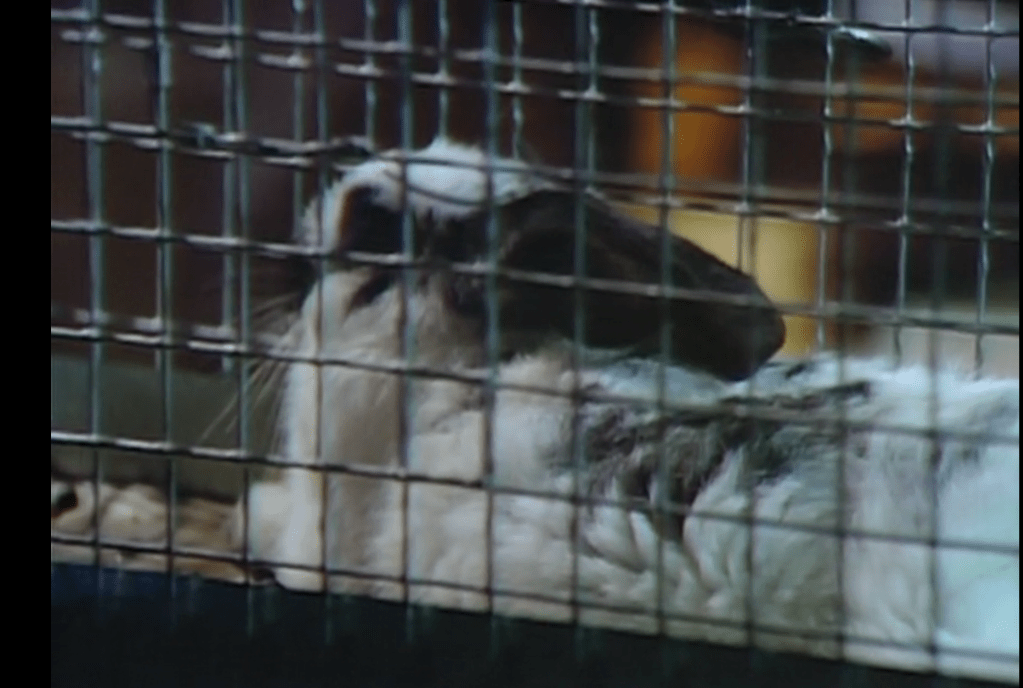
Quentin and Alexis aren’t the only ones dealing with frustrated sexual desire. We cut from them to a closeup of a bunny. This universally recognized symbol of amorous enthusiasm is alone in a cage.

The episode originally aired on the second Tuesday of Easter 1970, maybe the bunny was resting up after his big day.

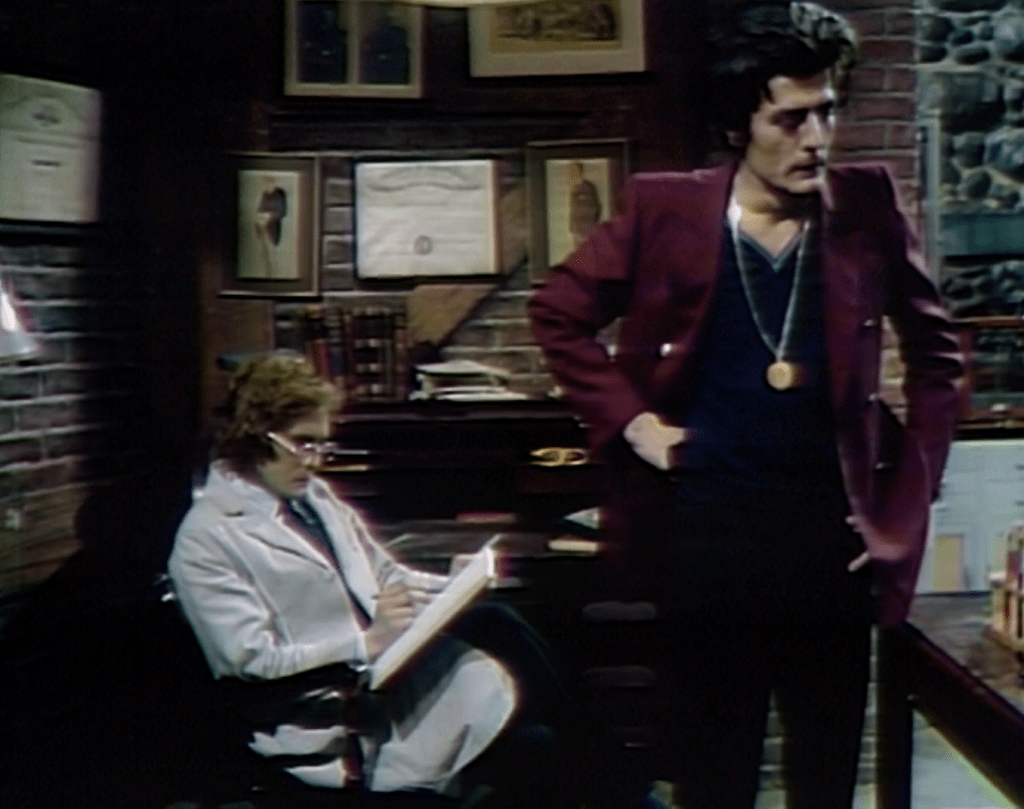
The cage is in a laboratory. A young woman in a lab coat is trying to work on a large apparatus for chemical experimentation while a man wearing a purple suit, a low cut shirt, a large medallion, and a huge bouffant hairdo is pestering her with clumsy attempts at flirting. She keeps laughing off his verbal gambits and swatting away his physical approaches.

A tall young man in a lab coat enters and calls out a booming “Sabrina!” The lounge lizard and the experimenter stand up straighter and step away from each other. Returning viewers know the tall man as aspiring mad scientist Cyrus Longworth and the ill-clad masher as Bruno Hess, musician and hanger-on of the late Angelique. We have not seen the woman before, but we recognize the actress as Lisa Blake Richards, who played another woman named Sabrina in the main continuity. That Sabrina was trapped in a go-nowhere storyline. Before today is done we will have grounds to hope that this one will give Miss Richards a task more in keeping with her considerable talents.

Cyrus sends Sabrina upstairs to wait for a package. Bruno gets ready for his part in Cyrus’ experiment, which involves giving a blood sample. Bruno asks Cyrus why he was so calm when he saw him trying to put the moves on Sabrina. Cyrus replies that he trusts Sabrina too much to worry that Bruno could come between them. He then jabs the syringe into Bruno’s arm with great force and without even looking at the spot from which he is drawing the sample, causing Bruno to jump. He may trust Sabrina, but he wants Bruno to know who’s boss.

Bruno tries to interest Cyrus in his theory that Alexis is Angelique returned from the grave. He eventually manages to get Cyrus to give him a quizzical look, but stops at that point, saying that if Cyrus won’t explain his experiment, he won’t explain his.

Sabrina comes downstairs and says that the package has come and that its bearer insists on meeting Cyrus himself. Cyrus is annoyed by this, but when it develops that the man is Mr Horace Gladstone himself, the very chemist who devised the unusual compound he has brought, Cyrus sends Sabrina back upstairs and Bruno out the basement door so that he can meet with the man alone.

Friday, Cyrus explained to his friend Chris that he is trying to devise a process for separating a human being into two parts, one good and the other evil. His scenes with Chris hit all the obligatory mad scientist notes, right down to disparaging non-mad scientists as unimaginative dolts who may as well believe that the Earth is flat. He won’t tell Gladstone what he is trying to do, perhaps because he has the same last name as did the man who was prime minister of the UK when Dr Jekyll and Mr Hyde was first published and so he reminds him that he is a character in a derivative storyline. But Gladstone does warn Cyrus that the compound he has purchased is a potent and dangerous one. Gladstone hints at the nature of the hazard when he says that he stepped back from active research when he feared that, even within the bounds of chemistry, he was about to uncover truths best left unknown.

Gladstone is played by John Harkins, in his fourth role on Dark Shadows. As before, he is playing a stranger from far away. In #174, he played Lieutenant Costa of the Arizona State Police. We saw him in a scene set in Phoenix, the first time Dark Shadows took us outside the northeastern USA. We did not leave that region again until #877, when sorcerer Count Petofi thought back to an incident in England in 1885, when he first met his henchman Aristide. Like Bruno, Aristide was played by Michael Stroka. The incident in England involved a man named Garth Blackwood, whom Petofi would bring back from the dead to punish Aristide. Blackwood was played by Harkins.

Harkins’ third character came from even further away than Arizona or England. He was Mr Strak, the representative of the Leviathan People, a race of Elder Gods long confined to the underworld. Strak appeared to Paul Stoddard in #899 and #900, and tricked Paul into selling his daughter Carolyn to the Leviathans. So far as Paul was concerned, Strak came from nowhere and disappeared to nowhere, so that he could never hope to explain to anyone what he had done, still less find a way to challenge the terms of the deal.

Gladstone is from Boston. Dark Shadows is set near the real-world location of Bar Harbor, Maine. The characters often mention Boston, but we’ve never had a scene set there. In #363, the ghost of nine year old Sarah Collins was perfectly bland when her friend, strange and troubled boy David, said he had been to China. Sarah said that her father and his business associates were always sailing to China. When David told Sarah that he was joking and he had actually gone to Boston, Sarah was thrilled. She had been to Boston herself once, and considered it a far more exotic place than China could possibly be. Gordon Russell was credited with the script for #363, and Joe Caldwell, the freshly returned author of today’s script, had finished his first tour of duty on the show three weeks before it was taped. But Sarah’s excitement about Boston is so much the kind of character moment Caldwell specialized in that I suspect it was a leftover idea of his that Russell found a place for. Perhaps the casting of Harkins as a Hub man reflects Caldwell’s idea of what Boston would represent to people in a coastal village in central Maine.

Bruno and Alexis

We cut to Bruno, who is on the telephone. He is talking to a person in an office somewhere. He learns that no ships from Genoa have docked in New York in the last week. This information excites him, but his excitement soon gives way to terror as he feels himself choking.

Bruno runs into Angelique’s bedroom, where Alexis is back on the piano bench. He gasps and demands she stop obstructing his breathing. She appears to have no idea what he is talking about.

The Angelique we have known since late 1967 did specialize in casting spells that made her enemies choke. We saw her do that as recently as #955, when her husband tried to set fire to her and she stopped him by twisting a scarf around the neck of a statue. On the other hand, Alexis seems genuinely bewildered by the situation.

When Bruno starts breathing again, he confronts her with the fact that no registered passenger ships from Genoa arrived in New York harbor the week before. She asks him if he considered that she might have been a guest on the yacht of some wealthy friends. He is stumped by this. Again, this keeps the suspense about her true identity alive. Alexis has been established as the sort of person who would be found on someone else’s yacht, but she doesn’t actually say that that is how she got back to the States. She merely asks Bruno if he had thought of the possibility that she may have done so.

Cyrus and Sabrina

Back in the lab, we see Sabrina collecting some equipment while Cyrus tends to his notes. She finds a small box, and asks him if he put it there for her to find. When he says he did, she opens it and finds a ring. She asks if it is an engagement ring. He says he hopes it is. She throws her arms around him and tells him she loves him. He holds her and does not say that he loves her too. He merely says that she knows how he feels about her, an ill-omen if ever we saw one.

Cyrus tells Sabrina that she knows how completely his work consumes his energies, and she says that is one of the things she admires about him. She asks what exactly he is working on. He is reticent, and she tries to walk the question back. He goes into his mad scientist ravings, and she gives him a stunned look. He tries to reassure her, saying that when he gets carried away he talks in cliches. He says that no one has found good or evil in a test tube… “yet!” The crazed gleam comes back into his eyes.

Sabrina is shocked by Cyrus’ ravings

This scene gives Miss Richards more to work with than she had had in her whole time in the main continuity. The look Sabrina gives at the end of Cyrus’ gust of lunacy is the first time she has had a chance to get a laugh, and she makes the most of it. As for Christopher Pennock, he had just been getting the hang of his previous part, hugely overgrown infant Jeb Hawkes, when he was written out. With Cyrus, he can to some extent pick up where he left off. Pennock had begun to find a way to suggest that there was a real sweetness bottled up inside one-man wrecking crew Jeb, and in Cyrus’ love for Sabrina he can play a character who is Jeb’s mirror image- abundantly sweet, but so deep inside his own head that he is about to become a monster.

Bruno

On Dark Shadows, wedding days usually come and go without anyone actually getting married. Typically, the ceremony is interrupted and someone has to go off and dig up a grave, in which they find an empty coffin.

Bruno has no manners and does not observe any of the recognized customs. So even though today is Sabrina and Cyrus’ engagement day, not their wedding day, he jumps the gun and starts opening Angelique’s grave, in which he believes he will find an empty coffin. We end with him chiseling at the wall of the mausoleum. I suppose you could say that he might be planning to work slowly, so that he won’t finish until the day of the wedding, but even if that were true it would be an outright violation of the accepted norm, and an undeniable sign that he is not the sort of person who can be expected to fit in at Collinwood.