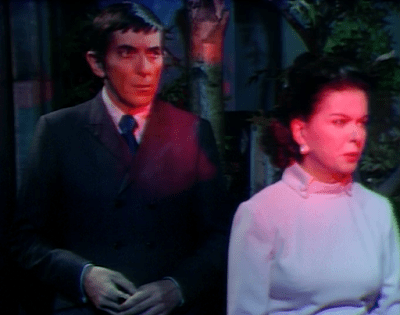
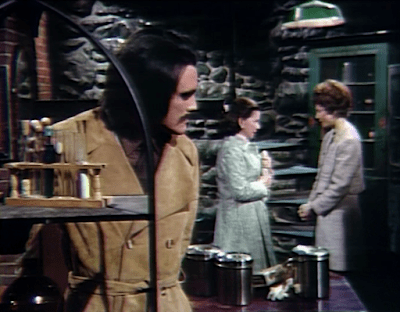
For some time, wicked witch Angelique Stokes Collins has been dissatisfied with her minion Julia Hoffman. What she most wants from Hoffman is information about her new enemy, old world gentleman Barnabas Collins. Yet Hoffman has told her nothing useful about Barnabas. The only time she brings him up is to claim that she was busy following him when Angelique needed her to do something else. Even then, her reports are no more substantive than “He went into town,” without so much as a single name of a person he met or building he entered while there. Hoffman keeps showing friendliness to people to whom Angelique wants her to be hostile, asking questions to which she ought already know the answer, and resisting orders she would usually be eager to follow. Whatever is wrong with Hoffman, Angelique does not propose to put up with it indefinitely.
Yesterday, Angelique found the solution to the puzzle. She learned that she has not been dealing with Hoffman at all, but with her Doppelgänger from an alternate universe. Barnabas came from that universe as well. This Julia is as devoted to Barnabas as Hoffman was to Angelique, and followed him to this reality to take her place at his side. Today, Angelique traps Julia in a secret chamber off the basement of the great house of Collinwood and demands to know what she has done with Hoffman. At length Julia confirms her true identity and admits that she killed Hoffman, but she will not answer any of Angelique’s questions about Barnabas.
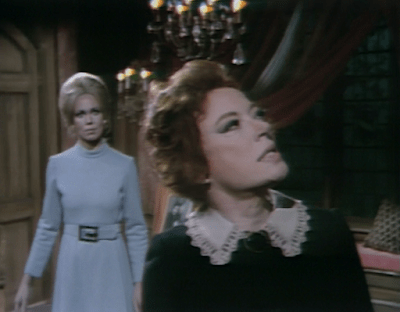
Angelique takes out a medallion and tells Julia to look at it. Julia gasps and turns away. She says that she knows about hypnosis and knows how to resist it. Angelique says that if she knows how to resist, there is no reason for her not to look at the medallion, but Julia keeps looking away. Julia was first introduced as a psychiatrist, whose talent for hypnosis was of magical proportions. By showing her medallion to a person, she could erase and rewrite that person’s memory as easily and as completely as one could erase and rewrite a chalkboard. Julia is the heroine of the show now, but longtime viewers will still find it fitting that Angelique turns the tables on her.
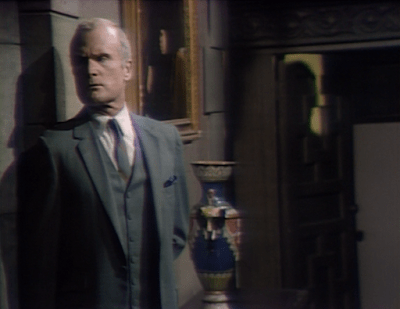
Upstairs in the same house, high-born ne’er-do-well Roger Collins is having a conversation with Angelique’s portrait. This is one of several habits Roger has that recall Waldo Lydecker, the sarcastic dandy in the 1943 novel and 1944 film Laura. Lydecker turned out to have murdered a woman with whom he had a strange obsession.
Roger is overwrought, telling the Angelique in the portrait that he should have known she would come back from the dead. If he had, he would have realized it was a waste of time to kill her. He only made things worse by doing that; for one thing, it made it necessary for him to kill his niece Carolyn. As he says this, his sister Elizabeth Collins Stoddard, Carolyn’s mother, overhears. She storms in. He tries to deny that meant anything he said, but Liz won’t be stopped. As Roger presses his hands on Liz’ shoulders, Joan Bennett plays the part of someone being strangled. Louis Edmonds’ fingers are nowhere near her throat. You can’t believe that Roger is hurting Liz, but you can easily believe that Edmonds and Bennett are a brother and sister playing pretend. They look like they’re about six.
Oh, oh, I’m being strangggled!
Just as Roger closes Liz’ body into the storage space under the window seat, Barnabas enters. Roger is on the point of tears, a circumstance Barnabas notices. Roger keeps urging Barnabas to leave the room with him, but he replies that what he has to say will take only a moment. Barnabas says that he is worried about Liz. Roger gets even more upset, and Barnabas finally agrees to go downstairs with him.
For longtime viewers, this scene makes a poignant contrast with #446. In that episode, set in the year 1796, Edmonds played haughty overlord Joshua Collins, father of Barnabas. Joshua discovered that Barnabas had become a vampire. Joshua confronted his son in his hiding place. Joshua was at once horrified and shattered, but in no way intimidated by Barnabas, who was for his part alternately ashamed and petulant. Edmonds and Jonathan Frid made that scene into one of the high points of the series. Now, it is Edmonds’ turn to be the murderer dejected by the knowledge of his own inexpungable guilt, and Frid’s turn to be the upright family man. Barnabas does not know Roger’s secret as Joshua knew his, but in Roger’s inability to face him we see the fear of the same righteous condemnation Joshua had felt it his duty to proclaim.
At one point in this conversation Frid has so much trouble with his lines that the words dissolve into a buzzing sound. I told my wife, Mrs Acilius, that it sounded like Barnabas had briefly turned into Bob Dylan. She roared with laughter and said that was exactly what she was going to say.
This is the first “Parallel Time” episode in which Lara Parker is credited as playing Angelique. Previously she had been billed as Alexis Stokes, the identical twin sister whom Angelique killed when she rose from the dead ten and a half weeks ago and whom she has been impersonating ever since. Several times in the series, cast members have wandered onto the set while the credits were rolling.* Referring to this, Mrs Acilius had explained that they kept using Alexis’ name in case any characters who didn’t know who she really was wandered in while the credits were rolling. She imagined them looking up, widening their eyes, and pointing. She meant that hypothesis as a joke. But since the only character in today’s episode who didn’t know Angelique’s true identity was Liz, who was dead by the time the credits rolled, I think we have to take it as proven.
*Most conspicuously in #703, #635, #510, and #328. There are also moments when crew members can be seen during the closing credits, most spectacularly in #999, when a man is just sitting there eating a sandwich.
Late in 1968, the ghost of Quentin Collins began haunting the great house on the estate of Collinwood. The ghost gradually waxed more powerful and more malevolent, killing some people and tormenting others. By March of 1969, the great house had become altogether uninhabitable. Old world gentleman Barnabas Collins, trying to contact Quentin, traveled back in time to 1897, when Quentin was a living being. During the eight months the show was set in that year, we got to know a Quentin who was selfish, cowardly, untrustworthy, cruel, and supremely charming. Barnabas’ interventions changed history. In the revised timeline, Quentin did not become a malevolent ghost. He didn’t even die. A spell was cast on him that immunized him against aging, so that when the show returned to a contemporary setting in November 1969 he was alive, well, and to all appearances 28 years old.
In 1969 and 1970, Quentin still had all the lovableness that came from being played by David Selby. But the writers were stumped when it came time to give Quentin something to do. They kept him in a holding pattern for a month or so with a case of amnesia, and used him and one of his girlfriends to tell a version of the story of Orpheus and Eurydice. When Barnabas and his best friend, mad scientist Julia Hoffman, were doing battle with an unseen race of monsters from beyond space and time, they occasionally turned to Quentin for help. When Barnabas’ old nemesis, wicked witch Angelique, grew jealous of his interest in governess Maggie Evans, she cast a spell to cause Quentin and Maggie to conceive a wild passion for each other, something which came and went and which Barnabas never noticed. None of that activity made an impression on the audience or gave the character room to grow.
The evil but irresistible Quentin of 1897 had a great deal in common with high-born ne’er-do-well Roger Collins, who was in 1966 the show’s first true villain. As played by Louis Edmonds, Roger was so much fun to watch that it was soon out of the question to follow the original plan and kill him off when his crimes were exposed, so they nerfed him. Roger turned into a sarcastic but harmless snob. When in November 1967 the show went back in time to 1795, Edmonds played haughty overlord Joshua Collins, a man as strong as Roger was weak. In a tragic turn Aristotle would have admired, it was Joshua’s virtues that led to disaster for himself and everyone he loved. In the 1897 segment, Edmonds played the stuffy but lovable Edward Collins, who had many faults but was devoted to his family and committed to doing the honorable thing. Under the influence of these roles, Roger himself had by the time the show was done with him transformed into an upright family man.
The makers of the show have apparently decided that if traveling in time and casting Edmonds in other roles could change Roger so profoundly, finding a setting where they can present us with a different version of Quentin might be a path to reinvigorating that character. To that end, they have traveled, not backward in time, but sideways in time. We are now in a different universe than the one where the first 196 weeks of the show took place. The show insists on calling this universe “Parallel Time.”
Here, Quentin is the master of Collinwood and Maggie is his wife. This Quentin is something his counterpart never was, an authority figure. But authority does not come naturally to him, as it did to Joshua and Edward. He holds onto it in his relationship with Maggie by treating her as a child, with the result that their marriage is all but dead. He ignores his son Daniel, caves in to the servants when they stand their ground against him, and throws tantrums and runs away when he encounters serious opposition. In those moments he reminds us of the cowardice Quentin showed in 1897. On occasion, however, he has shown physical courage, as when he stood up to an evil man called John Yaeger. As Joshua suffered from the overgrowth of his virtues, so Quentin’s better deeds seem to be the accidental byproduct of his vices. What we have seen in Parallel Time makes it easy to imagine that when we get back to the main continuity, we will see Quentin as a sometime action hero who must at all costs be kept from taking charge of anything. Had the segment caught on as 1795 and 1897 did and been expanded beyond the bounds originally planned for it, who knows what other paths it might have opened for the character.
Angelique was Quentin’s first wife, who was murdered nine months ago but has risen from the dead, assumed the identity of her identical twin sister Alexis, and set about taking revenge on her killer. She doesn’t know who that was, though for now she is operating on the assumption it was Quentin.
Roger and the matronly Elizabeth Collins Stoddard are Quentin’s siblings. While in the main continuity Liz kept her share of the inheritance as Roger was squandering his, here she entrusted her money to Roger, so that they are both penniless dependents on Quentin.
Barnabas and Julia have crossed over from the main continuity. Barnabas is pretending to be a long-lost cousin of the Collinses, while Julia is impersonating her own counterpart. That other Julia Hoffman was the housekeeper at Collinwood and Angelique’s most fanatical devotee until Julia showed up, beat her to death, and stole her French maid outfit.
At this point, Quentin is on the run from the law, suspected of the murder of sleazy musician Bruno Hess. He was choking Bruno shortly before his death, but is in a sense innocent of the crime, since it was a spell Angelique cast that completed the fatal strangulation. Liz’ daughter Carolyn is in mourning for her husband Will, who found himself caught between Angelique’s magical powers and Barnabas’ and could do nothing but fling himself to his death from a high window. Yesterday Carolyn announced that she knew and could prove who had killed Angelique. She went to the room on top of the tower attached to the great house. A man entered. She greeted him. He drew a knife and she screamed.
Today, Roger tells Liz and Julia that he heard Carolyn’s scream, ran to the tower room, and found her stabbed to death. Presumably the same man killed her who killed Angelique. The three current suspects are Roger himself, Quentin, and butler Mr Trask.
Yesterday’s episode hinted heavily that Trask was the culprit, and Liz says that he has been missing since Carolyn was killed. We had not seen or heard of Trask in more than eight weeks, and in none of the handful of episodes in which he appeared before that hiatus was it suggested he might have killed Angelique. If it does turn out that the butler did it, therefore, it would be obvious that the show had originally planned to pin the crime on a major character and chickened out at the last minute. We do see a man lurking about today who might be Trask and almost certainly is the mysterious and terrible “Claude North” whom we have heard about recently; if Trask and North are one and the same, that might lead somewhere, but it would hardly be a logical culmination of what we have seen so far.
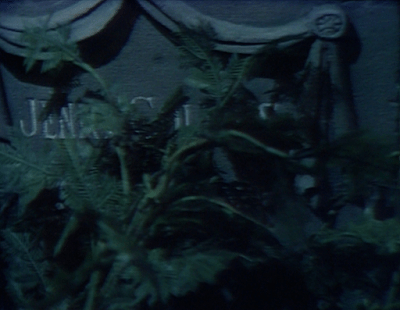
The whole point of the “Parallel Time” segment is to reconceive Quentin. Making him the killer of Angelique might fit with that. The Quentin of the main continuity murdered his wife Jenny in 1897,* and Angelique is much less sympathetic than Jenny was. Quentin does not have to be admirable, or even defensible. He just has to be attractive. If they can find a way to occasionally make his vices into motives for good deeds, all the better. But Carolyn’s counterpart in the main continuity has been a central figure on the show since the first week, and like all characters played by Nancy Barrett she is a fan favorite. If this Quentin deliberately kills Carolyn, especially by hacking her to bits with a kitchen knife, it is hard to see how the Quentin of the main continuity will benefit. It is true the present Quentin is such a gloomy sourpuss and such a miserable failure as a husband to Maggie that he has already alienated the audience, so they might have decided they had nothing to lose by turning him into Jack the Ripper.
That leaves Roger. He has been painted in the colors of his counterpart as he was in 1966, making him a possible murderer. Even at his coldest, the Roger of the main continuity was close to Carolyn, whom he called “Kitten.” But when we first saw the characters from the current universe in #975, they were hostile and impatient with each other, and Roger took a menacing tone with his niece. The only person for whom this iteration of Roger has any affection is Angelique, and all of that flows to a version of her that exists only in his imagination. Roger seems to be describing himself in both universes when he tells Liz that “The sum total of my life seems to be that I can never help anyone.” So we can certainly believe he killed both Angelique and Carolyn, and that he might kill again.
Liz and Roger’s counterparts have been on the fringes of the action in the main continuity for years, and today we see that this Liz and Roger are also excluded from much that is happening. They visit the Collins family mausoleum in the old cemetery north of town scouting out potential resting places for Carolyn. Unknown to them, there is a hidden chamber in the back of this mausoleum, and Claude North is lurking there, a dagger in his hand, while they chat in the publicly visible part. They then go to Carolyn’s home, the Old House on the grounds of Collinwood, to look for anything she might have written that would give a clue as to who killed her. Unknown to them, Julia is in the basement of the house, conducting a mad science procedure to weaken Angelique by reviving a woman named Roxanne on whose “life force” she is feeding. One wonders where else they will stop on their way home, and of what other uncanny doings they will be oblivious while there.
We hear Julia’s thoughts as she is preparing to revive Roxanne. She tells herself that this is the procedure that brought Adam and Eve to life. She is not thinking of some obscure midrash about the book of Genesis, but about two Frankenstein’s monsters she loosed upon the world in 1968.
*Jenny must have been in someone’s mind when they were making this episode. We catch a glimpse of a gravestone in her name during a cemetery scene:
In the first months of Dark Shadows, characters several times shared meals in the kitchen in the great house on the estate of Collinwood. In that intimate setting, they would often exchange information that made it possible for them to advance the story. As time went on, the show developed more ways to get knowledge flowing, and the kitchen lost its importance. We haven’t seen it since #208.
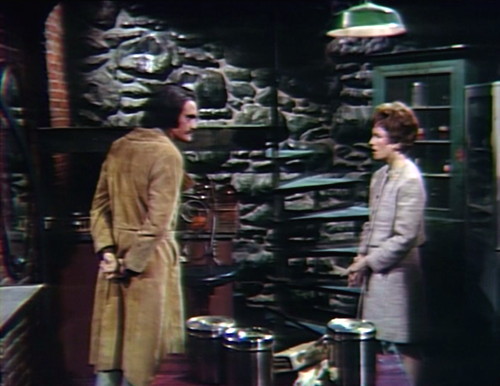
Now, the show is set in an alternate universe, which it calls “Parallel Time.” We see the kitchen in this reality’s Collinwood today, the last glimpse we get of the room in any version of the place. Young Amy Collins visits butler Mr Trask there while he is sharpening a large knife. She tells him a man is living in the tower room. He leaves to investigate, leaving the knife on the countertop. The camera zooms in on the implement, lingering over it while an ominous cue plays on the soundtrack.
Later, Amy returns to the kitchen with the matronly Elizabeth Collins Stoddard. Liz is upset that dinner is not ready and Trask is nowhere to be found. Amy notices that the knife is not where Trask left it hours before. Liz is unimpressed with this fact, as anyone would be who had not seen the zoom shot and heard the melodramatic music. We cut to the tower room, where Liz’ daughter Carolyn Loomis greets someone we cannot see. We cut to a hand holding a knife very much like the one Trask had sharpened. The hand brings the knife down, and Carolyn screams.
It is Carolyn who is the main source of information for the other characters in today’s show. Carolyn’s husband was killed the other day in a conflict between two supernatural beings. The other characters in today’s episode have no idea that such beings dwell among them, and think that those two in particular are simply members of their extended family. Carolyn has had all she can take of this situation. She claims “to know all the secrets” of Collinwood, and is far too drunk to keep many of them to herself.
Trask learned several secrets from Carolyn in Act One, when he was leaning up against the door to the drawing room, his ear pressed hard to it, eavesdropping ferociously on her conversation with her uncle, Roger Collins. Carolyn taunts Roger with his failure to recognize someone he loves desperately. She declares that she can prove that the houseguest who has been staying in the great house lately is not Alexis Stokes, but Alexis’ identical twin sister, Angelique Stokes Collins.
Roger rejects this claim. Since Angelique died last year, one might expect Roger to be confident in his rejection, but he is high-strung and defensive about it. Carolyn does not deny that Angelique is dead. Indeed, she says that if anyone were to look at the base of “Alexis'” skull, they would find a scar where the killer drove in the hatpin that killed Angelique, proving that “Alexis” is Angelique’s reanimated corpse. This makes more sense to Roger than one might expect. When he first saw Alexis in #990 she had to give him her hand and talk soothingly to him for some time before he would accept that she was not Angelique risen from the grave.
As it happens, Carolyn is right. Two weeks after she met Roger, Alexis saw Angelique lying in the tomb. Alexis touched her sister to bid her a final farewell, only to find that all of the heat was draining from her body into Angelique’s. Moments later, Alexis was dead and Angelique was standing over her icy corpse. Angelique put on Alexis’ clothes, did her hair in the style Alexis wore, and met Trask, who accompanied her to the great house. Ever since, Angelique has been passing herself off as Alexis.
Amy interrupted Trask while he was eavesdropping. He ordered her to leave him alone, getting quite surly about it. If he can hear everything Carolyn and Roger are saying, we wonder why they can’t hear him being nasty to a member of the family. But apparently they can’t. She goes away, and he presses himself even closer to the door.
Carolyn is still talking to Roger and Trask is still eavesdropping when “Alexis” comes by. She reproves Trask, opens the doors to the drawing room, and exposes him to Roger and Carolyn. Roger is too shocked by the sight of “Alexis” and Carolyn is too amused by it all for either of them to do anything about Trask’s misconduct.
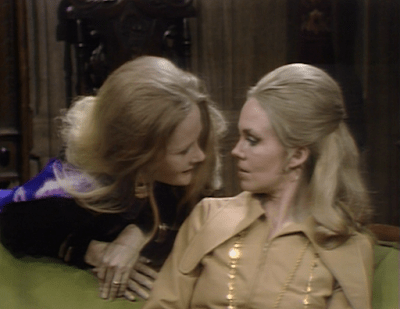
Later, Carolyn returns to the drawing room and finds her mother talking with “Alexis.” She leans down way into “Alexis'” personal space, making her hilariously uncomfortable.
“Alexis” leaves them alone. Carolyn tells her mother that she knows who murdered Angelique. She says that she had suspected her, and is greatly relieved to know that she was wrong. Roger eavesdrops on this conversation, and turns around to see the shadow of yet another eavesdropper.
Carolyn tells Liz that she not only knows who the murderer is, she has talked to “him” recently. That doesn’t narrow it down. She has talked to all three current suspects, and all of them are men. Roger gets very agitated whenever the topic of Angelique’s murderer comes up; his reaction is one of many heavy-handed clues the show has been giving lately that he did it. They had not suggested Trask might be the culprit when he was last on the show, in #1004, but they couldn’t be more obvious about it today. The third suspect is Quentin Collins, brother to Roger and Liz, who is currently a fugitive from justice, having escaped from jail after he was charged with another murder. Quentin is the man living in the tower room; Carolyn saw him there the other day, and he took a threatening tone with her. So any of those three men might be the one wielding the knife in the final shot.
This is a day for final appearances. Not only do we bid the kitchen adieu, but also Carolyn Loomis, Mr Trask, and Amy Collins. Nancy Barrett and Jerry Lacy will be back as other characters, but Denise Nickerson is gone from the cast as of today. After a great run in her first couple of months on the show, she was criminally underused. Still, whenever they did put her on she was typically the highlight of the day, so it is sad to lose her.
Liz mentions someone named “Dr Blum” today. We never see Dr Blum. The only character in the whole series who seems to be Jewish is Dr Julia Hoffman, who like the unseen Dr Blum is a psychiatrist. It was less than a year after this episode aired, on 26 May 1971, that President Richard Nixon said in a conversation with his chief of staff H. R. Haldeman that the reason he was unpopular with Jewish voters was that “Most of them are psychiatrists.” Ever since the tape of that conversation was released in 2002, people have been trying to figure out what Nixon meant to say. Perhaps the White House taping system malfunctioned, and picked up some audio not from the Richard Nixon of our universe, but from one who lived in one of the universes where Dark Shadows took place. There, he might have been making a simple statement of fact.
Yesterday’s episode ended with a climactic moment in Dark Shadows‘ adaptation of Jekyll and Hyde. Sabrina Stuart, fiancée of mild-mannered scientist Cyrus Longworth, had discovered that Cyrus’ evil alter ego John Yaeger is holding Maggie Evans Collins prisoner in a dungeon outside the village of Collinsport. For some reason she drove to Maggie’s home, the great house on the estate of Collinwood. Cyrus/ Yaeger followed her there and choked her out in the drawing room. Elizabeth Collins Stoddard, who is Maggie’s sister-in-law and Sabrina’s friend, saw the strangling and screamed. Cyrus/ Yaeger dropped Sabrina to the floor and turned his attention to Liz.
It was unclear at that time if Sabrina was dead or merely unconscious. Today’s opening voiceover says flatly that “Yaeger killed her,” and in the first scene of act one housekeeper Julia Hoffman checks Sabrina’s body and declares that she is dead. Since the narrator and Hoffman are both played by Grayson Hall, longtime viewers will be cautious about accepting these pronouncements. For its first 196 weeks, Dark Shadows was set in an alternate universe. There, Hall played Hoffman’s counterpart, a medical doctor who has many abilities no other member of her profession can equal but who is curiously unreliable when she pronounces patients dead. Julia has been known to erroneously pronounce the same person dead twice in a single episode. So we have to reserve judgment for a bit about whether Sabrina will be wanting breakfast.
Liz locked Cyrus/ Yaeger in the drawing room before he could get his hands on her, and he smashed a window and ran out when he heard her talking with Hoffman in the foyer. Liz and Hoffman find that Cyrus/ Yaeger had torn the telephones in both the drawing room and the foyer out of their wall sockets. We’ve seen telephones in other parts of the house several times, but evidently those are out of order today. Hoffman says that she will go to the Old House on the grounds of the estate, home to Liz’ daughter Carolyn and Carolyn’s husband Will, and call the police from there. Hoffman assures Liz that Cyrus/ Yaeger must have left the estate and that he will present no danger on the fifteen minute walk to the Loomis house.
Hoffman’s confidence on this point puzzles Liz, who watches her leave carrying only a flashlight while she herself crouches in the drawing room holding a pistol. It may puzzle first-time viewers as well. Those who have been watching for several days know that Hoffman is in league with Cyrus/ Yaeger. Hoffman has been acting as a messenger between Cyrus/ Yaeger and her mistress Angelique, the undead first wife of Quentin Collins, who is Maggie’s husband and Liz’ brother. Angelique wants Maggie out of the way so that she can remarry Quentin, and is supporting Cyrus/ Yaeger’s plan to torture her into loving him.
At the Loomis house, Hoffman calls the police and reports exactly what Liz knows. When she is done with her call, she realizes that she is alone in the house. Earlier, she was peeking through the window when Carolyn and Will’s mysterious houseguest, a person named Barnabas Collins, opened the secret panel behind a bookcase. She takes advantage of the opportunity to find out what Barnabas is hiding. She sees a coffin in the chamber behind it. Without hesitation, she opens the coffin. She finds that it is empty. She closes the panel, wondering why Barnabas would keep an empty coffin in a hidden chamber. She is on her way out when Barnabas enters and demands to know what she is doing there. She tells him what happened in the drawing room of the great house, and he rushes out with her.
Cyrus/ Yaeger is in his laboratory. He takes out the antidote. This will puzzle regular viewers. Up to this point, it has seemed clear that Cyrus/Yaeger has only one potion, and that it effects both his Hyde-ification and his re-Jekyllizing. He threw all of that potion away a couple of weeks ago, after he tried to rape Maggie in a dark alley. He cannot make more, since it requires a compound that only one chemist could provide and Cyrus murdered that chemist when he learned his secret. His current Yaegerness is the result of a spontaneous transformation that took place without drinking the potion. So we are at a loss to explain why he still has any of it. He tells himself that there is only enough to change him once. By the time he starts drinking it, the police are knocking at his door.
At length, Cyrus lets the policeman in. He asks what took so long; Cyrus claims to have been asleep. He tells Cyrus that Yaeger has murdered Sabrina; Cyrus responds with genuine shock. The policeman apologizes for not having known that Cyrus was engaged to marry Sabrina, but insists that he answer his questions.
Most of Collinsport’s police officers have been farcically incompetent. The actors have responded to the challenge of playing these useless men in various ways. Dana Elcar, who in 1966 and 1967 was the first of four to play Sheriff George Patterson, kept you hoping that his character was just playing dumb. Some of the others either gave up and let us see their own contempt for the bumblers the scripts had saddled them with, as Vince O’Brien did towards the end of his own time as the last of the Sheriffs George Patterson. Dreariest of all was the first law enforcement officer on Dark Shadows, Constable Jonas Carter, whose flagrant incompetence at his job scarcely exceeded the incompetence Michael Currie brought to the role. This policeman doesn’t solve anything, but Philip R. Allen’s performance makes him seem like the greatest detective we’ve ever seen. Allen is spellbinding as he simultaneously depicts sincere empathy and an unbending determination to get at the facts. It’s too bad this is the only time we get to see this dynamic actor on Dark Shadows.
Outside the great house, Barnabas and Liz are watching the ambulance take Sabrina’s body away. Its flashing lights illuminate their faces. This is the first evidence we have seen that emergency vehicles exist in any iteration of Collinsport. Indeed, when the characters decide that someone is dead they usually take it for granted that there is no longer any point in calling the authorities, that they should just set about digging a grave and burying the body.
Barnabas and Liz watch the ambulance take Sabrina’s body away. Screenshot by Dark Shadows Before I Die.
Barnabas asks Liz if she knew that Yaeger had threatened Maggie and that he has an unwholesome interest in her. She did not. Maggie had not told anyone at Collinwood about the incident in the dark alley. Barnabas tells her only that he heard about it in town. Regular viewers know that a woman named Buffie Harrington foiled Yaeger’s assault on Maggie when she happened by the alley. Barnabas can hardly tell Liz about his connection with Buffie, since he is a vampire and Buffie is his victim. They decide they must tell the police about Yaeger and Maggie, and they go back to the Loomis house to make a telephone call.
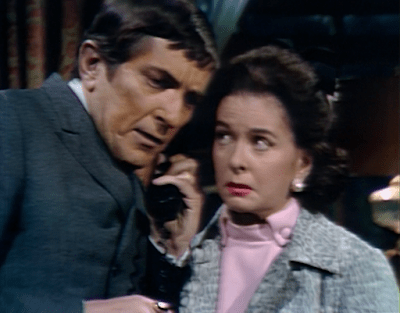
Cyrus is still in his lab. He knows that he might change back into Yaeger at any time. He decides to call Barnabas at the Loomis house and tell him where Maggie is. Barnabas holds the telephone so Liz can hear what Cyrus is saying. Barnabas asks Cyrus how he knows that Yaeger is holding Maggie; he says he can’t tell him. Barnabas and Liz rush out. They don’t think to call the police.
Back at Collinwood, Liz tells Hoffman she ought to go to the policemen outside the house and tell them what Cyrus told her and Barnabas. She also frets about Barnabas’ safety. Hoffman says she is quite sure that Barnabas Collins does not need anyone’s protection. Liz does not know what she means, but is in too much of a hurry to question her. Hoffman thinks to herself about how much has happened that she has not had a chance to tell Angelique.
In his lab, Cyrus raises a pistol to his head and puts his finger on the trigger. Before he can fire, he transforms into Yaeger.
Barnabas makes his way to Maggie’s dungeon. He searches it, finding her belongings but not her. She has picked the lock, untied the ropes in which Cyrus/ Yaeger bound her, and let herself out. She is hiding elsewhere in the basement. She can hear Barnabas’ steps, but does not know who it is. She assumes that it is Yaeger. When she hears him leave the basement, she starts to make her way out. Just as she emerges from the shadows, Yaeger appears on the steps and greets her. She screams, and he pounces.
Sabrina Stuart has been having a rough few weeks. Her fiancé, mild mannered scientist Cyrus Longworth, has been spending less and less time with her and is entangled with a strange, violent man named John Yaeger. The other day, she was with Cyrus in his laboratory and saw him transform into Yaeger. He confirmed that he had devised a potion to alter his appearance, and that Yaeger is merely a disguise he assumes to carry out crimes. The transformation Sabrina saw took place spontaneously, without a dose of the potion. Cyrus poured the potion down the drain a while ago, when he was feeling guilty about a rape he had committed as Yaeger, and we have seen him re-Jekyllize himself only by drinking another dose. So for all we know he will never resume his normal appearance. Sabrina pledged to stand by Cyrus no matter what; in response, he jeered and said he had no further use for her.
Tonight, Sabrina went out with her friend Elizabeth Collins Stoddard. Liz took her to a concert. The two women come to Cyrus’ laboratory, where Sabrina has left her wallet. Sabrina apologizes and calls herself stupid for forgetting it, as she keeps apologizing and calling herself stupid throughout the episode. She is very nervous, as witness not only her forgetfulness but also her physical awkwardness, shown most strikingly in the frequent mismatch between her facial expressions and her circumstances.
In his post about this episode on his great blog Dark Shadows Every Day, Danny Horn makes several complaints about Lisa Blake Richards as an actress, saying that “I don’t understand what Sabrina does with her face most of the time. She acts like she just got it recently, and she hasn’t figured out how to use it yet.” I think Danny is unfair to Miss Richards generally, and that this is a case in point. As Danny documents, the episode is full of flubs and goofs of various kinds, so it is natural to write off any kind of awkwardness as just another mistake. But considering how distracted and anxiety-ridden Sabrina must be given what she knows about Cyrus, her disconcerting facial expressions suit her perfectly, and are an intelligent acting choice on Miss Richards’ part. That we first see her in a scene with Liz helps to underline this intelligence, since Joan Bennett is the only other member of the cast who seems to know her lines today. Her smooth performance gives Miss Richards something to play off of and spotlights Sabrina’s barely controlled panic.
Sabrina and Liz haven’t been in the lab very long when Cyrus enters, as Yaeger. He introduces himself to Liz as a close associate of Cyrus’, and asks Sabrina to stay and help him analyze some data. Sabrina agrees to do so, and Liz excuses herself.
Cyrus, as “Yaeger,” listens while Liz and Sabrina talk in the laboratory. Screenshot by Dark Shadows Before I Die.
Cyrus tells Sabrina to mail some of his clothes and all of his money to New York. She asks if he is moving to New York permanently. In response, he rambles on about how big the world is and how little of it he knew before he assumed his current appearance. Apparently Cyrus retains his ignorance of geography when disguised as Yaeger. He simply tells Sabrina to send his belongings to New York, addressed to John Yaeger at General Delivery. Apparently he thinks there is only one post office location in the state of New York.
We next see Sabrina in the basement of an old farmhouse. Returning viewers know that Cyrus obtained this farmhouse last week by murdering the man who was about to sell it to him. Evidently, Sabrina has followed him there. She sees and hears him in a dungeon, tormenting Maggie Evans Collins, the wife of Liz’ brother Quentin. When Cyrus emerges from the dungeon, Sabrina runs away. He does not see her, but he finds the check he gave her to send to some post office randomly chosen from among the 1720 in New York State in 1970. It fell out of the pocket in her skirt* onto a stair.
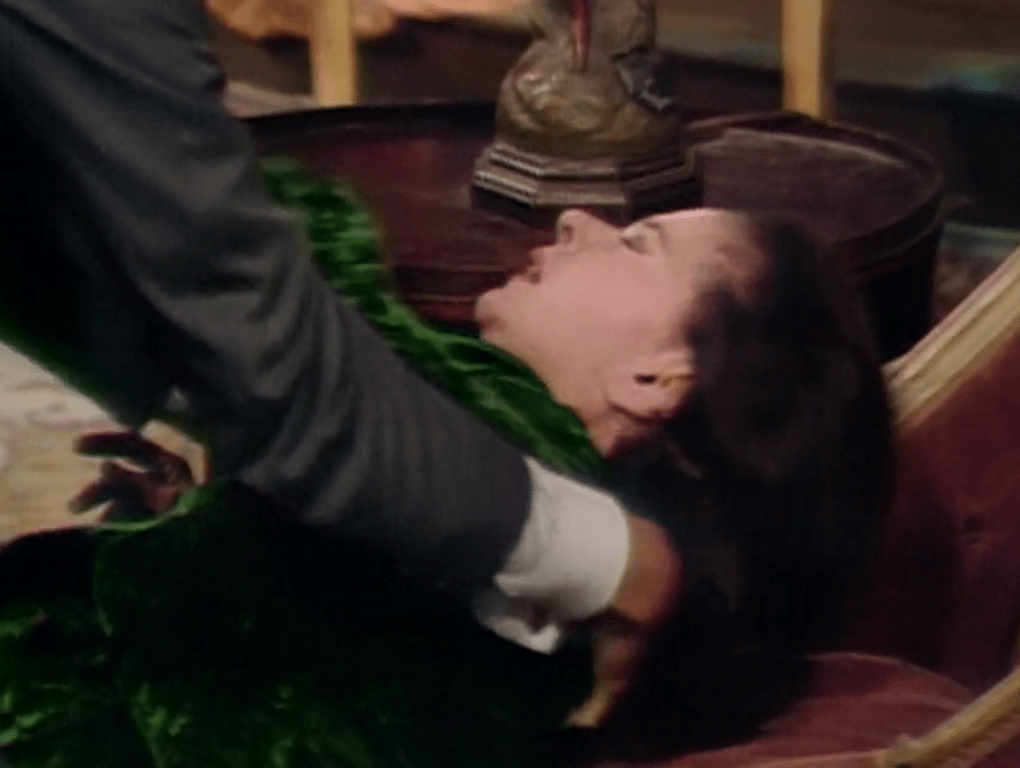
We cut to Liz’ home, the great house on the estate of Collinwood. We hear a car screeching to a halt. Sabrina comes running in the foyer, calling the names of the residents of the house. Cyrus follows her. He marches her into the drawing room and asks a series of questions. When she tells him she put the check in a safe place, he produces it. She blurts out that she dropped it. She pleads with him to let Maggie go. He says it would be foolish to let someone go who knows what Maggie knows about him. Sabrina knows even more about Cyrus than Maggie does, and asks what he is going to do to her. He tells her she knows what he is going to do. He strangles her.
Liz enters and screams. Startled, Cyrus lets go of Sabrina’s neck. She falls to the floor, her eyes closed. Tomorrow it will be confirmed that she is dead.
Liz had a dream earlier. She and Sabrina entered Cyrus’ lab and found it a shambles. Sabrina started cleaning the place up, only to find Maggie’s dead body sprawled on a table. Liz told this dream to a person named Barnabas Collins, who introduced himself to her family a few weeks ago as a distant cousin from South America. While the rest of the Collinses believe that Maggie left of her own accord, Barnabas is convinced that she is being held prisoner. The dream convinces Liz that Barnabas is right. When she told him about the dream, she also told him she had met Yaeger. Barnabas knows how cruel and dangerous Yaeger is, and has since #1021 been trying to find out exactly what the connection is between Cyrus and Yaeger. He announced to Liz that there is only one way to find out whether Yaeger has abducted Maggie, and when we last saw him in this episode he was in Cyrus’ lab, looking at the wardrobe he keeps there to wear when he is disguised as Yaeger.
Sabrina’s death marks Lisa Blake Richards’ final appearance on Dark Shadows. Her quiet competence as an actress allowed her scene partners to dial the vehemence essential to the Dark Shadows house style of acting down to bearable levels, and it highlighted Sabrina’s clumsiness under the severe pressures to which the story subjected her. I was glad when, during a 2020 reunion of Dark Shadows cast members on Zoom, Mitch Ryan took a call from Miss Richards, who was at that time his fellow student in a writing class. I’ll miss her, even if Danny Horn doesn’t.
*That pocket gets a couple of closeups today; after watching the episode, my wife and I happened to see another video mentioning that there was a trend towards putting pockets in skirts in the early 1970s.
Elizabeth Collins Stoddard is fretting about her brother Quentin’s childish behavior. Quentin’s wife, the former Maggie Evans, has left the house abruptly, without her purse, and has been away for some time. Liz is sure something bad has happened to Maggie, but Quentin refuses to look for her.
Liz tries to interest Alexis Stokes, identical twin sister of Quentin’s late first wife Angelique, in Quentin and Maggie’s troubles. She does not know that the person she is talking to is not Alexis at all, but Angelique herself. Angelique rose from the dead, murdered Alexis, and took Alexis’ place as a permanent houseguest in the great house of Collinwood as part of her plan to win Quentin back. To that end, Angelique is conspiring with a man she knows as John Yaeger. He has abducted Maggie and is holding her in a dungeon out in the country, hoping that after enough time alone with him she will forget all about Quentin and fall in love with him.
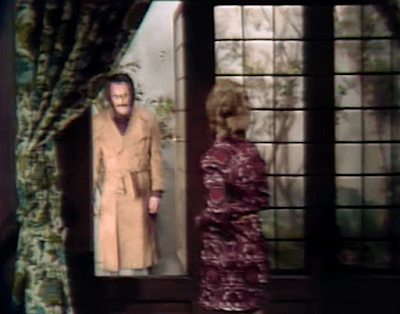
“Alexis” is pacing around the drawing room while Liz talks about Maggie and Quentin. She is half listening when she approaches a window and sees Yaeger waiting outside. She suddenly tells Liz that she is going to go out herself and look for Maggie. Liz tells her this is too dangerous, but she rushes out. She confers with Yaeger in the gazebo.* Yaeger is despairing of his plan, much to Angelique’s annoyance.
There is no such person as Yaeger, any more than there is a living Alexis Stokes. The man is really Cyrus Longworth in disguise. Maggie and Quentin think of Cyrus as a friend, a mild-mannered scientist who means well, though he is sometimes strangely naive. Cyrus has developed a potion which changes his appearance so drastically that not even those who know him best can recognize him when he is under its influence. After Cyrus tried to rape Maggie last week while disguised as Yaeger, he threw the potion away. But he then transformed spontaneously, without drinking it. Since he cannot re-Jekyllize himself without it, we are left wondering if he will remain in his Yaeger form permanently. We may also wonder what he will do if he reverts to his usual appearance in front of Maggie. He has admitted to himself that he and Yaeger are not separate people, but still seems to want to hold onto some sense that they are. He can’t very well do that if Maggie knows he is the one keeping her locked up.
Liz stays in the drawing room after “Alexis” leaves. Roger Collins enters and helps himself to some brandy. Liz picks up with her brother where she had left off with “Alexis.” Roger doesn’t even pretend to care about Maggie. He was fixated on Angelique when she was alive, and cannot forgive Maggie for not being her. He is glad Maggie is gone, and nothing Liz says about her can stir his interest. Joan Bennett and Louis Edmonds played different versions of these characters starting in #1, and it is always great to see them together.
Angelique has a problem of her own. She can stay out of the tomb only so long as she finds living bodies to drain of their warmth. She’s already killed three people that way. The first two were Alexis, whom she is successfully impersonating, and a handyman named Fred, who was expected to leave town anyway. Neither of them has been missed. The third, lawyer Larry Chase, caused puzzlement when his ice cold corpse was found in front of her, but as an isolated occurrence no one seems to have found a way to start solving that puzzle. So “Alexis” is not currently suspected of being a vampiric creature.
The need for warmth suddenly comes over Angelique. She goes to the drawing room and huddles in front of the fire. Roger sees her and remarks on how much she, “Alexis,” reminds him of Angelique. She says she doesn’t want to talk about her sister, then approaches Roger and embraces him. He says he feels terribly cold. She asks him to kiss her. That’s all it took to kill Fred and Larry, and a lot more contact than it took to kill Alexis. Roger is about to do it when Liz enters. They break their clinch and Angelique makes haste to go out. Roger is still feeling extreme cold, but he has no idea his sister just saved his life.
We see Angelique in the apartment of her (step?)father, Tim Stokes. She tells him she killed some stranger on her way over. By this time, his body will have been discovered, so cold that it will be assumed he had been dead for days. She tells Stokes that it was his occult prowess that enabled her to return from the dead, and asks if he can free her of her heat vampirism. He says that he cannot, and that he is so much the greatest expert in this sort of thing that there is no point in looking for anyone else who might be able to do so. She presses, and he mentions that someone else was involved in the process. She demands to see this person; he tells her the person is in the back room of the apartment. She eagerly goes to the door, unbothered by his pained refusal to accompany her.
Stokes’ apartment is laid out like the apartment of Professor Timothy Eliot Stokes, his counterpart in the parallel universe where Dark Shadows was set for its first 196 weeks. Two people had important connections with that other Stokes’ back room. One was Frankenstein’s monster Adam, who was last seen going in there. Adam’s creation was a means of freeing another vampire of his curse; longtime viewers may therefore wonder if we are about to meet his counterpart. The other was Paul Stoddard, ex-husband of Liz’ counterpart, who was attacked and killed in that room by a murderous shape-shifter who, like Cyrus Longworth/ John Yaeger, was played by Christopher Pennock. Perhaps whoever is waiting for Angelique in the room is somehow connected with Cyrus/ Yaeger.
There are other possibilities. Angelique’s counterpart in the other continuity was for a time subordinated to suave warlock Nicholas Blair. We have not seen a counterpart of Nicholas here; my wife, Mrs Acilius, thinks that we will meet another Nicholas tomorrow.
*Which she pronounces “ga-ZAY-bo,” a bit of Collinsport English Lara Parker introduced way back in #489. It’s fun to hear it again.
Maggie Evans is depressed about her marriage to drunken sourpuss Quentin Collins. In #1016, Maggie was getting ready to call a lawyer so she could put an end to their joyless union, but she changed her mind and decided to give it one more try. That has not worked out, and she has gone from contemplating divorce to attempting suicide. She is about to fling herself to her death from a window high in the great house of Collinwood when Quentin’s sister Elizabeth Collins Stoddard enters the room and talks her out of it. For its first 196 weeks, Dark Shadows was set in an alternate universe, which is in some ways a mirror image of this one. This incident is a case in point. In the original continuity, it was Liz’ counterpart whom people kept interrupting while she was trying to do away with herself,* so she takes the reversed position in this universe.
Most of the episode is devoted to the activities of a visitor from the main continuity, Barnabas Collins. The only thing Barnabas has a motivation to do is to try to get back home, but he seems to have decided he’d rather meddle in the problems the people in this alien universe are having. He suspects that the houseguest at Collinwood who is generally accepted as Alexis Stokes, identical twin sister of Quentin’s late first wife Angelique, is in fact Angelique herself risen from the dead. He also suspects that Maggie’s suicide attempt was the consequence of spells Angelique cast on her.
Barnabas is right about these things, but his grounds for believing them are thin. Angelique’s counterpart in his universe is a wicked witch who has long been the bane of his existence, and so he simply assumes that a woman with her face and voice will be the same. But for three weeks, Alexis really was staying at Collinwood, and Angelique really was in her tomb. Alexis looked and sounded exactly like Angelique. We saw that, while Alexis may not have been a one-dimensional innocent, she was not a witch and was not a direct threat to anyone’s life or liberty. Had Barnabas met Alexis before Angelique came back to life and murdered her, he would have had exactly the same suspicions about her that he has now about Angelique. It is purely a matter of luck that his suspicions coincide with the truth.
In the main continuity, Barnabas’ best friend and most frequent accomplice in his many crimes is mad scientist Julia Hoffman, MD. Julia’s counterpart here is the housekeeper at Collinwood. Miss Julia Hoffman is as devoted to Angelique as the original Julia is devoted to Barnabas. As the first Julia shows great reluctance when Barnabas is about to murder someone and shows even greater efficiency in getting rid of the bodies afterward, so this Julia protested yesterday that she would have nothing to do with Angelique’s plan to drive Maggie to her death, but was waiting outside the room when she was about to jump.
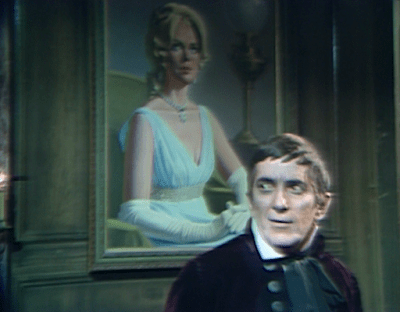
After confronting Julia and Angelique, needlessly revealing to them his suspicions, Barnabas decides to get some hard evidence. So he goes to Angelique’s old bedroom and stares really hard at the portrait of her that hangs there. She is in another part of the house, but grows agitated. She runs to the room and screams at him to stop staring into her eyes. He breaks into a triumphant… not grin, exactly, it’s more of a simper. It may be the only triumphant simper ever seen. That suits the occasion. He knows he was right, but Angelique knows that he knows, and it is not clear what he either can do to fight her or what reason he has to want to fight her.
Jonathan Frid’s invention of a facial expression previously thought to be impossible is one of several bits of conspicuously good acting in this episode. He also gets to deliver brief enigmatic responses to a number of questions, such as “Perhaps” and “Did I?,” and he makes each of those words materialize in space in such an arresting way that even his scene partners can’t help but show how impressed they are. As Liz fussing over Maggie, Joan Bennett shows a maternal quality that brings her hitherto undefined character into a very sharp focus. Grayson Hall also adds greatly to Hoffman’s depth. Standing by while Maggie is trying to kill herself, she is bland and detached. When she tells Angelique that it really is better for them that Maggie did not succeed, she is the opposite, torn between a number of emotions, including relief that she has avoided responsibility for a death.
Angelique has several comic lines, for example a wistful lament that she doesn’t get to see Maggie’s corpse mangled on the rocks below her window. And she puts real fervor into her spellcasting directed at Maggie. My wife, Mrs Acilius, remembered that when Lara Parker first joined the cast she wished she were playing an ingenue, so much so that Frid had to keep reminding her that she was the villain. But now she has settled in and become part of the group. So when Angelique abuses Maggie, Parker and her friend Kathryn Leigh Scott turn into two little girls playing make-believe, and they have so much fun at it that they are irresistible to watch, no matter how miserable Maggie is.
When Dark Shadows began in June 1966, its biggest draw was movie star Joan Bennett as reclusive matriarch Elizabeth Collins Stoddard. Liz was highly capable, and Bennett made her compelling to watch. When in #25 Liz’ brother, high-born ne’er-do-well Roger Collins, grudgingly complimented her on her “neat way of managing people,” we could see that he was putting it mildly. But the show didn’t handle Liz’ storyline very well, and she soon became a blocking figure. As the owner of the estate of Collinwood and of the Collins family businesses, as a central player in all the stories they had started with, and as the powerful personality Bennett had created, Liz was such an important part of the show that when she became a brake on the action, there was a constant danger that it would be impossible for anything to happen ever again.
The arrival of Roger’s estranged wife Laura Murdoch Collins in #123 marked Dark Shadows’ transformation into a supernatural thriller. By the time Laura went up in smoke in #191, her story had absorbed two of the four original narrative themes, “The Revenge of Burke Devlin” and well-meaning governess Vicki’s growing friendship with strange and troubled boy David, and had undercut whatever interest we might still have had in the other two, the mystery of Liz’ decision to become a recluse and Vicki’s quest to learn her true identity. The emerging Dark Shadows 2.0 had little room for Liz, and she subsided to the margins. When the show traveled back in time and became a costume drama from November 1967 to March 1968 and again from March to November 1969, Bennett played other characters and was able to make a substantial contribution, but Liz would never again be a suitable vessel for her great talents.
For the last eight weeks, the show has been in another time travel segment. Now it has traveled, not back in time, but sideways. They are in an alternate universe. The show insists on calling this universe “Parallel Time.” It is 1970 here, as it is in the original continuity, but a different 1970 where people with the names and faces we already know are living very different lives.
The Elizabeth Collins Stoddard of Parallel Time is not the mistress of Collinwood or an effective businesswoman. This Liz entrusted her inheritance to her brother Roger, who turned out to be just as feckless as his counterpart in the original continuity. As the penniless Roger we met in 1966 lives in Liz’ house as her guest and works in Liz’ business as her employee, so this Liz and Roger both live at Collinwood as the dependents of their brother, drunken sourpuss Quentin Collins.
In the original continuity, Quentin was not Liz and Roger’s brother, nor did he own anything. We got to know him when Dark Shadows was set in 1897, and he was a charming rogue, the younger brother of Judith and Edward Collins, who like Liz and Roger were played by Joan Bennett and Louis Edmonds. So the parallel lines representing the two versions of 1970 take a bit of a swerve into that other epoch.
Today, Liz is busy organizing a costume ball to be held in the great house of Collinwood. They had such a ball every year at this time when Quentin was married to his first wife, the late Angelique Stokes Collins, and Liz thinks that having another one would be the perfect occasion for Quentin to introduce all of his friends to his new wife, the former Maggie Evans. Liz needs help getting this party going. She comes bustling into the drawing room today and addresses herself to Angelique’s identical twin sister, Alexis Stokes, announcing that the party is tonight and 14 of the guests have failed to RSVP. She bemoans her inability to get anything organized and pleads with Alexis to help her. Alexis agrees to do so and excuses herself from a chess game she had been playing with Barnabas Collins, a man who recently showed up and introduced himself as a distant cousin of the Collinses of Collinwood.
Quentin enters the drawing room and orders Liz to cancel the ball. She says that it is too late to do that. Quentin stalks off and goes outside. Liz turns to Barnabas and asks him to reason with Quentin. Barnabas is unsure that he is the right person, but he goes to the door anyway. He opens it just in time to hear Quentin peeling away in his car. Maggie appears at the head of the stairs and asks if Quentin has gone. Barnabas has to say that he has, and Maggie looks crushed. Liz is unable to help in any way.
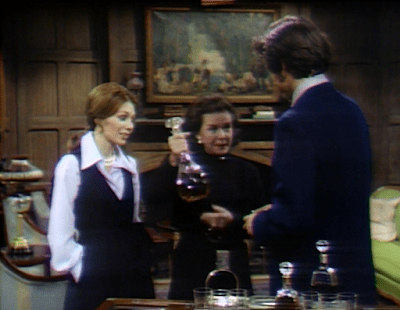
Later, Liz returns to the drawing room in the middle of a conversation between Quentin and Maggie. She is carrying an enormous decanter containing some sherry and congratulating herself on calming the cook’s nerves by her bartending. Quentin excuses himself to go get into his costume.
Liz finds that Maggie has not yet chosen a costume. She urges her to do so at once. Maggie says she supposed that Angelique always picked out her costume weeks in advance. Liz knows that Maggie is intimidated living in Angelique’s shadow, and does not know what to say in response to that remark. She quickly changes the subject. She brightens, and says that Alexis has brought many lovely dresses down from the attic. She urges Maggie to go to Alexis’ room and choose one of them.
As the time for the guests to arrive comes near, Liz and Barnabas meet in the foyer. A portrait of the Barnabas Collins who died in 1830 hangs on the spot on the wall next to the front door where earlier this week we had seen a metal doodad that looks like a coat of arms. Barnabas is wearing the same outfit, and looks just like the man in the portrait. Liz is wearing a dress of the same vintage. She is overjoyed, and tells Barnabas that the period suits him. He thanks her, and returns the compliment. Quentin is wearing a blue federal coat; Liz and Barnabas tell him that he, too, is suited to the early 1800s. Alexis comes downstairs in a blue dress, and she receives the same commendation. Lastly Maggie makes her appearance. When Quentin sees her dress, he becomes very tense. He tells her to take it off, orders her never to wear it again, and smashes his glass on the floor. The camera pans from Barnabas’shocked expression to a flickering look of pleasure on Alexis’ face; Liz stands between them, and unfortunately we only see the top of her head.
What Liz does not know is that the person she thinks is Alexis is in fact Angelique risen from the grave. Angelique murdered Alexis, took her place, and is conspiring with housekeeper Julia Hoffman to drive Maggie and Quentin apart. The story is a souped-up version of Daphne Du Maurier’s Rebecca, in which the dead first wife is not only a memory that triggers anxiety in her successor but a supernatural being who rises from the dead to torment her directly. There is a scene with Maggie looking out the window of the drawing room that is an exact recreation of a shot in Alfred Hitchcock’s 1940 film of Rebecca, and when Angelique and Hoffman trick Maggie into wearing the same dress Angelique wore to last year’s ball, prompting Quentin’s outburst, most grownups in the original audience would remember the same thing happening to the second Mrs de Winter in that film.
Angelique is the villain, and Maggie is the heroine. Still, we rather like Angelique. The sister-murdering is bad, of course, but Quentin is such a lousy husband that she is doing Maggie a big favor by trying to bring their intolerable marriage to its end as soon as possible. For example, today Quentin finds Maggie reading his old love letters to Angelique. He might justifiably have objected that those are private and say he wished she’d asked before reading them, but he doesn’t do that or anything else one adult would do when disappointed in another. Instead, he flies into a rage, accuses her of a variety of things she hasn’t done, and orders her to, and I quote, “Go to your room!”
Later, in the room they share, Quentin is still scolding Maggie for failing to admit that she was lying about how she found the letters. We know she had in fact told the truth. When she tells him so, he dismisses her with a shake of the head. When she brings up the fact that it is the anniversary of his wedding to Angelique, he shouts that she is forbidden to discuss the subject, then storms out and slams the door. This is when he goes downstairs, tells Liz to cancel the party, and drives away. We have never seen Maggie have a happy day with Quentin. He sometimes manages to be pleasant in the intervals between his tantrums, but even then he can’t let go of his habit of talking to Maggie as if she were a child and he were her somewhat weary guardian. If Angelique can hasten their final split, Maggie will owe her an enormous debt of gratitude.
Barnabas is not in fact a descendant of the man whose portrait now hangs in the foyer. He is a visitor from the main continuity. Angelique’s counterpart there is his great enemy, so it is fun to see him talking with this Angelique and playing chess with her.
David Selby has a problem with one of his lines, when Quentin winds up saying “I wonder where I got the illusion that an hour or two alone would settle one’s all of problems.” This is a fairly minor stumble by Dark Shadows standards, but it comes when Angelique is in closeup and Lara Parker’s left eyelid twitches when she hears “one’s all of problems.” That reaction is worth a laugh.
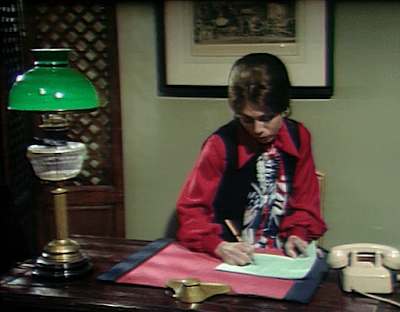
Maggie Evans Collins is staying with her sister Jennifer in New York.* She writes a letter to her estranged husband, Quentin Collins. Maggie says that there is no point in being married if they aren’t going to live together, so she is going to talk with Jennifer’s lawyer. She crumples the letter up and tosses it in the wastebasket. A moment later, the telephone rings. It is Quentin’s sister, Elizabeth Collins Stoddard. Liz tells Maggie that she must come home immediately.
Quentin appears to be having a heart attack. Liz found him writhing in pain in the drawing room. He was accompanied by someone Liz had never seen before. Eventually this person identified himself as Barnabas Collins, a distant cousin of theirs. Barnabas told Liz that Quentin had collapsed with severe chest pains, and urged her to call a doctor. She telephoned Cyrus Longworth, a friend of Quentin’s.** Cyrus doubts that Quentin will recover. Barnabas suggested Liz call Maggie, saying that she could get a flight and be at the great house of Collinwood within hours.***
The source of Quentin’s trouble is his first wife, the late Angelique. Angelique has risen from the dead, murdered her identical twin sister Alexis, and taken Alexis’ place as a houseguest at Collinwood. Angelique wanted Quentin to bring Maggie back to Collinwood so she could make them fall out of love with each other and reclaim her old place as his wife. To that end, she stuck a pin in the heart of a voodoo doll representing him. When that results in a possibly fatal cardiac event, she picks up the doll and cries that “You failed me!” She pulls the pin out. Cyrus’ prognosis that Quentin would die within minutes is thus defeated, but he is still gravely ill.
The camera settles on the clock in the foyer. It is 6:00. The shot lasts for five or ten seconds; they really want us to know it is 6:00. Barnabas has been in the house for several hours. He only exists when it is dark, since he is a vampire. When this episode premiered on 18 May 1970, the sun rose in central Maine at 4:29 AM and set at 8:00 PM. We may be able to believe that the date of broadcast doesn’t match the dramatic date, and accept that Barnabas can still be around at 6:00 AM. But it is not clear why they are asking us to do this.
We cut from the clock’s big closeup to another room, where Liz and Angelique are talking. Liz says that Cyrus was called away to attend another emergency. Angelique asks who is with Quentin. Liz says that Barnabas is. That left us wondering if the writers somehow forgot that Barnabas is a vampire. Why on earth would he agree to keep a vigil at an hour when the roosters are already crowing?
Maggie enters. She assumes Barnabas is the doctor. He tells her he is not. She apologizes; he dismisses it as a logical mistake. He hangs around when Liz and Angelique return and talk with Maggie. He accompanies Maggie when she goes in to the drawing room to see Quentin. He is still there when Quentin regains consciousness. He takes it upon himself to tell Quentin that Maggie is there. Quentin shouts that Maggie must not stay in the house. She does not go anywhere, but neither does Barnabas. He gives a shocked reaction, and is still lingering when the credits roll.
It is understandable that Barnabas would take a risk if it meant he could meet Maggie, and even more understandable that he would be reluctant to part from her once he had. He is not in fact related to anyone in this episode at all, not even as the extremely distant cousin he claims to be. In fact, he is from an alternate universe, which the show insists on calling “Parallel Time.” He knows another Maggie Evans there, one who looks and sounds just like this one but who is not married to Quentin. Barnabas had a long and fraught history with that Maggie. When he left his own continuity to come here in late March, he and the Maggie he knew had been moving towards a romance for several weeks. There was a bit of a bump in the road when Angelique’s counterpart cast a spell causing Maggie to fall in love with Quentin’s counterpart, but that was something that came and went. Barnabas never found out about it. So of course he wants to connect with this Maggie in some way.
*Presumably the city, though they never specify.
**Some in fandom protest that Cyrus is not a medical doctor. But he wrote a prescription for his fiancée, Sabrina Stuart, in #989, and in #1015 he resolved to give up his evil ways and “be a doctor again.” So I think these protests are ill-founded.
***Nowadays the idea of going to the airport in the middle of the night and buying a ticket for the next flight to central Maine seems to be of a piece with the most fantastic elements on Dark Shadows, but it wouldn’t have in 1970. Not that I can remember 1970- it was the year I was born, if you want to know- but well into my adult years it was still possible to show up at an airport gate with a handful of cash and buy a ticket for a plane that was already waiting there. I never did that myself, but I saw it done many times.
Chemist Horace Gladstone has been selling a strange and powerful synthesis of his own invention to Cyrus Longworth, an independent medical researcher. Cyrus refuses to tell Gladstone what he is using the synthesis for. Gladstone has now figured it out for himself. Cyrus has concocted a potion which he drinks to change his appearance, disguising him so effectively that even the people who know him best do not recognize him. In that disguise, Cyrus calls himself “John Yaeger,” spends a lot of money, and indulges his sadistic impulses.
Gladstone comes to Cyrus’ lab and tells him what he knows. Cyrus tries to deny that he is Yaeger, and Gladstone lists the evidence he has collected proving that he is. Gladstone tells Cyrus that he doesn’t believe he can do without the thrills he gets from his activities as Yaeger. The story has been crafted as an account of addiction, so returning viewers are sure Gladstone is right. He says he will go on serving as Cyrus’ connection for the drug he craves, but the price has gone up. He demands $10,000.
Cyrus first learned Gladstone’s name from his late friend Angelique Stokes Collins. Angelique was a woman of vast learning in a variety of fields, much like the title character in Edgar Allan Poe’s story “Ligeia.” Also like Ligeia, Angelique has returned from the dead. She is now back in the great house of Collinwood, impersonating the identical twin sister whom she murdered on the night of her resurrection, and occupying her old room as the guest of her widower, drunken sourpuss Quentin Collins.
Cyrus calls Gladstone a blackmailer. In reply, Gladstone makes a cryptic remark: “Why do you think my number was in Angelique Collins’ phone book? She’s led many lives. Each person only gets one. Good night.” We have indeed been wondering how Angelique came to know Gladstone, and now we wonder if he is aware of just how literally true it is that “She’s led many lives.” It doesn’t make any sense to follow “She’s led many lives” with “Each person only gets one,” but actor John Harkins was so precise in his delivery that I’m sure that was the scripted line. If there was a slip, it came from Sam Hall’s typewriter, not from Harkins’ tongue.
If it isn’t a slip, I think we would have to go out on a limb to explain what Gladstone could mean. Angelique built up a cult around herself, including several people who were firmly convinced that she was going to rise from the dead. When her sister Alexis came to Collinwood, housekeeper Julia Hoffman, sleazy musician Bruno Hess, and Angelique and Quentin’s son Daniel were certain that the prophecy had been fulfilled and they were seeing Angelique redivivus. This was also the first thought that came to Cyrus, to Quentin’s brother Roger, and to Angelique’s Aunt Hannah, though they were more easily persuaded that Alexis was a separate person. The cultists are impressive enough in their certainty that even people outside their ranks were sure Alexis was Angelique returned from the grave. Daniel’s cousin and playmate Amy Collins was horrified to see her for that reason, and Quentin’s second wife, the former Maggie Evans, fled the house in part because she could not shake her belief that Alexis was Angelique.
If Gladstone is familiar with Angelique’s cult and has been involved with it, he might be saying that each person gets to participate in only one of Angelique’s lives. We’ve already seen that is not the case, but that doesn’t mean he doesn’t think it is. Angelique may at some point have taught her followers a doctrine like that. While Hoffman, Bruno, and Daniel expected Angelique to come back and rejoin them, Cyrus, Roger, and Hannah were unsure they would see her again, even though they were certain that she was not simply dead. Indeed, Angelique is still telling her most of her devotees that she is Alexis. The only one to whom she has fully revealed herself is Hannah. Perhaps she had a plan to transcend death, but did not know just how it would work. Or perhaps she has decided the rest are not yet ready to be initiated into the esoteric truth of her return.
Sam Hall was a serious Lutheran, so much so that he insisted Shirley Grossman convert from Judaism before she married him and became Grayson Hall. Christian studies in twentieth century academic institutions were largely taken up with speculation about differences of opinion in the church before the codification of the New Testament and the formulation of the creeds. This sort of thing is still prominent in divinity schools today, and is often heard from pulpits in mainline Protestant denominations. Hall must have been familiar with it, so he probably gave it some thought when he spent Easter season 1970 writing scripts about a figure whose followers sort of expected her to rise from the dead and who surprised them by the way in which she actually did so. I doubt he was making any particular point about the various schools of thought that seminary professors postulate in the primitive church, but when he presents Angelique’s cult as divided into several strains of opinion from the start he is developing an idea that he did not have to invent himself.
We cut from the scene between Cyrus and Gladstone to the basement of Collinwood. Angelique leads Quentin to a little chamber hidden behind an alcove. A human skeleton stands in the chamber. You may wonder how a skeleton can stand, but Quentin doesn’t. He is too busy being surprised that he didn’t realize this chamber was in his basement.
The skeleton is that of Dameon Edwards, a friend of Angelique’s who went missing about a year before. Dameon’s ghost has been haunting the place for a couple of weeks. Angelique tells Quentin that Hannah found the skeleton and exorcised the ghost. Yesterday, we saw Angelique exorcise the ghost. Returning viewers know that she is giving credit to Hannah because she is masquerading as Alexis, who did not share her sister’s interest in the occult or her aunt’s. Quentin thinks that Bruno probably killed Dameon. Indeed, the ghost confirmed this yesterday. Quentin very much wants to get rid of Bruno, so you might think he would be interested in bringing a murder charge against him. But he decides that would be too much trouble, and it hurts his feelings when “Alexis” snaps at him that he shouldn’t be wasting his time reporting Dameon’s murder when he isn’t doing anything to investigate Angelique’s. So he calls Cyrus, and the two of them bury the bones on the grounds of the estate.
Meanwhile, two long-absent characters have returned from trips out of town. Quentin sent Hoffman to visit friends of hers in Boston because she kept antagonizing Maggie. Quentin’s sister Elizabeth Collins Stoddard also went away for a long stay in New York, where she visited Maggie. In off-screen reality, Grayson Hall and Joan Bennett were both in Tarrytown, New York with several other cast members, working on the feature film House of Dark Shadows. Liz complains that Hoffman didn’t meet her at the train station with a car, and Hoffman explains that she just got back herself.
Hoffman says she missed Collinwood terribly while she was in Boston; Liz says she can’t understand that. If she were in Quentin’s place, she would sell the house and move to the city. That will interest longtime viewers. For its first 196 weeks, Dark Shadows was set in a parallel universe, where Liz’ counterpart owned Collinwood. When the show started, she was a recluse who hadn’t left the house for eighteen years. Her brother Roger often urged her to sell the place so that they could live someplace less gloomy, but even after she stopped being a recluse Liz wouldn’t hear of that. She was a symbol of the family’s commitment to the house. We have already seen that this Liz is the opposite of her counterpart in other ways, and now we wonder how far they will take that mirror image motif.
Angelique is in the foyer, talking on the telephone to Hannah. Villains on Dark Shadows have remarkably little sense of OpSec, and this is a case in point. Quentin, Liz, and Hoffman are a few feet away from her in the drawing room, and each of them knows that Alexis and Hannah couldn’t stand each other. All Angelique has to do is call Hannah by name and she will raise their suspicions. Yet not only does she use Hannah’s name several times, she uses one incriminating expression after another about how no one will suspect what they are up to. If any of them listens in, or of anyone else in the house happens by on their way to the front door, Angelique will have tipped her hand.
It is Hoffman who eavesdrops on the call. After Angelique catches her, they have an awkward exchange and Hoffman goes upstairs. Angelique then stands at the door to the drawing room and eavesdrops on a conversation between Liz and Quentin. Liz wants Quentin to go to New York and ask Maggie to come home, he throws a tantrum and says that Maggie is too childish for him to do such a thing.
Hoffman is in Angelique’s old room, talking to the portrait of her that hangs there. The members of Angelique’s cult make a practice of coming to the room and carrying on conversations with the portrait; when Alexis was staying in the room, she sometimes walked in on them while they were confiding their thoughts to it. Angelique eavesdrops on the last part of Hoffman’s account that when she was in Boston, she felt a mystic assurance that when she returned to Collinwood she would find Angelique come back to life. When Hoffman says that everything seems to be the same as it was when she left, she is close to tears.
The resurrected Angelique eavesdrops on Hoffman’s conversation with the dead Angelique. Screenshot by Dark Shadows Before I Die.
Angelique takes a step forward, and Hoffman realizes she is not alone with the portrait. She apologizes to “Alexis,” and Angelique says she needs a friend she can trust. Hoffman claims to be such a friend. “Alexis” then launches into her reasons for believing that Angelique was murdered. After the first couple of sentences, returning viewers know what she is going to say, so we dissolve to Quentin and Cyrus in the drawing room.
Quentin and Cyrus have just buried the skeleton, prompting Quentin to feel sorry for himself. He then tries to explain to Cyrus something extremely weird he saw the other evening. He went to Angelique’s old room to see Alexis. He opened the door, and saw a space that lacked the room’s furniture, lights, and decor. He saw two children whom he took to be Daniel and Amy, and they said something about Barnabas Collins. The only person of that name of whom Quentin or Cyrus is aware died in 1830, but the children were talking about someone they knew. An invisible barrier kept Quentin from entering the room, and he could not attract the children’s attention. Regular viewers know that Quentin was catching a glimpse of the other continuity, and that the children were not Daniel and Amy Collins, but their counterparts David Collins and Amy Jennings. Cyrus hasn’t been watching the show, so all he can do is suggest Quentin take a vacation.
They’ve been experimenting with videotape editing, and they make a jump cut from the drawing room scene with Quentin and Cyrus to Quentin walking up to the doors of Angelique’s room. The effect is startling, I suspect intentionally so. Quentin opens the doors, and again sees the other universe.
This time Quentin sees the counterparts of Liz and Hoffman. As David and Amy had been, they are talking about Barnabas, who was last seen in this room. Hoffman, whom Liz addresses as Julia, says that they must keep the room open so that Barnabas will have a chance to return to them. She says she wants to stay there, because it makes her feel close to Barnabas. Liz excuses herself, and Julia calls out to Barnabas. As Hoffman had grown emotional talking to the Angelique whom she believed to be absent, Julia grows emotional when she talks to the missing Barnabas. She looks at the hallway, seeing not Quentin but the dark, empty space that is there in her universe. She asks if Barnabas is there, watching her. Grayson Hall plays these two scenes so similarly that we can have no doubt that whatever the one Julia Hoffman feels for Barnabas, the other feels for Angelique.
Quentin calls out to Hoffman’s counterpart, as he had called to Daniel and Amy’s counterparts. As the children had been unaware of his presence, so this other Julia Hoffman is unaware of him. And as Daniel and Amy had come to the hallway and asked why he was shouting for them, Hoffman comes to the hallway and asks why he is shouting for her.