Episode 1115: The woman in question

The year is 1840. Vampire Barnabas Collins summons his latest victim, Roxanne Drew. They meet at the gazebo on the grounds of the estate of Collinwood. He says he has a way they can be together forever. She says she would die for him. That’s what he had in mind. He bites her, drains her body of blood, and lets her fall to the floor of the gazebo. He tells her corpse that it will be found tomorrow, and that Roxanne will be mourned. The following night, she will rise as a vampire. He walks off, leaving her.
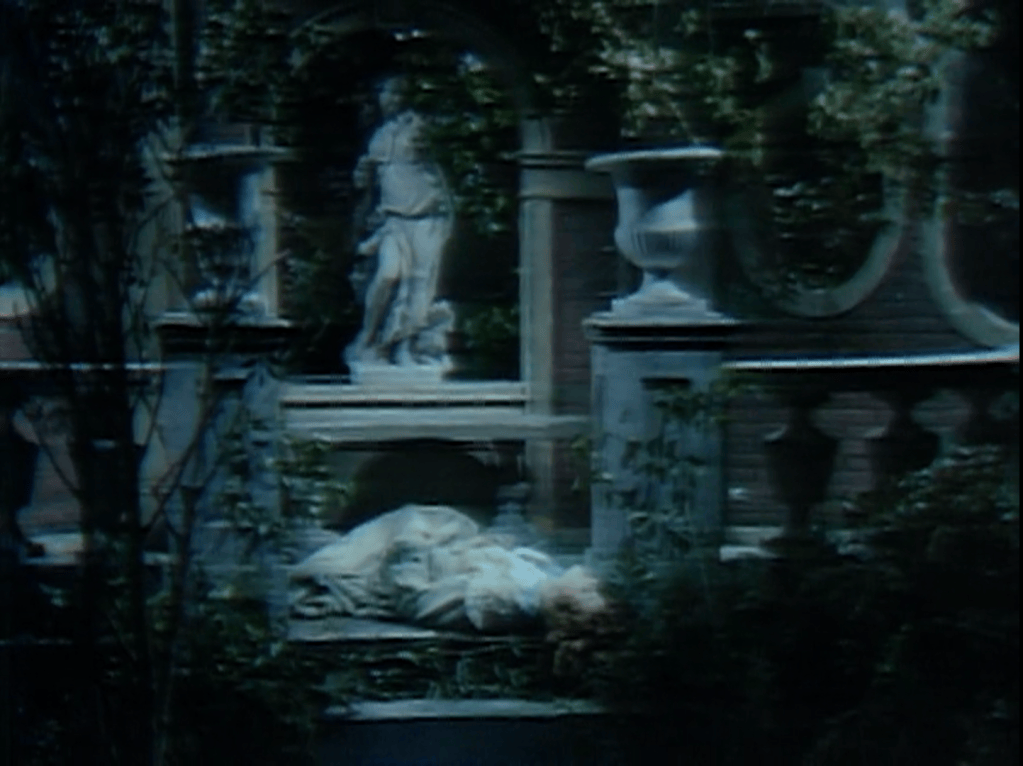
Roxanne, left like a cat leaves a mouse for its people to find.

Roxanne’s sister Samantha also has a new relationship, and may also be murdered as a result. Her husband, whose name is Quentin Collins, is missing and presumed dead after a shipwreck. Quentin and Samantha’s son Tad was with his father and is also missing. Quentin’s friend Gerard Stiles has been a guest at the great house of Collinwood for some time. We saw the other day that Samantha turns to Gerard when she needs comforting, and they kiss today.

After Gerard and Samantha’s love scene, Gerard is alone in the drawing room with Quentin’s brother Gabriel. He is in the act of walking out on Gabriel when Gabriel addresses him as “Mr Miller.” Gabriel leafs through a stack of papers about the life of crime Gerard led under his original name, Ivan Miller. Gerard grabs the papers from Gabriel. Gabriel clutches at Gerard’s arm and squeezes it so hard Gerard falls to his knees. Gerard is stunned by Gabriel’s strength. Gabriel gets around by pushing himself in a manual wheelchair, which does indeed build the muscles in the arms and upper back, so it is a believable moment.

Gabriel then hands Gerard the papers and says that they are his copy. He has another copy stashed where it will go to the authorities should any harm befall him. He says that he will hold them back provided Gerard makes himself useful to him. First he dispatches Gerard to acquire a large packet of arsenic. Then he tells Gerard that his next duty will be to poison Samantha with the arsenic a little bit at a time, so that she dies a painful, lingering death. Gerard says that he would rather just leave Collinwood and make a fresh start somewhere else rather than do that. Gabriel says that since Samantha’s death will make him the heir to his terminally ill father’s vast estate, he will be able to pay Gerard very handsomely for the task. He offers him 10% of the Collins fortune. Since Gerard apparently murdered a woman in Portugal a few years back, Gabriel is quite sure he will not be squeamish about murdering another woman, especially when he stands to profit so richly. Gerard says they have a deal.

In #1077, set in 1970, another Quentin Collins was reading the family history when he learned for the first time that he had a “grand uncle” who lived in 1840 who was also named Quentin Collins. Not even the family history mentioned Tad’s name. Since that Quentin was born in 1870 (though he looked much younger than his hundred years,) we could take it that neither Grand Uncle Quentin nor his widow was the one through whom ownership of the Collins family wealth passed to the other generations we have seen. Indeed, longtime viewers may recall that in #701 and #702, set in 1897, Quentin’s very elderly grandmother Edith Collins reminisced on her deathbed about her husband Gabriel. So we know that Gabriel and Edith are the parents of a son who will sire that other Quentin and his siblings, among them Edward Collins, whose son Jamison will go on to be the father of Elizabeth Collins Stoddard and Roger Collins, the adults at the great house in the 1960s.

As of this day in 1840, however, Gabriel’s father Daniel Collins has named his son Quentin his sole heir, with Tad in second place and Samantha in third. Told that Quentin and his son are dead, Daniel has refused to rewrite the will in Gabriel’s favor. Early in the episode, Samantha tells Gabriel that when Daniel dies, it will be up to her to take care of him and his wife, and that she will do so provided they behave themselves. Knowing that it does not work out that way, we can believe Gerard will actually carry out the assignment Gabriel gives him today.

The disappearance of Quentin and Samantha from the Collins family’s memory by the late nineteenth century is only the first of four reasons we might believe Gabriel’s plan will come to fruition. The second is the casting of Samantha. Virginia Vestoff was a splendid actress whose performance lets a great deal of fresh air into every scene she appears in. However, Samantha is Vestoff’s first role on Dark Shadows. If she were a member of the show’s established repertory company, we might be confident that Gerard will disappoint Gabriel and let her live. But first timers, even spectacularly talented ones with solid backgrounds on Broadway and in daytime television, often turn out to be short-timers. So her presence adds to the suspense about her character’s future.

The third reason is an echo of the circumstances of one of Dark Shadows‘ most prominent on-screen murders. In 1967, Barnabas coerced his associate, mad scientist Julia Hoffman, into preparing a lethal injection for her old friend Dave Woodard, who was threatening to expose their crimes. As Gerard brings the arsenic to Gabriel today, only to be shocked to hear that he will have to commit the murder himself, so Julia offered the hypodermic to Barnabas, only to be told that she would administer the deadly shot. The murder of Woodard actually came off, so longtime viewers have another reason to expect that Samantha, too, might die. And of course that Gabriel pulls the same maneuver on Gerard that Barnabas pulled on Julia shows that they really are members of the same family and that they are bearers of that family’s curse.

The fourth reason grows from what we have seen of the future of Collinwood. In segments set in 1970 and 1995, we have seen that Gerard’s ghost will destroy Collinwood and rule over its uninhabitable ruins for decades after. Today that starts to make sense. If Gabriel’s descendants own the house and hold their position in the community as the result of a hideous crime their ancestor committed through Gerard, then it is fitting that Gerard should be the face of the long-delayed reckoning for that crime.

I should mention that Vestoff is not alone in giving an excellent performance today. Christopher Pennock was pretty hard to take when he first joined the show as monstrous man-child Jabez Hawkes in #935; he moved well, but he delivered his dialogue with so much bombast that he stood out even among the cast of Dark Shadows. He was noticeably better as Jekyll/ Hyde characters Dr Cyrus Longworth and John Yaeger from #985, but still enunciated his lines too self-consciously to really draw the audience in. As astrologer Sebastian Shaw from #1073, he was a little more natural, but Sebastian was such a poorly conceived character that he couldn’t really show his stuff.

As Gabriel, Pennock finally comes into his own. He is smooth as silk in Gabriel’s scenes with Gerard today; it’s a pleasure to listen to him sidle his way from one syllable to the next. He’s just as pitch-perfect projecting Gabriel’s humiliation and uncontrolled rage in his scene with Samantha as he is at the opposite end of the emotional spectrum with Gerard. Certainly Vestoff and James Storm are first-rate scene partners; they may deserve a share of the credit for Pennock’s fine work. Or maybe he just needed to sit down, I don’t know.

It’s no news to fans of Dark Shadows that Jonathan Frid was capable of great work. He’s been on top form this week. The other day, Barnabas’ aged friend Ben Stokes told him a bizarre story, to which Barnabas replied “You’re mad, old man.” No actor could deliver Henry V’s dismissal of Falstaff, “I know thee not, old man” more heart-breakingly than Frid delivers that line. And watching his face as Roxanne falls dead in Barnabas’ arms, you can feel the terror and the awe of the moment. The murders sometimes come so thick and fast on Dark Shadows that watching them we can feel like we are seeing the coyote raise yet another the mushroom cloud at the end of his fall after failing to catch the roadrunner, and Barnabas himself often takes killing very lightly. But there is nothing cartoonish about what he does to Roxanne.
Episode 1074: Talking doesn’t help

For the first six months of Dark Shadows, reclusive matriarch Elizabeth Collins Stoddard kept the story from moving by refusing to tell anyone what she knew about the major storylines. With the introduction of undead blonde fire witch Laura Murdoch Collins in #123, the show became a supernatural thriller. The characters driving the new storylines took care to exclude Liz from the action by never letting her find out what was going on.

Now, old world gentleman Barnabas Collins and mad scientist Julia Hoffman have returned to 1970 after a visit to 1995. They have told Liz and others what they saw in that future year, warning that a terrible disaster is impending that will destroy the great house of Collinwood and everyone in it. Julia and Barnabas are not sure just what will happen or when, but they know it will occur before the year is out and that it will center on teenagers David Collins and Hallie Stokes.

The adults have decided to keep the relevant information from Hallie and David themselves. That’s the whole problem today- a series of uncanny events occur that David and Hallie would recognize as signs of the disaster and about which they would be able at least to sound the alarm had they been given the relevant information. Since they have been kept in the dark, they are helpless and the events are pointless.

Not only are the characters not learning from each other, Liz and David have forgotten a great deal that they used to know. From the first week of the show, David was on intimate terms with the ghosts of Collinwood. But today he mentions to Hallie that when he saw a ghost he was not afraid, and he cannot understand why he wasn’t afraid. Liz’ daughter Carolyn mentions that she found Hallie wearing an antique dress. Liz responds that putting on an antique dress can hardly precipitate the kind of disaster Barnabas is talking about. Yet precisely the kind of disaster Barnabas is talking about already befell Collinwood in March 1969, and the first step towards it came when David and his friend Amy Jennings played dress-up, wearing antique clothes under the influence of the malign ghost who would eventually drive everyone out of the great house.

At moments, the script seems to acknowledge that the whole episode is a waste of time. Liz asks Carolyn if she believes in astrology. Carolyn says she doesn’t believe in anything, so she might as well pay attention to her horoscope. It’s no more meaningless than anything else.

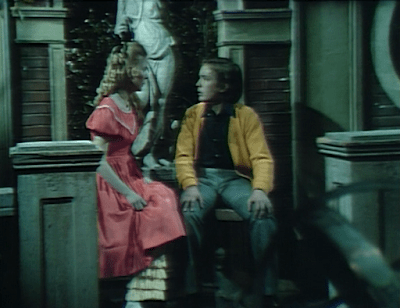
The opening scene, in which David and Hallie spend what seems like an hour hanging around the gazebo and talking about the fact that she doesn’t remember putting on her dress, is particularly bad. I’m reluctant to complain about any of the actors, since the conditions under which they had to work were extremely difficult. I’m especially reluctant to single out performers like Kathleen Cody, who gets a lot of negative comment from fandom. But she is very bad in this scene, just terrible, loud and fake and hard to put up with. Not that I can see what anyone could have done to make the scene interesting, but the situation is so slight it cannot for one moment bear the emotional load Miss Cody piles on it.

There are a few moments of unintentional comedy today revolving around wardrobe. David wears a sweater over a sports shirt and a pair of trousers with the belt fastened somewhere above his navel. David Henesy is in his late 60s now; he still isn’t old enough to wear that outfit. But combined with David’s grouchy attitude, the costume makes him seem like some old guy from New England.

Why don’t nobody know how to make clam chowdah no more? Screenshot by Dark Shadows Before I Die.

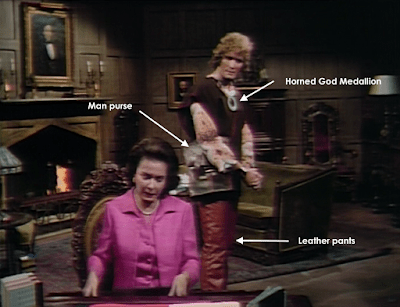
Chris Pennock shows up as astrologer Sebastian Shaw. Sebastian’s costume was bizarre even by the very generous standards of 1970. John and Christine Scoleri labeled some of its more unusual features in their post about it at Dark Shadows Before I Die:

I mean really. Screenshot by Dark Shadows Before I Die.

The utter preposterousness of Sebastian’s getup goes some way towards relieving another bad taste in the mouths of longtime viewers. Pennock also played Carolyn’s late husband Jabe, whom everyone insisted on calling Jeb. When Carolyn first sees Sebastian, she is shocked at the resemblance. The show first went all-in on its repertory approach to casting in November 1967, when well-meaning governess Vicki traveled back in time to the 1790s. She found that the characters she met in that epoch were played by actors she knew from the first 73 weeks of the show, and tried everyone’s patience by telling them about their previous parts. That unbelievably stupid habit marred the 1790s segment and utterly destroyed the audience’s interest in Vicki. Carolyn’s recognition that Pennock was Jeb before he was Seb brings that unpleasant memory back, and any distraction from it is welcome.

At one point Liz finds David standing over Hallie while she is in bed in the small hours of the morning. Liz demands to know what he’s doing there, and is particularly indignant that he is “still dressed.” Mrs Acilius and I laughed out loud at that. It’s better he should be naked?

Episode 1073: I don’t have to imagine things

Old world gentleman Barnabas Collins and his friend, Dr Julia Hoffman, MD, have returned to 1970 after an inexplicable journey through time. During a sojourn in 1995, they learned that a mysterious disaster is about to befall the great house of Collinwood. They have told several people about this disaster and withheld the information from several others.

Among those Julia and Barnabas have told is matriarch Elizabeth Collins Stoddard. We see Liz in the drawing room discussing the matter with governess Maggie Evans. Maggie is hurt that Barnabas hasn’t seen her since he returned. When Barnabas departed, there was a story brewing about a possible romance between him and Maggie; we might have thought the show would have forgotten this narrative thread, and some fans would prefer it had done so. But evidently it isn’t quite gone yet.

Among those Barnabas and Julia have not told is grouchy New England teen David Collins. David enters the room as Liz and Maggie are talking about the idea that something might happen. He says that something is happening, all right. Liz asks what it is and he says he will tell them what he knows if they tell him what they know. Liz huffily declares that the matter at hand has to do with a theory he could not possibly understand, and that she knows he could not understand it because she doesn’t understand it, either. Unimpressed by this logic, David stands his ground. He says it’s time they stop treating him like he is four and a half years old. Liz tells him that if he knows something they ought to know, he should tell them about it. How he is supposed to know what they ought to know when they won’t tell him anything is unclear. The exchange ends in a stalemate.

Julia and Barnabas have also tried to keep the relevant information from the other teen in the house, Hallie Stokes. Hallie eavesdropped on a conversation yesterday and picked up some ominous-sounding remarks with no context. David had a dream that night in which he saw Hallie wearing an old-fashioned long orange dress with puffy sleeves. Later, the same dress materialized on Hallie’s bed.

What neither Hallie nor David knew was that Barnabas and Julia saw that dress in 1995. The girl wearing it looked exactly like Hallie, but was named Carrie. She danced a minuet at the gazebo on the grounds of Collinwood with a boy who looked exactly like David but was named Tad.

When Hallie sees the dress at the beginning of today’s episode, she wonders how it got there. Maggie knocks on the door and Hallie hides it under her bedclothes. After Maggie goes, Hallie wonders why she didn’t just ask her about it. Longtime viewers have seen enough supernatural storylines start on Dark Shadows to know that a compulsion to withhold information is often the first step towards doom. It is frustrating that Liz, who has been central to the show since episode 1 premiered on 27 June 1966, hasn’t learned that lesson yet and applied it to her dealings with David.

David goes to Hallie’s room and tells her about his dream. She says that lots of boys dream about her; he says that unlike the others, he tried to go back to sleep afterward. David doesn’t specify what the other boys are doing with the image of Hallie in the middle of the night, but he lets her draw the conclusion that she isn’t up to his standards in that wise. When he tells her about the dress, she freaks out and accuses him of playing tricks on her. He doesn’t know what she’s talking about and doesn’t care enough about her to stick around until she clarifies it. He grumbles that he’ll never understand women and stalks off.

Later, David gets a note telling him to go to the gazebo at midnight. He sees Hallie emerge from the bushes, wearing the dress. He suddenly realizes that she is not Hallie at all. Carrie has made her appearance.

Carrie and David by the armillary sphere. Screenshot by Dark Shadows Before I Die.

The gazebo set is decorated with an armillary sphere that is prominently featured today. From the first appearance of this doodad in #737, we might have wondered if the show was going to incorporate astrology into its stories. Two of the cryptic phrases Julia and Barnabas collected as clues during their visit to 1995 were “the night of the sun and the moon” and “the unfinished horoscope,” indicating that the time is coming for this to occur.

Liz is in a strange quiet mood today; Joan Bennett plays her very deep. She speaks softly, rarely makes eye contact, and often gives little signs of deep, somber thought. She mutters to Maggie that no one can know the future, “unless…” When Maggie asks unless what, she refuses to answer.

Liz telephones a man named Sebastian Shaw, who is wearing a piece of clothing that was ridiculous even by the standards of 1970. Actor Chris Pennock would later say that he retained absolutely no memory of ever having played a character named Sebastian; if I had worn that garment on national television, I think I would have blocked out the recollection as well.

Sebastian gets very prickly when people do not accept him as a serious professional. Screenshot by Dark Shadows Before I Die.

Sebastian is an astrologer. He agrees to cast a full horoscope for the rest of 1970 for Liz. Since Barnabas and Julia told Liz that an unfinished horoscope is one of the signs that doom is near, it would seem rather bold of her to start an astrologer casting an elaborate chart.

Episode 1064: There are only intruders

A disruption in the very nature of time and space has thrust vampire Barnabas Collins and mad scientist Julia Hoffman into the year 1995, where the great house of Collinwood is in ruins and everyone is annoyed with them.

Yesterday, Julia and Barnabas were poking around inside the great house against the express instructions of its owner, Carolyn Fredericks, as conveyed earlier in the evening by the sheriff when he arrested them for trespassing. A heavy bust fell from the railing on the top of the foyer stairs, narrowly missing Julia. She and Barnabas fled the house. They looked back, and saw a young man in nineteenth century garb glaring at them from a window.

Today, Barnabas and Julia are in the parlor of the Old House on the estate. She tells him that when she saw the man in the window she was overcome by a powerful sensation. “It was the very essence of evil! I felt evil all around me. I was trapped by it!” Regular viewers may have thought Julia would be used to that by now, but apparently not. “It made me aware of something deep inside me that I don’t even understand — as though, with that one look, he could concentrate every grain of evil I have in my nature! Make it grow, and grow…” She asks Barnabas if he felt the same thing, and he says he didn’t, not at all. He concedes that he is an inhuman abomination from beyond the grave, so maybe he’s immune to that kind of thing.

Meanwhile, Carolyn is at home in the old shack by Finley’s Cove, accompanied by Mrs Johnson, who was the housekeeper at Collinwood in the late 1960s. Carolyn is brushing her hair and smiling. She reminisces about when she was a little girl and Mrs Johnson used to brush her hair. Mrs Johnson is not shy then or later about contradicting anything Carolyn says that is not so, but does not deny that she did that. So the audience is supposed to believe it. Some say this is a retcon, since Mrs Johnson did not join the staff at Collinwood until 1966, when Carolyn was fully grown. But in a comment on Danny Horn’s post about the episode on his great Dark Shadows Every Day, I expounded a theory as to how it might be true:

In the early episodes, Carolyn talks about having gone to school in town. How did she get there?

She can’t have walked; it was miles away, much of it along a winding road with several blind curves. Her mother never left the grounds during those years, she couldn’t have driven her. Roger was living in Augusta with Laura.

(I should expand on this point. Roger says that when Carolyn was born, he was away at boarding school. So he would still have been in college when his niece first became a pupil at Collinsport Elementary. He then busied himself squandering his inheritance, a process which included the ten years between his marriage to Laura and his return to Collinwood. So that doesn’t leave any time for him to have looked after his “Kitten” when she was little.)

The only servant was Matthew. Matthew and Carolyn don’t seem at all close; it doesn’t seem likely that he drove her to school every morning. If a school bus came up the hill to Collinwood day after day, the kids who rode it couldn’t have maintained the attitude Carolyn describes, whispering behind her back about her living with the witch in the haunted house. Sooner or later they’d have started talking to her face to face about it.

Carolyn also talks about Bill Malloy being more like a father to her than any other man, and the two of them do have a cozy relationship. Carolyn is also very quick to fall in with Mrs Johnson when Burke pitches the idea of her joining the household staff at Collinwood. So I think we have to conclude that Bill Malloy and his housekeeper were in charge of getting Carolyn to school in the mornings. Malloy was on the fishing boats, so that would require an early start to the day. There were probably many days when little Carolyn was still in her pajamas when she got to the Malloy house. On those days, Mrs Johnson brushed her hair while the water came to a boil for breakfast.

Comment left by “Acilius,” 27 January 2021, on Danny Horn, “Episode 1064: Here Comes the Hotstepper,” Dark Shadows Every Day, 20 August 2017.

Carolyn seems to be a crazy lady these days. Yesterday, we saw that much of this is an act, but in her scene with Mrs Johnson we see that it is an act she puts on even when she is alone with someone she trusts. It allows her to smile and laugh and be happy even when she is surrounded by the residue of an unimaginable catastrophe.

Carolyn tells Mrs Johnson that she will be going to the great house of Collinwood to get ready to host a picnic at the gazebo, which she pronounces “ga-ZAY-bo” in a bit of Collinsport English that we’ve been hearing intermittently since Lara Parker invented it in the summer of 1968. Mrs Johnson reacts with horror, saying that no one can go to the devil-haunted wreckage of Collinwood, but Carolyn laughs off her objections. Carolyn shows a picture of a picnic they had at the ga-ZAY-bo in 1970, the last year Collinwood was habitable. Mrs Johnson spots a figure in the background and declares that was “the first time we saw him.” Carolyn gets upset and tears up the picture.

Barnabas had insisted to Julia that the man they saw at the window may not be the only supernatural entity operating within the great house, and Carolyn seems to confirm that he is right. She does not want to hear Mrs Johnson referring to him, nor does she want to have a picture of him. But she happily says that she is going to the great house tonight with a present, because it is his birthday. Apparently him and his refer to different beings, each of which inheres in the haunting. One wonders how much of supernaturalism would dissolve if people would just use proper names instead of pronouns.

Julia and Barnabas barge into Carolyn’s house. Carolyn tells them to get out, which they refuse to do. They badger her with the story of what happened when they were illegally roaming around in her other house, and Mrs Johnson runs out. Eventually Carolyn resumes her crazy lady demeanor. Barnabas and Julia give up and leave, and for a moment we wonder if they are on their way to let themselves into some other property of Carolyn’s.

Julia and Barnabas go back to the Old House. They find that Mrs Johnson is waiting for them there. They tell her that they are time travelers, and that if she will tell them what happened they might be able to go back and prevent it. She is dubious about this claim, but starts telling the story anyway. She casts her mind back to the summer of 1970. “It all began when the days were so beautiful, you couldn’t help but be happy. There was a spirit of joy at Collinwood; there was a feeling that hadn’t been there in a long time. There was so much love among all of us at that time…” This would be the period that began immediately after Barnabas and Julia left.

Mrs Johnson says that all of the beauty and joy and love and other things you might experience when you don’t have a vampire and a mad scientist around your estate came to an end one quiet night. She seems to be on the point of saying something important when she looks at the window of the parlor and sees the glaring young man. She breaks off, screams that she won’t tell, and runs out into the night. Julia tells Barnabas she felt the evil presence, and that the ghost was there. They go out to look for Mrs Johnson.

The ghost catches up to Mrs Johnson first. He touches her shoulder, and she dies. When Barnabas and Julia find Mrs Johnson, she is sitting on the ground, her back against a tree, her eyes open. This was the same posture in which Clarice Blackburn’s character Abigail Collins was found when we saw her corpse in #432. That image was a brief shocker in the last couple of seconds of the episode; this time the camera zooms in on Blackburn’s face and pans across it, allowing her to show that an outstanding actress can give a powerful performance even when she is altogether motionless.

Carolyn happens by. Julia and Barnabas hide. Carolyn thinks Mrs Johnson is alive and chatters to her. As the truth begins to dawn, Carolyn’s alarm mounts. Finally Barnabas and Julia emerge from the shadows. Carolyn accuses them of killing Mrs Johnson. They deny their guilt. Carolyn is unconvinced, and indeed we cannot help but think that since Mrs Johnson lived through the 25 years of their absence and turned up dead so shortly after they returned, Julia and Barnabas cannot be exactly innocent.

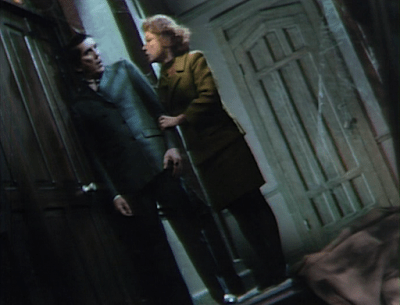
Barnabas and Julia follow Carolyn into the great house. Julia wonders what Mrs Johnson could have meant by “the children’s old room.” This is a blooper on Grayson Hall’s part- Mrs Johnson mentioned “the room the children called The Playroom.” Julia and Barnabas hear music playing, and follow it to a room upstairs. Barnabas looks at the doorway and remarks that the room was never there when he knew the house. The shot is framed at such a severe Dutch angle that we can tell something isn’t on the level.

Tell all the truth but tell it slant. Screenshot by Dark Shadows Before I Die.

They hear Carolyn inside, talking and laughing with at least one other person. Since their whole philosophy of life now seems to be making themselves as obnoxious as possible to Carolyn, they let themselves in.

Episode 1030: As though I had touched death

Elizabeth Collins Stoddard is fretting about her brother Quentin’s childish behavior. Quentin’s wife, the former Maggie Evans, has left the house abruptly, without her purse, and has been away for some time. Liz is sure something bad has happened to Maggie, but Quentin refuses to look for her.

Liz tries to interest Alexis Stokes, identical twin sister of Quentin’s late first wife Angelique, in Quentin and Maggie’s troubles. She does not know that the person she is talking to is not Alexis at all, but Angelique herself. Angelique rose from the dead, murdered Alexis, and took Alexis’ place as a permanent houseguest in the great house of Collinwood as part of her plan to win Quentin back. To that end, Angelique is conspiring with a man she knows as John Yaeger. He has abducted Maggie and is holding her in a dungeon out in the country, hoping that after enough time alone with him she will forget all about Quentin and fall in love with him.

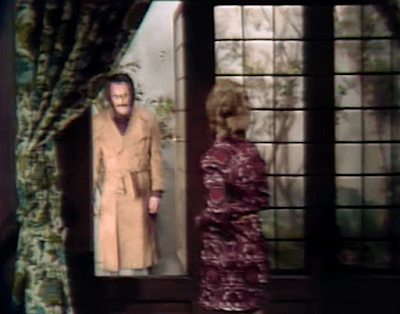
“Alexis” is pacing around the drawing room while Liz talks about Maggie and Quentin. She is half listening when she approaches a window and sees Yaeger waiting outside. She suddenly tells Liz that she is going to go out herself and look for Maggie. Liz tells her this is too dangerous, but she rushes out. She confers with Yaeger in the gazebo.* Yaeger is despairing of his plan, much to Angelique’s annoyance.

Angelique, alias Alexis, sees Yaeger at the window. Screenshot by Dark Shadows Before I Die.

There is no such person as Yaeger, any more than there is a living Alexis Stokes. The man is really Cyrus Longworth in disguise. Maggie and Quentin think of Cyrus as a friend, a mild-mannered scientist who means well, though he is sometimes strangely naive. Cyrus has developed a potion which changes his appearance so drastically that not even those who know him best can recognize him when he is under its influence. After Cyrus tried to rape Maggie last week while disguised as Yaeger, he threw the potion away. But he then transformed spontaneously, without drinking it. Since he cannot re-Jekyllize himself without it, we are left wondering if he will remain in his Yaeger form permanently. We may also wonder what he will do if he reverts to his usual appearance in front of Maggie. He has admitted to himself that he and Yaeger are not separate people, but still seems to want to hold onto some sense that they are. He can’t very well do that if Maggie knows he is the one keeping her locked up.

Liz stays in the drawing room after “Alexis” leaves. Roger Collins enters and helps himself to some brandy. Liz picks up with her brother where she had left off with “Alexis.” Roger doesn’t even pretend to care about Maggie. He was fixated on Angelique when she was alive, and cannot forgive Maggie for not being her. He is glad Maggie is gone, and nothing Liz says about her can stir his interest. Joan Bennett and Louis Edmonds played different versions of these characters starting in #1, and it is always great to see them together.

Angelique has a problem of her own. She can stay out of the tomb only so long as she finds living bodies to drain of their warmth. She’s already killed three people that way. The first two were Alexis, whom she is successfully impersonating, and a handyman named Fred, who was expected to leave town anyway. Neither of them has been missed. The third, lawyer Larry Chase, caused puzzlement when his ice cold corpse was found in front of her, but as an isolated occurrence no one seems to have found a way to start solving that puzzle. So “Alexis” is not currently suspected of being a vampiric creature.

The need for warmth suddenly comes over Angelique. She goes to the drawing room and huddles in front of the fire. Roger sees her and remarks on how much she, “Alexis,” reminds him of Angelique. She says she doesn’t want to talk about her sister, then approaches Roger and embraces him. He says he feels terribly cold. She asks him to kiss her. That’s all it took to kill Fred and Larry, and a lot more contact than it took to kill Alexis. Roger is about to do it when Liz enters. They break their clinch and Angelique makes haste to go out. Roger is still feeling extreme cold, but he has no idea his sister just saved his life.

We see Angelique in the apartment of her (step?)father, Tim Stokes. She tells him she killed some stranger on her way over. By this time, his body will have been discovered, so cold that it will be assumed he had been dead for days. She tells Stokes that it was his occult prowess that enabled her to return from the dead, and asks if he can free her of her heat vampirism. He says that he cannot, and that he is so much the greatest expert in this sort of thing that there is no point in looking for anyone else who might be able to do so. She presses, and he mentions that someone else was involved in the process. She demands to see this person; he tells her the person is in the back room of the apartment. She eagerly goes to the door, unbothered by his pained refusal to accompany her.

Stokes’ apartment is laid out like the apartment of Professor Timothy Eliot Stokes, his counterpart in the parallel universe where Dark Shadows was set for its first 196 weeks. Two people had important connections with that other Stokes’ back room. One was Frankenstein’s monster Adam, who was last seen going in there. Adam’s creation was a means of freeing another vampire of his curse; longtime viewers may therefore wonder if we are about to meet his counterpart. The other was Paul Stoddard, ex-husband of Liz’ counterpart, who was attacked and killed in that room by a murderous shape-shifter who, like Cyrus Longworth/ John Yaeger, was played by Christopher Pennock. Perhaps whoever is waiting for Angelique in the room is somehow connected with Cyrus/ Yaeger.

There are other possibilities. Angelique’s counterpart in the other continuity was for a time subordinated to suave warlock Nicholas Blair. We have not seen a counterpart of Nicholas here; my wife, Mrs Acilius, thinks that we will meet another Nicholas tomorrow.

*Which she pronounces “ga-ZAY-bo,” a bit of Collinsport English Lara Parker introduced way back in #489. It’s fun to hear it again.

Episode 798: A gift from the unicorn

In the first few decades of commercial television, ambitious shows tended to imitate live theater; since, they’ve tended to imitate feature films. Today’s episode is one of Dark Shadows’ stagiest, and it is a strong one.

The rakish Quentin Collins has lost his hopes of being cured of werewolf-ism, and is moping in the gazebo on the grounds of the estate of Collinwood. He is staring at a revolver, trying to talk himself into committing suicide. He hears two men approaching, and takes cover in some nearby bushes. The men are known to Quentin by the names “Aristide” and “Victor Fenn Gibbon.”* The set is so small that the actors are only a few feet away from each other, but we are supposed to believe that Quentin can’t quite hear what Aristide and Fenn Gibbon are saying. So when the camera is placed at Quentin’s point of view, Michael Stroka and Thayer David vigorously mime the act of talking.

Quentin listens in from a great distance. Screenshot by Dark Shadows Before I Die.

Quentin sees Fenn Gibbon slap Aristide’s face. Aristide responds, not with violence of his own, but with a continuation of the talking he had been doing before, showing Quentin that Fenn Gibbon is Aristide’s boss. The other day, Aristide tied Quentin to a table and tried to kill him by reenacting Poe’s “Pit and the Pendulum,” so this tells Quentin that Fenn Gibbon is his deadly enemy.

We hear some of Aristide and Fenn Gibbon’s dialogue. Fenn Gibbon and Aristide are based on Gutman and Wilmer from The Maltese Falcon. In their previous appearances, Aristide has been eager to connect with every attractive young woman he sees, suggesting that we would not see the strong suggestions of a sexual relationship that come with Gutman and Wilmer both in Dashiell Hammett’s 1930 novel and the 1941 film. But today, Aristide’s unshocked reaction to Fenn Gibbon’s slap shows that he is accustomed to robust forms of physical contact with him, and when Fenn Gibbon tells Aristide that “I’m aware of your charms, my dear Aristide, but I know only too well conversation is not among them,” we can see that there is going to be a substantial gay subtext.

Fenn Gibbon is one of two roles Thayer David plays today. He appears in the opening teaser as broad ethnic stereotype Sandor Rákóczi, husband of the even more offensively conceived Magda. Yesterday, Magda was placed under a curse. At that time, the curse was that everyone who loved Magda would die, but today it is that everyone she loves will die. When Magda talks about the curse with visiting vampire Barnabas Collins, he says that he is under the same curse, which is exactly true- in #705, he was told that everyone who loved him would die, and from the next episode on it was said that everyone he loved would die. Whichever way the curse is put, one would expect it to strike terror in Magda’s heart regarding Sandor. They are a happily married couple, the only one we ever see on Dark Shadows, and so one would expect him to be the first victim of the curse.

The curse was supposed to start when Magda heard three knocks on the front door of her home, the Old House at Collinwood. She hears the knocks, opens the door, and sees Sandor. She immediately falls into the same pattern she exhibits every time she sees Sandor, accusing him of infidelity, accusing him of coming back to her only because he has run out of money, telling him not to bother to lie to her, and generally having a wonderful time. But he is standing rigidly still, his eyes are glazed over, and he can speak only a few words, none of them the usual insults they exchange. He falls dead, a knife in his back. Barnabas touches his body, and says that it is cold, as if he had been dead a long time.

Later, Magda goes to Mrs Fillmore, a woman in the village of Collinsport. Quentin’s late wife Jenny was Magda’s sister. Unknown to Quentin, Jenny gave birth to twins after he left her, and his brother Edward decreed that the twins would be raised by Mrs Fillmore. Magda has never seen the twins, but she loves them nevertheless- the boy twin, anyway; she tells Barnabas that “Gypsies do not prize girls.” When she comes back to the Old House, Magda tells Barnabas and Quentin that the boy twin is dead. Mrs Fillmore said he was perfectly healthy that evening, then she heard a mysterious scream from the children’s bedroom and she found him dead in his crib. His body was cold, as if he had been dead a long time. Quentin is numb, bewildered to learn that he was a father and simultaneously to learn that he has outlived his son.

There have been other episodes in which an actor played one character as a living being and another as a ghost. There have also been episodes that jumped between two periods in history, and in those there were actors who played one character in one time frame and a different one in the other. Thayer David’s doubling as Sandor and as Fenn Gibbon makes this the first episode in which the same actor plays two living beings contemporary with each other in the same episode.

Sandor’s death and Fenn Gibbon’s ascent to prominence mark a transition in the show. They are in the middle of a bloodbath, killing off a great many of the characters who have defined the first twenty weeks of the 1897 flashback. Previously, that has meant they were getting ready to reset the show and go back to contemporary dress. But 1897 has been such a hit that a transition need not mean a return to the 1960s. There is still enough going on in this period that they can introduce a bunch of new characters, develop some new stories, and get a new phase of Dark Shadows started right here in the late Victorian era. Who knows- if they play their cards right, this period might be the new home base for the show, and the 1960s might be an afterthought.

The contemporary world does make one appearance today. Before their encounter at the gazebo, Fenn Gibbon meets Quentin in the drawing room of the great house at Collinwood. Quentin is studying the Moon. The two of them have a little exchange about Quentin’s fascination with the Moon; considering that this episode aired a few hours after Apollo 11 lifted off on the journey that would put the first crew on the Moon, that fascination must have been pretty widely shared by the original audience.

*In this episode, everyone says “Fenn Gibbons,” which we have heard before. But the credits read “Fenn Gibbon,” so I’m sticking with that version.

Episode 736: Quentin and Magda find Laura’s urn

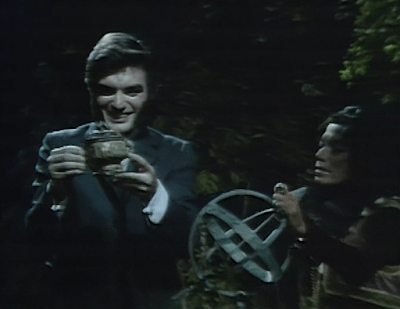
In this episode, libertine Quentin Collins teams up with broad ethnic stereotype Magda Rákóczi to find an Egyptian urn belonging to Quentin’s enemy, undead blonde fire witch Laura Murdoch Collins. Quentin has learned that the urn contains a magic fire, and that if the fire goes out Laura will die.

Quentin and Magda find the urn hidden under an armillary sphere near the gazebo on the grounds of the estate of Collinwood. Quentin takes the lid off the sphere, and the flame jumps out. He then takes some sand from a decorative pot near the gazebo and starts heaping it on the flame. If the flame keeps burning when the lid is on the urn, you’d think only magic could put it out. Then again, it is Collinwood- maybe they have magic sand around. The flame does fade from view, and we cut to a scene of Laura losing her strength.

Quentin and Magda find the urn under the armillary sphere. Screenshot by Dark Shadows Before I Die.

In a movie that runs two hours or less, the characters can be frantically absorbed in a search for any old thing. Alfred Hitchcock famously made that point when he called the objects of these searches “MacGuffins.”

But when a show that fills a thirty minute time slot five days a week and a storyline can stretch on for months, a MacGuffin has to represent something important about a character or a relationship between characters. So when, in the early days of the show, strange and troubled boy David Collins tried to kill his father Roger by sabotaging his car, it was fitting that the resulting plot spent a lot of time on the bleeder valve David removed from the car’s braking system. David is interested in mechanical work, and in his hostility to his son Roger refuses to share that interest or do anything to support it.

It was less successful when Roger was suspected of murder and the piece of evidence he spent several weeks obsessing over was a filigreed fountain pen belonging to his friend-turned-nemesis Burke Devlin. There was some obvious sexual symbolism in the question of where Burke’s pen is, and that symbolism did focus our attention on the question of what exactly Burke and Roger’s relationship was like before they turned against each other. Had writers Art Wallace and Francis Swann stayed with the show, they might have used that question to make the pen a powerfully evocative image. But Ron Sproat and Malcolm Marmorstein took over the writing duties as the fountain pen story was getting started. Sproat was gay himself, and perhaps for that reason made a point of avoiding any suggestion of homoeroticism in his work. Marmorstein was just clueless. In their hands, the pen was just a pen, and the 21 episodes devoted to the search for it were not among the great artistic achievements in the history of television.

The urn does remind us that Laura is supposed to have a mystical connection to Egypt, which is more meaning than Sproat dared or Marmorstein could attach to Burke’s pen. But her relationship to that country is not central to anything we see, as David’s relationship to his father was central to what we saw in the early days. So as metonymy for Laura and Egypt it is marginally more exciting than the pen was as a metonymy for Roger and Burke, but significantly less exciting than was the bleeder valve as a metonymy for David and Roger.

At the beginning of the episode, we have one of the most preposterously bad special effects we’ve seen so far, which is saying a lot. Teacher Tim Shaw is rescuing Laura’s daughter Nora from a burning school building. The school as seen in the green screen is hilariously unconvincing.

Screenshot by Dark Shadows Before I Die.

Episode 528: Old girl

In his post about this episode on Dark Shadows Every Day, Danny Horn remarks on the recapping that permeates the dialogue and reckons it as writer Sam Hall’s critique of the ongoing storylines. That assessment will be familiar to those who, unlike Danny, have been watching the show from the beginning. When Ron Sproat joined the writing staff in October 1966, his first several scripts featured a systematic inventory of the available narrative material, with each plot very explicitly marked as suitable or unsuitable for further development.

In its first year, very little happened on Dark Shadows; now, it has swung to the opposite extreme, and there is a climax at every commercial break. But the result is oddly similar. They don’t take the time to explore the overall situation, so that little seems to be at stake even when a spectacular event takes place. No matter how much happens per minute of screen time, it feels like the pace is slow. We see suave warlock Nicholas in the gazebo on the grounds of the estate of Collinwood summoning his subordinate, the wicked witch known variously as Angelique and Cassandra, and hear him complain that she has spent weeks attempting to do what she should have accomplished in minutes. Thus Hall assures us that the pace will be picking up.

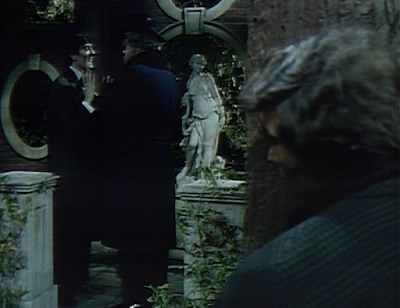
Angelique/ Cassandra comes to the gazebo, to which Nicholas refers as a “ga-ZAY-bo” in a bit of Collinsport English Angelique/ Cassandra herself introduced in #489. There, the two of them quarrel about her dilatory approach. They stand behind columns and look like debaters at podiums.

The debaters. Screenshot by Dark Shadows Every Day.

Danny Horn’s commenter “lakeplacidskater” made an interesting observation about the moment screenshotted above:

Maybe I’m reading too much into the set design, but in one of the photos Angelique and Nicholas are sperated by a statue of a Goddess (I assumed Venus). Wouldn’t it be awesome if it was Venus and that statue between them was to represent Angelique’s love for Barnabas blocking her efforts at villainy? More likely that the shot just looked better composed with the statue in the middle but how awesome if it was meant to be subtle symbolism! 🙂

“lakeplacidskater,” posted 25 February 2015 on Danny Horn, “Episode 528: This Tawdry Affair,” 21 November 2014.*

The statue appears to me to represent not Venus, but a harvest goddess. She is fully clothed, and there is a sack at her feet which seems to be full of grain. That makes a lot less sense than does the suggestion “lakeplacidskater” made. The Collinses derive their wealth from fishing and shipping, not from farming, so it is surprising that they would put a symbol of agriculture in such a prominent place. Perhaps she stands for wealth in general, but not for so much wealth that the family could afford to commission a statue of a sea goddess. And neither a bountiful harvest in particular nor wealth in general is any sort of obstacle between Nicholas and Angelique/ Cassandra. I suppose the visual metaphor might be emphasizing the image of the two of them as debaters, with the goddess serving as moderator.

Nicholas dominates Angelique/ Cassandra thoroughly and rather cruelly. Viewers who remember her from the portion of Dark Shadows set in the late eighteenth century may be taken aback by this. In those days, her power often seemed to be limited only by her own carelessness. That made for something of a shapeless narrative, since no one could oppose her effectively. Not only does Nicholas reduce her to a lowly state today, but he himself bungles a simple task when he sets out to do something nasty to well-meaning governess Vicki. Thus we see that the villains will have their work cut out for them.

Later, Vicki is in bed at her friend Maggie’s house. She has gone there to escape a curse Angelique/ Cassandra has placed that has caused several people to have the same nightmare. Since Maggie was at home when she was the first person to have the nightmare, and Vicki’s boyfriend Peter was sleeping there when he had it, it is hard to understand why Vicki thinks it is a place of safety.

We have several closeups of the face of the clock while Vicki goes to sleep. It’s an Ingraham eight day clock, apparently they wanted to make sure we knew that. When Vicki finally nods off, Angelique/ Cassandra materializes in the room with a jar of rose water that is supposed to make Vicki have the nightmare. Ever since the days when humanoid Phoenix Laura Murdoch Collins was on the show, we’ve been seeing undead witches materialize in people’s bedrooms while they sleep. This time, Maggie walks in and sees Angelique/ Cassandra. She screams at the sight. All of the women in the cast were required to scream frequently, so frequently that fans become connoisseurs of screaming. Kathryn Leigh Scott was one of the better screamers, not far behind Clarice Blackburn, so that makes for a satisfying ending.

*I can’t help but point that when “lakeplacidskater” left her post, all the members of the cast were still alive. Humbert Allen Astredo would die in 2016 and Lara Parker in 2023; Alexandra Moltke Isles, Roger Davis, and Kathryn Leigh Scott are still with us.

Episode 489: Ga-ZAY-bo

Wicked witch Angelique has cast a spell on lawyer Tony, compelling him to do her bidding. Today he calls on her at the great house of Collinwood. He is starting to remember some of the things he did for her. He can’t remember why he did them, and is troubled. She commands him to meet her at the gazebo on the estate. Up to this point in the series, Angelique and all other characters referring to this structure have spoken the word “gazebo” in its usual North American pronunciation, as /gəzɪ́jbəw/ (“ga-ZEE-bo.”) When Angelique tells Tony to meet her, she directs him to the /gəzējbəw/ (“ga-ZAY-bo.”)

In the gazebo, Tony shares his vague recollections with Angelique. He says that he does not understand why he would obey her commands. She tells him to look at her. When we heard this line, Mrs Acilius and I both laughed. Lara Parker delivers it with a little smile and a relaxed voice that made it sound like she was about to say “Of course you can’t resist me, I’m gorgeous!” Instead, she puts the zap on him and gives him more orders. But after she releases him from his trance, he again says that he doesn’t understand why he keeps coming to her, and she does in fact say that he’s falling in love with her. They kiss.

Angelique took up residence at Collinwood just a couple of weeks ago. She had cast a spell on sarcastic dandy Roger Collins and married him. Roger’s son, strange and troubled boy David, has been on a trip to Boston the whole time. David is about ten, but evidently he’s been incommunicado. He comes back today, and is surprised to find that he has a new stepmother. His surprise turns to alarm when he walks in on Tony and Angelique kissing. Later, he announces to Angelique that he will tell his father what he saw in the gazebo. He too pronounces it /gəzējbəw/. Evidently this bit of Collinsport English is taking root.

Angelique makes a bad impression at the ga-zay-bo. Screenshot by Dark Shadows Before I Die.

Angelique strikes David mute. The last time we saw her use her powers to silence a potential witness against her, Dark Shadows was a costume drama set in the 1790s, and her victim was indentured servant Ben. Ben was barely literate, but was able in #401 to write the letter A to indicate that she was the witch. Angelique has learned since then, and also prevents David from writing.

There are also two scenes where Angelique tries to find out if housekeeper Mrs Johnson has had a nightmare. Her motivation is to do with the Dream Curse, a dismal storyline I won’t explain, but the scenes are hilarious. Mrs Johnson is as commonsensical and down-to-earth as can be, while Angelique is as intense and melodramatic as can be. The two of them are naturally funny together, and these scenes leverage Clarice Blackburn’s gift for comedy of manners.

Episode 474: A Collins does the unexpected

Wicked witch Angelique (Lara Parker,) pretending to be named Cassandra, met sarcastic dandy Roger Collins (Louis Edmonds) one day and married him the next. Roger’s sister, matriarch Liz (Joan Bennett,) confronts Angelique/ Cassandra. Liz tells her that Roger has not been well and urges her to annul their marriage.

In the course of her confrontation with Liz, Angelique/ Cassandra reveals that she is not all-knowing. She thinks that Roger owns the great estate of Collinwood and the family’s business. Liz quickly explains that Roger owns nothing. He lives as a guest in her house and works as an employee of her company. Angelique/ Cassandra takes this in stride, and stands up to Liz’ insistence that the marriage must end. The only sign that Liz’ words are having an effect on anyone at all comes in the very last syllable of the scene. Unfortunately for Liz, it is not Angelique/ Cassandra who is intimidated by her, but Lara Parker who is intimidated by Joan Bennett. Angelique/ Cassandra’s mid-Atlantic accent vanishes and the purest musical note of Parker’s native Tennessee sounds as the word “you” emerges as “yeww.” If there had been another page or two of dialogue, she might have ended with a honeyed smile and a lethal “Bless your heart!”

From #395 to #461, Dark Shadows was a costume drama set in the late 1790s. In that segment, Angelique came to Collinwood as a servant girl and used her magical powers to manipulate scion Barnabas Collins (Jonathan Frid) into marrying her. Barnabas’ parents, Joshua (Louis Edmonds) and Naomi (Joan Bennett) were unhappy about the marriage. Joshua demanded that it be annulled, as Liz today demands Roger and Angelique/ Cassandra’s marriage be annulled. Naomi took a more conciliatory approach. Advocating Joshua’s position and but showing Naomi’s temperament, Liz combines two challenges Angelique has already shown herself able to overcome easily. Returning viewers will therefore have little hope that Liz will be able to stave off the disasters Angelique has in mind for the Collinses.

Angelique/ Cassandra is eager to get to work on the evil plans she has for the people at Collinwood, and so she is trying to stop Roger taking her on a honeymoon. She contrives to injure her ankle. We see permanent houseguest/ medical doctor/ mad scientist Julia Hoffman (Grayson Hall) in the bedroom Angelique/ Cassandra will be sharing with Roger, bandaging her ankle. Angelique/ Cassandra asks a series of questions about old world gentleman Barnabas Collins (Jonathan Frid,) making Julia visibly uncomfortable.

Barnabas is the same man Angelique married in the 1790s. He is here in 1968 because she turned him into a vampire then. He was relieved of the symptoms of vampirism only a couple of weeks ago. He and Julia are becoming fast friends, and on Tuesday he told her all about Angelique. He identified her as the woman in a portrait that has obsessed Roger, and expressed his belief that Roger’s obsession was a sign that Angelique herself was returning to Collinwood. Julia can see how strongly Cassandra resembles the portrait, and knows that Roger’s obsession led directly to his marrying her, so she really ought to have figured out by now that she is Angelique.

Like the scene between Angelique/ Cassandra and Liz, the scene between her and Julia makes an instructive comparison with the parts the same actresses played in the 1790s segment. Angelique was originally lady’s maid to the Countess DuPrés. We saw her helping the Countess put herself together in a bedroom that was a different dressing of the set on which Julia is now attending to her foot. This apparent reversal of roles illuminates the extent to which Angelique’s command of black magic always made her a mightier figure than her nominal mistress. As a mad scientist, Julia is far more formidable than was the countess, but this scene leaves us wondering if she will be able to stand up to Angelique for any longer than could her counterpart.

Well-meaning governess Vicki (Alexandra Moltke Isles) had traveled back in time and was at Collinwood through the 1790s segment. She recognizes Angelique, knows well how dangerous she is, and is desperate to stop her. She tries to tell Liz about the situation, but Liz has a very limited tolerance for information about the supernatural. Vicki later meets Julia at the gazebo on the grounds of the estate and shares her information with her. Julia knows as much as anyone about the strange goings-on, and what Vicki tells her confirms what she already has reason to suspect. However, Julia pretends to have trouble believing Vicki.

This pretense enables Julia to probe the limits of Vicki’s own knowledge. Barnabas and Julia do not want Vicki to know any of Barnabas’ secrets. Julia incredulously asks Vicki if she thinks the Barnabas Collins of 1968 is the same person she knew in the eighteenth century. Vicki turns away from Julia, looks troubled, and says that she does not believe this. Vicki has encountered plenty of evidence to that effect, not least when Barnabas bit her and sucked her blood, and the audience wonders what she knows. We see Julia studying her, trying to find the answer to the same question. In the first year of Dark Shadows, Vicki represented the audience’s point of view, the resolutely normal outsider getting to know the Collinwood crazies. In this moment, we see Vicki through Julia’s eyes. We identify, not with any sane person from the world of sunlight and natural laws, but with a mad scientist who has cast her lot with a vampire.

Vicki thinking about Barnabas, with a facial expression straight out of MAD magazine. Screenshot by Dark Shadows Before I Die.

Angelique/ Cassandra and Roger chat in their bedroom. He seems utterly delighted to be married to her, until she slips something into his drink. Suddenly he starts having doubts. Nothing we have seen leads us to expect she would want him to feel this way. The scene leaves us scratching our heads.

We end with Angelique/ Cassandra alone in the foyer of the great house, looking at the portrait of Barnabas that hangs there and vowing to restore the curse that had made him a vampire. We know that she is Angelique and that such is her goal, so her speech doesn’t set up any new story points.

It does give us some world-building information. Angelique says that the only way she knew that Barnabas was walking among the living in the 1960s was that Vicki had traveled back in time to the 1790s and told her. That explodes a theory some fans like that Angelique herself called Vicki back in time. When Vicki left the 1960s in #365, it was quite clear that the ghost of Barnabas’ little sister Sarah was sending her on the journey. Sarah has been fading steadily from our awareness, not least because child actress Sharon Smyth aged out of the part, and so it is not surprising that people expect a retcon to attribute the time travel story to a different force. But not only does Angelique rule herself out with this line, Sarah’s name comes up in the conversation between Julia and Vicki, reminding regular viewers of the original explanation.

More importantly, it confirms that once one person has made a wrong-way journey through time, a gate opens through which other unexpected things may come. To some extent we saw this when Barnabas himself was released from his coffin and Sarah’s ghost began showing up around the estate. The cosmological point will become extremely important for the rest of Dark Shadows, as one time-travel story keeps leading to another. Dark Shadows is often described as the story of the house, and so I can’t resist an inelegant metaphor from the building trades. It’s as if Vicki wrecked the plumbing of the universe when she went through the pipes backwards and then abruptly forward. Time will never flow the right way again.