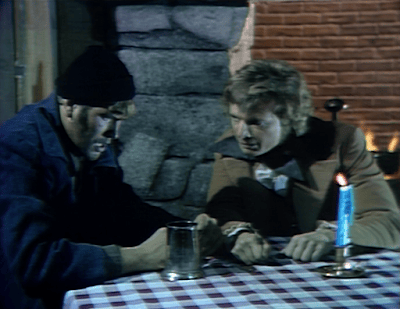
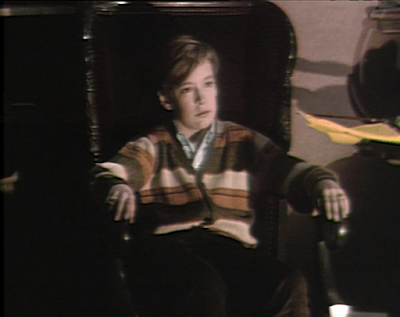
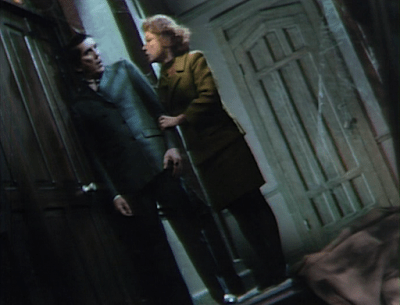
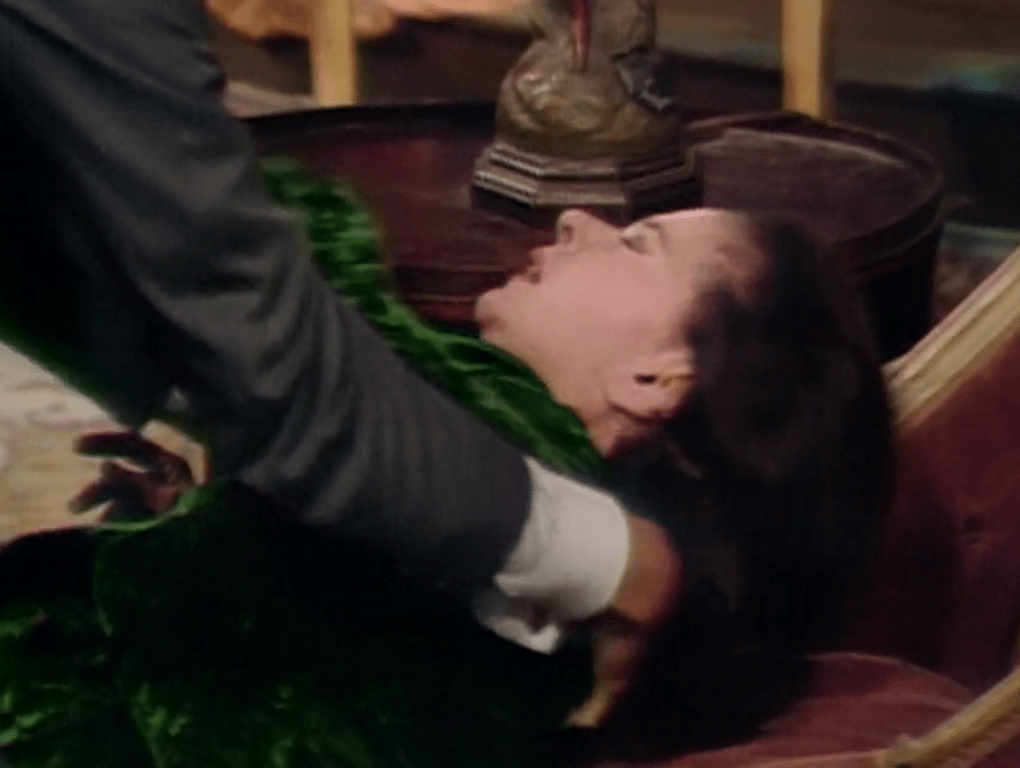
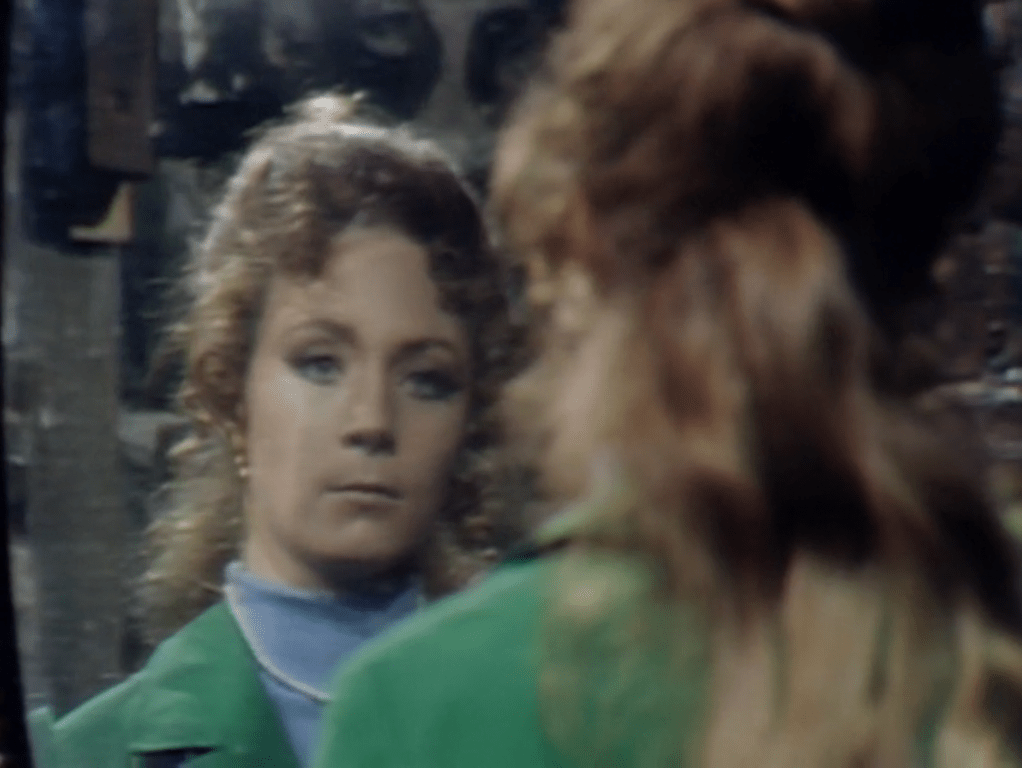
Episode 1024: Chance and Mrs Stoddard are identical twins

When Dark Shadows began in June 1966, its biggest draw was movie star Joan Bennett as reclusive matriarch Elizabeth Collins Stoddard. Liz was highly capable, and Bennett made her compelling to watch. When in #25 Liz’ brother, high-born ne’er-do-well Roger Collins, grudgingly complimented her on her “neat way of managing people,” we could see that he was putting it mildly. But the show didn’t handle Liz’ storyline very well, and she soon became a blocking figure. As the owner of the estate of Collinwood and of the Collins family businesses, as a central player in all the stories they had started with, and as the powerful personality Bennett had created, Liz was such an important part of the show that when she became a brake on the action, there was a constant danger that it would be impossible for anything to happen ever again.

The arrival of Roger’s estranged wife Laura Murdoch Collins in #123 marked Dark Shadows’ transformation into a supernatural thriller. By the time Laura went up in smoke in #191, her story had absorbed two of the four original narrative themes, “The Revenge of Burke Devlin” and well-meaning governess Vicki’s growing friendship with strange and troubled boy David, and had undercut whatever interest we might still have had in the other two, the mystery of Liz’ decision to become a recluse and Vicki’s quest to learn her true identity. The emerging Dark Shadows 2.0 had little room for Liz, and she subsided to the margins. When the show traveled back in time and became a costume drama from November 1967 to March 1968 and again from March to November 1969, Bennett played other characters and was able to make a substantial contribution, but Liz would never again be a suitable vessel for her great talents.

For the last eight weeks, the show has been in another time travel segment. Now it has traveled, not back in time, but sideways. They are in an alternate universe. The show insists on calling this universe “Parallel Time.” It is 1970 here, as it is in the original continuity, but a different 1970 where people with the names and faces we already know are living very different lives.

The Elizabeth Collins Stoddard of Parallel Time is not the mistress of Collinwood or an effective businesswoman. This Liz entrusted her inheritance to her brother Roger, who turned out to be just as feckless as his counterpart in the original continuity. As the penniless Roger we met in 1966 lives in Liz’ house as her guest and works in Liz’ business as her employee, so this Liz and Roger both live at Collinwood as the dependents of their brother, drunken sourpuss Quentin Collins.

In the original continuity, Quentin was not Liz and Roger’s brother, nor did he own anything. We got to know him when Dark Shadows was set in 1897, and he was a charming rogue, the younger brother of Judith and Edward Collins, who like Liz and Roger were played by Joan Bennett and Louis Edmonds. So the parallel lines representing the two versions of 1970 take a bit of a swerve into that other epoch.

Today, Liz is busy organizing a costume ball to be held in the great house of Collinwood. They had such a ball every year at this time when Quentin was married to his first wife, the late Angelique Stokes Collins, and Liz thinks that having another one would be the perfect occasion for Quentin to introduce all of his friends to his new wife, the former Maggie Evans. Liz needs help getting this party going. She comes bustling into the drawing room today and addresses herself to Angelique’s identical twin sister, Alexis Stokes, announcing that the party is tonight and 14 of the guests have failed to RSVP. She bemoans her inability to get anything organized and pleads with Alexis to help her. Alexis agrees to do so and excuses herself from a chess game she had been playing with Barnabas Collins, a man who recently showed up and introduced himself as a distant cousin of the Collinses of Collinwood.

Quentin enters the drawing room and orders Liz to cancel the ball. She says that it is too late to do that. Quentin stalks off and goes outside. Liz turns to Barnabas and asks him to reason with Quentin. Barnabas is unsure that he is the right person, but he goes to the door anyway. He opens it just in time to hear Quentin peeling away in his car. Maggie appears at the head of the stairs and asks if Quentin has gone. Barnabas has to say that he has, and Maggie looks crushed. Liz is unable to help in any way.

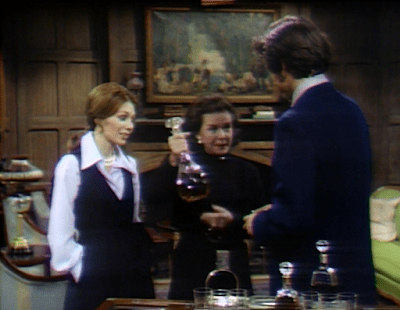
Later, Liz returns to the drawing room in the middle of a conversation between Quentin and Maggie. She is carrying an enormous decanter containing some sherry and congratulating herself on calming the cook’s nerves by her bartending. Quentin excuses himself to go get into his costume.

Liz brings the party. Screenshot by Dark Shadows Before I Die.

Liz finds that Maggie has not yet chosen a costume. She urges her to do so at once. Maggie says she supposed that Angelique always picked out her costume weeks in advance. Liz knows that Maggie is intimidated living in Angelique’s shadow, and does not know what to say in response to that remark. She quickly changes the subject. She brightens, and says that Alexis has brought many lovely dresses down from the attic. She urges Maggie to go to Alexis’ room and choose one of them.

As the time for the guests to arrive comes near, Liz and Barnabas meet in the foyer. A portrait of the Barnabas Collins who died in 1830 hangs on the spot on the wall next to the front door where earlier this week we had seen a metal doodad that looks like a coat of arms. Barnabas is wearing the same outfit, and looks just like the man in the portrait. Liz is wearing a dress of the same vintage. She is overjoyed, and tells Barnabas that the period suits him. He thanks her, and returns the compliment. Quentin is wearing a blue federal coat; Liz and Barnabas tell him that he, too, is suited to the early 1800s. Alexis comes downstairs in a blue dress, and she receives the same commendation. Lastly Maggie makes her appearance. When Quentin sees her dress, he becomes very tense. He tells her to take it off, orders her never to wear it again, and smashes his glass on the floor. The camera pans from Barnabas’shocked expression to a flickering look of pleasure on Alexis’ face; Liz stands between them, and unfortunately we only see the top of her head.

What Liz does not know is that the person she thinks is Alexis is in fact Angelique risen from the grave. Angelique murdered Alexis, took her place, and is conspiring with housekeeper Julia Hoffman to drive Maggie and Quentin apart. The story is a souped-up version of Daphne Du Maurier’s Rebecca, in which the dead first wife is not only a memory that triggers anxiety in her successor but a supernatural being who rises from the dead to torment her directly. There is a scene with Maggie looking out the window of the drawing room that is an exact recreation of a shot in Alfred Hitchcock’s 1940 film of Rebecca, and when Angelique and Hoffman trick Maggie into wearing the same dress Angelique wore to last year’s ball, prompting Quentin’s outburst, most grownups in the original audience would remember the same thing happening to the second Mrs de Winter in that film.

Angelique is the villain, and Maggie is the heroine. Still, we rather like Angelique. The sister-murdering is bad, of course, but Quentin is such a lousy husband that she is doing Maggie a big favor by trying to bring their intolerable marriage to its end as soon as possible. For example, today Quentin finds Maggie reading his old love letters to Angelique. He might justifiably have objected that those are private and say he wished she’d asked before reading them, but he doesn’t do that or anything else one adult would do when disappointed in another. Instead, he flies into a rage, accuses her of a variety of things she hasn’t done, and orders her to, and I quote, “Go to your room!”

Later, in the room they share, Quentin is still scolding Maggie for failing to admit that she was lying about how she found the letters. We know she had in fact told the truth. When she tells him so, he dismisses her with a shake of the head. When she brings up the fact that it is the anniversary of his wedding to Angelique, he shouts that she is forbidden to discuss the subject, then storms out and slams the door. This is when he goes downstairs, tells Liz to cancel the party, and drives away. We have never seen Maggie have a happy day with Quentin. He sometimes manages to be pleasant in the intervals between his tantrums, but even then he can’t let go of his habit of talking to Maggie as if she were a child and he were her somewhat weary guardian. If Angelique can hasten their final split, Maggie will owe her an enormous debt of gratitude.

Barnabas is not in fact a descendant of the man whose portrait now hangs in the foyer. He is a visitor from the main continuity. Angelique’s counterpart there is his great enemy, so it is fun to see him talking with this Angelique and playing chess with her.

David Selby has a problem with one of his lines, when Quentin winds up saying “I wonder where I got the illusion that an hour or two alone would settle one’s all of problems.”  This is a fairly minor stumble by Dark Shadows standards, but it comes when Angelique is in closeup and Lara Parker’s left eyelid twitches when she hears “one’s all of problems.” That reaction is worth a laugh.

Episode 1022: Do any of us know where our dreams come from?

Angelique Stokes Collins, late wife of gloomy sourpuss Quentin Collins, has risen from the grave, murdered her identical twin sister Alexis, and taken Alexis’ place as Quentin’s houseguest in his mansion, the great house of Collinwood. Impersonating Alexis, she has been busy with a lot of cackhanded schemes to drive a wedge between Quentin and his new wife, the former Maggie Evans. As recently as yesterday, Quentin and Maggie were keeping their cool and showing signs that they might catch on to what “Alexis” was up to, but today they both melt down completely. Quentin has a fit when he sees Maggie reading a book about witchcraft that Angelique left in the drawing room, and Maggie goes to Quentin’s friend Cyrus Longworth to ask some questions about Quentin’s role in Angelique’s death.

Cyrus is pretty nutty himself. He is a mad scientist who has developed and become addicted to a Jekyll and Hyde potion. When he drinks it, his appearance changes so drastically that even the people closest to him cannot recognize him. Thus disguised, he goes by the name “John Yaeger” and indulges his sadistic impulses.

Cyrus assures Maggie that Quentin did not murder Angelique. She leaves his laboratory feeling relieved. She forgets her gloves. He picks them up, and spends eight seconds rubbing them on his face, sniffing them, and looking ecstatic. Eight seconds is quite a long period to devote to that particular pastime.

Buffie Harrington comes to Cyrus’ lab. When he is masquerading as Yaeger, Cyrus’ favorite hobby has been beating Buffie and ridiculing her. She has a self-destructive streak that led her to submit to that treatment. Unknown to Cyrus and unmentioned in today’s episode, Buffie has a new dominator. Vampire Barnabas Collins has bitten her, made her his slave, and ordered her to find out whatever she can about Yaeger from Cyrus.

Buffie is very much in charge of her scene with Cyrus. She runs through a long list of emotions- anger and impatience with Cyrus, attraction to him and pity for him, contempt for Yaeger and admiration for him, pity and anger towards herself, all portrayed clearly and convincingly by Elizabeth Eis. Returning viewers who realize that Buffie is on a mission from Barnabas to get Cyrus to tell her what he knows about Yaeger will be impressed that Buffie is as good an actress as Eis was. She is looking for the note that will crack the glass holding Cyrus’ secrets, and striking each one perfectly.

When Buffie finds out that the gloves are Maggie’s, she mentions that she knew Maggie when they were growing up in the village of Collinsport. She says that Maggie was always a special person, obviously destined for greater things. Looking at herself in the mirror, Buffie says that Maggie probably doesn’t hate herself when she sees her reflection. Buffie may still be acting, trying to elicit Cyrus’ sympathy, but we don’t see his reaction when she says these things, only two images of her face. And her words do fit with the self-destructive streak she has shown in her relationship with “Yaeger.” Not only Elizabeth Eis’ extraordinary good looks, but also her forceful and intelligent manner, make it shocking to see Buffie looking at herself and hear her saying such things. The show never explains where Buffie’s urge to destroy herself came from, but Eis makes us both believe that it keeps overwhelming her and wish that she could escape it.

Buffie doesn’t like what she sees.

Cyrus stops by Collinwood to return Maggie’s gloves. When she sees him, Maggie brightens up and starts moving fluidly from the hips up in a way that suggests sexual attraction. She is disappointed he won’t stay. Considering how close Cyrus got to Maggie when they were in his lab and how he gazed longingly into her eyes until she asked him if something were wrong, it’s hard to see how he can fail to find her excitement encouraging.

Cyrus drinks his potion. Once Yaegerized, he telephones Maggie. He refuses to identify himself, but says that if she meets him at the docks at 6 PM sharp he will give her information about Angelique’s death. Maggie is initially appalled by the idea of a strange man asking her to meet him at the docks, but she is still carried away with the suspicions Angelique planted in her mind that Quentin is a wife-killer. She can’t resist.

Yaeger is at the docks when Buffie happens by on her way to work at the Eagle tavern. She speaks to him. He jeers at her until she leaves. Cyrus keeps telling himself what Buffie told him in their scene today, that Yaeger enjoys life. All I can say is that there are far more enjoyable things to do with a beautiful young woman than to beat her, insult her, and drive her away. Yaeger seems to me to be an utterly miserable sort, as strongly bent away from life towards death as is Buffie.

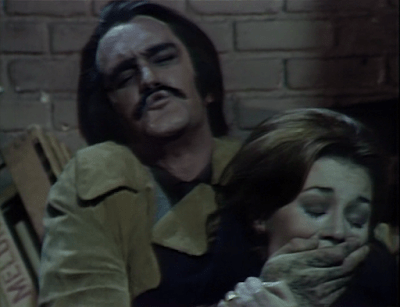
Maggie shows up shortly after Buffie has gone. Yaeger doesn’t tell her anything she doesn’t know. He moves in close and starts talking about wanting her favors. She says she will be going, and he grabs her from behind. He puts his hand over her mouth to stifle her screams while he does a series of pelvic thrusts. His facial expression gets more and more distorted until his tongue pops out.

Cyrus, in his “John Yaeger” disguise, rapes Maggie. Screenshot by Dark Shadows Before I Die.

I suppose Cyrus/ Yaeger is rather an intelligent depiction of a rapist. He craves cruelty for its own sake. Any sexual thrill he may get is a side effect of the pleasure he derives from hurting women. Cyrus is engaged to a lovely young woman who is devoted to him, his lab assistant Sabrina Stuart. Sabrina’s name doesn’t even come up today. When Buffie was under his influence, she would have gone along with just about any sort of relationship he wanted to develop, either as Cyrus or in the guise of Yaeger. All he wanted to do was use her as a punching bag and then laugh at the bruises he left on her. Maggie is clearly attracted to Cyrus today, and however loyal she may be to Quentin is at the least available for some very pleasant flirting. But all Cyrus can think to do is to conceal his identity so that he can humiliate her in the alley where the streetwalkers pick up their johns.

The conceit that Cyrus and Yaeger are different people helps writer Joe Caldwell make today’s script into an essay about rape. Had Maggie recognized Cyrus in the alley, he might have claimed that he took her earlier response to him to be an invitation to sex. It is certainly easy to imagine a husband as uncharitable as Quentin taking such a claim seriously. But when Cyrus disguises himself as Yaeger, he shows that he has no wish to accept an invitation of any kind from Maggie. All he wants is to avoid punishment for the crime he is planning to commit against her. Indeed, when she sees Cyrus as Yaeger, Maggie shows nothing but distaste and a desire to flee. Cyrus evidently prefers those reactions to the enthusiasm Maggie showed for him when he was being sweet and friendly.

The Yaeger makeup is not very consistent from day to day. This time, the hairline is so high that he kept making me think of John Cazale as Fredo Corleone. Also, Christopher Pennock’s acting is not up to its usual standard; he overacts so severely that he keeps stumbling over his words. He even botches the opening voiceover. Perhaps he was too nice a guy to really get into a character who is the distilled essence of Rapist. At this point, Cazale had done only one TV show, a guest spot on NYPD, a series made in New York that featured Dark Shadows cast members in about half its episodes. Maybe Cazale would have been available for the role of Cyrus/ Yaeger. He too was a famously nice guy, but was perhaps a more accomplished actor than Pennock and better able to handle a part like this one.

Episode 1018: The doctor’s verdict

Dave Woodard, MD, was on Dark Shadows from April to November 1967. Woodard was introduced as physician to Maggie Evans, The Nicest Girl in Town. Maggie was the victim of vampire Barnabas Collins. Woodard was the show’s answer to Dr John Seward, the commonsensical local physician in Bram Stoker’s Dracula who called in his old mentor Dr Van Helsing when he found that his patients were suffering maladies he could not explain. Woodard’s call went to his medical school classmate, Dr Julia Hoffman. As Van Helsing was an incredible polymath, equally at home in several branches of medical science, of esoteric philosophy, and even in the law, Julia was dually qualified as a blood specialist and a psychiatrist and just so happened to have a theory about curing vampirism.

This Van Helsing proved a traitor to her patient and to her friend. In order to persuade Barnabas to agree to cooperate with her experiment, Julia betrayed Maggie, using her magical powers of hypnosis to erase Barnabas’ abuse from Maggie’s memory. As time went on, Woodard figured out Barnabas’ secret and Julia’s complicity in his crimes. To keep him quiet, Julia prepared a lethal poison and helped Barnabas administer it to Woodard in #341.

From November 1967 to March 1968, Dark Shadows traveled back in time and was a costume drama set in the 1790s, the period when Barnabas first became a vampire. It was then that we were introduced to wicked witch Angelique, who often caused pain to her victims by sticking pins in dolls. When suspicion spread that witchcraft was going on, Angelique framed well-meaning governess Victoria Winters for her own crimes.

Now, the show has traveled in time again, not backward but sideways. Barnabas has gone to an alternate universe, which the show insists on calling “Parallel Time.” Maggie’s counterpart in this universe is married to drunken sourpuss Quentin Collins, master of Collinwood. Angelique’s counterpart was Quentin’s first wife. She died last year, but has risen from the grave. When she was alive, Angelique built a cult around herself, some members of which reacted to her death with the firm conviction that she would come back to life. Now that she has done so, she has kept most of her devotees in the dark. She has told only two of them who she really is. Everyone else, friend and foe alike, thinks she is her identical twin sister Alexis.

One of the two people who knows Angelique’s true identity is her aunt, Hannah Stokes. Angelique forced Aunt Hannah to act as her henchman from #1003 until we saw her for the last time in #1014. In #1015, Angelique revealed herself to her most devoted follower, the housekeeper at Collinwood. This person is named Julia Hoffman.

Alexis really was staying at the great house of Collinwood from #984 to #1001, when Angelique rose from the dead, murdered her, and assumed her identity. When Alexis showed up, she found that Maggie was uncertain of her position in the house because everyone was so obsessed with Angelique. Hoffman deliberately and very blatantly worked to exacerbate Maggie’s insecurities, in the manner of Mrs Danvers in Daphne Du Maurier’s Rebecca. Unlike Maxim de Winter in the novel, Quentin caught on to what was happening and sent Hoffman away for a time. And unlike the second Mrs de Winter, Maggie refused to put up with Quentin’s miserable behavior, including his alarmingly affectionate relationship with Alexis, walked out on him and went to stay with her sister in New York. The absences of Hoffman and of Maggie coincided with the work Grayson Hall and Kathryn Leigh Scott, along with the other survivors from the summer 1967 cast, did in the feature film House of Dark Shadows.

Today, we open in Quentin and Maggie’s bedroom. Quentin is in the hospital, so Maggie is alone in bed. But she is not alone in the room. Barnabas is there, about to bite her. He bared his fangs and plunged his head into her pillow in the last scene of yesterday’s episode; he does the same in the opening reprise. But when we come back from the title sequence, he is showing us his teeth again, and there is no blood on them. Evidently he just wanted to rub his face in Maggie’s pillow for a second while he worked up his appetite.

Barnabas is going in for a second round when the doorknob starts to turn. He retreats into the shadows, then turns into a bat and flies away. Hoffman enters. Maggie wakes up. She is startled to find Hoffman in the room. Hoffman explains that she thought she heard a prowler. Maggie tells her she doesn’t believe her.

Indeed, it is hard for us to believe Hoffman. The only sound we could hear Barnabas make was his squeaking in his bat form. Any sounds of footsteps the microphone did not pick up must have been much quieter than the squeaking that was going on while Hoffman was already in the room. Hoffman does not appear to have heard the squeaking, so it would not seem she could possibly have heard anything that would lead her to believe there was a prowler. Later, we hear Hoffman on the telephone to Angelique, gleefully reporting that Maggie was unnerved to find her in her room. So apparently she did not hear Barnabas. She went into the room to advance her plan of making Maggie look foolish. When she brought up the idea of an intruder, she was only accidentally pointing towards the truth, not saying something she believed or had reason to believe.

In the hospital, Quentin meets with his doctor, Cyrus Longworth. Quentin had severe chest pains the night before, so bad that Cyrus was for a time certain he had only minutes to live. Cyrus is deeply disturbed when he comes into the consultation room. He tells Quentin that he has run every relevant test, and that the results prove beyond a doubt that there is nothing physically wrong with him. Quentin asks how that can be, and Cyrus says that his chest pains were probably the result of a supernatural influence. His preliminary diagnosis is that a witch pushed a pin into a doll. This is correct. Angelique did indeed push a pin into a doll representing Quentin.

It took Woodard months of exposure to a pile of evidence before he would use the word “supernatural” without hesitation. All Cyrus needs is to see a man who is sick one day and healthy the next, and he’s right there. In #985, we learned that Cyrus had worried his friends by presenting a paper on black magic at a scientific conference. He was a member of Angelique’s cult, and at her suggestion he devised a Jekyll and Hyde formula that he has used to indulge his sadistic desires, which include murder. He is a mad scientist, less Woodard than Julia.

Back at Collinwood, Maggie gets dressed and opens the front door. She finds Barnabas standing there, about to knock. She says she is on her way to the hospital to visit Quentin. The telephone rings, and she finds that Quentin is on his way home. Barnabas asks to stay with her while she waits for her husband to return, and she agrees.

The two have a remarkably cozy conversation. They are so close together that her hair bounces in his breath. My wife, Mrs Acilius, said it looked like Barnabas was about to kiss Maggie at any moment. “You mean bite her,” I said. “Same thing,” she responded.

This conversation includes one of the most interesting of all the show’s countless bloopers. Maggie confides her insecurities about succeeding Angelique as Mrs Quentin Collins. Barnabas asks “Did Quentin really love Josette?” We cut to a closeup of Maggie. For half a second, Kathryn Leigh Scott visibly struggles not to laugh. Cast members almost never corrected each other on camera, just delivering their next scripted line no matter how bad the preceding miscue had been, but this one was so extreme that she improvised “Josette? I think he loved Angelique.” Once she had contained her laugh, she slipped right back into character. It really sounds like Maggie is caught off guard by Barnabas’ stumble, not like Miss Scott is caught off guard by Jonathan Frid’s. And when we cut back to Barnabas, his face is just as it was when we cut away to the closeup. That is an impressive bit of professionalism.

“Did Quentin really love Josette?”

Quentin comes home, and Barnabas excuses himself while he and Maggie have their joyous reunion. Maggie tells Quentin that she wants him to dismiss Hoffman. When she describes the awkward moment in her room, he grows impatient and irritated. He refuses to dismiss “someone for walking into a room!” Hoffman enters. Quentin orders the two of them to feel better about each other.

This is puzzling in a way. Before Maggie left, Quentin had caught on to what Hoffman was doing, and he seemed to be thinking of firing her. But regular viewers will not be entirely surprised. The confrontation that led to Maggie’s departure was all about Quentin’s habit of treating her like a child, and the whole time she was away he kept saying that he was not going to indulge her childish behavior. Quentin has got so deep into the habit of belittling Maggie that he cannot resist doing it even when he knows that she is in the right.

In their room, Maggie is getting ready to go back to bed while Quentin looks in her suitcase. He finds the voodoo doll there. As Mrs Acilius pointed out, Maggie was still in New York when Quentin’s pains started, so she is not very likely to be the witch. Also, the room has been open and vacant all night, so anyone could have walked in and left the doll. No reasonable person could take this as any kind of evidence against Maggie, but Angelique and Hoffman don’t have to concern themselves with reasonable people- their target is Quentin.

Episode 999: It’s the same as it was, you were different then

Quentin Collins walks into the bedroom once occupied by his late wife Angelique, where Angelique’s identical twin sister Alexis is staying. Quentin arrives just in time to see sleazy musician Bruno Hess strangling Alexis. He interrupts this process. Bruno is convinced that Alexis is Angelique returned from the grave, and that she is responsible for many strange and unhappy occurrences that have taken place on the estate of Collinwood since her arrival.

Bruno holds the deed to a cottage on the grounds of the estate and lives there, to Quentin’s intense annoyance. He hates Bruno, who had an affair with Angelique, a fact he likes to throw in Quentin’s face. You might think Quentin would call the police and report Bruno’s assault on Alexis. Not only would that result in a felony charge, but if Bruno bursts out with his suspicions it should be easy to get a civil commitment order that will earn him a a long stay in a home for the very nervous. But Quentin leaves Alexis and Angelique’s room without calling the sheriff. What’s more, when he goes to the drawing room and finds Bruno still in his house he has a lengthy conversation with him and waits for him to go. He never does telephone the police.

By the end of the episode, Quentin has convinced himself to take Bruno’s theory seriously. Alexis overhears him talking about it with his friend Cyrus Longworth. Quentin tells Cyrus that they must open Angelique’s tomb and look in her coffin.

Alexis finds them there, the coffin already out of its niche. She objects to the desecration of her sister’s resting place. She promises to leave Collinwood immediately if they will let Angelique rest in peace. Quentin refuses. He opens the box. Whatever he finds inside prompts a reaction of shock on his face and on Alexis’ as they look inside.

Between these scenes, we spend time in Cyrus’ laboratory. He is a mad scientist who has devised a Jekyll and Hyde potion. His alter ego goes by the name John Yaeger. Cyrus’ fiancée Sabrina Stuart is a sweet, trusting young woman who is determined to believe the best of Cyrus, but she has heard so much about Cyrus’ involvement with the brutal Yaeger that she is certain something is terribly wrong. We know that Cyrus was close to Angelique, and that she put him up to the Jekyll and Hyde experiment. Sabrina doesn’t know what Cyrus’ project is, but his withdrawn and irritable manner reminds her of the influence Angelique had on him. She says “It’s the same as it was when Angelique was alive- you were different then, and you’re different now.” I’m sure that was the scripted line, too.

Sabrina demands Cyrus stop lying to her and tell the truth about who Yaeger is and what hold he has over him. We saw yesterday that Cyrus’ attitude towards the potion and towards his time as Yaeger is already that of an addict towards his drug, and he sullenly refuses to answer any of Sabrina’s questions, even with more lies. She grows more and more exasperated.

Sabrina’s time with Cyrus is cut short when barmaid Buffie Harrington enters and insists on talking with Cyrus alone. Yaeger gave Buffie a check signed by Cyrus to cover the damages he did to her place of employment in a bar fight the other night; she wants to know if the check is authentic. Cyrus confirms that it is, much to Buffie’s delight. She mentions that her sometime boyfriend Steve is in the hospital because of a beating Yaeger gave him; Cyrus hands her a pile of cash to cover Steve’s hospital expenses. Buffie tells Cyrus that Yaeger has taken rooms in the boarding house where she stays, and that he frightens her. She does not tell him that Yaeger has hit her, choked her, and threatened her every time they have met. We know that he knows that- he has met her only when he was in the form of Yaeger, and he recognizes her on sight, showing that he remembers their encounters. Buffie asks if Yaeger works for Cyrus. He smiles with great satisfaction and says that he does.

That smile is a key moment. Yesterday’s episode gave the Jekyll and Hyde story a new lease on life by confirming that it will indeed be about addiction. That’s the usual thing with that material, but Dark Shadows has taken familiar tales in such weird directions that we could by no means take it for granted that its version would follow the typical pattern. Cyrus’ response to the thought that he controls Yaeger, who has put Steve in the hospital and is terrorizing Buffie, confirms something else. Cyrus’ diffident manner and scientific preoccupations help Sabrina hold onto the idea that he is a sweet man whose only flaw is naïveté, but Christopher Pennock’s rendering of that smile leaves no doubt that Yaeger is Cyrus’ means of indulging his own sadistic impulses.

As Buffie is leaving, Cyrus asks her if she likes Yaeger. Holding her head high, she says that sometimes she does. She sounds like she means it. Buffie was a commanding presence when first we saw her, and she is forceful throughout this scene. But she has given up on fighting back against Yaeger or even trying to run away from him. Her line suggests that she is not simply giving in to fear, but is drawn to a masochistic fantasy. Yaeger has been so vicious and Cyrus is so sinister that there is no prospect this fantasy is going to be channeled into any kind of consensual game- Buffie is drifting into a situation that can lead only to her destruction.

This episode includes one of the all-time great bloopers. The closing credits run over a shot of Angelique and Alexis’s room. For the first minute or so, we see a man sitting in a chair, chewing on something. Whoever he was, apparently he decided he’d found a good spot for lunch. Eventually the camera zooms in on the portrait of Angelique that dominates the room. This is so obviously an attempt to get the lunch-eater out of the frame that it only adds to the hilarity.

Who he is and what he is eating, I don’t know. Screenshot by Dark Shadows Before I Die.

Episode 966: All our dead have turned into skeletons

For sixteen weeks, Dark Shadows kept gearing up to tell us about the Leviathan People, a Lovecraftian race of Elder Gods who had a plan to retake the Earth and destroy humankind. During that time, the show gave us several good scenes, some striking images, a few thrilling moments, and many outstanding performances. But it never came together into anything that could be called a story. Today, they officially run up the white flag.

The harbinger of the Leviathans is a shape shifting monster from beyond space and time. The monster settled into the form of a tall young man, fell in love with heiress Carolyn Collins Stoddard, and decided he just wanted to be human and marry her. Nicholas Blair, high priest of the cult devoted to the service of the Leviathans, wants to join him and Carolyn, not in marriage, but in a ceremony that will turn her into the same kind of squamous, rugose, and paleogean creature the monster is when he is relaxed. The monster disrupts that ceremony, and suddenly the whole Leviathan project crumbles.

Nicholas tells the monster that he will die soon, since he can no longer change out of his humanoid form. The monster doesn’t understand what he means. Nicholas explains that the body through which he once invited people to “Call me Jabe” cannot live on its own. Since he can no longer shift shape, the monster’s future as Jabe is extremely limited.

Meanwhile, Nicholas’ henchman Bruno is hanging around the carriage house on the estate of Collinwood, where Jabe has been staying. He peels an apple and sits in a chair next to a zombie. We’ve seen plenty of zombies, but no one on the show has had anything to eat since the diner at the Collinsport Inn was a frequent set in 1966 and early 1967, so the apple is noteworthy.

In a different role, Michael Stroka visited the diner in its one post 1967 appearance, in #813. No one was being served that time, though.

Bruno finds that there is a fire raging in the back room, and orders the zombie to help him put it out. As he gives this order, the zombie’s flesh and clothing disappear. All that is left of him is a skeleton. Bruno goes to the woods and finds another skeleton, this one with eyes in its sockets and clothes around it. He sees Nicholas, and tells him that “All our dead have turned into skeletons!” Nicholas explains that the power of the Leviathans is broken, and their time is up.

Screenshot by Dark Shadows Before I Die.

Old world gentleman Barnabas Collins takes his distant cousin Carolyn back to her home in the great house of Collinwood. Barnabas tells Carolyn’s mother, matriarch Elizabeth Collins Stoddard, that Carolyn is in a trance. They take Carolyn upstairs and put her in bed.

Liz has been under the control of the Leviathans, a dedicated and ruthless member of their cult. She asks Barnabas what is going on, and he launches into a denunciation of the Leviathans. She responds with complete bewilderment. Barnabas realizes that Liz is not only free of the Leviathans, but that she does not remember them or anything she did for their sake.

This may disappoint longtime viewers. Throughout 1967 and 1968, the show kept Liz firmly shielded from any knowledge of the supernatural stories, let alone active involvement in them. For most of 1969, Dark Shadows was a costume drama set in 1897, and Joan Bennett played Judith Collins. Unlike Liz, Judith was allowed to know what was going on and to take part in the action. She was under mind-control when she shot governess Rachel Drummond to death, but when she was released from that control she remembered what she had done and was desperate to cover it up. In that desperation, she became a player in several plot-lines and we saw what Bennett could do when she had something to work with.

Liz hasn’t actually killed anyone, but she did lock governess Maggie Evans up to keep her from getting in Jabe’s way, and, when it looked like Jabe would kill Maggie, Liz’ greatest worry was that the resulting publicity would exonerate the man who has been framed for the murders Jabe had already committed. So if she came out of the cult remembering what she had done, Liz would be free to become a full participant in any story. Now, she snaps right back into her usual place, which is nowhere at all.

Jabe comes to Carolyn’s room. He orders Liz to get out of his way. As a cultist, she had responded to this sort of thing with dutiful obedience, but now she is quite properly indignant. Jabe is pleased to see that she has changed, but he keeps insisting she let him talk privately with Carolyn, and never thinks to say “please.” At Carolyn’s request, Liz finally agrees to this.

Jabe tells Carolyn that he will die soon unless he goes far away. He refuses to explain why this will happen, as he has consistently refused to answer any of Carolyn’s questions about him. But she somehow loves him anyway, so she agrees to marry him in the morning and leave town with him immediately after. Carolyn writes a farewell note to her mother, then falls asleep.

Carolyn has a dream in which she and Jabe go to the drawing room at Collinwood to get married. They find Nicholas there, and he starts in on the same Satanic invocation he had made before Jabe put the kibosh on the whole Leviathan segment. This was so incongruous that Mrs Acilius and I laughed out loud. Carolyn’s own shocked reaction absorbs the incongruity into the drama. Barnabas interrupts the ceremony and demands that Jabe admit that he murdered Carolyn’s father, Paul Stoddard.

Three times, Carolyn has had dreams in which Jabe made it clearer and clearer that he murdered Paul. Another distant cousin, Quentin Collins, came to her during waking hours and told her the same thing in so many words. But somehow it hasn’t clicked yet. In this dream, Jabe’s reaction to Barnabas finally gets the message through to her. Carolyn says she knows that Jabe killed Paul, and in response Jabe puts his hands around her throat and starts choking her.

Carolyn wakes up. She goes to the carriage house and tells Jabe she can’t marry him. She won’t explain why. Jabe is enraged by this. He puts his hands around her throat and starts choking her.

Christopher Pennock was a fine actor and a seriously nice guy, and in the last few days he has made us want to believe that Jabe has turned over a new leaf. But this closing makes it clear that he is still a no-goodnik. The Leviathan material is all they have had on the show lately; there are some other characters who have problems that could be developed into something, problems such as lycanthropy and vampirism, but those have been completely subordinated to the Leviathans and are in any case nothing new to Dark Shadows. So despite Nicholas’ assurance that Jabe can’t exist much longer, it is hard to see an end to a period when all they have to offer are Jabe’s tantrums.

When Jabe is choking Carolyn, the camera drifts a bit and exposes the “Property of ABC-TV” stencil on the side of the scenery:

Screenshot by Dark Shadows Before I Die.

Episode 964: Plan 9 from Down East

We are approaching the end of the sixteenth week of a segment made up of material drawn from the tales of H. P. Lovecraft. Central to this is the idea of the Leviathan People, a race of Elder Gods who want to retake the Earth and eliminate humankind. There has been a lot of good stuff in these episodes, but it hasn’t come together as a unit. At this point, the narrative seems to be falling apart completely.

The harbinger of the Leviathans, who appears to be a tall man in his mid twenties named Jeb but is in fact a four-month old shape-shifting monster who would rather be called Jabe, has lost interest in the plan and wishes he could be a real boy. Jabe has alienated virtually everyone with whom he has come into contact, including people who were under heavy mind-control meant to turn them into his slaves, and has been reduced to raising four recently deceased men to serve him as zombies.

Yesterday, he ordered the zombies to kill five of his enemies. The targets he listed were mad scientist Julia Hoffman, vampire Barnabas Collins, Barnabas’ servant Willie Loomis, and Barnabas’ distant cousins Roger Collins and Quentin Collins. The zombies have abducted Julia and brought her to Jabe’s house. She is welcomed there by a man named Sky Rumson. Sky is not a zombie, but may as well be for all the skill Geoffrey Scott brings to the role. When Scott recites his dialogue, you get the impression that he is telling you what an actor would say had they cast one in the part. Grayson Hall could fill any stage without support, making Julia’s scene with Sky relatively painless, but if it was meant to have any significance the audience will never know what that was.

Sky and a zombie force Julia into the back room of the house, where Jabe is in the squamous, rugose, and paleogean form of the true Leviathan. She is terrified by the sight. Jabe resumes his human shape. He and Julia go back to the living room, where he confides in her that he doesn’t want to take his Leviathan form ever again. He wants to renounce his powers and become human. He knows that Julia is giving Barnabas treatments to put his vampirism into remission, and that she succeeded with such treatments when Barnabas was under a different vampire curse in 1968. He asks her to help him rid himself of his Leviathan side. She is unsure she will be able to do so, but can’t resist the challenge. By the end of the scene, she is figuring out what tests she will have to run to diagnose the biochemical basis of Jabe’s condition.

Christopher Pennock really was a fine actor, and he is outstanding in this scene. He sounds like a deeply lonely, helplessly confused young boy who can’t figure out how to overcome the consequences of his own abuse of the people around him. Jabe’s request for Julia’s help and his agreement to lay off Barnabas as the price for it doesn’t fit with the orders he gave the zombies yesterday, the actions he takes later today, or anything else in the Leviathan story, and is a sign that the plot is falling apart faster than the writers can patch it up. But he and Hall are so splendid in showing Jabe’s neediness and Julia’s response to it that it doesn’t matter.

Meanwhile, Sky is at the great house of Collinwood, looking for Jabe’s foster mother-turned-makeout partner Megan Todd (it was 1970, everyone took Freud very seriously.) He meets Roger and Quentin there. They hold him at sword point until he tells them where Julia is and how to get past the zombies. To the extent that there is a reason for Sky to be on the show, it is to illustrate how total the control is the Leviathans have over the minds of the people they have co-opted, so when he gives in so quickly to Quentin’s threat to give him a scar (not even to kill him, just to compromise his potential as a model for deodorant ads) he dissolves the last prospect that the Leviathans themselves will be a danger we can care about.

Quentin goes off to rescue Julia, and Roger assumes responsibility for holding the sword. He is momentarily distracted when he sees Megan in the window, and Sky takes advantage, disarming Roger and running out of the house. Outside, he meets Megan and tells her that Jabe is upset with her for some reason. She asks if he is afraid of her. He is puzzled by the question, and tells her she is very beautiful. She invites him to look at her. As he does, she opens her mouth, revealing vampire’s fangs. She bites him.

Megan finds breakfast. Screenshot by Dark Shadows Before I Die.

Quentin arrives at Jabe’s house. Jabe is surprised to see him, but not surprised Sky was too chicken to keep any of his secrets. He orders the zombies to seize Quentin. The tall, portly, shaven headed zombie, who wears a mustache that keeps him from being mistaken for Tor Johnson in Plan 9 from Outer Space, slaps Quentin in the face a single time. With this, Quentin instantly loses consciousness. Yesterday, other zombies slapped Julia and Roger in the face, each a single time, and each of them instantly lost consciousness as well. Great ones with slaps, the zombies.

Jabe instructs the zombies to stuff Quentin into a coffin that is about three feet too short for him, and then has them carry it all the way to the cemetery. He has them bury Quentin in a grave that one of them had recently vacated. I suppose real-estate flipping has been interesting to TV viewers for longer than I had thought.

There is a famous goof in today’s episode. When Quentin grabs the sword out of its display on the wall of the Collinwood drawing room*, the lamp underneath it falls off the table and smashes on the floor. You know this wasn’t supposed to happen because it takes place out of frame and you can hear the stagehands sweeping the floor while Sky is pinned to the wall. Also, Dan Curtis was way too tight with a buck to break a lamp for the sake of a scene that’s mainly about a character as minor as Sky Rumson. It’s a shame they couldn’t have pulled the camera back and shown the lamp shattering, it would have been perfectly suited to the moment. And if they had to sweep up the wreckage right then, well, it would have been hilarious if housekeeper Mrs Johnson had come in with her broom and dustpan, taken care of the mess, and left without a word about what Quentin and Roger were doing to Sky.

A fine lamp about to meet its doom. Screenshot by Dark Shadows Before I Die.

*Something he first did in #703, when he and Barnabas first met. He knocked a lamp over then, too.

Episode 957: That’s a bad sign

Willie Loomis has come back to the Old House on the great estate of Collinwood, where he once lived as the sorely bedraggled blood thrall of vampire Barnabas Collins. Willie intends to stay only for a short time, answering an invitation from Barnabas and mad scientist Julia Hoffman. Willie is engaged to marry a woman named Roxanne, and Roxanne expects to leave with him in the morning. But he finds out that Barnabas and Julia, along with the kindly Maggie Evans and some other people, are locked in battle with a vast and incomprehensible evil. So Willie announces that he cannot leave. He will stay and help Barnabas and Julia fight.

At the beginning and end, a shape-shifting monster sees something that terrifies him. Pondering this, Barnabas remembers that the two things which frighten the monster are ghosts and werewolves. Since Collinwood is the world capital of both ghosts and werewolves, that raises the question of why the monster wants to be there. The disturbance can’t be a werewolf- the first time it occurs, it prevents the monster from attacking Willie and Maggie, and if it were a werewolf it would just have gone on to attack them itself. The second time, Julia comes face to face with it. It casts a glowing light on her, and she asks what it is. One might assume she would recognize a werewolf, who in any case don’t glow. The show does a good job making us wonder just what the phenomenon is and making us hope we will find out tomorrow.

When Barnabas first enslaved Willie in 1967, he was extremely cruel and Willie was miserable beyond imagining. When Willie came back in 1968 after a stay in Windcliff, the mental hospital Julia controls, Barnabas’ vampirism was in remission and Willie took rather an insouciant attitude towards him. In those days, Barnabas put up with Willie’s insubordinate attitude with relatively mild displays of annoyance. Barnabas finally brought Willie to heel in #560, when he convinced Willie that his disobedience was putting Maggie in danger and Willie responded with agony. Torturing Willie in that way made Barnabas smile for the first time in ages. He was glad to return at last to his happy place.

Now, Barnabas is a vampire again, but Willie is full of friendship and goodwill towards him. He talks warmly to Julia about how Barnabas helped him in the past. In turn, Barnabas is genuinely concerned for Willie’s well-being, telling him that the current situation is too dangerous for him and that he should go live his own life. This new coziness leads to some intentionally funny moments. At one point, Willie walks in on Barnabas saying out loud that he doesn’t understand what’s going on. He tells the vampire “You’re talking to yourself, Barnabas. That’s a bad sign!” As if that’s the part he needs to worry about!

Willie has a conversation with Maggie that verges on the poetic. When he tells her “I never knew how awful it was to be alone until I wasn’t,” we find ourselves wanting him to go directly to Roxanne and run as far as he can as fast as he can.

There is a big mirror on the wall at the foot of the stairs in Barnabas’ house. At one point he walks in front of it and casts a reflection. Sometimes they have been very emphatic that vampires don’t cast reflections. Most famously, Julia confirmed that Barnabas was a vampire in #288, when she contrived to open her compact and point the mirror at him. The same prop was used in #704, when it exposed Barnabas’ secret to the luckless Sophie Baker, prompting him to murder her. On the other hand, when wicked witch Angelique became a vampire for a while in 1968, there were some shots that were obviously deliberate in their composition that prominently featured her reflection in mirrors, making the point that she was an exception to this rule. The mirror doesn’t have to be on the wall, but if it is we will inevitably see Jonathan Frid reflected in it, suggesting that they put it there on purpose to show that he is now another exception to the rule.

Barnabas reflects.

Willie was off the show for a year, from #696 (broadcast 24 February 1969) to #956 (broadcast 23 February 1970.) His absence during that period was not explained. Today he mentions to Julia that he has been working at another hospital, as he once worked for her at Windcliff. Indeed, she had offered him a job there in #537. Since Julia did not know about this other hospital job, he must have taken it sometime after leaving his position at Windcliff and without a reference from her. Before Barnabas enslaved him, Willie was a dangerously unstable ruffian, wanted by the police, so they are likely the first employers he has had who would have provided a usable reference. So he probably left Collinwood for the job at Windcliff not much later than March 1969 and held a job in some third place before getting back into hospital work more recently.

In the first year of the show, only David Henesy, as strange and troubled boy David Collins, looked directly into the camera; in the last year, that move has been the signature of Denise Nickerson as David’s young friend Amy Jennings. Today, just about every member of the cast does it. I believe it is the first time Jonathan Frid has done so, though there have been times when his examination of the teleprompter has moved him perilously close to an unintentional soliloquy.

Barnabas tells Julia that their enemies will never find his coffin “where it is now.” The first time we heard that was in 1967, and back then it made us wonder why, if he has an impregnable hiding place for his coffin, he usually just leaves it in the middle of his basement where no one coming downstairs could avoid seeing it. Barnabas spent most of 1969 as a time traveler visiting 1897. His vampirism was exposed in that year, and he was hunted. He assured his allies that no one could find his coffin where it was hidden then; they found it immediately. So longtime viewers aren’t so sure that Barnabas will escape detection during the day.

As Julia, Grayson Hall has a new hairdo today. It is a bit longer than it has been, and is swept up in front.

Episode 940: You had dark hair

A shape-shifting monster from beyond time and space has assumed the form of a young man and decided to marry heiress Carolyn Collins Stoddard. Carolyn’s distant cousin, old world gentleman Barnabas Collins, knows all about the monster and wants to prevent the wedding.

The other day, the monster mentioned to Barnabas that when he is not in human form, nothing can kill him. That would seem to imply that when he is in human form, at least some of the things that kill humans can kill him. So Barnabas slips some poison in a drink and gives it to the monster. The plan is logical enough, but like all of Barnabas’ plans it fails. Whatever the monster’s vulnerabilities are, that particular poison is not one of them. It does not harm him at all, though it does affect the drink’s flavor sufficiently to damage the monster’s confidence in Barnabas’ bar-tending abilities.

Barnabas’ next plan is less sensible. His ex-wife, wicked witch Angelique, is living nearby with her new husband. He goes to Angelique and asks her to take Carolyn in for a while. Angelique reminds Barnabas that Carolyn knows her and dislikes her. She was married to Carolyn’s uncle Roger for a while in 1968, when she was using the alias Cassandra. By the end of that period, she had alienated Carolyn and everyone else at the great house of Collinwood. Barnabas exclaims “But she won’t recognize her; you had dark hair!” Presumably the scripted line was “But she won’t recognize you; you had dark hair!”

Barnabas pleads with Angelique. Screenshot by Dark Shadows Before I Die.

Which doesn’t really make all that much more sense- the black wig Angelique wore when she was calling herself Cassandra was the entirety of her disguise. She didn’t need to conceal her identity any more thoroughly than that, since the only people who could recognize her were Barnabas and time-traveling governess Vicki. Barnabas couldn’t afford to admit that he had lived in the 1790s and married a witch, and Vicki was at that point not allowed to do anything that would affect the course of the A story, so the wig was plenty. To say now that the difference in hair color will keep Carolyn from recognizing Angelique as Cassandra is to lampshade the absurdity of Barnabas’ idea.

Barnabas tells Angelique that the monster is affiliated with mysterious supernatural beings known as the Leviathan People. This alarms Angelique sufficiently that she agrees to hide Carolyn.

This is also the episode in which rakish libertine Quentin Collins reintroduces himself to the family at Collinwood. They had known him as the ghost who drove them from their home in November 1968, and Carolyn met the living Quentin in late 1969, when he went by the name Grant Douglas.

Quentin is at loose ends, so he agrees when Barnabas and mad scientist Julia Hoffman ask him to help them in their battle against the Leviathans. The plan is for him to use the power of his handsomeness and charm to distract Carolyn from the monster. This would seem to be quite a sensible idea, since he has been the big attraction of the fan magazines since he joined the show.

We cut to the great house of Collinwood, where the piano is being played very well. We see that Carolyn is the pianist. This is puzzling to longtime viewers. The piano has been a prominent part of the drawing room set from the beginning of the show, an echo of the deep prehistory of Dark Shadows, which was originally based in part on old teleplays Art Wallace wrote about a lady who gave piano lessons. We have seen Carolyn poke at the keyboard a couple of times, in a manner that made it clear she could not play at all.

Quentin knocks at the front door and Carolyn lets him in. He gives his right name, and claims to be his own great-grandson. When Carolyn asks why he said his name was Grant Douglas, he claims to be a writer who used that among other pseudonyms. That doesn’t explain anything, but Carolyn settles for it, for some reason. He tells her that, since they are only third cousins, their family relationship is no bar to them spending a great deal of time together. She says she is busy tonight, but eagerly volunteers that she is free tomorrow.

The monster enters. He meets Quentin, and they take an instant dislike to each other. That doesn’t mean much, since the monster is extremely obnoxious and everyone not under the power of the Leviathans dislikes him. For that matter, some who are under their power can’t stand him, either. For example, Barnabas was a devotee of theirs until he had to deal with the monster, and his personality broke the spell. So it remains to be seen what contribution, if any, Quentin will make to this story.

Quentin doesn’t try to persuade Carolyn to break her date with the monster. He, Julia, and Barnabas are at Collinwood when the monster calls. He tells her Carolyn is on her way, two hours earlier than originally planned. The monster and Carolyn share a drink; he slips her a mickey. Once she is passed out, he carries her up to the room in which he assumes his true form, declaring that her new life is about to begin.

Up to this point, drugging drinks has chiefly been a source of comedy on Dark Shadows. Barnabas tried to poison Angelique in #402, when they were married; that led to a farce scene when his mother showed up, Angelique passed the poisoned drink to her, and he had to scramble. For a while in 1968, a warlock calling himself Nicholas Blair hung around and functioned as Angelique’s boss; in #528, she asked him to slip some poison to Vicki, prompting him to complain that “I am much too talented to spend my time drugging drinks.” By the time he was done, he had not only complied with Angelique’s request, but drugged a couple of other people’s drinks on his own initiative. He may as well have kept his pride, since none of those poisonings got him what he wanted. So the monster’s use of that tactic might lead us to suspect that Carolyn’s odds are better than they appear.

Episode 904: To have fun, like everybody else

Matriarch Elizabeth Collins Stoddard (Joan Bennett) was usually a blocking figure in the first 73 weeks of Dark Shadows, and when the pace of the stories picked up sufficiently that they didn’t need to slam on the brakes so often she drifted far to the margins. When she does show up, she is usually a talk-to for characters who might actually do something. The few times she has been the center of attention have been when she was so crushingly depressed she was a suicide risk. At one point she went beyond that, succumbing to a boredom so extreme that she lapsed into a catatonic state and was mistaken for dead.

Today, Liz is being atypically dynamic. She is trying to figure out what her nephew, strange and troubled boy David Collins, has been up to. Her investigations have shown her that David stole an old book from an antique shop and bought some clothes at a department store. These aren’t exactly the most thrilling discoveries of the age, especially when it appears that David has already returned the book to its rightful owners, but it represents a big step up from her usual activity level.

Liz walks in on David in his room, and finds him reading from a book. He denies that it is the book from the antique shop, but she doesn’t believe him. Later, Liz is poring over the book in her drawing room when her distant cousin Barnabas comes in. She tells him she doesn’t recognize the language or the script in which it is written, but that she has found certain blocks of text that are repeated throughout, in the manner of ritual language. She thinks it must be a religious book of some kind. Barnabas recognizes this as a remarkably intelligent observation. He offers to take the book to the antique shop himself. Liz happily accepts his offer, and goes upstairs to bed.

Liz has a dream. In the dream, David is wearing a fat suit. He takes her to a funhouse. At first the mirrors merely add to her chronic depression, but she brightens when she sees Barnabas in one of the mirrors. And when David recites a bit of doggerel- “Fat and Skinny had a race, all around the steeplechase./ Fat fell down and broke his face./ Skinny said, I won the race!” she laughs heartily. She wakes up. In her bed, she is staring into space, all jollity gone.

David’s fat suit. Screenshot by Dark Shadows Before I Die.

Most of the dream is shot in a kaleidoscopic style, splitting the screen into many copies of the same image. Regular viewers know that Dark Shadows puts kaleidoscopic patterns on the screen when it is showing people submitting to one or another form of mind control. For example, when mad scientist Julia Hoffman hypnotizes people, we often see pictures that seem to come from inside a kaleidoscope. Liz herself asks David at the beginning of the dream if the mirrors will show her “all the people I could have been”; he says that no, “They’ll show you all the people you really are.” Since the dream is full of odd looking dolls and puppets, that suggests all the people she really is are controlled by someone other than herself. The cut from her laughing face at the end of the dream sequence to her blank expression when she wakes up would also suggest a discontinuity between the Liz who had the dream and the Liz who will rise from bed.

Over the last few weeks, the show has been developing a story about a cult devoted to mysterious supernatural beings known as the Leviathan people. The cult is secretly absorbing one person after another, enabling the Leviathans to act through them. Barnabas and David have taken turns leading the cult, and the owners of the antique shop are members of it. If Liz is no longer herself, we must conclude that she has now been coopted into the cult as well.

Liz’ daughter Carolyn works at the antique shop. Early in the episode, she met a man whom we could see only from the chest down. He was wearing a belted overcoat. In #902, we had the same view of a man wearing the same overcoat as he wandered into Liz’ house, straightened a portrait of Barnabas, hid from Carolyn, and wandered out again. Evidently this is the same man. Later, Barnabas went to the shop, and Carolyn told him she was smitten by the man and that he would be coming back when the shop closed, after 10 pm.

The man does come back as promised, but doesn’t quite make it into the shop. He is between the streetlight and the door, in a space which we must interpret as representing a sidewalk, when Barnabas runs him down with his car. Carolyn comes out of the shop and Barnabas claims that the man just darted out of nowhere, giving him no chance to stop. It is unclear when Barnabas learned to drive. When he was first on the show in April 1967, he was a vampire who had been sealed in a coffin since the 1790s. He was cured of the effects of vampirism in March 1968, and in #687 we heard about him driving. Perhaps his training in the rules of the road was irregular. Still, you would think he would have a better excuse for driving into a pedestrian than failing to expect him to be on the sidewalk.

The camera zooms in on the injured man’s face. We don’t see enough of it to be sure who it is. The closing credits tell us that “Unknown Man” is played by David Selby. It must be a goof that we don’t see much of Mr Selby’s face. Over the year he has been playing the rakish Quentin Collins, Mr Selby has become a huge breakout star, rivaling the fame Jonathan Frid has gained as Barnabas. Surely they wouldn’t put him on unless they wanted us to recognize him.

Quentin first came on the show as a ghost at the end of 1968, and found his greatest success from March to November 1969, when the show was set in the year 1897. Since the show returned to a contemporary setting, we have been sure that Quentin will be back, but we haven’t had any reason to expect him to return at any particular time. In #887, the first episode set in November 1969, we saw the back of a man prowling about the estate of Collinwood; we might have suspected he was Quentin. But he turned out to be Liz’ ex-husband Paul Stoddard, who had never before been a real character on the show and who has been unmentioned for more than two years. So when we are kept from seeing the face of another prowler, he could be anyone at all. Perhaps Frank Garner is training to be a ninja, or Ezra Hearne is having a personal crisis.

The closing credits run over this image from Liz’ dream. The dolls move while the credits are scrolling over them, the effect is hilarious. I didn’t think the dream sequence was particularly effective, but I wish every episode ended with these two figures doing their little act.

The real stars of today’s show. Screenshot by Dark Shadows Before I Die.

Episode 897: Restore our flesh and bones

The Trouble with David

Yesterday we saw strange and troubled boy David Collins (David Henesy) go to a mysterious cairn in the woods, the ceremonial center of the cult of the Leviathan people, and announce that he was now one of the cult. The cairn then opened, revealing a little gap. David crawled into the gap. The gap was not quite big enough for him, so that the episode ended with an extended sequence of David Henesy wiggling his rear end at the camera while he tried to wedge himself into place.

Today we learn that the carpenters were not the only ones who haven’t caught on that Mr Henesy isn’t nine years old anymore. David has followed the gap to an underground chamber with a steaming cauldron. He takes some vegetation out of the cauldron and recites a cryptic poem, all the while staring portentiously off into space. His manner, words, and actions would be effective as part of a creepy little kid sequence, but the thirteen year old Mr Henesy looks mature enough that we just chalk him up as one more member of the Leviathan cult.

The Trouble with Chris

Heiress Carolyn Collins Stoddard calls on drifter Chris Jennings in his cottage. They talk about someone named Sabrina who has told Carolyn that while Chris is a nice enough guy, he will, in spite of himself, kill her if she keeps hanging around him. Chris tells Carolyn that this is true and that he is “a monster.” He does not explain. She leaves, and he takes out a pistol. First-time viewers will wonder if Chris has a compulsion to fire his pistol at people. Regular viewers know that he is a werewolf, and that his particular case of lycanthropy is so advanced that he sometimes transforms even when the moon is not full. We can assume that he plans to use the pistol to put himself out of his misery.

Regular viewers also know that Chris was safely confined to a mental hospital until he checked himself out recently. When he returned to the great house of Collinwood, he told his psychiatrist, permanent houseguest Julia Hoffman, that he just couldn’t stand the conditions at the hospital. Since leaving the hospital means that Chris will resume killing at least one random person a month, this decision just about completely erased any sympathy we might have for him as a character. It also undercuts his motivation in this scene. If Chris really wants to stop killing, he is free to go back to the hospital at any time.

The ghost of Chris’ great-grandmother, Jenny Collins (Marie Wallace,) appears. She tells him not to commit suicide. Dark Shadows was a costume drama set in 1897 from March to November 1969; in those days, we got to know Jenny as “Crazy Jenny,” who played nothing but one mad scene after another. She was sane and well-put-together just once, when she appeared as a ghost in #810 and #811. In this second postmortem appearance, Jenny is extra mad, wearing a disheveled wig that reaches heights few hairpieces have dared. She does not tell Chris to return to the hospital, but to find his great-grandfather, Quentin Collins. She says that she cannot help him, but Quentin can.

This confirms what the show has been hinting, that Quentin is alive. Chris doesn’t know that, nor does he know of his relationship to Quentin. He is left bewildered and helpless by Jenny’s pronouncement. His response would no doubt be more complex if he were up to date, but he has been so ineffective at managing his curse and so irresponsible generally that we can’t imagine he would do anything constructive even if he knew everything we do. The character seems to have reached a dead end.

The Trouble with Barnabas

Upset by her conversation with Chris, Carolyn goes to her distant cousin, old world gentleman Barnabas Collins. She enters his home, the Old House on the estate of Collinwood, and finds the front parlor empty. She hears Barnabas’ voice coming from behind a bookcase, repeating over and over that “There is no margin for error. Punishment is necessary.”

Longtime viewers know, not only that a room is hidden behind this bookcase, but that Carolyn knows about that room. Her friend, David’s well-meaning governess Vicki, was held prisoner there by a crazy man in December 1966, several months before Barnabas joined the show. Carolyn is moving her hands, as if she is looking for the release that makes the bookcase swing open, when Barnabas comes downstairs.

When Carolyn says that she heard his voice, Barnabas explains that he was simply keeping busy by “conducting an experiment in electronics.” The candles around the room will suffice to show that the house doesn’t have electricity, and even if Barnabas weren’t so resolutely technophobic it would still require explanation that the text he set his speakers to reproduce over and over was “There is no margin for error. Punishment is necessary.” Moreover, Carolyn knows Barnabas well, and she can’t have overlooked that he is not his usual self these days. He is distant, calm, and utterly self-possessed, a far cry from the fussy, excitable chap who so often stumbles over his words. He remains formidably well-composed as he reiterates his position that Chris is a dangerously unstable person whom Carolyn should avoid, and that she has a bright future ahead of her. He gently but firmly guides her to the front door, and she is out of the house in record time.

Carolyn does not know that Chris is the werewolf, but at least she knows that there is a werewolf. She does not know that the Leviathan cult exists, and so it is understandable that she does not suspect that Barnabas is acting as its leader. But as the story unfolds, others will no doubt catch on that something is up, and so many people have spent so much time with Barnabas that it is difficult to see how they can all fail to notice the drastic change in his personality and to connect it with the strange goings-on. Putting him in this position makes it likely that the writers will have a harder time managing the story’s pace than they would if his involvement were more subtle.

Once Carolyn has exited, Barnabas opens the bookcase and reveals Philip Todd, antique shop owner. He rewinds a reel-to-reel tape and replays “There is no margin for error. Punishment is necessary.” Philip and his wife Megan are members of the cult, entrusted with the care of many of its most sacred items. Yesterday Barnabas found out that one of these, a book, had gone missing. He summoned Philip to the cairn, and it seemed he might be about to kill Philip. But now, he sends Philip off to administer the punishment to someone else, presumably Megan.

The Trouble with Megan

Megan (Marie Wallace) has been in an extremely overwrought state ever since she found that the book was gone. Today’s episode ends with a long scene in which she is alone in the shop, feeling that someone is coming to kill her, reacting sharply to every noise.

Danny Horn devotes most of his post about the episode on his great Dark Shadows Every Day to reasons why this scene does not work, among them the fact that a depiction of a person descending into madness requires that the person start off as something other than over-the-top loony. Megan has been so frenzied for the last few days that Miss Wallace has nowhere to go when she hears the ominous noises. Moreover, her first two characters on Dark Shadows, fiancée of Frankenstein Eve and Crazy Jenny, were both intense, overbearing characters who were so inflexible that they had little opportunity to respond to anything their scene partners might do. Longtime viewers therefore expect to see Miss Wallace screaming and carrying on by herself, so nothing she does here will unsettle us. They lampshade this iconography problem by showing us Crazy Jenny’s ghost today, but that doesn’t help at all.

Many fans compare this scene to episode #361. Most of #361 is devoted to a one-woman drama in which Julia is tormented by sights and sounds in her bedroom, suggesting that her mind is collapsing. I don’t think that episode is a success, but because Julia had always been in control of herself up to that point we can see what is supposed to be at stake in it. That’s more than we can say for Megan’s fearful turn.

In John and Christine Scoleri’s post about the episode on Dark Shadows Before I Die, Christine points out the prominence of the taxidermied animals in the background, and speculates that the scene is an homage to The Night of the Living Dead. I wouldn’t have guessed that director Lela Swift or writer Violet Welles would have studied that film, but Christine provides screenshots from it and from the episode, and the parallels are so striking that I can’t see how she could be wrong.

Closing Miscellany

I think the tape recorder is the same one we saw in the summer of 1968, when it was part of the Frankenstein story. It also appears to be the one that parapsychologist Peter Guthrie brought to Collinwood early in 1967.

Her haunting of Chris marks Jenny’s final appearance. Miss Wallace reprised the role decades later in a couple of the Big Finish audio dramas.

During Megan’s big scene, the camera swings a bit to the left and we can see beyond the edge of the antique shop set. We get a good look at a tree that stands near the cairn in the woods. Making matters worse, when they turn the camera away from the tree they go too far right, showing a stage light on the other side.

The antique shop and the cairn. Screenshot by Danny Horn, Dark Shadows Every Day.

As the opening credits begin to roll, the camera is pointed a bit too far to the right and a stagehand is visible, adding dry ice to the steaming cauldron in the underground chamber.

Closing credits blooper. Screenshot by Danny Horn, Dark Shadows Every Day.