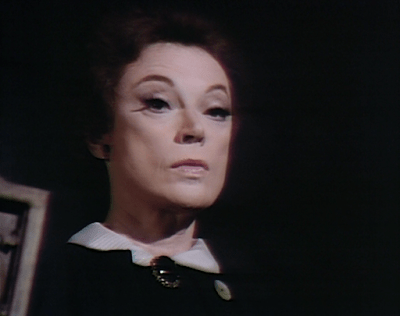
When Dark Shadows began in June 1966, its biggest draw was movie star Joan Bennett as reclusive matriarch Elizabeth Collins Stoddard. Liz was highly capable, and Bennett made her compelling to watch. When in #25 Liz’ brother, high-born ne’er-do-well Roger Collins, grudgingly complimented her on her “neat way of managing people,” we could see that he was putting it mildly. But the show didn’t handle Liz’ storyline very well, and she soon became a blocking figure. As the owner of the estate of Collinwood and of the Collins family businesses, as a central player in all the stories they had started with, and as the powerful personality Bennett had created, Liz was such an important part of the show that when she became a brake on the action, there was a constant danger that it would be impossible for anything to happen ever again.
The arrival of Roger’s estranged wife Laura Murdoch Collins in #123 marked Dark Shadows’ transformation into a supernatural thriller. By the time Laura went up in smoke in #191, her story had absorbed two of the four original narrative themes, “The Revenge of Burke Devlin” and well-meaning governess Vicki’s growing friendship with strange and troubled boy David, and had undercut whatever interest we might still have had in the other two, the mystery of Liz’ decision to become a recluse and Vicki’s quest to learn her true identity. The emerging Dark Shadows 2.0 had little room for Liz, and she subsided to the margins. When the show traveled back in time and became a costume drama from November 1967 to March 1968 and again from March to November 1969, Bennett played other characters and was able to make a substantial contribution, but Liz would never again be a suitable vessel for her great talents.
For the last eight weeks, the show has been in another time travel segment. Now it has traveled, not back in time, but sideways. They are in an alternate universe. The show insists on calling this universe “Parallel Time.” It is 1970 here, as it is in the original continuity, but a different 1970 where people with the names and faces we already know are living very different lives.
The Elizabeth Collins Stoddard of Parallel Time is not the mistress of Collinwood or an effective businesswoman. This Liz entrusted her inheritance to her brother Roger, who turned out to be just as feckless as his counterpart in the original continuity. As the penniless Roger we met in 1966 lives in Liz’ house as her guest and works in Liz’ business as her employee, so this Liz and Roger both live at Collinwood as the dependents of their brother, drunken sourpuss Quentin Collins.
In the original continuity, Quentin was not Liz and Roger’s brother, nor did he own anything. We got to know him when Dark Shadows was set in 1897, and he was a charming rogue, the younger brother of Judith and Edward Collins, who like Liz and Roger were played by Joan Bennett and Louis Edmonds. So the parallel lines representing the two versions of 1970 take a bit of a swerve into that other epoch.
Today, Liz is busy organizing a costume ball to be held in the great house of Collinwood. They had such a ball every year at this time when Quentin was married to his first wife, the late Angelique Stokes Collins, and Liz thinks that having another one would be the perfect occasion for Quentin to introduce all of his friends to his new wife, the former Maggie Evans. Liz needs help getting this party going. She comes bustling into the drawing room today and addresses herself to Angelique’s identical twin sister, Alexis Stokes, announcing that the party is tonight and 14 of the guests have failed to RSVP. She bemoans her inability to get anything organized and pleads with Alexis to help her. Alexis agrees to do so and excuses herself from a chess game she had been playing with Barnabas Collins, a man who recently showed up and introduced himself as a distant cousin of the Collinses of Collinwood.
Quentin enters the drawing room and orders Liz to cancel the ball. She says that it is too late to do that. Quentin stalks off and goes outside. Liz turns to Barnabas and asks him to reason with Quentin. Barnabas is unsure that he is the right person, but he goes to the door anyway. He opens it just in time to hear Quentin peeling away in his car. Maggie appears at the head of the stairs and asks if Quentin has gone. Barnabas has to say that he has, and Maggie looks crushed. Liz is unable to help in any way.
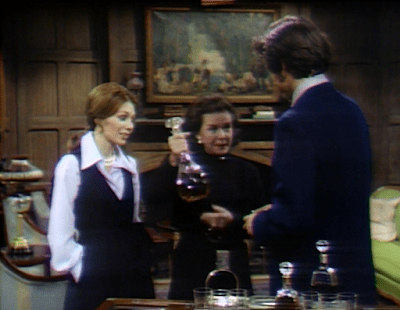
Later, Liz returns to the drawing room in the middle of a conversation between Quentin and Maggie. She is carrying an enormous decanter containing some sherry and congratulating herself on calming the cook’s nerves by her bartending. Quentin excuses himself to go get into his costume.
Liz finds that Maggie has not yet chosen a costume. She urges her to do so at once. Maggie says she supposed that Angelique always picked out her costume weeks in advance. Liz knows that Maggie is intimidated living in Angelique’s shadow, and does not know what to say in response to that remark. She quickly changes the subject. She brightens, and says that Alexis has brought many lovely dresses down from the attic. She urges Maggie to go to Alexis’ room and choose one of them.
As the time for the guests to arrive comes near, Liz and Barnabas meet in the foyer. A portrait of the Barnabas Collins who died in 1830 hangs on the spot on the wall next to the front door where earlier this week we had seen a metal doodad that looks like a coat of arms. Barnabas is wearing the same outfit, and looks just like the man in the portrait. Liz is wearing a dress of the same vintage. She is overjoyed, and tells Barnabas that the period suits him. He thanks her, and returns the compliment. Quentin is wearing a blue federal coat; Liz and Barnabas tell him that he, too, is suited to the early 1800s. Alexis comes downstairs in a blue dress, and she receives the same commendation. Lastly Maggie makes her appearance. When Quentin sees her dress, he becomes very tense. He tells her to take it off, orders her never to wear it again, and smashes his glass on the floor. The camera pans from Barnabas’shocked expression to a flickering look of pleasure on Alexis’ face; Liz stands between them, and unfortunately we only see the top of her head.
What Liz does not know is that the person she thinks is Alexis is in fact Angelique risen from the grave. Angelique murdered Alexis, took her place, and is conspiring with housekeeper Julia Hoffman to drive Maggie and Quentin apart. The story is a souped-up version of Daphne Du Maurier’s Rebecca, in which the dead first wife is not only a memory that triggers anxiety in her successor but a supernatural being who rises from the dead to torment her directly. There is a scene with Maggie looking out the window of the drawing room that is an exact recreation of a shot in Alfred Hitchcock’s 1940 film of Rebecca, and when Angelique and Hoffman trick Maggie into wearing the same dress Angelique wore to last year’s ball, prompting Quentin’s outburst, most grownups in the original audience would remember the same thing happening to the second Mrs de Winter in that film.
Angelique is the villain, and Maggie is the heroine. Still, we rather like Angelique. The sister-murdering is bad, of course, but Quentin is such a lousy husband that she is doing Maggie a big favor by trying to bring their intolerable marriage to its end as soon as possible. For example, today Quentin finds Maggie reading his old love letters to Angelique. He might justifiably have objected that those are private and say he wished she’d asked before reading them, but he doesn’t do that or anything else one adult would do when disappointed in another. Instead, he flies into a rage, accuses her of a variety of things she hasn’t done, and orders her to, and I quote, “Go to your room!”
Later, in the room they share, Quentin is still scolding Maggie for failing to admit that she was lying about how she found the letters. We know she had in fact told the truth. When she tells him so, he dismisses her with a shake of the head. When she brings up the fact that it is the anniversary of his wedding to Angelique, he shouts that she is forbidden to discuss the subject, then storms out and slams the door. This is when he goes downstairs, tells Liz to cancel the party, and drives away. We have never seen Maggie have a happy day with Quentin. He sometimes manages to be pleasant in the intervals between his tantrums, but even then he can’t let go of his habit of talking to Maggie as if she were a child and he were her somewhat weary guardian. If Angelique can hasten their final split, Maggie will owe her an enormous debt of gratitude.
Barnabas is not in fact a descendant of the man whose portrait now hangs in the foyer. He is a visitor from the main continuity. Angelique’s counterpart there is his great enemy, so it is fun to see him talking with this Angelique and playing chess with her.
David Selby has a problem with one of his lines, when Quentin winds up saying “I wonder where I got the illusion that an hour or two alone would settle one’s all of problems.” This is a fairly minor stumble by Dark Shadows standards, but it comes when Angelique is in closeup and Lara Parker’s left eyelid twitches when she hears “one’s all of problems.” That reaction is worth a laugh.
Wealthy socialite Alexis Stokes is looking at her identical twin sister, the late Angelique Stokes Collins. Angelique has been dead and in her coffin these six months, but hasn’t decayed visibly. This has led Angelique’s widower, drunken sourpuss Quentin Collins, to the conclusion that Angelique is an uncanny being whose remains must be burned. Quentin’s friend, foolish scientist Cyrus Longworth, heartily concurs with this opinion. Alexis sits by the coffin and tells her late sister that she has, with great regret, come to share Quentin and Cyrus’ conclusion. She touches Angelique’s shoulder. At this, Angelique’s eyes pop open. She speaks, and tells Alexis that she is half right. Someone must be destroyed, but it will be Alexis, not Angelique.
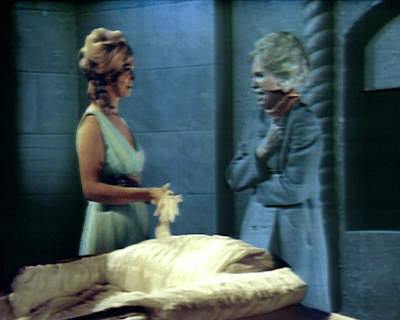
Angelique and Alexis stand facing each other in the tomb. Angelique explains that all she needed to come back to life was a touch. Now that Alexis has given her that, the warmth has begun to drain from her body into Angelique’s. Soon all of Alexis’ body heat will be transferred to Angelique. She will then die, and Angelique will trade places with her. The “heat vampire” idea was one the show explored briefly in April 1969, when undead blonde fire witch Laura Murdoch Collins drained the warmth from the bodies of the living to keep herself alive. Now Angelique will return from the grave as another heat vampire. Alexis will lie in the coffin, and Angelique will move back in to the great house of Collinwood, where Alexis has for the last three weeks been staying as Quentin’s guest.
Footage of the dress rehearsal for this scene survives. The only other surviving videotape from any episode of Dark Shadows not originally released for broadcast are the opening slates of the episodes.* The confrontation between Alexis and Angelique not only involves the most complicated videotape editing they’ve done so far, it also requires Lara Parker to do some intricate acting work as she plays off a version of herself she can neither see nor hear. In the rehearsal footage, she several times breaks character and turns to director Lela Swift to report on things that aren’t going right. We can hear Swift’s responses over the control room microphone. Some crew members are in and out of the shot, and at the end two people come to help Parker out of the coffin. It’s fascinating for hard-core fans, a must-watch:
By the time Mr Trask, the butler in the great house at Collinwood, comes to the mausoleum to see what’s taking so long, Angelique has changed into Alexis’ short bluish gray suit and chignon hairstyle with a tight spiral twist at the back, the look that the mysterious Madeleine wore in Alfred Hitchcock’s Vertigo. She has changed Alexis into her own gown and loose hairdo, and has put Alexis into her coffin. She is closing the lid of the coffin when Trask enters. Trask asks if she is ready to return to Collinwood, and she says she is looking forward to it.
We cut to the drawing room at Collinwood, where Quentin is yelling at the wind. He is convinced that it is really a ghost expressing discontent, and he demands to know what the trouble is. He doesn’t get any answers.
Angelique and Trask enter the house. Posing as Alexis, Angelique dismisses Trask, and tells Quentin she now agrees with him and Cyrus. The body in the tomb must be destroyed.
Cyrus is in his laboratory. He is talking with his lawyer, Quentin’s cousin Chris Collins. Chris has questions about Cyrus’ instructions to open a bank account in the name of John Yaeger and deposit $5000 in it. He asks if Yaeger is a pseudonym Cyrus is planning to use. Cyrus denies this, and says that Yaeger is a man he met recently who is helping him with his current experiments. In #985, Cyrus responded to Chris’ questions about these experiments with a lot of mad scientist ravings that alarmed him. Since Cyrus offers no information about Yaeger aside from his connection to this dubious project, Chris is reluctant to comply with Cyrus’ directives. Cyrus agrees that Chris should meet Yaeger first. Chris says “I’m looking forward to meeting him. See you, Cyrus,” and exits. This is the last time we will ever see Chris. Actor Don Briscoe’s health problems were catching up to him, and he was not able to return to the show.
While Quentin and Cyrus burn the coffin, Angelique is in her old bedroom. Alexis had been staying there, so Angelique is right at home. Trask tells her it is as if Angelique never left. Later, Quentin comes to invite her to join him and Cyrus for a drink downstairs. She declines, saying she would like to be alone.
Lara Parker’s performance as the newly returned Angelique is marvelous, her best work so far. We can see that she is a different person than the one who left the house earlier in the evening, and we can believe that the other characters don’t see it. In a closeup, she wrinkles her face like the Grinch, suggesting that Angelique has come to steal Christmas. The supernatural element of her confrontation with Alexis suggests Edgar Allan Poe’s “Ligeia,” which the show has been drawing on for the last few weeks, and reminds longtime viewers of Laura’s April 1969 storyline. But the idea of a woman killing her identical twin and taking her place would have been familiar to much of the audience from the 1964 film Dead Ringer, in which Bette Davis played the sisters in that sad situation. Bette Davis is one of the people frequently mentioned when film buffs name The Greatest Screen Actor of All Time, but not even she could have done better than Parker does today.
In the drawing room, Cyrus is alone. He was reluctant to accept Quentin’s invitation to stay for a drink, and is pacing and fidgeting. What Quentin does not know is that Cyrus is in the middle of a Jekyll and Hyde project, and he wants to get back to his lab to take the potion and change himself into the brutal John Yaeger. He revels in Yaeger’s cruelty and is addicted to the transformation.
Music begins playing on the soundtrack we have not heard before, a jagged piano theme. Cyrus suddenly feels the pains that he has felt after taking the potion. He sees Yaeger’s dark hair springing into place on his arms. He looks in the mirror and sees that he has become Yaeger, without taking the potion. He goes to flee the house, but realizes Quentin is already approaching. He retreats to the drawing room and locks the door. Quentin knocks, asking what on earth is wrong with Cyrus.
This is not only the first time Cyrus has changed without drinking the potion, it is also the first time he has appeared without a putty appliance precariously attached to the bridge of his nose. He looks far more convincing without it, though of course he is even more instantly recognizable as Cyrus.
In his post about the episode at his great Dark Shadows Every Day, Danny Horn points out both that the videotape editing is extremely ambitious today, with the confrontation between Alexis and Angelique at the beginning and the pretaped sequence of the Cyrus-to-Yaeger transformation at the end, and that that the editing in between these heroic shots looks ragged. The jump cut to Cyrus and Quentin’s approach to the mausoleum makes it look like Cyrus’ laboratory opens onto the cemetery, the first sequence of Angelique in her old room begins and ends with unusually long sequences of her pruning some extremely unhealthy looking flowers, and Cyrus spends a surprisingly large amount of time in the drawing room pacing about. Danny guesses that they did not know how long the process shots would run, so they inserted filler that could be removed if they went long.
That could be, but I like the episode the way it is. The jump cuts give the whole thing a dreamlike quality that works well with the subject matter. That’s certainly the case with the cut to the cemetery- we don’t know where Cyrus’ lab is, but we do know that only death is likely to come from the work being done there, so that jump makes a grim symbolic sense. Moreover, the actors use the sequences Danny identifies as filler to shed light on the characters and situate the scenes in the story. Angelique is so absorbed in her plant that you can believe she came back from the dead specifically to work on it, and nothing Trask or Quentin has to say is going to distract her for long. Cyrus’ pacing makes it clear he feels trapped at Collinwood, which adds considerably to the force of the moment when, as Yaeger, he has to hide from Quentin.
*I should mention that we have the dress rehearsal for #584. What we don’t have is a finished episode- they never made one. They just sent the tape of the dress rehearsal to the ABC network, and that was broadcast.
This is the last script that will be credited to writer Violet Welles. Welles had done a substantial amount of rewriting on scripts attributed to her friend Gordon Russell before her name first showed up in the credits with #711, and she will do more ghosting for Russell later.
Danny Horn’s post about this episode on his great Dark Shadows Every Day is a tribute to Welles; I recommend it highly. Welles was far and away the best author of dialogue among the nine writers credited through the show’s 249 weeks, so much so that her uncredited contributions are easy to recognize. I will mention a week very close to the end of the series in 1971, a long time after the wheels came off, when all of a sudden characters start making witty remarks and developing interesting relationships. Then it’s back to the dreariness of a bunch of go-nowhere stories.
Welles rated herself low as an inventor of plot-lines. I don’t know what went on during the long hours she spent in story conferences with Russell and Sam Hall, but it was when she was in the room that the most fertile planning sessions Dark Shadows ever had took place. They sketched out flimsies thirteen weeks at a time, and from the time Welles became a regular part of the staff until thirteen weeks after she left, the show was packed with more lively ideas than at any other time. So if she was correct in that harsh self-assessment of what she did in the writers’ room, it was only in the narrowest sense.
Welles also spoke disparagingly of herself as a designer of dramatic structure at the level of individual episodes, but today’s installment shows that this was simply wrong. There is a tremendous amount happening in these 22 minutes, it is crystal-clear throughout what is happening and why we should care, and the actors get to do some of the best work they ever did do. We see two stories, one a mashup of Daphne Du Maurier’s 1938 novel Rebecca with Edgar Allen Poe’s 1838 short story “Ligeia,”* the other a retelling of Robert Louis Stevenson’s 1886 novella Dr Jekyll and Mr Hyde, also with a dash of “Ligeia.”
The episode is set in a different universe than the one in which the first 196 weeks of Dark Shadows took place, and most of the characters are “Parallel Time” counterparts of those we met in the main continuity. In the Rebecca/ Ligeia mashup, we today see Quentin Collins, master of the estate of Collinwood, owner of Collinsport Enterprises, and gloomy drunkard; Quentin’s new wife, Maggie Evans Collins; housekeeper Julia Hoffman, fanatical devotee of Quentin’s late first wife Angelique; and Alexis Stokes, Angelique’s freshly arrived identical twin sister. The bit from the Jekyll and Hyde story features scientist Cyrus Longworth and attorney Chris Collins. Angelique comes up in Cyrus and Chris’ conversation, and she is emerging in the role of Ligeia. Like the eponymous character in Poe’s story, she is a celebrated beauty who is dead but expected to return. Alexis herself brings up yet another reference. She wears a short bluish gray suit and chignon hairstyle with a tight spiral twist at the back, the look that the mysterious Madeleine wore and her impostor copied in Alfred Hitchcock’s Vertigo.
Jekyll and Hyde Meet Ligeia
I’ll start with the Jekyll and Hyde story, since it is the simpler one today. Chris is the estate manager at Collinwood, and his responsibilities include custodianship of Angelique’s personal effects. His friend Cyrus has called Chris to his basement laboratory to ask for a favor. Angelique had told him about a chemist in Boston who could help him with some obscure formula he needs for his current experiments. She gave him the man’s contact information, but he lost it, and he wants to look for it in Angelique’s address book.
Before they start talking about the address book, Cyrus tells Chris that he saw Angelique in town today. He tells him he was driving past the drug store and saw her walking down the street. He called to her and she did not answer, but he is certain it was she. Chris does not yet know that Angelique’s identical twin sister is in town, so he does not tell Cyrus about Alexis. He starts with a philosophical approach, then veers towards the explanation medical:
CHRIS: Cyrus, you’re a scientist. A scientist deals in established principle and fact. One thing we have to accept is that death is the end.
CYRUS: I often wonder. People used to believe that the world was flat. They believed that, that the sun revolved around the earth, and these were facts to them.
CHRIS: Uh, what are you saying?
CYRUS: I’m saying that I saw Angelique. I saw her walking down the street.
CHRIS: Well, I wish to submit that there’s an explanation for it. All of this.
CYRUS: What do you mean by that?
CHRIS: You’ve been working yourself too hard. You’ve been locked in this laboratory for over a year. Whatever you’re doing it can’t be worth your health and your peace of mind. It might even damage your mind.
Cyrus tells Chris what he is trying to do:
CYRUS: Let me begin by saying that, that man is chemical in his composition. Now, if the proper compound was distilled, and administered to a human being, this chemical composition could be radically changed, radically altered, and I’ve been working on this composition.
CHRIS: Why, why alter a human being?
CYRUS: Now let me also say this. That man is not one person, he is two. One is good, and the other is, oh, let us say for scientific conversation, the other is evil. Now, these two people are within each of us, and they are always fighting against each other. But if these elements could be separated, just imagine the possibilities. Evil could go its own way, completely free of any aspirations or remorse that are foreign to it. And good, good can have its own life, free of any struggle against, against evil impulses or hostile thoughts. My god, just imagine what a person…
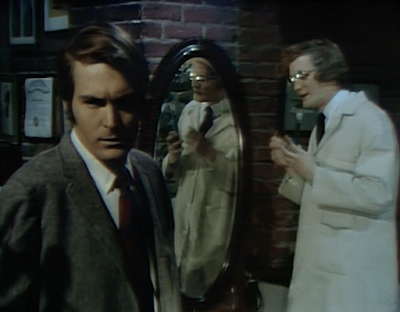
Chris is horrified by this idea, and is glad to be an obstacle to it. Director Lela Swift reinforces Chris’ conviction that Cyrus is destroying himself by placing Christopher Pennock next to a mirror during the most perfervid part of his mad scientist’s programmatic statement, a visual metaphor telling us that Cyrus is splitting himself in two.
Chris tells Cyrus that he won’t help him bury himself even more deeply in the strictly private world he has created. Cyrus says that it is not private, that it is something he shares with Angelique:
CYRUS: Angelique believed in this theory. She believed it could be done. And she was the one who started me on, on all these experiments. Separating good and evil.
CHRIS: (sourly) There is no doubt in my mind which of the two appealed to her.
Chris tells Cyrus that he has been anxious to see him. He has heard that he presented a paper on black magic to a scientific society, and that the news led him to fear that Cyrus’ mind is becoming unbalanced:
CHRIS: I admire your devotion, Cyrus, but not your direction. It can only lead to trouble.
CYRUS: It can only lead to glory. And it will. Very fast, if you’ll just give me the name of that chemist.
CHRIS: No. I’m sorry to withhold it from you, but it’s the only way I can stop you. And I think I have to stop you. I desperately think that.
Angelique was not only a great beauty and a gracious matron, but was also a scientific mind who inspired Cyrus to pursue his scheme. She could introduce an experimenter to chemists whose specialties are so obscure that they cannot be found in any published directory, and her influence leads to the study of black magic and a skeptical view of the finality of death. In these matters, Angelique recalls Ligeia. The unnamed narrator of Poe’s story, Ligeia’s widower, says of her:
I have spoken of the learning of Ligeia: it was immense –such as I have never known in woman. In the classical tongues was she deeply proficient, and as far as my own acquaintance extended in regard to the modern dialects of Europe, I have never known her at fault. Indeed upon any theme of the most admired, because simply the most abstruse of the boasted erudition of the academy, have I ever found Ligeia at fault? How singularly –how thrillingly, this one point in the nature of my wife has forced itself, at this late period only, upon my attention! I said her knowledge was such as I have never known in woman –but where breathes the man who has traversed, and successfully, all the wide areas of moral, physical, and mathematical science? I saw not then what I now clearly perceive, that the acquisitions of Ligeia were gigantic, were astounding; yet I was sufficiently aware of her infinite supremacy to resign myself, with a child-like confidence, to her guidance through the chaotic world of metaphysical investigation at which I was most busily occupied during the earlier years of our marriage. With how vast a triumph –with how vivid a delight –with how much of all that is ethereal in hope –did I feel, as she bent over me in studies but little sought –but less known –that delicious vista by slow degrees expanding before me, down whose long, gorgeous, and all untrodden path, I might at length pass onward to the goal of a wisdom too divinely precious not to be forbidden!
At the end of Poe’s story, the narrator’s second wife appears to die. Her body is eventually reanimated with the personality and even in the likeness of Ligeia. Cyrus’ un-nuanced belief that the woman he saw was Angelique come to life suggests that he expects her to follow in the footsteps of that other learned woman.
There is a poignancy now in seeing Don Briscoe play Chris’ concern for Cyrus. Briscoe suffered from bipolar disorder, and was at this time trying to self-medicate with street drugs. After he was violently mugged while trying to score a fix late at night in Central Park, he wound up leaving acting and moved into his parents’ house in Tennessee. He died there, morbidly obese, at the age of 64. I suppose what Dr Jekyll wanted was to come up with a drug that could sort the contents of the mind into orderly batches, so that people like Briscoe could live the lives they deserved to live.
Ligeia at Manderley
Meanwhile, at Collinwood, Quentin has been extremely stingy with information Maggie should know, and has neglected to tell her that Angelique had an identical twin. Hoffman and others on the estate are convinced that Angelique will somehow come back to life, and in their obsession with this idea they have made Maggie exceedingly uncomfortable in her imposing new home. Making matters worse, night before last Maggie heard a voice that she can believe to have been part of a prank played on her by Quentin’s son, strange and troubled boy Daniel, but which Daniel and we have reason to believe was actually Angelique’s ghost. So when Maggie opens the doors to the drawing room and sees Quentin giving a glass of sherry to a woman who, to all appearances, can only be Angelique, she flees in panic.
Quentin goes to Maggie in her bedroom. He explains that the woman she has seen is Angelique’s twin Alexis. At first he is relaxed and soothing, as charming as the Quentin of the main continuity has always been, almost as charming as David Selby is. But as Maggie insists on being left alone, his mood darkens. Alexis sticks her head in and suggests they should clear things up right away; Quentin asks her to wait downstairs. When Maggie refuses to be formally introduced to Alexis and play hostess to her, Quentin becomes stiff, grouchy, and patronizing, ordering her to do her duty as mistress of the house. She does not bend, and he leaves the room in a huff.
Back in the drawing room, Alexis tells Quentin she ought to leave rather than go on upsetting Maggie. Quentin dismisses Maggie’s concerns and proclaims that he alone makes decisions at Collinwood. Alexis is visibly startled by Quentin’s claim to autocracy, and doesn’t know where to look or what to do with her hands as she stammers out “Of course… you… make the decisions.” She goes along with Quentin’s decree that she will stay in the house starting tonight, before she can get her luggage back from the inn in the village.
Hoffman enters. At the sight of Alexis, she gasps “It- it’s you!” Hoffman composes herself quickly, and says that Angelique often spoke of her sister. She asks Alexis if she received the letter she sent her when Angelique died. Alexis says she missed it. Hoffman had sent it to her address in Tangier, but Alexis had moved from there to Florence by that time. Alexis does not seem to be in any particular business, and she describes her decision to return to Collinsport as motivated by a vague feeling of personal obligation, so we can assume that her long stays in these famous cities are a sign that she and Angelique have private resources that amount, if not to a fortune, at least to a competence. Hoffman suggests that Alexis stay in Angelique’s old room. Quentin does not object, and Alexis agrees.
Alone in the drawing room, Quentin wishes Alexis did not resemble Angelique so uncannily. In a gruff tone, he tells himself “I’m as bad as Maggie, I’m behaving like a frightened child.” Quentin’s attitude when he was lecturing Maggie about Alexis had indeed been that of an impatient adult ordering a child to stop having an inconvenient emotion. Since he does not believe he handled that exchange badly, it’s jarring to hear him say explicitly that he saw it that way. He pours himself a stiff drink.
In Angelique’s room, Hoffman tells Alexis she doesn’t have to lie to her. She may have her reasons to pretend with the others, but with her she can talk openly about the fact that she is Angelique risen from the grave. Alexis is thunderstruck by this, and tries to reason with her:
ALEXIS: You thought Angelique would come back? But that’s impossible, she’s dead.
HOFFMAN: She is not like others.
ALEXIS: She certainly wasn’t like anyone else. Nevertheless, she is dead. Do you hear me? She’s dead, and I’m her sister.
Hoffman tries to trip Alexis up by asking which nightgown she would like from Angelique’s dresser. Alexis points out that she has never seen any of them, so she can’t very well answer. Hoffman starts to apologize for her bizarre conduct:
HOFFMAN: I’m sorry, Miss Stokes, I’m sorry if I’ve said anything–
ALEXIS: It’s perfectly all right. I can understand how much you must miss her. But I wouldn’t intimate such a thing to anyone else if I were you. They might be very distressed by it, and so might you.
This exchange is very effective, particularly for regular viewers. Up to this point, Lara Parker has been playing Alexis quite differently than she played Angelique. Even when Angelique had been defeated in a conflict or was trying to seem like a wounded innocent, she always maintained eye contact with her scene partners and found a way to put a little more drama into her voice than any other performer would have thought to do. But Alexis looks down when she is confused, talks in a soft and casual tone when she thinks she understands what’s going on, and asks questions to which she obviously does not already know the answer. We can believe she really is a different character. But her last two sentences to Hoffman are exactly what Angelique would have said. When Alexis lifts her head and delivers them with her right eye fixed on Hoffman, we are suddenly in suspense as to whether Ligeia has already returned.
On her way out of the room, Hoffman passes Maggie. Without turning to face her, she explains that Alexis is staying, at Quentin’s orders. This brief scene is blocked as an homage to Hitchcock, whose 1940 film of Rebecca will have come to mind when Hoffman mentioned Angelique’s nightgowns. The censors tried to prevent the release of that movie, because of a scene in which obsessed housekeeper Mrs Danvers took a nightgown out of a wardrobe positioned in the same spot of the late Rebecca’s room as is the wardrobe in Angelique’s. Mrs Danvers went on and on about how sheer the nightgown was, how “You can see my hand through the material,” etc. Dark Shadows isn’t quite as bold with the homoerotic subtext of Hoffman’s devotion to Angelique as Du Maurier and Hitchcock were with that of Mrs Danvers’ devotion to Rebecca, but the shot is so much in his style and the movie was so famous that a large percentage of the grownups in the audience would likely have picked up on the reference.
Maggie goes to the drawing room, and finds that the decanter Quentin was drinking from is empty and lying on its side. She goes to Angelique’s room. She arrives just in time to see her obviously intoxicated husband in his first wife’s bedroom, with a woman who looks exactly like that first wife who is wearing a frilly nightgown, putting her hand on his shoulder, and saying in a soft voice “Perhaps we can comfort one another.” When we saw this, my wife, Mrs Acilius, said that she would not be especially pleased if she were to find me in such a situation.
Maggie and Quentin have a showdown about this in the drawing room. It’s a sensational scene, one of the best in the series. Selby plays Quentin as a drunken, condescending grouch, trying to tell Maggie she didn’t see what she clearly saw. Kathryn Leigh Scott is spellbinding as she plays Maggie’s rage. I think it’s her best moment since #265, when the Maggie of the main continuity was a mental patient and went completely nuts while singing “London Bridge.” That, I think, was the scariest scene they ever did, making us think our old pal Maggie was never going to be all right again.
This time Miss Scott doesn’t sound like any character we’ve heard her play before. In fact, she sounds more like a real person than anyone else ever does on Dark Shadows when Quentin has forbidden her to mention Angelique’s name and she responds “You forbid me! Forbid me like a child, and I am not a child, and I refuse to be treated like a child. Not by you or by anyone. I know what I heard and I know what I saw!” At that, Maggie Collins becomes a distinct character and the Parallel Time storyline jumps to a new level.
Quentin whines that Maggie isn’t giving him a chance, and she lets him have it:
MAGGIE: Nobody’s given me a chance. No. This is Angelique’s house, not mine, you’re Angelique’s husband, not mine.
QUENTIN: All right, if that’s the way you feel about it, get out of here!
MAGGIE: All right, Quentin.
QUENTIN: Leave Angelique’s house and leave Angelique’s husband!
MAGGIE: That’s exactly what I’ll do. That is exactly what I will do!
And to Quentin’s bewilderment, that’s exactly what she does. She rushes out the front door. After a bit, Quentin staggers after her. He looks outside. Alexis comes downstairs, in her sister’s frilly nightie, and asks what happened. Quentin frets that “She actually went out that door.” Alexis asks if he is going after her, and he says “No, why should I? She behaved like a child!” He’s still holding onto the idea that it is right and proper for him to regard his wife as a temperamental child. He wonders if perhaps Alexis is right, then hears Maggie drive away and announces that it’s too late to do anything. He wanders back towards the drawing room while Alexis looks on. We are left wondering if she is Angelique masquerading as her sister, or if Alexis, contrary to appearances, was actually the Evil Twin all along.
*I am indebted to Danny Horn’s commenter “Riccardo” for pointing out the connection to “Ligeia.”
The protagonist and narrator of Daphne Du Maurier’s novel Rebecca is the second wife of the enigmatic Maxim de Winter. The theme of the story is the protagonist’s timidity. She never introduces herself to us or reports a conversation in which anyone addresses her by name, so that we can call her only “the second Mrs de Winter.” Many people around her have something to say about Maxim’s first wife, the late Rebecca, though Maxim himself never mentions Rebecca and becomes upset when anyone reminds him of her. From this, the second Mrs de Winter concludes that Rebecca was an unsurpassably glamorous being and that Maxim is still in love with her and always will be. She is terrified of housekeeper Mrs Danvers, but since she would be terrified of anyone, this does not constitute evidence that Mrs Danvers actually represents a threat to her. In fact, the main thing about Mrs Danvers is her ambiguity. We have no way of knowing what she is thinking. Nor do we know what she is doing until the end of the book, when it turns out she is more dangerous even than the narrator had feared. It is also at the end that the second Mrs de Winter finds that Maxim’s hang-up is not his unquenched love for Rebecca. He never loved Rebecca, and would have been glad when she drowned were he not afraid of being prosecuted for his role in her death.
Alfred Hitchcock’s 1940 film Rebecca had to make several things definite that the novel could leave unsettled. So, while in the novel Mrs Danvers is a figure we glimpse in the course of her narrator’s confused attempts to remember what happened in her early days in the mansion, in the film she is a major character in several scenes. So we saw from relatively early on that Mrs Danvers was deliberately playing on the second Mrs de Winter’s insecurities in an attempt to get rid of her.
The film deviates even further from the book in showing Mrs Danvers’ motivation. Du Maurier was herself bisexual and may have started Rebecca with a plan to sketch Mrs Danvers as a mind warped by life in the closet, but as the story turned out it did not shed any light on the roots or structure of Mrs Danvers’ very intense feelings for Rebecca. It was just one more item on the endless list of things that the second Mrs de Winter could not hope to understand. But Judith Anderson’s performance of Mrs Danvers’ fixation on Rebecca struck film censor Joseph Breen as providing a “quite inescapable inference of sex perversion.” Anderson would deny then and in later years that she meant to play the character that way, but her body language throughout, most famously in the scene where Mrs Danvers handles Rebecca’s intimate apparel, makes those denials laughable.
Now, the A story of Dark Shadows is an adaptation of Rebecca. We are in an alternate universe, where the counterparts of Maggie Evans, Quentin Collins, Julia Hoffman, and wicked witch Angelique are cast in the roles of, respectively, the second Mrs de Winter, Maxim, Mrs Danvers, and Rebecca.
There is even less ambiguity here than in Hitchcock’s film. So after Miss Hoffman sets up a moment to enrage Quentin and confuse Maggie, Maggie goes to Angelique’s old room and hears Miss Hoffman telling the portrait of Angelique that hangs there how inadequate she had exposed her as being, cackling with glee all the while. Today Miss Hoffman sets up another such moment, suggesting Maggie give Quentin’s son Daniel a particular record that she knows Quentin will fly into a rage upon hearing. Miss Hoffman is so blatant that Quentin catches on to what she is doing and orders her to apologize to Maggie. When she does, she drifts off halfway through into a rhapsody about how irresistibly beautiful Angelique was. Grayson Hall had played lesbian characters in two films, Satan in High Heels (1962,) which became a cult favorite, and Night of the Iguana (1964,) for which she was nominated for the Academy Award for Best Supporting Actress. So she is on familiar ground when Miss Hoffman’s craving for Angelique becomes a spoof of Mrs Danvers’ homoerotic attachment to Rebecca.
It is not only in the character of Miss Hoffman that this version of Rebecca is less subtle than were those that preceded it. Maggie is even slower on the uptake than was the second Mrs de Winter. Even after she heard Miss Hoffman cackle about her deficiencies, and even after multiple people have made it clear that they are siding with her against Miss Hoffman, she still takes her advice and buys the record. Quentin is quite reasonable today, but that’s a first- so far, he has been even more miserly with information than Maxim was. And where Rebecca was an intimidating memory that became an inconvenient corpse, we end today’s episode with Maggie opening the doors to the drawing room and seeing Quentin offering a glass of sherry to someone who, for all she sees, can only be Angelique come back to life.
UPDATE: Thanks to FotB Melissa Snyder for pointing out a mistake in the original post. You can get the details in the comments below!
The ghost of the mysterious Quentin Collins has trapped children David Collins and Amy Jennings in a storeroom in the long-deserted west wing of the great house of Collinwood. Unable to open the door to the corridor, David and Amy have found another room hidden behind a panel in the storeroom. A room inside another room is often referred to as a “closet,” and this is the perfect soap opera closet- there is literally a skeleton in it.
On Dark Shadows, a fashion-conscious skeleton is never seen without a wig. This one is no exception. It is seated in a chair that swivels towards the children, revealing its face. This swivel reminds us of one of the most famous reveals of a bewigged skeleton in cinema, that of Norman Bates’ mother in Alfred Hitchcock’s Psycho.
Amy and David conclude that the skeleton in the closet must be Quentin’s. The skeleton sits beside an antique gramophone that plays a sickly old waltz over and over; Amy wonders how it started playing. David has been living in the house for two and a half years, so his experience with ghosts is already very extensive, and the gramophone is the least of his concerns.
The adults in the great house have noticed David and Amy’s absence and have gone looking for them. Matriarch Elizabeth Collins Stoddard calls at the other residence on the estate, the home of her distant cousin Barnabas Collins. She tells Barnabas that she wonders if they may have slipped in while he was sleeping. Barnabas tells Liz that he locked all the doors before going to bed, to which she responds “Barnabas, a locked door never kept David Collins out.” In 1967, Barnabas was a vampire and David kept endangering himself by sneaking into his house. In those days, David’s father Roger once made a similar remark. Barnabas isn’t a vampire anymore, but everyone other than Dark Shadows‘ hardcore fans will always think of him as one. David’s inability to get out of the room where Quentin kept him and Amy would suggest that he too has changed, and is now at a loss before locked doors. But for Liz, her nephew will always be a master burglar.
Barnabas searches his house and does not find the children. He and Liz leave for the great house. Hiding nearby, the children see them go and sneak in. As per Quentin’s orders, they go upstairs and take a wooden cradle. Later, we will see them put the cradle in the room with the skeleton and interact with Quentin’s ghost there. Their activities in the room don’t make any sense to the audience; they clearly are not meant to. They come after Amy and David have agreed to “play the game,” using a phrase we hear for the first time today. Those familiar with the mysterious atmosphere of ghost stories can assume it will be some time before we will get enough information even to guess what sort of game it is.
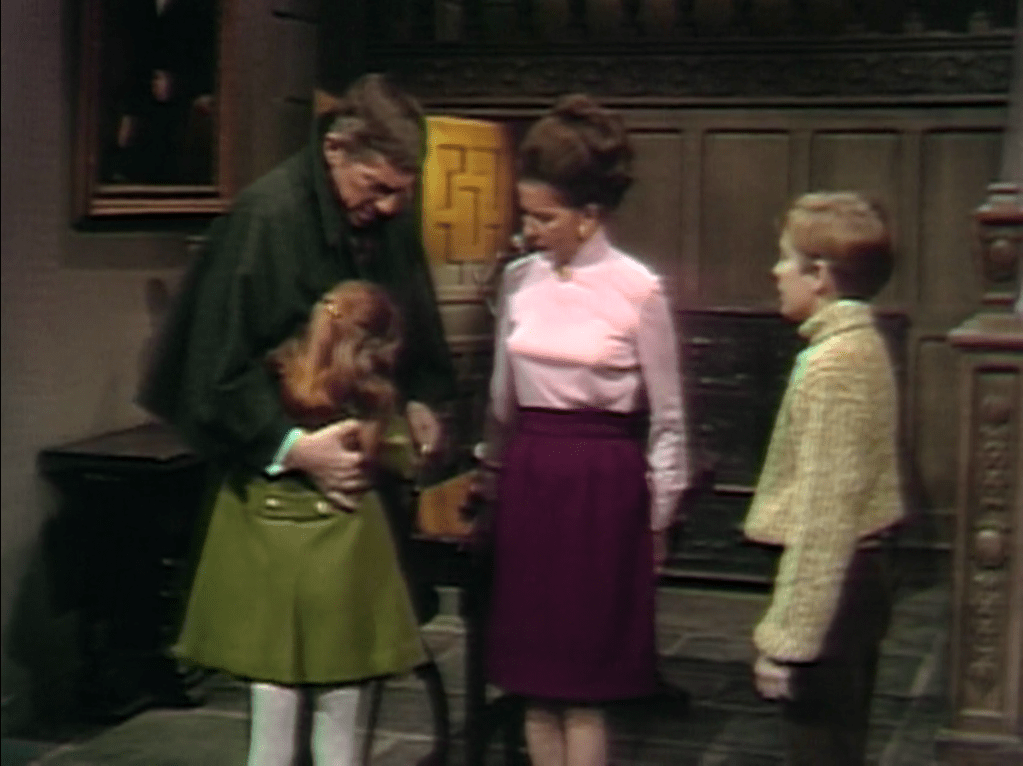
For longtime viewers, the highlight of today’s episode comes when Amy meets Barnabas and gives him a hug. Amy has dominated the show since her first appearance in #632; Barnabas has been its undisputed star since he joined the cast in #211. It turns out that the two of them became friends when they were both patients at Windcliff, a mental hospital a hundred miles north of town.
Amy hugs Barnabas while Liz and David look on.
The director of Windcliff is Julia Hoffman, MD. For almost a year and a half, Julia has been a permanent houseguest at Collinwood; as 1968 has gone on, she has become Barnabas’ inseparable friend. She hugged Barnabas for the first time in #635, to his evident discomfort. But as we saw when he interacted with the ghost of his little sister Sarah in #364 and again when we saw him with the living Sarah in the extended flashback to the 1790s that ran from November 1967 to March 1968, Barnabas gets along well with little girls, so it isn’t such a surprise that he returns Amy’s embrace.
In #629, Liz told Julia that Barnabas was miserable at Windcliff. If Barnabas were still a vampire, it would be easy to imagine his evil overwhelming the scientific rationality at the heart of a psychiatric facility, as it has long since overwhelmed Julia’s professional ethics. But his curse is in abeyance now. They’ve had to work to keep us thinking that he is exotic and uncanny and dangerous; one look at him in a group therapy session would undo all that work so abruptly that we would never stop laughing. Of course we never see him as a patient there. It was daring of them even to include Liz’ line, inviting us to imagine him in such a mundane setting.
There’s an implication that Barnabas and Amy hung out at Windcliff, because apparently exposing small children, in shock over the deaths of family members, to middle-aged mental patients is part of the healing process. The Barnabas/Amy scene makes me laugh at loud because it’s as if the writers think Windcliff is a vacation resort and Barnabas and Amy met by the pool.
Stephen E. Robinson, comment left 11 May 2015 at 6:59 AM Pacific time, on Danny Horn, “Episode 645: Spirited Away,” 10 May 2015, Dark Shadows Every Day.
Stephen is being generous- Barnabas was in the hospital because he had himself been the victim of a vampire, and Amy was there because her brother Tom had died. She did not know, but Julia did, that Tom had also come back as a vampire, and it was Barnabas who destroyed him, first by driving a stake through his heart, later by forcing him into the sunlight. I’m no psychiatrist, but with that history of closely related but non-discussable traumas I wouldn’t think the two of them ought to spend much time together.
But of course none of that matters. Barnabas and Julia are the show’s principal protagonists, and they ran out of story two weeks ago. Ever since Amy took over, we’ve been waiting to see how she will connect with them. Now that we know she is Barnabas’ substitute sister and Julia’s sometime patient, they are ready to rejoin the action.
Dashing action hero Burke Devlin pays yet another visit to the great house of Collinwood. He announces to its residents, the ancient and esteemed Collins family, that he intends to take control of all their properties, including the house. He is buying up their debts and will use them to seize their businesses. He offers to pay them for the house, though. He even offers to pay for it at higher than the market value.
Ne’er-do-well Roger Collins urges his sister, reclusive matriarch Liz, to take Burke’s offer for the house. It’s a huge, gloomy, impractical place, and they would be better off without it. He doesn’t mention that the cash might come in handy when Burke starts calling in all the notes they have no way of meeting. Liz won’t hear of it, and vows to fight.
Flighty heiress Carolyn and well-meaning governess Vicki process their feelings about the matter. Carolyn is wounded by the evidence that Burke never really wanted to be her boyfriend- not that he ever said he did, but she kept hoping. Vicki wonders what Burke is thinking, and whether he understands his own motives. He admits that he may not- after all, if he’s trying to avenge the wrongs the Collinses have done him by bankrupting them and collecting their assets, why not just watch their house fall into his lap with the cannery, the fishing boats, and whatever else they may have, leaving them with nothing?
With this post we say goodbye to one of the bloggers who has kept us company. This was the last episode Marc Masse discussed on his blog Dark Shadows from the Beginning. His posts usually include stimulating insights, sometimes remarkable scholarship, and occasionally material that is in one way or another frustrating. Still, he is always well worth reading.
Among his most extraordinary contributions was about the story of the sabotaging of Roger’s car, a.k.a. The Saga of the Bleeder Valve. That story began when we, accompanying Vicki, saw Burke standing by Roger’s car in episode 13.
Burke tells Vicki that he was looking at Roger’s car because he was thinking of buying one like it, an explanation she finds unconvincing.
In his post about episode 46, Masse includes a long section about similarities between the Saga of the Bleeder Valve and a particular episode of The Alfred Hitchcock Hour. He convinces me that Art Wallace and Lela Swift had studied that episode. You’ll notice from his screenshots that that John Cassavetes even had the same haircut that Mitch Ryan wore as Burke:
Source material for the missing brake valve storyline on Dark Shadows can also be found in The Alfred Hitchcock Hour anthology series. In the episode Murder Case (season 2, episode 19; aired March 6, 1964), Gena Rowlands plays an actress (Diana Justin) in London married to a rich diamond merchant (Charles Justin) played by Murray Matheson. Diana isn’t really in love with her much older husband Charles, but since he is the main financial backer of a play she is starring in, her success is ensured… that is until the boyfriend she dropped so she could run off to England and start a production company with her rich husband, a struggling actor named Lee Griffin (played by John Cassavetes), manages to wangle his way through an audition and secure a part in the play by getting Diana to pass a good word along to the author and director of the production. Lee gets Diana to agree to resume their former relationship, and in no time the pair are in cahoots to relieve Diana of her marital obligations and in the process secure a huge windfall by plotting to have the old man bumped off. To accomplish this, they arrange for Charles to have an automobile accident; this is where the similarities to the missing brake valve story on Dark Shadows come into play.
One afternoon, on a visit up to the country home where Diana and Charles live, which is situated high up on a hilly area, Lee gets an idea when he comments on how the type of car that Charles drives is famous for its brakes.
To compromise the functioning of the car’s brake system, Lee first uses a wrench to loosen something, probably the bleeder valve…
…after which he pumps the brake pedal several times so there won’t be any hydraulic fluid left for when Charles next gets behind the wheel.
Just after completing the task, and with the wrench still in his back pocket, Charles walks in to find Lee there standing by his car, just like in Dark Shadows episode 13 when Victoria Winters walks into the Collinwood garage to find Burke near Roger’s car. To diffuse the situation, Lee explains to Charles: “I was, uh, just admiring your car. It’s, uh, fabulous!”
That night Lee and Diana have a performance in London; to set the plan in motion, Lee phones Charles from backstage while the play is still on and concocts a story about nearly having gotten into an accident on their drive into London due to a careless young motorist, which left Diana shaken up, and suggesting to Charles that he drive down to London to take his wife home…
…which he agrees to, just like in Dark Shadows episode 15 when Roger agrees to drive into town to meet with Burke at the Blue Whale.
Similar to how Roger in episode 17 is shown to have miraculously escaped with just a sprained arm and a few stitches to the forehead, Charles winds up crashing head on into a tractor that was just starting up the hill; despite that the car ended up a total loss, Charles was extremely lucky in having sustained only a couple of cracked ribs and a slight concussion.
The missing brake valve story on Dark Shadows never really did feel like something that would ordinarily be presented on a daytime serial drama. Instead, thus far Dark Shadows has taken its cue from 1940s film noir for atmosphere, Broadway theater style for acting performances, and nighttime mystery suspense anthology programs for subject matter. Is it any wonder that Dark Shadows would go on to evolve into the cultural phenomenon it would later become? A truly one of a kind blend of widely varying influences.
In his post for episode 76, Masse includes the audio of Joan Bennett singing “Sentimental Moments” in the 1955 film We’re No Angels. I’d never heard of the song, and had no idea she sang. Indeed she was not a Singer with a capital S, but her gentle, precise phrasing is perfect for this strange, sad little tune. I think of it as a farewell to Masse and his blog.
We intercut between two contrasting scenes: in the mansion at Collinwood, Vicki the governess and Carolyn the heiress pour their hearts out to each other, while in the Evans cottage drunken artist Sam refuses to answer any of the questions his adult daughter Maggie puts to him.
The disappearance of doughty plant manager Bill Malloy looms over both conversations. Vicki and Carolyn can’t avoid the conclusion that the body they saw face-down on the beach at the end of Friday’s episode was Malloy’s. Sam tells Maggie that the reason he can’t sleep is that he’s worried about Malloy.
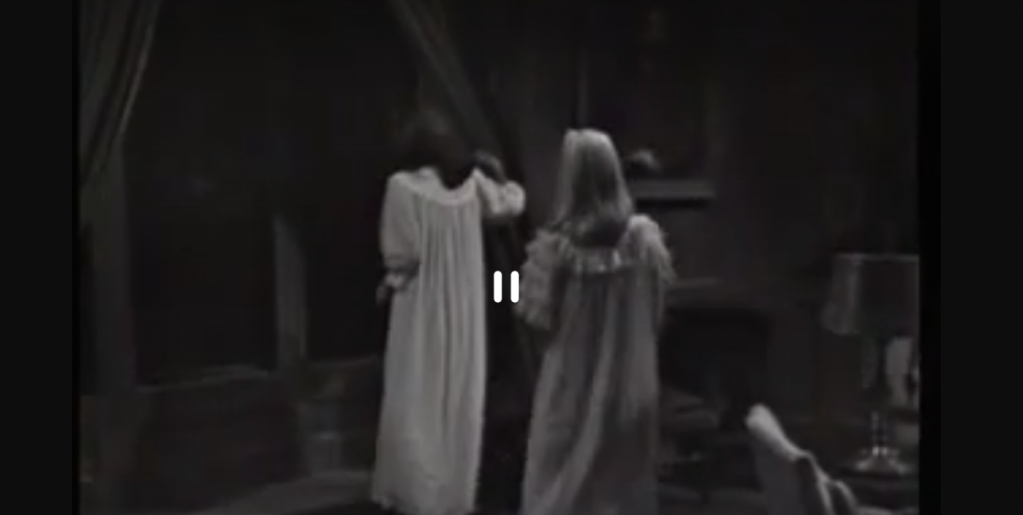
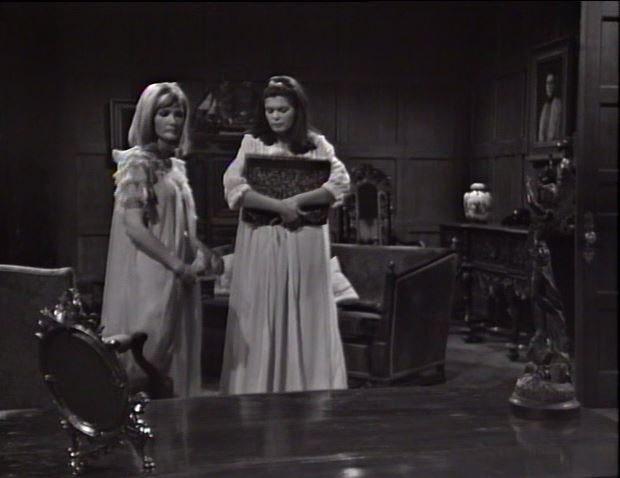
The two settings connect when Sam telephones Collinwood in hopes the dastardly Roger will answer. The call prompts Vicki and Carolyn to break up their slumber party in Vicki’s room and come to the telephone outside the drawing room.
Vicki answers the telephone. Sam says “Collins,” Vicki asks to whom she is speaking, he hangs up. They then hear a noise from inside the drawing room. They go in and search to see if anyone is hiding there. Vicki goes directly to the window and pays special attention to the area behind the curtain on her right, a spot that will become a frequent hiding place much later in the series. I suppose it makes sense that people would eventually start hiding there- the camera has a great angle on it. Smart of Vicki to know that’s the first place to look.
The girls find a book open on the floor. Vicki demonstrates that the noise they heard was the sound of the book falling, but she cannot explain how it moved several feet from the table where it was kept to the spot where she and Carolyn found it. Carolyn insists that they consider the possibility that a ghost put it there. Since they had heard the same sound at least once while they were still in Vicki’s room, it would make sense to consider that someone or something must have been involved in picking it up and dropping it again.
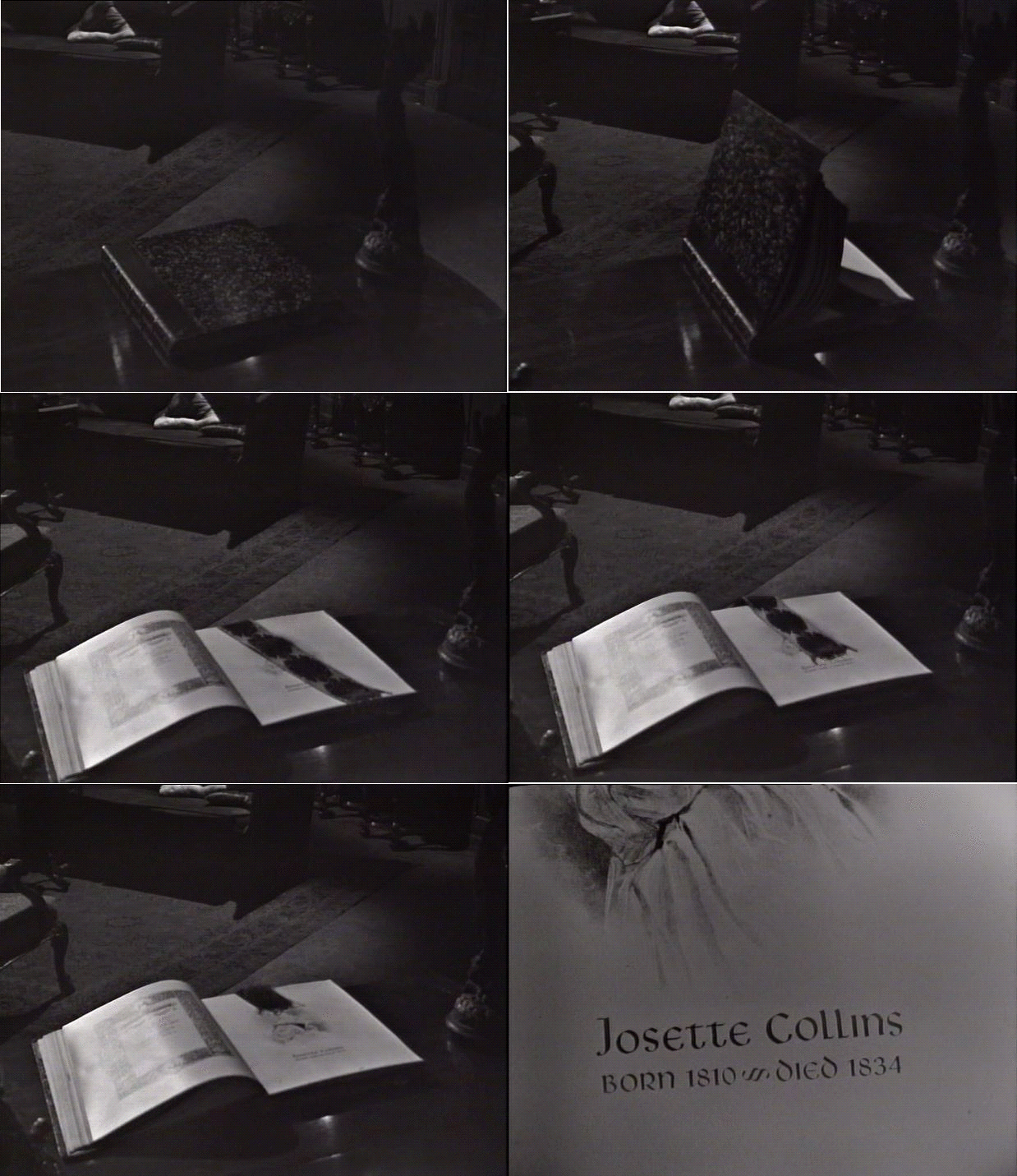
Vicki and Carolyn leave the drawing room, and we see the book reopen itself to the same page. The camera zooms in, and we see that the page bears the name and likeness of Josette Collins. This is the first supernatural manifestation that the audience sees when no character is looking. We’ve been hearing about the ghost of Josette Collins from week one; we have to assume that she is leaving us her carte de visite.
Each of the previous supernatural manifestations had marked a moment when off-screen events were stirring up the spirits that inhabit the back-world behind the universe the characters inhabit. When troubled rich boy David had tampered with the brakes on his father Roger’s car in an attempt at patricide, reclusive matriarch Liz was asleep and ghosts were trying to reach her in her dreams. That same night, Vicki saw a door open and close itself inexplicably, and saw a shrouded figure on the threshold of the drawing room. At the beginning of this episode, Carolyn admitted to Vicki that while Collinwood has always been a strange place, it was only when she and Burke came to town that the really weird stuff started happening. So we have to take it that Vicki’s presence in the house is itself a matter of concern to Josette and the other ghosts, and that what is happening off-screen in connection with the body on the beach and the secrets Sam refuses to share with Maggie are going to bring the phantoms out of the back-world into the foreground.
It’s also interesting that the first character we see after the ghost of Josette announces herself is Maggie. At this point and for some months to come, the show will be developing a connection between Vicki and the ghost of Josette. But later on, both Maggie the character and Kathryn Leigh Scott the actress will be very much involved with Josette. The series involved very little advance planning, nothing at all like daytime serials of the present day that have their stories sketched out in detail months in advance, so that is probably just something you’d expect to happen when you only have four actors in the studio. Still it’s an eldritch moment for repeat viewers.
Within the context of the show as it actually was at this period, I think there is a point to the juxtaposition of the ghost of Josette with the scene between Maggie and Sam in the Evans cottage. Vicki and Carolyn are girls at a slumber party scaring each other with ghost stories. Even when the slumber party takes place in a mansion on a great estate belonging to the family that gave the town its name, that’s a silly situation. When the ghost stories turn out to be true, though, you’re suddenly vaulted into an elevated realm of fantasy. Turn to a small house where the adult child of an alcoholic is wearing her late mother’s night-gown and trying fruitlessly to prise some useful information out of her drunken parent, and you land back in the real world with a thud. Nothing here seems to be either silly or fantastic. Sam’s association with Roger’s secret, and therefore with the unknown events that are roiling the supernatural world, suggests that the mundane struggles of the Evanses and the fantastic doings at Collinwood will sooner or later collapse into each other.
I should mention Marc Masse’s post about this episode on his always intriguing, usually inaccessible blog Dark Shadows from the Beginning. Masse meticulously demonstrates the influence of the 1944 film The Uninvited on the show in general and this episode in particular with close analysis and multiple screenshots, and then does the same thing with an episode of Alfred Hitchcock Presents called “The Gentleman from America.” It’s a very impressive and thoroughly convincing work of scholarship.
Masse’s blog is infamous among many Dark Shadows fans because of what he presents as transcripts of conversations between director Lela Swift, executive producer Dan Curtis, and others that he claims were picked up by the control room microphone and that he has recovered by some more or less magical technique unknown to other audio technicians. In this one he includes such a “transcript,” in which Swift (who didn’t direct this episode, but is supposed to be in the control room anyway) tells Curtis that she thinks it’s a terrible idea to do a ghost story or a Hitchcock story on daytime TV.
That installment of “The Dan and Lela Show” is pretty tedious to read, but in a way it’s a relief. In previous posts Masse has presented Swift as maniacally driven by lust for the female cast members, a presentation that her husband and their children might have found surprising. His post for episode 48 brings that presentation to a sort of crescendo. Since this one includes two shots of Vicki and Carolyn in bed together, I braced myself for Masse to outdo himself in that line, but there isn’t a bit of it there.