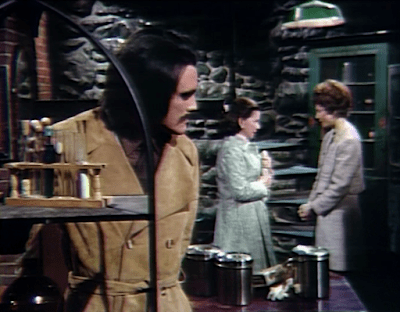
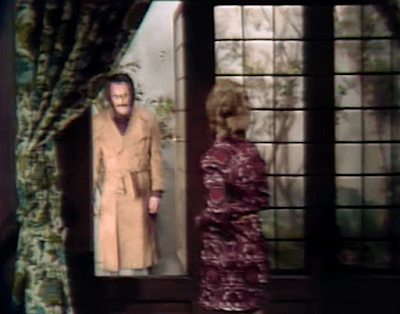
Episode 1026: The spectacle of Barnabas Collins trying to prove anything

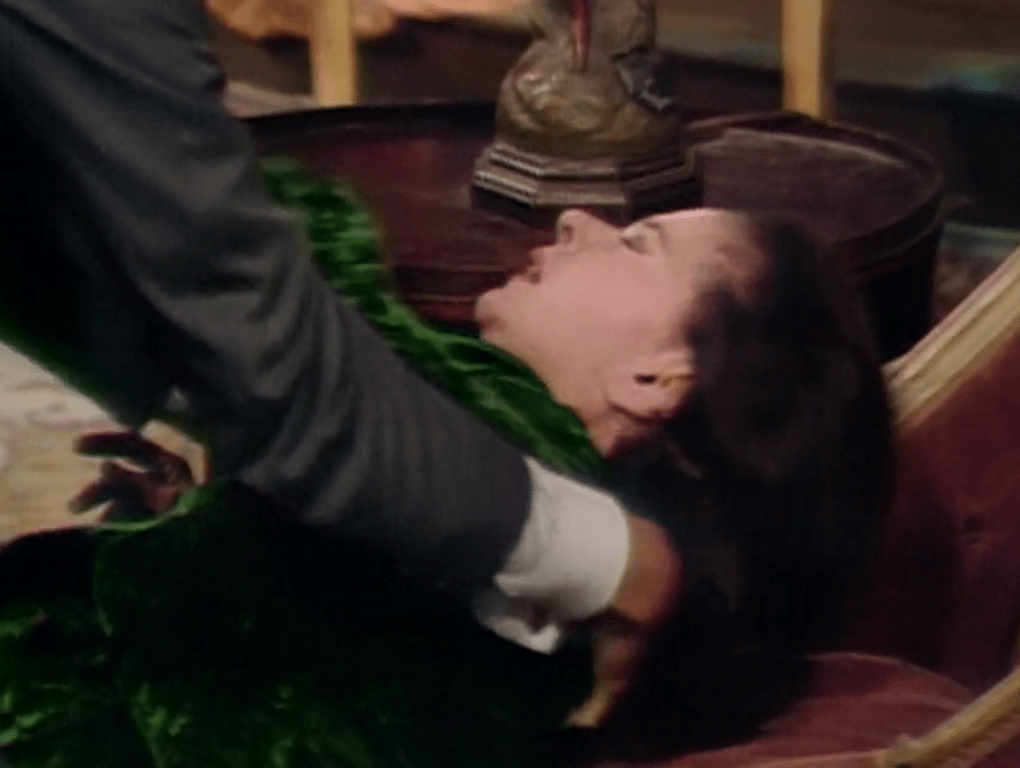
Maggie Evans is depressed about her marriage to drunken sourpuss Quentin Collins. In #1016, Maggie was getting ready to call a lawyer so she could put an end to their joyless union, but she changed her mind and decided to give it one more try. That has not worked out, and she has gone from contemplating divorce to attempting suicide. She is about to fling herself to her death from a window high in the great house of Collinwood when Quentin’s sister Elizabeth Collins Stoddard enters the room and talks her out of it. For its first 196 weeks, Dark Shadows was set in an alternate universe, which is in some ways a mirror image of this one. This incident is a case in point. In the original continuity, it was Liz’ counterpart whom people kept interrupting while she was trying to do away with herself,* so she takes the reversed position in this universe.

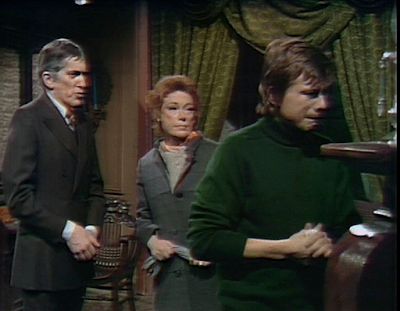
Most of the episode is devoted to the activities of a visitor from the main continuity, Barnabas Collins. The only thing Barnabas has a motivation to do is to try to get back home, but he seems to have decided he’d rather meddle in the problems the people in this alien universe are having. He suspects that the houseguest at Collinwood who is generally accepted as Alexis Stokes, identical twin sister of Quentin’s late first wife Angelique, is in fact Angelique herself risen from the dead. He also suspects that Maggie’s suicide attempt was the consequence of spells Angelique cast on her.

Barnabas is right about these things, but his grounds for believing them are thin. Angelique’s counterpart in his universe is a wicked witch who has long been the bane of his existence, and so he simply assumes that a woman with her face and voice will be the same. But for three weeks, Alexis really was staying at Collinwood, and Angelique really was in her tomb. Alexis looked and sounded exactly like Angelique. We saw that, while Alexis may not have been a one-dimensional innocent, she was not a witch and was not a direct threat to anyone’s life or liberty. Had Barnabas met Alexis before Angelique came back to life and murdered her, he would have had exactly the same suspicions about her that he has now about Angelique. It is purely a matter of luck that his suspicions coincide with the truth.

In the main continuity, Barnabas’ best friend and most frequent accomplice in his many crimes is mad scientist Julia Hoffman, MD. Julia’s counterpart here is the housekeeper at Collinwood. Miss Julia Hoffman is as devoted to Angelique as the original Julia is devoted to Barnabas. As the first Julia shows great reluctance when Barnabas is about to murder someone and shows even greater efficiency in getting rid of the bodies afterward, so this Julia protested yesterday that she would have nothing to do with Angelique’s plan to drive Maggie to her death, but was waiting outside the room when she was about to jump.

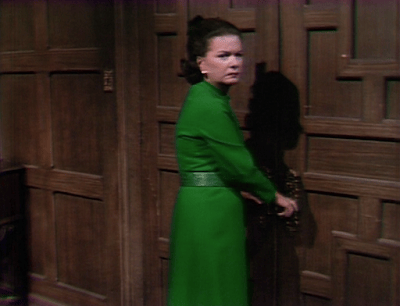
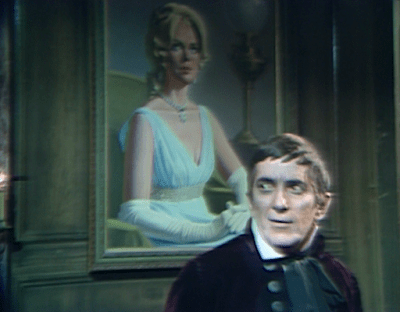
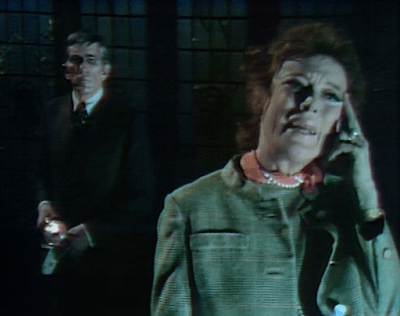
After confronting Julia and Angelique, needlessly revealing to them his suspicions, Barnabas decides to get some hard evidence. So he goes to Angelique’s old bedroom and stares really hard at the portrait of her that hangs there. She is in another part of the house, but grows agitated. She runs to the room and screams at him to stop staring into her eyes. He breaks into a triumphant… not grin, exactly, it’s more of a simper. It may be the only triumphant simper ever seen. That suits the occasion. He knows he was right, but Angelique knows that he knows, and it is not clear what he either can do to fight her or what reason he has to want to fight her.

Barnabas’ triumphant simper. Screenshot by Dark Shadows Before I Die.

Jonathan Frid’s invention of a facial expression previously thought to be impossible is one of several bits of conspicuously good acting in this episode. He also gets to deliver brief enigmatic responses to a number of questions, such as “Perhaps” and “Did I?,” and he makes each of those words materialize in space in such an arresting way that even his scene partners can’t help but show how impressed they are. As Liz fussing over Maggie, Joan Bennett shows a maternal quality that brings her hitherto undefined character into a very sharp focus. Grayson Hall also adds greatly to Hoffman’s depth. Standing by while Maggie is trying to kill herself, she is bland and detached. When she tells Angelique that it really is better for them that Maggie did not succeed, she is the opposite, torn between a number of emotions, including relief that she has avoided responsibility for a death.

Angelique has several comic lines, for example a wistful lament that she doesn’t get to see Maggie’s corpse mangled on the rocks below her window. And she puts real fervor into her spellcasting directed at Maggie. My wife, Mrs Acilius, remembered that when Lara Parker first joined the cast she wished she were playing an ingenue, so much so that Frid had to keep reminding her that she was the villain. But now she has settled in and become part of the group. So when Angelique abuses Maggie, Parker and her friend Kathryn Leigh Scott turn into two little girls playing make-believe, and they have so much fun at it that they are irresistible to watch, no matter how miserable Maggie is.

*For example, in #266, #267, and #268, and #569.

Episode 1024: Chance and Mrs Stoddard are identical twins

When Dark Shadows began in June 1966, its biggest draw was movie star Joan Bennett as reclusive matriarch Elizabeth Collins Stoddard. Liz was highly capable, and Bennett made her compelling to watch. When in #25 Liz’ brother, high-born ne’er-do-well Roger Collins, grudgingly complimented her on her “neat way of managing people,” we could see that he was putting it mildly. But the show didn’t handle Liz’ storyline very well, and she soon became a blocking figure. As the owner of the estate of Collinwood and of the Collins family businesses, as a central player in all the stories they had started with, and as the powerful personality Bennett had created, Liz was such an important part of the show that when she became a brake on the action, there was a constant danger that it would be impossible for anything to happen ever again.

The arrival of Roger’s estranged wife Laura Murdoch Collins in #123 marked Dark Shadows’ transformation into a supernatural thriller. By the time Laura went up in smoke in #191, her story had absorbed two of the four original narrative themes, “The Revenge of Burke Devlin” and well-meaning governess Vicki’s growing friendship with strange and troubled boy David, and had undercut whatever interest we might still have had in the other two, the mystery of Liz’ decision to become a recluse and Vicki’s quest to learn her true identity. The emerging Dark Shadows 2.0 had little room for Liz, and she subsided to the margins. When the show traveled back in time and became a costume drama from November 1967 to March 1968 and again from March to November 1969, Bennett played other characters and was able to make a substantial contribution, but Liz would never again be a suitable vessel for her great talents.

For the last eight weeks, the show has been in another time travel segment. Now it has traveled, not back in time, but sideways. They are in an alternate universe. The show insists on calling this universe “Parallel Time.” It is 1970 here, as it is in the original continuity, but a different 1970 where people with the names and faces we already know are living very different lives.

The Elizabeth Collins Stoddard of Parallel Time is not the mistress of Collinwood or an effective businesswoman. This Liz entrusted her inheritance to her brother Roger, who turned out to be just as feckless as his counterpart in the original continuity. As the penniless Roger we met in 1966 lives in Liz’ house as her guest and works in Liz’ business as her employee, so this Liz and Roger both live at Collinwood as the dependents of their brother, drunken sourpuss Quentin Collins.

In the original continuity, Quentin was not Liz and Roger’s brother, nor did he own anything. We got to know him when Dark Shadows was set in 1897, and he was a charming rogue, the younger brother of Judith and Edward Collins, who like Liz and Roger were played by Joan Bennett and Louis Edmonds. So the parallel lines representing the two versions of 1970 take a bit of a swerve into that other epoch.

Today, Liz is busy organizing a costume ball to be held in the great house of Collinwood. They had such a ball every year at this time when Quentin was married to his first wife, the late Angelique Stokes Collins, and Liz thinks that having another one would be the perfect occasion for Quentin to introduce all of his friends to his new wife, the former Maggie Evans. Liz needs help getting this party going. She comes bustling into the drawing room today and addresses herself to Angelique’s identical twin sister, Alexis Stokes, announcing that the party is tonight and 14 of the guests have failed to RSVP. She bemoans her inability to get anything organized and pleads with Alexis to help her. Alexis agrees to do so and excuses herself from a chess game she had been playing with Barnabas Collins, a man who recently showed up and introduced himself as a distant cousin of the Collinses of Collinwood.

Quentin enters the drawing room and orders Liz to cancel the ball. She says that it is too late to do that. Quentin stalks off and goes outside. Liz turns to Barnabas and asks him to reason with Quentin. Barnabas is unsure that he is the right person, but he goes to the door anyway. He opens it just in time to hear Quentin peeling away in his car. Maggie appears at the head of the stairs and asks if Quentin has gone. Barnabas has to say that he has, and Maggie looks crushed. Liz is unable to help in any way.

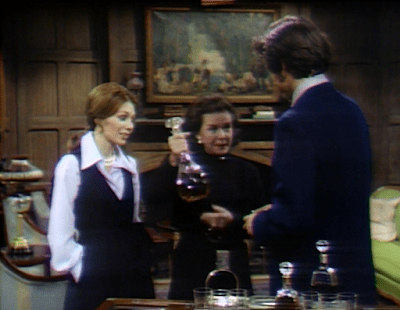
Later, Liz returns to the drawing room in the middle of a conversation between Quentin and Maggie. She is carrying an enormous decanter containing some sherry and congratulating herself on calming the cook’s nerves by her bartending. Quentin excuses himself to go get into his costume.

Liz brings the party. Screenshot by Dark Shadows Before I Die.

Liz finds that Maggie has not yet chosen a costume. She urges her to do so at once. Maggie says she supposed that Angelique always picked out her costume weeks in advance. Liz knows that Maggie is intimidated living in Angelique’s shadow, and does not know what to say in response to that remark. She quickly changes the subject. She brightens, and says that Alexis has brought many lovely dresses down from the attic. She urges Maggie to go to Alexis’ room and choose one of them.

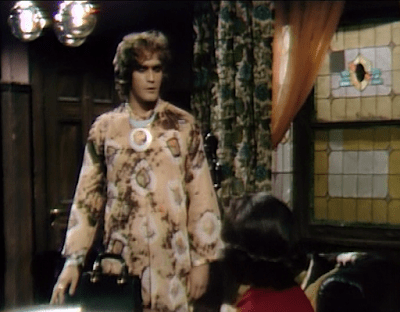
As the time for the guests to arrive comes near, Liz and Barnabas meet in the foyer. A portrait of the Barnabas Collins who died in 1830 hangs on the spot on the wall next to the front door where earlier this week we had seen a metal doodad that looks like a coat of arms. Barnabas is wearing the same outfit, and looks just like the man in the portrait. Liz is wearing a dress of the same vintage. She is overjoyed, and tells Barnabas that the period suits him. He thanks her, and returns the compliment. Quentin is wearing a blue federal coat; Liz and Barnabas tell him that he, too, is suited to the early 1800s. Alexis comes downstairs in a blue dress, and she receives the same commendation. Lastly Maggie makes her appearance. When Quentin sees her dress, he becomes very tense. He tells her to take it off, orders her never to wear it again, and smashes his glass on the floor. The camera pans from Barnabas’shocked expression to a flickering look of pleasure on Alexis’ face; Liz stands between them, and unfortunately we only see the top of her head.

What Liz does not know is that the person she thinks is Alexis is in fact Angelique risen from the grave. Angelique murdered Alexis, took her place, and is conspiring with housekeeper Julia Hoffman to drive Maggie and Quentin apart. The story is a souped-up version of Daphne Du Maurier’s Rebecca, in which the dead first wife is not only a memory that triggers anxiety in her successor but a supernatural being who rises from the dead to torment her directly. There is a scene with Maggie looking out the window of the drawing room that is an exact recreation of a shot in Alfred Hitchcock’s 1940 film of Rebecca, and when Angelique and Hoffman trick Maggie into wearing the same dress Angelique wore to last year’s ball, prompting Quentin’s outburst, most grownups in the original audience would remember the same thing happening to the second Mrs de Winter in that film.

Angelique is the villain, and Maggie is the heroine. Still, we rather like Angelique. The sister-murdering is bad, of course, but Quentin is such a lousy husband that she is doing Maggie a big favor by trying to bring their intolerable marriage to its end as soon as possible. For example, today Quentin finds Maggie reading his old love letters to Angelique. He might justifiably have objected that those are private and say he wished she’d asked before reading them, but he doesn’t do that or anything else one adult would do when disappointed in another. Instead, he flies into a rage, accuses her of a variety of things she hasn’t done, and orders her to, and I quote, “Go to your room!”

Later, in the room they share, Quentin is still scolding Maggie for failing to admit that she was lying about how she found the letters. We know she had in fact told the truth. When she tells him so, he dismisses her with a shake of the head. When she brings up the fact that it is the anniversary of his wedding to Angelique, he shouts that she is forbidden to discuss the subject, then storms out and slams the door. This is when he goes downstairs, tells Liz to cancel the party, and drives away. We have never seen Maggie have a happy day with Quentin. He sometimes manages to be pleasant in the intervals between his tantrums, but even then he can’t let go of his habit of talking to Maggie as if she were a child and he were her somewhat weary guardian. If Angelique can hasten their final split, Maggie will owe her an enormous debt of gratitude.

Barnabas is not in fact a descendant of the man whose portrait now hangs in the foyer. He is a visitor from the main continuity. Angelique’s counterpart there is his great enemy, so it is fun to see him talking with this Angelique and playing chess with her.

David Selby has a problem with one of his lines, when Quentin winds up saying “I wonder where I got the illusion that an hour or two alone would settle one’s all of problems.”  This is a fairly minor stumble by Dark Shadows standards, but it comes when Angelique is in closeup and Lara Parker’s left eyelid twitches when she hears “one’s all of problems.” That reaction is worth a laugh.

Episode 970: Another road

Yesterday, Barnabas Collins went to the long-disused east wing of the great house of Collinwood to search for the coffin that vampire Megan Todd occupies during the day. Barnabas is himself the vampire who ended Megan’s human life, passing his curse along to her. When his friend, mad scientist Julia Hoffman, makes a characteristic remark and tells him “you must not feel personally about Megan Todd,” Barnabas asks “How can I feel any other way?” Most of Barnabas’ feelings, in this or any other matter, consist of pity for himself, but there is a trace of sympathy for Megan in there someplace, probably.

Now, Barnabas has taken Julia to a spot that he happened upon while looking for Megan. While Julia was in the carriage house on the estate with matriarch Elizabeth Collins Stoddard, Barnabas saw two women who looked and sounded exactly like them in a brightly lit, fully furnished, heavily decorated room behind a pair of doors in the otherwise dark and empty east wing. Julia’s double was wearing a French maid outfit and giving orders to Liz’, which is probably someone’s fetish but which is totally out of character for the women Barnabas knows.

In #351, Barnabas was without a blood-thrall. Julia offered to guard his coffin during the day. They were not really friends at that point, and he reacted to her offer warily. Among his objections was that it was not suitable for her, as a medical doctor, to fill such a position. She assured him that she was not volunteering “to be your maid.” Longtime viewers might remember that line when they see Parallel Julia in her livery.

There was an invisible barrier in the doorway that Barnabas could not cross, and he was unable to attract the attention of the women who were so near to him, even when he shouted what he supposed to be their names. The doors closed, and when they opened again the barrier was gone, but so were the doubles of Julia and Liz, along with all the furnishings and lights that had surrounded them.

Thinking of what Barnabas has told her about the room, Julia hesitates to enter it with him. She dismisses her concern as “silly.” Regular viewers will perk up at this- labeling a fear as “silly” is the surest way of marking it as the basis of an upcoming major story point. Once inside the bare room, Julia starts thinking out loud:

JULIA: I was at Eliot Stokes’ house one night, oh, last spring. We were having a brandy after dinner and he started talking about time… He was complaining that we all simply accept it. We don’t have much choice, I thought.

But Eliot had been reading a theory. It sounded insane to me. A theory of parallel time… we live on this universe in 1970, right? We accept the fact that our time is the only time that we can truly know. Suppose time is like a road and parallel to it there’s another road. On one we live the lives we know, but on the other road our lives are different because we’re in a different time-band* and we’ve made different choices. For example, in that other band of time I could’ve made a different choice when I was at college. Instead of being a doctor I could’ve married and had children.

Barnabas, you don’t actually think through some warp in the time band that you have actually seen us living other lives?

BARNABAS: I don’t know, there’s got to be a more rational explanation.

JULIA: Must there?

So, now we know that we are about to launch a new kind of time travel story. The show has taken us back in time for long costume drama inserts, most notably from November 1967 to March 1968 when it was set in the 1790s and from March to November 1969 when it was set in 1897. Now they are going to travel sideways in time, and take us to a parallel universe where Julia is a maid and Liz is not the lady of the house.

Time bandits. Screenshot by Dark Shadows Before I Die.

At the end of the episode, Barnabas sees the room change again. Parallel Time Liz and Parallel Time Julia uncover a portrait that hangs there, the portrait of a woman whom PT Liz insists is dead and PT Julia insists is still the rightful mistress of the room. Barnabas recognizes the subject as the Parallel Time counterpart of his ex-wife, wicked witch Angelique.

With this, the behavior of PT Liz and PT Julia falls into place. We’re about to see a story derived from Daphne Du Maurier’s Rebecca. PT Julia is Mrs Danvers, the housekeeper maniacally devoted to Rebecca, the late wife of Maxim de Winter. PT Angelique is the one whose death and continued ownership of the room have been a point of contention between PT Julia and PT Liz. We’ve seen a photograph of Parallel Time counterparts of Barnabas’ distant cousin Quentin Collins and strange and troubled boy David Collins, signed “Your loving husband, Quentin.” PT Quentin is the one whom we have heard Liz say is returning with a new wife. In the main “time-band,” Quentin is a penniless rogue with a long supernatural backstory, but his counterpart is the master of Collinwood, and Liz ranks somewhere below the uniformed domestics in the household hierarchy. The David we know is the son of Liz’ brother Roger and a blonde fire witch named Laura Murdoch, but evidently his Parallel Time counterpart is the son of the counterparts of Quentin and Angelique. We have had no indication of who Quentin’s new wife is to be.

This is not the first reference to Rebecca on the show. When Clarice Blackburn joined the cast as housekeeper Mrs Johnson in September 1966, she was supposed to model the character on Mrs Danvers. Mrs Johnson came to Collinwood as a spy for Collins family nemesis Burke Devlin, driven by her certainty that Roger was responsible for the death of her beloved former employer Bill Malloy. Bill, like Rebecca, had drowned under suspicious circumstances, though he didn’t have much else in common with her. By the time the “Death of Bill Malloy” story played out, Mrs Johnson had taken on a new function as an inveterate gossip who made narrative progression possible by blabbing everything she knew to everyone she met. Blackburn’s outstanding talents made her a significant part of the show for quite some time; it’s a shame she isn’t going to be part of the upcoming segment.

Rebecca was not the only Du Maurier novel to inspire a story on Dark Shadows. Dangerously unstable ruffian Willie Loomis first freed Barnabas to prey upon the living after David and Mrs Johnson told him the plot of Du Maurier’s Frenchman’s Creek and claimed that it happened to one of the Collins ancestors. Searching for the treasure the pirate gave to the lady, Willie stumbled upon Barnabas’ coffin. He opened it, earning a bite that made him the vampire’s slave.

Willie’s mistake was that he did not know what kind of show he was on. When Dark Shadows began, executive producer Dan Curtis and ABC vice president for daytime programming Leonard Goldberg** meant for it to be the television equivalent of the “Gothic romance” novels that were so popular in those days. Du Maurier’s novels were among the cornerstones of the Gothic romance genre, and if it were still that kind of show in April 1967 Willie would have been on solid ground in his expectation that there might be a lot of jewels hidden in an unmarked coffin in the old mausoleum. But when Laura was on the show from December 1966 to March 1967, her story subsumed all the major plot threads into a tale of the supernatural. Willie and his sometime friend, seagoing con man Jason McGuire, were on the show as in-betweeners to sweep up the last non-paranormal odds and ends and help introduce the next uncanny menace.

Now, the show is heading in the opposite direction, and Willie is back to help take us there. In Parallel Time, Dark Shadows will finally do the Daphne Du Maurier adaptation that didn’t work out in the Bill Malloy story and that was never meant to work out for Willie. But Megan has to be destroyed before Barnabas can decamp for Parallel Time, and he and Julia order Willie to destroy her.

It was not a foregone conclusion that Julia and Barnabas would want to stake Megan. At the moment, Julia is giving Barnabas injections meant to relieve him of the effects of the vampire curse. Similar injections had worked in 1968 and again during the 1897 segment. Julia shows Barnabas the cross she wears to ward Megan off, and he does not recoil from it. That suggests the injections are having some effect on him, even though he keeps complaining that they aren’t doing anything to curb his bloodlust. When Julia and Barnabas find Megan in the east wing, she refuses the injections. When they find that she is feeding on Roger, they conclude that she cannot be allowed to see another night.

Willie is horrified by the command to drive a stake through Megan’s heart. He protests that he doesn’t even know her. As Barnabas and Julia tell him of the nightmare that awaits everyone if he doesn’t do as they say, he starts to talk about his fiancée Roxanne and the secrets he has been keeping from her. He worries about the image she will have of him if she finds out that he is the former blood-thrall of one vampire and the destroyer of another. “I mean, she’s gonna be thinkin’ I’m weird or somethin’!” I suppose that would be an occupational hazard for blood-thralls.

Willie is worried Roxanne might get the wrong idea about him. Screenshot by Dark Shadows Before I Die.

There is an odd moment when Julia is asking Liz about the east wing. Liz tells her that Roger knows more about the legends of the house than she does. When Julia was first on the show, she was posing as an historian looking into the old families of New England. In those days, Liz mentioned that Roger knew far less about the Collins past than she did, which fit with the original keynote of Roger’s character, an extreme lack of family feeling. But by this point, Roger has merged with the roles Louis Edmonds played in the 1790s and 1897 segments, both of whom were dedicated to the honor of the Collins name.

*The first appearance of this bit of Collinsport English.

**Not to be confused with his then-boss, network president Leonard Goldenson.

Episode 966: All our dead have turned into skeletons

For sixteen weeks, Dark Shadows kept gearing up to tell us about the Leviathan People, a Lovecraftian race of Elder Gods who had a plan to retake the Earth and destroy humankind. During that time, the show gave us several good scenes, some striking images, a few thrilling moments, and many outstanding performances. But it never came together into anything that could be called a story. Today, they officially run up the white flag.

The harbinger of the Leviathans is a shape shifting monster from beyond space and time. The monster settled into the form of a tall young man, fell in love with heiress Carolyn Collins Stoddard, and decided he just wanted to be human and marry her. Nicholas Blair, high priest of the cult devoted to the service of the Leviathans, wants to join him and Carolyn, not in marriage, but in a ceremony that will turn her into the same kind of squamous, rugose, and paleogean creature the monster is when he is relaxed. The monster disrupts that ceremony, and suddenly the whole Leviathan project crumbles.

Nicholas tells the monster that he will die soon, since he can no longer change out of his humanoid form. The monster doesn’t understand what he means. Nicholas explains that the body through which he once invited people to “Call me Jabe” cannot live on its own. Since he can no longer shift shape, the monster’s future as Jabe is extremely limited.

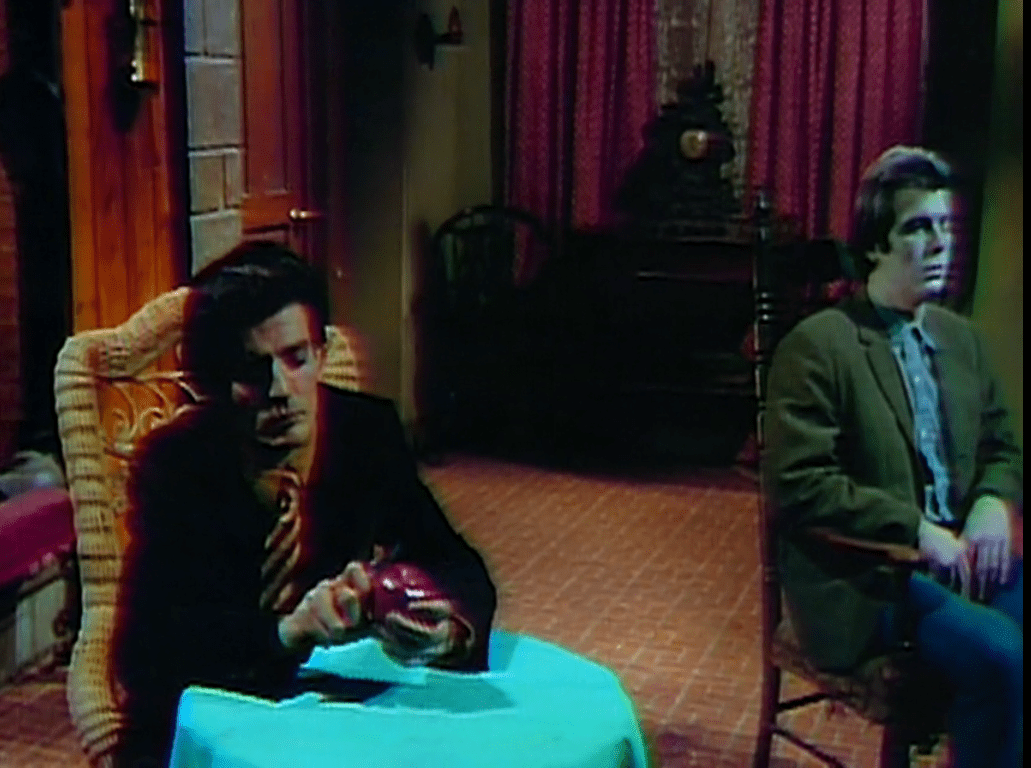
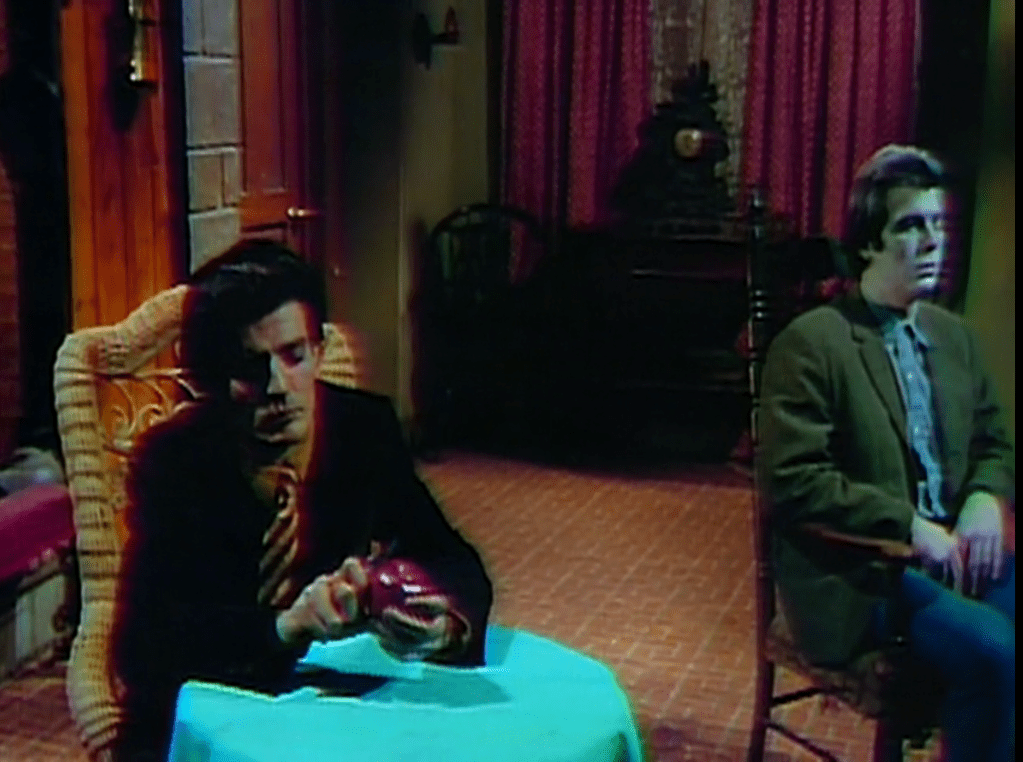
Meanwhile, Nicholas’ henchman Bruno is hanging around the carriage house on the estate of Collinwood, where Jabe has been staying. He peels an apple and sits in a chair next to a zombie. We’ve seen plenty of zombies, but no one on the show has had anything to eat since the diner at the Collinsport Inn was a frequent set in 1966 and early 1967, so the apple is noteworthy.

In a different role, Michael Stroka visited the diner in its one post 1967 appearance, in #813. No one was being served that time, though.

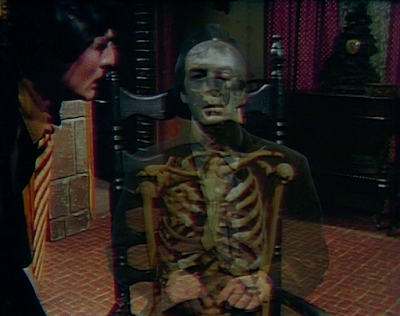
Bruno finds that there is a fire raging in the back room, and orders the zombie to help him put it out. As he gives this order, the zombie’s flesh and clothing disappear. All that is left of him is a skeleton. Bruno goes to the woods and finds another skeleton, this one with eyes in its sockets and clothes around it. He sees Nicholas, and tells him that “All our dead have turned into skeletons!” Nicholas explains that the power of the Leviathans is broken, and their time is up.

Screenshot by Dark Shadows Before I Die.

Old world gentleman Barnabas Collins takes his distant cousin Carolyn back to her home in the great house of Collinwood. Barnabas tells Carolyn’s mother, matriarch Elizabeth Collins Stoddard, that Carolyn is in a trance. They take Carolyn upstairs and put her in bed.

Liz has been under the control of the Leviathans, a dedicated and ruthless member of their cult. She asks Barnabas what is going on, and he launches into a denunciation of the Leviathans. She responds with complete bewilderment. Barnabas realizes that Liz is not only free of the Leviathans, but that she does not remember them or anything she did for their sake.

This may disappoint longtime viewers. Throughout 1967 and 1968, the show kept Liz firmly shielded from any knowledge of the supernatural stories, let alone active involvement in them. For most of 1969, Dark Shadows was a costume drama set in 1897, and Joan Bennett played Judith Collins. Unlike Liz, Judith was allowed to know what was going on and to take part in the action. She was under mind-control when she shot governess Rachel Drummond to death, but when she was released from that control she remembered what she had done and was desperate to cover it up. In that desperation, she became a player in several plot-lines and we saw what Bennett could do when she had something to work with.

Liz hasn’t actually killed anyone, but she did lock governess Maggie Evans up to keep her from getting in Jabe’s way, and, when it looked like Jabe would kill Maggie, Liz’ greatest worry was that the resulting publicity would exonerate the man who has been framed for the murders Jabe had already committed. So if she came out of the cult remembering what she had done, Liz would be free to become a full participant in any story. Now, she snaps right back into her usual place, which is nowhere at all.

Jabe comes to Carolyn’s room. He orders Liz to get out of his way. As a cultist, she had responded to this sort of thing with dutiful obedience, but now she is quite properly indignant. Jabe is pleased to see that she has changed, but he keeps insisting she let him talk privately with Carolyn, and never thinks to say “please.” At Carolyn’s request, Liz finally agrees to this.

Jabe tells Carolyn that he will die soon unless he goes far away. He refuses to explain why this will happen, as he has consistently refused to answer any of Carolyn’s questions about him. But she somehow loves him anyway, so she agrees to marry him in the morning and leave town with him immediately after. Carolyn writes a farewell note to her mother, then falls asleep.

Carolyn has a dream in which she and Jabe go to the drawing room at Collinwood to get married. They find Nicholas there, and he starts in on the same Satanic invocation he had made before Jabe put the kibosh on the whole Leviathan segment. This was so incongruous that Mrs Acilius and I laughed out loud. Carolyn’s own shocked reaction absorbs the incongruity into the drama. Barnabas interrupts the ceremony and demands that Jabe admit that he murdered Carolyn’s father, Paul Stoddard.

Three times, Carolyn has had dreams in which Jabe made it clearer and clearer that he murdered Paul. Another distant cousin, Quentin Collins, came to her during waking hours and told her the same thing in so many words. But somehow it hasn’t clicked yet. In this dream, Jabe’s reaction to Barnabas finally gets the message through to her. Carolyn says she knows that Jabe killed Paul, and in response Jabe puts his hands around her throat and starts choking her.

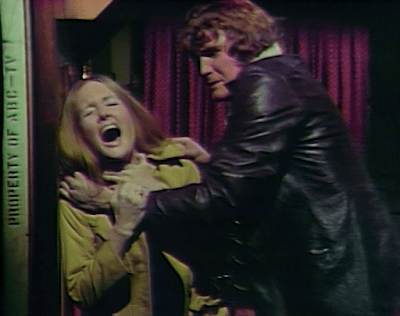
Carolyn wakes up. She goes to the carriage house and tells Jabe she can’t marry him. She won’t explain why. Jabe is enraged by this. He puts his hands around her throat and starts choking her.

Christopher Pennock was a fine actor and a seriously nice guy, and in the last few days he has made us want to believe that Jabe has turned over a new leaf. But this closing makes it clear that he is still a no-goodnik. The Leviathan material is all they have had on the show lately; there are some other characters who have problems that could be developed into something, problems such as lycanthropy and vampirism, but those have been completely subordinated to the Leviathans and are in any case nothing new to Dark Shadows. So despite Nicholas’ assurance that Jabe can’t exist much longer, it is hard to see an end to a period when all they have to offer are Jabe’s tantrums.

When Jabe is choking Carolyn, the camera drifts a bit and exposes the “Property of ABC-TV” stencil on the side of the scenery:

Screenshot by Dark Shadows Before I Die.

Episode 941: Barnabas, Quentin, and the Stopped Clock

Yesterday and today, a clock stopped at 8:00 featured prominently in shots when it was pivotal to the story that it was not 8:00. The clock is part of the merchandise in an antique shop, so it is understandable it does not run, but it is rather odd to see someone telling people that he didn’t wait for 8:00 when a clock face displaying that time looms over his shoulder. Today, it is important that a scene in the shop is taking place after 10:00. We open that scene with a view of a different clock, one that reads 10:20, but before long the stopped clock is back in full view.

At the great house of Collinwood, old world gentleman Barnabas Collins is rushing to the front door. Governess Maggie Evans asks him where he is going. He says that he is going to the village of Collinsport. She says she is going there as well and that she will ride in with him. He says that he can’t take her. He refuses to explain why. The other day, Maggie and Barnabas held hands and leaned in close to each other, talking softly about how important their friendship was. This sudden refusal to communicate pulls Maggie up short. She demands to know whether Barnabas trusts her. He says he does. She marches up to him and orders him to “Prove it!” The tight aspect ratio of old time TV combines with director Henry Kaplan’s habit of putting the actors as close to the camera as he can get them to make it seem, in the moment, that the feelings Maggie expects Barnabas to prove are of an erotic nature.

Hubba-hubba. Screenshot by Dark Shadows Before I Die.

Maggie has been the governess at Collinwood for over a year now. Her predecessor, the well-meaning Vicki Winters, was written out of the show for a number of reasons, not least their inability to figure out an intelligible relationship between her and Barnabas. There was a long period when Vicki the character seemed to know that she was on a show starring Barnabas and she kept trying to involve herself in his storyline, even inviting herself to spend the night at his house. In theory, Barnabas was in love with Vicki and yearned for her, but no matter how flagrantly she threw herself at him he never did anything about it. Eventually they paired her off with an intolerable jerk, and the two of them disappeared into a rift in the space-time continuum.

Vicki never did take quite as direct an approach with Barnabas as Maggie does today. No matter how deeply Vicki drove the ball into his court, she always counted on him to show at least a little initiative. Maggie knows better than to rely on Barnabas, and she corners him into agreeing to see her and give some kind of explanation when he is done with the mission he is concealing from her, at 10:00 sharp.

Fans often fret about the “Vickification” Maggie undergoes while she is serving as governess. When it became clear that Vicki wasn’t going to matter to Barnabas, she couldn’t be allowed to affect the A story in any way. To keep her on the sidelines, she was written as an ever greater ninny.

Maggie is pretty bad at her job- she’s a squish when the children don’t want to do their lessons, which is every time we’ve seen her with them. But she’s still good with grownups, she’s smart, and she’s emphatically sexy. So she isn’t going to go down into irrelevance without a fight.

Maggie isn’t the only character insisting on her place in the story. A few weeks ago, it seemed that matriarch Elizabeth Collins Stoddard would be a part of the main plot for the first time in ages when she was inducted into a secret cult serving a mysterious race of Elder Gods who are trying to regain control of the Earth. But she has drifted back to the sidelines, and has yet to meet the cult’s leader in his current form.

Barnabas was Liz’ preceptor in the cult, and she is indignant with him for the decline in her part:

Liz: Barnabas, I must speak to you.

Barnabas: Not now, Elizabeth.

Liz: Have I done something wrong? Just tell me that.

Barnabas: No, nothing at all.

Liz: I’ve tried to follow the rules, as many as I know. You yourself can testify to my faithfulness. But David sees our leader, you’ve seen him.

Barnabas: Jabez?

Liz: Is that what he calls himself now? Well, no matter what name, he’s the same boy who used to play here. Surely he must remember me with some affection.

Barnabas: He is only recently matured enough to appear to us.

Liz: Why have I been ignored? Barnabas? You haven’t answered my question.

Barnabas: You’ll meet him soon enough but now is not the time.

Liz: Does the book specify when I am to meet him? Is that why you’re against it now?

During the show’s costume drama segments, Joan Bennett got to play dynamic roles, but she has been excluded from the action in the contemporary parts for so long that she has a tremendous amount of passion to bring to this scene. It is great to see her cut loose for once.

Episode 929: The convergence

For the first 55 weeks of Dark Shadows, matriarch Elizabeth Collins Stoddard was under the impression that she had killed her husband Paul and that Paul’s associate Jason McGuire had buried his corpse in the basement of the great house on the estate of Collinwood. She spent nineteen years at home, terrified that if she left the estate someone might find Paul’s grave and hold her to account for his killing. Finally it turned out that she had only stunned Paul. He and Jason had faked his death to trick Liz into giving them a lot of money. Soon, Liz was no longer a recluse and that whole story was forgotten.

Now, Paul has returned. He denies knowing anything about his fake death, claiming that Jason acted alone. Longtime viewers will be skeptical of this claim, and Liz certainly is. But she doesn’t care about it as much as you might expect. She is now part of a secret cult that serves mysterious supernatural forces known as the Leviathan People, who plan to take over the earth, supplanting the human race. Paul has learned that he inadvertently sold Carolyn Collins Stoddard, his daughter with Liz, to the Leviathans, and he has been trying to sound the alarm about them. As a serenely happy devotee of the Leviathan cult, Liz has agreed to keep Paul at Collinwood where she can drug him into immobility.

The power of the Leviathans has taken bodily form in a succession of children who live in an antique shop in the village of Collinsport. The shop’s owners, Megan and Philip Todd, were the first people inducted into the cult by Liz’ distant cousin, old world gentleman Barnabas Collins. The latest manifestation of this being, an apparently thirteen year old boy known as Michael, had been attracting attention that threatened to blow the cult’s cover, so Philip and Megan faked his death. They held a funeral this morning.

Michael is supposed to retire into his room above the antique shop and stay there until he has graduated to his next form. He comes out and tells Megan and Philip that he has decided not to go through with this plan. Philip picks him up and carries him there, putting a new lock on the outside of the door to keep him in until he has gone through another transformation.

Carolyn calls the Todds and extends her mother’s invitation to an evening at Collinwood. They accept.

Unknown to Liz or the Todds, Barnabas has become disaffected from the cult. He visits Paul in his room. He gives Paul clothes and a lot of money and urges him to go far away. Paul doesn’t trust Barnabas, and holds him at gunpoint throughout their entire conversation.

When the Leviathan cult first emerged, its members were siloed off from each other. Barnabas gave Philip and Megan their instructions in dream visitations. When they were awake, they would not recognize him as their leader. They and Liz were not aware of each other’s connection to the cult, though Liz did know that Barnabas was her leader and her nephew David Collins was a fellow cultist. It reminded us of secret operations in the real world, where only people who work with each other directly are allowed to know of their shared allegiance.

Now, all that security is out the window. Liz and the Todds stand around the drawing room at Collinwood having drinks and talking about what Barnabas has and has not told them about the Leviathans and their goals. They do still keep some secrets, however. Liz says that she can’t help but wonder what Carolyn’s role will be in the time to come. Barnabas and the Todds know that she is fated to be the bride of the force currently incarnated as Michael, but they are not allowed to tell Liz this. They look at each other with alarm, and Barnabas gives her some vague and hasty assurances.

There is an unintentionally hilarious moment during the cocktail party scene. Megan is seized by enthusiasm for the Leviathan project, and starts babbling all sorts of portentous phrases about the new world that is taking shape through their efforts. Marie Wallace was one of the most committed exponents of the Dark Shadows house style of acting, which consists largely of delivering your lines so vehemently that you are in constant danger of spraining your back. For her part, while Joan Bennett sometimes played to the balcony as Liz and her other characters, she never really let go of the urbane and relatively understated approach that made her one of the biggest movie stars of the late 1930s. When Liz responds to Megan with the amiable smile and subtly musical voice of a sophisticated society hostess, it all of a sudden strikes regular viewers who have got used to the show’s peculiarities just how incredibly bombastic Miss Wallace was.

Meanwhile, Paul goes through a lot of business with Barnabas and Carolyn in which he is told to wait an hour, no half an hour, no ten minutes, before leaving the house. He steals the keys from Megan’s purse and sneaks off to the antique shop. He has decided he must figure out what exactly is going on there. He lets himself into the room where the Leviathan force is kept when it is not embodied as a child. He hears a heavy breathing. The camera zooms in on his shocked face. With that, the episode closes. Paul’s future would appear to be extremely brief. On the day of Michael’s phony funeral, he seems likely to bring the show’s first fake death firmly into the realm of the actual.

Paul gets more than he bargained for. Screenshot by Dark Shadows Before I Die.

Today marks Michael Maitland’s last appearance as Michael. He did a lot of acting as a child, including major roles on Broadway both before and after his run on Dark Shadows. Playing Michael didn’t give him much chance to show what he could do. His resume suggests that is a shame- he must have had a lot to offer to get all those big parts. And by all accounts, he was a very nice guy.

Michael Maitland died of cancer in 2014, at the age of 57. That means that three of the five child actors who appeared on Dark Shadows during the Leviathan segment have died. Denise Nickerson, who played Amy Jennings, was 62 when she died in 2019; Alyssa Mary Ross Eppich, who under the name Lisa Ross played the Leviathan child in the guise of an eight year old version of Carolyn in #909, was 60 when she died in 2020. David Henesy, who played David Collins, and David Jay, who played the Leviathan child as an eight year boy called Alexander, are still going strong. So too is Sharon Smyth Lentz, who played the ghost of nine year old Sarah Collins in 31 episodes in 1967 and the living Sarah in six episodes in 1967 and early 1968.

Episode 916: Julia Hoffman has had her dream

Certain People

Six weeks ago, old world gentleman Barnabas Collins was absorbed into a group serving supernatural beings known as the Leviathans. Also in the group is matriarch Elizabeth Collins Stoddard. Barnabas and Liz are worried that mad scientist Julia Hoffman, Barnabas’ sometime best friend and Liz’ permanent houseguest, is catching on to the truth about their group. They decide Julia must be absorbed into it.

Barnabas finds Julia on a couch in the drawing room, reading a book about lycanthropy. He strikes up a conversation about Chris Jennings, a young man who suffers from that condition. Julia replies bitterly that she still cares about Chris, unlike Barnabas. He tells her that he does care, and they quarrel a bit. He then strokes Julia’s cheek. He did the same thing with Chris’ little sister Amy in #912, at which point Amy fell asleep. Shortly after Amy woke up, she had become part of the Leviathan group. Julia gets a headache and goes to her room, where she does fall asleep.

We didn’t see a dream sequence when Amy fell asleep, but do see one for Julia today. The visuals alternate between two stock clips of lightning flashes as we hear Jonathan Frid give a dramatic reading of some portentous nonsense, then give way to Julia finding Barnabas in the drawing room inviting her to open a wooden box. We saw a dream of Liz’ in #904; she woke from it already transformed into a faithful devotee of the Leviathans. But when Julia wakes up, she just has a worse headache.

They’ve shown us this clip more times than I can count…
… but I don’t think we’ve seen this one before. It’s fascinating to me, like an image David Lynch would have used in Eraserhead or the third season of Twin Peaks.

Julia goes downstairs and find Liz holding the box from her dream. She is urging her to open it. Julia is confused by the situation. A knock comes at the door, and she rushes to answer it. It is Chris, saying that it is time for Julia to drive him to the institution where he is locked up on nights of the full moon. Julia calls back to Liz that she will be back later in the evening.

Barnabas enters and says that Julia will never be absorbed into the cult. If she were suited for absorption, the knock at the door would not have distracted her. He explains that “There are certain people, Elizabeth, whom we are not able to absorb. It has to do with their genetic structure. And Julia Hoffman is one of them.” As a former vampire who is now leading a cult that is trying to bring a race of Elder Gods back into the world where they will destroy and replace humankind, Barnabas is supposed to be strange and unnerving, but hearing him talk about “certain people” and their “genetic structure” is off-putting in a whole other way. Why not just say that she’s Jewish, we know you mean that she’s Jewish.

Barnabas then tells Liz that it is now up to her to handle Julia. So far as we know, Liz does not have any special powers like those Barnabas uses when he fondles people’s faces. Liz doesn’t even know what the cult is all about- today, she asks Barnabas what the goal is they are working for, and he tells her he isn’t at liberty to say. So when Barnabas tells her to deal with Julia, we can only remember the last time we saw Joan Bennett playing a character under the control of an uncanny force, when Judith Collins shot and killed neurotic intellectual Rachel Drummond on the orders of vampire Dirk Wilkins in #776.

In #915, one Leviathan ordered Barnabas to kill Julia. When he refused, another caused him to have nightmares, then told him it was OK to leave Julia alive if he could find another way to keep her under control. That episode was written hurriedly and rushed into production at the last minute, three full weeks after this one was in the can, in response to complaints from fans dissatisfied with the Leviathan story in general and Barnabas’ coldness to Julia in particular. It’s anybody’s guess what they were originally planning to do with #915, but today’s episode makes it clear that it did not include the reset of Barnabas’ character that we saw yesterday. He is still leading the Leviathans, and when he delegates the problem to Liz murdering Julia is pretty obviously the likeliest solution.

Not a Portrait of Quentin Collins

Julia’s plan for Chris is to persuade an artist named Charles Delaware Tate to paint a portrait of him. Tate painted a portrait of Chris’ great-grandfather, Quentin Collins, in 1897. That portrait had magical powers. Once it was painted, Quentin’s own werewolf curse went into abeyance. It was the portrait that transformed on nights of the full moon, while Quentin himself remained human. Indeed, the portrait also caused Quentin to remain young and healthy. He returned to Collinsport a couple of weeks ago, and though he is 99 years old he still looks just like he did when he was 28. In #913/ 914, Julia found that Tate, also, is alive, and still looks like he did in 1897.

Quentin and Tate are not the only emigrés from 1897 currently sheltering in Collinsport. Another of Tate’s magical portraits, a concept piece depicting his ideal woman, caused its subject to pop into existence. In 1897, she went by the name Amanda Harris, met Quentin, and fell in love with him. She, too, is unchanged in 1969, though she now calls herself Olivia Corey.

Amanda/ Olivia and Julia are both hunting for paintings by Tate, and met each other through that pursuit. They have also met Quentin, and vied with each other to decide which would be the one to keep him. He has amnesia and knows only that he was carrying papers identifying him as Grant Douglas. He is open to the idea that this is not his real name, but he finds Julia’s attempt to convince him that he is a 99 year old man ludicrous and is frustrated with Amanda/ Olivia’s unwillingness to tell him when and where they first met.

Amanda/ Olivia comes back to her suite at the Collinsport Inn and finds Quentin there, swilling her booze and enormously drunk. He tells her that he finds his room depressing, because it doesn’t have a bar. He says he can’t stand not knowing who he is. She points out that he has taken this in his stride up to now, and asks why today is different. He says he doesn’t know why it is different, but it very much is. When the show was a costume drama set in 1897 and we saw Amanda, she did not know about Quentin’s lycanthropy, and now that she calls herself Olivia she still does not think of the full moon when she sees him in anguish.

Later, Julia shows up at Amanda/ Olivia’s door. She has brought one of Tate’s portraits of Amanda Harris. Amanda/ Olivia staggers back at the sight of it. She composes herself and says that it is of no interest to her, since she already has several of Tate’s paintings of her “grandmother.” Julia tells Amanda/ Olivia that the real reason she is not interested in it is that it is not a portrait of Quentin Collins. She replies that Julia is the one who is fascinated by Quentin, not she. Julia says that she wants to show the portrait to Quentin. Amanda/ Olivia does not bother pretending that his name is “Grant Douglas” or that it might be something other than “Quentin Collins”; she simply tells Julia that he is in his room sleeping off an alcoholic binge. Julia adopts her most unmistakably Mad Scientist manner when she responds “Then this is definitely the right time to see him!” She marches out, and Amanda/ Olivia follows her.

Julia had told Chris that if Quentin’s portrait has been destroyed, his lycanthropy will be back in force. If that is so, she wants to be with him when he transforms. This was a doubly confusing thing to say. First, if the portrait had been destroyed, Quentin would not only be a werewolf, he would also look his age. She therefore knows it is not so. Second, she does not have anything with her to protect her against werewolves. If she is with Quentin when he transforms, he will kill her immediately.

When Julia and Amanda/ Olivia let themselves into Quentin’s room, they find that it is a shambles and he is gone. As a closing cliffhanger, this is supposed to leave us with the fear that a werewolf is stalking Collinsport. But since we know what the portrait does for Quentin, it only leaves us wondering if Amanda/ Olivia will have to pay an extra housekeeping charge because he trashed the room she was renting for him.

When Julia met Tate in #913/914, she could not get him to engage her in any kind of conversation, much less agree to paint a portrait of Chris. She did not mention Amanda/ Olivia. Since Tate was maniacally obsessed with Amanda in 1897, Julia should have known that her acquaintance with her was the strongest card she had to play. So when she goes to Amanda/ Olivia’s suite today, returning viewers were hoping that she was going to propose they team up to persuade Tate to paint Chris. Perhaps that will still happen. If it does, it might be a lot more interesting than is the revelation that Quentin doesn’t keep his hotel room clean.

Episode 908: Mollycoddle that monster

The current phase of Dark Shadows is focused on the threat to the human race posed by the Leviathans, unseen supernatural beings who have taken control of several characters on the show. Among their devoted servants are matriarch Elizabeth Collins Stoddard and her nephew, strange and troubled boy David Collins. Today, Liz and David welcome a boy known as Alexander to the great house of Collinwood. Alexander appears to be an eight year old boy, but is in fact an extreme case of Soap Opera Rapid Aging Syndrome. Last week he was an infant, and a few days before a whistling sound coming from a wooden box. Whatever Alexander may really be, he holds a key position in the Leviathans’ plan.

At times, Dark Shadows becomes so much a kids’ show that it loses much of its adult audience. The Leviathan story so far has gone to the opposite extreme. A scene in which Alexander orders the thirteen year old David to give up the transistor radio he had long wanted and that his father just gave him will probably get similar reactions from viewers of all ages, but when Alexander scolds Liz for asking questions and she apologizes, only those who remember Joan Bennett as the great star she was in the late 1930s and early 1940s will get the full force of the moment. In general, adults will probably feel the distress Alexander’s tyranny is supposed to induce, while the fans who are running home from elementary school to watch the show will likely be either annoyed with the kid or amused to see the grownups getting theirs.

Liz’ ex-husband Paul is being persecuted by the Leviathans and their human agents. Paul is staying at Collinwood, and he is outraged to find Alexander in the house. Paul carries on like a crazy man, prompting Liz to tell him that if he doesn’t compose himself he will end up in a mental hospital. He tells Maggie Evans, David’s governess, about his suspicions; she listens sympathetically until he catches Alexander eavesdropping and roughs the boy up. Maggie then freezes in horror, and Paul goes on shaking Alexander and yelling at him until Liz enters and puts a stop to it. While Liz and Maggie stand in the corridor and talk about Paul’s lunatic behavior, he paces in the drawing room, telling himself that he mustn’t “fly off the handle” again.

David enters and hands Paul a small photo album. He says that it has pictures of Paul and Liz’ daughter Carolyn when she was a child. Since Paul wasn’t around when Carolyn was growing up, David says it occurred to him that Paul might want to look through it. Paul thanks David for his thoughtfulness.

As Paul leafs through the album, we get a look at a picture depicting Carolyn as she was when she was about ten. We haven’t seen the model before. Dark Shadows had such a tight budget that regular viewers will be fairly sure they wouldn’t have brought a girl in only to pose for a single photograph, so we might start wondering when we will meet the ten year old Carolyn.

Child Carolyn. Screenshot by Dark Shadows Before I Die.

We may also be wondering when we will see another girl of about the same age. Denise Nickerson, twelve years old in December 1969, has been in the cast for a year at this point, and has made major contributions every time we’ve seen her. We saw in #893 and #896 that her character Amy Jennings is still living at Collinwood and is still David’s chief playmate. But as is usual in episodes where she does not appear, Amy is unmentioned today. Liz tells Paul that David spends entirely too much time surrounded by adults, as if Amy does not exist. They followed the same pattern during the eight months of 1969 when Dark Shadows was set in 1897 and Nickerson played nine year old Nora Collins. When Nora was in the episode, she was often its brightest spot, but when she wasn’t her name never came up. It’s unnerving that the show does so little to reassure us that it will continue to make use of such a talented and appealing young actress.

Alexander sits on the bench that has been in the foyer at Collinwood throughout the whole series. The Dark Shadows wiki says this is only the second time the bench has been used. I want to say it is the third- I remember David sitting there in #176, when Maggie’s predecessor Vicki told him he could have two desserts, cake and ice cream, but I seem to recall either him or someone else sitting there at some point around that time. I’m not going to go back through those episodes to check, but if you’ve been watching them I’d appreciate it if you’d leave a note in the comments.

Episode 906: Like an organization

Paul Stoddard has returned to Collinsport, Maine, the town he left twenty years before when he despaired of getting his hands on his wife Liz’ money. He is being tormented by a mysterious group. What the group is and what it is doing he does not understand, but he knows that they are destroying him and that they want to get their hands on his daughter, heiress Carolyn Collins Stoddard.

Liz shows up at Paul’s hotel room. He tells her about the shadowy force that is menacing him and Carolyn. He gives her the one fact he is sure of, that her distant cousin Barnabas Collins is a leader of that force. She gets a faraway look in her eyes and says that Barnabas has been different since he “came back,” and that perhaps Paul is right about him. To his astonishment, she invites him to move back into her home, the great house on the estate of Collinwood. If he is the one who has perceived a threat to the family, then he should be in the family’s home where he can make the maximum contribution to the fight against that threat.

Liz formulating her response to Paul. Screenshot by Dark Shadows Before I Die.

Liz’ reaction to Paul’s allegation against Barnabas is intriguing for two reasons. First, Liz has been kept out of the main story consistently since January 1967, when the story centering on blonde fire witch Laura Murdoch Collins was first turning Dark Shadows into a supernatural thriller. Laura cast a spell on Liz to get her out of her way, and she never did make it back into the action. So when we hear her saying that she has noticed something disturbing about Barnabas, concerning whom she has always had a breathtakingly vast blind spot, and that she is ready to do battle, we are presented with the possibility that her character might be reinvented completely. Liz has connections to every other character on the show, and Joan Bennett still had significant star power in late 1969. So a revitalization of Liz might well revolutionize the whole show.

Second, Barnabas’ personality has indeed undergone a drastic change of late. Since every established character on the show is well acquainted with Barnabas, this cannot be concealed for very long. That suggests that the current story will move at a much faster pace than we are accustomed to seeing. If even Liz is entering the action, longtime viewers will suspect that it is already coming to a climax.

Liz sends Paul off to fetch Carolyn. Once he is gone, she picks up the telephone and places a call. We cut to the other end of the call. We see that she is telling Barnabas that everything is going according to their plan. If Liz has merely become one of Barnabas’ minions, the change in her may be temporary and the story may still have some time to run. Paul’s life expectancy, however, may be rather shorter.

Episode 904: To have fun, like everybody else

Matriarch Elizabeth Collins Stoddard (Joan Bennett) was usually a blocking figure in the first 73 weeks of Dark Shadows, and when the pace of the stories picked up sufficiently that they didn’t need to slam on the brakes so often she drifted far to the margins. When she does show up, she is usually a talk-to for characters who might actually do something. The few times she has been the center of attention have been when she was so crushingly depressed she was a suicide risk. At one point she went beyond that, succumbing to a boredom so extreme that she lapsed into a catatonic state and was mistaken for dead.

Today, Liz is being atypically dynamic. She is trying to figure out what her nephew, strange and troubled boy David Collins, has been up to. Her investigations have shown her that David stole an old book from an antique shop and bought some clothes at a department store. These aren’t exactly the most thrilling discoveries of the age, especially when it appears that David has already returned the book to its rightful owners, but it represents a big step up from her usual activity level.

Liz walks in on David in his room, and finds him reading from a book. He denies that it is the book from the antique shop, but she doesn’t believe him. Later, Liz is poring over the book in her drawing room when her distant cousin Barnabas comes in. She tells him she doesn’t recognize the language or the script in which it is written, but that she has found certain blocks of text that are repeated throughout, in the manner of ritual language. She thinks it must be a religious book of some kind. Barnabas recognizes this as a remarkably intelligent observation. He offers to take the book to the antique shop himself. Liz happily accepts his offer, and goes upstairs to bed.

Liz has a dream. In the dream, David is wearing a fat suit. He takes her to a funhouse. At first the mirrors merely add to her chronic depression, but she brightens when she sees Barnabas in one of the mirrors. And when David recites a bit of doggerel- “Fat and Skinny had a race, all around the steeplechase./ Fat fell down and broke his face./ Skinny said, I won the race!” she laughs heartily. She wakes up. In her bed, she is staring into space, all jollity gone.

David’s fat suit. Screenshot by Dark Shadows Before I Die.

Most of the dream is shot in a kaleidoscopic style, splitting the screen into many copies of the same image. Regular viewers know that Dark Shadows puts kaleidoscopic patterns on the screen when it is showing people submitting to one or another form of mind control. For example, when mad scientist Julia Hoffman hypnotizes people, we often see pictures that seem to come from inside a kaleidoscope. Liz herself asks David at the beginning of the dream if the mirrors will show her “all the people I could have been”; he says that no, “They’ll show you all the people you really are.” Since the dream is full of odd looking dolls and puppets, that suggests all the people she really is are controlled by someone other than herself. The cut from her laughing face at the end of the dream sequence to her blank expression when she wakes up would also suggest a discontinuity between the Liz who had the dream and the Liz who will rise from bed.

Over the last few weeks, the show has been developing a story about a cult devoted to mysterious supernatural beings known as the Leviathan people. The cult is secretly absorbing one person after another, enabling the Leviathans to act through them. Barnabas and David have taken turns leading the cult, and the owners of the antique shop are members of it. If Liz is no longer herself, we must conclude that she has now been coopted into the cult as well.

Liz’ daughter Carolyn works at the antique shop. Early in the episode, she met a man whom we could see only from the chest down. He was wearing a belted overcoat. In #902, we had the same view of a man wearing the same overcoat as he wandered into Liz’ house, straightened a portrait of Barnabas, hid from Carolyn, and wandered out again. Evidently this is the same man. Later, Barnabas went to the shop, and Carolyn told him she was smitten by the man and that he would be coming back when the shop closed, after 10 pm.

The man does come back as promised, but doesn’t quite make it into the shop. He is between the streetlight and the door, in a space which we must interpret as representing a sidewalk, when Barnabas runs him down with his car. Carolyn comes out of the shop and Barnabas claims that the man just darted out of nowhere, giving him no chance to stop. It is unclear when Barnabas learned to drive. When he was first on the show in April 1967, he was a vampire who had been sealed in a coffin since the 1790s. He was cured of the effects of vampirism in March 1968, and in #687 we heard about him driving. Perhaps his training in the rules of the road was irregular. Still, you would think he would have a better excuse for driving into a pedestrian than failing to expect him to be on the sidewalk.

The camera zooms in on the injured man’s face. We don’t see enough of it to be sure who it is. The closing credits tell us that “Unknown Man” is played by David Selby. It must be a goof that we don’t see much of Mr Selby’s face. Over the year he has been playing the rakish Quentin Collins, Mr Selby has become a huge breakout star, rivaling the fame Jonathan Frid has gained as Barnabas. Surely they wouldn’t put him on unless they wanted us to recognize him.

Quentin first came on the show as a ghost at the end of 1968, and found his greatest success from March to November 1969, when the show was set in the year 1897. Since the show returned to a contemporary setting, we have been sure that Quentin will be back, but we haven’t had any reason to expect him to return at any particular time. In #887, the first episode set in November 1969, we saw the back of a man prowling about the estate of Collinwood; we might have suspected he was Quentin. But he turned out to be Liz’ ex-husband Paul Stoddard, who had never before been a real character on the show and who has been unmentioned for more than two years. So when we are kept from seeing the face of another prowler, he could be anyone at all. Perhaps Frank Garner is training to be a ninja, or Ezra Hearne is having a personal crisis.

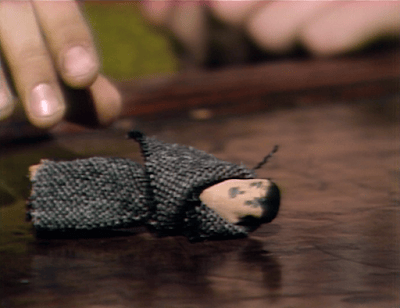
The closing credits run over this image from Liz’ dream. The dolls move while the credits are scrolling over them, the effect is hilarious. I didn’t think the dream sequence was particularly effective, but I wish every episode ended with these two figures doing their little act.

The real stars of today’s show. Screenshot by Dark Shadows Before I Die.