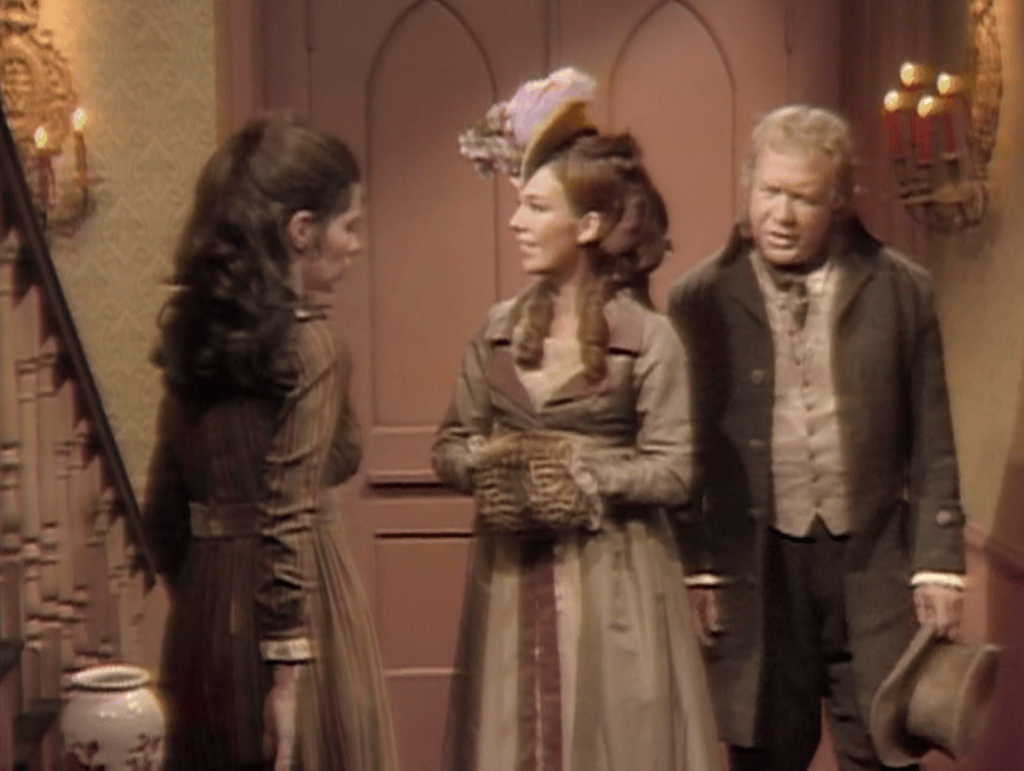
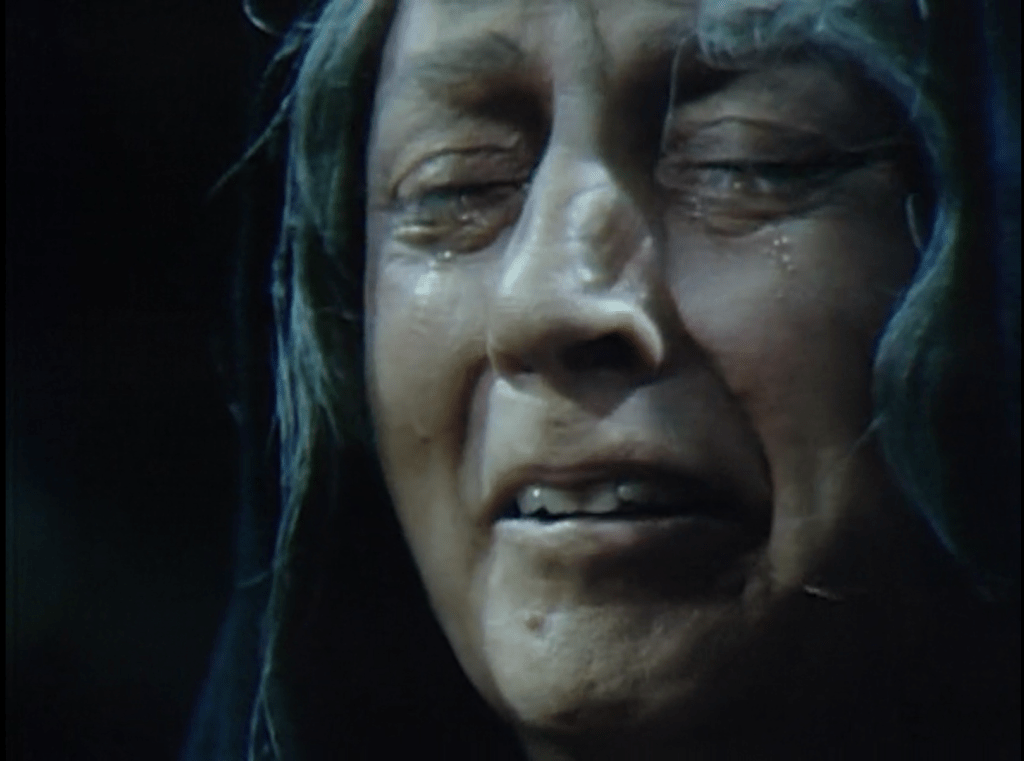
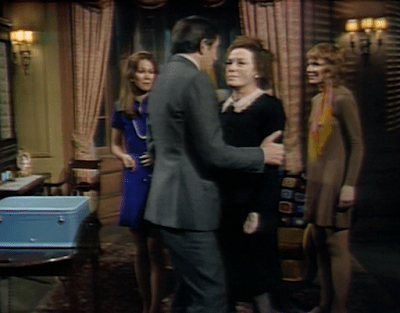
Episode 997: How pretty your tears

We are in the fourth week of an arc set in a different universe than the one we saw in the first 196 weeks of Dark Shadows. This universe, which the show insists on calling “Parallel Time,” was originally introduced as a realm populated by Doppelgänger of the characters we have known. They are the same people, but have made different choices and are therefore living different lives.

Some of the Parallel Time characters fit this description. So, we have known matriarch Elizabeth Collins Stoddard and her brother Roger Collins from episode #1. In the early days of the show, much was made of the Collinses’ straitened financial circumstances, the result of Roger squandering the half of the family’s assets he had inherited and Liz scrambling to keep control of the business. Roger lived in Liz’ house as her guest and worked in the business as her employee, and she kept a wary eye on any move he made to get his hands on her money. In #981, Parallel Liz mentions that she used to be quite wealthy, but that she entrusted her share of the Collins fortune to Roger, and as a result they are both penniless. Original Liz saw that fate as a distinct possibility, every time Roger was in the same wing of the house as her bank account information.

Parallel Liz and Parallel Roger live in the great house of Collinwood as the guests of their brother Quentin. Parallel Quentin is not at all the same person as Original Quentin. He is an entirely different person. Original Quentin was born in 1870, died in 1897, became a ghost haunting Collinwood in 1968 and 1969, and as the result of a time travel storyline in 1969 was both spared death and immunized against aging. Original Quentin was a riff on the early conception of Roger as a villain, and he was a huge hit with the viewing public during the part of the show set in 1897. Ever since Dark Shadows returned to contemporary dress in late 1969, they’ve been at a loss what to do with him. Parallel Quentin is an attempt to reinvent the character to let him keep enough of his vices that he retains the roguish charm that the fans liked, but at the same time use those vices as motivation for him to act the part of the hero from time to time.

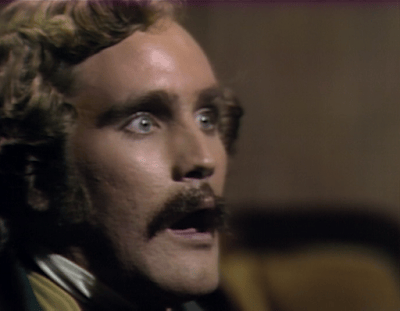
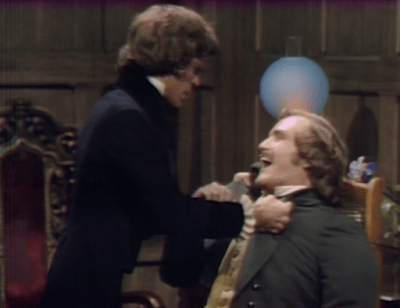
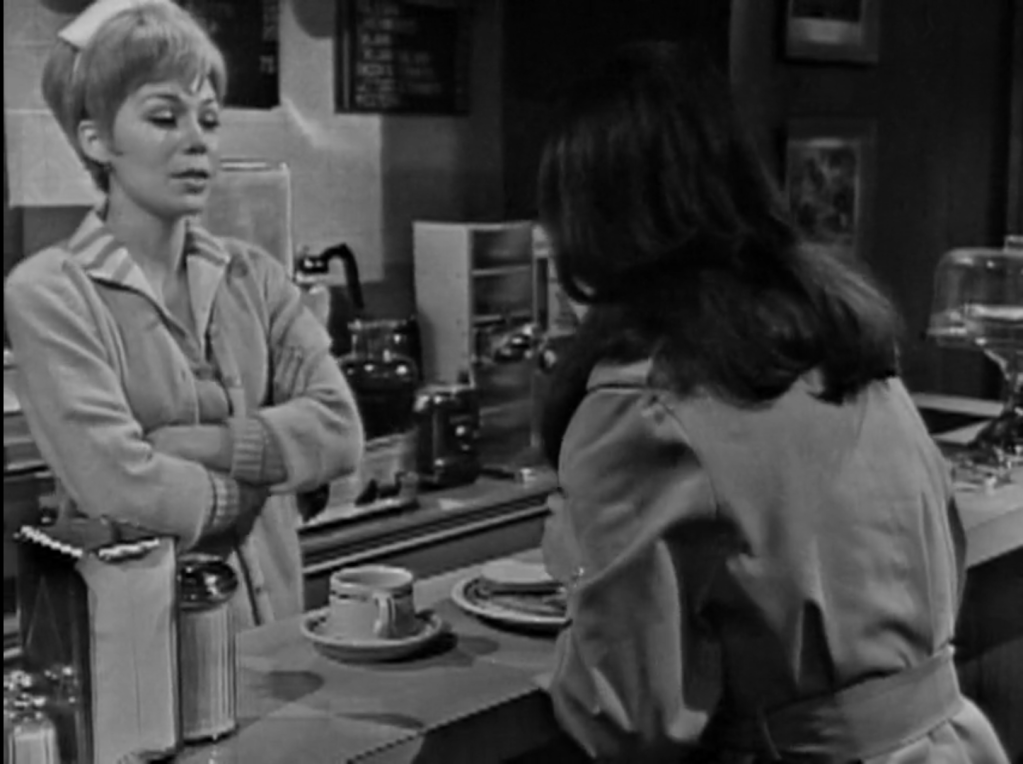
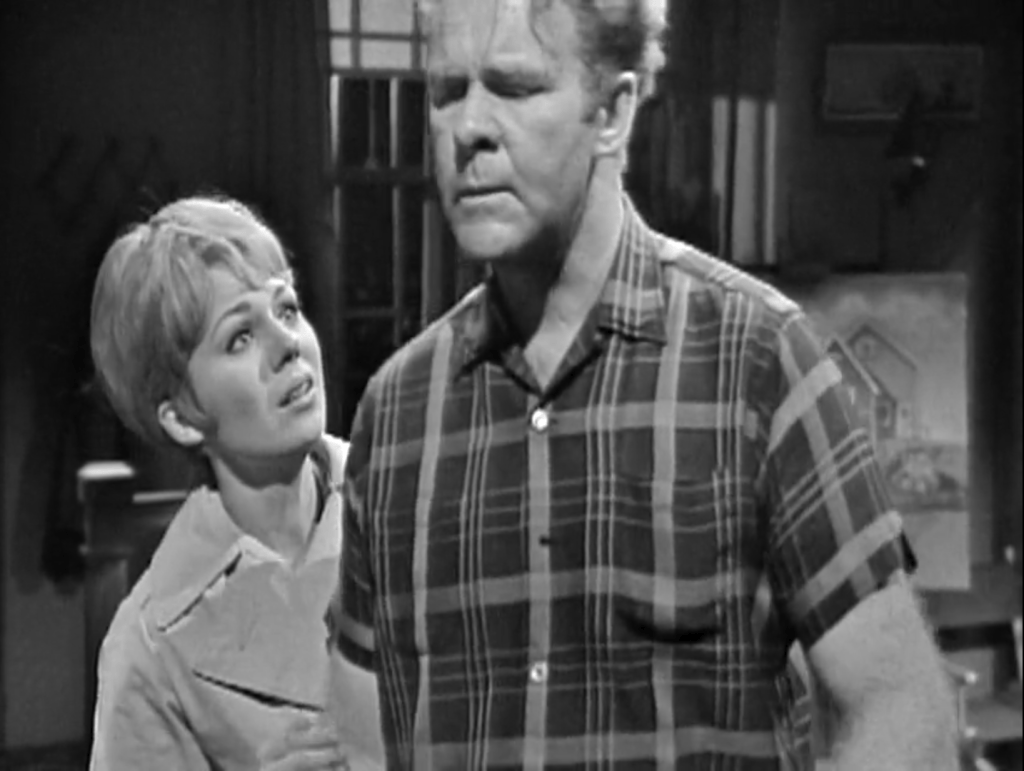
There is need for an action hero today. Quentin’s friend, dippy mad scientist Cyrus Longworth, has invented a Jekyll-and-Hyde potion and taken a swig of it. As the darkly mustachio’d John Yaeger, he has been persecuting barmaid Buffie Harrington and Buffie’s unlucky boyfriend, big galoot Steve. We open with Yaeger choking Buffie and telling her she needs to be beaten into submission. Later, Yaeger gets the jump on Steve in a dark alley behind the Greenfield Inn, an establishment that also fronts a sinister alley in the main continuity. He threatens him with his sword cane. Steve manages to get that weapon away from him, but Yaeger beats him down. Yaeger is choking Steve, apparently with the intention of murdering him, when he hears a police whistle and runs away.

Cyrus Longworth and John Yaeger are played by Christopher Pennock.* In the main continuity, Pennock played a character who asked to be called Jabe but wound up answering to “Jeb.” Jabe appeared to be a man in his twenties, but was in fact a shape-shifting monster who was only a few months old when he was destroyed. We’ve heard a good deal about what Cyrus was doing six months ago and more, and there are diplomas on the walls of his laboratory that show his history is nothing like Jabe’s.

Among the very few choices in Jabe’s short life was an attempt to renounce his shape-shifting abilities so that he could remain in human form at all times. In that way, he is the opposite of Cyrus, who chooses to take his potion knowing it will change him into Yaeger.

Also, Jabe was so obnoxious that even people brainwashed to regard him as a divine being come to fulfill a plan that more than justified the extermination of the human race found his personality too much to take and turned against him after a few encounters. But by the end of Jabe’s time on the show, it had become undeniable that there was a kernel of sweetness in his personality. In this regard, too, Cyrus is the opposite of Jabe. We hear his soft voice and see his diffident manner, and we assume that the single-minded scientist in his lab coat, toiling all hours on a project that he keeps saying will benefit humankind, is a well-meaning sort, though perhaps dangerously naïve. Cyrus’ dutiful assistant and devoted fiancée, the lovely Sabrina Stuart, encourages us in that assumption, insisting that Cyrus is thoroughly good, if hopelessly unworldly. But as the initially insufferable Jabe turned out to be endearing at the end, so the apparently innocent Cyrus is deliberately choosing to turn himself into Yaeger even after he knows what Yaeger is capable of. What’s more, he refuses to let anyone at all help him with his experiment, meaning there is no one to restrain Yaeger’s sprees.

Sabrina’s counterpart in the main continuity was the fiancée, not of Jabe, but of another dangerous shape-shifter. She was engaged to werewolf Chris Jennings. As this Sabrina is convinced Cyrus is good, so that one kept insisting Chris was good, even after she had learned that he repeatedly refused to be restrained on nights of the full Moon, so that the killings he committed in his lupine form were premeditated murders on his part. This Sabrina does not know the nature of Cyrus’ work, and she believes that Yaeger is an enemy of his who is holding him prisoner. Sabrina would appear to stand with Roger and Liz as a character who is in a meaningful sense the same person in both timelines, so we are in suspense as to how she might react if she finds out the truth about her man.

Sabrina’s part makes us wonder if the original plan were to cast Don Briscoe, who plays Chris in the main continuity, as Cyrus and Yaeger. At this time Briscoe was struggling with bipolar disorder. He was trying to self-medicate with street drugs, which not only made matters worse in itself, but also led him to get a severe beating one night while trying to score a fix in Central Park. Briscoe appears in Parallel Time as lawyer Chris Collins and has a small part in the concurrently filmed feature House of Dark Shadows, but his health problems ruled out a part as crucial as the lead in the Jekyll and Hyde story.

Buffie is played by Elizabeth Eis, who appeared in one episode set in the main continuity as Nelle Gunston. Nelle was a young woman from Virginia, bored by life with her parents, who had joined the cult that was meant to serve Jabe and the world-wrecking plan to which he was central. When she was asked if she would commit murder if that was what the cult required, she smiled pleasantly and said “Even that.” Nelle was killed before she could meet Jabe.

Buffie is not at all the same person as Nelle. She is not from Virginia, for one thing. When she thinks about leaving Collinsport to get away from Yaeger, she realizes she has only $13.40 to her name, and laughs at herself for a plan that wouldn’t get her any further than Worcester, Massachusetts. Naming Worcester as a synonym for “nowhere” would suggest that she is a New England girl, which would fit with her employment in a bar in a fishing village in central Maine. Buffie is the opposite of what they originally told us the characters in Parallel Time would be- she is not Nelle after she has made a different choice, she is a person who began differently than Nelle and is making a similar choice.

Buffie is in her room when her landlady, Mrs Duvall, comes for the rent. Buffie has a check ready. Mrs Duvall thanks Buffie for recommending her boarding house to a gentleman who has rented her four best rooms at a very handsome price. She tells Buffie that the man is a big step up from Steve. Buffie has no idea what she is talking about. Yaeger shows up, and Buffie realizes he is Mrs Duvall’s new prize boarder. Buffie is horrified, and demands her rent check back. Mrs Duvall refuses to return it. Yaeger points to a print hanging on the wall and instructs Mrs Duvall to take it away and burn it. She is doing so when Buffie protests that it is hers. At that, Mrs Duvall stops short of the door, but she does not put the print back on the wall. Eventually, Mrs Duvall does take Buffie’s print, and leaves her with Yaeger.

Mrs Duvall leaves with Buffie’s print.

The telephone rings. It is Quentin, asking Buffie about Yaeger. Yaeger stands next to her and forces her to answer Quentin’s questions with lies. Later, Steve will come to Buffie’s room. She will tell him to give up on her and not to take any more beatings from Yaeger on her behalf. Steve asks if Yaeger is a superman; Buffie widens her eyes and says that he might be. This brings us back to Nelle, who renounced her life in Virginia and her connection to the human race because she was looking for a superman and thought she would find one in Jabe. Steve may not have had much to offer, but it’s a cinch he wasn’t as bad as Yaeger, and he’s gone from Buffie’s life after this scene.

The emptiness of Buffie’s life is represented today by a prop we have seen only once before on Dark Shadows, a television set. There was a set in a motel room in Bangor in #27; we never do see one in the Collinsport or the Collinwood of the main continuity. Perhaps the makers of the show are suggesting that people who have nothing better to do than to watch the idiot box are likely to fall prey to any fella who offers physical abuse and verbal intimidation.

Mrs Duvall is played by Camila Ashland. Ashland was a very distinguished stage actress who appeared in #928 as someone called Mrs Hutchins. A man from the cult around Jabe hired Mrs Hutchins to tell some lies to throw mad scientist Julia Hoffman off their trail. That didn’t work, but Julia admired Mrs Hutchins’ performance, as we suspect Grayson Hall admired Ashland’s. When the man from the cult paid Mrs Hutchins for her work, he was unpleasantly surprised at her questions and the uneasy conscience it reflected, responding roughly that she is being paid for a job and should leave it at that. He didn’t realize he was dealing with an artist. Mrs Duvall’s eagerness to please the obviously horrible Yaeger shows that she really is the crude mercenary the man from the cult assumed Mrs Hutchins was.

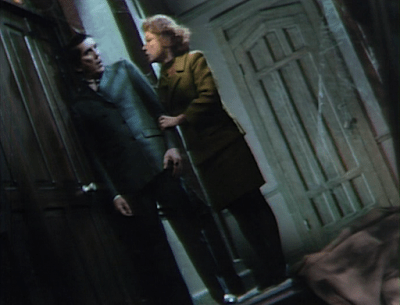
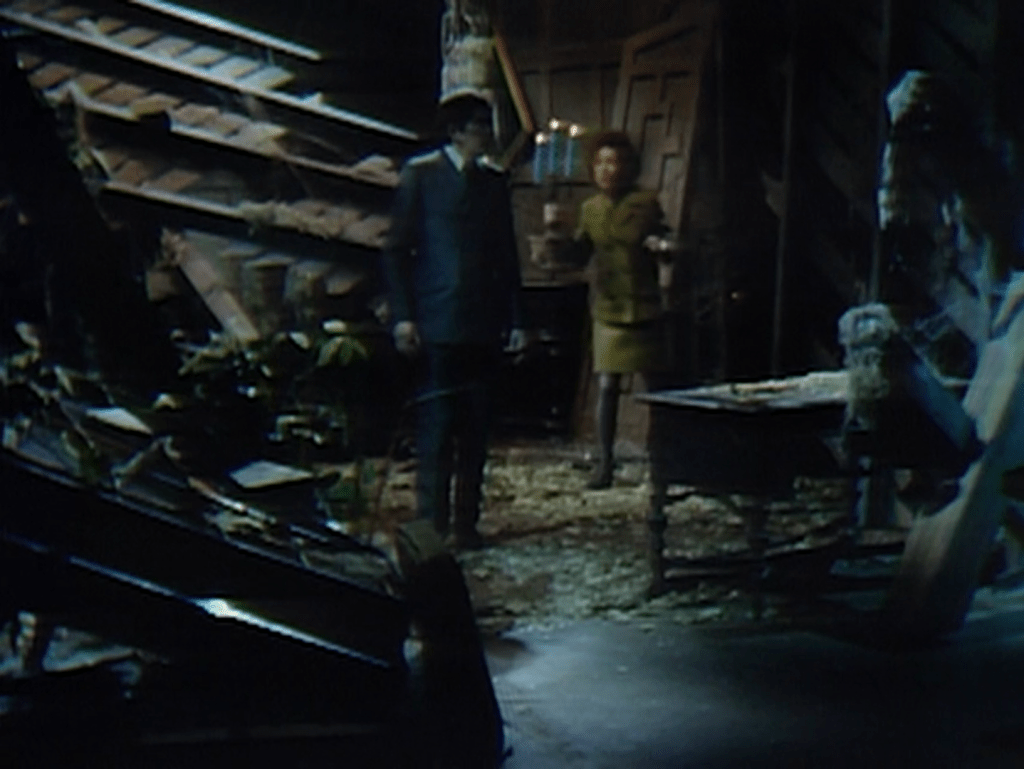
We cut to Cyrus’ laboratory. Yaeger has fled there from the police. He is about to take the re-Jekylling formula when Quentin shows up and demands to know where Cyrus is. We end with them in that standoff.

*Billed twice in the closing credits- as Christopher Pennock for Cyrus, and as Chris Pennock for Yaeger. Adorable!

Episode 993: She lacks the power to tell us more

The show has been keeping us in suspense as to whether Lara Parker is playing wealthy socialite Alexis Stokes or Alexis’ identical twin sister, the late Angelique Stokes Collins. Regular viewers know that the title “the late” is no impediment to a major part for a character on Dark Shadows. In the universe where the action took place for the first 196 weeks, Angelique’s counterpart was a wicked witch who returned from the dead countless times, and the clues are mounting that Alexis’ sister is active on the estate of Collinwood in this continuity, whether in her form or a more ethereal one.

While with Angelique’s widower Quentin Collins, Alexis has witnessed a series of odd occurrences that have led her to become distraught and to protest that Angelique is haunting them. She has questions, and takes those questions to two of Angelique’s acquaintances, medical researcher Cyrus Longworth and Cyrus’ assistant/ fiancée, Sabrina Stuart. That would seem to support the premise that she is Alexis, but she keeps the suspense alive for regular viewers when she approaches Cyrus’ laboratory by its courtyard door. The other day, the police were watching Cyrus’ house, and they did not notice that there was a door in the courtyard. When a detective came inside and spoke with him, Cyrus pointed the door out to him and told him that only a few people knew of it. Angelique was very close to Cyrus and was involved in his work, so we can assume she was one of those few people. It is not at all clear who could have told Alexis about the door.

Ms A. Stokes comes in through the courtyard door.

On Friday, Alexis joined a group assembled in the drawing room of the great house of Collinwood to reenact the séance at which Angelique died. Sabrina went into the trance and started shouting about murder. Ever since, Alexis has been sure Angelique was murdered. When she questions Sabrina today, Sabrina first asks her what she knows about the original séance.

Alexis says she has heard that Sabrina went into a trance and started speaking for a man. In the séances we have seen in the main continuity, the spirits have always spoken through a medium of the same sex. My wife, Mrs Acilius, points out that if this universe is a mirror image of that one, it makes sense that they would speak through one of the opposite sex. Alexis says that the man who spoke through Sabrina said something that angered Quentin, prompting him to rise from the table and start strangling Angelique. At that moment, the lights went out. When they came back on, Angelique was dead. The authorities would rule the death the result of a stroke.

Sabrina says that in her vision at the second séance, she saw those same events. But she also saw another figure standing near Angelique. Alexis declares that she must identify that other figure, since that must be the person who murdered Angelique. Quentin was much too busy strangling her to be the murderer, apparently.

Quentin’s counterpart in the main continuity lived in 1897. We saw him strangle his own wife, Jenny, to death in #748. Jenny had a sister named Magda, but they were not twins. Magda placed a curse on Quentin when she found out what he had done.

For his part, Quentin is also trying to get to the bottom of the mystery. He has asked Alexis and Angelique’s spooky aunt Hannah, who was introduced yesterday as one of his least favorite people, to come to Collinwood and exorcise the spirit that has been bothering everyone. Just as Hannah is getting ready to do some mumbo-jumbo, she starts choking. The Angelique from the main continuity was forever casting spells to choke people remotely, so regular viewers will assume that Hannah’s niece is behind her discomfiture.

Quentin talks with Alexis about taking everyone and fleeing the house to escape from the ghost. Alexis says he can do what he thinks best, but that she is not leaving until she finds out more. Before we went back in time in the original continuity and saw Quentin as a living being in 1897, he was a ghost who drove everyone out of Collinwood, so when this Quentin thinks of taking the family and fleeing a ghost we see another inversion.

Later, Quentin is alone. Angelique’s theme song starts playing from everywhere in the house. He cannot escape it. Regular viewers will remember that the ghost of the other Quentin persecuted the residents of the great house by playing a phonograph recording of a sickly little waltz over and over. In 1897, we found that the living Quentin obsessively played the same recording, occasioning protest from all the other characters. This may be a different Quentin, but we can’t help take a certain satisfaction in seeing him get a taste of the medicine his counterpart dished out so cruelly to the other characters and to the audience.

Episode 992: What form she has, I do not know

We meet Hannah Stokes, aunt of identical twins Alexis Stokes and Angelique Stokes Collins. Hannah is in the cottage on the grounds of the estate of Collinwood, home to sleazy musician Bruno Hess. When we first see her, Hannah is casting a horoscope. Later she reads tarot cards. Still later she sprinkles some bone meal on a stolen handkerchief and says an incantation over it. The point of all this mumbo-jumbo is to determine whether the blonde woman living in the great house on the estate is Angelique or Alexis. Since Angelique died six months previously, this question would seem to have an obvious answer, but Bruno and Hannah seem to know that death is seldom a major disability among characters on Dark Shadows.

Hannah laughs at Bruno, who shares her hairstyle but does not appreciate her talents.

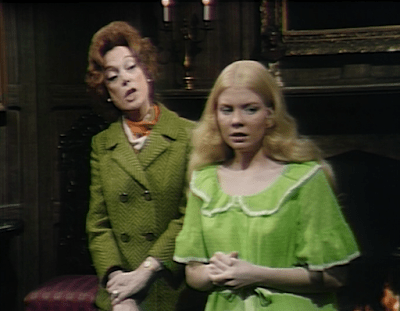
Hannah goes to the great house to see her niece. Alexis hated Hannah, so if she is the woman she could be expected to receive the visit coldly. Angelique was close to her, but knew of Alexis’ attitude. So if she is the woman, she could be expected to behave in exactly the same way. Indeed, the episode began with Angelique’s son Daniel and her widower Quentin noticing little things Alexis did just as her sister would do them, prompting her to point out that they were raised by the same mother and picked up many habits from her. So if a resurrected Angelique is trying to imitate Alexis, she has enough material to work with that not even her aunt can tell them apart.

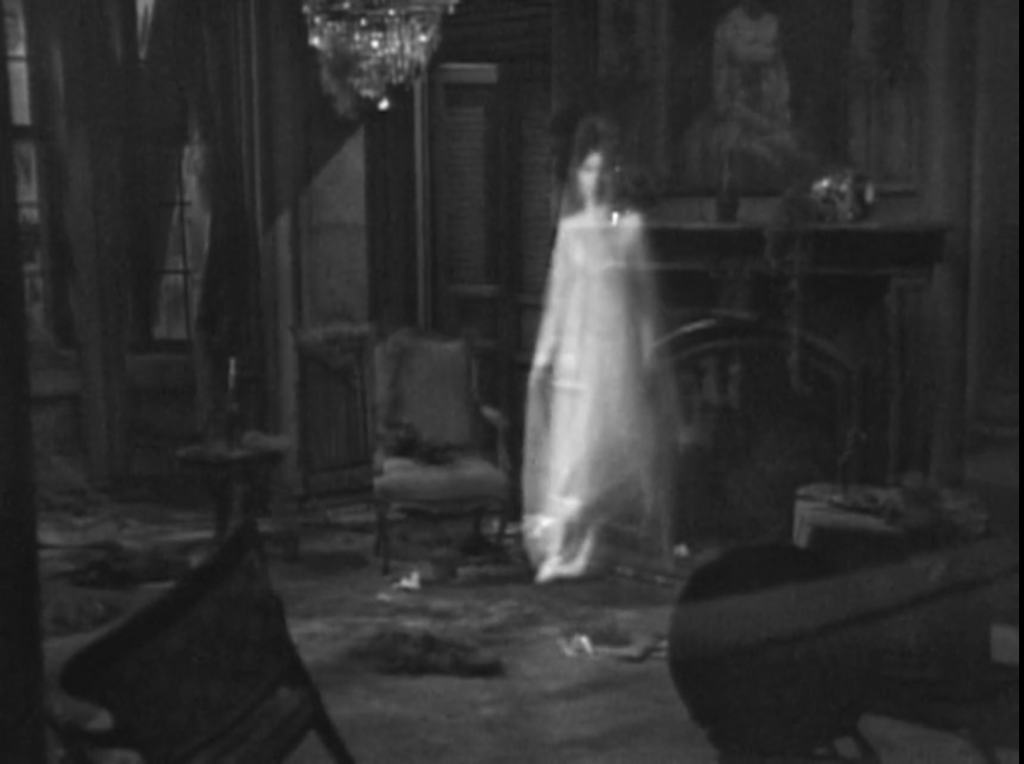
Hannah goes back to the cottage. None of her black magic answers the question of which sister is living in the great house, but she is sure that Angelique is present on the estate in some form, perhaps visible, perhaps ghostly. Bruno is convinced Angelique is present in her own form and using Alexis’ name. Quentin overhears their conversation and believes for a moment that Bruno is right, before talking himself out of it. Later, he and Alexis see Angelique’s piano playing itself in her old bedroom, and Alexis believes that Angelique’s ghost is playing it.

The most interesting thing about this episode is Paula Laurence’s turn as Hannah. Her whole performance today is an imitation of Lara Parker as Angelique. Laurence was such a different physical type from Parker I couldn’t put my finger on what she was doing until she was about to exit the cottage at the end of her first scene and she laughed at Bruno. She recreated the very distinctive laugh Parker uses as Angelique. At that, my wife and I simultaneously said “The same laugh!” From then on, it was impossible to miss the imitation. It comes across as a family resemblance, of a piece with Alexis and Angelique trimming plants the same way or humming the same tune while fluffing pillows.

The cottage is the place for spooky doings. We are in a different universe today than the one where the show was based for its first 196 weeks. In the main continuity, we first saw the cottage as the home of crazed handyman Matthew Morgan, who would be scared to death by ghosts. Matthew was succeeded as a resident of the cottage by undead blonde fire witch Laura Murdoch Collins. Laura was central to the storyline that picked up where the ghosts who killed Matthew left off. Most of the major narrative loose ends, such as the “Revenge of Burke Devlin” arc, were wrapped up as points within her story, while the ghosts were pulled out of the unseen back-world behind the action and brought into the spotlight. By the time Laura went up in smoke, the back-world of uncanny beings and the front-world of business stories and estranged spouses had reversed their places, and Dark Shadows had become a supernatural thriller.

The cottage was vacant for a long time after Laura. The next inhabitant was werewolf Chris Jennings. He was haunted there by the ghost of the main continuity’s counterpart of Quentin, who had lived and died in 1897. Quentin’s ghost seemed to have greater power in the cottage than elsewhere on the grounds of the estate. When the show traveled back in time to 1897, we found that Quentin and his fellow Satanist Evan Hanley had spent time there working black magic. At one point Quentin and Evan asked for a spirit to come from Hell to join them in an evil plan, and the one who appeared was Angelique’s counterpart, who like Laura was an undead blonde fire witch. Also in 1897, we learned that Quentin had been entangled with another iteration of Laura, and that the cottage had been one of their places.

Vague as Hannah’s findings are, they combine with Angelique’s iconography and that of the cottage to assure us that her ghost is active on the estate and that she will be returning in physical form. They are still keeping us guessing about how Alexis fits into all of that, but it seems more and more likely that she is at least sincere in her belief that she is not Angelique. Maybe she is an entirely separate entity who will eventually meet her reanimated sister, or maybe it will turn out that she and Angelique are inhabiting the same body. The spirits of the dead have been known to sublet space from the living on Dark Shadows, so that is one of many possible outcomes.

Episode 987: The possibilities of this synthesis

Q & A

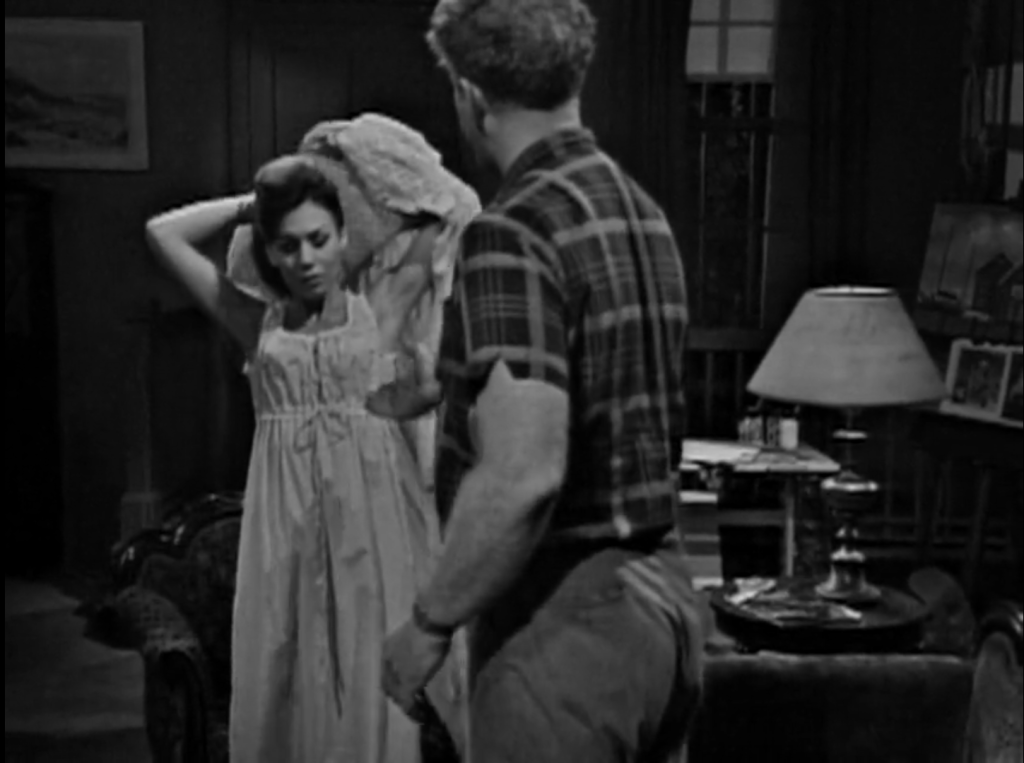
Quentin Collins, master of the estate of Collinwood, is in an even grimmer mood than usual. His new wife, the former Maggie Evans, has left him after only a week in the great house. She had had all she was going to take of his patronizing attitude towards her and of everyone else’s preoccupation with his first wife, the late Angelique Stokes Collins. Maggie was particularly satiated with Quentin’s houseguest, Angelique’ unmarried identical twin sister, Alexis Stokes. Maggie had found Alexis in Angelique’s bedroom, wearing Angelique’s frilly nightgown, and reaching out to Quentin while suggesting in a soft voice that “Perhaps we can comfort each other.” When that sight moved Maggie to voice objections to the situation, Quentin responded by forbidding her, for her own good no less, from mentioning Angelique’s name ever again. He was amazed that this led Maggie to leave the house. Considering the provocation, it is indeed amazing that Quentin did not require medical attention to remove his brandy decanter from whatever part of his anatomy Maggie could reach.

We open today with Quentin and Alexis back in Angelique’s room. She is fully dressed this time, but they are sitting together on the piano bench. They move their heads together, and lock their lips in a passionate kiss.

Returning viewers know that we are visiting a universe parallel to the one in which the action was based for its first 196 weeks of the show. Angelique’s counterpart in the main continuity is a wicked witch who has returned from the dead quite a few times, so when we first crossed over here and heard her devotees saying that they were sure their Angelique would find a way to come back to life we did not doubt that they were right. Maggie wants nothing to do with Angelique or the cult she built up around herself, but she is among those who are convinced that Alexis is in fact Angelique redivivus. The show has done an excellent job keeping us guessing whether she is or isn’t, and we will still be guessing when we come to the end of today’s episode.

Alexis pulls away from Quentin and is visibly upset. He apologizes for kissing her. She says that she is disappointed in him- she had thought that he, of all people would know that she is not Angelique returned from the grave. He says he does not think that she is. We can believe him- his counterpart in the main continuity usually had two or three fiancées at a time, and they were rarely his only love interests. So he wouldn’t have to believe Alexis was Angelique, or indeed that she was anyone in particular, to start a make-out session with her. After they clear the air, she agrees to stay on in the house until she can meet Quentin and Angelique’s son, her nephew Daniel Collins, who is on a trip at the moment.

Bruno, Sabrina, Cyrus, Gladstone, and the Bunny

Quentin and Alexis aren’t the only ones dealing with frustrated sexual desire. We cut from them to a closeup of a bunny. This universally recognized symbol of amorous enthusiasm is alone in a cage.

The episode originally aired on the second Tuesday of Easter 1970, maybe the bunny was resting up after his big day.

The cage is in a laboratory. A young woman in a lab coat is trying to work on a large apparatus for chemical experimentation while a man wearing a purple suit, a low cut shirt, a large medallion, and a huge bouffant hairdo is pestering her with clumsy attempts at flirting. She keeps laughing off his verbal gambits and swatting away his physical approaches.

A tall young man in a lab coat enters and calls out a booming “Sabrina!” The lounge lizard and the experimenter stand up straighter and step away from each other. Returning viewers know the tall man as aspiring mad scientist Cyrus Longworth and the ill-clad masher as Bruno Hess, musician and hanger-on of the late Angelique. We have not seen the woman before, but we recognize the actress as Lisa Blake Richards, who played another woman named Sabrina in the main continuity. That Sabrina was trapped in a go-nowhere storyline. Before today is done we will have grounds to hope that this one will give Miss Richards a task more in keeping with her considerable talents.

Cyrus sends Sabrina upstairs to wait for a package. Bruno gets ready for his part in Cyrus’ experiment, which involves giving a blood sample. Bruno asks Cyrus why he was so calm when he saw him trying to put the moves on Sabrina. Cyrus replies that he trusts Sabrina too much to worry that Bruno could come between them. He then jabs the syringe into Bruno’s arm with great force and without even looking at the spot from which he is drawing the sample, causing Bruno to jump. He may trust Sabrina, but he wants Bruno to know who’s boss.

Bruno tries to interest Cyrus in his theory that Alexis is Angelique returned from the grave. He eventually manages to get Cyrus to give him a quizzical look, but stops at that point, saying that if Cyrus won’t explain his experiment, he won’t explain his.

Sabrina comes downstairs and says that the package has come and that its bearer insists on meeting Cyrus himself. Cyrus is annoyed by this, but when it develops that the man is Mr Horace Gladstone himself, the very chemist who devised the unusual compound he has brought, Cyrus sends Sabrina back upstairs and Bruno out the basement door so that he can meet with the man alone.

Friday, Cyrus explained to his friend Chris that he is trying to devise a process for separating a human being into two parts, one good and the other evil. His scenes with Chris hit all the obligatory mad scientist notes, right down to disparaging non-mad scientists as unimaginative dolts who may as well believe that the Earth is flat. He won’t tell Gladstone what he is trying to do, perhaps because he has the same last name as did the man who was prime minister of the UK when Dr Jekyll and Mr Hyde was first published and so he reminds him that he is a character in a derivative storyline. But Gladstone does warn Cyrus that the compound he has purchased is a potent and dangerous one. Gladstone hints at the nature of the hazard when he says that he stepped back from active research when he feared that, even within the bounds of chemistry, he was about to uncover truths best left unknown.

Gladstone is played by John Harkins, in his fourth role on Dark Shadows. As before, he is playing a stranger from far away. In #174, he played Lieutenant Costa of the Arizona State Police. We saw him in a scene set in Phoenix, the first time Dark Shadows took us outside the northeastern USA. We did not leave that region again until #877, when sorcerer Count Petofi thought back to an incident in England in 1885, when he first met his henchman Aristide. Like Bruno, Aristide was played by Michael Stroka. The incident in England involved a man named Garth Blackwood, whom Petofi would bring back from the dead to punish Aristide. Blackwood was played by Harkins.

Harkins’ third character came from even further away than Arizona or England. He was Mr Strak, the representative of the Leviathan People, a race of Elder Gods long confined to the underworld. Strak appeared to Paul Stoddard in #899 and #900, and tricked Paul into selling his daughter Carolyn to the Leviathans. So far as Paul was concerned, Strak came from nowhere and disappeared to nowhere, so that he could never hope to explain to anyone what he had done, still less find a way to challenge the terms of the deal.

Gladstone is from Boston. Dark Shadows is set near the real-world location of Bar Harbor, Maine. The characters often mention Boston, but we’ve never had a scene set there. In #363, the ghost of nine year old Sarah Collins was perfectly bland when her friend, strange and troubled boy David, said he had been to China. Sarah said that her father and his business associates were always sailing to China. When David told Sarah that he was joking and he had actually gone to Boston, Sarah was thrilled. She had been to Boston herself once, and considered it a far more exotic place than China could possibly be. Gordon Russell was credited with the script for #363, and Joe Caldwell, the freshly returned author of today’s script, had finished his first tour of duty on the show three weeks before it was taped. But Sarah’s excitement about Boston is so much the kind of character moment Caldwell specialized in that I suspect it was a leftover idea of his that Russell found a place for. Perhaps the casting of Harkins as a Hub man reflects Caldwell’s idea of what Boston would represent to people in a coastal village in central Maine.

Bruno and Alexis

We cut to Bruno, who is on the telephone. He is talking to a person in an office somewhere. He learns that no ships from Genoa have docked in New York in the last week. This information excites him, but his excitement soon gives way to terror as he feels himself choking.

Bruno runs into Angelique’s bedroom, where Alexis is back on the piano bench. He gasps and demands she stop obstructing his breathing. She appears to have no idea what he is talking about.

The Angelique we have known since late 1967 did specialize in casting spells that made her enemies choke. We saw her do that as recently as #955, when her husband tried to set fire to her and she stopped him by twisting a scarf around the neck of a statue. On the other hand, Alexis seems genuinely bewildered by the situation.

When Bruno starts breathing again, he confronts her with the fact that no registered passenger ships from Genoa arrived in New York harbor the week before. She asks him if he considered that she might have been a guest on the yacht of some wealthy friends. He is stumped by this. Again, this keeps the suspense about her true identity alive. Alexis has been established as the sort of person who would be found on someone else’s yacht, but she doesn’t actually say that that is how she got back to the States. She merely asks Bruno if he had thought of the possibility that she may have done so.

Cyrus and Sabrina

Back in the lab, we see Sabrina collecting some equipment while Cyrus tends to his notes. She finds a small box, and asks him if he put it there for her to find. When he says he did, she opens it and finds a ring. She asks if it is an engagement ring. He says he hopes it is. She throws her arms around him and tells him she loves him. He holds her and does not say that he loves her too. He merely says that she knows how he feels about her, an ill-omen if ever we saw one.

Cyrus tells Sabrina that she knows how completely his work consumes his energies, and she says that is one of the things she admires about him. She asks what exactly he is working on. He is reticent, and she tries to walk the question back. He goes into his mad scientist ravings, and she gives him a stunned look. He tries to reassure her, saying that when he gets carried away he talks in cliches. He says that no one has found good or evil in a test tube… “yet!” The crazed gleam comes back into his eyes.

Sabrina is shocked by Cyrus’ ravings

This scene gives Miss Richards more to work with than she had had in her whole time in the main continuity. The look Sabrina gives at the end of Cyrus’ gust of lunacy is the first time she has had a chance to get a laugh, and she makes the most of it. As for Christopher Pennock, he had just been getting the hang of his previous part, hugely overgrown infant Jeb Hawkes, when he was written out. With Cyrus, he can to some extent pick up where he left off. Pennock had begun to find a way to suggest that there was a real sweetness bottled up inside one-man wrecking crew Jeb, and in Cyrus’ love for Sabrina he can play a character who is Jeb’s mirror image- abundantly sweet, but so deep inside his own head that he is about to become a monster.

Bruno

On Dark Shadows, wedding days usually come and go without anyone actually getting married. Typically, the ceremony is interrupted and someone has to go off and dig up a grave, in which they find an empty coffin.

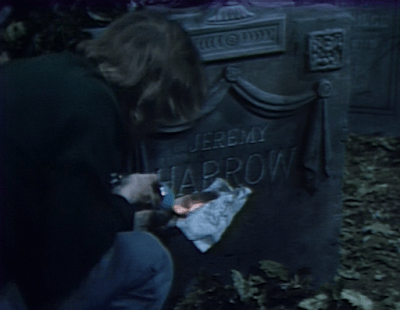
Bruno has no manners and does not observe any of the recognized customs. So even though today is Sabrina and Cyrus’ engagement day, not their wedding day, he jumps the gun and starts opening Angelique’s grave, in which he believes he will find an empty coffin. We end with him chiseling at the wall of the mausoleum. I suppose you could say that he might be planning to work slowly, so that he won’t finish until the day of the wedding, but even if that were true it would be an outright violation of the accepted norm, and an undeniable sign that he is not the sort of person who can be expected to fit in at Collinwood.

Episode 986: I saw her in the casket myself

In #949, eleven year old Amy Jennings saw twenty-nine year old Quentin Collins. She reacted with terror, certain that he was the ghost of her great grandfather, the ghost who had persecuted her and everyone else at the great house of Collinwood from December 1968 to September 1969. Heiress Carolyn Collins laughed at Amy and told her that he was not a ghost, but was a cousin of theirs, another descendant of Quentin’s. In fact, Quentin was Amy’s great-grandfather and Carolyn’s great-great-uncle, but he wasn’t a ghost, and he meant no harm to Amy.

Amy refused to accept Carolyn and Quentin’s assurances that he was “not that Quentin Collins.” That refusal highlighted Quentin’s convoluted backstory. The show went back in time in March 1969 to the year 1897, and during an eight-month costume drama segment it introduced us to Quentin as he was before he died. He was a charming rascal who immediately became a huge breakout star. During the 1897 segment, they showed history being changed so that Quentin never died and was the beneficiary of a magic spell that immunized him against aging. Ever since early 1967, Dark Shadows has been operating on a model of the cosmos in which the usual laws of cause and effect are replaced with anniversaries. So in #839, we saw that Quentin’s haunting of Collinwood had gone on for ten months and had finally resulted in the death of strange and troubled boy David Collins. But that day was also the 72nd anniversary of the change in history which prevented Quentin’s death, so the haunting broke and David came back to life. When Quentin showed up in 1969 as a living being, everyone remembered the haunting. Most characters accepted Quentin’s claim to be his own great-grandson, but Amy saw the truth, that he and the ghost were two continuations of one man.

The show’s metaphysics probably didn’t bother anyone who watched it the first time it was broadcast. The characters just take them for granted, as in our world we take hard-to-explain phenomena like gravity and magnetism for granted, and the story keeps on going as if they somehow made sense. What the writers were worried about when Amy saw the living Quentin was not that their model of the universe lacked plausibility, but that they hadn’t found a way to keep Quentin at the center of the story. He’d made a hit in the 1897 segment because he was connected to everyone and was naturally involved in everything that was happening, but in 1969 and 1970 he is a visitor, a distant relative who has come wandering in from who knows where. When Amy tries to figure out in what sense he is “that Quentin Collins,” she is trying to solve a puzzle that the show has to solve to keep him generating heat in the ratings.

Now, Dark Shadows has crossed over to an alternate universe. Here, we have met yet another iteration of Quentin. This Quentin Collins is the Master of Collinwood. Amy lives in the house in this continuity as well, but she really is Quentin’s cousin, and her last name is Collins.

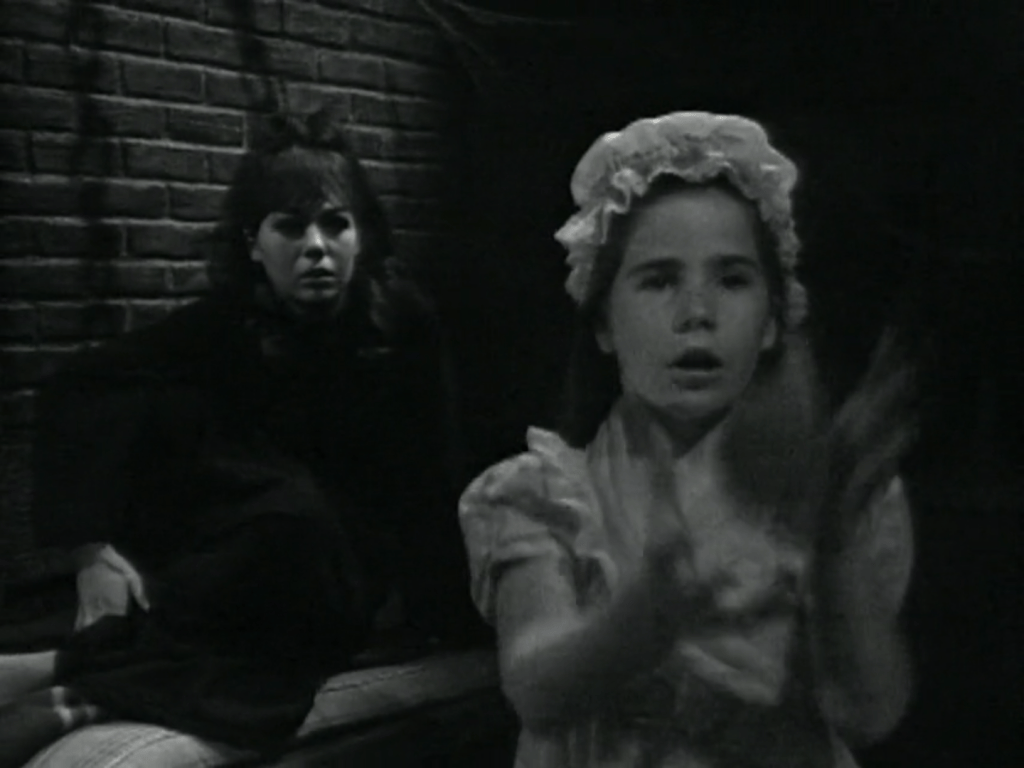
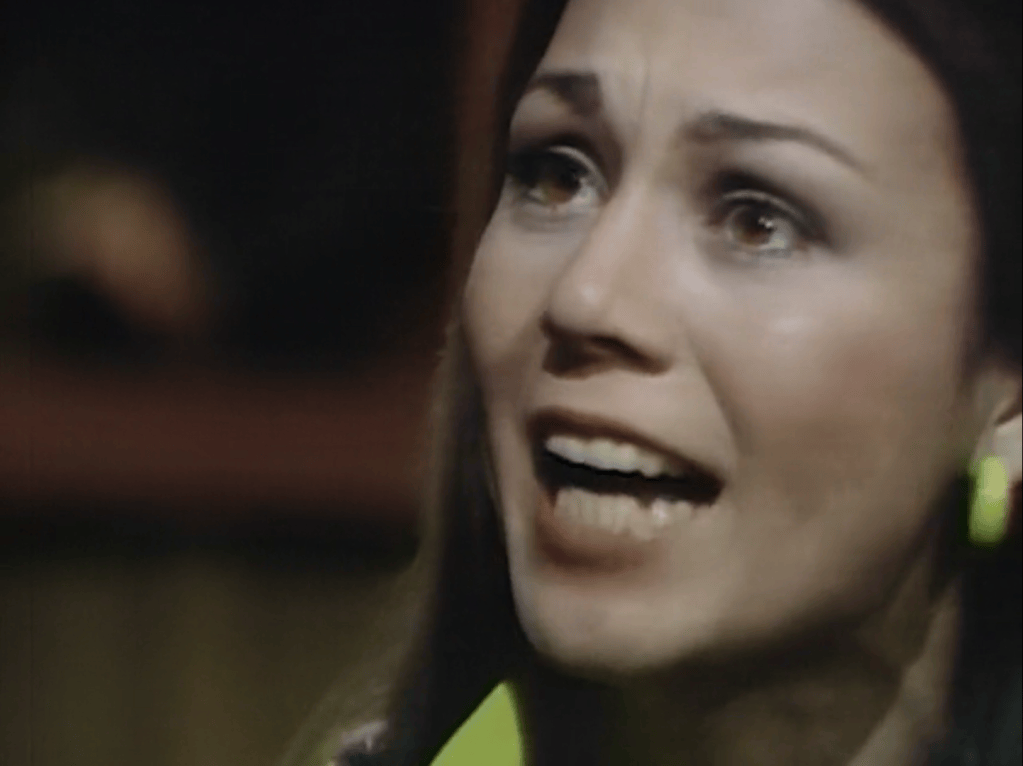
Parallel Quentin hasn’t thought to tell Amy that there is a houseguest staying at Collinwood. She is Alexis Stokes, identical twin sister of his late wife Angelique. Since there are a lot of people around the estate who keep saying that Angelique is going to come back to life, the sight of Alexis comes as quite a shock to everyone. Amy sees Alexis today, and reacts with terror, certain that she is the ghost of Angelique. She does not accept Quentin’s belated explanations, anymore than her counterpart accepted Carolyn’s. Amy Jennings had specialized in looking directly into the camera; as Amy Collins, Denise Nickerson has a moment after Quentin and Alexis have explained the situation to her when it looks like she is about to make this move, but she does not.

Amy terrified. Screenshot by Dark Shadows Before I Die.

Amy has two more scenes today. She opens the front door and lets Angelique’s associate, sleazy musician Bruno Hess, into the house. Amy greets Bruno with “She’s upstairs.” He asks how she knows who he came to see, and she tells him he always came to see “her” before. She wonders if “they” will make Bruno call the woman “Alexis.” Perhaps she thinks all adults are in on this scam, pretending that the dead can be counted on to leave the living alone. Later, she gives Quentin a telegram. When he scolds her for having opened it, she is at once sincerely remorseful about what she has done and indignant about what is going on upstairs. She says that while opening other people’s mail is indeed bad, what “she” has done is even worse.

On Friday, the show hinted that Alexis might be Angelique. Today, Bruno starts an investigation to check up on Alexis’ report that she arrived in New York from Genoa a couple of days before. They spend enough time on Bruno’s activities that it would be surprising if her story simply held up, so that keeps the question alive.

Quentin’s new wife, the former Maggie Evans, left him and went to her sister Jennifer’s place in New York on Friday. She was fed up with Quentin’s high-handed attitude, with everyone’s preoccupation with Angelique, and with Alexis’ presence in the house. Quentin picks up a telephone today, says “Operator, this is a person to person call. Mrs Collins!” And they connect him to Jennifer’s place! In spite of this magical power, he still can’t persuade Maggie to come to the phone. By the end of the call, he and Jennifer are mad at each other, too.

When this episode was taped, principal photography was underway for the feature film House of Dark Shadows. Many of the best-known members of the cast are going to be in Tarrytown, New York for the next six weeks. When Quentin talks to Jennifer Evans, he offers to go to Maggie in New York- we might assume he means NYC, but I suppose Jennifer might live in Tarrytown, and Maggie’s real reason for staying with her is that she doesn’t want to be separated from Kathryn Leigh Scott.

As Quentin and Alexis, David Selby and Lara Parker are the biggest names currently on Dark Shadows, and they are playing characters quite different from those that made them famous. This Quentin intermittently displays the charm which the one from the main continuity exudes so effortlessly, but he is a downer at least half the time, and his position as Master of Collinwood keeps him from being the lovable rascal who has been a fixture on the cover of the fan magazines for a year now. And even if Alexis is Angelique, she is an Angelique who has not gone through any of the development that has held the fans’ attention for over two years. Angelique was a story dynamo from her introduction at the end of 1967, but what has made her indispensable in arc after arc is that she usually knows everything the audience knows about what is happening and has some crazy scheme that no one else would have thought of as to how she can make it all much worse. And over the last year, she has shown an ability to learn and grow that has made her a much more interesting character. A new Angelique, starting from scratch, won’t match the audience’s understanding of the situation, and won’t remember anything that gave her new depth in 1969 and early 1970.

You may wonder if these two can carry the show for a month and a half. The writers certainly did, as witness a conversation between Alexis and Quentin today. She goes on at length about how difficult it was to grow up in her sister’s shadow, saying that she tried to imitate Angelique but could never make it. The harder she tried to copy the habits that attracted everyone to Angelique, the more embarrassed their reactions were.

Not only does Alexis tell us explicitly that she isn’t as appealing as Angelique, Quentin couldn’t be less interested what she is saying. He is preoccupied with a dispute he is having with Bruno. That dispute, were Alexis aware of it, would probably interest her as little as what she is saying interests Quentin. In their scene together, Alexis does not give any sign that she recognizes Bruno. After he leaves, she looks at a picture of him on some sheet music he composed, as she would do if she never had seen him before. So, if she is Angelique returned from the grave, she would appear to have lost her memory of Bruno along the way. And whoever she is, her attitude towards him throughout is one of amused tolerance. We can’t imagine her being particularly invested in a conflict about whether Bruno has a right to live in the caretaker’s cottage on the grounds of Collinwood. So the scene between Angelique and Quentin, in which neither has anything to say that is of concern to the other, seems to be something like the opposite of a programmatic statement. Rather than telling us what they plan to do, the writers are telling us what they are afraid we will think they have done.

Not that they have despaired of making it work. By the end, Quentin and Alexis have drawn each other’s attention sufficiently to do some pretty firm smooching. Maggie has been a fan favorite from episode #1, and many of the nine year old girls in the audience probably identify with her and are excited about the idea of her being married to Quentin. The image of him cheating on Maggie with the wicked witch will outrage them enough to keep them tuning in.

The prospect of an affair between Quentin and Alexis presents something of a puzzle in logic. If she really is who she says she is, he is cheating on Maggie with her. But if she is Angelique, he has been cheating on her with Maggie, albeit unknowingly. One way or another, it is far from gentlemanly behavior on his part. As for Alexis, what we know so far would tend to confirm our initial assumption that Angelique is an Evil Twin, but seeing her go after Maggie’s husband will keep regular viewers from labeling her the Good Twin.

Episode 984: A rare person

The protagonist and narrator of Daphne Du Maurier’s novel Rebecca is the second wife of the enigmatic Maxim de Winter. The theme of the story is the protagonist’s timidity. She never introduces herself to us or reports a conversation in which anyone addresses her by name, so that we can call her only “the second Mrs de Winter.” Many people around her have something to say about Maxim’s first wife, the late Rebecca, though Maxim himself never mentions Rebecca and becomes upset when anyone reminds him of her. From this, the second Mrs de Winter concludes that Rebecca was an unsurpassably glamorous being and that Maxim is still in love with her and always will be. She is terrified of housekeeper Mrs Danvers, but since she would be terrified of anyone, this does not constitute evidence that Mrs Danvers actually represents a threat to her. In fact, the main thing about Mrs Danvers is her ambiguity. We have no way of knowing what she is thinking. Nor do we know what she is doing until the end of the book, when it turns out she is more dangerous even than the narrator had feared. It is also at the end that the second Mrs de Winter finds that Maxim’s hang-up is not his unquenched love for Rebecca. He never loved Rebecca, and would have been glad when she drowned were he not afraid of being prosecuted for his role in her death.

Alfred Hitchcock’s 1940 film Rebecca had to make several things definite that the novel could leave unsettled. So, while in the novel Mrs Danvers is a figure we glimpse in the course of her narrator’s confused attempts to remember what happened in her early days in the mansion, in the film she is a major character in several scenes. So we saw from relatively early on that Mrs Danvers was deliberately playing on the second Mrs de Winter’s insecurities in an attempt to get rid of her.

The film deviates even further from the book in showing Mrs Danvers’ motivation. Du Maurier was herself bisexual and may have started Rebecca with a plan to sketch Mrs Danvers as a mind warped by life in the closet, but as the story turned out it did not shed any light on the roots or structure of Mrs Danvers’ very intense feelings for Rebecca. It was just one more item on the endless list of things that the second Mrs de Winter could not hope to understand. But Judith Anderson’s performance of Mrs Danvers’ fixation on Rebecca struck film censor Joseph Breen as providing a “quite inescapable inference of sex perversion.” Anderson would deny then and in later years that she meant to play the character that way, but her body language throughout, most famously in the scene where Mrs Danvers handles Rebecca’s intimate apparel, makes those denials laughable.

Now, the A story of Dark Shadows is an adaptation of Rebecca. We are in an alternate universe, where the counterparts of Maggie Evans, Quentin Collins, Julia Hoffman, and wicked witch Angelique are cast in the roles of, respectively, the second Mrs de Winter, Maxim, Mrs Danvers, and Rebecca.

There is even less ambiguity here than in Hitchcock’s film. So after Miss Hoffman sets up a moment to enrage Quentin and confuse Maggie, Maggie goes to Angelique’s old room and hears Miss Hoffman telling the portrait of Angelique that hangs there how inadequate she had exposed her as being, cackling with glee all the while. Today Miss Hoffman sets up another such moment, suggesting Maggie give Quentin’s son Daniel a particular record that she knows Quentin will fly into a rage upon hearing. Miss Hoffman is so blatant that Quentin catches on to what she is doing and orders her to apologize to Maggie. When she does, she drifts off halfway through into a rhapsody about how irresistibly beautiful Angelique was. Grayson Hall had played lesbian characters in two films, Satan in High Heels (1962,) which became a cult favorite, and Night of the Iguana (1964,) for which she was nominated for the Academy Award for Best Supporting Actress. So she is on familiar ground when Miss Hoffman’s craving for Angelique becomes a spoof of Mrs Danvers’ homoerotic attachment to Rebecca.

Miss Hoffman. Screenshot by Dark Shadows Before I Die.

It is not only in the character of Miss Hoffman that this version of Rebecca is less subtle than were those that preceded it. Maggie is even slower on the uptake than was the second Mrs de Winter. Even after she heard Miss Hoffman cackle about her deficiencies, and even after multiple people have made it clear that they are siding with her against Miss Hoffman, she still takes her advice and buys the record. Quentin is quite reasonable today, but that’s a first- so far, he has been even more miserly with information than Maxim was. And where Rebecca was an intimidating memory that became an inconvenient corpse, we end today’s episode with Maggie opening the doors to the drawing room and seeing Quentin offering a glass of sherry to someone who, for all she sees, can only be Angelique come back to life.

UPDATE: Thanks to FotB Melissa Snyder for pointing out a mistake in the original post. You can get the details in the comments below!

Episode 983: Sing to me again

When Dark Shadows premiered in June 1966, strange and troubled boy David Collins (David Henesy) was obsessed with his absent mother and determined to get rid of his new governess, the well-meaning Victoria Winters. In #15, David had tampered with his father Roger’s car. As he stood at the window and watched Roger drive down the narrow, twisting mountain road away from the great house of Collinwood, he said “He’s going to die, mother, he’s going to die!” When Roger survived and it was discovered that someone had removed the bleeder valve from his braking system, David planted the valve in Vicki’s room in an attempt to frame her for the murder attempt. Later, Roger would come to fear that Vicki was about to expose a dark secret of his own, and would encourage David to try to kill her.

David eventually gave up on homicide, and dropped his hostility to Vicki. One of the more benevolent influences on him was his best friend, the ghost of the gracious Josette. In #102, we saw David in the Old House on the grounds of Collinwood, carrying on a conversation with the portrait of Josette that hung above the mantel. We could not hear Josette’s side of the conversation, but it certainly sounded like David could. We already knew at that point that Josette was real- we saw her emanate from the portrait, walk out of the house, and dance among the columns outside it in #70, when David first took Vicki to the Old House. In #126, we would see and hear Josette when she led the ghosts of Collinwood in rescuing Vicki from crazed handyman Matthew Morgan. That rescue was not only a good deed for Vicki, but also a favor to David, who had stumbled upon Vicki in the secret room where Matthew had her tied up and, in a panic, left her to her fate.

In #153, we learned that David’s mother, the former Laura Murdoch, was the one who chose his name, one which no previous Collins had borne. Roger had wanted to call David “Charles Andrew,” in honor of some Collins ancestors. In #181, Vicki and her allies learned that two previous women given the name Laura Murdoch at birth had died by fire, one in 1867 and the other in 1767, each accompanied by her young son, and that each of those boys was named David. It would eventually become clear that Laura was an undead fire witch, a humanoid Phoenix who went into a pyre with her sons at intervals of exactly 100 years, gaining immortality for herself, though not for the Davids. In #288, they had forgotten the lore about David’s name, and mentioned a previous David Collins, but in #685 and #767, it was back to being a first in the family. Between those two episodes, from #729 to #760, another iteration of Laura was on the show, suggesting that the writers brushed up on their knowledge of her original storyline.

By the time Vicki saved David from Laura, he had moved out of the villain category altogether. When his third cousin Amy Jennings (Denise Nickerson) moved into Collinwood at the end of 1968, David was as pleasant to her as one could expect. But his behavior towards her and others changed when the two of them stirred up the ghost of Quentin Collins, Amy’s great-grandfather and David’s great-great-uncle. As Quentin gathered strength, he intermittently possessed first one child and then the other. While David was under Quentin’s control in #679, he twisted Amy’s arm to force her to go to a secret room and join in their vengeful ancestor’s evil plans for their governess, Vicki’s successor Maggie Evans (Kathryn Leigh Scott.) The camera lingered on that act of bullying, meant to shock us with evidence that Quentin’s dire influence had overwhelmed David’s kindly nature.

The arm-twisting incident made an impression on the viewers. In #813, set in the year 1897 when Quentin was alive, Henesy and Nickerson played brother and sister Jamison and Nora Collins, nephew and niece of Quentin, grandfather and great-aunt to David. Jamison, possessed by sorcerer Count Petofi, twisted Nora’s arm to force her to give him information, a reference which shows that the writers were confident that many viewers would see David Henesy’s character abusing Denise Nickerson’s in that way and read it as a sign that he is under the power of an outside force.

Now, it is 1970, but we are not in the main continuity at all. We have traveled to an alternate universe, which on Dark Shadows is known as “Parallel Time.” In this “time-band,” to use another bit of Collinsport English, Quentin is alive and the master of Collinwood. His first wife, the counterpart of wicked witch Angelique, has died, and he has remarried. The new Mrs Collins is the former Maggie Evans (Kathryn Leigh Scott.) Quentin and Angelique’s son, strange and troubled boy Daniel (David Henesy,) is obsessed with his absent mother and determined to get rid of his new stepmother.

Apparently the writers still remember the connection between David’s name and the first Phoenix story, because Daniel is the only character we have yet seen in Parallel Time answering to a different first name than his counterpart in the main continuity. Angelique and Quentin gave him the name of the Collins ancestor whom Mr Henesy played in early 1968, when the show was set in the year 1796. We know that the timelines diverged in that period, so it follows that it was the counterpart of the eighteenth and nineteenth century Daniel who was this Daniel’s namesake.

When we first saw Daniel, he was carrying on a one-sided conversation with his mother’s portrait, which hangs in her old bedroom. Today, he devises a plan to use the portrait to frighten Maggie. The plan requires the cooperation of his cousin, Amy Collins (Denise Nickerson.) When Amy refuses, he twists her arm until she agrees to go to a secret room and sing, making Maggie think the portrait is coming to life. This attack is shown only for a few seconds, and Amy’s arm is out of frame. They have already established that Daniel is cruel, and do not need to dwell on the act of abuse.

Daniel twists Amy’s arm. Screenshot by Dark Shadows Before I Die.

Daniel claims that his father often goes to Angelique’s room to meditate and talk to the portrait. That lures Maggie to the room, where Daniel is waiting. They have a confrontation. When she says she wishes she could “make him understand-,” he interrupts her and asks if what she wants him to understand is that his mother is dead and is never coming back. She looks at him and answers with a flat “Yes.” He tells her she is wrong, and pleads with the portrait to sing to him. Maggie says she can’t stand to see him like this, and turns to go. Before she gets out of the room, we hear a woman’s voice singing a lullaby. Maggie and Daniel hear it too. She turns around, shocked, and runs from the room. Daniel laughs that his plan worked so well.

Amy comes rushing into the room. Daniel congratulates her on her performance, and asks how she got in from the secret room so quickly. She explains that she never went to the secret room- her brother Chris intercepted her before she could do so. It wasn’t her voice Daniel and Maggie heard. He absorbs her message, and looks at the portrait in wonderment.

The audience could tell it wasn’t Denise Nickerson singing- she had such a high-pitched voice when she was twelve that she had to work hard to keep it in a range that would sound good on television, while the pre-recorded voice we heard singing was definitely that of a grown woman. Angelique was played by Lara Parker; Parker did some very distinctive things with her voice on Dark Shadows, none of which shows up in the lullaby, so I’m sure it wasn’t her. Several fansites attribute the singing to Joan Bennett, who is in this episode, but I’ve heard Bennett sing and she didn’t get from one note to another the way this voice does. I think the singer must be Kathryn Leigh Scott.

Early in the episode, Daniel and Amy had a scene in his bedroom. David’s bedroom was a frequent set in the first 38 weeks of the show, and was occasionally seen thereafter. Daniel’s room is the same set, with the same furnishings and decorations, but they are arranged in the opposite direction from the pattern we see in David’s. His bed is at stage right rather than stage left, and everything else is also transposed. Seeing this mirror image, regular viewers will appreciate this reminder that we are in a Mirror Universe.

Episode 981: Last night I dreamt I went to Manderley again

When Dark Shadows premiered in June 1966, it was supposed to bring the sensibility of the then-fashionable “Gothic romances” to the small screen. That did not prove to be much of a ratings draw, so six months later they introduced undead blonde fire witch Laura Murdoch Collins, who was at the center of a story that by March 1967 had swallowed up all of the major loose ends and committed the show to becoming a supernatural thriller.

Now, vampire Barnabas Collins has crossed over to an alternate universe. We have seen enough of “Parallel Time” over the last several episodes to know that it will feature a story derived from Daphne Du Maurier’s Rebecca, one of the foundational works of the “Gothic romance” genre. Viewers who have been with the show from the beginning will be intrigued at this return to its starting point.

The first person Barnabas meets is the counterpart of his distant cousin and onetime blood thrall, heiress Carolyn Collins Stoddard. This Carolyn finds him in a room deep in the great house of Collinwood and demands to know who he is and what he is doing there. He starts in on the “cousin from England” jazz that won him his place at Collinwood in the continuity we have been following so far. He cites the portrait of him that hangs in the foyer in the familiar timeline, only to be told that there is no such portrait in this house and that his story does not add up. Carolyn marches off to blow the whistle on the intruder, and Barnabas bites her. We can see that Parallel Time is going to move fast- it took Barnabas 28 weeks to attack Carolyn in the other universe.

Same as the old boss. Screenshot by Dark Shadows Before I Die.

This Carolyn is married to the counterpart of Barnabas’ servant Willie Loomis. While Willie is an uneducated ruffian, Will Loomis is the author of several books, including three bestselling novels and a biography of Barnabas’ late counterpart, who died a natural death in 1830. Will and Carolyn live in the Old House, which corresponds to Barnabas’ own house in the main continuity. Quentin Collins, another distant cousin, is the master of Collinwood here, and widower of Angelique, who corresponds to the wicked witch who made Barnabas a vampire in 1796 but was apparently a mortal woman and a native of the twentieth century here. Other characters we see today include: Julia Hoffman, in the other universe, a mad scientist and Barnabas’ best friend, but here a uniformed domestic and Angelique’s fanatical devotee, Mrs Danvers to her Rebecca; Carolyn’s mother Elizabeth Collins Stoddard, who is not the owner of Collinwood and the Collins family businesses but a guest in Quentin’s house; and Quentin’s new wife, Maggie Evans Collins. We also hear that Angelique’s father is “Tim Stokes,” the counterpart of Barnabas’ sometime ally, occult expert Timothy Eliot Stokes.

What we had seen of “Parallel Time” before Barnabas arrived let us know that Quentin was bringing a new bride home, much to the displeasure of Hoffman and Angelique’s other acolytes. We also knew about the Loomises. So that left us with two candidates to play the part of the intimidated, anxiety ridden “second Mrs de Winter.” Those were Kathryn Leigh Scott, who has been Maggie in the main continuity since episode #1 and has played other parts in time travel segments and as a ghost, and Lisa Blake Richards, who plays Sabrina Stuart, girlfriend of werewolf Chris Jennings.

I love Miss Scott, but I was hoping Miss Richards would be the overpowered new wife. Miss Scott has one of the deepest iconographies of any cast member. No matter how far Miss Scott dials down the big brassy Dark Shadows style of acting, regular viewers simply will not believe that she, answering to the name of Maggie, is going to be reduced to the position that the second Mrs de Winter finds herself in, where she is grateful to her own servants for allowing her a piece of bread and butter when she hasn’t eaten all day. It took all the abuse Barnabas could heap on her, supported by Julia’s magical powers of hypnosis, to break Maggie in 1967. Miss Scott was successful as neurotic intellectual Rachel Drummond when the show was set in 1897, but they went out of their way to show that Rachel was not Maggie. The second Mrs Quentin Collins not only has the same name as the wised-up representative of Collinsport’s working class whom we met long ago, we even hear today that her father was an artist who lived in the village, as our Maggie’s was.

Miss Richards, by contrast, would come in clean. Sabrina, stuck in a dead-end story where her character was a mute for a long time, has made relatively little impression. Miss Richards specialized in a very precise, understated approach. She would be the perfect choice to tackle the job Alfred Hitchcock gave Joan Fontaine in his 1940 feature adaptation of Rebecca and depict a character succumbing to obscure anxieties.

We hear today that this Maggie has a sister, which ours never did. Perhaps Miss Richards will appear as that character. We do not hear whether Sam Evans is still alive. He is dead in the main continuity, but that was the result of an attack by a monster who would not have existed in this one. Longtime fans might get their hopes up that we will see David Ford again as Sam’s counterpart. Carolyn Loomis tells Barnabas today that the idea of widowhood is not as unattractive to her as he seems to imagine; since Nancy Barrett had divorced Ford a few months before this episode was taped, bringing him back into the cast might have helped her add some zest to this aspect of her character.

The blocking does not always take into account the dimensions of the brief outfits Junior Sophisticates provided Miss Scott. So when Quentin carries Maggie into the great house today, the camera looks right up her miniskirt. The ratings were still high during this period, but you can tell no one was watching who worked for either ABC’s Standards and Practices Office or the Federal Communications Commission.

Episode 980: I don’t want memories

Heiress Carolyn Collins Stoddard has had a dream in which her new husband, whom she knows as Jeb Hawkes but who when we first saw him asked to be called Jabe, was in a fight on top of Widows’ Hill. His opponent, a stooge named Sky Rumson, threw him off the precipice to his death. When she awoke, Carolyn ran to the hill in search of Jabe. Instead, she found Sky. He told her that her dream was not complete, because it did not show her death. He then grabbed her by the throat.

Jabe rushes up and knocks Carolyn out of Sky’s grip. He and Sky fight, and Sky does throw him off the precipice. Carolyn escapes.

Back home at the great house of Collinwood, Carolyn finds her mother, matriarch Elizabeth Collins Stoddard, and permanent houseguest Julia Hoffman, MD. It takes her a while to compose herself sufficiently to tell Liz and Julia what happened. Julia offers Carolyn a sedative, which prompts her to jump up and shout a verbal refusal. By the time Carolyn starts telling the story, her distant cousin, old world gentleman Barnabas Collins, has joined them in the drawing room. She interrupts herself to yell at Barnabas that he always hated Jabe and is probably glad he’s dead. When Carolyn finishes, Barnabas slips out. Liz calls the police, and Julia is surprised neither of them saw Barnabas leave.

For the last nineteen weeks, the show has been trying to make a story out of some themes drawn from the writings of H. P. Lovecraft. That segment is usually called “the Leviathans,” after a race of Elder Gods who are behind the action. Jabe was central to the Leviathan segment. Sky is the only other character remaining from it. Barnabas appears in the house where Sky has been crashing and finds him packing his bag. Sky does not understand how Barnabas got in. Barnabas dismisses his question, merely saying that Sky knows there are things he can do that ordinary people cannot. Sky draws a revolver and fires two rounds at Barnabas point blank, without effect. Sky exclaims “Oh, no!” Barnabas is amused that none of Sky’s late colleagues told him that he is a vampire. He takes Sky’s hand, curls his arm back so that the gun is pointing at his heart, and squeezes Sky’s finger onto the trigger.

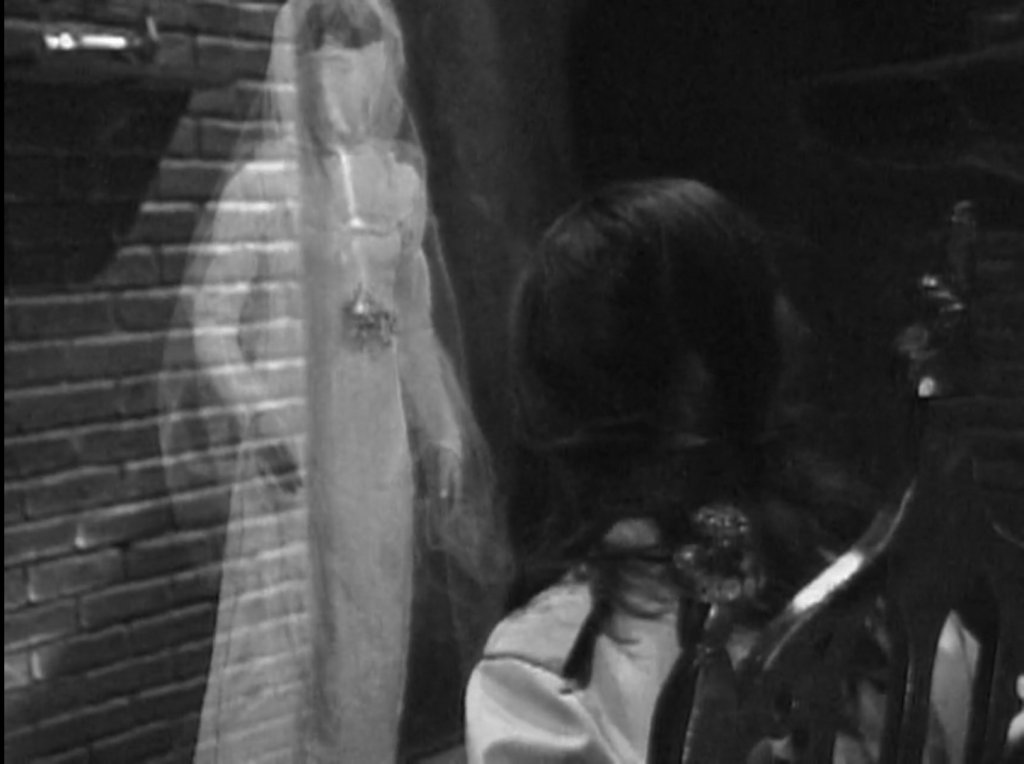
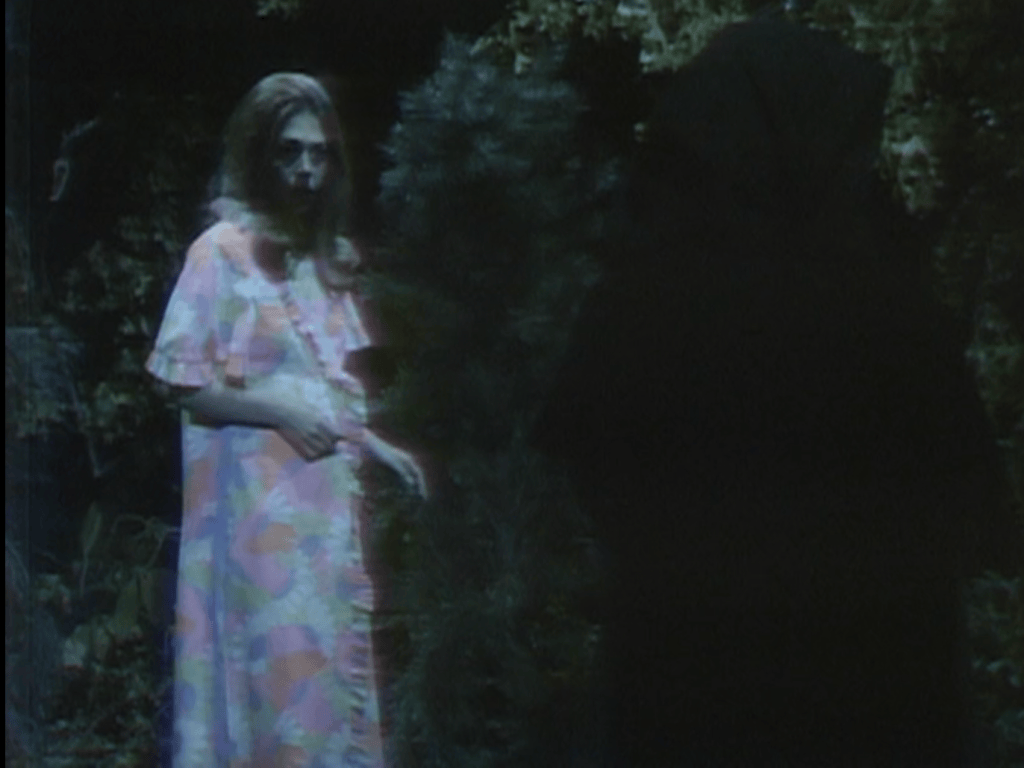
Back at the great house, Liz gets a telephone call from the sheriff. The police haven’t found Jabe’s body, and have surmised that it washed out to sea. They have found Sky, and have tentatively ruled his death a suicide. Later, Carolyn has another dream. In this one, Jabe shows up and confirms his death. That marks the end of the Leviathan segment. Carolyn will go on using the name “Mrs Hawkes” and saying she misses Jabe, but otherwise the last nineteen weeks will be forgotten.

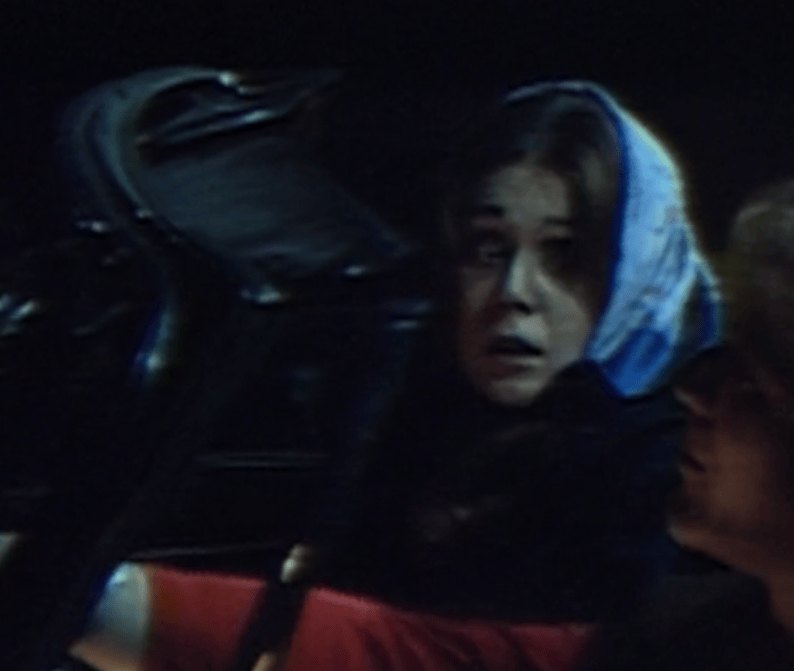
Carolyn sees Jabe for the last time. Screenshot by Dark Shadows Before I Die.

Before killing Sky, Barnabas had mentioned that he almost regrets not leaving him to the other person who is on her way to do him in. That is Sky’s estranged wife, wicked witch Angelique. Had the Leviathan segment been more successful, or had Geoffrey Scott been even marginally competent in his performance as Sky, they might have made something of the parallels between Sky and Jabe. They are both very tall men with blonde wives who are dissatisfied with them. Angelique is dissatisfied that Sky is a tool of the Leviathans and that he tried to set fire to her on the orders of their representative, and Carolyn is dissatisfied with Jabe because he keeps running away from dangers he has brought on himself by his rebellion against the Leviathans and he won’t tell her anything about himself. Sky is a mortal man, while Angelique may once have been human but has long since become a creature of the supernatural. Carolyn is a mortal woman, while Jabe is now human but was originally a shape-shifting monster from beyond space and time.

But the ratings have been sinking throughout the Leviathan period, and the whole narrative structure of the arc keeps collapsing around them every time they try to do anything with it. So they are in too much of a hurry to move on to the next thing to do any exploring of the characters. Also, Scott is hopeless. As my wife, Mrs Acilius, put it, it isn’t that he is an actor with just one strategy. He keeps trying different things, and none of them comes close to working. We won’t see him again.

The new story has to do with an alternate universe that is occasionally visible in a room in the long disused east wing of Collinwood. Barnabas, Julia, and others have been spying on its inhabitants, and Barnabas is fixated on the idea that if he can cross over into it his vampirism will disappear. Since his bloodlust is overwhelming him, he is desperate to pursue this forlorn hope. He goes to the room when the alternate universe cannot be seen there, and a moment later finds that it has changed with him in it. Julia is in the hallway, looking in. At first she and Barnabas can see each other, and she can hear him, though he cannot hear her. After a moment, Carolyn’s alternate universe counterpart enters and demands to know who Barnabas is and what he is doing in the house.

Barnabas took Carolyn as his blood-thrall in October 1967. The show went back in time to 1795 the following month. In the 1790s segment, Nancy Barrett played fluttery heiress Millicent Collins. We saw that Barnabas first became a vampire in 1796; not long after, he took Millicent as his blood thrall. Shortly after the show returned to contemporary dress in March 1968, one of Julia’s colleagues in the mad science profession applied a treatment that put Barnabas’ vampirism into remission. That freed Carolyn of her connection to him, and at some point she forgot it ever happened.

For most of 1969, Dark Shadows was set in 1897. In that segment, Miss Barrett played repressed schoolmarm Charity Trask. Barnabas bit her, too. Carolyn’s counterpart in “Parallel Time,” known by her married name Carolyn Loomis, is the fourth character* Miss Barrett played on Dark Shadows; considering that Barnabas is so frantically hungry, it looks like she will follow in the footsteps of her predecessors and serve as his breakfast.

*Or fifth- in #819, sorcerer Count Petofi found Charity’s personality to be an irritant, so he erased it and replaced it with that of the late Pansy Faye, a Cockney showgirl/ mentalist. From that time on, Miss Barrett played Pansy, not Charity.

Episode 979: Nicholas Blair

The Failure Demon

Suave warlock Nicholas Blair first joined the cast of characters in June 1968, posing as the brother of Cassandra, wife of Roger Collins. Since Cassandra was an alias that 200 year old wicked witch Angelique was using, we knew right away this could not be so. Nicholas asserted himself as Angelique’s boss, faced down the ghost of the fanatical Reverend Trask, and kept saying that he had a plan that was far more important than Angelique’s petty little scheme to establish herself in the great house of Collinwood and turn Roger’s distant cousin Barnabas Collins back into a vampire. As played by Humbert Allen Astredo, Nicholas kept us believing for weeks that we would be in awe once we heard his plan.

Eventually, Nicholas stumbled upon the fact that Barnabas’ best friend, mad scientist Julia Hoffman, had constructed a Frankenstein’s monster in the course of a project to keep his vampirism in remission. From that point on, Nicholas declared that his plan was to force Julia to make a female Frankenstein’s monster, to mate the already existing monster to her, and thereby to breed a new race of people loyal only to his master, Satan. He’d been on the show so long at that point that his sudden parachuting into the Frankenstein story only revealed that up to that point, all his talk about his grand design had been empty boasting.

Moreover, Nicholas’ plan for the patchwork people did not make sense in the context of the show. In a novel or movie like Rosemary’s Baby, the audience sees the heroine raped with the acquiescence of her husband, and our horror at that crime gives force to the premise that she will bear Satan’s only begotten son, who, in an inversion of the Christian story, will transform the whole world by the very fact of his birth. Stealing fresh corpses, chopping them up, and stitching them together isn’t the same horror as rape, but it is a pretty disgusting way to spend an evening, so I suppose that will get you off to some kind of start. But if your show is on the air for half an hour a day across the board Monday through Friday, your audience has time to sit with Nicholas’ scheme and think through all of the practicalities it implies. The new race is going to take many years to grow and multiply and overtake H. Sap., even if its members all have Soap Opera Rapid Aging Syndrome. What are we all supposed to do in the interim, watch the Frankenbabies through nanny cams? It isn’t an idea for series television.

Nicholas not only saddled himself with a plan that obviously wasn’t going to work, he didn’t deliver on his claim to be a surpassingly talented sorcerer. In #528, Angelique asked him to slip a potion to one of her adversaries. He complained that “I am much too talented to spend my time drugging drinks,” but he complied with the request. Not only did that turn out to be a waste of time, later he would on his own initiative drug a couple of other people’s drinks, again without the results he wanted.

Eventually, Nicholas fell in love with Maggie Evans, The Nicest Girl in Town. That amused Angelique, who taunted him with all the times when he had sneered at her for the humanity she showed in her emotional attachment to Barnabas. As Nicholas grew fonder of Maggie, his powers became less reliable, and his involvement with the main plot became more tenuous. No longer able to make Angelique obey him, Nicholas was reduced to using unsightly ex-convict Harry Johnson as his henchman. By the time the Frankenstein project collapsed and Satan called Nicholas back to Hell, not even Astredo’s considerable acting talent could make us take him seriously.

Nicholas returned in February 1970, just over five weeks ago. At that point the show was mainly concerned with an attempt the writers were making to take some material from the tales of H. P. Lovecraft and make a story out of them. The Leviathan People are Elder Gods who want to reconquer the Earth and destroy humankind. Their harbinger was a shape-shifting monster who had taken the form of a tall young man and invited people to call him Jabe. Jabe was supposed to join with Roger’s niece Carolyn to produce a new race of people.

The Lovecraft material never came together, and by the middle of February the makers of the show were scrambling to find a new direction. Nicholas appears to have been a last-minute replacement for a different sort of villain who was supposed to take over as the chief menace in the second half of the segment. Now they have thrown out that second half and are trying to get to something else before the ratings drop any further. So they brought back an already established character and plugged him into the scenes originally meant to be played by the one they never got around to introducing.

Bringing Nicholas in to the Leviathan arc makes it hard for longtime viewers to ignore the similarities between the Leviathans’ plan to breed a new race and his 1968 plan for the patchwork people, including the shared weakness that if either plan were successful, it wouldn’t leave you anything to put on a daytime soap. Also, Nicholas explicitly acknowledges that he has already failed in one such project, lampshading the problem but not alleviating it. He also keeps bringing up his “Master,” who is clearly still Satan. No other character in the Leviathan arc makes reference to any themes derived from Christianity- everyone else is living in the determinedly non-Christian world of Lovecraft’s imagination. So he seems out of place from the beginning.

The Leviathans’ plan was already nearing collapse when Nicholas showed up. Every time Jabe has used his powers, the results have backfired on him. His personality has alienated all of his allies. And now he doesn’t even want to be a shape-shifting monster anymore- he fell in love with Carolyn, and just wanted to take her on dates and then marry her. Nicholas is supposed to be the trouble-shooter who will turn this troubled operation around, but nothing about him inspires confidence that he is the right person for that job.

Since Nicholas arrived, things have gone downhill for the Leviathan cause even faster than they had been before. In #966, Nicholas watched in horror as Jabe smashed the box from which he originally emanated, causing all of the Leviathans’ other visible belongings to vanish. Nicholas then declared that everything was over, and that the time of the Leviathans was no more. But they still didn’t have another story ready to go, so he and Jabe have continued to hang around. Nicholas still has one follower, Angelique’s estranged husband Sky Rumson, but since there is no reason for Sky to be on the show either, that isn’t much of a basis for Nicholas’ continued presence. On his great blog Dark Shadows Every Day, Danny Horn called Nicholas a “failure demon”; all in all, that would seem an apt classification.

Today, Jabe turns up at Nicholas’ place. Nicholas knows that Angelique cursed Jabe to be plagued by a mysterious shadow not his own that follows him and drives him mad. This much is borrowed from George MacDonald’s 1858 novel Phantastes, but unlike the Reverend MacDonald’s allegory of sin and anxiety this shadow is a physical weapon that will kill Jabe when it grows strong enough. Jabe asked Nicholas to use his powers to lift Angelique’s spell the other day, but Nicholas refused, even though he claimed that he could and he acknowledged that it would have been to his advantage to do so. The opening voiceover today reminds us that Nicholas knows all about the shadow.

Now, Jabe is telling Nicholas that he was wrong to turn against him, wrong to smash the box, wrong to give up his destiny of leading the Leviathans to global dominion. Nicholas dwells on his exhaustive knowledge of the shadow and tells Jabe he can take the shadow from him and set it on Angelique. He begins to hypnotize Jabe. When he seems to have Jabe in a trance, he tells him he does not give second chances, and that he is going to kill him and Carolyn. Jabe suddenly produces the paper cutout Angelique used to place the shadow curse on him and places it on Nicholas’ jacket. He then runs out of the room. The shadow appears and envelopes Nicholas, who collapses. Even though he knew in advance exactly what was going on, Nicholas still could not avoid death as the result of getting slapped on the chest with a piece of construction paper. He dies as he lived, a failure demon to the end.

Sky enters. Jabe returns, and Sky tells him Nicholas is dead. Sky whines that because Nicholas was not human, his death will not be the end of him and Jabe will not get away with killing him. Geoffrey Scott’s appallingly bad acting reinforces the image of Nicholas as a colossal loser- if this was the only ally he had left at the end, he must have been an even more hopeless stumblebum than we had thought. Jabe exits. A moment later, Nicholas’ ghost appears to Sky and tells him to kill Jabe.

Nicholas gives Sky his orders. Screenshot by Dark Shadows Before I Die.

Jabe goes back to the great house of Collinwood to tell Carolyn that he is rid of the shadow. They are married now, but have spent very little time together because the shadow has kept chasing Jabe off. She is puzzled by the whole thing, in part because Jabe refuses to tell her anything about his situation, and is unenthusiastic about Jabe’s renewed insistence that they go away immediately. She agrees to leave with him in the morning.

Carolyn goes upstairs. In the drawing room, Jabe hears Nicholas’ voice telling him that he will never escape. Roger’s son, strange and troubled boy David Collins, enters; Jabe tells him that he and Carolyn are going on a trip tonight.

Jabe sent Carolyn upstairs with orders to pack and tell her mother they were leaving, but it would seem she has not complied. She is snoozing in a chair in her room. She has a dream. It begins with Nicholas’ voice rasping at her that it will all end at Widows’ Hill. She then sees Jabe and Sky, lit in groovy psychedelic colors, arguing about Nicholas and fighting near the precipice. Sky throws Jabe over the edge.

Groovy, man. Screenshot by Dark Shadows Before I Die.

Carolyn awakens, calls for Jabe, and rushes out. On her way she tells David that she is going to Widows’ Hill. A moment later Jabe comes along, and David relays this information to him.

Carolyn gets to the top of Widows’ Hill, where Sky is waiting for her. He tells her that the dream Nicholas sent her stopped short of its end, because he did not want her to see her own death. He grabs her by the throat.

Meanwhile, in another universe…

While Jabe, Nicholas, and Carolyn are cleaning up the messes the Leviathan segment left behind, Roger is busy getting the new storyline off the ground. There is a room in the long disused east wing of the great house in which an alternate universe is occasionally visible. Roger goes there, and sees the counterparts of Carolyn and David. They are talking about the boy’s parents, whom Roger ascertains to be, not himself and undead blonde fire witch Laura Murdoch, but the counterparts of his distant cousin Quentin Collins and of Angelique. Everyone else we have seen in “Parallel Time” has the same first name as their counterpart in the main continuity, but David’s is named “Daniel.”

Roger never found out who Cassandra really was, so it is a puzzle for longtime viewers how he knows Angelique’s name. Carolyn and her mother met her under that name at the house she and Sky shared, but somehow did not recognize her as Cassandra. She visited them at Collinwood after her marriage to Sky broke up, but did not see Roger there.

Arrivals and Departures

This is the first time we see this Daniel Collins, but not the first time we are exposed to his name. The closing credits for #958 billed David Henesy not as David Collins, the role he played that day, but as Daniel Collins. I don’t know whether they had already decided that would be his name in Parallel Time and the person making up the credit roll got confused about it, or if the writers thought the goof was funny and gave the character the name as an inside joke.

Also, Mr Henesy played a character named Daniel Collins in February and March 1968, when the show was set in the year 1796. Since they have established that the two universes diverged during that Daniel’s lifetime, he may be this Daniel’s namesake. There is another connection, an accidental one I’m sure but an accident with a bit of an eldritch quality to it. In #350, three weeks before the 1790s segment began and more than sixteen weeks before Daniel made his first appearance, a slip of Nancy Barrett’s tongue left Carolyn referring to David as “Daniel.” It’s odd that the two Daniels were both heralded by these small inadvertences.

This episode marks, not only the final appearance of Nicholas, but also that of Roger. Louis Edmonds will play Roger’s counterpart in the Parallel Time segment, and as these episodes are being taped he is playing still another iteration of Roger on the feature film House of Dark Shadows. He will also be back in another role later on. But all the character development Roger has gone through since we first saw him in episode 1 is at an end.

Monday’s episode gave Roger his real sendoff, and my post about it summed up his history. I will just mention here that when I first saw Dark Shadows, Roger was something of a puzzle to me. That was the 1990s, when I saw it on what was then The SciFi Channel. The first episode I saw was #193, featuring art dealer Portia Fitzsimmons, but I didn’t have a chance to watch it at all regularly until a month or so after that, when Barnabas had already joined the cast. By that point Roger was already very much confined to the margins.

Curious as to when the dazzling Mrs Fitzsimmons would return, I looked online and found what is now the Dark Shadows wiki. I was disappointed to find that she was a one-off character. I also found that her function was to bring to a head a major story centering on Roger. I then looked through the episode summaries of the first weeks of the show. Those were quite terse and indigestible, meant to remind people who had seen the episodes of points they had forgotten. But one thing I did gather from them was that Roger had been a major character when the show started, indeed its chief villain. I couldn’t imagine the sardonic but lovable Roger of 1967 and 1968 in that capacity, and when I finally saw those episodes many years later I was thrilled by Edmonds’ performance.

One of the strongest themes of Roger’s character in his early days as a villain was his open hatred of David. It is nice for longtime viewers that he makes his final exit with an affectionate fatherly hand on David’s shoulder.