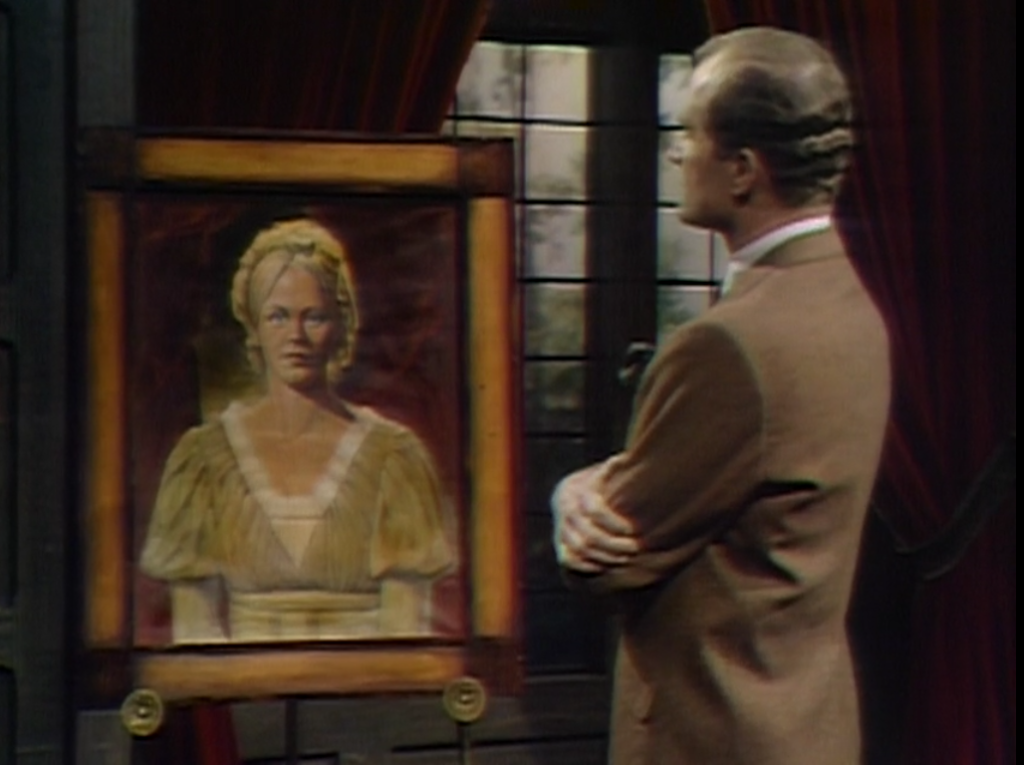
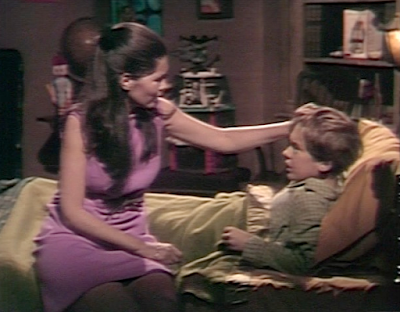
Episode 1012: Does he look to you like a man under a curse?

Vampire Barnabas Collins has escaped from the continuity in which Dark Shadows took place until late March 1970 and found himself in an alternate universe, which the show insists on calling “Parallel Time.” This universe is largely populated by people who remind Barnabas of their counterparts in his own world, but their personalities and relationships are very different from those he knew. His own counterpart is a case in point. That other Barnabas Collins never became a vampire, but lived a quiet life and died a natural death in 1830.

Barnabas’ first few weeks in Parallel Time were spent trapped in a coffin. Alcoholic novelist Will Loomis found out about Barnabas after he saw fang marks on the neck of his wife, the former Carolyn Collins Stoddard, and decided he could force Barnabas to give him a complete history of his career as a vampire. Will was under the impression this would make a good book. Will’s irresponsibility in keeping a vampire as a pet, his cruelty in exploiting a fellow creature for his own gain, and his lack of literary judgment in imagining that a recounting of the plot of weeks 43 through 196 of Dark Shadows would be both a bestseller and a critical favorite come back to bite him. More precisely, Barnabas comes to bite him when Will lets him out of his coffin and turns his back on him for a moment during their interview, taking the cross out of his sight and freeing Barnabas to attack.

Barnabas forces Will to burn all the pages he has already written. The idea of a book detailing Barnabas’ crimes featured in #326, #510, and #756, and may have planted the seed for the whole conception of Will Loomis.

Will and Carolyn live in the Old House on the grounds of the estate of Collinwood, which in the original continuity belongs to Barnabas. The pages are still in the fireplace when drunken sourpuss Quentin Collins, master of the great house of Collinwood and proprietor of the family businesses, bangs on the door and demands admittance.

Quentin interrogates Will. The name “Barnabas Collins” has been cropping up in the oddest connections lately, and Quentin is convinced Will knows why. Their exchange is getting quite warm when Barnabas enters and introduces himself.

Quentin is bewildered to see Barnabas. Through a time warp that occasionally manifests in the east wing of his house, he has caught a few glimpses of the original continuity, mostly in the form of people standing around talking about how Barnabas is missing and is under a terrible curse. So he is inclined to be leery of this fellow claiming to be a descendant of the Barnabas who died in 1830. Barnabas specifies that his great-grandfather was the son of that Barnabas, the son who went to Peru in the nineteenth century. Quentin had read that that son of Barnabas died while still in Peru. Barnabas says that he did not die in that country. He does not specify where his ancestor went after leaving Peru, but says he spent the rest of his life in poverty. He was so ashamed of this circumstance that neither he nor any member of his family could bear to reconnect with the rich Collinses in Maine. Barnabas claims that he has now made a fortune of his own, leading him to conclude that the time is right for a reunion. Barnabas invites himself to the great house in an hour. Quentin says that the morning would be better, to which Barnabas replies that he will not be free then. Quentin acquiesces.

Quentin exits, and Barnabas orders Will to accompany him to the grave of his counterpart. Longtime viewers will remember #660, when Barnabas managed to travel back in time by going to a grave and yelling at its occupant. Now he hopes to travel sideways in time, returning to his own universe, by the same technique.

Barnabas and Will enter a graveyard we have seen several times in the last seven weeks. It differs from the cemeteries we have seen in the original continuity in that none of the grave markers is in the form of a cross. Most of the graves in the cemetery from which Barnabas emerged were marked with crosses, and he strolled by them with perfect equanimity. The cemetery set was built for Barnabas, so evidently it was not the original plan that the cross would be formidable to him. It wasn’t until #450, 48 weeks after Barnabas debuted, that he was first held at bay with a cross. Even after that, he still strolled placidly through the field of crosses in Eagle Hill Cemetery. Now the apotropaic power of the cross is a major point, and they have designed the cemetery in this universe to accommodate Barnabas’ special needs.

Barnabas calls on his counterpart. He conjures up a spirit, but it is not that of Barnabas Collins (d. 1830.) It is Joshua Collins, father of that Barnabas. The sight prompts Barnabas to gasp “Father!” Joshua denies that Barnabas is any kin to him. Barnabas tries to explain that, while that is true, he is nonetheless Barnabas Collins, son of Joshua, eliciting an angry command “Do not profane those names!” Joshua tells Barnabas to take his vileness back where it came from. Before Barnabas can explain that is what he is trying to do, Joshua vanishes.
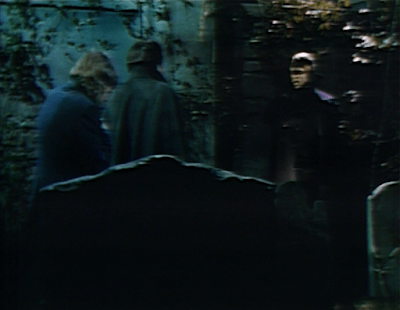
Joshua orders Barnabas to go back where he came from. Screenshot by Dark Shadows Before I Die.

Joshua appeared to Quentin and Angelique in #1009. That turn was not particularly effective. The visual composition made it too clear that Louis Edmonds was standing in the same space as David Selby and Lara Parker for the actors to create any sense of the uncanny. And Joshua hung around too long and had too many lines for it to make sense that he couldn’t give any useful information. But this time Joshua is off to the side, lit by his own light, and he disappears after just a few seconds. It is a powerful scene, especially for longtime viewers who remember the relationship between Barnabas and Joshua we saw when the show was set in the 1790s from November 1967 to March 1968.

Will is terrified. The apparition leaves him trembling and speechless. So far Will has cut an arrogant, self-assured figure. He handled his encounter with the vampire with aplomb. Even after Barnabas bit him, his resistance to the command to burn the pages showed that self-assured personality is still partly functional. But the ghost of Joshua has blasted away the last of it.

Barnabas tells Will that he now has only one way back to his own universe, the way he came. There is a room in the east wing of the great house that is bare and vacant in Barnabas’ universe, but that is fully furnished, richly decorated, and brightly lit here. When Quentin’s wife Angelique Stokes Collins was alive, it was her bedroom. Now Quentin has given it to Angelique’s identical twin sister Alexis to occupy while she is his guest. The barrier between the universes is at its thinnest there. Barnabas could occasionally see into Angelique and Alexis’ room from the main continuity, and it was when he was looking through the doors to the room that Quentin has seen that other Collinwood. Barnabas was in the room when it changed, and found himself here. Now he wants to go back to the room, and make the opposite journey.

What neither Barnabas nor Quentin knows is that Angelique has returned from the dead and murdered Alexis. Angelique is now impersonating Alexis. In her life, Angelique had built a little cult of people who expected her to transcend death. The only one she has so far told that she has actually done so is her aunt, Hannah Stokes. Everyone else believes she is Alexis.

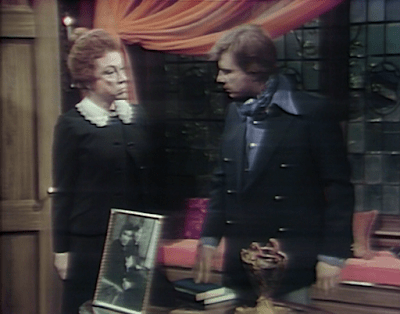
Barnabas enters the drawing room of the great house, where Quentin introduces him to “Alexis” and to housekeeper Julia Hoffman, the most devoted member of Angelique’s cult. Hoffman and “Alexis” had been talking about Barnabas before he arrived. Hoffman expressed certainty that Barnabas is a fraud. But after he and Quentin leave to examine the room where the Parallel Time phenomenon can sometimes be seen, she admits that his resemblance to the portrait of Barnabas is too strong to disregard. “Alexis” remembers what Quentin heard while he was watching the people in the room, and asks Hoffman if Barnabas looks like a man under a curse. She does not appear to have expected this question.

Quentin takes Barnabas to the room. Sure enough, the other continuity is visible. Barnabas’ best friend is there, talking to herself about how much she hopes to see him again. She is mad scientist Julia Hoffman, MD, counterpart of Hoffman. Julia is as devoted to Barnabas as Hoffman is to Angelique. Seeing her, we wonder how long Angelique can keep it a secret from her Julia Hoffman that she has returned.
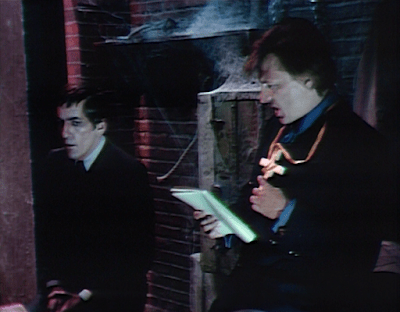
Episode 1011: In death he dictates

Mad scientist Cyrus Longworth has developed a potion that changes his appearance so drastically that even those closest to him cannot recognize him when he is under its influence. In this disguise, he calls himself “John Yaeger” and indulges his sadistic impulses. He has just committed his first murder, killing a man who had learned his secret. The potion he needs to restore his usual looks is in his lab, but he can’t get there without passing the police. So he has ordered Buffie Harrington, a young woman he has been terrorizing, to fetch it for him. He was waiting for Buffie in a cave on the beach near the estate of Collinwood when he saw the signs of a secret passage, and decided to see where it would lead him.

It has led him to the basement of the Old House on the estate, home of writer Will Loomis and his wife, the former Carolyn Collins Stoddard. We have known that this passage was here since #1003, when strange and troubled teen Daniel Collins suggested that his young cousin, Amy Collins, join him in opening it and exploring the basement. Amy refused to go there at night, prompting Daniel to taunt her as a scared-y-cat. We also know, if only because the opening voiceover has been telling us every day for the last five and a half weeks, that vampire Barnabas Collins is chained in a coffin in the basement. Will is holding him captive and forcing him to dictate his autobiography to him.

Barnabas is a visitor from a parallel universe. Longtime viewers are familiar with that universe; Dark Shadows was set there for its first 196 weeks. There is a tunnel between the beach and the basement there as well, and each time it has figured there has been a major development in the story. So when Cyrus, disguised as Yaeger, follows the tunnel and discovers Barnabas’ coffin, we can believe something big is about to happen. He starts to unchain the coffin; if he frees the vampire, that would certainly qualify.

Will and Carolyn are upstairs. She hears the sounds Cyrus is making in the basement and tells Will to go down and check. He takes this as an invitation to another of their drunken quarrels, in which he taunts her for being Barnabas’ victim. Eventually he does go downstairs, where he pistol-whips Cyrus into unconsciousness. He and Carolyn rather improbably manage to carry Cyrus up to the parlor.

When Cyrus comes to, he finds Carolyn aiming the pistol at him. He calls her by name. She does not recognize him, and asks how he knows her. He tells her that he makes it his business to know who all the attractive women are. He asks why Will isn’t there. She doesn’t answer the question. He sees that she is trembling so violently that she can barely keep hold of the pistol; he knocks it out of her hands and runs away. Later, he will meet Buffie in the cave, get the potion from her, and shed his disguise in time to get away with his crimes.

Will rejoins Carolyn in the parlor. He scolds her for letting the intruder escape; she says he was wrong to leave her alone with him. He says he was busy sealing up the panel so that no one else could come into the basement through the tunnel. He says that Barnabas’ coffin must be moved. His idea is to carry it up the stairs and hide it in a secret chamber behind the bookcase in the parlor.

This chamber, too, has its counterpart in the original continuity. We first saw it in December 1966, when crazed handyman Matthew Morgan abducted well-meaning governess Victoria Winters and planned to kill her there. After Barnabas joined the cast of characters in April 1967 and became the master of the Old House, he several times used the chamber as a hiding place. Matthew’s plans for Vicki backfired on him when the ghosts of Collinwood and scared him to death before he could carry out his fell design. None of the occasions when Barnabas used the chamber worked out very well for him. So longtime viewers may suspect that, even if Will and Carolyn can somehow transport Barnabas and his coffin up the stairs and into the hidden chamber, things will not go as they project.

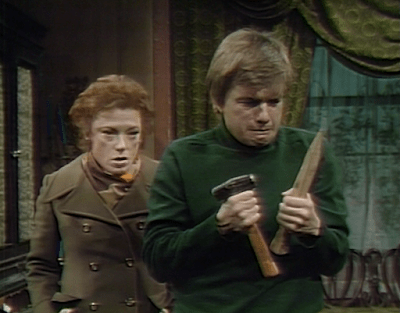
Will and Carolyn let Barnabas out of his coffin. They wear large crosses around their necks, and hold them towards him when he looks at them. They get him up the stairs and into the secret chamber this way.

Once there, Will resumes interrogating Barnabas. Barnabas protests that Will has “enough story” and ought to set him free; Will disagrees. One wonders if Barnabas’ line represents Sam Hall’s feelings as one half of the two-man staff currently charged with writing five scripts a week for Dark Shadows.

Story conference. Screenshot by Dark Shadows Before I Die.

Will’s counterpart in the original continuity is Willie Loomis, who was Barnabas’ sorely bedraggled blood thrall. In #326, Barnabas had framed Willie for some of his own crimes, and the police had obligingly shot him several times. Barnabas was worried that Willie was not dying quickly enough. He railed to his associate, mad scientist Julia Hoffman, that Willie continued to “cling to life with leech-like persistence!” When Julia assured him that Willie would probably die without regaining consciousness, Barnabas said that he might just as easily make a full recovery and set about “writing his memoirs!”

The show picked up on that line after it went back in time to the 1790s. We learned in #510 that Ben Stokes, the much-put-upon indentured servant who was Barnabas’ friend before and after he first became a vampire, did indeed write a memoir, and in #756 we learned that Ben’s memoir included the story of Barnabas’ curse. I wonder if Barnabas’ line to Julia about Willie writing his memoirs was the seed, not only of Ben’s memoirs, but of the whole story of Will Loomis.

Barnabas’ cartoonish villainy in #326 was hilarious, but his objections to Will’s behavior today are quite reasonable. Will would have been doing his civic duty had he staked Barnabas, and indeed Barnabas asked Will to let him die when he first found him in his coffin. Keeping him trapped in the coffin endangers the community irresponsibly, and when Will opens it night after night with Barnabas immobilized by the cross and forces him to produce an oral history he can use use as a source of material he is choosing to be as much of a parasite on Barnabas as Barnabas’ curse has forced him to be on his victims.

Moreover, when Will tells Carolyn today that the book he extracts from Barnabas will be “all true” and that “every critic” will hail it as “a classic,” he seems to be delusional. If it is “all true,” the book will be a novelization of the last 160 weeks of Dark Shadows. The show is fun to watch, but that’s largely because the writers know what kind of material the actors and directors can use to create exciting moments. I can’t imagine anyone looking at it as so much text sitting on the page and calling it “a classic.”

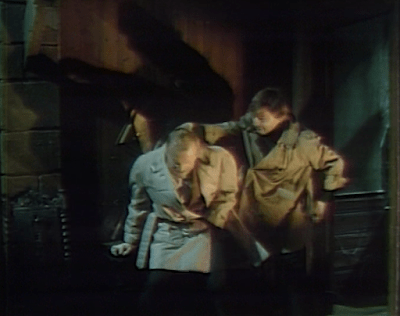
Will turns his back on Barnabas and takes a note. Seeing an opportunity, Barnabas grabs the cord by which the cross hangs from Will’s neck, choking him. Will falls to the floor, and Barnabas bares his fangs.

I haven’t read Anne Rice’s 1976 novel Interview with the Vampire. Ms Rice says she wrote a short story about a reporter taking an oral history from a vampire no later than 1969, the year before this storyline premiered. That story has never been published, but biographers of hers report having seen it and they accept the dating. She also says that she decided to turn it into a novel in 1973, not because she had seen Dark Shadows, but because her daughter had died and she thought it would be a way of exploring her grief. So, any similarities are mere coincidence. I bring it up here, because it represents the definitive refutation of Will’s expectation that “every critic” would hail his retelling of Dark Shadows from the time Barnabas debuted as “a classic.” Ms Rice was free to craft a story that would be right for a novel, unconstrained to copy material produced to keep a soap opera spinning, and most of the reviews she received were quite hostile.

Episode 971: A twist of time

Out With the Old

Vampire Barnabas Collins inadvertently killed his victim Megan Todd the other night, turning her into a creature like himself. Now his chief enabler, mad scientist Julia Hoffman, is browbeating his ex-blood thrall Willie Loomis into destroying Megan. Willie is horrified by the prospect of driving a stake through a woman’s heart, and Julia gives him a pep talk. She says that staking Megan is the only way to free her of the curse and to free her blood thrall, Barnabas’ distant cousin Roger Collins, from bondage. But it is necessary to finish Megan off “most of all, for Barnabas.”

“Most of all, for Barnabas.” Screenshot by Dark Shadows Before I Die.

The premise of Willie’s character at this point in Dark Shadows is that he regards Barnabas as a dear friend and valued patron. When Willie first knew Barnabas, from April to September 1967, Barnabas drank his blood, beat him savagely when he defied his fiendish commands, and framed him for his crimes. Barnabas had Julia fetch Willie back from the mental hospital she controls in May 1968, so he could use him to steal bodies to use in making a Frankenstein’s monster. Barnabas’ vampirism was in remission at that time, so he did not have any supernatural control over Willie. Willie’s attitude towards Barnabas then was rather insouciant, so he and Julia kept threatening to send him back to the ward for the criminally insane unless he obeyed them. Barnabas only seemed happy during this time once. That came in #560, when he saw the agony Willie went through when he persuaded him that it would be his fault if the monster murdered Maggie Evans, The Nicest Girl in Town. I suppose people do rewrite their own pasts to make them bearable, so it is understandable that Willie has chosen to believe that his abuser was really his best buddy. Still, it does seem a bit much for Julia to tell Willie that he should destroy Megan “most of all, for Barnabas.”

Julia accompanies Willie to Megan’s hiding place in the long-disused east wing of the great house of Collinwood. Willie breaks down outside the room where Roger is guarding her coffin, and Julia has to give him another motivational speech. She tells him he “mustn’t think of Megan as a person,” but as “a creature, an evil thing,” and besides that “You must help her to rest” and that staking is “the best thing for her.” While Willie struggles to hold back his tears, she warns him against waking Roger. By the time they enter the room, Roger is awake. He fights Willie and Julia to protect Megan, and Willie defeats him only by breaking a bottle over the back of his head.

Bonkus of the konkus. Screenshot by Dark Shadows Before I Die.

Julia and Willie take Roger out of the room. Julia tends to Roger while we hear Megan’s screams. Once the staking is complete, Roger comes to, with no recollection of how he got to the east wing or what Megan did to him. This recovery tells us Megan is destroyed.

Later, Barnabas will tell Willie to bury Megan and all her belongings in a hole in the ground somewhere out in the woods. This shows longtime viewers that Barnabas has improved his post-murder game considerably. The first time he forced Willie into helping him cover up a killing came in #276. Barnabas had strangled Willie’s sometime friend, seagoing con man Jason McGuire. He had Willie help him bury Jason in the secret room in the old Collins family mausoleum, which would eventually cease to be much of a secret and which several people could connect with Barnabas. He also neglected to do anything about Jason’s belongings. Everyone thought Jason was leaving town and was glad to see him go, so there was no investigation. But in #277, Roger mentioned to his sister, matriarch Elizabeth Collins Stoddard, that all of Jason’s stuff was still in the room he had been occupying at Collinwood. He told Liz that even Jason’s razor was still there. It was strictly a matter of luck that no one asked any questions about Jason- had they done so, Barnabas would have been in trouble almost immediately.

This episode marks, not only the end of Megan’s career as a vampire, but Marie Wallace’s final appearance on Dark Shadows. Miss Wallace was one of the most exuberant practitioners of the Dark Shadows house style of acting, a hyper-vehement manner of performance previously unknown in the history of the dramatic arts. It can take a bit of getting used to. But once Megan became a vampire, she suddenly became quiet and subtle, almost understated. Miss Wallace explains that by saying that the dentures they gave her to wear as fangs didn’t stay in her mouth very well, so she had to go small to keep them from flying across the room. As a result, her last few episodes are a revelation. The first time we watched the show I was impatient with Miss Wallace’s ultra-intense technique; I can appreciate it now, but her miniaturizing approach to Vampire Megan is so very effective that I wish we could have seen a couple hundred more episodes of her doing that kind of thing.

Miss Wallace tells the story of the day they shot this episode. She got a telephone call from her agent that they wanted her for a part on a soap called Somerset. She was thrilled, since there was no new part planned for her after Megan’s demise. From the few surviving bits of video showing her on Somerset, it doesn’t look like she decided to become a miniaturist.

In With the New

Megan is left over from an exhausted story. The new one is starting in another room in the east wing. The Collinses cram all of the deserted rooms in their buildings full of stuff- vases, paintings, books, furniture of all sorts. This room outdoes all the rest, and contains a whole parallel universe.

Barnabas has been peeping in on the doings in the parallel universe room for couple of days, but there is an invisible barrier which prevents him entering it or communicating with the people he sees and hears there. At the opening today, he sees Julia’s counterpart and Liz’ continuing a quarrel they had been having when he observed them before; at the close, he sees Willie’s counterpart and Julia’s having a similar quarrel.

Parallel Julia wears a maid’s uniform, but is full of commands for Parallel Liz and Parallel Willie. Parallel Liz’ response to her commands shows that she is not the mistress of the house, and cannot control Parallel Julia. Parallel Willie wears an ascot and a smoking jacket, and regards Parallel Julia with amused contempt.

Screenshot by Dark Shadows Before I Die.

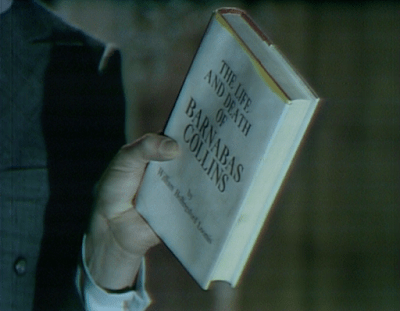
Parallel Willie finds a book in the room that he wanted; Parallel Julia takes it from him, and tosses it into the hallway. The book passes through the barrier, and lands at Barnabas’ feet. The doors to the room close. Barnabas opens them again, and finds that the room is empty, devoid of the people, furnishings, and lights that had been visible there a moment before. Carrying the book, he goes in.

The title and author of the book stun him. It is titled The Life and Death of Barnabas Collins; its author is William Hollingshead Loomis.

Screenshot by Dark Shadows Before I Die.

In #326, Willie had been shot by the police, who blamed him for some of Barnabas’ crimes. Barnabas grew anxious as the hours passed and Willie failed to die. He complained to Julia of Willie’s “leech-like persistence” in remaining alive. Julia tried to reassure Barnabas that Willie was unlikely to survive much longer, and in response he raged that Willie might just as easily recover from his wounds and “write his memoirs!”

That line found an echo in #464, when we learned that Barnabas’ eighteenth century servant Ben Stokes had indeed written a memoir, though the extant manuscript was missing some parts about Barnabas. In #756, undead blonde fire witch Laura Murdoch Collins heard that Ben had secrets about Barnabas which he “took to his grave,” so she dug the grave up and, by golly, there were the missing passages explaining that Barnabas was a vampire. Now the same line is going to give rise to another William Loomis, one who has written a book about his world’s counterpart of Barnabas.

Episode 756: A bizarre activity for a beautiful woman

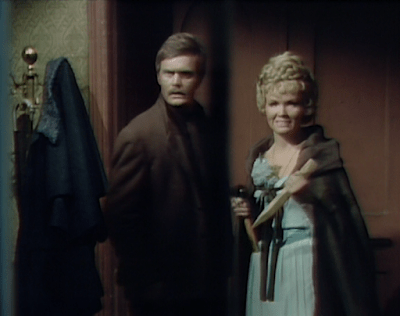
Undead blonde fire witch Laura Murdoch Collins realizes that Barnabas Collins is a vampire, and that when he was alive he was the “strange, dreamy boy with sad eyes” she was fond of in the 1760s, when she was married to his uncle. Laura and Barnabas confront each other in a graveyard at the beginning of the episode; she tells him he is not human. He passes up the opportunity to reply “So few people are, these days.” At the end of the episode, Laura and her witless henchman Dirk let themselves into Barnabas’ house after dawn. She has a mallet and stake, he has a pistol to ensure no one interferes.

It means something to longtime viewers that we end today with Laura poised to destroy Barnabas. It was Laura who cleared the way for Barnabas’ first introduction. She was the show’s first supernatural menace when she was on from December 1966 to March 1967, and her story was structured very much like Bram Stoker’s Dracula. That was successful enough that the following month they introduced Barnabas as Dracula Mark II. That Laura knew Barnabas in the 1760s when she was already what she is and he was still a boy also nods to this history.

Laura went up in smoke in March 1967, when the show took place in a contemporary setting, and reappeared in April 1969, when it was a costume drama set in 1897. In the interval, Dark Shadows changed from a slow-paced, moody Gothic drama meant for an audience largely consisting of people who were fans of Joan Bennett’s in the 1930’s to a slam-bang supernatural thriller with a huge following among preteens. In her first tour as Laura, Diana Millay could focus on her strengths in dry comedy and subtle psychological drama. This time around, she recognizes the new demographic and plays Laura like a villain on Batman. At times it seems odd that Dirk isn’t wearing a jumpsuit with his name stenciled on it.

Perhaps when she hits the stake with the mallet, the word “Whack!” will be printed in a bubble on the screen. Screenshot by Dark Shadows Before I Die.

Meanwhile, Barnabas materializes inside a classroom at a school where Laura’s nine-year old daughter Nora is alone. Nora tells Barnabas that she is not happy at the school and that she and her twelve year old brother Jamison want to leave with their mother. Barnabas tells her to “Look into my eyes!” and he puts the zap on her. When he is done, he tells her that their conversation will be their secret. She smiles, looks directly into the camera, and tells the audience “I like secrets!” Denise Nickerson had a talent for delivering lines to the camera, and ever since she joined the show in November 1968 they’ve had her do that quite often. Rather too often, I’m sorry to say- it can chill the audience to see a character who is so disconnected from everyone else that they just start talking to us if the effect is used sparingly, but they have her do it so frequently that it has lost its force by now.

Nora and Jamison’s school is a miserable place, less a center of learning than a dungeon where the sadistic Rev’d Gregory Trask gleefully inflicts unwarranted and cruel punishments on both children and teachers. Trask’s daughter Charity is a member of the faculty, and since #727 she has also been Barnabas’ blood thrall. In #753, we saw Charity acting as her father’s second in command at the school, enforcing a particularly vicious sanction against Jamison. It did not then seem that her subjection to Barnabas had modified her role in her father’s operation at all.

When Charity enters and finds Barnabas with Nora, her two enslavements come into conflict. Barnabas tells her that Laura will be coming to the school to see Nora soon, and orders her to let her in. Charity is very confused and starts talking about her father and his rules. Barnabas bites her, leaving her more tranquil but quite weak.

Laura knocks on the door. Charity finds that Barnabas has vanished, and lets her in. She demands to see Nora, saying that she will take her away. Charity says that no relatives are allowed to visit the children at night, and that she will need permission from others to allow Laura to take Nora. Laura insists, and eventually Charity complies. She sends Nora down, and brings her packed suitcase. But Nora has told her mother that she does not want to go. We saw in 1967 that Laura’s children must go with her willingly if she is to perform her evil mission, and so she has to yield. She looks at the collar Charity has drawn up to cover her neck, and says that she will not tell her father that two of Nora’s relatives have visited her tonight.

Some of the actors have trouble with the names “Laura” and “Nora” today. It really was a mistake to give Nickerson’s character a name that rhymes with “Laura.” In #354, set in 1967, matriarch Elizabeth Collins Stoddard told her daughter Carolyn that “Aunt Catherine” would be overjoyed to host her in her home in Boston, and that this never-before mentioned aunt gives wonderful parties attended by men Carolyn’s own age. Catherine cannot have been Elizabeth’s sister or a member of Carolyn’s father’s family; she must be Elizabeth’s own aunt. Nora is the only one of Elizabeth’s aunts we ever hear about, and she would have been 79 in 1967. As a grande dame of Boston society, she might still have been giving big parties featuring people of all ages, and so naming the character “Catherine” would have closed that loop.

It would also have opened the door for another story to add some action to the rather slow period leading up to the 1897 flashback. Aunt Catherine could have come to Collinwood from Boston in 1969 and met the evil ghost of the roguish Quentin Collins. Recognizing her favorite uncle but knowing that he came to a dark and mysterious end, that would have set up a confrontation that might have led to an enigmatic conclusion. Quentin killed other adults who knew about him, but his relationship with Catherine would have made it maladroit to bring their encounter to so straightforward a climax. Better to have her disappear inexplicably. That disappearance would be followed by signs that the disturbances in the house had suddenly grown far more dangerous. We would wonder if Catherine had joined with Quentin as another evil spirit, or if the two of them were doing battle in some unseen realm and inflicting collateral damage in the world of the living.

I have an idea who they should have cast as Aunt Catherine. Isabella Hoopes played dying matriarch Edith Collins at the beginning of the 1897 segment, and she was great fun. Had we been introduced to Hoopes as the spry and sophisticated Aunt Catherine, her turn as Edith would have been even richer. When Quentin chokes and threatens to kill Edith, we would try to read their interaction as a clue to what happened between him and Catherine before her disappearance. When Edith haunts Quentin after her death, we would look for clues as to what happened to Catherine after her disappearance. And of course Nickerson’s role as Catherine’s younger self would have gained another dimension, not only as we watch her interactions with Quentin, but also as we compare her personality at the age of nine to that of the octogenarian we had met previously.

I even have some dialogue Catherine could have exchanged with the Collinses of 1969:

Catherine: Roger, I hear you have married again. Will you present me to your wife this time? I must admit I took it rather personally that I could never meet Laura.

Roger: I’m sorry, Aunt Catherine. Cassandra and I have already gone our separate ways.

Catherine: Oh, I’m the one who should be sorry- it was tactless of me not to know… We Collinses have never have had much luck in marriage, have we?

Elizabeth: You and Uncle Ambrose were happy.

Catherine: Yes. Happy… But there wasn’t much luck to that. After all, he was my fourth husband and I was his third wife. We simply applied the lessons of experience.

Carolyn: So there is hope. After your disappointments, you found your grand passion.

Catherine (a look of frank disbelief on her face): Not exactly. (Pause.) Carolyn, your mother told me some time ago you were the one involved in a grand passion. His name is- what- Bud?

Carolyn: Buzz?

Catherine: Yes, Buzz. I should have remembered that, I once knew a Navy flyer who went by that name. If your Uncle Roger won’t be introducing me to anyone, will you at least present me to Buzz?

Carolyn: Oh, it ended between me and Buzz some time back. He’s left town.

Catherine: Ah, too bad. I’d have liked to meet another Buzz, the one I knew was so elegant.

Elizabeth: This one was hardly elegant. He rode a motorcycle, and that was his whole life. He always wore leather clothing and dark glasses, with a long beard and a ragged mop of hair. You never saw the like, Aunt Catherine.

Catherine: On the contrary, I have seen the like every often. Just such men make up your cousin William’s preferred milieu.

Carolyn (laughing): I once told mother I was going to marry Buzz, but that was an empty threat. Buzz isn’t the sort of man who really wants a wife.

Catherine: Neither is William.

(Elizabeth, Roger, and Carolyn fall silent. After a moment, they all start talking at once.)

Elizabeth: Have you seen-

Roger: How is old Mr-

Carolyn: Was your trip-

(They fall silent again. Another awkward pause ensues.)

Elizabeth: Do you know that there is another Collins at Collinwood?

Catherine: Oh?

Elizabeth: Yes, a distant cousin of ours, from England. His name is Barnabas Collins.

Catherine (furrows her brow): Barnabas Collins? Named for the man in the foyer?

Elizabeth: Yes, the portrait is of his ancestor.

Catherine: How odd. When I was a girl, I asked the old people around here about all of the portraits. They were happy to go on at length about all the others, but they were always tongue-tied when we got to that one. Left me with the impression there was something exceptionally sinister about it, or about the man. Of course that only piqued my curiosity.

Carolyn (suddenly defensive): There is certainly nothing sinister about our Barnabas!

Catherine: Nothing sinister? Are you sure he is a Collins?

(Roger and Elizabeth chuckle, Carolyn flushes.)

Elizabeth: Oh, he is a Collins, all right. He’s quite an expert on the family’s past. I’m sure the two of you would have a great deal to talk about.

Catherine: I’m sure. But I would rather choose another topic. At my age I can’t forget that I will soon be part of the past. I would like to keep my eyes on the future while I still have one.

This scene would have left longtime viewers with some suspense-generating questions. Why did Roger’s wife Laura go out of her way to avoid Catherine? Who were the “old people” at Collinwood in Catherine’s childhood? What did they know about Barnabas? Further, Laura and Buzz were so emblematic of two of the early phases of Dark Shadows that involving Catherine in a conversation referring to both of them would promise that she will be woven in with the whole narrative structure of the show.

Moreover, seeing a Collins who had spent decades far from Collinwood might give us a fresh perspective on the main characters. We see only those whose minds and hearts have been deformed by the many curses that loom over the estate. Meeting one who has been outside their influence for so long would suggest what it has cost the others to stay on the estate. We might then feel anew the tragedy that we have been taking for granted.

Episode 510: One passion in death

Yesterday, wiggéd witch Angelique/ Cassandra sent her cat’s paw Tony to kill sage Timothy Eliot Stokes. Stokes pulled “the old switcheroo” on him, and Tony drank from the glass into which he had put Angelique/ Cassandra’s poison. Today, we learn that Stokes gave Tony an emetic to save his life. Stokes calls mad scientist Julia Hoffman, MD to examine Tony and assist with the next stage of the battle against Angelique/ Cassandra.

Recovered, Tony has no idea why he obeyed Angelique/ Cassandra’s command to kill Stokes, and is ready to surrender to the police. Stokes tells him he is under the power of a witch, and enlists him in the battle against her.

Stokes takes out the memoirs of his ancestor Ben, who was Angelique’s cat’s paw in the eighteenth century. He does some automatic writing in Ben’s hand and finds that they must contact the spirit of the Rev’d Mr Trask, a witchfinder who inadvertently helped Angelique in those days. Fortunately, Trask, like Tony, was played by Jerry Lacy, so it shouldn’t be too hard to get hold of him. Stokes also finds that Trask was walled up in “the coffin room,” which Julia tells him is for some mysterious reason a nickname given to the space at the foot of the stairs in the basement of the Old House on the estate of Collinwood. Stokes decrees that he, Julia, and Tony must go to this room and hold a séance there.

On his way to the Old House, Tony follows Stokes’ instructions and stops at the main house on the estate and tells Angelique/ Cassandra that Stokes is dead. This follows a scene between Angelique/ Cassandra and her husband, sarcastic dandy Roger, in which Roger complains about her lack of interest in him. Her mind isn’t on the game of chess they are playing, she hasn’t been attentive to him for several nights, and she refuses to go on a honeymoon. Angelique/ Cassandra ensorcelled Roger into marrying her so that she could have a perch at Collinwood, and he seems to be slipping out of the spell’s power.

Stokes, Julia, and Tony gather in the coffin room. They begin the séance. This is the fifth séance we have seen on Dark Shadows, but the first that does not include well-meaning governess Vicki. In four of the previous five, it had been Vicki who went into the trance. On the other occasion, it was strange and troubled boy David who became the vessel through which the dead spoke to the living. The first three times Vicki served as the medium, she channeled the gracious Josette Collins, and when David filled that role he gave voice to David Radcliffe. In those days, Vicki was closely connected to Josette, perhaps a reincarnation of her, as David was another version of the cursed boy David Radcliffe. The final time Vicki spoke for the dead, she spoke for nine year old Sarah Collins, with whom she was no more closely connected than were any of a number of other characters. Sarah has no present-day counterpart, so her appearance at a séance suggested that Dark Shadows was moving away from its use of necromancy as a way of connecting characters from different time periods.

This time, Tony goes into the trance. In #481, Angelique/ Cassandra told Tony that she chose him as her cat’s paw because he resembled Trask, so when he is the medium through whom Trask speaks we are returning to Dark Shadows‘ original conception of how séances work. Trask mistakes Stokes for Ben, as Angelique did in a dream visitation last week. The brick wall behind which Trask’s remains are hidden bulges and is about to crumble when we fade to the credits.

True fans of Dark Shadows know that the episode’s real climax comes during those credits. Thayer David strolls onto the set under Louis Edmonds’ credit for Roger. He even looks into the camera when he realizes what he has done.

Screenshot by Dark Shadows Before I Die.

Episode 464: Justice to history

High-born ne’er-do-well Roger Collins was Dark Shadows‘ first villain. Through the first 40 weeks of the show, dashing action hero Burke Devlin was determined to prove that Roger, not he, had been driving when his car hit and killed a pedestrian ten years before, and Roger would stop at nothing to keep Burke from succeeding. The Revenge of Burke Devlin storyline was never particularly exciting. By the time Burke formally gave up on his quest for vindication in #201, it had been running on fumes for some time. Roger hasn’t been central to a plot since then. The show has capitalized on actor Louis Edmonds’ unrivaled gift for sarcasm by having him deliver the occasional zinger, and otherwise has used him as a symbol of the inability of the Collins family to use its wealth and connections to solve any of its problems.

For nineteen weeks ending this past Monday, Dark Shadows was a costume drama set in the late eighteenth century and Edmonds played haughty overlord Joshua Collins. That performance was a triumph, and the entire segment turned out to be The Tragedy of Joshua Collins. So returning viewers will have an appetite to see more of what Edmonds can do, and will be excited when we come back from the opening title sequence to a scene focusing on Roger.

Roger spends this scene staring at a portrait and reciting poetry to it while various people enter the room and try to get his attention. That may not sound like a promise of thrills, but it is on this show. For example, Roger’s son, strange and troubled boy David, had a lively if somewhat one-sided conversation with the portrait of Josette Collins that hangs in the Old House on the estate in #102, and that conversation presaged danger for David and an important role for Josette’s ghost. The show’s first supernatural menace was Roger’s estranged wife, undead fire witch Laura Murdoch Collins, and several characters had important relationships with portraits of Laura during the four months she was in the cast. And dangerously unstable ruffian Willie Loomis once spent a week staring at the portrait of the late Barnabas Collins that hangs in the foyer of Collinwood. As a result, Willie wound up opening Barnabas’ coffin, finding that he was a vampire, and turning Dark Shadows into an entirely different kind of show.

Roger talks to the portrait of Angelique.

The portrait that has captured Roger’s attention is of Angelique, the wicked witch who turned Barnabas into a vampire in the first place. Well-meaning governess Vicki found this portrait in an antique store and brought it home yesterday. It was Vicki who took us to the 1790s when she became unstuck in time. While there, she met Angelique and the living Barnabas. Shortly after her return to the 1960s, Vicki found that her memory of her time in the past had become spotty. She can’t explain why she wanted the painting, but it does make sense to her that Barnabas reacts to it with violent dislike.

We first saw the portrait in #449, when it was clear that Vicki would be returning to the 1960s soon but unclear whether Angelique would follow her. Showing us that they had commissioned a portrait of Lara Parker was their way of telling us she would be back. Having Roger become obsessed with the portrait is their way of telling us that he will be the instrument of her arrival, as Willie was the instrument of Barnabas’.

We learn that Roger’s obsession will blur the distinction between him and Joshua when long-term houseguest Julia Hoffman approaches him and he speaks to her in Joshua’s voice, addressing her as the Countess DuPrés, who was a houseguest at Collinwood in Joshua’s time. Julia and the countess are both played by Grayson Hall. Vicki mistook the countess for Julia when she first met her in 1795, and since her return to 1968 has kept mistaking Julia for the countess. Now that Roger has made the same mistake, Julia must be trying to figure out what’s going on.

A man comes to the front door. Vicki answers it and sees a familiar face. It belongs to Professor Timothy Eliot Stokes. She hasn’t met him before, but she met his ancestor, much put-upon servant Ben Stokes, in the 1790s.

Like Ben and crazed handyman Matthew Morgan from 1966, Professor Stokes is played by Thayer David. Matthew and Ben were both major characters, so we can assume that Stokes will be as well. Matthew was a bad guy, Ben a good guy. When Ben was on the show, the contrast between him and Matthew was drawn very heavily to make the point that Matthew’s crimes are what Ben’s virtues would have led him to do had his personality been warped by the environment in which Matthew grew up. That environment was the consequence of the curse that Angelique placed on the Collinses in the 1790s. Burke expressed this idea in #64 when he said of Matthew that “Collinwood breeds murderers,” but he was understating the effect. Matthew grew up, not on the estate, but in the nearby village of Collinsport, and the curse leaves its mark on everyone who comes from there. Since Stokes is an out-of-towner, he is likely to be unaffected by the consequences of the curse, and so we do not know what we will find under his worldly and self-possessed exterior.

Stokes is researching his ancestor Ben, and wanted to buy the portrait because he thought it might depict a woman Ben knew. Stokes says that Ben wrote a memoir. Barnabas is in the room; in the 1790s, Ben was his closest friend, and knew all about his vampirism. So he is alarmed by the idea of a volume of memoirs by Ben. He can take some comfort when Stokes tells him that most of the manuscript was lost in a fire a few years ago.

The idea of a servant writing memoirs that might expose Barnabas’ secret first came up in #326. At that point, Willie was out of his control, and Barnabas told Julia, who is a mad scientist and his confederate, that he was afraid Willie might start “writing his memoirs!” That phrasing was meant to raise a laugh, since Willie is conspicuously not burdened with literary ambitions. But it planted a seed that flowers for the first time here, and that will flower again later.

Stokes offers Vicki $200 for the painting. Barnabas is eager to get the thing out of the house and urges her to take Stokes’ money, but before she can Roger bids $500. Stokes can’t afford that, and so it stays at Collinwood.

Stokes’ interest in family history establishes a contrast between him and Roger. Stokes, like Roger, appears to be a confirmed bachelor. But while Roger’s lack of interest in the responsibilities of marriage is of a piece with his indifference to all family ties, so that he was eager to divorce Laura and palm David off on her even after it had become clear to other characters that she was a danger to the boy, Stokes is an avid genealogist. He has renounced the prospect of marriage because he has other ways to be of service, not simply because he wants to wallow in his own crapulence as Roger does.

Suddenly Vicki remembers that the woman in the portrait is named Angelique, that Angelique was a witch, and that her spells caused all the misfortune that began at Collinwood in 1795. We hear all of this while Barnabas is in closeup, squirming gloriously. Stokes leaves with Barnabas and tells him he knew that the woman’s name was Angelique, but that it’s news to him that she was a witch. He is impressed by Vicki’s knowledge, and says that he can sense that she is attuned to paranormal phenomena. He wants to get to know her better.

Vicki suddenly remembers who Angelique was. Screenshot by Dark Shadows Before I Die.

Most characters we have met spend a long time slowing the story down by scoffing at the idea of the supernatural. That Stokes is a self-identified student of the occult and immediately receptive to Vicki’s identification of Angelique as a wicked witch tells us that he will serve to speed up the pace of events.

This again makes a stark contrast with Roger. When Vicki managed to get Roger away from the painting for a moment in Act One, he told her that he refused to believe that she traveled to the past and returned to the present. When she lists some of the abundant evidence he and everyone else saw that can be explained no other way, he says he attributes all of that to mass hallucination.

In his Dark Shadows Every Day post about this episode, Danny Horn at one point refers to Stokes as a character whose function is “to backfill Dr. Woodard’s spot in the cast,” referring to a stolid medico whom Barnabas and Julia murdered several months back. But in this contrast, we see that the character whose place Stokes is actually taking is Roger. When the show started, the Collinses of Collinwood were the central frame of reference for the action. But Roger and his sister, matriarch Liz, are for various reasons locked out of the supernatural storylines. Since those are the only storylines they have, the show needs to build another family to anchor the action, and that family is going to be defined, not by marriage and genealogy, but by a shared commitment to getting as deep as possible into the weirdest shit going.

Stokes tells Barnabas that there was a series of unsolved murders in Collinsport in the 1790s, and wonders if it might be possible to prove that Angelique was responsible for them. Barnabas suggests that it is too late to do justice in such an old case, to which Stokes replies that it is never too late to do justice to history. Not only does this reply deepen the contrast between Stokes and the amoral Roger, it has, by happenstance, a deep resonance for many who might see the episode today. It originally aired on 4 April 1968, just a few hours before the Rev’d Dr Martin Luther King, Jr, was assassinated. Millions are still unsatisfied with the official answers about who killed Dr King and why; they might cheer the idea that there is a species of justice that is still possible even after 56 years or more have gone by.

Barnabas bit Vicki the other day in an attempt to control her and keep her from revealing any information about him she may have acquired during her sojourn in the past. Disquieted by his conversation with Stokes, Barnabas stares out his window and summons Vicki to his house. In her bedroom, an enchanted music box Barnabas gave her as part of an earlier brainwashing attempt opens itself and begins to play. She rises from bed and goes to him listening to the music box all the way.

At Barnabas’ house, Vicki gives him the music box. He tells her that the next time he calls her, they will go away together forever. He bites her neck.

Barnabas has Vicki over for a bite. Screenshot by Dark Shadows Before I Die.

We cut to Vicki’s bedroom. The music box is back in its place and she is back in bed, asleep. Julia comes in to check on her. Vicki says she’d had a bad dream, and Julia finds the bite marks on her neck.

In the weeks leading up to Vicki’s visit to the past, Julia had alienated Barnabas by opposing his efforts to seduce Vicki. Now she marches over to Barnabas’ house and renews her opposition. She accuses him of having been in Vicki’s bedroom. He answers that he brought her to his house. This might seem to be a trivial distinction, but perhaps not to viewers who have been with the show from the beginning. Today’s focus on Roger might remind us of #4, when Roger tried to let himself into Vicki’s room while she was sleeping, obviously in search of some kind of sexual thrill that would not be preceded by her consent. Barnabas can’t deny that he is the moral equivalent of a rapist, but he isn’t going to miss an opportunity to differentiate himself from Roger.

Barnabas doesn’t seem very interested in anything Julia is saying. Even when she gives him an ultimatum, threatening to expose him if he doesn’t back off by tomorrow night, he reacts with a mild irritation. Regular viewers, remembering the displays of jeering contempt and seething rage which are typically the options from which Barnabas chooses his response to this sort of thing, will be startled by his relative blandness. Julia should be unnerved by it.

Episode 326: Some experience with child psychology

In the late 1960s and early 1970s, most households in the USA had television sets that received only in black and white. So the first requirement of any program’s visual strategy was that it look good on those sets. Prime-time programs with big budgets and long production schedules could sometimes look good in black and white and dazzling in color; the most noteworthy example was the 1966-1968 Batman series. But even most prime-time shows limited themselves to a palette that resembled a plate of processed baby food, with the green of strained peas next to the orange of puréed carrots and the purple of mashed prunes. The use of color on a show like Dark Shadows, which every week had to crank out five episodes on a total budget of $70,000, could rarely rise even to the level of a well-presented infant’s breakfast. Directors Lela Swift and John Sedwick were ambitious visual artists who sometimes managed to use color to advantage, but most of the time the color is a gimmick as worthless as any spear pointed at the viewer of a 3D movie.

Today begins with a reprise of the dream sequence that ended Friday’s episode so effectively. But where that episode survived only on a black and white kinescope, the original videotape of this one has come down to us. As a result, we see the dream in color today. Black and white images are abstract; color images, even when they are composed of only two or three flat colors, make everything literal. So while the dream we saw in Friday’s ending was a terrifying message from a mysterious realm, today’s opening is something that might trouble the sleep of someone who ate a big meal too soon before bedtime.

Strange and troubled boy David wakes up from his nightmare, and well-meaning governess Vicki tries to calm him down. David is frustrated that Vicki won’t take him seriously when he tells her that he learned from the dream that his cousin Barnabas is an undead ghoul and that his friend Sarah is a ghost. We know that he is right, but after the color version of the dream, we can understand why Vicki thinks all he needs is a warm glass of milk.

Vicki checks to see if David has a fever. Screenshot by Dark Shadows Before I Die.

Meanwhile, Barnabas is at home, being unpleasant to his co-conspirator, mad scientist Julia Hoffman. He snaps at Julia for sitting in his house browsing through medical journals. This is unfair of him- since Julia is concealing her medical degree and pretending to be an historian studying the old families of New England, she can’t very well read medical journals anywhere else.

What is really bothering Barnabas is that his sorely bedraggled blood thrall Willie isn’t dead yet. The authorities have decided to blame Willie for the many unsolved crimes Barnabas himself committed, primarily because Willie is poor and unpopular, and if he dies of the gunshot wounds the police inflicted on him in #322, they will close all those cases. Yet Willie “clings to life with leech-like persistence.” Barnabas fears that Willie will make a miraculous recovery and set about “writing his memoirs.” Barnabas wants to break into the hospital and kill Willie, but Julia persuades him this would be counterproductive.

Barnabas then starts talking about his inclination to kill David. Julia persuades him that she can hypnotize David so that he will no longer be curious about him. In both parts of the conversation, Barnabas is a pouting child, Julia an authoritative figure, though because of her amorality ultimately a no less childish one. We see again the Bossy Big Sister/ Bratty Little Brother dynamic that has been at the heart of Dark Shadows since the first episode, when we were introduced to matriarch Liz and her brother, high-born ne’er-do-well Roger.

Back at the great house of Collinwood, Julia asks Liz and Vicki if she might talk alone with David about his fear of Barnabas. She explains that she has had some experience of child psychology. This led my wife, Mrs Acilius, to exclaim that Julia has forgotten her cover story and is presenting herself as what she actually is, a medical doctor dually qualified as a specialist in psychiatry and hematology. Liz remarks that Julia is “a woman of many talents.” This is not the first time Liz seems suspicious of Julia, but she nonetheless agrees to bring David to meet with her alone in the drawing room.

Julia and David sit on the couch, and she takes out the medallion she shows to people while she is hypnotizing them. David recognizes the medallion from his dream. He saw a faceless woman wearing Julia’s wig and coat showing him that medallion. He declares that the dream was warning him against Julia, and runs off, calling to Vicki.