Episode 995: Another slow Friday

Dark Shadows never followed the usual soap opera pattern of a week building to a slam-bang conclusion on a Friday. This one is a case in point. It aired on a Friday, and nothing new happens.

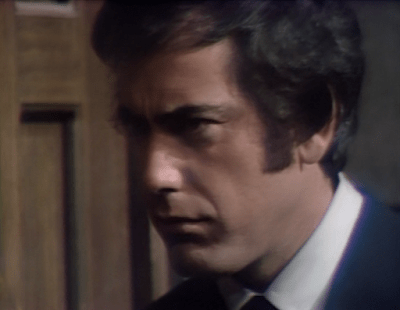
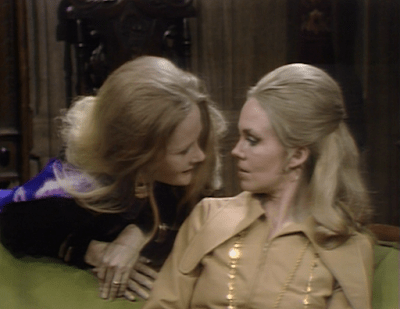
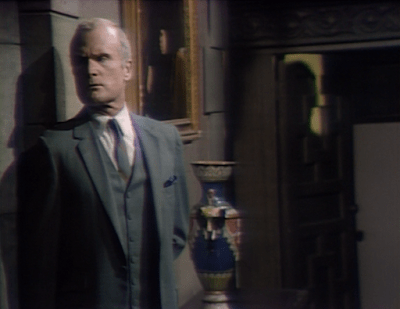
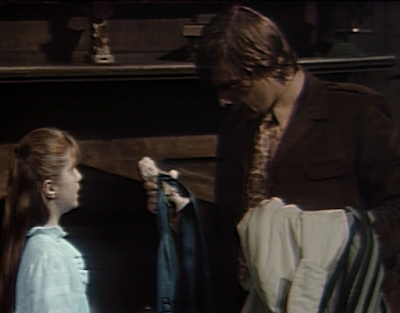
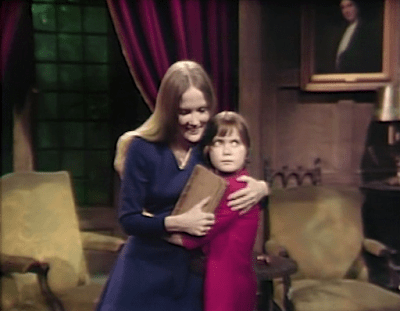
The actors are all very good, and each makes the most of their time on screen today. As child Amy Collins and drunken sourpuss Quentin Collins, Denise Nickerson and David Selby do a good job reacting to the ghost of someone named Dameon Edwards, which they saw yesterday. As sleazy musician Bruno Hess and sneaky butler Mr Trask, Michael Stroka and Jerry Lacy do a good job being alarmed by the prospect that Dameon has returned to expose their guilty secrets. As mad scientist Cyrus Longworth, Christopher Pennock does a good job failing to perceive the consequences of his lunatic scheme. And as Cyrus’ blindly devoted assistant/ fiancée Sabrina Stuart, Lisa Blake Richards does a good job being trusting and optimistic.

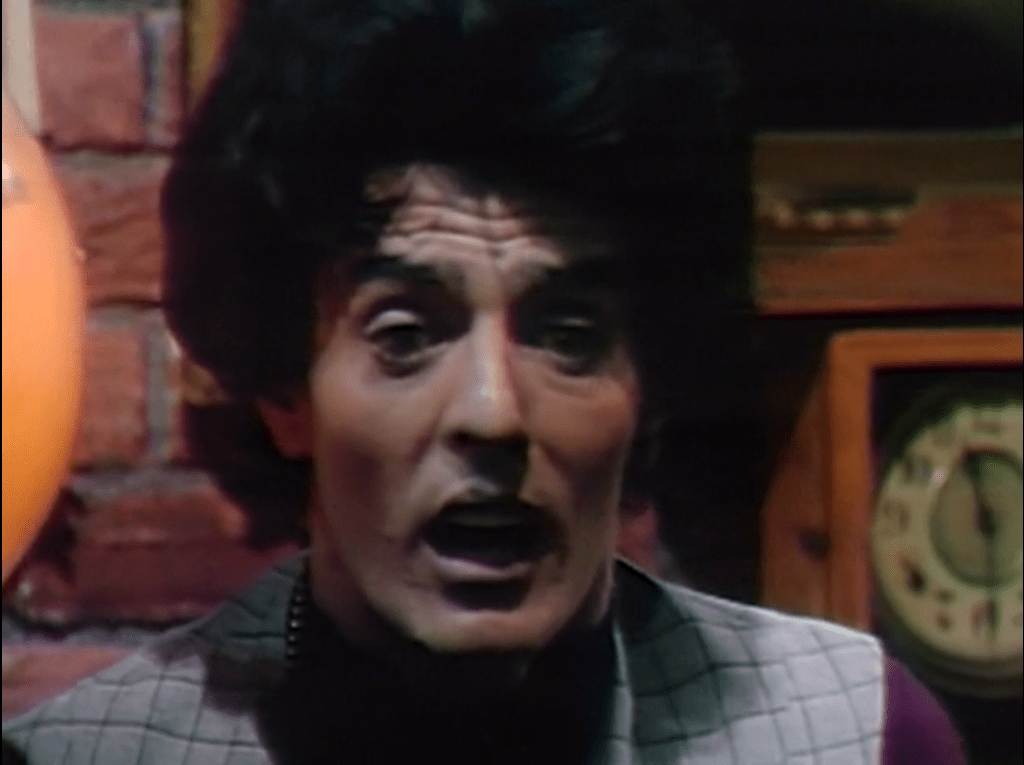
I’ll just single out one moment, when Bruno sees his piano playing with the touch of visible fingers and realizes it is Dameon’s doing. Michael Stroka gives a memorable take.

If the piano starts playing itself, Bruno’s going to be out of a job.

Cyrus drinks the potion he has formulated to turn himself from a mild-mannered Jekyll into a brutish Hyde. As her did the first time we saw him do this, he cries out in pain and collapses. This time they add a lot of flaring green lights to illustrate his distress. The process is not effective at all- at first, I thought something had gone wrong with one of the cameras. At the end of the sequence, we fade from Pennock in his Cyrus look to him in his Hyde makeup, which we didn’t see the first time. The shot doesn’t line up, so it does not create the illusion of a transformation, and the prosthetic nose isn’t very firmly attached, so it takes a second to realize that it is supposed to be part of his face and not just something that landed on him while he was falling.

Episode 994: I might as well be glad

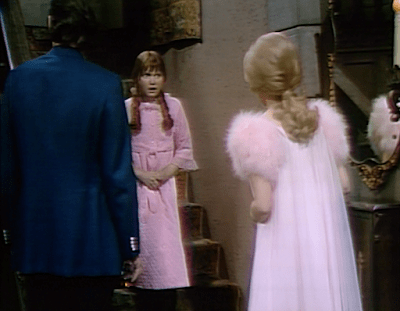
Amy Collins twice sees the ghost of Dameon Edwards, whom she and others at the great house of Collinwood apparently knew when he was alive a year or so previously. At that time, Dark Shadows was set in a different universe than the one it has been showing us for the last few weeks, so the first thing the audience has ever heard about Dameon is that he is dead. Nor do we learn much more about him today. He looks at people with a vaguely sad expression, wanders off, and vanishes into thin air, never speaking a word. His part reminds me of G. K. Chesterton’s line that “Journalism consists largely in saying ‘Lord Jones is dead’ to people who never knew Lord Jones was alive.”

When Amy sees Dameon the second time, he leads her to the basement of Collinwood. This is a bit of a treat for longtime viewers. We may only have been in this universe for a few weeks, but the house is supposed to be laid out similarly to the one where we spent the previous 196 weeks, and the basement of that house was a significant set in the first year of the show. We haven’t been to that basement since #273, when it was revealed that reclusive matriarch Elizabeth Collins Stoddard was mistaken in her belief that she had killed her husband Paul and that he was buried in a locked storeroom there. It turned out Paul wasn’t dead at all. Liz was so embarrassed when her mistake was revealed that no one ever mentioned it again.

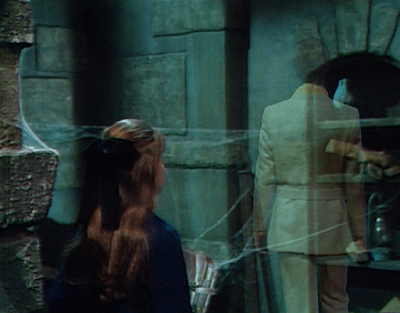
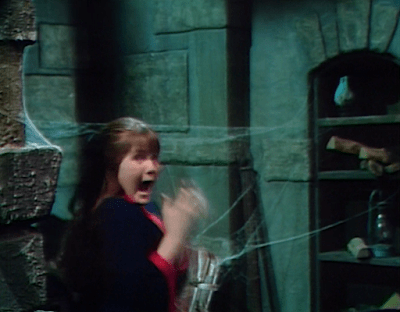
Dameon reminds us of that storeroom when he leads Amy, not to the spot where it was, but to an alcove in the wall opposite it. Amy’s cousin Daniel’s bedroom is a mirror image of his counterpart David’s bedroom in the other continuity. If the basement is a mirror image as well, the alcove to which Dameon leads Amy corresponds to the locked storeroom. Dameon turns towards the door, and vanishes as he walks into it. Amy screams.

He wasn’t there again today. Screenshot by Dark Shadows Before I Die.

Dameon is completely new to the audience, and the story of Liz’ belief that Paul was buried in the basement is so old that the reference will be lost on anyone who hasn’t been writing up notices about every episode of the show for the last few years. So the whole thing is pretty ineffective. Indeed, while Amy is screaming Denise Nickerson is visibly struggling not to laugh out loud.

Oh I am sooo scared! Screenshot by Dark Shadows Before I Die.

I’m sure this episode is the result of a failed plan. Dameon must represent a character who would have meant something to us. Since most of the people we have seen in the last few weeks have the same names and are played by the same actors as counterparts from the original continuity, that character would likely have been a familiar face. The one face that would have brought the locked room in Liz’ basement to the minds of longtime viewers would have been that of Dennis Patrick. Patrick was in #273 as Jason McGuire, the seagoing con man who first convinced Liz that Paul was buried in her basement and then returned to exploit that belief by blackmailing her, and returned late in 1969 as Paul himself. Liz’ counterpart in the current universe is named Mrs Stoddard, so Paul must have existed there as well.

Patrick and his wife Barbara Cason were at this time in Tarrytown, New York, playing supporting roles in the feature film House of Dark Shadows. Patrick’s role as the sheriff puts him in only a few scenes, and Dan Curtis may well have hoped that once he’d got Patrick back to the East Coast he would be able to persuade him to return to the show for a short stint as Parallel Paul’s ghost. But Patrick was based in Los Angeles at this time, busy there as a producer and in demand as an actor, and he had no interest in coming back to a daytime drama taped in NYC for any length of time. So Dameon may have been a last-minute patch to cover Parallel Paul’s absence.

If Plan A had been that today’s ghost would represent Parallel Paul, Plan B appears to have been that he would remind longtime viewers of Quentin’s counterpart in the main continuity. Quentin was introduced late in 1968 as a ghost who did not speak. He first appeared to the children at Collinwood. Those were Amy’s counterpart, Amy Jennings, and her friend, strange and troubled boy David Collins, whose counterpart here is Daniel. Quentin’s ghost beckoned Amy and David into hidden rooms where they would, as they called it, “play the game.” When Dameon beckons Amy to the basement today, she asks if this is another of the games he used to play with her and Daniel.

The echo of the “Haunting of Collinwood” story is clear. But a revisiting of it that would have been effective would have taken some time to set up, especially since there is a living, speaking Quentin at the center of the show now. By the time they got to this topic, David Henesy had left to start his own stay in Tarrytown for House of Dark Shadows, so we won’t be seeing Daniel for a while. The most they can do is what we see here.

The upshot of these two aborted plans is a situation that does not seem to belong on the show at all, and it is no wonder Nickerson can’t keep a straight face. Even more than it reminds me of “Lord Jones is dead,” this installment reminds me of Edna St. Vincent Millay’s 1920 poem “The Penitent“:

I had a little Sorrow,

Born of a little Sin,

I found a room all damp with gloom

And shut us all within;

And, “Little Sorrow, weep,” said I,

“And, Little Sin, pray God to die,

And I upon the floor will lie

And think how bad I’ve been!”

Alas for pious planning —

It mattered not a whit!

As far as gloom went in that room,

The lamp might have been lit!

My Little Sorrow would not weep,

My Little Sin would go to sleep —

To save my soul I could not keep

My graceless mind on it!

So up I got in anger,

And took a book I had,

And put a ribbon on my hair

To please a passing lad.

And, “One thing there’s no getting by —

I’ve been a wicked girl,” said I;

“But if I can’t be sorry, why,

I might as well be glad!”

I don’t know if Amy had been a wicked girl, but the other characters today all seem to have secrets that it would behoove them to feel sorry for when Dameon shows up. There is drunken sourpuss Quentin Collins, who like Amy sees Dameon twice; sleazy musician Bruno Hess, whom Quentin suspects of having killed Dameon; and butler Mr Trask, who, when Quentin mentions Dameon, frantically denies knowing anything about him, and who, when Amy says she saw Dameon, squeezes a drinking glass so tightly it shatters in his hand.

This is the first time we see Mr Trask. He is the fourth character played by Jerry Lacy. Mr Lacy first joined the cast in the fall of 1967 to do his celebrated Humphrey Bogart imitation as lawyer Tony Peterson before finding immortality as overheated witch-hunter Reverend Trask in the 1790s flashback that ran from November 1967 to March 1968. That first Trask came to his end sealed in a basement alcove not so different from the one into which Dameon disappears today. That incident made a big impression, and was referenced several times on the show and time and again in spin-offs of Dark Shadows in other media. Mr Trask’s debut today may, in the original, never-developed plan, have been intended to remind viewers of it. Perhaps Mr Trask would be the one to open the alcove and find Parallel Paul’s remains. That would be a fitting way to join the story that introduced the idea of a basement burial to Dark Shadows with the famous story that showed one taking place.

Mr Lacy matched his triumph as the first Trask when he returned as his hypocritical descendant Gregory in the 1897 segment that spanned most of 1969. Today’s Mr Trask is in part a placeholder for sinister housekeeper Miss Hoffman. Quentin explains today that he sent Miss Hoffman to visit her friends. Mr Lacy was in one scene of House of Dark Shadows, a funeral sequence shot on the first day of principal photography, and unlike Dennis Patrick he was still living in NYC. So he was available for a couple of weeks of fill-in work. The role is thin on paper, but Mr Lacy gives the part a lot of life.

Episode 986: I saw her in the casket myself

In #949, eleven year old Amy Jennings saw twenty-nine year old Quentin Collins. She reacted with terror, certain that he was the ghost of her great grandfather, the ghost who had persecuted her and everyone else at the great house of Collinwood from December 1968 to September 1969. Heiress Carolyn Collins laughed at Amy and told her that he was not a ghost, but was a cousin of theirs, another descendant of Quentin’s. In fact, Quentin was Amy’s great-grandfather and Carolyn’s great-great-uncle, but he wasn’t a ghost, and he meant no harm to Amy.

Amy refused to accept Carolyn and Quentin’s assurances that he was “not that Quentin Collins.” That refusal highlighted Quentin’s convoluted backstory. The show went back in time in March 1969 to the year 1897, and during an eight-month costume drama segment it introduced us to Quentin as he was before he died. He was a charming rascal who immediately became a huge breakout star. During the 1897 segment, they showed history being changed so that Quentin never died and was the beneficiary of a magic spell that immunized him against aging. Ever since early 1967, Dark Shadows has been operating on a model of the cosmos in which the usual laws of cause and effect are replaced with anniversaries. So in #839, we saw that Quentin’s haunting of Collinwood had gone on for ten months and had finally resulted in the death of strange and troubled boy David Collins. But that day was also the 72nd anniversary of the change in history which prevented Quentin’s death, so the haunting broke and David came back to life. When Quentin showed up in 1969 as a living being, everyone remembered the haunting. Most characters accepted Quentin’s claim to be his own great-grandson, but Amy saw the truth, that he and the ghost were two continuations of one man.

The show’s metaphysics probably didn’t bother anyone who watched it the first time it was broadcast. The characters just take them for granted, as in our world we take hard-to-explain phenomena like gravity and magnetism for granted, and the story keeps on going as if they somehow made sense. What the writers were worried about when Amy saw the living Quentin was not that their model of the universe lacked plausibility, but that they hadn’t found a way to keep Quentin at the center of the story. He’d made a hit in the 1897 segment because he was connected to everyone and was naturally involved in everything that was happening, but in 1969 and 1970 he is a visitor, a distant relative who has come wandering in from who knows where. When Amy tries to figure out in what sense he is “that Quentin Collins,” she is trying to solve a puzzle that the show has to solve to keep him generating heat in the ratings.

Now, Dark Shadows has crossed over to an alternate universe. Here, we have met yet another iteration of Quentin. This Quentin Collins is the Master of Collinwood. Amy lives in the house in this continuity as well, but she really is Quentin’s cousin, and her last name is Collins.

Parallel Quentin hasn’t thought to tell Amy that there is a houseguest staying at Collinwood. She is Alexis Stokes, identical twin sister of his late wife Angelique. Since there are a lot of people around the estate who keep saying that Angelique is going to come back to life, the sight of Alexis comes as quite a shock to everyone. Amy sees Alexis today, and reacts with terror, certain that she is the ghost of Angelique. She does not accept Quentin’s belated explanations, anymore than her counterpart accepted Carolyn’s. Amy Jennings had specialized in looking directly into the camera; as Amy Collins, Denise Nickerson has a moment after Quentin and Alexis have explained the situation to her when it looks like she is about to make this move, but she does not.

Amy terrified. Screenshot by Dark Shadows Before I Die.

Amy has two more scenes today. She opens the front door and lets Angelique’s associate, sleazy musician Bruno Hess, into the house. Amy greets Bruno with “She’s upstairs.” He asks how she knows who he came to see, and she tells him he always came to see “her” before. She wonders if “they” will make Bruno call the woman “Alexis.” Perhaps she thinks all adults are in on this scam, pretending that the dead can be counted on to leave the living alone. Later, she gives Quentin a telegram. When he scolds her for having opened it, she is at once sincerely remorseful about what she has done and indignant about what is going on upstairs. She says that while opening other people’s mail is indeed bad, what “she” has done is even worse.

On Friday, the show hinted that Alexis might be Angelique. Today, Bruno starts an investigation to check up on Alexis’ report that she arrived in New York from Genoa a couple of days before. They spend enough time on Bruno’s activities that it would be surprising if her story simply held up, so that keeps the question alive.

Quentin’s new wife, the former Maggie Evans, left him and went to her sister Jennifer’s place in New York on Friday. She was fed up with Quentin’s high-handed attitude, with everyone’s preoccupation with Angelique, and with Alexis’ presence in the house. Quentin picks up a telephone today, says “Operator, this is a person to person call. Mrs Collins!” And they connect him to Jennifer’s place! In spite of this magical power, he still can’t persuade Maggie to come to the phone. By the end of the call, he and Jennifer are mad at each other, too.

When this episode was taped, principal photography was underway for the feature film House of Dark Shadows. Many of the best-known members of the cast are going to be in Tarrytown, New York for the next six weeks. When Quentin talks to Jennifer Evans, he offers to go to Maggie in New York- we might assume he means NYC, but I suppose Jennifer might live in Tarrytown, and Maggie’s real reason for staying with her is that she doesn’t want to be separated from Kathryn Leigh Scott.

As Quentin and Alexis, David Selby and Lara Parker are the biggest names currently on Dark Shadows, and they are playing characters quite different from those that made them famous. This Quentin intermittently displays the charm which the one from the main continuity exudes so effortlessly, but he is a downer at least half the time, and his position as Master of Collinwood keeps him from being the lovable rascal who has been a fixture on the cover of the fan magazines for a year now. And even if Alexis is Angelique, she is an Angelique who has not gone through any of the development that has held the fans’ attention for over two years. Angelique was a story dynamo from her introduction at the end of 1967, but what has made her indispensable in arc after arc is that she usually knows everything the audience knows about what is happening and has some crazy scheme that no one else would have thought of as to how she can make it all much worse. And over the last year, she has shown an ability to learn and grow that has made her a much more interesting character. A new Angelique, starting from scratch, won’t match the audience’s understanding of the situation, and won’t remember anything that gave her new depth in 1969 and early 1970.

You may wonder if these two can carry the show for a month and a half. The writers certainly did, as witness a conversation between Alexis and Quentin today. She goes on at length about how difficult it was to grow up in her sister’s shadow, saying that she tried to imitate Angelique but could never make it. The harder she tried to copy the habits that attracted everyone to Angelique, the more embarrassed their reactions were.

Not only does Alexis tell us explicitly that she isn’t as appealing as Angelique, Quentin couldn’t be less interested what she is saying. He is preoccupied with a dispute he is having with Bruno. That dispute, were Alexis aware of it, would probably interest her as little as what she is saying interests Quentin. In their scene together, Alexis does not give any sign that she recognizes Bruno. After he leaves, she looks at a picture of him on some sheet music he composed, as she would do if she never had seen him before. So, if she is Angelique returned from the grave, she would appear to have lost her memory of Bruno along the way. And whoever she is, her attitude towards him throughout is one of amused tolerance. We can’t imagine her being particularly invested in a conflict about whether Bruno has a right to live in the caretaker’s cottage on the grounds of Collinwood. So the scene between Angelique and Quentin, in which neither has anything to say that is of concern to the other, seems to be something like the opposite of a programmatic statement. Rather than telling us what they plan to do, the writers are telling us what they are afraid we will think they have done.

Not that they have despaired of making it work. By the end, Quentin and Alexis have drawn each other’s attention sufficiently to do some pretty firm smooching. Maggie has been a fan favorite from episode #1, and many of the nine year old girls in the audience probably identify with her and are excited about the idea of her being married to Quentin. The image of him cheating on Maggie with the wicked witch will outrage them enough to keep them tuning in.

The prospect of an affair between Quentin and Alexis presents something of a puzzle in logic. If she really is who she says she is, he is cheating on Maggie with her. But if she is Angelique, he has been cheating on her with Maggie, albeit unknowingly. One way or another, it is far from gentlemanly behavior on his part. As for Alexis, what we know so far would tend to confirm our initial assumption that Angelique is an Evil Twin, but seeing her go after Maggie’s husband will keep regular viewers from labeling her the Good Twin.

Episode 983: Sing to me again

When Dark Shadows premiered in June 1966, strange and troubled boy David Collins (David Henesy) was obsessed with his absent mother and determined to get rid of his new governess, the well-meaning Victoria Winters. In #15, David had tampered with his father Roger’s car. As he stood at the window and watched Roger drive down the narrow, twisting mountain road away from the great house of Collinwood, he said “He’s going to die, mother, he’s going to die!” When Roger survived and it was discovered that someone had removed the bleeder valve from his braking system, David planted the valve in Vicki’s room in an attempt to frame her for the murder attempt. Later, Roger would come to fear that Vicki was about to expose a dark secret of his own, and would encourage David to try to kill her.

David eventually gave up on homicide, and dropped his hostility to Vicki. One of the more benevolent influences on him was his best friend, the ghost of the gracious Josette. In #102, we saw David in the Old House on the grounds of Collinwood, carrying on a conversation with the portrait of Josette that hung above the mantel. We could not hear Josette’s side of the conversation, but it certainly sounded like David could. We already knew at that point that Josette was real- we saw her emanate from the portrait, walk out of the house, and dance among the columns outside it in #70, when David first took Vicki to the Old House. In #126, we would see and hear Josette when she led the ghosts of Collinwood in rescuing Vicki from crazed handyman Matthew Morgan. That rescue was not only a good deed for Vicki, but also a favor to David, who had stumbled upon Vicki in the secret room where Matthew had her tied up and, in a panic, left her to her fate.

In #153, we learned that David’s mother, the former Laura Murdoch, was the one who chose his name, one which no previous Collins had borne. Roger had wanted to call David “Charles Andrew,” in honor of some Collins ancestors. In #181, Vicki and her allies learned that two previous women given the name Laura Murdoch at birth had died by fire, one in 1867 and the other in 1767, each accompanied by her young son, and that each of those boys was named David. It would eventually become clear that Laura was an undead fire witch, a humanoid Phoenix who went into a pyre with her sons at intervals of exactly 100 years, gaining immortality for herself, though not for the Davids. In #288, they had forgotten the lore about David’s name, and mentioned a previous David Collins, but in #685 and #767, it was back to being a first in the family. Between those two episodes, from #729 to #760, another iteration of Laura was on the show, suggesting that the writers brushed up on their knowledge of her original storyline.

By the time Vicki saved David from Laura, he had moved out of the villain category altogether. When his third cousin Amy Jennings (Denise Nickerson) moved into Collinwood at the end of 1968, David was as pleasant to her as one could expect. But his behavior towards her and others changed when the two of them stirred up the ghost of Quentin Collins, Amy’s great-grandfather and David’s great-great-uncle. As Quentin gathered strength, he intermittently possessed first one child and then the other. While David was under Quentin’s control in #679, he twisted Amy’s arm to force her to go to a secret room and join in their vengeful ancestor’s evil plans for their governess, Vicki’s successor Maggie Evans (Kathryn Leigh Scott.) The camera lingered on that act of bullying, meant to shock us with evidence that Quentin’s dire influence had overwhelmed David’s kindly nature.

The arm-twisting incident made an impression on the viewers. In #813, set in the year 1897 when Quentin was alive, Henesy and Nickerson played brother and sister Jamison and Nora Collins, nephew and niece of Quentin, grandfather and great-aunt to David. Jamison, possessed by sorcerer Count Petofi, twisted Nora’s arm to force her to give him information, a reference which shows that the writers were confident that many viewers would see David Henesy’s character abusing Denise Nickerson’s in that way and read it as a sign that he is under the power of an outside force.

Now, it is 1970, but we are not in the main continuity at all. We have traveled to an alternate universe, which on Dark Shadows is known as “Parallel Time.” In this “time-band,” to use another bit of Collinsport English, Quentin is alive and the master of Collinwood. His first wife, the counterpart of wicked witch Angelique, has died, and he has remarried. The new Mrs Collins is the former Maggie Evans (Kathryn Leigh Scott.) Quentin and Angelique’s son, strange and troubled boy Daniel (David Henesy,) is obsessed with his absent mother and determined to get rid of his new stepmother.

Apparently the writers still remember the connection between David’s name and the first Phoenix story, because Daniel is the only character we have yet seen in Parallel Time answering to a different first name than his counterpart in the main continuity. Angelique and Quentin gave him the name of the Collins ancestor whom Mr Henesy played in early 1968, when the show was set in the year 1796. We know that the timelines diverged in that period, so it follows that it was the counterpart of the eighteenth and nineteenth century Daniel who was this Daniel’s namesake.

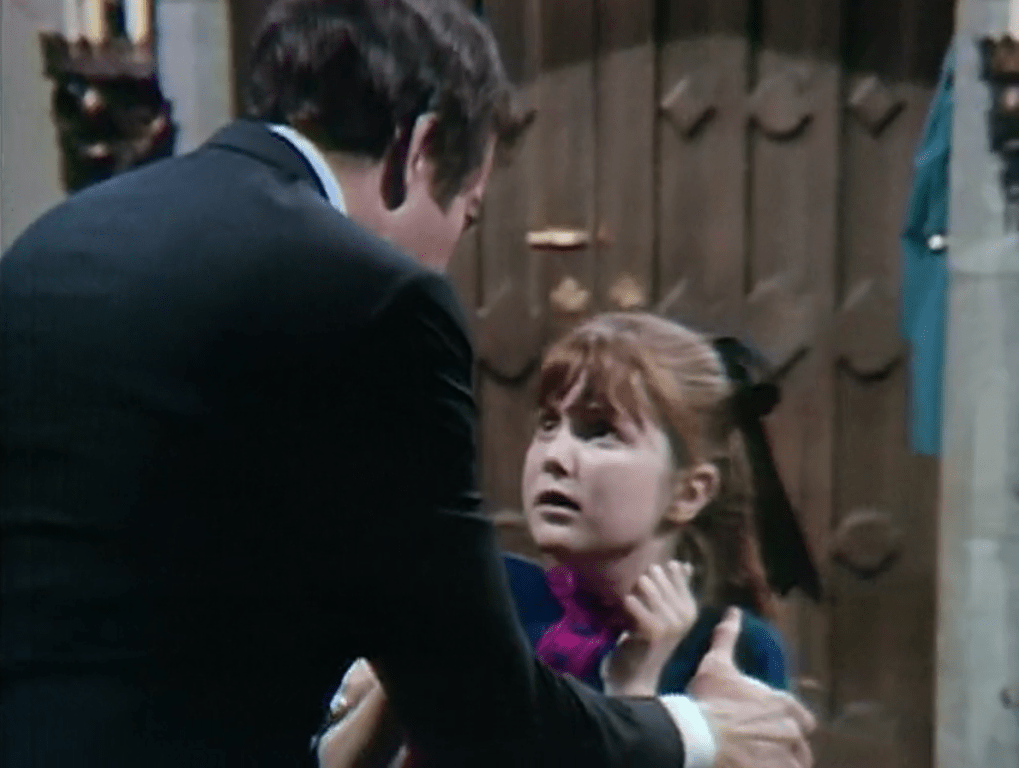
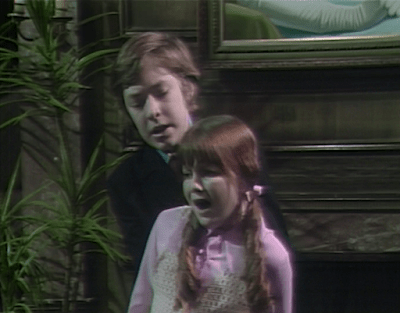
When we first saw Daniel, he was carrying on a one-sided conversation with his mother’s portrait, which hangs in her old bedroom. Today, he devises a plan to use the portrait to frighten Maggie. The plan requires the cooperation of his cousin, Amy Collins (Denise Nickerson.) When Amy refuses, he twists her arm until she agrees to go to a secret room and sing, making Maggie think the portrait is coming to life. This attack is shown only for a few seconds, and Amy’s arm is out of frame. They have already established that Daniel is cruel, and do not need to dwell on the act of abuse.

Daniel twists Amy’s arm. Screenshot by Dark Shadows Before I Die.

Daniel claims that his father often goes to Angelique’s room to meditate and talk to the portrait. That lures Maggie to the room, where Daniel is waiting. They have a confrontation. When she says she wishes she could “make him understand-,” he interrupts her and asks if what she wants him to understand is that his mother is dead and is never coming back. She looks at him and answers with a flat “Yes.” He tells her she is wrong, and pleads with the portrait to sing to him. Maggie says she can’t stand to see him like this, and turns to go. Before she gets out of the room, we hear a woman’s voice singing a lullaby. Maggie and Daniel hear it too. She turns around, shocked, and runs from the room. Daniel laughs that his plan worked so well.

Amy comes rushing into the room. Daniel congratulates her on her performance, and asks how she got in from the secret room so quickly. She explains that she never went to the secret room- her brother Chris intercepted her before she could do so. It wasn’t her voice Daniel and Maggie heard. He absorbs her message, and looks at the portrait in wonderment.

The audience could tell it wasn’t Denise Nickerson singing- she had such a high-pitched voice when she was twelve that she had to work hard to keep it in a range that would sound good on television, while the pre-recorded voice we heard singing was definitely that of a grown woman. Angelique was played by Lara Parker; Parker did some very distinctive things with her voice on Dark Shadows, none of which shows up in the lullaby, so I’m sure it wasn’t her. Several fansites attribute the singing to Joan Bennett, who is in this episode, but I’ve heard Bennett sing and she didn’t get from one note to another the way this voice does. I think the singer must be Kathryn Leigh Scott.

Early in the episode, Daniel and Amy had a scene in his bedroom. David’s bedroom was a frequent set in the first 38 weeks of the show, and was occasionally seen thereafter. Daniel’s room is the same set, with the same furnishings and decorations, but they are arranged in the opposite direction from the pattern we see in David’s. His bed is at stage right rather than stage left, and everything else is also transposed. Seeing this mirror image, regular viewers will appreciate this reminder that we are in a Mirror Universe.

Episode 958: A house of lies

The residents of the estate of Collinwood are divided. Matriarch Elizabeth Collins Stoddard, her nephew David Collins, and their distant cousin, eleven year old Amy Jennings, have been brought under the power of the Leviathan People, an unseen race of Elder Gods who mean to retake the Earth from humankind. Liz has invited the harbinger of the Leviathans, a shape-shifting monster who in his human form is a young man who once revealed he wanted to be known as Jabe, to live in the carriage house on the estate. Jabe’s onetime foster mother Megan Todd is living as Liz’ guest in the main house.

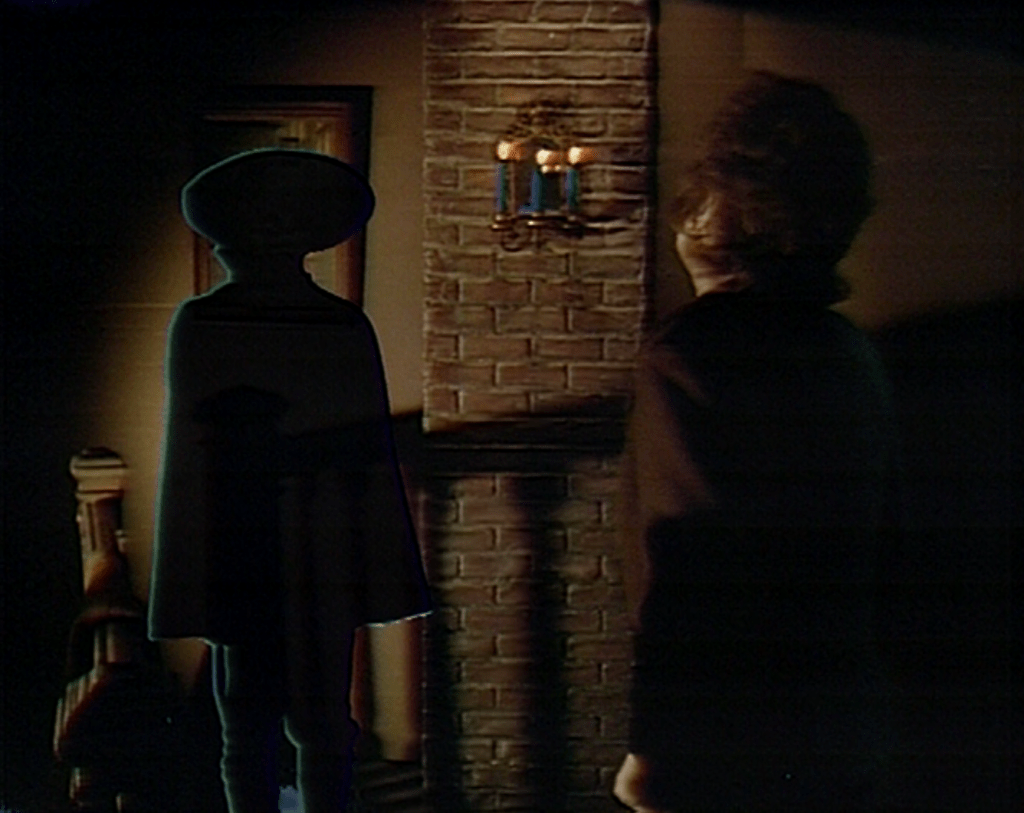
The main house is also home to mad scientist Julia Hoffman and governess Maggie Evans, who have ranged themselves against the Leviathans. Yesterday Jabe was about to kill Maggie when he saw something outside Collinwood’s Tower Room that scared him off. Wanting to know what it was Jabe was afraid of, Julia went to the scene to investigate, and found Jabe lurking there. Before he could attack her, the mysterious presence returned, and Jabe ran off. Today, we see the presence- it is a dark shadow. It makes perfect sense that a reminder of which show he is on would terrify Jabe. The writers keep painting his character into a corner so that he won’t be able to continue once the current storyline ends.

Julia sees a dark shadow. Screenshot by Dark Shadows Before I Die.

The shadow appears to be that of a slim man wearing a comically oversized hat and a cape. The only character who dressed that way was painter Charles Delaware Tate. Tate was killed by a werewolf in #922. It seems unlikely that Tate’s ghost would haunt Jabe, since werewolves and Leviathans are each other’s implacable enemies. Granted, the Leviathans are also hostile to humans, but Tate was always something of a post-humanist himself. For a while he had magical powers that he used to blur the boundary between humans and their portraits, and in his later years he tried to replace himself with a robot. Besides, Tate was always such a jerk to every individual person he met that it is difficult to imagine him taking much trouble to defend humanity in the mass.

Jabe has murdered three people so far. He raised one of these, Sheriff Davenport, from the dead. He made Davenport into a peculiarly garrulous zombie and forced him to do his bidding. I don’t know of any stories where the same person manifests after death as both a zombie and a ghost, but then I’m no expert on tales of the supernatural. So I guess the shade could be Davenport’s.

Jabe also murdered Paul Stoddard, Liz’ ex-husband and father of her daughter Carolyn. Last week Jabe was afraid Paul’s ghost would come after him, so he dug his body up and burned it. Today we hear that the village of Collinsport is buzzing with talk about the fact that Paul’s body went missing. So Paul is a possibility. The third victim, Maine state police investigator Lawrence Guthrie, was a one-time character. It would seem a bit late to start developing him now.

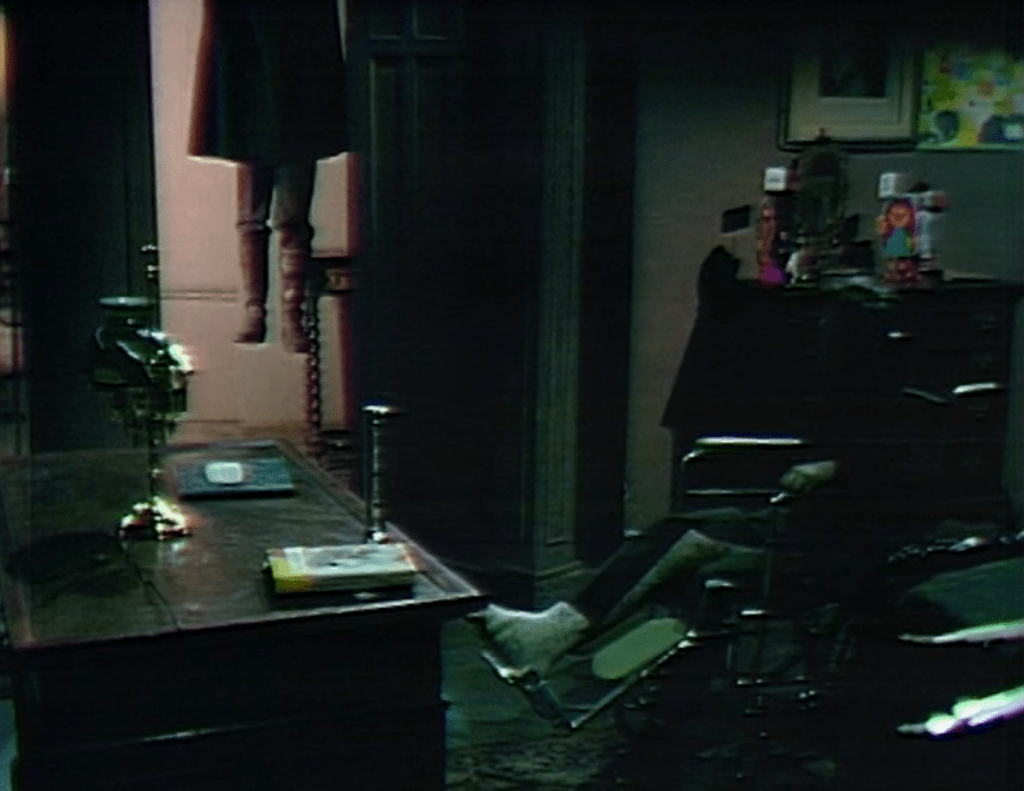
At the end of the episode, the ghost appears to David in the form of a man hanging from the ceiling. We get a clear look at the ghost’s trouser legs and boots. This rules out, not only Davenport, Paul, and Guthrie, but almost all characters from the parts of Dark Shadows set in contemporary times. The only women who have worn trousers were Carolyn, in a couple of 1966 episodes, and Megan. Both of them are still alive. The only man who wore boots was motorcycle enthusiast Buzz, who dated Carolyn for a little while in 1967. Those longtime viewers who remember Buzz might be amused if it were to turn out that he was the Leviathans’ mightiest foe.

“If you FEEL it… Sit it!” Screenshot by Dark Shadows Before I Die.

This episode also features Roger Collins, who is Liz’ brother and David’s father. Roger meets his distant cousin Quentin Collins. From December 1968 to September 1969, Quentin was a ghost who haunted Collinwood, rendering the place uninhabitable and killing David. There was a time travel story going on for most of that period, and in September 1897 events played out differently than they had the first time through. The result of that difference was that Quentin did not die. The haunting broke and David came back to life on the anniversary of the change. Some magic spells cast on him have kept Quentin alive and apparently twenty nine years old ever since, but the haunting still happened and Roger’s memory of it gives him a shock when he sees the living Quentin. He quickly composes himself; he has already heard of Quentin’s claim to be his own great-grandson, and accepts it cheerfully.

Amy is Quentin’s actual great-granddaughter, and she is not so easily persuaded. Both as a living being in the 1890s and as a ghost in the 1960s, Quentin was obsessed with a phonograph recording of a sickly little waltz and inflicted endless replays of it on the residents of Collinwood. While Quentin and Roger are chatting in the drawing room, she starts playing the waltz. Amy asks Quentin if he likes it. He zones out, and after a long interval declares that he likes it very much. She says she is going to play it again, and Roger forbids her.

Amy says she doesn’t have anything to do. Roger puts his hand on her shoulder, tells her that the house is full of good books, and marches her off to find one. I had remembered this scene with David as the one Roger takes to the library, and moreover had remembered it as their last scene together. When the show started, Roger was a villain and David was a budding psychopath, so it would have been touching to end their story on this note of loving paternal firmness.

Later, Amy goes upstairs to David’s room. David has for several weeks been using a wheelchair because of a broken leg, but it hasn’t occurred to anyone to move him to one of the vacant rooms on the first floor. She tells him about Quentin, and he tells her to get the sacred book of the Leviathan people from its hiding place on the top shelf of his bookcase. They search the book for guidance. Just as they find something promising, they feel a ghostly chill. The book flies off David’s desk and bursts into flames. The ghost has done its work; David observes that “The chill is gone.”

David keeps ordering Amy around the whole time they are on together. This is quite a change from the beginning of Amy’s time on the show, in the early days of Quentin’s haunting, when they bickered like an old married couple and took turns being the one in charge. Since then, Amy has been in steep decline, absent from the cast and unmentioned for months at a time. Indeed, today is the last episode in which Denise Nickerson will appear only as Amy Jennings. Amy will make two brief appearances in upcoming episodes where Nickerson plays another character, but this is the end of the road for her as a significant presence on the show. She started so strong and Nickerson was so talented that it is very sad to see her go like this. The chill is gone, baby.

Roger doesn’t know about the Leviathans, but he has caught on that something very strange is going on. He goes to the Old House on the estate, home to his distant cousin Barnabas Collins. He finds Quentin there. Quentin tells him Barnabas is not in. Roger tells Quentin about the strange goings-on, and Quentin says that he can explain them. He warns Roger that the knowledge he is about to impart to him will put him in deadly jeopardy.

Once Roger has heard the story, he says he wants to take David and flee. Quentin tells him this will not work- the Leviathans will kill both of them if they try it. All they can do is fight them. Roger is unconvinced of their chances, but does not have a better idea.

Roger was one of the last characters to hold out against the evidence that the show had become a supernatural thriller. Even after he was forced to accept that he was up against uncanny forces of evil, he would snap back to “Surely there is a logical explanation!” mode the minute the danger had passed. That changed when Quentin’s ghost forced the family out of the main house in #694. When he accepts Quentin’s story today, we can see that it will no longer be Roger’s function to slow the story down. That is good news and bad news- Dark Shadows long had too many speed bumps, and like all of Louis Edmonds’ characters, Roger is too delightful to be related to such a lowly rank. But not since he ceased to be a villain in #201 have the writers come up with anything else for him to do. We may be losing Roger altogether before much longer.

Episode 956: Your ol’ William

Today we see Willie Loomis, much-put-upon servant of old world gentleman Barnabas Collins, for the first time since #696. We have heard no explanation of where he has been during the year in between. Long before his absence began, in #537, Barnabas’ friend Julia Hoffman had offered Willie a job at Windcliff, a mental hospital which she controls and where he was once a patient. Maybe he went off to work there.

Willie makes his first entrance today in conversation with Amy Jennings, a child who was herself a patient at Windcliff until she moved to the great house on the estate of Collinwood in #639. Willie knows Amy and expects her to know him, presumably from the time they overlapped on the estate, though perhaps they may have met at the hospital as well. Amy lets Willie in the house, but is in a hurry to go outside. He asks where she is going at such a late hour; she says that she left her bicycle outside and has to put it away before it starts raining.

Next we see Willie, he is on the telephone, making kissing noises. “Oh, oh, well you know, I can’t help it, precious. Oh, I mean your ol’ William, he wants to be with you so bad, but I just gotta wait. Well, sure I’ll hurry, I’ll get back as soon as I can.” Willie has always been much given to referring to himself in the third person, even in his first week on the show, when he was played by James Hall. This is the first time he has called himself “William,” and the first time we have had evidence that there is a woman anywhere in the world who reciprocates his romantic feelings.

Matriarch Elizabeth Collins Stoddard enters. Liz had unpleasant dealings with Willie in his early days, and like most other people in and around Collinsport believes that he abducted Maggie Evans,The Nicest Girl in Town, and held her prisoner in May and June of 1967. She is disgusted to see him in her house. He tells her that Barnabas and Julia asked him to come to Collinwood. He says that he went to the Old House on the estate, where Barnabas lives, and that he is not at home. He asks if Julia still lives in the great house; Liz says that she does, but that she isn’t in at the moment. Maggie is the governess at Collinwood now, and is in the minority of Collinsporters who don’t believe Willie was her kidnapper. She doesn’t know what happened to her in that period, since Julia used her magical power of hypnosis to wipe Maggie’s mind clear of the memories of the period to cover up the fact that Barnabas was the guilty party. Nonetheless, she is sure Willie was not to blame, and she considers him a friend. Willie asks to see Maggie, and Liz says that she, also, is out. He tells Liz he is getting married; she could not be less interested.

Liz and Amy meet in the drawing room and confer about Maggie. They have locked her in the room on top of the great house’s tower, because she is opposed to a conspiracy they are involved in. Amy says that she has told their leader about Maggie, and that he is on his way to take care of Maggie. The leader is a shape-shifting monster. Liz says she hopes he won’t come in the form he assumes when he is in his room, because that would involve killing Maggie. They have managed to frame someone else for the murders the monster has already committed, so if he kills Maggie it will reveal that that man is innocent.

Willie overhears the end of this conversation, and Liz and Amy realize he has overheard them. He sneaks up to the tower room to free Maggie. He gets into the room, but Amy closes and locks it, trapping them inside. Amy makes her signature move, looking directly into the camera and smiling at the audience. We hear the monster approaching, and Willie and Maggie clutch at each other.

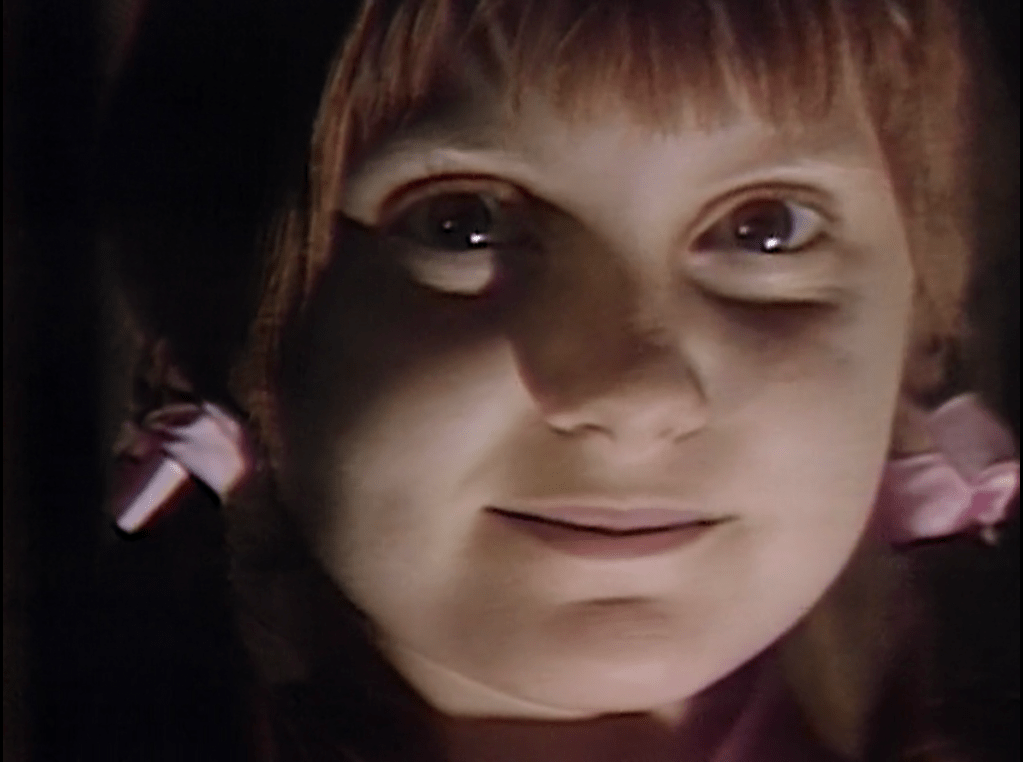
Denise Nickerson was good at lots of things, especially playing Creepy Little Kid.

Episode 949: Not that Quentin Collins

Ten year old Amy Jennings is at home in the great house on the estate of Collinwood. Evidently she’s in a literal mood- she’s in the drawing room, so she’s drawing. Heiress Carolyn Collins Stoddard sees Amy’s work and asks why she is doing it. Amy says she thinks the design is “pretty”; Carolyn replies that “pretty” is the last thing she would call it. That may seem rather rude, but as Amy hasn’t been seen since #912 I suppose she’ll take what she can get.

The design is one which on Dark Shadows is called simply a Naga. It is the secret emblem of a secret cult serving the Leviathan People, a race of Elder Gods. Secret cultist Megan Todd wears the Naga on a large pendant around her neck; Megan’s husband, secret cultist Philip, wears it on a shining ring; Carolyn’s mother, secret cultist Elizabeth Collins Stoddard, wears it as an oversized broach. Amy herself is a secret member of the secret cult, but she hasn’t yet acquired any conspicuous jewelry emblazoned with the secret symbol, leaving her to do her own artwork. Carolyn wonders aloud why so many people are so preoccupied with the design.

Quentin Collins enters. Amy is terrified. Starting in December 1968, Quentin’s ghost haunted Collinwood. By March, the house was uninhabitable and strange and troubled boy David Collins was near death. Old world gentleman Barnabas Collins tried some mumbo-jumbo in hopes of communicating with Quentin; he came unstuck in time and found himself in the year 1897, where he remained for eight months. While Barnabas was flailing about in the late Victorian era, time continued to pass in 1969, and Quentin’s obsession of David finally killed him in September. But a sequence of events with which Barnabas had a tenuous connection changed the circumstances on the night in September 1897 when Quentin originally died, causing him to survive. That night, as it happened, was exactly 72 years before David’s death. On Dark Shadows, anniversaries have the power that laws of nature have in our world, so that caused the haunting to break and David to come back to life. Due to a series of spells cast on him during Barnabas’ sojourn in the past, Quentin is still alive and still apparently in his late twenties in 1970. But the haunting still happened between December 1968 and September 1969, and everyone who lived through it still remembers it.

Quentin has introduced himself to Carolyn as his own great-grandson. Since Carolyn never actually saw his ghost, she is willing to accept this. But Amy had more dealings with the ghost than anyone but David, and it is obvious to her that they are one and the same. She clings to Carolyn.

Amy knows a Quentin when she sees one. Screenshot by Dark Shadows Before I Die.

Carolyn laughs at Amy’s fear and tells her that this Quentin is not the ghost, but is “a cousin of ours.” This is intriguing to regular viewers. It was during the 1897 segment that the audience learned that Quentin was the great-grandfather of Amy and her brother Chris, and just a few weeks ago that Chris learned about that relationship. It is through their descent from Quentin that Amy and Chris are cousins to Carolyn. So if Amy knows she is a Collins, she must have been told that the ghost that tormented her and David was that of her great-grandfather. A scene in which someone gave her that information might have been a good use of Denise Nickerson’s considerable acting talent, but they didn’t bother to produce one.

Quentin tells Carolyn to leave him alone with Amy. Still chuckling, she complies. Once they are alone in the drawing room, Quentin kneels and touches Amy’s face, assuring her that he is “not that Quentin Collins.” David Selby brought immense charm to the role of Quentin, so this scene isn’t as revolting as it might have been, but it is still pretty bad, and we can’t be surprised that Amy is not satisfied.

Amy goes to the village of Collinsport to seek guidance from her spiritual advisor. He is a shape-shifting monster from beyond space and time who usually takes the form of a very tall young man. When he first assumed that form, he invited people to “Call me Jabe,” but no one did. They call him “Jeb” instead, and he answers to it.

Jabe lives in a room above Megan and Philip’s antique shop, and when Amy enters the shop she finds him looking after the place. Apparently shape-shifting monsters from beyond space and time aren’t above doing a little work in retail now and then. She tells Jabe about her encounter with Quentin, and then tells him about a dream she had. In the dream, she went into the long-disused room where she and David first met Quentin. Quentin’s theme song, a sickly little waltz, was playing; she exclaims “It was terrible!” Longtime viewers know the feeling. The tune played incessantly during the “Haunting of Collinwood” period, and when they went back to 1897 characters kept complaining to the living Quentin that he was making them miserable by playing it on his phonograph all the time.

In the dream, Quentin appeared to Amy wearing the nineteenth century clothing and the angry scowl that he wore when he was a ghost. But when he was a ghost, he never spoke words the audience could hear. The only exception was a dream sequence in #767, when Quentin’s ghost spoke to David. That was also the only other dream sequence to be presented as this one is, in flashback as the dreamer is recounting it after the fact. That sequence marked a watershed, the first attempt to explain how Quentin the cranky ghost emerged from Quentin the charming scoundrel we had got to know in the 1897 segment.

This episode, also, has to do with the relationship between these two iterations of Quentin. Amy tells Jabe that Quentin’s ghost in the dream warned her against him by name, and says that she is therefore convinced that the living man she met in the drawing room today is in some way identical to the ghost who haunted the house for those ten months. Amy’s dream marks the final appearance of Quentin’s ghost, but we can see the ghost will not be forgotten.

A state police investigator named Lawrence Guthrie is in town looking into two murders Jabe has committed, those of Carolyn’s father Paul and of a law enforcement officer whose gravestone revealed that his given name was “Sheriff Davenport” (we never learn what Mr Davenport’s title was.) Jabe orders Philip to kill Guthrie. Philip calls Guthrie and asks him to come to the antique shop when Jabe will be out. Once Guthrie is there, Philip tells him that the upstairs room where Jabe stays is an important part of the story of the murders. He shows Guthrie into the room. He stays outside, and locks Guthrie in. Guthrie encounters Jabe there in his true form; Jabe kills him. This is quite effectively handled. My wife, Mrs Acilius, was completely caught off guard by the killing. She believed Philip really was trying to break free of the Leviathan cult, and wondered what Guthrie was supposed to find in the room.

Neither Jabe nor Philip is an especially well-developed character, but Christopher Bernau and Christopher Pennock were both fine actors, and they play off each other very well today. It is a tribute to their performances that Guthrie’s death scene comes as a surprise.

At the end, Quentin is at Collinwood trying to tell Carolyn that it was Jabe who killed her father and Mr S. Davenport. Inexplicably, Carolyn is interested in dating Jabe, and is unwilling to listen to this. Jabe bursts in and announces that there has been another murder, that the murderer is in custody, and that he has confessed to it and to the killings of Paul and Sheriff. That murderer, Jabe says, is Philip. That’s another surprise- after the murder of Guthrie, Jabe did tell Philip that he had another task to perform, and once we hear that he has confessed to the killings it makes perfect sense that that would have been what Jabe meant. But I don’t think anyone could have predicted it. It makes for a strong ending.

Danny Horn’s post about this episode on his great blog Dark Shadows Every Day is a lovely little bit of fanfic proceeding from the assumption that Lawrence Guthrie is the brother of Dr Peter Guthrie, the parapsychologist whom undead blonde fire witch Laura Murdoch Collins killed in March 1967.

The closing credits again misspell writer Violet Welles’ name as “Wells.” They started doing that last week, around the same time the misspelling of wardrobe house Ohrbach’s as “Orhbach’s,” a frequent goof in the show’s first year, reappeared after a long absence.

Episode 893: We serve him now

Heiress Carolyn Collins Stoddard is sitting at a table in the Blue Whale, a tavern. A man who refused to give his name when she caught him trespassing on her property invites himself to sit down with her. She objects to this. He identifies himself as her father, the long-missing Paul Stoddard. She objects far more strenuously to that. Not only did Paul leave the family when Carolyn was an infant, he and his friend Jason McGuire faked his death. Jason convinced Carolyn’s mother, Liz, that she had killed Paul and he had buried the corpse in the basement. In response, Liz immured herself in the house for nineteen years. Only after Jason came back and was blackmailing Liz into marrying him did the truth come out and Liz break free of her reclusive ways.

Paul tells Carolyn that he didn’t know Jason told Liz that she had killed him. Longtime viewers may suspect this is a lie, not least because Paul and Jason are both played by Dennis Patrick. Nonetheless, Carolyn falls for it. Soon she is agreeing to sound Liz out to see how she might react were she to hear that Paul had returned. He walks her home to the great house on the estate of Collinwood. He can’t go in, but gives her a goodnight kiss on the forehead.

Carolyn’s young cousin, strange and troubled boy David Collins, sees Paul kissing her. When she goes inside, he asks who her new boyfriend is. Carolyn is vexed. She refuses to tell David anything, and sends him to bed.

Carolyn’s friend Philip Todd comes to the door. He tells her that he and his wife Megan want Carolyn to work at their antique shop in the village. It may seem rather odd for the keeper of a little shop to go to a vast mansion and ask the daughter of its proprietor to take a job as his assistant, but Carolyn loves the shop and was volunteering there yesterday. She agrees happily, and mentions that a man might be leaving messages for her there.

In the shop the next morning, Carolyn sees that Megan has a baby. Megan says it is her sister’s son. Carolyn asks his name. Megan thinks for quite a while before coming up with “Joseph!”

Carolyn is alone in the shop when David comes in with his friend and fellow resident of Collinwood, Amy Jennings. We haven’t seen Amy since #835; that in turn was her first appearance since #700. For eight months, from #701 to #884, Dark Shadows was set in the year 1897, with only a few brief glimpses of the 1960s. In the 1897 segment, Denise Nickerson played Nora Collins, whose own final appearance was in #859. Both Nora and Amy had long absences from the cast, and were usually unmentioned while they were away. So we’ve been afraid that we wouldn’t see Amy or any other Nickerson character again. It’s good to have her back. She even pulls her signature move and gives a meaningful look directly into the camera at one point.

A Nickerson special.

Amy and David see a doll that longtime viewers will recognize as Samantha, favorite plaything of the late Sarah Collins both when we saw her as a living being in the 1790s from November 1967 to March 1968 and before that, when she was a ghost haunting Collinwood and its environs in 1967. There are also a couple of toy soldiers from “The Regiment,” which Sarah’s brother Barnabas played with when he was a young boy and which Sarah gave to people in 1967 as protection against Barnabas, who was at that time a vampire. Barnabas did sell a bunch of things to Megan and Philip the other day, but neither Samantha nor the members of The Regiment were in Barnabas’ possession when last we saw them. Presumably the camera lingers on the toys, not because we are supposed to know how Philip and Megan got them, but because we are supposed to be pleased with ourselves for recognizing them.

Paul comes into the shop. David recognizes him as the man he saw kissing Carolyn. Carolyn addresses Paul as “Mr Prescott,” sends him into a back room, and hustles the children out of the shop. She tells Paul who David is, and explains that he saw them together, complicating their plans.

When Carolyn was minding the shop yesterday, her friend Maggie noticed an old book on a table. Neither of them knew what it was, but viewers knew it was an object of great importance to a cult into which Philip and Megan have been inducted. It seemed inexplicable that they would leave it on a table in their shop, as if it were for sale. We get a hint today as to what they may have been thinking. In his room at Collinwood, David shows Amy that he has stolen the book. She asks why he would want it. He explains that Carolyn said that if they damaged anything in the shop, his father, Roger, would have to pay for it, and he creased a page in the book. David’s fear that his father would punish him drove several stories in the early months of the show. Roger has mellowed enormously since then, but evidently David is still so afraid of him that he will make a bad situation worse rather than face his wrath.

Indeed, many major storylines have begun with David. The 1897 flashback started because Barnabas was trying to keep a ghost from killing David, as the 1790s segment started when David’s governess Vicki participated in a séance meant to solve a mystery concerning him. For that matter, the whole show started when Vicki was summoned to Collinwood to take charge of David’s education. David doesn’t always have a lot to do in the stories, and when they are over it is often as not forgotten that he was in peril when they began. But he is so often the catalyst that we can suppose that David was supposed to find the book so that the current story could move into its major phase.

If that was the intention, Megan and Philip didn’t know about it. When they discover that the book is gone from the shop, they fly into a panic and declare that whoever took it must be killed. It may turn out that the mysterious forces behind the cult want David to become involved and that they created a situation in which he would find the book and take it with him, but if so, those forces are operating outside the cognizance of anyone in today’s episode.

Episode 859: Not this grownup

Nine year old Nora Collins enters the drawing room of the great house of Collinwood. She walks in on her father, the stuffy but lovable Edward, embracing Kitty Soames, the dowager countess of Hampshire. She gives them a dirty look and says she supposes Edward is too busy to join her in a game of checkers. He says he does have to run an errand, but suggests that Nora play with Kitty.

Kitty is eager to ingratiate herself with Nora, who clearly wants nothing to do with her. Nora asks, in an icy voice, if the reason Kitty wants to be her friend is that she is planning to marry her father. Returning viewers suspect she is right. Kitty and Edward have more in common than they know. Both are penniless, each is sure the other is very rich, and each imagines marriage to the other will solve all their problems. Kitty can’t very well level with Nora about this, so she claims that the women in the Collins family, being outnumbered by the men, have to stick together. Nora does not hide her distaste at Kitty’s inclusion of herself among the women of the family. Kitty asks Nora if she wants her father to be happy. Nora drills her eyes into Kitty’s face and says in a firm, flat voice “I want that.”

Nora asks Kitty if she is just letting her win at checkers. While she is asking this, Nora moves twice in one turn and takes three of Kitty’s pieces. Kitty watches this without protest and denies that she is letting her win. She then says she wants to concede the game and listen to whatever information Nora is willing to share about the family.

Nora is not impressed with Her Ladyship. Screenshot by Dark Shadows Before I Die.

Edward comes back from his errand to find Nora packing up the checkers and the board. He asks if she enjoyed her game with Kitty. Not looking up, Nora says they never finished it. Kitty hastens back in and asks if she wants to finish it now. Edward points out that it is getting close to Nora’s bedtime. He kisses her, and bids her say goodnight to Lady Hampshire. Kitty asks Nora to call her by her first name. Nora pointedly says “Good night, Lady Hampshire.”

It doesn’t show in her scenes with Nora, but Kitty seems to be suffering from a severe mental health crisis. Returning viewers know that the ghost of Josette Collins is taking possession of her, and suspect that she will turn out to be a reincarnation of Josette. Edward knows enough about the supernatural doings on the estate of Collinwood that he might give Kitty the benefit of the doubt when, for example, she comes running in today and is shrieking about a haunted house, a vanishing woman, and a curse that follows her everywhere. But she is so often so highly distraught that Nora must have noticed that she is not right in the head, and she can hardly look forward to having such a person as a stepmother.

Shortly before Nora enters, Edward calls Kitty “Katie.” This is a small enough slip of the tongue, but Kathryn Leigh Scott’s friends call her Katie, so it is a case of an actor’s name in place of the character’s. I think I can see Louis Edmonds blush a little when he realizes what he has done.

This episode marks the final appearance of Nora, and very nearly the last time we will hear Nora’s name. I think she was badly underused, disappointingly so after the outstanding work Denise Nickerson did as Amy Jennings in the months leading up to the segment set in 1897. She will be back later, in other parts.

Director Henry Kaplan was not much of a visual artist, and his deficiencies are particularly glaring today. Especially during Kitty and Nora’s first scene, the camera keeps drifting up to the actors until we see a randomly selected two-thirds of their faces in extreme closeup. Once the shot excludes the eyes or the mouth, it abruptly pulls back. Even the successfully framed closeups are rarely in focus, and you can forget about finding coherent visual storytelling in any kind of shot other than a closeup. The actors themselves do a good job, in spite of Kaplan’s notoriously unpleasant behavior towards them, but aside from a few evocative facial expressions, most of them by Nickerson, it may as well have been a radio play.

Episode 816: David Collins, who lives in the year 1969

From December 1968 to through February 1969, strange and troubled boy David Collins (David Henesy) and his friend Amy Jennings (Denise Nickerson) were falling under the power of the malign ghost of Quentin Collins. Occasionally the children were possessed by the spirits of David’s grandfather Jamison and great-aunt Nora; at other times they were possessed by Quentin’s own spirit and that of Quentin’s sometime lover, maidservant Beth. In those same days, Amy’s brother Chris (Don Briscoe) was suffering from a curse that made him a werewolf.

As Quentin’s power over David and Amy grew, so did the frequency and duration of Chris’ spells in lupine form. By #700, Quentin so dominated the great house on the estate of Collinwood that its residents fled to the Old House on the estate, home of their distant cousin Barnabas Collins. David, entirely possessed by Jamison, was close to death. For his part, Chris was stuck in wolf form, apparently permanently, and Barnabas had locked him in a secret room in the old Collins family mausoleum.

Desperate to remedy the situation, Barnabas and his associate, occult expert Timothy Eliot Stokes (Thayer David,) searched Quentin’s old room in the long-deserted west wing of the great house. They found some I Ching wands there. Under Stokes’ direction, Barnabas threw the wands, meditated on them, and found himself transported back in time to 1897. In that year, Quentin, Beth, Jamison, and Nora are alive, and Barnabas is a vampire.

Barnabas had no idea what led Quentin to become a malevolent ghost or what first brought the werewolf curse on Chris, but he had reason to believe that 1897 was an important year in the events leading up to both of those unhappy circumstances. So once he arrived in that period, he spent his nights meddling in all the affairs of the Collins family he found there. Vampires are not problem-solvers; their function in a story is to create problems that other characters will have to solve. So all of Barnabas’ well-intentioned interventions backfired badly. Even disregarding the many murders he committed for his own selfish ends, including the murder of Quentin’s brother Carl Collins, his trip would by any standard have to be considered a disaster.

Now, evil sorcerer Count Petofi (Thayer David) has found that Barnabas is a visitor from the future and is determined to go with him when he returns to 1969. When he demanded Barnabas tell him his secret, Barnabas quite truthfully told him he had no idea what was going on when he found himself transported from one period to another. Petofi did not believe him, and is trying to extort the information he wants by summoning the spirit of David to come from 1969 and possess Jamison (David Henesy) in 1897.

Not only is this an intriguing reversal of the 1968-1969 story in which the ghost of Quentin caused Jamison’s spirit to possess David, it also picks up on some recent hints that they might retcon the whole “Haunting of Collinwood” story to put Quentin’s ghost under the control of Petofi. Even if he can’t hitch a ride with Barnabas, perhaps Petofi will find a way to use Quentin to go back to 1969 with us.

Nora (Denise Nickerson) is with her brother Jamison when the possession takes hold. She is puzzled that he insists on calling her “Amy” and himself “David” and that he tells her to call Quentin on the telephone, even though he is in the house. When Quentin shows up, he recognizes the name David Collins from something Barnabas has told him about the future. But Barnabas has not told Quentin that he is fated to become a family-annihilating ghost, and so Quentin cannot understand how David knows who he is.

Meanwhile, a man named Tim Shaw (Don Briscoe) comes to the house and visits Nora in her room. Tim is Amy’s former teacher, and she considers him a friend. She does not know that since she first knew him, he has lost his moral compass, found the severed Hand of Count Petofi, stolen it, and used its magical powers to make a small fortune in New York City. Evidently all working-class Collinsport boys get rich quick when they go to NYC. In 1961, ex-fisherman Burke Devlin got out of prison and went to that city. By the time he returned to Collinsport in 1966, Burke was a big-time corporate raider who had to think for a moment when David Collins asked him if he’d already made his first $100,000,000. He answered “Not yet.” If he’d had the Hand, no doubt he would have passed that milestone long before.

A couple of days ago, Tim asked Nora to hide a box for him. Unknown to her, the box contained the Hand. Tim asks Nora to return the box to him. She tells him Jamison has it, and he flies into a rage. He gets very rough with her. Briscoe and Nickerson were both good actors, and we’ve seen them share tender moments both as Nora and Tim and as Amy and Chris, so the resulting scene is as uncomfortable as it needs to be to show us that Tim is no longer the long-suffering nice guy we once knew. Moreover, longtime viewers who recognize Tim’s echo of Burke and remember that Burke, though sometimes villainous, was always good with David, will be shocked that Tim does not mirror the earlier character’s consistent soft spot for children.

Tim roughs Nora up. Screenshot by Dark Shadows Before I Die.

Tim goes downstairs and sees Quentin coming out of the drawing room. He demands to see Jamison. Quentin tells him that Jamison is ill, and it will be impossible for anyone to talk to him. Tim starts to get ugly about it, and Quentin cuts him off, saying that Jamison doesn’t have the Hand. Tim is shocked that Quentin knows about the Hand, but recovers sufficiently to ask who does. Quentin cheerfully tells Tim that if he goes to the abandoned mill at the end of the North Road, he will find his onetime acquaintance Aristide, and that Aristide will direct him to the man who has the Hand.

Tim knows Aristide only slightly, but he has a grudge against him. Aristide attacked Tim’s girlfriend Amanda and demanded she tell him where the Hand was. Even after he realized Amanda did not know what he was talking about, he beat her and threatened to kill her, forcing her to tell him whatever she did know that would help him retrace Tim’s steps. When Tim found Amanda, Aristide had left her unconscious, and Tim feared at first she might be dead.

We cut to the hideout in the mill, where Tim is waiting with a pistol and thinking that he would be justified in killing Aristide for what he did to Amanda. When Aristide comes, Tim holds him at gunpoint and demands the Hand be returned to him. Aristide tells him that is not possible. They quarrel until another man enters. It is Petofi, who shows Tim that the Hand has resumed its place at the end of his right arm.

That suffices to show Tim that the Hand is no longer available to him. Petofi tells him he should consider himself lucky that the Hand, which followed no one’s commands, chose to make him rich and happy. Tim says he is not happy, and will not be until he can take revenge on the hypocritical Rev’d Gregory Trask and lawyer/ Satanist Evan Hanley. This again reminds longtime viewers of Burke, whose original goal in returning to Collinsport was to wreak vengeance on Roger Collins. As Trask and Evan involved Tim in a homicide when he was not in his right mind and tried to make him alone pay the legal penalty for it, so Roger killed someone with Burke’s car while Burke was passed out drunk in the back seat and saw to it that the court concluded that Burke was driving.

Petofi laughs and congratulates Tim on his choice of enemies. Tim brightens and asks if Petofi will join with him in bringing Trask and Evan down. Petofi explains that he does nothing without a price. Tim says he has a lot of money, and Petofi says he doesn’t have any use for money. Petofi brings up Amanda, only to say that he doesn’t have a use for her either, at least not at the moment. He sends Tim along his way.

Aristide is talking when Petofi dismisses him. He tells him that two visitors are coming, and that he wants to be alone when they arrive. He will not explain further, and so Aristide is in rather a huff when he leaves.

The visitors are Quentin and Jamison/ David. Quentin is carrying his nephew/ great-great-nephew. He demands that Petofi cure Jamison of the possession, which seems to be killing him. Petofi refuses. When Jamison/ David calls Quentin by name, Petofi asks him how a boy who lives in 1969 knows who he is. Quentin’s bewildered reaction leaves us wondering how he will respond if Barnabas ever tells him just why he went to the past.

In the opening teaser, Petofi stood over the coffin in which he has trapped Barnabas. He told Aristide that he and Barnabas have been at war for what even he, at his immense age, considers to be a very long time. He says that they are now engaged in the final battle of that war.

Petofi’s remarks make absolutely no sense whatever in the context of what we have seen. It has been clear so far that Petofi’s presence at Collinwood is an accident, that Barnabas never heard of him before, and that Petofi only just learned that Barnabas has traveled through time. Many of the oddest dead ends on the show were left over from advance plans that hadn’t worked out; so when they were drawing up broad outlines six months before taping, or when they were writing episode summaries (called “flimsies”) thirteen weeks before, they would often include ideas that depended on story points that they never got around to making happen or characters who never worked out. Once in a while, the writers tasked with filling in the flimsies wouldn’t be able to make up a complete 22 minute script without incorporating some of this irrelevant material. So perhaps at some point in the planning process they meant to have stories about Barnabas going back to the eighteenth century and fighting Petofi there. They may still have been kicking that idea around when they shot this installment.

Danny Horn closes his post about this episode at Dark Shadows Every Day with this little poem, which he attributes to Petofi (though it may remind some of Puck from Shakespeare’s Midsummer Night’s Dream):

If Dark Shadows has offended,
Think but this, and all is mended —
That you have but slumbered here
While these visions did appear.
And now, a word from All Temperature Cheer.

Danny Horn, “Episode 816: Midsummer,” posted 1 February 2016 at Dark Shadows Every Day.