Episode 1050: How to bring you half alive

Late in 1968, the ghost of Quentin Collins began haunting the great house on the estate of Collinwood. The ghost gradually waxed more powerful and more malevolent, killing some people and tormenting others. By March of 1969, the great house had become altogether uninhabitable. Old world gentleman Barnabas Collins, trying to contact Quentin, traveled back in time to 1897, when Quentin was a living being. During the eight months the show was set in that year, we got to know a Quentin who was selfish, cowardly, untrustworthy, cruel, and supremely charming. Barnabas’ interventions changed history. In the revised timeline, Quentin did not become a malevolent ghost. He didn’t even die. A spell was cast on him that immunized him against aging, so that when the show returned to a contemporary setting in November 1969 he was alive, well, and to all appearances 28 years old.

In 1969 and 1970, Quentin still had all the lovableness that came from being played by David Selby. But the writers were stumped when it came time to give Quentin something to do. They kept him in a holding pattern for a month or so with a case of amnesia, and used him and one of his girlfriends to tell a version of the story of Orpheus and Eurydice. When Barnabas and his best friend, mad scientist Julia Hoffman, were doing battle with an unseen race of monsters from beyond space and time, they occasionally turned to Quentin for help. When Barnabas’ old nemesis, wicked witch Angelique, grew jealous of his interest in governess Maggie Evans, she cast a spell to cause Quentin and Maggie to conceive a wild passion for each other, something which came and went and which Barnabas never noticed. None of that activity made an impression on the audience or gave the character room to grow.

The evil but irresistible Quentin of 1897 had a great deal in common with high-born ne’er-do-well Roger Collins, who was in 1966 the show’s first true villain. As played by Louis Edmonds, Roger was so much fun to watch that it was soon out of the question to follow the original plan and kill him off when his crimes were exposed, so they nerfed him. Roger turned into a sarcastic but harmless snob. When in November 1967 the show went back in time to 1795, Edmonds played haughty overlord Joshua Collins, a man as strong as Roger was weak. In a tragic turn Aristotle would have admired, it was Joshua’s virtues that led to disaster for himself and everyone he loved. In the 1897 segment, Edmonds played the stuffy but lovable Edward Collins, who had many faults but was devoted to his family and committed to doing the honorable thing. Under the influence of these roles, Roger himself had by the time the show was done with him transformed into an upright family man.

The makers of the show have apparently decided that if traveling in time and casting Edmonds in other roles could change Roger so profoundly, finding a setting where they can present us with a different version of Quentin might be a path to reinvigorating that character. To that end, they have traveled, not backward in time, but sideways in time. We are now in a different universe than the one where the first 196 weeks of the show took place. The show insists on calling this universe “Parallel Time.”

Here, Quentin is the master of Collinwood and Maggie is his wife. This Quentin is something his counterpart never was, an authority figure. But authority does not come naturally to him, as it did to Joshua and Edward. He holds onto it in his relationship with Maggie by treating her as a child, with the result that their marriage is all but dead. He ignores his son Daniel, caves in to the servants when they stand their ground against him, and throws tantrums and runs away when he encounters serious opposition. In those moments he reminds us of the cowardice Quentin showed in 1897. On occasion, however, he has shown physical courage, as when he stood up to an evil man called John Yaeger. As Joshua suffered from the overgrowth of his virtues, so Quentin’s better deeds seem to be the accidental byproduct of his vices. What we have seen in Parallel Time makes it easy to imagine that when we get back to the main continuity, we will see Quentin as a sometime action hero who must at all costs be kept from taking charge of anything. Had the segment caught on as 1795 and 1897 did and been expanded beyond the bounds originally planned for it, who knows what other paths it might have opened for the character.

Angelique was Quentin’s first wife, who was murdered nine months ago but has risen from the dead, assumed the identity of her identical twin sister Alexis, and set about taking revenge on her killer. She doesn’t know who that was, though for now she is operating on the assumption it was Quentin.

Roger and the matronly Elizabeth Collins Stoddard are Quentin’s siblings. While in the main continuity Liz kept her share of the inheritance as Roger was squandering his, here she entrusted her money to Roger, so that they are both penniless dependents on Quentin.

Barnabas and Julia have crossed over from the main continuity. Barnabas is pretending to be a long-lost cousin of the Collinses, while Julia is impersonating her own counterpart. That other Julia Hoffman was the housekeeper at Collinwood and Angelique’s most fanatical devotee until Julia showed up, beat her to death, and stole her French maid outfit.

At this point, Quentin is on the run from the law, suspected of the murder of sleazy musician Bruno Hess. He was choking Bruno shortly before his death, but is in a sense innocent of the crime, since it was a spell Angelique cast that completed the fatal strangulation. Liz’ daughter Carolyn is in mourning for her husband Will, who found himself caught between Angelique’s magical powers and Barnabas’ and could do nothing but fling himself to his death from a high window. Yesterday Carolyn announced that she knew and could prove who had killed Angelique. She went to the room on top of the tower attached to the great house. A man entered. She greeted him. He drew a knife and she screamed.

Today, Roger tells Liz and Julia that he heard Carolyn’s scream, ran to the tower room, and found her stabbed to death. Presumably the same man killed her who killed Angelique. The three current suspects are Roger himself, Quentin, and butler Mr Trask.

Yesterday’s episode hinted heavily that Trask was the culprit, and Liz says that he has been missing since Carolyn was killed. We had not seen or heard of Trask in more than eight weeks, and in none of the handful of episodes in which he appeared before that hiatus was it suggested he might have killed Angelique. If it does turn out that the butler did it, therefore, it would be obvious that the show had originally planned to pin the crime on a major character and chickened out at the last minute. We do see a man lurking about today who might be Trask and almost certainly is the mysterious and terrible “Claude North” whom we have heard about recently; if Trask and North are one and the same, that might lead somewhere, but it would hardly be a logical culmination of what we have seen so far.

The whole point of the “Parallel Time” segment is to reconceive Quentin. Making him the killer of Angelique might fit with that. The Quentin of the main continuity murdered his wife Jenny in 1897,* and Angelique is much less sympathetic than Jenny was. Quentin does not have to be admirable, or even defensible. He just has to be attractive. If they can find a way to occasionally make his vices into motives for good deeds, all the better. But Carolyn’s counterpart in the main continuity has been a central figure on the show since the first week, and like all characters played by Nancy Barrett she is a fan favorite. If this Quentin deliberately kills Carolyn, especially by hacking her to bits with a kitchen knife, it is hard to see how the Quentin of the main continuity will benefit. It is true the present Quentin is such a gloomy sourpuss and such a miserable failure as a husband to Maggie that he has already alienated the audience, so they might have decided they had nothing to lose by turning him into Jack the Ripper.

That leaves Roger. He has been painted in the colors of his counterpart as he was in 1966, making him a possible murderer. Even at his coldest, the Roger of the main continuity was close to Carolyn, whom he called “Kitten.” But when we first saw the characters from the current universe in #975, they were hostile and impatient with each other, and Roger took a menacing tone with his niece. The only person for whom this iteration of Roger has any affection is Angelique, and all of that flows to a version of her that exists only in his imagination. Roger seems to be describing himself in both universes when he tells Liz that “The sum total of my life seems to be that I can never help anyone.” So we can certainly believe he killed both Angelique and Carolyn, and that he might kill again.

Liz and Roger’s counterparts have been on the fringes of the action in the main continuity for years, and today we see that this Liz and Roger are also excluded from much that is happening. They visit the Collins family mausoleum in the old cemetery north of town scouting out potential resting places for Carolyn. Unknown to them, there is a hidden chamber in the back of this mausoleum, and Claude North is lurking there, a dagger in his hand, while they chat in the publicly visible part. They then go to Carolyn’s home, the Old House on the grounds of Collinwood, to look for anything she might have written that would give a clue as to who killed her. Unknown to them, Julia is in the basement of the house, conducting a mad science procedure to weaken Angelique by reviving a woman named Roxanne on whose “life force” she is feeding. One wonders where else they will stop on their way home, and of what other uncanny doings they will be oblivious while there.

We hear Julia’s thoughts as she is preparing to revive Roxanne. She tells herself that this is the procedure that brought Adam and Eve to life. She is not thinking of some obscure midrash about the book of Genesis, but about two Frankenstein’s monsters she loosed upon the world in 1968.

*Jenny must have been in someone’s mind when they were making this episode. We catch a glimpse of a gravestone in her name during a cemetery scene:
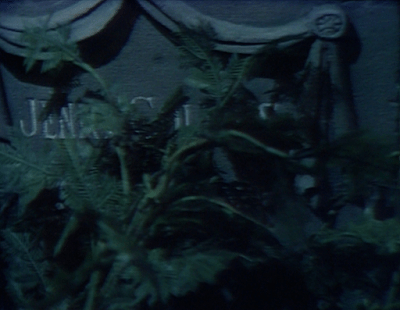
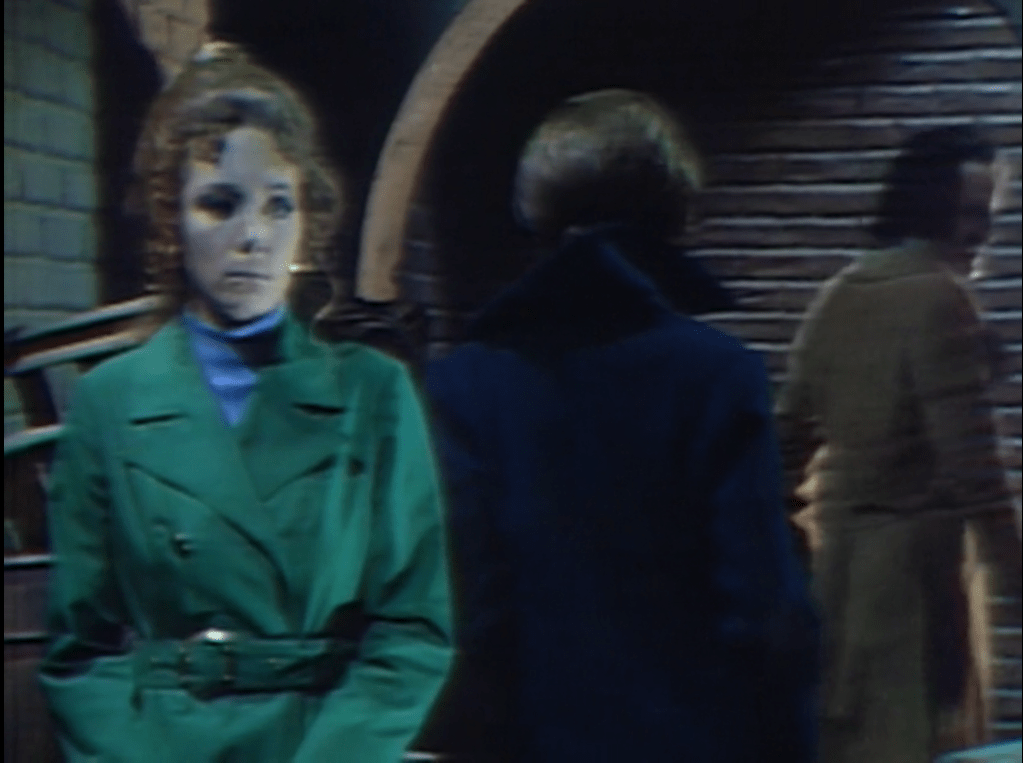
Poor Jenny, bright as a penny. Screenshot by Dark Shadows Every Day.

Episode 1023: The lady wanted a certain piece of information

Barmaid Buffie Harrington sees a man assaulting a woman in the alley next to the tavern. She recognizes the man as ruffian John Yaeger. Yaeger used to buy Buffie gifts, then beat her and laugh at her bruises. She recognizes the woman as her childhood friend Maggie Evans. Maggie moved away from the village of Collinsport when she was very young, and came back recently as the wife of Quentin Collins, drunken sourpuss and master of the estate of Collinwood. Buffie orders Yaeger to unhand Maggie. He sneers at the women, threatening to make a stink if they go to the police. Buffie stands her ground, and at length Yaeger backs down and leaves.

Buffie and Maggie see Yaeger off.

Maggie goes to Quentin’s friend Cyrus Longworth in his laboratory. She tells Cyrus that Buffie rescued her from Yaeger. She asks Cyrus if it is true that Yaeger is his friend. Cyrus looks pained, and says that for some time he has considered Yaeger his enemy. Maggie had never seen Yaeger before; she was at the docks because he called her anonymously and promised her some information relevant to her suspicion that Quentin murdered his first wife, Angelique Stokes Collins. Nor did he identify himself to her. Buffie did not call him by name. So Maggie and Buffie must have had a conversation afterward in which she told him who Yaeger was and that he and Cyrus are connected to each other.

What neither Buffie nor Maggie knows is that Yaeger does not exist. He is simply a disguise Cyrus assumes when he wants to hurt someone. Cyrus never meant to tell Maggie anything about Quentin; he called Maggie to meet him at the docks because he wanted to rape and abduct her. Cyrus has devised a potion that causes his hair to turn darker and sprout all over his body, his shoulders to broaden, and his skin tone to change. John Yaeger is the alias he uses when in this disguise. After Maggie leaves, he tells himself that he and Yaeger are the same person, and that he is responsible for all of Yaeger’s crimes. He smashes up his lab equipment and burns his notes. All he really needed to do was pour out the potion. One of the essential ingredients is a compound he can’t make himself. He murdered the only known supplier, so once it is gone, it will be gone for good.

Cyrus is only the first character today to use Maggie’s need for information about Quentin to trap and hurt her. Quentin’s brother, high-born ne’er-do-well Roger Collins, keeps baiting her with references to the cause of Quentin’s current fit of bad temper. She finally insists he tells her what he means, and he says it is the anniversary of his wedding to Angelique.

The other character is Angelique herself. Unknown to any other character in today’s episode, Angelique has risen from the grave, murdered her identical twin sister Alexis, and taken Alexis’ place as Quentin’s houseguest in his mansion, the great house of Collinwood.

Maggie turns to “Alexis” for information about Quentin and Angelique’s marriage. When she asks if Angelique often wrote her when she was living in Florence, “Alexis” replies “Not often, but when she did she made up for it.” We know this is a lie, and Maggie should too. When the real Alexis first came to the Collinwood, housekeeper Julia Hoffman asked if she received the letter she sent informing her of Angelique’s death. She said she did not. It turned out that the last address Angelique had for Alexis was in Tangier, a city she had left some time before moving to Florence. Maggie takes “Alexis'” statement at face value, and also believes her when she says that Angelique wrote only of how wonderful her marriage to Quentin was. Further, she believes that Angelique was telling the truth in those supposed letters. Since her own marriage to Quentin has been miserable from the first day we saw them together, this depresses Maggie.

Maggie goes to sleep, and Angelique casts a spell to send her a dream. In the dream, Maggie goes to Angelique’s old bedroom and opens a hidden compartment in a small table. She finds a packet of letters there. She wakes up, goes to the room, and finds not only that there is such a compartment but that it does contain the letters. Presumably she will read these and add to her misery.

As Yaeger’s former punching bag and current blood thrall of vampire Barnabas Collins, Buffie is central to two of the ongoing stories. When she rescues Maggie, we can assume that they will renew their friendship, putting her close to the heart of all the other stories. The episode thus promises to usher in the Age of Buffie. But in fact, this is the character’s final appearance.

I suspect that the writers and producers were impressed with Elizabeth Eis’ performance and expanded Buffie’s part beyond what they originally intended. There were several cast members whom Dan Curtis Productions was contractually obligated to use in a certain number of episodes per month, and for the first weeks of the current segment most of those were off in Tarrytown, New York, doing principal photography on the feature House of Dark Shadows. That gave the show a greater flexibility with new performers than they have now that those people are back.

Moreover, the writers projected the plot out thirteen weeks at a time, in documents divided into 65 parts for the 65 episodes of that period. These projections were known in the soap opera business as “flimsies.” The show would scrap its plans completely when a story drew a different reaction from the audience than they had expected, most famously when Barnabas was introduced in April 1967 and was such a hit that they dropped the original idea to stake him at the end of a number of weeks. But Buffie isn’t that kind of a hit, and with the return to the jigsaw puzzle they have to solve every day to get the name actors their required appearances, the writers have to stick close to the flimsies for a while. By the time they could find room for Eis, the story had moved on and Buffie was no longer particularly relevant. Eis will be back later, when the show is set in a different version of Collinsport, playing a character who shows up in only three episodes.

Episode 1004: The dead are not to be trifled with

We are in the fifth week of a segment set in a different universe than the one where Dark Shadows spent its first 196 weeks. There are enough stories to keep everyone busy all day every day, and almost all of those stories are working quite well right now.

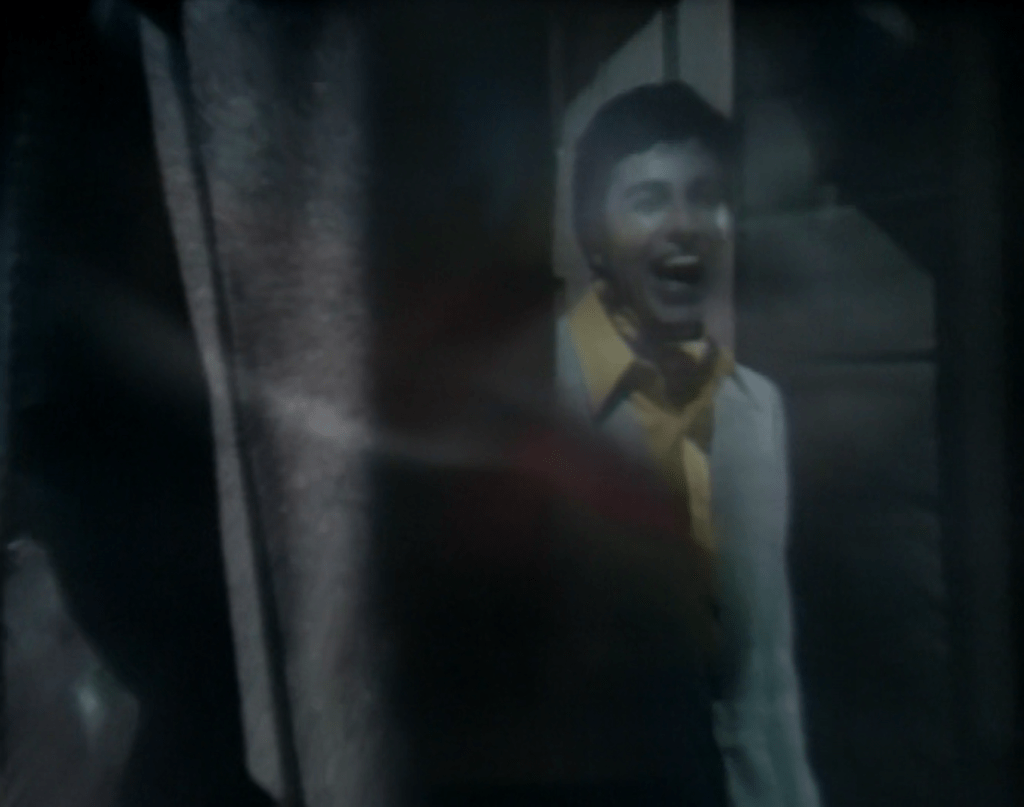
The only exception is the one that dominates the action today. In #994, we learned that a man named Dameon Edwards used to be a frequent visitor to the great estate of Collinwood. Dameon hasn’t been seen or heard from in about a year. He’s dead, as it happens, and his ghost has been popping up and making various people uncomfortable.

Dameon has a laugh at Quentin’s expense. Screenshot by Dark Shadows Before I Die.

Since the first thing we had ever heard about Dameon was that he was dead, we were off to a rocky start with him. The main continuity had a great success with Quentin Collins, who was introduced the same way. But Quentin was not only a member of the Collins family that is central to the show, he figured first as a series of weird and frightening events in the lives of children David Collins and Amy Jennings, characters we know and care about. Dameon’s only background is that he was one of many ex-boyfriends of Angelique Collins, the late and recently reanimated wife of Quentin’s counterpart. His actions are just a bunch of not-particularly scary special effects that are witnessed by people who have either been brought on so that they can worry about them, such as sleazy musician Bruno Hess and uptight butler Mr Trask, or who have bigger problems, such as Quentin and Angelique.

I’ve speculated in previous posts that this was not the original plan for Dameon. Maybe they planned to develop more of a connection between him and the action, and just couldn’t fit the necessary material into the first 13 scripts of the “Parallel Time” segment. Or maybe they did not intend to introduce a new character, but the counterpart of someone we know from the other continuity. Whatever they may have hoped to do, what they actually did falls absolutely flat.

To the extent that Dameon is the counterpart to anyone in the other continuity, it would be Quentin’s ghost. Indeed, today he leads Parallel Quentin to a room that reminds us of the one from which Quentin’s ghost began his reign of terror in late 1968 and early 1969. As 1969 went on, the living Quentin became an important character. Due to a trip back in time and some magic, he was prevented from dying and immunized against aging. The people he had haunted remembered the ghost, but the living Quentin was also around. Eventually they started to treat the ghost as a separate being from the Quentin who was a regular fixture of the cast of characters. So I suppose they might have intended to have Quentin’s ghost cross over into the current continuity, confusing David Selby when he saw himself wearing mutton chop sideburns, a Victorian-era suit, and a sardonic grin while he refused to speak. But that kind of thing was still a stretch for viewers when they did it on Twin Peaks twenty years later, and would have been a big ask for a daytime audience to follow in 1970.

Episode 994: I might as well be glad

Amy Collins twice sees the ghost of Dameon Edwards, whom she and others at the great house of Collinwood apparently knew when he was alive a year or so previously. At that time, Dark Shadows was set in a different universe than the one it has been showing us for the last few weeks, so the first thing the audience has ever heard about Dameon is that he is dead. Nor do we learn much more about him today. He looks at people with a vaguely sad expression, wanders off, and vanishes into thin air, never speaking a word. His part reminds me of G. K. Chesterton’s line that “Journalism consists largely in saying ‘Lord Jones is dead’ to people who never knew Lord Jones was alive.”

When Amy sees Dameon the second time, he leads her to the basement of Collinwood. This is a bit of a treat for longtime viewers. We may only have been in this universe for a few weeks, but the house is supposed to be laid out similarly to the one where we spent the previous 196 weeks, and the basement of that house was a significant set in the first year of the show. We haven’t been to that basement since #273, when it was revealed that reclusive matriarch Elizabeth Collins Stoddard was mistaken in her belief that she had killed her husband Paul and that he was buried in a locked storeroom there. It turned out Paul wasn’t dead at all. Liz was so embarrassed when her mistake was revealed that no one ever mentioned it again.

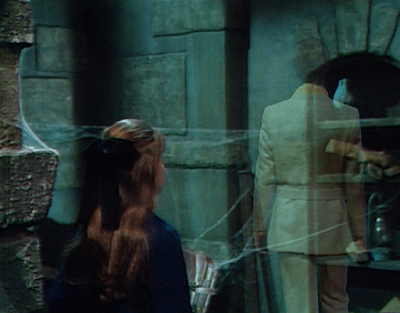
Dameon reminds us of that storeroom when he leads Amy, not to the spot where it was, but to an alcove in the wall opposite it. Amy’s cousin Daniel’s bedroom is a mirror image of his counterpart David’s bedroom in the other continuity. If the basement is a mirror image as well, the alcove to which Dameon leads Amy corresponds to the locked storeroom. Dameon turns towards the door, and vanishes as he walks into it. Amy screams.

He wasn’t there again today. Screenshot by Dark Shadows Before I Die.

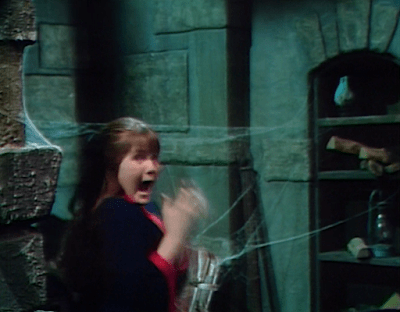
Dameon is completely new to the audience, and the story of Liz’ belief that Paul was buried in the basement is so old that the reference will be lost on anyone who hasn’t been writing up notices about every episode of the show for the last few years. So the whole thing is pretty ineffective. Indeed, while Amy is screaming Denise Nickerson is visibly struggling not to laugh out loud.

Oh I am sooo scared! Screenshot by Dark Shadows Before I Die.

I’m sure this episode is the result of a failed plan. Dameon must represent a character who would have meant something to us. Since most of the people we have seen in the last few weeks have the same names and are played by the same actors as counterparts from the original continuity, that character would likely have been a familiar face. The one face that would have brought the locked room in Liz’ basement to the minds of longtime viewers would have been that of Dennis Patrick. Patrick was in #273 as Jason McGuire, the seagoing con man who first convinced Liz that Paul was buried in her basement and then returned to exploit that belief by blackmailing her, and returned late in 1969 as Paul himself. Liz’ counterpart in the current universe is named Mrs Stoddard, so Paul must have existed there as well.

Patrick and his wife Barbara Cason were at this time in Tarrytown, New York, playing supporting roles in the feature film House of Dark Shadows. Patrick’s role as the sheriff puts him in only a few scenes, and Dan Curtis may well have hoped that once he’d got Patrick back to the East Coast he would be able to persuade him to return to the show for a short stint as Parallel Paul’s ghost. But Patrick was based in Los Angeles at this time, busy there as a producer and in demand as an actor, and he had no interest in coming back to a daytime drama taped in NYC for any length of time. So Dameon may have been a last-minute patch to cover Parallel Paul’s absence.

If Plan A had been that today’s ghost would represent Parallel Paul, Plan B appears to have been that he would remind longtime viewers of Quentin’s counterpart in the main continuity. Quentin was introduced late in 1968 as a ghost who did not speak. He first appeared to the children at Collinwood. Those were Amy’s counterpart, Amy Jennings, and her friend, strange and troubled boy David Collins, whose counterpart here is Daniel. Quentin’s ghost beckoned Amy and David into hidden rooms where they would, as they called it, “play the game.” When Dameon beckons Amy to the basement today, she asks if this is another of the games he used to play with her and Daniel.

The echo of the “Haunting of Collinwood” story is clear. But a revisiting of it that would have been effective would have taken some time to set up, especially since there is a living, speaking Quentin at the center of the show now. By the time they got to this topic, David Henesy had left to start his own stay in Tarrytown for House of Dark Shadows, so we won’t be seeing Daniel for a while. The most they can do is what we see here.

The upshot of these two aborted plans is a situation that does not seem to belong on the show at all, and it is no wonder Nickerson can’t keep a straight face. Even more than it reminds me of “Lord Jones is dead,” this installment reminds me of Edna St. Vincent Millay’s 1920 poem “The Penitent“:

I had a little Sorrow,

Born of a little Sin,

I found a room all damp with gloom

And shut us all within;

And, “Little Sorrow, weep,” said I,

“And, Little Sin, pray God to die,

And I upon the floor will lie

And think how bad I’ve been!”

Alas for pious planning —

It mattered not a whit!

As far as gloom went in that room,

The lamp might have been lit!

My Little Sorrow would not weep,

My Little Sin would go to sleep —

To save my soul I could not keep

My graceless mind on it!

So up I got in anger,

And took a book I had,

And put a ribbon on my hair

To please a passing lad.

And, “One thing there’s no getting by —

I’ve been a wicked girl,” said I;

“But if I can’t be sorry, why,

I might as well be glad!”

I don’t know if Amy had been a wicked girl, but the other characters today all seem to have secrets that it would behoove them to feel sorry for when Dameon shows up. There is drunken sourpuss Quentin Collins, who like Amy sees Dameon twice; sleazy musician Bruno Hess, whom Quentin suspects of having killed Dameon; and butler Mr Trask, who, when Quentin mentions Dameon, frantically denies knowing anything about him, and who, when Amy says she saw Dameon, squeezes a drinking glass so tightly it shatters in his hand.

This is the first time we see Mr Trask. He is the fourth character played by Jerry Lacy. Mr Lacy first joined the cast in the fall of 1967 to do his celebrated Humphrey Bogart imitation as lawyer Tony Peterson before finding immortality as overheated witch-hunter Reverend Trask in the 1790s flashback that ran from November 1967 to March 1968. That first Trask came to his end sealed in a basement alcove not so different from the one into which Dameon disappears today. That incident made a big impression, and was referenced several times on the show and time and again in spin-offs of Dark Shadows in other media. Mr Trask’s debut today may, in the original, never-developed plan, have been intended to remind viewers of it. Perhaps Mr Trask would be the one to open the alcove and find Parallel Paul’s remains. That would be a fitting way to join the story that introduced the idea of a basement burial to Dark Shadows with the famous story that showed one taking place.

Mr Lacy matched his triumph as the first Trask when he returned as his hypocritical descendant Gregory in the 1897 segment that spanned most of 1969. Today’s Mr Trask is in part a placeholder for sinister housekeeper Miss Hoffman. Quentin explains today that he sent Miss Hoffman to visit her friends. Mr Lacy was in one scene of House of Dark Shadows, a funeral sequence shot on the first day of principal photography, and unlike Dennis Patrick he was still living in NYC. So he was available for a couple of weeks of fill-in work. The role is thin on paper, but Mr Lacy gives the part a lot of life.