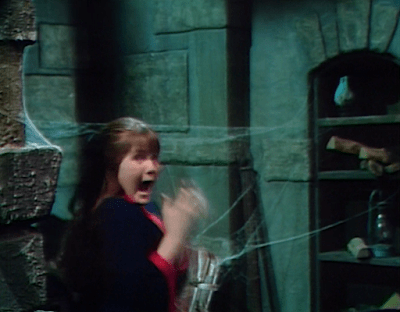
Episode 1050: How to bring you half alive

Late in 1968, the ghost of Quentin Collins began haunting the great house on the estate of Collinwood. The ghost gradually waxed more powerful and more malevolent, killing some people and tormenting others. By March of 1969, the great house had become altogether uninhabitable. Old world gentleman Barnabas Collins, trying to contact Quentin, traveled back in time to 1897, when Quentin was a living being. During the eight months the show was set in that year, we got to know a Quentin who was selfish, cowardly, untrustworthy, cruel, and supremely charming. Barnabas’ interventions changed history. In the revised timeline, Quentin did not become a malevolent ghost. He didn’t even die. A spell was cast on him that immunized him against aging, so that when the show returned to a contemporary setting in November 1969 he was alive, well, and to all appearances 28 years old.

In 1969 and 1970, Quentin still had all the lovableness that came from being played by David Selby. But the writers were stumped when it came time to give Quentin something to do. They kept him in a holding pattern for a month or so with a case of amnesia, and used him and one of his girlfriends to tell a version of the story of Orpheus and Eurydice. When Barnabas and his best friend, mad scientist Julia Hoffman, were doing battle with an unseen race of monsters from beyond space and time, they occasionally turned to Quentin for help. When Barnabas’ old nemesis, wicked witch Angelique, grew jealous of his interest in governess Maggie Evans, she cast a spell to cause Quentin and Maggie to conceive a wild passion for each other, something which came and went and which Barnabas never noticed. None of that activity made an impression on the audience or gave the character room to grow.

The evil but irresistible Quentin of 1897 had a great deal in common with high-born ne’er-do-well Roger Collins, who was in 1966 the show’s first true villain. As played by Louis Edmonds, Roger was so much fun to watch that it was soon out of the question to follow the original plan and kill him off when his crimes were exposed, so they nerfed him. Roger turned into a sarcastic but harmless snob. When in November 1967 the show went back in time to 1795, Edmonds played haughty overlord Joshua Collins, a man as strong as Roger was weak. In a tragic turn Aristotle would have admired, it was Joshua’s virtues that led to disaster for himself and everyone he loved. In the 1897 segment, Edmonds played the stuffy but lovable Edward Collins, who had many faults but was devoted to his family and committed to doing the honorable thing. Under the influence of these roles, Roger himself had by the time the show was done with him transformed into an upright family man.

The makers of the show have apparently decided that if traveling in time and casting Edmonds in other roles could change Roger so profoundly, finding a setting where they can present us with a different version of Quentin might be a path to reinvigorating that character. To that end, they have traveled, not backward in time, but sideways in time. We are now in a different universe than the one where the first 196 weeks of the show took place. The show insists on calling this universe “Parallel Time.”

Here, Quentin is the master of Collinwood and Maggie is his wife. This Quentin is something his counterpart never was, an authority figure. But authority does not come naturally to him, as it did to Joshua and Edward. He holds onto it in his relationship with Maggie by treating her as a child, with the result that their marriage is all but dead. He ignores his son Daniel, caves in to the servants when they stand their ground against him, and throws tantrums and runs away when he encounters serious opposition. In those moments he reminds us of the cowardice Quentin showed in 1897. On occasion, however, he has shown physical courage, as when he stood up to an evil man called John Yaeger. As Joshua suffered from the overgrowth of his virtues, so Quentin’s better deeds seem to be the accidental byproduct of his vices. What we have seen in Parallel Time makes it easy to imagine that when we get back to the main continuity, we will see Quentin as a sometime action hero who must at all costs be kept from taking charge of anything. Had the segment caught on as 1795 and 1897 did and been expanded beyond the bounds originally planned for it, who knows what other paths it might have opened for the character.

Angelique was Quentin’s first wife, who was murdered nine months ago but has risen from the dead, assumed the identity of her identical twin sister Alexis, and set about taking revenge on her killer. She doesn’t know who that was, though for now she is operating on the assumption it was Quentin.

Roger and the matronly Elizabeth Collins Stoddard are Quentin’s siblings. While in the main continuity Liz kept her share of the inheritance as Roger was squandering his, here she entrusted her money to Roger, so that they are both penniless dependents on Quentin.

Barnabas and Julia have crossed over from the main continuity. Barnabas is pretending to be a long-lost cousin of the Collinses, while Julia is impersonating her own counterpart. That other Julia Hoffman was the housekeeper at Collinwood and Angelique’s most fanatical devotee until Julia showed up, beat her to death, and stole her French maid outfit.

At this point, Quentin is on the run from the law, suspected of the murder of sleazy musician Bruno Hess. He was choking Bruno shortly before his death, but is in a sense innocent of the crime, since it was a spell Angelique cast that completed the fatal strangulation. Liz’ daughter Carolyn is in mourning for her husband Will, who found himself caught between Angelique’s magical powers and Barnabas’ and could do nothing but fling himself to his death from a high window. Yesterday Carolyn announced that she knew and could prove who had killed Angelique. She went to the room on top of the tower attached to the great house. A man entered. She greeted him. He drew a knife and she screamed.

Today, Roger tells Liz and Julia that he heard Carolyn’s scream, ran to the tower room, and found her stabbed to death. Presumably the same man killed her who killed Angelique. The three current suspects are Roger himself, Quentin, and butler Mr Trask.

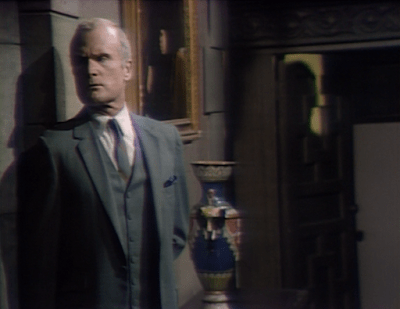
Yesterday’s episode hinted heavily that Trask was the culprit, and Liz says that he has been missing since Carolyn was killed. We had not seen or heard of Trask in more than eight weeks, and in none of the handful of episodes in which he appeared before that hiatus was it suggested he might have killed Angelique. If it does turn out that the butler did it, therefore, it would be obvious that the show had originally planned to pin the crime on a major character and chickened out at the last minute. We do see a man lurking about today who might be Trask and almost certainly is the mysterious and terrible “Claude North” whom we have heard about recently; if Trask and North are one and the same, that might lead somewhere, but it would hardly be a logical culmination of what we have seen so far.

The whole point of the “Parallel Time” segment is to reconceive Quentin. Making him the killer of Angelique might fit with that. The Quentin of the main continuity murdered his wife Jenny in 1897,* and Angelique is much less sympathetic than Jenny was. Quentin does not have to be admirable, or even defensible. He just has to be attractive. If they can find a way to occasionally make his vices into motives for good deeds, all the better. But Carolyn’s counterpart in the main continuity has been a central figure on the show since the first week, and like all characters played by Nancy Barrett she is a fan favorite. If this Quentin deliberately kills Carolyn, especially by hacking her to bits with a kitchen knife, it is hard to see how the Quentin of the main continuity will benefit. It is true the present Quentin is such a gloomy sourpuss and such a miserable failure as a husband to Maggie that he has already alienated the audience, so they might have decided they had nothing to lose by turning him into Jack the Ripper.

That leaves Roger. He has been painted in the colors of his counterpart as he was in 1966, making him a possible murderer. Even at his coldest, the Roger of the main continuity was close to Carolyn, whom he called “Kitten.” But when we first saw the characters from the current universe in #975, they were hostile and impatient with each other, and Roger took a menacing tone with his niece. The only person for whom this iteration of Roger has any affection is Angelique, and all of that flows to a version of her that exists only in his imagination. Roger seems to be describing himself in both universes when he tells Liz that “The sum total of my life seems to be that I can never help anyone.” So we can certainly believe he killed both Angelique and Carolyn, and that he might kill again.

Liz and Roger’s counterparts have been on the fringes of the action in the main continuity for years, and today we see that this Liz and Roger are also excluded from much that is happening. They visit the Collins family mausoleum in the old cemetery north of town scouting out potential resting places for Carolyn. Unknown to them, there is a hidden chamber in the back of this mausoleum, and Claude North is lurking there, a dagger in his hand, while they chat in the publicly visible part. They then go to Carolyn’s home, the Old House on the grounds of Collinwood, to look for anything she might have written that would give a clue as to who killed her. Unknown to them, Julia is in the basement of the house, conducting a mad science procedure to weaken Angelique by reviving a woman named Roxanne on whose “life force” she is feeding. One wonders where else they will stop on their way home, and of what other uncanny doings they will be oblivious while there.

We hear Julia’s thoughts as she is preparing to revive Roxanne. She tells herself that this is the procedure that brought Adam and Eve to life. She is not thinking of some obscure midrash about the book of Genesis, but about two Frankenstein’s monsters she loosed upon the world in 1968.

*Jenny must have been in someone’s mind when they were making this episode. We catch a glimpse of a gravestone in her name during a cemetery scene:
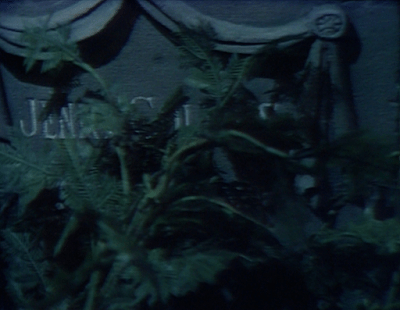
Poor Jenny, bright as a penny. Screenshot by Dark Shadows Every Day.

Episode 1049: Evening brings another secret

In the first months of Dark Shadows, characters several times shared meals in the kitchen in the great house on the estate of Collinwood. In that intimate setting, they would often exchange information that made it possible for them to advance the story. As time went on, the show developed more ways to get knowledge flowing, and the kitchen lost its importance. We haven’t seen it since #208.

Now, the show is set in an alternate universe, which it calls “Parallel Time.” We see the kitchen in this reality’s Collinwood today, the last glimpse we get of the room in any version of the place. Young Amy Collins visits butler Mr Trask there while he is sharpening a large knife. She tells him a man is living in the tower room. He leaves to investigate, leaving the knife on the countertop. The camera zooms in on the implement, lingering over it while an ominous cue plays on the soundtrack.

Later, Amy returns to the kitchen with the matronly Elizabeth Collins Stoddard. Liz is upset that dinner is not ready and Trask is nowhere to be found. Amy notices that the knife is not where Trask left it hours before. Liz is unimpressed with this fact, as anyone would be who had not seen the zoom shot and heard the melodramatic music. We cut to the tower room, where Liz’ daughter Carolyn Loomis greets someone we cannot see. We cut to a hand holding a knife very much like the one Trask had sharpened. The hand brings the knife down, and Carolyn screams.

It is Carolyn who is the main source of information for the other characters in today’s show. Carolyn’s husband was killed the other day in a conflict between two supernatural beings. The other characters in today’s episode have no idea that such beings dwell among them, and think that those two in particular are simply members of their extended family. Carolyn has had all she can take of this situation. She claims “to know all the secrets” of Collinwood, and is far too drunk to keep many of them to herself.

Trask learned several secrets from Carolyn in Act One, when he was leaning up against the door to the drawing room, his ear pressed hard to it, eavesdropping ferociously on her conversation with her uncle, Roger Collins. Carolyn taunts Roger with his failure to recognize someone he loves desperately. She declares that she can prove that the houseguest who has been staying in the great house lately is not Alexis Stokes, but Alexis’ identical twin sister, Angelique Stokes Collins.

Trask eavesdropping. Screenshot by Dark Shadows Before I Die.

Roger rejects this claim. Since Angelique died last year, one might expect Roger to be confident in his rejection, but he is high-strung and defensive about it. Carolyn does not deny that Angelique is dead. Indeed, she says that if anyone were to look at the base of “Alexis'” skull, they would find a scar where the killer drove in the hatpin that killed Angelique, proving that “Alexis” is Angelique’s reanimated corpse. This makes more sense to Roger than one might expect. When he first saw Alexis in #990 she had to give him her hand and talk soothingly to him for some time before he would accept that she was not Angelique risen from the grave.

As it happens, Carolyn is right. Two weeks after she met Roger, Alexis saw Angelique lying in the tomb. Alexis touched her sister to bid her a final farewell, only to find that all of the heat was draining from her body into Angelique’s. Moments later, Alexis was dead and Angelique was standing over her icy corpse. Angelique put on Alexis’ clothes, did her hair in the style Alexis wore, and met Trask, who accompanied her to the great house. Ever since, Angelique has been passing herself off as Alexis.

Amy interrupted Trask while he was eavesdropping. He ordered her to leave him alone, getting quite surly about it. If he can hear everything Carolyn and Roger are saying, we wonder why they can’t hear him being nasty to a member of the family. But apparently they can’t. She goes away, and he presses himself even closer to the door.

Carolyn is still talking to Roger and Trask is still eavesdropping when “Alexis” comes by. She reproves Trask, opens the doors to the drawing room, and exposes him to Roger and Carolyn. Roger is too shocked by the sight of “Alexis” and Carolyn is too amused by it all for either of them to do anything about Trask’s misconduct.

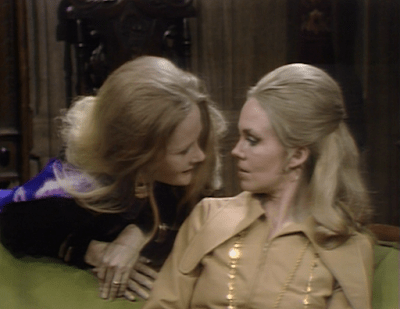
Later, Carolyn returns to the drawing room and finds her mother talking with “Alexis.” She leans down way into “Alexis'” personal space, making her hilariously uncomfortable.

Hello there. Screenshot by Dark Shadows Before I Die.

“Alexis” leaves them alone. Carolyn tells her mother that she knows who murdered Angelique. She says that she had suspected her, and is greatly relieved to know that she was wrong. Roger eavesdrops on this conversation, and turns around to see the shadow of yet another eavesdropper.

The Shadows’ knows. Screenshot by Dark Shadows Before I Die.

Carolyn tells Liz that she not only knows who the murderer is, she has talked to “him” recently. That doesn’t narrow it down. She has talked to all three current suspects, and all of them are men. Roger gets very agitated whenever the topic of Angelique’s murderer comes up; his reaction is one of many heavy-handed clues the show has been giving lately that he did it. They had not suggested Trask might be the culprit when he was last on the show, in #1004, but they couldn’t be more obvious about it today. The third suspect is Quentin Collins, brother to Roger and Liz, who is currently a fugitive from justice, having escaped from jail after he was charged with another murder. Quentin is the man living in the tower room; Carolyn saw him there the other day, and he took a threatening tone with her. So any of those three men might be the one wielding the knife in the final shot.

This is a day for final appearances. Not only do we bid the kitchen adieu, but also Carolyn Loomis, Mr Trask, and Amy Collins. Nancy Barrett and Jerry Lacy will be back as other characters, but Denise Nickerson is gone from the cast as of today. After a great run in her first couple of months on the show, she was criminally underused. Still, whenever they did put her on she was typically the highlight of the day, so it is sad to lose her.

Liz mentions someone named “Dr Blum” today. We never see Dr Blum. The only character in the whole series who seems to be Jewish is Dr Julia Hoffman, who like the unseen Dr Blum is a psychiatrist. It was less than a year after this episode aired, on 26 May 1971, that President Richard Nixon said in a conversation with his chief of staff H. R. Haldeman that the reason he was unpopular with Jewish voters was that “Most of them are psychiatrists.” Ever since the tape of that conversation was released in 2002, people have been trying to figure out what Nixon meant to say. Perhaps the White House taping system malfunctioned, and picked up some audio not from the Richard Nixon of our universe, but from one who lived in one of the universes where Dark Shadows took place. There, he might have been making a simple statement of fact.

Episode 1000: All people have a reason for their fears

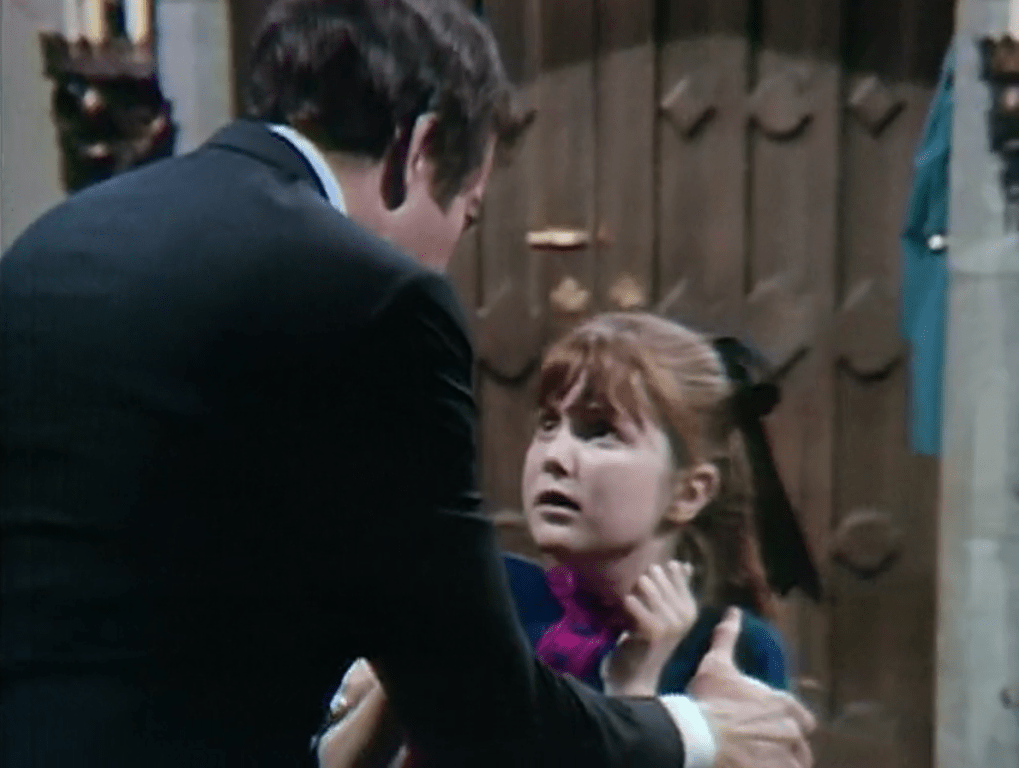
Trask the butler is surprised to see young Amy Collins in the great house of Collinwood. Amy’s cousin Quentin, the master of Collinwood, sent her to stay in the Old House on the estate, home to Will and Carolyn Loomis. The visibly uncomfortable Trask tells Amy she is not supposed to come back until Quentin sends for her. Amy says that she can’t stand it at the Loomises. Trask snaps at her for making life more complicated “at a time like this.” Amy asks what’s so unusual about this time, and Trask claims that he just means that he has been working hard. After an awkward silence, Amy asks if there has been any news about someone called Dameon Edwards. At Edwards’ name, Trask flies out of control. He grabs Amy by the shoulders, leans down so that his nose is in her face, and shouts that she has seen Edwards again. Terrified, she says she hasn’t. He shakes her and shouts louder, she freezes tighter and tighter. It’s getting pretty disturbing when the front door opens. Quentin enters, with two other adults, and demands to know what Trask thinks he’s doing.

Trask goes berserk.

Jerry Lacy and Denise Nickerson do a great job in this scene, which comes as no surprise to longtime viewers. For much of 1969, Dark Shadows was a costume drama set in 1897. In that segment, Nickerson and Mr Lacy played Nora Collins and the evil Gregory Trask. They were terrific together then, as they are today.

Gregory was cruel to children, including Nora. Gregory’s goal was to take control of Collinwood and all its residents, and for a time he seemed to be succeeding. As such, Gregory’s abuse of Nora left us feeling helpless. This Trask is not in control of anything, least of all himself. We don’t know exactly what secret he is frantically trying to keep in connection with Edwards, but we know he believes that it might be exposed at any moment and that when it is he will be ruined. He is acting from panic. Outrageous as Trask’s attack on Amy is, we can see that it is not likely to be repeated and it does not fill us with despair.

Quentin takes Amy to the drawing room and talks with her privately. She is absorbed in her dislike of the Loomises’ house. She says she has a feeling that something terrible is happening there, but she can’t give any reason why she should feel that way. She says that Will spends all of his time writing a new book. This surprises Quentin, who says that Will hasn’t written a word in five years. Amy says that he is busy now, and mentions that she stole a couple of pages from his wastebasket. Quentin asks if she still has them. She hands them over, and he reads them avidly.

Quentin is so enthusiastic about joining Amy in spying on Will’s new project that he forgets all about Trask. Amy seems to have forgotten him as well. When Quentin walked in and found Trask getting rough with her, it looked like he was going to dismiss him on the spot, but now it seems Trask will keep his job for a while longer.

The two who entered with Quentin were Cyrus Longworth and Alexis Stokes. Alexis is the identical twin sister of Quentin’s late wife, Angelique. Cyrus was a friend of Angelique’s, and is a fool. He is a scientist by occupation, and unknown to any of the other characters in today’s episode has been taking a potion of his own devising to turn himself into a hairier and more openly sadistic version of himself. That Jekyll and Hyde potion was the end product of an idea he got from Angelique. Cyrus tells Alexis today that Angelique was his teacher in matters of the occult, with which he is fascinated.

Quentin, Cyrus, and Alexis have returned from Angelique’s tomb. Alexis went there to try to prevent the men from unsealing the tomb and opening the coffin. They were so caught up in the idea that she was really Angelique come back to life that there was no point in her trying to talk sense to them. When they had done their work, they were astounded to find, not only that Angelique’s body was where it was supposed to be, but that it was perfectly preserved six months after her death. Quentin twice asked Cyrus how that could be, first appealing to his expertise as a scientist, then to his studies in occult lore, and each time Cyrus responded with a declaration that what they were seeing could not possibly exist.

The men are now convinced that Alexis is not Angelique, and they tell Trask this. He never thought she was, and is entirely absorbed in his fears about Dameon Edwards. All he says in reply is that he believes there is an evil presence in the house.

Quentin and Cyrus want to cremate Angelique’s body. They announced this plan while they were still in the tomb, prompting Alexis to remind them that her sister’s will specified that she be buried and to threaten to take them to court if they go against Angelique’s wishes.

Cyrus talks with Alexis in Angelique’s old bedroom, telling her that the body’s extraordinarily uncorrupted state has persuaded him that Angelique survives in some uncanny way. He urges her to let the body be destroyed. She continues to demur.

Cyrus says that when she was alive, Angelique had a “rapport with the unnatural” that inclines him to believe she might come “back from the death.” These awkward phrases were probably just line bobbles by Christopher Pennock, but they suit Cyrus well. He’s supposed to be an intellectual who spends little time talking to anyone, and such people do indeed tend to stumble over their words.

Later, Alexis summons Trask. She asks him to drive her to the cemetery and to keep their trip there a secret from Quentin. He acquiesces.

At the mausoleum, Trask is worried about an impending storm. He says he will go back to the car to get an umbrella, but Alexis tells him to forget about that. He is simply to wait for her in the car. She plans to spend only ten minutes with her sister’s remains.

Alexis looks in the coffin and talks to Angelique. She has bad news for her:

I don’t know what your secret was, Angelique, or why you still look as you did in life. I only know that it is wrong. It goes against the natural order of things. I don’t want to do what I have to do now. Quentin and Cyrus are right. Your body must be destroyed.

Distraught, Alexis puts her hand on Angelique’s shoulder, touching her sister one last time. We cut to a closeup of Angelique lying in her coffin. Her eyes pop open, and her lips curl into a smile. For a half a second, these motions look like they might be mechanical reflexes taking place within a dead body as it begins to decompose. But then she speaks: “My dear Alexis, you were always so right. Someone must be destroyed, but it won’t be me. It will be you.”

The show has kept us in suspense for three weeks as to whether Alexis was Angelique. Now, they’ve settled that question, and we know who Alexis is. Unfortunately for her, it seems we just have time to say goodbye.

In our world, bodies do sometimes turn up long after death showing no visible signs of decay. There were several vampire panics in Europe in the early modern era when exhumed corpses were found still looking fresh after months in the grave. Cyrus does not know of any such events in his world’s history, so he and Quentin have to come up with the idea of a panicked response on their own.

It has also been traditional in many branches of Christianity to regard a long-uncorrupted corpse as a count in favor of putting the person on the calendar of saints. Dostoevsky was hugely fashionable in the USA in the Cold War years of the 1950s and 1960s, and it is probable that the writing staff had at least a nodding acquaintance with The Brothers Karamazov. One of the central episodes of that novel comes when the admirers of the godly Father Zosima insist on leaving his body unburied for a long period, certain that it will remain uncorrupt and prove that the anniversary of his passing should be kept as a feast day. To their horror, his remains rot in the usual way. We’ve only been in this particular universe for four weeks, and the only indication we have so far had that Christianity even exists here came early on, when Will used the sign of the cross to immobilize and trap a vampire. So it is no surprise that Quentin, Cyrus, and Alexis never consider that the perfect preservation of Angelique’s body might suggest that she has taken a place among the saints.

Episode 994: I might as well be glad

Amy Collins twice sees the ghost of Dameon Edwards, whom she and others at the great house of Collinwood apparently knew when he was alive a year or so previously. At that time, Dark Shadows was set in a different universe than the one it has been showing us for the last few weeks, so the first thing the audience has ever heard about Dameon is that he is dead. Nor do we learn much more about him today. He looks at people with a vaguely sad expression, wanders off, and vanishes into thin air, never speaking a word. His part reminds me of G. K. Chesterton’s line that “Journalism consists largely in saying ‘Lord Jones is dead’ to people who never knew Lord Jones was alive.”

When Amy sees Dameon the second time, he leads her to the basement of Collinwood. This is a bit of a treat for longtime viewers. We may only have been in this universe for a few weeks, but the house is supposed to be laid out similarly to the one where we spent the previous 196 weeks, and the basement of that house was a significant set in the first year of the show. We haven’t been to that basement since #273, when it was revealed that reclusive matriarch Elizabeth Collins Stoddard was mistaken in her belief that she had killed her husband Paul and that he was buried in a locked storeroom there. It turned out Paul wasn’t dead at all. Liz was so embarrassed when her mistake was revealed that no one ever mentioned it again.

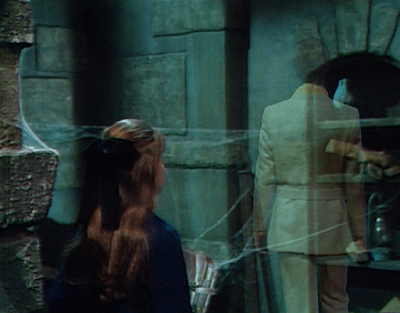
Dameon reminds us of that storeroom when he leads Amy, not to the spot where it was, but to an alcove in the wall opposite it. Amy’s cousin Daniel’s bedroom is a mirror image of his counterpart David’s bedroom in the other continuity. If the basement is a mirror image as well, the alcove to which Dameon leads Amy corresponds to the locked storeroom. Dameon turns towards the door, and vanishes as he walks into it. Amy screams.

He wasn’t there again today. Screenshot by Dark Shadows Before I Die.

Dameon is completely new to the audience, and the story of Liz’ belief that Paul was buried in the basement is so old that the reference will be lost on anyone who hasn’t been writing up notices about every episode of the show for the last few years. So the whole thing is pretty ineffective. Indeed, while Amy is screaming Denise Nickerson is visibly struggling not to laugh out loud.

Oh I am sooo scared! Screenshot by Dark Shadows Before I Die.

I’m sure this episode is the result of a failed plan. Dameon must represent a character who would have meant something to us. Since most of the people we have seen in the last few weeks have the same names and are played by the same actors as counterparts from the original continuity, that character would likely have been a familiar face. The one face that would have brought the locked room in Liz’ basement to the minds of longtime viewers would have been that of Dennis Patrick. Patrick was in #273 as Jason McGuire, the seagoing con man who first convinced Liz that Paul was buried in her basement and then returned to exploit that belief by blackmailing her, and returned late in 1969 as Paul himself. Liz’ counterpart in the current universe is named Mrs Stoddard, so Paul must have existed there as well.

Patrick and his wife Barbara Cason were at this time in Tarrytown, New York, playing supporting roles in the feature film House of Dark Shadows. Patrick’s role as the sheriff puts him in only a few scenes, and Dan Curtis may well have hoped that once he’d got Patrick back to the East Coast he would be able to persuade him to return to the show for a short stint as Parallel Paul’s ghost. But Patrick was based in Los Angeles at this time, busy there as a producer and in demand as an actor, and he had no interest in coming back to a daytime drama taped in NYC for any length of time. So Dameon may have been a last-minute patch to cover Parallel Paul’s absence.

If Plan A had been that today’s ghost would represent Parallel Paul, Plan B appears to have been that he would remind longtime viewers of Quentin’s counterpart in the main continuity. Quentin was introduced late in 1968 as a ghost who did not speak. He first appeared to the children at Collinwood. Those were Amy’s counterpart, Amy Jennings, and her friend, strange and troubled boy David Collins, whose counterpart here is Daniel. Quentin’s ghost beckoned Amy and David into hidden rooms where they would, as they called it, “play the game.” When Dameon beckons Amy to the basement today, she asks if this is another of the games he used to play with her and Daniel.

The echo of the “Haunting of Collinwood” story is clear. But a revisiting of it that would have been effective would have taken some time to set up, especially since there is a living, speaking Quentin at the center of the show now. By the time they got to this topic, David Henesy had left to start his own stay in Tarrytown for House of Dark Shadows, so we won’t be seeing Daniel for a while. The most they can do is what we see here.

The upshot of these two aborted plans is a situation that does not seem to belong on the show at all, and it is no wonder Nickerson can’t keep a straight face. Even more than it reminds me of “Lord Jones is dead,” this installment reminds me of Edna St. Vincent Millay’s 1920 poem “The Penitent“:

I had a little Sorrow,

Born of a little Sin,

I found a room all damp with gloom

And shut us all within;

And, “Little Sorrow, weep,” said I,

“And, Little Sin, pray God to die,

And I upon the floor will lie

And think how bad I’ve been!”

Alas for pious planning —

It mattered not a whit!

As far as gloom went in that room,

The lamp might have been lit!

My Little Sorrow would not weep,

My Little Sin would go to sleep —

To save my soul I could not keep

My graceless mind on it!

So up I got in anger,

And took a book I had,

And put a ribbon on my hair

To please a passing lad.

And, “One thing there’s no getting by —

I’ve been a wicked girl,” said I;

“But if I can’t be sorry, why,

I might as well be glad!”

I don’t know if Amy had been a wicked girl, but the other characters today all seem to have secrets that it would behoove them to feel sorry for when Dameon shows up. There is drunken sourpuss Quentin Collins, who like Amy sees Dameon twice; sleazy musician Bruno Hess, whom Quentin suspects of having killed Dameon; and butler Mr Trask, who, when Quentin mentions Dameon, frantically denies knowing anything about him, and who, when Amy says she saw Dameon, squeezes a drinking glass so tightly it shatters in his hand.

This is the first time we see Mr Trask. He is the fourth character played by Jerry Lacy. Mr Lacy first joined the cast in the fall of 1967 to do his celebrated Humphrey Bogart imitation as lawyer Tony Peterson before finding immortality as overheated witch-hunter Reverend Trask in the 1790s flashback that ran from November 1967 to March 1968. That first Trask came to his end sealed in a basement alcove not so different from the one into which Dameon disappears today. That incident made a big impression, and was referenced several times on the show and time and again in spin-offs of Dark Shadows in other media. Mr Trask’s debut today may, in the original, never-developed plan, have been intended to remind viewers of it. Perhaps Mr Trask would be the one to open the alcove and find Parallel Paul’s remains. That would be a fitting way to join the story that introduced the idea of a basement burial to Dark Shadows with the famous story that showed one taking place.

Mr Lacy matched his triumph as the first Trask when he returned as his hypocritical descendant Gregory in the 1897 segment that spanned most of 1969. Today’s Mr Trask is in part a placeholder for sinister housekeeper Miss Hoffman. Quentin explains today that he sent Miss Hoffman to visit her friends. Mr Lacy was in one scene of House of Dark Shadows, a funeral sequence shot on the first day of principal photography, and unlike Dennis Patrick he was still living in NYC. So he was available for a couple of weeks of fill-in work. The role is thin on paper, but Mr Lacy gives the part a lot of life.