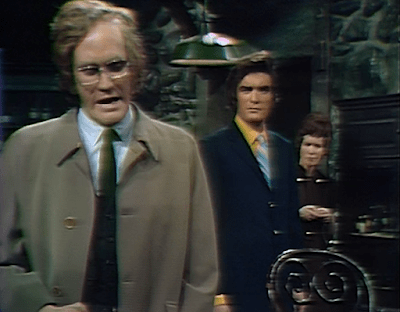
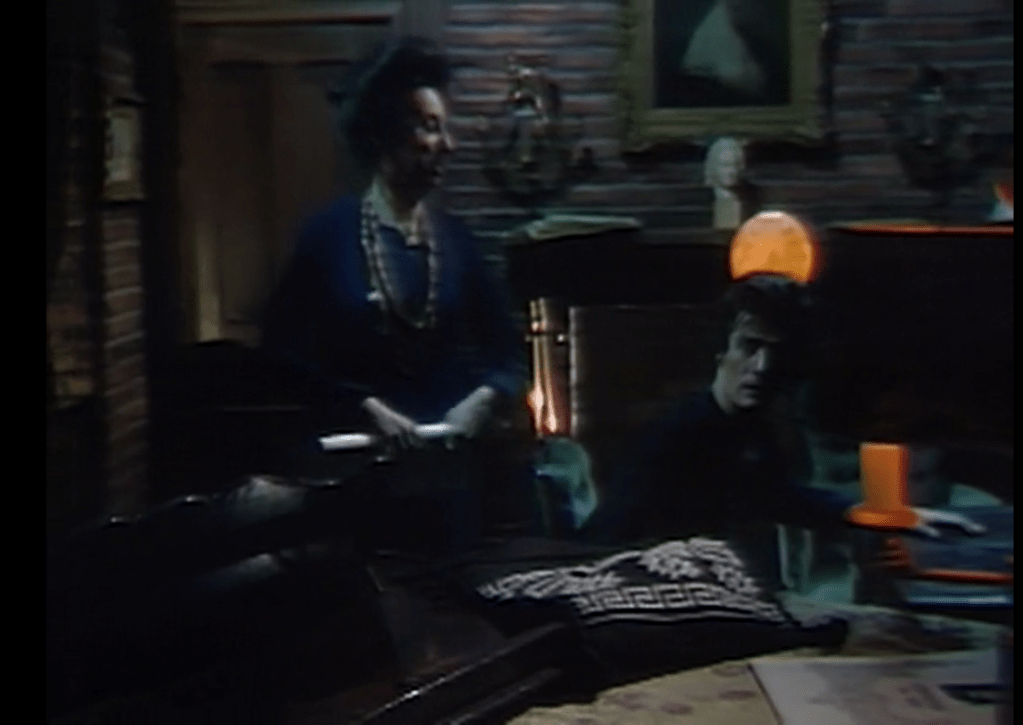
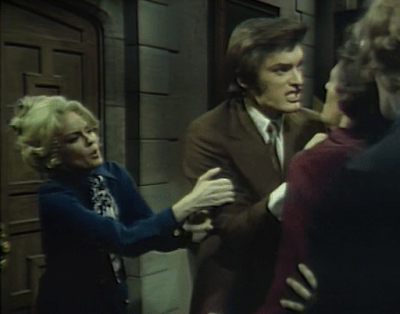
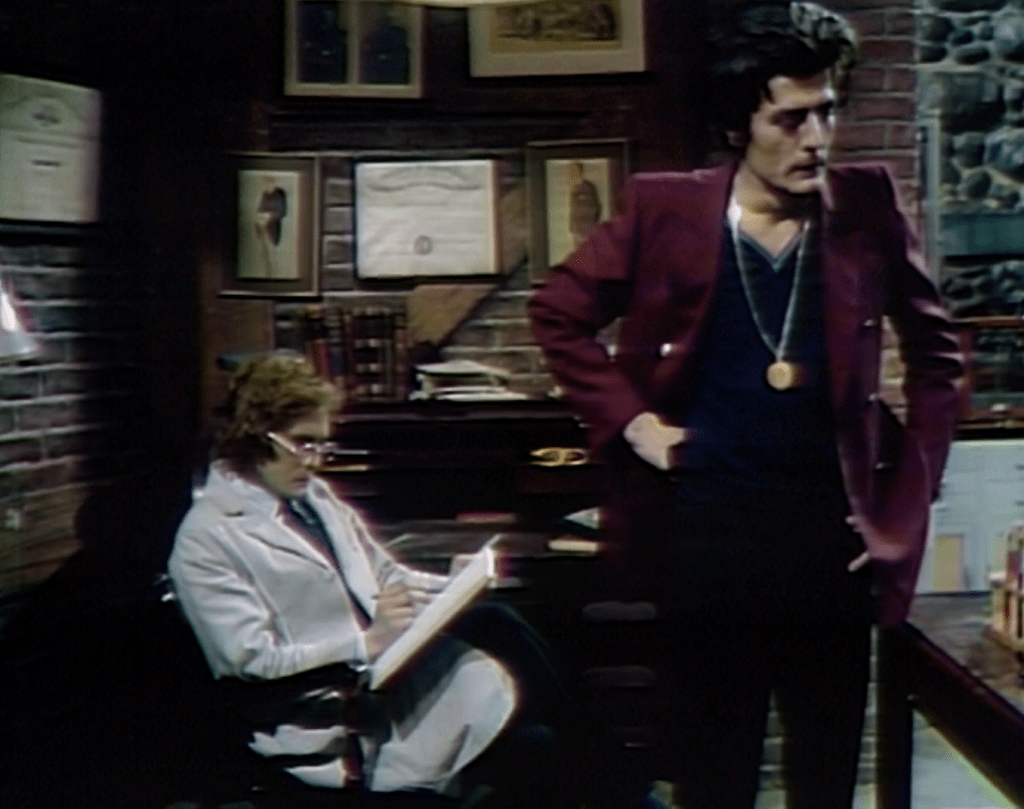
From its first episode, one of the principal sets on Dark Shadows has been the drawing room of the great house of Collinwood. So every violent death on the show has been pregnant with the possibility of a scene in which the characters gather on that set and a detective says that he supposes they are probably wondering why he asked them to join him there. We come as close to that scene today as we ever will.
The detective is Inspector Hamilton of the Collinsport police. That is itself a disappointment to regular viewers. In #1034, a detective played by Philip R. Allen made an appearance. He had little to do, but Allen was such a dynamic actor that it was gripping to watch him do it. When we heard that the police were on their way, we might have been excited to see Allen again. Inspector Hamilton is played by Colin Hamilton. It’s always a bad sign when the producers don’t trust an actor to answer to any name other than his own, and Hamilton’s performance is a case in point. The only note he strikes today is languid annoyance. Perhaps he had watched the Thin Man movies and been impressed by the use William Powell and Myrna Loy made of that note in their portrayals of Nick and Nora Charles in their drawing room reveals, but if so he had forgotten that Powell and Loy did other things as well.
Making matters worse, Inspector Hamilton does not actually have much to contribute. Sleazy musician Bruno Hess gave him photostats of a couple of pages of the journal of the late Cyrus Longworth, homicidal maniac, in which Cyrus speculates that his friend Quentin Collins murdered Angelique, his first wife. But Cyrus did not see Quentin commit that crime, so the papers are in no sense evidence.
Quentin gets very angry with Bruno. Standing next to Inspector Hamilton, he declares that Bruno will never make trouble for him again and that he will put a stop to him “with my bare hands!” He then rushes out of the house. At length, Inspector Hamilton moseys over to Bruno’s place.
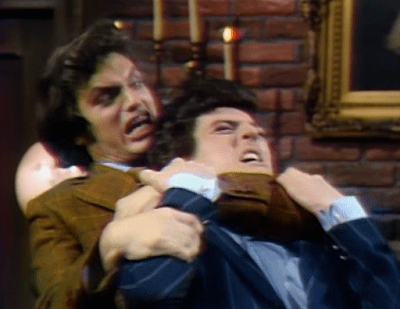
The camera gets there before Inspector Hamilton does. We find Quentin crushing Bruno’s throat in his elbow. He releases him and shouts that he isn’t “worth killing!” A moment later, Bruno starts choking and falls to the floor. Quentin ridicules him, then kneels down and finds that he really seems to be unconscious. Inspector Hamilton then enters and says that he hopes for Quentin’s sake that Bruno isn’t dead. This line is a bit surprising; it would have fit with Colin Hamilton’s lazy performance had Inspector Hamilton said that he hopes Bruno is alive so he won’t have to stay up late doing paperwork.
As it happens, Angelique has returned from the grave and is impersonating her identical twin sister Alexis. None of the other characters in today’s episode are onto her. We see her flash a self-satisfied grin every time Quentin annoys Inspector Hamilton by proclaiming his intention of killing Bruno. We also see her cast the spell that causes Bruno to choke and die.
Bruno’s death is no great shock. He smacked Angelique around yesterday, a sure sign of a short and unhappy future, and had been absent from the action and unmentioned on screen for more than six weeks before he came back on Tuesday. Actor Michael Stroka will be back later as another character.
Angelique could be fairly sure that Quentin was in Bruno’s cottage and that Inspector Hamilton was on his way there when she was casting the spell, but she has no powers of remote viewing. For all she knew, Quentin may have been choking Bruno while she was casting the spell. Had that been the case, we would have been presented with a puzzle in logic. Bruno would have died of strangulation while Quentin was strangling him, but there would be a sense in which we could say that Quentin was not the strangler. That sense might not have made much difference to Quentin’s felony exposure, though Angelique would also be guilty of the killing.
This scenario should remind viewers who have been with the show from the beginning of the first murder mystery on Dark Shadows, the vehicular homicide of a man known only as Hansen. Hansen was walking by the road one night in 1956 when a car hit him and continued on. The owner of the car, Burke Devlin, was convicted of manslaughter and sent to prison for five years. It later turned out that Burke had been blacked out drunk when he started driving the car away from a restaurant, and that he gave the keys to his passenger, Roger Collins, after they had gone some way. Roger was also heavily intoxicated, and he was behind the wheel when the car hit Hansen.
Burke claimed that Roger’s role in Hansen’s death exonerated him of guilt. But since Burke knew that Roger had had as much to drink as he had, handing the keys to him was scarcely more responsible than operating the vehicle himself. Indeed, by the time of the collision Burke had passed out, so if he had kept the keys the car would not have been moving and Hansen would have had nothing to fear. The fact that Roger was also guilty of a crime does nothing to clear Burke. Remembering that, we may wonder whether Angelique’s participation really clears Quentin.
The version of Quentin that became a major breakout hit was the one we saw in 1969, when the show was a costume drama set in the year 1897. That Quentin had all of the vices Roger had in 1966, and like Roger was witty and full of joie de vivre. The easygoing 27 year old David Selby had a sex appeal that reached young viewers who did not respond to Louis Edmonds in that way, and the show was free to make villains into permanent parts of the cast of characters at that point, so Quentin became what Roger might have been.
After the show returned to a contemporary setting in late 1969, it struggled to find a place for Quentin. Now they have crossed over into an alternate universe, and they have dabbled with the idea of turning his counterpart into an action hero like Burke. That hasn’t worked at all, but then Burke’s own arc of development fizzled out, so I suppose we can say that Parallel Quentin really is a mashup of Burke and Roger.
Dark Shadows spent yesterday and the day before showing us how much her relationship with vampire Barnabas Collins has cost Dr Julia Hoffman. Once a superlatively capable, masterfully poised scientist, Julia has become so ragged and dependent that she reacts to the sight of Barnabas rising from his coffin with a puppyish delight. She has followed him into an alternate universe, cutting herself off from everyone she knows and everything she has. Once in that universe, her first act was to kill her own Doppelgänger, leaving her face to face with a dead version of herself. She has set out to gather intelligence that might help Barnabas in his madcap schemes by impersonating that Doppelgänger, who was the housekeeper at the great house of Collinwood. In that persona, she wears a French maid outfit and disclaims all of her professional and educational attainments. Yesterday, Barnabas was briefly impressed by how much Julia had sacrificed for him; for a second or two, it looked like her love for him might be requited, at least to the extent of one kiss. But he turned his attention elsewhere, and now they are busy on a monster-slaying expedition.
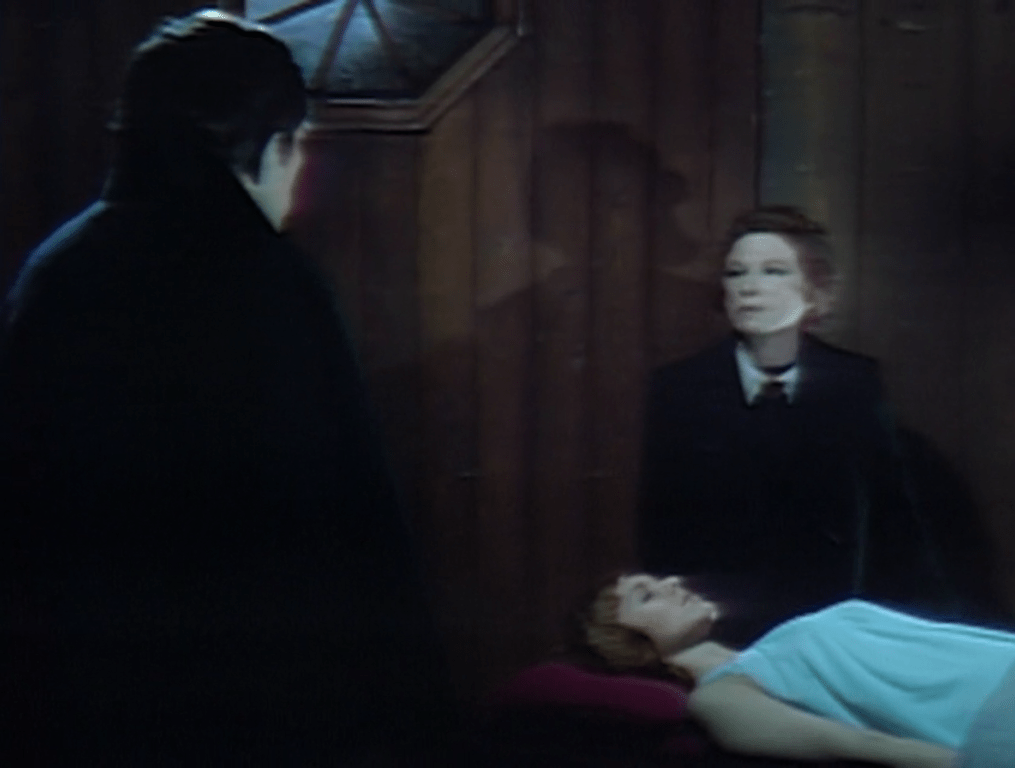
The monster is Angelique Stokes Collins, undead first wife of foul-tempered sourpuss Quentin Collins, master of Collinwood. Angelique’s father, a wizard known as Tim (but he’ll always be “Stokes” to us,) has somehow established an invisible connection between her and a woman he keeps in the back room of his apartment. We learn in the closing credits that this woman’s name is Roxanne. Roxanne is in a coma. Stokes has drained most of Roxanne’s “life-force” into Angelique. Occasionally Roxanne perks up a bit and regains some of her strength. When this happens, Angelique weakens. If Roxanne gets too vigorous, Angelique will die, but that will also happen if Roxanne herself dies. Stokes keeps busy trying to maintain Roxanne in her precise state of debility.
We find Julia and Barnabas in the room with Roxanne. They have learned the secret and come here to kill Roxanne, finishing off Angelique. They talk for a moment about Stokes, who is likely to find another way to revive Angelique if they kill Roxanne. They imply that they will kill him, too. That raises a question. Yesterday Julia saw Angelique collapse and become altogether helpless when Roxanne gained just a tiny bit of strength. If they are going to kill Stokes anyway, why not do that first? Then they can neutralize Angelique by giving Roxanne a little TLC and drop her off at the hospital on their way back to their native universe.
Barnabas doesn’t think of that, but neither does he go through with the murder. He sees Roxanne, raves about her looks, and says in a world full of ugliness they have no right to destroy such beauty. Julia just keeps insisting that they finish her off, and says that if they don’t the blood of Angelique’s future victims will be on Barnabas. That is further evidence of what Julia has lost in her time at Barnabas’ side. Up to this point, she has consistently shown reluctance when he was planning a murder.
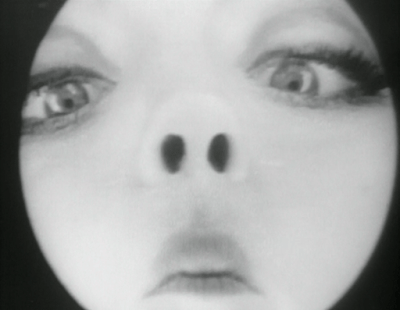
Barnabas says that he has never seen a face like Roxanne’s. He’s the only one. With her short red hair, pale skin, and strong chin, Roxanne looks very much like Julia. Indeed, the fans sometimes refer to Donna Wandrey as “Grayson Hall, Junior.” When we see the two together, we wonder if it will turn out that Roxanne is the daughter of the late housekeeper Julia Hoffman. It would be typical of Barnabas to reward Julia’s extreme devotion to him by forgetting all about her and chasing after a girl whose mother she might have been.
Meet Junior.
There’s also a lot of business today about two minor villains, sleazy musician Bruno Hess and high-born ne’er-do-well Roger Collins. Michael Stroka and Louis Edmonds were always fun to watch, but Roger and Bruno are absent and unmentioned for such long stretches that it is hard to believe that anything important is at stake in what they do. Like most of the characters, Bruno believes Angelique’s cover story that she is her identical twin sister Alexis. Acting under this impression, he smacks her around a couple of times. So we can see that he is going to be dead soon, though she will likely make him wish it were a lot sooner.
Roger announces that he has been named executor of the estate of the late Dr Cyrus Longworth. This means he will be coming into some money and perhaps learning some secrets. Quentin’s current wife, the former Maggie Evans, is lonely because her husband is a hopeless jerk. She tries to be friendly to Bruno, and he gets fresh. While he is grabbing her, Roger enters and sneers at Maggie.
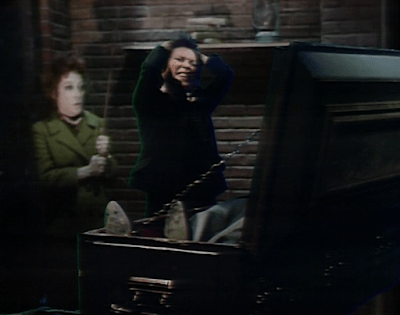
Housekeeper Julia Hoffman, fanatical devotee of the undead Angelique Stokes Collins, has discovered that Angelique’s enemy Barnabas Collins is a vampire. Hoffman is standing at Barnabas’ open coffin. In one hand she holds a stake on his chest, in the other a mallet upraised.
As Hoffman is about to rid the world of this loathsome abomination from beyond the grave, another woman strikes her dead. This woman appears to be Hoffman’s identical twin. Regular viewers know that she is another Julia Hoffman, a Doppelgänger intruding here from another universe. This Julia is a medical doctor by qualification and a mad scientist by vocation, and she is as committed to Barnabas as Hoffman is to Angelique.
Julia sees her own face on a corpse of her own slaying. She leaves the secret chamber and closes the panel that hides it. A man enters the house. He takes Julia to be Hoffman, and demands to know why she is there and why she is not wearing her French maid uniform. Julia says that she was running an errand, and that she is on her way into town. The man remarks that she does not seem like herself; she replies that “I am who I am.” The man does not give any sign that this assertion reminds him of either Popeye the Sailor or the God of the Book of Exodus. Longtime viewers will already have noticed more than a few parallels between Julia and each of these characters.
The man says he has come to the house to see its master, Will Loomis. He wants to ask Will for money so that he can leave town. When Julia says that Will is sleeping and may not be up for hours, the man turns his request to her. He says that he, Angelique, and others had paid her plenty over the years in return for her discretion, and he asks for $500. She says she doesn’t have any money with her. Indeed, she is not carrying a purse, and her bank account and other liquid assets are all located in a different universe. The man leaves.
Julia is back in the secret chamber trying to figure out what to do when Will comes home. He pulls a gun on her. He is one of Barnabas’ blood thralls, and is in charge of protecting him during the day. He knows that Hoffman and Angelique are Barnabas’ enemies. Thinking that Julia is Hoffman, he is prepared to kill her. She denies that she is Hoffman, and tells him that if he looks in the secret chamber he will know she is telling the truth. He does, and a look of recognition comes on his face. “You are Julia!” he says, delighted. Barnabas had told Will about her and others in his own universe, and he couldn’t be happier to meet her.
Julia decides to masquerade as Hoffman. She says that if she could fool the man who came by earlier, whose name is Bruno, she should be able to fool Angelique and the others. Will points out that fooling Bruno for a few minutes is not the same thing as fooling Angelique for an indefinite time, but Julia is nothing daunted.
Julia passes the first test. Angelique finds her in her room and demands where she has been all day. Julia says she was following Barnabas, as per her orders. That is the right answer. Angelique asks what she was talking about last night when she said on the telephone that she had discovered Barnabas’ big secret and would tell her what it was when they were face to face. Julia says that she thought she was onto something while following him around, but in the light of day it turns out to be pretty vague. Angelique is frustrated and orders her to resume snooping on Barnabas.
Meanwhile, Bruno has learned that his acquaintance Cyrus Longworth the mad scientist is dead. Cyrus had kidnapped Maggie Evans Collins, second wife of Angelique’s widower Quentin Collins. Barnabas killed Cyrus while rescuing Maggie.
Bruno knows that Cyrus kept a big wad of cash in the wall safe in his laboratory, in the sum of “thousands!” of dollars. He goes to the lab and rummages through the papers on the desk, certain that the combination to the wall safe is there. That seems like bad OpSec, but Cyrus wasn’t very shrewd, so it is no surprise that Bruno turns out to be right. He finds that the cash is gone. All that is in the safe is a notebook. Bruno is furious at the sight of the notebook, exclaiming “Why aren’t you money!?”
Bruno sees that the notebook is marked to be delivered unread to Quentin Collins in the event of Cyrus’ death. Bruno reads it and laughs joyously. He says that he was mistaken when he said there was no money in the safe. There is far more money than he hoped for.
Bruno telephones Angelique. Like almost everyone else, Bruno believes Angelique to be her identical twin sister Alexis. Angelique rose from the dead and murdered Alexis, who was already established as Quentin’s permanent guest in his home, the great house of Collinwood. Alexis was convinced that Angelique was murdered and was trying to investigate when Angelique killed her. For her part, Angelique knows she was murdered and very much wants to complete that investigation. Bruno happily tells “Alexis” that he knows who murdered Angelique.
Bruno’s claim that the notebook represents far more money than he had hoped for narrows the range of possible suspects to one. He hoped for thousands of dollars, so whatever message Cyrus wanted to deliver to Quentin must be something that can be leveraged for hundreds of thousands or millions. Quentin himself is the only person we’ve seen who has resources like that. He is too selfish to pay blackmail to conceal anyone else’s guilt, even that of his closest family members, so the notebook must contain an accusation against Quentin. Whether that accusation is correct, of course, remains to be seen.
The show has been spending a lot of time lately trying to interest us in the ghost of Dameon Edwards, a man who doesn’t seem to have had much going for him even when he was alive. They went through the motions of a murder mystery concerning Dameon’s death. The episode that introduced him also hinted that he was killed by sleazy musician Bruno Hess with the complicity of butler Mr Trask, and those hints are confirmed today. So the mystery was never much of a puzzle. Besides, Bruno and Trask are the counterparts of homicidal villains whom we saw in the universe where Dark Shadows was set for its first 196 weeks, so we’ve expected all along that they would turn out to have someone’s blood on their hands. And neither of them is the central figure in an ongoing story, so even if they had been brought to justice for their crimes it would only be an easy way for the writers to dispose of characters who were going to be written out anyway.
Today, wicked witch Angelique finds Dameon’s skeleton sealed up in an alcove in the basement of the great house of Collinwood. She summons his ghost and dismisses him. That’s it for Dameon. What will happen to the skeleton, or to Bruno, or to Trask, or to the alcove, we don’t yet know.
The sight of the skeleton standing in the alcove does remind us of one of Trask’s alternate universe counterparts, a fanatical witchfinder who was sealed up in a basement alcove elsewhere on the estate in 1796. Since Trask is involved in this little arc, it’s a nice touch to connect it to that other Trask.
Most of the episode is devoted to a far more interesting story, an adaptation of Jekyll and Hyde. They’ve been focusing on the addiction angle. Mad scientist Cyrus Longworth is hooked on the potion that changes his appearance and allows him to fool even people who know him well into believing that he is a separate person by the name of John Yaeger. He enjoys the violence that he commits as Yaeger.
Today, three people try to save Cyrus from himself. Lawyer Larry Chase resists Cyrus’ instructions to transfer $5000 to Yaeger and to rewrite his willin Yaeher’s favor; chemist Horace Gladstone is reluctant to keep selling Cyrus a volatile synthesis he needs for the potion, and figures out that he and Yaeger are one and the same; and Buffie Harrington, who is exploring her masochistic side by submitting to beatings from Cyrus as Yaeger but still thinks the two are different people, goes to Cyrus to urge him to be more careful in his dealings with Yaeger. Dark Shadows has dealt intelligently and sensitively with the theme of addiction from its earliest days, and today’s focus on people who care about the addict trying to help him achieves a real poignancy.
We may wonder if drug abuse was a particularly timely topic behind the scenes of Dark Shadows at this point. Larry is a substitute for the character of Chris Collins, who was played by Don Briscoe. Briscoe would eventually be diagnosed with bipolar personality disorder, and in 1970 was trying to self-medicate with street drugs.
The makers of the show didn’t give up on Briscoe until the absolute last minute. This episode was taped very close to airtime, after episodes that would be broadcast weeks later were already in the can, giving Briscoe as much time as possible to get himself together. The part of Larry was played by Ken McEwen. McEwen joined the show in August 1968 as an associate director. He had a guild card due to small parts he had taken in a couple of TV shows in the 50s, but had never been an actor full-time. And he clearly hasn’t had much time to learn his dialogue. He is perfectly competent in the first of his two scenes, when Larry is in The Eagle tavern with Yaeger, Gladstone, and Buffie. There are no major bobbles and you can tell exactly what is on his mind. But when Larry returns and meets with Cyrus in his laboratory, McEwen stumbles over every line and never develops a coherent attitude.
The music is interesting today. The Eagle in the current universe corresponds to the Blue Whale, Collinsport’s tavern in the main continuity, and while we are there we hear the jukebox music that was prominent in the show’s first year. There is a scene between Gladstone and Buffie in her apartment; when that opens, we hear some music I don’t believe we’ve heard before. If they’ve written a theme for Buffie, it gives us hope we will see a lot more of Elizabeth Eis’ excellent performance in this role.
The original videotape master of this episode was lost. We have it on a kinescope. I love the kinescopes; I wish all the episodes were available in that format, as well as the videotapes. We haven’t seen one since #813, and will see only one more, #1017. You can always set the options on your device to display in black and white, but the kinescope comes with some visual blurring and sound distortions. Those are usually flaws, of course, but when the show has already given you the feeling that you are catching a glimpse of another reality they can add to the eeriness and yearning for what might have been.
Quentin Collins walks into the bedroom once occupied by his late wife Angelique, where Angelique’s identical twin sister Alexis is staying. Quentin arrives just in time to see sleazy musician Bruno Hess strangling Alexis. He interrupts this process. Bruno is convinced that Alexis is Angelique returned from the grave, and that she is responsible for many strange and unhappy occurrences that have taken place on the estate of Collinwood since her arrival.
Bruno holds the deed to a cottage on the grounds of the estate and lives there, to Quentin’s intense annoyance. He hates Bruno, who had an affair with Angelique, a fact he likes to throw in Quentin’s face. You might think Quentin would call the police and report Bruno’s assault on Alexis. Not only would that result in a felony charge, but if Bruno bursts out with his suspicions it should be easy to get a civil commitment order that will earn him a a long stay in a home for the very nervous. But Quentin leaves Alexis and Angelique’s room without calling the sheriff. What’s more, when he goes to the drawing room and finds Bruno still in his house he has a lengthy conversation with him and waits for him to go. He never does telephone the police.
By the end of the episode, Quentin has convinced himself to take Bruno’s theory seriously. Alexis overhears him talking about it with his friend Cyrus Longworth. Quentin tells Cyrus that they must open Angelique’s tomb and look in her coffin.
Alexis finds them there, the coffin already out of its niche. She objects to the desecration of her sister’s resting place. She promises to leave Collinwood immediately if they will let Angelique rest in peace. Quentin refuses. He opens the box. Whatever he finds inside prompts a reaction of shock on his face and on Alexis’ as they look inside.
Between these scenes, we spend time in Cyrus’ laboratory. He is a mad scientist who has devised a Jekyll and Hyde potion. His alter ego goes by the name John Yaeger. Cyrus’ fiancée Sabrina Stuart is a sweet, trusting young woman who is determined to believe the best of Cyrus, but she has heard so much about Cyrus’ involvement with the brutal Yaeger that she is certain something is terribly wrong. We know that Cyrus was close to Angelique, and that she put him up to the Jekyll and Hyde experiment. Sabrina doesn’t know what Cyrus’ project is, but his withdrawn and irritable manner reminds her of the influence Angelique had on him. She says “It’s the same as it was when Angelique was alive- you were different then, and you’re different now.” I’m sure that was the scripted line, too.
Sabrina demands Cyrus stop lying to her and tell the truth about who Yaeger is and what hold he has over him. We saw yesterday that Cyrus’ attitude towards the potion and towards his time as Yaeger is already that of an addict towards his drug, and he sullenly refuses to answer any of Sabrina’s questions, even with more lies. She grows more and more exasperated.
Sabrina’s time with Cyrus is cut short when barmaid Buffie Harrington enters and insists on talking with Cyrus alone. Yaeger gave Buffie a check signed by Cyrus to cover the damages he did to her place of employment in a bar fight the other night; she wants to know if the check is authentic. Cyrus confirms that it is, much to Buffie’s delight. She mentions that her sometime boyfriend Steve is in the hospital because of a beating Yaeger gave him; Cyrus hands her a pile of cash to cover Steve’s hospital expenses. Buffie tells Cyrus that Yaeger has taken rooms in the boarding house where she stays, and that he frightens her. She does not tell him that Yaeger has hit her, choked her, and threatened her every time they have met. We know that he knows that- he has met her only when he was in the form of Yaeger, and he recognizes her on sight, showing that he remembers their encounters. Buffie asks if Yaeger works for Cyrus. He smiles with great satisfaction and says that he does.
That smile is a key moment. Yesterday’s episode gave the Jekyll and Hyde story a new lease on life by confirming that it will indeed be about addiction. That’s the usual thing with that material, but Dark Shadows has taken familiar tales in such weird directions that we could by no means take it for granted that its version would follow the typical pattern. Cyrus’ response to the thought that he controls Yaeger, who has put Steve in the hospital and is terrorizing Buffie, confirms something else. Cyrus’ diffident manner and scientific preoccupations help Sabrina hold onto the idea that he is a sweet man whose only flaw is naïveté, but Christopher Pennock’s rendering of that smile leaves no doubt that Yaeger is Cyrus’ means of indulging his own sadistic impulses.
As Buffie is leaving, Cyrus asks her if she likes Yaeger. Holding her head high, she says that sometimes she does. She sounds like she means it. Buffie was a commanding presence when first we saw her, and she is forceful throughout this scene. But she has given up on fighting back against Yaeger or even trying to run away from him. Her line suggests that she is not simply giving in to fear, but is drawn to a masochistic fantasy. Yaeger has been so vicious and Cyrus is so sinister that there is no prospect this fantasy is going to be channeled into any kind of consensual game- Buffie is drifting into a situation that can lead only to her destruction.
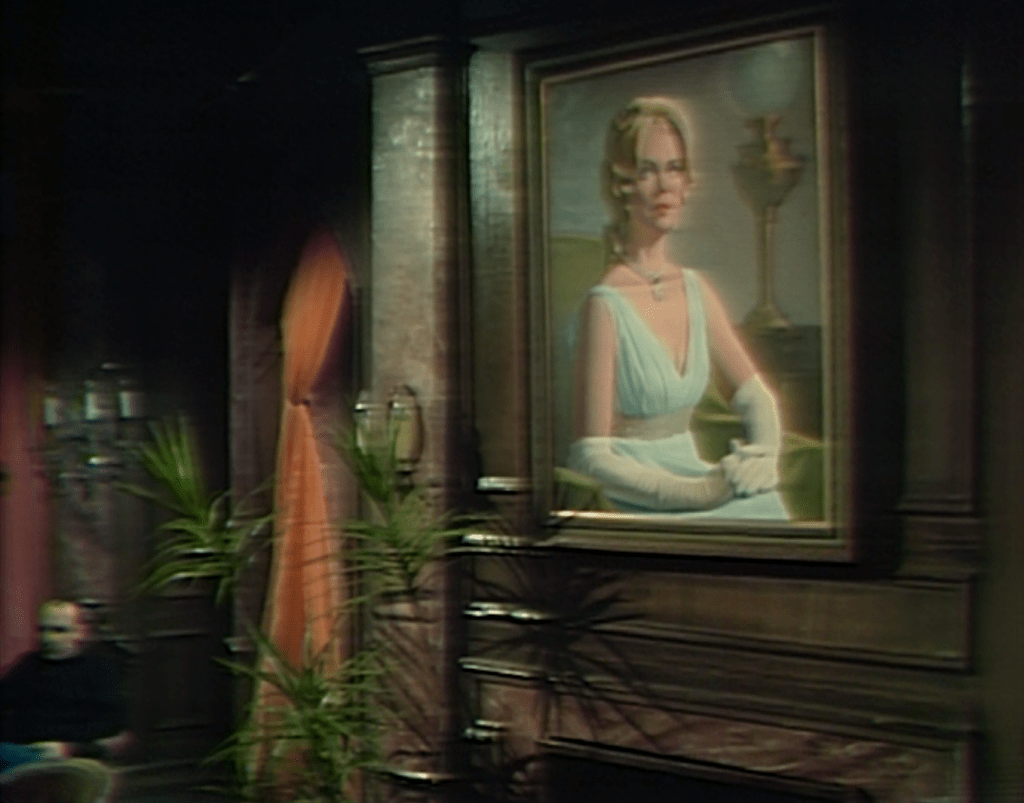
This episode includes one of the all-time great bloopers. The closing credits run over a shot of Angelique and Alexis’s room. For the first minute or so, we see a man sitting in a chair, chewing on something. Whoever he was, apparently he decided he’d found a good spot for lunch. Eventually the camera zooms in on the portrait of Angelique that dominates the room. This is so obviously an attempt to get the lunch-eater out of the frame that it only adds to the hilarity.
Writer Gordon Russell has to give two characters plausible motivations today, and he succeeds admirably.
One is Dr Cyrus Longworth, the apparently nice half of a Jekyll and Hyde duality. Jekyll and Hyde is a story about drug addiction, but Dark Shadows has so often featured villains whose crazy ideas have turned out to be true that we can’t be sure the show’s version will be that way. For all we know, it might turn out that Cyrus really has developed a method of separating the good from the evil in human nature and that he will use it to breed a new race.
Today, Cyrus is confronted in his laboratory by his fiancée Sabrina Stuart and his friend Quentin Collins about his association with his alter ego, whom they believe to be a separate person named John Yaeger. Cyrus pulls himself up to his full height and declares “I can end my relationship with Yaeger any time it suits me.” At this, the universal motto of the addict, we know just what is driving Cyrus. We can set aside all the talk in the opening voiceovers and elsewhere about how good and innocent Cyrus is, and see him as a man in the grip of a force he won’t face and can’t beat.
The other character in need of an intelligible motivation is Cyrus’ friend, sleazy musician Bruno Hess. Bruno is staying in a room above Cyrus’ laboratory in hopes that the ghost of a man he murdered won’t be able to find him there. The ghost appears to him there today, and sets the room on fire. Cyrus helps Bruno put the fire out, and talks about trying to exorcise the ghost. Bruno tells Cyrus he doesn’t believe he can help him. When he says this, Bruno seems, for the first time, reasonable. He has asked many things of Cyrus, so many that we might think of him as nothing more than a source of ever-escalating demands. But when he says that what is happening now is outside Cyrus’ province, we can see that there is some kind of mental process going on in his head.
Bruno thinks the ghost and the fire were both sent by Quentin’s late wife, Angelique. In the universe where Dark Shadows spent its first 196 weeks, Angelique’s counterpart is a witch who has a complicated relationship to fire. She is vulnerable to it, but can also use it in various ways. And, she has returned from the dead many times. If the Angelique in this continuity is like that one, it would make sense to suspect her. Angelique’s identical twin sister Alexis is Quentin’s guest at the great house of Collinwood. Bruno believes Alexis is really Angelique. He bursts in on her and says that he has a way to test whether she is Angelique returned from the dead. If she is, she can’t die again. So he sets about strangling her. If he kills her, Bruno will know he was mistaken.
In the main continuity, every drawer in every table at the great house contains a loaded gun. Longtime viewers have no reason to doubt that the same circumstance obtains here. So if we had not seen Bruno being rational in his scene with Cyrus, we would have no question in our minds but why Alexis does not draw a weapon and shoot the crazy man who is going to do nothing but try to kill her. That moment of lucidity makes the scene interesting. It even makes it somewhat surprising that Bruno goes all the way to homicide- we know he is a strange and violent man, but if he could think as clearly as that, maybe he could come up with a less drastic expedient.
The “Dan Curtis Productions” logo at the end of the closing credits is printed in a simpler style than it has been so far. We will see this new style several more times in the remaining months of the show.
Amy Collins twice sees the ghost of Dameon Edwards, whom she and others at the great house of Collinwood apparently knew when he was alive a year or so previously. At that time, Dark Shadows was set in a different universe than the one it has been showing us for the last few weeks, so the first thing the audience has ever heard about Dameon is that he is dead. Nor do we learn much more about him today. He looks at people with a vaguely sad expression, wanders off, and vanishes into thin air, never speaking a word. His part reminds me of G. K. Chesterton’s line that “Journalism consists largely in saying ‘Lord Jones is dead’ to people who never knew Lord Jones was alive.”
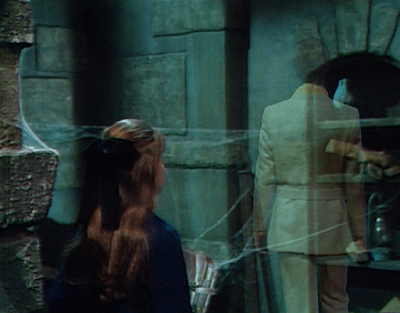
When Amy sees Dameon the second time, he leads her to the basement of Collinwood. This is a bit of a treat for longtime viewers. We may only have been in this universe for a few weeks, but the house is supposed to be laid out similarly to the one where we spent the previous 196 weeks, and the basement of that house was a significant set in the first year of the show. We haven’t been to that basement since #273, when it was revealed that reclusive matriarch Elizabeth Collins Stoddard was mistaken in her belief that she had killed her husband Paul and that he was buried in a locked storeroom there. It turned out Paul wasn’t dead at all. Liz was so embarrassed when her mistake was revealed that no one ever mentioned it again.
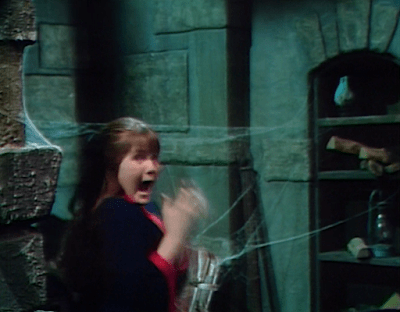
Dameon reminds us of that storeroom when he leads Amy, not to the spot where it was, but to an alcove in the wall opposite it. Amy’s cousin Daniel’s bedroom is a mirror image of his counterpart David’s bedroom in the other continuity. If the basement is a mirror image as well, the alcove to which Dameon leads Amy corresponds to the locked storeroom. Dameon turns towards the door, and vanishes as he walks into it. Amy screams.
Dameon is completely new to the audience, and the story of Liz’ belief that Paul was buried in the basement is so old that the reference will be lost on anyone who hasn’t been writing up notices about every episode of the show for the last few years. So the whole thing is pretty ineffective. Indeed, while Amy is screaming Denise Nickerson is visibly struggling not to laugh out loud.
I’m sure this episode is the result of a failed plan. Dameon must represent a character who would have meant something to us. Since most of the people we have seen in the last few weeks have the same names and are played by the same actors as counterparts from the original continuity, that character would likely have been a familiar face. The one face that would have brought the locked room in Liz’ basement to the minds of longtime viewers would have been that of Dennis Patrick. Patrick was in #273 as Jason McGuire, the seagoing con man who first convinced Liz that Paul was buried in her basement and then returned to exploit that belief by blackmailing her, and returned late in 1969 as Paul himself. Liz’ counterpart in the current universe is named Mrs Stoddard, so Paul must have existed there as well.
Patrick and his wife Barbara Cason were at this time in Tarrytown, New York, playing supporting roles in the feature film House of Dark Shadows. Patrick’s role as the sheriff puts him in only a few scenes, and Dan Curtis may well have hoped that once he’d got Patrick back to the East Coast he would be able to persuade him to return to the show for a short stint as Parallel Paul’s ghost. But Patrick was based in Los Angeles at this time, busy there as a producer and in demand as an actor, and he had no interest in coming back to a daytime drama taped in NYC for any length of time. So Dameon may have been a last-minute patch to cover Parallel Paul’s absence.
If Plan A had been that today’s ghost would represent Parallel Paul, Plan B appears to have been that he would remind longtime viewers of Quentin’s counterpart in the main continuity. Quentin was introduced late in 1968 as a ghost who did not speak. He first appeared to the children at Collinwood. Those were Amy’s counterpart, Amy Jennings, and her friend, strange and troubled boy David Collins, whose counterpart here is Daniel. Quentin’s ghost beckoned Amy and David into hidden rooms where they would, as they called it, “play the game.” When Dameon beckons Amy to the basement today, she asks if this is another of the games he used to play with her and Daniel.
The echo of the “Haunting of Collinwood” story is clear. But a revisiting of it that would have been effective would have taken some time to set up, especially since there is a living, speaking Quentin at the center of the show now. By the time they got to this topic, David Henesy had left to start his own stay in Tarrytown for House of Dark Shadows, so we won’t be seeing Daniel for a while. The most they can do is what we see here.
The upshot of these two aborted plans is a situation that does not seem to belong on the show at all, and it is no wonder Nickerson can’t keep a straight face. Even more than it reminds me of “Lord Jones is dead,” this installment reminds me of Edna St. Vincent Millay’s 1920 poem “The Penitent“:
I had a little Sorrow,
Born of a little Sin,
I found a room all damp with gloom
And shut us all within;
And, “Little Sorrow, weep,” said I,
“And, Little Sin, pray God to die,
And I upon the floor will lie
And think how bad I’ve been!”
Alas for pious planning —
It mattered not a whit!
As far as gloom went in that room,
The lamp might have been lit!
My Little Sorrow would not weep,
My Little Sin would go to sleep —
To save my soul I could not keep
My graceless mind on it!
So up I got in anger,
And took a book I had,
And put a ribbon on my hair
To please a passing lad.
And, “One thing there’s no getting by —
I’ve been a wicked girl,” said I;
“But if I can’t be sorry, why,
I might as well be glad!”
I don’t know if Amy had been a wicked girl, but the other characters today all seem to have secrets that it would behoove them to feel sorry for when Dameon shows up. There is drunken sourpuss Quentin Collins, who like Amy sees Dameon twice; sleazy musician Bruno Hess, whom Quentin suspects of having killed Dameon; and butler Mr Trask, who, when Quentin mentions Dameon, frantically denies knowing anything about him, and who, when Amy says she saw Dameon, squeezes a drinking glass so tightly it shatters in his hand.
This is the first time we see Mr Trask. He is the fourth character played by Jerry Lacy. Mr Lacy first joined the cast in the fall of 1967 to do his celebrated Humphrey Bogart imitation as lawyer Tony Peterson before finding immortality as overheated witch-hunter Reverend Trask in the 1790s flashback that ran from November 1967 to March 1968. That first Trask came to his end sealed in a basement alcove not so different from the one into which Dameon disappears today. That incident made a big impression, and was referenced several times on the show and time and again in spin-offs of Dark Shadows in other media. Mr Trask’s debut today may, in the original, never-developed plan, have been intended to remind viewers of it. Perhaps Mr Trask would be the one to open the alcove and find Parallel Paul’s remains. That would be a fitting way to join the story that introduced the idea of a basement burial to Dark Shadows with the famous story that showed one taking place.
Mr Lacy matched his triumph as the first Trask when he returned as his hypocritical descendant Gregory in the 1897 segment that spanned most of 1969. Today’s Mr Trask is in part a placeholder for sinister housekeeper Miss Hoffman. Quentin explains today that he sent Miss Hoffman to visit her friends. Mr Lacy was in one scene of House of Dark Shadows, a funeral sequence shot on the first day of principal photography, and unlike Dennis Patrick he was still living in NYC. So he was available for a couple of weeks of fill-in work. The role is thin on paper, but Mr Lacy gives the part a lot of life.
We meet Hannah Stokes, aunt of identical twins Alexis Stokes and Angelique Stokes Collins. Hannah is in the cottage on the grounds of the estate of Collinwood, home to sleazy musician Bruno Hess. When we first see her, Hannah is casting a horoscope. Later she reads tarot cards. Still later she sprinkles some bone meal on a stolen handkerchief and says an incantation over it. The point of all this mumbo-jumbo is to determine whether the blonde woman living in the great house on the estate is Angelique or Alexis. Since Angelique died six months previously, this question would seem to have an obvious answer, but Bruno and Hannah seem to know that death is seldom a major disability among characters on Dark Shadows.
Hannah laughs at Bruno, who shares her hairstyle but does not appreciate her talents.
Hannah goes to the great house to see her niece. Alexis hated Hannah, so if she is the woman she could be expected to receive the visit coldly. Angelique was close to her, but knew of Alexis’ attitude. So if she is the woman, she could be expected to behave in exactly the same way. Indeed, the episode began with Angelique’s son Daniel and her widower Quentin noticing little things Alexis did just as her sister would do them, prompting her to point out that they were raised by the same mother and picked up many habits from her. So if a resurrected Angelique is trying to imitate Alexis, she has enough material to work with that not even her aunt can tell them apart.
Hannah goes back to the cottage. None of her black magic answers the question of which sister is living in the great house, but she is sure that Angelique is present on the estate in some form, perhaps visible, perhaps ghostly. Bruno is convinced Angelique is present in her own form and using Alexis’ name. Quentin overhears their conversation and believes for a moment that Bruno is right, before talking himself out of it. Later, he and Alexis see Angelique’s piano playing itself in her old bedroom, and Alexis believes that Angelique’s ghost is playing it.
The most interesting thing about this episode is Paula Laurence’s turn as Hannah. Her whole performance today is an imitation of Lara Parker as Angelique. Laurence was such a different physical type from Parker I couldn’t put my finger on what she was doing until she was about to exit the cottage at the end of her first scene and she laughed at Bruno. She recreated the very distinctive laugh Parker uses as Angelique. At that, my wife and I simultaneously said “The same laugh!” From then on, it was impossible to miss the imitation. It comes across as a family resemblance, of a piece with Alexis and Angelique trimming plants the same way or humming the same tune while fluffing pillows.
The cottage is the place for spooky doings. We are in a different universe today than the one where the show was based for its first 196 weeks. In the main continuity, we first saw the cottage as the home of crazed handyman Matthew Morgan, who would be scared to death by ghosts. Matthew was succeeded as a resident of the cottage by undead blonde fire witch Laura Murdoch Collins. Laura was central to the storyline that picked up where the ghosts who killed Matthew left off. Most of the major narrative loose ends, such as the “Revenge of Burke Devlin” arc, were wrapped up as points within her story, while the ghosts were pulled out of the unseen back-world behind the action and brought into the spotlight. By the time Laura went up in smoke, the back-world of uncanny beings and the front-world of business stories and estranged spouses had reversed their places, and Dark Shadows had become a supernatural thriller.
The cottage was vacant for a long time after Laura. The next inhabitant was werewolf Chris Jennings. He was haunted there by the ghost of the main continuity’s counterpart of Quentin, who had lived and died in 1897. Quentin’s ghost seemed to have greater power in the cottage than elsewhere on the grounds of the estate. When the show traveled back in time to 1897, we found that Quentin and his fellow Satanist Evan Hanley had spent time there working black magic. At one point Quentin and Evan asked for a spirit to come from Hell to join them in an evil plan, and the one who appeared was Angelique’s counterpart, who like Laura was an undead blonde fire witch. Also in 1897, we learned that Quentin had been entangled with another iteration of Laura, and that the cottage had been one of their places.
Vague as Hannah’s findings are, they combine with Angelique’s iconography and that of the cottage to assure us that her ghost is active on the estate and that she will be returning in physical form. They are still keeping us guessing about how Alexis fits into all of that, but it seems more and more likely that she is at least sincere in her belief that she is not Angelique. Maybe she is an entirely separate entity who will eventually meet her reanimated sister, or maybe it will turn out that she and Angelique are inhabiting the same body. The spirits of the dead have been known to sublet space from the living on Dark Shadows, so that is one of many possible outcomes.
Most of this one is taken up watching people argue with each other about whether they should hold a séance. This puts longtime viewers on familiar ground. We’ve seen fourteen séances on Dark Shadows over the years, and have heard about others. Many of those we’ve seen have been preceded by the sort of wrangling we see today. The most spectacular case was #365. That installment was structured just like this one, one quarrel after another about the idea of the séance, then in the final scene the séance is held and comes to a shock ending.
Episode 365 came at the end of a period when the show was as slow-paced as it ever would be, and when such story elements as they had were all coming to an end. The episode was surprisingly fast-moving and exciting, mostly due to the visual artistry of director Lela Swift. Not only did Swift use a visual strategy that told more of a story than you might have thought was available had you read the script, but her skillful blocking and fluid use of the camera allowed the actors to project a great deal of energy. The shock ending, which the ABC network had spoiled with a series of promos but which I don’t think anyone could have seen coming otherwise, was the show’s first trip back in time. At the climax of the séance, well-meaning governess Vicki came unstuck in time and found herself transported to the year 1795.
Now, Vicki is long gone and mostly forgotten. The show has traveled in time again, not backward but sideways. We are in an alternate universe, which the show insists on calling “Parallel Time.” In this continuity, counterparts of familiar characters have different personalities and are arranged in different relationships than are the people we know.
The episode is much less effective than was #365, not so much from the absence of Vicki or the presence of any of the new characters, but because the director’s chair is occupied by the hapless Henry Kaplan. Kaplan stood at the opposite extreme from Swift. His idea of a well-composed sequence of images was one closeup after another, punctuated by extreme closeups showing us what an actor’s ear looked like when she was speaking a crucial line of dialogue. He takes the trouble to set up some two-shots and even three-shots today, but they put the actors in such cramped little frames that they don’t dare move without a furtive glance at the camera.
The master of the great house of Collinwood is drunken sourpuss Quentin Collins. His penniless siblings and permanent houseguests Elizabeth Collins Stoddard and Roger Collins have just come home from a trip out of town to find family friend Sabrina Stuart in the drawing room, demanding that they hold the séance that Quentin’s wife Angelique ordained for this night. They are shocked, because the night on which Angelique said there would be a séance fell six months before. Sabrina is having some kind of fit that causes her to be unalterably certain that this night is that one.
Angelique died of a stroke at that séance, and Liz and Roger are horrified at the idea of reenacting it. Sabrina’s fiancé, mad scientist Cyrus Longworth, says that she went through a traumatic experience the night before, when a strange man forced his way into her room and terrorized her. He then reports a conversation with a psychiatrist who suggests humoring Sabrina and holding another séance. Cyrus brings Bruno Hess, musician, lover of Angelique, and all-around sleaze to join in the reenactment.
While Roger and Liz were away, Angelique’s identical twin sister, Alexis Stokes, came to stay at Collinwood. Quentin neglected to inform even the people who were in the house at the time that this had happened, setting Alexis up for one terribly awkward encounter after another with people who thought she was her sister returned from the grave. Quentin and Alexis also got alarmingly cozy with each other, prompting his new wife, the former Maggie Evans, to walk out on him after barely a week in residence at Collinwood. So it is no surprise that he didn’t bother to telephone Liz and Roger and let them know they would see Angelique’s identical twin sister when they came home.
Roger is standing in Angelique’s old bedroom, holding a one-sided conversation with her portrait. We know that he is in the habit of doing this; it was what he was doing when first we saw him in #975. Quentin probably knows about it too, since several other people in the house have the same habit and even those who don’t spend a surprisingly large amount of time going in and out of Angelique’s room. Roger turns around and sees Alexis. Believing her to be Angelique redivivus, he nearly faints. She gives him her hand to assure him she is not a ghost, and he will later introduce her to Liz as Angelique’s sister.
Roger’s counterpart in the main continuity was Dark Shadows‘ first Big Bad, a charming, dissolute, narcissistic, cowardly, lecherous wastrel. That Roger Collins was supposed to be killed off when Vicki exposed his crimes, but Louis Edmonds made him such a joy to watch that this was out of the question. Dark Shadows had not yet figured out that a villain could be a permanent part of the cast, so when they decided to keep Roger around they nerfed him into a basically harmless supporting character. He developed gradually from the functional sociopath who in #68 coldly manipulated his own nine year old son David into a murder attempt on Vicki to the stoutly virtuous family man who made his final exit in #979 with a fatherly hand on David’s shoulder.
The Quentin of the main continuity made his debut in #646 as a ghost bent on annihilating all of his surviving relatives. From #701 to #884, Dark Shadows was a costume drama set in 1897, when we met Quentin as a living being. In those days, he was very much what Roger had been in 1966, only younger, sexier, and on a show that isn’t afraid to keep villains around indefinitely. He became a huge breakout hit, and a magic spell was cast that kept him from dying or aging. So when the show returned to contemporary dress at the end of 1969, Quentin was there, alive and intact.
Upon his arrival in 1969, Quentin found himself in the same position Roger had occupied two and a half years before. Everyone wanted him to be a big part of the show, but there was nothing for him to do. Unlike Roger, he was free to be evil, but also unlike him he had no connections to anyone who had anything he wanted to take. In some ways, Quentin is in an even worse position than Roger was. Even in his lovable gay uncle phase, Roger could admit to his sister Liz in #273 that he would have blackmailed her if he had had the chance, an admission that Quentin merrily echoed in #702 when he laughed at his sister Judith’s attempt to buy him off with $1500, boasting that he could blow through that much in a single night, even in a sleepy little place like Collinsport, and that he would shamelessly come back for more. He has no one to do anything like that with now.
Quentin can charm his way to an easy living. In December 1969, mad scientist Julia Hoffman and Broadway star Olivia Corey fought over which of them would get to pay Quentin’s hotel bill, a conflict that was motivated by some story points but that is the sort of thing that might happen to a man who looks like a young David Selby. On a fast-paced supernatural thriller, you have to be something a lot juicier than a mercenary Kept Man to count for much as a villain. No one in the Nixon era owes Quentin anything, so he can’t exploit anyone the way he did Judith and the rest of his immediate family. He has fallen into service as henchman to Julia and her best friend, his distant cousin vampire Barnabas Collins, but something big is going to have to change to find him another place at the center of the action.
Since that is the same problem that cost them Roger, it makes since that in this mirror universe Quentin’s counterpart and Roger’s are revisiting some stages of the development of the Roger from the main continuity. When Parallel Roger first appeared in #975 and #976, he seemed to be, if not the utterly depraved villain of the early days, at least the spineless, snobby, but amusingly sarcastic figure he was through most of 1967. Today he seems to be closer to the responsible family man he dead-ended into being.
This Roger is the first to articulate the reasons why it is inadvisable to reenact a ceremony that cost a life the last time it was attempted. Roger’s position recalls his role in #170, when he was the principal opponent of the first séance shown on Dark Shadows. In that, he was the unwitting stooge of his estranged wife, undead fire witch Laura Murdoch Collins, but the objections he came up with were all about the importance of social respectability and of refraining from doing the thing which is not done, fitting into the image of him as a shallow and unimaginative person. The fact of Angelique’s death gives his objections today a firmer footing and presents him as a representative of sober good sense, but does not make him seem any more dynamic than his counterpart in the main continuity did in #170.
Quentin learns of the proposed séance when Cyrus and Bruno enter the house. He is angry at the sight of Bruno, and reminds him he is not welcome there. Cyrus explains that Bruno is needed for the séance. This increases Quentin’s anger, and he tells Cyrus and Bruno to “go to another house and work your black magic, boys.” They insist on staying, and suggest that Alexis sit in Angelique’s place. After all, Bruno says, why shouldn’t she see exactly how her sister died, from her sister’s point of view. At this Quentin’s anger turns to total rage, and he has to be restrained from attacking Bruno physically. Alexis wants to hold the séance, though, and Quentin gives in. He refuses to participate, but allows the others to gather in the drawing room.
Roger was never given to violence that required his direct personal involvement. Quentin’s reaction to Cyrus and Bruno’s awful idea suggests that the writers are trying to find a way forward for his character. The well-justified repugnance he feels for Bruno, the grotesquely morbid nature of the proposed reenactment, and the breathtakingly irresponsible suggestion that Alexis do the very thing it killed her sister to do, all call for a forceful response. His lunge at Bruno is manful in the best sense, and leads us to wonder if they might try to develop Quentin’s vices into the basis of some kind of heroic action.
When he scornfully tells Bruno and Cyrus to go somewhere else with their “black magic, boys,” it is clear that the writers are thinking in terms of what is possible for Quentin. In 1897, the original Quentin and his fellow Satanist Evan Hanley would hang out in the cottage on the estate corresponding to the one where Bruno lives in this timeline and do all sorts of ill-intended mumbo-jumbo. They could easily have been called “The Black Magic Boys.” That Quentin stood at the opposite pole from this one. Perhaps as the story progresses, we will see these contraries fuse into something more sustainable.
Although we are in “Parallel Time,” a development like that might have good effects on the Quentin of the main continuity as well. Roger’s character changed massively after the flashbacks to 1795 and 1897, merging with the deeply flawed, yet sturdily upright family men whom Edmonds played in those periods. So if they can build a version of Quentin in this universe who is still narcissistic but also capable of saving the day, that might point the way to transforming the Quentin in the established “time-band” into a character who can carry the show as he did for so many months in 1969.
The séance goes forward. Cyrus conducts, and Sabrina goes into the trance. She shouts the word “murder” over and again, and breaks the circle of fingers to point at Alexis. Alexis passes out. That’s the closing cliffhanger. We can be sure Alexis is not dead- it wouldn’t leave the story anywhere to go. Besides, they commissioned a gorgeous full-sized portrait of Lara Parker as Angelique for this storyline. That thing must have cost at least $5000, maybe twice that, and they will never be able to use it again after they go back to the main continuity. There’s no way they are going to blow that much money on a set decoration unless they are planning to feature it in another couple of months of episodes.
Drunken sourpuss Quentin Collins and wealthy socialite Alexis Stokes enter the mausoleum where Angelique, Quentin’s late wife and Angelique’s identical twin sister, is entombed. They find a fancifully dressed man named Bruno Hess driving a chisel into the wall beside Angelique’s nameplate. When they demand to know what Bruno is doing, he explains that he is going to open the vault, show that Angelique’s body is not there, and thereby prove that Alexis is in reality Angelique come back to life.
Quentin says he will call the police if Bruno does not desist from his efforts. Bruno says that he does not believe that Quentin wants to involve the police, since that might raise questions that he would rather leave unasked. In response to this, Quentin looks down, and Alexis asks what on earth he is talking about. Quentin says it is an empty threat. He offers Bruno $25,000 to go away, rather a large amount of money to offer someone who has just made an empty threat. Bruno says he will go away without payment if he is allowed to open the vault and it turns out Angelique’s remains are there. Alexis is horrified by this idea, and she and Quentin manage to run Bruno off.
Returning viewers know that these characters are part of a story mashing up Daphne Du Maurier’s 1938 novel Rebecca with Edgar Allan Poe’s 1838 story Ligeia. Maxim de Winter put up with the presence of Jack Favell, his late wife Rebecca’s lover, on his estate because Maxim knew that Favell was willing to spread the rumor that Maxim had murdered Rebecca, and he feared that Favell might be able to prove that the rumor was true. Bruno was Angelique’s lover, and is ensconced on the estate of Collinwood. Quentin’s look down when Bruno scoffs at the idea of him calling the police suggests that he has the same exposure in regard to Angelique’s death that Maxim had in regard to Rebecca’s.
This part of the show is set in a universe parallel to the one where it spent its first 196 weeks. Angelique’s counterpart in the main continuity is a wicked witch who has returned from the dead many times. Poe’s Ligeia, like Du Maurier’s Rebecca and like the Angelique of the current continuity, was a great beauty who fascinated those who knew her and remained an inescapable presence in her husband’s house after her death and his remarriage. Unlike Rebecca, but like the Angelique of the main continuity, Ligeia was a woman of vast knowledge who could transcend death. At the end of Poe’s story, the unnamed narrator finds that his second wife, who has died, has come back to life, and that both her physical appearance and her personality have been transformed into those of Ligeia. Bruno, like other devotees of Angelique, is unshakably convinced that Alexis is lying when she says that she is not the resurrected Angelique.
Bruno is a subject in an experiment being conducted by aspiring mad scientist Cyrus Longworth. Cyrus was himself an admirer of Angelique’s. When he first saw Alexis, he too believed that she was Angelique risen from the dead. But he has accepted that she is who she says she is, and has immersed himself in his work, an attempt to create a potion that will turn whoever drinks it into a Dr Jekyll and Mr Hyde-like duality. Last week, we learned that this somewhat questionable project was Angelique’s idea.
We see Bruno in Cyrus’ laboratory, telling him about his activities in the mausoleum. Cyrus is amused by the story, and tells Bruno he wishes he had his daring. He makes fun of Bruno for getting caught, and turns back to his notes. Frustrated that he cannot enlist Cyrus in his attempt to prove that Alexis is Angelique redivivus, Bruno exits.
Bruno’s a pretty weird guy, but you’d think even he would hesitate before getting into that outfit. Screenshot by Dark Shadows Before I Die.
Later, Bruno shows up in Angelique’s old bedroom at the great house of Collinwood, where Alexis is staying. She demands he leave, and he demands she admit to being Angelique. She says that if he refuses to go, she will resort to force. He invites her to do so.
The Angelique we know in the main continuity has vast magic powers, and would be hard put to keep herself from turning Bruno into a toadstool. We don’t know if the Angelique who once occupied this room is a match for her, but the widespread belief among people who knew her well that she will transcend death suggests that she does have some kind of extraordinary ability, and a moment yesterday when Bruno believed she had cast a spell to interfere with his breathing confirms that she shared at least some of our Angelique’s talents. Bruno believes he will expose her true identity by provoking her into using them. My wife, Mrs Acilius, says that she found herself torn at this point. Returning viewers have ample reasons to dislike Bruno, and his invasion of Alexis’ personal space reinforces all of them. At the same time, she is very much inclined to believe that Alexis is Angelique. So even while she roots against Bruno, she also hopes he will succeed in this attempt.
Alexis does not cast a spell. Instead, she goes to the drawing room and tells Quentin that Bruno has invaded her room. Our Angelique would probably find it galling to have to turn to some guy and report that a meanie was bothering her, so if Alexis is an impostor we can believe she is an exceptionally well-disciplined one.
Bruno follows her. He and Quentin confront each other. Bruno taunts Quentin, saying that he always knew Angelique better than he did. Quentin reminds Bruno that he is not allowed in the house and forbids him to pester Alexis. Bruno mentions that Angelique died during a séance; this piques Alexis’ interest, and after Bruno leaves she asks Quentin about it. He doesn’t want to answer, and she drops the subject.
Cyrus goes to his laboratory late at night and finds evidence of an intruder. He discovers that the man is still there. Cyrus tells him to come out of the shadows so he can see him face to face. It is Horace Gladstone, a chemist from Boston who formulated an extremely exotic compound Cyrus bought as an ingredient in his potion. Cyrus asks Gladstone if he satisfied his curiosity when he was reading through his notes. Gladstone said he didn’t, because Cyrus’ handwriting is so bad. Gladstone says that if Cyrus will tell him what he is working on, he can be of great assistance to him. Cyrus keeps refusing, and Gladstone warns him that he is about to take “a lonely and dangerous journey.”
When he is alone, Cyrus drinks the potion. He makes noises suggesting acute gastric distress and collapses.