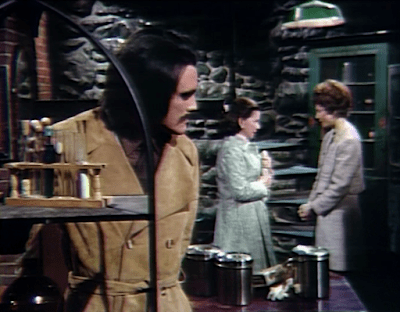
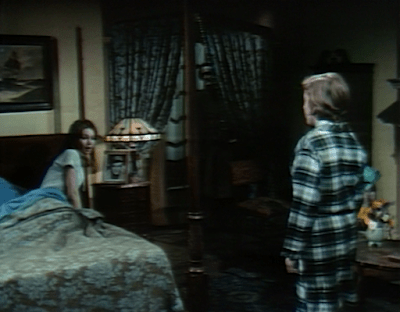
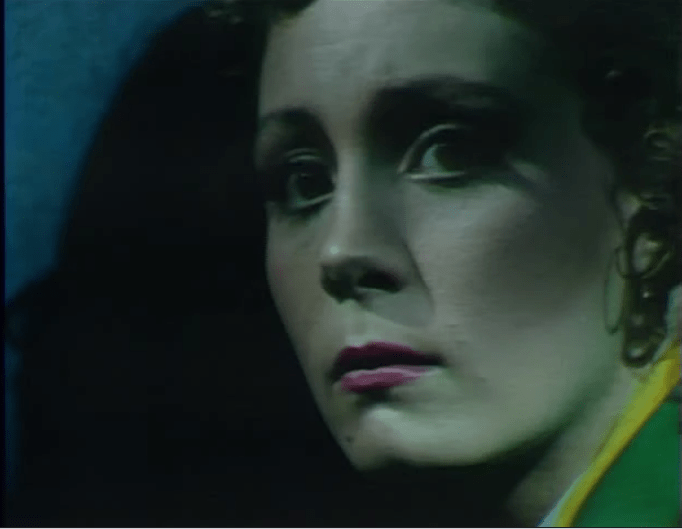
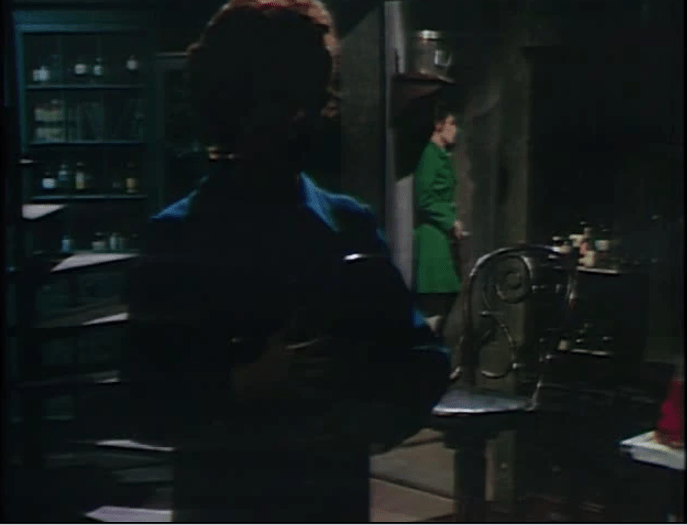
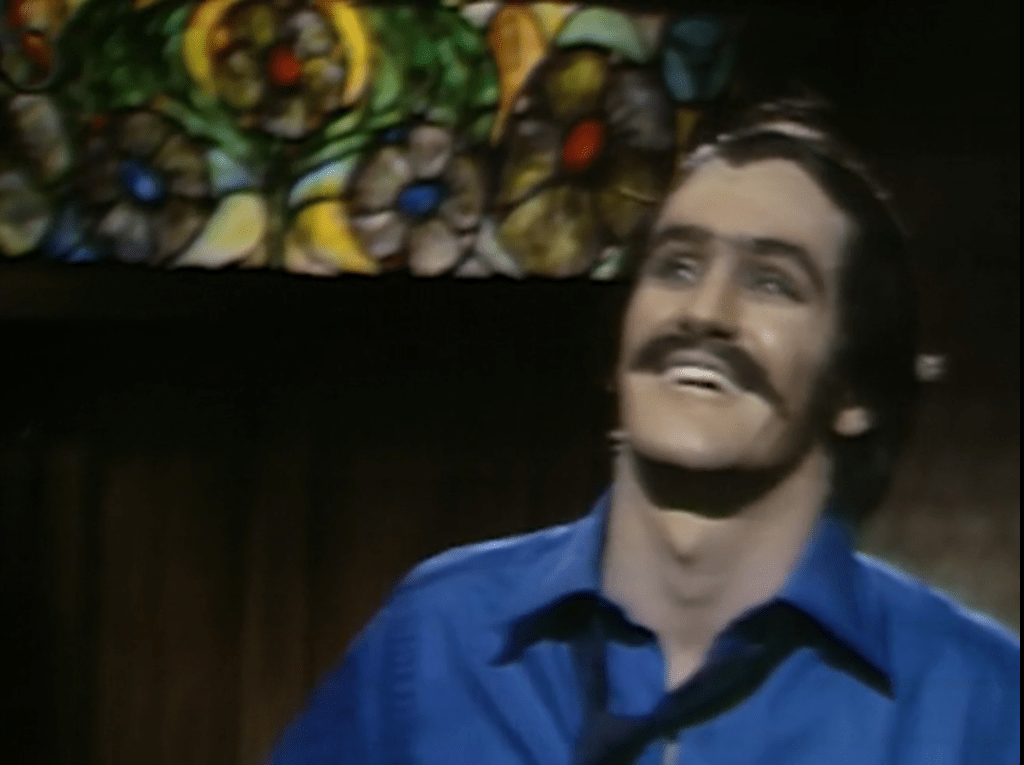
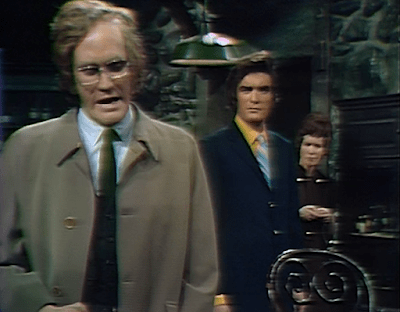
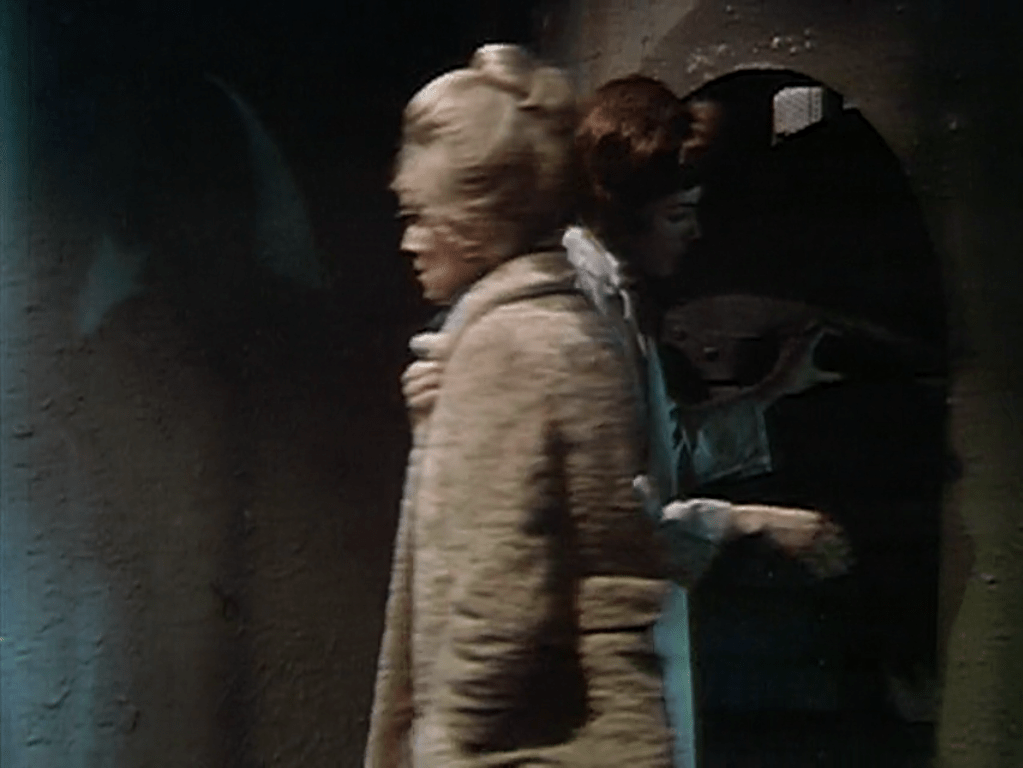
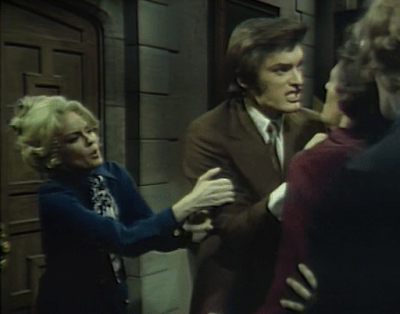
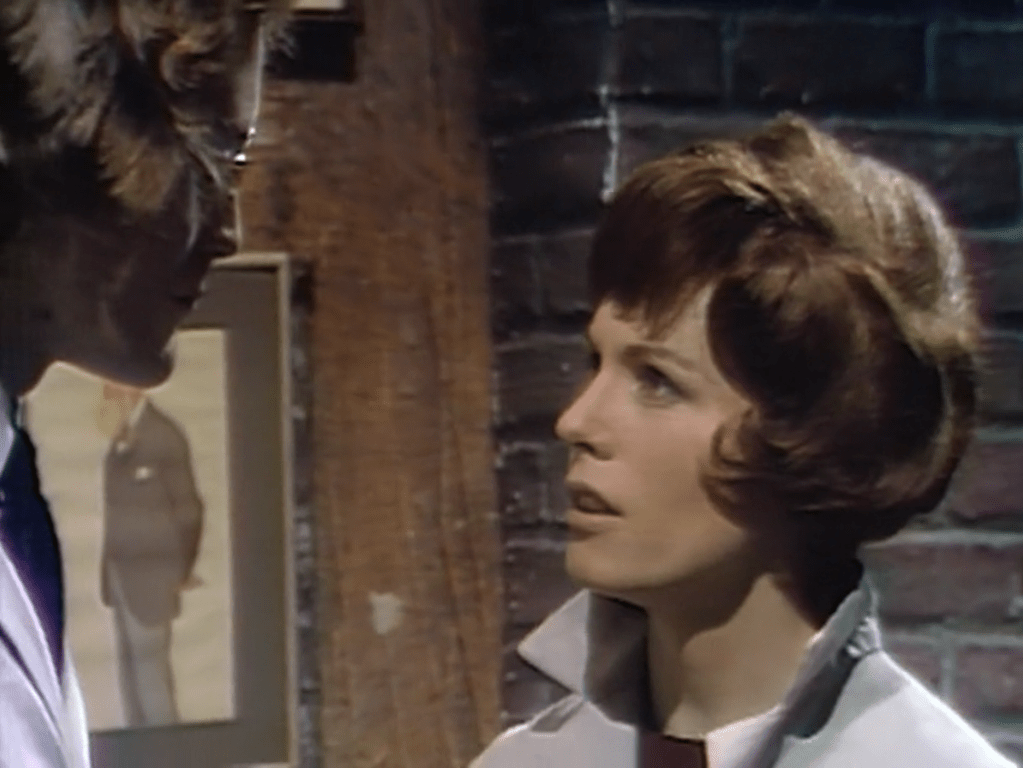
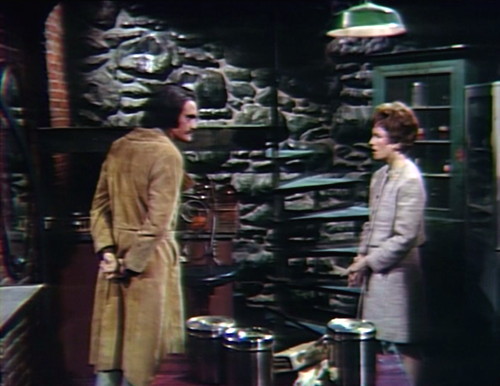
Quentin Collins walks into the bedroom once occupied by his late wife Angelique, where Angelique’s identical twin sister Alexis is staying. Quentin arrives just in time to see sleazy musician Bruno Hess strangling Alexis. He interrupts this process. Bruno is convinced that Alexis is Angelique returned from the grave, and that she is responsible for many strange and unhappy occurrences that have taken place on the estate of Collinwood since her arrival.
Bruno holds the deed to a cottage on the grounds of the estate and lives there, to Quentin’s intense annoyance. He hates Bruno, who had an affair with Angelique, a fact he likes to throw in Quentin’s face. You might think Quentin would call the police and report Bruno’s assault on Alexis. Not only would that result in a felony charge, but if Bruno bursts out with his suspicions it should be easy to get a civil commitment order that will earn him a a long stay in a home for the very nervous. But Quentin leaves Alexis and Angelique’s room without calling the sheriff. What’s more, when he goes to the drawing room and finds Bruno still in his house he has a lengthy conversation with him and waits for him to go. He never does telephone the police.
By the end of the episode, Quentin has convinced himself to take Bruno’s theory seriously. Alexis overhears him talking about it with his friend Cyrus Longworth. Quentin tells Cyrus that they must open Angelique’s tomb and look in her coffin.
Alexis finds them there, the coffin already out of its niche. She objects to the desecration of her sister’s resting place. She promises to leave Collinwood immediately if they will let Angelique rest in peace. Quentin refuses. He opens the box. Whatever he finds inside prompts a reaction of shock on his face and on Alexis’ as they look inside.
Between these scenes, we spend time in Cyrus’ laboratory. He is a mad scientist who has devised a Jekyll and Hyde potion. His alter ego goes by the name John Yaeger. Cyrus’ fiancée Sabrina Stuart is a sweet, trusting young woman who is determined to believe the best of Cyrus, but she has heard so much about Cyrus’ involvement with the brutal Yaeger that she is certain something is terribly wrong. We know that Cyrus was close to Angelique, and that she put him up to the Jekyll and Hyde experiment. Sabrina doesn’t know what Cyrus’ project is, but his withdrawn and irritable manner reminds her of the influence Angelique had on him. She says “It’s the same as it was when Angelique was alive- you were different then, and you’re different now.” I’m sure that was the scripted line, too.
Sabrina demands Cyrus stop lying to her and tell the truth about who Yaeger is and what hold he has over him. We saw yesterday that Cyrus’ attitude towards the potion and towards his time as Yaeger is already that of an addict towards his drug, and he sullenly refuses to answer any of Sabrina’s questions, even with more lies. She grows more and more exasperated.
Sabrina’s time with Cyrus is cut short when barmaid Buffie Harrington enters and insists on talking with Cyrus alone. Yaeger gave Buffie a check signed by Cyrus to cover the damages he did to her place of employment in a bar fight the other night; she wants to know if the check is authentic. Cyrus confirms that it is, much to Buffie’s delight. She mentions that her sometime boyfriend Steve is in the hospital because of a beating Yaeger gave him; Cyrus hands her a pile of cash to cover Steve’s hospital expenses. Buffie tells Cyrus that Yaeger has taken rooms in the boarding house where she stays, and that he frightens her. She does not tell him that Yaeger has hit her, choked her, and threatened her every time they have met. We know that he knows that- he has met her only when he was in the form of Yaeger, and he recognizes her on sight, showing that he remembers their encounters. Buffie asks if Yaeger works for Cyrus. He smiles with great satisfaction and says that he does.
That smile is a key moment. Yesterday’s episode gave the Jekyll and Hyde story a new lease on life by confirming that it will indeed be about addiction. That’s the usual thing with that material, but Dark Shadows has taken familiar tales in such weird directions that we could by no means take it for granted that its version would follow the typical pattern. Cyrus’ response to the thought that he controls Yaeger, who has put Steve in the hospital and is terrorizing Buffie, confirms something else. Cyrus’ diffident manner and scientific preoccupations help Sabrina hold onto the idea that he is a sweet man whose only flaw is naïveté, but Christopher Pennock’s rendering of that smile leaves no doubt that Yaeger is Cyrus’ means of indulging his own sadistic impulses.
As Buffie is leaving, Cyrus asks her if she likes Yaeger. Holding her head high, she says that sometimes she does. She sounds like she means it. Buffie was a commanding presence when first we saw her, and she is forceful throughout this scene. But she has given up on fighting back against Yaeger or even trying to run away from him. Her line suggests that she is not simply giving in to fear, but is drawn to a masochistic fantasy. Yaeger has been so vicious and Cyrus is so sinister that there is no prospect this fantasy is going to be channeled into any kind of consensual game- Buffie is drifting into a situation that can lead only to her destruction.
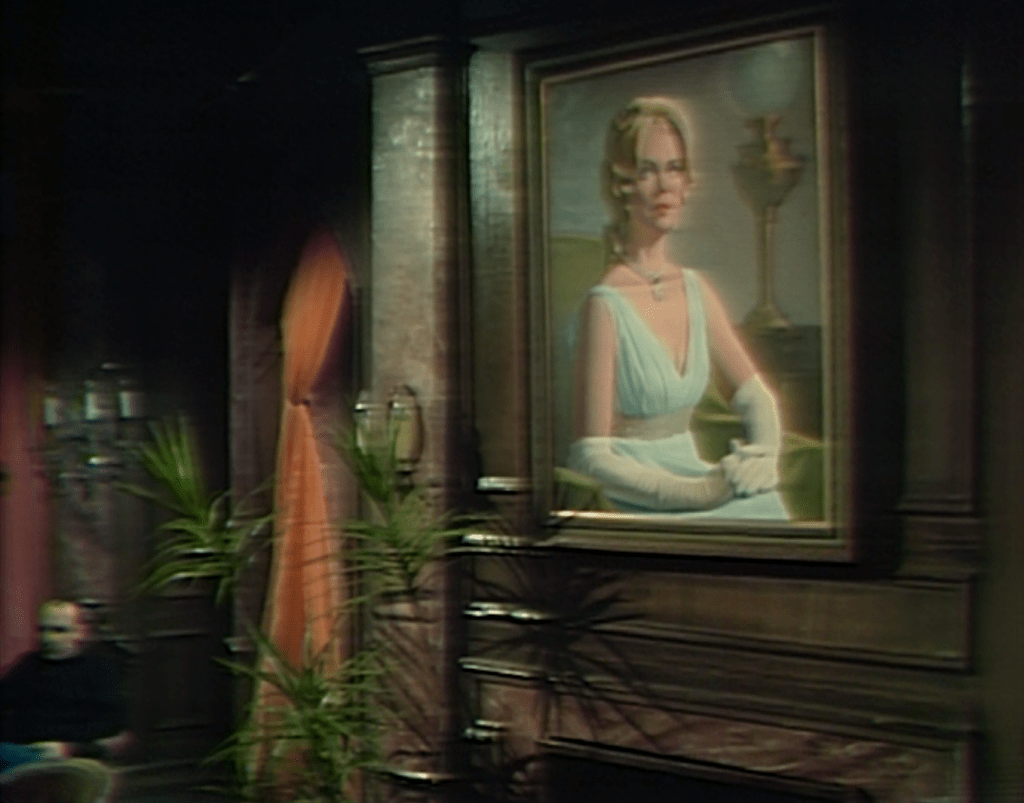
This episode includes one of the all-time great bloopers. The closing credits run over a shot of Angelique and Alexis’s room. For the first minute or so, we see a man sitting in a chair, chewing on something. Whoever he was, apparently he decided he’d found a good spot for lunch. Eventually the camera zooms in on the portrait of Angelique that dominates the room. This is so obviously an attempt to get the lunch-eater out of the frame that it only adds to the hilarity.
Writer Gordon Russell has to give two characters plausible motivations today, and he succeeds admirably.
One is Dr Cyrus Longworth, the apparently nice half of a Jekyll and Hyde duality. Jekyll and Hyde is a story about drug addiction, but Dark Shadows has so often featured villains whose crazy ideas have turned out to be true that we can’t be sure the show’s version will be that way. For all we know, it might turn out that Cyrus really has developed a method of separating the good from the evil in human nature and that he will use it to breed a new race.
Today, Cyrus is confronted in his laboratory by his fiancée Sabrina Stuart and his friend Quentin Collins about his association with his alter ego, whom they believe to be a separate person named John Yaeger. Cyrus pulls himself up to his full height and declares “I can end my relationship with Yaeger any time it suits me.” At this, the universal motto of the addict, we know just what is driving Cyrus. We can set aside all the talk in the opening voiceovers and elsewhere about how good and innocent Cyrus is, and see him as a man in the grip of a force he won’t face and can’t beat.
The other character in need of an intelligible motivation is Cyrus’ friend, sleazy musician Bruno Hess. Bruno is staying in a room above Cyrus’ laboratory in hopes that the ghost of a man he murdered won’t be able to find him there. The ghost appears to him there today, and sets the room on fire. Cyrus helps Bruno put the fire out, and talks about trying to exorcise the ghost. Bruno tells Cyrus he doesn’t believe he can help him. When he says this, Bruno seems, for the first time, reasonable. He has asked many things of Cyrus, so many that we might think of him as nothing more than a source of ever-escalating demands. But when he says that what is happening now is outside Cyrus’ province, we can see that there is some kind of mental process going on in his head.
Bruno thinks the ghost and the fire were both sent by Quentin’s late wife, Angelique. In the universe where Dark Shadows spent its first 196 weeks, Angelique’s counterpart is a witch who has a complicated relationship to fire. She is vulnerable to it, but can also use it in various ways. And, she has returned from the dead many times. If the Angelique in this continuity is like that one, it would make sense to suspect her. Angelique’s identical twin sister Alexis is Quentin’s guest at the great house of Collinwood. Bruno believes Alexis is really Angelique. He bursts in on her and says that he has a way to test whether she is Angelique returned from the dead. If she is, she can’t die again. So he sets about strangling her. If he kills her, Bruno will know he was mistaken.
In the main continuity, every drawer in every table at the great house contains a loaded gun. Longtime viewers have no reason to doubt that the same circumstance obtains here. So if we had not seen Bruno being rational in his scene with Cyrus, we would have no question in our minds but why Alexis does not draw a weapon and shoot the crazy man who is going to do nothing but try to kill her. That moment of lucidity makes the scene interesting. It even makes it somewhat surprising that Bruno goes all the way to homicide- we know he is a strange and violent man, but if he could think as clearly as that, maybe he could come up with a less drastic expedient.
The “Dan Curtis Productions” logo at the end of the closing credits is printed in a simpler style than it has been so far. We will see this new style several more times in the remaining months of the show.
The show has been keeping us in suspense as to whether Lara Parker is playing wealthy socialite Alexis Stokes or Alexis’ identical twin sister, the late Angelique Stokes Collins. Regular viewers know that the title “the late” is no impediment to a major part for a character on Dark Shadows. In the universe where the action took place for the first 196 weeks, Angelique’s counterpart was a wicked witch who returned from the dead countless times, and the clues are mounting that Alexis’ sister is active on the estate of Collinwood in this continuity, whether in her form or a more ethereal one.
While with Angelique’s widower Quentin Collins, Alexis has witnessed a series of odd occurrences that have led her to become distraught and to protest that Angelique is haunting them. She has questions, and takes those questions to two of Angelique’s acquaintances, medical researcher Cyrus Longworth and Cyrus’ assistant/ fiancée, Sabrina Stuart. That would seem to support the premise that she is Alexis, but she keeps the suspense alive for regular viewers when she approaches Cyrus’ laboratory by its courtyard door. The other day, the police were watching Cyrus’ house, and they did not notice that there was a door in the courtyard. When a detective came inside and spoke with him, Cyrus pointed the door out to him and told him that only a few people knew of it. Angelique was very close to Cyrus and was involved in his work, so we can assume she was one of those few people. It is not at all clear who could have told Alexis about the door.
Ms A. Stokes comes in through the courtyard door.
On Friday, Alexis joined a group assembled in the drawing room of the great house of Collinwood to reenact the séance at which Angelique died. Sabrina went into the trance and started shouting about murder. Ever since, Alexis has been sure Angelique was murdered. When she questions Sabrina today, Sabrina first asks her what she knows about the original séance.
Alexis says she has heard that Sabrina went into a trance and started speaking for a man. In the séances we have seen in the main continuity, the spirits have always spoken through a medium of the same sex. My wife, Mrs Acilius, points out that if this universe is a mirror image of that one, it makes sense that they would speak through one of the opposite sex. Alexis says that the man who spoke through Sabrina said something that angered Quentin, prompting him to rise from the table and start strangling Angelique. At that moment, the lights went out. When they came back on, Angelique was dead. The authorities would rule the death the result of a stroke.
Sabrina says that in her vision at the second séance, she saw those same events. But she also saw another figure standing near Angelique. Alexis declares that she must identify that other figure, since that must be the person who murdered Angelique. Quentin was much too busy strangling her to be the murderer, apparently.
Quentin’s counterpart in the main continuity lived in 1897. We saw him strangle his own wife, Jenny, to death in #748. Jenny had a sister named Magda, but they were not twins. Magda placed a curse on Quentin when she found out what he had done.
For his part, Quentin is also trying to get to the bottom of the mystery. He has asked Alexis and Angelique’s spooky aunt Hannah, who was introduced yesterday as one of his least favorite people, to come to Collinwood and exorcise the spirit that has been bothering everyone. Just as Hannah is getting ready to do some mumbo-jumbo, she starts choking. The Angelique from the main continuity was forever casting spells to choke people remotely, so regular viewers will assume that Hannah’s niece is behind her discomfiture.
Quentin talks with Alexis about taking everyone and fleeing the house to escape from the ghost. Alexis says he can do what he thinks best, but that she is not leaving until she finds out more. Before we went back in time in the original continuity and saw Quentin as a living being in 1897, he was a ghost who drove everyone out of Collinwood, so when this Quentin thinks of taking the family and fleeing a ghost we see another inversion.
Later, Quentin is alone. Angelique’s theme song starts playing from everywhere in the house. He cannot escape it. Regular viewers will remember that the ghost of the other Quentin persecuted the residents of the great house by playing a phonograph recording of a sickly little waltz over and over. In 1897, we found that the living Quentin obsessively played the same recording, occasioning protest from all the other characters. This may be a different Quentin, but we can’t help take a certain satisfaction in seeing him get a taste of the medicine his counterpart dished out so cruelly to the other characters and to the audience.
Most of this one is taken up watching people argue with each other about whether they should hold a séance. This puts longtime viewers on familiar ground. We’ve seen fourteen séances on Dark Shadows over the years, and have heard about others. Many of those we’ve seen have been preceded by the sort of wrangling we see today. The most spectacular case was #365. That installment was structured just like this one, one quarrel after another about the idea of the séance, then in the final scene the séance is held and comes to a shock ending.
Episode 365 came at the end of a period when the show was as slow-paced as it ever would be, and when such story elements as they had were all coming to an end. The episode was surprisingly fast-moving and exciting, mostly due to the visual artistry of director Lela Swift. Not only did Swift use a visual strategy that told more of a story than you might have thought was available had you read the script, but her skillful blocking and fluid use of the camera allowed the actors to project a great deal of energy. The shock ending, which the ABC network had spoiled with a series of promos but which I don’t think anyone could have seen coming otherwise, was the show’s first trip back in time. At the climax of the séance, well-meaning governess Vicki came unstuck in time and found herself transported to the year 1795.
Now, Vicki is long gone and mostly forgotten. The show has traveled in time again, not backward but sideways. We are in an alternate universe, which the show insists on calling “Parallel Time.” In this continuity, counterparts of familiar characters have different personalities and are arranged in different relationships than are the people we know.
The episode is much less effective than was #365, not so much from the absence of Vicki or the presence of any of the new characters, but because the director’s chair is occupied by the hapless Henry Kaplan. Kaplan stood at the opposite extreme from Swift. His idea of a well-composed sequence of images was one closeup after another, punctuated by extreme closeups showing us what an actor’s ear looked like when she was speaking a crucial line of dialogue. He takes the trouble to set up some two-shots and even three-shots today, but they put the actors in such cramped little frames that they don’t dare move without a furtive glance at the camera.
The master of the great house of Collinwood is drunken sourpuss Quentin Collins. His penniless siblings and permanent houseguests Elizabeth Collins Stoddard and Roger Collins have just come home from a trip out of town to find family friend Sabrina Stuart in the drawing room, demanding that they hold the séance that Quentin’s wife Angelique ordained for this night. They are shocked, because the night on which Angelique said there would be a séance fell six months before. Sabrina is having some kind of fit that causes her to be unalterably certain that this night is that one.
Angelique died of a stroke at that séance, and Liz and Roger are horrified at the idea of reenacting it. Sabrina’s fiancé, mad scientist Cyrus Longworth, says that she went through a traumatic experience the night before, when a strange man forced his way into her room and terrorized her. He then reports a conversation with a psychiatrist who suggests humoring Sabrina and holding another séance. Cyrus brings Bruno Hess, musician, lover of Angelique, and all-around sleaze to join in the reenactment.
While Roger and Liz were away, Angelique’s identical twin sister, Alexis Stokes, came to stay at Collinwood. Quentin neglected to inform even the people who were in the house at the time that this had happened, setting Alexis up for one terribly awkward encounter after another with people who thought she was her sister returned from the grave. Quentin and Alexis also got alarmingly cozy with each other, prompting his new wife, the former Maggie Evans, to walk out on him after barely a week in residence at Collinwood. So it is no surprise that he didn’t bother to telephone Liz and Roger and let them know they would see Angelique’s identical twin sister when they came home.
Roger is standing in Angelique’s old bedroom, holding a one-sided conversation with her portrait. We know that he is in the habit of doing this; it was what he was doing when first we saw him in #975. Quentin probably knows about it too, since several other people in the house have the same habit and even those who don’t spend a surprisingly large amount of time going in and out of Angelique’s room. Roger turns around and sees Alexis. Believing her to be Angelique redivivus, he nearly faints. She gives him her hand to assure him she is not a ghost, and he will later introduce her to Liz as Angelique’s sister.
Roger’s counterpart in the main continuity was Dark Shadows‘ first Big Bad, a charming, dissolute, narcissistic, cowardly, lecherous wastrel. That Roger Collins was supposed to be killed off when Vicki exposed his crimes, but Louis Edmonds made him such a joy to watch that this was out of the question. Dark Shadows had not yet figured out that a villain could be a permanent part of the cast, so when they decided to keep Roger around they nerfed him into a basically harmless supporting character. He developed gradually from the functional sociopath who in #68 coldly manipulated his own nine year old son David into a murder attempt on Vicki to the stoutly virtuous family man who made his final exit in #979 with a fatherly hand on David’s shoulder.
The Quentin of the main continuity made his debut in #646 as a ghost bent on annihilating all of his surviving relatives. From #701 to #884, Dark Shadows was a costume drama set in 1897, when we met Quentin as a living being. In those days, he was very much what Roger had been in 1966, only younger, sexier, and on a show that isn’t afraid to keep villains around indefinitely. He became a huge breakout hit, and a magic spell was cast that kept him from dying or aging. So when the show returned to contemporary dress at the end of 1969, Quentin was there, alive and intact.
Upon his arrival in 1969, Quentin found himself in the same position Roger had occupied two and a half years before. Everyone wanted him to be a big part of the show, but there was nothing for him to do. Unlike Roger, he was free to be evil, but also unlike him he had no connections to anyone who had anything he wanted to take. In some ways, Quentin is in an even worse position than Roger was. Even in his lovable gay uncle phase, Roger could admit to his sister Liz in #273 that he would have blackmailed her if he had had the chance, an admission that Quentin merrily echoed in #702 when he laughed at his sister Judith’s attempt to buy him off with $1500, boasting that he could blow through that much in a single night, even in a sleepy little place like Collinsport, and that he would shamelessly come back for more. He has no one to do anything like that with now.
Quentin can charm his way to an easy living. In December 1969, mad scientist Julia Hoffman and Broadway star Olivia Corey fought over which of them would get to pay Quentin’s hotel bill, a conflict that was motivated by some story points but that is the sort of thing that might happen to a man who looks like a young David Selby. On a fast-paced supernatural thriller, you have to be something a lot juicier than a mercenary Kept Man to count for much as a villain. No one in the Nixon era owes Quentin anything, so he can’t exploit anyone the way he did Judith and the rest of his immediate family. He has fallen into service as henchman to Julia and her best friend, his distant cousin vampire Barnabas Collins, but something big is going to have to change to find him another place at the center of the action.
Since that is the same problem that cost them Roger, it makes since that in this mirror universe Quentin’s counterpart and Roger’s are revisiting some stages of the development of the Roger from the main continuity. When Parallel Roger first appeared in #975 and #976, he seemed to be, if not the utterly depraved villain of the early days, at least the spineless, snobby, but amusingly sarcastic figure he was through most of 1967. Today he seems to be closer to the responsible family man he dead-ended into being.
This Roger is the first to articulate the reasons why it is inadvisable to reenact a ceremony that cost a life the last time it was attempted. Roger’s position recalls his role in #170, when he was the principal opponent of the first séance shown on Dark Shadows. In that, he was the unwitting stooge of his estranged wife, undead fire witch Laura Murdoch Collins, but the objections he came up with were all about the importance of social respectability and of refraining from doing the thing which is not done, fitting into the image of him as a shallow and unimaginative person. The fact of Angelique’s death gives his objections today a firmer footing and presents him as a representative of sober good sense, but does not make him seem any more dynamic than his counterpart in the main continuity did in #170.
Quentin learns of the proposed séance when Cyrus and Bruno enter the house. He is angry at the sight of Bruno, and reminds him he is not welcome there. Cyrus explains that Bruno is needed for the séance. This increases Quentin’s anger, and he tells Cyrus and Bruno to “go to another house and work your black magic, boys.” They insist on staying, and suggest that Alexis sit in Angelique’s place. After all, Bruno says, why shouldn’t she see exactly how her sister died, from her sister’s point of view. At this Quentin’s anger turns to total rage, and he has to be restrained from attacking Bruno physically. Alexis wants to hold the séance, though, and Quentin gives in. He refuses to participate, but allows the others to gather in the drawing room.
Roger was never given to violence that required his direct personal involvement. Quentin’s reaction to Cyrus and Bruno’s awful idea suggests that the writers are trying to find a way forward for his character. The well-justified repugnance he feels for Bruno, the grotesquely morbid nature of the proposed reenactment, and the breathtakingly irresponsible suggestion that Alexis do the very thing it killed her sister to do, all call for a forceful response. His lunge at Bruno is manful in the best sense, and leads us to wonder if they might try to develop Quentin’s vices into the basis of some kind of heroic action.
When he scornfully tells Bruno and Cyrus to go somewhere else with their “black magic, boys,” it is clear that the writers are thinking in terms of what is possible for Quentin. In 1897, the original Quentin and his fellow Satanist Evan Hanley would hang out in the cottage on the estate corresponding to the one where Bruno lives in this timeline and do all sorts of ill-intended mumbo-jumbo. They could easily have been called “The Black Magic Boys.” That Quentin stood at the opposite pole from this one. Perhaps as the story progresses, we will see these contraries fuse into something more sustainable.
Although we are in “Parallel Time,” a development like that might have good effects on the Quentin of the main continuity as well. Roger’s character changed massively after the flashbacks to 1795 and 1897, merging with the deeply flawed, yet sturdily upright family men whom Edmonds played in those periods. So if they can build a version of Quentin in this universe who is still narcissistic but also capable of saving the day, that might point the way to transforming the Quentin in the established “time-band” into a character who can carry the show as he did for so many months in 1969.
The séance goes forward. Cyrus conducts, and Sabrina goes into the trance. She shouts the word “murder” over and again, and breaks the circle of fingers to point at Alexis. Alexis passes out. That’s the closing cliffhanger. We can be sure Alexis is not dead- it wouldn’t leave the story anywhere to go. Besides, they commissioned a gorgeous full-sized portrait of Lara Parker as Angelique for this storyline. That thing must have cost at least $5000, maybe twice that, and they will never be able to use it again after they go back to the main continuity. There’s no way they are going to blow that much money on a set decoration unless they are planning to feature it in another couple of months of episodes.
Dark Shadows has taken us to a parallel universe where the A story is a mashup of Daphne Du Maurier’s 1938 novel Rebecca with Edgar Allan Poe’s 1838 story “Ligeia,” and the B story is a retelling of Robert Louis Stevenson’s 1886 novella Dr Jekyll and Mr Hyde. Today we also get a good look at the C story, another mashup. The ingredients in this one are Dracula and Who’s Afraid of Virginia Woolf.
Drunken novelist William H. Loomis and his disappointed wife, the former Carolyn Collins Stoddard, take the roles of George and Martha. The parts of Nick, of Honey, and of George and Martha’s imaginary son are combined in vampire Barnabas Collins.
Honey is present at two conversations with George and Martha. She flees from each, moved to vomit by their cruelties, and after the second is never seen again. One session with Will and Carolyn was enough for Barnabas. The circumstances of his exit were rather different from those of Honey’s. Barnabas did not become physically ill when he saw Will and Carolyn quarreling, and is willing to keep skulking in and out of their basement when he is not out preying upon the living. But Will has other ideas. He has chained Barnabas in his coffin in the basement of their house and is planning to force him to tell him his life story, which Will thinks he will be able to use as material for a book that will restore his fortunes. In this he is the mirror image of his counterpart in the main continuity, who broke the chains that held Barnabas in his coffin in his own attempt to get rich quick.
As Martha taunts George for the dead end his career has reached, Carolyn is in the habit of taunting Will with his inability to write new books of his own. As Martha flirts aggressively with Nick in front of George, so Carolyn wants Will to release Barnabas so that he can drink her blood again. As George and Martha’s son turns out to be imaginary, not part of their material reality, so Barnabas is a visitor from the main continuity, not a part of this universe. Inasmuch as Jonathan Frid is away for several weeks making the feature House of Dark Shadows, Barnabas is present only as a topic in Will and Carolyn’s quarrels.
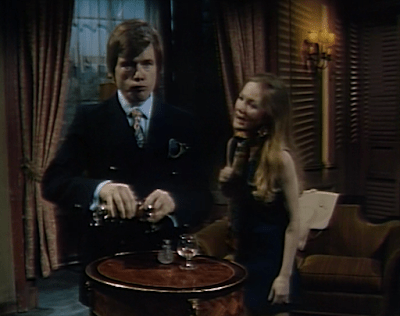
Will pours himself a glass of something, perhaps bergin and water. Screenshot by Dark Shadows Before I Die.
One might wonder if the idea of casting John Karlen as an analogue of George in an adaptation of Who’s Afraid of Virginia Woolf? occurred to the makers of the show around the time of #706. In that episode, Karlen played inveterate prankster Carl Collins, who held a gun at Barnabas’ head and threatened to shoot him. When he pulled the trigger, a flag labeled FIB! sprang out. George fires a rifle at Martha in Act One of the play, only to produce a similar effect with a Chinese parasol.
Later, Carolyn is eavesdropping outside the drawing room in the great house of Collinwood while Will is flirting with a lovely houseguest, a central character in the Rebecca/ Ligeia mashup. Carolyn stands in the doorway, in Will’s line of sight when he tries to make a date with the woman. Will has already rubbed Carolyn’s face in the intimate nature of her connection to Barnabas, and as his victim she can’t very well recreate Martha and Nick’s threat to cuckold George with any other male. So if we are going to have another scene built around that kind of insult, it will have to be Will who plays it with another woman.
Carolyn also spends some time with her friend Sabrina Stuart, who is part of the Jekyll and Hyde story. Sabrina is engaged to Dr Cyrus Longworth, the Jekyll character, and did not recognize him when last night he invaded her home and assaulted her in the persona of John Yaeger, the Mr Hyde character. Cyrus himself is puzzled when he comes to his laboratory in the morning and finds a terrible mess there, along with an IOU from Yaeger. A policeman shows up and asks him some questions, assuring him that he does not match the description of Yaeger. In his post about the episode on his great Dark Shadows Every Day, Danny Horn points out that this scene is recycled beat for beat from Dan Curtis’ 1968 TV movie adaption of Jekyll and Hyde.
Carolyn marches into Cyrus’ lab and tells him Sabrina is missing. She is angry with him for leaving Sabrina alone when the man who attacked her is still at large. He tries to assure her that Sabrina is in no danger, but since he cannot explain why he would believe that he only exasperates her further. She insists they go looking for Sabrina, and he acquiesces. It turns out Sabrina is in the great house of Collinwood, in a trance, trying to reenact the séance at which the Rebecca analogue died.
In the main continuity, Carolyn’s counterpart was married to someone whom she believed to be a man named Jeb. Like Cyrus, he was played by Christopher Pennock. Also like Cyrus, he was a shape-shifter who in his other form committed horrific acts of violence. Carolyn accepted Jeb’s refusal to tell him anything about himself, as Sabrina accepts Cyrus’ refusal to tell her anything that might lead her to suspect the nature of the potion he has developed. It is refreshing to see this Carolyn taking Sabrina’s side and insisting Cyrus do things a reasonable person might do.
Quentin Collins, master of the estate of Collinwood, is in an even grimmer mood than usual. His new wife, the former Maggie Evans, has left him after only a week in the great house. She had had all she was going to take of his patronizing attitude towards her and of everyone else’s preoccupation with his first wife, the late Angelique Stokes Collins. Maggie was particularly satiated with Quentin’s houseguest, Angelique’ unmarried identical twin sister, Alexis Stokes. Maggie had found Alexis in Angelique’s bedroom, wearing Angelique’s frilly nightgown, and reaching out to Quentin while suggesting in a soft voice that “Perhaps we can comfort each other.” When that sight moved Maggie to voice objections to the situation, Quentin responded by forbidding her, for her own good no less, from mentioning Angelique’s name ever again. He was amazed that this led Maggie to leave the house. Considering the provocation, it is indeed amazing that Quentin did not require medical attention to remove his brandy decanter from whatever part of his anatomy Maggie could reach.
We open today with Quentin and Alexis back in Angelique’s room. She is fully dressed this time, but they are sitting together on the piano bench. They move their heads together, and lock their lips in a passionate kiss.
Returning viewers know that we are visiting a universe parallel to the one in which the action was based for its first 196 weeks of the show. Angelique’s counterpart in the main continuity is a wicked witch who has returned from the dead quite a few times, so when we first crossed over here and heard her devotees saying that they were sure their Angelique would find a way to come back to life we did not doubt that they were right. Maggie wants nothing to do with Angelique or the cult she built up around herself, but she is among those who are convinced that Alexis is in fact Angelique redivivus. The show has done an excellent job keeping us guessing whether she is or isn’t, and we will still be guessing when we come to the end of today’s episode.
Alexis pulls away from Quentin and is visibly upset. He apologizes for kissing her. She says that she is disappointed in him- she had thought that he, of all people would know that she is not Angelique returned from the grave. He says he does not think that she is. We can believe him- his counterpart in the main continuity usually had two or three fiancées at a time, and they were rarely his only love interests. So he wouldn’t have to believe Alexis was Angelique, or indeed that she was anyone in particular, to start a make-out session with her. After they clear the air, she agrees to stay on in the house until she can meet Quentin and Angelique’s son, her nephew Daniel Collins, who is on a trip at the moment.
Bruno, Sabrina, Cyrus, Gladstone, and the Bunny
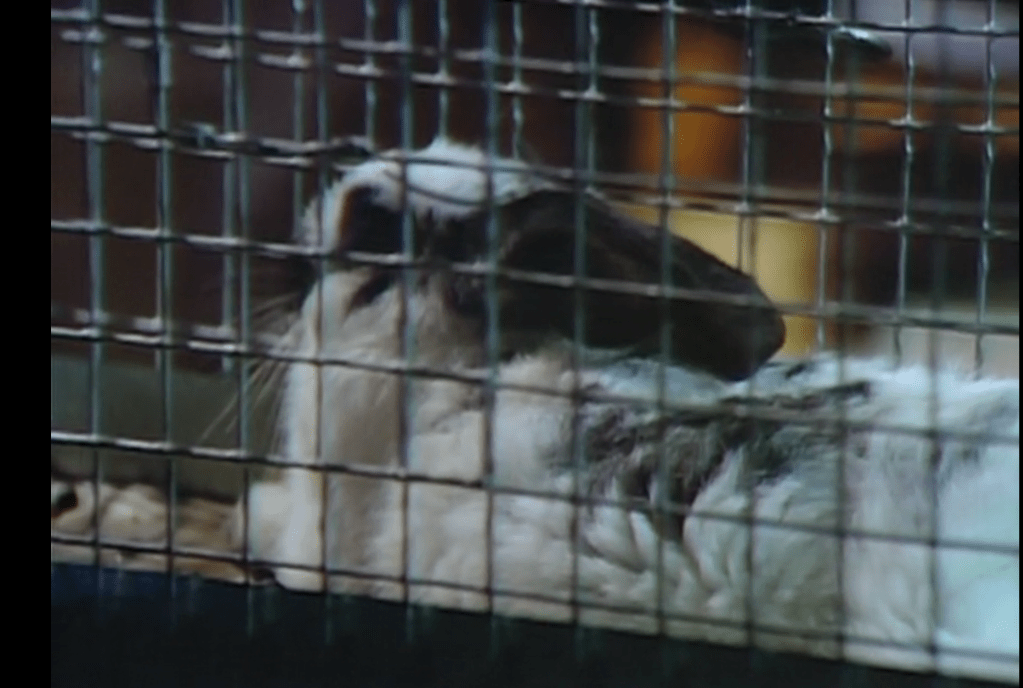
Quentin and Alexis aren’t the only ones dealing with frustrated sexual desire. We cut from them to a closeup of a bunny. This universally recognized symbol of amorous enthusiasm is alone in a cage.
The episode originally aired on the second Tuesday of Easter 1970, maybe the bunny was resting up after his big day.
The cage is in a laboratory. A young woman in a lab coat is trying to work on a large apparatus for chemical experimentation while a man wearing a purple suit, a low cut shirt, a large medallion, and a huge bouffant hairdo is pestering her with clumsy attempts at flirting. She keeps laughing off his verbal gambits and swatting away his physical approaches.
A tall young man in a lab coat enters and calls out a booming “Sabrina!” The lounge lizard and the experimenter stand up straighter and step away from each other. Returning viewers know the tall man as aspiring mad scientist Cyrus Longworth and the ill-clad masher as Bruno Hess, musician and hanger-on of the late Angelique. We have not seen the woman before, but we recognize the actress as Lisa Blake Richards, who played another woman named Sabrina in the main continuity. That Sabrina was trapped in a go-nowhere storyline. Before today is done we will have grounds to hope that this one will give Miss Richards a task more in keeping with her considerable talents.
Cyrus sends Sabrina upstairs to wait for a package. Bruno gets ready for his part in Cyrus’ experiment, which involves giving a blood sample. Bruno asks Cyrus why he was so calm when he saw him trying to put the moves on Sabrina. Cyrus replies that he trusts Sabrina too much to worry that Bruno could come between them. He then jabs the syringe into Bruno’s arm with great force and without even looking at the spot from which he is drawing the sample, causing Bruno to jump. He may trust Sabrina, but he wants Bruno to know who’s boss.
Bruno tries to interest Cyrus in his theory that Alexis is Angelique returned from the grave. He eventually manages to get Cyrus to give him a quizzical look, but stops at that point, saying that if Cyrus won’t explain his experiment, he won’t explain his.
Sabrina comes downstairs and says that the package has come and that its bearer insists on meeting Cyrus himself. Cyrus is annoyed by this, but when it develops that the man is Mr Horace Gladstone himself, the very chemist who devised the unusual compound he has brought, Cyrus sends Sabrina back upstairs and Bruno out the basement door so that he can meet with the man alone.
Friday, Cyrus explained to his friend Chris that he is trying to devise a process for separating a human being into two parts, one good and the other evil. His scenes with Chris hit all the obligatory mad scientist notes, right down to disparaging non-mad scientists as unimaginative dolts who may as well believe that the Earth is flat. He won’t tell Gladstone what he is trying to do, perhaps because he has the same last name as did the man who was prime minister of the UK when Dr Jekyll and Mr Hyde was first published and so he reminds him that he is a character in a derivative storyline. But Gladstone does warn Cyrus that the compound he has purchased is a potent and dangerous one. Gladstone hints at the nature of the hazard when he says that he stepped back from active research when he feared that, even within the bounds of chemistry, he was about to uncover truths best left unknown.
Gladstone is played by John Harkins, in his fourth role on Dark Shadows. As before, he is playing a stranger from far away. In #174, he played Lieutenant Costa of the Arizona State Police. We saw him in a scene set in Phoenix, the first time Dark Shadows took us outside the northeastern USA. We did not leave that region again until #877, when sorcerer Count Petofi thought back to an incident in England in 1885, when he first met his henchman Aristide. Like Bruno, Aristide was played by Michael Stroka. The incident in England involved a man named Garth Blackwood, whom Petofi would bring back from the dead to punish Aristide. Blackwood was played by Harkins.
Harkins’ third character came from even further away than Arizona or England. He was Mr Strak, the representative of the Leviathan People, a race of Elder Gods long confined to the underworld. Strak appeared to Paul Stoddard in #899 and #900, and tricked Paul into selling his daughter Carolyn to the Leviathans. So far as Paul was concerned, Strak came from nowhere and disappeared to nowhere, so that he could never hope to explain to anyone what he had done, still less find a way to challenge the terms of the deal.
Gladstone is from Boston. Dark Shadows is set near the real-world location of Bar Harbor, Maine. The characters often mention Boston, but we’ve never had a scene set there. In #363, the ghost of nine year old Sarah Collins was perfectly bland when her friend, strange and troubled boy David, said he had been to China. Sarah said that her father and his business associates were always sailing to China. When David told Sarah that he was joking and he had actually gone to Boston, Sarah was thrilled. She had been to Boston herself once, and considered it a far more exotic place than China could possibly be. Gordon Russell was credited with the script for #363, and Joe Caldwell, the freshly returned author of today’s script, had finished his first tour of duty on the show three weeks before it was taped. But Sarah’s excitement about Boston is so much the kind of character moment Caldwell specialized in that I suspect it was a leftover idea of his that Russell found a place for. Perhaps the casting of Harkins as a Hub man reflects Caldwell’s idea of what Boston would represent to people in a coastal village in central Maine.
Bruno and Alexis
We cut to Bruno, who is on the telephone. He is talking to a person in an office somewhere. He learns that no ships from Genoa have docked in New York in the last week. This information excites him, but his excitement soon gives way to terror as he feels himself choking.
Bruno runs into Angelique’s bedroom, where Alexis is back on the piano bench. He gasps and demands she stop obstructing his breathing. She appears to have no idea what he is talking about.
The Angelique we have known since late 1967 did specialize in casting spells that made her enemies choke. We saw her do that as recently as #955, when her husband tried to set fire to her and she stopped him by twisting a scarf around the neck of a statue. On the other hand, Alexis seems genuinely bewildered by the situation.
When Bruno starts breathing again, he confronts her with the fact that no registered passenger ships from Genoa arrived in New York harbor the week before. She asks him if he considered that she might have been a guest on the yacht of some wealthy friends. He is stumped by this. Again, this keeps the suspense about her true identity alive. Alexis has been established as the sort of person who would be found on someone else’s yacht, but she doesn’t actually say that that is how she got back to the States. She merely asks Bruno if he had thought of the possibility that she may have done so.
Cyrus and Sabrina
Back in the lab, we see Sabrina collecting some equipment while Cyrus tends to his notes. She finds a small box, and asks him if he put it there for her to find. When he says he did, she opens it and finds a ring. She asks if it is an engagement ring. He says he hopes it is. She throws her arms around him and tells him she loves him. He holds her and does not say that he loves her too. He merely says that she knows how he feels about her, an ill-omen if ever we saw one.
Cyrus tells Sabrina that she knows how completely his work consumes his energies, and she says that is one of the things she admires about him. She asks what exactly he is working on. He is reticent, and she tries to walk the question back. He goes into his mad scientist ravings, and she gives him a stunned look. He tries to reassure her, saying that when he gets carried away he talks in cliches. He says that no one has found good or evil in a test tube… “yet!” The crazed gleam comes back into his eyes.
Sabrina is shocked by Cyrus’ ravings
This scene gives Miss Richards more to work with than she had had in her whole time in the main continuity. The look Sabrina gives at the end of Cyrus’ gust of lunacy is the first time she has had a chance to get a laugh, and she makes the most of it. As for Christopher Pennock, he had just been getting the hang of his previous part, hugely overgrown infant Jeb Hawkes, when he was written out. With Cyrus, he can to some extent pick up where he left off. Pennock had begun to find a way to suggest that there was a real sweetness bottled up inside one-man wrecking crew Jeb, and in Cyrus’ love for Sabrina he can play a character who is Jeb’s mirror image- abundantly sweet, but so deep inside his own head that he is about to become a monster.
Bruno
On Dark Shadows, wedding days usually come and go without anyone actually getting married. Typically, the ceremony is interrupted and someone has to go off and dig up a grave, in which they find an empty coffin.
Bruno has no manners and does not observe any of the recognized customs. So even though today is Sabrina and Cyrus’ engagement day, not their wedding day, he jumps the gun and starts opening Angelique’s grave, in which he believes he will find an empty coffin. We end with him chiseling at the wall of the mausoleum. I suppose you could say that he might be planning to work slowly, so that he won’t finish until the day of the wedding, but even if that were true it would be an outright violation of the accepted norm, and an undeniable sign that he is not the sort of person who can be expected to fit in at Collinwood.