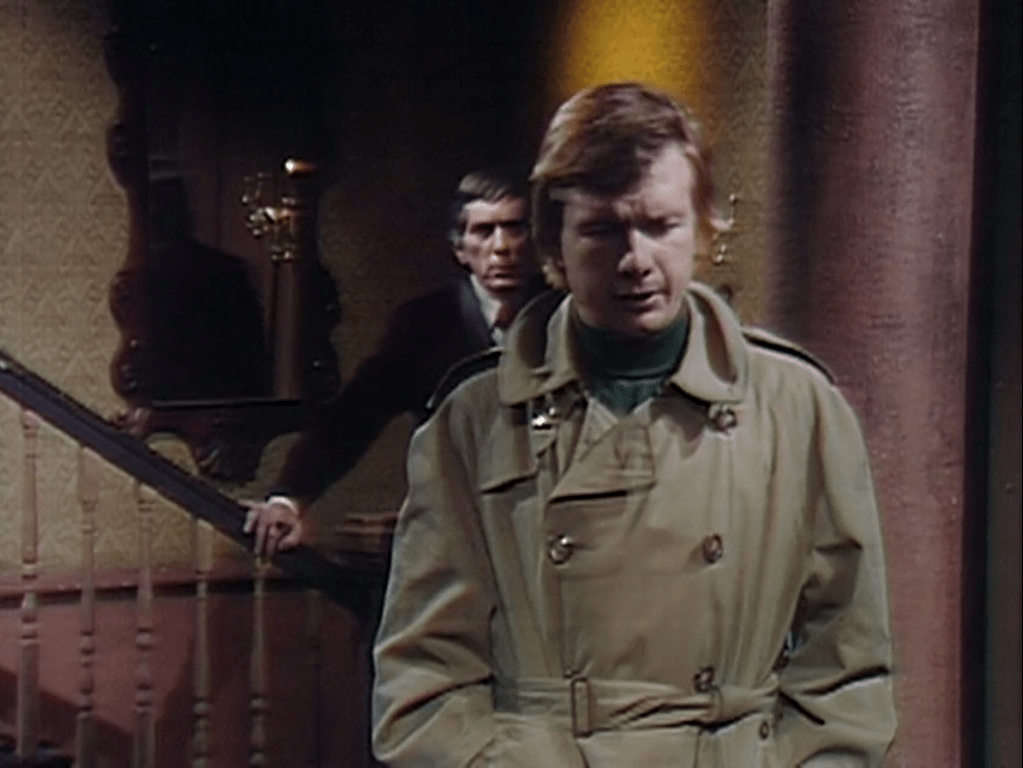
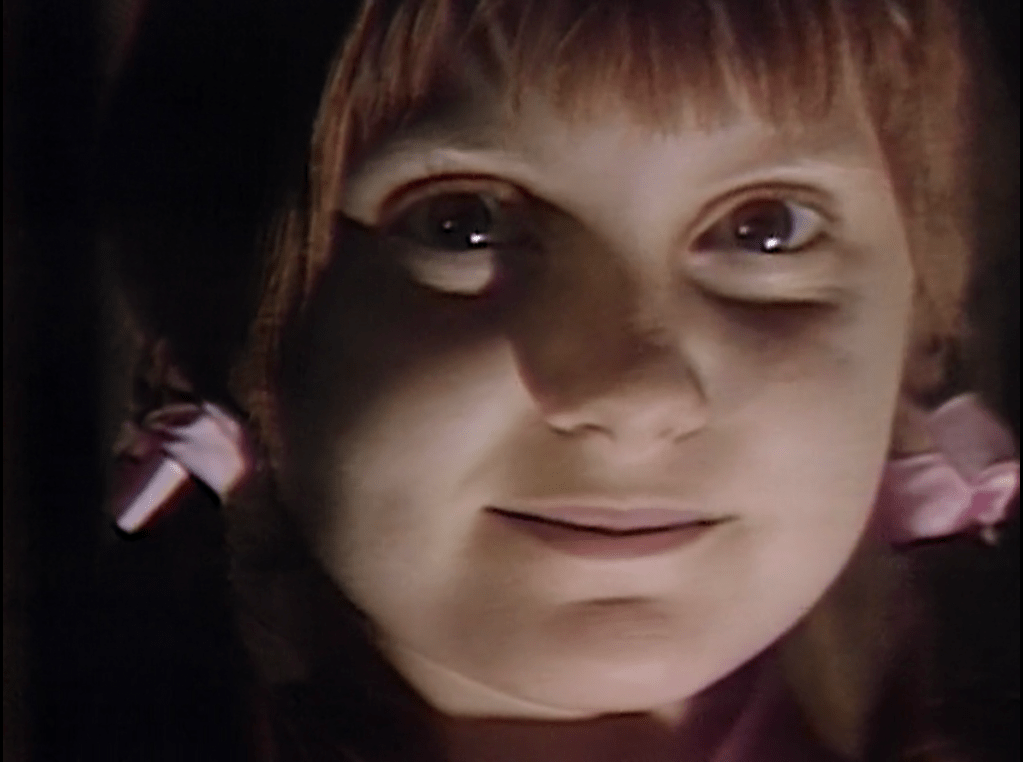
From March until July 1970, Dark Shadows was set in a universe other than the one where the action had taken place up to that point. In that universe, which the show insists on calling “Parallel Time,” the counterparts of heiress Carolyn Collins Stoddard and woebegone lowlife Willie Loomis were a married couple. That other Will Loomis was a bestselling but hard-drinking author who had squandered his earnings, and Carolyn Loomis was a poor relation of the master of the great house of Collinwood. They bickered incessantly, in an adaptation of Who’s Afraid of Virginia Woolf? that, in the hands of John Karlen and Nancy Barrett, sometimes seemed to rival Edward Albee’s original.
We’ve been back in the original continuity for five weeks now. The Carolyn we have known from the first week of the show is back, but she is half mad, intermittently possessed by a ghost known as Leticia Faye. Willie is helping time travelers Barnabas Collins and Julia Hoffman in their efforts to battle two distinct supernatural menaces, one consisting of a group of ghosts including Leticia, the other a vampire whose identity they have not discerned but whom they know to be feeding on governess Maggie Evans. Carolyn and Willie have their first scene together today since the return from Parallel Time. It is infused with the energy Karlen and Miss Barrett brought to their versions of Albee’s George and Martha. Karlen has some scenes alone where he wanders around and shouts in the general direction of a microphone; those don’t work at all. But when he has Miss Barrett to anchor him, he’s terrific and so is she. When she addresses him as “Willie Loomis!,” we are, for one lovely moment, right back in Loomis House.
Carolyn gives Willie a riddle and tells her that unless he’s too stupid to solve it, it will lead him to the missing governess: “Where the north woods path is narrow, you’ll be at sixes and sevens, but look for the H and follow the arrow, that points to Maggie Evans.” That riddle reminds longtime viewers how far the show has come in the last three years. The last time Maggie was the victim of a vampire, it was the summer of 1967 and the ghoul was Barnabas. The ghost of Barnabas’ little sister Sarah appeared to Maggie in the cell where he and his blood thrall Willie were keeping her and gave her a riddle which she solved, finding an escape route and avoiding the death Barnabas had planned for her. Now Maggie is helpless, and Willie and Barnabas are the good-ish guys. This riddle will enable Willie to come to her rescue.
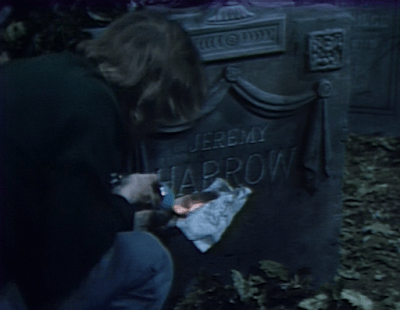
Willie goes to the narrow part of the path through the north woods. He shines a flashlight directly into the camera, a sure sign that we are watching Dark Shadows. Willie finds himself in a graveyard. He notices a tombstone inscribed with the name of Harrow. Subtracting the H, what’s left is “arrow.” He keeps moving his eyes rightward beyond the edge of the stone and sees the door of a mausoleum. He goes inside and finds Maggie on the floor, beside an empty coffin. He infers that the empty coffin must be where the vampire rests during the day.
Willie takes Maggie back to her room at Collinwood and confers with Julia and Barnabas. Barnabas decrees that Willie and Julia should go to the mausoleum during the day and stake the vampire. When they do, they are uneasy to find that no one is guarding the coffin. The episode ends with Julia’s expression of shock when she sees inside the coffin.
The ghosts of four people who died in 1841 have been haunting the great house of Collinwood. They represent teenagers Carrie Stokes and Tad Collins; Carrie and Tad’s governess, Daphne Harridge; and a sometime pirate captain known as Gerard Stiles. Three of these four have now assumed corporeal form. Tad and Hallie have taken possession of their lookalikes, David Collins and Hallie Stokes. They then performed a ceremony that caused Daphne to come back to life in a body of her own. We open with these three repeating the ceremony in order to conjure Gerard back into existence as a living being.
When Carrie and Tad performed the ceremony the first time, they did not know whether they would raise Daphne or Gerard. That episode ended with a knock at the door, leaving us to wonder along with them who would come. My wife, Mrs Acilius, said it would be funny if it were someone else. She suggested the writers might take a page from Let’s Make a Deal and have Tad and Carrie find a donkey behind Door Number Three.
Today, the ceremony again ends with a rapping on the door. But it is not Gerard. It isn’t a donkey, either. It is Willie Loomis, servant to old world gentleman Barnabas Collins. John Karlen always finds a way to bring out humor in his characters’ predicaments, and the rough-hewn Willie does deflate the grandiosity of Carrie, Tad, and Daphne’s meddling in God’s realm.
Scrambling to cover up the signs of the ceremony before he has to open the door to Willie, Tad calls out “We were sleeping! (pause) I was sleeping!” David Henesy plays this absolutely straight, so that we can see it dawning on Tad that he and Carrie aren’t supposed to be sleeping together. Karlen wasn’t the only actor who knew how to find the laughs hidden in his lines.
Daphne hides. Tad opens the door. Willie sees the pentagram on the floor with the candles at its points and says he recognizes it as a device of black magic. He forestalls the teens’ attempt to pretend to be Hallie and David by calling Tad by name. Tad then turns to Carrie and makes fun of Willie’s twentieth century vocabulary in an attempt to intimidate him by a display of social superiority. This collapses immediately, and Willie says that Tad and Carrie have to come with him because he is bigger than they are.
Willie detains Carrie and Tad in the drawing room, waiting for Barnabas to come back. He has to leave them when he hears Maggie Evans, governess to the late David and Hallie, coming downstairs. Maggie is the victim of a vampire, and Willie is part of the crew that is keeping her from going off to get her blood sucked.
Willie rushes to the foyer and asks Maggie why housekeeper Mrs Johnson isn’t keeping her in her room. Maggie does not respond. The true answer would be that Clarice Blackburn has a writing job on another soap now and isn’t available to play the part, so they leave Mrs Johnson’s absence unexplained.
While Willie gets Maggie back to her room, Tad and Carrie listen to the dogs howling outside. Carrie says she has never heard howling like that before, and Tad contradicts her. He says that if she searches her memory, she will find that they heard just that sound in their own time. He gives a somber look, as if he knows what the howling means. The show has been making it clear that we will be going back in time to 1840 sooner or later. These lines of Tad’s tell us that we will find a vampire in operation when we get there.
In Maggie’s bedroom, Willie explains that Hallie and David have been possessed by Carrie and Tad. Maggie has seen enough in her time at Collinwood that she finds this instantly credible. She blames herself, saying that if she were not ill she would have been able to prevent the possession. Willie asks what she could have done, and she cannot think of anything. He presses her to tell him who the vampire is. She claims he cannot understand what she is going through. He cannot tell her that he himself was once the victim of a vampire, since that vampire was Barnabas and the show will implode if Maggie is ever told about that. So they are left at a stalemate.
Meanwhile, Daphne takes shelter in a deserted mansion once known as Rose Cottage. Gerard confronts her there. He is cranky about still being dead. She tells him it’s no one’s fault that the ceremony didn’t work. They will reenact it tonight, when the stars are back in the right alignment. She also tells him that they don’t need Tad and Carrie to accomplish their goal. This line is unfortunate- to the extent that the story has generated suspense, it has involved us wondering how Carrie and Tad are involved in whatever it is Gerard wants to do. When we hear they aren’t involved at all, it lets the air out of an already badly under-inflated set of tires.
Gerard vanishes from Daphne’s presence and materializes in a mysterious chamber known as The Playroom. The Playroom intermittently appears in a little-used part of the great house, behind a door that usually opens on a linen closet. There is a dollhouse in The Playroom that is a scale model of Rose Cottage and that is, in some supernatural sense, identical to it. Gerard sets fire to the room in the dollhouse that corresponds to the room in Rose Cottage where Daphne is. He uses his finger to hold closed the door corresponding to the one from which she could escape a fire in the room.
Daphne finds that the room she is in is engulfed in flames and she cannot open the door. Apparently Gerard has decided that if Daphne is going to tell him they don’t need Tad and Carrie, he doesn’t need Daphne, either. Daphne, being as she is played by Kate Jackson, is impossible not to care about, so this cliffhanger does make us want to come back Monday and see her escape. But since it implies that none of the relationships among the ghosts means anything, and since we’ve already seen that none of the living characters can mount an effective resistance to the ghosts, it also brings us to the conclusion that the whole Re-Haunting of Collinwood story is at a dead end.
We open in the room atop the tower of the great house on the estate of Collinwood. Wicked witch Angelique, enemy of the mysterious Barnabas Collins, confronts Will Loomis, Barnabas’ henchman. She demands Will tell her Barnabas’ secret. Returning viewers know that Barnabas is a vampire, and Will is his blood thrall. When Will tells Angelique that he is incapable of betraying Barnabas, we know that he is making a literal statement of fact. But Angelique has power over Will, too. Caught between these opposing forces, Will does the only thing he can. He opens the window and flings himself to his death.
John Karlen plays Will, Lara Parker Angelique. In his post about this episode at his great Dark Shadows Every Day, Danny Horn observes that Karlen approached all of his parts as if he were in a play by Tennessee Williams. In a comment I left under that post, I said that while most of Karlen’s scene partners stuck with their own distinctive styles of acting while playing opposite him, resulting in surprisingly effective mashups of techniques that you wouldn’t think could coexist on any stage, Parker followed his volcanic lead in today’s first act. Will’s anguish and Angelique’s vehemence both go way over the top, but the result is far from hammy. Orson Welles famously said that hamminess is not overacting, it is false acting. There is nothing false between Will and Angelique today.
Just before Will jumped out the window, Julia Hoffman entered the room. Furious that Will has died without telling her what sort of creature Barnabas is, Angelique accuses Hoffman of startling him and ruining everything. Wondering if Will may have survived his fall, she orders Hoffman to accompany her to the foot of the tower. Hoffman kneels down and says that Will’s spinal cord snapped on impact resulting in instant death. Angelique says that she is intrigued by Hoffman’s diagnosis. “Have you a medical degree?”
Unknown to Angelique, the true answer would be yes. Angelique believes herself to be with Hoffman the housekeeper, her most fanatical devotee. In fact, the woman is Hoffman’s counterpart from an alternate universe, Dr Julia Hoffman, MD. Julia has followed her best friend Barnabas into this continuity and is assisting Barnabas in his battle against Angelique. Julia killed Hoffman and assumed her identity. Julia responds to Angelique’s puzzlement with a story about an incident when she saw a man fall from a roof and land in the same twisted position Will now holds. She remembered the words the doctor said when examining that man and merely repeated them when she saw Will’s distorted neck. Angelique compliments Julia on her extraordinary memory, and proceeds as if she were telling the truth. There seems little else she could do.
I remembered the line “Have you a medical degree?” from the first time Mrs Acilius and I watched Dark Shadows. Angelique has noticed that Julia is different from the Hoffman she knows, and has been showing signs of impatience with her. But she has not suspected she is a different person, only that she is going soft on her enemies. “Have you a medical degree?” makes it seem that might be changing. Julia may be in grave danger before long.
Barnabas rises from his coffin in the basement of Will’s house. He goes upstairs and finds Angelique waiting for him. She says she came, not to see him, but to console the widow Loomis. Thus Barnabas learns that Will has died.
Barnabas tells Angelique that he will avenge Will’s death upon her, but she tells him that he is the one to blame. It was because his power over Will matched hers that Will could respond to her commands only by killing himself.
Angelique’s counterpart in Barnabas’ own universe placed the curse that first made him a vampire. She was also wholly or partially responsible for the deaths of his mother, sister, aunt, uncle, fiancée, and many other people he cared about. So he reacts to the sight of this Angelique with barely controlled rage. For her part, she has no idea who he is, and does not know why he is hostile to her. She, therefore, is much cooler. The contrast is fascinating to watch, far more interesting than are the scenes between Barnabas and the other Angelique and one of the joys of the “Parallel Time” segment.
Julia and Barnabas are busy with a science project. They have learned that Angelique returned from the grave because her father, evil barfly Tim Stokes, somehow established a remote connection between her and a woman named Roxanne whom he keeps in the back room of his apartment. This connection, whatever it is, drains most of the “life force” from Roxanne into Angelique. This creates a delicate situation. If Roxanne dies, all of her “life force,” including that which animates Angelique, will vanish. But if she regains any of the force that has been taken from her, even enough to flutter her eyelids, Angelique will collapse and, unless Roxanne is brought back down to the prescribed level of debility, re-die.
When Julia and Barnabas first came upon Roxanne, they planned to kill her to finish Angelique off. Barnabas put the kibosh on that when he saw how pretty Roxanne was. Then they thought of destroying Angelique by reviving Roxanne, but, for reasons too silly to explain, they’ve decided they want to keep Angelique around. So now Barnabas has decreed that they will manipulate Roxanne’s condition to slow Angelique down. They have taken her from Stokes’ place and put her on a table in Will’s basement, somewhere away from the coffin. They have connected her to a lot of mad science equipment that is supposed to act on the “life force.” Longtime viewers know all about this equipment, because Julia had it in 1968 when she was building a Frankenstein’s monster as part of a project to cure Barnabas of vampirism.
Julia runs the equipment. Roxanne’s condition does not change. Julia tells Barnabas that Angelique is expecting her back at the great house. In her absence, Barnabas takes Roxanne’s hand and stares at her. She opens her eyes and sits up. In the great house, Angelique weakens and collapses.
Many fans wonder where Julia could have got the “life force” equipment. In her own universe, she is a medical doctor and the head of a private hospital, so she could order anything she needed from a medical supply house. Here, her only identity is her imposture as Hoffman the housekeeper, who did not have a prescription pad.
I don’t see why people are so concerned with this. In 1968, the equipment originally belonged, not to Julia, but to another mad scientist, Dr Eric Lang. Barnabas and Julia simply stole it from Dr Lang’s house after he died. In this continuity, we haven’t heard about Dr Lang, but we hadn’t heard about him in the main continuity either until Barnabas fell into his clutches, at which point he already had all of his equipment. So we can presume Barnabas and Julia just found out when his counterpart would be out of the house and raided the place.
Will’s death marks his final appearance, but John Karlen will be back in a couple of months as Willie Loomis, the version of him we met in the main continuity. He will play other characters later, when the show will be set in other periods.
Angelique Stokes Collins has risen from the dead, but her renewed existence may end within seconds. She is overwhelmingly cold, and can warm up only by draining the heat from the body of a living person. Someone is coming in the front door, just in time to be her victim and die in her stead. She wonders who it will be.
Almost all the characters currently on Dark Shadows are either so important to an ongoing story that their deaths would end a major arc or have so many connections to everyone else that their deaths would start a new one. So if she kills mad scientist Cyrus Longworth, his fiancée Sabrina Stuart, or barmaid Buffie Harrington, Angelique will be ending the Jekyll and Hyde story, or at least shifting it into a radically new phase. If she kills drunken sourpuss Quentin Collins, his wife Maggie Evans Collins, or housekeeper Julia Hoffman, she will be ending the adaptation of Rebecca. If she kills Carolyn Loomis or her husband Will, she will be ending the restaging of Who’s Afraid of Virginia Woolf?
If Angelique kills woebegone homebody Elizabeth Collins Stoddard or her brother, sardonic dandy Roger Collins, she won’t be ending any ongoing stories. But Liz and Roger are the counterparts of characters who were central to the life of the great house of Collinwood in the first 196 weeks of Dark Shadows, when it was set in another universe, and are played by actors who have substantial followings. If either of them is murdered, the audience will expect major consequences. Angelique’s son Daniel Collins and Daniel’s cousin Amy Collins aren’t doing much just now, but if Angelique kills a child, especially her own son, the ABC network’s office of Standards and Practices would join the audience in insisting she face a serious reckoning that would take up a lot of screen time. This fit of heat vampirism came on Angelique too suddenly to make sense as the start of a new arc, so we can rule all of those candidates out.
There are also a couple of characters who were introduced to fill in for actors who were away the previous couple of months filming their parts in the theatrical feature House of Dark Shadows. Among those are Angelique’s Aunt Hannah and butler Mr Trask. They are possibilities, but are both played by actors who have enough going for them that it would be a bit surprising to bring them back just to kill them off. There are also a few miscellaneous day players whose characters would have no reason to let themselves into the great house of Collinwood- a bartender we saw in #991, a landlady we saw in #997, etc.
So it would seem that there are only two people who could be Angelique’s next meal. One is sleazy musician Bruno Hess, a former boyfriend of hers who lives in the cottage on the grounds of Collinwood and is friends with Cyrus, but who has been neither seen nor missed for some time. The other is Larry Chase, attorney at law.
Bruno is played by the dynamic Michael Stroka, who twice made a mark when cast in stories set in the other universe. Larry was written into the show as a last-minute substitute for a part played by an actor whose health problems made it impossible for him to continue. They didn’t have time for auditions, so they drafted associate director Ken McEwen for the part. McEwen was in the building, and he had a guild card because of some small parts he’d taken in TV shows he’d worked on in the 1950s. When he has enough time to rehearse, which is to say when he has had more time to rehearse than actors usually got on a show like Dark Shadows, McEwen gets his lines right, except for adding “Well…” at the beginning of every single one. You can tell he is making a sincere effort not to ruin the show. But that’s about all you can say for him. Even at his best he’s stiff and distracted, and when he hasn’t been able to get his part down, he disintegrates completely. So it isn’t much of a surprise that Larry is the one who opens the door. It wasn’t a surprise to me, I should say; writing these posts keeps all the details fresh in my mind. My wife, Mrs Acilius, looked at him for about thirty seconds and asked “Who’s that?”
Larry plays the same scene with Angelique that her second victim, Fred the transient handyman, had played with her in #1003, right down to telling her that he had wanted to hold her since he first saw her. Fred was played by Edmond Hashim, and anyone who sees the two versions of this scene side by side will come away with a new appreciation for Hashim’s talents as an actor. This is McEwen’s final on-screen appearance, though he will pinch hit as the opening narrator in three upcoming episodes. He will continue as an associate director through episode 1179/1180 in December.
Will enters to find Angelique screaming and Larry dead. Angelique, who is impersonating her late identical twin sister Alexis, claims that Larry was just standing there when he had an attack of some kind and dropped dead. Will touches the corpse and says that he is so cold he must have been dead for hours. “Alexis” insists he just died a moment before. Will calls Cyrus, who is the Collins family physician.
Cyrus is in his lab, looking at the potion which turns him into the Mr Hyde-like John Yaeger. He is about to capitulate to his craving when the telephone rings. Will tells him that Larry is dead and asks him to come to Collinwood. Cyrus puts the potion back in his safe and rejoices that he is “Saved!” Larry was Cyrus’ lawyer and apparently a social friend as well. We’ve already seen Cyrus do enough horrible things that this sociopathic reaction is no shock.
Back at Collinwood, Will and “Alexis” are talking with Barnabas Collins. Unknown to “Alexis,” Barnabas is a visitor from the other universe. Her counterpart in his world was the wicked witch who turned him into a vampire, so Barnabas cannot keep a hostile edge out of his voice and manner when he is talking to her. Will is one of Barnabas’ victims, and knows all of his secrets.
When they are alone in the drawing room, “Alexis” questions Will about Barnabas. Will denies knowing him particularly well. Barnabas is staying at Will’s house, and several years ago Will wrote a biography of Barnabas’ counterpart in this universe, a man who lived a quiet life and died a natural death in 1830. Barnabas claims to be a descendant of that Barnabas Collins, and to have come to Collinwood to meet the author of the biography. Will becomes more and more disturbed as “Alexis” presses him harder and harder for information. She is perplexed that he won’t tell her anything. Lara Parker and John Karlen have both been on the show for a long time, but this is the first substantial two scene between them, and it is terrific. Their acting styles were very different, but they couldn’t have meshed better.
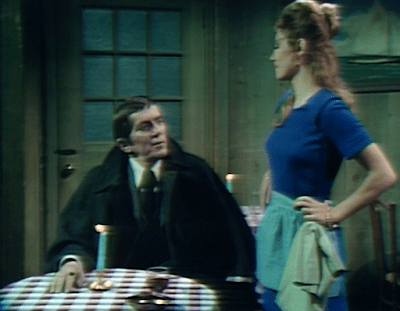
Barnabas is sitting at a table in the Eagle tavern. There is a glass of reddish liquid in front of him. In view of his condition, one wonders what that liquid might be.
Barnabas invites Buffie to sit with him. Since there are no other customers, she agrees. He tells her he is from South America. The son of this universe’s Barnabas Collins whom he claims as his great-grandfather went to Peru; when he introduced himself to the family, he said that his forebear did not die in that country. But evidently his imaginary descendants stayed on the continent, somewhere.
The Eagle is the counterpart of the Blue Whale in the other continuity. In #3, Burke Devlin was sitting at a table in the Blue Whale with hard-working young fisherman Joe Haskell when he said that his success in life began when a strange man picked him up in a bar in Montevideo. That was the show’s only reference to Uruguay, but Burke, the Blue Whale, and Brazil came to be strongly associated with each other. The song “Aquarela do Brasil,” a big hit in the English speaking world in the 1960s under the title “Brazil,” played on the jukebox at the Blue Whale, and it became Burke’s theme song. Ultimately Burke would die on a business trip to Brazil. Barnabas and Burke were enemies; when he sits at this table and claims to have a South American background, longtime viewers may wonder if he is thinking that the new universe is a place where he can try out a new personality and maybe he will start by imitating Burke’s.
Burke was a dashing action hero, attractive to women. Barnabas’ attempt to imitate him breaks down almost immediately. He winds up mimicking another prominent bachelor from his native universe, Professor Timothy Eliot Stokes, when he asks Buffie if she’s ever heard of the theory of “Parallel Time.”
Buffie shakes her head no. Barnabas says that some people believe that there are many universes, and that a copy of each of us can be found in each of them. They may look the same, but they lead different lives because they have made different choices. Buffie laughs and says that she hopes her other selves are having more fun than she is. She hastens to say that she doesn’t mean she isn’t having fun at the moment, sharing a table with Barnabas; she means that her life in Collinsport, as viewed from the most all-encompassing perspective and analyzed in the most thorough philosophic manner, well and truly sucks shit. Barnabas says that the other Buffies in the multiverse might have left Collinsport* and had wonderful adventures.
Longtime viewers saw one of those other Buffies in #951, when we were still in the original continuity. She had a different name; she went by Nelle Gunston. And as befits a mirror universe, she moved in the opposite direction. Rather than leaving Collinsport to look for something new as Buffie wishes she had done, Nelle left her parents’ home in Virginia and went to Collinsport because she had joined a cult dedicated to the destruction of the human race and its replacement by a loathsome breed of Elder Gods known as the Leviathan People. Barnabas had been the leader of the Leviathan cult, and when Nelle came to town she sat with him by the same table where Buffie and Barnabas sit today. They even take the same seats.
Buffie is charmed by Barnabas’ talk; between the suavity that Jonathan Frid brings to his part today and the energy with which Elizabeth Eis presents Buffie’s enthusiasm for him, it is far easier than it usually is to believe that Barnabas is a sexy dude. Maybe we are supposed to think that role-playing as Burke has enabled him to loosen up.
The conversation is really warming up when the bell attached to the front door rings. “Customer,” Buffie ruefully says to Barnabas as she rises. It is Cyrus.
Barnabas invites Cyrus to sit with them. He declines, saying that he came only to ask Buffie if she had seen John Yaeger lately. She tenses up. Yaeger used to beat her up and force her to help him with his crimes. She says that Cyrus himself had told Buffie that Yaeger wouldn’t be back in Collinsport. Cyrus says that he did, but that he is worried he might not be able to predict Yaeger’s movements as well as he thought he could. He offers Barnabas a lift back to Collinwood. That’s a bit surprising, since Cyrus got uptight when he saw Barnabas. As Yaeger, Cyrus discovered that there is a coffin in the basement of Will and Carolyn’s house, and he suspects that Barnabas spends his days there. But longtime viewers can remember the days Barnabas and Burke had conversations at the Blue Whale that were just as tense as the one he and Cyrus have in the Eagle, and Burke never failed to observe the small graces. It’s just the done thing, I suppose.
Cyrus leaves, and Buffie remains standing. She and Barnabas keep talking. He gets close, and goes in for a bite. He stops himself at the last second, to her surprise and disappointment. She was apparently ready for a kiss on the neck. He says he has to go. She is even more disappointed by that, but he promises to come back at closing. He asks to walk her home, and she happily agrees.
Will and Cyrus are in the drawing room at Collinwood. Will urges Cyrus to join him in a drink. When Cyrus declines, Will reminisces about the old days at Collinwood, when the party would just be getting started at this hour. In those days, people would leave the great house in the small hours of the morning and continue their revels at the Eagle. Cyrus says he won’t find much company there tonight. When he says that the only people in the place earlier were “the girl who works there” and Barnabas, Will looks alarmed. All of his mannerisms that suggest drunkenness drop away, and he rushes out.
Will gets to the tavern, and finds Buffie alone. The alcoholic author is obviously one of her favorite and most lucrative customers, so even though she has already blown out the candles she tells him he is in time for last call. To her amazement, he is not interested in a drink. He asks her where Barnabas is. She says he’ll be back and that he is taking her home. He says no, and she asks what’s wrong. Before he can answer, Will hears Barnabas’ voice behind him, echoing Buffie’s question. Laboring under the vampire’s power, Will has no choice but to leave Buffie alone with Barnabas.
Nelle, too, had agreed left the tavern with Barnabas. She expected to meet the leader of the Leviathans at his place, and was unhappy to find that the two of them were alone. Buffie is again an inverted mirror image of her counterpart. She takes Barnabas to her place, and is quite happy to be alone with him. The two close in for an embrace. He bites her neck, and she collapses. He had bitten Nelle, too. At that moment, Cyrus enters the room.
Cyrus does not exactly have a counterpart in the other continuity, but Christopher Pennock did play the Leviathan leader whom Nelle expected to meet. Like Cyrus, that character was a murderous shape-shifter. So Cyrus’ unexpected arrival mirrors the Leviathan leader’s unexpected absence.
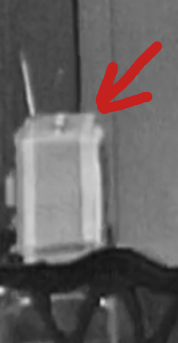
When we first cut to Buffie’s room, the camera lingers for several seconds on an extremely unusual prop. It is a television set. The only other time we have seen a television set on Dark Shadows was in #27, in the other universe, when Burke visited investigator Stuart Bronson in a hotel room in Bangor, Maine where there was a small portable unit. It looks like it might be the same set.
Bronson’s TVBuffie’s TV
The shot goes on so long, and the set is such an odd thing to see in the context of the show, that they must be making some kind of point with it. We have wondered why Buffie submitted to Yaeger’s abuse, when she is such a strong and intelligent person. Her reflection in Nelle suggests a partial answer. Nelle was drawn to the Leviathans, who offered to destroy her and all other humans. We can assume that Buffie, too, was following a self-destructive urge when she went along with Yaeger. Associated with her, the television is a symbol of the annihilation of the self. Turn the idiot box on, turn your mind off. If you aren’t careful, you may even wind up spending your weekdays staring glassy-eyed at ABC’s daytime lineup.
*He actually says “Collinwood.” Which is a blooper, but since Buffie mentioned in her first episode that she used to work at Collinwood it is kind of an interesting one. Maybe when another Buffie left her position as an upstairs maid or whatever she was, she got further than the nearest tavern.
Dark Shadows has taken us to a parallel universe where the A story is a mashup of Daphne Du Maurier’s 1938 novel Rebecca with Edgar Allan Poe’s 1838 story “Ligeia,” and the B story is a retelling of Robert Louis Stevenson’s 1886 novella Dr Jekyll and Mr Hyde. Today we also get a good look at the C story, another mashup. The ingredients in this one are Dracula and Who’s Afraid of Virginia Woolf.
Drunken novelist William H. Loomis and his disappointed wife, the former Carolyn Collins Stoddard, take the roles of George and Martha. The parts of Nick, of Honey, and of George and Martha’s imaginary son are combined in vampire Barnabas Collins.
Honey is present at two conversations with George and Martha. She flees from each, moved to vomit by their cruelties, and after the second is never seen again. One session with Will and Carolyn was enough for Barnabas. The circumstances of his exit were rather different from those of Honey’s. Barnabas did not become physically ill when he saw Will and Carolyn quarreling, and is willing to keep skulking in and out of their basement when he is not out preying upon the living. But Will has other ideas. He has chained Barnabas in his coffin in the basement of their house and is planning to force him to tell him his life story, which Will thinks he will be able to use as material for a book that will restore his fortunes. In this he is the mirror image of his counterpart in the main continuity, who broke the chains that held Barnabas in his coffin in his own attempt to get rich quick.
As Martha taunts George for the dead end his career has reached, Carolyn is in the habit of taunting Will with his inability to write new books of his own. As Martha flirts aggressively with Nick in front of George, so Carolyn wants Will to release Barnabas so that he can drink her blood again. As George and Martha’s son turns out to be imaginary, not part of their material reality, so Barnabas is a visitor from the main continuity, not a part of this universe. Inasmuch as Jonathan Frid is away for several weeks making the feature House of Dark Shadows, Barnabas is present only as a topic in Will and Carolyn’s quarrels.
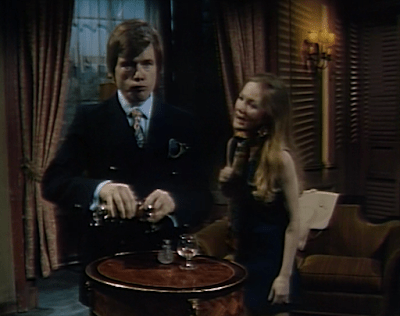
Will pours himself a glass of something, perhaps bergin and water. Screenshot by Dark Shadows Before I Die.
One might wonder if the idea of casting John Karlen as an analogue of George in an adaptation of Who’s Afraid of Virginia Woolf? occurred to the makers of the show around the time of #706. In that episode, Karlen played inveterate prankster Carl Collins, who held a gun at Barnabas’ head and threatened to shoot him. When he pulled the trigger, a flag labeled FIB! sprang out. George fires a rifle at Martha in Act One of the play, only to produce a similar effect with a Chinese parasol.
Later, Carolyn is eavesdropping outside the drawing room in the great house of Collinwood while Will is flirting with a lovely houseguest, a central character in the Rebecca/ Ligeia mashup. Carolyn stands in the doorway, in Will’s line of sight when he tries to make a date with the woman. Will has already rubbed Carolyn’s face in the intimate nature of her connection to Barnabas, and as his victim she can’t very well recreate Martha and Nick’s threat to cuckold George with any other male. So if we are going to have another scene built around that kind of insult, it will have to be Will who plays it with another woman.
Carolyn also spends some time with her friend Sabrina Stuart, who is part of the Jekyll and Hyde story. Sabrina is engaged to Dr Cyrus Longworth, the Jekyll character, and did not recognize him when last night he invaded her home and assaulted her in the persona of John Yaeger, the Mr Hyde character. Cyrus himself is puzzled when he comes to his laboratory in the morning and finds a terrible mess there, along with an IOU from Yaeger. A policeman shows up and asks him some questions, assuring him that he does not match the description of Yaeger. In his post about the episode on his great Dark Shadows Every Day, Danny Horn points out that this scene is recycled beat for beat from Dan Curtis’ 1968 TV movie adaption of Jekyll and Hyde.
Carolyn marches into Cyrus’ lab and tells him Sabrina is missing. She is angry with him for leaving Sabrina alone when the man who attacked her is still at large. He tries to assure her that Sabrina is in no danger, but since he cannot explain why he would believe that he only exasperates her further. She insists they go looking for Sabrina, and he acquiesces. It turns out Sabrina is in the great house of Collinwood, in a trance, trying to reenact the séance at which the Rebecca analogue died.
In the main continuity, Carolyn’s counterpart was married to someone whom she believed to be a man named Jeb. Like Cyrus, he was played by Christopher Pennock. Also like Cyrus, he was a shape-shifter who in his other form committed horrific acts of violence. Carolyn accepted Jeb’s refusal to tell him anything about himself, as Sabrina accepts Cyrus’ refusal to tell her anything that might lead her to suspect the nature of the potion he has developed. It is refreshing to see this Carolyn taking Sabrina’s side and insisting Cyrus do things a reasonable person might do.
Yesterday, Barnabas Collins went to the long-disused east wing of the great house of Collinwood to search for the coffin that vampire Megan Todd occupies during the day. Barnabas is himself the vampire who ended Megan’s human life, passing his curse along to her. When his friend, mad scientist Julia Hoffman, makes a characteristic remark and tells him “you must not feel personally about Megan Todd,” Barnabas asks “How can I feel any other way?” Most of Barnabas’ feelings, in this or any other matter, consist of pity for himself, but there is a trace of sympathy for Megan in there someplace, probably.
Now, Barnabas has taken Julia to a spot that he happened upon while looking for Megan. While Julia was in the carriage house on the estate with matriarch Elizabeth Collins Stoddard, Barnabas saw two women who looked and sounded exactly like them in a brightly lit, fully furnished, heavily decorated room behind a pair of doors in the otherwise dark and empty east wing. Julia’s double was wearing a French maid outfit and giving orders to Liz’, which is probably someone’s fetish but which is totally out of character for the women Barnabas knows.
In #351, Barnabas was without a blood-thrall. Julia offered to guard his coffin during the day. They were not really friends at that point, and he reacted to her offer warily. Among his objections was that it was not suitable for her, as a medical doctor, to fill such a position. She assured him that she was not volunteering “to be your maid.” Longtime viewers might remember that line when they see Parallel Julia in her livery.
There was an invisible barrier in the doorway that Barnabas could not cross, and he was unable to attract the attention of the women who were so near to him, even when he shouted what he supposed to be their names. The doors closed, and when they opened again the barrier was gone, but so were the doubles of Julia and Liz, along with all the furnishings and lights that had surrounded them.
Thinking of what Barnabas has told her about the room, Julia hesitates to enter it with him. She dismisses her concern as “silly.” Regular viewers will perk up at this- labeling a fear as “silly” is the surest way of marking it as the basis of an upcoming major story point. Once inside the bare room, Julia starts thinking out loud:
JULIA: I was at Eliot Stokes’ house one night, oh, last spring. We were having a brandy after dinner and he started talking about time… He was complaining that we all simply accept it. We don’t have much choice, I thought.
But Eliot had been reading a theory. It sounded insane to me. A theory of parallel time… we live on this universe in 1970, right? We accept the fact that our time is the only time that we can truly know. Suppose time is like a road and parallel to it there’s another road. On one we live the lives we know, but on the other road our lives are different because we’re in a different time-band* and we’ve made different choices. For example, in that other band of time I could’ve made a different choice when I was at college. Instead of being a doctor I could’ve married and had children.
Barnabas, you don’t actually think through some warp in the time band that you have actually seen us living other lives?
BARNABAS: I don’t know, there’s got to be a more rational explanation.
JULIA: Must there?
So, now we know that we are about to launch a new kind of time travel story. The show has taken us back in time for long costume drama inserts, most notably from November 1967 to March 1968 when it was set in the 1790s and from March to November 1969 when it was set in 1897. Now they are going to travel sideways in time, and take us to a parallel universe where Julia is a maid and Liz is not the lady of the house.
At the end of the episode, Barnabas sees the room change again. Parallel Time Liz and Parallel Time Julia uncover a portrait that hangs there, the portrait of a woman whom PT Liz insists is dead and PT Julia insists is still the rightful mistress of the room. Barnabas recognizes the subject as the Parallel Time counterpart of his ex-wife, wicked witch Angelique.
With this, the behavior of PT Liz and PT Julia falls into place. We’re about to see a story derived from Daphne Du Maurier’s Rebecca. PT Julia is Mrs Danvers, the housekeeper maniacally devoted to Rebecca, the late wife of Maxim de Winter. PT Angelique is the one whose death and continued ownership of the room have been a point of contention between PT Julia and PT Liz. We’ve seen a photograph of Parallel Time counterparts of Barnabas’ distant cousin Quentin Collins and strange and troubled boy David Collins, signed “Your loving husband, Quentin.” PT Quentin is the one whom we have heard Liz say is returning with a new wife. In the main “time-band,” Quentin is a penniless rogue with a long supernatural backstory, but his counterpart is the master of Collinwood, and Liz ranks somewhere below the uniformed domestics in the household hierarchy. The David we know is the son of Liz’ brother Roger and a blonde fire witch named Laura Murdoch, but evidently his Parallel Time counterpart is the son of the counterparts of Quentin and Angelique. We have had no indication of who Quentin’s new wife is to be.
This is not the first reference to Rebecca on the show. When Clarice Blackburn joined the cast as housekeeper Mrs Johnson in September 1966, she was supposed to model the character on Mrs Danvers. Mrs Johnson came to Collinwood as a spy for Collins family nemesis Burke Devlin, driven by her certainty that Roger was responsible for the death of her beloved former employer Bill Malloy. Bill, like Rebecca, had drowned under suspicious circumstances, though he didn’t have much else in common with her. By the time the “Death of Bill Malloy” story played out, Mrs Johnson had taken on a new function as an inveterate gossip who made narrative progression possible by blabbing everything she knew to everyone she met. Blackburn’s outstanding talents made her a significant part of the show for quite some time; it’s a shame she isn’t going to be part of the upcoming segment.
Rebecca was not the only Du Maurier novel to inspire a story on Dark Shadows. Dangerously unstable ruffian Willie Loomis first freed Barnabas to prey upon the living after David and Mrs Johnson told him the plot of Du Maurier’s Frenchman’s Creek and claimed that it happened to one of the Collins ancestors. Searching for the treasure the pirate gave to the lady, Willie stumbled upon Barnabas’ coffin. He opened it, earning a bite that made him the vampire’s slave.
Willie’s mistake was that he did not know what kind of show he was on. When Dark Shadows began, executive producer Dan Curtis and ABC vice president for daytime programming Leonard Goldberg** meant for it to be the television equivalent of the “Gothic romance” novels that were so popular in those days. Du Maurier’s novels were among the cornerstones of the Gothic romance genre, and if it were still that kind of show in April 1967 Willie would have been on solid ground in his expectation that there might be a lot of jewels hidden in an unmarked coffin in the old mausoleum. But when Laura was on the show from December 1966 to March 1967, her story subsumed all the major plot threads into a tale of the supernatural. Willie and his sometime friend, seagoing con man Jason McGuire, were on the show as in-betweeners to sweep up the last non-paranormal odds and ends and help introduce the next uncanny menace.
Now, the show is heading in the opposite direction, and Willie is back to help take us there. In Parallel Time, Dark Shadows will finally do the Daphne Du Maurier adaptation that didn’t work out in the Bill Malloy story and that was never meant to work out for Willie. But Megan has to be destroyed before Barnabas can decamp for Parallel Time, and he and Julia order Willie to destroy her.
It was not a foregone conclusion that Julia and Barnabas would want to stake Megan. At the moment, Julia is giving Barnabas injections meant to relieve him of the effects of the vampire curse. Similar injections had worked in 1968 and again during the 1897 segment. Julia shows Barnabas the cross she wears to ward Megan off, and he does not recoil from it. That suggests the injections are having some effect on him, even though he keeps complaining that they aren’t doing anything to curb his bloodlust. When Julia and Barnabas find Megan in the east wing, she refuses the injections. When they find that she is feeding on Roger, they conclude that she cannot be allowed to see another night.
Willie is horrified by the command to drive a stake through Megan’s heart. He protests that he doesn’t even know her. As Barnabas and Julia tell him of the nightmare that awaits everyone if he doesn’t do as they say, he starts to talk about his fiancée Roxanne and the secrets he has been keeping from her. He worries about the image she will have of him if she finds out that he is the former blood-thrall of one vampire and the destroyer of another. “I mean, she’s gonna be thinkin’ I’m weird or somethin’!” I suppose that would be an occupational hazard for blood-thralls.
Willie is worried Roxanne might get the wrong idea about him. Screenshot by Dark Shadows Before I Die.
There is an odd moment when Julia is asking Liz about the east wing. Liz tells her that Roger knows more about the legends of the house than she does. When Julia was first on the show, she was posing as an historian looking into the old families of New England. In those days, Liz mentioned that Roger knew far less about the Collins past than she did, which fit with the original keynote of Roger’s character, an extreme lack of family feeling. But by this point, Roger has merged with the roles Louis Edmonds played in the 1790s and 1897 segments, both of whom were dedicated to the honor of the Collins name.
*The first appearance of this bit of Collinsport English.
**Not to be confused with his then-boss, network president Leonard Goldenson.
Willie Loomis has come back to the Old House on the great estate of Collinwood, where he once lived as the sorely bedraggled blood thrall of vampire Barnabas Collins. Willie intends to stay only for a short time, answering an invitation from Barnabas and mad scientist Julia Hoffman. Willie is engaged to marry a woman named Roxanne, and Roxanne expects to leave with him in the morning. But he finds out that Barnabas and Julia, along with the kindly Maggie Evans and some other people, are locked in battle with a vast and incomprehensible evil. So Willie announces that he cannot leave. He will stay and help Barnabas and Julia fight.
At the beginning and end, a shape-shifting monster sees something that terrifies him. Pondering this, Barnabas remembers that the two things which frighten the monster are ghosts and werewolves. Since Collinwood is the world capital of both ghosts and werewolves, that raises the question of why the monster wants to be there. The disturbance can’t be a werewolf- the first time it occurs, it prevents the monster from attacking Willie and Maggie, and if it were a werewolf it would just have gone on to attack them itself. The second time, Julia comes face to face with it. It casts a glowing light on her, and she asks what it is. One might assume she would recognize a werewolf, who in any case don’t glow. The show does a good job making us wonder just what the phenomenon is and making us hope we will find out tomorrow.
When Barnabas first enslaved Willie in 1967, he was extremely cruel and Willie was miserable beyond imagining. When Willie came back in 1968 after a stay in Windcliff, the mental hospital Julia controls, Barnabas’ vampirism was in remission and Willie took rather an insouciant attitude towards him. In those days, Barnabas put up with Willie’s insubordinate attitude with relatively mild displays of annoyance. Barnabas finally brought Willie to heel in #560, when he convinced Willie that his disobedience was putting Maggie in danger and Willie responded with agony. Torturing Willie in that way made Barnabas smile for the first time in ages. He was glad to return at last to his happy place.
Now, Barnabas is a vampire again, but Willie is full of friendship and goodwill towards him. He talks warmly to Julia about how Barnabas helped him in the past. In turn, Barnabas is genuinely concerned for Willie’s well-being, telling him that the current situation is too dangerous for him and that he should go live his own life. This new coziness leads to some intentionally funny moments. At one point, Willie walks in on Barnabas saying out loud that he doesn’t understand what’s going on. He tells the vampire “You’re talking to yourself, Barnabas. That’s a bad sign!” As if that’s the part he needs to worry about!
Willie has a conversation with Maggie that verges on the poetic. When he tells her “I never knew how awful it was to be alone until I wasn’t,” we find ourselves wanting him to go directly to Roxanne and run as far as he can as fast as he can.
There is a big mirror on the wall at the foot of the stairs in Barnabas’ house. At one point he walks in front of it and casts a reflection. Sometimes they have been very emphatic that vampires don’t cast reflections. Most famously, Julia confirmed that Barnabas was a vampire in #288, when she contrived to open her compact and point the mirror at him. The same prop was used in #704, when it exposed Barnabas’ secret to the luckless Sophie Baker, prompting him to murder her. On the other hand, when wicked witch Angelique became a vampire for a while in 1968, there were some shots that were obviously deliberate in their composition that prominently featured her reflection in mirrors, making the point that she was an exception to this rule. The mirror doesn’t have to be on the wall, but if it is we will inevitably see Jonathan Frid reflected in it, suggesting that they put it there on purpose to show that he is now another exception to the rule.
Barnabas reflects.
Willie was off the show for a year, from #696 (broadcast 24 February 1969) to #956 (broadcast 23 February 1970.) His absence during that period was not explained. Today he mentions to Julia that he has been working at another hospital, as he once worked for her at Windcliff. Indeed, she had offered him a job there in #537. Since Julia did not know about this other hospital job, he must have taken it sometime after leaving his position at Windcliff and without a reference from her. Before Barnabas enslaved him, Willie was a dangerously unstable ruffian, wanted by the police, so they are likely the first employers he has had who would have provided a usable reference. So he probably left Collinwood for the job at Windcliff not much later than March 1969 and held a job in some third place before getting back into hospital work more recently.
In the first year of the show, only David Henesy, as strange and troubled boy David Collins, looked directly into the camera; in the last year, that move has been the signature of Denise Nickerson as David’s young friend Amy Jennings. Today, just about every member of the cast does it. I believe it is the first time Jonathan Frid has done so, though there have been times when his examination of the teleprompter has moved him perilously close to an unintentional soliloquy.
Barnabas tells Julia that their enemies will never find his coffin “where it is now.” The first time we heard that was in 1967, and back then it made us wonder why, if he has an impregnable hiding place for his coffin, he usually just leaves it in the middle of his basement where no one coming downstairs could avoid seeing it. Barnabas spent most of 1969 as a time traveler visiting 1897. His vampirism was exposed in that year, and he was hunted. He assured his allies that no one could find his coffin where it was hidden then; they found it immediately. So longtime viewers aren’t so sure that Barnabas will escape detection during the day.
As Julia, Grayson Hall has a new hairdo today. It is a bit longer than it has been, and is swept up in front.
Today we see Willie Loomis, much-put-upon servant of old world gentleman Barnabas Collins, for the first time since #696. We have heard no explanation of where he has been during the year in between. Long before his absence began, in #537, Barnabas’ friend Julia Hoffman had offered Willie a job at Windcliff, a mental hospital which she controls and where he was once a patient. Maybe he went off to work there.
Willie makes his first entrance today in conversation with Amy Jennings, a child who was herself a patient at Windcliff until she moved to the great house on the estate of Collinwood in #639. Willie knows Amy and expects her to know him, presumably from the time they overlapped on the estate, though perhaps they may have met at the hospital as well. Amy lets Willie in the house, but is in a hurry to go outside. He asks where she is going at such a late hour; she says that she left her bicycle outside and has to put it away before it starts raining.
Next we see Willie, he is on the telephone, making kissing noises. “Oh, oh, well you know, I can’t help it, precious. Oh, I mean your ol’ William, he wants to be with you so bad, but I just gotta wait. Well, sure I’ll hurry, I’ll get back as soon as I can.” Willie has always been much given to referring to himself in the third person, even in his first week on the show, when he was played by James Hall. This is the first time he has called himself “William,” and the first time we have had evidence that there is a woman anywhere in the world who reciprocates his romantic feelings.
Matriarch Elizabeth Collins Stoddard enters. Liz had unpleasant dealings with Willie in his early days, and like most other people in and around Collinsport believes that he abducted Maggie Evans,The Nicest Girl in Town, and held her prisoner in May and June of 1967. She is disgusted to see him in her house. He tells her that Barnabas and Julia asked him to come to Collinwood. He says that he went to the Old House on the estate, where Barnabas lives, and that he is not at home. He asks if Julia still lives in the great house; Liz says that she does, but that she isn’t in at the moment. Maggie is the governess at Collinwood now, and is in the minority of Collinsporters who don’t believe Willie was her kidnapper. She doesn’t know what happened to her in that period, since Julia used her magical power of hypnosis to wipe Maggie’s mind clear of the memories of the period to cover up the fact that Barnabas was the guilty party. Nonetheless, she is sure Willie was not to blame, and she considers him a friend. Willie asks to see Maggie, and Liz says that she, also, is out. He tells Liz he is getting married; she could not be less interested.
Liz and Amy meet in the drawing room and confer about Maggie. They have locked her in the room on top of the great house’s tower, because she is opposed to a conspiracy they are involved in. Amy says that she has told their leader about Maggie, and that he is on his way to take care of Maggie. The leader is a shape-shifting monster. Liz says she hopes he won’t come in the form he assumes when he is in his room, because that would involve killing Maggie. They have managed to frame someone else for the murders the monster has already committed, so if he kills Maggie it will reveal that that man is innocent.
Willie overhears the end of this conversation, and Liz and Amy realize he has overheard them. He sneaks up to the tower room to free Maggie. He gets into the room, but Amy closes and locks it, trapping them inside. Amy makes her signature move, looking directly into the camera and smiling at the audience. We hear the monster approaching, and Willie and Maggie clutch at each other.
Denise Nickerson was good at lots of things, especially playing Creepy Little Kid.
In yesterday’s episode, inveterate prankster Carl Collins told his brother, the rakishly handsome Quentin, that their distant cousin Barnabas was a vampire. Quentin has problems of his own, and he is counting on Barnabas to help him. So he locked Carl up in Barnabas’ hiding place, expecting that when night came Barnabas would prune one more branch off the Collins family tree.
Today, Quentin finds that Carl has escaped. He goes to Barnabas and tells him what has happened. Carl’s practical jokes annoy Barnabas intensely, and Barnabas has never bothered to conceal his disdain for him. He reacts to Quentin’s news with fury and a lot of orders. When Quentin later finds Barnabas standing by Carl’s corpse in the drawing room of the great house of Collinwood, he is really torn up about his brother’s death for almost a whole minute.
A knock comes at the door; it is the oppressively evil Rev’d Gregory Trask. Quentin keeps Trask in the foyer for a bit while Barnabas hides Carl’s body. When Trask forces his way into the drawing room, Barnabas is gone. Carl’s body is cunningly hidden… behind the curtains, propped upright. Of course it falls out almost immediately. Earlier in the episode, Carl took Trask to Barnabas’ hiding place, and we saw that Barnabas had single-handedly lugged his coffin and the structure on which it rests some distance away. If he is strong enough to do that, surely he could have tossed Carl’s body out the window. And regular viewers know that there is a secret panel in this room, of which Barnabas has repeatedly shown that he is well aware. They would probably have expected him to hide the body there. That he just stashes it behind the curtains where it is certain to come into Trask’s view suggests that he isn’t even trying to get away with this particular murder.
Closing Miscellany
John Karlen is breathing pretty deeply during Carl’s big closeup as a corpse. It’s really confusing, I thought they were telling us he wasn’t dead yet.
I don’t know what the writers planned for Carl in the flimsies they sketched out six months before this episode was made, though there is so little room for him in subsequent plot-lines that I suspect he was supposed to die at about this point in the story. Still, his death was accelerated because Karlen had other things to do. He won’t be back on the show until #956, in February of next year.
The creaky little waltz that Quentin listens to obsessively was released as a single in June of 1969 and would hit #13 on the Billboard Hot 100 in August. Regular viewers may be sick of it already, and the characters certainly wish Quentin would get another record. It’s Trask’s turn to complain about it today, giving him something in common with Barnabas.
Trask wears a cross which he uses as a weapon against Barnabas. The show is oddly inconsistent about the effect of the cross on vampires. We’ve seen other characters use crosses against them, and at one point it was said that a cross inside the lid of Barnabas’ coffin immobilized him. But his hiding place is in the middle of a cemetery full of grave markers in the shape of huge crosses, and we see several of them today. Barnabas just walks right past those with no problem. You might think that since the show was made in the USA, where sincerity is so highly regarded, that the cross might be effective against him only if it is wielded by the pure of heart. But Trask is every bit as evil as are Barnabas and Quentin, and it works for him. It’s a puzzlement.
I think of the climax of the Iliad. As Achilles moves in to kill Hector, Athena takes hold of his spear and drives it in, delivering the fatal wound herself.
For modern readers, this may ruin the story. The whole poem has been leading up to this moment; we’ve spent a lot of time with Achilles, listening to him try to figure out what it would mean for him to kill Hector. So why have the goddess take over at the last minute? Isn’t it an evasion of Achilles’ responsibility for his actions, and a cheat for us as we’ve been observing his psychological development?
For the original audience, it was not. They actually believed in their gods. Athena really existed, as far as they were concerned. When an event was important enough, they took a interest. If it was really huge, they would get involved. Moreover, the gods worked closely with each other. So much so that you didn’t pray to one at a time, but always to groups of them. When Athena joins Achilles in his fight, it isn’t her pushing him aside- it’s him doing something so important it blurs the boundary between human and divine.
Something like that is at work in the traditional, pre-modern, conception of demonic possession. To say that a person is possessed is a way of looking at behavior that is reducible neither to moralistic judgment nor to psychological analysis. It isn’t individualistic in the way that those modes of discourse are. Rather, it suggests that the boundaries between the person and the spiritual forces of darkness have broken down. Perhaps the person is partly to blame for that breakdown, but the whole point is that s/he is no longer a distinct being, but is merging into those supernatural forces.
So, imagine a version of Dark Shadows where Elizabeth Collins Stoddard really was the main character. Her whole approach to life is denial. So, you could have had a story with a beginning, middle, and end. In the beginning, we see the lengths she has gone to in her quest to keep from ever having to have an embarrassing conversation. In the middle, we see various horrors take place around her, each worse than the one before, each more obvious than the one before, and each time she finds a way to convince herself it doesn’t exist. At the end, a couple of innocent characters go to her in the drawing room of Collinwood to rescue her from the monsters who are running rampant there. She looks at them placidly and tells them she sees nothing wrong. Why ever do they think she would want to leave her home? All the while leathery-winged demons are fluttering about her head. She doesn’t see them, and they have no choice but to flee.
Comment left 10 November 2020 by “Acilius” on “Episode 780: The Establishment Vampire,” posted 2 December 2015 by Danny Horn at Dark Shadows Every Day
Vampire Barnabas Collins has stashed his coffin in its old hiding place, the hidden chamber inside the mausoleum where his parents and sister are buried. As dawn approaches, he tells his reluctant sidekick, broad ethnic stereotype Magda Rákóczi, that this is the last day he will have to leave the coffin there. The suspicions that had recently surrounded him have cleared, and he will move the coffin back to the basement of Magda’s home, the Old House on the estate of Collinwood, when he next arises.
The graveyard is immersed in a heavy fog. As Barnabas approaches the mausoleum, a familiar voice calls to him. His old nemesis and ex-wife, wicked witch Angelique, implores him to come with her and leave the year 1897. She warns him that he must return to 1969 now, or it will be too late. Barnabas tells Angelique that he has not accomplished the goals for which he came to the past, and that he will not leave until he has done so.
Longtime viewers may be puzzled when Angelique tells Barnabas that she has helped him before. In #757, Angelique did prevent her fellow undead blonde fire witch, Laura Murdoch Collins, from staking Barnabas, but that did not seem to be intended as a service to Barnabas. Rather, it recalled #417, in which Angelique prevented Barnabas’ friend Ben Stokes from staking him and freeing him of the effects of the vampire curse she had placed upon him. She told Ben that she wanted Barnabas to suffer forever, and nothing she says to Laura indicates that she has changed. Indeed, the only time she ever seemed to act out of goodwill towards Barnabas was in #410, when Barnabas was about to rise as a vampire for the first time and she, regretting the curse, tried to stake him herself. Perhaps there is a retcon coming up, in which it will be made possible for Barnabas and Angelique to join forces against some new enemy.
It certainly seems that the show is about to take a new turn of some kind. The major storylines with which the 1897 segment began are all approaching their natural conclusions, and a number of major characters have already been killed off. Longtime viewers will recognize an acknowledgement of these facts, not only in Angelique’s explicit statement that the proper time for Barnabas’ stay in the late nineteenth century is almost up, but also in the doings of another character in the graveyard.
Inveterate prankster Carl Collins suspects Barnabas of being a vampire, and in a dream visitation his late fiancée Pansy directed his attention to the mausoleum. Lurking outside it, he sees Barnabas open the secret panel and go into the chamber where the coffin is kept. Carl declares that “We’ll get him tonight! We’ll get cousin Barnabas… TONIGHT!”
Carl is played by John Karlen, who first appeared on Dark Shadows as the luckless Willie Loomis. It was Willie who, in a misbegotten attempt at jewel theft, inadvertently freed Barnabas to prey upon the living in #210. In consequence, Barnabas bit Willie and enslaved him. When Willie first served him, Barnabas would control him not only by the usual vampiric practices of blood-drinking and telepathic summoning, but also by frequent heavy beatings with his cane. Later, Willie would come to feel that Barnabas was his friend; it was never clear that Barnabas reciprocated this feeling.
Carl first met Barnabas in #706. He introduced himself by holding a gun to Barnabas’ head and threatening to shoot him if he did not admit that his story of being a long-lost cousin from England was a lie. The gun turned out to be loaded with a flag labeled “FIB,” and the whole thing was Carl’s idea of a joke. Barnabas’ icy response, starting with his incredulous tone while asking if “YOU are a COLLINS?,” set the tone for all of his subsequent dealings with Carl, in which his attitude ranged from undisguised contempt to barely disguised contempt. Yet Carl remained convinced that he and Barnabas were going to be great friends, and he even asked Barnabas to be the best man at his wedding to Pansy. Carl is much more enthusiastic about his supposed friendship with Barnabas than Willie is about his, and Barnabas is far more open about his hostility towards him, making the Carl/ Barnabas relationship a spoof of the Willie/ Barnabas one.
Ever since Pansy’s death, Carl’s thoughts about Barnabas have taken a darker cast. When we see him in the mausoleum, watching the panel open, we know that his plan to “get cousin Barnabas” will take him into the chamber where Willie forever lost his freedom. We know, too, that Willie’s misfortune revolutionized the show; when it puts this actor on this set, Dark Shadows is promising to make major changes.
We cut to the drawing room of the great house on the estate. Rakishly handsome Quentin Collins is talking with Magda. As Angelique cursed Barnabas to be a vampire, so Magda cursed Quentin to be a werewolf. Angelique placed her curse because she was upset that Barnabas did not love her and was under the impression she was about to die. Magda placed hers because Quentin had married and then murdered her sister Jenny. Magda did not know then that Jenny had borne twins to Quentin, a son and a daughter. Since the curse is hereditary, Magda has been trying desperately to reverse it ever since she learned of the children’s existence.
The children are still secret from Quentin, and so he does not understand why Magda is trying to help him. When he demands she tell him, she says “I. Did. Not. KNOWWW!” in exactly the same intonation she had used when she first heard about the children in #763. First time viewers don’t know any more than Quentin does what she is talking about- the children are not mentioned today. Magda makes up an obvious lie, saying that she hadn’t known how much Jenny loved him. That isn’t meant to fool the audience, and doesn’t fool Quentin. But when Carl enters, Quentin drops the subject and leaves new viewers in suspense about what Magda now knows that they do not.
Carl knows that Magda lives with Barnabas, and refuses to talk in front of her. She teasingly asks “Mr Carl” if he “don’t like me any more,” and walks out with a bold stride, suggesting that Carl may at some point have shown signs of liking her rather too avidly for her husband’s comfort. Once she is gone, Carl tells Quentin that there is a vampire in their midst. Quentin dismisses this out of hand, telling him that their brother Edward staked a vampire named Dirk and told him about it in vast and gory detail. Carl asks who made Dirk a vampire; Quentin says that it was Laura. No, says Carl, Barnabas made Dirk a vampire, and Barnabas is a vampire himself.
Quentin begins to laugh, but within seconds realizes that there is a great deal of evidence in plain sight to support Carl’s assertion. He agrees to go with Carl to the mausoleum, but we hear his thoughts as he reflects that Barnabas’ efforts to help him are the only hope he has of release from the werewolf curse.
In the mausoleum, Carl wonders aloud where Barnabas came from. Quentin supposes that he was there all along. Carl is horrified at the thought that he is “the real Barnabas- our ancestor! Oh God, that makes it worse!” Quentin orders Carl to open the panel, and Carl obeys. As my wife, Mrs Acilius, points out, John Karlen once again plays the servant’s role.
In the hidden chamber, the brothers open the coffin, finding the diurnally deceased Barnabas. Quentin tells Carl to hand over the gun he has brought; Carl obeys. Quentin asks Carl if he knows how to get out of the chamber. When Carl says that he does not, Quentin turns the gun on him and forces him to stay. Quentin shuts his brother up in the chamber with the vampire.
In #384, set in the 1790s, Barnabas shot and killed his uncle Jeremiah. Barnabas and Jeremiah were about the same age, and had been very close; they were often compared to brothers. Barnabas was not yet under a curse when he committed that fratricide; it was an act entirely of his own will. Angelique was also partly responsible; she had cast spells on Jeremiah and on Barnabas’ fiancée Josette, causing them to conceive a mad passion for each other and to run off and get married. Enraged, Barnabas broke from the customs of New England and challenged Jeremiah to a duel. Consumed with guilt, Jeremiah deloped and let Barnabas kill him.
Barnabas’ killing of Jeremiah was murder under the laws which prevailed at the time in Maine, which was until 1821 part of Massachusetts. Indeed, Massachusetts’ anti-dueling act of 1730 provided that anyone who had either been killed in a duel or been put to death for winning a duel would “be given an unchristian burial at a gallows or crossroads, with a stake driven through their body.” Since the audience knows that Barnabas is fated to become a vampire, there is a chilling irony in seeing him volunteer for a staked burial.
Dark as was the shadow the duel cast over the subsequent history of the Collinses, at least Barnabas’ act showed a kind of twisted courage. But when Quentin uses Barnabas as a weapon to kill his brother, he is acting from the most abject cowardice. In the century that they have been subject to black magic, the Collinses have sunk from tragic grandeur to infantile squalor.
Quentin goes to the Old House and tells Magda what he has done. Magda is horrified at another murder. “No! Too many people are suspicious now. We’ve got to stop it or we’ll all be found out!” Since Magda is not a member of the Collins family, she is often the straight man reacting to revelations of their misdeeds and monstrosities. And since she is played by the charismatic Grayson Hall, the audience tends to adopt her point of view. So it is easy for us to forget that she is a functional sociopath. Despite all the killings we know to have resulted from her actions, it is still startling that Magda’s only objection to Quentin’s attempt to murder his brother is that she is afraid of getting caught.
We cut to another scene on the same set. Magda has summoned Angelique to the front parlor of the Old House. She asks Angelique to erase Carl’s memory so that Barnabas will not choose to kill him. Angelique taunts Magda as an “amateur” in the occult arts, and declares that she is done helping Barnabas. Magda says that she has read the Tarot, and that the cards tell her that Angelique loves Barnabas. She renews her plea to prevent the killing of Carl, but Angelique will not yield.
The reference to the Tarot rings a bell for longtime viewers. In the 1790s segment, Hall played the Countess DuPrés, Josette’s aunt. Angelique was introduced in that segment; she was the countess’ maidservant, and appeared to be a beginner in witchcraft. The countess was oblivious to Angelique’s sideline, and in #393 declared her to be an uninteresting woman whom she had known ever since she was an uninteresting child. The countess spent most of her time in the front parlor of the Old House reading the Tarot. That Angelique speaks so haughtily to the Tarot reader and “amateur” witch Magda on the same set highlights the reversal of roles in this segment.
Meanwhile, Carl searches the hidden chamber for a way to escape. He finds that one of the stones in the steps slides and reveals a lever. He turns the lever, opening the panel. He runs out and vows to destroy Barnabas, in the process almost knocking over a large tombstone that wobbles as if it were made of Styrofoam.
In episodes #310-315, made and set in 1967, strange and troubled boy David Collins was trapped in the hidden chamber for a whole week. He never did find the release lever- the ghost of Barnabas’ little sister Sarah finally took pity on him, materializing and showing it to him. The show avoids the implication that David is drastically dumber than his great-great uncle Carl by showing that the stone concealing the lever is already slightly ajar.