Preemption Day: Dark Shadows actors on N.Y.P.D. (1967-1969)

On 23 October 1970, the ABC network preempted its afternoon lineup to cover President Richard Nixon’s address to the General Assembly of the United Nations. As a result no episode of Dark Shadows premiered 56 years ago today.

A few months ago, I was looking for something to watch on TV. My eye fell on a show from the 1960s I’d never heard of, titled NYPD. I flipped over to it, expecting it would hold my attention for a few seconds at most. But I saw that the guest star was John Karlen, Willie Loomis himself, playing a television reporter. Like Willie, Karlen’s character thought he had found a path to fortune and success, only to end up hopelessly entangled with a homicidal maniac. Karlen was great of course, and the show was way above average for cop shows of any period. Also, the opening title sequence, shot from a perspective immediately behind a flashing light on top of a car speeding through the city streets, was obviously the inspiration for the same image in the opening of Police Squad! So I watched it again the next time it was on, and soon found myself watching it as a matter of habit.

NYPD was produced in New York City for ABC from 1967 to 1969, and Karlen was one of a great many Dark Shadows cast members who had parts on it. Their appearances are fun for Dark Shadows fans, and in more than a few cases, they played remarkably similar roles. There were other connections between the shows as well- Ohrbach’s even provided the wardrobe.

Here are some of the casting overlaps. The first season was 26 episodes long, the second 23:

Season 1, Episode 1, “Shakedown”: Opens in a hotel room where a man appears to have committed suicide. The hotel manager is played by Conrad Bain; as when he played Mr Wells, manager of the Collinsport Inn, we don’t get to see nearly enough of him. The hotel detective is played by Dana Elcar, Sheriff Patterson #1. The heroes from the 27th Squad of the New York Police Department are exasperated at having to deal with Elcar’s character, since he is notorious throughout the city as an utterly incompetent investigator. Good to see that he didn’t lose his Collinsport ways when he moved to the big city! And John Harkins, who appeared in four roles on Dark Shadows, always as a mysterious man from another place, plays a nameless character who is the secret leader of all the gays in NYC (I don’t know if the gays all share a secret leader now. Maybe things were different in the sixties.)

Season 1, Episode 2, “Fingerman”: Joel Fabiani was heard but not seen as Paul Stoddard in #271, when we flashed back to the night when Liz learned Paul’s secret and tried to beat him to death. In this episode, Fabiani plays a man who is frantic because his secrets have caught up with him and now someone wants to beat him to death.

Season 1,Episode 8, “To Catch a Hero”: Michael Currie was Dark Shadows first law enforcement officer, the hapless Constable Jonas Carter. In this episode, Currie plays an army officer assigned to assist the detectives with the case of a psychotic war veteran. He fails to provide appropriate security to keep the veteran from getting loose and the police are forced to shoot him. That’s exactly the result we’d expect if Constable Carter were in his position.

Season 1, Episode 9, “Murder for Infinity”: John Karlen’s episode. Other familiar faces in the cast are Ralph Waite, the future Pa Walton, as the homicidal maniac and Sam Waterston as a beatnik who uses “hetero” as a pejorative term to describe Karlen’s character. There’s no word on whether the Sam Waterston character is satisfied with John Harkins’ secret leadership, but I do wish the young Sam Waterston had been on Dark Shadows as a militant sexual liberationist who sneered at straight people.

Season 1, Episode 10, “The Pink Gumdrop”: Nancy Barrett is glimpsed for about three seconds sitting at a table in a cafe where people plan car thefts.

Season 1, Episode 11, “The Witness”: about 20 minutes into it there was Bob O’Connell, a.k.a. Bob the Bartender, as laboratory technician Gerardi. He has several lines, but is uncredited. He isn’t even listed on IMDb, so I took this screenshot to prove that it is him:
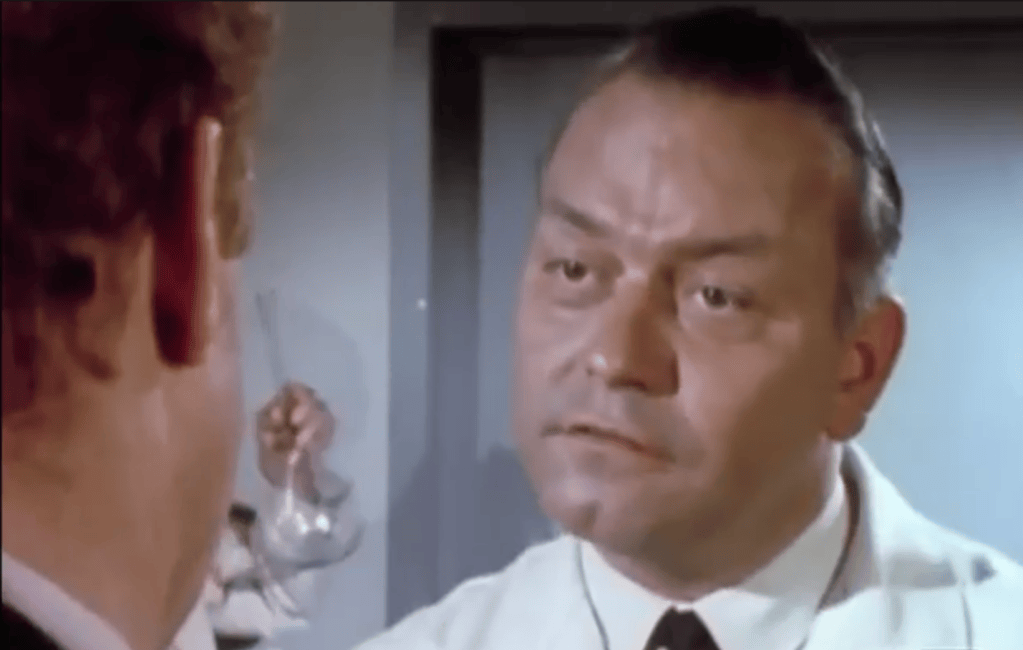
Criminalist Gerardi is supposed to analyze the ink on a document and determine when it was signed.

Season 1, Episode 12, “Boy Witness”: A 13 year old sees a woman shot to death and claims to have seen the gunman. A fingerprint on the cartridge of the fatal bullet leads the detectives to a man who matches the boy’s description and who was dating the woman. The man is played by Mitch Ryan. Ryan’s character breaks into the boy’s bedroom, and when the police catch up to him he assaults them and attempts suicide. It turns out the boy didn’t really get such a good look at the guy, so the detectives say that now they have to start all over. Since they could prove that he loaded the murder weapon, that would seem to be an overreaction! That overreaction reminds me of Burke Devlin’s belief that he was somehow proved innocent of vehicular manslaughter because he wasn’t driving his car when it hit the victim, he was just passed out drunk in the back seat after he had given the keys to an equally drunk guy. Still guilty!

Season 1, Episode 16, “Cruise to Oblivion”: Hugh Franklin played Richard Garner, grey eminence of the Collins’ family’s legal team on Dark Shadows. In this one, he plays the grey eminence of a drug ring. James Hall was Willie Loomis #1, a young mariner who seems to have lost his sea papers and who is a subordinate in some kind of unsavory scheme. Here, Hall is a subordinate in the scheme Franklin’s character oversees, and is connected with a ship carrying heroin.

Season 1, Episode 20, “Cry Brute”: Clarice Blackburn played three characters on Dark Shadows whose function was to introduce false allegations. Housekeeper Mrs Johnson was originally supposed to accuse Roger Collins of killing Bill Malloy; repressed spinster Abigail Collins brought in the Rev’d Mr Trask to accuse well-meaning governess Victoria Winters of witchcraft; and hateful biddy Minerva Trask accused neurotic intellectual Rachel Drummond of all sorts of things. In this episode, Blackburn plays a wife who backs her husband up when he falsely accuses one of Our Heroes of assault.

Season 1, Episode 24, “The Private Eye Puzzle”: Donna McKechnie as a young woman with a secret, over a year before she appeared on Dark Shadows as Amanda Harris.

Season 1, Episodes 25 & 26, “Nothing is Real But the Dead” Parts One and Two: Michael Hadge, who attained immortality as motorcycle enthusiast Buzz on Dark Shadows, plays a man the detectives meet in a pool hall. In Part One, he’s on camera for about a minute, enough to make a strong impression. He complains angrily about the damn dirty hippies who have moved into the neighborhood and are ruining it for all the hardworking, clean-living old-time residents such as himself and his family.

In Part Two, he gets another minute. The detectives remember his vociferousness against the hippies, and suspects he may have killed one of them. He denies it. Hadge has a very fine needle to thread here. The character is pretending not to be afraid of the police, and he is not as good an actor as Hadge is. We notice his insincerity, and are left wondering if he might be guilty. But it takes more time than Hadge has to really deliver on this, so we wind up attributing the character’s shrill awkwardness to his limitations and bumping ourselves out of the story for a little bit.

Season 2, Episode 1, “Naked in the Streets”: Vince O’Brien played a couple of forgettable roles as senior law enforcement officers on Dark Shadows. He has an equally forgettable role in this one as the New York Police Department’s Commander for the borough of Manhattan.

Season 2, Episode 2, “Encounter on a Rooftop”: Alfred Hinckley had a bit part in the first episode of Dark Shadows as a train conductor, and a more substantial part later as a doctor who is initially courageous when confronted by the monsters, but who ends up letting them have their way. He has a small part in this one as a man who reports a prowler and sets off the action.

Season 2, Episode 5, “Deadly Circle of Violence”: Gene Lindsey has a great scene as a man who catches up to a racist mass murderer played by some guy called Al Pacino. He doesn’t share any scenes with the murderer’s girlfriend, played by a actress named Jill Clayburgh. I wonder if those two ever called Lindsey for career help when he made it big as Randall Drew in the 1840 segment of Dark Shadows.

Season 2, Episode 6, “Case of the Shady Lady”: Harvey Keitel danced at the Blue Whale in #33; within two years, he played the manager of a dance club in NYC in this episode.

Season 2, Episode 7, “The Golden Fleece”: John Harkins has a major part as a man who gives the police an incomplete report of a a robbery of which he was the victim. Erica Fitz is credited as a waitress, but we didn’t notice her.

Season 2, Episode 9, “Walk the Long Pier”: Hugh Franklin reprises his role as the drug kingpin, but doesn’t have much to say. Dolph Sweet, a forceful Collins family loyalist in #99, is a forceful police official. Frederic Forrest, who danced at the Blue Whale in #137, appears briefly and is credited as “Customs Official.”

Season 2, Episode 12, “The Love Hustle”: The episode opens with Lara Parker walking into the squad room, raving that her mother is in danger, and dropping dead. Most of the time she is on screen she is photographed in an extreme closeup focused on her eyes. She’s only on for a minute, but the rest of the episode is an investigation of what happened to her, so she makes an impression.

Season 2, Episode 13, “The Body in the Trunk”: Mitch Ryan is the angry father of a girl who died under unsavory circumstances. House Jameson, who appeared in #270 as the useless Judge Crathorne in #270 and #271, here plays the even more useless doctor who is responsible for the girl’s death.

Season 2, Episode 14, “Night Watch”: Daniel Keyes plays a locksmith, which I suppose might be a joke about his name. Come to think of it, as the Caretaker at the old cemetery north of town he played a character whose chief responsibility was locking and unlocking gates and doorways, so perhaps he was cast on Dark Shadows for the same reason.

Season 2, Episode 15, “Three Fifty Two”: Frederic Forrest, wearing a wig that appears to be made of an old truck tire, is the second most prominent member of a gang of robbers who beat up two of the three main characters.

Season 2, Episode 21, “Boys’ Night Out”: David Ford, Sam Evans #2 and Andre DuPrés, is a detective who advises Our Heroes on his specialty, extortion rackets. He just sits across a table from them and gives a brief lecture in a reassuring tone. He appears to be reading off a teleprompter.

Season 2, Episode 22, “Everybody Loved Him”: Alfred Hinckley has another small part as a witness.

Season 2, Episode 23, “No Day-Trippers Need Apply”: Lee Beery and Gaye Edmond play women who are more or less prostitutes, which their characters on Dark Shadows were not. Philip R. Allen plays a policeman, which his was.
Episode 264: In the shadows

In its first months, Dark Shadows spent a fair bit of time on the business interests of the ancient and esteemed Collins family. In those days, the Collinses were running out of money and their old nemesis, Burke Devlin, had come back to town with a plan to strip them of their remaining assets and drive them into poverty. The “Revenge of Burke Devlin” storyline never really took off, and was eventually subsumed into the tale of blonde fire witch Laura Murdoch Collins. Shortly after Laura disappeared, Burke formally gave up on his revenge. With that, the business stories ended, and there was no particular reason for Burke to stick around.

On Tuesday, Burke was recast. However little his character may have had to do on the show or however much he may have had to drink before he arrived at the studio, Mitch Ryan was always interesting to watch. Anthony George couldn’t match Ryan’s charisma, but by 1967 he had been a familiar face in feature films and primetime television for years. The original audience, even if they couldn’t remember George’s name, would have recognized him as a famous actor and assumed that his casting meant that something big was in store for Burke.

Today, we have two hints that business stories might be making a comeback as well. Seagoing con man Jason McGuire is blackmailing reclusive matriarch Liz into marrying him. Vampire Barnabas worries that the cozy little home he has made for himself in the Old House on the estate of Collinwood might be threatened if Jason takes control of the family’s holdings. He asks Liz’ brother, high-born ne’er-do-well Roger, to look at the original deeds for the Old House and the great house to see if there is some provision he might be able to use to defend his interests against Jason. That Barnabas asks about the deeds would suggest that he has acquired some form of ownership in the Old House. We’ve never seen him buy the house from Liz or receive it as a gift from her, but if both deeds are still in Liz’ name, he could hardly use their wording to claim a right to stay there. So when Roger goes off to look for the deeds, there is a chance he will come back with a story about real estate.

The second hint comes in Barnabas’ confrontation with Jason. Barnabas takes a very aggressive tone with Jason, who responds by asking Barnabas where he goes in the daytime and where his money comes from. “You have no accounts in the bank in town, and I know you don’t operate a business…” If Barnabas is going to be on the show for the long haul, as the ratings clearly indicate we should expect him to be, Jason will not be the last person to ask these questions. We might wonder how exactly he will forestall them.

If we have been watching from the beginning, the likeliest answer would involve Burke. When was a major character, Burke was presented as an inexhaustibly rich man who knew his way around some of the shadiest places in the world. If Burke happens upon Barnabas’ secret, we could expect Barnabas to bite him and thereby bring him under his power. With his money, Burke could set up plenty of bank accounts and businesses in Barnabas’ name. With his contacts in the demimonde, he could secure whatever papers Barnabas needs to establish his identity. Even a photo ID- Burke could easily hire a Barnabas lookalike to pose for a British passport.*

During the “Revenge of Burke Devlin” arc, Burke bought up a lot of Liz’ debts. In particular, he held enough notes payable on demand that she feared he might be able to put her out of business at any time. That hasn’t been mentioned for a long while, but if Barnabas takes control of Burke he could take those notes and exchange some of them for outright ownership of the Old House.

Barnabas could also compel Burke to fabricate some fraudulent papers that would make it look as if he were deeply in debt to Barnabas. When Barnabas got around to killing Burke, those papers would come to light. Liz and Roger would be grateful to Barnabas for taming their old adversary and clearing out some debts that posed a danger to their financial position, while well-meaning governess Vicki would be grateful to him for helping her boyfriend save his face after his business went south. As a result, his position at Collinwood would be unassailable.

Closing Miscellany

There is a location insert of Roger walking to the Old House, a flashlight in hand. I don’t think we have seen this footage before.

Screenshot by Dark Shadows Before I Die

Until today, Barnabas has tried to be very suave with everyone who doesn’t know that he is a vampire. Since he has nothing to say to Jason that will intimidate him, he might as well continue that approach in his scene with him, or at least play dumb. But instead, he is openly, and self-defeatingly, hostile. This will become a pattern in future episodes. Time and again, Barnabas will greet a potential adversary with an immediate declaration of war, often before the adversary even knows who he is, thereby forfeiting whatever element of surprise he might have on his side.

Barnabas catches a glimpse of the ghost of his sister Sarah. He only sees her as a figure moving in the distance as he is looking out the window, and has no idea who she is. But it does confirm that he is able to see her, something we had not known he could do.

*I laid all this out two years ago in a comment on Danny Horn’s Dark Shadows Every Day.

In place of 131: “A Christmas Carol”

There never was an episode #131 of Dark Shadows. They made a point of giving numbers divisible by 5 to episodes that aired on Fridays, so on days when the show was not broadcast-as it was not broadcast on 26 December 1966- they just skipped the number that would have been used had it run that day.

Since that preemption was the result of Christmas-related programming,* this seems like the place to promote 2021’s big Dark Shadows Christmas event, a dramatic reading of the Orson Welles version of Dickens’ A Christmas Carol by ten surviving members of the original cast. Surviving at that time- it turned out to be Mitchell Ryan’s last performance before his death on 4 March 2022; Christopher Pennock had been involved in the early stages of the production, but he would die in February of 2021.

It is irresistible viewing for Dark Shadows fans. It makes extensive use of music from the show- rather too extensive for my taste, but Mrs Acilius liked it, and from what I gather she appears to be in the majority.

The acting is quite good. I was especially impressed by James Storm’s portrayal of Bob Cratchit. I had never seen Mr Storm in anything but Dark Shadows, where he was cast in the preposterously unplayable role of Gerard Stiles, so it was amazing to me to see what he could do when he had something to work with.

Another pleasant surprise was Alexandra Moltke Isles as the Ghost of Christmas Present. Readers of this blog know that I have a high opinion of Mrs Isles’ abilities, but this was her first part in 53 years. I held my breath to see how many steps she had lost in that interval. As it became clear that she could go as deep into her character as ever and pull up a treasure trove of dramatic insight, I was thrilled.

Mrs Isles appeared at one or two Dark Shadows conventions early in the 1980s. During the unpleasantness, she couldn’t very well make herself available for any event where she would be expected to take questions from the floor, but from time to time she sent greetings on video that would be played at conventions. And she sat for several interviews about Dark Shadows over the years. So you can’t say she made herself a complete stranger, but it is still quite a novelty to see her in this setting.

Many longtime fans describe Mrs Isles as the cast member who was least friendly to them when the show was in production, and there may be a reason for that. In the Q & A, she responds to the question about her first encounter with fandom by telling a story about a girl jumping her on the street and trying to rip her hair out of her head. After that introduction, it is remarkable that she’s been around as much as she has.

The person who had been absolutely disconnected from fandom the longest was David Henesy. He stuck with acting for a few years into the 1970s, but never attended a convention or had any connection with any Dark Shadows themed public events until a cast reunion on Zoom in October 2020. His performances as the child characters (he’s by far the youngest member of the cast, a mere 65 years old at the time of taping) are as letter-perfect as was his work in the series.

*A football match, but a football match usually held at Christmas-time.

Episode 79: I’ll hate you in public

Problem child David Collins enters the restaurant at the Collinsport Inn. Mrs Sarah Johnson, longtime housekeeper to the late Bill Malloy, is confronting dashing action hero Burke Devlin, declaring that he is to blame for Bill’s death. David angrily defends Burke. Burke whisks him out of the restaurant into the hotel lobby.

Screenshot by Dark Shadows Before I Die

Little does David know that the confrontation between Burke and Mrs Johnson was staged for the benefit of his family, the ancient and esteemed Collinses. The two of them are scheming to have Mrs Johnson placed on the Collinses’ domestic staff as housekeeper so that she can spy on Burke’s enemy, David’s father, high-born ne’er-do-well Roger Collins.

Burke and David have a charming little scene in the lobby. David stumbles over many of his words. These are probably flubs, but they fit so perfectly with what we would expect a highly agitated nine year old to sound like that the writer might have wished he’d put them in the script. David says that he and Burke are two of a kind, that everyone in the world is against them, and that he wants to murder them all. Burke asks if this wouldn’t be a bit of a drastic solution. While David ponders that question, Burke ushers him up to his suite.

There, David asks if it is true that he told his aunt, reclusive matriarch Liz, that he would use any means at his disposal to strip the family of all its assets. Burke says that he offered to buy the house, and reminds David that he himself had suggested Burke do that so the two of them could enjoy a freewheeling bachelor existence there. David accepts this at once and is all smiles. He then tells Burke that his governess, Miss Victoria Winters, has been teaching him about the Civil War. The theme of divided loyalties has been weighing on him- how can he choose between two sides led by Liz and Burke, the only two people he likes? Burke tells him they will just have to work out a peaceful solution, and David smiles again.

Screenshot by Dark Shadows Before I Die

David Henesy and Mitchell Ryan were not only excellent actors- preternaturally so, in the case of the preteen Henesy- but were also such appealing personalities that scenes featuring the two of them are irresistible. These particular scenes build Burke up as a villain. In his conversations with Mrs Johnson and in a couple of phone conversations, he has made it clear that he is indeed committed to destroying the Collinses. Even if this is the first episode we have seen, we know that he is lying to David and tricking him into helping with the annihilation of his birthright. Returning viewers have seen him being even more explicit about his plans on many occasions. So our loyalties are as divided as David’s- we are eager to see more interactions between Mitch Ryan and David Henesy, but are appalled by what is going on between Burke Devlin and David Collins.

Episode 64: Collinwood breeds murderers

Dashing action hero Burke Devlin goes to the local tavern, The Blue Whale. He sees Matthew Morgan, maniacally devoted servant of his foes, the wealthy Collins family. Matthew demands that Burke leave town. When Burke refuses, Matthew calmly informs Burke that he will kill him. Mitch Ryan plays Burke’s reaction to this announcement with a priceless look of disbelief. There’s a flicker of light in his eyes in the first second of the reaction, and he holds it long enough to be hilarious to watch:

Burke's reaction
Burke is stunned by Matthew’s casual announcement

Their conversation devolves into a bar fight. After the sheriff breaks it up, Ryan again has an opportunity for a memorable facial expression:

Burke recovering from the bar fight

Burke has been obnoxious enough, and Thayer David’s Matthew is engaging enough, that we found ourselves cheering Matthew on and laughing when Burke lost the fight.

In the sheriff’s office, both men get stern scoldings, Matthew for assaulting Burke, Burke for interfering with the police investigation of the death of beloved local man Bill Malloy. The sheriff releases both, warning Burke to stay away from the estate of Collinwood and Matthew to stay on it. Alone in the office, he calls reclusive matriarch Liz to warn her that Burke might be coming to Collinwood, and asking her to call him if he does.

Liz tells first the sheriff, then her daughter, flighty heiress Carolyn, that she doesn’t think Burke will come to the estate. The sheriff had previously assured Matthew that Burke wouldn’t go there “if he knows what’s good for him.” If soap opera characters knew what was good for them, they wouldn’t get much screen time, so of course the episode ends with Burke entering the house.

Episode 61: A sandwich for a lonely man

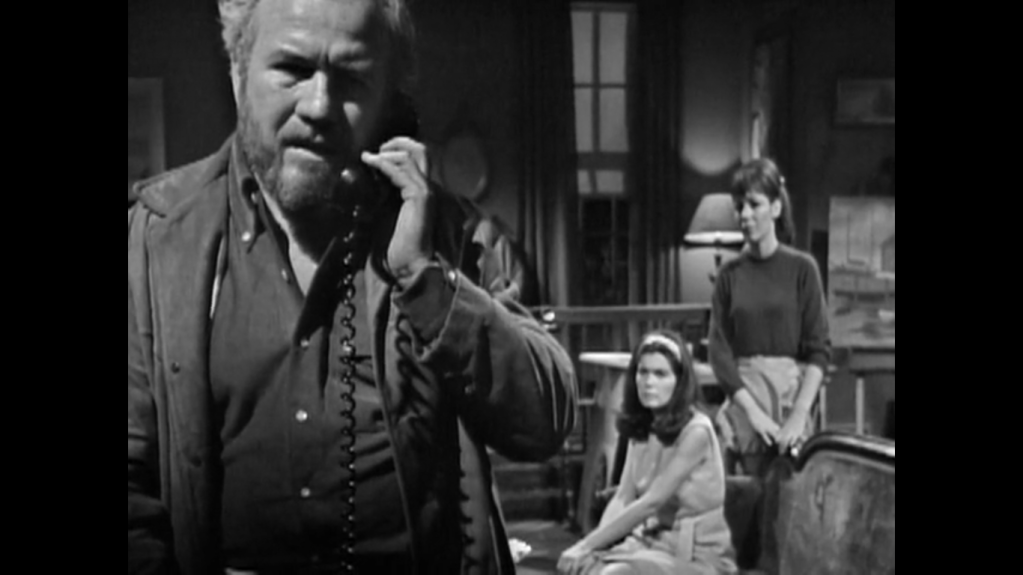
My wife, Mrs Acilius, pointed out that my post about episode 60 was unfair. She objected to the sentence “The Friday cliffhanger is Burke asking if he may join the Evanses and Vicki for dinner.” As she explained, that moment actually is an effective cliffhanger. I hadn’t mentioned that the sheriff had called drunken artist Sam Evans to warn him that dashing action hero Burke Devlin might be coming to his house, that he urged Sam to call back if Burke did come, and that actor David Ford played Sam’s reaction to this call with a convincing display of terror.

Sam on the phone
Sam trying to conceal his fear from the women behind him and the man on the other end of the call

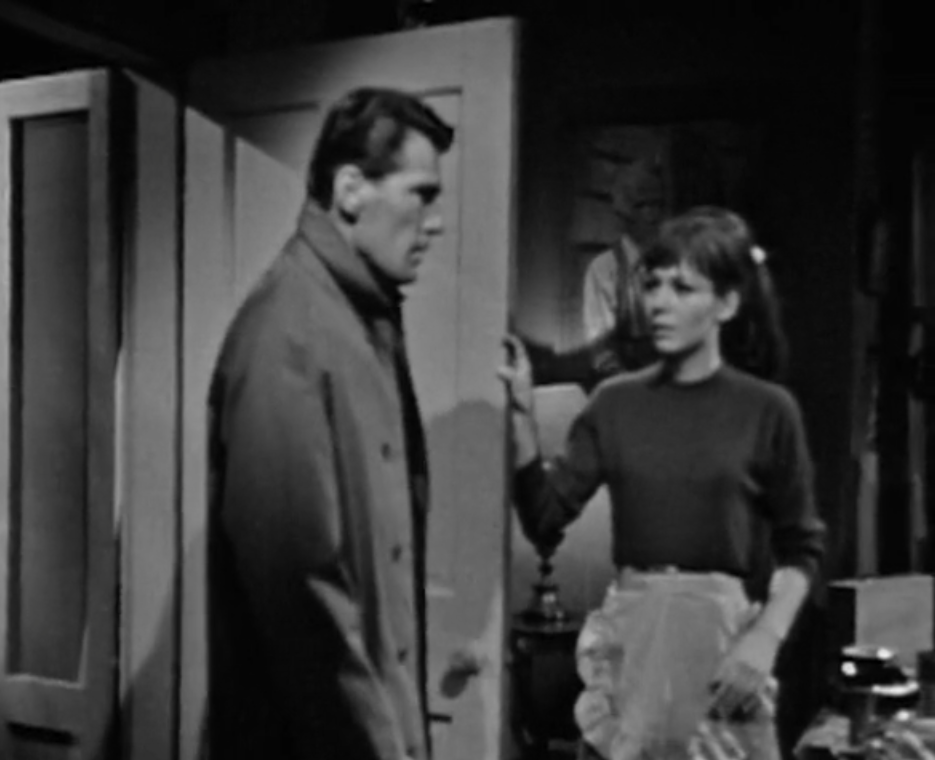
I also failed to mention the shot when Burke enters the room. Before Sam can get the words out to tell his daughter Maggie not to open the door, Burke has burst in. The scenes in the Evans cottage have been dimly lit, with all three figures moving before dark backgrounds. When the light colored door swings open, its relative brightness feels for a second like a flash, and when he stands in front of it Burke cuts a stark figure. We see him in contrast with Maggie, who stands against a dark background, wearing a dark top and a stunned expression:

Burke enters
Burke enters the Evans cottage

Throughout the episode, Sam had failed repeatedly to exercise any measure of control even in a social situation in his own home where the only other people are his daughter Maggie and well-meaning governess Vicki, the two kindliest characters on the show. The irruption of Burke into that setting is indeed a formidable moment for Sam.

So yes, that was a more plausible Friday cliffhanger than I allowed. Perhaps I was prejudiced against it because I remembered this episode. The purpose of a cliffhanger is to bring the audience back for the next installment. Typically, the next installment will begin by resolving the cliffhanger as quickly and unceremoniously as possible. But today, Burke’s intrusion into the Evans cottage drags on and on. In the process, it does serious harm to Burke’s character.

After rushing into the Evans cottage, Burke defies Sam and Maggie to say that he isn’t welcome. Maggie, unaware of the sheriff’s call urging Sam to let him know if Burke shows up, breaks down and says that of course Burke is welcome. Burke then tries to order Vicki and Maggie into the kitchen so that he can be alone with Sam. Neither woman is at all meek, however, and they stand up to Burke’s browbeating admirably.

Not so Sam. He takes the first opportunity to run away. We know that Sam has his guilty secrets, but he is a likable character, and it is hurts to imagine the pain that will await him the rest of his life whenever he remembers the night he left his daughter and her sweet young friend to face an angry man alone in his house. Sam doesn’t even call the sheriff. Instead, in his panic he goes to the hotel to try to retrieve a sealed envelope he had Maggie leave in the safe there. That gives us a scene with Conrad Bain as hotel manager Mr Wells. Bain is always a delight, and his little business about the envelope is certainly the most pleasant part of the episode. At the end of the episode, Sam will meet Burke at the hotel and ask to talk with him alone in his room, leaving us with the image of him trying to redeem himself in his own eyes.

Before that end comes, however, we have much, much more of Burke trying to bully the young women in the cottage. He won’t let them eat dinner. He harangues them about his manslaughter conviction. In the course of that harangue, it becomes clear that he isn’t thinking at all clearly. “I was drunk and don’t remember too much about that night, but I do remember Roger Collins taking over the wheel.” That’s just delicious- he was hopelessly drunk, blacked out in fact, but he’s pretty sure he remembers giving the keys to someone else before the fatal collision. The fact that his substitute driver was just as drunk as he was doesn’t seem to occur to him as a flaw in his “defense,” nor does the fact that this one convenient piece of information is the only thing to surface from his alcoholic stupor. That sort of thinking runs at such an oblique angle to reality that there would be nothing to say to Burke even if he were willing to listen to you. He goes on to suggest to Maggie that her father may have killed their old friend Bill Malloy, and refuses to leave the house when Maggie tells him to do so.

Burke’s abuse of Sam, Maggie, and Vicki makes it hard for us to like Burke as much as the show needs us to like him. We’re supposed to perk up when he’s on screen, not only because we don’t know what he might do next, but also because we don’t know whether we will approve of whatever surprising thing he makes happen. Even when he is trying to destroy the family to which our point of view character, Vicki, owes her loyalty, we’re supposed to want to see more of him. But when we see him treat Vicki and Maggie the way he does here, the image of him as a grinning thug sticks in the mind, and it is hard to want more of that.

All the more so, perhaps, because of his ineffectiveness as a thug. Our first concern with the show is that it should tell an interesting story, and Burke earns our attention by providing exciting story points. We can like even a very evil character who makes exciting things happen, but someone who simply shows up at your house when you’re about to eat, keeps you from your dinner, rambles on with a lot of nonsense, insults your father, and refuses to leave is just testing your patience for bad conduct.

We can compare Burke as the villain of this episode to another, more interesting villain. Throughout 1966, Mitch Ryan was not only playing Burke on Dark Shadows, but was also on Broadway in Wait Until Dark. In that play, he was one of the con men who, under the control of a mysterious figure calling himself Harry Roat, junior (and senior, but that’s another matter,) talk their way into a blind woman’s apartment and try, at first by trickery and then by threats of murder, to get her to hand over something valuable that she hadn’t realized she had in her possession. Like Maggie and Vicki, the heroine of the play stands up to Ryan’s character and the other villains. She ultimately triumphs over them. Unlike Burke, who is simply indulging on rage for its own sake and boring everyone as he does so, Roat has devised a brilliantly clever scheme to trick his victim, a scheme which fails only because she is his equal in brilliance and his superior in other ways. Wait Until Dark was a major hit in that original Broadway run, as was the movie version the next year and as many revivals of it have been in the years since. If Roat’s activities were as pointless in the play as Burke’s are in this episode, I very much doubt it would have been produced at all.