Episode 1115: The woman in question

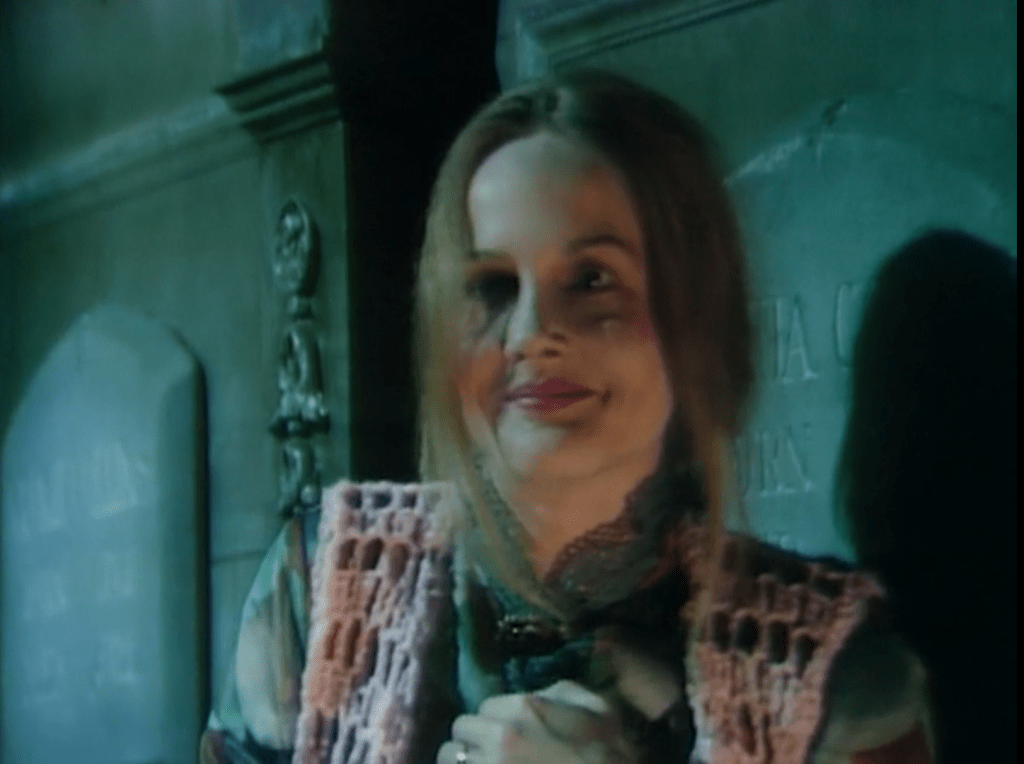
The year is 1840. Vampire Barnabas Collins summons his latest victim, Roxanne Drew. They meet at the gazebo on the grounds of the estate of Collinwood. He says he has a way they can be together forever. She says she would die for him. That’s what he had in mind. He bites her, drains her body of blood, and lets her fall to the floor of the gazebo. He tells her corpse that it will be found tomorrow, and that Roxanne will be mourned. The following night, she will rise as a vampire. He walks off, leaving her.
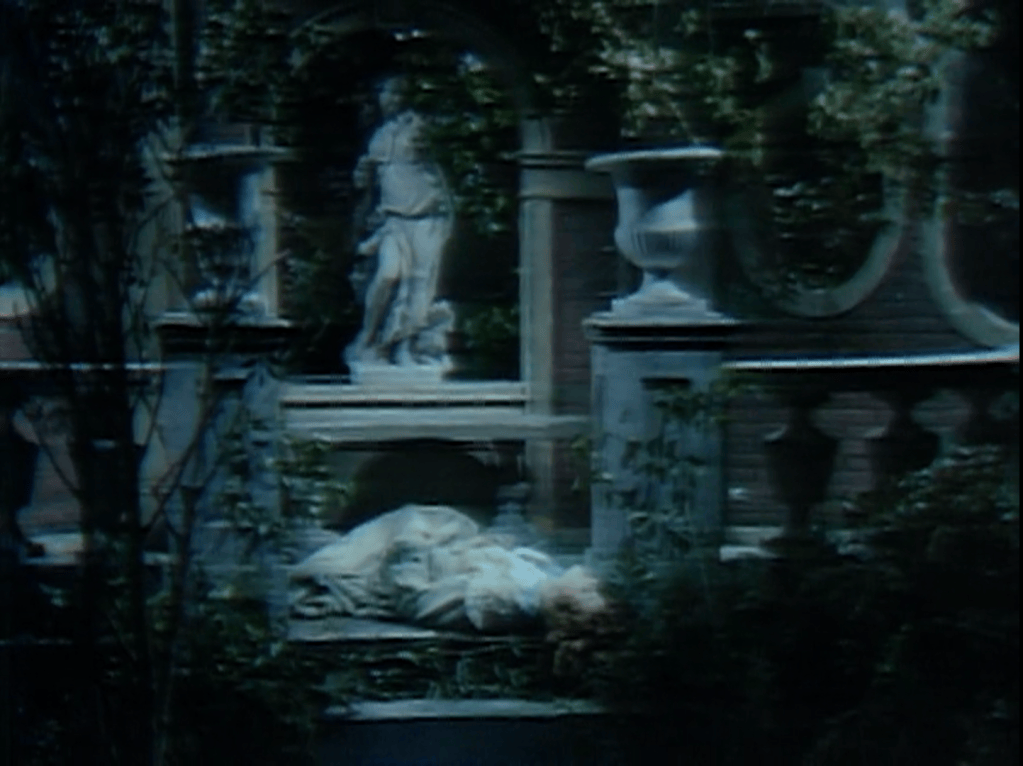
Roxanne, left like a cat leaves a mouse for its people to find.

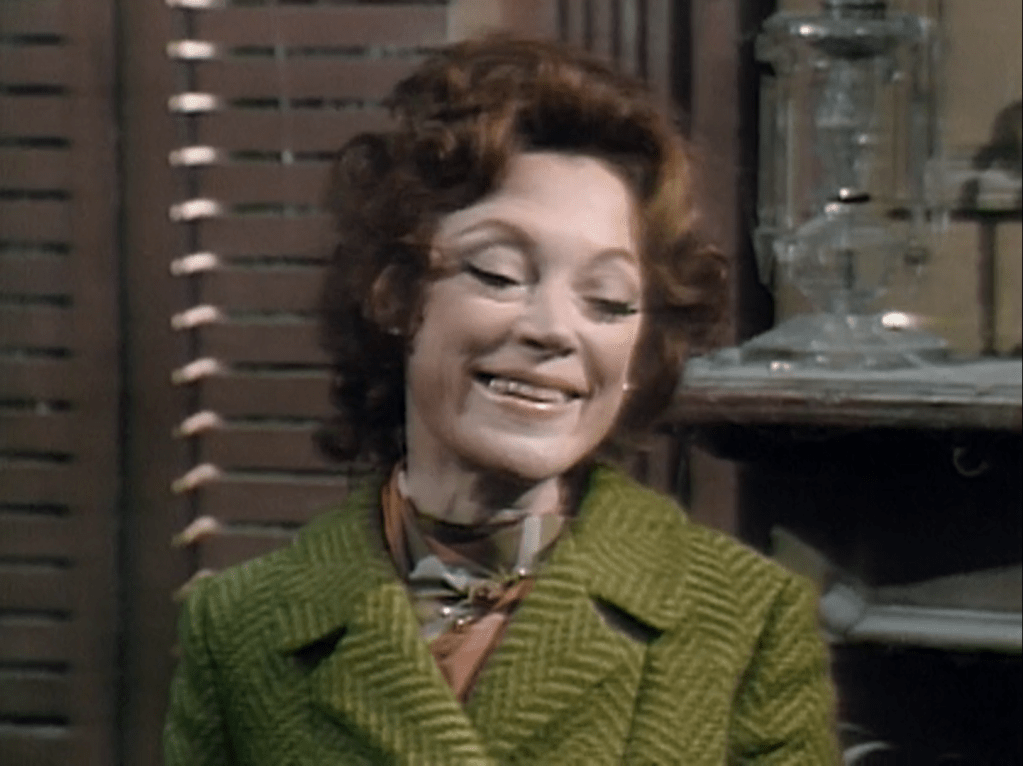
Roxanne’s sister Samantha also has a new relationship, and may also be murdered as a result. Her husband, whose name is Quentin Collins, is missing and presumed dead after a shipwreck. Quentin and Samantha’s son Tad was with his father and is also missing. Quentin’s friend Gerard Stiles has been a guest at the great house of Collinwood for some time. We saw the other day that Samantha turns to Gerard when she needs comforting, and they kiss today.

After Gerard and Samantha’s love scene, Gerard is alone in the drawing room with Quentin’s brother Gabriel. He is in the act of walking out on Gabriel when Gabriel addresses him as “Mr Miller.” Gabriel leafs through a stack of papers about the life of crime Gerard led under his original name, Ivan Miller. Gerard grabs the papers from Gabriel. Gabriel clutches at Gerard’s arm and squeezes it so hard Gerard falls to his knees. Gerard is stunned by Gabriel’s strength. Gabriel gets around by pushing himself in a manual wheelchair, which does indeed build the muscles in the arms and upper back, so it is a believable moment.

Gabriel then hands Gerard the papers and says that they are his copy. He has another copy stashed where it will go to the authorities should any harm befall him. He says that he will hold them back provided Gerard makes himself useful to him. First he dispatches Gerard to acquire a large packet of arsenic. Then he tells Gerard that his next duty will be to poison Samantha with the arsenic a little bit at a time, so that she dies a painful, lingering death. Gerard says that he would rather just leave Collinwood and make a fresh start somewhere else rather than do that. Gabriel says that since Samantha’s death will make him the heir to his terminally ill father’s vast estate, he will be able to pay Gerard very handsomely for the task. He offers him 10% of the Collins fortune. Since Gerard apparently murdered a woman in Portugal a few years back, Gabriel is quite sure he will not be squeamish about murdering another woman, especially when he stands to profit so richly. Gerard says they have a deal.

In #1077, set in 1970, another Quentin Collins was reading the family history when he learned for the first time that he had a “grand uncle” who lived in 1840 who was also named Quentin Collins. Not even the family history mentioned Tad’s name. Since that Quentin was born in 1870 (though he looked much younger than his hundred years,) we could take it that neither Grand Uncle Quentin nor his widow was the one through whom ownership of the Collins family wealth passed to the other generations we have seen. Indeed, longtime viewers may recall that in #701 and #702, set in 1897, Quentin’s very elderly grandmother Edith Collins reminisced on her deathbed about her husband Gabriel. So we know that Gabriel and Edith are the parents of a son who will sire that other Quentin and his siblings, among them Edward Collins, whose son Jamison will go on to be the father of Elizabeth Collins Stoddard and Roger Collins, the adults at the great house in the 1960s.

As of this day in 1840, however, Gabriel’s father Daniel Collins has named his son Quentin his sole heir, with Tad in second place and Samantha in third. Told that Quentin and his son are dead, Daniel has refused to rewrite the will in Gabriel’s favor. Early in the episode, Samantha tells Gabriel that when Daniel dies, it will be up to her to take care of him and his wife, and that she will do so provided they behave themselves. Knowing that it does not work out that way, we can believe Gerard will actually carry out the assignment Gabriel gives him today.

The disappearance of Quentin and Samantha from the Collins family’s memory by the late nineteenth century is only the first of four reasons we might believe Gabriel’s plan will come to fruition. The second is the casting of Samantha. Virginia Vestoff was a splendid actress whose performance lets a great deal of fresh air into every scene she appears in. However, Samantha is Vestoff’s first role on Dark Shadows. If she were a member of the show’s established repertory company, we might be confident that Gerard will disappoint Gabriel and let her live. But first timers, even spectacularly talented ones with solid backgrounds on Broadway and in daytime television, often turn out to be short-timers. So her presence adds to the suspense about her character’s future.

The third reason is an echo of the circumstances of one of Dark Shadows‘ most prominent on-screen murders. In 1967, Barnabas coerced his associate, mad scientist Julia Hoffman, into preparing a lethal injection for her old friend Dave Woodard, who was threatening to expose their crimes. As Gerard brings the arsenic to Gabriel today, only to be shocked to hear that he will have to commit the murder himself, so Julia offered the hypodermic to Barnabas, only to be told that she would administer the deadly shot. The murder of Woodard actually came off, so longtime viewers have another reason to expect that Samantha, too, might die. And of course that Gabriel pulls the same maneuver on Gerard that Barnabas pulled on Julia shows that they really are members of the same family and that they are bearers of that family’s curse.

The fourth reason grows from what we have seen of the future of Collinwood. In segments set in 1970 and 1995, we have seen that Gerard’s ghost will destroy Collinwood and rule over its uninhabitable ruins for decades after. Today that starts to make sense. If Gabriel’s descendants own the house and hold their position in the community as the result of a hideous crime their ancestor committed through Gerard, then it is fitting that Gerard should be the face of the long-delayed reckoning for that crime.

I should mention that Vestoff is not alone in giving an excellent performance today. Christopher Pennock was pretty hard to take when he first joined the show as monstrous man-child Jabez Hawkes in #935; he moved well, but he delivered his dialogue with so much bombast that he stood out even among the cast of Dark Shadows. He was noticeably better as Jekyll/ Hyde characters Dr Cyrus Longworth and John Yaeger from #985, but still enunciated his lines too self-consciously to really draw the audience in. As astrologer Sebastian Shaw from #1073, he was a little more natural, but Sebastian was such a poorly conceived character that he couldn’t really show his stuff.

As Gabriel, Pennock finally comes into his own. He is smooth as silk in Gabriel’s scenes with Gerard today; it’s a pleasure to listen to him sidle his way from one syllable to the next. He’s just as pitch-perfect projecting Gabriel’s humiliation and uncontrolled rage in his scene with Samantha as he is at the opposite end of the emotional spectrum with Gerard. Certainly Vestoff and James Storm are first-rate scene partners; they may deserve a share of the credit for Pennock’s fine work. Or maybe he just needed to sit down, I don’t know.

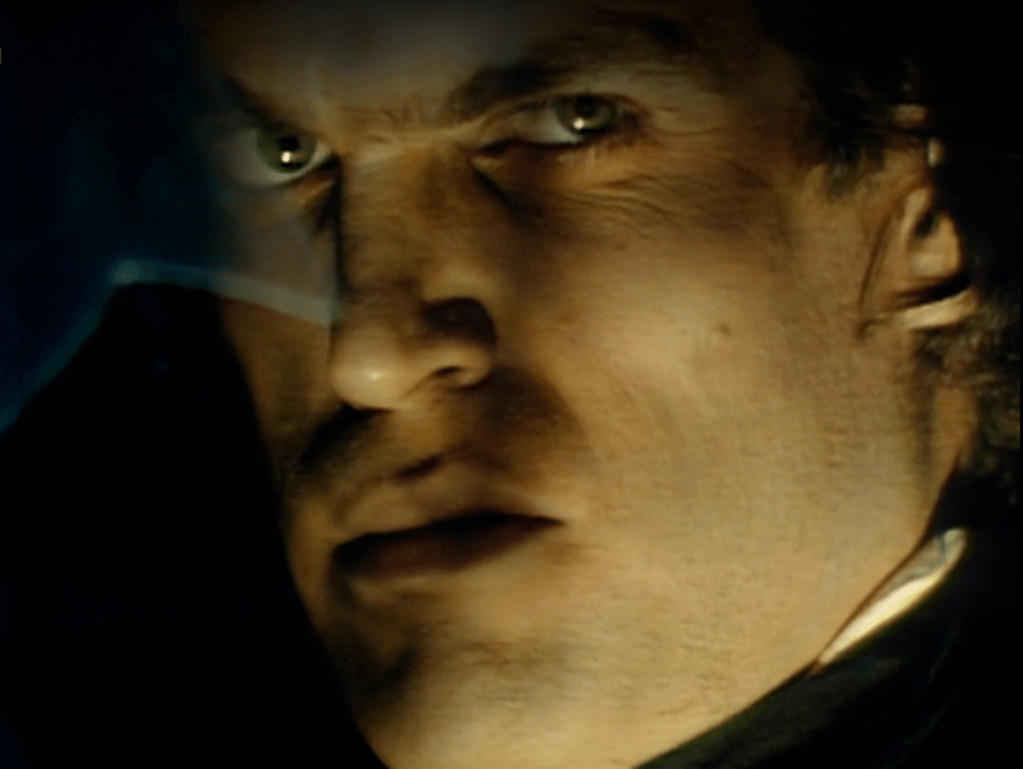
It’s no news to fans of Dark Shadows that Jonathan Frid was capable of great work. He’s been on top form this week. The other day, Barnabas’ aged friend Ben Stokes told him a bizarre story, to which Barnabas replied “You’re mad, old man.” No actor could deliver Henry V’s dismissal of Falstaff, “I know thee not, old man” more heart-breakingly than Frid delivers that line. And watching his face as Roxanne falls dead in Barnabas’ arms, you can feel the terror and the awe of the moment. The murders sometimes come so thick and fast on Dark Shadows that watching them we can feel like we are seeing the coyote raise yet another the mushroom cloud at the end of his fall after failing to catch the roadrunner, and Barnabas himself often takes killing very lightly. But there is nothing cartoonish about what he does to Roxanne.
Episode 1089: Why hasn’t anything happened?

It’s often said that the most compelling villains of stage and screen are played by the nicest actors. That’s often explained by saying that the audience can pick up on a sweetness in the actor even when the character is doing the most vile things, making it possible for us to enjoy watching actions that sound like they would be unbearable even to think about.

I suppose there is some truth to that. Certainly Jonathan Frid’s abundant kindliness helped to make the fiendish Barnabas Collins a pop culture sensation in the 1960s, as David Selby’s sunny good nature made the thoroughly deplorable Quentin Collins almost as popular. But it is also the case that the function of a villain is to focus attention on other cast members. The villain makes things happen that get us wondering what the heroic characters will do to oppose them, how vulnerable characters will elicit our pity and admiration by their noble suffering, and which differently vulnerable characters will wrestle with their consciences as they are drawn into the villain’s web of sin. That function is one that might be expected to appeal to the most generous members of the profession, those most eager to help their fellow players show what they can do.

The villain in this portion of Dark Shadows is supposed to be the ghost of Gerard Stiles. Gerard is played by James Storm, who is by all accounts as adorable a human being as Jonathan Frid, David Selby, or anyone else. If the actor’s lovableness were all it took to make a villain a hit, Mr Storm’s face would have been on the cover of every issue of 16 magazine from the summer of 1970 on.

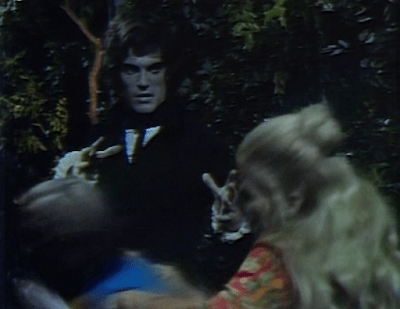
But in fact, the writers have let us down. Gerard is not doing what we expect of a villain. Today he takes possession of matriarch Elizabeth Collins Stoddard. As a result of that possession, Liz becomes an emotionless drone and checks out of the story. That’s the common theme of all Gerard’s possessions- he stops his victims from exchanging information with others, slowing everything down and leaving them with nothing to do. He does not really serve the villain’s function at all. So far from bringing out the best in the whole cast as Barnabas did in his heyday or Quentin in his, Gerard has caused the plot to grind to a halt, leaving the characters playing out variations on the same few scenes over and again. He is a non-villain in the middle of a non-story.

Longtime viewers know that Dark Shadows has been chiefly about time travel since November 1967. When we see the ghosts, dwell on their wardrobe, and hear living characters tell us what they’ve been reading in documents from the years 1840 and 1841, we know that the show is getting ready to take us to that period for an extended costume drama segment. To the extent that the current haunting generates any suspense at all, that suspense comes from our wondering what explanation we will find in that upcoming segment for the activities of the ghosts. What was it about teenagers Tad Collins and Carrie Stokes when they were alive that makes their ghosts want to take possession of their lookalikes David Collins and Hallie Stokes, why will that possession result in the deaths of Hallie and David, and why will Tad and Carrie’s ghosts merge with theirs and appear in clothing from 1970? What goal does Gerard have that will be advanced by the possession and death of Hallie and David? What exactly is the relationship between Gerard and the ghost of Tad and Carrie’s governess Daphne Harridge? Are Daphne’s dealings with Quentin and the teens entirely in service of Gerard’s aims, or does she have goals of her own? The ongoing story has been laboring mightily to raise these questions, and it has been made very clear that none of them will be resolved until we get to 1840.

We do pick up a couple more bits of information today that we will have questions about in 1840. The show’s chief heroine and audience identification character, Julia Hoffman, reads that Gerard’s ship, the Java Queen, was a pirate vessel. That may remind us of #208, when David told dangerously unstable ruffian Willie Loomis of a legend about a pirate who fell in love with a lady at Collinwood and brought her jewels. That story was a nod to Daphne Du Maurier’s Frenchman’s Creek, one of the “Gothic romance” novels that had inspired Dark Shadows in its early days. Willie found out too late that Dark Shadows wasn’t that kind of show anymore when he opened a chained coffin and found, not jewels, but Barnabas. Maybe when we get to know him as a living being, Gerard will bring in a little bit more of the “Gothic” element. Or at least we can hope that he will reveal his piratical background by overemphasizing the Rs in his name. Avast, ye mateys, beware of Gerrr-ARRRRd!

Moreover, Julia reads that the Java Queen wrecked off Collinsport exactly 129 years ago, on Thursday, 27 August 1841. In our universe, 27 August 1841 was a Friday, but apparently the calendar is aligned a little bit differently in the continuity where Dark Shadows takes place. I suppose there must have been a readjustment sometime between 1841 and 1970, because today is Thursday, 27 August 1970, which matches the day on which that date fell in our world.

Be that as it may, anniversaries have had the power to make things happen on Dark Shadows ever since it first became a supernatural thriller with the introduction of undead blonde fire witch Laura Murdoch Collins in late 1966. Laura was going to incinerate herself with her son David on a particular date in 1967 because other women named Laura Murdoch had incinerated themselves with their young sons named David on the same date in 1767 and 1867. When you don’t follow the laws that science lays out for us, you have to come up with some other mechanism of cause and effect to keep the audience in suspense, and anniversaries will serve as well as anything else.

Julia reads on in her book. The captain of the Java Queen was widely feared, though his name was never known. He was the sole survivor of the crash off Collinsport, and he vowed that he would raise his men from the dead and resume his reign of terror.

David takes Hallie to Gerard’s grave. Cemeteries have been hotspots on the Collinsport dating scene since well-meaning governess Vicki insisted her boyfriend, instantly forgettable lawyer Frank Garner, take her to the old cemetery north of town in #153, but David and Hallie are not a couple and this is no mere social outing. David has told Hallie that you can tell whether the dead are at rest by standing on their graves at the stroke of midnight.

While they are waiting for the appointed time, Hallie notices a fenced-in area in the middle of the old cemetery and asks who is buried there. David tells her that that is where criminals were buried in the eighteenth and nineteenth centuries, mostly in unmarked graves. He says that there are a lot of legends about how vicious they all were. He goes on to say that their spirits are supposed to be restless because they are so vile that Hell won’t have them. Hallie is, as usual, teetering on the brink of a fit of the screaming meemees, and this story makes her teeter even more rapidly.

At midnight, Gerard shows up. He approaches Hallie and David. They run away. When he was walking towards them, Gerard had his arms in front of him, bent at an angle that suggested he was hoping one of them would lead him in a waltz. When they run away, he has a disappointed look that makes us wonder if that’s all he wanted.

You lead. Screenshot by Dark Shadows Before I Die.

Back at the great house, David and Hallie run into Julia. She demands to know what they were doing outside. David says they were out for a walk. Julia says that people do not take walks at one in the morning. That’s right, characters on Dark Shadows usually wait until three o’clock to start roaming about. Julia takes quite an authoritative tone for someone who is staying in the house as a permanent guest. While Julia is focusing her sternness on Hallie, whom she really seems to dislike, David sees a note tucked in the book Julia was reading. He slips the note in his pocket. He then asks Julia whether she is going to tell his Aunt Liz that she caught him and Hallie sneaking into the house so late. Julia agrees not to, and David thanks her.

Hallie and David go to her bedroom. As you would expect a teenage boy and girl to do when alone in a bedroom in the small hours of the morning, they conduct paleographic research. They examine the note, commenting on the age of the paper and features of the handwriting. They see that it concludes with the siglum “G,” which they hypothesize may indicate that it was written by Gerard. They read the text: “Know ye who do not rest in the town of Collinsport! In the dead of night watch for the signal, as ever before the green flag in the window. Three times shall it wave, as it did in days of yore!” Hallie claims that she doesn’t understand “a word of it!” For a second it seems like David might start explaining words Hallie might not be familiar with, such as “flag” and “green,” but he thinks better of it and assures her that he, too, finds the note puzzling.

David says that he thinks there might be a green flag in the tower room at Collinwood. I don’t know how he got that from the note, but if getting clarification requires Hallie to deliver more dialogue I’m just as happy to leave it unexplained. David goes to the tower room, finds a green polyester flag wedged into something attached to the ceiling, and starts waving it out the window. We cut back to the cemetery, where the soil on top of one of the graves in the enclosure is heaving. In view of the power of anniversaries in the universe of Dark Shadows, it makes perfect sense that polyester would have a profoundly disquieting effect on people who died in 1841, since polyester was invented in 1941- exactly one hundred years later.

Episode 1087: How can I go to sleep in a house like this?

For several months starting in late 1968, the great house of Collinwood was haunted by the unspeaking ghost of Quentin Collins. The Haunting of Collinwood posed a grave danger to children David Collins and Amy Jennings. At the end of March 1969, old world gentleman Barnabas Collins tried to communicate with Quentin’s ghost in hopes of saving David’s life. Barnabas came unstuck in time and found himself in 1897, where he met Quentin as a living being. For the next eight months Dark Shadows was a costume drama set in that year. David Selby’s charm made Quentin a breakout hit. In the course of Barnabas’ bungling, history was changed so that Quentin did not die. Instead, he was immunized against aging, so that when the show returned to contemporary dress he showed up alive, well, and apparently a bit under 30.

Now, this storyline is being recycled. In the Re-Haunting of Collinwood, the unspeaking ghost of Gerard Stiles takes the place of the unspeaking ghost of Quentin. Hallie Stokes takes the place of Amy. David is reenacting his original part.

David Henesy does a good job today playing David’s frustration at finding himself in the same situation over and over. He is in his bedroom when Gerard stands in front of him menacingly. He screams. Permanent houseguest Julia Hoffman lets herself into the room. Julia knows about Gerard, and tells David she can feel that “he” has been in the room. David feigns ignorance. Julia has withheld her knowledge of the ghosts from David, so she cannot give him an answer when he asks who she is talking about. She stays on the offensive, asking him to tell her. He won’t, so she asks him why he was screaming. He tells her he had a nightmare. She demands he stop lying and claims that she has always told him the truth. In fact, she has never told him the truth, and her failure to let him in on what she knows about Gerard and the other ghosts is a case of dishonesty that has kept the show on a treadmill for three and a half weeks now, so this is just a bizarre claim.

David becomes angry with Julia. When she tells him that it is important he report anything unusual to her, he explodes:

“No, you calm down!”

DAVID: What’s so unusual about a dream? Nothing. Or a kid having one? I can’t do anything around here without one of you jumping on my back, asking me about unusual things. Well, the unusual things around here are you, and Barnabas, and Quentin.

JULIA David, just be calm.

DAVID: No, you calm down! Pretty soon somebody’s going to come in here and say, ‘David, why aren’t you asleep yet?’ How could I go to sleep in a house like this, with all of you people crawling all over the halls?

David is right when he says that he is questioned in just about every episode in which he appears, and right that there have been countless scenes in which someone comes into his bedroom and asks him why he is still up. He’s also right that people at Collinwood keep odd hours. Most episodes are set at night, and involve people running into each other at four in the morning and exchanging stories about how they are out running errands and have to rush off to keep an appointment. And he is certainly right about Julia, Barnabas, and Quentin being unusual. Julia is a mad scientist, Barnabas is a vampire, and Quentin is an ex-ghost, ex-zombie, and ex-werewolf. All three of them have made weird journeys through time and into the world of the dead, and each is guilty of several murders.

Later, David opens the door to his bedroom and finds Julia examining his belongings. He’s had as much of that kind of thing as he plans to take:

David stands up for his rights.

DAVID (sharply): What are you doing here?

JULIA (oblivious to David’s irritation): Oh, David, David, this flag, it was never here before.

DAVID (angrier): Well, I don’t think that’s any of your business.

JULIA (still oblivious): I was just curious.

DAVID (making an effort to control his anger): Well, you have no right to be here.

JULIA (finally aware that David is upset): David!

DAVID (really blowing his stack): I’ve got a right to some privacy, don’t I? Do I have to put signs up?

JULIA (sincerely puzzled at his reaction): David, there’s no reason for you to be this angry.

DAVID (firm): Well, you can just get out of here. You don’t have to come back until you’re invited, and I can guarantee you won’t be, because I’m tired of all of your questions and snooping. Tired!

JULIA (seeming to realize she is in the wrong): I’m sorry.

Later, David goes to the drawing room and apologizes to Julia for his harshness. She says that he was right to object to her letting herself into his room when he wasn’t there. She assures him it won’t happen again. David says that he is glad she isn’t angry, because he can’t stand to be on bad terms with anyone. What if something happens and they never have a chance to make up? Julia shows signs of concern when he first says this, but then smiles and says she is sure that she and David will have many opportunities to fight and make up. As in all scenes where Julia talks to a child character in a happy and relaxed tone, we can see that Grayson Hall must have been great with kids. Julia offers David a hug at the end, but he is too deep in his thoughts to embrace her. They exit together.

Looking forward to future fights and makings-up.

The episode ends with Gerard in corporeal form, standing behind Quentin and preparing to strangle him with a cord. Gerard is played by James Storm, who like David Selby is a darkly handsome man. Mr Storm is much shorter than Mr Selby. This has some practical advantages. Mr Selby is well over six feet tall, so that it was often beyond the abilities of the makers of the show to keep the studio lights out of frame when they were shooting him from the perspective of a scene partner. But when we see the two of them together, I can think of Gerard only as mini-Quentin. It rather undercuts the effectiveness of the closing cliffhanger.

Quentin! Turn around! And look down!

Episode 1068: Almost pleased

I wonder how long the actors had the script before they started taping this one. As unspeaking, barely mobile ghosts Gerard and Daphne, James Storm and Kate Jackson didn’t need much prep time; as lunatics Carolyn Fredericks (neé Stoddard) and Quentin Collins, Nancy Barrett and David Selby probably didn’t need much more. But vampire Barnabas Collins has a lot of dialogue today, and Jonathan Frid rarely seems to be within a country mile of his scripted lines. That isn’t so unusual, but Grayson Hall’s trouble really stands out. Barnabas’ friend, Julia Hoffman, MD, is possessed by Gerard and is pleased that Barnabas keeps meeting with one failure after another. We are supposed to know this, Barnabas isn’t. But she has a huge grin on her face each time she gloats to Barnabas about one of his setbacks. The one time Frid is clearly delivering a line that was written for him, Barnabas tells a conspicuously blissed-out Julia that she seems “almost pleased.” Hall was a highly accomplished actress, and we would expect her to be able to do “secretly pleased” in her sleep. But when this line comes up, she gets a bad laugh.

Far and away the happiest we have ever seen Julia, this strikes Barnabas as “almost pleased.”

The episode ends with Barnabas going to the drawing room of the great house of Collinwood in response to a note from Carolyn. He finds her sitting at the desk there. He talks to her for a moment, then notices that she is not moving. He touches her, and she falls over dead. The episode has its problems, but that is an extremely effective closing curtain.

Episode 1066: And all that

For many months starting in late 1968, the estate of Collinwood was haunted by the ghost of Quentin Collins. Quentin’s presence became steadily more intolerable until the living members of the Collins family had to abandon the great house in #694. At the end of that episode, we saw Quentin standing on the walkway at the top of the foyer stairs, laughing in triumph.

Vampire Barnabas Collins traveled back in time in #701 and blundered around until history was changed. In #838, set in September 1897, Quentin’s death was prevented. On the anniversary of that event in September 1969, the haunting broke, though the people who lived through it remembered Quentin’s ghost and the events of the haunting. A magic spell was cast on Quentin keeping him forever young, and late in 1969 he took his place among the Collinses whom he had once driven from the family home.

Now, Barnabas and his friend, mad scientist Julia Hoffman, have come unstuck in time again. They find themselves in Collinwood in the year 1995. The house is in ruins, the members of the family either dead, missing, or insane, and the village of Collinsport full of people who won’t answer any of their questions. Quentin is around, having escaped from a psychiatric facility and come back to the estate. Today, Barnabas and Julia have taken him to the great house to try to get him to tell them something useful.

Julia and Barnabas want Quentin to see an upstairs room that is in much better shape than the rest of the house. They open the door, and see a ghost which appears to be strange and troubled teen David Collins. Quentin flees in terror and makes his way to the foyer while Barnabas and Julia watch the ghost vanish.

Quentin finds that he cannot open the front doors. He sees the ghost of a young man staring at him from the walkway at the top of the stairs. Like Quentin during “The Haunting of Collinwood,” this ghost has lots of curly black hair, does not speak, and wears a dark suit from the nineteenth century. Since David Selby is very tall and James Storm is rather the other thing, I can’t help but think of him as Mini-Quentin. The credits tell us that his name is Gerard.

Quentin cannot abide the sight of Mini-Quentin. Screenshot by Dark Shadows Before I Die.

Quentin rolls around on the floor, terrified of Gerard. Barnabas and Julia come and try to calm him down. Quentin says the doors won’t open; Barnabas opens them. Quentin runs out. Julia says she senses an evil presence, which, considering that every character we’ve seen so far is a murderer, is not too surprising. She and Barnabas leave.

Two ghosts dance a minuet by the gazebo. Julia and Barnabas think that one of the ghosts is David; the other is a blonde girl whom they do not recognize. The ghosts kiss each other. They walk towards the woods and vanish.

Barnabas and Julia go to the Old House on the estate. They find Quentin, and overhear him talking in an anguished voice to someone named “Daphne.” He tells them that the ghost they saw was not David Collins, but was named Tad. Julia remembers that they found a birthday card addressed to “Tad” and signed “Carrie.” If the ghost who looks like David is actually Tad, one might assume that the blonde girl is Carrie, though she could be Daphne or some other personage.

The next afternoon, Quentin finds Julia sleeping in an armchair in the parlor of the Old House. He asks to see Barnabas. Julia reacts with puzzlement. She says Quentin knows perfectly well that Barnabas cannot rise until the sun sets. He says he doesn’t know what she’s talking about. Julia is shocked. Once you’ve learned that a fellow is a vampire, that information doesn’t usually slip your mind. But he seems quite sincere. He wanders off.

The blonde girl appears at the window and beckons to Julia. Julia follows her, silently. It seems at first that Julia is in a trance, since she does not call to the girl by the names “Carrie” or “Daphne.” But when the girl leads her into the great house, Julia keeps moving her head around as she watches her step, making it clear she is wide awake. The girl leads her into the strangely intact room, where Gerard is waiting for her.

Danny Horn’s post about the episode on his great Dark Shadows Every Day is full of remarks about how cleverly they blur the line between soundtrack music that the characters can’t hear and atmospheric sounds that they can, disorienting us in a way that adds greatly to the effect of the scares and confusion. It is indeed powerful, and there is a lot of other good stuff in this one.

But this is the first episode of the 1995 segment I wouldn’t show to someone new to Dark Shadows to entice them into watching the show. The pacing is just too slow for the material. We have time to start asking questions that take us out of the story. For example, Julia and Barnabas lament that they have no idea what is going on and are desperate for Quentin to tell them what he knows. But as soon as he volunteers a piece of information, telling him that they saw Tad’s ghost rather than David’s they flatly contradict him. Also, Julia gives Quentin a sedative. We wonder where she got it, since her prescription pad is 25 years out of date and any samples she had in her bag have been sitting out, unrefrigerated and exposed to dry rot, for that same period. Those and other incongruities are the sorts of things we could easily overlook if we were moving as fast as we moved in all five episodes last week, but when events move as leisurely as they do today they mean trouble.

Episode 1063: To see what you own

The sheriff of Collinsport arrests two trespassers at the long-deserted great house of Collinwood. They are Barnabas Collins and Dr Julia Hoffman, who inexplicably disappeared in 1970 and have even more inexplicably reappeared in 1995. The owner of Collinwood, Carolyn Fredericks (formerly Carolyn Stoddard Hawkes) has complained about them.

Barnabas pretends to be his own son, and claims that Carolyn’s mother, Elizabeth Collins Stoddard, put the Old House on the estate in his father’s name in the late 1960s. While we never saw this happen, from 1967 on Liz often did talk about the Old House as if it and its contents were Barnabas’ property. Furthermore, the sheriff’s office appears to be right across the hall from the registry of deeds, and the Sheriff himself appears to be far more competent than most Collinsport law enforcement personnel we have seen, so if Barnabas were lying he would probably catch on.

The sheriff says that Barnabas may have a right to go to the Old House, but that he found him and Julia at the great house. He asks a number of intelligent questions, none of which Julia or Barnabas can answer to his satisfaction. He threatens to hold them on a vagrancy charge. When Barnabas says that “I have a great deal of money… I own property here,” he backs off that threat, but he does tell them that he hopes their friends from Bangor come and take them away very soon.

Barnabas and Julia leave the sheriff’s office. Carolyn enters from the back room where she has been eavesdropping. She asks the sheriff to look at a picture in her photo album. It is a picture of Julia taken in 1970. The sheriff notices that she hasn’t changed a bit, not even the way she wears her hair. He asks Carolyn if she has any pictures of Barnabas, and she says that she does not. She says that the only picture of him she knows of is an oil painting done in the 1790s.

There was another oil painting of Barnabas done in 1967, and Carolyn’s late cousin David took a photograph of him in #659. The 1967 portrait hung in the Old House, which Carolyn may not have visited in the last twenty five years, and the photograph David took was an oddity that likely would not have been put into an album. So it isn’t really strange that she doesn’t think of them.

Carolyn does remember some other things about Barnabas, though. We open with Julia and Barnabas heading towards the Collins family mausoleum in the old cemetery north of town. They find that the door to the secret chamber is standing open, and are shocked that someone else knows about it. They find Carolyn there. They pretend not to have known about the chamber. They also pretend to be puzzled by the empty coffin in the chamber.

Carolyn says she knows why the coffin is there. She tells Barnabas it is waiting for him. Then she turns to Julia and says that it may also be waiting for her, whichever one dies first. They leave. Carolyn closes the panel and says with a gleam in her eye that it is waiting for him.

“It is waiting… for… him.”

Barnabas is a vampire, and the coffin is his resting place. In the fall of 1967, he bit Carolyn and took her as his victim. He was cured of vampirism in March of 1968. The bite marks disappeared from his victims’ necks at that point, and it seemed that their memory of what he was and what he had done to them faded as well.

But for months after, Nancy Barrett played Carolyn as if she remembered a good deal more than Barnabas knew she remembered. The scripts didn’t give her much support in that interpretation, but it was well over a year before she had to make it clear Carolyn no longer knew about Barnabas. Perhaps whatever happened while Barnabas and Julia were away jarred Carolyn’s memory loose. If Carolyn does remember that Barnabas is a vampire, she is being astonishingly reckless in her scene with him and Julia in the secret room. Barnabas takes a menacing tone when she says that she knows why the coffin is there, and the background music makes it clear that he is on the point of striking when she says it is waiting for him. She laughs after she says to herself that “It is for him”; perhaps the light in her eyes is nostalgia for those days in 1967 when she was his blood thrall.

There is also a scene in Julia’s old room at Collinwood where they find that the box containing the notes she took while trying to cure Barnabas of vampirism has been forced open. They wonder who may have seen those notes.

Julia and Barnabas go back to the great house. She points out that the sheriff will lock them up if he finds them there, a concern Barnabas dismisses. He mentions that they have to find another place for the coffin, and suggests the great house. It would be interesting if they were lugging a coffin around when the sheriff showed up, but Julia puts the kibosh on that. Barnabas then says maybe the Old House. They busy themselves running up and down the stairs in the foyer for no discernible reason. They hear some music coming from nowhere in particular. Barnabas declares that this cannot be a sign of danger, since “music is seldom used to frighten.” For months in early 1969, an evil spirit possessed Collinwood and drove the family out by the incessant playing of a sickly little waltz, but apparently that has slipped Barnabas’ memory.

Yesterday, a man called Victor Flagler told Barnabas and Julia that he and his wife Jeanne had gone into the great house on a dare. Something pushed a heavy object off the rail at the top of the stairs. It landed on Jeanne’s head, killing her, and Victor heard laughter in the house. Julia and Barnabas don’t notice that there is a weighty bust perched on that rail today that wasn’t there yesterday, and Julia stands on the floor beneath it. It falls, and she gets out of the way in the nick of time. They leave the house.

We see a blue dot pulsating inside the house. Barnabas and Julia don’t get a look at that, but when they are outside they do see a man in nineteenth century garb sneering at them through a window. He is the face of whatever is going on in the house. The credits give his name as Gerard.

In place of 131: “A Christmas Carol”

There never was an episode #131 of Dark Shadows. They made a point of giving numbers divisible by 5 to episodes that aired on Fridays, so on days when the show was not broadcast-as it was not broadcast on 26 December 1966- they just skipped the number that would have been used had it run that day.

Since that preemption was the result of Christmas-related programming,* this seems like the place to promote 2021’s big Dark Shadows Christmas event, a dramatic reading of the Orson Welles version of Dickens’ A Christmas Carol by ten surviving members of the original cast. Surviving at that time- it turned out to be Mitchell Ryan’s last performance before his death on 4 March 2022; Christopher Pennock had been involved in the early stages of the production, but he would die in February of 2021.

It is irresistible viewing for Dark Shadows fans. It makes extensive use of music from the show- rather too extensive for my taste, but Mrs Acilius liked it, and from what I gather she appears to be in the majority.

The acting is quite good. I was especially impressed by James Storm’s portrayal of Bob Cratchit. I had never seen Mr Storm in anything but Dark Shadows, where he was cast in the preposterously unplayable role of Gerard Stiles, so it was amazing to me to see what he could do when he had something to work with.

Another pleasant surprise was Alexandra Moltke Isles as the Ghost of Christmas Present. Readers of this blog know that I have a high opinion of Mrs Isles’ abilities, but this was her first part in 53 years. I held my breath to see how many steps she had lost in that interval. As it became clear that she could go as deep into her character as ever and pull up a treasure trove of dramatic insight, I was thrilled.

Mrs Isles appeared at one or two Dark Shadows conventions early in the 1980s. During the unpleasantness, she couldn’t very well make herself available for any event where she would be expected to take questions from the floor, but from time to time she sent greetings on video that would be played at conventions. And she sat for several interviews about Dark Shadows over the years. So you can’t say she made herself a complete stranger, but it is still quite a novelty to see her in this setting.

Many longtime fans describe Mrs Isles as the cast member who was least friendly to them when the show was in production, and there may be a reason for that. In the Q & A, she responds to the question about her first encounter with fandom by telling a story about a girl jumping her on the street and trying to rip her hair out of her head. After that introduction, it is remarkable that she’s been around as much as she has.

The person who had been absolutely disconnected from fandom the longest was David Henesy. He stuck with acting for a few years into the 1970s, but never attended a convention or had any connection with any Dark Shadows themed public events until a cast reunion on Zoom in October 2020. His performances as the child characters (he’s by far the youngest member of the cast, a mere 65 years old at the time of taping) are as letter-perfect as was his work in the series.

*A football match, but a football match usually held at Christmas-time.