
It’s often said that the most compelling villains of stage and screen are played by the nicest actors. That’s often explained by saying that the audience can pick up on a sweetness in the actor even when the character is doing the most vile things, making it possible for us to enjoy watching actions that sound like they would be unbearable even to think about.
I suppose there is some truth to that. Certainly Jonathan Frid’s abundant kindliness helped to make the fiendish Barnabas Collins a pop culture sensation in the 1960s, as David Selby’s sunny good nature made the thoroughly deplorable Quentin Collins almost as popular. But it is also the case that the function of a villain is to focus attention on other cast members. The villain makes things happen that get us wondering what the heroic characters will do to oppose them, how vulnerable characters will elicit our pity and admiration by their noble suffering, and which differently vulnerable characters will wrestle with their consciences as they are drawn into the villain’s web of sin. That function is one that might be expected to appeal to the most generous members of the profession, those most eager to help their fellow players show what they can do.
The villain in this portion of Dark Shadows is supposed to be the ghost of Gerard Stiles. Gerard is played by James Storm, who is by all accounts as adorable a human being as Jonathan Frid, David Selby, or anyone else. If the actor’s lovableness were all it took to make a villain a hit, Mr Storm’s face would have been on the cover of every issue of 16 magazine from the summer of 1970 on.
But in fact, the writers have let us down. Gerard is not doing what we expect of a villain. Today he takes possession of matriarch Elizabeth Collins Stoddard. As a result of that possession, Liz becomes an emotionless drone and checks out of the story. That’s the common theme of all Gerard’s possessions- he stops his victims from exchanging information with others, slowing everything down and leaving them with nothing to do. He does not really serve the villain’s function at all. So far from bringing out the best in the whole cast as Barnabas did in his heyday or Quentin in his, Gerard has caused the plot to grind to a halt, leaving the characters playing out variations on the same few scenes over and again. He is a non-villain in the middle of a non-story.
Longtime viewers know that Dark Shadows has been chiefly about time travel since November 1967. When we see the ghosts, dwell on their wardrobe, and hear living characters tell us what they’ve been reading in documents from the years 1840 and 1841, we know that the show is getting ready to take us to that period for an extended costume drama segment. To the extent that the current haunting generates any suspense at all, that suspense comes from our wondering what explanation we will find in that upcoming segment for the activities of the ghosts. What was it about teenagers Tad Collins and Carrie Stokes when they were alive that makes their ghosts want to take possession of their lookalikes David Collins and Hallie Stokes, why will that possession result in the deaths of Hallie and David, and why will Tad and Carrie’s ghosts merge with theirs and appear in clothing from 1970? What goal does Gerard have that will be advanced by the possession and death of Hallie and David? What exactly is the relationship between Gerard and the ghost of Tad and Carrie’s governess Daphne Harridge? Are Daphne’s dealings with Quentin and the teens entirely in service of Gerard’s aims, or does she have goals of her own? The ongoing story has been laboring mightily to raise these questions, and it has been made very clear that none of them will be resolved until we get to 1840.
We do pick up a couple more bits of information today that we will have questions about in 1840. The show’s chief heroine and audience identification character, Julia Hoffman, reads that Gerard’s ship, the Java Queen, was a pirate vessel. That may remind us of #208, when David told dangerously unstable ruffian Willie Loomis of a legend about a pirate who fell in love with a lady at Collinwood and brought her jewels. That story was a nod to Daphne Du Maurier’s Frenchman’s Creek, one of the “Gothic romance” novels that had inspired Dark Shadows in its early days. Willie found out too late that Dark Shadows wasn’t that kind of show anymore when he opened a chained coffin and found, not jewels, but Barnabas. Maybe when we get to know him as a living being, Gerard will bring in a little bit more of the “Gothic” element. Or at least we can hope that he will reveal his piratical background by overemphasizing the Rs in his name. Avast, ye mateys, beware of Gerrr-ARRRRd!
Moreover, Julia reads that the Java Queen wrecked off Collinsport exactly 129 years ago, on Thursday, 27 August 1841. In our universe, 27 August 1841 was a Friday, but apparently the calendar is aligned a little bit differently in the continuity where Dark Shadows takes place. I suppose there must have been a readjustment sometime between 1841 and 1970, because today is Thursday, 27 August 1970, which matches the day on which that date fell in our world.
Be that as it may, anniversaries have had the power to make things happen on Dark Shadows ever since it first became a supernatural thriller with the introduction of undead blonde fire witch Laura Murdoch Collins in late 1966. Laura was going to incinerate herself with her son David on a particular date in 1967 because other women named Laura Murdoch had incinerated themselves with their young sons named David on the same date in 1767 and 1867. When you don’t follow the laws that science lays out for us, you have to come up with some other mechanism of cause and effect to keep the audience in suspense, and anniversaries will serve as well as anything else.
Julia reads on in her book. The captain of the Java Queen was widely feared, though his name was never known. He was the sole survivor of the crash off Collinsport, and he vowed that he would raise his men from the dead and resume his reign of terror.
David takes Hallie to Gerard’s grave. Cemeteries have been hotspots on the Collinsport dating scene since well-meaning governess Vicki insisted her boyfriend, instantly forgettable lawyer Frank Garner, take her to the old cemetery north of town in #153, but David and Hallie are not a couple and this is no mere social outing. David has told Hallie that you can tell whether the dead are at rest by standing on their graves at the stroke of midnight.
While they are waiting for the appointed time, Hallie notices a fenced-in area in the middle of the old cemetery and asks who is buried there. David tells her that that is where criminals were buried in the eighteenth and nineteenth centuries, mostly in unmarked graves. He says that there are a lot of legends about how vicious they all were. He goes on to say that their spirits are supposed to be restless because they are so vile that Hell won’t have them. Hallie is, as usual, teetering on the brink of a fit of the screaming meemees, and this story makes her teeter even more rapidly.
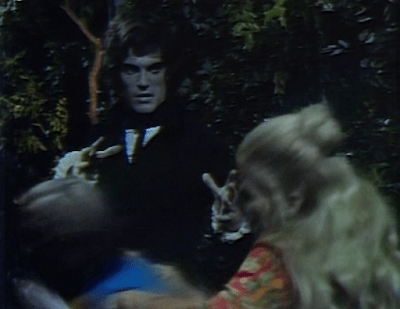
At midnight, Gerard shows up. He approaches Hallie and David. They run away. When he was walking towards them, Gerard had his arms in front of him, bent at an angle that suggested he was hoping one of them would lead him in a waltz. When they run away, he has a disappointed look that makes us wonder if that’s all he wanted.
Back at the great house, David and Hallie run into Julia. She demands to know what they were doing outside. David says they were out for a walk. Julia says that people do not take walks at one in the morning. That’s right, characters on Dark Shadows usually wait until three o’clock to start roaming about. Julia takes quite an authoritative tone for someone who is staying in the house as a permanent guest. While Julia is focusing her sternness on Hallie, whom she really seems to dislike, David sees a note tucked in the book Julia was reading. He slips the note in his pocket. He then asks Julia whether she is going to tell his Aunt Liz that she caught him and Hallie sneaking into the house so late. Julia agrees not to, and David thanks her.
Hallie and David go to her bedroom. As you would expect a teenage boy and girl to do when alone in a bedroom in the small hours of the morning, they conduct paleographic research. They examine the note, commenting on the age of the paper and features of the handwriting. They see that it concludes with the siglum “G,” which they hypothesize may indicate that it was written by Gerard. They read the text: “Know ye who do not rest in the town of Collinsport! In the dead of night watch for the signal, as ever before the green flag in the window. Three times shall it wave, as it did in days of yore!” Hallie claims that she doesn’t understand “a word of it!” For a second it seems like David might start explaining words Hallie might not be familiar with, such as “flag” and “green,” but he thinks better of it and assures her that he, too, finds the note puzzling.
David says that he thinks there might be a green flag in the tower room at Collinwood. I don’t know how he got that from the note, but if getting clarification requires Hallie to deliver more dialogue I’m just as happy to leave it unexplained. David goes to the tower room, finds a green polyester flag wedged into something attached to the ceiling, and starts waving it out the window. We cut back to the cemetery, where the soil on top of one of the graves in the enclosure is heaving. In view of the power of anniversaries in the universe of Dark Shadows, it makes perfect sense that polyester would have a profoundly disquieting effect on people who died in 1841, since polyester was invented in 1941- exactly one hundred years later.

