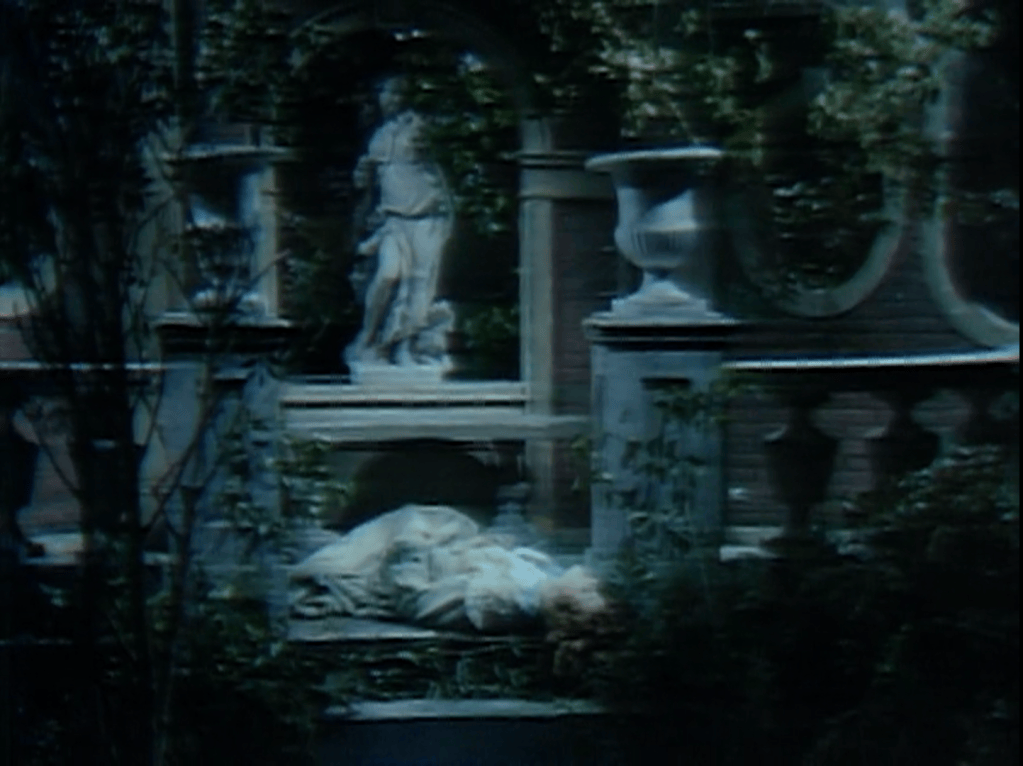
The year is 1840. Vampire Barnabas Collins summons his latest victim, Roxanne Drew. They meet at the gazebo on the grounds of the estate of Collinwood. He says he has a way they can be together forever. She says she would die for him. That’s what he had in mind. He bites her, drains her body of blood, and lets her fall to the floor of the gazebo. He tells her corpse that it will be found tomorrow, and that Roxanne will be mourned. The following night, she will rise as a vampire. He walks off, leaving her.
Roxanne’s sister Samantha also has a new relationship, and may also be murdered as a result. Her husband, whose name is Quentin Collins, is missing and presumed dead after a shipwreck. Quentin and Samantha’s son Tad was with his father and is also missing. Quentin’s friend Gerard Stiles has been a guest at the great house of Collinwood for some time. We saw the other day that Samantha turns to Gerard when she needs comforting, and they kiss today.
After Gerard and Samantha’s love scene, Gerard is alone in the drawing room with Quentin’s brother Gabriel. He is in the act of walking out on Gabriel when Gabriel addresses him as “Mr Miller.” Gabriel leafs through a stack of papers about the life of crime Gerard led under his original name, Ivan Miller. Gerard grabs the papers from Gabriel. Gabriel clutches at Gerard’s arm and squeezes it so hard Gerard falls to his knees. Gerard is stunned by Gabriel’s strength. Gabriel gets around by pushing himself in a manual wheelchair, which does indeed build the muscles in the arms and upper back, so it is a believable moment.
Gabriel then hands Gerard the papers and says that they are his copy. He has another copy stashed where it will go to the authorities should any harm befall him. He says that he will hold them back provided Gerard makes himself useful to him. First he dispatches Gerard to acquire a large packet of arsenic. Then he tells Gerard that his next duty will be to poison Samantha with the arsenic a little bit at a time, so that she dies a painful, lingering death. Gerard says that he would rather just leave Collinwood and make a fresh start somewhere else rather than do that. Gabriel says that since Samantha’s death will make him the heir to his terminally ill father’s vast estate, he will be able to pay Gerard very handsomely for the task. He offers him 10% of the Collins fortune. Since Gerard apparently murdered a woman in Portugal a few years back, Gabriel is quite sure he will not be squeamish about murdering another woman, especially when he stands to profit so richly. Gerard says they have a deal.
In #1077, set in 1970, another Quentin Collins was reading the family history when he learned for the first time that he had a “grand uncle” who lived in 1840 who was also named Quentin Collins. Not even the family history mentioned Tad’s name. Since that Quentin was born in 1870 (though he looked much younger than his hundred years,) we could take it that neither Grand Uncle Quentin nor his widow was the one through whom ownership of the Collins family wealth passed to the other generations we have seen. Indeed, longtime viewers may recall that in #701 and #702, set in 1897, Quentin’s very elderly grandmother Edith Collins reminisced on her deathbed about her husband Gabriel. So we know that Gabriel and Edith are the parents of a son who will sire that other Quentin and his siblings, among them Edward Collins, whose son Jamison will go on to be the father of Elizabeth Collins Stoddard and Roger Collins, the adults at the great house in the 1960s.
As of this day in 1840, however, Gabriel’s father Daniel Collins has named his son Quentin his sole heir, with Tad in second place and Samantha in third. Told that Quentin and his son are dead, Daniel has refused to rewrite the will in Gabriel’s favor. Early in the episode, Samantha tells Gabriel that when Daniel dies, it will be up to her to take care of him and his wife, and that she will do so provided they behave themselves. Knowing that it does not work out that way, we can believe Gerard will actually carry out the assignment Gabriel gives him today.
The disappearance of Quentin and Samantha from the Collins family’s memory by the late nineteenth century is only the first of four reasons we might believe Gabriel’s plan will come to fruition. The second is the casting of Samantha. Virginia Vestoff was a splendid actress whose performance lets a great deal of fresh air into every scene she appears in. However, Samantha is Vestoff’s first role on Dark Shadows. If she were a member of the show’s established repertory company, we might be confident that Gerard will disappoint Gabriel and let her live. But first timers, even spectacularly talented ones with solid backgrounds on Broadway and in daytime television, often turn out to be short-timers. So her presence adds to the suspense about her character’s future.
The third reason is an echo of the circumstances of one of Dark Shadows‘ most prominent on-screen murders. In 1967, Barnabas coerced his associate, mad scientist Julia Hoffman, into preparing a lethal injection for her old friend Dave Woodard, who was threatening to expose their crimes. As Gerard brings the arsenic to Gabriel today, only to be shocked to hear that he will have to commit the murder himself, so Julia offered the hypodermic to Barnabas, only to be told that she would administer the deadly shot. The murder of Woodard actually came off, so longtime viewers have another reason to expect that Samantha, too, might die. And of course that Gabriel pulls the same maneuver on Gerard that Barnabas pulled on Julia shows that they really are members of the same family and that they are bearers of that family’s curse.
The fourth reason grows from what we have seen of the future of Collinwood. In segments set in 1970 and 1995, we have seen that Gerard’s ghost will destroy Collinwood and rule over its uninhabitable ruins for decades after. Today that starts to make sense. If Gabriel’s descendants own the house and hold their position in the community as the result of a hideous crime their ancestor committed through Gerard, then it is fitting that Gerard should be the face of the long-delayed reckoning for that crime.
I should mention that Vestoff is not alone in giving an excellent performance today. Christopher Pennock was pretty hard to take when he first joined the show as monstrous man-child Jabez Hawkes in #935; he moved well, but he delivered his dialogue with so much bombast that he stood out even among the cast of Dark Shadows. He was noticeably better as Jekyll/ Hyde characters Dr Cyrus Longworth and John Yaeger from #985, but still enunciated his lines too self-consciously to really draw the audience in. As astrologer Sebastian Shaw from #1073, he was a little more natural, but Sebastian was such a poorly conceived character that he couldn’t really show his stuff.
As Gabriel, Pennock finally comes into his own. He is smooth as silk in Gabriel’s scenes with Gerard today; it’s a pleasure to listen to him sidle his way from one syllable to the next. He’s just as pitch-perfect projecting Gabriel’s humiliation and uncontrolled rage in his scene with Samantha as he is at the opposite end of the emotional spectrum with Gerard. Certainly Vestoff and James Storm are first-rate scene partners; they may deserve a share of the credit for Pennock’s fine work. Or maybe he just needed to sit down, I don’t know.
It’s no news to fans of Dark Shadows that Jonathan Frid was capable of great work. He’s been on top form this week. The other day, Barnabas’ aged friend Ben Stokes told him a bizarre story, to which Barnabas replied “You’re mad, old man.” No actor could deliver Henry V’s dismissal of Falstaff, “I know thee not, old man” more heart-breakingly than Frid delivers that line. And watching his face as Roxanne falls dead in Barnabas’ arms, you can feel the terror and the awe of the moment. The murders sometimes come so thick and fast on Dark Shadows that watching them we can feel like we are seeing the coyote raise yet another the mushroom cloud at the end of his fall after failing to catch the roadrunner, and Barnabas himself often takes killing very lightly. But there is nothing cartoonish about what he does to Roxanne.