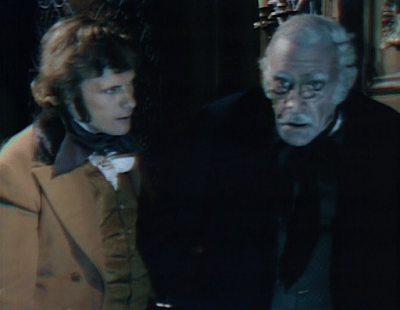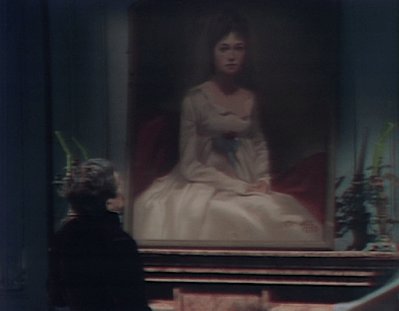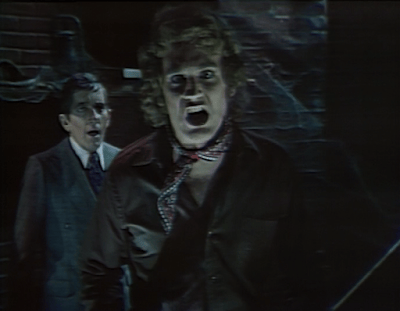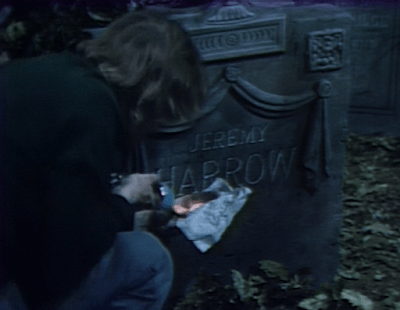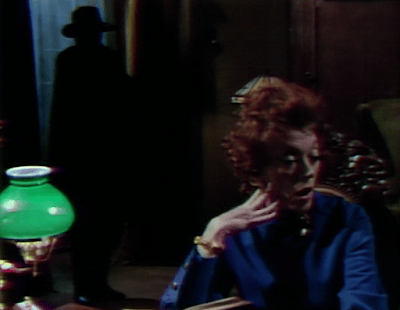
Episode 1137: Gerard is not important now

In March 1967, seagoing con man Jason McGuire showed up at the great house of Collinwood with a plan to help himself to the Collins family’s wealth. He had told matriarch Elizabeth Collins Stoddard that her husband was dead as the result of a blow she had dealt him. He used that story to force Liz to put him up in the great house.

After a few days, Jason’s friend, dangerously unstable ruffian Willie Loomis, showed up in town. Willie was to play a role in some plan of Jason’s that was never explained. Jason made Liz give Willie a room in the great house as well. After a couple of weeks, Willie stumbled onto vampire Barnabas Collins, who took him into his power.

Jason was on the point of success beyond his wildest hopes, about to marry Liz and become master of Collinwood. Suddenly it all came crashing down, and it was revealed that Liz’ husband wasn’t dead after all. Liz threw Jason out of the house. Spying on Willie and Barnabas, Jason saw that they had a fortune in jewels. Seeing one last chance to leave Collinwood a rich man, Jason went to Barnabas’ underground lair to help himself to the jewels. But he wound up opening the coffin just after sunset, and at the end of his final episode Jason had the hand of the undead menace Barnabas crushing his throat. In the next episode, Barnabas and Willie took Jason’s corpse to Barnabas’ old hiding place and Barnabas forced Willie to bury it there.

Now, Barnabas and his friend, mad scientist Julia Hoffman, have become the protagonists of Dark Shadows. They have traveled back in time to 1840 and the show is a costume drama set in that year.

Months before Julia and Barnabas arrived in 1840, seagoing con man Gerard Stiles showed up at the great house of Collinwood. He told Samantha Drew Collins and the rest of the family that her husband had died in a storm at sea, despite his efforts to save them. He used that story to persuade the family to put him up in the great house.

Around that same time, Gerard’s friend, Cockney showgirl/ psychic Leticia Faye, showed up in town. Leticia was to play a role in some plan of Gerard’s that was never explained. Gerard used his influence to persuade Flora Collins to give Leticia a room in her mansion, a place near Collinwood known as Rose Cottage. A couple of weeks into the 1840 segment, Leticia stumbled onto the disembodied head of warlock Judah Zachery, which took her into its power.

Gerard was on the point of success beyond his wildest hopes, about to marry Samantha and become master of Collinwood. Suddenly it all came crashing down when it was revealed that Samantha’s husband wasn’t dead after all. Gerard could not decently stay in the house. Spying on Leticia, Gerard saw that she had a golden mask encrusted with a fortune in jewels. Seeing one last chance to leave Collinwood a rich man, Gerard goes to Judah’s underground lair to help himself to the jewels. But he winds up uncovering him just after his body has been reconnected to his head and reanimated, and at the end of today’s episode the hands of undead menace Judah are moving towards Gerard’s throat.
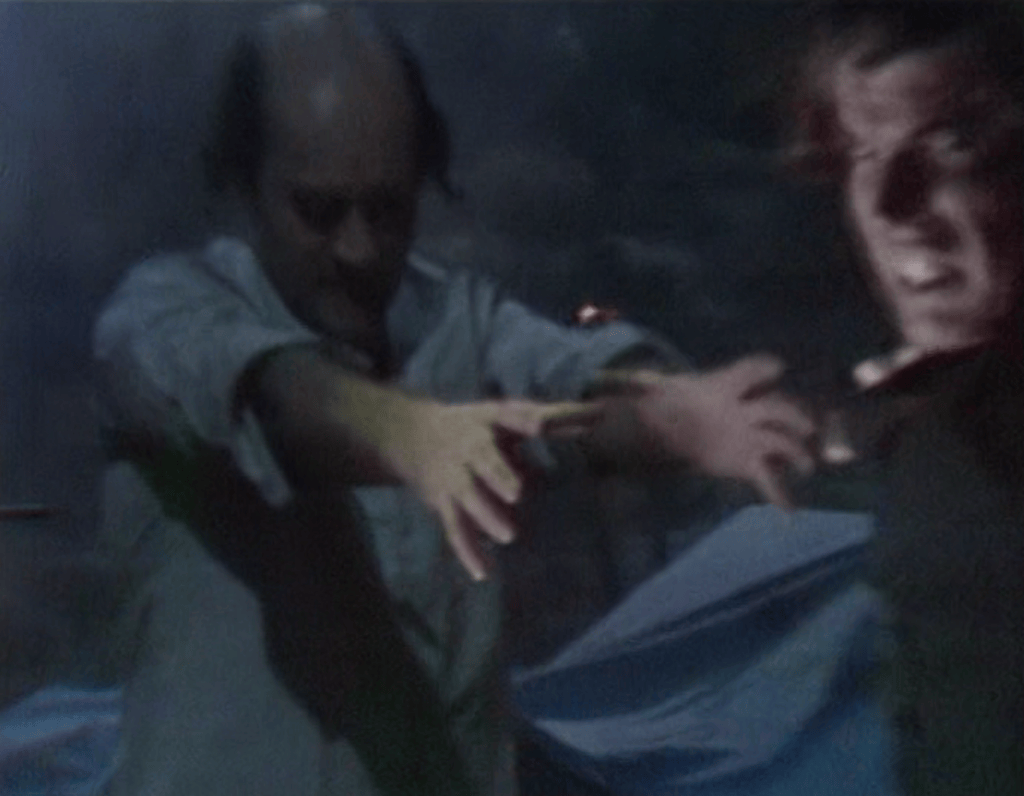
The McGuire brothers, Michael and Jason. Screenshot by Dark Shadows Before I Die.

Jason was always meant to be an in-betweener, a character who would help clear up a couple of unresolved storylines and introduce Barnabas. In those days before internet discussion fora and soap opera magazines, the viewers would not have known that actor Dennis Patrick never signed a contract when he was cast as Jason and already had commitments in California coming up in the summer. But those who had been watching for the previous four months had seen the story of undead fire witch Laura Murdoch Collins absorb one narrative thread after another, so many that it would be clear to them that the show had committed itself to being a supernatural thriller. We may not expect a vampire named Barnabas, but we do expect someone to succeed Laura as the show’s next uncanny Big Bad. Jason was obviously doomed, because he did not know what kind of show he was on. He thought it was still the noir drama it was from August to December 1966, when it told of the Murder of Bill Malloy and its aftermath. In that genre, a blackmailer or a thief might find a way to prosper. But in this world, he is just so much meat for the monster’s dinner table.

But the show has been building Gerard up for months. In July, Julia and Barnabas traveled to the year 1995, where they found that Collinwood was a deadly ruin presided over by Gerard’s ghost and had been since a mysterious disaster took place sometime in 1970. They then went to 1970, and found that they were as powerless to prevent Gerard’s ghost from destroying Collinwood in that year as they had been unable to fight him in 1995. And while his attempt to steal the mask shows that he has failed to understand the extent to which supernatural powers dominate his world, his association with Leticia and his own pose as a seer show that he can engage with those powers to some extent. Therefore, we cannot expect that we will see Judah standing over Gerard’s corpse tomorrow, ordering Leticia to dig a grave.

As the show has been building up the character of Gerard and with him actor James Storm, so it has been going out of its way to keep actor Michael McGuire and the physical presence of Judah on the sidelines. When a character heard a voice coming from the Head, another actor provided that voice. Even today, when Michael McGuire is playing a fully reconstituted and reanimated Judah, he is billed in the credits as The Head. Nor is there a portrait of Judah, as there was a portrait of Barnabas starting a week and a half before Jonathan Frid made his first appearance, committing the show to using the actor who modeled for it. So while they have established that Judah will be the Big Bad for some time to come, there is no reason to expect Michael McGuire to continue playing him.

For most of 1969, Dark Shadows was set in 1897. During that time, David Selby’s character Quentin Collins, whose great-uncle and Doppelgänger is Samantha’s husband and is also named Quentin Collins, became a huge breakout hit. In the second half of the segment, the arch-villain was sorcerer Count Petofi. Among his other powers, Petofi was able to forcibly swap bodies with people. In #872, Petofi, inhabiting Quentin’s body, managed to travel to the year 1969. It looked like Mr Selby would be playing Petofi in a contemporary dress segment, but after a brief moment he was snatched back to 1897.

Quentin had first been introduced as an unspeaking ghost wearing nineteenth century garb, giving people dirty looks, and figuring in a retelling of The Turn of the Screw. Gerard met exactly that description when the show was in contemporary dress in August and September 1970. When we traveled back to 1840, characters even remarked on the living Gerard’s similarity to that year’s version of Quentin. In #1120, Daniel Collins, father of Quentin, told Gerard that he was very much like Quentin, and after their attempted marriage collapsed Samantha bitterly told Gerard that all he ever wanted was to become Quentin. So we can easily suppose that the show is trying to replicate with Gerard and Mr Storm the success it had with Quentin and Mr Selby. Even if Judah displaces Gerard’s personality and begins operating through his body, that will be a reenactment of the Quentin/ Petofi story. If we hope that the possession will be broken, we will be hoping for Gerard to return, leaving us rooting for him and opening the possibility that he will be transformed from villain to protagonist, as Barnabas and Quentin have been.

But there is an obvious problem with the idea of adding a second Quentin to the cast of characters. Ever since the show left 1897 in November 1969, the show has been struggling to find a place in the story for the Quentin it already has. Abraham Lincoln used to say that a town that isn’t big enough to support one lawyer can always support two, and I suppose they might have hoped that two Quentins would clash with each other often enough that the same principle would apply. But even if that was on their minds, in Gerard’s similarity to Jason they hedged their bet. If Judah takes possession of Gerard, it will be as if Jason’s fatal misadventure had been followed by Dennis Patrick switching to the role of Barnabas. They’ve managed to keep Barnabas busy most of the time he’s been on the show, so perhaps they think they have space for an another character like him.

This episode does feature one scene that is so hilarious I think it must be an example of intentional comedy, intentional at least so far as the director and actors were concerned, if not the writer. Barnabas has discovered that Julia is under Judah’s power and is giving her a stern talking-to in the drawing room of the great house. Leticia enters to report to Julia that there is trouble in the hiding place. Julia looks at her and shouts “Leticia, get out! Get out, Leticia!” As she does so, Barnabas shouts “Come back! Come back!” The alternating cries “Get out!”/ “Come back!”/ “Get out!”/ “Come back!” had us laughing out loud.
Episode 1134/1135: I got BLISTERS on mah FEET!

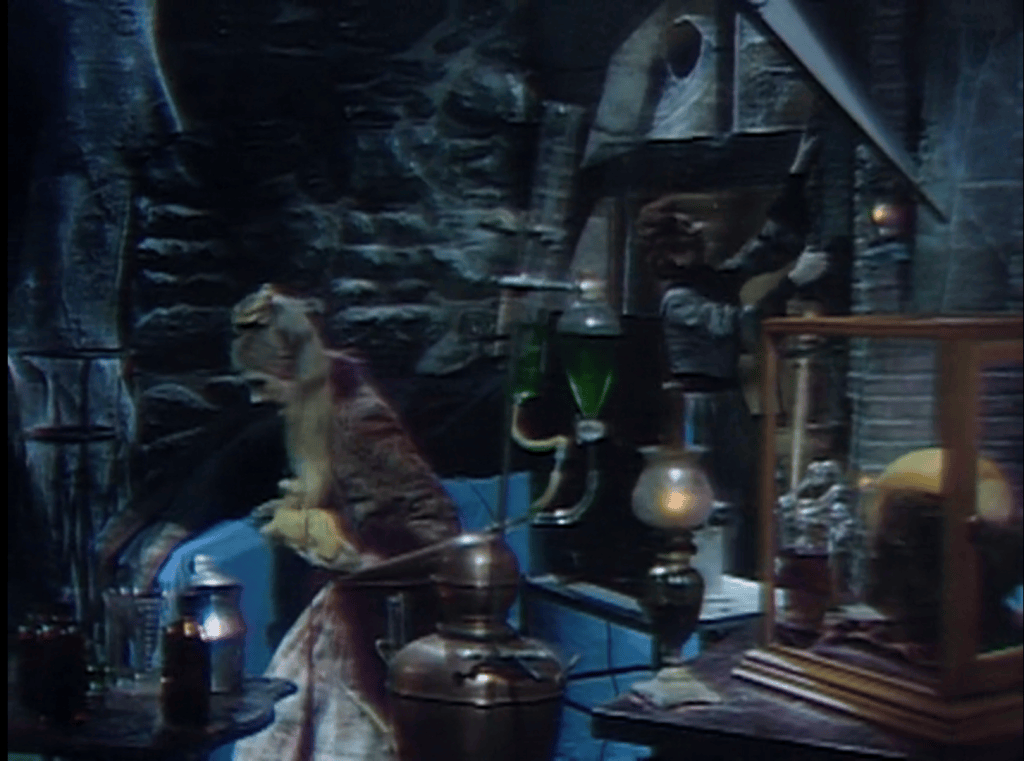
Mad scientist Julia Hoffman has traveled back in time to 1840 and fallen under the power of the severed head of warlock Judah Zachery. Now she has put together a laboratory in a pit where Judah’s body has long been kept, and is planning to reattach it to the head and reanimate them both with a jolt of electricity harvested from lightning. Julia’s assistant in this lunatic scheme is Cockney music hall performer/ psychic Leticia Faye.

In October 1970, every British performer in show business labored in the shadow of the recently dissolved Beatles. Leticia is no exception. She comes back to the laboratory after Julia has sent her on some errands and exclaims “I got BLISTERS on mah FEET!,” evoking John Lennon’s shout at the end of “Helter Skelter.”

Leticia looks at her aching feet.

The Charles Manson trial was in full swing at this time, so the news was full of reports about how Manson’s group committed murders in expectation that they would somehow trigger a race war between Black and White, which would somehow end with the Blacks turning to Manson for leadership. This notion was known within the group as “Helter Skelter,” so the song was likely to come to the forefront of people’s minds when they heard about a nonsensical plot involving bloodshed. The story of Judah Zachery is mainly derived from C. S. Lewis’ 1945 novel That Hideous Strength. It will be interesting to see if they decide to mash up Lewis’ Satanic cult of overly ambitious academic administrators with the Manson Family.

Episode 1132: A remarkably modern day woman

In 1968, mad scientist Julia Hoffman, MD, built two Frankenstein’s monsters. Now Julia has traveled back in time to 1840. She and Cockney showgirl/ mentalist Leticia Faye have come under the power of Judah Zachery, a warlock who was beheaded in 1692. Judah’s head and body have been maintaining separate residences ever since, and now he wants them reattached. Julia has given Leticia a list of medical supplies that she will need to complete the operation.

The other day, we heard Quentin Collins and his wife Samantha quarreling about their crappy marriage. Evidently Quentin asked Samantha to agree to a divorce four years ago so that he could marry someone he didn’t hate. Today, we learn that this person’s name was Joanna Mills, that she was a widow when Quentin took up with her, that her landlady Mrs Purdy was her only friend, and that Mrs Purdy identified Joanna’s corpse after she escaped from the insane asylum and drowned herself.

Mrs Purdy shows up at the great house of Collinwood and tells Quentin all of this. He doesn’t know what to make of this news, since he recently received a handwritten note apparently from Joanna. Indeed, immediately after Mrs Purdy leaves Quentin finds another such note.

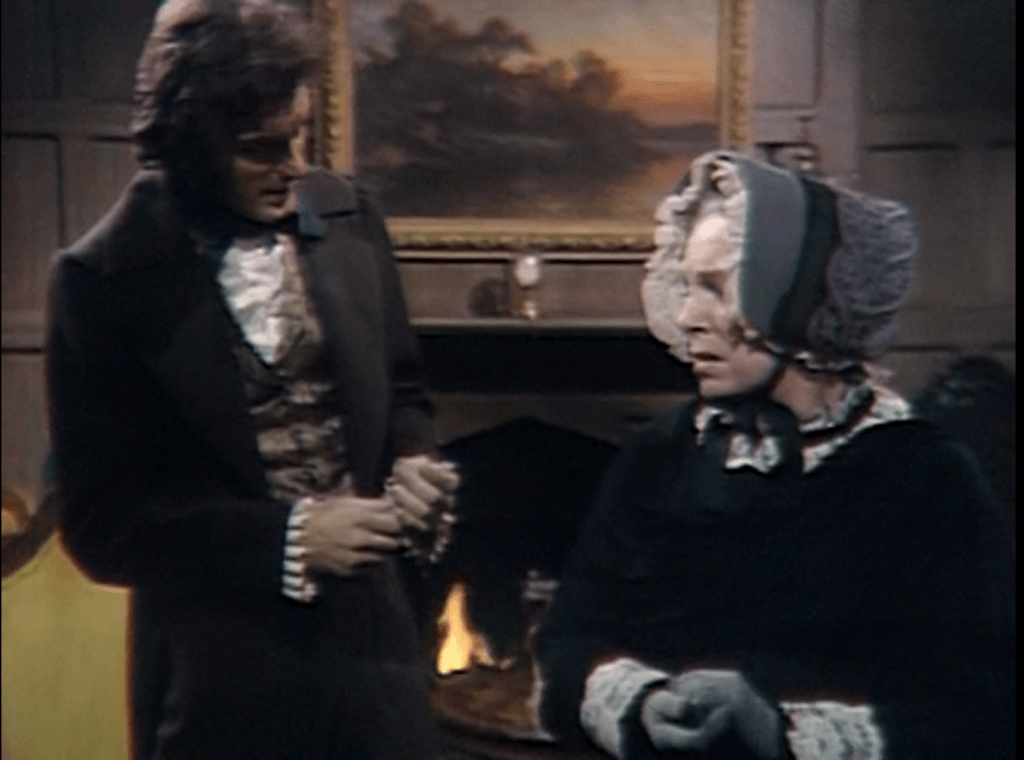
Quentin talks with Mrs Purdy.

Returning viewers have every reason to believe that the notes are the creations of Daphne Harridge, a young woman whom Quentin just hired to be governess to his son Tad. Daphne keeps writing in her journal that her plan to murder Quentin is coming along nicely. At one point today, she leaves her gun behind in the drawing room where a houseguest finds it. An amazingly poor sense of OpSec is one thing all the most popular characters on Dark Shadows have in common, so we can take it that Daphne will be on the show for a long time.

For her part, Samantha is furious that Quentin has hired Daphne. She has always hired the governesses. It is particularly galling to Samantha that Quentin did not inform her that he had taken that task from her, even though he told the cook that Daphne would be coming. Samantha tries to bring up something she asserted earlier, that Tad is not Quentin’s son but the product of a dalliance she had with a lover. He cuts her off before she can repeat this claim, and tells her she is free to leave the house.

Mrs Purdy is played by Camila Ashland, her third and, alas, final role on Dark Shadows. The others were also one-shots. In #928, Ashland played Mrs Hutchins, a woman the villains hired to lie to Julia. In #997, she was Mrs Duval, landlady to masochistic barmaid Buffie Harrington. Ashland was an extremely distinguished stage actress. She has a lot of trouble with her lines today, but she still manages to get the point across that Mrs Purdy was not at all shocked that Joanna was carrying on an affair with a married man and that she tried her best to get her decent care when her mental health collapsed.

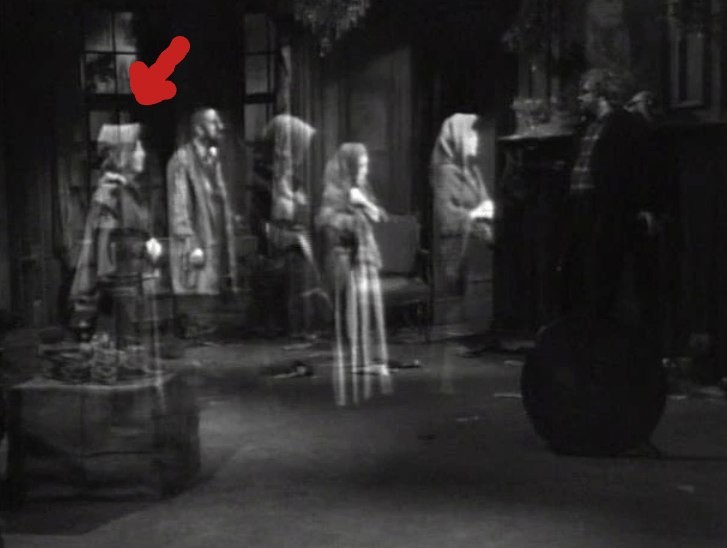
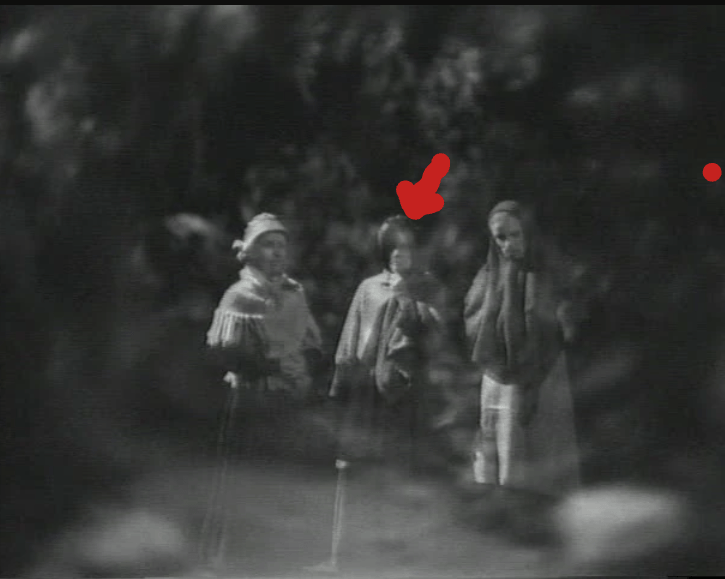
Mrs Purdy wears a bonnet that I believe we have seen before. In the early days of the show, the most frequently mentioned figures in the supernatural back-world behind the action were The Widows, ghosts of women whose young husbands died because of the Collins family’s inhumane management of its whaling fleet. In #266, we learned that The Widows were named Rachel Comstock, Margaret Findley, and Abigail Tolliver. A couple of times we caught glimpses of The Widows, and when we did we always saw one wearing a bonnet just like Mrs Purdy’s.

The ghosts of Collinwood in #126.
The Widows in #266. The one in the middle is wearing the bonnet.

We are now in the era when the Widows would have been alive. I wonder if they dug the bonnet up for the first time since 1967 because in some early stage of the planning for the 1840 segment they were thinking of incorporating a story that would have introduced Rachel, Margaret, and Abigail as living characters.

Episode 1130: A better place to imagine than to live in

Dark Shadows featured several long costume drama segments depicting stories of time travel. From November 1967 to March 1968, well-meaning governess Victoria Winters bumbled around in the years 1795 and 1796, convincing the people of Collinsport that they should hang her. Meanwhile, we learned how old world gentleman Barnabas Collins first became a vampire.

From March to November 1969, Barnabas was the one making poor decisions in an era not his own when he found himself in the year 1897. Those eight months were by most measures the show’s most successful period. From March to July 1970, the show traveled sideways in time to an alternate universe where Barnabas and his friend, mad scientist Julia Hoffman, meddled in the problems of the family who lived on that version of the estate of Collinwood. The show insisted on calling that alternate universe “Parallel Time.”

Now, Julia and Barnabas have made their way to the year 1840. They know that something or other happened in that year that would lead to the destruction of the great house of Collinwood and its residents in 1970. They have no very clear idea what that fateful event was, and it is becoming increasingly clear that the writers don’t have any good ideas about it either.

While Barnabas, Julia, and the writers cast about in the darkness, we keep meeting characters who remind us of earlier phases of the show. Early on, we met Ben Stokes and Daniel Collins, two people left over from the 1790s segment. Ben helped Julia and Barnabas establish themselves with the current crop of Collinses by corroborating their story that they were cousins from England (or Philadelphia, whichever.) Daniel, who was a boy in the 1790s and is now the master of Collinwood, greeted them warmly and invited Barnabas to stay in the Old House at Collinwood as long as he liked. The presence of Daniel and Ben not only helped graft Barnabas and Julia onto the new stories, but also told longtime viewers that the 1840 segment will be a sequel to the 1790s segment.

We also see mergers of characters from the 1897 segment with those from Parallel Time. For example, charming rogue Quentin Collins became a huge breakout star in 1897; in Parallel Time, Quentin’s counterpart was the grumpy and irascible master of Collinwood. In 1840, Quentin is Daniel’s older son and sole heir, in charge of the house due to his father’s many problems. He is again grumpy and irascible, again in a loveless marriage. But like the 1897 Quentin, he is fascinated by the occult and creates trouble by his reckless involvement with it. Quentin’s best friend and fellow occultist is his cousin Desmond Collins, played by John Karlen. Desmond shares the irresponsibility of Karlen’s 1897 character, inveterate prankster Carl Collins. But Desmond has none of the extreme childlike quality that it made seem Carl had a cognitive impairment of some sort. He has the manner and bearing of Karlen’s Parallel Time character, drunken novelist Will Loomis.

Will was married to Carolyn Collins Stoddard, played by Nancy Barrett. In 1897, Miss Barrett played a villain named Charity Trask who fell afoul of evil sorcerer Count Petofi. Petofi erased Charity’s personality and replaced it with that of Cockney showgirl/ mentalist Pansy Faye. Carl had brought Pansy to Collinwood as his fiancée. Pansy was killed before she ever met Charity, who never had any use for Carl. Carl himself was killed before Petofi took Charity’s body away from her and gave it to Pansy. Miss Barrett’s acting style is to throw herself completely into each of her roles, so we quickly accepted her as Pansy. But when we heard Miss Barrett’s Pansy pine for her poor lost Carl, we were reminded that Petofi had murdered Charity and reanimated her form with Pansy’s mind.

In 1840, Miss Barrett is Leticia Faye, who is barely distinguishable from Pansy. She was brought to Collinwood by the evil Gerard Stiles to play some part in his never-explained scheme to cheat the Collilnses out of their money. When we first saw her, Leticia confronted Gerard over her suspicions that if he ever did get his hands on any of the Collins money, she wouldn’t see any of it. Then Gerard humiliated her by marrying Quentin’s widow Samantha, which promptly redounded to his own humiliation when Quentin turned up alive and well. Leticia confronted him again, brandishing her own pain and mocking his in what sounded very much like the sorts of things Carolyn used to say to Will. Now, Leticia has set her cap for Desmond, but also become involved in his occult mischief.

Most of the action in the 1790s was driven by wicked witch Angelique. A maniacal villain then, Angelique appeared in 1897 and became a multilayered personality. Angelique rejoined the cast of characters at the end of yesterday’s episode. We saw her enter the hidden chamber where Barnabas’ chained coffin was kept from the 1790s on and discover that it was no longer there.

Angelique’s counterpart in Parallel Time had a sidekick, a housekeeper modeled on Mrs Danvers from Rebecca who was herself Julia’s Doppelgänger. We didn’t get to see a great deal of that relationship, since Grayson Hall was off for principal photography for the feature film House of Dark Shadows during most of the first half of the Parallel Time segment. Today, we see that we will be getting another look at how Angelique handles a sidekick. Angelique Model 1840 has a servant, a man named Laszlo Ferrari.

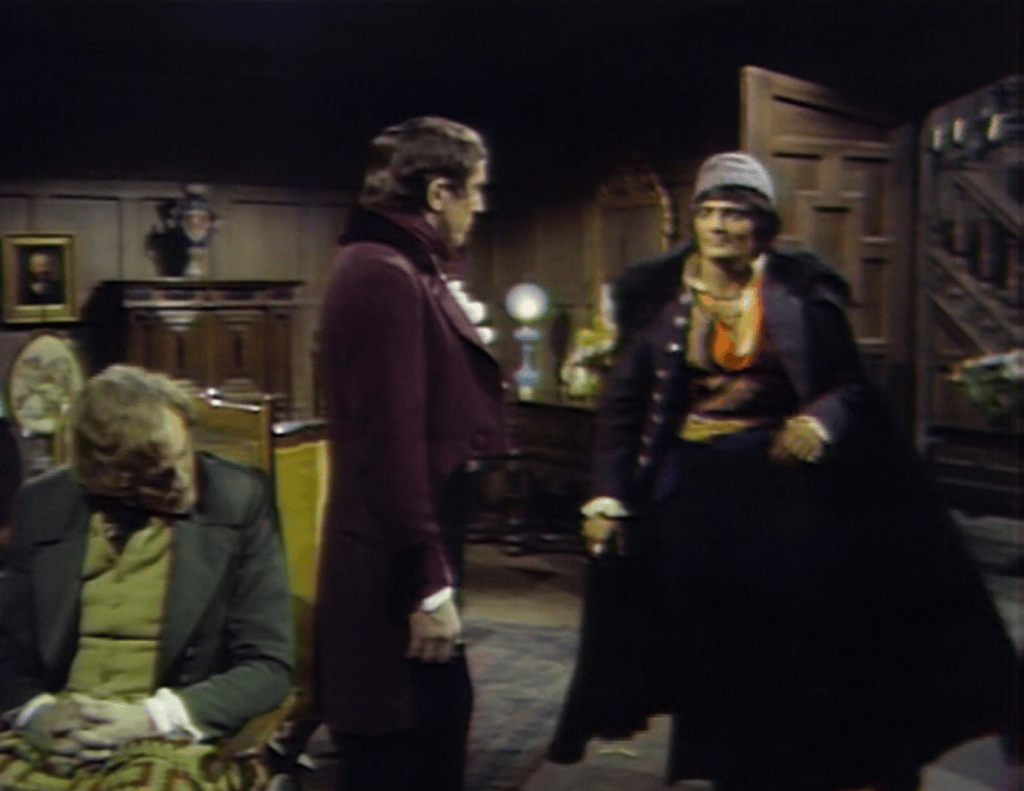
Laszlo’s appearance evokes the 1897 segment. He is played by Michael Stroka, wearing the astrakhan hat that he wore when we first saw him as Aristide, servant of Count Petofi. His attitude towards Angelique is very much like Aristide’s towards Petofi, asking a question in a vaguely belligerent tone, occasionally making a show of defiance, and quickly collapsing into cringing obedience. So he asks Angelique why they keep coming to the tomb every year, and why she isn’t as happy as she usually is when she emerges from the secret room. She snaps at him in response, saying that she would have expected him to stop asking her questions by now, since she has never yet given him any answers. She orders him to go to the great house at Collinwood and find out if a man named Barnabas Collins has been around recently. Reluctant to go, he asks who Barnabas is. She says he is the only man she ever loved. He says “Other than me, of course!” and she agrees in a sarcastic tone. It’s all in very joking, but he scurries away to obey her. All that is missing is him addressing her as “Excellency!” and her remarking on his good looks, and we’d be right back with Aristide and Petofi.

At Collinwood, Laszlo meets Quentin’s younger brother, Gabriel Collins. Gabriel is amused by Laszlo’s attempt to persuade him that he can see into the future, and tells him that the pressing need is for someone who can see into the present. There is a headless body wandering the estate killing people, and if Laszlo can tell them how to put a stop to that he’ll be onto something. Barnabas shows up and scowls at Laszlo, who leaves.

Barnabas doesn’t like the looks of Laszlo. Screenshot by Dark Shadows Before I Die.

Meanwhile, we learn that Leticia knows a great deal about the headless body. It used to be attached to a severed head that Desmond brought back from Macau as a gift for Quentin. That separates Desmond from Carl, who brought Pansy back from Atlantic City to be his own bride. Leticia is now keeping the head in her own room, and is acting under its influence.

The head and body are those of warlock Judah Zachery, executed in 1692. The head has turned up occasionally in the years since, each time figuring in a series of brutal murders. Apparently the situation will get even worse if the head can be reattached to the body. This also harks back to Petofi, whose hand had been cut from his wrist in the 1790s and had carried on its own career of malignity in the years before Petofi stuck it back onto the end of his arm in 1897. Since Angelique joined forces with Barnabas and Julia to fight Petofi then, showing a new and extremely engaging side of her character, longtime viewers may hope that she and Laszlo will be part of an alliance with our protagonists against Judah Zachery in this period.

Laszlo’s name evokes the movie Casablanca, in which the most morally upright character is French Résistance leader Victor Laszlo while the most morally debased character is crime boss Signor Ferrari. We can imagine Jerry Lacy breaking his character as overbearing undertaker Lamar Trask, putting on his celebrated Humphrey Bogart imitation, and saying of Angelique that “Of all the temporal anomalies in all the multiverse, she had to walk into mine.”

The Petofi/ Aristide relationship was based on one memorialized in another Humphrey Bogart film, Gutman and Wilmer in The Maltese Falcon. As Sydney Greenstreet played Ferrari in Casablanca, so he played Gutman in The Maltese Falcon. It may have been a bit on-the-nose to cast portly gentleman Thayer David as an analogue of Greenstreet, a criticism which cannot be leveled at the choice of the svelte and dazzling Lara Parker. In another departure from the Petofi/ Aristide model, Laszlo is a member of the Romani or Sinti people, the ethnicities often slurred as “Gypsies.” Petofi was vulnerable to certain Romani, and was deathly afraid of all of them.

Aristide was a lot of fun. Stroka came back in 1970 as two characters very like Aristide, first in the original continuity as a hitman known only as Bruno, then in Parallel Time as failed composer Bruno Hess, a member of a little cult that had grown up around that universe’s version of Angelique. The two Brunos were so similar to each other and to Aristide that regular viewers might be disappointed to see Stroka working the old stand one more time.

The essence of Aristide and the Brunos was an insecurity that rode very close to the surface of the character. Each man sneers as he asserts himself against his victims or puffs himself up as he attempts to assert himself against his superiors, then dissolves immediately into frantic backpedaling when he encounters opposition. Stroka made as much as anyone could of those parts, and I had hoped to see him in a role where the insecurity lies deeper in the character’s personality. I wanted to see him as an authority figure whose pompous self-satisfaction can withstand a fair amount of battering and whose eventual defeats prompt a more complex response from him than Aristide/ Bruno’s hectic flailing.

The two characters we have seen who meet that description were Joshua Collins in the 1790s segment and Edward Collins in the 1897 segment, both played brilliantly by Louis Edmonds. In 1840, Edmonds plays Daniel, who is the legal owner of the Collins fortune but whose mental and physical infirmities keep him from exercising much authority. In #1074 and #1076, an ancestor called Abner Collins was associated with the events of 1840; I wish that Barnabas and Julia had found that Abner, rather than Quentin, was Daniel’s eldest son and was in charge of Collinwood and the businesses. Quentin would then be free to be the insouciant wastrel who was such a hit in 1897, rather than a retread of the foul-tempered sourpuss who was a consistent downer in Parallel Time.

As Abner, Stroka could have taken advantage of his striking facial resemblance to William F. Buckley, Junior, making clever-sounding but specious arguments in defense of the family’s most objectionable business practices, littering his speech with seldom-heard polysyllabic words and, when he makes what he believes to be a persuasive argument, leaning way back in his chair and fluttering his eyelids. Buckley was a prominent figure nationally and especially in NYC in 1970. He had been hosting a nationally syndicated television show ever since his unsuccessful bid for mayor of New York in 1965, and in 1970 his brother James would defeat the Democratic and Republican nominees to be elected to the US Senate from New York as the candidate of the Buckley family’s Conservative Party. A spoof of him would therefore be something that grownups in the audience would likely find amusing, and that the New York based makers of the show would surely have enjoyed creating.

In the early days of the show, the most prominent supernatural presences were the ghosts of The Widows, women who flung themselves to their deaths after their husbands were lost at sea due to the inhumane practices of the Collins whaling fleet. The story of The Widows came forward as the first explanation of the origin of the Collins family curse. The whaling industry in New England was approaching its zenith in 1840; it was in the following decades that it finally surpassed cod fishing in the region’s economy. It would close the loop on that early story to present Abner as the man who ensured that the Collinses would be enormously rich for a long time to come by switching the focus of the fleet from a mature market to a rapidly growing one, but who also ensured that they would be the object of undying wrath among many in Collinsport by switching from a decentralized business in which many men had a realistic chance of becoming independent operators to a capital-intensive one in which a handful of magnates control everyone else’s destiny. Abner could become callous to conditions on the whaling ships, because he would see the men as easily replaceable parts of a single machine, not as professionals who had to use their judgment to track down the fish and who might at any time strike out on their own as his colleagues or competitors.

The switch from cod fishing to whaling and its consequences for the life of the village would hark back not only to The Widows, but also to the business stories incorporated in the early storyline of “The Revenge of Burke Devlin.” The theme of those stories was that the Collinses had trapped the people of Collinsport in a situation where the only way for an ambitious young man to improve his lot in life was to leave town. If the 1840 story went on long enough, they might have been able to explore that theme in some depth. Not only would that have appealed to the taste for social and political relevance that was so much in the air in the early 1970s, but by depicting Collinsport as a place full of people who are involved in the story it would also relieve the claustrophobia that stems from the all-Collins episodes that come up so often in the later phases of the show.

Episode 1125: All the rotten apples

The narrative voiceover that opened #202 told us that a new addition to the cast of characters, dangerously unstable ruffian Willie Loomis, was destined to “awaken and unleash a force that will affect the lives of everyone.” In #209, the voiceover identified this “force” as “the darkest and strangest secret of them all.”

In his first five appearances, Willie was played by Mississippian James Hall. In #205, Hall’s Willie was escorted to a portrait we had seen for the first time under the previous day’s closing credits. Strange and troubled boy David Collins identified its subject to Willie as Barnabas Collins, a name we had not heard before. Soon Willie started to hear a heartbeat coming from the portrait, and it led him to a mausoleum in a rarely visited part of the old cemetery north of town. In #210, Willie, now played by John Karlen, inadvertently opened a secret panel in that mausoleum and found a chained coffin in the secret chamber behind it. He opened that coffin, hoping to find the jewels that once belonged to Barnabas. In fact, he found Barnabas himself, a vampire who would enslave him.

In the fall of 1970, the feature film House of Dark Shadows was playing in theaters around the USA. In that movie, Karlen again plays Willie. That version of the character is led to the mausoleum not by a heartbeat he hears through a the portrait of Barnabas, but by a riddle he finds in an old book:

The Madonnas rest high above

The Lion’s head watches the dove

And in the womb beneath the hill

A blazing light glows bright and still.

As in the show, so in the movie Willie opens the coffin expecting to find a fortune in jewels, only to find Barnabas’ hand darting for his throat. As in the show, the movie version of Willie becomes a slave whom Barnabas beats unmercifully.

Now, the show is set in the year 1840. Karlen plays Desmond Collins. An evil spirit emanating from a severed head Desmond brought home with him from Macau has taken control of him. As Willie heard the heartbeat from the portrait of Barnabas, so Desmond hears a voice from the head. The head wants to be reunited with its body, which is buried somewhere in the Collinsport area. Yesterday Desmond brought a man named Otis Greene to his room. Greene was under the head’s control in 1803, when he brutally murdered four people. Desmond showed the head to Otis, who was horrified. Desmond demanded to know where the body was, and kept shouting in Otis’ ear even after Otis clutched his chest and started gasping. He managed to get a few cryptic remarks out of Otis before he fell dead to the floor: “The noose, a ring of gold, the stairs, top of the hill, direct line, an unmarked stone.”

A woman named Leticia Faye enters. Leticia sees Otis’ body on the floor and asks Desmond why he killed him. Leticia has psychic powers, so she quickly realizes that it was not really Desmond, but the head that is responsible. Desmond menaces her and demands she keep quiet.

Later, Leticia returns to the room and notices the body is gone. When she asked “Where’s the body?,” my wife, Mrs Acilius, laughed out loud. It’s as if she is noticing that Desmond has removed a piece of furniture. Desmond says that Otis’ son came and took it away. One might wonder how that went. There were no telephones in 1840, and we haven’t seen any servants at Desmond’s house. So Desmond must have gone to Greene’s son in person, told him he had his father’s body in his room, and asked him to come fetch it.

Leticia herself is a reference to Willie’s early days on the show. As seagoing con man Jason McGuire brought Willie to Collinwood to play a never-specified part in his plan to cheat the Collinses out of their money, so seagoing con man Gerard Stiles brought Leticia to play a never-specified part in his pursuit of the same objective. Before we saw Willie, we saw Jason talking on the telephone to someone named Chris who wanted to join him at Collinwood and with whom he had an ambivalent relationship. We might have assumed that “Chris” was short for some such name as Christine or Christabel and that she was a girlfriend or wife who was going to complicate Jason’s plans to impose himself on matriarch Elizabeth Collins Stoddard. When the name Chris was dropped and Willie put in its place, we saw it wasn’t quite that way, but as Dennis Patrick played Jason and both James Hall and John Karlen played Willie, we wondered if it might have been somewhat that way. There was something a lot more complicated in the emotions they showed in their scenes together than what could be explained by what we saw.

Leticia is upset with Gerard these days. He married Samantha Collins, widow of Quentin Collins, lady of the great house of Collinwood, and sole heiress to the Collins fortune. That seemed to seal his triumph, and left Leticia out in the cold. The marriage was only a few hours old when it turned out Samantha wasn’t a widow after all. Quentin turned up alive and well six months after he went missing during a mishap at sea. Now Samantha has to decide whether to go back to Quentin, leaving Gerard where he started, or to go with Gerard, going him a wife to support somehow. Leticia mocks Gerard bitterly for the dismal alternatives he now faces.

House of Dark Shadows left the audience to do a lot of guesswork as to how the characters got from one place to another, and indeed as to where exactly any given scene was supposed to be taking place. Among other things, it never explained how the riddle led Willie to the mausoleum. Today, Desmond goes to his cousin Gabriel Collins to ask for help deciphering Otis’ cryptic remarks. Gabriel mentions a place called Gallows Hill; that reminds Desmond that Otis said his grandfather was the executioner, and between them they figure out where to go.

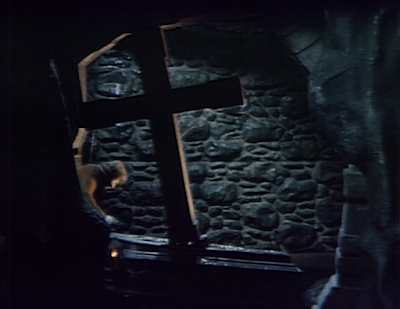
In both #210 and House of Dark Shadows, Willie opened the secret panel in the mausoleum in the old cemetery by pulling a ring that was connected to a cable. Today, Desmond pulls a ring on a small headstone in an old cemetery and opens a secret panel on the ground next to it. As Willie walked down stone steps and found a chained coffin behind the panel, Desmond walks down stone steps and finds a coffin. This coffin is held shut, not by chains, but by a large cross wedged between it and the ceiling of the chamber.

The underground chamber. Screenshot by Dark Shadows Before I Die.

Desmond finds that the lid of the coffin is divided into two parts. He can open the small part at one end. inside it, he finds what Willie had hoped to find, many precious jewels. They are embedded in a golden face mask.

Episode 1124: Where the bodies are buried

Desmond Collins has fallen under the influence of an evil spirit emanating from a severed head he bought in Macau, and is now trying to find the body that used to be attached to the head. Lamar Trask is an evil spirit unto himself, and is trying to find the body of his late father, fanatical witchfinder the Rev’d Mr Trask.

It is not clear what the severed head is hoping will come of a reunion with its body, though longtime viewers will remember the last time a body part was reconnected to its original possessor. Evil sorcerer Count Petofi stuck his hand back on the end of his arm in #814. As separate entities, Petofi and the hand both wielded considerable magical powers. Reunited, they seemed to be unstoppable.

What Lamar wants is much clearer. He believes that his father was murdered in the 1790s, 45 years ago. He hopes that the killer might still be alive and that he will be able to take revenge.

As it happens, Lamar is right about what happened to his father. Vampire Barnabas Collins walled Trask up in his basement and left him to die there. Barnabas is back on the estate of Collinwood, having been sealed in his coffin in 1796, freed in 1967, and dislocated in time in 1970. It might be just for Lamar to expose Barnabas and destroy him, but it would also ruin the show. Besides, Lamar and his father are both hilariously obnoxious, so it wouldn’t occur to anyone to root for them.

Lamar persuades Cockney showgirl/ mentalist Leticia Faye to hold a letter from his late father while she goes into a trance. She has a vision of the Old House on the grounds of Collinwood. Lamar interprets this to mean that his father’s remains are there. Barnabas interrupts this scene and reproves Lamar for taking advantage of Leticia. He might have pointed out that what Leticia was doing is by any definition witchcraft, and have gone on to point out that the Rev’d Mr Trask would be horrified that his son would participate in it. But that would put Lamar on the defensive, and the function of a Trask is always to attack.

The Collinses think that Barnabas left for England in the 1790s and died there. They also believe that he and his fellow time traveler, mad scientist Julia Hoffman, are the offspring of that original Barnabas come to visit their late father’s birthplace. The other day, Daniel Collins, master of Collinwood, invited Barnabas to stay in the Old House as long as he liked. So Barnabas does not have to sit still for Lamar’s attack later, when he goes home to the Old House and finds him poking around. Lamar explicitly says that he is looking for his father’s remains. Knowing that they are behind a brick wall which has attracted no one’s notice in the decades for which it has stood, Barnabas is quite relaxed about this search. He tells Lamar that he is risking his good name by taking Leticia’s visions so seriously, and tells him to leave the house.

Desmond and Leticia live under the same roof. She is his mother’s permanent guest in their home, a mansion known as Rose Cottage. But unlike Lamar, Desmond does not turn to Leticia for guidance today. At the beginning of the episode, she walked into the room where he keeps the head, exclaimed about the evil present there, and fainted. So he gives her a wide berth for the rest of the day.

Instead, Desmond calls in Otis Greene, who was associated with the head in 1803. The head possessed Otis, as it is taking possession of Desmond, and led him to commit four brutal murders. Otis confessed to those murders and asked to be punished, but his talk about the head led the court to exercise a leniency extraordinary for the period and to set aside criminal charges, instead committing him to an asylum. Released from there about ten years ago, Otis has established himself as a successful antique dealer.

Otis enters and at once begins admiring Desmond’s furniture and telling him about the prices it would fetch in his shop. He looks at one chair and says that he knows a collector who would pay the fantastic sum of $100 for it, equivalent to many thousands of dollars in 2026. Desmond says he is not interested in selling the chair, and directs Otis’ attention to a table that belonged to someone associated with a witchcraft trial.

Desmond questions Otis. Screenshot by Dark Shadows Before I Die.

Otis is played by Abe Vigoda, his second role on Dark Shadows. Vigoda’s first character made his entrance in #684 expressing admiration for the fine things around him, as Otis admires Desmond’s furniture today. That was Ezra Braithwaite, a silversmith. Ezra was brought on to provide information that would lead to the ghost of a man from his own past. Ezra did answer some questions, but the ghost killed him before he could make an exit.

Evidently writer Sam Hall remembers Ezra. Not only does Otis make the same entrance as Ezra, but like Ezra he is there to talk about his past. He tells Desmond that his grandfather was the executioner in the town of Bedford, and that his work brought a curse on the family. Desmond shows Otis the head, and he is shattered at the sight of it. Desmond demands to know where the body is. Otis resists answering, but is quickly overwhelmed with chest pains. Desmond screams in his ear, and he starts gasping out cryptic remarks. “The noose, a ring of gold, the stairs, top of the hill, direct line, an unmarked stone.” He falls dead, and Desmond vows that the hidden body will be found.

Unfortunately, this marks Abe Vigoda’s final appearance on Dark Shadows. Vigoda’s first television role came in 1949, when he was 28 years old. He played a character identified as “Old Man on Train” in an installment of Studio One. He went on playing old men on television, in movies, and on Broadway until his death in 2016. His most famous feature film role was that of doomed capo Sal Tessio in The Godfather (1972,) and his biggest TV part was as Detective Philip K. Fish on the series Barney Miller and its spin-off Fish (1977-1978.) He once sat on a panel of cast members at a Dark Shadows convention. When it was his turn to talk, he said “My name is Abe Vigoda. I played Otis Greene on Dark Shadows. I don’t remember much about it,” and passed the microphone to the next person.

Episode 1113: Do you smell the smoke?

From March to November 1969, Dark Shadows was mostly set in the year 1897, to which time-traveling vampire Barnabas Collins had made his way. Barnabas’ friend, mad scientist Julia Hoffman, would join him for several weeks towards the end of the 1897 segment.

While Barnabas and Julia were busy in the past, the show cut to a contemporary setting a few times to show us that time was passing there and that the actions taking place in 1897 were changing the circumstances at the great house of Collinwood in the twentieth century. When Barnabas returned to the contemporary setting, the other characters knew where he had been and remembered both the events he went back in time hoping to prevent and those that had replaced them.

The 1897 segment was so good I wished it had gone on longer. One way I imagined they might have been able to stretch it out would have been to do more with the intercutting timelines. So perhaps spend a week in 1897, then a week in 1969. Obviously that would have required a lot more advance planning than they ever managed to do, since they would have had to keep redressing the sets to represent the different periods, but I thought it might have been worthwhile.

Today, we have evidence that some idea like this also occurred to the makers of the show. Julia has gone back in time to 1840 to keep a series of events from starting that will lead to the ruination of Collinwood and its inhabitants in 1970. Barnabas was unable to join her. We spend time today with Julia in 1840, and then with Barnabas in 1970.

Arriving in 1840, Julia’s first act was to make contact with Barnabas’ old friend Ben Stokes. Ben believed her story and made himself incredibly helpful to her effort to establish herself at Collinwood. But she convinced herself that Barnabas had magically projected himself from 1970 into his body as it is in 1840. So she went to the secret room of the old Collins family mausoleum, unchained his coffin, and released him. He was about to kill her when Ben showed up and stopped him. Ben persuaded Barnabas to let Julia leave the room alive, and repeated her story to him. Barnabas reacted with incredulity, telling Ben that he had gone mad to accept such a tale, but Ben insisted Julia was their friend. Now Barnabas has resumed killing people, and Julia is terribly afraid that unless he stops he might be caught.

Barnabas is in the bedroom at the Old House at Collinwood once meant for Josette DuPrés to call her own after she married him. He takes Josette’s portrait off the wall and tells her that he must go on without her. We’ve heard that before. In #281, he stood in the same room and spoke to the same portrait, telling Josette that her ghost must go away and never come back so that he could face the world with someone else. We soon found that his plan was to turn that someone else into a simulacrum of Josette, and later he kept deciding that other women were reincarnations of Josette, so that speech did not represent the emotional growth we might have hoped to see. Finally, Josette’s ghost appeared to Barnabas in #948 and told him to lose her number, and his next love interest was a woman who did not remind him of her. That new woman was comatose, and Barnabas rhapsodized about how much beauty he found in her silence and immobility. Also, there was a bit of a problematic age gap, since she was 22 and he was well over 200. Baby steps, baby steps.

Barnabas has a heart to heart with Josette’s portrait. Screenshot by Dark Shadows Before I Die.

Ben enters and tries to talk Barnabas into returning to his coffin and allowing himself to be chained back in. As my wife, Mrs Acilius, points out, he doesn’t even mention that murder is bad. He knows Barnabas well enough to know he’d roll his eyes at that kind of talk. He just focuses on the danger Barnabas is putting himself in. Barnabas says that Ben does not know how horrible it is to spend years trapped in the darkness. Returning viewers may smile at this, since Barnabas doesn’t know that either. When Julia opened his coffin, he had no idea more than a single day had passed since he was chained there in the 1790s. He flounces off to take more victims.

In the drawing room of the great house, Julia meets Cockney psychic Leticia Faye. She asks Leticia if she can tell what will happen in that room in 1970. Leticia laughs and says her visions don’t extend that far. She adds that there wouldn’t be much point in them if they did, since no one alive today will be around to see if they came true. Julia claims to have had a dream about 1970, and Leticia humors her. She goes into a trance, and smells smoke. That’s about it, and when Leticia comes out of it she is still laughing, perhaps thinking that it didn’t amount to much. But it reminds Julia of the disaster she escaped, and leaves her wondering what Barnabas is doing in 1970.

We cut to Barnabas’ house in that year. He is doing what he does best, sitting around feeling sorry for himself. Ben’s descendant, occult expert Timothy Eliot Stokes, is there. They are talking about the funeral held that afternoon for the residents of the great house killed in the disaster. Stokes does not know that Barnabas is a vampire, and so Barnabas has to make an excuse for his absence from this daytime event. He simply says he was too upset to attend.

Heiress Carolyn Stoddard Hawkes and charming rogue Quentin Collins survived the disaster and are in the Old House, both quite insane. Barnabas and Stokes cart them off to a psychiatric facility. This is the final appearance on Dark Shadows of either of these characters, each of whom has been enormously important to the show.

Carolyn is played by Nancy Barrett, who also plays Leticia. Quentin is played by David Selby. We had expected to see Mr Selby in 1840 as another character named Quentin Collins, but when Julia arrived she learned that Quentin was missing and presumed dead after a nautical mishap. This glimpse of Quentin doesn’t add much to the story, but it does serve to reassure us that Mr Selby has not left the cast and that we will be seeing the 1840 version of Quentin sooner or later.

Barnabas decides to cast some I Ching wands. That’s what got him back to 1897, and the wands fall in the same pattern this time as they did then. He meditates on them. He sees a door, and seems to pass through it. On the other side, he sees a tombstone engraved “Julia Hoffman Collins 6 October 1840.”

Julia is masquerading as the daughter Barnabas had after he left for England in the 1790s, and has been telling the Collinses to expect her brother, Barnabas Junior. We haven’t heard her give “Hoffman” as a middle name. Of course it had to be there for Barnabas to be shocked by the stone. Otherwise, he would just have wondered who “Julia Collins” was.

It strikes me that they missed an opportunity. Julia has said that she moved from England to Philadelphia. Even though she lived there for so many years that she picked up an eastern Pennsylvania accent, she did not contact the family at Collinwood. Eventually they are likely to find out that she has a great deal of medical expertise, most unusual for a lady in 1840. Had she introduced herself as Julia Collins Hoffman, she might have explained that she met her late husband Dr Samuel Hoffman while he was studying in London, married him there, and lived with him in his hometown, Philadelphia. At the name “Dr Samuel Hoffman,” a theremin might have played on the soundtrack. Electronic music enthusiasts would laugh at the nod to the real Dr Samuel J. Hoffman (1903-1967,) the great player of and composer for the theremin. And fans of Dark Shadows would be happy that Julia’s imaginary husband has the same first name as Grayson Hall’s real husband, series writer Sam Hall.

This episode marks not only the final appearances of Carolyn and the original Quentin, but also the last time Peter Miner’s name will appear in the credits as line producer. Starting tomorrow, Lela Swift will be in command at 433 West 53rd Street. Swift was the principal director since the beginning of the show, chiefly responsible for the show’s often striking visual composition. It will be exciting to see what she can do now that she has a wider scope of action.

Episode 1107: Bury me not

A lot happens in this one, and all the actors do a good job. Even so, it feels very slow. None of the incidents seems to connect with any of the others.

Ill-dressed man Sebastian Shaw lets himself into the secret room where vampire Barnabas Collins keeps a coffin. It is not the coffin where Barnabas spends his days, but is the resting place of another vampire. Its occupant is Roxanne Drew, whom Barnabas loves and Sebastian hates. Sebastian opens the coffin, pulls a pistol, and aims it at Roxanne. He is about to fire when another figure appears in the corner of the room. Regular viewers recognize this figure as the ghost of pirate Gerard Stiles. Sebastian does not know that Gerard is a ghost. He fires two shots at him, of course without effect.

Barnabas enters. He disarms Sebastian, who tells him he was going to destroy Roxanne but that a man stopped him. Barnabas recognizes his description of Gerard. Sebastian shows Barnabas the bite marks on his neck, and explains he was under Roxanne’s power until recently. She lost her control of him when she began feeding on governess Maggie Evans. Longtime viewers have often wondered why Barnabas didn’t build an army by biting everyone who got in his way and turning them into his blood slaves; this is the first explicit statement on the show that a vampire risks losing control over one victim by taking another. We’ve seen examples of Barnabas’ power weakening when he takes an additional victim, but this has been far from consistent.

Sebastian shouts so loudly the microphone distorts his voice in a way we’ve never heard before on the show. Screenshot by Dark Shadows Before I Die.

Barnabas asks if Roxanne ever mentioned the name Gerard Stiles. Sebastian says that he believes she did, but that he can’t remember in what connection it came up. We’ve had a few hints recently that Roxanne has some kind of association with Gerard and the other ghosts who are taking over the great house of Collinwood. This doesn’t give any substance to these hints, but it does confirm that the writers plan to keep dropping them.

Upstairs, Barnabas visits the other undead female he is keeping in his house, former ghost Daphne Harridge. He questions Daphne, who confirms that there was a girl named Roxanne Drew around Collinwood when she and Gerard were alive in 1840. She doesn’t remember much about Roxanne, but does recall that there was some drastic change in her that got people talking in that year. The show is obviously preparing for a trip back in time to 1840, so with this we learn that Roxanne will figure in that segment and that we will see how she became a vampire.

Another rehumanized ghost, Quentin Collins, enters. Barnabas orders Daphne to leave with Quentin, going far away from Collinwood before Gerard can get at her. Quentin tells Daphne to take Barnabas’ orders. When she protests, he says “Daphhh-neee” in a slow, condescending voice. David Selby started doing this in March to July 1970, when Dark Shadows was set in an alternate universe and he played a different Quentin Collins, one who was married to Maggie’s counterpart. That Quentin was an insufferable jerk who often scolded Maggie with a slow, condescending “Maaaa-ggie.” Hearing him say Daphne’s name in that tonal format this time, I finally realized what it reminded me of. Ted Knight, as pompous newsman Ted Baxter on the Mary Tyler Moore show, would often pronounce the two-syllable names of people he was addressing using the same intonation. All of a sudden I could hear Quentin telling “Murrr-ray!” he shouldn’t put such complicated words in the copy he writes, or “Georrr-gette” not to be so independent. When I mentioned the resonance to my wife, Mrs Acilius, she laughed and said she couldn’t believed she hadn’t noticed it herself.

Barnabas leaves Daphne alone with Quentin. They toast their future life. Daphne abruptly collapses, and Quentin clutches his stomach. Gerard appears, and Quentin asks him why he has poisoned them. Quentin is an expert on ghosts who poison the living. In #677, he was himself a ghost, and he put strychnine in a drink his great-grandson Chris Jennings took. Barnabas’ buddy, mad scientist Julia Hoffman, saved Chris then. Now, Julia is with Barnabas when he returns to the room. Daphne is on the floor, unconscious but still alive. Quentin is nowhere to be seen.

Barnabas goes to the great house, searching for Quentin. He finds heiress Carolyn Stoddard Hawkes, playing a mad scene. Nancy Barrett and Jonathan Frid make Carolyn and Barnabas sound like Ophelia and Claudius in Act 4, Scene 5 of Hamlet, for a little while anyway. When Barnabas tells Carolyn that they must stop what is happening, she replies “I cannot stop anything. Whatever gave you the impression that I could?” It really is lovely.

Barnabas goes back to his house. Julia has treated Daphne, who is resting comfortably, aside from glycerin tears streaking her face at several angles, none of them convincing. Carolyn enters and demands to be left alone with Daphne. Julia and Barnabas know that Carolyn is intermittently possessed by a ghost known as Leticia, who is somehow associated with Gerard and Daphne, and are therefore reluctant to comply with this demand. But they apparently don’t think they have much to lose, so they go along with it.

Carolyn/ Leticia gives Daphne a dress. It is the dress she wore when she was a ghost. Daphne cries out to Gerard, asking if the time has really come. She then goes and hides in the closet. There was a lot of dull business with clothes when Quentin was a ghost, late in 1968, and they recycled that early in the current haunting, five weeks ago. This moment is easier to take, both because it is mercifully brief and because the dress is clearly legible as a sign of imminent story progression in the form of Daphne’s next death.

Quentin and Gerard are in a graveyard. Quentin has recovered from the poisoning sufficiently to smile lovingly at Gerard and say that he can’t imagine why he ever thought he was his enemy. He examines the tombstones in the fenced-off part of the graveyard and reminisces about the men buried under them, men who were underlings of Gerard’s in 1840. Since Quentin is only 100 years old, he is puzzled that he has memories from 130 years ago, but when he takes another look at Gerard’s smiling face his anxiety dissipates. He looks at a blank tombstone and puzzles as to why it is blank. At Gerard’s bidding, he digs up the grave and opens the coffin. He is delighted to realize that it was meant for Quentin Collins, and that the time has come for him to get into it. He briefly resists the idea of burying himself alive, but then looks at Gerard, says “You are Death. Whatever made me think I could run away from you?,” and complies. We end with Gerard putting the dirt back on top of the grave, Quentin securely inhumed.

Longtime viewers know that Quentin is alive because of a magical portrait that immunized him against aging, lycanthropy, and injury. So we are left wondering whether he is also covered for asphyxiation. If he is, Gerard is going to be pretty embarrassed when Quentin makes his way out of the ground.

Episode 1105: Look for the H and follow the arrow

From March until July 1970, Dark Shadows was set in a universe other than the one where the action had taken place up to that point. In that universe, which the show insists on calling “Parallel Time,” the counterparts of heiress Carolyn Collins Stoddard and woebegone lowlife Willie Loomis were a married couple. That other Will Loomis was a bestselling but hard-drinking author who had squandered his earnings, and Carolyn Loomis was a poor relation of the master of the great house of Collinwood. They bickered incessantly, in an adaptation of Who’s Afraid of Virginia Woolf? that, in the hands of John Karlen and Nancy Barrett, sometimes seemed to rival Edward Albee’s original.

We’ve been back in the original continuity for five weeks now. The Carolyn we have known from the first week of the show is back, but she is half mad, intermittently possessed by a ghost known as Leticia Faye. Willie is helping time travelers Barnabas Collins and Julia Hoffman in their efforts to battle two distinct supernatural menaces, one consisting of a group of ghosts including Leticia, the other a vampire whose identity they have not discerned but whom they know to be feeding on governess Maggie Evans. Carolyn and Willie have their first scene together today since the return from Parallel Time. It is infused with the energy Karlen and Miss Barrett brought to their versions of Albee’s George and Martha. Karlen has some scenes alone where he wanders around and shouts in the general direction of a microphone; those don’t work at all. But when he has Miss Barrett to anchor him, he’s terrific and so is she. When she addresses him as “Willie Loomis!,” we are, for one lovely moment, right back in Loomis House.

Carolyn gives Willie a riddle and tells her that unless he’s too stupid to solve it, it will lead him to the missing governess: “Where the north woods path is narrow, you’ll be at sixes and sevens, but look for the H and follow the arrow, that points to Maggie Evans.” That riddle reminds longtime viewers how far the show has come in the last three years. The last time Maggie was the victim of a vampire, it was the summer of 1967 and the ghoul was Barnabas. The ghost of Barnabas’ little sister Sarah appeared to Maggie in the cell where he and his blood thrall Willie were keeping her and gave her a riddle which she solved, finding an escape route and avoiding the death Barnabas had planned for her. Now Maggie is helpless, and Willie and Barnabas are the good-ish guys. This riddle will enable Willie to come to her rescue.

Willie goes to the narrow part of the path through the north woods. He shines a flashlight directly into the camera, a sure sign that we are watching Dark Shadows. Willie finds himself in a graveyard. He notices a tombstone inscribed with the name of Harrow. Subtracting the H, what’s left is “arrow.” He keeps moving his eyes rightward beyond the edge of the stone and sees the door of a mausoleum. He goes inside and finds Maggie on the floor, beside an empty coffin. He infers that the empty coffin must be where the vampire rests during the day.

H + arrow = Harrow. Screenshot by Dark Shadows Before I Die.

Willie takes Maggie back to her room at Collinwood and confers with Julia and Barnabas. Barnabas decrees that Willie and Julia should go to the mausoleum during the day and stake the vampire. When they do, they are uneasy to find that no one is guarding the coffin. The episode ends with Julia’s expression of shock when she sees inside the coffin.

Episode 1101: Whithersoever the governess listeth

Vampire Barnabas Collins and mad scientist Julia Hoffman are trying to prevent a disaster that is fated to destroy the great house of Collinwood and everyone in it before the year 1970 is out. They have a handful of cryptic phrases that clue them in to events that will precede this disaster. One of the phrases is “The night Rose Cottage was destroyed.” They have no idea what Rose Cottage is, and have been unable to find anyone who does.

Julia finds heiress Carolyn Stoddard Hawkes leaving the great house. Carolyn says nonchalantly that there is something she has to do at Rose Cottage. Julia gets Carolyn to say that going to Rose Cottage involves leaving the grounds of Collinwood through the front gate. She asks her to mail a letter for her on her way. She agrees, and waits outside while Julia goes back into the house to get the letter.

Julia rushes to a bedroom where Barnabas is sitting with governess Maggie Evans, who is the victim of a vampire other than himself. Julia fabricates a letter while repeating to Barnabas what Carolyn said. Julia takes over the vigil, and Barnabas gives Carolyn the phony letter. He then follows her to a deserted mansion in the area.

Barnabas barges in on Carolyn in a room in Rose Cottage. He ignores her indignation at his following her and presses her with questions:

CAROLYN: Barnabas!

BARNABAS: So this is Rose Cottage.

CAROLYN: You followed me here!

BARNABAS: Carolyn, who is your friend? Who were you talking to just before I came in?

CAROLYN: That, that really is no concern of yours, now is it?

BARNABAS: Carolyn, you must tell us everything you know about this place, who lived here and who it was you were trying to find.

CAROLYN: Why are you and Dr. Hoffman so interested in this place?

BARNABAS: We’ve told you before one of the events that’s to happen before the disaster at Collinwood is the destruction of Rose Cottage.

CAROLYN: Rose Cottage… [laughs] Now, that’s a strange name for a place like this, isn’t it?

BARNABAS: I know now why it was so difficult to find. How did it get such a name?

CAROLYN: Oh, it happened a very long time ago, when Carrie was very small.

BARNABAS: Carrie lived here?

CAROLYN: Are you going to be quiet and let me tell you?

BARNABAS: I’m sorry, go on.

CAROLYN: Carrie, Carrie always dreamed of having a doll’s house which she would call Rose Cottage. So for her birthday I asked Quentin to build her one. Quentin was so good with his hands you know, and so terribly inventive. He actually built a replica of this house, and I gave it to Carrie for her birthday. [laughs] I told her she would have to find another name for it, but she said no, it would always be Rose Cottage to her. So she kept calling it that, and before very long people called the mansion itself Rose Cottage.

BARNABAS: When was all this, Carolyn?

CAROLYN: I’m not going to answer any more of your questions! You were very rude to follow me here, very rude indeed!

Carrie died in 1841. Her ghost has taken possession of teenager Hallie Stokes. The ghost of Carrie’s friend Tad has taken possession of David Collins. Tad and Carrie, in personis David and Hallie, are currently at Windcliff, a psychiatric facility Julia controls. Before they were taken there, Carrie and Tad did some mumbo-jumbo and restored their late governess Daphne Harridge to life. Daphne then led Tad and Carrie in an unsuccessful attempt to do the same for another ghost, erstwhile pirate captain Gerard Stiles. Carolyn is possessed by the spirit of a certain Leticia Faye, though unlike Hallie and David her own personality still exists within her body and from time to time asserts itself.

We have seen the dollhouse of which Carolyn/ Leticia speaks many times, and we know that it is in some supernatural sense identical with the full-scale mansion. The episode opened with a reprise of Friday’s cliffhanger, in which Gerard used the dollhouse to trap Daphne in the mansion and to set fire to it. Carolyn/ Leticia interrupted Gerard and saved Daphne.

Barnabas returns to the great house and tells Julia that he now knows where Rose Cottage is. He says that he saw Carolyn there. She asks if he got any information out of Carolyn. He says that he did not. He does not mention the business about Carrie and the dollhouse, which is just bizarre. He and Julia know about a mysterious playroom full of toys appropriate to small children that intermittently appears in a space in a little used part of the great house otherwise occupied by a linen closet. They know that all four ghosts are associated with this playroom. You would think he would therefore realize that a story about a toy of Carrie’s would be relevant to their concerns, but apparently the connection escaped him.

In the last scene, Julia is in Maggie’s room when she is suddenly seized by a fit of sleepiness. A dark figure in a cloak and a slouch hat appears inside the window. Maggie gets up and goes to the figure, who is no taller than she is.

The figure’s slight build and short stature may suggest it is a woman, but no woman on Dark Shadows has ever worn shoes like that. Screenshot by Dark Shadows Before I Die.

I don’t know if the above makes it clear, but this episode is a sharp step up from last week’s offerings. It is tightly paced, clearly developed, and forcefully acted, a bright spot in a storyline that has been desperately dreary so far.