
Episode 1118: Relics of the Anti-Saints

From March to June 1969, during a segment of Dark Shadows set in the year 1897, John Karlen played inveterate prankster Carl Collins. Carl could barely contain the manic glee his own practical jokes inspired in him, even though they rarely moved anyone else to more than irritation. A childlike man, Carl quickly dissolved into helplessness before even the slightest challenge.

Now, the dramatic date is 1840. Karlen is Desmond Collins. We met Desmond yesterday, and he seemed to be cut from the same cloth as Carl. He has returned from a trip to East Asia, and has brought a severed human head in a glass display case. His mother Flora reacted to this object with horror, as one would expect. In response, Desmond kept insisting that there was nothing frightening about the head and averring that he could not understand Flora’s reaction. His demeanor is calm and mature, setting him apart from Carl. But as regards the head, his judgment seems to be just as ludicrously poor.

Desmond does show good sense in one matter. Yesterday, Desmond expressed distrust of two people who have recently presented themselves at the great house of Collinwood under the names Barnabas and Julia Collins. Julia and Barnabas have identified themselves as brother and sister, and have said that their father was the Barnabas Collins who lived on the estate in the late eighteenth century and left for England in the 1790s. Desmond talks with Barnabas in the drawing room of the great house today, and is still openly suspicious.

The two people at Collinwood now who were there in the 1790s are Ben Stokes, an old man who was an indentured servant at Collinwood back then, and Daniel Collins, who was a child then and is now the master of the house. Daniel reacts with amazement to the sight of Barnabas. He is convinced he is the same man, unchanged after four and a half decades. Barnabas tells him he is the son of that Barnabas. There is still a note of suspicion in Desmond’s voice when he remarks that it is Barnabas’ night for being mistaken for his father, but he can hardly keep doubting that he is a member of the family.

As it happens, Daniel’s first impression was right. Barnabas is the person he knew long ago. Julia is not related to the Collinses at all. Barnabas has not aged, because he was turned into a vampire in the 1790s and was sealed in a coffin from that time until Julia released him a few nights ago. She is a time traveler from the year 1970, where she and Barnabas are friends. Barnabas is also a time traveler of a sort; he used some mumbo-jumbo to project his 1970 personality into his 1840 body, so that he and Julia are on the same page now. They have traveled into the past in hopes of preventing a disaster that will befall the Collins family in 1970, so their motives are good. But after all, one of them is a vampire and the other is a mad scientist. They are not likely to be an unmixed blessing to any house they enter.

Ben is visiting Flora at the house she and Desmond share, a mansion near Collinwood known as Rose Cottage. He sees the head, and recognizes it as something that figured in a series of murders many years before. Those murders took place in and around a town called Bedford, and are therefore known as The Bedford Atrocity. Ben asks Daniel if he remembers the matter. He certainly does, and mentions that his late sister Millicent had a book that included a chapter about it. He suggests Ben look for the book in the attic.

Ben finds the book there, and he is sure that if he shows it to Desmond he will convince Desmond to destroy the head. He takes the book to Rose Cottage. No one is home. He leaves the book in the room where the head is kept and writes a note for Desmond. He explains to the head that he is going to destroy it. This turns out to have been an unwise move. When Ben is walking home through the woods, an image of the head is superimposed over him and he reacts with distress.
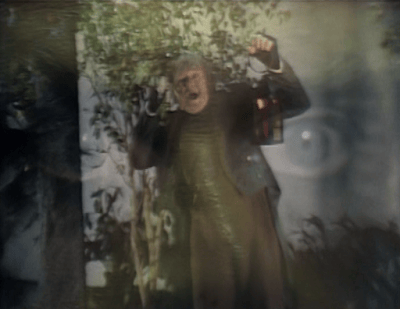
In a day concerned with nautical mishaps, it is somehow fitting that Ben gets stuck in the head. Screenshot by Dark Shadows Before I Die.

There are a couple of other points worthy of mention. Daniel is conscious of his position as master of Collinwood, but he is not the haughty overlord Louis Edmonds played when he was Joshua Collins in the part of the show set in the 1790s or the stuffy but lovable figure he created as Edward Collins in the 1897 segment. He is dignified, courteous, and kindly. But he is also gravely mentally ill. When first we saw him, he tried to kill Julia, not for any of the good reasons anyone might have to do such a thing, but because he thought she was his late wife, whom he killed years ago and keeps trying to kill again every time she shows up disguised as someone else. He cannot remember who is alive and who is dead, or what year it is. (In fairness, these are very difficult things to keep track of on Dark Shadows.) It’s a cliche that Jonathan Frid played Barnabas “as if he were playing King Lear.” In his scenes today, Edmonds quite literally is playing King Lear. Mrs Acilius and I marveled at the depth and complexity of the characterization.

Barnabas meets the evil Gerard Stiles. Barnabas knows that Gerard’s ghost will cause the destruction of the great house and its residents in 1970 and that he will still preside over its ruins in 1995. Gerard tells Daniel a story about the deaths of his son and grandson, Quentin and Tad Collins. Barnabas is in the room when Gerard tells this story, and has reason to disbelieve it. Later, he is alone with Gerard and challenges his story. Barnabas learns nothing from this encounter, but Gerard learns that Barnabas is his enemy. Barnabas very often introduces himself to his foes by showing his cards in this way. That habit does keep the plot moving, but it is frustrating that the protagonist does not even try to ingratiate himself to his adversaries and get information from them he can use to advance his goals.
Episode 1117: That Hideous Strength

The Signal of Another Start*

In June 1970, Dark Shadows was set in a universe other than the one where it usually takes place. The show insisted on calling that other continuity “Parallel Time.”

In the main continuity, mad scientist Julia Hoffman is the friend and enabler of vampire Barnabas Collins. When Barnabas crossed over to Parallel Time, he found that Julia’s counterpart there was as devoted to wicked witch Angelique as the Julia he knew was to him. He made himself Angelique’s enemy, and in #1036 Hoffman was poised over him with a stake and a hammer, ready to destroy him. In the nick of time, Julia arrived from the main continuity and saved Barnabas. She bashed Hoffman’s head in, stole her clothes, and set about impersonating her. When Barnabas first saw Julia in Parallel Time, he thought she was her Doppelgänger, and since she was in his hiding place he was going to kill her. Fortunately for Julia, Barnabas had got into the habit of making speeches to people before he murdered them, so she was able to tell him who she was. With that, the murder was off and their friendship was back on track.

Now, it is Julia who has crossed over into another world. She has traveled back to the year 1840, and has told the family in the great house of Collinwood at that time that she is the daughter of the Barnabas Collins who supposedly left for England in the 1790s. She has also told them to expect her brother, Barnabas Junior, who, she says, looks just like their old man.

In a moment of extreme folly, Julia went to the room where Barnabas was sealed in his coffin in the 1790s and released him. This mirrored the folly of her waiting around in his hiding place after she killed Hoffman in Parallel Time. The Barnabas of 1840 had no idea that any time had passed since he was imprisoned four and a half decades before, and certainly did not know what Julia was talking about when she claimed that they had met in 1967 and become friends in 1968. He was about to kill her when his old friend Ben Stokes turned up in the nick of time and stopped him.

Now, Barnabas has discovered that Julia is interfering in his plans. He has bitten the lovely Roxanne Drew, intending for her to die and rise as his vampire bride. Julia and Ben found Roxanne and brought her to the Old House on the grounds of Collinwood. Julia is giving Roxanne a blood transfusion which has prevented her death. When Barnabas sees what is going on, he grabs Julia and is about to bite her.

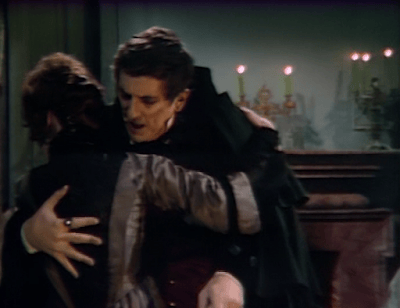
Barnabas is already flashing his fangs when he has a seizure and collapses. He stands back up and finds Julia holding a cross at him. He tells her that he is the Barnabas of 1970, projected into his 1840 body by some mumbo-jumbo involving the I Ching. He could be making that up based on things she has already told him, so she keeps holding the cross. He goes on to give specific facts about several people they know in 1970. She realizes he is telling the truth. She puts the cross down, and gives him a hug. As Julia came from the main continuity and destroyed her own Doppelgänger to save Barnabas, so Barnabas has come from the future and destroyed his previous self to save Julia.**

Embraceable vampire. Screenshot by Dark Shadows Before I Die.

The 1970 model Barnabas does not want Roxanne to be a vampire, and he is ashamed of his earlier self for having tried to make her one. Roxanne comes to, sees him, and is delighted to think he has come to bite her again. When he says that things have changed, she is disappointed and he is embarrassed. He goes away.

Julia has a superhuman power of hypnosis that she has often used to erase people’s memories and overwrite them with information that will not incriminate Barnabas. She tries this on Roxanne. She is halfway through the process when some noises outside prompt her to leave the room and investigate. The room is at the top of the stairs, and has been a major set for years. We’ve caught glimpses of the door that opens to it a couple of times, but this is the first time there is set built all the way to the railing.

Julia goes to the railing and calls downstairs, asking if anyone is there. No one answers, so she goes back into the room. Roxanne has somehow got away.

Barnabas goes to the great house and introduces himself as Julia’s brother. Julia comes. They get a private moment, during which Julia tells him that Roxanne escaped and that she does not know whether the hypnosis was successful. Roxanne enters, looks at Barnabas, and announces to the assembled Collinses that she knows who he is. She is escorted upstairs. Barnabas and Julia are on the verge of panic until Roxanne’s sister, Samantha Drew Collins, comes down and says that Roxanne doesn’t remember anything of the last couple nights.

The Gods are Weak at First*

The 1970 version of Barnabas is not the only character to make his grand entrance today. We also meet Desmond Collins and an acquaintance of his.

Desmond is the son of Flora Collins, a lady novelist and all-around silly person who lives in the nearby mansion called Rose Cottage. He has just returned from a long journey with a present for his friend, Quentin Collins, husband of Samantha and heir to the Collins estate. Flora breaks the sad news that Quentin and his son Tad Collins were lost at sea some time ago, that they have been missing ever since, and that they are now presumed dead.

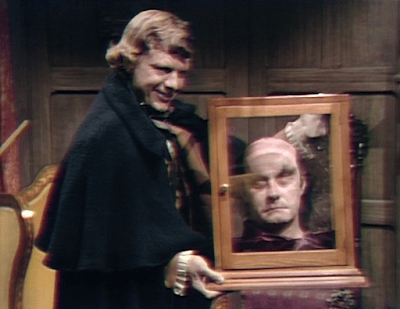
The present is in a large cube that is covered with a cloth. Desmond removes the cloth and exposes a glass box holding a severed head. Flora reacts with horror; Desmond laughs and says that it is surely a carved figure of some sort, entirely harmless. We know better; the episode ends with the head opening its eyes.

The perfect gift for the man who has everything, except a sense of decency. Screenshot by Dark Shadows Before I Die.

In 1945, C. S. Lewis published the third volume of his “Space Trilogy,” a novel called That Hideous Strength. It was a commercial success at the time, and has been in print ever since. I have mixed feelings about Lewis’ writings; I essentially agree with his religious views, but he often expressed them in a cutesy-poo style that is still endemic among Anglican writers and that makes me wish I were a Zoroastrian or a Buddhist or something whenever I encounter it.

But the first fifty pages of That Hideous Strength are terrific. I teach in a university, and the account of life inside the fictional University of Edgestow is the most insightful depiction of campus politics I’ve ever read. The place is dominated by a clique of administrators who keep talking to each other about what “Our Head” wants them to do. In British institutions of higher education, “Head” is a title for a permanent director of a department or institute, so that’s what you think they are talking about. But no, it’s an actual severed head through which the voice of Satan speaks to them. They worship the head and follow the commands they receive from its mouth.

That Hideous Strength was certainly popular enough that it is likely the writers of Dark Shadows had looked to it as a source of material. In particular, Sam Hall was a serious enough Protestant that he persuaded Shirley Grossman to convert from Judaism and join him in the Lutheran church before they married and she became Grayson Hall. Lewis was so celebrated for his apologetics that it would be rather odd if his name did not attract Hall’s notice. So we can expect that Desmond and others will form a cult of some sort and that the Head will give them diabolical orders to follow.

The Head is that of Michael McGuire, making the first of scores of television appearances. One of my favorite parts of his was Sumner Sloan, the prominent academic who dumped Diane Chambers in the first episode of Cheers and came back for her in her last episode as a regular part of the cast of characters. McGuire also appeared in my favorite episode of Columbo, “A Friend in Deed,” in which his character tries to confess to killing his wife in a fit of rage only to find himself involved in a plot to kill another man’s wife in cold blood. I suppose one of McGuire’s specialties was “Do Not Date This Man.” I’ve never heard that he was anything other than a nice guy in real life, though.

*These section titles are taken from William Dickey’s 1961 poem, “Continued in Our Next”:

Over the quiet paper, in light that is

Interested only in a casual way,

All quite polite, the neat pen idly marries

Third sons to princesses.

They go away,

To the widest margin, to a land of white,

Wholly uninhabited until they came,

And from the sacks with which they are provided

Stock it with leaping trout and huntable game.

Hounds to be cursed at when the blood trail falters,

Eventually, reasons why the hounds went wrong.

Then to the reasons they establish altars.

The gods are weak at first.

When they grow strong

They bring into the world their choicest thunders.

Plagues, curses color the narrow countryside.

The peasantry speaks of horned, unnatural wonders,

And in the violence takes a natural pride.

But all the while the map-makers are busy.

Faint explorations die in the savage hills,

Others go on to the farthest fabled city,

Where for six months the sun is lost, and the cold kills.

Geometers prove the world, and it is conquered.

Truth overtakes the aborigine.

The gods depart. Mankind is anchored

To clear historical necessity.

Until one day at midday

When the sun ought to be loudest in the shouting sky

Shadow occludes it. Suddenly life is done.

The fire goes out. The constellations die.

Only, above the following page, the pen,

Whose quality is not to have taken part,

Hovers in uncommittedness again,

Poised for the signal of another start

Towards some fresh country, princesses more golden,

And younger sons who wage a bolder fight,

Stags nobler, hounds more diligent than the olden,

The page lies empty in the easy light.

This poem reminds me of Dark Shadows. The creative process is so close to the surface of the show that an image of a writer with pen and paper is a suitable way to start a description of it. When the third sons and the princesses are moved to the “widest margin, to the land of white” it’s ambiguous if that just means the writer is making notes on the otherwise blank edge of the paper or whether the characters are going off to the Arctic. We see the same ambiguity in “the pen whose quality is not to have taken part.” That brings to mind both the characters visiting from other times or other universes and the writers who use those cosmic journeys to start the story fresh.

The “natural pride” that the “peasantry” takes in the crimes of the “unnatural wonders” explains both why there are characters who are willing to go on living in Collinsport and why the audience keeps coming back to the show. The wish for “princesses more golden” and for “younger sons who wage a bolder fight” casts our minds to stories like the conflict between Barnabas and Jeremiah Collins over the love of the gracious Josette and the ongoing scheme Gabriel Collins has devised to do away with his sister-in-law Samantha, grubby little imbroglios that never could lead to anything but sorrow, and leaves us wondering why we choose to follow this show rather than seeking out happier and more glorious tales.

**My wife, Mrs Acilius, had a lot to say about this inverted parallel.

Episode 1118: Getting Ahead

In which I suggest that the “Head of Judah Zachery” might be a borrowing from C. S. Lewis’ 1945 novel That Hideous Strength, a best-seller in which a group of devil worshipers take their orders from a severed head kept in a box in a curtained room. 

Episode 1118: Getting Ahead

Episode 1144: The Merry Widow

I explain how, without making the show any more complicated than it in fact was, they could have made the various Angeliques logically consistent with each other. 

Episode 1144: The Merry Widow