
Episode 1064: There are only intruders

A disruption in the very nature of time and space has thrust vampire Barnabas Collins and mad scientist Julia Hoffman into the year 1995, where the great house of Collinwood is in ruins and everyone is annoyed with them.

Yesterday, Julia and Barnabas were poking around inside the great house against the express instructions of its owner, Carolyn Fredericks, as conveyed earlier in the evening by the sheriff when he arrested them for trespassing. A heavy bust fell from the railing on the top of the foyer stairs, narrowly missing Julia. She and Barnabas fled the house. They looked back, and saw a young man in nineteenth century garb glaring at them from a window.

Today, Barnabas and Julia are in the parlor of the Old House on the estate. She tells him that when she saw the man in the window she was overcome by a powerful sensation. “It was the very essence of evil! I felt evil all around me. I was trapped by it!” Regular viewers may have thought Julia would be used to that by now, but apparently not. “It made me aware of something deep inside me that I don’t even understand — as though, with that one look, he could concentrate every grain of evil I have in my nature! Make it grow, and grow…” She asks Barnabas if he felt the same thing, and he says he didn’t, not at all. He concedes that he is an inhuman abomination from beyond the grave, so maybe he’s immune to that kind of thing.

Meanwhile, Carolyn is at home in the old shack by Finley’s Cove, accompanied by Mrs Johnson, who was the housekeeper at Collinwood in the late 1960s. Carolyn is brushing her hair and smiling. She reminisces about when she was a little girl and Mrs Johnson used to brush her hair. Mrs Johnson is not shy then or later about contradicting anything Carolyn says that is not so, but does not deny that she did that. So the audience is supposed to believe it. Some say this is a retcon, since Mrs Johnson did not join the staff at Collinwood until 1966, when Carolyn was fully grown. But in a comment on Danny Horn’s post about the episode on his great Dark Shadows Every Day, I expounded a theory as to how it might be true:

In the early episodes, Carolyn talks about having gone to school in town. How did she get there?

She can’t have walked; it was miles away, much of it along a winding road with several blind curves. Her mother never left the grounds during those years, she couldn’t have driven her. Roger was living in Augusta with Laura.

(I should expand on this point. Roger says that when Carolyn was born, he was away at boarding school. So he would still have been in college when his niece first became a pupil at Collinsport Elementary. He then busied himself squandering his inheritance, a process which included the ten years between his marriage to Laura and his return to Collinwood. So that doesn’t leave any time for him to have looked after his “Kitten” when she was little.)

The only servant was Matthew. Matthew and Carolyn don’t seem at all close; it doesn’t seem likely that he drove her to school every morning. If a school bus came up the hill to Collinwood day after day, the kids who rode it couldn’t have maintained the attitude Carolyn describes, whispering behind her back about her living with the witch in the haunted house. Sooner or later they’d have started talking to her face to face about it.

Carolyn also talks about Bill Malloy being more like a father to her than any other man, and the two of them do have a cozy relationship. Carolyn is also very quick to fall in with Mrs Johnson when Burke pitches the idea of her joining the household staff at Collinwood. So I think we have to conclude that Bill Malloy and his housekeeper were in charge of getting Carolyn to school in the mornings. Malloy was on the fishing boats, so that would require an early start to the day. There were probably many days when little Carolyn was still in her pajamas when she got to the Malloy house. On those days, Mrs Johnson brushed her hair while the water came to a boil for breakfast.

Comment left by “Acilius,” 27 January 2021, on Danny Horn, “Episode 1064: Here Comes the Hotstepper,” Dark Shadows Every Day, 20 August 2017.

Carolyn seems to be a crazy lady these days. Yesterday, we saw that much of this is an act, but in her scene with Mrs Johnson we see that it is an act she puts on even when she is alone with someone she trusts. It allows her to smile and laugh and be happy even when she is surrounded by the residue of an unimaginable catastrophe.

Carolyn tells Mrs Johnson that she will be going to the great house of Collinwood to get ready to host a picnic at the gazebo, which she pronounces “ga-ZAY-bo” in a bit of Collinsport English that we’ve been hearing intermittently since Lara Parker invented it in the summer of 1968. Mrs Johnson reacts with horror, saying that no one can go to the devil-haunted wreckage of Collinwood, but Carolyn laughs off her objections. Carolyn shows a picture of a picnic they had at the ga-ZAY-bo in 1970, the last year Collinwood was habitable. Mrs Johnson spots a figure in the background and declares that was “the first time we saw him.” Carolyn gets upset and tears up the picture.

Barnabas had insisted to Julia that the man they saw at the window may not be the only supernatural entity operating within the great house, and Carolyn seems to confirm that he is right. She does not want to hear Mrs Johnson referring to him, nor does she want to have a picture of him. But she happily says that she is going to the great house tonight with a present, because it is his birthday. Apparently him and his refer to different beings, each of which inheres in the haunting. One wonders how much of supernaturalism would dissolve if people would just use proper names instead of pronouns.

Julia and Barnabas barge into Carolyn’s house. Carolyn tells them to get out, which they refuse to do. They badger her with the story of what happened when they were illegally roaming around in her other house, and Mrs Johnson runs out. Eventually Carolyn resumes her crazy lady demeanor. Barnabas and Julia give up and leave, and for a moment we wonder if they are on their way to let themselves into some other property of Carolyn’s.

Julia and Barnabas go back to the Old House. They find that Mrs Johnson is waiting for them there. They tell her that they are time travelers, and that if she will tell them what happened they might be able to go back and prevent it. She is dubious about this claim, but starts telling the story anyway. She casts her mind back to the summer of 1970. “It all began when the days were so beautiful, you couldn’t help but be happy. There was a spirit of joy at Collinwood; there was a feeling that hadn’t been there in a long time. There was so much love among all of us at that time…” This would be the period that began immediately after Barnabas and Julia left.

Mrs Johnson says that all of the beauty and joy and love and other things you might experience when you don’t have a vampire and a mad scientist around your estate came to an end one quiet night. She seems to be on the point of saying something important when she looks at the window of the parlor and sees the glaring young man. She breaks off, screams that she won’t tell, and runs out into the night. Julia tells Barnabas she felt the evil presence, and that the ghost was there. They go out to look for Mrs Johnson.

The ghost catches up to Mrs Johnson first. He touches her shoulder, and she dies. When Barnabas and Julia find Mrs Johnson, she is sitting on the ground, her back against a tree, her eyes open. This was the same posture in which Clarice Blackburn’s character Abigail Collins was found when we saw her corpse in #432. That image was a brief shocker in the last couple of seconds of the episode; this time the camera zooms in on Blackburn’s face and pans across it, allowing her to show that an outstanding actress can give a powerful performance even when she is altogether motionless.

Carolyn happens by. Julia and Barnabas hide. Carolyn thinks Mrs Johnson is alive and chatters to her. As the truth begins to dawn, Carolyn’s alarm mounts. Finally Barnabas and Julia emerge from the shadows. Carolyn accuses them of killing Mrs Johnson. They deny their guilt. Carolyn is unconvinced, and indeed we cannot help but think that since Mrs Johnson lived through the 25 years of their absence and turned up dead so shortly after they returned, Julia and Barnabas cannot be exactly innocent.

Barnabas and Julia follow Carolyn into the great house. Julia wonders what Mrs Johnson could have meant by “the children’s old room.” This is a blooper on Grayson Hall’s part- Mrs Johnson mentioned “the room the children called The Playroom.” Julia and Barnabas hear music playing, and follow it to a room upstairs. Barnabas looks at the doorway and remarks that the room was never there when he knew the house. The shot is framed at such a severe Dutch angle that we can tell something isn’t on the level.
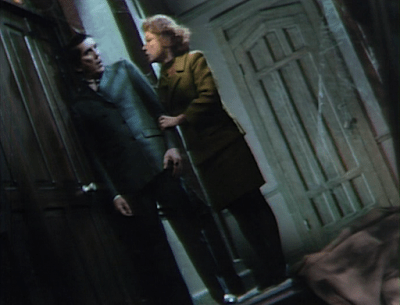
Tell all the truth but tell it slant. Screenshot by Dark Shadows Before I Die.

They hear Carolyn inside, talking and laughing with at least one other person. Since their whole philosophy of life now seems to be making themselves as obnoxious as possible to Carolyn, they let themselves in.
Episode 1063: To see what you own

The sheriff of Collinsport arrests two trespassers at the long-deserted great house of Collinwood. They are Barnabas Collins and Dr Julia Hoffman, who inexplicably disappeared in 1970 and have even more inexplicably reappeared in 1995. The owner of Collinwood, Carolyn Fredericks (formerly Carolyn Stoddard Hawkes) has complained about them.

Barnabas pretends to be his own son, and claims that Carolyn’s mother, Elizabeth Collins Stoddard, put the Old House on the estate in his father’s name in the late 1960s. While we never saw this happen, from 1967 on Liz often did talk about the Old House as if it and its contents were Barnabas’ property. Furthermore, the sheriff’s office appears to be right across the hall from the registry of deeds, and the Sheriff himself appears to be far more competent than most Collinsport law enforcement personnel we have seen, so if Barnabas were lying he would probably catch on.

The sheriff says that Barnabas may have a right to go to the Old House, but that he found him and Julia at the great house. He asks a number of intelligent questions, none of which Julia or Barnabas can answer to his satisfaction. He threatens to hold them on a vagrancy charge. When Barnabas says that “I have a great deal of money… I own property here,” he backs off that threat, but he does tell them that he hopes their friends from Bangor come and take them away very soon.

Barnabas and Julia leave the sheriff’s office. Carolyn enters from the back room where she has been eavesdropping. She asks the sheriff to look at a picture in her photo album. It is a picture of Julia taken in 1970. The sheriff notices that she hasn’t changed a bit, not even the way she wears her hair. He asks Carolyn if she has any pictures of Barnabas, and she says that she does not. She says that the only picture of him she knows of is an oil painting done in the 1790s.

There was another oil painting of Barnabas done in 1967, and Carolyn’s late cousin David took a photograph of him in #659. The 1967 portrait hung in the Old House, which Carolyn may not have visited in the last twenty five years, and the photograph David took was an oddity that likely would not have been put into an album. So it isn’t really strange that she doesn’t think of them.

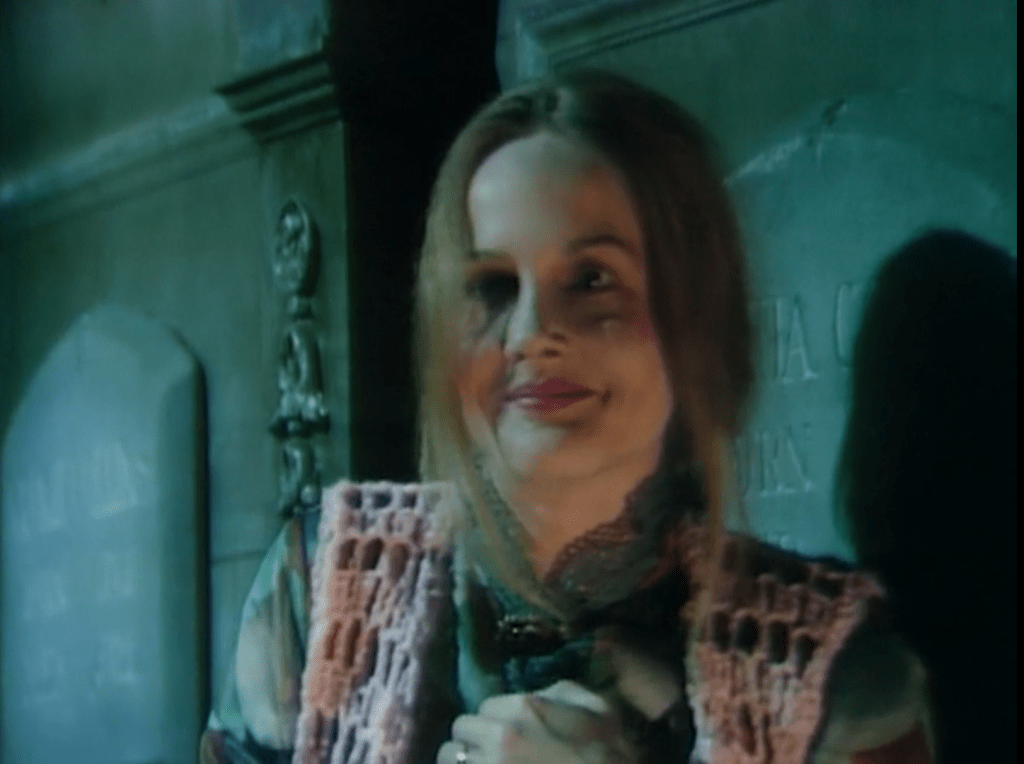
Carolyn does remember some other things about Barnabas, though. We open with Julia and Barnabas heading towards the Collins family mausoleum in the old cemetery north of town. They find that the door to the secret chamber is standing open, and are shocked that someone else knows about it. They find Carolyn there. They pretend not to have known about the chamber. They also pretend to be puzzled by the empty coffin in the chamber.

Carolyn says she knows why the coffin is there. She tells Barnabas it is waiting for him. Then she turns to Julia and says that it may also be waiting for her, whichever one dies first. They leave. Carolyn closes the panel and says with a gleam in her eye that it is waiting for him.

“It is waiting… for… him.”

Barnabas is a vampire, and the coffin is his resting place. In the fall of 1967, he bit Carolyn and took her as his victim. He was cured of vampirism in March of 1968. The bite marks disappeared from his victims’ necks at that point, and it seemed that their memory of what he was and what he had done to them faded as well.

But for months after, Nancy Barrett played Carolyn as if she remembered a good deal more than Barnabas knew she remembered. The scripts didn’t give her much support in that interpretation, but it was well over a year before she had to make it clear Carolyn no longer knew about Barnabas. Perhaps whatever happened while Barnabas and Julia were away jarred Carolyn’s memory loose. If Carolyn does remember that Barnabas is a vampire, she is being astonishingly reckless in her scene with him and Julia in the secret room. Barnabas takes a menacing tone when she says that she knows why the coffin is there, and the background music makes it clear that he is on the point of striking when she says it is waiting for him. She laughs after she says to herself that “It is for him”; perhaps the light in her eyes is nostalgia for those days in 1967 when she was his blood thrall.

There is also a scene in Julia’s old room at Collinwood where they find that the box containing the notes she took while trying to cure Barnabas of vampirism has been forced open. They wonder who may have seen those notes.

Julia and Barnabas go back to the great house. She points out that the sheriff will lock them up if he finds them there, a concern Barnabas dismisses. He mentions that they have to find another place for the coffin, and suggests the great house. It would be interesting if they were lugging a coffin around when the sheriff showed up, but Julia puts the kibosh on that. Barnabas then says maybe the Old House. They busy themselves running up and down the stairs in the foyer for no discernible reason. They hear some music coming from nowhere in particular. Barnabas declares that this cannot be a sign of danger, since “music is seldom used to frighten.” For months in early 1969, an evil spirit possessed Collinwood and drove the family out by the incessant playing of a sickly little waltz, but apparently that has slipped Barnabas’ memory.

Yesterday, a man called Victor Flagler told Barnabas and Julia that he and his wife Jeanne had gone into the great house on a dare. Something pushed a heavy object off the rail at the top of the stairs. It landed on Jeanne’s head, killing her, and Victor heard laughter in the house. Julia and Barnabas don’t notice that there is a weighty bust perched on that rail today that wasn’t there yesterday, and Julia stands on the floor beneath it. It falls, and she gets out of the way in the nick of time. They leave the house.

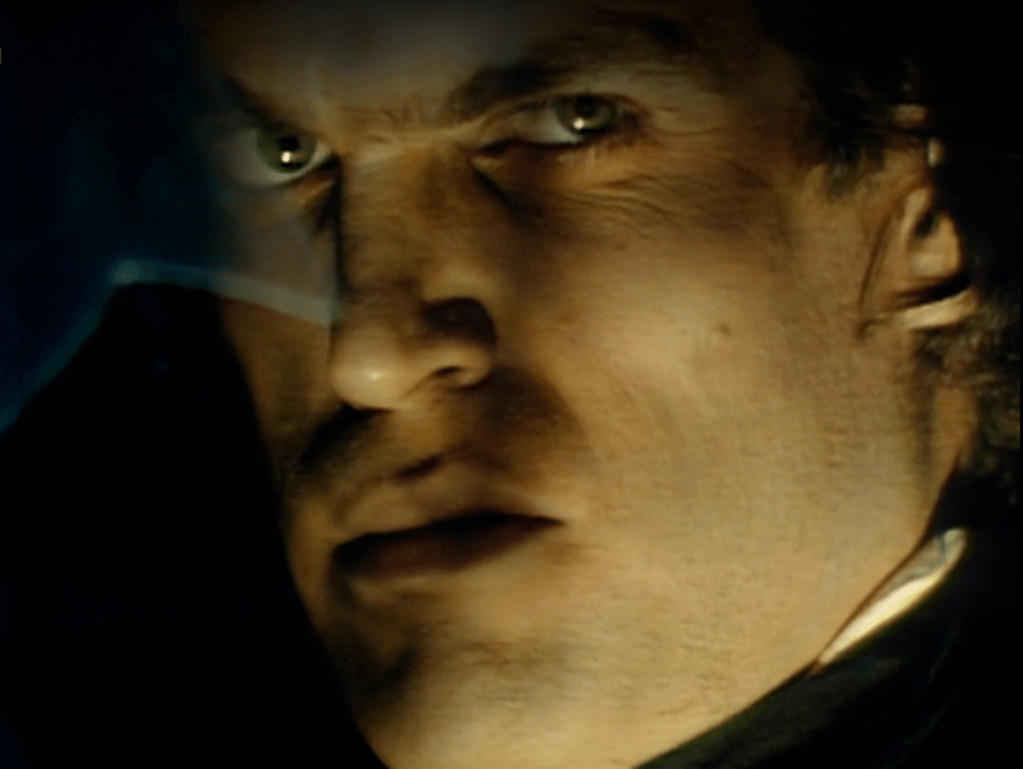
We see a blue dot pulsating inside the house. Barnabas and Julia don’t get a look at that, but when they are outside they do see a man in nineteenth century garb sneering at them through a window. He is the face of whatever is going on in the house. The credits give his name as Gerard.

My usual themes: Continuity

In 281 of the posts that follow, I link to comments I made on Danny Horn’s blog, “Dark Shadows Every Day.”

Not all of these comments were absolutely unique. A number of times I argued that the show was not so discontinuous as people were making it out to be. To be sure, the creative process is very close to the surface, so that viewers have to do a lot of re-writing in their heads to make sense of what they’re watching. Sometimes the writers just lost track of the story and contradicted themselves from one episode to the next, and other times they changed their minds abruptly. But there were other times when alleged contradictions can be reconciled without having to invent anything drastic.

For example, Danny and many of his regular commenters from time to time mock the depiction of Dr Julia Hoffman as sometimes a blood specialist, sometimes a psychiatrist. I think that’s a pretty easy one to resolve. In this comment, I added some fanfic of my own to sell the idea that she started as a hematologist and retained an interest in that field after switching to psychiatry:

The story I made up for myself is that Julia started out as a blood specialist but switched to psychiatry. She was interested in rare diseases, the rarer the better. She found that in hematology, there’s so much money to be made from developing treatments for the most widespread disorders that a researcher with an emphasis in the exotic is constantly fighting an uphill battle for funding and recognition.* Even those colleagues who had an abstract appreciation of the importance of studying rare disorders had to work within a system where all the institutions push them towards the biggest projects possible.

Psychiatry, on the other hand, always had room for the unusual.** In fact, Julia discovered that high-strung rich people would pay a great deal of money to be told that whatever happens to be bothering them at the moment is not the same kind of problem that one of their servants might have, but is a mental aberration hitherto unattested in the annals of psychiatry.*** So she switched to that field and quickly made enough money to open her own, hugely profitable, mental hospital. But she never stopped working in rare blood diseases, and the experiments she was able to finance by flattering the vanity of her wealthier patients earned her such a reputation in a male-dominated field that even her old acquaintance Dave Woodard would commit sexist slips of the tongue and say of “Hoffman” that “he” is “the top man in the field” of rare blood diseases.

Lucrative as Windcliff was, Julia’s true love was never money, or even science per se, but the exotic. When she found herself as the best friend/ frequent accomplice/ bossy big sister of an honest-to-wickedness vampire, surrounded by ghosts and witches and werewolves and Frankensteins and time travelers and interdimensional anomalies and who knows what else, there was never any question of her going back to the office.

*I have no reason to believe this was true in the real world in the middle decades of the twentieth century, or that it is true today. It’s simply part of the fictional world in which I see Julia.
**(Same note)
***(Same note)

In this comment, I devised a much more modest bit of fanfic to answer a simpler question. Quentin has a girlfriend named Tessie, and at some point in the night he had, in his werewolf form, attacked her in the woods. Why was she in the woods? Danny and his commenters had proposed various awkward scenarios to answer this question, but I suggest she just followed Quentin after she saw him in town looking for booze.

In the “1995” segment, Mrs Johnson and Carolyn talk about how Mrs Johnson brushed Carolyn’s hair for her when she was a little girl. Some say this was a continuity error, because Mrs Johnson didn’t come to work at Collinwood until episode 81. Before that, she’d been housekeeper to Collins family retainer Bill Malloy. However, I say that she still could have brushed little Carolyn’s hair while working for Malloy:

I have a theory that could explain Mrs Johnson brushing Carolyn’s hair when she was little.

In the early episodes, Carolyn talks about having gone to school in town. How did she get there?

She can’t have walked; it was miles away, much of it along a winding road with several blind curves. Her mother never left the grounds during those years, she couldn’t have driven her. Roger was living in Augusta with Laura. The only servant was Matthew. Matthew and Carolyn don’t seem at all close; it doesn’t seem likely that he drove her to school every morning. If a school bus came up the hill to Collinwood day after day, the kids who rode it couldn’t have maintained the attitude Carolyn describes, whispering behind her back about her living with the witch in the haunted house. Sooner or later they’d have started talking to her face to face about it.

Carolyn also talks about Bill Malloy being more like a father to her than any other man, and the two of them do have a cozy relationship. Carolyn is also very quick to fall in with Mrs Johnson when Burke pitches the idea of her joining the household staff at Collinwood. So I think we have to conclude that Bill Malloy and his housekeeper were in charge of getting Carolyn to school in the mornings. Malloy was on the fishing boats, so that would require an early start to the day. There were probably many days when little Carolyn was still in her pajamas when she got to the Malloy house. On those days, Mrs Johnson brushed her hair while the water came to a boil for breakfast.

Several times I explained my theory about how the “Meet Gerard” segment (episodes 1061-1198, including “1995,” “The Re-Haunting of Collinwood,” and “1840”) fits together. This iteration also suggests ways to resolve a couple of puzzles about Angelique:

For me, a lot can be explained by the smile of satisfaction Gerard gives when he sees Julia and Barnabas take the staircase from 1995 to 1970. The dark power he represents called them to 1995 from Parallel 1970, and is now sending them back in time, first to 1970, then to 1840 to make it possible for the future they see in 1995 to exist.

This is analogous to what the Leviathans did at the end of 1897. First Quentin’s ghost, then Barnabas and Julia’s I Ching trips, had created a rift in the order of things that made it possible for the Leviathans to erupt from the underworld into the human world, and to send Barnabas to 1969 as their agent. So too have the journeys Barnabas and Julia took into Parallel Time torn open the fabric of time and space, and made it possible for Judah Zachery to bring a Frankenstein maker back to his time.

Attributing to Zachery the same power to exploit disruptions in time to shuttle people between past and future and thereby to rewrite his own history that the Leviathans had shown, we also have a way to resolve the Angelique/ Miranda paradox. Perhaps Angelique really was relatively new to witchcraft in 1795. Perhaps also, in her early naive attempts, she stumbled into the same kind of trouble Barnabas stumbled into with his time-travel. That’s what Zachery had in mind when he shouted at her during his trial that she ought to tell the truth, that she had come to him of her own accord- it was only because she had already worked in the black arts that he could call her to him, from the days after she first left Collinwood in 1796 to a nearby town 104 years before. And perhaps, with the first beheading of Zachery, his spell broke returning her to a time shortly after the “Burn Witch Burn!” moment in the tower room.

Come to think of it, that might also put sense into Angelique’s remark that she is “consigned to this century forever.” There were a few days after Zachery calls her to 1692 and before she returns from 1692, and until Barnabas and Ben torched her, she was sentenced to relive those few days over and over again, Bill Murray-style.

That’s a comment on Danny’s post for episode 1140. Just four episodes later, the show will kick away the explanation I offer for Angelique‘s various incarnations in the main continuity, but leave open the rest of it.

The logic that counts the most in the show isn’t so much the kind of sequential reasoning that I’ve done in these posts as it is the associational logic of a dream. An image or situation or word reminds a dreamer of something, and suddenly the dreamer is in the middle of that something. You dream about polishing your Ford with Turtle Wax, and the next thing you know Polish turtles are whacking away at a shallow spot in a river. You tell a story about rich, selfish people who obsessively keep secrets and set a dreary tone for their town, and the next thing you know your main character is a vampire. I left an unreasonably long comment where I natter on about the concept of dream logic.

Dividing Dark Shadows into Periods

In the posts that follow, I link to comments I made on Danny Horn’s blog Dark Shadows Every Day. Unlike most daytime serials, Dark Shadows tended to restart itself from time to time, dividing the show into major periods. I’ve tagged most of these posts with the periods of the show to which they refer. 

There are several ways of periodizing the show. The scheme I use is this: 

Episodes 1-45 “Meet Vicki” 

Episodes 46-126 “Meet Matthew”

Episodes 127-192 “Meet Laura”

Episodes 193-209 “Meet Jason”

Episodes 210-260 “Meet Barnabas”

Episodes 261-365 “Meet Julia”

Episodes 366-466 “Meet Angelique”

Episodes 467-626 “Monster Mash”

Episodes 627-700 “Meet Amy” (subdivided into “Chris the Werewolf,” 627-638, and “The Haunting of Collinwood,” 639-700)

Episodes 701-885 “1897″ (subdivided into “Meet Quentin,” 701-748, and “Meet Petofi,” 749-885)

Episodes 886-969 “Leviathans”

Episodes 970-1060, “Meet Another Angelique” 

Episodes 1061-1198, “Meet Gerard” (subdivided into “1995,″ 1061-1070, “The Re-Haunting of Collinwood,” 1071-1109, and “1840,″ 1110-1198)

Episodes 1199-1245, “Dying Days” 

Episode 1078: Everyone Must Leave This House at Once

In which I watch characters on Dark Shadows while they watch another version of Dark Shadows and form opinions of their own about what the characters on it should do. 

Episode 1078: Everyone Must Leave This House at Once