Episode 1140: Merely an extension of life

The dramatic date is 1840. This is quite an ambitious half-hour, featuring both a dream sequence and a flashback.

The head of warlock Judah Zachery and the rest of his body maintained separate residences from the time Judah was put to death in 1692 until the other day. Mad scientist Julia Hoffman and Cockney showgirl/ psychic Leticia Faye fell under Judah’s power and reattached the head to the body. Seagoing con man Gerard Stiles found his way to the vault where the reconstituted Judah was resting after this procedure. Judah attacked Gerard who in the course of escaping from him started a fire that destroyed the body. Now the head is back in its glass case, and Gerard is keeping it in his room. He is falling under Judah’s power, and has a dream today in which he sees his own head in the case while Judah stands outside. He hears Judah’s voice saying that he will take Gerard’s body for his own, and that Gerard will cease to exist. Regular viewers have likely seen this coming for some time, and it is a relief that Gerard is finally catching on.
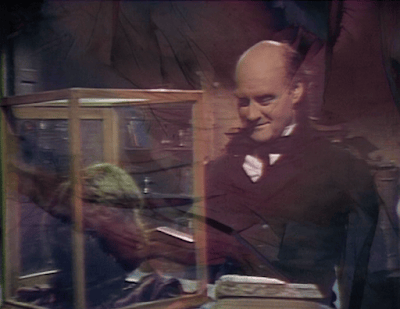
Gerard’s vision of Judah looking at his head in the case. Screenshot by Dark Shadows Before I Die.

Gerard is in the drawing room of the great house of Collinwood when wicked witch Angelique enters. They have not previously met. He introduces himself as Gerard Stiles. Before she can identify herself, he tells her that she once answered to the name Miranda. She is startled by this. He cannot explain why he said it. He says that he has never known anyone named Miranda. He excuses himself.

Angelique thinks back to the last time she was known as Miranda, which was in 1692. She was the key witness at Judah’s trial. We see Amadeus Collins browbeat Angelique with threats that she will be executed if she does not testify and with promises that she will be given safe passage out of the country if she does. She testifies, over Judah’s loud objections. Judah is convicted.
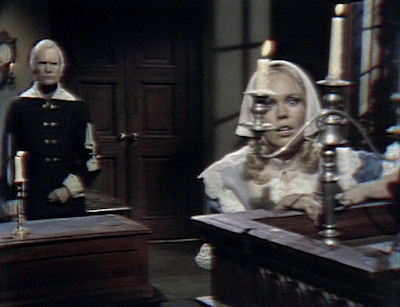
Amadeus pressures Miranda to testify. Screenshot by Dark Shadows Before I Die.

In his post about the episode on his great blog Dark Shadows Every Day, Danny Horn objects that the flashback represents a bad retcon. He describes it as “a perplexing revelation that basically eviscerates everything that we thought that we knew, and doesn’t replace it with anything.” I’d say it’s even worse. We first met Angelique late in 1967, when the show was set in 1795. At that time, we heard from people who knew her and her family when she was a little girl fifteen or twenty years before. We also saw that, while she had an awe-inspiring gift for black magic, she seemed to be a novice at it. She was continually surprising herself with the disastrous results of her spells. That made it possible for us to care about her later, when she became a more sympathetic character and an ally of the protagonists. If we suppose that she was already so skilled at witchcraft in 1692 that she could still be alive and not look a day older in 1795, that all falls apart.

The cosmology the show has developed with its journeys through time and the multiverse might leave a couple of options open to explain how Angelique could have been around in 1692, but what we see today forecloses those options. Perhaps she traveled back in time sometime between the 1790s and 1840. But as Danny points out, Lara Parker’s performance in the flashback eliminates that possibility. She plays “Miranda” as a true innocent, helpless between Judah and the court, without so much as a flicker in her eye suggesting that she might have some secrets of her own that she is keeping from Amadeus Collins.

We’ve seen “astral twins,” characters set in different periods who are played by the same actor and are in some sense the same person. Occasionally a sorcerer can cause the personality of one of these twins to invade the consciousness of the other. Angelique did this when a spell of hers caused Roger Collins to be intermittently possessed by his eighteenth century ancestor Joshua Collins in starting in #470. In #1107, a ghost which appeared to be Gerard, but which we now suppose to be Judah, caused the Quentin Collins who was born in 1870 to channel his great-uncle Quentin, who was born in 1810. But without the magical interventions, neither Roger nor Quentin knew much about his twin. Quentin had never even heard of his great uncle until he found his name in some old papers a few days before Gerard/ Judah mind-melded them. Angelique looks back on Miranda’s life as an earlier phase of her own, so regular viewers can exclude the “astral twin” explanation.

As Danny points out, the Miranda story is just an attempt to graft Judah onto the early history of the Collins family so that he seems dramatically satisfying as a major threat to them. They use Angelique because she seems to be the only major character whom they can patch back into a seventeenth century story. But since they get her there in a way that kicks load-bearing elements out of the continuity, it winds up making Judah seem even more like a random visitor.

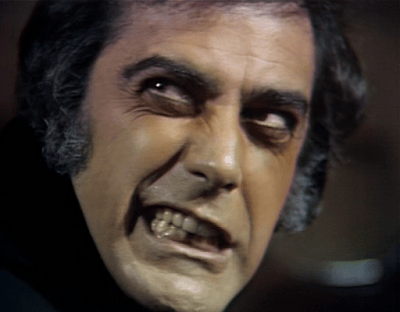
In his previous appearances as Judah, even in the episodes where Judah was in one piece, Michael McGuire was credited as “The Head.” Today, he is finally credited as “Judah Zachery.” But he shares the part with Keene Curtis. It is Curtis’ voice Gerard hears in his dream and Curtis who appears in the trial sequence as Judah wearing a black mask and objecting to Miranda’s testimony. They cut away from the speaking Judah and back to Michael McGuire in a matching costume. McGuire is built quite differently than Curtis, so the cut is jarring. McGuire pulls the mask off and shows the face we have come to think of as Judah’s.

It mystifies me that a show with such a tight budget as Dark Shadows chose to pay two actors for playing one part. McGuire had a fine actorly voice and had already appeared in several plays in New York, including the Broadway runs of The Passion of Josef D. and Child’s Play, and in the feature films Coming Apart and Where’s Poppa? (also known as Going Ape.) Curtis had an impressive face and was at this time acting in his 25th Broadway show. So either of them would have been well-qualified to play a whole part.

I first became aware of Michael McGuire in 1982, when he appeared in the pilot episode of Cheers as Professor Sumner Sloane, who dumps his date Diane Chambers and strands her at the bar. He reprised that role in two subsequent episodes of the show. None of McGuire’s three episodes of Cheers featured bar owner Sam Malone’s nemesis, John Allen Hill, who was played in his fifteen episodes by Keene Curtis. So when the characters talk about leaving Collinsport for Boston, we might wonder if they are looking to have a drink someplace where everybody knows their names.
Episode 1139: The misery of the living dead

At the end of #1109, mad scientist Julia Hoffman passed through a warp in spacetime and found herself at the great house of Collinwood in the year 1840. Lonely, she persuaded herself that if she went to the hidden chamber in the Collins family mausoleum and let vampire Barnabas Collins out of the chained coffin to which he had been confined since the 1790s he would remember the friendship that they began in 1968, and that they would be able to work together against the supernatural menace closing in on the Collinses of 1840.

In fact, Julia found that Barnabas had no recollection of anything later than the 1790s. He had no idea who she was, no interest in anything she tried to say, and no intention of letting her leave the chamber alive. It was only because his old friend Ben Stokes had followed Julia to the mausoleum and entered in the nick of time that Barnabas did not kill Julia then and there.

For the next several days, Barnabas rampaged through the grounds of Collinwood and the village of Collinsport. In #1114, he espied the lovely Roxanne Drew on the terrace of the great house, telling overbearing undertaker Lamar Trask that she hated him and would never yield to her father’s wish that she should marry him. Lamar looks and sounds just like his own late father, an enemy whom Barnabas loathed and took pleasure in torturing to death, so her hostility to Lamar wins Roxanne a place in Barnabas’ heart. In #1115, he bit Roxanne and left her to die, intending for her to rise as a vampire so that they could spend the rest of time preying on the living together.

In #1116, Julia and Ben found Roxanne and took her to the Old House on the grounds of Collinwood. There, Julia rigged up a medical apparatus and kept Roxanne alive. When Barnabas found what she had done, he was about to kill Julia. At the last second, his 1970 self projected his personality into his 1840 body, and Barnabas and Julia’s friendship picked up where it left off.

In #1117, Barnabas was remorseful about what he had done to Roxanne. He was distressed that Roxanne wanted him to bite her again and finish the job, and relieved that Julia was able not only to heal Roxanne’s physical wounds, but also to hypnotize her so that she did not remember the attack.

In #1129, Barnabas’ one-time wife, wicked witch Angelique, showed up and found that Barnabas was no longer in his coffin. In #1130, she went to the great house and introduced herself as Mrs Barnabas Collins. In #1133, she found that Barnabas and Roxanne shared a mutual attraction, and that Roxanne was shocked to hear that Barnabas was married. She told Barnabas that if he had anything more to do with Roxanne, she would cause the wounds on her neck to reopen, leading to her death and subsequent reappearance as a vampire. That curse would be Barnabas’ doing. Under this threat, Barnabas sent Roxanne a note saying they could never be together. Roxanne responded to that note yesterday by agreeing to marry Lamar.

Angelique’s threat should have been unnecessary. Barnabas knew full well that he was tempted to bite Roxanne and that if he did so she would likely become a vampire. Since he did not want that to happen, he should already have been at pains to avoid being alone with her. But a vampire is after all a metaphor for extreme selfishness, and so when he refuses to respect the logic of his own position and keeps stringing Roxanne along we might be frustrated with him, but we cannot really be surprised.

Barnabas cannot tolerate the idea of Roxanne as Lamar’s wife. He tells Julia that he is going to go to her and urge her not to marry Lamar. Julia tells him that if he does, Angelique will kill Roxanne. Barnabas asserts that Angelique will never find out. Since Angelique has powers including remote viewing, this is a bizarre thing to be sure of, and Julia tells him he is wrong. He ignores her. Desperate, she says she will go to Roxanne. Barnabas agrees to let her do this.

My wife, Mrs Acilius, points out that Julia is an extraordinarily skilled and inventive liar. While Barnabas might catch on if she does not go to Roxanne’s house, there is no reason once she is there she should not simply convey good wishes from Barnabas and herself for a happy marriage. But she presses Roxanne to admit she doesn’t love Lamar and insists that she call off the engagement.

Roxanne comes to Collinwood and tells Barnabas she loves only him. She embraces him. He can’t resist kissing her and telling her he loves her, too. Of course Angelique walks in on them.

Roxanne goes back home. Lamar is there. She tells him she cannot marry him, because she hates him. She loves Barnabas. We cut to Collinwood, where Angelique is casting her spell. Roxanne’s neck wounds reopen and blood comes spurting out.

Lamar bursts in the front door of Collinwood and shouts for Barnabas. Julia meets him. He tells her what has happened and declares that only Barnabas can save Roxanne, since he has cast a spell that is causing her to die. Julia insists Lamar take her to Roxanne. She gets to her just in time to hear her murmur Barnabas’ name as she dies. Lamar says that Barnabas is responsible for her death, which is of course true. He vows that he will exact vengeance for her on Barnabas, which is not likely to be true.

Lamar vows that Roxanne will be avenged. Screenshot by Dark Shadows Before I Die.

Back at Collinwood, Julia tells Barnabas that Roxanne is dead. Barnabas strikes a noble pose while saying that he feels responsible, then talks about how much he hates Angelique. He and Julia agree that the urgent thing now is to prevent Roxanne rising as a vampire. It is too close to dawn to make any plans, so they agree to talk it over in the evening. Julia does not bother to mention Lamar’s vow of revenge.

Episode 1138: A tomb again

By order of the court, warlock Judah Zachery was decapitated in 1692. His body was buried in a large underground chamber in a graveyard, and his head was put on public display to deter his followers. The head disappeared. It cropped up again in 1803, when it was associated with a series of horrendous murders.

Now it is 1840. Wealthy dilettante Desmond Collins found the head in some kind of shop in Macau and brought it back to his home, a mansion known as Rose Cottage that lies near the estate of Collinwood. Desmond regained his senses too late to stop the head resuming its lethal career.

The head recently enslaved Cockney showgirl/ psychic Leticia Faye and mad scientist Julia Hoffman. Julia and Leticia set up a laboratory in the underground chamber, reattached the head to the body, and brought Judah back to life with electricity harvested from lightning.

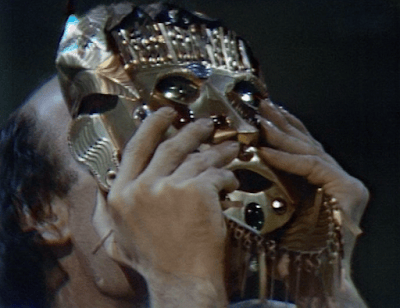
Seagoing con man Gerard Stiles had seen Leticia with the jewel-encrusted gold mask that is part of Judah’s equipment. He followed her to the underground chamber, hoping to steal it. When he arrived there, Julia and Leticia were out, but Judah was just getting up. He approached Gerard with his hands out, as if to strangle him. Gerard bumped into a bottle of ether and started a fire. Amid the flames, he escaped from Judah. As Gerard scampered out into the graveyard, Judah remained in the burning chamber, pressing the mask to his face.

Judah masks up. Screenshot by Dark Shadows Before I Die.

In the drawing room at the great house of Collinwood, Julia is getting a stern lecture from her best friend, vampire Barnabas Collins, about how she oughtn’t help Judah. She keeps protesting that she must help him, then cries out that Judah is burning. Suddenly Judah’s power over her breaks, and she is her old self again.

Barnabas insists that Julia take him to the underground chamber so that they can make sure Judah is dead. They find him under a pile of rubble. Julia checks his wrist for a pulse. He doesn’t have one. He didn’t when first she found him, so that wouldn’t seem to prove very much, but she and Barnabas decide it’s good enough. They leave the chamber, sure that Judah won’t be killing anyone else.

In his room at Rose Cottage, Gerard drifts off to sleep. He has a dream in which he is back in the underground chamber and a voice is ordering him to find “it.” He is puzzled, but as soon as he wakes up he knows exactly what he is supposed to do. He returns to the chamber, digs Judah out from under the pile of rubble, and removes the mask from his face. Judah blinks. What the point was of any of that, I leave as an exercise for the reader.

Barnabas and Julia are back in the drawing room at Collinwood, congratulating themselves on their great success. A man enters. He is overbearing undertaker Lamar Trask. He says that he just got engaged. In a very pleasant tone, Barnabas asks whom he will be marrying. Lamar is surprised at the question, as are returning viewers. Barnabas knows well that Roxanne Drew has been the object of Lamar’s suit for some time and that her father is very much in favor of the match. When Lamar identifies Roxanne as his fiancée, Barnabas is speechless. Lamar asks if congratulations are not in order, and Julia extends them.

Barnabas had shared a mutual attraction with Roxanne. As a vampire, he knew that he could not be alone with her without biting her, and he does not want to do that. When his one-time wife, wicked witch Angelique, showed up, she made him send Roxanne a letter saying that they couldn’t see each other again. It’s 1840, so Roxanne is probably going to marry someone. Much as Barnabas hates Lamar, he really should have braced himself for the likelihood that Roxanne would end up with him.

The scene in which Lamar proposes to Roxanne is the one high point in this otherwise wasted half hour. She talks about her desire to become “one of those new professional women,” and as Donna Wandrey delivers her lines we can see that she has given serious thought to that. Lamar stiffly declares that the only place for a woman is beside the man who loves her.

Lamar is the fourth villain named Trask whom Jerry Lacy has played, and the others excelled at snuffing out women’s dreams. So we recoil when he makes his sexist remark, but Roxanne does not. She smiles and says that if her father had not pushed them together, things might have been different between them. Miss Wandrey makes us believe that, while she does want an independent life, Roxanne is also a product of her time, and that she more or less believes in what she was raised to believe. Moreover, Mr Lacy does manage to make us believe that for all his obnoxiousness, Lamar loves Roxanne. So we can understand Roxanne’s motivations.

Episode 1137: Gerard is not important now

In March 1967, seagoing con man Jason McGuire showed up at the great house of Collinwood with a plan to help himself to the Collins family’s wealth. He had told matriarch Elizabeth Collins Stoddard that her husband was dead as the result of a blow she had dealt him. He used that story to force Liz to put him up in the great house.

After a few days, Jason’s friend, dangerously unstable ruffian Willie Loomis, showed up in town. Willie was to play a role in some plan of Jason’s that was never explained. Jason made Liz give Willie a room in the great house as well. After a couple of weeks, Willie stumbled onto vampire Barnabas Collins, who took him into his power.

Jason was on the point of success beyond his wildest hopes, about to marry Liz and become master of Collinwood. Suddenly it all came crashing down, and it was revealed that Liz’ husband wasn’t dead after all. Liz threw Jason out of the house. Spying on Willie and Barnabas, Jason saw that they had a fortune in jewels. Seeing one last chance to leave Collinwood a rich man, Jason went to Barnabas’ underground lair to help himself to the jewels. But he wound up opening the coffin just after sunset, and at the end of his final episode Jason had the hand of the undead menace Barnabas crushing his throat. In the next episode, Barnabas and Willie took Jason’s corpse to Barnabas’ old hiding place and Barnabas forced Willie to bury it there.

Now, Barnabas and his friend, mad scientist Julia Hoffman, have become the protagonists of Dark Shadows. They have traveled back in time to 1840 and the show is a costume drama set in that year.

Months before Julia and Barnabas arrived in 1840, seagoing con man Gerard Stiles showed up at the great house of Collinwood. He told Samantha Drew Collins and the rest of the family that her husband had died in a storm at sea, despite his efforts to save them. He used that story to persuade the family to put him up in the great house.

Around that same time, Gerard’s friend, Cockney showgirl/ psychic Leticia Faye, showed up in town. Leticia was to play a role in some plan of Gerard’s that was never explained. Gerard used his influence to persuade Flora Collins to give Leticia a room in her mansion, a place near Collinwood known as Rose Cottage. A couple of weeks into the 1840 segment, Leticia stumbled onto the disembodied head of warlock Judah Zachery, which took her into its power.

Gerard was on the point of success beyond his wildest hopes, about to marry Samantha and become master of Collinwood. Suddenly it all came crashing down when it was revealed that Samantha’s husband wasn’t dead after all. Gerard could not decently stay in the house. Spying on Leticia, Gerard saw that she had a golden mask encrusted with a fortune in jewels. Seeing one last chance to leave Collinwood a rich man, Gerard goes to Judah’s underground lair to help himself to the jewels. But he winds up uncovering him just after his body has been reconnected to his head and reanimated, and at the end of today’s episode the hands of undead menace Judah are moving towards Gerard’s throat.

The McGuire brothers, Michael and Jason. Screenshot by Dark Shadows Before I Die.

Jason was always meant to be an in-betweener, a character who would help clear up a couple of unresolved storylines and introduce Barnabas. In those days before internet discussion fora and soap opera magazines, the viewers would not have known that actor Dennis Patrick never signed a contract when he was cast as Jason and already had commitments in California coming up in the summer. But those who had been watching for the previous four months had seen the story of undead fire witch Laura Murdoch Collins absorb one narrative thread after another, so many that it would be clear to them that the show had committed itself to being a supernatural thriller. We may not expect a vampire named Barnabas, but we do expect someone to succeed Laura as the show’s next uncanny Big Bad. Jason was obviously doomed, because he did not know what kind of show he was on. He thought it was still the noir drama it was from August to December 1966, when it told of the Murder of Bill Malloy and its aftermath. In that genre, a blackmailer or a thief might find a way to prosper. But in this world, he is just so much meat for the monster’s dinner table.

But the show has been building Gerard up for months. In July, Julia and Barnabas traveled to the year 1995, where they found that Collinwood was a deadly ruin presided over by Gerard’s ghost and had been since a mysterious disaster took place sometime in 1970. They then went to 1970, and found that they were as powerless to prevent Gerard’s ghost from destroying Collinwood in that year as they had been unable to fight him in 1995. And while his attempt to steal the mask shows that he has failed to understand the extent to which supernatural powers dominate his world, his association with Leticia and his own pose as a seer show that he can engage with those powers to some extent. Therefore, we cannot expect that we will see Judah standing over Gerard’s corpse tomorrow, ordering Leticia to dig a grave.

As the show has been building up the character of Gerard and with him actor James Storm, so it has been going out of its way to keep actor Michael McGuire and the physical presence of Judah on the sidelines. When a character heard a voice coming from the Head, another actor provided that voice. Even today, when Michael McGuire is playing a fully reconstituted and reanimated Judah, he is billed in the credits as The Head. Nor is there a portrait of Judah, as there was a portrait of Barnabas starting a week and a half before Jonathan Frid made his first appearance, committing the show to using the actor who modeled for it. So while they have established that Judah will be the Big Bad for some time to come, there is no reason to expect Michael McGuire to continue playing him.

For most of 1969, Dark Shadows was set in 1897. During that time, David Selby’s character Quentin Collins, whose great-uncle and Doppelgänger is Samantha’s husband and is also named Quentin Collins, became a huge breakout hit. In the second half of the segment, the arch-villain was sorcerer Count Petofi. Among his other powers, Petofi was able to forcibly swap bodies with people. In #872, Petofi, inhabiting Quentin’s body, managed to travel to the year 1969. It looked like Mr Selby would be playing Petofi in a contemporary dress segment, but after a brief moment he was snatched back to 1897.

Quentin had first been introduced as an unspeaking ghost wearing nineteenth century garb, giving people dirty looks, and figuring in a retelling of The Turn of the Screw. Gerard met exactly that description when the show was in contemporary dress in August and September 1970. When we traveled back to 1840, characters even remarked on the living Gerard’s similarity to that year’s version of Quentin. In #1120, Daniel Collins, father of Quentin, told Gerard that he was very much like Quentin, and after their attempted marriage collapsed Samantha bitterly told Gerard that all he ever wanted was to become Quentin. So we can easily suppose that the show is trying to replicate with Gerard and Mr Storm the success it had with Quentin and Mr Selby. Even if Judah displaces Gerard’s personality and begins operating through his body, that will be a reenactment of the Quentin/ Petofi story. If we hope that the possession will be broken, we will be hoping for Gerard to return, leaving us rooting for him and opening the possibility that he will be transformed from villain to protagonist, as Barnabas and Quentin have been.

But there is an obvious problem with the idea of adding a second Quentin to the cast of characters. Ever since the show left 1897 in November 1969, the show has been struggling to find a place in the story for the Quentin it already has. Abraham Lincoln used to say that a town that isn’t big enough to support one lawyer can always support two, and I suppose they might have hoped that two Quentins would clash with each other often enough that the same principle would apply. But even if that was on their minds, in Gerard’s similarity to Jason they hedged their bet. If Judah takes possession of Gerard, it will be as if Jason’s fatal misadventure had been followed by Dennis Patrick switching to the role of Barnabas. They’ve managed to keep Barnabas busy most of the time he’s been on the show, so perhaps they think they have space for an another character like him.

This episode does feature one scene that is so hilarious I think it must be an example of intentional comedy, intentional at least so far as the director and actors were concerned, if not the writer. Barnabas has discovered that Julia is under Judah’s power and is giving her a stern talking-to in the drawing room of the great house. Leticia enters to report to Julia that there is trouble in the hiding place. Julia looks at her and shouts “Leticia, get out! Get out, Leticia!” As she does so, Barnabas shouts “Come back! Come back!” The alternating cries “Get out!”/ “Come back!”/ “Get out!”/ “Come back!” had us laughing out loud.

Episode 1136: I’m sure that you would be even more prettier

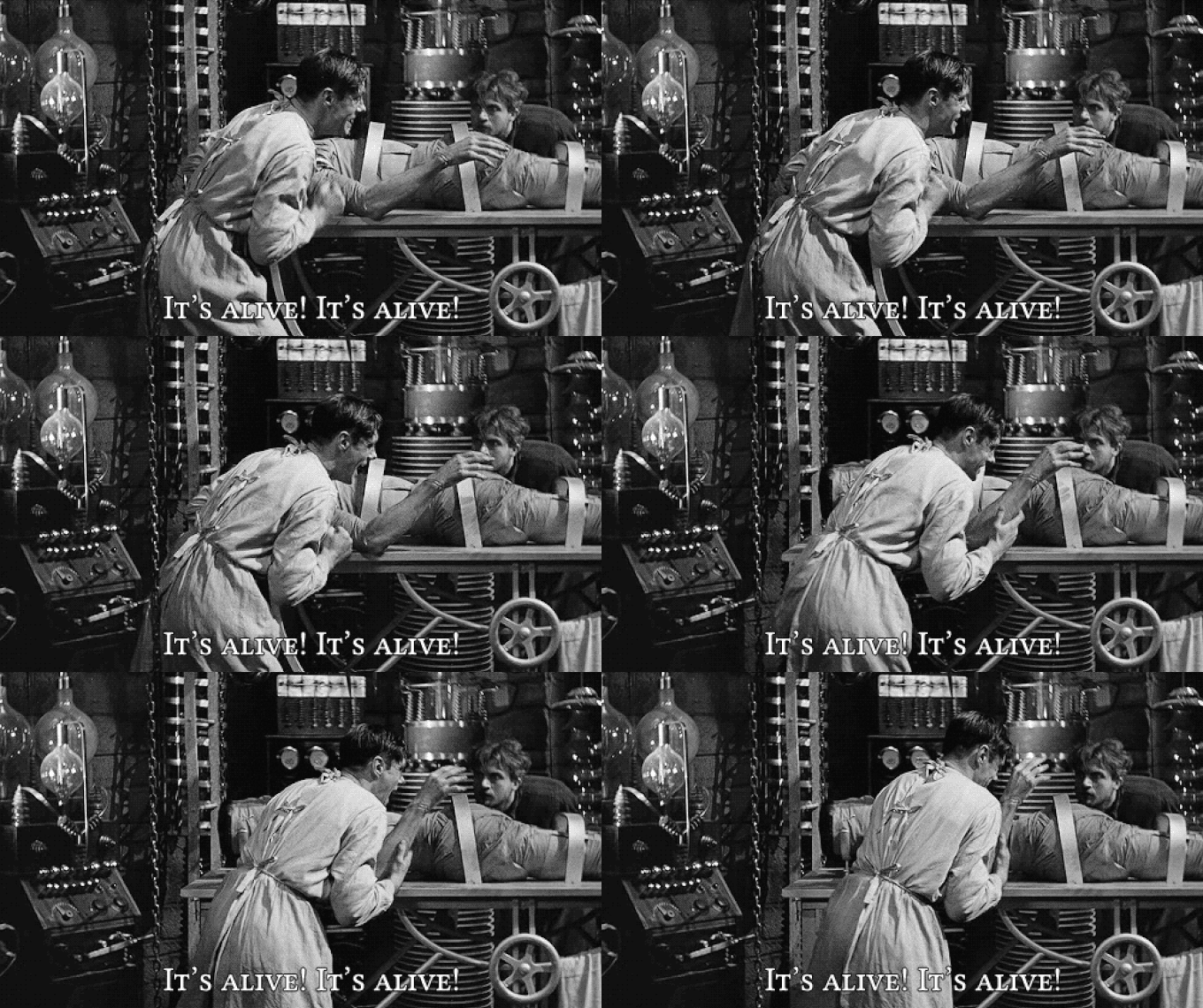
Mad scientist Julia Hoffman sews the severed head of warlock Judah Zachery back on its body, electrifies it with a bolt of lightning, and exclaims to her assistant, Cockney showgirl/ psychic Leticia Faye, that Judah “is alive!” Grayson Hall doesn’t take this line as far over the top as Colin Clive took the original line in the 1931 film Frankenstein, but she and Nancy Barrett are having so much fun with the whole preposterous situation that she doesn’t have to.

Unfortunately, another cast member is stuck with a less enjoyable set of chores today. That is James Storm as seagoing con man Gerard Stiles. Nothing Gerard does makes much sense, the dialogue he speaks while doing it is turgid and pointless, and he starts the episode already in a pose of extreme self-satisfaction that leaves the character nowhere to go emotionally. It’s no wonder he keeps stumbling over his lines. When we watched the episode, my wife, Mrs Acilius, described Gerard’s part as “crappy.” Enough of Mr Storm’s personal charm peeks through to make Gerard just about watchable, but it is no wonder the character did not take off with viewers as other villains had done.

In a mansion known as Rose Cottage, Gerard catches Leticia sneaking out of a room with a wooden box. He demands she tell him what is in the box. She refuses; they scuffle. She has a perfect opportunity to knee him in the groin. Leticia is the sort of downright personality whom one would expect to be used to defending herself in that manner. Moreover, she is under Judah’s power, and he is most insistent she bring him the contents of the box at once. The box itself looks quite sturdy and is admirably suited to banging Gerard on the head until he is unable to follow Leticia out of Rose Cottage. So it is quite disappointing that she leaves her feet on the floor and lets Gerard take the box. Leticia hasn’t had much sleep lately, maybe her reaction time is just down.

Gerard opens the box and finds what the show asks us to accept as a solid gold mask inlaid with precious jewels (it looks like part of a Halloween costume that cost $1.98, but let us put that to one side.) He exclaims that it must be worth a fortune. Leticia asks him to hand it over to her so that she can take it to Braithwaite’s shop in the village to be appraised. Inexplicably, he agrees.

Gerard goes to the great house of Collinwood, where he confronts newly hired governess Daphne Harridge with a demand for her real name. She denies having any other name, and he says there is no record of a Daphne Harridge in the town she told him she came from. She says she lied when she claimed to be from that town, since he is neither her employer nor a member of the Collins family and so it was impertinent of him to question her about her history. That leaves Gerard at a dead end.

The effective master of Collinwood, Quentin Collins, hears a tune being played on the piano in the drawing room. We haven’t heard it before, and we wonder what it could possibly be. The dramatic date is 1840, and the tune is in a post-impressionist style that would be unknown until the 1920s and not popular for decades after that. Quentin finds Gerard at the piano. Gerard points to the sheet music on the piano. Quentin says that the only copy of it belonged to his paramour Joanna Mills, and that other notes apparently from Joanna have turned up in odd places in the last few days. Since Joanna has been dead for almost a year, Quentin finds this troubling.

Gerard declares that “Well, there must be two reasons. Either somebody is deliberately trying to upset you, or Joanna is trying to communicate with you, beyond the grave.” He and Quentin then go on to bicker about Quentin’s reluctance to accept a supernatural explanation. As Mrs Acilius pointed out, the whole matter becomes quite simple once you set aside the supernatural option. Daphne, a woman about whom Quentin knows almost nothing, moved into the house at almost exactly the time the notes started appearing. Since Gerard was just telling Daphne that he suspects she is up to no good, we cannot understand why he does not bring this up to Quentin. I’ve heard actors talk about situations when they froze on stage because the character had no coherent attitude towards the words and actions; it’s a tribute to Mr Storm’s professionalism that he could deliver his dialogue at all today.