
The dramatic date is 1840. This is quite an ambitious half-hour, featuring both a dream sequence and a flashback.
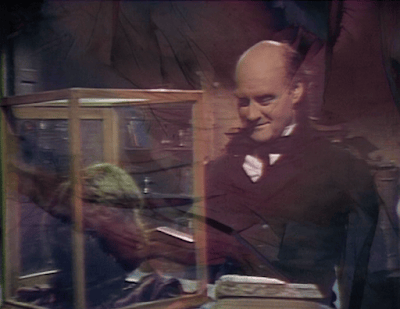
The head of warlock Judah Zachery and the rest of his body maintained separate residences from the time Judah was put to death in 1692 until the other day. Mad scientist Julia Hoffman and Cockney showgirl/ psychic Leticia Faye fell under Judah’s power and reattached the head to the body. Seagoing con man Gerard Stiles found his way to the vault where the reconstituted Judah was resting after this procedure. Judah attacked Gerard who in the course of escaping from him started a fire that destroyed the body. Now the head is back in its glass case, and Gerard is keeping it in his room. He is falling under Judah’s power, and has a dream today in which he sees his own head in the case while Judah stands outside. He hears Judah’s voice saying that he will take Gerard’s body for his own, and that Gerard will cease to exist. Regular viewers have likely seen this coming for some time, and it is a relief that Gerard is finally catching on.
Gerard is in the drawing room of the great house of Collinwood when wicked witch Angelique enters. They have not previously met. He introduces himself as Gerard Stiles. Before she can identify herself, he tells her that she once answered to the name Miranda. She is startled by this. He cannot explain why he said it. He says that he has never known anyone named Miranda. He excuses himself.
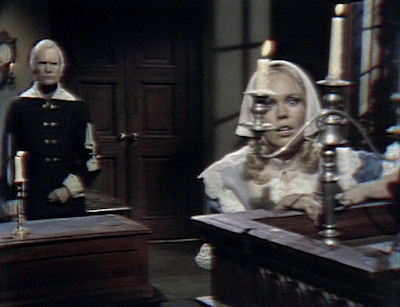
Angelique thinks back to the last time she was known as Miranda, which was in 1692. She was the key witness at Judah’s trial. We see Amadeus Collins browbeat Angelique with threats that she will be executed if she does not testify and with promises that she will be given safe passage out of the country if she does. She testifies, over Judah’s loud objections. Judah is convicted.
In his post about the episode on his great blog Dark Shadows Every Day, Danny Horn objects that the flashback represents a bad retcon. He describes it as “a perplexing revelation that basically eviscerates everything that we thought that we knew, and doesn’t replace it with anything.” I’d say it’s even worse. We first met Angelique late in 1967, when the show was set in 1795. At that time, we heard from people who knew her and her family when she was a little girl fifteen or twenty years before. We also saw that, while she had an awe-inspiring gift for black magic, she seemed to be a novice at it. She was continually surprising herself with the disastrous results of her spells. That made it possible for us to care about her later, when she became a more sympathetic character and an ally of the protagonists. If we suppose that she was already so skilled at witchcraft in 1692 that she could still be alive and not look a day older in 1795, that all falls apart.
The cosmology the show has developed with its journeys through time and the multiverse might leave a couple of options open to explain how Angelique could have been around in 1692, but what we see today forecloses those options. Perhaps she traveled back in time sometime between the 1790s and 1840. But as Danny points out, Lara Parker’s performance in the flashback eliminates that possibility. She plays “Miranda” as a true innocent, helpless between Judah and the court, without so much as a flicker in her eye suggesting that she might have some secrets of her own that she is keeping from Amadeus Collins.
We’ve seen “astral twins,” characters set in different periods who are played by the same actor and are in some sense the same person. Occasionally a sorcerer can cause the personality of one of these twins to invade the consciousness of the other. Angelique did this when a spell of hers caused Roger Collins to be intermittently possessed by his eighteenth century ancestor Joshua Collins in starting in #470. In #1107, a ghost which appeared to be Gerard, but which we now suppose to be Judah, caused the Quentin Collins who was born in 1870 to channel his great-uncle Quentin, who was born in 1810. But without the magical interventions, neither Roger nor Quentin knew much about his twin. Quentin had never even heard of his great uncle until he found his name in some old papers a few days before Gerard/ Judah mind-melded them. Angelique looks back on Miranda’s life as an earlier phase of her own, so regular viewers can exclude the “astral twin” explanation.
As Danny points out, the Miranda story is just an attempt to graft Judah onto the early history of the Collins family so that he seems dramatically satisfying as a major threat to them. They use Angelique because she seems to be the only major character whom they can patch back into a seventeenth century story. But since they get her there in a way that kicks load-bearing elements out of the continuity, it winds up making Judah seem even more like a random visitor.
In his previous appearances as Judah, even in the episodes where Judah was in one piece, Michael McGuire was credited as “The Head.” Today, he is finally credited as “Judah Zachery.” But he shares the part with Keene Curtis. It is Curtis’ voice Gerard hears in his dream and Curtis who appears in the trial sequence as Judah wearing a black mask and objecting to Miranda’s testimony. They cut away from the speaking Judah and back to Michael McGuire in a matching costume. McGuire is built quite differently than Curtis, so the cut is jarring. McGuire pulls the mask off and shows the face we have come to think of as Judah’s.
It mystifies me that a show with such a tight budget as Dark Shadows chose to pay two actors for playing one part. McGuire had a fine actorly voice and had already appeared in several plays in New York, including the Broadway runs of The Passion of Josef D. and Child’s Play, and in the feature films Coming Apart and Where’s Poppa? (also known as Going Ape.) Curtis had an impressive face and was at this time acting in his 25th Broadway show. So either of them would have been well-qualified to play a whole part.
I first became aware of Michael McGuire in 1982, when he appeared in the pilot episode of Cheers as Professor Sumner Sloane, who dumps his date Diane Chambers and strands her at the bar. He reprised that role in two subsequent episodes of the show. None of McGuire’s three episodes of Cheers featured bar owner Sam Malone’s nemesis, John Allen Hill, who was played in his fifteen episodes by Keene Curtis. So when the characters talk about leaving Collinsport for Boston, we might wonder if they are looking to have a drink someplace where everybody knows their names.

