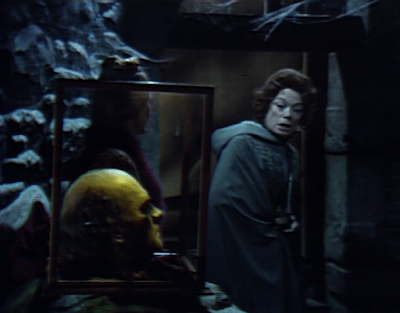
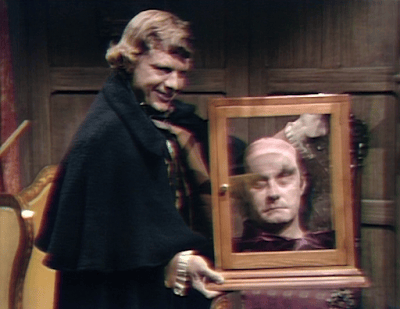
The severed head of warlock Judah Zachery has at various times been housed in three of the bedrooms in a mansion known as Rose Cottage. Occasionally, it opens its eyes. When it does this, it is played by actor Michael McGuire. At other times, the head is still. In those scenes, a replica of McGuire’s head is used.
Today, Judah takes possession of seagoing con man Gerard Stiles. When he does so, the head closes its eyes forever. Using Gerard’s body as his own, Judah orders his minion Charles Dawson to keep the head in a safe place. McGuire went back to Broadway to appear as Richard Greatham in a revival of Hay Fever.
One of the judges who sentenced Judah to be beheaded in 1692 was Amadeus Collins. Now that he is back in action, Judah wants to take revenge on Amadeus’s descendants. He decides to frame Quentin Collins for witchcraft. The dramatic date is 1840, and the location is the state of Maine. In our universe, there were no laws against witchcraft in Maine or anywhere else in the English-speaking world at that time, and had not been since 1736. But early in 1968, Dark Shadows was set in 1796, and we saw that there were witchcraft laws on the books in its version of the place. So perhaps they are still in effect in 1840.
At any rate, the black magic rite in which Judah implicates Quentin involves a human sacrifice. So even if there are no witchcraft laws, presumably the murder statutes would apply. Judah, passing as Gerard, goes to a viewing at the funeral home operated by overbearing undertaker Lamar Trask. A woman named Lorna Bell shows up to pay her respects to the deceased. As Gerard, Judah tells her that some of his friends are getting together for a Lamar-free memorial service later in the evening. She agrees to attend, and says she wants to go home with him afterward. Quentin stops in, and Lorna sees that he and Gerard are friends. She tells him that she will see him later that evening. Lamar overhears. Quentin doesn’t know what she is talking about.
Lorna goes to a house where Dawson meets her. He ushers her into room with an altar. He locks her in by herself. He returns, and Judah also enters, wearing a mask and carrying a dagger.
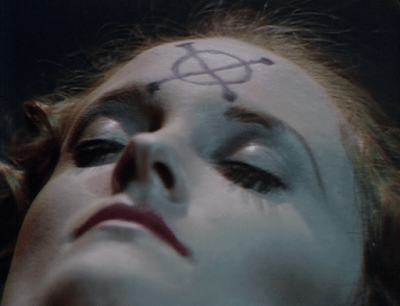
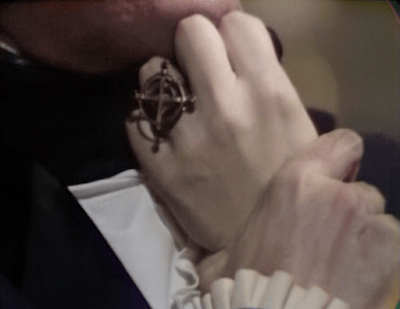
Lamar calls on Quentin in the great house of Collinwood. He informs him that Lorna was found murdered, with “the mark of Satan” on her forehead. It turns out that Quentin wears a ring with this mark.
Even if the Dark Shadows version of Maine was in 1840 as lacking in witchcraft laws as was the real one, it would seem rather indiscreet for a prominent member of the community to go around wearing a ring featuring “the mark of Satan.” It may not have been so strange in 1970, when the success of the movie Rosemary’s Baby led to a fad for Satanic symbolism, which led to such oddities as Sammy Davis, Jr’s 1974 album Satan Swings featuring Church of Satan founder Anton LeVey on background vocals. But in the days when Queen Victoria was young, people tended to be a bit more cautious about that sort of thing.
Lorna is played by Marilyn Joseph. Miss Joseph was at this time married to Christopher Pennock. Lorna’s ghost, or a simulacrum of it, will appear in #1145.
The dramatic date is 1840. This is quite an ambitious half-hour, featuring both a dream sequence and a flashback.
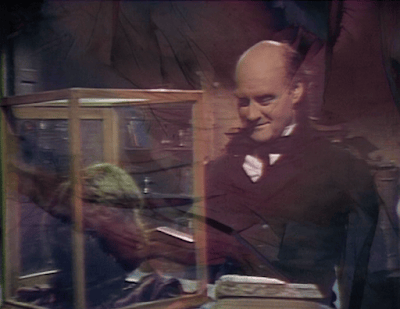
The head of warlock Judah Zachery and the rest of his body maintained separate residences from the time Judah was put to death in 1692 until the other day. Mad scientist Julia Hoffman and Cockney showgirl/ psychic Leticia Faye fell under Judah’s power and reattached the head to the body. Seagoing con man Gerard Stiles found his way to the vault where the reconstituted Judah was resting after this procedure. Judah attacked Gerard who in the course of escaping from him started a fire that destroyed the body. Now the head is back in its glass case, and Gerard is keeping it in his room. He is falling under Judah’s power, and has a dream today in which he sees his own head in the case while Judah stands outside. He hears Judah’s voice saying that he will take Gerard’s body for his own, and that Gerard will cease to exist. Regular viewers have likely seen this coming for some time, and it is a relief that Gerard is finally catching on.
Gerard is in the drawing room of the great house of Collinwood when wicked witch Angelique enters. They have not previously met. He introduces himself as Gerard Stiles. Before she can identify herself, he tells her that she once answered to the name Miranda. She is startled by this. He cannot explain why he said it. He says that he has never known anyone named Miranda. He excuses himself.
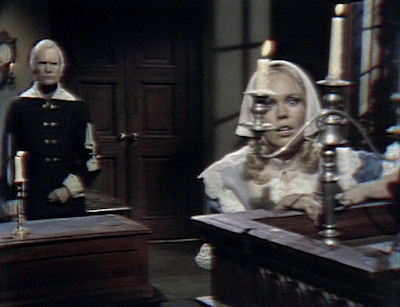
Angelique thinks back to the last time she was known as Miranda, which was in 1692. She was the key witness at Judah’s trial. We see Amadeus Collins browbeat Angelique with threats that she will be executed if she does not testify and with promises that she will be given safe passage out of the country if she does. She testifies, over Judah’s loud objections. Judah is convicted.
In his post about the episode on his great blog Dark Shadows Every Day, Danny Horn objects that the flashback represents a bad retcon. He describes it as “a perplexing revelation that basically eviscerates everything that we thought that we knew, and doesn’t replace it with anything.” I’d say it’s even worse. We first met Angelique late in 1967, when the show was set in 1795. At that time, we heard from people who knew her and her family when she was a little girl fifteen or twenty years before. We also saw that, while she had an awe-inspiring gift for black magic, she seemed to be a novice at it. She was continually surprising herself with the disastrous results of her spells. That made it possible for us to care about her later, when she became a more sympathetic character and an ally of the protagonists. If we suppose that she was already so skilled at witchcraft in 1692 that she could still be alive and not look a day older in 1795, that all falls apart.
The cosmology the show has developed with its journeys through time and the multiverse might leave a couple of options open to explain how Angelique could have been around in 1692, but what we see today forecloses those options. Perhaps she traveled back in time sometime between the 1790s and 1840. But as Danny points out, Lara Parker’s performance in the flashback eliminates that possibility. She plays “Miranda” as a true innocent, helpless between Judah and the court, without so much as a flicker in her eye suggesting that she might have some secrets of her own that she is keeping from Amadeus Collins.
We’ve seen “astral twins,” characters set in different periods who are played by the same actor and are in some sense the same person. Occasionally a sorcerer can cause the personality of one of these twins to invade the consciousness of the other. Angelique did this when a spell of hers caused Roger Collins to be intermittently possessed by his eighteenth century ancestor Joshua Collins in starting in #470. In #1107, a ghost which appeared to be Gerard, but which we now suppose to be Judah, caused the Quentin Collins who was born in 1870 to channel his great-uncle Quentin, who was born in 1810. But without the magical interventions, neither Roger nor Quentin knew much about his twin. Quentin had never even heard of his great uncle until he found his name in some old papers a few days before Gerard/ Judah mind-melded them. Angelique looks back on Miranda’s life as an earlier phase of her own, so regular viewers can exclude the “astral twin” explanation.
As Danny points out, the Miranda story is just an attempt to graft Judah onto the early history of the Collins family so that he seems dramatically satisfying as a major threat to them. They use Angelique because she seems to be the only major character whom they can patch back into a seventeenth century story. But since they get her there in a way that kicks load-bearing elements out of the continuity, it winds up making Judah seem even more like a random visitor.
In his previous appearances as Judah, even in the episodes where Judah was in one piece, Michael McGuire was credited as “The Head.” Today, he is finally credited as “Judah Zachery.” But he shares the part with Keene Curtis. It is Curtis’ voice Gerard hears in his dream and Curtis who appears in the trial sequence as Judah wearing a black mask and objecting to Miranda’s testimony. They cut away from the speaking Judah and back to Michael McGuire in a matching costume. McGuire is built quite differently than Curtis, so the cut is jarring. McGuire pulls the mask off and shows the face we have come to think of as Judah’s.
It mystifies me that a show with such a tight budget as Dark Shadows chose to pay two actors for playing one part. McGuire had a fine actorly voice and had already appeared in several plays in New York, including the Broadway runs of The Passion of Josef D. and Child’s Play, and in the feature films Coming Apart and Where’s Poppa? (also known as Going Ape.) Curtis had an impressive face and was at this time acting in his 25th Broadway show. So either of them would have been well-qualified to play a whole part.
I first became aware of Michael McGuire in 1982, when he appeared in the pilot episode of Cheers as Professor Sumner Sloane, who dumps his date Diane Chambers and strands her at the bar. He reprised that role in two subsequent episodes of the show. None of McGuire’s three episodes of Cheers featured bar owner Sam Malone’s nemesis, John Allen Hill, who was played in his fifteen episodes by Keene Curtis. So when the characters talk about leaving Collinsport for Boston, we might wonder if they are looking to have a drink someplace where everybody knows their names.
In March 1967, seagoing con man Jason McGuire showed up at the great house of Collinwood with a plan to help himself to the Collins family’s wealth. He had told matriarch Elizabeth Collins Stoddard that her husband was dead as the result of a blow she had dealt him. He used that story to force Liz to put him up in the great house.
After a few days, Jason’s friend, dangerously unstable ruffian Willie Loomis, showed up in town. Willie was to play a role in some plan of Jason’s that was never explained. Jason made Liz give Willie a room in the great house as well. After a couple of weeks, Willie stumbled onto vampire Barnabas Collins, who took him into his power.
Jason was on the point of success beyond his wildest hopes, about to marry Liz and become master of Collinwood. Suddenly it all came crashing down, and it was revealed that Liz’ husband wasn’t dead after all. Liz threw Jason out of the house. Spying on Willie and Barnabas, Jason saw that they had a fortune in jewels. Seeing one last chance to leave Collinwood a rich man, Jason went to Barnabas’ underground lair to help himself to the jewels. But he wound up opening the coffin just after sunset, and at the end of his final episode Jason had the hand of the undead menace Barnabas crushing his throat. In the next episode, Barnabas and Willie took Jason’s corpse to Barnabas’ old hiding place and Barnabas forced Willie to bury it there.
Now, Barnabas and his friend, mad scientist Julia Hoffman, have become the protagonists of Dark Shadows. They have traveled back in time to 1840 and the show is a costume drama set in that year.
Months before Julia and Barnabas arrived in 1840, seagoing con man Gerard Stiles showed up at the great house of Collinwood. He told Samantha Drew Collins and the rest of the family that her husband had died in a storm at sea, despite his efforts to save them. He used that story to persuade the family to put him up in the great house.
Around that same time, Gerard’s friend, Cockney showgirl/ psychic Leticia Faye, showed up in town. Leticia was to play a role in some plan of Gerard’s that was never explained. Gerard used his influence to persuade Flora Collins to give Leticia a room in her mansion, a place near Collinwood known as Rose Cottage. A couple of weeks into the 1840 segment, Leticia stumbled onto the disembodied head of warlock Judah Zachery, which took her into its power.
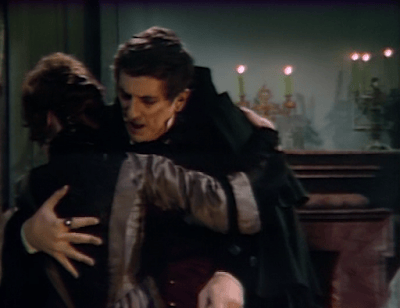
Gerard was on the point of success beyond his wildest hopes, about to marry Samantha and become master of Collinwood. Suddenly it all came crashing down when it was revealed that Samantha’s husband wasn’t dead after all. Gerard could not decently stay in the house. Spying on Leticia, Gerard saw that she had a golden mask encrusted with a fortune in jewels. Seeing one last chance to leave Collinwood a rich man, Gerard goes to Judah’s underground lair to help himself to the jewels. But he winds up uncovering him just after his body has been reconnected to his head and reanimated, and at the end of today’s episode the hands of undead menace Judah are moving towards Gerard’s throat.
Jason was always meant to be an in-betweener, a character who would help clear up a couple of unresolved storylines and introduce Barnabas. In those days before internet discussion fora and soap opera magazines, the viewers would not have known that actor Dennis Patrick never signed a contract when he was cast as Jason and already had commitments in California coming up in the summer. But those who had been watching for the previous four months had seen the story of undead fire witch Laura Murdoch Collins absorb one narrative thread after another, so many that it would be clear to them that the show had committed itself to being a supernatural thriller. We may not expect a vampire named Barnabas, but we do expect someone to succeed Laura as the show’s next uncanny Big Bad. Jason was obviously doomed, because he did not know what kind of show he was on. He thought it was still the noir drama it was from August to December 1966, when it told of the Murder of Bill Malloy and its aftermath. In that genre, a blackmailer or a thief might find a way to prosper. But in this world, he is just so much meat for the monster’s dinner table.
But the show has been building Gerard up for months. In July, Julia and Barnabas traveled to the year 1995, where they found that Collinwood was a deadly ruin presided over by Gerard’s ghost and had been since a mysterious disaster took place sometime in 1970. They then went to 1970, and found that they were as powerless to prevent Gerard’s ghost from destroying Collinwood in that year as they had been unable to fight him in 1995. And while his attempt to steal the mask shows that he has failed to understand the extent to which supernatural powers dominate his world, his association with Leticia and his own pose as a seer show that he can engage with those powers to some extent. Therefore, we cannot expect that we will see Judah standing over Gerard’s corpse tomorrow, ordering Leticia to dig a grave.
As the show has been building up the character of Gerard and with him actor James Storm, so it has been going out of its way to keep actor Michael McGuire and the physical presence of Judah on the sidelines. When a character heard a voice coming from the Head, another actor provided that voice. Even today, when Michael McGuire is playing a fully reconstituted and reanimated Judah, he is billed in the credits as The Head. Nor is there a portrait of Judah, as there was a portrait of Barnabas starting a week and a half before Jonathan Frid made his first appearance, committing the show to using the actor who modeled for it. So while they have established that Judah will be the Big Bad for some time to come, there is no reason to expect Michael McGuire to continue playing him.
For most of 1969, Dark Shadows was set in 1897. During that time, David Selby’s character Quentin Collins, whose great-uncle and Doppelgänger is Samantha’s husband and is also named Quentin Collins, became a huge breakout hit. In the second half of the segment, the arch-villain was sorcerer Count Petofi. Among his other powers, Petofi was able to forcibly swap bodies with people. In #872, Petofi, inhabiting Quentin’s body, managed to travel to the year 1969. It looked like Mr Selby would be playing Petofi in a contemporary dress segment, but after a brief moment he was snatched back to 1897.
Quentin had first been introduced as an unspeaking ghost wearing nineteenth century garb, giving people dirty looks, and figuring in a retelling of The Turn of the Screw. Gerard met exactly that description when the show was in contemporary dress in August and September 1970. When we traveled back to 1840, characters even remarked on the living Gerard’s similarity to that year’s version of Quentin. In #1120, Daniel Collins, father of Quentin, told Gerard that he was very much like Quentin, and after their attempted marriage collapsed Samantha bitterly told Gerard that all he ever wanted was to become Quentin. So we can easily suppose that the show is trying to replicate with Gerard and Mr Storm the success it had with Quentin and Mr Selby. Even if Judah displaces Gerard’s personality and begins operating through his body, that will be a reenactment of the Quentin/ Petofi story. If we hope that the possession will be broken, we will be hoping for Gerard to return, leaving us rooting for him and opening the possibility that he will be transformed from villain to protagonist, as Barnabas and Quentin have been.
But there is an obvious problem with the idea of adding a second Quentin to the cast of characters. Ever since the show left 1897 in November 1969, the show has been struggling to find a place in the story for the Quentin it already has. Abraham Lincoln used to say that a town that isn’t big enough to support one lawyer can always support two, and I suppose they might have hoped that two Quentins would clash with each other often enough that the same principle would apply. But even if that was on their minds, in Gerard’s similarity to Jason they hedged their bet. If Judah takes possession of Gerard, it will be as if Jason’s fatal misadventure had been followed by Dennis Patrick switching to the role of Barnabas. They’ve managed to keep Barnabas busy most of the time he’s been on the show, so perhaps they think they have space for an another character like him.
This episode does feature one scene that is so hilarious I think it must be an example of intentional comedy, intentional at least so far as the director and actors were concerned, if not the writer. Barnabas has discovered that Julia is under Judah’s power and is giving her a stern talking-to in the drawing room of the great house. Leticia enters to report to Julia that there is trouble in the hiding place. Julia looks at her and shouts “Leticia, get out! Get out, Leticia!” As she does so, Barnabas shouts “Come back! Come back!” The alternating cries “Get out!”/ “Come back!”/ “Get out!”/ “Come back!” had us laughing out loud.
C. S. Lewis’ novel That Hideous Strength was a popular success when it was first published in 1946, and has been in print ever since. It begins as a satire of university life and academic politics. When it turns out that the inner circle of the fictional Edgestowe university are a Satanic cult who take their orders from a severed head that once belonged to a warlock named François Alcasan and that their project involves extensive efforts to add to the head’s power with biotechnological interventions, it turns into a supernatural thriller. As one would expect of a writer as outspokenly Christian as Lewis, this all culminates in the Second Coming of Jesus.
It is psychiatrist Grace Ironwood who does the investigative heavy lifting that leads the protagonists to understand what is really going on. Jane Tudor Studdock, wife of ambitious professor Mark Studdock, has a series of bizarre dreams which she reports to Dr Ironwood. Dr Ironwood interprets these dreams as visions of the simple facts of what is happening at Edgestowe. Mark is arrested for a brutal murder the head committed, one that involved a near-decapitation of the victim, and Jane throws her lot in with Dr Ironwood and the other good guys. Dr Ironwood is then crucial in identifying Alcasan.
The A story on Dark Shadows is about another severed head that takes charge of a malign cult. The warlock from whom this head was cut was called Judah Zachery. The biotechnological intervention is not about connecting it with the “macrobes” Lewis invented, but with its original body. The cult takes shape not as a stable group as at Edgestowe, but serially, as the head takes control first of one person, then of another on or around the estate of Collinwood. The female psychiatrist who is a key member of the team opposing the head’s project is named, not Grace Ironwood, but Julia Hoffman. Today, the head takes Julia under its power, at a stroke both tearing the heart out of its opposition and recruiting the one person most likely to be able to reattach it to its body.
Before that happens, Julia and her best friend, vampire Barnabas Collins, are going over some documents she has found about Judah Zachery. The front door opens and Barnabas’ one-time wife, wicked witch Angelique, enters.
Since November 1967, when the show left its contemporary setting to spend four months in the 1790s, Dark Shadows has largely been about time travel. We met Angelique during that first jaunt into the past, when she was monomaniacally obsessed with taking control of Barnabas and first turned him into a vampire. She hadn’t changed much when we next saw her, when the show was back in contemporary dress for most of 1968. But in 1969, Julia and Barnabas met Angelique during a trip to 1897. In that segment, Angelique remembered the events of 1968 and had moved on from Barnabas, focusing her attentions on his distant cousin Quentin Collins. In the latter part of it, Angelique teamed up with Barnabas and Julia to fight sorcerer Count Petofi. Julia and Angelique even became friends in that time.
Back in a contemporary setting early in 1970, Angelique wound up aligned with Julia and Barnabas again, waging war against a race of Elder Gods known as the Leviathan People. During that segment, she told Barnabas that she regretted turning him into an undead abomination and murdering his family and friends, and he responded in a light tone that he didn’t suppose any of that really mattered all that much.
Now, Barnabas and Julia are in 1840. The Angelique they meet in this year does not remember anything that happened in 1897, 1968, or 1970. She has no idea who Julia is. But they remember it all. So, when Angelique walks in, we might look forward to her reaction when Julia greets her by exclaiming “Angelique! You’re the one person who can help us!”
But that doesn’t happen. Instead, it is Barnabas who calls Angelique by name. When she says she is eager to meet the new sister-in-law whom she heard about when she introduced herself at the great house on the grounds of the estate as “Mrs Barnabas Collins,” Barnabas simply shoos Julia away. Alone with Angelique, Barnabas vents his hostility as if 1897 and 1970 never happened. When Angelique points out that he cannot challenge her directly, Barnabas says that they have arrived at their “usual stalemate.” Stale is the word for this mating, that’s for sure.
Early in the 1840 segment, there were several days when Barnabas had only the knowledge he would have had at that time and did not recognize Julia. Had Angelique come back then, this scene would have made perfect sense. Perhaps it was originally meant to be so, and for some reason they had to displace it to this point, where it is a disappointment. I complained about this years ago in a long comment on Danny Horn’s post about this episode at his great blog Dark Shadows Every Day:
It’s too bad they didn’t have it take a good deal longer for Barnabas to project himself back from 1970. If Julia had managed to partially domesticate the 1840 Barnabas and get him on board with her investigation, his confrontation with Angelique would have been much improved. He wouldn’t have known anything that Julia and we know, and he couldn’t be counted on to listen to Julia. That would have made him a total loose cannon, as absolutely unpredictable in his reaction to Angelique as he would be unpredictable in his reactions to everyone else.
As it is, there’s only one intelligent way for him to respond to Angelique’s appearance. “Since you’re here, you may as well help us.”
“What makes me think I will help you?”
Barnabas and Julia tell her that they have traveled back in time from 1970, and that in the interval between 1840 and 1970 Angelique had twice joined forces with them against common foes.
“Do you expect me to believe this ABSURD TALE?”
They tell her that the foes they fought in 1897 and [1970] were Count Petofi and the Leviathans.
Smiling dismissively, she replies, “You can make up all the names you like, they won’t make me believe [your] story. But very well, tell me what name you have invented for the common adversary we are supposed to fight now.”
They say “Judah Zachery,” and she’s in. Murder Club is in session.
Having Barnabas and Angelique instead revisit their old scenes, right down to an improved version of the “My name is Cassandra!” bit, just tries our patience and makes Barnabas look even dumber than usual.
Comment left 13 February 2021 by “Acilius” on “Episode 11331: The Perils of Memory,” Danny Horn, Dark Shadows Every Day.
Norman Parker plays the body of Judah Zachery, while Michael McGuire plays the head. Michael McGuire gets to open his eyes a couple of times today, and Norman Parker reads the opening voiceover.
In June 1970, Dark Shadows was set in a universe other than the one where it usually takes place. The show insisted on calling that other continuity “Parallel Time.”
In the main continuity, mad scientist Julia Hoffman is the friend and enabler of vampire Barnabas Collins. When Barnabas crossed over to Parallel Time, he found that Julia’s counterpart there was as devoted to wicked witch Angelique as the Julia he knew was to him. He made himself Angelique’s enemy, and in #1036 Hoffman was poised over him with a stake and a hammer, ready to destroy him. In the nick of time, Julia arrived from the main continuity and saved Barnabas. She bashed Hoffman’s head in, stole her clothes, and set about impersonating her. When Barnabas first saw Julia in Parallel Time, he thought she was her Doppelgänger, and since she was in his hiding place he was going to kill her. Fortunately for Julia, Barnabas had got into the habit of making speeches to people before he murdered them, so she was able to tell him who she was. With that, the murder was off and their friendship was back on track.
Now, it is Julia who has crossed over into another world. She has traveled back to the year 1840, and has told the family in the great house of Collinwood at that time that she is the daughter of the Barnabas Collins who supposedly left for England in the 1790s. She has also told them to expect her brother, Barnabas Junior, who, she says, looks just like their old man.
In a moment of extreme folly, Julia went to the room where Barnabas was sealed in his coffin in the 1790s and released him. This mirrored the folly of her waiting around in his hiding place after she killed Hoffman in Parallel Time. The Barnabas of 1840 had no idea that any time had passed since he was imprisoned four and a half decades before, and certainly did not know what Julia was talking about when she claimed that they had met in 1967 and become friends in 1968. He was about to kill her when his old friend Ben Stokes turned up in the nick of time and stopped him.
Now, Barnabas has discovered that Julia is interfering in his plans. He has bitten the lovely Roxanne Drew, intending for her to die and rise as his vampire bride. Julia and Ben found Roxanne and brought her to the Old House on the grounds of Collinwood. Julia is giving Roxanne a blood transfusion which has prevented her death. When Barnabas sees what is going on, he grabs Julia and is about to bite her.
Barnabas is already flashing his fangs when he has a seizure and collapses. He stands back up and finds Julia holding a cross at him. He tells her that he is the Barnabas of 1970, projected into his 1840 body by some mumbo-jumbo involving the I Ching. He could be making that up based on things she has already told him, so she keeps holding the cross. He goes on to give specific facts about several people they know in 1970. She realizes he is telling the truth. She puts the cross down, and gives him a hug. As Julia came from the main continuity and destroyed her own Doppelgänger to save Barnabas, so Barnabas has come from the future and destroyed his previous self to save Julia.**
The 1970 model Barnabas does not want Roxanne to be a vampire, and he is ashamed of his earlier self for having tried to make her one. Roxanne comes to, sees him, and is delighted to think he has come to bite her again. When he says that things have changed, she is disappointed and he is embarrassed. He goes away.
Julia has a superhuman power of hypnosis that she has often used to erase people’s memories and overwrite them with information that will not incriminate Barnabas. She tries this on Roxanne. She is halfway through the process when some noises outside prompt her to leave the room and investigate. The room is at the top of the stairs, and has been a major set for years. We’ve caught glimpses of the door that opens to it a couple of times, but this is the first time there is set built all the way to the railing.
Julia goes to the railing and calls downstairs, asking if anyone is there. No one answers, so she goes back into the room. Roxanne has somehow got away.
Barnabas goes to the great house and introduces himself as Julia’s brother. Julia comes. They get a private moment, during which Julia tells him that Roxanne escaped and that she does not know whether the hypnosis was successful. Roxanne enters, looks at Barnabas, and announces to the assembled Collinses that she knows who he is. She is escorted upstairs. Barnabas and Julia are on the verge of panic until Roxanne’s sister, Samantha Drew Collins, comes down and says that Roxanne doesn’t remember anything of the last couple nights.
The Gods are Weak at First*
The 1970 version of Barnabas is not the only character to make his grand entrance today. We also meet Desmond Collins and an acquaintance of his.
Desmond is the son of Flora Collins, a lady novelist and all-around silly person who lives in the nearby mansion called Rose Cottage. He has just returned from a long journey with a present for his friend, Quentin Collins, husband of Samantha and heir to the Collins estate. Flora breaks the sad news that Quentin and his son Tad Collins were lost at sea some time ago, that they have been missing ever since, and that they are now presumed dead.
The present is in a large cube that is covered with a cloth. Desmond removes the cloth and exposes a glass box holding a severed head. Flora reacts with horror; Desmond laughs and says that it is surely a carved figure of some sort, entirely harmless. We know better; the episode ends with the head opening its eyes.
The perfect gift for the man who has everything, except a sense of decency. Screenshot by Dark Shadows Before I Die.
In 1945, C. S. Lewis published the third volume of his “Space Trilogy,” a novel called That Hideous Strength. It was a commercial success at the time, and has been in print ever since. I have mixed feelings about Lewis’ writings; I essentially agree with his religious views, but he often expressed them in a cutesy-poo style that is still endemic among Anglican writers and that makes me wish I were a Zoroastrian or a Buddhist or something whenever I encounter it.
But the first fifty pages of That Hideous Strength are terrific. I teach in a university, and the account of life inside the fictional University of Edgestow is the most insightful depiction of campus politics I’ve ever read. The place is dominated by a clique of administrators who keep talking to each other about what “Our Head” wants them to do. In British institutions of higher education, “Head” is a title for a permanent director of a department or institute, so that’s what you think they are talking about. But no, it’s an actual severed head through which the voice of Satan speaks to them. They worship the head and follow the commands they receive from its mouth.
That Hideous Strength was certainly popular enough that it is likely the writers of Dark Shadows had looked to it as a source of material. In particular, Sam Hall was a serious enough Protestant that he persuaded Shirley Grossman to convert from Judaism and join him in the Lutheran church before they married and she became Grayson Hall. Lewis was so celebrated for his apologetics that it would be rather odd if his name did not attract Hall’s notice. So we can expect that Desmond and others will form a cult of some sort and that the Head will give them diabolical orders to follow.
The Head is that of Michael McGuire, making the first of scores of television appearances. One of my favorite parts of his was Sumner Sloan, the prominent academic who dumped Diane Chambers in the first episode of Cheers and came back for her in her last episode as a regular part of the cast of characters. McGuire also appeared in my favorite episode of Columbo, “A Friend in Deed,” in which his character tries to confess to killing his wife in a fit of rage only to find himself involved in a plot to kill another man’s wife in cold blood. I suppose one of McGuire’s specialties was “Do Not Date This Man.” I’ve never heard that he was anything other than a nice guy in real life, though.
Hounds to be cursed at when the blood trail falters,
Eventually, reasons why the hounds went wrong.
Then to the reasons they establish altars.
The gods are weak at first.
When they grow strong
They bring into the world their choicest thunders.
Plagues, curses color the narrow countryside.
The peasantry speaks of horned, unnatural wonders,
And in the violence takes a natural pride.
But all the while the map-makers are busy.
Faint explorations die in the savage hills,
Others go on to the farthest fabled city,
Where for six months the sun is lost, and the cold kills.
Geometers prove the world, and it is conquered.
Truth overtakes the aborigine.
The gods depart. Mankind is anchored
To clear historical necessity.
Until one day at midday
When the sun ought to be loudest in the shouting sky
Shadow occludes it. Suddenly life is done.
The fire goes out. The constellations die.
Only, above the following page, the pen,
Whose quality is not to have taken part,
Hovers in uncommittedness again,
Poised for the signal of another start
Towards some fresh country, princesses more golden,
And younger sons who wage a bolder fight,
Stags nobler, hounds more diligent than the olden,
The page lies empty in the easy light.
This poem reminds me of Dark Shadows. The creative process is so close to the surface of the show that an image of a writer with pen and paper is a suitable way to start a description of it. When the third sons and the princesses are moved to the “widest margin, to the land of white” it’s ambiguous if that just means the writer is making notes on the otherwise blank edge of the paper or whether the characters are going off to the Arctic. We see the same ambiguity in “the pen whose quality is not to have taken part.” That brings to mind both the characters visiting from other times or other universes and the writers who use those cosmic journeys to start the story fresh.
The “natural pride” that the “peasantry” takes in the crimes of the “unnatural wonders” explains both why there are characters who are willing to go on living in Collinsport and why the audience keeps coming back to the show. The wish for “princesses more golden” and for “younger sons who wage a bolder fight” casts our minds to stories like the conflict between Barnabas and Jeremiah Collins over the love of the gracious Josette and the ongoing scheme Gabriel Collins has devised to do away with his sister-in-law Samantha, grubby little imbroglios that never could lead to anything but sorrow, and leaves us wondering why we choose to follow this show rather than seeking out happier and more glorious tales.
**My wife, Mrs Acilius, had a lot to say about this inverted parallel.