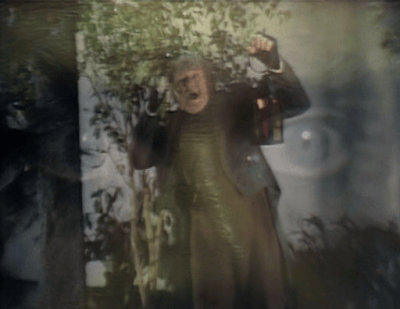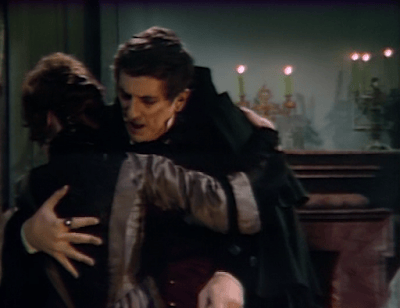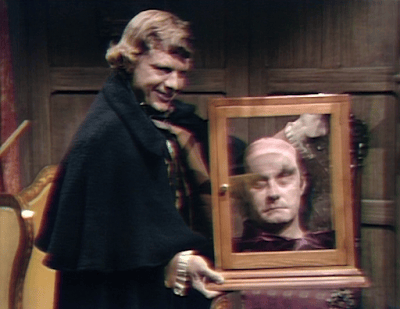
Episode 1141: Inheritance from the late Judah Zachery

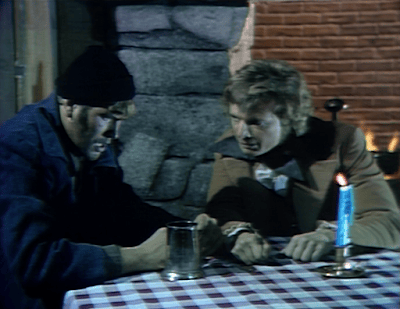
Ever since we first saw his ghost scowling at us in July, when the show was set in the far-off future year 1995, Dark Shadows has been trying to build Gerard Stiles up as the next villain who will become a breakout star. Gerard’s ghost haunted the great house of Collinwood and masterminded its destruction in August and September 1970, when the show took place in a contemporary setting. For over six weeks now, we’ve been back on Gerard’s home territory, in the year 1840, where he is a living being. Today, they remember that they are supposed to make us care about him.

So far in 1840, Gerard has been a complete bust as a charming villain. James Storm’s natural appeal has been thwarted by Gerard’s limited range. So far, the only attitudes he has portrayed are Smug and Enraged, neither of them an inherently attractive state.

Nor have the people who like Gerard given us much reason to hope he will show a more appealing side. Lady novelist Flora Collins raves about him as “The Healer!,” but in their scenes together Gerard displayed only his customary self-satisfaction while Flora seemed determined to find something marvelous about him. Samantha Drew Collins, widow of Quentin Collins, was in love with Gerard and even married him. But Gerard was just as blandly smug in his scenes with her as he was in his scenes with Flora, and when it turned out Quentin wasn’t dead after all Samantha very quickly caught on that he never had any feelings for her, only for Quentin’s money. He dismissed her, and we haven’t seen her since. Quentin regards Gerard as a friend; he was amused to find that he and Samantha had had a wedding, and he is amused when he talks about Gerard’s presentation of himself as a seer. Quentin may enjoy Gerard’s company, but only to the extent that he doesn’t take him seriously.

Not only has Gerard not lived up to the “charming” half of “charming villain,” he barely qualifies as a villain at all. A villain is supposed to give the rest of the cast things to do. The protagonists get to be heroic, the ingenue gets to suffer nobly, etc, because of the villain’s evil deeds. But most of Gerard’s evil deeds have failed to attract anyone’s notice, let alone open up the story for participation by more characters. He now divides his time between two solitary pursuits, berating a severed head he keeps in his bedroom and fondling a jewel-encrusted golden mask he stole from the tomb where he found that head. Even the other residents of Flora’s house, a mansion known as Rose Cottage, don’t know about Gerard’s pastimes.

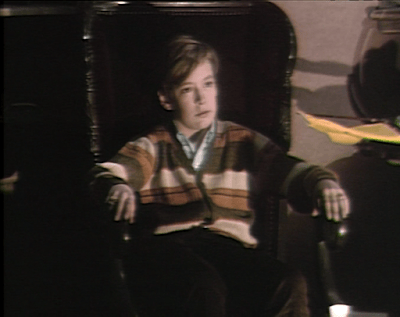
Teenager Carrie Stokes comes to Gerard’s room during his head-berating time. He is furious at the interruption. His anger stuns Carrie, who has been away for a few weeks and who has a crush on Gerard. Gerard eventually remembers to smile at Carrie, and sounds pleasant when he asks her to go away.

In 1970, Carrie’s ghost took possession of teenager Hallie Stokes. She was terribly afraid of Gerard’s ghost at that time, and Carrie/ Hallie was among those Gerard’s ghost murdered shortly before the show took us to 1840. So when regular viewers see Carrie brighten up at the sight of Gerard and try to flirt with him, it not only confirms that an adolescent girl might be attracted to him, but also takes us back to one of the moments when Gerard was impossibly repellent and revises it as a late stage in a story which has yet to be told. So that little scene is a step towards making Gerard interesting.

Gerard has figured out that the head is the focus of an evil spirit that is in the process of taking possession of him. Every member of the audience figured that out quite a while before he did. In fact, even after the head had told Gerard what it was doing in so many words, illustrating its explanation with vivid imagery in a dream visitation, Gerard still kept looking at the head and demanding further clarification. Gerard’s apparent cognitive limitations further undercut our hopes that he will be a dynamic presence in the plot. Interesting characters don’t have to be smart in an IQ sense, but they do have to know what they want, to observe what is going on around them, to absorb new information, and to use that information in their efforts to pursue their goals. Until today, Gerard has not shown the ability to do any of those things.

Gerard finally does something with a definable purpose when he takes the head, still in its glass case, to the top of the cliff on Widow’s Hill and throws it to the rocks below.
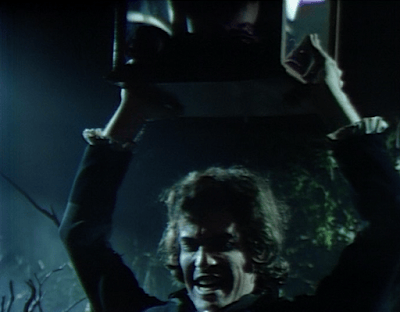
Gerard flings the head over Widows’ Hill. Screenshot by Dark Shadows Before I Die.

Carrie emerges from the darkness the moment after Gerard flings the head into the abyss. He demands to know what she saw and why she is there. She says she saw nothing, and that she followed him to see if he was meeting a girl. He calms down and makes another attempt to be charming. She says that he seems to be himself again. He is happy with this idea.

Gerard takes Carrie back to Rose Cottage. Her governess, Daphne Harridge, is waiting for her there. Daphne says that she will take Carrie back home to the great house on the estate of Collinwood. But then it turns out that Samantha has sent her son Tad, Daphne’s other charge, to stay with Flora at Rose Cottage and that there is no reason Carrie should not stay there as well. Gerard sends Carrie out of the room to say goodnight to Flora.

Gerard takes this as an opportunity to pressure Daphne to go out with him on a date. Daphne has only just met Carrie and may not know about her feelings for Gerard. Nonetheless, she is uncomfortable with the idea of going out with him, partly because Samantha’s sister Roxanne just died, partly because of Gerard’s aggressive manner, and partly because Flora’s son Desmond already forced her to spend some hours socializing with him in the afternoon. She keeps refusing, and he keeps informing her that he will call for her at Collinwood in an hour.

After a hostile interlude with Desmond, Gerard spends some quality time fondling the mask. He then gets very sleepy. He yells down the hall at Carrie, saying he is about to take a nap and asking her to wake him in half an hour. She yells back that she will be glad to. As is customary for men in Collinsport, he lies down on the bed fully clothed, boots and all. He dreams that Carrie wakes him, saying that a pleasant man has come to see him. He opens the door to find a man he has never seen holding the glass case that he had thrown off the cliff. He awakens, and the same scene plays out.

The man is unknown to Gerard, but familiar to longtime viewers. He is Humbert Allen Astredo. In 1968, Astredo played the suave Nicholas Blair, who was introduced as a warlock of unfathomably vast powers. Astredo’s talents as an actor were so considerable that he held our attention for weeks and weeks, keeping us waiting to see what terrible plan Nicholas was pursuing. When it finally became clear that Nicholas was flying blind and that whatever he might come up with to do was going to fail almost immediately, the disappointment was so bitter that he had to be incinerated and dragged back to Hell in front of us. Apparently even that wasn’t sufficient punishment for having disappointed us so thoroughly. When another storyline collapsed early in 1970, they brought Nicholas back for a couple of weeks, just so that they could kill him off again.

In between his two tours of duty as Nicholas, Astredo appeared in the long segment of Dark Shadows set in 1897 as lawyer/ Satanist Evan Hanley. Evan was both a commentary on Nicholas and a great improvement on him. He aspired to become what Nicholas was introduced as already being. That gave him a set of goals and kept us in suspense as to how close he would come to achieving them. When he fell short of his objectives, it was interesting to see what would happen to him and how he would react to it.

We can’t tell who Astredo is today. He might be a third run-through of Nicholas. If so, we can expect that he will strut and preen and tell Gerard that he cannot escape what is in store for him. When Gerard’s personality is erased and James Storm starts playing the evil spirit of the head, Nicholas will become his helpless stooge and wind up in yet another damnation scene. That sounds pretty dismal. But if this is another human aspiring to become a warlock, perhaps he will recapture the spark that Astredo cultivated as Evan. If that happens, Gerard or whatever takes Gerard’s place just might have an associate in whose company he can finally shine brightly enough to become what we had hoped he would be.
Episode 1126: Evil is joining evil

Overbearing undertaker Lamar Trask is on a mission to find out what happened to his late father, fanatical witchfinder the Rev’d Mr Trask. Trask was last seen entering the gates of the estate of Collinwood in the 1790s. Lamar is pretty sure that he was murdered by Barnabas Collins and that his remains are in the Old House on the grounds of Collinwood.

Lamar is correct on these points. There is a Barnabas Collins staying at the Old House now; he has identified himself as the son of the Barnabas who was there in the late eighteenth century and who left for England. Unknown to Lamar or the others who live on and around Collinwood in 1840, he is in fact the same person, and never went to England. A witch turned him into a vampire in 1796, and he was sealed in a coffin in the old cemetery north of town after he had taken many victims. He was released to prey upon the living in 1967. Now, Barnabas and his friend Julia Hoffman have traveled back in time from 1970 in hopes of preventing a disaster that will befall Collinwood in that year as the result of events in the current year, 1840.

Lamar is in a mansion near Collinwood known as Rose Cottage. He is visiting Gerard Stiles, a guest of Flora Collins, the lady of the house. Lamar tells Gerard and Flora that he is searching for his father’s remains and that he hopes to take revenge on his killer. When he says that he believes Barnabas has something to hide, he piques Gerard’s interest. Barnabas saw Gerard’s ghost as the face of the disaster in 1970, and when he encounters a potential adversary Barnabas is incapable of concealing his hostility for one second. So when he met Gerard as a living being, Barnabas all but announced himself as his sworn enemy. Gerard wants to know who this new foe is and what he wants, so he suggests holding a séance to contact the late Mr Trask. Flora avidly agrees, and Lamar goes along.

The séance is barely underway when the disembodied voice of Trask rings out. It speaks of evil in the room and evil all around them. It says that soon the evil will walk again. Since Barnabas is not in the room and can already walk, it does not seem to be a reference to him. We cut to an alcove in the room shaded by a curtain; in it there is a glass case holding a severed head. Flora’s adult son Desmond brought it home with him from a trip to Macau, and it has already taken possession of him and killed two men. Returning viewers know that the evil Trask is speaking of is that which emanates from the head. Since Barnabas murdered Trask, and did so most cruelly, it really is quite decent of him to forgo an opportunity to ask that Barnabas be punished and to focus on this immediate problem.

Trask was a villain in life, whose fanatical sincerity not only led him to commit grave injustices but also turned itself into hypocrisy when he saw that only crime could prevent an embarrassment that would interfere with his mission. But he has been somewhat redeemed in death. In #523, made and set in 1968, a warlock raised Trask’s ghost and tried to manipulate his hostility to Barnabas for evil purposes, but he would not be used. He was about to warn well-meaning governess Vicki of the danger the warlock posed to her when he met a character played by Roger Davis. At the sight of him, Trask instantly returned to whence he came. Say what you will about Hell, at least you don’t have to put up with Roger Davis while you’re there.

None of Trask’s ominous utterances is very definite, but one would have puzzled the assembled spiritualists more than the rest. He warns them to “Beware the cross!” Trask wasn’t consistently orthodox in his approach to Christianity, but he was all for the cross. What we can see that Lamar, Gerard, and Flora cannot are cross-cuts to a secret underground chamber in an old cemetery. Desmond, in search of the body that used to go along with the head, uncovered the chamber and found a coffin in it. A large cross is wedged between the ceiling of the chamber and the lid of the coffin, holding the main part of it shut. There is a Dutch door cut into one end of the lid. Desmond opened it, and found a golden mask with many precious jewels embedded in it. The opening looked big enough to pull the body through, but Desmond decided to put the mask back and get help moving the cross.

Desmond went to the Eagle tavern. There, he found a drunken sailor named Tim Braithwaite. He offered Braithwaite a $20 gold piece if he would do a job for him, no questions asked. Tim starts asking questions. The first is whether Desmond wants him to beat someone up. His tone and manner suggest that Desmond has hired him to do that before. This reminds us that they’ve never got round to telling us much about Desmond. All we know is that he is the sort of person who goes to Macau and buys severed heads, which come to think of it is also the sort of person who hires guys to beat people up.

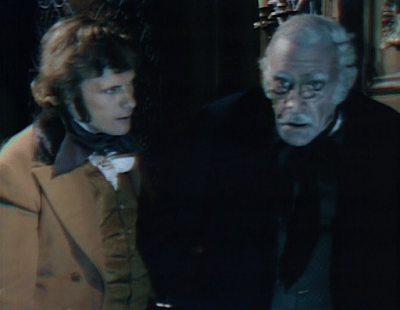
Desmond has a job for Tim. Screenshot by Dark Shadows Before I Die.

Tim is now in the chamber working the cross loose while Desmond is at the livery stable getting a cart in which to carry the coffin back to Rose Cottage. That’s the cross of which Trask wants Lamar, Flora, and Gerard to beware.

Tim finds the jewel-encrusted mask and decides to make off with it. The body comes to life, leaves the coffin, kills Tim, and escapes from the chamber.

Tim’s name recalls two other characters. At first glance I mistook actor Dick Sabol for Don Briscoe, and the resemblance between them is strong enough that every time Desmond calls him “Tim” I thought of Briscoe’s character Tim Shaw, who figured in the story when it was set in the year 1897. Tim inadvertently helped to reunite evil sorcerer Count Petofi with his severed and equally evil hand, so the resonance with that Tim is a clue to longtime viewers that this one will also thwart his own plans in the course of reconnecting the evil head with its missing body.

We’ve heard the name “Braithwaite” before as well. Abe Vigoda appeared in #684 and #685 as aged silversmith Ezra Braithwaite, and Edward Marshall played a much younger version of the same character in #764. We learned in those episodes that Braithwaite’s silver shop had been in operation in Collinsport continuously from 1781 to 1968. Vigoda returned to the show just last week, playing the head’s victim Otis Greene in # 1124. Nothing is said of any connection between Tim and the owners of the silver shop, though “Braithwaite” isn’t so common a name that we can assume he is not related to them. All we can be sure of is that the writers and producers had Abe Vigoda on their minds at this time.

A woman named Christine Domaniecki is seen gulping a drink at the Eagle. She is credited as “Christine Domaneck,” in the role of “Barmaid.” Whether “Domaneck” was a stage name or a typo, who can say. Ms Domaniecki has the role because she was the runner-up in the Miss American Vampire Contest, a promotion for the feature film House of Dark Shadows. She went on to become a highly accomplished makeup artist in Hollywood, working on dozens of well-known television and big screen productions. She was nominated for a primetime Emmy in 2016 for her work on a production of The Wiz. This episode is the first of six screen acting credits listed on her IMDb page. All of the others went direct to video, were produced in the 2000s, and involved her then-husband, Michael R. Thomas. Four of the five appear to be soft-core porn flicks.

The winner of the Miss American Vampire contest was Sacheen Littlefeather. Littlefeather made an appearance on a 1970 episode of To Tell the Truth in her capacity as Miss American Vampire, but was not able to be in New York to tape this episode. She became even more famous in 1973, when her friend Marlon Brando dispatched her to Hollywood to convey his refusal to accept the Academy Award for his work in The Godfather. As luck would have it, Abe Vigoda also had a part in The Godfather, playing doomed capo Sal Tessio.

Also, Brando’s performance in The Godfather always reminds me of David Henesy as strange and troubled boy David Collins in #667. I wonder if Brando insisted on holding a cat during the opening scene of the film because he didn’t want people catching on that he was copying Mr Henesy.

You come to my house on the day of my daughter’s wedding and you ask me to play dress-up? Screenshot by Dark Shadows Before I Die.

This one also includes a notable blooper. Jerry Lacy’s Lamar is telling Flora about his suspicions of Barnabas:

LAMAR: Ms. Faye corroborated my opinion. When I asked her to locate my father’s last remains, she had a vision of the Old House.

FLORA: But that is when the original Barnabas lived there, wasn’t it? Before the main house was built?

LAMAR: Yes, that’s true, but I don’t think… I do think he had something to do with it.

FLORA: You don’t think he had anything to do with it!?

LAMAR: What I think is my business.

It’s clear enough that Mr Lacy was supposed to stop with “Yes, that’s true…” and that he encroached upon Flora’s dialogue with “but I don’t think,” leaving him in a trap from which he could escape only by adding “I do think he had something to do with it.” Joan Bennett goes ahead with her scripted line, sounding exactly as you suppose she would if she had received the correct cue, and he responds with “What I think is my business.” Though the blooper makes this final line nonsensical, Mr Lacy delivers it with the full weight of Trask’s immense pomposity, and the effect is hilarious.

Episode 1125: All the rotten apples

The narrative voiceover that opened #202 told us that a new addition to the cast of characters, dangerously unstable ruffian Willie Loomis, was destined to “awaken and unleash a force that will affect the lives of everyone.” In #209, the voiceover identified this “force” as “the darkest and strangest secret of them all.”

In his first five appearances, Willie was played by Mississippian James Hall. In #205, Hall’s Willie was escorted to a portrait we had seen for the first time under the previous day’s closing credits. Strange and troubled boy David Collins identified its subject to Willie as Barnabas Collins, a name we had not heard before. Soon Willie started to hear a heartbeat coming from the portrait, and it led him to a mausoleum in a rarely visited part of the old cemetery north of town. In #210, Willie, now played by John Karlen, inadvertently opened a secret panel in that mausoleum and found a chained coffin in the secret chamber behind it. He opened that coffin, hoping to find the jewels that once belonged to Barnabas. In fact, he found Barnabas himself, a vampire who would enslave him.

In the fall of 1970, the feature film House of Dark Shadows was playing in theaters around the USA. In that movie, Karlen again plays Willie. That version of the character is led to the mausoleum not by a heartbeat he hears through a the portrait of Barnabas, but by a riddle he finds in an old book:

The Madonnas rest high above

The Lion’s head watches the dove

And in the womb beneath the hill

A blazing light glows bright and still.

As in the show, so in the movie Willie opens the coffin expecting to find a fortune in jewels, only to find Barnabas’ hand darting for his throat. As in the show, the movie version of Willie becomes a slave whom Barnabas beats unmercifully.

Now, the show is set in the year 1840. Karlen plays Desmond Collins. An evil spirit emanating from a severed head Desmond brought home with him from Macau has taken control of him. As Willie heard the heartbeat from the portrait of Barnabas, so Desmond hears a voice from the head. The head wants to be reunited with its body, which is buried somewhere in the Collinsport area. Yesterday Desmond brought a man named Otis Greene to his room. Greene was under the head’s control in 1803, when he brutally murdered four people. Desmond showed the head to Otis, who was horrified. Desmond demanded to know where the body was, and kept shouting in Otis’ ear even after Otis clutched his chest and started gasping. He managed to get a few cryptic remarks out of Otis before he fell dead to the floor: “The noose, a ring of gold, the stairs, top of the hill, direct line, an unmarked stone.”

A woman named Leticia Faye enters. Leticia sees Otis’ body on the floor and asks Desmond why he killed him. Leticia has psychic powers, so she quickly realizes that it was not really Desmond, but the head that is responsible. Desmond menaces her and demands she keep quiet.

Later, Leticia returns to the room and notices the body is gone. When she asked “Where’s the body?,” my wife, Mrs Acilius, laughed out loud. It’s as if she is noticing that Desmond has removed a piece of furniture. Desmond says that Otis’ son came and took it away. One might wonder how that went. There were no telephones in 1840, and we haven’t seen any servants at Desmond’s house. So Desmond must have gone to Greene’s son in person, told him he had his father’s body in his room, and asked him to come fetch it.

Leticia herself is a reference to Willie’s early days on the show. As seagoing con man Jason McGuire brought Willie to Collinwood to play a never-specified part in his plan to cheat the Collinses out of their money, so seagoing con man Gerard Stiles brought Leticia to play a never-specified part in his pursuit of the same objective. Before we saw Willie, we saw Jason talking on the telephone to someone named Chris who wanted to join him at Collinwood and with whom he had an ambivalent relationship. We might have assumed that “Chris” was short for some such name as Christine or Christabel and that she was a girlfriend or wife who was going to complicate Jason’s plans to impose himself on matriarch Elizabeth Collins Stoddard. When the name Chris was dropped and Willie put in its place, we saw it wasn’t quite that way, but as Dennis Patrick played Jason and both James Hall and John Karlen played Willie, we wondered if it might have been somewhat that way. There was something a lot more complicated in the emotions they showed in their scenes together than what could be explained by what we saw.

Leticia is upset with Gerard these days. He married Samantha Collins, widow of Quentin Collins, lady of the great house of Collinwood, and sole heiress to the Collins fortune. That seemed to seal his triumph, and left Leticia out in the cold. The marriage was only a few hours old when it turned out Samantha wasn’t a widow after all. Quentin turned up alive and well six months after he went missing during a mishap at sea. Now Samantha has to decide whether to go back to Quentin, leaving Gerard where he started, or to go with Gerard, going him a wife to support somehow. Leticia mocks Gerard bitterly for the dismal alternatives he now faces.

House of Dark Shadows left the audience to do a lot of guesswork as to how the characters got from one place to another, and indeed as to where exactly any given scene was supposed to be taking place. Among other things, it never explained how the riddle led Willie to the mausoleum. Today, Desmond goes to his cousin Gabriel Collins to ask for help deciphering Otis’ cryptic remarks. Gabriel mentions a place called Gallows Hill; that reminds Desmond that Otis said his grandfather was the executioner, and between them they figure out where to go.

In both #210 and House of Dark Shadows, Willie opened the secret panel in the mausoleum in the old cemetery by pulling a ring that was connected to a cable. Today, Desmond pulls a ring on a small headstone in an old cemetery and opens a secret panel on the ground next to it. As Willie walked down stone steps and found a chained coffin behind the panel, Desmond walks down stone steps and finds a coffin. This coffin is held shut, not by chains, but by a large cross wedged between it and the ceiling of the chamber.

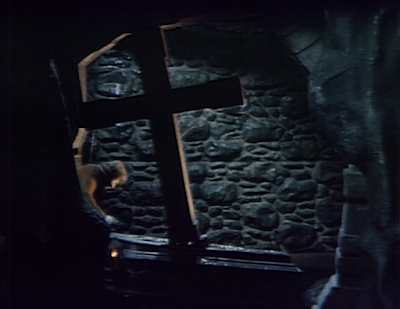
The underground chamber. Screenshot by Dark Shadows Before I Die.

Desmond finds that the lid of the coffin is divided into two parts. He can open the small part at one end. inside it, he finds what Willie had hoped to find, many precious jewels. They are embedded in a golden face mask.

Episode 1124: Where the bodies are buried

Desmond Collins has fallen under the influence of an evil spirit emanating from a severed head he bought in Macau, and is now trying to find the body that used to be attached to the head. Lamar Trask is an evil spirit unto himself, and is trying to find the body of his late father, fanatical witchfinder the Rev’d Mr Trask.

It is not clear what the severed head is hoping will come of a reunion with its body, though longtime viewers will remember the last time a body part was reconnected to its original possessor. Evil sorcerer Count Petofi stuck his hand back on the end of his arm in #814. As separate entities, Petofi and the hand both wielded considerable magical powers. Reunited, they seemed to be unstoppable.

What Lamar wants is much clearer. He believes that his father was murdered in the 1790s, 45 years ago. He hopes that the killer might still be alive and that he will be able to take revenge.

As it happens, Lamar is right about what happened to his father. Vampire Barnabas Collins walled Trask up in his basement and left him to die there. Barnabas is back on the estate of Collinwood, having been sealed in his coffin in 1796, freed in 1967, and dislocated in time in 1970. It might be just for Lamar to expose Barnabas and destroy him, but it would also ruin the show. Besides, Lamar and his father are both hilariously obnoxious, so it wouldn’t occur to anyone to root for them.

Lamar persuades Cockney showgirl/ mentalist Leticia Faye to hold a letter from his late father while she goes into a trance. She has a vision of the Old House on the grounds of Collinwood. Lamar interprets this to mean that his father’s remains are there. Barnabas interrupts this scene and reproves Lamar for taking advantage of Leticia. He might have pointed out that what Leticia was doing is by any definition witchcraft, and have gone on to point out that the Rev’d Mr Trask would be horrified that his son would participate in it. But that would put Lamar on the defensive, and the function of a Trask is always to attack.

The Collinses think that Barnabas left for England in the 1790s and died there. They also believe that he and his fellow time traveler, mad scientist Julia Hoffman, are the offspring of that original Barnabas come to visit their late father’s birthplace. The other day, Daniel Collins, master of Collinwood, invited Barnabas to stay in the Old House as long as he liked. So Barnabas does not have to sit still for Lamar’s attack later, when he goes home to the Old House and finds him poking around. Lamar explicitly says that he is looking for his father’s remains. Knowing that they are behind a brick wall which has attracted no one’s notice in the decades for which it has stood, Barnabas is quite relaxed about this search. He tells Lamar that he is risking his good name by taking Leticia’s visions so seriously, and tells him to leave the house.

Desmond and Leticia live under the same roof. She is his mother’s permanent guest in their home, a mansion known as Rose Cottage. But unlike Lamar, Desmond does not turn to Leticia for guidance today. At the beginning of the episode, she walked into the room where he keeps the head, exclaimed about the evil present there, and fainted. So he gives her a wide berth for the rest of the day.

Instead, Desmond calls in Otis Greene, who was associated with the head in 1803. The head possessed Otis, as it is taking possession of Desmond, and led him to commit four brutal murders. Otis confessed to those murders and asked to be punished, but his talk about the head led the court to exercise a leniency extraordinary for the period and to set aside criminal charges, instead committing him to an asylum. Released from there about ten years ago, Otis has established himself as a successful antique dealer.

Otis enters and at once begins admiring Desmond’s furniture and telling him about the prices it would fetch in his shop. He looks at one chair and says that he knows a collector who would pay the fantastic sum of $100 for it, equivalent to many thousands of dollars in 2026. Desmond says he is not interested in selling the chair, and directs Otis’ attention to a table that belonged to someone associated with a witchcraft trial.

Desmond questions Otis. Screenshot by Dark Shadows Before I Die.

Otis is played by Abe Vigoda, his second role on Dark Shadows. Vigoda’s first character made his entrance in #684 expressing admiration for the fine things around him, as Otis admires Desmond’s furniture today. That was Ezra Braithwaite, a silversmith. Ezra was brought on to provide information that would lead to the ghost of a man from his own past. Ezra did answer some questions, but the ghost killed him before he could make an exit.

Evidently writer Sam Hall remembers Ezra. Not only does Otis make the same entrance as Ezra, but like Ezra he is there to talk about his past. He tells Desmond that his grandfather was the executioner in the town of Bedford, and that his work brought a curse on the family. Desmond shows Otis the head, and he is shattered at the sight of it. Desmond demands to know where the body is. Otis resists answering, but is quickly overwhelmed with chest pains. Desmond screams in his ear, and he starts gasping out cryptic remarks. “The noose, a ring of gold, the stairs, top of the hill, direct line, an unmarked stone.” He falls dead, and Desmond vows that the hidden body will be found.

Unfortunately, this marks Abe Vigoda’s final appearance on Dark Shadows. Vigoda’s first television role came in 1949, when he was 28 years old. He played a character identified as “Old Man on Train” in an installment of Studio One. He went on playing old men on television, in movies, and on Broadway until his death in 2016. His most famous feature film role was that of doomed capo Sal Tessio in The Godfather (1972,) and his biggest TV part was as Detective Philip K. Fish on the series Barney Miller and its spin-off Fish (1977-1978.) He once sat on a panel of cast members at a Dark Shadows convention. When it was his turn to talk, he said “My name is Abe Vigoda. I played Otis Greene on Dark Shadows. I don’t remember much about it,” and passed the microphone to the next person.

Episode 1123: The Strange Case of the Pagan Head

Desmond Collins has fallen under the power of a mysterious severed head he brought back from southeastern China. When his mother Flora sees him in the room where he keeps the head in a glass case, he bursts out with inexplicable remarks, such as “An outcast has no friends!” and “I kept telling them! Death was an extension of life! I kept telling them that!” Flora remarks that Desmond hasn’t acted like that since he was in love with a girl named Carson. He then tells her that she’s discovered his secret. He met a pretty girl recently and can’t find her again, and that’s what he’s upset about. This doesn’t explain who it was Desmond told that “Death was an extension of life!” or why it is important to remember either that idea or the notion that “An outcast has no friends,” but it’s the best Flora is going to get, so she settles for it.

Desmond really is trying to reconnect with a pretty girl. Her name is Daphne Harridge, and he finds her today when he goes to the offices of the Collinsport Star to ask for some issues from October 1803, 37 years ago. His cousin, the 57 year old Daniel Collins, told him that the papers were full of stories about a series of murders that took place in and around the town of Bedford in that month, and that a severed head was mentioned in connection with them. Since Daniel also said that the man who was last known to have the head ran off to Macau and died there, Desmond suspects that it is the same head he brought back from that city. Moreover, a man named Ben Stokes recently died in circumstances that strongly remind Daniel of the Bedford Atrocity, and Desmond now knows that the Head has power over him. So he fears the worst.

Desmond is surprised when Daphne answers the door at the offices of the Star. She explains that she needed a job, and she found a respectable one there. She shows him the file with back issues from October 1803. He finds some with stories about the killings in Bedford, and asks permission to sign them out. When he does, she asks if he is making a joke. He has signed his name “Judah Zachery.” He is disconcerted, then claims that he uses that as a pen name for some writing he does.

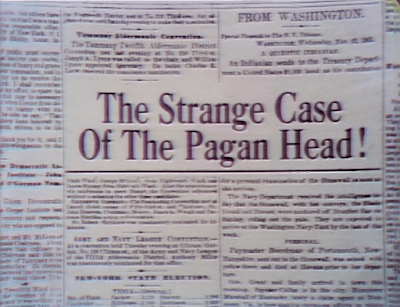
A headline from an October 1803 edition of the Collinsport Star. Screenshot by Dark Shadows Before I Die.

Earlier, we had seen Daphne at what we now know was her desk at the newspaper office. Daphne was thinking to herself that she really ought to have found a way to pretend to like Desmond when they met yesterday, since he can be useful to her in the objective she has come to Collinsport to pursue. She wondered how she would meet him again. So when he invites her to the house he and Flora share, a mansion known as Rose Cottage, she gladly accepts.

Daphne has dinner with Desmond, Flora, and Quentin Collins. Quentin is Daniel’s son and the heir to his vast fortune. He turned up at the great house of Collinwood the other day, six months after he and his son Tad were washed off the deck of a ship at sea and presumed dead. He and Tad hiked their way back to the States over a circuitous route that took them all through South America, and Quentin got home just in time to congratulate his wife on her remarriage.

Flora has recently taken an avid interest in the occult. She deals a layout of tarot cards to tell Quentin’s fortune. She is horrified by each card in its turn. She asks Quentin if someone close to him died recently. They just had Ben’s funeral and he has been close to the family for decades, but Quentin gets agitated and insists that no one he loves has died, no one at all.

Back in the newspaper office, Daphne writes in a notebook that she has met the man she came to town to kill. Presumably this is a private notebook; it might be embarrassing if that winds up printed in the paper.

Episode 1122: The drama will begin to unfold

A disaster destroyed the great house of Collinwood and everyone in it in 1970. The ghosts of some people who were alive in 1840 were part of this disaster. Vampire Barnabas Collins and mad scientist Julia Hoffman have traveled back in time in hopes of preventing the disaster.

One of the ghosts was that of governess Daphne Harridge. When Julia and Barnabas first arrived in 1840, they were bewildered to find that no one at Collinwood had heard of Daphne. Now, Barnabas has found Daphne skulking about in the woods on the grounds of the estate. He confronts her, and demands she answer a series of questions. Desmond Collins, a cousin of the Collinses who live in the great house, shows up just in time to hear Barnabas threatening to force Daphne to tell him what he wants to know. Desmond asks why he would do that, and Barnabas has no choice but to back down. Desmond and Daphne walk away together.

Barnabas has a habit of introducing himself to his adversaries by declaring that he has come to fight them. He did that when he met the evil Gerard Stiles, whose ghost he saw as the face of the disaster in 1970. But the living Gerard has no idea who Barnabas is. For all Barnabas knows, it might be possible for him to get close enough to Gerard to pick up a great deal of information from him that he can use to reshape the future. Daphne doesn’t recognize him either, but when in the twentieth century he and Julia interacted with her ghost and with a resurrected version of her, Daphne was often helpful to them. Barnabas’ aggressive manner in this scene blows any chance he may have had to build the same kind of relationship in this period. Even worse, when Desmond walks in on the encounter what he sees confirms the suspicions he has already expressed, costing Barnabas another possible ally.

My frustration with Barnabas’ part in this scene drove me to fanfic a few years ago. In a comment on Danny Horn’s post about the episode at his great blog Dark Shadows Every Day, I wrote:

One of my pet peeves is Barnabas’ habit of introducing himself to people as their enemy. He does it with Daphne in this episode, and he did it with Gerard last week. Not only is it irritatingly stupid, but it creates a pacing problem. They establish the enmity right away, then they have nothing to do while we sit around for weeks and weeks waiting for a confrontation. If he’d made an effort to charm Gerard, we could watch that effort crumble, and the last part of its collapse could coincide with their showdown.

The scene where Barnabas meets Daphne calls out for a different sort of fix. Everyone watching the show knows that Barnabas is a vampire, and everyone who saw the cliffhanger at the end of #1121 knows that Daphne is going to be important. So have him do a “Look into my eyes!” bit. Then we are in suspense- will he get useful information? Will he bite her? They show us Desmond approaching, and the suspense shifts- will Desmond catch them in a compromising situation? If he does, will Barnabas kill him? Even if the scene ends up doing as little to advance the plot as the scene they shot in fact does, the result would be an exciting sequence that promises big developments later on.

Comment by “Acilius,” 10 February 2021, on “Episode 1121: The Lost World,” Dark Shadows Every Day, 31 January 2018

In the great house, Julia is having a conversation with Gabriel Collins. She has told the family that she is a medical doctor. Nine more years will pass before Elizabeth Blackwell is admitted to that profession in 1849, making Julia the first woman to practice medicine in the United States. Extraordinary as her claim to be a doctor is, everyone accepts it equably enough. Gabriel says that one of these days Julia will have to see if she can do anything about his legs, which haven’t been able to bear his weight since an accident he had when he was a child. He starts to explain what his brother Quentin did to cause that accident. He is chattering away happily when he suddenly falls silent and drops his teacup. He is stunned to see Quentin entering the room.

Gabriel had thought Quentin was dead. Everyone thought that until a day or two ago, when Quentin returned after an absence of six months. He explained that while it is true that he and his son Tad were washed off the deck of a ship in a storm, they survived and made their way through South America by a highly circuitous route. Julia knows this, and greets Quentin calmly. But no one bothered to tell Gabriel. If that were not enough to tell us where Gabriel ranks in the hierarchy at Collinwood, it is made abundantly clear after Julia excuses herself and leaves the brothers to talk. Quentin says that he always felt guilty about his part in Gabriel’s injury, which is why he has put up with him so much longer than anyone else. But now, even he has had enough of Gabriel’s intolerable personality.

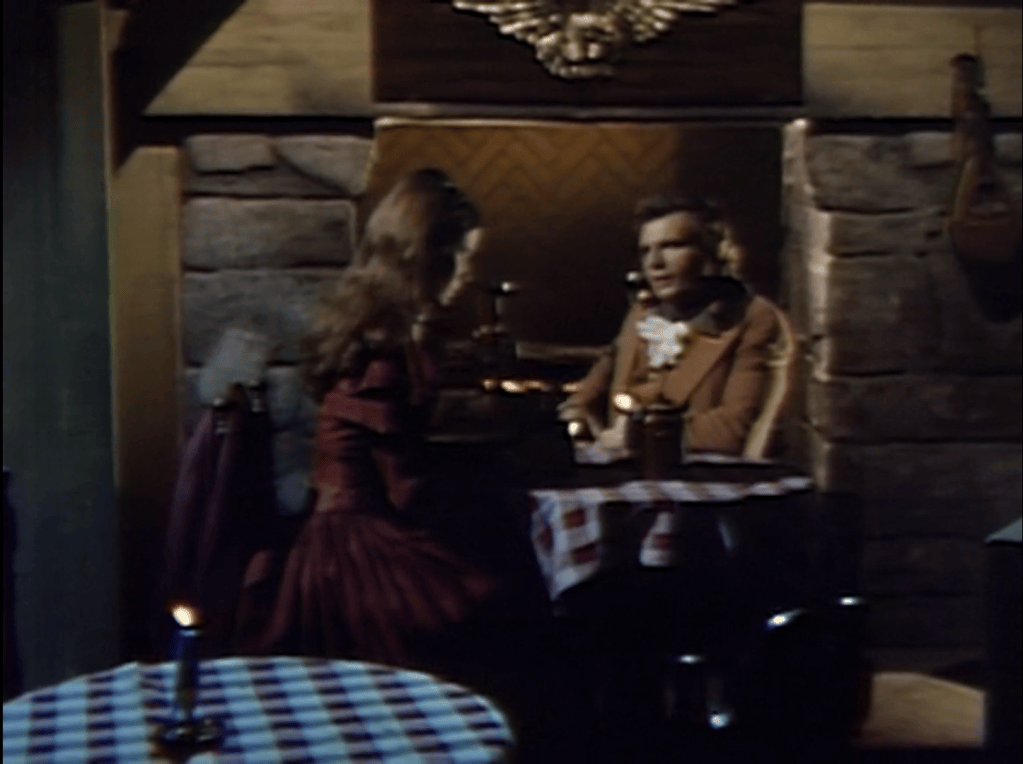
We see Daphne and Desmond sharing one of two circular tables covered with checkered cloths in front of a fireplace. On the wall above the fireplace is a metallic decoration in the shape of an eagle. In the foreground is a bar with a rack of drinking glasses. Longtime viewers know that the tavern in Collinsport was in the eighteenth and nineteenth century known as The Eagle, and that its tables were covered with checkered cloths even in the 1790s.

Daphne and Desmond at The Eagle

Daphne was prominent in the twentieth century segments that led us to 1840, while Desmond was never mentioned. His very existence seems to be omitted from the documents that Barnabas and Julia examined when they were trying to figure out what happened in 1840. So it is clear to us that he doesn’t have a shot with Daphne, but not to him. He’s dialed the charm up to 11, or would have if he weren’t such a grouchy New Englander that the most charming manner he can produce rises to about 4. She won’t answer any of his questions, but finally agrees not to check out of the Collinsport Inn and leave town until tomorrow.

Desmond goes home to a mansion known as Rose Cottage. He has brought a curio from his recent trip to southeastern China, intending it as a gift for Quentin. It is a human head in a glass box. When his mother reacted to the sight of this blasphemous thing with horror, Desmond told her that he was sure it was “a carving of some sort,” not an actual body part, and asserted that there was nothing frightening about it. He has since had second thoughts, though the head keeps waiting for Desmond to look away before it opens its eyes.

Quentin turns up and tells Desmond that he has come for the present he had told him he has for him. Desmond has changed his mind about giving the head to Quentin, so he has to scramble to come up with another present. Finally, he tells Quentin that the present is a couple of books about the occult. Quentin is delighted with them. He says he has been eager to get back into the study of “the lost world that we can’t understand, or even see.” He sits down and starts reading them right there, and Desmond suggests that it is time to go. Quentin is disappointed to have to wait to get home to read the books, but goes anyway.

Barnabas shows up and pesters Desmond about Daphne. Desmond is unimpressed with Barnabas, but does tell him that, contrary to the promise she made at the Eagle, Daphne has checked out of the inn and left no forwarding address. He shoos Barnabas away.

Back at Collinwood, Julia and Barnabas are in the drawing room. The doors to the rest of the house are wide open as they declaim loudly about how they are pretending to be people they are not and dare trust no one with their terrible secrets. Fortunately for them, the only person who overhears them is Daphne, who is sneaking into the house to leave a note in the foyer for Quentin.

Back at Rose Cottage, Desmond is yelling at the head. An image of the head is superimposed over him, and he shows signs of distress. We saw aged retainer Ben Stokes have a similar reaction the other day when the image of the head was superimposed on him; Ben died as a result. Desmond hears a voice telling him that he will follow its commands. We are to take it that he is now possessed by the head.

Episode 1118: Relics of the Anti-Saints

From March to June 1969, during a segment of Dark Shadows set in the year 1897, John Karlen played inveterate prankster Carl Collins. Carl could barely contain the manic glee his own practical jokes inspired in him, even though they rarely moved anyone else to more than irritation. A childlike man, Carl quickly dissolved into helplessness before even the slightest challenge.

Now, the dramatic date is 1840. Karlen is Desmond Collins. We met Desmond yesterday, and he seemed to be cut from the same cloth as Carl. He has returned from a trip to East Asia, and has brought a severed human head in a glass display case. His mother Flora reacted to this object with horror, as one would expect. In response, Desmond kept insisting that there was nothing frightening about the head and averring that he could not understand Flora’s reaction. His demeanor is calm and mature, setting him apart from Carl. But as regards the head, his judgment seems to be just as ludicrously poor.

Desmond does show good sense in one matter. Yesterday, Desmond expressed distrust of two people who have recently presented themselves at the great house of Collinwood under the names Barnabas and Julia Collins. Julia and Barnabas have identified themselves as brother and sister, and have said that their father was the Barnabas Collins who lived on the estate in the late eighteenth century and left for England in the 1790s. Desmond talks with Barnabas in the drawing room of the great house today, and is still openly suspicious.

The two people at Collinwood now who were there in the 1790s are Ben Stokes, an old man who was an indentured servant at Collinwood back then, and Daniel Collins, who was a child then and is now the master of the house. Daniel reacts with amazement to the sight of Barnabas. He is convinced he is the same man, unchanged after four and a half decades. Barnabas tells him he is the son of that Barnabas. There is still a note of suspicion in Desmond’s voice when he remarks that it is Barnabas’ night for being mistaken for his father, but he can hardly keep doubting that he is a member of the family.

As it happens, Daniel’s first impression was right. Barnabas is the person he knew long ago. Julia is not related to the Collinses at all. Barnabas has not aged, because he was turned into a vampire in the 1790s and was sealed in a coffin from that time until Julia released him a few nights ago. She is a time traveler from the year 1970, where she and Barnabas are friends. Barnabas is also a time traveler of a sort; he used some mumbo-jumbo to project his 1970 personality into his 1840 body, so that he and Julia are on the same page now. They have traveled into the past in hopes of preventing a disaster that will befall the Collins family in 1970, so their motives are good. But after all, one of them is a vampire and the other is a mad scientist. They are not likely to be an unmixed blessing to any house they enter.

Ben is visiting Flora at the house she and Desmond share, a mansion near Collinwood known as Rose Cottage. He sees the head, and recognizes it as something that figured in a series of murders many years before. Those murders took place in and around a town called Bedford, and are therefore known as The Bedford Atrocity. Ben asks Daniel if he remembers the matter. He certainly does, and mentions that his late sister Millicent had a book that included a chapter about it. He suggests Ben look for the book in the attic.

Ben finds the book there, and he is sure that if he shows it to Desmond he will convince Desmond to destroy the head. He takes the book to Rose Cottage. No one is home. He leaves the book in the room where the head is kept and writes a note for Desmond. He explains to the head that he is going to destroy it. This turns out to have been an unwise move. When Ben is walking home through the woods, an image of the head is superimposed over him and he reacts with distress.

In a day concerned with nautical mishaps, it is somehow fitting that Ben gets stuck in the head. Screenshot by Dark Shadows Before I Die.

There are a couple of other points worthy of mention. Daniel is conscious of his position as master of Collinwood, but he is not the haughty overlord Louis Edmonds played when he was Joshua Collins in the part of the show set in the 1790s or the stuffy but lovable figure he created as Edward Collins in the 1897 segment. He is dignified, courteous, and kindly. But he is also gravely mentally ill. When first we saw him, he tried to kill Julia, not for any of the good reasons anyone might have to do such a thing, but because he thought she was his late wife, whom he killed years ago and keeps trying to kill again every time she shows up disguised as someone else. He cannot remember who is alive and who is dead, or what year it is. (In fairness, these are very difficult things to keep track of on Dark Shadows.) It’s a cliche that Jonathan Frid played Barnabas “as if he were playing King Lear.” In his scenes today, Edmonds quite literally is playing King Lear. Mrs Acilius and I marveled at the depth and complexity of the characterization.

Barnabas meets the evil Gerard Stiles. Barnabas knows that Gerard’s ghost will cause the destruction of the great house and its residents in 1970 and that he will still preside over its ruins in 1995. Gerard tells Daniel a story about the deaths of his son and grandson, Quentin and Tad Collins. Barnabas is in the room when Gerard tells this story, and has reason to disbelieve it. Later, he is alone with Gerard and challenges his story. Barnabas learns nothing from this encounter, but Gerard learns that Barnabas is his enemy. Barnabas very often introduces himself to his foes by showing his cards in this way. That habit does keep the plot moving, but it is frustrating that the protagonist does not even try to ingratiate himself to his adversaries and get information from them he can use to advance his goals.

Episode 1117: That Hideous Strength

The Signal of Another Start*

In June 1970, Dark Shadows was set in a universe other than the one where it usually takes place. The show insisted on calling that other continuity “Parallel Time.”

In the main continuity, mad scientist Julia Hoffman is the friend and enabler of vampire Barnabas Collins. When Barnabas crossed over to Parallel Time, he found that Julia’s counterpart there was as devoted to wicked witch Angelique as the Julia he knew was to him. He made himself Angelique’s enemy, and in #1036 Hoffman was poised over him with a stake and a hammer, ready to destroy him. In the nick of time, Julia arrived from the main continuity and saved Barnabas. She bashed Hoffman’s head in, stole her clothes, and set about impersonating her. When Barnabas first saw Julia in Parallel Time, he thought she was her Doppelgänger, and since she was in his hiding place he was going to kill her. Fortunately for Julia, Barnabas had got into the habit of making speeches to people before he murdered them, so she was able to tell him who she was. With that, the murder was off and their friendship was back on track.

Now, it is Julia who has crossed over into another world. She has traveled back to the year 1840, and has told the family in the great house of Collinwood at that time that she is the daughter of the Barnabas Collins who supposedly left for England in the 1790s. She has also told them to expect her brother, Barnabas Junior, who, she says, looks just like their old man.

In a moment of extreme folly, Julia went to the room where Barnabas was sealed in his coffin in the 1790s and released him. This mirrored the folly of her waiting around in his hiding place after she killed Hoffman in Parallel Time. The Barnabas of 1840 had no idea that any time had passed since he was imprisoned four and a half decades before, and certainly did not know what Julia was talking about when she claimed that they had met in 1967 and become friends in 1968. He was about to kill her when his old friend Ben Stokes turned up in the nick of time and stopped him.

Now, Barnabas has discovered that Julia is interfering in his plans. He has bitten the lovely Roxanne Drew, intending for her to die and rise as his vampire bride. Julia and Ben found Roxanne and brought her to the Old House on the grounds of Collinwood. Julia is giving Roxanne a blood transfusion which has prevented her death. When Barnabas sees what is going on, he grabs Julia and is about to bite her.

Barnabas is already flashing his fangs when he has a seizure and collapses. He stands back up and finds Julia holding a cross at him. He tells her that he is the Barnabas of 1970, projected into his 1840 body by some mumbo-jumbo involving the I Ching. He could be making that up based on things she has already told him, so she keeps holding the cross. He goes on to give specific facts about several people they know in 1970. She realizes he is telling the truth. She puts the cross down, and gives him a hug. As Julia came from the main continuity and destroyed her own Doppelgänger to save Barnabas, so Barnabas has come from the future and destroyed his previous self to save Julia.**

Embraceable vampire. Screenshot by Dark Shadows Before I Die.

The 1970 model Barnabas does not want Roxanne to be a vampire, and he is ashamed of his earlier self for having tried to make her one. Roxanne comes to, sees him, and is delighted to think he has come to bite her again. When he says that things have changed, she is disappointed and he is embarrassed. He goes away.

Julia has a superhuman power of hypnosis that she has often used to erase people’s memories and overwrite them with information that will not incriminate Barnabas. She tries this on Roxanne. She is halfway through the process when some noises outside prompt her to leave the room and investigate. The room is at the top of the stairs, and has been a major set for years. We’ve caught glimpses of the door that opens to it a couple of times, but this is the first time there is set built all the way to the railing.

Julia goes to the railing and calls downstairs, asking if anyone is there. No one answers, so she goes back into the room. Roxanne has somehow got away.

Barnabas goes to the great house and introduces himself as Julia’s brother. Julia comes. They get a private moment, during which Julia tells him that Roxanne escaped and that she does not know whether the hypnosis was successful. Roxanne enters, looks at Barnabas, and announces to the assembled Collinses that she knows who he is. She is escorted upstairs. Barnabas and Julia are on the verge of panic until Roxanne’s sister, Samantha Drew Collins, comes down and says that Roxanne doesn’t remember anything of the last couple nights.

The Gods are Weak at First*

The 1970 version of Barnabas is not the only character to make his grand entrance today. We also meet Desmond Collins and an acquaintance of his.

Desmond is the son of Flora Collins, a lady novelist and all-around silly person who lives in the nearby mansion called Rose Cottage. He has just returned from a long journey with a present for his friend, Quentin Collins, husband of Samantha and heir to the Collins estate. Flora breaks the sad news that Quentin and his son Tad Collins were lost at sea some time ago, that they have been missing ever since, and that they are now presumed dead.

The present is in a large cube that is covered with a cloth. Desmond removes the cloth and exposes a glass box holding a severed head. Flora reacts with horror; Desmond laughs and says that it is surely a carved figure of some sort, entirely harmless. We know better; the episode ends with the head opening its eyes.

The perfect gift for the man who has everything, except a sense of decency. Screenshot by Dark Shadows Before I Die.

In 1945, C. S. Lewis published the third volume of his “Space Trilogy,” a novel called That Hideous Strength. It was a commercial success at the time, and has been in print ever since. I have mixed feelings about Lewis’ writings; I essentially agree with his religious views, but he often expressed them in a cutesy-poo style that is still endemic among Anglican writers and that makes me wish I were a Zoroastrian or a Buddhist or something whenever I encounter it.

But the first fifty pages of That Hideous Strength are terrific. I teach in a university, and the account of life inside the fictional University of Edgestow is the most insightful depiction of campus politics I’ve ever read. The place is dominated by a clique of administrators who keep talking to each other about what “Our Head” wants them to do. In British institutions of higher education, “Head” is a title for a permanent director of a department or institute, so that’s what you think they are talking about. But no, it’s an actual severed head through which the voice of Satan speaks to them. They worship the head and follow the commands they receive from its mouth.

That Hideous Strength was certainly popular enough that it is likely the writers of Dark Shadows had looked to it as a source of material. In particular, Sam Hall was a serious enough Protestant that he persuaded Shirley Grossman to convert from Judaism and join him in the Lutheran church before they married and she became Grayson Hall. Lewis was so celebrated for his apologetics that it would be rather odd if his name did not attract Hall’s notice. So we can expect that Desmond and others will form a cult of some sort and that the Head will give them diabolical orders to follow.

The Head is that of Michael McGuire, making the first of scores of television appearances. One of my favorite parts of his was Sumner Sloan, the prominent academic who dumped Diane Chambers in the first episode of Cheers and came back for her in her last episode as a regular part of the cast of characters. McGuire also appeared in my favorite episode of Columbo, “A Friend in Deed,” in which his character tries to confess to killing his wife in a fit of rage only to find himself involved in a plot to kill another man’s wife in cold blood. I suppose one of McGuire’s specialties was “Do Not Date This Man.” I’ve never heard that he was anything other than a nice guy in real life, though.

*These section titles are taken from William Dickey’s 1961 poem, “Continued in Our Next”:

Over the quiet paper, in light that is

Interested only in a casual way,

All quite polite, the neat pen idly marries

Third sons to princesses.

They go away,

To the widest margin, to a land of white,

Wholly uninhabited until they came,

And from the sacks with which they are provided

Stock it with leaping trout and huntable game.

Hounds to be cursed at when the blood trail falters,

Eventually, reasons why the hounds went wrong.

Then to the reasons they establish altars.

The gods are weak at first.

When they grow strong

They bring into the world their choicest thunders.

Plagues, curses color the narrow countryside.

The peasantry speaks of horned, unnatural wonders,

And in the violence takes a natural pride.

But all the while the map-makers are busy.

Faint explorations die in the savage hills,

Others go on to the farthest fabled city,

Where for six months the sun is lost, and the cold kills.

Geometers prove the world, and it is conquered.

Truth overtakes the aborigine.

The gods depart. Mankind is anchored

To clear historical necessity.

Until one day at midday

When the sun ought to be loudest in the shouting sky

Shadow occludes it. Suddenly life is done.

The fire goes out. The constellations die.

Only, above the following page, the pen,

Whose quality is not to have taken part,

Hovers in uncommittedness again,

Poised for the signal of another start

Towards some fresh country, princesses more golden,

And younger sons who wage a bolder fight,

Stags nobler, hounds more diligent than the olden,

The page lies empty in the easy light.

This poem reminds me of Dark Shadows. The creative process is so close to the surface of the show that an image of a writer with pen and paper is a suitable way to start a description of it. When the third sons and the princesses are moved to the “widest margin, to the land of white” it’s ambiguous if that just means the writer is making notes on the otherwise blank edge of the paper or whether the characters are going off to the Arctic. We see the same ambiguity in “the pen whose quality is not to have taken part.” That brings to mind both the characters visiting from other times or other universes and the writers who use those cosmic journeys to start the story fresh.

The “natural pride” that the “peasantry” takes in the crimes of the “unnatural wonders” explains both why there are characters who are willing to go on living in Collinsport and why the audience keeps coming back to the show. The wish for “princesses more golden” and for “younger sons who wage a bolder fight” casts our minds to stories like the conflict between Barnabas and Jeremiah Collins over the love of the gracious Josette and the ongoing scheme Gabriel Collins has devised to do away with his sister-in-law Samantha, grubby little imbroglios that never could lead to anything but sorrow, and leaves us wondering why we choose to follow this show rather than seeking out happier and more glorious tales.

**My wife, Mrs Acilius, had a lot to say about this inverted parallel.