Episode 1150: The sisterhood of the living dead

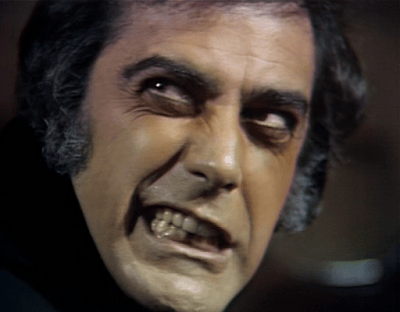
Day is breaking, and vampire Roxanne Drew has returned to her tomb. Roxanne finds her brother Randall standing in front of her coffin, holding a cross. Randall asks Roxanne who made her a vampire. She refuses to answer. In the last moments before she disintegrates in the morning light, she calls out the name “Barnabas.”

A certain Barnabas Collins told Randall that Roxanne was a vampire. Barnabas later took Roxanne’s victim Lamar Trask away from the tomb so that he could not stop Randall from putting his sister to rest. Randall goes to Barnabas’ home, the Old House on the estate of Collinwood. He does not find him, but does hear Lamar shouting in the basement. Barnabas locked Lamar up there and is nowhere to be found. Randall goes to the great house on the estate to find a key to release Lamar.

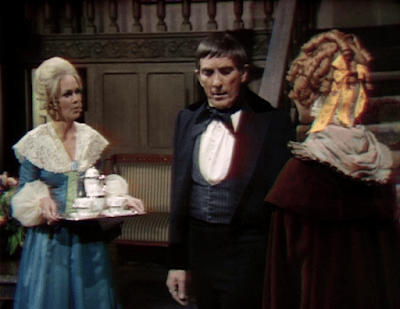
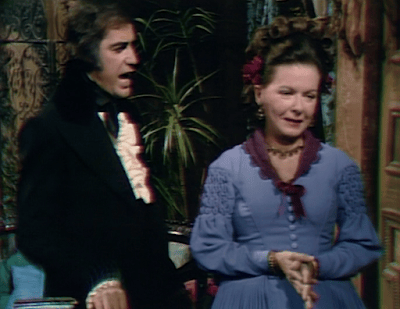
At the great house, Randall finds two people at home. One is Quentin Collins, heir to the Collins fortune and acting head of the family. The other is a woman he knows as Julia Collins, sister of Barnabas. Julia had been Roxanne’s first victim. Randall notes that Julia is fully recovered from the grievous wounds Roxanne had inflicted on her, wounds which had her at death’s door just a few hours previously. He tells Julia and Quentin the whole story. They have a couple of drinks and agree to keep Roxanne’s fate secret. Randall has probably been at the house for about an hour when Julia gets around to suggesting they go to the Old House and let Lamar out. Lamar is, as they say, a lot. No one is in all that much of a hurry to have him back out where he might at any time show up in your house and yell at you.

Once freed, Lamar starts jabbering that he heard the sound of chains rattling behind a brick wall in the basement. Julia identifies the wall as part of the foundations of the house, which is certainly what it looks like. Even a well-adjusted person might lose control of himself after going through what Lamar has been through in the last several hours, and there can’t be many people who know Lamar and would call him “well-adjusted.”

Nonetheless, Randall takes Lamar seriously, at least for a little while. He will not join in Lamar’s demand that the wall be torn down, but he does have questions for Barnabas. How did he come to know so much about vampires, and where is he now? He and Lamar leave together, and Julia frets that she has not allayed Randall’s suspicions.
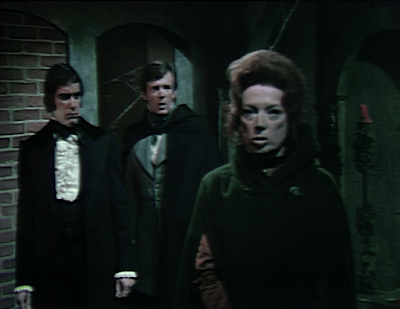
Julia can’t believe she has to work this hard to throw two dopes like Lamar and Randall off the track. Screenshot by Dark Shadows Before I Die.

Julia is not, in fact, Barnabas’ sister. She is a medical doctor and mad scientist who first became aware of Barnabas in the summer of 1967, when an escaped victim of his was a hospitalized patient of hers. Doubly qualified as a blood specialist and a psychiatrist, Julia approached Barnabas with a proposition. She was working on an experimental treatment to cure vampirism. If he would agree to serve as a test subject, she would protect his secret. He accepted that deal, and by the summer of 1968 he and Julia had become best friends.

Since then, Julia and Barnabas have had many adventures together. Those have involved traveling backward in time to the nineteenth century, forward in time to the far-off future year 1995, and sideways in time to an alternate universe. When Julia traveled back in time from 1970 to the current year, 1840, she told the members of the Collins family she found living on the estate of Collinwood that she was their distant cousin and that she was expecting that her brother Barnabas would soon arrive from England. She and Barnabas have for all practical purposes been functioning as a close-knit pair of siblings for some time, so this imposture is logical enough.

Julia and Barnabas were in the alternate universe in #1039. This was when we first saw a version of Roxanne. Donna Wandrey’s short red hair, pale skin, and strong chin gave her a strong enough resemblance to Grayson Hall that we wondered if Roxanne would turn out to be the daughter of Julia’s counterpart in that universe of inverted mirror images. They didn’t develop that idea. Pairing the story of dutiful brother Randall destroying vampire Roxanne with that of virtual sister Julia protecting vampire Barnabas creates another inverted mirror image. The show may not have built a story around Miss Wandrey’s resemblance to Hall, but that resemblance does serve as a visual marker underlining the contrast between the two sets of siblings.

Sisterhood comes up in today’s B story as well. Governess Daphne Harridge is the sister of Joanna Mills, who was once the mistress of Quentin Collins. Daphne and Joanna were very close, and Quentin did love Joanna after his fashion. So Daphne and Quentin hold a séance today to contact Joanna’s spirit. We’ve heard enough about Joanna that it is plausible her ghost might show up, and a mysterious figure does appear at the climax of the séance.

It’s hard to get excited about the idea of bringing a ghost onto the show right now. So few characters seem even to like each other that it is hard to come up with credible motivations for anyone to do anything except look for a place to be alone. And there are are plenty of dynamic supernatural villains around. So a wispy presence whose connection to the rest of the cast of characters cannot quite be defined would seem to be the very last thing they need. Still, Daphne is played by the irresistible Kate Jackson, so we might enjoy getting to know her better as we see her interact with the sister who means so much to her.

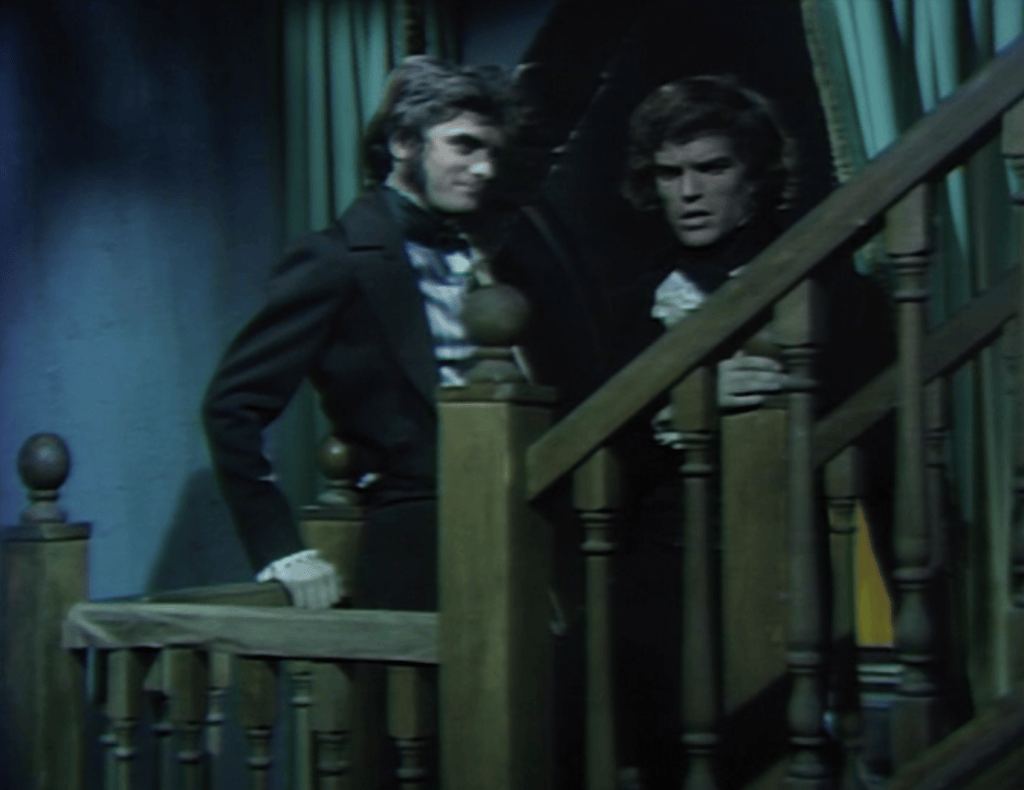
They do a deep dive into the show’s iconography to make it seem that Joanna’s ghost might turn out to matter. The mysterious figure is a hooded form wearing a gown in the doorway of the drawing room of the great house at Collinwood. This is a recreation of a shot from #170, which was also recreated in #860. In #170, the hooded figure was Laura Murdoch Collins, an undead fire witch whose story absorbed most of the open narrative threads on the show and committed Dark Shadows to being a supernatural thriller. In #860, it turned out to be Judith Collins, whose arrival was nothing more than a bridge between the closing cliffhanger of that episode and the first act of the next.

It’s hard to see how Joanna’s ghost could follow Laura’s lead and take over the show, and equally hard to see how she could serve so minor a function as Judith’s in #861. So perhaps it will turn out to be someone else.

The two female characters capable of taking control of the plot as Laura once did are Julia and wicked witch Angelique. If the hooded figure turns out to be one of them, the resonance with Laura in #170 might be a promise that her part will be decisive when the 1840 segment is resolved. If it is another female character, the resonance with #860 and #861 may be a sign that Dark Shadows’ visual vocabulary has run very dry and it is time for the audience to find something else to do at 4 PM on weekdays. If it is a male character in drag, the show will have taken a turn to self-parody which would seem to have been a bit more in keeping with the campy Zeitgeist of the mid-1960s than with the more earnest attitude typical of 1970. Still, if they’re looking for a change in tone, it might have been worth a try.

The title of this post is taken from Wallace Stevens’ “To the One of Fictive Music“:

Sister and mother and diviner love,
And of the sisterhood of the living dead
Most near, most clear, and of the clearest bloom,
And of the fragrant mothers the most dear
And queen, and of diviner love the day
And flame and summer and sweet fire, no thread
Of cloudy silver sprinkles in your gown
Its venom of renown, and on your head
No crown is simpler than the simple hair.

Now, of the music summoned by the birth
That separates us from the wind and sea,
Yet leaves us in them, until earth becomes,
By being so much of the things we are,
Gross effigy and simulacrum, none
Gives motion to perfection more serene
Than yours, out of our own imperfections wrought,
Most rare, or ever of more kindred air
In the laborious weaving that you wear.

For so retentive of themselves are men
That music is intensest which proclaims
The near, the clear, and vaunts the clearest bloom,
And of all the vigils musing the obscure,
That apprehends the most which sees and names,
As in your name, an image that is sure,
Among the arrant spices of the sun,
O bough and bush and scented vine, in whom
We give ourselves our likest issuance.

Yet not too like, yet not so like to be
Too near, too clear, saving a little to endow
Our feigning with the strange unlike, whence springs
The difference that heavenly pity brings.
For this, musician, in your girdle fixed
Bear other perfumes. On your pale head wear
A band entwining, set with fatal stones.
Unreal, give back to us what once you gave:
The imagination that we spurned and crave.

Wallace Stevens, “To the One of Fictive Music,” as published in his collection Harmonium (Knopf, 1923)

I don’t suppose I need to add anything to explain my choice of “The sisterhood of the living dead” as a title. But I do think the whole poem speaks to today’s episode. Neither Gene Lindsey nor Miss Wandrey gets much love from Dark Shadows bloggers, but they both do fine work today. Randall and Roxanne are very raw and basic. They are just themselves when they confront each other in the tomb. She is not the legendary terror from beyond the grave, he is not the heroic defender of the natural order of things. They are simply two people who grew up together, who care about each other, and who are used to knowing everything about each other. She is impelled to attack him, and he keeps her away with that “fatal stone,” the cross. Her last energies are spent on one final effort to keep a secret from him. The bizarre circumstances are stripped away, the plain human feeling remains. “[N]o thread/ of cloudy silver sprinkles in your gown/ a venom of renown.”

A vampire is a metaphor for extreme selfishness, and Julia has surrendered everything in her life to become an appendix to Barnabas’ narcissism. Because she serves him so tirelessly and reflects him back to himself as mirrors can no longer do, he cannot be at ease when he is separated from her. “For so retentive of themselves are men/ That music is intensest which proclaims/ The near, the clear, and vaunts the clearest bloom/…in whom/ We give ourselves our likest issuance.” Julia has reinvented herself as the likest issuance for which even Barnabas could hope.

Randall sees what his beloved sister has become, and knows what he himself would want in her place. He steels himself to relieve her of her cruelly extended existence. “Yet not too like, yet not so like to be/ Too near, too clear, saving a little to endow/ Our feigning with the strange unlike, whence springs/ The difference that heavenly pity brings.”

Too near, too clear. All relationships in Soap Opera Land serve as a basis for deception, either beginning when one party deceives another, deepening when the parties join together to deceive someone else, or shattering when deceptions are exposed. Roxanne is too near to Randall, too clear to his understanding, for the two of them to be on screen together very long.

“Unreal, give back to us what once you gave:/ The imagination that we spurned and crave.” We have seen other vampires destroyed, in some cases by wooden stakes through their hearts. That violent, bloody act makes the vampire seem like a gruesome physical reality, its destruction an onerous labor. But when they melt away in the sunlight, they are presented as bad dreams that can’t hurt us once we are awake. Choosing that method, they present Roxanne as “Unreal.” Seeing Randall with Roxanne, we picture them as children playing together, building their imaginations together. When Randall first joined the cast of characters, he was one of the “Surely There Must Be a Logical Explanation!” people. Only when he saw the evidence of what had happened to Roxanne could he consider the possibility of supernatural events. He had spurned that side of imagination which is most essential to surviving in a world like that of Dark Shadows. Now he has put that same side of it to work to satisfy his craving for answers to questions that he can only doom himself by asking.
Episode 1149: Alive again

Mad scientist Julia Hoffman came unstuck in time in #1109 and found herself in the year 1840. Her best friend, vampire Barnabas Collins, joined her in that year in #1117.

Barnabas is not the only vampire at large in this period. The other is a former woman named Roxanne Drew. At the bidding of wicked witch Angelique, Roxanne has bitten Julia and left her to die. Barnabas finds Julia, who is close to death. Roxanne appears and demands he leave without Julia. He orders Roxanne to look into his eyes. She does, then backs down. Barnabas was the show’s original vampire, and is evidently still the king of his particular hill.

Meanwhile, Flora Collins is entertaining Roxanne’s brother Randall in her home, a mansion known as Rose Cottage. Overbearing undertaker Lamar Trask enters and starts raving about witchcraft and suchlike matters. Jerry Lacy developed a peculiary intense style of performance for the members of the Trask family. After three years of exposure to that style, Joan Bennett is used to it, and keeps it together for her first really good episode as Flora. Up to this point, she’s been doing Flora as an imitation of Millicent Collins, the flighty heiress Nancy Barrett played in late 1967 and early 1968 when the show was set in the 1790s. But between Gene Lindsey’s meticulously understated Randall and Mr Lacy’s maniacal Lamar, Flora emerges as a distinct character. She has a whimsical side and is quick to believe absurdities, but nonetheless is intelligent, decisive, and unintimidated by the imposing men around her.

Lamar gives Flora a Trask-blast, to her amusement. Screenshot by Dark Shadows Before I Die.

Gene Lindsey is new to the show, and he does not hold up so well in the face of Mr Lacy’s onslaught. Randall is supposed to be indignant about Lamar’s callous talk, but Lindsey is stunned and shrinks back. When he delivers Randall’s replies to Lamar, he loses his grip on his lines, stammering and producing forkfuls of word salad such as “Well, if you’re not at liberty to divulge it, why not — say anything at all about it?” After Lamar storms out, Randall has a few more lines with Flora, during which Lindsey begins to recover, and he has some scenes later where he does a fine job. One really can sympathize. Standing face to face with Mr Lacy when he was in full Trask mode must have been like being in a boxing ring opposite a world heavyweight champion.

Out in the woods, Trask meets Roxanne. He is shocked to see her. She bites him.

Barnabas shows up at Rose Cottage with Julia. He tells Flora and Randall to get Julia to bed and put a cross near her. He refuses to answer when Flora asks why they need a cross. He rushes off to fetch a doctor.

Later, Barnabas tells Randall that the doctor has stopped the bleeding and that Julia will have a chance to survive if “the person” who attacked her does not strike again. Randall is puzzled to hear the attacker called a “person,” since everyone has thus far been saying it was an animal. Barnabas breaks the news to him that Roxanne is a vampire. Randall has been away in New York for some time, and so cannot believe in the sorts of things that people in Collinsport have begun to consider possible. After Barnabas shows him Roxanne’s empty coffin, Randall concludes that the story is true.

Barnabas needs help to fight Roxanne. She can be destroyed only in the daylight, which is as fatal to him as it is to her. Flora and Randall are the only people available at the moment. Barnabas does not want to disrupt history in ways that will prevent the world he knew in 1970 from coming into being, and as a member of the Collins family Flora is likelier than Randall to make a vital contribution to the shape of that world. So it is Randall whom he enlists for the dangerous mission.

Flora finds a blissed-out Lamar sitting on her couch. He seems to have only the vaguest recollection of what he had gone on about with such vehemence so shortly before. Flora thinks he must be coming down with a fever.

The function of a Trask is always to attack. When they cease to attack, the Trasks immediately become comic. The first Trask, a fanatical witchfinder with no first name who appeared in the 1790s segment, occasioned some of the darkest black comedy in the series when Barnabas planted a dead hooker in his room. Seeing that the mission which he regarded with such suffocating sincerity would come to an end if the facts were revealed, that Trask turned to an unsavory character for help getting rid of the body. When we saw that gruesome situation tip his earnest fanaticism into base hypocrisy, we could respond only with a grim chuckle.

The second Trask was the Rev’d Mr Gregory Trask, a villain in the segment set in the year 1897 that ran through most of 1969. Gregory was a hypocrite from the beginning. At times he made the opposite move from his forebear. He was sufficiently committed to his act that he occasionally convinced even himself of his righteousness. That wasn’t funny, because it didn’t knock him off the offensive. But when Gregory’s daughter Charity came to be possessed by the ghost of Cockney showgirl Pansy Faye and summoned him by shouting “Hey, Traaaaask!” his discomfiture was enough to make you fall on the floor. The Zen state Lamar seems to be in after Roxanne has bitten him doesn’t raise that kind of guffaw, but I started chuckling right away and just laughed harder at each line.

Randall and Barnabas return. Flora tells them that now she knows why Barnabas insisted they get a cross for Julia, since she has obviously been bitten by a vampire. The men then interact with Lamar and notice his atypical calm. When Lamar hurries out, making a nonsensical excuse, Randall expresses puzzlement. Barnabas says that Lamar must be Roxanne’s new victim, and that if they follow him he might lead them to her.

That’s how it works out. In Roxanne’s tomb, Barnabas apprehends Lamar. He orders Randall to stay. Randall is alarmed that Barnabas won’t be with him, but Barnabas points out that he has to get Lamar out of the way. Roxanne shows up, and Randall uses a cross to keep her away from her coffin as the sun is rising. There is some dialogue between them, and Lindsey gets to show us how reluctant Randall is to do his sister in, even though he knows intellectually that he is freeing her from a curse and allowing her to rest in peace. The episode ends on a cliffhanger. Roxanne is still recoiling from the cross when we cut to the credits, and there is still time for Angelique to intervene before she disintegrates.

This episode is fast-paced and fun to watch, the first such in several days. Since we can’t help but know that the end is approaching for Dark Shadows, the rough patches bring a fear they didn’t earlier in its run. We find ourselves wondering if this is it, if we’ve reached the dregs and there are no enjoyable episodes left. I try to avoid giving spoilers, but I don’t think it will ruin any suspense anyone wants to be in if I say that I seem to remember that the show keeps having its good days for a while yet. There does come a time when they are few and far between, but I don’t think there is any need to fear that the last good episode is behind us.

Episode 1145: We must execute with all extreme caution

Dark Shadows is completing the ninth week of a segment set in the year 1840. Like the other episodes of the segment, this one is packed with action, but still seems slow. In part that is because they are in such a hurry to keep the story beats coming that they don’t anchor them in relationships between characters we care about. In part it is because of the drag longtime viewers feel when they see undisguised recycling of stories from previous segments. In part it might be because they spent so much time in the months leading up to the segment teasing developments that haven’t taken place and are pretty clearly not going to take place. And in part it is because of something the original audience would not have known but that today even the viewers most scrupulous about avoiding spoilers cannot help but know, that we are just a hundred episodes from the end of the series. It’s hard to believe that anything much will come of what is happening when we know that that less than 10% of the show remains.

Seagoing con man Gerard Stiles was evicted from his body the other day. The new occupant is warlock Judah Zachery. Judah was put to death by order of magistrate Amadeus Collins in 1692, but he is not one to let a little thing like that slow him down. After 148 years as a disembodied head, he is getting busy with a plan to avenge himself on Amadeus’ descendants.

One of these, Quentin Collins, wants to show off his latest home improvement project to his good buddy Gerard. Not knowing that there is no longer any such person, he takes Judah to the basement of the great house of Collinwood and shows him his “Stairway into Time.” He explains that by going up and down the stairway, a person will be able to go forward and backward in time. He does not explain how this works, but since it is the means by which mad scientist Julia Hoffman brought us from 1970 to 1840 regular viewers know that it does work. Several months ago, the characters found that they could pass into an alternate universe by walking through a door in a little-used hallway of the great house. There was no attempt to suggest any mechanism, either technological or natural or magical, to account for this aperture. Because there was no explanation to consider, we wound up simply accepting the alternate universe as a bare fact. The Stairway into Time is similarly easy to accept.

Quentin shows off the Stairway into Time to Judah, who is masquerading as Gerard. Screenshot by Dark Shadows Before I Die.

Judah, masquerading as Gerard, seems unconvinced. Quentin goes off to get some of the project documents, leaving Judah alone in the basement. He uses the time to cast a spell on overbearing undertaker Lamar Trask. Lamar is sure Quentin is a warlock who murdered a woman named Lorna Bell in the course of a Black Mass. In fact, Judah committed this crime. He sends a dream in which Lamar sees Quentin killing Lorna. When Lamar wakes up, he is sure that he has had a revelation from the Almighty.

Quentin returns to the basement with his papers. Judah is reading them aloud when Quentin’s wife Samantha barges in. She starts telling Quentin that they need to talk about the governess in charge of their son Tad’s education. Then she notices Judah. Thinking him to be Gerard, Samantha falls silent. She looks down, shamefaced, and says she thought Quentin was alone. She hurries out.

Quentin tells “Gerard” that they shouldn’t let Samantha get in the way of their friendship. Until #1120, Samantha and Gerard thought that Quentin and Tad were dead, lost at sea. They married. When Quentin came back, he found the situation amusing, and promised to abide by whatever decision Samantha made about her marital status. It was fine with him when she chose Gerard, but when she said she wanted to take Tad with her the conversation became intensely hostile. When Gerard found out that Samantha wanted to marry him even though she no longer had a claim on Quentin’s inheritance, he quickly made it clear he was not interested. So neither man actually wants Samantha, but Quentin very much regards Gerard as a dear friend. Quentin’s brother Gabriel may have spoken truer than he knew in #1127, when he was taunting Samantha and asked her if she had addressed her son with “Dear Tad, there is something I must tell you. You are going to have two fathers now.” In fact, Quentin and Gerard were co-parenting Tad when their ship ran into trouble, and would probably still be happily doing that now if all had gone according to plan.

Lamar comes to Collinwood and tells Samantha about his dream. She thinks he is an idiot, which of course he is. Nonetheless, she is looking for a way to dislodge Quentin from his father Daniel’s affections. She hopes that Daniel will disinherit Quentin and name Tad as his heir with herself as his guardian. So she sends Lamar along his way with encouragement to keep accusing Quentin of witchcraft.

After a quarrel with Quentin, Samantha tells Daniel what Lamar told her. Daniel marvels that she would listen to anything such a “pompous imbecile” might tell her, but he does remember the events of the 1790s, when he was a boy, and of 1803, when he was 20. There was witchcraft in the area in those periods, and it led to strange and horrible acts of violence. There have been strange and horrible acts of violence lately, some of them uncommonly like the events of those earlier years. So Daniel cannot lightly disregard the allegations against Quentin, despite their ludicrously unreliable source.

Daniel confronts Quentin in the drawing room. He asks “Are you practicing witchcraft in this house?” Quentin is shocked by the question, and rages at Samantha and Lamar for bringing it to Daniel’s mind. Daniel insists Quentin answer, and he says “No, I am not practicing witchcraft in this house.” He really should have omitted the phrase “in this house,” since he does after all have access to many other houses, but that suffices to bring the scene to its conclusion. Quentin goes on to the foyer, where he shouts at Samantha that if she keeps trying to turn Daniel against him he will take great pleasure in strangling her.

Daniel has great faith in Gerard. Judah takes advantage of this. When Daniel tells “Gerard” that he regards him as a man of sound judgment, Judah responds that Quentin is his closest friend and that he could not take Lamar’s charges seriously without far more compelling evidence than has been forthcoming. Daniel brings up Quentin’s Stairway into Time, which he has regarded as a joke but which Lamar has made him suspect might be some kind of product of black magic. Judah offers to show him the stairway and put his fears to rest.

When Daniel sees the stairway, he says that he must have been right. It is simply an ordinary stairway, and Quentin’s talk about time travel can only be one of his peculiar little jokes. He walks up it a bit, and Judah causes him to have a vision of Quentin strangling Lorna. Not only did Daniel likely hear Quentin shouting about how much he would enjoy strangling Samantha, he himself murdered his own wife Harriet by strangulation some years ago and from time to time has fits of madness during which he mistakes other women for Harriet and tries to strangle them. So he knows that his family is a strangley bunch, and believes that what he is seeing is real.

Daniel has a heart condition, and the vision of Quentin strangling Lorna triggers chest pains. This episode marks the final appearance of Lorna and of actress Marilyn Joseph; we may wonder if it marks Daniel’s final appearance as well.

Episode 1139: The misery of the living dead

At the end of #1109, mad scientist Julia Hoffman passed through a warp in spacetime and found herself at the great house of Collinwood in the year 1840. Lonely, she persuaded herself that if she went to the hidden chamber in the Collins family mausoleum and let vampire Barnabas Collins out of the chained coffin to which he had been confined since the 1790s he would remember the friendship that they began in 1968, and that they would be able to work together against the supernatural menace closing in on the Collinses of 1840.

In fact, Julia found that Barnabas had no recollection of anything later than the 1790s. He had no idea who she was, no interest in anything she tried to say, and no intention of letting her leave the chamber alive. It was only because his old friend Ben Stokes had followed Julia to the mausoleum and entered in the nick of time that Barnabas did not kill Julia then and there.

For the next several days, Barnabas rampaged through the grounds of Collinwood and the village of Collinsport. In #1114, he espied the lovely Roxanne Drew on the terrace of the great house, telling overbearing undertaker Lamar Trask that she hated him and would never yield to her father’s wish that she should marry him. Lamar looks and sounds just like his own late father, an enemy whom Barnabas loathed and took pleasure in torturing to death, so her hostility to Lamar wins Roxanne a place in Barnabas’ heart. In #1115, he bit Roxanne and left her to die, intending for her to rise as a vampire so that they could spend the rest of time preying on the living together.

In #1116, Julia and Ben found Roxanne and took her to the Old House on the grounds of Collinwood. There, Julia rigged up a medical apparatus and kept Roxanne alive. When Barnabas found what she had done, he was about to kill Julia. At the last second, his 1970 self projected his personality into his 1840 body, and Barnabas and Julia’s friendship picked up where it left off.

In #1117, Barnabas was remorseful about what he had done to Roxanne. He was distressed that Roxanne wanted him to bite her again and finish the job, and relieved that Julia was able not only to heal Roxanne’s physical wounds, but also to hypnotize her so that she did not remember the attack.

In #1129, Barnabas’ one-time wife, wicked witch Angelique, showed up and found that Barnabas was no longer in his coffin. In #1130, she went to the great house and introduced herself as Mrs Barnabas Collins. In #1133, she found that Barnabas and Roxanne shared a mutual attraction, and that Roxanne was shocked to hear that Barnabas was married. She told Barnabas that if he had anything more to do with Roxanne, she would cause the wounds on her neck to reopen, leading to her death and subsequent reappearance as a vampire. That curse would be Barnabas’ doing. Under this threat, Barnabas sent Roxanne a note saying they could never be together. Roxanne responded to that note yesterday by agreeing to marry Lamar.

Angelique’s threat should have been unnecessary. Barnabas knew full well that he was tempted to bite Roxanne and that if he did so she would likely become a vampire. Since he did not want that to happen, he should already have been at pains to avoid being alone with her. But a vampire is after all a metaphor for extreme selfishness, and so when he refuses to respect the logic of his own position and keeps stringing Roxanne along we might be frustrated with him, but we cannot really be surprised.

Barnabas cannot tolerate the idea of Roxanne as Lamar’s wife. He tells Julia that he is going to go to her and urge her not to marry Lamar. Julia tells him that if he does, Angelique will kill Roxanne. Barnabas asserts that Angelique will never find out. Since Angelique has powers including remote viewing, this is a bizarre thing to be sure of, and Julia tells him he is wrong. He ignores her. Desperate, she says she will go to Roxanne. Barnabas agrees to let her do this.

My wife, Mrs Acilius, points out that Julia is an extraordinarily skilled and inventive liar. While Barnabas might catch on if she does not go to Roxanne’s house, there is no reason once she is there she should not simply convey good wishes from Barnabas and herself for a happy marriage. But she presses Roxanne to admit she doesn’t love Lamar and insists that she call off the engagement.

Roxanne comes to Collinwood and tells Barnabas she loves only him. She embraces him. He can’t resist kissing her and telling her he loves her, too. Of course Angelique walks in on them.

Roxanne goes back home. Lamar is there. She tells him she cannot marry him, because she hates him. She loves Barnabas. We cut to Collinwood, where Angelique is casting her spell. Roxanne’s neck wounds reopen and blood comes spurting out.

Lamar bursts in the front door of Collinwood and shouts for Barnabas. Julia meets him. He tells her what has happened and declares that only Barnabas can save Roxanne, since he has cast a spell that is causing her to die. Julia insists Lamar take her to Roxanne. She gets to her just in time to hear her murmur Barnabas’ name as she dies. Lamar says that Barnabas is responsible for her death, which is of course true. He vows that he will exact vengeance for her on Barnabas, which is not likely to be true.

Lamar vows that Roxanne will be avenged. Screenshot by Dark Shadows Before I Die.

Back at Collinwood, Julia tells Barnabas that Roxanne is dead. Barnabas strikes a noble pose while saying that he feels responsible, then talks about how much he hates Angelique. He and Julia agree that the urgent thing now is to prevent Roxanne rising as a vampire. It is too close to dawn to make any plans, so they agree to talk it over in the evening. Julia does not bother to mention Lamar’s vow of revenge.

Episode 1138: A tomb again

By order of the court, warlock Judah Zachery was decapitated in 1692. His body was buried in a large underground chamber in a graveyard, and his head was put on public display to deter his followers. The head disappeared. It cropped up again in 1803, when it was associated with a series of horrendous murders.

Now it is 1840. Wealthy dilettante Desmond Collins found the head in some kind of shop in Macau and brought it back to his home, a mansion known as Rose Cottage that lies near the estate of Collinwood. Desmond regained his senses too late to stop the head resuming its lethal career.

The head recently enslaved Cockney showgirl/ psychic Leticia Faye and mad scientist Julia Hoffman. Julia and Leticia set up a laboratory in the underground chamber, reattached the head to the body, and brought Judah back to life with electricity harvested from lightning.

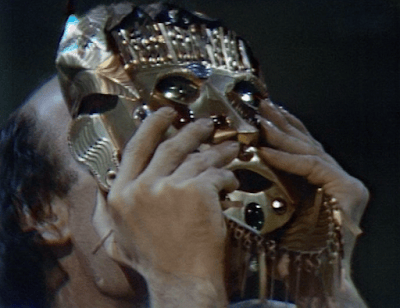
Seagoing con man Gerard Stiles had seen Leticia with the jewel-encrusted gold mask that is part of Judah’s equipment. He followed her to the underground chamber, hoping to steal it. When he arrived there, Julia and Leticia were out, but Judah was just getting up. He approached Gerard with his hands out, as if to strangle him. Gerard bumped into a bottle of ether and started a fire. Amid the flames, he escaped from Judah. As Gerard scampered out into the graveyard, Judah remained in the burning chamber, pressing the mask to his face.

Judah masks up. Screenshot by Dark Shadows Before I Die.

In the drawing room at the great house of Collinwood, Julia is getting a stern lecture from her best friend, vampire Barnabas Collins, about how she oughtn’t help Judah. She keeps protesting that she must help him, then cries out that Judah is burning. Suddenly Judah’s power over her breaks, and she is her old self again.

Barnabas insists that Julia take him to the underground chamber so that they can make sure Judah is dead. They find him under a pile of rubble. Julia checks his wrist for a pulse. He doesn’t have one. He didn’t when first she found him, so that wouldn’t seem to prove very much, but she and Barnabas decide it’s good enough. They leave the chamber, sure that Judah won’t be killing anyone else.

In his room at Rose Cottage, Gerard drifts off to sleep. He has a dream in which he is back in the underground chamber and a voice is ordering him to find “it.” He is puzzled, but as soon as he wakes up he knows exactly what he is supposed to do. He returns to the chamber, digs Judah out from under the pile of rubble, and removes the mask from his face. Judah blinks. What the point was of any of that, I leave as an exercise for the reader.

Barnabas and Julia are back in the drawing room at Collinwood, congratulating themselves on their great success. A man enters. He is overbearing undertaker Lamar Trask. He says that he just got engaged. In a very pleasant tone, Barnabas asks whom he will be marrying. Lamar is surprised at the question, as are returning viewers. Barnabas knows well that Roxanne Drew has been the object of Lamar’s suit for some time and that her father is very much in favor of the match. When Lamar identifies Roxanne as his fiancée, Barnabas is speechless. Lamar asks if congratulations are not in order, and Julia extends them.

Barnabas had shared a mutual attraction with Roxanne. As a vampire, he knew that he could not be alone with her without biting her, and he does not want to do that. When his one-time wife, wicked witch Angelique, showed up, she made him send Roxanne a letter saying that they couldn’t see each other again. It’s 1840, so Roxanne is probably going to marry someone. Much as Barnabas hates Lamar, he really should have braced himself for the likelihood that Roxanne would end up with him.

The scene in which Lamar proposes to Roxanne is the one high point in this otherwise wasted half hour. She talks about her desire to become “one of those new professional women,” and as Donna Wandrey delivers her lines we can see that she has given serious thought to that. Lamar stiffly declares that the only place for a woman is beside the man who loves her.

Lamar is the fourth villain named Trask whom Jerry Lacy has played, and the others excelled at snuffing out women’s dreams. So we recoil when he makes his sexist remark, but Roxanne does not. She smiles and says that if her father had not pushed them together, things might have been different between them. Miss Wandrey makes us believe that, while she does want an independent life, Roxanne is also a product of her time, and that she more or less believes in what she was raised to believe. Moreover, Mr Lacy does manage to make us believe that for all his obnoxiousness, Lamar loves Roxanne. So we can understand Roxanne’s motivations.

Episode 1133: This ever-increasing family

Vampire Barnabas Collins and his friend mad scientist Julia Hoffman have traveled in time from 1970 to 1840. Barnabas’ one-time wife, wicked witch Angelique, has met them there. But this Angelique does not remember the adventures she had as an ally of Julia and Barnabas in 1897 and 1970. Instead, she seems to have come straight from the 1790s, when her monomaniacal focus on Barnabas led her to make him a vampire and kill most of his family and friends. She does not know who Julia is, and demands Barnabas resume their marriage.

Angelique has been introducing herself around the great house of Collinwood as Barnabas’ wife. She learns that Barnabas and a young woman named Roxanne Drew have a mutual attraction. She makes sure that Barnabas introduces her to Roxanne as his wife. Alone with Barnabas, Angelique threatens to kill Roxanne and raise her as a vampire unless Barnabas becomes a loving husband. Her threat gains substance when Roxanne collapses and blood gushes from her neck while she is with the man her father wants her to marry, overbearing undertaker Lamar Trask.

Barnabas introduces Roxanne to his wife, Screenshot by Dark Shadows Before I Die.

We’ve been here before. From March to November 1969, Barnabas found himself in the year 1897. There, he met neurotic intellectual Rachel Drummond, governess to the children in the great house. Angelique showed up and found that Barnabas was in love with Rachel. She introduced herself to everyone as Barnabas’ fiancée, and made a point of forcing Barnabas to confirm to Rachel that he was engaged to her. Rachel reacted to that news just as Roxanne reacts to the news that Barnabas is married. For a while it looked like Angelique would kill Rachel. Rachel was even mixed up with a Trask, the hypocritical Rev’d Mr Gregory Trask. So longtime viewers will find today’s whole segment very familiar indeed.

There may have been a way to make it fresh. Barnabas and Julia knew Roxanne as a vampire in 1970, and they learned that she became one in 1840. She did not recognize Barnabas at that time, so he couldn’t have made her one the first time she died in 1840. Neither would Angelique have had a motive to show herself at Collinwood, let alone to start making new vampires, were Barnabas not in evidence there. So they might have come up with a story in which Roxanne’s curse was the doing of the supernatural menace in the current A story, The Head of Judah Zachery.

The Head of Judah Zachery is based on the supernatural menace that drives the plot of C.. S. Lewis’ 1945 novel That Hideous Strength, The Head of François Alcasan. Alcasan’s Head issued commands to a little circle of cultists in charge of the fictional Edgestow University. Prominent in that circle was a clergyman known as the Rev’d Straike, a man whose every utterance is ludicrously vehement. The first two episodes of Dark Shadows featured a private investigator known as Strake, and episodes #899 and #900 featured a cultist named Strak. Trask is an anagram of those names and a reminder that all men of the Trask family sound very much like the Rev’d Straike. So perhaps the curse could have come upon Roxanne as the result of Lamar’s involvement with the cult of Zachery’s Head. That would have left room for Angelique to find herself in another uneasy alliance with Julia and Barnabas.

This episode includes two moments of special interest to the most intense fans. Angelique and Barnabas refer to his late sister Sarah. Once a pivotal character on the show, Sarah has gone unmentioned for a couple of years. It’s nice to hear her name again.

Trask says that he has done an investigation of Barnabas, and found information contradicting his claim to have lived in a house in Cadogan Square in London. Since Cadogan Square wasn’t built until the 1870s, you might think this would be a fairly simple investigation to complete. But it does touch on two bits we’ve already seen. In 1967, dashing action hero Burke Devlin commissioned an investigation into the life Barnabas claimed to have led in England; and in the feature film House of Dark Shadows, still in theaters at this time, Barnabas said that he had lived in Cadogan Square.

Episode 1126: Evil is joining evil

Overbearing undertaker Lamar Trask is on a mission to find out what happened to his late father, fanatical witchfinder the Rev’d Mr Trask. Trask was last seen entering the gates of the estate of Collinwood in the 1790s. Lamar is pretty sure that he was murdered by Barnabas Collins and that his remains are in the Old House on the grounds of Collinwood.

Lamar is correct on these points. There is a Barnabas Collins staying at the Old House now; he has identified himself as the son of the Barnabas who was there in the late eighteenth century and who left for England. Unknown to Lamar or the others who live on and around Collinwood in 1840, he is in fact the same person, and never went to England. A witch turned him into a vampire in 1796, and he was sealed in a coffin in the old cemetery north of town after he had taken many victims. He was released to prey upon the living in 1967. Now, Barnabas and his friend Julia Hoffman have traveled back in time from 1970 in hopes of preventing a disaster that will befall Collinwood in that year as the result of events in the current year, 1840.

Lamar is in a mansion near Collinwood known as Rose Cottage. He is visiting Gerard Stiles, a guest of Flora Collins, the lady of the house. Lamar tells Gerard and Flora that he is searching for his father’s remains and that he hopes to take revenge on his killer. When he says that he believes Barnabas has something to hide, he piques Gerard’s interest. Barnabas saw Gerard’s ghost as the face of the disaster in 1970, and when he encounters a potential adversary Barnabas is incapable of concealing his hostility for one second. So when he met Gerard as a living being, Barnabas all but announced himself as his sworn enemy. Gerard wants to know who this new foe is and what he wants, so he suggests holding a séance to contact the late Mr Trask. Flora avidly agrees, and Lamar goes along.

The séance is barely underway when the disembodied voice of Trask rings out. It speaks of evil in the room and evil all around them. It says that soon the evil will walk again. Since Barnabas is not in the room and can already walk, it does not seem to be a reference to him. We cut to an alcove in the room shaded by a curtain; in it there is a glass case holding a severed head. Flora’s adult son Desmond brought it home with him from a trip to Macau, and it has already taken possession of him and killed two men. Returning viewers know that the evil Trask is speaking of is that which emanates from the head. Since Barnabas murdered Trask, and did so most cruelly, it really is quite decent of him to forgo an opportunity to ask that Barnabas be punished and to focus on this immediate problem.

Trask was a villain in life, whose fanatical sincerity not only led him to commit grave injustices but also turned itself into hypocrisy when he saw that only crime could prevent an embarrassment that would interfere with his mission. But he has been somewhat redeemed in death. In #523, made and set in 1968, a warlock raised Trask’s ghost and tried to manipulate his hostility to Barnabas for evil purposes, but he would not be used. He was about to warn well-meaning governess Vicki of the danger the warlock posed to her when he met a character played by Roger Davis. At the sight of him, Trask instantly returned to whence he came. Say what you will about Hell, at least you don’t have to put up with Roger Davis while you’re there.

None of Trask’s ominous utterances is very definite, but one would have puzzled the assembled spiritualists more than the rest. He warns them to “Beware the cross!” Trask wasn’t consistently orthodox in his approach to Christianity, but he was all for the cross. What we can see that Lamar, Gerard, and Flora cannot are cross-cuts to a secret underground chamber in an old cemetery. Desmond, in search of the body that used to go along with the head, uncovered the chamber and found a coffin in it. A large cross is wedged between the ceiling of the chamber and the lid of the coffin, holding the main part of it shut. There is a Dutch door cut into one end of the lid. Desmond opened it, and found a golden mask with many precious jewels embedded in it. The opening looked big enough to pull the body through, but Desmond decided to put the mask back and get help moving the cross.

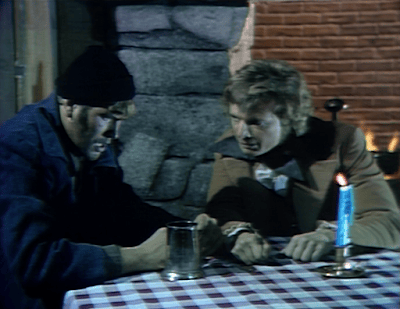
Desmond went to the Eagle tavern. There, he found a drunken sailor named Tim Braithwaite. He offered Braithwaite a $20 gold piece if he would do a job for him, no questions asked. Tim starts asking questions. The first is whether Desmond wants him to beat someone up. His tone and manner suggest that Desmond has hired him to do that before. This reminds us that they’ve never got round to telling us much about Desmond. All we know is that he is the sort of person who goes to Macau and buys severed heads, which come to think of it is also the sort of person who hires guys to beat people up.

Desmond has a job for Tim. Screenshot by Dark Shadows Before I Die.

Tim is now in the chamber working the cross loose while Desmond is at the livery stable getting a cart in which to carry the coffin back to Rose Cottage. That’s the cross of which Trask wants Lamar, Flora, and Gerard to beware.

Tim finds the jewel-encrusted mask and decides to make off with it. The body comes to life, leaves the coffin, kills Tim, and escapes from the chamber.

Tim’s name recalls two other characters. At first glance I mistook actor Dick Sabol for Don Briscoe, and the resemblance between them is strong enough that every time Desmond calls him “Tim” I thought of Briscoe’s character Tim Shaw, who figured in the story when it was set in the year 1897. Tim inadvertently helped to reunite evil sorcerer Count Petofi with his severed and equally evil hand, so the resonance with that Tim is a clue to longtime viewers that this one will also thwart his own plans in the course of reconnecting the evil head with its missing body.

We’ve heard the name “Braithwaite” before as well. Abe Vigoda appeared in #684 and #685 as aged silversmith Ezra Braithwaite, and Edward Marshall played a much younger version of the same character in #764. We learned in those episodes that Braithwaite’s silver shop had been in operation in Collinsport continuously from 1781 to 1968. Vigoda returned to the show just last week, playing the head’s victim Otis Greene in # 1124. Nothing is said of any connection between Tim and the owners of the silver shop, though “Braithwaite” isn’t so common a name that we can assume he is not related to them. All we can be sure of is that the writers and producers had Abe Vigoda on their minds at this time.

A woman named Christine Domaniecki is seen gulping a drink at the Eagle. She is credited as “Christine Domaneck,” in the role of “Barmaid.” Whether “Domaneck” was a stage name or a typo, who can say. Ms Domaniecki has the role because she was the runner-up in the Miss American Vampire Contest, a promotion for the feature film House of Dark Shadows. She went on to become a highly accomplished makeup artist in Hollywood, working on dozens of well-known television and big screen productions. She was nominated for a primetime Emmy in 2016 for her work on a production of The Wiz. This episode is the first of six screen acting credits listed on her IMDb page. All of the others went direct to video, were produced in the 2000s, and involved her then-husband, Michael R. Thomas. Four of the five appear to be soft-core porn flicks.

The winner of the Miss American Vampire contest was Sacheen Littlefeather. Littlefeather made an appearance on a 1970 episode of To Tell the Truth in her capacity as Miss American Vampire, but was not able to be in New York to tape this episode. She became even more famous in 1973, when her friend Marlon Brando dispatched her to Hollywood to convey his refusal to accept the Academy Award for his work in The Godfather. As luck would have it, Abe Vigoda also had a part in The Godfather, playing doomed capo Sal Tessio.

Also, Brando’s performance in The Godfather always reminds me of David Henesy as strange and troubled boy David Collins in #667. I wonder if Brando insisted on holding a cat during the opening scene of the film because he didn’t want people catching on that he was copying Mr Henesy.

You come to my house on the day of my daughter’s wedding and you ask me to play dress-up? Screenshot by Dark Shadows Before I Die.

This one also includes a notable blooper. Jerry Lacy’s Lamar is telling Flora about his suspicions of Barnabas:

LAMAR: Ms. Faye corroborated my opinion. When I asked her to locate my father’s last remains, she had a vision of the Old House.

FLORA: But that is when the original Barnabas lived there, wasn’t it? Before the main house was built?

LAMAR: Yes, that’s true, but I don’t think… I do think he had something to do with it.

FLORA: You don’t think he had anything to do with it!?

LAMAR: What I think is my business.

It’s clear enough that Mr Lacy was supposed to stop with “Yes, that’s true…” and that he encroached upon Flora’s dialogue with “but I don’t think,” leaving him in a trap from which he could escape only by adding “I do think he had something to do with it.” Joan Bennett goes ahead with her scripted line, sounding exactly as you suppose she would if she had received the correct cue, and he responds with “What I think is my business.” Though the blooper makes this final line nonsensical, Mr Lacy delivers it with the full weight of Trask’s immense pomposity, and the effect is hilarious.

Episode 1124: Where the bodies are buried

Desmond Collins has fallen under the influence of an evil spirit emanating from a severed head he bought in Macau, and is now trying to find the body that used to be attached to the head. Lamar Trask is an evil spirit unto himself, and is trying to find the body of his late father, fanatical witchfinder the Rev’d Mr Trask.

It is not clear what the severed head is hoping will come of a reunion with its body, though longtime viewers will remember the last time a body part was reconnected to its original possessor. Evil sorcerer Count Petofi stuck his hand back on the end of his arm in #814. As separate entities, Petofi and the hand both wielded considerable magical powers. Reunited, they seemed to be unstoppable.

What Lamar wants is much clearer. He believes that his father was murdered in the 1790s, 45 years ago. He hopes that the killer might still be alive and that he will be able to take revenge.

As it happens, Lamar is right about what happened to his father. Vampire Barnabas Collins walled Trask up in his basement and left him to die there. Barnabas is back on the estate of Collinwood, having been sealed in his coffin in 1796, freed in 1967, and dislocated in time in 1970. It might be just for Lamar to expose Barnabas and destroy him, but it would also ruin the show. Besides, Lamar and his father are both hilariously obnoxious, so it wouldn’t occur to anyone to root for them.

Lamar persuades Cockney showgirl/ mentalist Leticia Faye to hold a letter from his late father while she goes into a trance. She has a vision of the Old House on the grounds of Collinwood. Lamar interprets this to mean that his father’s remains are there. Barnabas interrupts this scene and reproves Lamar for taking advantage of Leticia. He might have pointed out that what Leticia was doing is by any definition witchcraft, and have gone on to point out that the Rev’d Mr Trask would be horrified that his son would participate in it. But that would put Lamar on the defensive, and the function of a Trask is always to attack.

The Collinses think that Barnabas left for England in the 1790s and died there. They also believe that he and his fellow time traveler, mad scientist Julia Hoffman, are the offspring of that original Barnabas come to visit their late father’s birthplace. The other day, Daniel Collins, master of Collinwood, invited Barnabas to stay in the Old House as long as he liked. So Barnabas does not have to sit still for Lamar’s attack later, when he goes home to the Old House and finds him poking around. Lamar explicitly says that he is looking for his father’s remains. Knowing that they are behind a brick wall which has attracted no one’s notice in the decades for which it has stood, Barnabas is quite relaxed about this search. He tells Lamar that he is risking his good name by taking Leticia’s visions so seriously, and tells him to leave the house.

Desmond and Leticia live under the same roof. She is his mother’s permanent guest in their home, a mansion known as Rose Cottage. But unlike Lamar, Desmond does not turn to Leticia for guidance today. At the beginning of the episode, she walked into the room where he keeps the head, exclaimed about the evil present there, and fainted. So he gives her a wide berth for the rest of the day.

Instead, Desmond calls in Otis Greene, who was associated with the head in 1803. The head possessed Otis, as it is taking possession of Desmond, and led him to commit four brutal murders. Otis confessed to those murders and asked to be punished, but his talk about the head led the court to exercise a leniency extraordinary for the period and to set aside criminal charges, instead committing him to an asylum. Released from there about ten years ago, Otis has established himself as a successful antique dealer.

Otis enters and at once begins admiring Desmond’s furniture and telling him about the prices it would fetch in his shop. He looks at one chair and says that he knows a collector who would pay the fantastic sum of $100 for it, equivalent to many thousands of dollars in 2026. Desmond says he is not interested in selling the chair, and directs Otis’ attention to a table that belonged to someone associated with a witchcraft trial.

Desmond questions Otis. Screenshot by Dark Shadows Before I Die.

Otis is played by Abe Vigoda, his second role on Dark Shadows. Vigoda’s first character made his entrance in #684 expressing admiration for the fine things around him, as Otis admires Desmond’s furniture today. That was Ezra Braithwaite, a silversmith. Ezra was brought on to provide information that would lead to the ghost of a man from his own past. Ezra did answer some questions, but the ghost killed him before he could make an exit.

Evidently writer Sam Hall remembers Ezra. Not only does Otis make the same entrance as Ezra, but like Ezra he is there to talk about his past. He tells Desmond that his grandfather was the executioner in the town of Bedford, and that his work brought a curse on the family. Desmond shows Otis the head, and he is shattered at the sight of it. Desmond demands to know where the body is. Otis resists answering, but is quickly overwhelmed with chest pains. Desmond screams in his ear, and he starts gasping out cryptic remarks. “The noose, a ring of gold, the stairs, top of the hill, direct line, an unmarked stone.” He falls dead, and Desmond vows that the hidden body will be found.

Unfortunately, this marks Abe Vigoda’s final appearance on Dark Shadows. Vigoda’s first television role came in 1949, when he was 28 years old. He played a character identified as “Old Man on Train” in an installment of Studio One. He went on playing old men on television, in movies, and on Broadway until his death in 2016. His most famous feature film role was that of doomed capo Sal Tessio in The Godfather (1972,) and his biggest TV part was as Detective Philip K. Fish on the series Barney Miller and its spin-off Fish (1977-1978.) He once sat on a panel of cast members at a Dark Shadows convention. When it was his turn to talk, he said “My name is Abe Vigoda. I played Otis Greene on Dark Shadows. I don’t remember much about it,” and passed the microphone to the next person.

Episode 1114: I am the stranger

In June, Dark Shadows was set in an alternate universe to which vampire Barnabas Collins and mad scientist Julia Hoffman had traveled. Julia and Barnabas found a comatose woman. Barnabas took one look at her, saw how silent and immobile she was, and fell in love. He’s dead half the time, so we can’t judge him for that reaction.

The woman’s name was Roxanne Drew, and Barnabas’ love for her survived even after she regained the ability to walk and talk. Roxanne didn’t make it to the original continuity when Barnabas and Julia returned there in July. Barnabas’ sorrow for her was lightened in #1081, when he met Roxanne’s counterpart in his native universe. Their relationship took a turn for the worse in #1106, when he discovered that she, too, was a vampire. In #1107, he found out that Roxanne was alive in 1840, and that she underwent a mysterious and terrible change in that year.

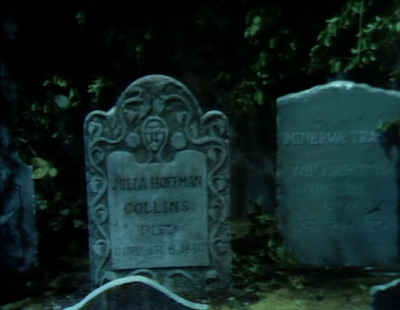
Now, Barnabas is keeping Roxanne chained in her coffin in the secret room behind his bookcase. Julia has traveled back in time to 1840 and hopes to prevent a disaster that has destroyed the great house of Collinwood and its residents. Trying some mumbo-jumbo that he hopes will lead him to join Julia in the past, Barnabas has a vision of a tombstone saying that she died on 6 October 1840. He and his friend Timothy Eliot Stokes go to the graveyard and see such a tombstone there. Barnabas says that 6 October is three days away; the episode was originally broadcast on 1 October 1970, which is more than three days from 6 October. But there is a weekend in between, and days when the show isn’t on don’t count.

The stones. Screenshot by Dark Shadows Before I Die.

Barnabas says that he must find a way to travel back in time before 6 October. Stokes asks why, and Barnabas says he himself doesn’t understand how it works. But regular viewers know that anniversaries have a power in the cosmos of Dark Shadows that physical laws have in our world. If an event took place exactly 130 years ago, or any other number of years ago, it is possible for people in the present to interact with that event in ways they cannot on other days of the year. That has been the case ever since undead blonde fire witch Laura Murdoch Collins was on the show, before Barnabas made his first appearance.

Julia’s grave is next to one commemorating Minerva Trask, a hateful biddy who was one of the most effective villains during the period in 1969 when the show was set in 1897. That turns out to be foreshadowing. The scenes with Barnabas and Stokes in a contemporary setting are a prologue to an episode set mostly in 1840. Julia meets the living Roxanne, who is accompanied by Lamar Trask, a kinsman of Minerva’s loathsome husband Gregory.

Julia is a guest at Collinwood, impersonating Barnabas’ imaginary daughter and telling the family to await the arrival of her brother, Barnabas Junior, who looks remarkably like their late father. Julia is in the drawing room, talking to herself about how much she misses Barnabas, when Roxanne enters. Roxanne makes a little joke about talking to inanimate objects, and introduces herself as the sister of Samantha Drew Collins, wife of the missing Quentin Collins and lady of the house.

Trask enters. Julia is startled to see him. Roxanne asks Julia to guess what business Trask is in. She says she could not possibly, and Trask protests that guessing games are silly. That’s a shame. Julia must have seen What’s My Line?; we can imagine her asking “Is there a product connected with what you do? Is the product bigger than a bread box? Is the product alive? Are your services equally available to men and women?” etc.

Roxanne says that Lamar is an undertaker. She spits the word out, and asks him sarcastically if he prefers to be called a mortician. She reviles his profession in quite vigorous language. The dramatic date may be 1840, but at this moment we are very clearly in the aftermath of Jessica Mitford’s 1963 book The American Way of Death, an extremely influential polemic against the mortuary industry.

Lamar insists that Roxanne go out on the terrace to talk with him privately. When they are gone, Julia wonders to herself what will happen later this year to turn Roxanne into a vampire. She really ought to know. She released Barnabas from his chained coffin the other day, hoping that he would already be her friend returned from the future. But instead he was the same monster sealed up there in the 1790s, who had no idea who she was. Had his old friend Ben Stokes not shown up in the nick of time, Barnabas would have killed Julia then and there. He has gone on to take other victims, killing some of them, and remains at large. So it seems quite likely that Barnabas will bite Roxanne to death, causing her to rise as a vampire. When that happens, Julia will be to blame.

This is a temporal paradox. Julia hadn’t traveled back to 1840 when she first met the vampiric Roxanne, and Barnabas hadn’t been out of his coffin between the 1790s and 1897 at that point. Roxanne’s vampirism was involved in the circumstances that led to Julia’s trip to 1840. So the vampirism caused the trip that caused the vampirism. And Roxanne the vampire had clearly never seen Barnabas before when she met him in 1970. Of course it doesn’t make logical sense, but so much of the story is made up of the consequences of Julia and Barnabas’ bungling that it would be wrong if it were any other way.

On the terrace, Lamar asks Roxanne to marry him. She refuses, angrily. My wife, Mrs Acilius, said that it was odd Lamar wanted to marry Roxanne, since she obviously hates him. I pointed out that he seems to hate her as well. Many married couples come to hate each other over the years, so I suppose it is a time-saver of a kind if two people get married who already hate each other.

Lamar keeps telling Roxanne that he made a deal with her father to marry her, and she keeps telling him that she doesn’t care. She wants to marry a mysterious stranger who will sweep her off her feet and show her a new life. Barnabas is eavesdropping from behind the wrought iron fence. He has not met Roxanne before, and cannot see her well, but he can well imagine himself being a mysterious stranger who will change everything in a woman’s life. Moreover, Barnabas hears her raging at Trask, whose late father was an enemy whom Barnabas killed with an even higher degree of sadism than is usual for him. Since Trask Junior looks and sounds just like Trask Senior, Roxanne’s hostility to him is enough to make Barnabas feel a special closeness to her.

Barnabas approaches Roxanne after Lamar has left. He persuades her to invite him to her home. When Barnabas was first on the show in April and May of 1967, they made good use of the trope that vampires can enter only where they are invited, but they soon became very inconsistent about that. It places a restriction on Barnabas’ movements that can be story-productive though, so I’m always happy when it seems they will be bringing it back.

In her room, Roxanne is disappointed Barnabas did not call. He materializes inside her window. She can’t very well be happy about that, but he talks her out of screaming. She looks into his eyes and falls into a trance. He bares his fangs, and she tilts her head to offer him her neck. Her fate would appear to be sealed.

This is the first episode credited to Lela Swift as line producer. Swift has been with the show as its principal director from the beginning. Even though Henry Kaplan is listed as director today, it has the crisp look and inventive compositions that characterize Swift’s style, not the muddy images and extreme closeups with which Kaplan was content to fill the time. We can hope that, with Swift in the driver’s seat, the show will consistently meet her high standards of visual strategy.