Day is breaking, and vampire Roxanne Drew has returned to her tomb. Roxanne finds her brother Randall standing in front of her coffin, holding a cross. Randall asks Roxanne who made her a vampire. She refuses to answer. In the last moments before she disintegrates in the morning light, she calls out the name “Barnabas.”
A certain Barnabas Collins told Randall that Roxanne was a vampire. Barnabas later took Roxanne’s victim Lamar Trask away from the tomb so that he could not stop Randall from putting his sister to rest. Randall goes to Barnabas’ home, the Old House on the estate of Collinwood. He does not find him, but does hear Lamar shouting in the basement. Barnabas locked Lamar up there and is nowhere to be found. Randall goes to the great house on the estate to find a key to release Lamar.
At the great house, Randall finds two people at home. One is Quentin Collins, heir to the Collins fortune and acting head of the family. The other is a woman he knows as Julia Collins, sister of Barnabas. Julia had been Roxanne’s first victim. Randall notes that Julia is fully recovered from the grievous wounds Roxanne had inflicted on her, wounds which had her at death’s door just a few hours previously. He tells Julia and Quentin the whole story. They have a couple of drinks and agree to keep Roxanne’s fate secret. Randall has probably been at the house for about an hour when Julia gets around to suggesting they go to the Old House and let Lamar out. Lamar is, as they say, a lot. No one is in all that much of a hurry to have him back out where he might at any time show up in your house and yell at you.
Once freed, Lamar starts jabbering that he heard the sound of chains rattling behind a brick wall in the basement. Julia identifies the wall as part of the foundations of the house, which is certainly what it looks like. Even a well-adjusted person might lose control of himself after going through what Lamar has been through in the last several hours, and there can’t be many people who know Lamar and would call him “well-adjusted.”
Nonetheless, Randall takes Lamar seriously, at least for a little while. He will not join in Lamar’s demand that the wall be torn down, but he does have questions for Barnabas. How did he come to know so much about vampires, and where is he now? He and Lamar leave together, and Julia frets that she has not allayed Randall’s suspicions.
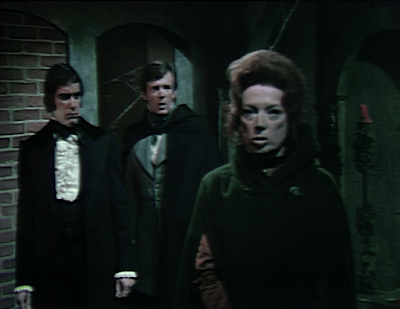
Julia is not, in fact, Barnabas’ sister. She is a medical doctor and mad scientist who first became aware of Barnabas in the summer of 1967, when an escaped victim of his was a hospitalized patient of hers. Doubly qualified as a blood specialist and a psychiatrist, Julia approached Barnabas with a proposition. She was working on an experimental treatment to cure vampirism. If he would agree to serve as a test subject, she would protect his secret. He accepted that deal, and by the summer of 1968 he and Julia had become best friends.
Since then, Julia and Barnabas have had many adventures together. Those have involved traveling backward in time to the nineteenth century, forward in time to the far-off future year 1995, and sideways in time to an alternate universe. When Julia traveled back in time from 1970 to the current year, 1840, she told the members of the Collins family she found living on the estate of Collinwood that she was their distant cousin and that she was expecting that her brother Barnabas would soon arrive from England. She and Barnabas have for all practical purposes been functioning as a close-knit pair of siblings for some time, so this imposture is logical enough.
Julia and Barnabas were in the alternate universe in #1039. This was when we first saw a version of Roxanne. Donna Wandrey’s short red hair, pale skin, and strong chin gave her a strong enough resemblance to Grayson Hall that we wondered if Roxanne would turn out to be the daughter of Julia’s counterpart in that universe of inverted mirror images. They didn’t develop that idea. Pairing the story of dutiful brother Randall destroying vampire Roxanne with that of virtual sister Julia protecting vampire Barnabas creates another inverted mirror image. The show may not have built a story around Miss Wandrey’s resemblance to Hall, but that resemblance does serve as a visual marker underlining the contrast between the two sets of siblings.
Sisterhood comes up in today’s B story as well. Governess Daphne Harridge is the sister of Joanna Mills, who was once the mistress of Quentin Collins. Daphne and Joanna were very close, and Quentin did love Joanna after his fashion. So Daphne and Quentin hold a séance today to contact Joanna’s spirit. We’ve heard enough about Joanna that it is plausible her ghost might show up, and a mysterious figure does appear at the climax of the séance.
It’s hard to get excited about the idea of bringing a ghost onto the show right now. So few characters seem even to like each other that it is hard to come up with credible motivations for anyone to do anything except look for a place to be alone. And there are are plenty of dynamic supernatural villains around. So a wispy presence whose connection to the rest of the cast of characters cannot quite be defined would seem to be the very last thing they need. Still, Daphne is played by the irresistible Kate Jackson, so we might enjoy getting to know her better as we see her interact with the sister who means so much to her.
They do a deep dive into the show’s iconography to make it seem that Joanna’s ghost might turn out to matter. The mysterious figure is a hooded form wearing a gown in the doorway of the drawing room of the great house at Collinwood. This is a recreation of a shot from #170, which was also recreated in #860. In #170, the hooded figure was Laura Murdoch Collins, an undead fire witch whose story absorbed most of the open narrative threads on the show and committed Dark Shadows to being a supernatural thriller. In #860, it turned out to be Judith Collins, whose arrival was nothing more than a bridge between the closing cliffhanger of that episode and the first act of the next.
It’s hard to see how Joanna’s ghost could follow Laura’s lead and take over the show, and equally hard to see how she could serve so minor a function as Judith’s in #861. So perhaps it will turn out to be someone else.
The two female characters capable of taking control of the plot as Laura once did are Julia and wicked witch Angelique. If the hooded figure turns out to be one of them, the resonance with Laura in #170 might be a promise that her part will be decisive when the 1840 segment is resolved. If it is another female character, the resonance with #860 and #861 may be a sign that Dark Shadows’ visual vocabulary has run very dry and it is time for the audience to find something else to do at 4 PM on weekdays. If it is a male character in drag, the show will have taken a turn to self-parody which would seem to have been a bit more in keeping with the campy Zeitgeist of the mid-1960s than with the more earnest attitude typical of 1970. Still, if they’re looking for a change in tone, it might have been worth a try.
The title of this post is taken from Wallace Stevens’ “To the One of Fictive Music“:
Sister and mother and diviner love,
And of the sisterhood of the living dead
Most near, most clear, and of the clearest bloom,
And of the fragrant mothers the most dear
And queen, and of diviner love the day
And flame and summer and sweet fire, no thread
Of cloudy silver sprinkles in your gown
Its venom of renown, and on your head
No crown is simpler than the simple hair.Now, of the music summoned by the birth
That separates us from the wind and sea,
Yet leaves us in them, until earth becomes,
By being so much of the things we are,
Gross effigy and simulacrum, none
Gives motion to perfection more serene
Than yours, out of our own imperfections wrought,
Most rare, or ever of more kindred air
In the laborious weaving that you wear.For so retentive of themselves are men
That music is intensest which proclaims
The near, the clear, and vaunts the clearest bloom,
And of all the vigils musing the obscure,
That apprehends the most which sees and names,
As in your name, an image that is sure,
Among the arrant spices of the sun,
O bough and bush and scented vine, in whom
We give ourselves our likest issuance.Yet not too like, yet not so like to be
Too near, too clear, saving a little to endow
Our feigning with the strange unlike, whence springs
The difference that heavenly pity brings.
For this, musician, in your girdle fixed
Bear other perfumes. On your pale head wear
A band entwining, set with fatal stones.
Unreal, give back to us what once you gave:
The imagination that we spurned and crave.Wallace Stevens, “To the One of Fictive Music,” as published in his collection Harmonium (Knopf, 1923)
I don’t suppose I need to add anything to explain my choice of “The sisterhood of the living dead” as a title. But I do think the whole poem speaks to today’s episode. Neither Gene Lindsey nor Miss Wandrey gets much love from Dark Shadows bloggers, but they both do fine work today. Randall and Roxanne are very raw and basic. They are just themselves when they confront each other in the tomb. She is not the legendary terror from beyond the grave, he is not the heroic defender of the natural order of things. They are simply two people who grew up together, who care about each other, and who are used to knowing everything about each other. She is impelled to attack him, and he keeps her away with that “fatal stone,” the cross. Her last energies are spent on one final effort to keep a secret from him. The bizarre circumstances are stripped away, the plain human feeling remains. “[N]o thread/ of cloudy silver sprinkles in your gown/ a venom of renown.”
A vampire is a metaphor for extreme selfishness, and Julia has surrendered everything in her life to become an appendix to Barnabas’ narcissism. Because she serves him so tirelessly and reflects him back to himself as mirrors can no longer do, he cannot be at ease when he is separated from her. “For so retentive of themselves are men/ That music is intensest which proclaims/ The near, the clear, and vaunts the clearest bloom/…in whom/ We give ourselves our likest issuance.” Julia has reinvented herself as the likest issuance for which even Barnabas could hope.
Randall sees what his beloved sister has become, and knows what he himself would want in her place. He steels himself to relieve her of her cruelly extended existence. “Yet not too like, yet not so like to be/ Too near, too clear, saving a little to endow/ Our feigning with the strange unlike, whence springs/ The difference that heavenly pity brings.”
Too near, too clear. All relationships in Soap Opera Land serve as a basis for deception, either beginning when one party deceives another, deepening when the parties join together to deceive someone else, or shattering when deceptions are exposed. Roxanne is too near to Randall, too clear to his understanding, for the two of them to be on screen together very long.
“Unreal, give back to us what once you gave:/ The imagination that we spurned and crave.” We have seen other vampires destroyed, in some cases by wooden stakes through their hearts. That violent, bloody act makes the vampire seem like a gruesome physical reality, its destruction an onerous labor. But when they melt away in the sunlight, they are presented as bad dreams that can’t hurt us once we are awake. Choosing that method, they present Roxanne as “Unreal.” Seeing Randall with Roxanne, we picture them as children playing together, building their imaginations together. When Randall first joined the cast of characters, he was one of the “Surely There Must Be a Logical Explanation!” people. Only when he saw the evidence of what had happened to Roxanne could he consider the possibility of supernatural events. He had spurned that side of imagination which is most essential to surviving in a world like that of Dark Shadows. Now he has put that same side of it to work to satisfy his craving for answers to questions that he can only doom himself by asking.

