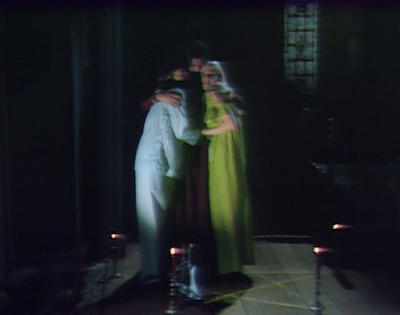
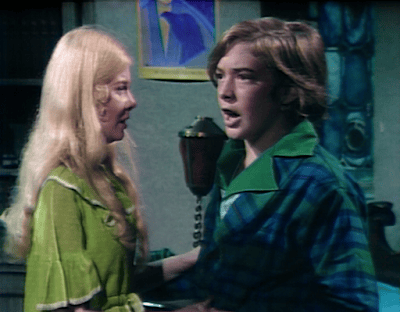
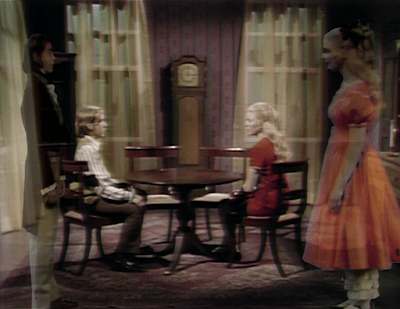
The ghost of Gerard Stiles kills Daphne Harridge, Tad Collins, and Carrie Stokes. It was his idea to bring these three back to life in recent weeks after he murdered them the first time, in 1841. Daphne regained a body of her own, while Carrie and Tad took possession of the bodies of Hallie Stokes and David Collins. Now all of them are dead again, David and Hallie into the bargain. What the point was of any of that, none can say.
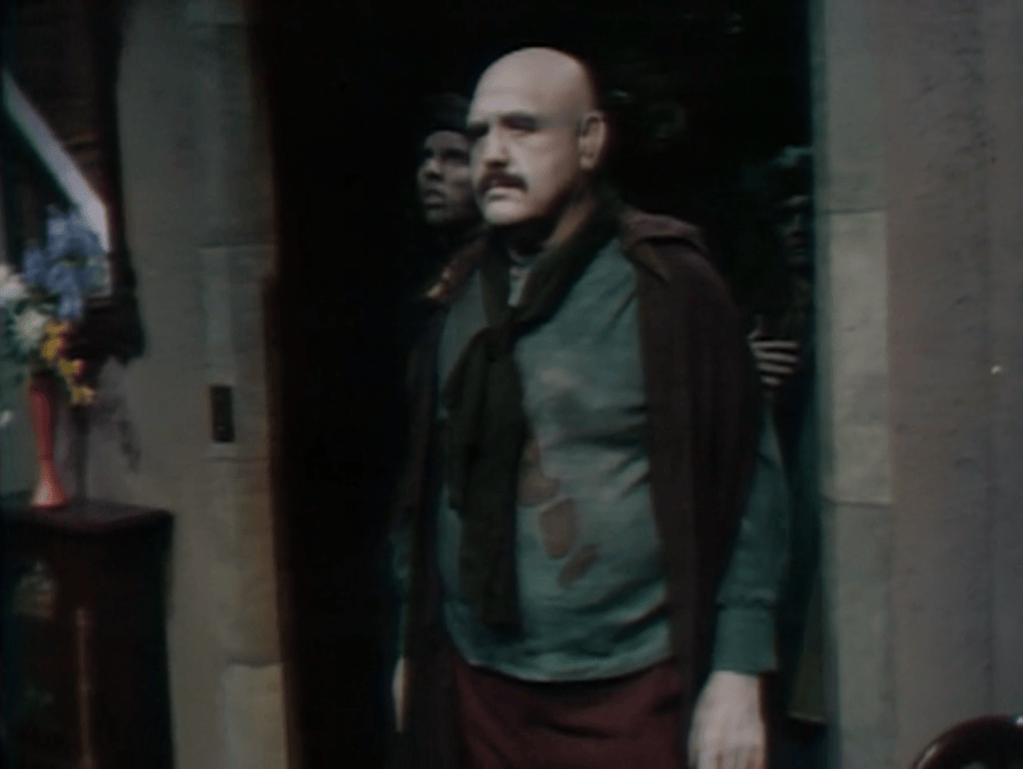
Gerard waves a green polyester flag from the window of the room on top of the tower at the great house of Collinwood, prompting zombies to rise from the dead and wreck the house. The shots of the earth heaving as the zombies rise from their graves were anticipated when David waved the flag in #1089, when a monster masquerading as a man named Jabez Hawkes raised some zombies in #963, and when wicked witch Angelique raised Jeremiah Collins from the dead as a zombie in #392/393. For that matter, the whole graveyard scene was anticipated in the 1959 feature film Plan 9 from Outer Space, and actor Chuck Morgan, who also played one of Jabe’s zombies, even looks like Tor Johnson.
Laugh if you must, but he’s leading a group of six who will demolish an incomprehensibly large haunted house in a single night. That’s more than you’ve done.
The Destruction of Collinwood will leave most of the Collins family dead, missing, or hopelessly insane. That was prophesied when vampire Barnabas Collins and mad scientist Julia Hoffman traveled to the far-off future year 1995 in #1061-1070. It also echoes a line with which heiress Carolyn Collins Stoddard greeted well-meaning governess Victoria Winters in #2, “Welcome to the House of Usher.”
Julia escapes from the zombies and finds herself in 1840. She has to leave Barnabas behind in 1970, where he is busy wrestling with some of the zombies. Each of Dark Shadows‘ major costume drama segments has begun with a character from the contemporary setting alone in an unfamiliar past. Victoria served this function in the first costume drama segment, when the show went to the 1790s from November 1967 to March 1968; Barnabas did it in March 1969, when the show started an eight months tour in the year 1897. Now it is Julia’s turn. She eventually joined Barnabas in 1897; we may wonder whether Barnabas, or perhaps someone else, will manage to find their way to her from 1970.
A lot happens in this one, and all the actors do a good job. Even so, it feels very slow. None of the incidents seems to connect with any of the others.
Ill-dressed man Sebastian Shaw lets himself into the secret room where vampire Barnabas Collins keeps a coffin. It is not the coffin where Barnabas spends his days, but is the resting place of another vampire. Its occupant is Roxanne Drew, whom Barnabas loves and Sebastian hates. Sebastian opens the coffin, pulls a pistol, and aims it at Roxanne. He is about to fire when another figure appears in the corner of the room. Regular viewers recognize this figure as the ghost of pirate Gerard Stiles. Sebastian does not know that Gerard is a ghost. He fires two shots at him, of course without effect.
Barnabas enters. He disarms Sebastian, who tells him he was going to destroy Roxanne but that a man stopped him. Barnabas recognizes his description of Gerard. Sebastian shows Barnabas the bite marks on his neck, and explains he was under Roxanne’s power until recently. She lost her control of him when she began feeding on governess Maggie Evans. Longtime viewers have often wondered why Barnabas didn’t build an army by biting everyone who got in his way and turning them into his blood slaves; this is the first explicit statement on the show that a vampire risks losing control over one victim by taking another. We’ve seen examples of Barnabas’ power weakening when he takes an additional victim, but this has been far from consistent.
Sebastian shouts so loudly the microphone distorts his voice in a way we’ve never heard before on the show. Screenshot by Dark Shadows Before I Die.
Barnabas asks if Roxanne ever mentioned the name Gerard Stiles. Sebastian says that he believes she did, but that he can’t remember in what connection it came up. We’ve had a few hints recently that Roxanne has some kind of association with Gerard and the other ghosts who are taking over the great house of Collinwood. This doesn’t give any substance to these hints, but it does confirm that the writers plan to keep dropping them.
Upstairs, Barnabas visits the other undead female he is keeping in his house, former ghost Daphne Harridge. He questions Daphne, who confirms that there was a girl named Roxanne Drew around Collinwood when she and Gerard were alive in 1840. She doesn’t remember much about Roxanne, but does recall that there was some drastic change in her that got people talking in that year. The show is obviously preparing for a trip back in time to 1840, so with this we learn that Roxanne will figure in that segment and that we will see how she became a vampire.
Another rehumanized ghost, Quentin Collins, enters. Barnabas orders Daphne to leave with Quentin, going far away from Collinwood before Gerard can get at her. Quentin tells Daphne to take Barnabas’ orders. When she protests, he says “Daphhh-neee” in a slow, condescending voice. David Selby started doing this in March to July 1970, when Dark Shadows was set in an alternate universe and he played a different Quentin Collins, one who was married to Maggie’s counterpart. That Quentin was an insufferable jerk who often scolded Maggie with a slow, condescending “Maaaa-ggie.” Hearing him say Daphne’s name in that tonal format this time, I finally realized what it reminded me of. Ted Knight, as pompous newsman Ted Baxter on the Mary Tyler Moore show, would often pronounce the two-syllable names of people he was addressing using the same intonation. All of a sudden I could hear Quentin telling “Murrr-ray!” he shouldn’t put such complicated words in the copy he writes, or “Georrr-gette” not to be so independent. When I mentioned the resonance to my wife, Mrs Acilius, she laughed and said she couldn’t believed she hadn’t noticed it herself.
Barnabas leaves Daphne alone with Quentin. They toast their future life. Daphne abruptly collapses, and Quentin clutches his stomach. Gerard appears, and Quentin asks him why he has poisoned them. Quentin is an expert on ghosts who poison the living. In #677, he was himself a ghost, and he put strychnine in a drink his great-grandson Chris Jennings took. Barnabas’ buddy, mad scientist Julia Hoffman, saved Chris then. Now, Julia is with Barnabas when he returns to the room. Daphne is on the floor, unconscious but still alive. Quentin is nowhere to be seen.
Barnabas goes to the great house, searching for Quentin. He finds heiress Carolyn Stoddard Hawkes, playing a mad scene. Nancy Barrett and Jonathan Frid make Carolyn and Barnabas sound like Ophelia and Claudius in Act 4, Scene 5 of Hamlet, for a little while anyway. When Barnabas tells Carolyn that they must stop what is happening, she replies “I cannot stop anything. Whatever gave you the impression that I could?” It really is lovely.
Barnabas goes back to his house. Julia has treated Daphne, who is resting comfortably, aside from glycerin tears streaking her face at several angles, none of them convincing. Carolyn enters and demands to be left alone with Daphne. Julia and Barnabas know that Carolyn is intermittently possessed by a ghost known as Leticia, who is somehow associated with Gerard and Daphne, and are therefore reluctant to comply with this demand. But they apparently don’t think they have much to lose, so they go along with it.
Carolyn/ Leticia gives Daphne a dress. It is the dress she wore when she was a ghost. Daphne cries out to Gerard, asking if the time has really come. She then goes and hides in the closet. There was a lot of dull business with clothes when Quentin was a ghost, late in 1968, and they recycled that early in the current haunting, five weeks ago. This moment is easier to take, both because it is mercifully brief and because the dress is clearly legible as a sign of imminent story progression in the form of Daphne’s next death.
Quentin and Gerard are in a graveyard. Quentin has recovered from the poisoning sufficiently to smile lovingly at Gerard and say that he can’t imagine why he ever thought he was his enemy. He examines the tombstones in the fenced-off part of the graveyard and reminisces about the men buried under them, men who were underlings of Gerard’s in 1840. Since Quentin is only 100 years old, he is puzzled that he has memories from 130 years ago, but when he takes another look at Gerard’s smiling face his anxiety dissipates. He looks at a blank tombstone and puzzles as to why it is blank. At Gerard’s bidding, he digs up the grave and opens the coffin. He is delighted to realize that it was meant for Quentin Collins, and that the time has come for him to get into it. He briefly resists the idea of burying himself alive, but then looks at Gerard, says “You are Death. Whatever made me think I could run away from you?,” and complies. We end with Gerard putting the dirt back on top of the grave, Quentin securely inhumed.
Longtime viewers know that Quentin is alive because of a magical portrait that immunized him against aging, lycanthropy, and injury. So we are left wondering whether he is also covered for asphyxiation. If he is, Gerard is going to be pretty embarrassed when Quentin makes his way out of the ground.
Three ghosts who have been hanging around the great house of Collinwood for the last several weeks have assumed corporeal form. Teenagers Tad Collins and Carrie Stokes have taken possession of the bodies of David Collins and Hallie Stokes. Once embodied, Carrie and Tad cast a spell that brought their governess, Daphne Harridge, back to life in a body of her own.
Mad scientist Julia Hoffman confronts Daphne and demands she help David and Hallie resume their place among the living. Daphne angrily refuses. “I’m not going to let you destroy Tad and Carrie to bring David and Hallie back!” Carrie and Tad were already destroyed, when they died in 1841; it was Daphne who robbed Hallie and David of their rightful place among the living when she helped Carrie and Tad possess them. That possession is a murder, and one of the victims of that murder, David, has been a central character since the show’s first week in 1966, and the show has often been driven by our concern for his well-being. Daphne’s protest, voiced in a righteous tone that makes it clear David and Hallie mean nothing at all to her, marks Daphne as a villain whose motivations are entirely hostile to everything we could care about. But Daphne is, among other things, Kate Jackson. As such, it is impossible for an audience not to fall in love with her. Though Daphne’s presence in the story can lead to nothing but disaster for the human characters, we cannot want her to go away.
Among Julia’s many powers is mastery of a preternatural form of hypnosis that enables her to mold people’s memories as easily as a potter can shape clay. Until today, we have seen her use this power only on humans. But Daphne is human now, at least technically, so Julia gives it a shot. She takes out her magical medallion and shows it to Daphne. Once Daphne is in a trance, Julia asks her questions. They are not questions about Daphne’s memories of the past, but about events that will take place in the future. Somehow Daphne knows the answers to those. They suggest that the final catastrophe is very near at hand.
Julia introduces our new friend Daphne to our old friend, the magical medallion. Screenshot by Dark Shadows Before I Die.
Carrie and Tad have been inmates at Windcliff, a psychiatric facility Julia controls. Daphne had reached them there, driven in a car by charming rogue Quentin Collins. When Windcliff was first introduced in the summer of 1967, it was made explicit that it was located a hundred miles north of Collinwood. It lay far enough away that Julia could be sure no one on the estate or in the village of Collinsport would recognize her face or name when she showed up in town in #284. It was an unmistakable sign of supernatural agency when Maggie Evans was able to make it from Windcliff to Collinsport on foot in a single night in #295. And after hardworking young fisherman Joe Haskell was sent to Windcliff in #658, everyone seemed to forget all about him, as they had forgotten about sorely bedraggled blood thrall Willie Loomis after he was set there in #329. The place was the functional equivalent of the far side of the moon.
Today, Tad and Carrie escape from Windcliff and Tad remarks that Collinwood is “only a few miles” away. This is quite a severe retcon. It does strip away the sense that Windcliff is a safe place where the characters can take refuge from the impending catastrophe, raising the stakes and heightening the tension. But it also leaves us wondering why they don’t just go someplace else further away. The Collinses are supposed to be terribly rich, so there’s nothing stopping them from buying a place in California or Hawai’i or Bugtussle, Oklahoma and moving there while the ghosts have their way at Collinwood.
Vampire Barnabas Collins and mad scientist Julia Hoffman are trying to prevent a disaster that is fated to destroy the great house of Collinwood and everyone in it before the year 1970 is out. They have a handful of cryptic phrases that clue them in to events that will precede this disaster. One of the phrases is “The night Rose Cottage was destroyed.” They have no idea what Rose Cottage is, and have been unable to find anyone who does.
Julia finds heiress Carolyn Stoddard Hawkes leaving the great house. Carolyn says nonchalantly that there is something she has to do at Rose Cottage. Julia gets Carolyn to say that going to Rose Cottage involves leaving the grounds of Collinwood through the front gate. She asks her to mail a letter for her on her way. She agrees, and waits outside while Julia goes back into the house to get the letter.
Julia rushes to a bedroom where Barnabas is sitting with governess Maggie Evans, who is the victim of a vampire other than himself. Julia fabricates a letter while repeating to Barnabas what Carolyn said. Julia takes over the vigil, and Barnabas gives Carolyn the phony letter. He then follows her to a deserted mansion in the area.
Barnabas barges in on Carolyn in a room in Rose Cottage. He ignores her indignation at his following her and presses her with questions:
CAROLYN: Barnabas!
BARNABAS: So this is Rose Cottage.
CAROLYN: You followed me here!
BARNABAS: Carolyn, who is your friend? Who were you talking to just before I came in?
CAROLYN: That, that really is no concern of yours, now is it?
BARNABAS: Carolyn, you must tell us everything you know about this place, who lived here and who it was you were trying to find.
CAROLYN: Why are you and Dr. Hoffman so interested in this place?
BARNABAS: We’ve told you before one of the events that’s to happen before the disaster at Collinwood is the destruction of Rose Cottage.
CAROLYN: Rose Cottage… [laughs] Now, that’s a strange name for a place like this, isn’t it?
BARNABAS: I know now why it was so difficult to find. How did it get such a name?
CAROLYN: Oh, it happened a very long time ago, when Carrie was very small.
BARNABAS: Carrie lived here?
CAROLYN: Are you going to be quiet and let me tell you?
BARNABAS: I’m sorry, go on.
CAROLYN: Carrie, Carrie always dreamed of having a doll’s house which she would call Rose Cottage. So for her birthday I asked Quentin to build her one. Quentin was so good with his hands you know, and so terribly inventive. He actually built a replica of this house, and I gave it to Carrie for her birthday. [laughs] I told her she would have to find another name for it, but she said no, it would always be Rose Cottage to her. So she kept calling it that, and before very long people called the mansion itself Rose Cottage.
BARNABAS: When was all this, Carolyn?
CAROLYN: I’m not going to answer any more of your questions! You were very rude to follow me here, very rude indeed!
Carrie died in 1841. Her ghost has taken possession of teenager Hallie Stokes. The ghost of Carrie’s friend Tad has taken possession of David Collins. Tad and Carrie, in personis David and Hallie, are currently at Windcliff, a psychiatric facility Julia controls. Before they were taken there, Carrie and Tad did some mumbo-jumbo and restored their late governess Daphne Harridge to life. Daphne then led Tad and Carrie in an unsuccessful attempt to do the same for another ghost, erstwhile pirate captain Gerard Stiles. Carolyn is possessed by the spirit of a certain Leticia Faye, though unlike Hallie and David her own personality still exists within her body and from time to time asserts itself.
We have seen the dollhouse of which Carolyn/ Leticia speaks many times, and we know that it is in some supernatural sense identical with the full-scale mansion. The episode opened with a reprise of Friday’s cliffhanger, in which Gerard used the dollhouse to trap Daphne in the mansion and to set fire to it. Carolyn/ Leticia interrupted Gerard and saved Daphne.
Barnabas returns to the great house and tells Julia that he now knows where Rose Cottage is. He says that he saw Carolyn there. She asks if he got any information out of Carolyn. He says that he did not. He does not mention the business about Carrie and the dollhouse, which is just bizarre. He and Julia know about a mysterious playroom full of toys appropriate to small children that intermittently appears in a space in a little used part of the great house otherwise occupied by a linen closet. They know that all four ghosts are associated with this playroom. You would think he would therefore realize that a story about a toy of Carrie’s would be relevant to their concerns, but apparently the connection escaped him.
In the last scene, Julia is in Maggie’s room when she is suddenly seized by a fit of sleepiness. A dark figure in a cloak and a slouch hat appears inside the window. Maggie gets up and goes to the figure, who is no taller than she is.
The figure’s slight build and short stature may suggest it is a woman, but no woman on Dark Shadows has ever worn shoes like that. Screenshot by Dark Shadows Before I Die.
I don’t know if the above makes it clear, but this episode is a sharp step up from last week’s offerings. It is tightly paced, clearly developed, and forcefully acted, a bright spot in a storyline that has been desperately dreary so far.
The ghosts of four people who died in 1841 have been haunting the great house of Collinwood. They represent teenagers Carrie Stokes and Tad Collins; Carrie and Tad’s governess, Daphne Harridge; and a sometime pirate captain known as Gerard Stiles. Three of these four have now assumed corporeal form. Tad and Hallie have taken possession of their lookalikes, David Collins and Hallie Stokes. They then performed a ceremony that caused Daphne to come back to life in a body of her own. We open with these three repeating the ceremony in order to conjure Gerard back into existence as a living being.
When Carrie and Tad performed the ceremony the first time, they did not know whether they would raise Daphne or Gerard. That episode ended with a knock at the door, leaving us to wonder along with them who would come. My wife, Mrs Acilius, said it would be funny if it were someone else. She suggested the writers might take a page from Let’s Make a Deal and have Tad and Carrie find a donkey behind Door Number Three.
Today, the ceremony again ends with a rapping on the door. But it is not Gerard. It isn’t a donkey, either. It is Willie Loomis, servant to old world gentleman Barnabas Collins. John Karlen always finds a way to bring out humor in his characters’ predicaments, and the rough-hewn Willie does deflate the grandiosity of Carrie, Tad, and Daphne’s meddling in God’s realm.
Scrambling to cover up the signs of the ceremony before he has to open the door to Willie, Tad calls out “We were sleeping! (pause) I was sleeping!” David Henesy plays this absolutely straight, so that we can see it dawning on Tad that he and Carrie aren’t supposed to be sleeping together. Karlen wasn’t the only actor who knew how to find the laughs hidden in his lines.
Daphne hides. Tad opens the door. Willie sees the pentagram on the floor with the candles at its points and says he recognizes it as a device of black magic. He forestalls the teens’ attempt to pretend to be Hallie and David by calling Tad by name. Tad then turns to Carrie and makes fun of Willie’s twentieth century vocabulary in an attempt to intimidate him by a display of social superiority. This collapses immediately, and Willie says that Tad and Carrie have to come with him because he is bigger than they are.
Willie detains Carrie and Tad in the drawing room, waiting for Barnabas to come back. He has to leave them when he hears Maggie Evans, governess to the late David and Hallie, coming downstairs. Maggie is the victim of a vampire, and Willie is part of the crew that is keeping her from going off to get her blood sucked.
Willie rushes to the foyer and asks Maggie why housekeeper Mrs Johnson isn’t keeping her in her room. Maggie does not respond. The true answer would be that Clarice Blackburn has a writing job on another soap now and isn’t available to play the part, so they leave Mrs Johnson’s absence unexplained.
While Willie gets Maggie back to her room, Tad and Carrie listen to the dogs howling outside. Carrie says she has never heard howling like that before, and Tad contradicts her. He says that if she searches her memory, she will find that they heard just that sound in their own time. He gives a somber look, as if he knows what the howling means. The show has been making it clear that we will be going back in time to 1840 sooner or later. These lines of Tad’s tell us that we will find a vampire in operation when we get there.
In Maggie’s bedroom, Willie explains that Hallie and David have been possessed by Carrie and Tad. Maggie has seen enough in her time at Collinwood that she finds this instantly credible. She blames herself, saying that if she were not ill she would have been able to prevent the possession. Willie asks what she could have done, and she cannot think of anything. He presses her to tell him who the vampire is. She claims he cannot understand what she is going through. He cannot tell her that he himself was once the victim of a vampire, since that vampire was Barnabas and the show will implode if Maggie is ever told about that. So they are left at a stalemate.
Meanwhile, Daphne takes shelter in a deserted mansion once known as Rose Cottage. Gerard confronts her there. He is cranky about still being dead. She tells him it’s no one’s fault that the ceremony didn’t work. They will reenact it tonight, when the stars are back in the right alignment. She also tells him that they don’t need Tad and Carrie to accomplish their goal. This line is unfortunate- to the extent that the story has generated suspense, it has involved us wondering how Carrie and Tad are involved in whatever it is Gerard wants to do. When we hear they aren’t involved at all, it lets the air out of an already badly under-inflated set of tires.
Gerard vanishes from Daphne’s presence and materializes in a mysterious chamber known as The Playroom. The Playroom intermittently appears in a little-used part of the great house, behind a door that usually opens on a linen closet. There is a dollhouse in The Playroom that is a scale model of Rose Cottage and that is, in some supernatural sense, identical to it. Gerard sets fire to the room in the dollhouse that corresponds to the room in Rose Cottage where Daphne is. He uses his finger to hold closed the door corresponding to the one from which she could escape a fire in the room.
Daphne finds that the room she is in is engulfed in flames and she cannot open the door. Apparently Gerard has decided that if Daphne is going to tell him they don’t need Tad and Carrie, he doesn’t need Daphne, either. Daphne, being as she is played by Kate Jackson, is impossible not to care about, so this cliffhanger does make us want to come back Monday and see her escape. But since it implies that none of the relationships among the ghosts means anything, and since we’ve already seen that none of the living characters can mount an effective resistance to the ghosts, it also brings us to the conclusion that the whole Re-Haunting of Collinwood story is at a dead end.
For several months starting in late 1968, Dark Shadows did an adaptation of Henry James’ Turn of the Screw. This segment is often called “The Haunting of Collinwood.” For the last six weeks, they’ve been doing a second adaptation of that same novella. I call the current segment “The Re-Haunting of Collinwood.”
So far, the remake has been so close to the original that it is little more than a test of the patience of longtime viewers. The last few days, they’ve been deviating a bit. So the ghosts of teenagers Tad and Carrie have erased the personalities of their lookalikes, David Collins and Hallie Stokes, and are now operating as living beings in their bodies. That didn’t quite happen in 1968 and 1969, when David and his friend Amy Jennings were beset by ghosts who were excited by their resemblance to their late ancestors Jamison and Nora Collins.
Carrie and Tad have cast a spell that has conjured up their old governess, Daphne Harridge, as a living woman. Amy and David never even tried to bring lady’s maid Beth Chavez back to life. She remained an unspeaking ghost until the show went back in time to 1897 and we met her in her proper lifetime. Today, Daphne orders Tad and Carrie to go through the same spellcasting procedure to bring the other ghost, the evil Gerard Stiles, back to life. Again, David and Amy did not try to bring Quentin Collins back to life. He is alive today only because he was immunized against death and aging in the 1897 segment, since he was such a hit with the audience.
Yesterday, David’s distant cousin Barnabas Collins questioned Carrie and Tad and revealed their true identities. Neither of them was able to name the parents of the person they were possessing. Tad was also unable to name David’s former governess Victoria Winters. Through the show’s first year, Vicki was the chief protagonist and main audience identification character. She was written out in 1968, and Barnabas’ question was the first reference to her in months. She comes up again today. Carrie brings some contemporary clothes for Daphne to wear. She explains to Tad that “They belong to a governess that was here once… Her name was Victoria or something.” She says that the current governess told Hallie that Victoria left the clothes behind, but did not explain why.
Two consecutive episodes alluding to Vicki will be enough to get longtime viewers wondering if we will see her again. They had run out of things for Vicki to do in the story long before she left the show, and there is no clear opening for her now. When Carrie calls attention to the fact that there is a mystery around the circumstances of Vicki’s departure, she reminds us that that Vicki disappeared into a time warp. Since The Re-Haunting of Collinwood seems to be heading into a trip back through time to the year 1840, that might lead us to hope that what we find in that year will have something to do with Vicki. Then again, if all the ghosts are going to turn into living people, maybe they will be able to cancel their reservations for the journey to the past and stay in contemporary dress. Perhaps in that case, Vicki will find her way back as well. We might imagine that we will find tomorrow that they have failed to bring Gerard to life, but have conjured up Vicki instead. Maybe the summoning procedure only brings up governesses with long black hair.
Daphne is played by Kate Jackson, in her first screen role. Miss Jackson would go on to star in primetime series such as The Rookies, Charlie’s Angels, and Scarecrow and Mrs King.
Barnabas Collins leaves people who appear to be his distant cousins Carolyn Stoddard Hawkes and David Collins, as well as Carolyn and David’s houseguest Hallie Stokes, in David’s bedroom. Barnabas is still within earshot when these three address each other as “Leticia,” “Tad,” and “Carrie.” He rushes back into the room, looks at those who might be taken for Hallie and David, and declares “You are both possessed!” He ignores the fact that the same evidence indicates that Carolyn is also possessed.
Initially, Tad and Carrie pretend they were only using those names as part of a game. Barnabas says that in that case, he will play, too. He asks Tad to name David’s mother. He cannot. He then asks who his previous governess was. He can’t answer that, either. He asks Carrie why Hallie lives in the great house of Collinwood. She says that it is because there was an accident. Barnabas confirms that is so, and that the accident involved her parents. He asks her what their names were. She cannot answer. He presses on when they object. Finally, Carrie calls out to Daphne, a ghost whom she and Tad had previously denied ever having heard of, to come and help them. Shocked, Tad looks at her and calls her Carrie. The cat is out of the bag.
Longtime viewers will be thrilled by Barnabas’ questions. Not only is it a refreshing change to see him demonstrating presence of mind and moving quickly to advance the story, but the references to David’s mother and to his previous governess bring up characters who used to be very important to the show and who have been absent from the story and unmentioned for a long time. Real heads know who those women were, Tad and Carrie are exposed as noobs.
Throughout this interrogation, Carolyn/ Leticia was standing still, watching placidly while Carrie and Tad got flustered and blew their cover. Barnabas asks what the ghosts of Daphne and of someone named Gerard want. At that, Carolyn/ Leticia breaks her silence. Smiling, she says that Tad and Carrie do not yet know the answer to that themselves. Neither does she, come to that. She wafts away, leaving everyone reeling.
Yesterday, Tad told Carrie that if they let on who they really were, they would be defeated at once. It was not at all clear then what anyone could do to bring that about. Tad tells Barnabas that he and Carrie are here to stay, and that there is nothing he can do to stop them. This seems to be true.
After Barnabas leaves Carrie and Tad alone in David’s room, they wonder what happened to Hallie and David. They say that they liked them, and that they hope nothing bad happened to them. Carrie asks Tad if he thinks David and Hallie are dead. He says he doesn’t think so, but he sounds very doubtful. Carrie asks where they are. He says they aren’t anyplace. While he and Carrie are using their bodies, Hallie and David “don’t exist.” It may seem obvious that ceasing to exist qualifies as something bad happening to a person, but ever since Epicurus in the fourth century BCE that has been an open question among philosophers. So maybe nothing bad did happen to David and Hallie. Certainly nothing at all will happen to them ever again.
Though Carrie and Tad have entirely erased Hallie and David, Carolyn persists. Leticia sets out to tell Quentin Collins something. By the time she gets to Quentin’s room, Carolyn has reemerged and is unsure what she is doing there. Quentin is drunk, which is not unusual. He is under Daphne’s power and has been unable to do anything to prevent Tad and Carrie from taking over David and Hallie’s bodies. Carolyn became clairvoyant when Leticia moved in with her, and can tell Quentin is feeling guilty about something. He denies everything.
There’s a lot of spellcasting today. Quentin tries to break free of Daphne by setting fire to her handkerchief. This fails immediately. Carrie and Tad try to raise one of the ghosts from the dead. They hope they will get Daphne, because they are afraid of Gerard, but they have no way of knowing which one it will be. The episode ends with a knock at the door. We will have to wait until tomorrow to find out whether that will be Daphne, Gerard, or the man from the gas company come to read the meter.
Dark Shadows began in June 1966, when well-meaning governess Victoria Winters was on her way to the great house of Collinwood to take charge of the education of strange and troubled boy David Collins. David’s aunt, matriarch Elizabeth Collins Stoddard, had written to Vicki to offer her the job; his father, Liz’ brother Roger Collins, was opposed to Vicki’s hiring. Roger’s opposition rose from mild disapproval to paranoid fervor when he learned that his arch-nemesis, Burke Devlin, rode into the village of Collinsport on the same train as Vicki.
In the months that followed, the only story that consistently worked was Vicki’s attempt to build a friendship with David in spite of his vicious and at times murderous hostility towards her. Later, David met Burke, and the two of them quickly bonded over their shared hatred of Roger. For his part, Roger was haunted by the thought that Burke was David’s biological father, a thought which Liz forbade him to express.
For a long time, David continued to be the pivot on which the story turned. Crazed handyman Matthew Morgan abducted Vicki and tried to kill her; that crisis reached its emotional peak when David found Vicki bound and gagged in Matthew’s hiding place and refused to rescue her. David’s mother, undead blonde fire witch Laura Murdoch Collins, came back to claim him, which would have meant his death. That arc ended when David ran from the fishing shack Laura had set ablaze and flung himself into Vicki’s arms. With that, he chose Vicki and life over Laura and death, appointing Vicki as his new mother. That marked the conclusion, not only of the David and Vicki story, but of Dark Shadows 1.0.
As the show reinvented itself, David remained the key to the action. The two long costume drama inserts that established Dark Shadows as, first and foremost, a show about time travel, the trip to the 1790s that lasted from November 1967 to March 1968 and the trip to 1897 that ran from March to November 1969, were both prompted by attempts to protect David from a looming supernatural menace. Though he was not an active participant in either of those stories, it was his peril that triggered them, and attempts to protect him and his analogues in previous generations of the Collins family that set the boundaries of the possible action.
As of this episode, all of the characters mentioned above are off the show. Vicki made her final appearance in #665*; Matthew made his in #123; Laura in #191**; Burke in #344; Roger, in #979***. Liz made her last substantive appearance on Friday; she will have one brief scene in #1198, simply to mark the end of a storyline. David leaves the show today.
In the early parts of today’s episode, David and his fellow teenager, houseguest Hallie Stokes, are being led through the woods by the unspeaking ghosts of two people who died in 1841. David’s psychopomp is the late Gerard Stiles, who was apparently a pirate when he was alive but has become a landlubber in death. Hallie’s is the late Daphne Harridge, who was once the governess at the great house. Daphne’s charges were Tad Collins and Carrie Stokes. Hallie and David have spent vast amounts of time moaning about how the ghosts of Carrie and Tad are going to take possession of their bodies and erase them from existence. Much of this moaning has taken place in a mysterious room which they call “The Playroom.” The Playroom intermittently exists in a obscure corner of the great house. When it materializes, it can be found behind a door that at other times opens onto a linen closet. Gerard, Daphne, Tad, and Carrie have free rein in The Playroom.
There is a dollhouse in The Playroom that the ghosts like to play with when David and Hallie aren’t looking. This dollhouse is a scale model of Rose Cottage, a mansion which stood somewhere near Collinwood in 1840. It is in some supernatural sense identical with that mansion. In #1082 and again in #1093, it was made clear to Hallie and David that they are fated to become dolls confined to this dollhouse, and that any living that is left for their bodies to do will be done by Carrie and Tad.
Daphne and Gerard take Hallie and David to a full-sized version of Rose Cottage that stands in the woods. It is unclear whether this mansion is visible all the time, or if it comes and goes as does The Playroom. The latter would seem more likely, since it is such a big place it is hard to imagine it would have escaped the notice of the people who have heard the expression “Rose Cottage” and have recently been trying to figure out which of the big houses in the area was around in 1840 and could have been known by that name in that year.
Gerard gets David to Rose Cottage while Daphne and Hallie are still making their way through the woods. David takes a nap in the corridor outside the upstairs parlor where the dolls are kept. He has another dream like the one he and Hallie both had in #1082, in which they are in the upstairs parlor. Daphne is in his dream. She smiles. Her smile is more unsettling than Gerard’s sneer. David wakes up and finds that Daphne is there, with Hallie.
David says they must resist; Hallie says it is too late. Then there is a commercial break. When we come back, they are in the upstairs parlor. Hallie notices the dolls are gone. David says they are no longer needed. Hallie says they must resist; David says it is too late. David Henesy manages to make David Collins’ part in these two scenes work. In the corridor, David is conflicted, trying to sound brave as he says the words about resisting but looking helpless as his eyes turn to the ghosts. In the parlor, he is simply defeated. His performance sketches a clear line between these two emotional states.
Kathleen Cody is less successful as Hallie. She seems to have come to terms with the reality while in the corridor. In the parlor, she flips back into Hallie’s usual mode, maximum possible tension. It doesn’t help that her dialogue is a bunch of questions about why they can’t resist. In context, those questions are just nonsense, and Hallie’s abrupt switch from quiet resignation to extreme plangency is inexplicable. My wife, Mrs Acilius, asked if they were trying to make us root for the ghosts who promise to shut Hallie up.
This story is the second time Dark Shadows has adapted Henry James’ The Turn of the Screw. The first time through, in late 1968 and early 1969, David and his friend Amy Jennings took turns in the role of Child Who Enforces the Will of the Ghosts and Child Who Resists the Will of the Ghosts. That got to be frustrating, but at least they waited until the episode was over to switch roles. Switching them during a commercial break is just a slap in the face of the audience. Miss Cody’s decision to play Hallie at such a high level of agitation so much of the time was a costly mistake, but no performer could really have saved the part.
The ghosts indicate that David and Hallie are to take their seats at the table where the dolls usually sit. When they do so, we jump to a somewhat lower camera angle. This cut does indeed make it look like Hallie and David are small figures inside a small space. Henry Kaplan directed this episode. I usually have a lot of complaints about Kaplan. His preferred visual strategy was to cut from a closeup of one face to a closeup of another face to an extreme closeup that shows at most part of a face. But this shot achieves a subtle effect, and that effect tells the whole story. I can’t suppress a suspicion that Lela Swift stepped in and set the shot up for Kaplan, but even if she did he deserves credit for not fouling it up.
Carrie and Tad come into view. Carrie superimposes herself on Hallie’s body, Tad superimposes himself on David’s, and both ghosts fade out. As they do, we hear Tad say “Goodbye, David,” and Carrie say “Goodbye, Hallie.” We will see Carrie and Tad in the persons of Hallie and David for some time, but will never see either David or Hallie again.
I remembered this closing image vividly from our previous watch-through of the series. I misremembered the lines, though. I recalled David and Hallie saying goodbye to each other, not the ghosts saying goodbye to the teenagers as they took possession of them. I think it is better the way it is. We are supposed to be horrified at Carrie and Tad’s thoughtless cruelty as they annihilate Hallie and David, and denying them even the opportunity to bid each other farewell serves that purpose. Unsatisfactory as are the rest of the episode and indeed the rest of the David and Hallie story, this closing shot is highly effective.
*Alexandra Moltke Isles last played the character in #627. Two other actresses succeeded Mrs Isles in the role.
**Another iteration of the character appeared in 20 episodes between #729 and #760.
***Another version of the character appeared in 17 episodes between #975 and #1055.
Teenagers David Collins and Hallie Stokes are intermittently subject to possession by the ghosts of Tad Collins and Carrie Stokes. They fear that the ghosts will soon take them over permanently, erasing their own personalities once and for all. We have seen the future, and know that unless something changes not only will the bodies of Hallie and David become vessels for Carrie and Tad, but those bodies will die and the ghosts will haunt the uninhabitable ruins of the great house of Collinwood for years to come.
Previously, Tad and Carrie had been unaware of David and Hallie. When one of them was possessed, the ghost would not know whom the other meant when addressing them by the name of the living person. But yesterday Carrie and Tad simultaneously took possession of Hallie and David, and they talked to each other about how much they liked them and how puzzled they were that they were afraid of them. They went to the ghost of their governess, Daphne Harridge, and asked her if she knew why David and Hallie were afraid of them. For a moment we might have hoped that communication would take place and the story of the haunting would finally pick up steam, but that hope was dashed when Daphne responded to Tad and Carrie with silence. Daphne had been silent in her interactions with the living characters until Hallie and David heard her laugh in a dream they both had in #1082. It’s depressing that she can’t talk even to her fellow ghosts.
Any hopes we may have had for Hallie or Carrie also suffered yesterday from Kathleen Cody’s poor performance. Miss Cody gets a lot of hate from fandom, much of it unfair. She is good sometimes. But called upon to draw a bright line between the frightened Hallie and the cheerful Carrie, she went way overboard in both parts. The excessively ebullient Carrie is easy to ignore, while the heavily distraught Hallie is tiresome in the extreme. Even the usually reliable David Henesy occasionally got caught up in Miss Cody’s hamminess and overplayed David Collins. He pulled himself back each time, but it is hard to look forward to heaven knows how much more of this story when that keeps happening.
Today we get another David and Hallie/ Tad and Carrie episode, and it is little better than yesterday’s. Miss Cody is even more monotonous than she was yesterday. Mr Henesy does keep from following her into the dead end where she is stuck, and he manages to introduce a touch of comedy. The ghosts lock David in his room with Hallie, and his response is go directly to the window, open it, and climb out. His room appears to be on the third floor of the house and to overlook a cliff, but if that’s the only alternative to spending an hour locked up with Hallie I don’t think anyone can blame him.
David climbs out the window to get the hell away from Hallie. Screenshot by Dark Shadows Before I Die.
The highlight comes when David sees his distant cousin, Quentin Collins, standing by the brandy decanter. David has overheard Quentin muttering about a mysterious stranger and has questions:
David: Who are you talking to?
Quentin (drunk): The dregs, David…the dregs of this glass. That’s where all the answers are.
David: I thought you said something about a stranger.
Quentin: Oh, well, I’m in immediate danger of becoming a stranger to my glass, but that can be easily remedied. Yes, it can be. [Pours drink.] Ah ha ha…friends again.
Quentin was a malevolent ghost when we first got to know him, late in 1968. We then traveled back in time to 1897, where we met him as a living being. He was an utterly irresponsible rascal, selfish, cruel, cowardly, and shameless, and everyone who saw him fell in love with him at once. His death was prevented, he was immunized against aging, and when the show returned to contemporary dress there he was, none the worse for his 100 years. But they couldn’t find much of a place for him in the story. He may not be making many things happen these days, but in this exchange we find that he is still an alcoholic. As long as he has that going for him, he will always be the Quentin we can’t get enough of.
If you’re telling a fictional story and your audience is with you, they will treat whatever you don’t explain as something that does not need to be explained. So if the story takes place in and around a village on the Atlantic coast about 50 miles from Bangor, Maine, you don’t need to explain why Bar Harbor doesn’t exist in the world you are describing. They will take it for granted that your village is on that spot instead.
When you introduce fantastic elements and don’t explain them, you have “fantasy fiction.” That’s the category Dark Shadows has belonged to since undead blonde fire witch Laura Murdoch Collins joined the cast of characters late in 1966 and her arc absorbed all of the unresolved narrative threads that were still generating interest. So in March 1970, it turned out that an alternate universe could sometimes be glimpsed in a room in the long-disused east wing of the great house of Collinwood, and that people who entered the room at the right time could cross over into that universe. The aperture between the universes was not induced by any process, either natural or artificial; it was just there, and it was marked by an ordinary door. The handful of throwaway lines we heard about the many-worlds hypothesis were not explanatory in any way; they were simply a description of one way the show might use the alternate universe to develop characters. Because the practicalities were not explained, we accepted them as something that needed no explanation.
Mad scientist Julia Hoffman and her friend, old world gentleman Barnabas Collins, crossed over into the other universe. They escaped from it in July, while the alternate version of Collinwood was on fire. Evidently the flames disturbed the aperture, because they found themselves, not in the summer of 1970, but in 1995. In that far-off future year, Collinwood was in ruins and everyone who had lived there was either dead, missing, or insane. Julia and Barnabas learned that this sad state of affairs resulted from a mysterious disaster that took place at some point in 1970. They had gathered only a little information as to what this disaster might have been when they had to flee for their lives. A ghost led them to a magic doorway behind which a staircase appeared. They followed this staircase to another doorway. They passed through that, and found themselves back in the Collinwood of their own native universe in 1970, sometime before the disaster is due to strike.
Passing from 1995 to 1970 by means of a stairway is as fantastic as passing from one universe to another by means of a door, but it was not explained, and has barely been mentioned these last three weeks as Julia, Barnabas, and those they have told of their experiences have been trying to figure out what the disaster is going to be and how they might prevent it. So we have accepted it as readily as we accepted the “Parallel Time room.”
That changes today. Julia knows that the ghosts represent people who lived in 1840, and has started looking for information about the staircase in documents from that year. Quentin Collins has been giving her a hand with this project. She finds a plan for a “Proposed Stairway into Time” signed by another Quentin Collins and dated 1840.
The ghost of governess Daphne Harridge seemed friendly to Julia and Barnabas in 1995, but in 1970 she has ensorcelled Quentin and kept him from being as helpful to Julia as he might. Today, Daphne oversees the destruction of a notebook in which teens David Collins and Hallie Stokes have written an account of their experiences with her and the other ghosts. But later it seems Daphne might be coming back around. She gives Quentin another journal, which he hands over to Julia. In it, Julia finds that Quentin’s namesake from 1840 had written about the thoughts that led him to design his “Proposed Stairway into Time”:
There is no such thing as time. There’s only space, physical space, and it is space that measures the distance between those points which we, in our ignorance and folly, insist are points in time. All time is one point, one moment. It is ever existent and it is ever accessible, and it is physical space that can be used to make all time easily accessible.
This describes the show’s method of jumping backward, forward, and sideways in time accurately enough. They cut from a set in one part of the studio to a set in another, and in so doing they have defeated chronology. Since Julia has found the note as part of an investigation that has kept her busy for so long, we are led to expect that we will be hearing more of this kind of talk, perhaps arranged in a pattern that will create the impression that we are being presented with an explanation of something.
Dark Shadows has been desperately short of story since Julia and Barnabas returned to 1970, and spinning out explanations is one way of introducing new story points. When these explanations resemble theories that researchers are actually using to look into natural phenomena, they turn fantastic fiction into science fiction. At no point has Dark Shadows come anywhere near this genre, and it does not seem like the “Proposed Stairway into Time” will lead them there. But who knows. Before Laura came on the show, it was a Gothic romance that included hints that ghosts and other unearthly forces were at work in an uncanny back-world behind the action. If Laura could transform it from that into the supernatural thriller it has been ever since, perhaps Quentin’s namesake from 1840 will be able to transform it into a science-fiction show.
If they are going to take that route, a time-travel gimmick would seem to be the logical way to merge onto it. Ghosts and vampires and zombies and other revenants, like time travel and alternate universes, are ways of making believe that options which events have foreclosed are still at least partly open to us. So if we say that the 1840 Quentin built a time machine, we can subsume more or less everything else we have seen under the idea that he created a rupture in space-time through which all of the other weird phenomena have been cascading.