Quentin Collins, sole heir to the Collins family fortune, took his young son Tad with him and sailed away on a cruise meant to take them and Quentin’s friend Gerard Stiles around the world. He left his wife Samantha, Tad’s mother, behind in the great house at Collinwood.
Six months ago, in the spring of 1840, Gerard came to the great house with sad news. Quentin and Tad had been washed overboard off the coast of Brazil. He had tried to save them, but could not. They must be presumed dead. To the dismay of Quentin’s younger brother Gabriel, his father Daniel decided not to change his will when told of Quentin’s death. Samantha remains as sole heiress of all Daniel’s vast holdings.
Gerard was invited to stay in the great house as a guest, and did so. In #1119, Samantha decided that her period of mourning had gone on long enough and married Gerard. In #1120, Gabriel found that not even this had moved Daniel to change his will in favor of him and his children. On the contrary, Daniel says that he ought to adopt Gerard, who is the son he should have had. It seemed that all the Collins wealth was fated to pass from the family with Daniel.
Before Samantha and Gerard had been married a whole day, Quentin turned up, alive and well and reporting that Tad would be along as soon as he recuperated from a mild fever. They had spent the last six months as penniless tramps making their way through South America on foot. It quickly emerged that Quentin had no particular feeling for Samantha; he regarded the Enoch Ardenesque situation as a comedy. He invited Samantha to choose between him and Gerard. If she chose to resume their life together, he would endeavor to make a go of it. If she preferred to start fresh with Gerard, there would be no hard feelings.
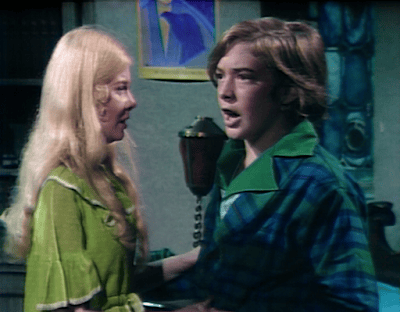
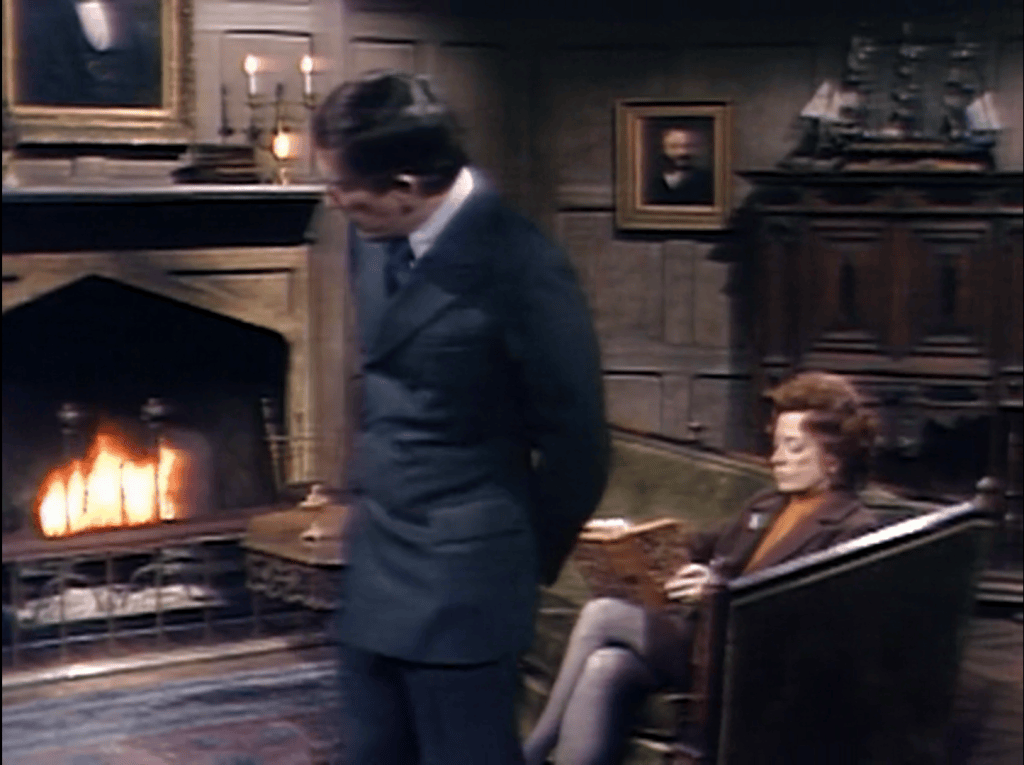
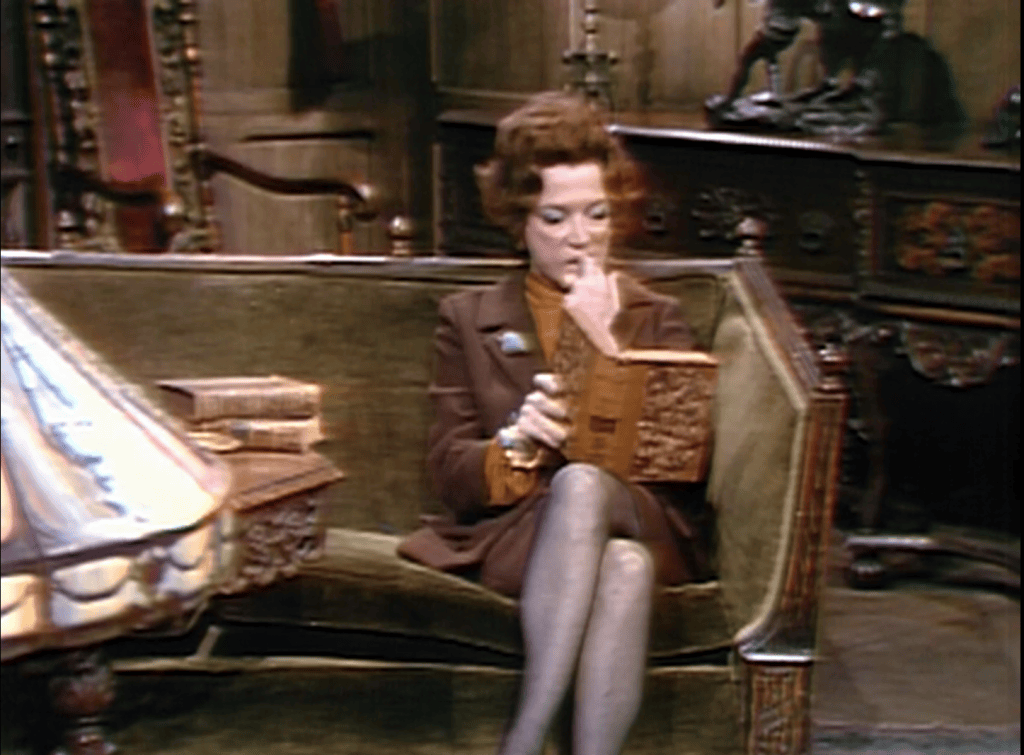
Samantha is having trouble deciding. Today, Gabriel taunts her, imagining how she broke the news to Tad: “Dear Tad, there is something I must tell you. You’re going to have two fathers now.” In fact, this doesn’t sound like such a bad idea. Quentin and Samantha cannot be bothered even to pretend they love each other, and whatever Gerard may feel for Samantha pales by comparison to his yearning to live at Collinwood and enjoy the family’s riches. If all had gone according to Quentin’s original plan, he and Tad would probably still be living with Gerard on board ship at this time, with Samantha just an increasingly distant memory. And despite the awkward situation in which they find themselves, Quentin still regards Gerard as a friend. His memories of their time together before the accident at sea must be very warm indeed to prompt that attitude.
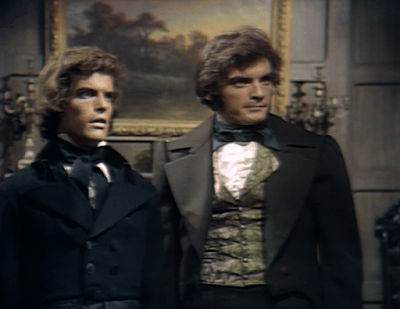
The whole situation will remind longtime viewers of the conflict between high-born ne’er-do-well Roger Collins and dashing action hero Burke Devlin that ran through the first 40 weeks of the show, when it was set in 1966. Burke and Roger fought over many things, not least their past involvements with Laura Murdoch Collins, David’s mother and Roger’s estranged wife. Each man suspected that Burke was David’s true father. Roger and Burke noisily hated each other, but as Louis Edmonds and Mitch Ryan played them they seemed to have some very complicated feelings for each other that came from places other than wounded pride or class conflict or jealousy about Laura. When Laura joined the cast of characters, Diana Millay joined Ryan and Edmonds in making it crystal clear that Burke and Roger had always been more focused on each other than either was on her. In #139, they fought in front of Laura and forgot she was in the room. She rolled her eyes, telling the audience that it was the same as it ever was.
Laura turned out to be an undead fire witch come to immolate David in order to perpetuate her own supernatural existence. When that dawned on Roger and Burke, they set their hostility aside and worked together to protect David. In #187, the two of them took their places beside David’s bed and gave him some important news. They looked so natural together that it was as if they had been raising David together all of his life. Up to that point Roger had been unnervingly cold and evil, remarkably cruel to David and potentially deadly to well-meaning governess Vicki. After we see him and Burke co-parent David so tenderly, Roger is never a villain again.
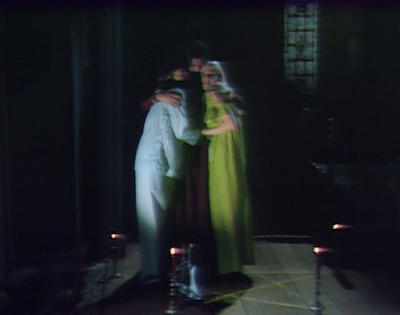
Tad is no likelier than David was to end up with two dads. Long before the show traveled back in time to 1840, we saw that Gerard’s ghost was the face of a disaster that reduced Collinwood to ruins in 1970 and was still taking the lives of those who dared venture there in 1995. We learned from other ghosts of those who had been on the estate in 1840 that Gerard murdered several people, Quentin and Tad among them. If history is to unfold again as it did that first time, Gerard will have to change. We have seen that he is greedy, dishonest, and cruel, but he hasn’t shown any enthusiasm for murder. And Quentin’s continued friendliness towards him suffices to show that he has a more agreeable side.
When the present-day characters were researching the Collinwood of 1840, they were surprised to find that there had been a man named Quentin Collins there at that time. They could find no reference to Tad or Samantha, and the only evidence of Gerard was his tombstone. So a resolution that leaves Quentin and Gerard living together happily ever after, but the rest of the family so scandalized by them that Daniel writes them out of history and leaves his estate to Gabriel and Gabriel’s children, would prevent the disaster while leaving in place a timeline in which the characters we know could be born and live the lives we have seen. I can imagine a story in which Gerard committed the murders only because he fell under the power of an evil spirit that promised to cure him of his same-sex desires. The disaster could then be prevented when he and Quentin decide to throw the conventional morals of the nineteenth century aside and commit themselves to each other.