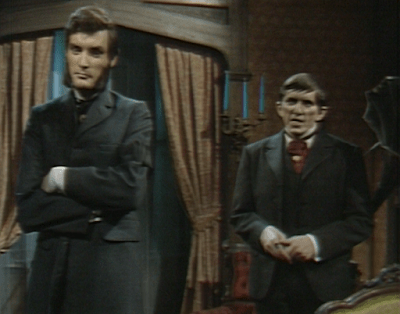
The ghost of Gerard Stiles kills Daphne Harridge, Tad Collins, and Carrie Stokes. It was his idea to bring these three back to life in recent weeks after he murdered them the first time, in 1841. Daphne regained a body of her own, while Carrie and Tad took possession of the bodies of Hallie Stokes and David Collins. Now all of them are dead again, David and Hallie into the bargain. What the point was of any of that, none can say.
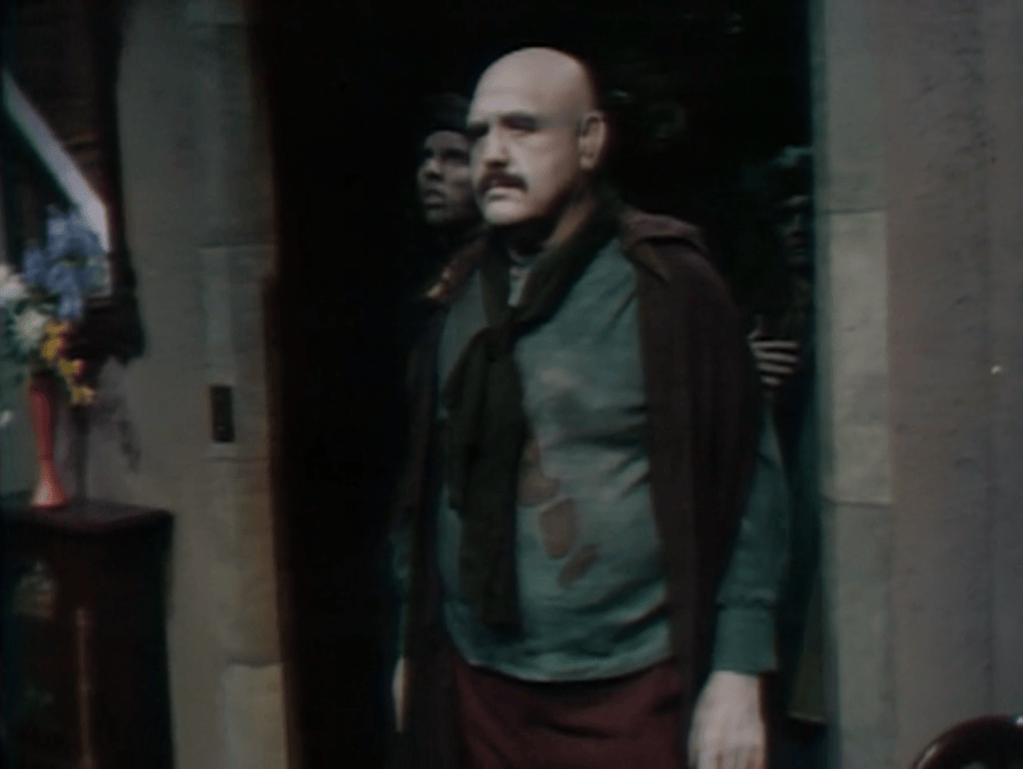
Gerard waves a green polyester flag from the window of the room on top of the tower at the great house of Collinwood, prompting zombies to rise from the dead and wreck the house. The shots of the earth heaving as the zombies rise from their graves were anticipated when David waved the flag in #1089, when a monster masquerading as a man named Jabez Hawkes raised some zombies in #963, and when wicked witch Angelique raised Jeremiah Collins from the dead as a zombie in #392/393. For that matter, the whole graveyard scene was anticipated in the 1959 feature film Plan 9 from Outer Space, and actor Chuck Morgan, who also played one of Jabe’s zombies, even looks like Tor Johnson.
Laugh if you must, but he’s leading a group of six who will demolish an incomprehensibly large haunted house in a single night. That’s more than you’ve done.
The Destruction of Collinwood will leave most of the Collins family dead, missing, or hopelessly insane. That was prophesied when vampire Barnabas Collins and mad scientist Julia Hoffman traveled to the far-off future year 1995 in #1061-1070. It also echoes a line with which heiress Carolyn Collins Stoddard greeted well-meaning governess Victoria Winters in #2, “Welcome to the House of Usher.”
Julia escapes from the zombies and finds herself in 1840. She has to leave Barnabas behind in 1970, where he is busy wrestling with some of the zombies. Each of Dark Shadows‘ major costume drama segments has begun with a character from the contemporary setting alone in an unfamiliar past. Victoria served this function in the first costume drama segment, when the show went to the 1790s from November 1967 to March 1968; Barnabas did it in March 1969, when the show started an eight months tour in the year 1897. Now it is Julia’s turn. She eventually joined Barnabas in 1897; we may wonder whether Barnabas, or perhaps someone else, will manage to find their way to her from 1970.
Chemist Horace Gladstone has been selling a strange and powerful synthesis of his own invention to Cyrus Longworth, an independent medical researcher. Cyrus refuses to tell Gladstone what he is using the synthesis for. Gladstone has now figured it out for himself. Cyrus has concocted a potion which he drinks to change his appearance, disguising him so effectively that even the people who know him best do not recognize him. In that disguise, Cyrus calls himself “John Yaeger,” spends a lot of money, and indulges his sadistic impulses.
Gladstone comes to Cyrus’ lab and tells him what he knows. Cyrus tries to deny that he is Yaeger, and Gladstone lists the evidence he has collected proving that he is. Gladstone tells Cyrus that he doesn’t believe he can do without the thrills he gets from his activities as Yaeger. The story has been crafted as an account of addiction, so returning viewers are sure Gladstone is right. He says he will go on serving as Cyrus’ connection for the drug he craves, but the price has gone up. He demands $10,000.
Cyrus first learned Gladstone’s name from his late friend Angelique Stokes Collins. Angelique was a woman of vast learning in a variety of fields, much like the title character in Edgar Allan Poe’s story “Ligeia.” Also like Ligeia, Angelique has returned from the dead. She is now back in the great house of Collinwood, impersonating the identical twin sister whom she murdered on the night of her resurrection, and occupying her old room as the guest of her widower, drunken sourpuss Quentin Collins.
Cyrus calls Gladstone a blackmailer. In reply, Gladstone makes a cryptic remark: “Why do you think my number was in Angelique Collins’ phone book? She’s led many lives. Each person only gets one. Good night.” We have indeed been wondering how Angelique came to know Gladstone, and now we wonder if he is aware of just how literally true it is that “She’s led many lives.” It doesn’t make any sense to follow “She’s led many lives” with “Each person only gets one,” but actor John Harkins was so precise in his delivery that I’m sure that was the scripted line. If there was a slip, it came from Sam Hall’s typewriter, not from Harkins’ tongue.
If it isn’t a slip, I think we would have to go out on a limb to explain what Gladstone could mean. Angelique built up a cult around herself, including several people who were firmly convinced that she was going to rise from the dead. When her sister Alexis came to Collinwood, housekeeper Julia Hoffman, sleazy musician Bruno Hess, and Angelique and Quentin’s son Daniel were certain that the prophecy had been fulfilled and they were seeing Angelique redivivus. This was also the first thought that came to Cyrus, to Quentin’s brother Roger, and to Angelique’s Aunt Hannah, though they were more easily persuaded that Alexis was a separate person. The cultists are impressive enough in their certainty that even people outside their ranks were sure Alexis was Angelique returned from the grave. Daniel’s cousin and playmate Amy Collins was horrified to see her for that reason, and Quentin’s second wife, the former Maggie Evans, fled the house in part because she could not shake her belief that Alexis was Angelique.
If Gladstone is familiar with Angelique’s cult and has been involved with it, he might be saying that each person gets to participate in only one of Angelique’s lives. We’ve already seen that is not the case, but that doesn’t mean he doesn’t think it is. Angelique may at some point have taught her followers a doctrine like that. While Hoffman, Bruno, and Daniel expected Angelique to come back and rejoin them, Cyrus, Roger, and Hannah were unsure they would see her again, even though they were certain that she was not simply dead. Indeed, Angelique is still telling her most of her devotees that she is Alexis. The only one to whom she has fully revealed herself is Hannah. Perhaps she had a plan to transcend death, but did not know just how it would work. Or perhaps she has decided the rest are not yet ready to be initiated into the esoteric truth of her return.
Sam Hall was a serious Lutheran, so much so that he insisted Shirley Grossman convert from Judaism before she married him and became Grayson Hall. Christian studies in twentieth century academic institutions were largely taken up with speculation about differences of opinion in the church before the codification of the New Testament and the formulation of the creeds. This sort of thing is still prominent in divinity schools today, and is often heard from pulpits in mainline Protestant denominations. Hall must have been familiar with it, so he probably gave it some thought when he spent Easter season 1970 writing scripts about a figure whose followers sort of expected her to rise from the dead and who surprised them by the way in which she actually did so. I doubt he was making any particular point about the various schools of thought that seminary professors postulate in the primitive church, but when he presents Angelique’s cult as divided into several strains of opinion from the start he is developing an idea that he did not have to invent himself.
We cut from the scene between Cyrus and Gladstone to the basement of Collinwood. Angelique leads Quentin to a little chamber hidden behind an alcove. A human skeleton stands in the chamber. You may wonder how a skeleton can stand, but Quentin doesn’t. He is too busy being surprised that he didn’t realize this chamber was in his basement.
The skeleton is that of Dameon Edwards, a friend of Angelique’s who went missing about a year before. Dameon’s ghost has been haunting the place for a couple of weeks. Angelique tells Quentin that Hannah found the skeleton and exorcised the ghost. Yesterday, we saw Angelique exorcise the ghost. Returning viewers know that she is giving credit to Hannah because she is masquerading as Alexis, who did not share her sister’s interest in the occult or her aunt’s. Quentin thinks that Bruno probably killed Dameon. Indeed, the ghost confirmed this yesterday. Quentin very much wants to get rid of Bruno, so you might think he would be interested in bringing a murder charge against him. But he decides that would be too much trouble, and it hurts his feelings when “Alexis” snaps at him that he shouldn’t be wasting his time reporting Dameon’s murder when he isn’t doing anything to investigate Angelique’s. So he calls Cyrus, and the two of them bury the bones on the grounds of the estate.
Meanwhile, two long-absent characters have returned from trips out of town. Quentin sent Hoffman to visit friends of hers in Boston because she kept antagonizing Maggie. Quentin’s sister Elizabeth Collins Stoddard also went away for a long stay in New York, where she visited Maggie. In off-screen reality, Grayson Hall and Joan Bennett were both in Tarrytown, New York with several other cast members, working on the feature film House of Dark Shadows. Liz complains that Hoffman didn’t meet her at the train station with a car, and Hoffman explains that she just got back herself.
Hoffman says she missed Collinwood terribly while she was in Boston; Liz says she can’t understand that. If she were in Quentin’s place, she would sell the house and move to the city. That will interest longtime viewers. For its first 196 weeks, Dark Shadows was set in a parallel universe, where Liz’ counterpart owned Collinwood. When the show started, she was a recluse who hadn’t left the house for eighteen years. Her brother Roger often urged her to sell the place so that they could live someplace less gloomy, but even after she stopped being a recluse Liz wouldn’t hear of that. She was a symbol of the family’s commitment to the house. We have already seen that this Liz is the opposite of her counterpart in other ways, and now we wonder how far they will take that mirror image motif.
Angelique is in the foyer, talking on the telephone to Hannah. Villains on Dark Shadows have remarkably little sense of OpSec, and this is a case in point. Quentin, Liz, and Hoffman are a few feet away from her in the drawing room, and each of them knows that Alexis and Hannah couldn’t stand each other. All Angelique has to do is call Hannah by name and she will raise their suspicions. Yet not only does she use Hannah’s name several times, she uses one incriminating expression after another about how no one will suspect what they are up to. If any of them listens in, or of anyone else in the house happens by on their way to the front door, Angelique will have tipped her hand.
It is Hoffman who eavesdrops on the call. After Angelique catches her, they have an awkward exchange and Hoffman goes upstairs. Angelique then stands at the door to the drawing room and eavesdrops on a conversation between Liz and Quentin. Liz wants Quentin to go to New York and ask Maggie to come home, he throws a tantrum and says that Maggie is too childish for him to do such a thing.
Hoffman is in Angelique’s old room, talking to the portrait of her that hangs there. The members of Angelique’s cult make a practice of coming to the room and carrying on conversations with the portrait; when Alexis was staying in the room, she sometimes walked in on them while they were confiding their thoughts to it. Angelique eavesdrops on the last part of Hoffman’s account that when she was in Boston, she felt a mystic assurance that when she returned to Collinwood she would find Angelique come back to life. When Hoffman says that everything seems to be the same as it was when she left, she is close to tears.
The resurrected Angelique eavesdrops on Hoffman’s conversation with the dead Angelique. Screenshot by Dark Shadows Before I Die.
Angelique takes a step forward, and Hoffman realizes she is not alone with the portrait. She apologizes to “Alexis,” and Angelique says she needs a friend she can trust. Hoffman claims to be such a friend. “Alexis” then launches into her reasons for believing that Angelique was murdered. After the first couple of sentences, returning viewers know what she is going to say, so we dissolve to Quentin and Cyrus in the drawing room.
Quentin and Cyrus have just buried the skeleton, prompting Quentin to feel sorry for himself. He then tries to explain to Cyrus something extremely weird he saw the other evening. He went to Angelique’s old room to see Alexis. He opened the door, and saw a space that lacked the room’s furniture, lights, and decor. He saw two children whom he took to be Daniel and Amy, and they said something about Barnabas Collins. The only person of that name of whom Quentin or Cyrus is aware died in 1830, but the children were talking about someone they knew. An invisible barrier kept Quentin from entering the room, and he could not attract the children’s attention. Regular viewers know that Quentin was catching a glimpse of the other continuity, and that the children were not Daniel and Amy Collins, but their counterparts David Collins and Amy Jennings. Cyrus hasn’t been watching the show, so all he can do is suggest Quentin take a vacation.
They’ve been experimenting with videotape editing, and they make a jump cut from the drawing room scene with Quentin and Cyrus to Quentin walking up to the doors of Angelique’s room. The effect is startling, I suspect intentionally so. Quentin opens the doors, and again sees the other universe.
This time Quentin sees the counterparts of Liz and Hoffman. As David and Amy had been, they are talking about Barnabas, who was last seen in this room. Hoffman, whom Liz addresses as Julia, says that they must keep the room open so that Barnabas will have a chance to return to them. She says she wants to stay there, because it makes her feel close to Barnabas. Liz excuses herself, and Julia calls out to Barnabas. As Hoffman had grown emotional talking to the Angelique whom she believed to be absent, Julia grows emotional when she talks to the missing Barnabas. She looks at the hallway, seeing not Quentin but the dark, empty space that is there in her universe. She asks if Barnabas is there, watching her. Grayson Hall plays these two scenes so similarly that we can have no doubt that whatever the one Julia Hoffman feels for Barnabas, the other feels for Angelique.
Quentin calls out to Hoffman’s counterpart, as he had called to Daniel and Amy’s counterparts. As the children had been unaware of his presence, so this other Julia Hoffman is unaware of him. And as Daniel and Amy had come to the hallway and asked why he was shouting for them, Hoffman comes to the hallway and asks why he is shouting for her.
This is the last script that will be credited to writer Violet Welles. Welles had done a substantial amount of rewriting on scripts attributed to her friend Gordon Russell before her name first showed up in the credits with #711, and she will do more ghosting for Russell later.
Danny Horn’s post about this episode on his great Dark Shadows Every Day is a tribute to Welles; I recommend it highly. Welles was far and away the best author of dialogue among the nine writers credited through the show’s 249 weeks, so much so that her uncredited contributions are easy to recognize. I will mention a week very close to the end of the series in 1971, a long time after the wheels came off, when all of a sudden characters start making witty remarks and developing interesting relationships. Then it’s back to the dreariness of a bunch of go-nowhere stories.
Welles rated herself low as an inventor of plot-lines. I don’t know what went on during the long hours she spent in story conferences with Russell and Sam Hall, but it was when she was in the room that the most fertile planning sessions Dark Shadows ever had took place. They sketched out flimsies thirteen weeks at a time, and from the time Welles became a regular part of the staff until thirteen weeks after she left, the show was packed with more lively ideas than at any other time. So if she was correct in that harsh self-assessment of what she did in the writers’ room, it was only in the narrowest sense.
Welles also spoke disparagingly of herself as a designer of dramatic structure at the level of individual episodes, but today’s installment shows that this was simply wrong. There is a tremendous amount happening in these 22 minutes, it is crystal-clear throughout what is happening and why we should care, and the actors get to do some of the best work they ever did do. We see two stories, one a mashup of Daphne Du Maurier’s 1938 novel Rebecca with Edgar Allen Poe’s 1838 short story “Ligeia,”* the other a retelling of Robert Louis Stevenson’s 1886 novella Dr Jekyll and Mr Hyde, also with a dash of “Ligeia.”
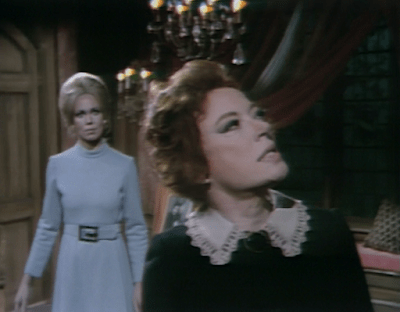
The episode is set in a different universe than the one in which the first 196 weeks of Dark Shadows took place, and most of the characters are “Parallel Time” counterparts of those we met in the main continuity. In the Rebecca/ Ligeia mashup, we today see Quentin Collins, master of the estate of Collinwood, owner of Collinsport Enterprises, and gloomy drunkard; Quentin’s new wife, Maggie Evans Collins; housekeeper Julia Hoffman, fanatical devotee of Quentin’s late first wife Angelique; and Alexis Stokes, Angelique’s freshly arrived identical twin sister. The bit from the Jekyll and Hyde story features scientist Cyrus Longworth and attorney Chris Collins. Angelique comes up in Cyrus and Chris’ conversation, and she is emerging in the role of Ligeia. Like the eponymous character in Poe’s story, she is a celebrated beauty who is dead but expected to return. Alexis herself brings up yet another reference. She wears a short bluish gray suit and chignon hairstyle with a tight spiral twist at the back, the look that the mysterious Madeleine wore and her impostor copied in Alfred Hitchcock’s Vertigo.
Jekyll and Hyde Meet Ligeia
I’ll start with the Jekyll and Hyde story, since it is the simpler one today. Chris is the estate manager at Collinwood, and his responsibilities include custodianship of Angelique’s personal effects. His friend Cyrus has called Chris to his basement laboratory to ask for a favor. Angelique had told him about a chemist in Boston who could help him with some obscure formula he needs for his current experiments. She gave him the man’s contact information, but he lost it, and he wants to look for it in Angelique’s address book.
Before they start talking about the address book, Cyrus tells Chris that he saw Angelique in town today. He tells him he was driving past the drug store and saw her walking down the street. He called to her and she did not answer, but he is certain it was she. Chris does not yet know that Angelique’s identical twin sister is in town, so he does not tell Cyrus about Alexis. He starts with a philosophical approach, then veers towards the explanation medical:
CHRIS: Cyrus, you’re a scientist. A scientist deals in established principle and fact. One thing we have to accept is that death is the end.
CYRUS: I often wonder. People used to believe that the world was flat. They believed that, that the sun revolved around the earth, and these were facts to them.
CHRIS: Uh, what are you saying?
CYRUS: I’m saying that I saw Angelique. I saw her walking down the street.
CHRIS: Well, I wish to submit that there’s an explanation for it. All of this.
CYRUS: What do you mean by that?
CHRIS: You’ve been working yourself too hard. You’ve been locked in this laboratory for over a year. Whatever you’re doing it can’t be worth your health and your peace of mind. It might even damage your mind.
Cyrus tells Chris what he is trying to do:
CYRUS: Let me begin by saying that, that man is chemical in his composition. Now, if the proper compound was distilled, and administered to a human being, this chemical composition could be radically changed, radically altered, and I’ve been working on this composition.
CHRIS: Why, why alter a human being?
CYRUS: Now let me also say this. That man is not one person, he is two. One is good, and the other is, oh, let us say for scientific conversation, the other is evil. Now, these two people are within each of us, and they are always fighting against each other. But if these elements could be separated, just imagine the possibilities. Evil could go its own way, completely free of any aspirations or remorse that are foreign to it. And good, good can have its own life, free of any struggle against, against evil impulses or hostile thoughts. My god, just imagine what a person…
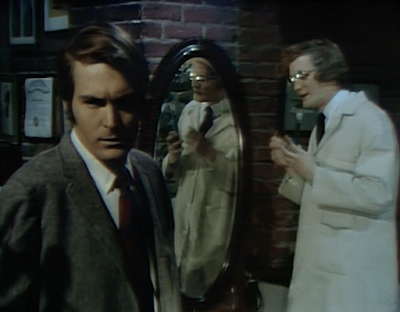
Chris is horrified by this idea, and is glad to be an obstacle to it. Director Lela Swift reinforces Chris’ conviction that Cyrus is destroying himself by placing Christopher Pennock next to a mirror during the most perfervid part of his mad scientist’s programmatic statement, a visual metaphor telling us that Cyrus is splitting himself in two.
Chris tells Cyrus that he won’t help him bury himself even more deeply in the strictly private world he has created. Cyrus says that it is not private, that it is something he shares with Angelique:
CYRUS: Angelique believed in this theory. She believed it could be done. And she was the one who started me on, on all these experiments. Separating good and evil.
CHRIS: (sourly) There is no doubt in my mind which of the two appealed to her.
Chris tells Cyrus that he has been anxious to see him. He has heard that he presented a paper on black magic to a scientific society, and that the news led him to fear that Cyrus’ mind is becoming unbalanced:
CHRIS: I admire your devotion, Cyrus, but not your direction. It can only lead to trouble.
CYRUS: It can only lead to glory. And it will. Very fast, if you’ll just give me the name of that chemist.
CHRIS: No. I’m sorry to withhold it from you, but it’s the only way I can stop you. And I think I have to stop you. I desperately think that.
Angelique was not only a great beauty and a gracious matron, but was also a scientific mind who inspired Cyrus to pursue his scheme. She could introduce an experimenter to chemists whose specialties are so obscure that they cannot be found in any published directory, and her influence leads to the study of black magic and a skeptical view of the finality of death. In these matters, Angelique recalls Ligeia. The unnamed narrator of Poe’s story, Ligeia’s widower, says of her:
I have spoken of the learning of Ligeia: it was immense –such as I have never known in woman. In the classical tongues was she deeply proficient, and as far as my own acquaintance extended in regard to the modern dialects of Europe, I have never known her at fault. Indeed upon any theme of the most admired, because simply the most abstruse of the boasted erudition of the academy, have I ever found Ligeia at fault? How singularly –how thrillingly, this one point in the nature of my wife has forced itself, at this late period only, upon my attention! I said her knowledge was such as I have never known in woman –but where breathes the man who has traversed, and successfully, all the wide areas of moral, physical, and mathematical science? I saw not then what I now clearly perceive, that the acquisitions of Ligeia were gigantic, were astounding; yet I was sufficiently aware of her infinite supremacy to resign myself, with a child-like confidence, to her guidance through the chaotic world of metaphysical investigation at which I was most busily occupied during the earlier years of our marriage. With how vast a triumph –with how vivid a delight –with how much of all that is ethereal in hope –did I feel, as she bent over me in studies but little sought –but less known –that delicious vista by slow degrees expanding before me, down whose long, gorgeous, and all untrodden path, I might at length pass onward to the goal of a wisdom too divinely precious not to be forbidden!
At the end of Poe’s story, the narrator’s second wife appears to die. Her body is eventually reanimated with the personality and even in the likeness of Ligeia. Cyrus’ un-nuanced belief that the woman he saw was Angelique come to life suggests that he expects her to follow in the footsteps of that other learned woman.
There is a poignancy now in seeing Don Briscoe play Chris’ concern for Cyrus. Briscoe suffered from bipolar disorder, and was at this time trying to self-medicate with street drugs. After he was violently mugged while trying to score a fix late at night in Central Park, he wound up leaving acting and moved into his parents’ house in Tennessee. He died there, morbidly obese, at the age of 64. I suppose what Dr Jekyll wanted was to come up with a drug that could sort the contents of the mind into orderly batches, so that people like Briscoe could live the lives they deserved to live.
Ligeia at Manderley
Meanwhile, at Collinwood, Quentin has been extremely stingy with information Maggie should know, and has neglected to tell her that Angelique had an identical twin. Hoffman and others on the estate are convinced that Angelique will somehow come back to life, and in their obsession with this idea they have made Maggie exceedingly uncomfortable in her imposing new home. Making matters worse, night before last Maggie heard a voice that she can believe to have been part of a prank played on her by Quentin’s son, strange and troubled boy Daniel, but which Daniel and we have reason to believe was actually Angelique’s ghost. So when Maggie opens the doors to the drawing room and sees Quentin giving a glass of sherry to a woman who, to all appearances, can only be Angelique, she flees in panic.
Quentin goes to Maggie in her bedroom. He explains that the woman she has seen is Angelique’s twin Alexis. At first he is relaxed and soothing, as charming as the Quentin of the main continuity has always been, almost as charming as David Selby is. But as Maggie insists on being left alone, his mood darkens. Alexis sticks her head in and suggests they should clear things up right away; Quentin asks her to wait downstairs. When Maggie refuses to be formally introduced to Alexis and play hostess to her, Quentin becomes stiff, grouchy, and patronizing, ordering her to do her duty as mistress of the house. She does not bend, and he leaves the room in a huff.
Back in the drawing room, Alexis tells Quentin she ought to leave rather than go on upsetting Maggie. Quentin dismisses Maggie’s concerns and proclaims that he alone makes decisions at Collinwood. Alexis is visibly startled by Quentin’s claim to autocracy, and doesn’t know where to look or what to do with her hands as she stammers out “Of course… you… make the decisions.” She goes along with Quentin’s decree that she will stay in the house starting tonight, before she can get her luggage back from the inn in the village.
Hoffman enters. At the sight of Alexis, she gasps “It- it’s you!” Hoffman composes herself quickly, and says that Angelique often spoke of her sister. She asks Alexis if she received the letter she sent her when Angelique died. Alexis says she missed it. Hoffman had sent it to her address in Tangier, but Alexis had moved from there to Florence by that time. Alexis does not seem to be in any particular business, and she describes her decision to return to Collinsport as motivated by a vague feeling of personal obligation, so we can assume that her long stays in these famous cities are a sign that she and Angelique have private resources that amount, if not to a fortune, at least to a competence. Hoffman suggests that Alexis stay in Angelique’s old room. Quentin does not object, and Alexis agrees.
Alone in the drawing room, Quentin wishes Alexis did not resemble Angelique so uncannily. In a gruff tone, he tells himself “I’m as bad as Maggie, I’m behaving like a frightened child.” Quentin’s attitude when he was lecturing Maggie about Alexis had indeed been that of an impatient adult ordering a child to stop having an inconvenient emotion. Since he does not believe he handled that exchange badly, it’s jarring to hear him say explicitly that he saw it that way. He pours himself a stiff drink.
In Angelique’s room, Hoffman tells Alexis she doesn’t have to lie to her. She may have her reasons to pretend with the others, but with her she can talk openly about the fact that she is Angelique risen from the grave. Alexis is thunderstruck by this, and tries to reason with her:
ALEXIS: You thought Angelique would come back? But that’s impossible, she’s dead.
HOFFMAN: She is not like others.
ALEXIS: She certainly wasn’t like anyone else. Nevertheless, she is dead. Do you hear me? She’s dead, and I’m her sister.
Hoffman tries to trip Alexis up by asking which nightgown she would like from Angelique’s dresser. Alexis points out that she has never seen any of them, so she can’t very well answer. Hoffman starts to apologize for her bizarre conduct:
HOFFMAN: I’m sorry, Miss Stokes, I’m sorry if I’ve said anything–
ALEXIS: It’s perfectly all right. I can understand how much you must miss her. But I wouldn’t intimate such a thing to anyone else if I were you. They might be very distressed by it, and so might you.
This exchange is very effective, particularly for regular viewers. Up to this point, Lara Parker has been playing Alexis quite differently than she played Angelique. Even when Angelique had been defeated in a conflict or was trying to seem like a wounded innocent, she always maintained eye contact with her scene partners and found a way to put a little more drama into her voice than any other performer would have thought to do. But Alexis looks down when she is confused, talks in a soft and casual tone when she thinks she understands what’s going on, and asks questions to which she obviously does not already know the answer. We can believe she really is a different character. But her last two sentences to Hoffman are exactly what Angelique would have said. When Alexis lifts her head and delivers them with her right eye fixed on Hoffman, we are suddenly in suspense as to whether Ligeia has already returned.
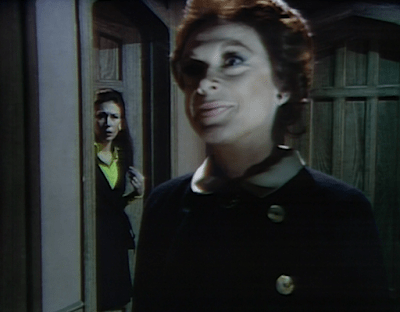
On her way out of the room, Hoffman passes Maggie. Without turning to face her, she explains that Alexis is staying, at Quentin’s orders. This brief scene is blocked as an homage to Hitchcock, whose 1940 film of Rebecca will have come to mind when Hoffman mentioned Angelique’s nightgowns. The censors tried to prevent the release of that movie, because of a scene in which obsessed housekeeper Mrs Danvers took a nightgown out of a wardrobe positioned in the same spot of the late Rebecca’s room as is the wardrobe in Angelique’s. Mrs Danvers went on and on about how sheer the nightgown was, how “You can see my hand through the material,” etc. Dark Shadows isn’t quite as bold with the homoerotic subtext of Hoffman’s devotion to Angelique as Du Maurier and Hitchcock were with that of Mrs Danvers’ devotion to Rebecca, but the shot is so much in his style and the movie was so famous that a large percentage of the grownups in the audience would likely have picked up on the reference.
Maggie goes to the drawing room, and finds that the decanter Quentin was drinking from is empty and lying on its side. She goes to Angelique’s room. She arrives just in time to see her obviously intoxicated husband in his first wife’s bedroom, with a woman who looks exactly like that first wife who is wearing a frilly nightgown, putting her hand on his shoulder, and saying in a soft voice “Perhaps we can comfort one another.” When we saw this, my wife, Mrs Acilius, said that she would not be especially pleased if she were to find me in such a situation.
Maggie and Quentin have a showdown about this in the drawing room. It’s a sensational scene, one of the best in the series. Selby plays Quentin as a drunken, condescending grouch, trying to tell Maggie she didn’t see what she clearly saw. Kathryn Leigh Scott is spellbinding as she plays Maggie’s rage. I think it’s her best moment since #265, when the Maggie of the main continuity was a mental patient and went completely nuts while singing “London Bridge.” That, I think, was the scariest scene they ever did, making us think our old pal Maggie was never going to be all right again.
This time Miss Scott doesn’t sound like any character we’ve heard her play before. In fact, she sounds more like a real person than anyone else ever does on Dark Shadows when Quentin has forbidden her to mention Angelique’s name and she responds “You forbid me! Forbid me like a child, and I am not a child, and I refuse to be treated like a child. Not by you or by anyone. I know what I heard and I know what I saw!” At that, Maggie Collins becomes a distinct character and the Parallel Time storyline jumps to a new level.
Quentin whines that Maggie isn’t giving him a chance, and she lets him have it:
MAGGIE: Nobody’s given me a chance. No. This is Angelique’s house, not mine, you’re Angelique’s husband, not mine.
QUENTIN: All right, if that’s the way you feel about it, get out of here!
MAGGIE: All right, Quentin.
QUENTIN: Leave Angelique’s house and leave Angelique’s husband!
MAGGIE: That’s exactly what I’ll do. That is exactly what I will do!
And to Quentin’s bewilderment, that’s exactly what she does. She rushes out the front door. After a bit, Quentin staggers after her. He looks outside. Alexis comes downstairs, in her sister’s frilly nightie, and asks what happened. Quentin frets that “She actually went out that door.” Alexis asks if he is going after her, and he says “No, why should I? She behaved like a child!” He’s still holding onto the idea that it is right and proper for him to regard his wife as a temperamental child. He wonders if perhaps Alexis is right, then hears Maggie drive away and announces that it’s too late to do anything. He wanders back towards the drawing room while Alexis looks on. We are left wondering if she is Angelique masquerading as her sister, or if Alexis, contrary to appearances, was actually the Evil Twin all along.
*I am indebted to Danny Horn’s commenter “Riccardo” for pointing out the connection to “Ligeia.”
A MacGuffin day today, as everyone is busy trying to get hold of the magical Hand of Count Petofi. Broad ethnic stereotype Magda Rákóczi stole the Hand, which incidentally is a literal severed hand, from Romani chieftain/ organized crime boss King Johnny Romana. She hoped to use it to cure handsome rake Quentin Collins of the werewolf curse she placed on him, but found that she was unable to master its powers. Several people have stolen it from each other since then; at the beginning of the episode it is in the possession of wicked witch Angelique, who is also unable to figure out how to use it to solve Quentin’s problem.
Today, a man named Aristide is holding Quentin prisoner. He straps Quentin to a table under a descending pendulum with what we are supposed to imagine is a razor sharp blade. He goes to Angelique and tells her that Quentin will die in minutes unless she gives him the hand. Since Angelique can’t see Quentin and Aristide doesn’t even describe the predicament, it isn’t clear why Aristide went to all this trouble, but it does create a memorable image and a nice homage to the works of Edgar Allan Poe. It would also warm the hearts of viewers mourning the end of the Batman TV series.
Meanwhile, a small and pretty young woman named Julianka has told Quentin’s distant cousin Barnabas Collins that she can cure Quentin if she has the Hand. He gets it from Angelique and takes it back to his house, where Julianka is waiting. She pulls a knife on him and declares that she is an emissary of King Johnny. She will not cure Quentin, and will stab Barnabas if he does not surrender the Hand. Barnabas calmly offers her money and the Hand if she will cure Quentin before she goes, but she refuses. He gives her the Hand. After she goes, we hear his thoughts as he is feeling sorry for her.
In the woods, Julianka hears a squeaking bat. She reacts with horror as the bat turns into Barnabas in front of her. She asks what he is; he tells her that he believes she knows what he is. He does not bite her, but she does become docile. It seems that Barnabas is using the “Look into my eyes!” vampiric power that he only recently acquired. It also seems that, while Julianka was lying when she originally claimed she had come to Collinwood to cure Quentin, she was telling the truth when she said that she was able to do so.
The Hand recently disfigured Quentin’s face, as it had a few days before disfigured the face of Quentin’s onetime friend Evan Hanley. Evan’s good looks returned after a while, and we have not been told why. Today Quentin’s do as well, and when he asks Aristide for an explanation the best he can do is to suggest it may just be luck. They spent quite a bit of time showing Evan’s efforts to cure himself, and even more time showing Quentin feeling sorry for himself, so this is not at all a satisfactory payoff.
In an original cast panel at a Dark Shadows convention in the 80s or 90s, David Selby reminisced about today’s scene between Quentin and Aristede. He said that when the cameras started rolling, he knew what actions he and Michael Stroka were supposed to perform, that he was supposed to end up tied to the table, and that it was supposed to take a certain number of minutes and seconds. He also knew that there was some dialogue they were to speak in the midst of all that, but he couldn’t remember any of it. The teleprompter was out of view. He looked at Stroka, hoping to see something in his face to jog his memory, and what he actually saw was the same blankness he was himself experiencing. So the two of them improvised their way through it. When they were done, they looked at the clock and saw that they had filled exactly the allotted time. But not a word of what they said was in the script. The resulting scene includes some awkward lines, but it has a great energy to it, just the sort of thing that gets you hooked on live theater.
Vampire Barnabas Collins has traveled back in time to the year 1897 where he hopes to prevent his distant cousin, libertine Quentin, from becoming a ghost who will ruin things for everyone in 1969. Barnabas knows that if events play out as they did originally, Quentin will die soon. He tells him today that it is his understanding that people become ghosts when they leave unfinished business behind them. He does not know what business Quentin originally left unfinished, or how he can keep him from dying without finishing it on this iteration of the timeline. So you might think that his first priority would be to get as close as possible to Quentin and learn as much as he can about what he wants.
Instead of doing this, Barnabas has gone out of his way to antagonize Quentin by accusing him of stealing his grandmother Edith’s will. Quentin and his siblings are all frenziedly searching for the will, but it is of no concern to Barnabas. Edith cannot possibly have left him any money, and he knows that the original timeline worked out so that the Collins family assets wound up in the hands of people who were oblivious to his sinister nature and happy to let him make his home on their estate. Showing interest in the will can do nothing but raise suspicions as to who this stranger really is and why he showed up when he did.
Quentin did in fact steal the will. Edith’s ghost may be at work in the house- her glove mysteriously shows up in the corridor near Quentin’s room, the furniture in the room is turned upside down, and before the end of the episode Quentin alone can hear the pounding of an enormously amplified heartbeat emanating from the walls of his room. But Quentin accuses Barnabas of planting the glove and disordering his room, and in #538 we saw that Barnabas is capable of making people with guilty consciences have hallucinations of just this kind. Barnabas is also frequently seen reading, and it is certainly possible he might have read Edgar Allan Poe’s “Tell-Tale Heart” and decided to make it come to life. He may not even have needed to read the story- we saw in #442 that in 1796, early in his career as a vampire, he bricked up an enemy of his in the style Poe would describe in his 1846 story “The Cask of Amontillado.” Evidently his imagination and Poe’s ran along similar lines.
Barnabas meets governess Rachel Drummond. He is immediately attracted to Rachel, unsurprising since she is played by the lovely Kathryn Leigh Scott. He tells Rachel that she strongly resembles the portrait of Josette Collins, and he relates some facts about Josette’s life and death that did not make it into the family history. Indeed, Miss Scott played Josette in the part of Dark Shadows set in the 1790s.
Yesterday, Barnabas met unethical lawyer Evan Hanley, played by Humbert Allen Astredo. His reaction to Evan was not inappropriate, but the same reaction would also have been fitting had Barnabas thought Evan was Astredo’s previous character, warlock Nicholas Blair. This may have reminded longtime viewers of the 1790s segment, when time-traveling governess Vicki alienated the audience by time and again telling the characters that they were being played by actors who had other parts in the first 73 weeks of the show. Do the characters not look alike to Barnabas, or does he simply have the presence of mind not to waste everyone’s time with tedious drivel about who used to be who? We now know that in Rachel’s case, at least, it is the latter.
Quentin has a scene with his sister Judith in which he tells her that he did not like to play with her when they were children, because she was a “scaredy-cat.” Joan Bennett was 31 years old when David Selby was born, a fact of which the original audience would have been well aware since she was already a major star of motion pictures at the time. Indeed, her father Richard Bennett had been so big on Broadway that her birth was announced on the front pages of the New York papers, so that she never bothered to be coy about her age. But she and Mr Selby are such strong actors that it doesn’t raise an eyebrow when we hear that Judith and Quentin were children together.
Not everyone we see today merits such high praise, alas. Executive producer Dan Curtis was friendly with a man called Roger Davis, and he often let Mr Davis come on the set of Dark Shadows and assault the actors while they were trying to work. Unfortunately this happens today. Mr Davis is usually presented as if he were himself an actor playing a part. His idea of acting is simple enough. For example, he was once supposed to play a character named Jeff Clark, and his approach involved shouting “My name is Jeff Clark!” every episode or two. More recently, he was credited with a role called Ned Stuart, and he went around saying “My name is Ned Stuart!” That’s one way of attempting characterization, I suppose.
Today he is supposed to be someone named Dirk Wilkins. Regular viewers keep waiting for him to yell “My name is Dirk Wilkins!,” but he neglects to do so. He has a mustache, perhaps he thought that was sufficient. He finds Terry Crawford playing maidservant Beth Chavez, grabs her and yells in her face. Mr Selby interrupts this encounter. In character as Quentin, he makes some flip remarks and walks away, and Mr Davis resumes abusing Ms Crawford. Later he finds Ms Crawford on another set and grabs her again. Finally he walks into the set representing Quentin’s room while David Selby is trying to show us Quentin’s panicked response to the sound of the heartbeat. Mr Davis makes some nasty remarks, and when Mr Selby tries to involve him in the scene by tussling with him as Quentin might under those circumstances, it looks like Mr Davis gives him a real punch in the midsection. Mr Selby goes on acting, but the assault takes the audience out of the story. The ABC network really should have posted security guards outside the studio to keep this sort of thing from happening.
Heiress Carolyn came running when her mother, matriarch Liz, woke her with her screams. Liz was having a nightmare about being buried alive. She tries Carolyn’s patience and ours with her obsession that this will in fact happen to her.
Liz tries to call her lawyer, Richard Garner. Whoever answers the phone tells Liz that Garner is not available, hardly surprising since it is the middle of the night. She responds that if he doesn’t call back within the hour, he need never call again. Since we last saw Garner in #246, and his name hasn’t been mentioned since #271, it seems like he may as well get some sleep.
Liz then calls Tony, a young lawyer in town who used to date Carolyn. Tony comes over and Liz hires him to help with some changes to her will. She dictates excerpts from Edgar Allan Poe’s “The Premature Burial” by way of a codicil protecting her from being buried alive, and he tells her he thinks she’s being weird.
The most prominent reference to Poe on Dark Shadows up to this point was in #442, when vampire Barnabas reenacted the plot of “The Cask of Amontillado” by bricking the fanatical Rev’d Mr Trask up in an alcove in his basement. Like Tony, Trask was played by Jerry Lacy, so it is possible that the writers hope the audience will recognize the connection.
Poe wrote punchy little short stories each of which leaves the reader with a single horrifying image. “The Cask of Amontillado” worked well as the basis for an episode, and the bricking up of Trask is one of the most enduring images in all of Dark Shadows. “The Premature Burial” could have made for the same kind of success, had Liz’ obsession begun and ended within one episode. But it has already gone on longer than that, and there is no end in sight. Each time we come back to it, the situation becomes more familiar and less urgent.
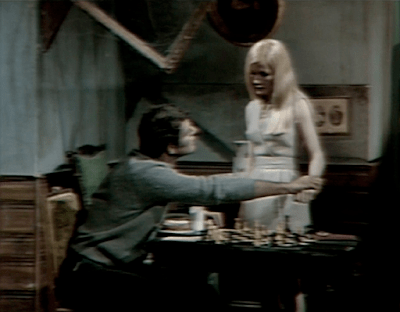
Meanwhile, Carolyn takes a glass of milk and a sandwich to Adam, a Frankenstein’s monster she is hiding in the long-deserted west wing of the house. Adam has little to do but read, and he has become quite intellectual. He is playing both sides of a game of chess when Carolyn arrives, pretending that she is his opponent. When she comes, he attempts a joke, pretending she has left him alone so long he does not remember her name. She is distressed about Liz’ obsessive fear of being buried alive, and so does not recognize that he is joking.
Carolyn looks at the chessboard and asks Adam who he is playing. He says that he is pretending to play her. He is smiling and relaxed when he admits this, and he starts joking again as he tells her about their imaginary games. Adam’s pretending that he did not remember Carolyn’s name was a weak joke, but he is actually pretty funny when he tells her that when he pretends they are playing, she doesn’t do as well as he does. She still does not realize that he is kidding, and reacts with horror. She says she doesn’t play chess; in #357, her uncle Roger mentioned that she does, but that she usually loses to him. Perhaps in the 44 weeks since then, she has given up the game altogether.
Adam shows Carolyn the book he has been reading, a volume of Sigmund Freud’s works, and is disappointed she has not already read it. When she tells him she is worried because of Liz’ condition, he invites her to sit down and says “Tell me about your mother,” suggesting that he is ready to set up shop as a psychoanalyst. Adam is being serious now, but this part of the exchange is hilarious.
Carolyn goes out to the terrace and looks at the night sky, wondering if Freud could help her understand what is happening with her mother. I live in the year 2024, and so I have difficulty imagining how people could ever have taken Freud seriously. But he was very very big in the 1960s, and in its first year Dark Shadows gave us a lot of heavy-handed Freudian symbolism and a number of storylines with obvious psychoanalytic themes. Longtime viewers will find it a reassuring sign of continuity that Freud is still around as the thinker “every twentieth century man should read.”
Tony joins Carolyn on the terrace. He greets her and sees that she has a book about Freud. “I don’t have to ask why you’re reading him,” he remarks. Carolyn asks if he is referring to her mother, and Tony’s response is so indiscreet he may as well spinning his finger around his temple and saying “Cuckoo, cuckoo!” It is clear enough that the concept of “confidential communication” is alien to the lawyers in Soap Opera Land, and now we see that “basic respect” is also very much on the optional list. Carolyn tells Tony to do whatever Liz asks, and starts crying.
I was startled by Carolyn’s crying turn, because it is the first time in the two hundred or so episodes she has appeared in thus far Nancy Barrett has given a subpar performance. The actors all had to work under virtually impossible conditions, so I rarely mention it when one of those who usually does well has a bad day at the office, but the 20 seconds or so she spends very obviously not crying in this scene mark the end of an extraordinary streak.
Tony embraces Carolyn and kisses her. Adam’s room in the west wing overlooks the terrace, and he spies on them while they kiss. After Carolyn excuses herself and goes back into the house, Adam comes up behind Tony, grabs him, forbids him to touch Carolyn, and throws him to the ground.
For nineteen weeks from November 1967 to March 1968, Dark Shadows was a costume drama set in the late eighteenth century. Among the more interesting characters introduced in that period were fanatical witchfinder the Rev’d Mr Trask; roguish naval officer Nathan Forbes; fast-talking con artist Suki Forbes; and streetwalkers Ruby Tate and Maude Browning. All five of these characters were murdered by vampire Barnabas Collins, and all five of them are among those who return today for an impromptu trial of Barnabas.
Barnabas killed Trask by luring him to his basement and bricking him up in an alcove, as Montresor did to Fortunato in Edgar Allan Poe’s 1846 story “The Cask of Amontillado.” Some other characters invited themselves to the basement yesterday and held a séance there. As a result of the séance, the bricks fell away and Trask came back to life. Now, Trask has confined Barnabas to the same alcove. He declares that he will give him a trial before he bricks him up.
In the eighteenth century, Trask was the prosecutor in the trial of time traveling governess Vicki Winters. Victoria was convicted of witchcraft and sentenced to death. Vicki’s trip from the 1960s to the 1790s inverted Barnabas’ displacement in time; as Vicki’s witchcraft trial was so chaotic it did not seem to follow rules of any kind, neither does the murder trial Trask improvises for Barnabas fit any conceivable model of procedure. Vicki’s trial stretched over two weeks, from #427 to #437; Barnabas’ begins and ends today, during the second half of the episode.
Trask conjures up Nathan, Suki, Ruby, Maude, and Barnabas’ first homicide victim, his uncle Jeremiah, to serve as a jury; he conjures up a man named Ezra Simpson, of whom we have never previously heard, to act as judge. Trask is the prosecutor, and Nathan is his sole witness. This court of “the damned!,” as Trask calls them, recalls the rogues who confront Jabez Stone as jurors and judge in Stephen Vincent Benét’s 1936 story “The Devil and Daniel Webster.” Unlike Jabez Stone, however, Barnabas does not have a right to counsel.
Trask asks Nathan how he died. After Nathan says that Barnabas strangled him, Trask asks him how Suki died. Barnabas objects that Nathan shouldn’t be allowed to speak for others; regular viewers sympathize with this, since Suki, played today as she was originally by Jane Draper, was sensational every second she was on screen, and when we saw Miss Draper again we were happy to think that she would have another chance to show what she could do. Barnabas also shouts at one point that he is innocent; this is less likely to attract the audience’s sympathy. Mrs Acilius and I certainly got a good laugh from it.
Barnabas asks to be allowed to present a defense. Trask invites him to question Nathan. He is about to do so when Nathan smiles at him, turns around, and vanishes. Trask explains that Nathan has already said all that needs to be said. Later, Trask looks at the recompleted wall and laughs with vicious glee, delighted at what is behind it.
Barnabas has neither the powers nor the limitations of a vampire now. The effects of the curse went into remission when mad scientists Eric Lang and Julia Hoffman created a man from parts scavenged from the cemetery and connected Barnabas to him as they electrified him and brought him to life. Barnabas named this man Adam.
Now Adam has escaped from the horribly abusive home Barnabas and Julia provided for him. He has found a friend in Sam Evans, an artist who was blinded when Barnabas enlisted him in one of his hare-brained schemes. Sam is teaching Adam to speak, and is so impressed with his ability to learn that he wonders aloud if he will be able to teach him to paint professionally.
Adam develops a sudden pain in his wrists. He moans “Barnabas! Hurt!” A shot of Barnabas hanging by his wrists in the basement alcove is laid over a closeup of Adam. Evidently the bond between them is such that Adam can sense Barnabas’ pain, even though they are miles apart. Apparently it is mid-1840s day on Dark Shadows; the scene in Barnabas’ house recalls “The Cask of Amontillado,” and the scene at Sam’s house is based on Alexandre Dumas’ 1846 novella The Corsican Brothers. “The Devil and Daniel Webster” was set in that decade or a bit earlier, and while Frankenstein was written in 1818 many adaptations of it, including the one Dark Shadows creator Dan Curtis would make in 1973, are set in the 1840s.
Adam becomes agitated. He cannot explain what is happening to him, no matter how patiently Sam asks. Sam’s son-in-law-to-be Joe Haskell comes in; Adam brushes against Joe as he runs out the door. Though Joe is a tall and sturdy man, Adam is so tremendously strong that this casual contact sends him flying.
It dawns on Joe that Adam is the man who abducted heiress Carolyn Collins Stoddard and then fell from the cliff on Widows’ Hill. Sam calmly replies that he had already figured that out. Joe is shocked that Sam hasn’t called the police; Sam replies that Adam is as disabled as he is, and that he means no one any harm. Joe is not at all convinced of the second of these points, and worries that “Barnabas! Hurt!” might not have reflected a fear that Barnabas is hurt, as Sam thinks it does, but might rather express Adam’s resolution to hurt Barnabas. Joel Crothers and David Ford bring out the full comic value of this scene; Mrs Acilius laughed at the blandness with which Ford’s Sam confirms that he knows who Adam is.
Joe goes to Barnabas’ house to warn him, but finds it locked and apparently empty. Later, Julia goes there too. She has a key, and lets herself in. She doesn’t see any evidence that Barnabas is or has been home; she goes downstairs, and is mystified to see that the alcove wall, which was broken when she was there for the séance, is now bricked up again.
Several times, Dark Shadows has contrasted Barnabas’ home, the Old House on the great estate of Collinwood, with the Evans cottage, a working class residence in the village of Collinsport. Today they draw this contrast in sharp relief. The basement of the Old House is always dark, but even the upstairs is lit by candles today; the scenes in the Evans cottage, taking place at the same time, are sunlit. The basement is the most haunted part of the most haunted house on the haunted estate, and eight characters in costume dress materialize from thin air there; the Evans cottage is a part of the modern world where Sam and Joe can use reason to arrive at agreement about facts, even if they make different judgments about the significance of those facts. When Julia and Joe go to the Old House, each wanders about alone, finding no one to talk to; at the Evans cottage, even Adam is able to have a conversation, and while there he can receive a message from Barnabas by some mysterious means. Trask seizes control of the basement of the Old House to make a parody of the criminal justice system and enact his vengeance on Barnabas; in the Evans cottage, Sam refuses to call the sheriff because he wants to shield Adam from punishment for the crimes he inadvertently committed.
When vampire Barnabas Collins rose from his grave to prey upon the living in April 1967, he was a bleak, frightening presence. As the show went on, we saw him spend a great deal of time ruminating on murders he might like to commit, but he had few opportunities to act on those thoughts. By November, when well-meaning governess Vicki came unstuck in time and wound up in the year 1795, Barnabas had killed only two people, only one of them with premeditation. Both of those victims, seagoing con man Jason McGuire and addled quack Dave Woodard, had long since lost their relevance to the plot, and neither has been mentioned more than a few times since his death. As a result, Barnabas’ talk of killing comes to seem like nothing more than a series of hostile fantasies.
Soon, Dark Shadows will have to return to a contemporary setting. It was the frightening impression Barnabas created in his first weeks that made Dark Shadows a hit, and to keep it going the show will have to make him seem dangerous again. In the fifteen and a half weeks they have been in the 1790s, he has killed at least six people, including his uncle, his aunt, his wife, two streetwalkers, and a woman named Suki. That’s an adequate rate of murders to reestablish Barnabas as a fiend, but volume will only get you so far. They need to give us some shocking images of cruelty, preferably as the result of crimes committed with slender motives, to get him back in place as a truly scary creature.
Today, the show addresses both that need and the need to give a fitting sendoff to a character who has been one of the standouts of the eighteenth century flashback. The Rev’d Mr Trask, visiting witchfinder, was, along with repressed spinster Abigail, one of the two bright lights of the show’s otherwise dreary reworking of Arthur Miller’s The Crucible. Now the witch trial is over, Vicki has been convicted, and she is waiting to be hanged. In #437, Vicki gave a speech which left little doubt that at the moment appointed for her execution she would return to the 1960s and the costume drama period would end. Therefore, Trask can hardly reopen the case without confusing the whole plot. As a personality totally warped by fanaticism, he can’t very well branch out into other kinds of stories without a long buildup, much longer than they are likely to stay in the 1790s. Yet Trask has been so much fun that the audience would feel cheated if he simply went back where he came from.
So Barnabas lures Trask to his basement, ties him to the ceiling, and seals him up behind a brick wall. Unfortunately, this homage to Edgar Allan Poe’s “Cask of Amontillado” does not adapt the most celebrated line of that story and have Trask cry out “For the love of God, Mr Collins!”
In a moment of black humor, the closing credits run over an image of the completed brick wall. We might imagine Jerry Lacy still dangling from the ceiling behind the wall. Mr Lacy was often a model of an actor’s devotion to his craft, but I very much doubt that even he took matters that far.
A recording of Jonathan Frid reading “The Cask of Amontillado” made in the spring of 1992 can be found on YouTube, posted by Frid’s longtime business partner Mary O’Leary.
In #264, high-born ne’er-do-well Roger Collins visited Barnabas at home. When it was time for a drink, Barnabas offered him a glass of amontillado. Poe’s story is so famous and amontillado is such an unusual variety of sherry that it must have been a deliberate reference. Perhaps the idea of Barnabas sealing someone up behind bricks was floating around among the writing staff for months and months.
Several fansites label it a continuity error that Trask reacts to the sight of Barnabas by exclaiming that he is dead. The family has been covering up Barnabas’ death, putting word about that he went to England. Many think Trask should not be among those privy to the Collinses’ secret. But as Danielle Gelehrter points out in a comment on Danny Horn’s Dark Shadows Before I Die, Trask and the gracious Josette discussed Barnabas’ death in #412.
I am writing this post on 19 February 2024. In a bit of synchronicity, yesterday, I saw this post on the site that all normal people still call Twitter: