Episode 1009: Remember the dead

The Graves of All Those Who Once Lived Here

The name “Barnabas Collins” has been coming up in the oddest circumstances around the estate of Collinwood. The only person of that name known to drunken sourpuss Quentin Collins, the master of the great house, was an ancestor of his who lived a long dull life and died a natural death in 1830. Quentin has decided that it is time to ask Barnabas’ spirit what’s going on. He wants housekeeper Julia Hoffman to join him and his late wife Angelique’s identical twin sister, Alexis Stokes, in a séance.

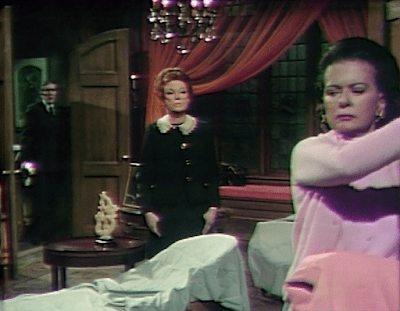
Hoffman is reluctant to participate, and when the invocation prompts theremin music to start playing in the background she breaks the circle of fingers and runs out of the drawing room. But Hoffman is not the most problematic participant. Alexis is not in fact present. Angelique returned from the dead, murdered her, and took her place. Unknown to Hoffman or to Quentin, it is the undead Angelique who is at the table with them.

“Alexis” tells Quentin that she felt a presence before Hoffman broke the circle, but that it is gone now. Suddenly a figure appears in the corner of the room. He identifies himself as the ghost of Joshua Collins, father of Barnabas. Joshua addresses his remarks to Quentin, ignoring “Alexis.” He says that Quentin knows all he needs to know about his son Barnabas, but that there is another entity at Collinwood, an evil that is at once living and dead. “Alexis” looks shocked and says “Living and dead? How can that be possible?” I suppose we should praise Lara Parker for resisting the temptation to pad her part by visibly squirming and playing up the fact that this describes her character precisely. She is giving the audience credit for the brains needed to make that connection. But if I wanted a show that gave me credit for brains, I wouldn’t watch Dark Shadows every evening, so I’m disappointed. I wish she were tugging on her collar and fidgeting like a Hank Azaria character on The Simpsons.

Joshua can’t be any more specific. This might have been OK had he just flickered into view for a few seconds, uttered his vague warning, and flickered out. We would then be left thinking of the awe-inspiring improbability of even the most fleeting communication between the living and the dead. But as Joshua, Louis Edmonds stands there for several minutes, in the same light as the other actors. They’ve had trouble with one of the microphones lately, occasionally making one actor sound like they are far away from the person standing next to them, but that microphone isn’t used in this scene. Both the audio and the video make it clear Joshua is occupying the same space as Quentin and “Alexis.” The result is an embarrassment for which writer Gordon Russell and director Henry Kaplan must share the blame.

This embarrassment is particularly disappointing under the circumstances. The scene is Edmonds’ first appearance since going off to play his part in the feature House of Dark Shadows after #990, and the first appearance of this Joshua Collins. Edmonds played another version of Joshua from November 1967 to March 1968, when Dark Shadows was set in a different universe. That Joshua figured in a costume drama segment set in the 1790s. He emerged as the central figure in a tragedy in the course of which his son Barnabas became a vampire and he had to decide what to do about him.

This Joshua never dealt with such a curse. The audience knows, if only because the opening voiceover told us, that the vampire Barnabas has crossed over into this universe, into this year 1970, and that he is at present trapped in a chained coffin in the basement of the home where the Joshua we meet today raised that other, luckier Barnabas. We last saw the other Joshua in #623, and longtime viewers will be excited at the idea of seeing Edmonds reprise the character who was perhaps his greatest triumph. To see him in such a debacle lets us down hard.

After Joshua leaves, Quentin and “Alexis” talk for a moment. Then Quentin’s brother Roger enters. Roger is also played by Louis Edmonds, but neither Quentin nor “Alexis” notices that he looks like Joshua. This works well enough, since Edmonds takes a very different posture and tone as Roger than he had as Joshua. Joshua was erect and stentorian, Roger curls to his left as he sits on the couch and purrs about how tedious it is to read about the life of the late Barnabas.

Quentin exits, and Roger talks with “Alexis.” He says that despite her resemblance to her sister, he never for a moment thought she was Angelique. In fact, when he first met the real Alexis he was utterly shocked, certain she was Angelique, and she had to work hard to bring him around. But Angelique doesn’t know about that, and Roger doesn’t want to remember it, so she just looks at him placidly while he goes on and on about how unlike anyone else Angelique was and how he knew her more intimately than anyone else could, even though she was married to Quentin.

I suppose Russell may have been trying to make a point by juxtaposing Joshua’s long pointless speech in which he keeps referring to Quentin’s responsibilities as the master of Collinwood with Roger’s long pointless speech in which he keeps referring to his mystical connection with his brother’s late wife. We saw in the 1790s segment that the Joshua of the other continuity was the victim of his own virtues. A forceful, dynamic man devoted to his family and its honor, he became a tyrant in pursuit of his worthy goals, and saw everyone he loved destroyed in part because of his haughtiness. As generation followed generation, Joshua’s misguided strength and brittle courage would yield to ever weaker, ever-softer descendants. Perhaps in the contrast between this Joshua’s attempt to help his successor use the authority he once held when he cannot impart any useful information and Roger’s fatuous pretense to have known Angelique uniquely well when he cannot recognize that he is talking to her we can see the same decline in this iteration of the Collins family.

The Legal Eagle

Meanwhile, mad scientist Cyrus Longworth has a problem of his own. Cyrus has developed a potion which, when he drinks it, transforms his appearance so drastically that even those closest to him cannot recognize him. When thus disguised, he calls himself “John Yaeger,” spends a lot of money, and beats people up. This makes him very happy, but now chemist Horace Gladstone, his connection for one of the potion’s vital ingredients, has learned his secret. Gladstone will not supply him with more of the ingredient or keep his mouth shut about Cyrus’ crimes unless he gets $10,000 in cash.

Cyrus’ lawyer, Larry Chase, comes to his laboratory. On Cyrus’ instructions, Larry has drawn up a will naming “Yaeger” as the sole beneficiary of Cyrus’ estate. Larry has met “Yaeger” and been appalled by him. He urges Cyrus to reconsider. Cyrus signs the papers and invites Larry to a late supper. Larry declines, saying that Horace Gladstone called him earlier and wants to meet him outside the Eagle tavern at 10 PM.

Larry was in the drawing room at Collinwood going over some papers with Quentin when he got Gladstone’s call. Cyrus’ newly drafted will fell out of Larry’s briefcase, and Quentin read through it while Larry was looking for another document. Quentin asked some questions about the will. Larry responded to the first by saying that he couldn’t talk about it, but thereafter blabbed away, revealing everything Quentin could want to know. With that level of regard for a client’s confidential communications, we aren’t surprised when Larry tells Cyrus who he is going to meet at what time in what place.

After Larry goes, Cyrus takes the potion, that is, puts on his disguise. He goes to the alley next to the Eagle, in which the sign for the Greenfield Inn hangs. He corners Gladstone there. He beats Gladstone to the pavement with his heavy cane. Gladstone begs for mercy, and Cyrus sneers at him. He releases the bayonet from inside the cane, stabbing Gladstone with it. The first time Cyrus took the potion, he had amnesia after he resumed his normal appearance, and we could believe that he was less than fully responsible for what he did while under its influence. But he has had his full memories on each subsequent occasion, and has shown pleasure when told of the harm “Yaeger” has done and the fear he inspires. By this point, we can classify Cyrus’ killing of Gladstone as nothing other than premeditated murder.

Cyrus doesn’t really surprise us by this act. It is Larry who does something we would not have expected. While Gladstone is in the alley, Larry is already in front of the tavern. We see enough of the set that we cannot believe he is more than 30 or 40 feet away from Gladstone, just around the corner. Gladstone cries out when “Yaeger” attacks him. We cut to Larry, and see him react to that cry and start towards the alley. “Yaeger” stands over Gladstone and pontificates for a minute or two before stabbing him. Even after that, “Yaeger” still has time to get most of the way out of the alley before Larry finally arrives. It took Joshua Collins less time to get from the abode of the dead to the drawing room at Collinwood than it takes Larry to walk the few steps from the sidewalk to the alley. Maybe he had to stop somewhere along the way to make some more announcements about a client’s business.
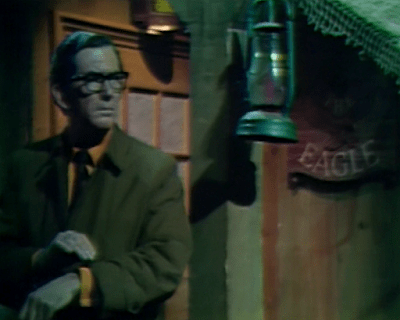
Larry hears a cry for help. Screenshot by Dark Shadows Before I Die.

Episode 1007: Accumulating guilts

Chemist Horace Gladstone has been selling a strange and powerful synthesis of his own invention to Cyrus Longworth, an independent medical researcher. Cyrus refuses to tell Gladstone what he is using the synthesis for. Gladstone has now figured it out for himself. Cyrus has concocted a potion which he drinks to change his appearance, disguising him so effectively that even the people who know him best do not recognize him. In that disguise, Cyrus calls himself “John Yaeger,” spends a lot of money, and indulges his sadistic impulses.

Gladstone comes to Cyrus’ lab and tells him what he knows. Cyrus tries to deny that he is Yaeger, and Gladstone lists the evidence he has collected proving that he is. Gladstone tells Cyrus that he doesn’t believe he can do without the thrills he gets from his activities as Yaeger. The story has been crafted as an account of addiction, so returning viewers are sure Gladstone is right. He says he will go on serving as Cyrus’ connection for the drug he craves, but the price has gone up. He demands $10,000.

Cyrus first learned Gladstone’s name from his late friend Angelique Stokes Collins. Angelique was a woman of vast learning in a variety of fields, much like the title character in Edgar Allan Poe’s story “Ligeia.” Also like Ligeia, Angelique has returned from the dead. She is now back in the great house of Collinwood, impersonating the identical twin sister whom she murdered on the night of her resurrection, and occupying her old room as the guest of her widower, drunken sourpuss Quentin Collins.

Cyrus calls Gladstone a blackmailer. In reply, Gladstone makes a cryptic remark: “Why do you think my number was in Angelique Collins’ phone book? She’s led many lives. Each person only gets one. Good night.” We have indeed been wondering how Angelique came to know Gladstone, and now we wonder if he is aware of just how literally true it is that “She’s led many lives.” It doesn’t make any sense to follow “She’s led many lives” with “Each person only gets one,” but actor John Harkins was so precise in his delivery that I’m sure that was the scripted line. If there was a slip, it came from Sam Hall’s typewriter, not from Harkins’ tongue.

If it isn’t a slip, I think we would have to go out on a limb to explain what Gladstone could mean. Angelique built up a cult around herself, including several people who were firmly convinced that she was going to rise from the dead. When her sister Alexis came to Collinwood, housekeeper Julia Hoffman, sleazy musician Bruno Hess, and Angelique and Quentin’s son Daniel were certain that the prophecy had been fulfilled and they were seeing Angelique redivivus. This was also the first thought that came to Cyrus, to Quentin’s brother Roger, and to Angelique’s Aunt Hannah, though they were more easily persuaded that Alexis was a separate person. The cultists are impressive enough in their certainty that even people outside their ranks were sure Alexis was Angelique returned from the grave. Daniel’s cousin and playmate Amy Collins was horrified to see her for that reason, and Quentin’s second wife, the former Maggie Evans, fled the house in part because she could not shake her belief that Alexis was Angelique.

If Gladstone is familiar with Angelique’s cult and has been involved with it, he might be saying that each person gets to participate in only one of Angelique’s lives. We’ve already seen that is not the case, but that doesn’t mean he doesn’t think it is. Angelique may at some point have taught her followers a doctrine like that. While Hoffman, Bruno, and Daniel expected Angelique to come back and rejoin them, Cyrus, Roger, and Hannah were unsure they would see her again, even though they were certain that she was not simply dead. Indeed, Angelique is still telling her most of her devotees that she is Alexis. The only one to whom she has fully revealed herself is Hannah. Perhaps she had a plan to transcend death, but did not know just how it would work. Or perhaps she has decided the rest are not yet ready to be initiated into the esoteric truth of her return.

Sam Hall was a serious Lutheran, so much so that he insisted Shirley Grossman convert from Judaism before she married him and became Grayson Hall. Christian studies in twentieth century academic institutions were largely taken up with speculation about differences of opinion in the church before the codification of the New Testament and the formulation of the creeds. This sort of thing is still prominent in divinity schools today, and is often heard from pulpits in mainline Protestant denominations. Hall must have been familiar with it, so he probably gave it some thought when he spent Easter season 1970 writing scripts about a figure whose followers sort of expected her to rise from the dead and who surprised them by the way in which she actually did so. I doubt he was making any particular point about the various schools of thought that seminary professors postulate in the primitive church, but when he presents Angelique’s cult as divided into several strains of opinion from the start he is developing an idea that he did not have to invent himself.

We cut from the scene between Cyrus and Gladstone to the basement of Collinwood. Angelique leads Quentin to a little chamber hidden behind an alcove. A human skeleton stands in the chamber. You may wonder how a skeleton can stand, but Quentin doesn’t. He is too busy being surprised that he didn’t realize this chamber was in his basement.

The skeleton is that of Dameon Edwards, a friend of Angelique’s who went missing about a year before. Dameon’s ghost has been haunting the place for a couple of weeks. Angelique tells Quentin that Hannah found the skeleton and exorcised the ghost. Yesterday, we saw Angelique exorcise the ghost. Returning viewers know that she is giving credit to Hannah because she is masquerading as Alexis, who did not share her sister’s interest in the occult or her aunt’s. Quentin thinks that Bruno probably killed Dameon. Indeed, the ghost confirmed this yesterday. Quentin very much wants to get rid of Bruno, so you might think he would be interested in bringing a murder charge against him. But he decides that would be too much trouble, and it hurts his feelings when “Alexis” snaps at him that he shouldn’t be wasting his time reporting Dameon’s murder when he isn’t doing anything to investigate Angelique’s. So he calls Cyrus, and the two of them bury the bones on the grounds of the estate.

Meanwhile, two long-absent characters have returned from trips out of town. Quentin sent Hoffman to visit friends of hers in Boston because she kept antagonizing Maggie. Quentin’s sister Elizabeth Collins Stoddard also went away for a long stay in New York, where she visited Maggie. In off-screen reality, Grayson Hall and Joan Bennett were both in Tarrytown, New York with several other cast members, working on the feature film House of Dark Shadows. Liz complains that Hoffman didn’t meet her at the train station with a car, and Hoffman explains that she just got back herself.

Hoffman says she missed Collinwood terribly while she was in Boston; Liz says she can’t understand that. If she were in Quentin’s place, she would sell the house and move to the city. That will interest longtime viewers. For its first 196 weeks, Dark Shadows was set in a parallel universe, where Liz’ counterpart owned Collinwood. When the show started, she was a recluse who hadn’t left the house for eighteen years. Her brother Roger often urged her to sell the place so that they could live someplace less gloomy, but even after she stopped being a recluse Liz wouldn’t hear of that. She was a symbol of the family’s commitment to the house. We have already seen that this Liz is the opposite of her counterpart in other ways, and now we wonder how far they will take that mirror image motif.

Angelique is in the foyer, talking on the telephone to Hannah. Villains on Dark Shadows have remarkably little sense of OpSec, and this is a case in point. Quentin, Liz, and Hoffman are a few feet away from her in the drawing room, and each of them knows that Alexis and Hannah couldn’t stand each other. All Angelique has to do is call Hannah by name and she will raise their suspicions. Yet not only does she use Hannah’s name several times, she uses one incriminating expression after another about how no one will suspect what they are up to. If any of them listens in, or of anyone else in the house happens by on their way to the front door, Angelique will have tipped her hand.

It is Hoffman who eavesdrops on the call. After Angelique catches her, they have an awkward exchange and Hoffman goes upstairs. Angelique then stands at the door to the drawing room and eavesdrops on a conversation between Liz and Quentin. Liz wants Quentin to go to New York and ask Maggie to come home, he throws a tantrum and says that Maggie is too childish for him to do such a thing.

Hoffman is in Angelique’s old room, talking to the portrait of her that hangs there. The members of Angelique’s cult make a practice of coming to the room and carrying on conversations with the portrait; when Alexis was staying in the room, she sometimes walked in on them while they were confiding their thoughts to it. Angelique eavesdrops on the last part of Hoffman’s account that when she was in Boston, she felt a mystic assurance that when she returned to Collinwood she would find Angelique come back to life. When Hoffman says that everything seems to be the same as it was when she left, she is close to tears.

The resurrected Angelique eavesdrops on Hoffman’s conversation with the dead Angelique. Screenshot by Dark Shadows Before I Die.

Angelique takes a step forward, and Hoffman realizes she is not alone with the portrait. She apologizes to “Alexis,” and Angelique says she needs a friend she can trust. Hoffman claims to be such a friend. “Alexis” then launches into her reasons for believing that Angelique was murdered. After the first couple of sentences, returning viewers know what she is going to say, so we dissolve to Quentin and Cyrus in the drawing room.

Quentin and Cyrus have just buried the skeleton, prompting Quentin to feel sorry for himself. He then tries to explain to Cyrus something extremely weird he saw the other evening. He went to Angelique’s old room to see Alexis. He opened the door, and saw a space that lacked the room’s furniture, lights, and decor. He saw two children whom he took to be Daniel and Amy, and they said something about Barnabas Collins. The only person of that name of whom Quentin or Cyrus is aware died in 1830, but the children were talking about someone they knew. An invisible barrier kept Quentin from entering the room, and he could not attract the children’s attention. Regular viewers know that Quentin was catching a glimpse of the other continuity, and that the children were not Daniel and Amy Collins, but their counterparts David Collins and Amy Jennings. Cyrus hasn’t been watching the show, so all he can do is suggest Quentin take a vacation.

They’ve been experimenting with videotape editing, and they make a jump cut from the drawing room scene with Quentin and Cyrus to Quentin walking up to the doors of Angelique’s room. The effect is startling, I suspect intentionally so. Quentin opens the doors, and again sees the other universe.

This time Quentin sees the counterparts of Liz and Hoffman. As David and Amy had been, they are talking about Barnabas, who was last seen in this room. Hoffman, whom Liz addresses as Julia, says that they must keep the room open so that Barnabas will have a chance to return to them. She says she wants to stay there, because it makes her feel close to Barnabas. Liz excuses herself, and Julia calls out to Barnabas. As Hoffman had grown emotional talking to the Angelique whom she believed to be absent, Julia grows emotional when she talks to the missing Barnabas. She looks at the hallway, seeing not Quentin but the dark, empty space that is there in her universe. She asks if Barnabas is there, watching her. Grayson Hall plays these two scenes so similarly that we can have no doubt that whatever the one Julia Hoffman feels for Barnabas, the other feels for Angelique.

Quentin calls out to Hoffman’s counterpart, as he had called to Daniel and Amy’s counterparts. As the children had been unaware of his presence, so this other Julia Hoffman is unaware of him. And as Daniel and Amy had come to the hallway and asked why he was shouting for them, Hoffman comes to the hallway and asks why he is shouting for her.

Episode 987: The possibilities of this synthesis

Q & A

Quentin Collins, master of the estate of Collinwood, is in an even grimmer mood than usual. His new wife, the former Maggie Evans, has left him after only a week in the great house. She had had all she was going to take of his patronizing attitude towards her and of everyone else’s preoccupation with his first wife, the late Angelique Stokes Collins. Maggie was particularly satiated with Quentin’s houseguest, Angelique’ unmarried identical twin sister, Alexis Stokes. Maggie had found Alexis in Angelique’s bedroom, wearing Angelique’s frilly nightgown, and reaching out to Quentin while suggesting in a soft voice that “Perhaps we can comfort each other.” When that sight moved Maggie to voice objections to the situation, Quentin responded by forbidding her, for her own good no less, from mentioning Angelique’s name ever again. He was amazed that this led Maggie to leave the house. Considering the provocation, it is indeed amazing that Quentin did not require medical attention to remove his brandy decanter from whatever part of his anatomy Maggie could reach.

We open today with Quentin and Alexis back in Angelique’s room. She is fully dressed this time, but they are sitting together on the piano bench. They move their heads together, and lock their lips in a passionate kiss.

Returning viewers know that we are visiting a universe parallel to the one in which the action was based for its first 196 weeks of the show. Angelique’s counterpart in the main continuity is a wicked witch who has returned from the dead quite a few times, so when we first crossed over here and heard her devotees saying that they were sure their Angelique would find a way to come back to life we did not doubt that they were right. Maggie wants nothing to do with Angelique or the cult she built up around herself, but she is among those who are convinced that Alexis is in fact Angelique redivivus. The show has done an excellent job keeping us guessing whether she is or isn’t, and we will still be guessing when we come to the end of today’s episode.

Alexis pulls away from Quentin and is visibly upset. He apologizes for kissing her. She says that she is disappointed in him- she had thought that he, of all people would know that she is not Angelique returned from the grave. He says he does not think that she is. We can believe him- his counterpart in the main continuity usually had two or three fiancées at a time, and they were rarely his only love interests. So he wouldn’t have to believe Alexis was Angelique, or indeed that she was anyone in particular, to start a make-out session with her. After they clear the air, she agrees to stay on in the house until she can meet Quentin and Angelique’s son, her nephew Daniel Collins, who is on a trip at the moment.

Bruno, Sabrina, Cyrus, Gladstone, and the Bunny

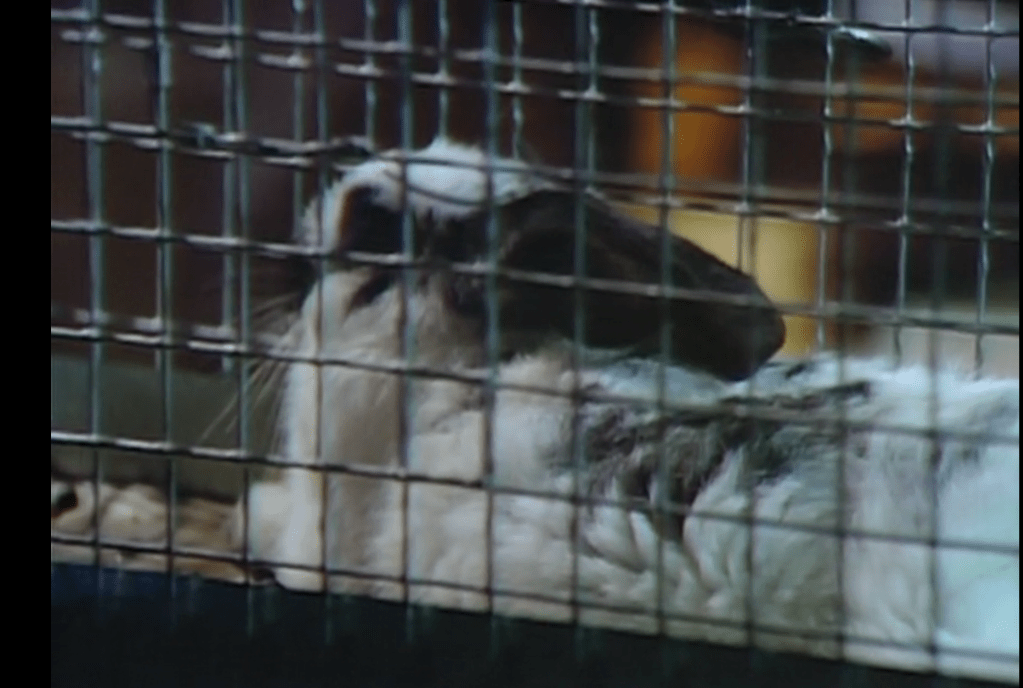
Quentin and Alexis aren’t the only ones dealing with frustrated sexual desire. We cut from them to a closeup of a bunny. This universally recognized symbol of amorous enthusiasm is alone in a cage.

The episode originally aired on the second Tuesday of Easter 1970, maybe the bunny was resting up after his big day.

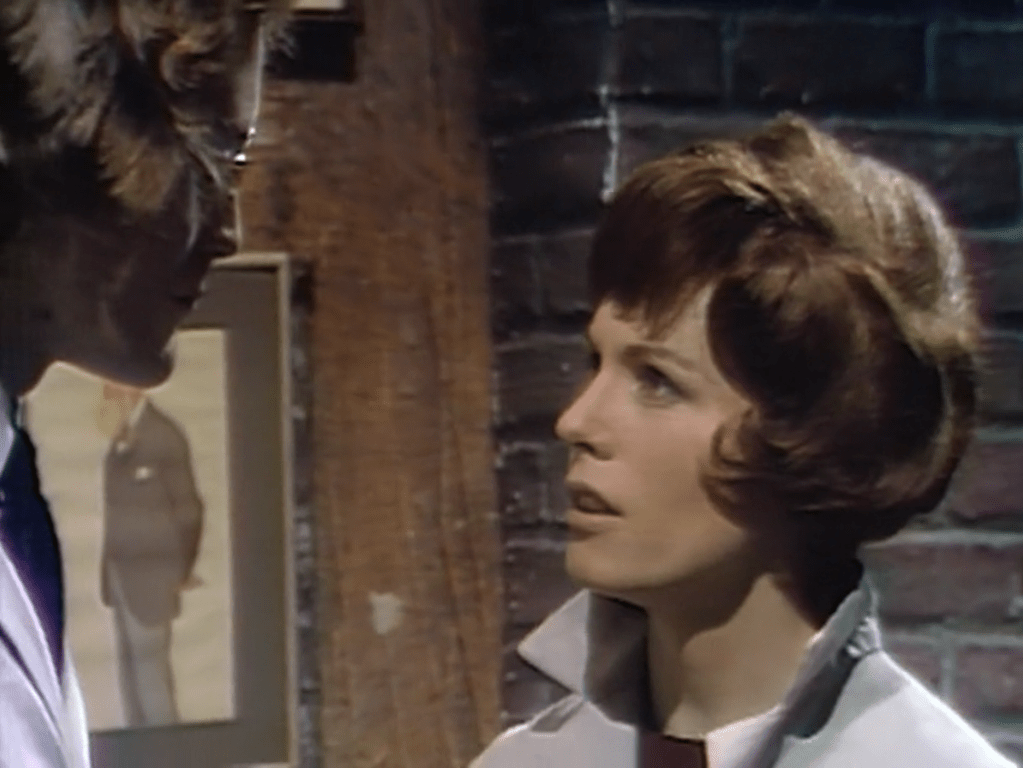
The cage is in a laboratory. A young woman in a lab coat is trying to work on a large apparatus for chemical experimentation while a man wearing a purple suit, a low cut shirt, a large medallion, and a huge bouffant hairdo is pestering her with clumsy attempts at flirting. She keeps laughing off his verbal gambits and swatting away his physical approaches.

A tall young man in a lab coat enters and calls out a booming “Sabrina!” The lounge lizard and the experimenter stand up straighter and step away from each other. Returning viewers know the tall man as aspiring mad scientist Cyrus Longworth and the ill-clad masher as Bruno Hess, musician and hanger-on of the late Angelique. We have not seen the woman before, but we recognize the actress as Lisa Blake Richards, who played another woman named Sabrina in the main continuity. That Sabrina was trapped in a go-nowhere storyline. Before today is done we will have grounds to hope that this one will give Miss Richards a task more in keeping with her considerable talents.

Cyrus sends Sabrina upstairs to wait for a package. Bruno gets ready for his part in Cyrus’ experiment, which involves giving a blood sample. Bruno asks Cyrus why he was so calm when he saw him trying to put the moves on Sabrina. Cyrus replies that he trusts Sabrina too much to worry that Bruno could come between them. He then jabs the syringe into Bruno’s arm with great force and without even looking at the spot from which he is drawing the sample, causing Bruno to jump. He may trust Sabrina, but he wants Bruno to know who’s boss.

Bruno tries to interest Cyrus in his theory that Alexis is Angelique returned from the grave. He eventually manages to get Cyrus to give him a quizzical look, but stops at that point, saying that if Cyrus won’t explain his experiment, he won’t explain his.

Sabrina comes downstairs and says that the package has come and that its bearer insists on meeting Cyrus himself. Cyrus is annoyed by this, but when it develops that the man is Mr Horace Gladstone himself, the very chemist who devised the unusual compound he has brought, Cyrus sends Sabrina back upstairs and Bruno out the basement door so that he can meet with the man alone.

Friday, Cyrus explained to his friend Chris that he is trying to devise a process for separating a human being into two parts, one good and the other evil. His scenes with Chris hit all the obligatory mad scientist notes, right down to disparaging non-mad scientists as unimaginative dolts who may as well believe that the Earth is flat. He won’t tell Gladstone what he is trying to do, perhaps because he has the same last name as did the man who was prime minister of the UK when Dr Jekyll and Mr Hyde was first published and so he reminds him that he is a character in a derivative storyline. But Gladstone does warn Cyrus that the compound he has purchased is a potent and dangerous one. Gladstone hints at the nature of the hazard when he says that he stepped back from active research when he feared that, even within the bounds of chemistry, he was about to uncover truths best left unknown.

Gladstone is played by John Harkins, in his fourth role on Dark Shadows. As before, he is playing a stranger from far away. In #174, he played Lieutenant Costa of the Arizona State Police. We saw him in a scene set in Phoenix, the first time Dark Shadows took us outside the northeastern USA. We did not leave that region again until #877, when sorcerer Count Petofi thought back to an incident in England in 1885, when he first met his henchman Aristide. Like Bruno, Aristide was played by Michael Stroka. The incident in England involved a man named Garth Blackwood, whom Petofi would bring back from the dead to punish Aristide. Blackwood was played by Harkins.

Harkins’ third character came from even further away than Arizona or England. He was Mr Strak, the representative of the Leviathan People, a race of Elder Gods long confined to the underworld. Strak appeared to Paul Stoddard in #899 and #900, and tricked Paul into selling his daughter Carolyn to the Leviathans. So far as Paul was concerned, Strak came from nowhere and disappeared to nowhere, so that he could never hope to explain to anyone what he had done, still less find a way to challenge the terms of the deal.

Gladstone is from Boston. Dark Shadows is set near the real-world location of Bar Harbor, Maine. The characters often mention Boston, but we’ve never had a scene set there. In #363, the ghost of nine year old Sarah Collins was perfectly bland when her friend, strange and troubled boy David, said he had been to China. Sarah said that her father and his business associates were always sailing to China. When David told Sarah that he was joking and he had actually gone to Boston, Sarah was thrilled. She had been to Boston herself once, and considered it a far more exotic place than China could possibly be. Gordon Russell was credited with the script for #363, and Joe Caldwell, the freshly returned author of today’s script, had finished his first tour of duty on the show three weeks before it was taped. But Sarah’s excitement about Boston is so much the kind of character moment Caldwell specialized in that I suspect it was a leftover idea of his that Russell found a place for. Perhaps the casting of Harkins as a Hub man reflects Caldwell’s idea of what Boston would represent to people in a coastal village in central Maine.

Bruno and Alexis

We cut to Bruno, who is on the telephone. He is talking to a person in an office somewhere. He learns that no ships from Genoa have docked in New York in the last week. This information excites him, but his excitement soon gives way to terror as he feels himself choking.

Bruno runs into Angelique’s bedroom, where Alexis is back on the piano bench. He gasps and demands she stop obstructing his breathing. She appears to have no idea what he is talking about.

The Angelique we have known since late 1967 did specialize in casting spells that made her enemies choke. We saw her do that as recently as #955, when her husband tried to set fire to her and she stopped him by twisting a scarf around the neck of a statue. On the other hand, Alexis seems genuinely bewildered by the situation.

When Bruno starts breathing again, he confronts her with the fact that no registered passenger ships from Genoa arrived in New York harbor the week before. She asks him if he considered that she might have been a guest on the yacht of some wealthy friends. He is stumped by this. Again, this keeps the suspense about her true identity alive. Alexis has been established as the sort of person who would be found on someone else’s yacht, but she doesn’t actually say that that is how she got back to the States. She merely asks Bruno if he had thought of the possibility that she may have done so.

Cyrus and Sabrina

Back in the lab, we see Sabrina collecting some equipment while Cyrus tends to his notes. She finds a small box, and asks him if he put it there for her to find. When he says he did, she opens it and finds a ring. She asks if it is an engagement ring. He says he hopes it is. She throws her arms around him and tells him she loves him. He holds her and does not say that he loves her too. He merely says that she knows how he feels about her, an ill-omen if ever we saw one.

Cyrus tells Sabrina that she knows how completely his work consumes his energies, and she says that is one of the things she admires about him. She asks what exactly he is working on. He is reticent, and she tries to walk the question back. He goes into his mad scientist ravings, and she gives him a stunned look. He tries to reassure her, saying that when he gets carried away he talks in cliches. He says that no one has found good or evil in a test tube… “yet!” The crazed gleam comes back into his eyes.

Sabrina is shocked by Cyrus’ ravings

This scene gives Miss Richards more to work with than she had had in her whole time in the main continuity. The look Sabrina gives at the end of Cyrus’ gust of lunacy is the first time she has had a chance to get a laugh, and she makes the most of it. As for Christopher Pennock, he had just been getting the hang of his previous part, hugely overgrown infant Jeb Hawkes, when he was written out. With Cyrus, he can to some extent pick up where he left off. Pennock had begun to find a way to suggest that there was a real sweetness bottled up inside one-man wrecking crew Jeb, and in Cyrus’ love for Sabrina he can play a character who is Jeb’s mirror image- abundantly sweet, but so deep inside his own head that he is about to become a monster.

Bruno

On Dark Shadows, wedding days usually come and go without anyone actually getting married. Typically, the ceremony is interrupted and someone has to go off and dig up a grave, in which they find an empty coffin.

Bruno has no manners and does not observe any of the recognized customs. So even though today is Sabrina and Cyrus’ engagement day, not their wedding day, he jumps the gun and starts opening Angelique’s grave, in which he believes he will find an empty coffin. We end with him chiseling at the wall of the mausoleum. I suppose you could say that he might be planning to work slowly, so that he won’t finish until the day of the wedding, but even if that were true it would be an outright violation of the accepted norm, and an undeniable sign that he is not the sort of person who can be expected to fit in at Collinwood.

Episode 969: On the same side at last

Wedding Day

On Dark Shadows, weddings are usually stopped when one of the couple makes a decision in the middle of the ceremony that leads to the exhumation of an empty coffin. In #270, the first wedding followed that pattern, when instead of saying her vows matriarch Elizabeth Collins Stoddard announced that she and her intended, seagoing con man Jason McGuire, had killed her first husband, Paul Stoddard. That led the sheriff to dig up the spot in the basement of the great house of Collinwood where Liz said Jason had buried Paul, only to discover an empty box. It turned out Paul wasn’t dead at all.

The next wedding we saw was in #397, set in the year 1796. Scion Barnabas Collins and wicked witch Angelique Bouchard managed to get through the ceremony, but before the night was out Angelique had been abducted by the late Jeremiah Collins, whom she had raised from the dead as a zombie. Jeremiah dug up his own grave, opened his empty coffin, and put Angelique in it.

In #625, well-meaning governess Vicki was supposed to marry an unpleasant man known variously as Peter and Jeff. Peter/ Jeff left the ceremony to dig up another grave, and find another empty coffin.

For sixteen weeks, Dark Shadows was dominated by an effort to take some themes from the tales of H. P. Lovecraft and build them into a story. We kept hearing about the Leviathan People, a race of Elder Gods who were trying to retake the Earth and destroy humankind. The Leviathan material never coalesced into a story, and they gave up on it last week.

The last event in the Leviathan segment was an attempted wedding between Liz’ daughter Carolyn and someone who appears to be a very tall young man, but is in fact a shape-shifting creature from beyond space and time. When he first assumed the form of the tall young man, the creature asked people to call him Jabe. That didn’t come off, so he answers to “Jeb” instead. The Leviathan plan has always called for Jabe to join himself with Carolyn in an unholy ceremony that would cause her to become the same sort of creature he is, and last Friday they stood by an altar in the woods while Nicholas Blair, the high priest of a cult devoted to the service of the Leviathans’ project, called on Jabe to take his place behind the altar. There, Jabe deviated from the rubrics of the ceremony. He smashed a small wooden box and called for Barnabas to rescue Carolyn. The wooden box was empty, but it was not exactly a coffin- it was the matrix from which Jabe first emerged, four months ago, when he was nothing more than a whistling.

After their traditional Collinwood non-wedding in #625, Vicki and Peter/ Jeff had a second ceremony in #637. They completed it, but shortly afterward the supernatural powers that allowed Peter/ Jeff to exist in the 1960s lost their grip and he vanished into a rift in time and space. Today Jabe and Carolyn also complete a second ceremony, but it seems their marriage is approaching a similar crisis. When Jabe smashed the box, Nicholas told him that his humanoid appearance was all that was left of him, and that it was only a projection from a true form that was destroyed with the box. He could not continue to exist as Jabe for very long. As Peter/ Jeff prolonged his time in the 1960s by force of will, Jabe has prolonged his own existence beyond what Nicholas had thought possible, but returning viewers will still expect him to vanish at any moment.

Moreover, Jabe has made many powerful enemies. One of them is Angelique. She has taken a cue from George MacDonald’s 1858 novel Phantastes and plagued him with a shadow that he does not cast but that follows him about. The shadow menaces Jabe a couple of times today, and each time it prompts him to shriek to Carolyn that they must flee. Since he won’t explain to her what is going on, we can only wonder if he will meet his demise before she concludes that he is an abject lunatic and files for an annulment.

Jabe faces his dark shadow. Screenshot by Dark Shadows Before I Die.

Meanwhile, Barnabas and his friend, mad scientist Julia Hoffman, are on a vampire hunt. Barnabas is a vampire himself; Angelique turned him into one when their marriage didn’t work out, Julia and another mad scientist cured him of the effects of that curse in 1968, and then Jabe placed another vampire curse on him more recently. Barnabas has bitten a woman named Megan Todd and accidentally turned her into a vampire. One of Megan’s victims, a man named Sky Rumson, tips Barnabas and Julia off that her coffin is hidden somewhere in the long-disused east wing of the great house. Barnabas conducts a search there while Julia goes with Liz to inspect the carriage house on the estate, where Jabe has been staying.

In the first months of the show, they went back and forth on whether the great house had a vacant west wing or a vacant east wing. They eventually settled on a west wing, and the west wing was an important locale at various points. Once in a while actors would slip and refer to an east wing. It was not until #648 that the show made it unequivocally clear that the house had both east and west wings, and not until #760 that we had a look inside the east wing. This is the first reference to it since then.

Barnabas is walking through a dark, dusty corridor, thinking that no one had been down it in “years.” Double doors open, and Barnabas sees a fully furnished, brightly lit room. He tries to enter, and suddenly turns into a mime struggling to escape from an invisible cage. He sees a framed photograph on a table in the room. The photograph appears to show his distant cousin Quentin sitting next to Liz’ nephew, strange and troubled boy David. It is signed “Your loving husband, Quentin.” Barnabas knows that Quentin and David have not been photographed together, and Quentin’s only marriage ended when he murdered his wife long before David was born, so neither the photograph nor the writing on it make any sense to him.

Barnabas sees Liz enter the room from a doorway on the other side. She is wearing a completely different outfit than she had on when Barnabas saw her shortly before. She does not see Barnabas or hear him, even though he is standing only a few feet away and calling out to her. She opens a closet and examines some clothes.

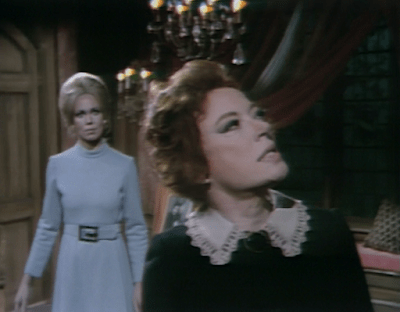
Julia enters, wearing a French maid outfit. She demands to know what Liz is doing. Since Barnabas knows Liz as the owner of Collinwood and Julia as a houseguest there, albeit one of unlimited tenure and an overpowering nature, her tone is as inexplicable as her attire. She orders Liz to leave the clothes alone. They argue about a person to whom they refer only as “she.” Liz says that “she” is dead, Julia insists that “she” will return. Liz wants to prepare the room for someone else’s use, Julia declares that only “she” will ever possess it.

Hoffman confronts Liz. Screenshot by Dark Shadows Before I Die.

The doors close. Barnabas cries out to Liz and Julia. He opens the doors again, only to find that the room is entirely bare. It has no furniture, no carpeting, no lights, no decoration of any kind. It is as dark and as dusty as the rest of the east wing, and appears to have been unvisited for as long.

Barnabas returns to the main part of the house. He sees Liz and Julia returning through the front door, dressed as they had been before they left for the carriage house and talking to each other in the same relaxed, friendly manner. Flummoxed, he asks Julia if they went anywhere other than the carriage house. She says they did not. He tells her he did not find Megan’s coffin, and tries to explain what he did in fact see.

The Man Who Wasn’t There

It would seem that whatever phenomenon Barnabas is seeing when he looks into this room is going to mark the beginning of the next phase of Dark Shadows. When Jabe smashed the box, he ended the Lovecraft segment. But the show had not set up any story to follow it. For the last few days, we’ve passed the time watching him and some other characters left over from it flounder about helplessly. Peter/ Jeff’s ghost showed up and claimed to have a grudge against Jabe that dated from the 1790s. Since Jabe did not exist in those days, I suspect the tale Peter/ Jeff tells is a remnant of some story they planned long ago but never developed, with Jabe hastily put in the place of some character they projected but did not introduce.

I’m not sure what the untold story and never-introduced character were, but there may be a clue in this episode. Sky Rumson was at one point under the power of the Leviathans. Barnabas tells Sky that Jabe has smashed the box and everyone is now free of their power, which fits with what we have seen and with what Nicholas told his henchman Bruno. Sky is indeed disconnected from the Leviathans- he now figures only as Megan’s victim. But for no reason that has to do with today’s events, he denies that and says “My deal was with Mr Strak.”

In #899 and #900, there was a flashback to the year 1949. We saw that Paul Stoddard unwittingly sold his daughter Carolyn to the Leviathans that year, and that their agent was a Mr Strak. Strak was played by John Harkins, who had played a monster in several episodes not long before. The whole point of Strak as a character seemed to be that he was someone Paul could never find again, so that he was entirely helpless in the face of the deal he had struck. The casting of Hankins reinforced that for viewers who recognized him, since he was pretty obviously there to use up the last two episodes on his contract. It would seem to defeat the purpose to bring his name up again, yet Sky’s reference to Strak marks the second time we have heard his name recently. Doomed Leviathan cultist Nelle Gunston told Barnabas in #951 that Strak had recruited Bruno.

Nicholas’ association with the Leviathans is also hard to explain. He was on the show in 1968 as Angelique’s boss. At that time the show was taking a peculiar sort of Christian turn, and it was very clear that Nicholas was in the employ of Satan. Indeed, just last week he invoked Satan at the ceremony to join Carolyn and Jabe. But the Leviathans are rooted in Lovecraft’s resolutely non-Christian cosmology, and when Jabe himself performed an incantation to raise some dead men to serve him as zombies he called upon multiple “gods of the underworld,” not Satan. Moreover, we know that Nicholas was at Collinwood in 1968, and Nicholas tells Jabe that he has been confined to the underworld since then. It is therefore nonsensical when Sky treats Nicholas as his long-established supervisor in the Leviathan cult.

I suspect that Nicholas’ role, the references to Strak, and Peter/ Jeff’s complaint against Jabe are all traces of a single never-introduced character. They may have intended, in the early stages of planning the Leviathan segment, to bring in a second Leviathan, one who had been lurking on the Earth for a long time and had great powers, though he could not fill Jabe’s intended place as harbinger of the new age. This projected character would have been the main villain of the second half of the Leviathan segment, which would have involved another trip in time back to the late eighteenth century. When the ratings sagged, they often scrapped a lot of what they had written and everything they had planned to get to something fresh. Since the Leviathan segment was a flop, it certainly would not be surprising if they had chucked that new villain, along with the second half of the Leviathan segment and its time-travel story, plugging in Nicholas, the references to Strak, and Peter/Jeff’s complaint to Jabe to cover what they tore out.

Closing Miscellany

The clergyman who marries Jabe and Carolyn is called “the Reverend Brand.” The clergyman who married Barnabas and Angelique in 1796 was called “the Reverend Bland.” Those names are similar enough that I have to suppose there was some point to it. Perhaps an inside joke between writers Gordon Russell and Sam Hall.

The show has been ambiguous about the Collinses’ precise religious affiliation. In the 1790s, we saw that repressed spinster Abigail Collins was a very extreme sort of Congregationalist, but the other members of the family pointedly referred to “Cousin Abigail’s religion” as one of the things that set her apart from the rest of the family. As the name suggests, Congregationalists vary quite a bit from place to place, so the other Collinses’ differences with Abigail do not mean that they were not of that tradition in the 1790s. As upper crust New Englanders of an early vintage, they would likely have been Congregationalists at some point, though by the 1790s, they may well have been Unitarians or Presbyterians. By the 1960s they could have been just about any kind of Protestant without occasioning comment. Today, Liz mentions that the Reverend Brand has a “vestry meeting” to attend. Only Anglicans call the lay leadership of their parishes a “vestry,” and the only Anglican denomination the Collinses could plausibly have belonged to in 1970 was The Episcopal Church.

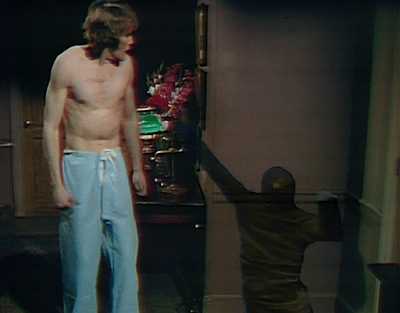
We see Jabe and Carolyn asleep in bed together on their wedding night. This is the first time we see a couple sharing a bed on Dark Shadows. What’s more, while most sleepers we have seen have been fully clothed under their bedsheets, even wearing shoes, Jabe is wearing only pajama bottoms, and those are tugged down noticeably below his waist when he first gets out of bed. You can say goodbye to the uptight Sixties, it’s the Seventies now, baby.

The Sexual Revolution reaches the Collinses. Screenshot by Dark Shadows Before I Die.

During the joining ceremony between Jabe and Carolyn, Bruno was in the carriage house. There was a magical room there where Jabe changed between his human form and his rugose, paleogean one. When Jabe smashed the box, Bruno saw that room suddenly engulfed in flames. Later, he and Nicholas examined the room, and could not find any sign there had ever been a fire there. Nicholas explained that the fire was a supernatural manifestation, and that what it consumed was not any of the material aspects of the room, but its character as Jabe’s changing station. But Liz tells Julia she is going to the carriage house to inspect fire damage, and when they come back they say that they have seen such damage.

Danny Horn’s post about this episode on his great blog Dark Shadows Every Day is a particular delight. It’s so full of spoilers about the story that begins today that I can’t say much about it. I’ll tell you it is written from the perspective of a person who would be familiar with the versions of Liz and Julia that Barnabas encounters in the east wing, but not with him. Danny is writing from an imaginary world in which actor David Selby went into politics and was elected president of the United States in 2016.

Episode 900: Precious possession

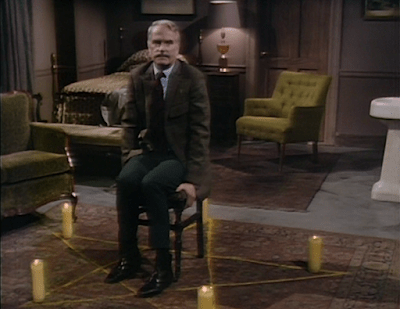
We open with the sight of a man (Dennis Patrick) sitting nervously on a chair placed in the middle of a pentagram marked on a rug. At each point of the pentagram there is a candle. The man is Paul Stoddard.

Paul’s precarious pentagram perch. Screenshot by Dark Shadows Before I Die.

Regular viewers will remember #752, in which Quentin Collins was told to sit on a chair in the middle of a similar pentagram. Quentin’s friend, amateur warlock Evan Hanley, told him that by doing this he could keep from turning into a werewolf. Paul isn’t afraid of turning into a werewolf, and he doesn’t have a friend like Evan. His worry is vague, but urgent- he knows that someone is after him, that if that someone catches up to him they will do something horrible, and that whoever it is keeps sending him messages that it is time for him to pay his debt. But he has no idea who that is, what they will do, or what the debt they are talking about. Sitting in the pentagram was a suggestion that came from a sailor who cruised him in a gay bar met him in a local tavern.

Paul’s pursuers are a cult associated with mysterious beings known as “the Leviathan people.” It has been made clear to us that both Paul and his daughter, heiress Carolyn Collins Stoddard, are, unknown to themselves, part of its orbit. In #888, Paul and Carolyn ran into each other at a cairn that is the cult’s ceremonial center and looked at it. Carolyn had been on its site many times, and could not understand why she had not seen it before. In #894/895, the cult’s acting leader, Carolyn’s distant cousin Barnabas Collins, took antique shop owner Philip Todd to the cairn. Philip told Barnabas he had walked past the site a few days before and that the cairn was not there then; Barnabas explained that only those connected with the Leviathan cult can see it. Barnabas has also been highly solicitous of Carolyn’s well-being since he became part of the cult, and he keeps telling her that he knows she has an extraordinary future ahead of her. So we know that the cult has plans for her, and Paul’s distress suggests that they have less attractive plans for him.

Paul sees the doorknob turning. He is terrified. Instead of the enemy Paul expects, Carolyn enters. He yells at her to leave. She stays. When he is unable to explain what he is afraid of, but that the pentagram on the floor will protect him, she notices that it is the same as the symbol she has been wearing on a chain around her neck. Barnabas gave it to her some days ago and urged her to wear it always. The audience knows, but she does not, that he intends it to protect her from the local werewolf. When she sees the similarity, the show invites us to wonder what the Leviathans have to do with werewolves. Carolyn tells Paul that if the symbol will protect him from his enemies in the form of chalk or gaffer tape on the floor, it will also protect him when it is composed of a silver pendant. He puts the pendant on and declares that he feels much better. He can no longer hear the voices that have been telling him his payment is due immediately. He embraces Carolyn and tells her he trusts only her.

When Carolyn mentioned Barnabas to Paul, he responded “Who is Barnabas?” Carolyn seems surprised he does not know, since she saw him near Barnabas’ house. Indeed, we saw him enter Barnabas’ house and wander through it the night he first returned to Collinwood, after an absence of twenty years. But he doesn’t remember anything about that.

Not that Carolyn’s own long acquaintance with Barnabas is all that enlightening to her just now. Ever since the Leviathans adopted him as one of their own, he has not been himself at all. We see him in his front parlor with mad scientist Julia Hoffman, who has for a year and a half been his inseparable best friend. She is trying to interest him in some information she has gathered about another storyline, and he makes it clear he could not be less interested in it or in her. She demands to know what he is interested in, and he refuses to answer. Carolyn enters, and suddenly Barnabas is all ears. Julia, frustrated, snaps that now she can see what he does care about.

In the autumn of 1967, Barnabas was a vampire and Julia had failed in an attempt to make him human again. He bit Carolyn and made her his blood thrall. He also decided that he would kill Julia to prevent her exposing him. Julia soon learned that Carolyn was both a wily operator and a most devoted servant. Julia had already realized that she was in so deep with Barnabas that she would be unlikely ever to make a life with anyone else, and so she conceived an unrequited love for him. In her dealings with Carolyn in those days, terror mingled with jealousy. Her bitter remark when she sees that Barnabas, who has been so dismissive of her, is now so concerned with Carolyn, reminds longtime viewers of that jealousy. Combined with the story of a daughter reunited with her long-absent and none too respectable father, this faint suggestion of a love triangle is enough to remind us that we are watching a daytime soap.

For her part, Carolyn was freed of her subservience to Barnabas as soon as he was freed of the effects of the vampire curse in March 1968. For some time, Nancy Barrett went out of her way to play Carolyn in a way that left us wondering if Carolyn remembered her time in his power. The scripts didn’t give her a lot of support in that endeavor, but the closeness she feels towards him combines with Julia’s jealousy to bring it back to our minds.

Carolyn has come to ask Julia to help Paul. Julia is back in the great house of Collinwood getting her medical bag to take to Paul’s hotel room when Paul himself bursts in. He demands to see Carolyn. Julia tells him that she left a little while ago to go to his hotel, and is probably there now. The telephone rings. Julia answers it, and tells Paul it is for him. This doesn’t strike her as odd, even though he hasn’t set foot there in twenty years, not since the night he left his wife Liz thinking she had killed him. Julia hands the phone to Paul. He expects to hear Carolyn, but instead hears the same voice that has been taunting him, saying that his bill is due now. He hangs up, and it starts ringing again. He forbids Julia to answer it, and runs out. We cut to his hotel room, and see that this time it is Carolyn trying to reach her father. Later, Carolyn will come home and Julia will tell her that Paul doesn’t seem to want help, however much he may need it.

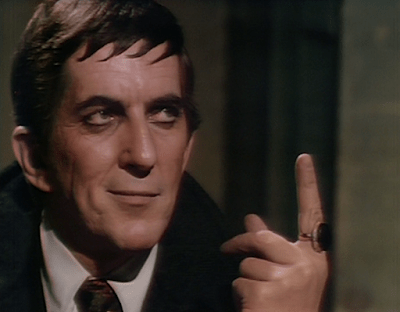
Paul goes back to his room, and hears the phone there ringing. Terrified, he runs out, returning to the bar where he’d picked up trade met a new friend the night before. He sees another stranger sitting at a table, looking him over and beckoning him by rolling back one finger. The stranger is Barnabas.

Barnabas beckons Paul. Screenshot by Dark Shadows Before I Die.

Paul reluctantly goes to the table, and Barnabas introduces himself. Paul says he doesn’t know Barnabas, but Barnabas makes it clear he knows all about Paul. He asks him to think back to the night he left Collinwood in 1949. We dissolve to a flashback.

Paul is at the bar, and another strange man strikes up a conversation with him. The man encourages him to assume that he has the power to grant any wish Paul might make in return for a price they would agree on. Paul says that in that case, he will ask for twenty years of boundless prosperity. At the end of those twenty years, Paul will give up anything he has, even his “most precious possession.” They shake hands on this deal. Paul laughs, and says he has won the game. He said that he would surrender anything he has, present tense- not anything he might gain in the course of his successful future, but anything he has as of 4 December 1949. On that date, Paul assures the man, he has nothing anyone could possibly want. The man laughs, and wants to drink to congratulate Paul on his cleverness.

Back in the present, Barnabas is laughing as heartily as the other man did twenty years before. He finds it preposterous that Paul could have forgotten such an important encounter. Paul can’t see anything important in it- it was just a silly little game, and its only consequence was that a strange man bought him a drink. Barnabas says that on the contrary, the bargain he struck was quite real. The Leviathans kept their side of it by giving him the success he has had over the last twenty years. Now that the twenty years are up, the time has come for them to claim the most precious possession he had the night he fled Collinwood.

Paul says that he supposes Barnabas is talking about his soul. He laughs heartily at that, and tells Barnabas that he is welcome to it. He is telling Paul that that is not what he meant as Carolyn enters. Paul is still laughing, and is delighted to see his daughter. She says she is relieved that the two of them found each other, and he tells her everything will be all right now. Barnabas says that Carolyn is her father’s most precious possession.

The scenes of Paul rushing around in a steadily mounting panic he is unable to explain are highly reminiscent of The Twilight Zone. The last line is a twist worthy of that classic series, especially as delivered by Jonathan Frid. His icy performance as Barnabas in these early episodes of the Leviathan arc not only recalls the malign representatives of alien powers on that show, but is superb in itself. He stumbles a little over his words in Barnabas’ scene with Julia, but is perfectly composed otherwise, and the effect is quite frightening.

I remarked on the gay subtext of the barroom scenes in the comment thread on Danny Horn’s post about the episode at his great Dark Shadows Every Day:

So far, this has been the gayest storyline the show has taken on yet.

In 899, the sailor offers to buy Paul a drink, and Paul shouts “I buy my own drinks!” This isn’t subtext- any man getting that reaction in a bar will know that the other fellow has interpreted his offer as including more than the drink. Paul apologizes and becomes friendly, indicating that he is willing to abandon that interpretation and set aside the hostility that accompanied it.

In this episode, we’re back in the same bar. Barnabas beckons Paul to his table with his index finger. I invite any man who doesn’t think we are intended to read this as a reference to a sexual come-on to try that move on a homophobic tough guy in a bar.

Paul’s face shows his inner struggle as he tries to resist Barnabas’ advances, but he can’t. Barnabas coaxes him into reminiscing about yet another night in the same bar, when a casual encounter with yet another guy led to something that seemed at the time like a little harmless tomfoolery, but that has now grown into a threat to his relationship with his family, his standing in the community, his physical well-being, and everything else.

Comment by “Acilius,” left 12 December 2020 on Danny Horn, “Episode 900: The Long Con,” posted on Dark Shadows Every Day, 18 July 2016.

In response to someone who said some kind words about that comment, I made a remark that I no longer think is very good:

Thanks! It’s a bit of a puzzle- so far as I know, none of the writers on the show at this time was gay, so I’m not sure why they decided to go so deep into these themes just then.

Comment by “Acilius,” left 11 April 2021 on Danny Horn, “Episode 900: The Long Con,” posted on Dark Shadows Every Day, 18 July 2016.

What I think now, and probably would have thought then if I had stopped and considered it for a minute before I hit “Post Comment,” is that the writing staff’s sexuality has nothing to do with it. They were worldly, sophisticated people with long experience in the theatrical profession in New York City. They all probably had many gay friends, and when they are called upon to write a story about people being drawn into a secret underworld and learning uncomfortable truths about themselves in the process their minds will naturally turn to themes having to do with closeted homosexuality. Granted, that doesn’t fully account for Christopher Bernau’s decision to play Philip as a much queenier version of Paul Lynde, but it is hardly a “puzzle” that the writers would draw on motifs suggestive of the closet when that’s the story they have to work with.

The man who met Paul in the bar in 1949 is unnamed in today’s dialogue, but will later be referred to as Mr Strak. Strak is played by John Harkins, who appeared in #174 as Lieutenant Costa of the Arizona State Police and in #878, 879, 880, 881, and 883 as Garth Blackwood, formerly the keeper of England’s Dartmoor Prison, and by that time a creature raised from Hell to wreak vengeance on an escaped prisoner and anyone else who caught his attention.

Strak’s name may remind longtime viewers of another minor character whom we saw in episodes #1 and #2, Wilbur Strake, private eye. We saw Strake in this same bar, where he gave reports about Carolyn and other members of the Collins family to his employer, Burke Devlin. Like Strak, Strake was a rather smug, sardonic sort. Add to this the rarity of the names “Strak” and “Strake” and the fact that they sound so much alike, and it seems obvious that there is an intentional reference of some kind. Paul’s presence in this storyline is the result of the writers reaching back to the show’s early days to find a loose end they could attach to this storyline to incorporate it into the Collins family saga, so they probably were looking through the scripts from the first week. Still, I can’t imagine they thought many people would remember Wilbur Strake by this point. Likely the reference is an inside joke, but who was on the inside and what the point of the joke was, I can’t begin to guess.

I wasn’t writing detailed posts with background information when I covered the first weeks of the show, so I will mention here Strake was played by Joseph Julian, who later became a regular on Somerset, a soap that aired on NBC opposite Dark Shadows for the last year of its run. The cast of Somerset included several Dark Shadows alums, including Dennis Patrick, Joel Crothers, and Christopher Pennock in major roles, and, as day players, Dolph Sweet and Humbert Allen Astredo.

Episode 878: The moors are my domain

Episode 174 of Dark Shadows, broadcast and set in February 1967, included a scene set in a police station and morgue in Phoenix, Arizona, where we met Lieutenant Costa of the Arizona State Police. Lieutenant Costa was played by John Harkins, who would become a ubiquitous TV presence in the decades to follow.

Harkins returns to the cast today as another law enforcement character. The show is set in 1897, and the action is almost entirely driven by supernatural doings. Harkins’ character, Garth Blackwood, is the late keeper of Dartmoor Prison. He is conjured up from the depths of Hell by sorcerer Count Petofi, who has decided to use him to kill his unreliable servant Aristide. Blackwood was heard but not seen yesterday, in a flashback set near Dartmoor. That flashback broke the record Harkins’ previous appearance had long held for the scene in the series set furthest from Collinsport, Maine.

Blackwood storms into the room where Petofi is recovering from a knife wound Aristide recently inflicted on him. He announces that his prisoner was seen entering the house and threatens Petofi with a heavy chain he carries. Petofi keeps smiling, but points out that he is injured and was unable to stop Aristide leaving. Blackwood exits. The threat suggests that conjuring him up may not have been Petofi’s wisest move. Petofi has such great powers that we have for some time suspected that he himself would have to be the source of his own destruction. Perhaps Blackwood will be the instrument who finishes him off.

At the great house of Collinwood, matriarch Judith Collins Trask tells her lawyer, Evan Hanley, that she is ready to put her husband, the odious Gregory Trask, in his place. She will be changing her will the next day to remove Trask as executor of her estate. Evan, a former co-conspirator of Trask’s in his evil schemes against Judith and others, is reluctant, but can tell there is no point in resisting Judith. He exits, and Trask enters. Judith tells him she will be rewriting her will to pass all of her wealth to worthy causes after she dies, and he is thunderstruck. He exits hastily.

Trask goes to Evan’s house. He tries to talk his onetime partner in crime into stopping Judith’s plan, but Evan says that her resolution is beyond his ability to change. Aristide bursts in. He pleads for help, and reveals that Petofi has conjured up a demon to stalk him. Evan knows Petofi’s power and wants nothing to do with the situation, but Trask does not know what he is dealing with. He promises to help Aristide in return for a favor. Evan leaves the room, and Trask tells Aristide he wants him to commit a murder for him. After he agrees, Evan returns and Trask persuades him to let Aristide stay in his house for an hour.

In Trask’s absence, Blackwood catches up with Aristide. He enters the house, and Aristide flees. He demands Evan let him search the house. Evan’s background as an attorney kicks in, and he declares he will not let Blackwood conduct a search without a warrant. Blackwood’s response is to strangle him with his chain. Evan has been one of the most consistently interesting characters in the 1897 segment; his death is another sign that we will soon be leaving this epoch.

Garth Blackwood dispatches Evan Hanley. Screenshot by Dark Shadows Before I Die.

Episode 174: I can’t say it hasn’t been weird

Parapsychologist Peter Guthrie has been doing a lot in the three weeks since he first appeared on Dark Shadows, but today is the first time we see him upset. He made an audio recording of the séance that he organized in the great house of Collinwood last week, and now blonde fire witch Laura Murdoch Collins has erased the tape and replaced it with the sound of fire crackling.

Dr Guthrie tells his friend, instantly forgettable young lawyer Frank Garner, that he isn’t sure exactly what it means to say that Laura erased the tape. Maybe there is some supernatural force that accompanies Laura but acts independently of her. Or maybe the force is one that grants her wishes, perhaps without her knowing it. Or maybe she herself is actively doing the strange things that everyone has been puzzling over lately.

When Laura first came on the show, the audience was invited to weigh these same three alternatives. She was mysterious in speech, vague in manner, and ethereal in appearance. She seemed to be in more than one place at a time, and to conduct herself very differently in each place. She ate nothing, drank nothing, had no material possessions, and spent most of her time sitting motionless, staring into the fire.

Recently, Laura has become a more substantial being. We’ve heard her make threats and seen her cast spells to carry them out. She has materialized in rooms, but then gone on to join conversations in other rooms. She has met with other characters and planned strategies. We still haven’t seen her eat or drink, and it is still hard to get her attention when she’s by the fire. But she gets so agitated when she talks about how little time she has to achieve what she must do that she seems to be quite corporeal. So we are leaning pretty heavily towards Option 3, but it is interesting to see that Dr Guthrie’s view of Laura today is what ours was a month ago. That does make sense- his knowledge of her now is about what ours was then.

The idea of Laura is an interesting one, but her story is developed at the slowest possible pace. They’ve been filling time lately by harking back to story points from the early weeks of the show that didn’t lead anywhere when they were first introduced, and then giving us a scene or two in which they still don’t lead anywhere. Today, I was afraid this was about to happen again. Hardworking young fisherman Joe comes to the house to deliver some papers, and has a conversation with flighty heiress Carolyn. When Dark Shadows started, these two characters had been dating for a long time. They were bored with each other, and the audience was bored whenever the camera was pointed at them. They gradually broke up, and now Joe is seeing Maggie, The Nicest Girl in Town. For a couple of minutes, it looks like we are about to have another scene in which Carolyn tries to start their relationship back up, leading to an endless recap of what happened between them to end it.

But that isn’t what happens at all. Instead, we have a sequence in which Carolyn and Joe talk about what is going on in their lives now and how they feel about it. Their attitudes towards their past influence that, but the main point is that Carolyn is more mature than she has ever been and Joe is more independent than he has ever been. If you were to analyze it in terms of plot points, you’d have something like “Joe offers to be Carolyn’s friend. She considers this offer from several points of view. He tells her that don’t have to be friends if she doesn’t want to be. She seems to want to be.” Hardly the stuff of a stirring adventure tale, but as they play it, the exchange goes a long way towards explaining why we care about these people. Carolyn was often exasperatingly selfish and impulsive in the early months of Dark Shadows, and Joe was such a one-dimensional Mr Nice Guy that you couldn’t imagine him doing anything to surprise an audience. But the woman and man we see today have real feelings and real problems, and a story about them could be exciting.

In the first week of Dark Shadows, we had a couple of brief glimpses of the administrative offices of the Hammond Foundling Home, a fictional institution in New York City where well-meaning governess Vicki lived before she came to Collinwood. A few times since, there have been scenes set in the town of Bangor, Maine. Today, we leave the northeastern USA for the first and only time in the entire series. They take us to Phoenix, Arizona.

Phoenix, Arizona: A cactus-eye view
A street in Phoenix, Arizona, where each car is driven by an office worker carrying money she has embezzled from an obnoxious guy in a cowboy hat.
The Phoenix police got their sign from the same place as the Collinsport sheriff’s office

Two policemen are filling out papers in an office there. One we have seen before. He is Lieutenant Dan Riley of the Maine State Police, and he has been hanging around asking Laura what if anything she knows about a woman whose charred corpse was found in what was left of her apartment in that city after it burned to the ground. The other is Lieutenant Costa of the Phoenix police.

Lieutenant Costa had been convinced that the woman who died in the fire was Laura Murdoch Collins, and all the scientific evidence his department has been able to gather has confirmed that identification. But of course there is a woman living in Maine who can also be proved to be Laura Murdoch Collins, so the authorities have decided to bury the remains as a Jane Doe.

Regular viewers might be puzzled as to why Lieutenant Riley had to go all the way to Arizona. The Phoenix police had a body to identify, and Riley asked Laura some questions on their behalf. But he never had an investigation of his own to conduct. Seeing him here, we might jump to the conclusion that there was more to Riley’s task than we saw on screen, though we can’t really imagine what it might have been. The performance of John Harkins as Lieutenant Costa goes a long way towards selling this idea; Harkins’ guest spots would become a staple of prime time network television in the 1970s and 1980s, and it’s easy to see why. His embodiment of a weary cop having to give up on an important case he’s been working on for a long time lets us believe that the premise makes sense. His scene partner, Vince O’Brien, doesn’t undercut Harkins. Riley seems as weary as Costa, though he doesn’t do anything special to express his weariness

Riley and Costa go to the morgue. This is a large set, well realized visually and even more so acoustically. The actors’ voices echo musically while the camera zooms steadily in on them. They open the vault in which the unidentified body was deposited, and find that it is empty.

The Phoenix morgue