Episode 998: What can one do to Cyrus Longworth?

Writer Gordon Russell has to give two characters plausible motivations today, and he succeeds admirably.

One is Dr Cyrus Longworth, the apparently nice half of a Jekyll and Hyde duality. Jekyll and Hyde is a story about drug addiction, but Dark Shadows has so often featured villains whose crazy ideas have turned out to be true that we can’t be sure the show’s version will be that way. For all we know, it might turn out that Cyrus really has developed a method of separating the good from the evil in human nature and that he will use it to breed a new race.

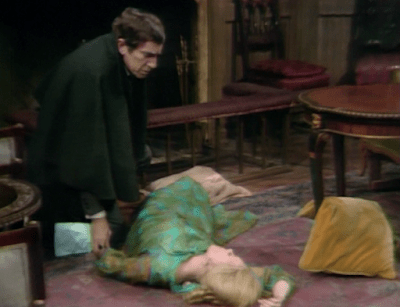
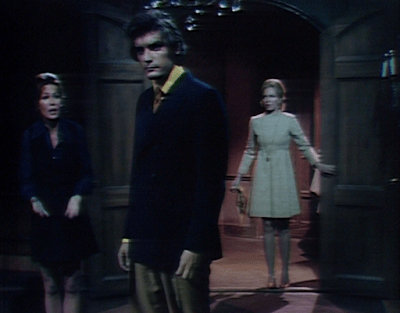
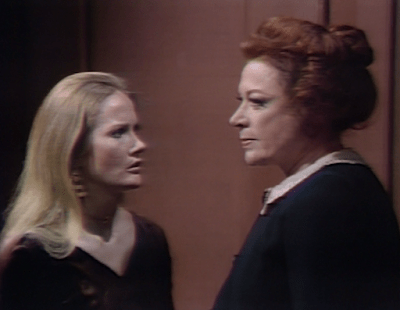
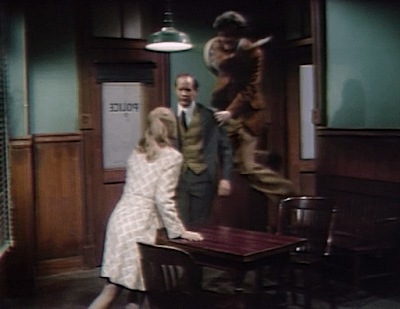
Today, Cyrus is confronted in his laboratory by his fiancée Sabrina Stuart and his friend Quentin Collins about his association with his alter ego, whom they believe to be a separate person named John Yaeger. Cyrus pulls himself up to his full height and declares “I can end my relationship with Yaeger any time it suits me.” At this, the universal motto of the addict, we know just what is driving Cyrus. We can set aside all the talk in the opening voiceovers and elsewhere about how good and innocent Cyrus is, and see him as a man in the grip of a force he won’t face and can’t beat.

Cyrus doesn’t have a problem, you two have a problem. Screenshot by Dark Shadows Before I Die.

The other character in need of an intelligible motivation is Cyrus’ friend, sleazy musician Bruno Hess. Bruno is staying in a room above Cyrus’ laboratory in hopes that the ghost of a man he murdered won’t be able to find him there. The ghost appears to him there today, and sets the room on fire. Cyrus helps Bruno put the fire out, and talks about trying to exorcise the ghost. Bruno tells Cyrus he doesn’t believe he can help him. When he says this, Bruno seems, for the first time, reasonable. He has asked many things of Cyrus, so many that we might think of him as nothing more than a source of ever-escalating demands. But when he says that what is happening now is outside Cyrus’ province, we can see that there is some kind of mental process going on in his head.

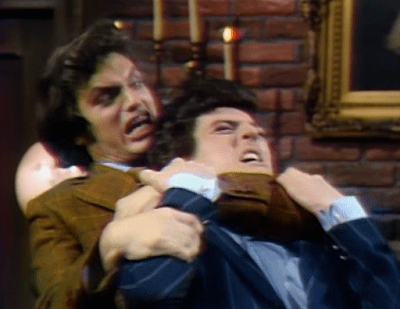
Bruno thinks the ghost and the fire were both sent by Quentin’s late wife, Angelique. In the universe where Dark Shadows spent its first 196 weeks, Angelique’s counterpart is a witch who has a complicated relationship to fire. She is vulnerable to it, but can also use it in various ways. And, she has returned from the dead many times. If the Angelique in this continuity is like that one, it would make sense to suspect her. Angelique’s identical twin sister Alexis is Quentin’s guest at the great house of Collinwood. Bruno believes Alexis is really Angelique. He bursts in on her and says that he has a way to test whether she is Angelique returned from the dead. If she is, she can’t die again. So he sets about strangling her. If he kills her, Bruno will know he was mistaken.

In the main continuity, every drawer in every table at the great house contains a loaded gun. Longtime viewers have no reason to doubt that the same circumstance obtains here. So if we had not seen Bruno being rational in his scene with Cyrus, we would have no question in our minds but why Alexis does not draw a weapon and shoot the crazy man who is going to do nothing but try to kill her. That moment of lucidity makes the scene interesting. It even makes it somewhat surprising that Bruno goes all the way to homicide- we know he is a strange and violent man, but if he could think as clearly as that, maybe he could come up with a less drastic expedient.

The “Dan Curtis Productions” logo at the end of the closing credits is printed in a simpler style than it has been so far. We will see this new style several more times in the remaining months of the show.

Episode 993: She lacks the power to tell us more

The show has been keeping us in suspense as to whether Lara Parker is playing wealthy socialite Alexis Stokes or Alexis’ identical twin sister, the late Angelique Stokes Collins. Regular viewers know that the title “the late” is no impediment to a major part for a character on Dark Shadows. In the universe where the action took place for the first 196 weeks, Angelique’s counterpart was a wicked witch who returned from the dead countless times, and the clues are mounting that Alexis’ sister is active on the estate of Collinwood in this continuity, whether in her form or a more ethereal one.

While with Angelique’s widower Quentin Collins, Alexis has witnessed a series of odd occurrences that have led her to become distraught and to protest that Angelique is haunting them. She has questions, and takes those questions to two of Angelique’s acquaintances, medical researcher Cyrus Longworth and Cyrus’ assistant/ fiancée, Sabrina Stuart. That would seem to support the premise that she is Alexis, but she keeps the suspense alive for regular viewers when she approaches Cyrus’ laboratory by its courtyard door. The other day, the police were watching Cyrus’ house, and they did not notice that there was a door in the courtyard. When a detective came inside and spoke with him, Cyrus pointed the door out to him and told him that only a few people knew of it. Angelique was very close to Cyrus and was involved in his work, so we can assume she was one of those few people. It is not at all clear who could have told Alexis about the door.

Ms A. Stokes comes in through the courtyard door.

On Friday, Alexis joined a group assembled in the drawing room of the great house of Collinwood to reenact the séance at which Angelique died. Sabrina went into the trance and started shouting about murder. Ever since, Alexis has been sure Angelique was murdered. When she questions Sabrina today, Sabrina first asks her what she knows about the original séance.

Alexis says she has heard that Sabrina went into a trance and started speaking for a man. In the séances we have seen in the main continuity, the spirits have always spoken through a medium of the same sex. My wife, Mrs Acilius, points out that if this universe is a mirror image of that one, it makes sense that they would speak through one of the opposite sex. Alexis says that the man who spoke through Sabrina said something that angered Quentin, prompting him to rise from the table and start strangling Angelique. At that moment, the lights went out. When they came back on, Angelique was dead. The authorities would rule the death the result of a stroke.

Sabrina says that in her vision at the second séance, she saw those same events. But she also saw another figure standing near Angelique. Alexis declares that she must identify that other figure, since that must be the person who murdered Angelique. Quentin was much too busy strangling her to be the murderer, apparently.

Quentin’s counterpart in the main continuity lived in 1897. We saw him strangle his own wife, Jenny, to death in #748. Jenny had a sister named Magda, but they were not twins. Magda placed a curse on Quentin when she found out what he had done.

For his part, Quentin is also trying to get to the bottom of the mystery. He has asked Alexis and Angelique’s spooky aunt Hannah, who was introduced yesterday as one of his least favorite people, to come to Collinwood and exorcise the spirit that has been bothering everyone. Just as Hannah is getting ready to do some mumbo-jumbo, she starts choking. The Angelique from the main continuity was forever casting spells to choke people remotely, so regular viewers will assume that Hannah’s niece is behind her discomfiture.

Quentin talks with Alexis about taking everyone and fleeing the house to escape from the ghost. Alexis says he can do what he thinks best, but that she is not leaving until she finds out more. Before we went back in time in the original continuity and saw Quentin as a living being in 1897, he was a ghost who drove everyone out of Collinwood, so when this Quentin thinks of taking the family and fleeing a ghost we see another inversion.

Later, Quentin is alone. Angelique’s theme song starts playing from everywhere in the house. He cannot escape it. Regular viewers will remember that the ghost of the other Quentin persecuted the residents of the great house by playing a phonograph recording of a sickly little waltz over and over. In 1897, we found that the living Quentin obsessively played the same recording, occasioning protest from all the other characters. This may be a different Quentin, but we can’t help take a certain satisfaction in seeing him get a taste of the medicine his counterpart dished out so cruelly to the other characters and to the audience.

Episode 992: What form she has, I do not know

We meet Hannah Stokes, aunt of identical twins Alexis Stokes and Angelique Stokes Collins. Hannah is in the cottage on the grounds of the estate of Collinwood, home to sleazy musician Bruno Hess. When we first see her, Hannah is casting a horoscope. Later she reads tarot cards. Still later she sprinkles some bone meal on a stolen handkerchief and says an incantation over it. The point of all this mumbo-jumbo is to determine whether the blonde woman living in the great house on the estate is Angelique or Alexis. Since Angelique died six months previously, this question would seem to have an obvious answer, but Bruno and Hannah seem to know that death is seldom a major disability among characters on Dark Shadows.

Hannah laughs at Bruno, who shares her hairstyle but does not appreciate her talents.

Hannah goes to the great house to see her niece. Alexis hated Hannah, so if she is the woman she could be expected to receive the visit coldly. Angelique was close to her, but knew of Alexis’ attitude. So if she is the woman, she could be expected to behave in exactly the same way. Indeed, the episode began with Angelique’s son Daniel and her widower Quentin noticing little things Alexis did just as her sister would do them, prompting her to point out that they were raised by the same mother and picked up many habits from her. So if a resurrected Angelique is trying to imitate Alexis, she has enough material to work with that not even her aunt can tell them apart.

Hannah goes back to the cottage. None of her black magic answers the question of which sister is living in the great house, but she is sure that Angelique is present on the estate in some form, perhaps visible, perhaps ghostly. Bruno is convinced Angelique is present in her own form and using Alexis’ name. Quentin overhears their conversation and believes for a moment that Bruno is right, before talking himself out of it. Later, he and Alexis see Angelique’s piano playing itself in her old bedroom, and Alexis believes that Angelique’s ghost is playing it.

The most interesting thing about this episode is Paula Laurence’s turn as Hannah. Her whole performance today is an imitation of Lara Parker as Angelique. Laurence was such a different physical type from Parker I couldn’t put my finger on what she was doing until she was about to exit the cottage at the end of her first scene and she laughed at Bruno. She recreated the very distinctive laugh Parker uses as Angelique. At that, my wife and I simultaneously said “The same laugh!” From then on, it was impossible to miss the imitation. It comes across as a family resemblance, of a piece with Alexis and Angelique trimming plants the same way or humming the same tune while fluffing pillows.

The cottage is the place for spooky doings. We are in a different universe today than the one where the show was based for its first 196 weeks. In the main continuity, we first saw the cottage as the home of crazed handyman Matthew Morgan, who would be scared to death by ghosts. Matthew was succeeded as a resident of the cottage by undead blonde fire witch Laura Murdoch Collins. Laura was central to the storyline that picked up where the ghosts who killed Matthew left off. Most of the major narrative loose ends, such as the “Revenge of Burke Devlin” arc, were wrapped up as points within her story, while the ghosts were pulled out of the unseen back-world behind the action and brought into the spotlight. By the time Laura went up in smoke, the back-world of uncanny beings and the front-world of business stories and estranged spouses had reversed their places, and Dark Shadows had become a supernatural thriller.

The cottage was vacant for a long time after Laura. The next inhabitant was werewolf Chris Jennings. He was haunted there by the ghost of the main continuity’s counterpart of Quentin, who had lived and died in 1897. Quentin’s ghost seemed to have greater power in the cottage than elsewhere on the grounds of the estate. When the show traveled back in time to 1897, we found that Quentin and his fellow Satanist Evan Hanley had spent time there working black magic. At one point Quentin and Evan asked for a spirit to come from Hell to join them in an evil plan, and the one who appeared was Angelique’s counterpart, who like Laura was an undead blonde fire witch. Also in 1897, we learned that Quentin had been entangled with another iteration of Laura, and that the cottage had been one of their places.

Vague as Hannah’s findings are, they combine with Angelique’s iconography and that of the cottage to assure us that her ghost is active on the estate and that she will be returning in physical form. They are still keeping us guessing about how Alexis fits into all of that, but it seems more and more likely that she is at least sincere in her belief that she is not Angelique. Maybe she is an entirely separate entity who will eventually meet her reanimated sister, or maybe it will turn out that she and Angelique are inhabiting the same body. The spirits of the dead have been known to sublet space from the living on Dark Shadows, so that is one of many possible outcomes.

Episode 991: It wasn’t all mushy

In December 1966 and January 1967, strange and troubled boy David Collins was unwilling to believe that a woman who had come to the estate of Collinwood was his long-absent mother, Laura Murdoch Collins. He had troubling dreams about her. In #150, we saw him asleep in his bed when Laura appeared in the corner of his room. He opened his eyes and looked at her while she made a speech. This is not generally considered a dream sequence, since David appears to wake up at the beginning of it. But Laura turns out to be a humanoid Phoenix. The Phoenix is a creature first described in the Histories of Herodotus. As is typical in ancient Greek literature, all dreams in Herodotus take the form of a person materializing at the foot of the dreamer’s bed and delivering a speech while the dreamer appears to be awake. So I think we have to consider that the first dream sequence dramatized on Dark Shadows.

Laura appears in David’s room, #150.

Now, we have crossed over into an alternate universe, which the show insists on calling “Parallel Time.” David’s counterpart is strange and troubled teenager Daniel Collins. Daniel is unwilling to believe that a woman who has come to the estate of Collinwood is not his late mother, Angelique Stokes Collins. We see him asleep in his bedroom. As Daniel’s problem is the mirror image of David’s, so his room is the mirror image of David’s. Daniel’s bed is at stage right while David’s is at stage left on the same set. Daniel has a troubling dream in which Angelique appears to him. Dark Shadows is a lot more definite now than it was in its first year, so they have a special effect to show that even though Daniel is opening his eyes and getting out of bed, it is still a dream sequence. It is 1970, so that special effect is a disco glitter ball throwing colored lights.

Daniel thrashes about in bed, and the visitor, who has been patiently trying to explain to everyone that she is Angelique’s identical twin sister Alexis, comes rushing in. Daniel awakes, and asks her to promise to tell him the truth. He in turn promises to keep her secret. He asks her if she is his mother. She is silent, apparently stunned by the question. At that moment, Daniel’s father Quentin appears in the doorway.

Laura turned out to be an undead blonde fire witch come to burn David alive that she might renew her own unnatural existence. Angelique’s counterpart in the main continuity is also an undead blonde fire witch, and for a time she was David’s stepmother and represented a considerable danger to him. So regular viewers will understand Daniel’s confusion.

There is a scene today in the tavern in the village of Collinsport. In the main continuity, this tavern was called the Eagle in the eighteenth and nineteenth centuries, but the Blue Whale in the twentieth. In this universe, it is still called the Eagle. The bartender in the Blue Whale is usually played by Bob O’Connell. The bartender in the Eagle today is played by Kenneth McMillan. McMillan was a very distinguished actor and does a fine job telling a long story, but Bob O’Connell is a favorite of longtime viewers and I think we are all disappointed we didn’t get another chance to see him.

Episode 985: She is not like others

This is the last script that will be credited to writer Violet Welles. Welles had done a substantial amount of rewriting on scripts attributed to her friend Gordon Russell before her name first showed up in the credits with #711, and she will do more ghosting for Russell later.

Danny Horn’s post about this episode on his great Dark Shadows Every Day is a tribute to Welles; I recommend it highly. Welles was far and away the best author of dialogue among the nine writers credited through the show’s 249 weeks, so much so that her uncredited contributions are easy to recognize. I will mention a week very close to the end of the series in 1971, a long time after the wheels came off, when all of a sudden characters start making witty remarks and developing interesting relationships. Then it’s back to the dreariness of a bunch of go-nowhere stories.

Welles rated herself low as an inventor of plot-lines. I don’t know what went on during the long hours she spent in story conferences with Russell and Sam Hall, but it was when she was in the room that the most fertile planning sessions Dark Shadows ever had took place. They sketched out flimsies thirteen weeks at a time, and from the time Welles became a regular part of the staff until thirteen weeks after she left, the show was packed with more lively ideas than at any other time. So if she was correct in that harsh self-assessment of what she did in the writers’ room, it was only in the narrowest sense.

Welles also spoke disparagingly of herself as a designer of dramatic structure at the level of individual episodes, but today’s installment shows that this was simply wrong. There is a tremendous amount happening in these 22 minutes, it is crystal-clear throughout what is happening and why we should care, and the actors get to do some of the best work they ever did do. We see two stories, one a mashup of Daphne Du Maurier’s 1938 novel Rebecca with Edgar Allen Poe’s 1838 short story “Ligeia,”* the other a retelling of Robert Louis Stevenson’s 1886 novella Dr Jekyll and Mr Hyde, also with a dash of “Ligeia.”

The episode is set in a different universe than the one in which the first 196 weeks of Dark Shadows took place, and most of the characters are “Parallel Time” counterparts of those we met in the main continuity. In the Rebecca/ Ligeia mashup, we today see Quentin Collins, master of the estate of Collinwood, owner of Collinsport Enterprises, and gloomy drunkard; Quentin’s new wife, Maggie Evans Collins; housekeeper Julia Hoffman, fanatical devotee of Quentin’s late first wife Angelique; and Alexis Stokes, Angelique’s freshly arrived identical twin sister. The bit from the Jekyll and Hyde story features scientist Cyrus Longworth and attorney Chris Collins. Angelique comes up in Cyrus and Chris’ conversation, and she is emerging in the role of Ligeia. Like the eponymous character in Poe’s story, she is a celebrated beauty who is dead but expected to return. Alexis herself brings up yet another reference. She wears a short bluish gray suit and chignon hairstyle with a tight spiral twist at the back, the look that the mysterious Madeleine wore and her impostor copied in Alfred Hitchcock’s Vertigo.

Jekyll and Hyde Meet Ligeia

I’ll start with the Jekyll and Hyde story, since it is the simpler one today. Chris is the estate manager at Collinwood, and his responsibilities include custodianship of Angelique’s personal effects. His friend Cyrus has called Chris to his basement laboratory to ask for a favor. Angelique had told him about a chemist in Boston who could help him with some obscure formula he needs for his current experiments. She gave him the man’s contact information, but he lost it, and he wants to look for it in Angelique’s address book.

Before they start talking about the address book, Cyrus tells Chris that he saw Angelique in town today. He tells him he was driving past the drug store and saw her walking down the street. He called to her and she did not answer, but he is certain it was she. Chris does not yet know that Angelique’s identical twin sister is in town, so he does not tell Cyrus about Alexis. He starts with a philosophical approach, then veers towards the explanation medical:

CHRIS: Cyrus, you’re a scientist. A scientist deals in established principle and fact. One thing we have to accept is that death is the end.

CYRUS: I often wonder. People used to believe that the world was flat. They believed that, that the sun revolved around the earth, and these were facts to them.

CHRIS: Uh, what are you saying?

CYRUS: I’m saying that I saw Angelique. I saw her walking down the street.

CHRIS: Well, I wish to submit that there’s an explanation for it. All of this.

CYRUS: What do you mean by that?

CHRIS: You’ve been working yourself too hard. You’ve been locked in this laboratory for over a year. Whatever you’re doing it can’t be worth your health and your peace of mind. It might even damage your mind.

Cyrus tells Chris what he is trying to do:

CYRUS: Let me begin by saying that, that man is chemical in his composition. Now, if the proper compound was distilled, and administered to a human being, this chemical composition could be radically changed, radically altered, and I’ve been working on this composition.

CHRIS: Why, why alter a human being?

CYRUS: Now let me also say this. That man is not one person, he is two. One is good, and the other is, oh, let us say for scientific conversation, the other is evil. Now, these two people are within each of us, and they are always fighting against each other. But if these elements could be separated, just imagine the possibilities. Evil could go its own way, completely free of any aspirations or remorse that are foreign to it. And good, good can have its own life, free of any struggle against, against evil impulses or hostile thoughts. My god, just imagine what a person…

Chris is horrified by this idea, and is glad to be an obstacle to it. Director Lela Swift reinforces Chris’ conviction that Cyrus is destroying himself by placing Christopher Pennock next to a mirror during the most perfervid part of his mad scientist’s programmatic statement, a visual metaphor telling us that Cyrus is splitting himself in two.

Chris is worried that his friend is going to pieces. Screenshot by Dark Shadows Before I Die.

Chris tells Cyrus that he won’t help him bury himself even more deeply in the strictly private world he has created. Cyrus says that it is not private, that it is something he shares with Angelique:

CYRUS: Angelique believed in this theory. She believed it could be done. And she was the one who started me on, on all these experiments. Separating good and evil.

CHRIS: (sourly) There is no doubt in my mind which of the two appealed to her.

Chris tells Cyrus that he has been anxious to see him. He has heard that he presented a paper on black magic to a scientific society, and that the news led him to fear that Cyrus’ mind is becoming unbalanced:

CHRIS: I admire your devotion, Cyrus, but not your direction. It can only lead to trouble.

CYRUS: It can only lead to glory. And it will. Very fast, if you’ll just give me the name of that chemist.

CHRIS: No. I’m sorry to withhold it from you, but it’s the only way I can stop you. And I think I have to stop you. I desperately think that.

Angelique was not only a great beauty and a gracious matron, but was also a scientific mind who inspired Cyrus to pursue his scheme. She could introduce an experimenter to chemists whose specialties are so obscure that they cannot be found in any published directory, and her influence leads to the study of black magic and a skeptical view of the finality of death. In these matters, Angelique recalls Ligeia. The unnamed narrator of Poe’s story, Ligeia’s widower, says of her:

I have spoken of the learning of Ligeia: it was immense –such as I have never known in woman. In the classical tongues was she deeply proficient, and as far as my own acquaintance extended in regard to the modern dialects of Europe, I have never known her at fault. Indeed upon any theme of the most admired, because simply the most abstruse of the boasted erudition of the academy, have I ever found Ligeia at fault? How singularly –how thrillingly, this one point in the nature of my wife has forced itself, at this late period only, upon my attention! I said her knowledge was such as I have never known in woman –but where breathes the man who has traversed, and successfully, all the wide areas of moral, physical, and mathematical science? I saw not then what I now clearly perceive, that the acquisitions of Ligeia were gigantic, were astounding; yet I was sufficiently aware of her infinite supremacy to resign myself, with a child-like confidence, to her guidance through the chaotic world of metaphysical investigation at which I was most busily occupied during the earlier years of our marriage. With how vast a triumph –with how vivid a delight –with how much of all that is ethereal in hope –did I feel, as she bent over me in studies but little sought –but less known –that delicious vista by slow degrees expanding before me, down whose long, gorgeous, and all untrodden path, I might at length pass onward to the goal of a wisdom too divinely precious not to be forbidden!

At the end of Poe’s story, the narrator’s second wife appears to die. Her body is eventually reanimated with the personality and even in the likeness of Ligeia. Cyrus’ un-nuanced belief that the woman he saw was Angelique come to life suggests that he expects her to follow in the footsteps of that other learned woman.

There is a poignancy now in seeing Don Briscoe play Chris’ concern for Cyrus. Briscoe suffered from bipolar disorder, and was at this time trying to self-medicate with street drugs. After he was violently mugged while trying to score a fix late at night in Central Park, he wound up leaving acting and moved into his parents’ house in Tennessee. He died there, morbidly obese, at the age of 64. I suppose what Dr Jekyll wanted was to come up with a drug that could sort the contents of the mind into orderly batches, so that people like Briscoe could live the lives they deserved to live.

Ligeia at Manderley

Meanwhile, at Collinwood, Quentin has been extremely stingy with information Maggie should know, and has neglected to tell her that Angelique had an identical twin. Hoffman and others on the estate are convinced that Angelique will somehow come back to life, and in their obsession with this idea they have made Maggie exceedingly uncomfortable in her imposing new home. Making matters worse, night before last Maggie heard a voice that she can believe to have been part of a prank played on her by Quentin’s son, strange and troubled boy Daniel, but which Daniel and we have reason to believe was actually Angelique’s ghost. So when Maggie opens the doors to the drawing room and sees Quentin giving a glass of sherry to a woman who, to all appearances, can only be Angelique, she flees in panic.

Quentin goes to Maggie in her bedroom. He explains that the woman she has seen is Angelique’s twin Alexis. At first he is relaxed and soothing, as charming as the Quentin of the main continuity has always been, almost as charming as David Selby is. But as Maggie insists on being left alone, his mood darkens. Alexis sticks her head in and suggests they should clear things up right away; Quentin asks her to wait downstairs. When Maggie refuses to be formally introduced to Alexis and play hostess to her, Quentin becomes stiff, grouchy, and patronizing, ordering her to do her duty as mistress of the house. She does not bend, and he leaves the room in a huff.

Back in the drawing room, Alexis tells Quentin she ought to leave rather than go on upsetting Maggie. Quentin dismisses Maggie’s concerns and proclaims that he alone makes decisions at Collinwood. Alexis is visibly startled by Quentin’s claim to autocracy, and doesn’t know where to look or what to do with her hands as she stammers out “Of course… you… make the decisions.” She goes along with Quentin’s decree that she will stay in the house starting tonight, before she can get her luggage back from the inn in the village.

Hoffman enters. At the sight of Alexis, she gasps “It- it’s you!” Hoffman composes herself quickly, and says that Angelique often spoke of her sister. She asks Alexis if she received the letter she sent her when Angelique died. Alexis says she missed it. Hoffman had sent it to her address in Tangier, but Alexis had moved from there to Florence by that time. Alexis does not seem to be in any particular business, and she describes her decision to return to Collinsport as motivated by a vague feeling of personal obligation, so we can assume that her long stays in these famous cities are a sign that she and Angelique have private resources that amount, if not to a fortune, at least to a competence. Hoffman suggests that Alexis stay in Angelique’s old room. Quentin does not object, and Alexis agrees.

Alone in the drawing room, Quentin wishes Alexis did not resemble Angelique so uncannily. In a gruff tone, he tells himself “I’m as bad as Maggie, I’m behaving like a frightened child.” Quentin’s attitude when he was lecturing Maggie about Alexis had indeed been that of an impatient adult ordering a child to stop having an inconvenient emotion. Since he does not believe he handled that exchange badly, it’s jarring to hear him say explicitly that he saw it that way. He pours himself a stiff drink.

In Angelique’s room, Hoffman tells Alexis she doesn’t have to lie to her. She may have her reasons to pretend with the others, but with her she can talk openly about the fact that she is Angelique risen from the grave. Alexis is thunderstruck by this, and tries to reason with her:

ALEXIS: You thought Angelique would come back? But that’s impossible, she’s dead.

HOFFMAN: She is not like others.

ALEXIS: She certainly wasn’t like anyone else. Nevertheless, she is dead. Do you hear me? She’s dead, and I’m her sister.

Hoffman tries to trip Alexis up by asking which nightgown she would like from Angelique’s dresser. Alexis points out that she has never seen any of them, so she can’t very well answer. Hoffman starts to apologize for her bizarre conduct:

HOFFMAN: I’m sorry, Miss Stokes, I’m sorry if I’ve said anything–

ALEXIS: It’s perfectly all right. I can understand how much you must miss her. But I wouldn’t intimate such a thing to anyone else if I were you. They might be very distressed by it, and so might you.

This exchange is very effective, particularly for regular viewers. Up to this point, Lara Parker has been playing Alexis quite differently than she played Angelique. Even when Angelique had been defeated in a conflict or was trying to seem like a wounded innocent, she always maintained eye contact with her scene partners and found a way to put a little more drama into her voice than any other performer would have thought to do. But Alexis looks down when she is confused, talks in a soft and casual tone when she thinks she understands what’s going on, and asks questions to which she obviously does not already know the answer. We can believe she really is a different character. But her last two sentences to Hoffman are exactly what Angelique would have said. When Alexis lifts her head and delivers them with her right eye fixed on Hoffman, we are suddenly in suspense as to whether Ligeia has already returned.

On her way out of the room, Hoffman passes Maggie. Without turning to face her, she explains that Alexis is staying, at Quentin’s orders. This brief scene is blocked as an homage to Hitchcock, whose 1940 film of Rebecca will have come to mind when Hoffman mentioned Angelique’s nightgowns. The censors tried to prevent the release of that movie, because of a scene in which obsessed housekeeper Mrs Danvers took a nightgown out of a wardrobe positioned in the same spot of the late Rebecca’s room as is the wardrobe in Angelique’s. Mrs Danvers went on and on about how sheer the nightgown was, how “You can see my hand through the material,” etc. Dark Shadows isn’t quite as bold with the homoerotic subtext of Hoffman’s devotion to Angelique as Du Maurier and Hitchcock were with that of Mrs Danvers’ devotion to Rebecca, but the shot is so much in his style and the movie was so famous that a large percentage of the grownups in the audience would likely have picked up on the reference.

Without a Hitch. Screenshot by Dark Shadows Before I Die.

Maggie goes to the drawing room, and finds that the decanter Quentin was drinking from is empty and lying on its side. She goes to Angelique’s room. She arrives just in time to see her obviously intoxicated husband in his first wife’s bedroom, with a woman who looks exactly like that first wife who is wearing a frilly nightgown, putting her hand on his shoulder, and saying in a soft voice “Perhaps we can comfort one another.” When we saw this, my wife, Mrs Acilius, said that she would not be especially pleased if she were to find me in such a situation.

Maggie and Quentin have a showdown about this in the drawing room. It’s a sensational scene, one of the best in the series. Selby plays Quentin as a drunken, condescending grouch, trying to tell Maggie she didn’t see what she clearly saw. Kathryn Leigh Scott is spellbinding as she plays Maggie’s rage. I think it’s her best moment since #265, when the Maggie of the main continuity was a mental patient and went completely nuts while singing “London Bridge.” That, I think, was the scariest scene they ever did, making us think our old pal Maggie was never going to be all right again.

This time Miss Scott doesn’t sound like any character we’ve heard her play before. In fact, she sounds more like a real person than anyone else ever does on Dark Shadows when Quentin has forbidden her to mention Angelique’s name and she responds “You forbid me! Forbid me like a child, and I am not a child, and I refuse to be treated like a child. Not by you or by anyone. I know what I heard and I know what I saw!” At that, Maggie Collins becomes a distinct character and the Parallel Time storyline jumps to a new level.

Quentin whines that Maggie isn’t giving him a chance, and she lets him have it:

MAGGIE: Nobody’s given me a chance. No. This is Angelique’s house, not mine, you’re Angelique’s husband, not mine.

QUENTIN: All right, if that’s the way you feel about it, get out of here!

MAGGIE: All right, Quentin.

QUENTIN: Leave Angelique’s house and leave Angelique’s husband!

MAGGIE: That’s exactly what I’ll do. That is exactly what I will do!

And to Quentin’s bewilderment, that’s exactly what she does. She rushes out the front door. After a bit, Quentin staggers after her. He looks outside. Alexis comes downstairs, in her sister’s frilly nightie, and asks what happened. Quentin frets that “She actually went out that door.” Alexis asks if he is going after her, and he says “No, why should I? She behaved like a child!” He’s still holding onto the idea that it is right and proper for him to regard his wife as a temperamental child. He wonders if perhaps Alexis is right, then hears Maggie drive away and announces that it’s too late to do anything. He wanders back towards the drawing room while Alexis looks on. We are left wondering if she is Angelique masquerading as her sister, or if Alexis, contrary to appearances, was actually the Evil Twin all along.

*I am indebted to Danny Horn’s commenter “Riccardo” for pointing out the connection to “Ligeia.”