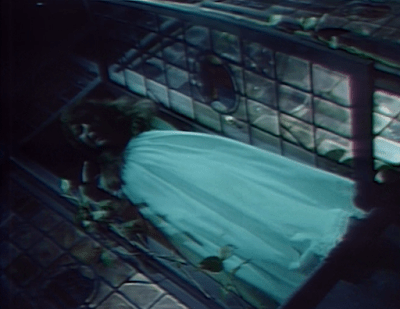
Maggie Evans Collins is upset. Her husband, drunken sourpuss Quentin Collins, has stormed out of the house yet again, as usual for a reason he refuses to explain to her. Quentin’s brother, high-born ne’er-do-well Roger Collins, taunts her with invidious comparisons to Quentin’s first wife, the late Angelique. Housekeeper Julia Hoffman keeps setting Maggie up to remind Quentin of Angelique, one of the most reliable methods of triggering his tantrums. Worst of all, but unknown to Maggie, Angelique herself has come back to life and is casting spells on her. Angelique murdered her identical twin sister Alexis and took Alexis’ place as Quentin’s houseguest. Maggie is desperate for a friend and keeps behaving as if “Alexis” were one, leaving her exposed to attack. We end today with Maggie standing at an open window, hearing Alexis’ voice urging her to jump. The angle makes it look like Maggie is already in her coffin and is opening its lid.
Dark Shadows was unusual among soap operas in that Friday’s episode was often the least eventful of the week. This one is a case in point. It doesn’t feel slow, though. The dialogue is well-crafted and expertly delivered, leaving us with the feeling that we are getting to know Maggie and each of her tormentors better with each scene.
When Dark Shadows began in June 1966, its biggest draw was movie star Joan Bennett as reclusive matriarch Elizabeth Collins Stoddard. Liz was highly capable, and Bennett made her compelling to watch. When in #25 Liz’ brother, high-born ne’er-do-well Roger Collins, grudgingly complimented her on her “neat way of managing people,” we could see that he was putting it mildly. But the show didn’t handle Liz’ storyline very well, and she soon became a blocking figure. As the owner of the estate of Collinwood and of the Collins family businesses, as a central player in all the stories they had started with, and as the powerful personality Bennett had created, Liz was such an important part of the show that when she became a brake on the action, there was a constant danger that it would be impossible for anything to happen ever again.
The arrival of Roger’s estranged wife Laura Murdoch Collins in #123 marked Dark Shadows’ transformation into a supernatural thriller. By the time Laura went up in smoke in #191, her story had absorbed two of the four original narrative themes, “The Revenge of Burke Devlin” and well-meaning governess Vicki’s growing friendship with strange and troubled boy David, and had undercut whatever interest we might still have had in the other two, the mystery of Liz’ decision to become a recluse and Vicki’s quest to learn her true identity. The emerging Dark Shadows 2.0 had little room for Liz, and she subsided to the margins. When the show traveled back in time and became a costume drama from November 1967 to March 1968 and again from March to November 1969, Bennett played other characters and was able to make a substantial contribution, but Liz would never again be a suitable vessel for her great talents.
For the last eight weeks, the show has been in another time travel segment. Now it has traveled, not back in time, but sideways. They are in an alternate universe. The show insists on calling this universe “Parallel Time.” It is 1970 here, as it is in the original continuity, but a different 1970 where people with the names and faces we already know are living very different lives.
The Elizabeth Collins Stoddard of Parallel Time is not the mistress of Collinwood or an effective businesswoman. This Liz entrusted her inheritance to her brother Roger, who turned out to be just as feckless as his counterpart in the original continuity. As the penniless Roger we met in 1966 lives in Liz’ house as her guest and works in Liz’ business as her employee, so this Liz and Roger both live at Collinwood as the dependents of their brother, drunken sourpuss Quentin Collins.
In the original continuity, Quentin was not Liz and Roger’s brother, nor did he own anything. We got to know him when Dark Shadows was set in 1897, and he was a charming rogue, the younger brother of Judith and Edward Collins, who like Liz and Roger were played by Joan Bennett and Louis Edmonds. So the parallel lines representing the two versions of 1970 take a bit of a swerve into that other epoch.
Today, Liz is busy organizing a costume ball to be held in the great house of Collinwood. They had such a ball every year at this time when Quentin was married to his first wife, the late Angelique Stokes Collins, and Liz thinks that having another one would be the perfect occasion for Quentin to introduce all of his friends to his new wife, the former Maggie Evans. Liz needs help getting this party going. She comes bustling into the drawing room today and addresses herself to Angelique’s identical twin sister, Alexis Stokes, announcing that the party is tonight and 14 of the guests have failed to RSVP. She bemoans her inability to get anything organized and pleads with Alexis to help her. Alexis agrees to do so and excuses herself from a chess game she had been playing with Barnabas Collins, a man who recently showed up and introduced himself as a distant cousin of the Collinses of Collinwood.
Quentin enters the drawing room and orders Liz to cancel the ball. She says that it is too late to do that. Quentin stalks off and goes outside. Liz turns to Barnabas and asks him to reason with Quentin. Barnabas is unsure that he is the right person, but he goes to the door anyway. He opens it just in time to hear Quentin peeling away in his car. Maggie appears at the head of the stairs and asks if Quentin has gone. Barnabas has to say that he has, and Maggie looks crushed. Liz is unable to help in any way.
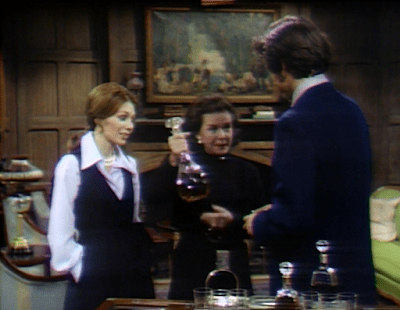
Later, Liz returns to the drawing room in the middle of a conversation between Quentin and Maggie. She is carrying an enormous decanter containing some sherry and congratulating herself on calming the cook’s nerves by her bartending. Quentin excuses himself to go get into his costume.
Liz finds that Maggie has not yet chosen a costume. She urges her to do so at once. Maggie says she supposed that Angelique always picked out her costume weeks in advance. Liz knows that Maggie is intimidated living in Angelique’s shadow, and does not know what to say in response to that remark. She quickly changes the subject. She brightens, and says that Alexis has brought many lovely dresses down from the attic. She urges Maggie to go to Alexis’ room and choose one of them.
As the time for the guests to arrive comes near, Liz and Barnabas meet in the foyer. A portrait of the Barnabas Collins who died in 1830 hangs on the spot on the wall next to the front door where earlier this week we had seen a metal doodad that looks like a coat of arms. Barnabas is wearing the same outfit, and looks just like the man in the portrait. Liz is wearing a dress of the same vintage. She is overjoyed, and tells Barnabas that the period suits him. He thanks her, and returns the compliment. Quentin is wearing a blue federal coat; Liz and Barnabas tell him that he, too, is suited to the early 1800s. Alexis comes downstairs in a blue dress, and she receives the same commendation. Lastly Maggie makes her appearance. When Quentin sees her dress, he becomes very tense. He tells her to take it off, orders her never to wear it again, and smashes his glass on the floor. The camera pans from Barnabas’shocked expression to a flickering look of pleasure on Alexis’ face; Liz stands between them, and unfortunately we only see the top of her head.
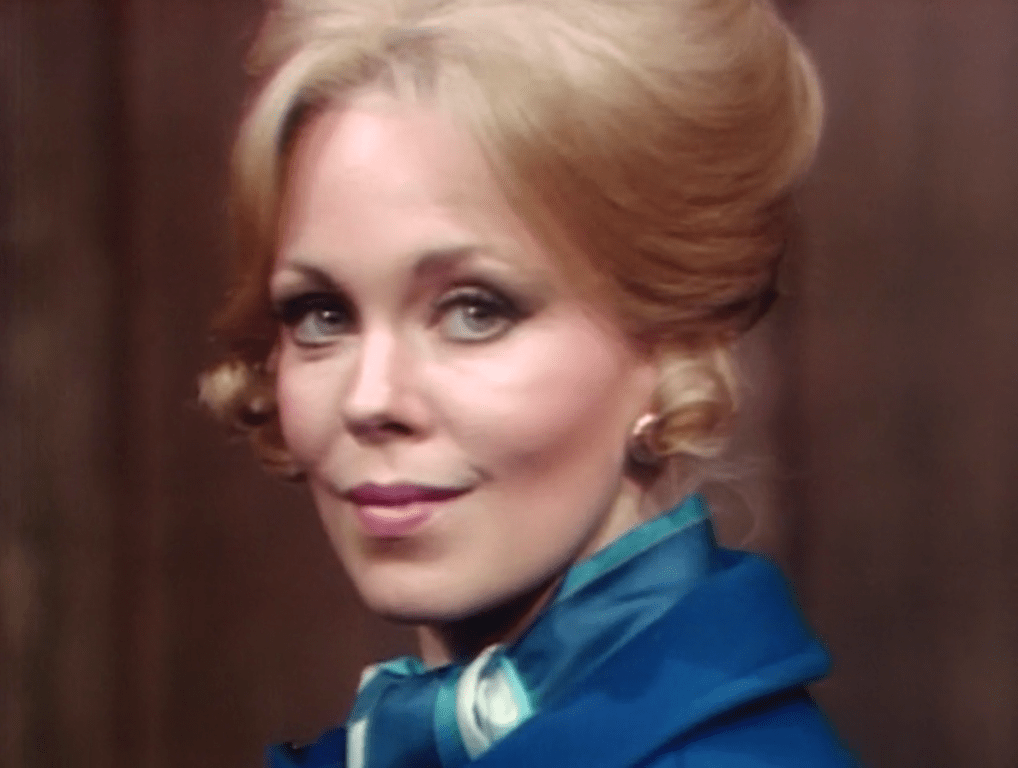
What Liz does not know is that the person she thinks is Alexis is in fact Angelique risen from the grave. Angelique murdered Alexis, took her place, and is conspiring with housekeeper Julia Hoffman to drive Maggie and Quentin apart. The story is a souped-up version of Daphne Du Maurier’s Rebecca, in which the dead first wife is not only a memory that triggers anxiety in her successor but a supernatural being who rises from the dead to torment her directly. There is a scene with Maggie looking out the window of the drawing room that is an exact recreation of a shot in Alfred Hitchcock’s 1940 film of Rebecca, and when Angelique and Hoffman trick Maggie into wearing the same dress Angelique wore to last year’s ball, prompting Quentin’s outburst, most grownups in the original audience would remember the same thing happening to the second Mrs de Winter in that film.
Angelique is the villain, and Maggie is the heroine. Still, we rather like Angelique. The sister-murdering is bad, of course, but Quentin is such a lousy husband that she is doing Maggie a big favor by trying to bring their intolerable marriage to its end as soon as possible. For example, today Quentin finds Maggie reading his old love letters to Angelique. He might justifiably have objected that those are private and say he wished she’d asked before reading them, but he doesn’t do that or anything else one adult would do when disappointed in another. Instead, he flies into a rage, accuses her of a variety of things she hasn’t done, and orders her to, and I quote, “Go to your room!”
Later, in the room they share, Quentin is still scolding Maggie for failing to admit that she was lying about how she found the letters. We know she had in fact told the truth. When she tells him so, he dismisses her with a shake of the head. When she brings up the fact that it is the anniversary of his wedding to Angelique, he shouts that she is forbidden to discuss the subject, then storms out and slams the door. This is when he goes downstairs, tells Liz to cancel the party, and drives away. We have never seen Maggie have a happy day with Quentin. He sometimes manages to be pleasant in the intervals between his tantrums, but even then he can’t let go of his habit of talking to Maggie as if she were a child and he were her somewhat weary guardian. If Angelique can hasten their final split, Maggie will owe her an enormous debt of gratitude.
Barnabas is not in fact a descendant of the man whose portrait now hangs in the foyer. He is a visitor from the main continuity. Angelique’s counterpart there is his great enemy, so it is fun to see him talking with this Angelique and playing chess with her.
David Selby has a problem with one of his lines, when Quentin winds up saying “I wonder where I got the illusion that an hour or two alone would settle one’s all of problems.” This is a fairly minor stumble by Dark Shadows standards, but it comes when Angelique is in closeup and Lara Parker’s left eyelid twitches when she hears “one’s all of problems.” That reaction is worth a laugh.
Barmaid Buffie Harrington sees a man assaulting a woman in the alley next to the tavern. She recognizes the man as ruffian John Yaeger. Yaeger used to buy Buffie gifts, then beat her and laugh at her bruises. She recognizes the woman as her childhood friend Maggie Evans. Maggie moved away from the village of Collinsport when she was very young, and came back recently as the wife of Quentin Collins, drunken sourpuss and master of the estate of Collinwood. Buffie orders Yaeger to unhand Maggie. He sneers at the women, threatening to make a stink if they go to the police. Buffie stands her ground, and at length Yaeger backs down and leaves.
Buffie and Maggie see Yaeger off.
Maggie goes to Quentin’s friend Cyrus Longworth in his laboratory. She tells Cyrus that Buffie rescued her from Yaeger. She asks Cyrus if it is true that Yaeger is his friend. Cyrus looks pained, and says that for some time he has considered Yaeger his enemy. Maggie had never seen Yaeger before; she was at the docks because he called her anonymously and promised her some information relevant to her suspicion that Quentin murdered his first wife, Angelique Stokes Collins. Nor did he identify himself to her. Buffie did not call him by name. So Maggie and Buffie must have had a conversation afterward in which she told him who Yaeger was and that he and Cyrus are connected to each other.
What neither Buffie nor Maggie knows is that Yaeger does not exist. He is simply a disguise Cyrus assumes when he wants to hurt someone. Cyrus never meant to tell Maggie anything about Quentin; he called Maggie to meet him at the docks because he wanted to rape and abduct her. Cyrus has devised a potion that causes his hair to turn darker and sprout all over his body, his shoulders to broaden, and his skin tone to change. John Yaeger is the alias he uses when in this disguise. After Maggie leaves, he tells himself that he and Yaeger are the same person, and that he is responsible for all of Yaeger’s crimes. He smashes up his lab equipment and burns his notes. All he really needed to do was pour out the potion. One of the essential ingredients is a compound he can’t make himself. He murdered the only known supplier, so once it is gone, it will be gone for good.
Cyrus is only the first character today to use Maggie’s need for information about Quentin to trap and hurt her. Quentin’s brother, high-born ne’er-do-well Roger Collins, keeps baiting her with references to the cause of Quentin’s current fit of bad temper. She finally insists he tells her what he means, and he says it is the anniversary of his wedding to Angelique.
The other character is Angelique herself. Unknown to any other character in today’s episode, Angelique has risen from the grave, murdered her identical twin sister Alexis, and taken Alexis’ place as Quentin’s houseguest in his mansion, the great house of Collinwood.
Maggie turns to “Alexis” for information about Quentin and Angelique’s marriage. When she asks if Angelique often wrote her when she was living in Florence, “Alexis” replies “Not often, but when she did she made up for it.” We know this is a lie, and Maggie should too. When the real Alexis first came to the Collinwood, housekeeper Julia Hoffman asked if she received the letter she sent informing her of Angelique’s death. She said she did not. It turned out that the last address Angelique had for Alexis was in Tangier, a city she had left some time before moving to Florence. Maggie takes “Alexis'” statement at face value, and also believes her when she says that Angelique wrote only of how wonderful her marriage to Quentin was. Further, she believes that Angelique was telling the truth in those supposed letters. Since her own marriage to Quentin has been miserable from the first day we saw them together, this depresses Maggie.
Maggie goes to sleep, and Angelique casts a spell to send her a dream. In the dream, Maggie goes to Angelique’s old bedroom and opens a hidden compartment in a small table. She finds a packet of letters there. She wakes up, goes to the room, and finds not only that there is such a compartment but that it does contain the letters. Presumably she will read these and add to her misery.
As Yaeger’s former punching bag and current blood thrall of vampire Barnabas Collins, Buffie is central to two of the ongoing stories. When she rescues Maggie, we can assume that they will renew their friendship, putting her close to the heart of all the other stories. The episode thus promises to usher in the Age of Buffie. But in fact, this is the character’s final appearance.
I suspect that the writers and producers were impressed with Elizabeth Eis’ performance and expanded Buffie’s part beyond what they originally intended. There were several cast members whom Dan Curtis Productions was contractually obligated to use in a certain number of episodes per month, and for the first weeks of the current segment most of those were off in Tarrytown, New York, doing principal photography on the feature House of Dark Shadows. That gave the show a greater flexibility with new performers than they have now that those people are back.
Moreover, the writers projected the plot out thirteen weeks at a time, in documents divided into 65 parts for the 65 episodes of that period. These projections were known in the soap opera business as “flimsies.” The show would scrap its plans completely when a story drew a different reaction from the audience than they had expected, most famously when Barnabas was introduced in April 1967 and was such a hit that they dropped the original idea to stake him at the end of a number of weeks. But Buffie isn’t that kind of a hit, and with the return to the jigsaw puzzle they have to solve every day to get the name actors their required appearances, the writers have to stick close to the flimsies for a while. By the time they could find room for Eis, the story had moved on and Buffie was no longer particularly relevant. Eis will be back later, when the show is set in a different version of Collinsport, playing a character who shows up in only three episodes.
Angelique Stokes Collins, late wife of gloomy sourpuss Quentin Collins, has risen from the grave, murdered her identical twin sister Alexis, and taken Alexis’ place as Quentin’s houseguest in his mansion, the great house of Collinwood. Impersonating Alexis, she has been busy with a lot of cackhanded schemes to drive a wedge between Quentin and his new wife, the former Maggie Evans. As recently as yesterday, Quentin and Maggie were keeping their cool and showing signs that they might catch on to what “Alexis” was up to, but today they both melt down completely. Quentin has a fit when he sees Maggie reading a book about witchcraft that Angelique left in the drawing room, and Maggie goes to Quentin’s friend Cyrus Longworth to ask some questions about Quentin’s role in Angelique’s death.
Cyrus is pretty nutty himself. He is a mad scientist who has developed and become addicted to a Jekyll and Hyde potion. When he drinks it, his appearance changes so drastically that even the people closest to him cannot recognize him. Thus disguised, he goes by the name “John Yaeger” and indulges his sadistic impulses.
Cyrus assures Maggie that Quentin did not murder Angelique. She leaves his laboratory feeling relieved. She forgets her gloves. He picks them up, and spends eight seconds rubbing them on his face, sniffing them, and looking ecstatic. Eight seconds is quite a long period to devote to that particular pastime.
Buffie Harrington comes to Cyrus’ lab. When he is masquerading as Yaeger, Cyrus’ favorite hobby has been beating Buffie and ridiculing her. She has a self-destructive streak that led her to submit to that treatment. Unknown to Cyrus and unmentioned in today’s episode, Buffie has a new dominator. Vampire Barnabas Collins has bitten her, made her his slave, and ordered her to find out whatever she can about Yaeger from Cyrus.
Buffie is very much in charge of her scene with Cyrus. She runs through a long list of emotions- anger and impatience with Cyrus, attraction to him and pity for him, contempt for Yaeger and admiration for him, pity and anger towards herself, all portrayed clearly and convincingly by Elizabeth Eis. Returning viewers who realize that Buffie is on a mission from Barnabas to get Cyrus to tell her what he knows about Yaeger will be impressed that Buffie is as good an actress as Eis was. She is looking for the note that will crack the glass holding Cyrus’ secrets, and striking each one perfectly.
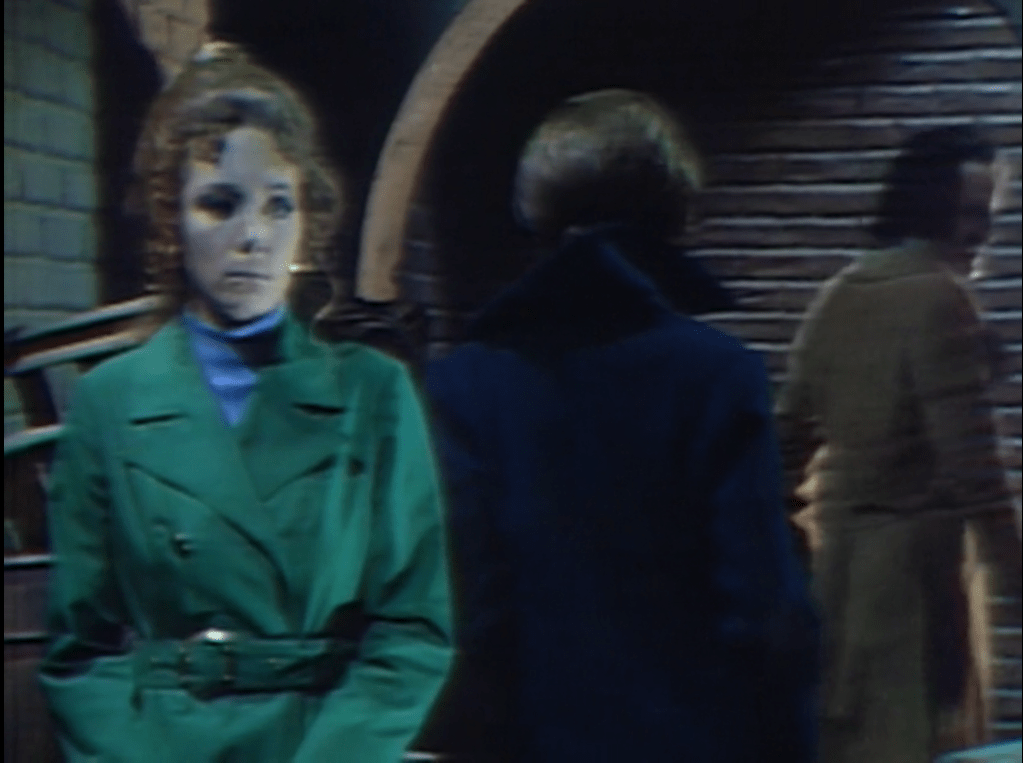
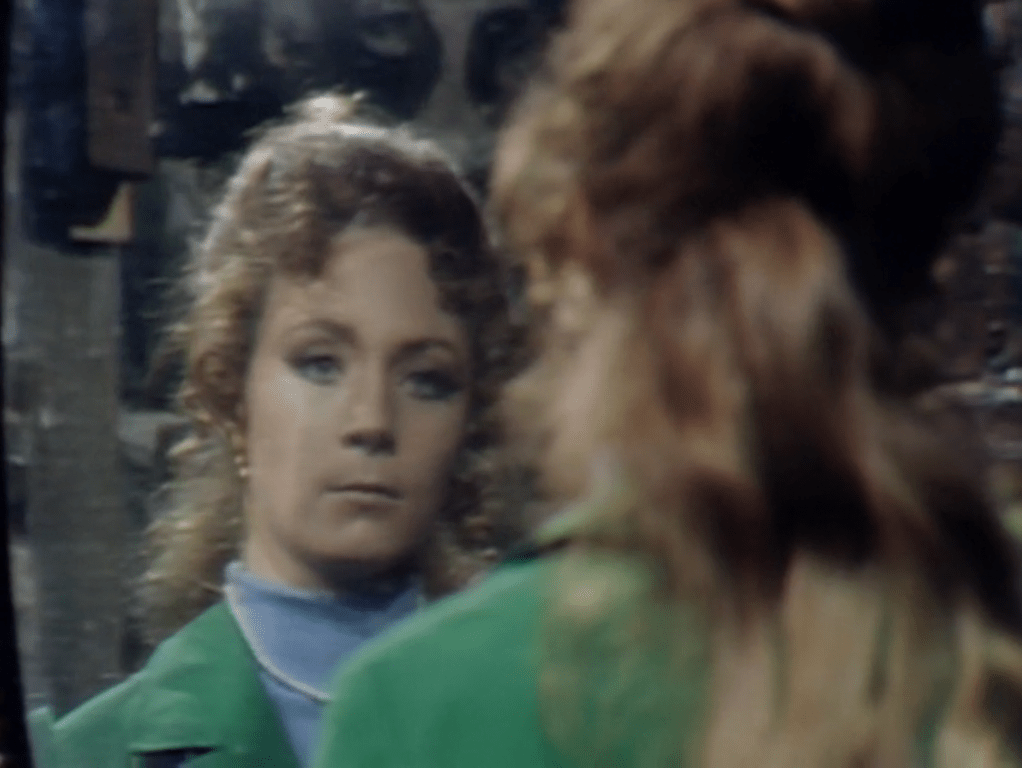
When Buffie finds out that the gloves are Maggie’s, she mentions that she knew Maggie when they were growing up in the village of Collinsport. She says that Maggie was always a special person, obviously destined for greater things. Looking at herself in the mirror, Buffie says that Maggie probably doesn’t hate herself when she sees her reflection. Buffie may still be acting, trying to elicit Cyrus’ sympathy, but we don’t see his reaction when she says these things, only two images of her face. And her words do fit with the self-destructive streak she has shown in her relationship with “Yaeger.” Not only Elizabeth Eis’ extraordinary good looks, but also her forceful and intelligent manner, make it shocking to see Buffie looking at herself and hear her saying such things. The show never explains where Buffie’s urge to destroy herself came from, but Eis makes us both believe that it keeps overwhelming her and wish that she could escape it.
Buffie doesn’t like what she sees.
Cyrus stops by Collinwood to return Maggie’s gloves. When she sees him, Maggie brightens up and starts moving fluidly from the hips up in a way that suggests sexual attraction. She is disappointed he won’t stay. Considering how close Cyrus got to Maggie when they were in his lab and how he gazed longingly into her eyes until she asked him if something were wrong, it’s hard to see how he can fail to find her excitement encouraging.
Cyrus drinks his potion. Once Yaegerized, he telephones Maggie. He refuses to identify himself, but says that if she meets him at the docks at 6 PM sharp he will give her information about Angelique’s death. Maggie is initially appalled by the idea of a strange man asking her to meet him at the docks, but she is still carried away with the suspicions Angelique planted in her mind that Quentin is a wife-killer. She can’t resist.
Yaeger is at the docks when Buffie happens by on her way to work at the Eagle tavern. She speaks to him. He jeers at her until she leaves. Cyrus keeps telling himself what Buffie told him in their scene today, that Yaeger enjoys life. All I can say is that there are far more enjoyable things to do with a beautiful young woman than to beat her, insult her, and drive her away. Yaeger seems to me to be an utterly miserable sort, as strongly bent away from life towards death as is Buffie.
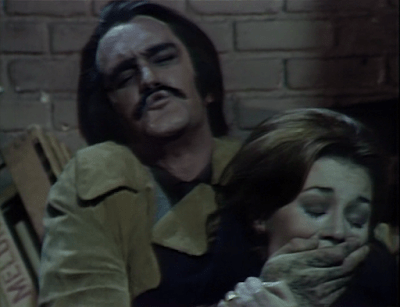
Maggie shows up shortly after Buffie has gone. Yaeger doesn’t tell her anything she doesn’t know. He moves in close and starts talking about wanting her favors. She says she will be going, and he grabs her from behind. He puts his hand over her mouth to stifle her screams while he does a series of pelvic thrusts. His facial expression gets more and more distorted until his tongue pops out.
I suppose Cyrus/ Yaeger is rather an intelligent depiction of a rapist. He craves cruelty for its own sake. Any sexual thrill he may get is a side effect of the pleasure he derives from hurting women. Cyrus is engaged to a lovely young woman who is devoted to him, his lab assistant Sabrina Stuart. Sabrina’s name doesn’t even come up today. When Buffie was under his influence, she would have gone along with just about any sort of relationship he wanted to develop, either as Cyrus or in the guise of Yaeger. All he wanted to do was use her as a punching bag and then laugh at the bruises he left on her. Maggie is clearly attracted to Cyrus today, and however loyal she may be to Quentin is at the least available for some very pleasant flirting. But all Cyrus can think to do is to conceal his identity so that he can humiliate her in the alley where the streetwalkers pick up their johns.
The conceit that Cyrus and Yaeger are different people helps writer Joe Caldwell make today’s script into an essay about rape. Had Maggie recognized Cyrus in the alley, he might have claimed that he took her earlier response to him to be an invitation to sex. It is certainly easy to imagine a husband as uncharitable as Quentin taking such a claim seriously. But when Cyrus disguises himself as Yaeger, he shows that he has no wish to accept an invitation of any kind from Maggie. All he wants is to avoid punishment for the crime he is planning to commit against her. Indeed, when she sees Cyrus as Yaeger, Maggie shows nothing but distaste and a desire to flee. Cyrus evidently prefers those reactions to the enthusiasm Maggie showed for him when he was being sweet and friendly.
The Yaeger makeup is not very consistent from day to day. This time, the hairline is so high that he kept making me think of John Cazale as Fredo Corleone. Also, Christopher Pennock’s acting is not up to its usual standard; he overacts so severely that he keeps stumbling over his words. He even botches the opening voiceover. Perhaps he was too nice a guy to really get into a character who is the distilled essence of Rapist. At this point, Cazale had done only one TV show, a guest spot on NYPD, a series made in New York that featured Dark Shadows cast members in about half its episodes. Maybe Cazale would have been available for the role of Cyrus/ Yaeger. He too was a famously nice guy, but was perhaps a more accomplished actor than Pennock and better able to handle a part like this one.
The opening voiceover tells us that vampire Barnabas Collins is about to “find an innocent victim, who will not only add to his grief and guilt, but also to his immediate peril.” Innocent victims can be so inconsiderate that way.
Barnabas has taken barmaid Buffie Harrington back to her apartment. She asks if she can give him a drink. He moves closer, and she takes him in her arms. He takes a drink, all right. She screams and collapses. As she hits the floor, Cyrus Longworth, MD, lets himself into the room and makes eye contact with Barnabas.
Barnabas claims that he ran into the room when he heard Buffie’s scream, which is not one of his more convincing lies. Cyrus insists on examining Buffie. In the nick of time, Buffie wakes up. She agrees with Barnabas that she is fine. Barnabas offers to stay with her. Cyrus does the same, to which Barnabas replies that he must have some business to attend to if he is in this part of town so late at night. Cyrus can’t deny that, and leaves.
Barnabas gives his new blood thrall some quick instructions, including strict orders to stay away from Cyrus. The next evening, Cyrus drops by Buffie’s place again, and she is as cold and unfriendly as Barnabas could have wished. As Cyrus is going, Buffie asks if he has heard from his friend John Yaeger lately. He says he hasn’t, but that she will be the first to know if he does. He leaves.
Barnabas materializes. Buffie is surprised that he was eavesdropping. Now that he knows Cyrus is close to Yaeger, he rescinds his order for her to avoid him. He says that Yaeger knows where his coffin is, and he wants to know everything he can about Yaeger for his own protection.
The next evening, Cyrus is back at Buffie’s. He is surprised she invited him. She says she hadn’t meant to be so rude the evening before. She asks about Yaeger, explaining that she has some things of his and is keen to get them back to him as soon as possible. Cyrus says only that he is sure Yaeger will be back soon. He leaves, and Buffie asks herself why Cyrus is protecting Yaeger.
Returning viewers know what Buffie and Barnabas do not. Yaeger does not exist. Cyrus has developed a potion which alters his appearance so drastically that even those closest to him do not recognize him when he is under its influence. Thus disguised, he calls himself “John Yaeger” and indulges his sadistic impulses. With this episode, the show sets Barnabas and Cyrus on a collision course. Dr Jekyll and Mr Hyde meet Dracula, here we come.
In the great house of Collinwood, another bizarre imposture is underway. Angelique Stokes Collins, the late wife of Quentin Collins, has returned from the dead, murdered her identical twin sister Alexis, and taken Alexis’ place as a houseguest. Her goal is to alienate Quentin from his new wife, the former Maggie Evans, and return to her previous place as mistress of Collinwood.
“Alexis” has been telling everyone that Angelique was murdered, which she in fact believes herself to have been. Since the coroner’s report ruled Angelique’s death the result of a stroke, Quentin does not take this idea seriously. “Alexis” has managed to persuade Maggie to do so, however, and when first we see them they are having a testy exchange over the question.
“Alexis” is happy to overhear this conversation. When the drawing room doors open, she presents Maggie with a bunch of flowers she has picked from the gardens on the grounds of the estate. Since the estate belongs to Maggie and Quentin, this is rather a childish gesture, but it pleases Maggie. “Alexis” goes to fetch a vase.
Cyrus shows up. Maggie goes upstairs while Cyrus and Quentin go to the drawing room. The men talk about Larry Chase, an attorney who represented both of them. Larry died in the foyer at Collinwood yesterday. At that time Quentin and Maggie were out together, so Larry was alone with “Alexis.” Cyrus says that Larry somehow froze to death in the foyer.
Angelique is alone with the flowers. She casts a spell causing them to shrivel and die. She then turns to the camera, looks directly at the audience, and gives her best “Ain’t I a stinker?” look.
In #346, Barnabas touched a bouquet of flowers, causing them to shrivel and die. That embarrassed Barnabas, as if he had lost control of his gastrointestinal system for a moment. It also alarmed well-meaning governess Vicki, but she never mentioned it again, and it certainly didn’t tip her off that Barnabas was a vampire. This incident shocks and befuddles Quentin and Maggie, but when he brings it up in their bedroom later she has already forgotten all about it and he agrees it wasn’t very important.
Even if it had made as big an impression as Angelique was hoping it would, destroying the flowers would probably not have advanced her goal of making Quentin suspect that Maggie is a supernatural force of darkness. He does notice the similarity to what happened to Larry, but since Angelique was with Larry when he died and Quentin and Maggie were together somewhere else, and since Angelique was in contact with the flowers for far longer than Maggie was, any suspicion it would raise would most logically be directed at herself.
“Alexis” has more success persuading Maggie to suspect Quentin of the murder of Angelique. Maggie has a dream about the séance at which Angelique died. It ends with Quentin choking Angelique. She wakes up screaming that he shouldn’t have murdered his wife.
In fact, Quentin did choke Angelique at the séance, but Angelique has discounted that as a possible cause of her death. She thinks that someone else drove a pin into her head while Quentin was busy strangling her. How the autopsy missed that, she hasn’t told us.
Last week the show credited its videotape editors for the first time, the team of Danny Rosenson and Robert Steinback. Today is the first credit for another pair of videotape editors, Chuck Gardner and Indra Sadoo.
The music under the closing credits sounds quite different than it has the last couple of years. We were wondering if it was an old tape, and then, about halfway through, came the voice that used to end every episode- ABC staff man Bob Lloyd intoning “Dark Shadows… is a Dan Curtis Production.” I was delighted to hear him again, if only on an old recording used by mistake.
Angelique Stokes Collins has risen from the dead, but her renewed existence may end within seconds. She is overwhelmingly cold, and can warm up only by draining the heat from the body of a living person. Someone is coming in the front door, just in time to be her victim and die in her stead. She wonders who it will be.
Almost all the characters currently on Dark Shadows are either so important to an ongoing story that their deaths would end a major arc or have so many connections to everyone else that their deaths would start a new one. So if she kills mad scientist Cyrus Longworth, his fiancée Sabrina Stuart, or barmaid Buffie Harrington, Angelique will be ending the Jekyll and Hyde story, or at least shifting it into a radically new phase. If she kills drunken sourpuss Quentin Collins, his wife Maggie Evans Collins, or housekeeper Julia Hoffman, she will be ending the adaptation of Rebecca. If she kills Carolyn Loomis or her husband Will, she will be ending the restaging of Who’s Afraid of Virginia Woolf?
If Angelique kills woebegone homebody Elizabeth Collins Stoddard or her brother, sardonic dandy Roger Collins, she won’t be ending any ongoing stories. But Liz and Roger are the counterparts of characters who were central to the life of the great house of Collinwood in the first 196 weeks of Dark Shadows, when it was set in another universe, and are played by actors who have substantial followings. If either of them is murdered, the audience will expect major consequences. Angelique’s son Daniel Collins and Daniel’s cousin Amy Collins aren’t doing much just now, but if Angelique kills a child, especially her own son, the ABC network’s office of Standards and Practices would join the audience in insisting she face a serious reckoning that would take up a lot of screen time. This fit of heat vampirism came on Angelique too suddenly to make sense as the start of a new arc, so we can rule all of those candidates out.
There are also a couple of characters who were introduced to fill in for actors who were away the previous couple of months filming their parts in the theatrical feature House of Dark Shadows. Among those are Angelique’s Aunt Hannah and butler Mr Trask. They are possibilities, but are both played by actors who have enough going for them that it would be a bit surprising to bring them back just to kill them off. There are also a few miscellaneous day players whose characters would have no reason to let themselves into the great house of Collinwood- a bartender we saw in #991, a landlady we saw in #997, etc.
So it would seem that there are only two people who could be Angelique’s next meal. One is sleazy musician Bruno Hess, a former boyfriend of hers who lives in the cottage on the grounds of Collinwood and is friends with Cyrus, but who has been neither seen nor missed for some time. The other is Larry Chase, attorney at law.
Bruno is played by the dynamic Michael Stroka, who twice made a mark when cast in stories set in the other universe. Larry was written into the show as a last-minute substitute for a part played by an actor whose health problems made it impossible for him to continue. They didn’t have time for auditions, so they drafted associate director Ken McEwen for the part. McEwen was in the building, and he had a guild card because of some small parts he’d taken in TV shows he’d worked on in the 1950s. When he has enough time to rehearse, which is to say when he has had more time to rehearse than actors usually got on a show like Dark Shadows, McEwen gets his lines right, except for adding “Well…” at the beginning of every single one. You can tell he is making a sincere effort not to ruin the show. But that’s about all you can say for him. Even at his best he’s stiff and distracted, and when he hasn’t been able to get his part down, he disintegrates completely. So it isn’t much of a surprise that Larry is the one who opens the door. It wasn’t a surprise to me, I should say; writing these posts keeps all the details fresh in my mind. My wife, Mrs Acilius, looked at him for about thirty seconds and asked “Who’s that?”
Larry plays the same scene with Angelique that her second victim, Fred the transient handyman, had played with her in #1003, right down to telling her that he had wanted to hold her since he first saw her. Fred was played by Edmond Hashim, and anyone who sees the two versions of this scene side by side will come away with a new appreciation for Hashim’s talents as an actor. This is McEwen’s final on-screen appearance, though he will pinch hit as the opening narrator in three upcoming episodes. He will continue as an associate director through episode 1179/1180 in December.
Will enters to find Angelique screaming and Larry dead. Angelique, who is impersonating her late identical twin sister Alexis, claims that Larry was just standing there when he had an attack of some kind and dropped dead. Will touches the corpse and says that he is so cold he must have been dead for hours. “Alexis” insists he just died a moment before. Will calls Cyrus, who is the Collins family physician.
Cyrus is in his lab, looking at the potion which turns him into the Mr Hyde-like John Yaeger. He is about to capitulate to his craving when the telephone rings. Will tells him that Larry is dead and asks him to come to Collinwood. Cyrus puts the potion back in his safe and rejoices that he is “Saved!” Larry was Cyrus’ lawyer and apparently a social friend as well. We’ve already seen Cyrus do enough horrible things that this sociopathic reaction is no shock.
Back at Collinwood, Will and “Alexis” are talking with Barnabas Collins. Unknown to “Alexis,” Barnabas is a visitor from the other universe. Her counterpart in his world was the wicked witch who turned him into a vampire, so Barnabas cannot keep a hostile edge out of his voice and manner when he is talking to her. Will is one of Barnabas’ victims, and knows all of his secrets.
When they are alone in the drawing room, “Alexis” questions Will about Barnabas. Will denies knowing him particularly well. Barnabas is staying at Will’s house, and several years ago Will wrote a biography of Barnabas’ counterpart in this universe, a man who lived a quiet life and died a natural death in 1830. Barnabas claims to be a descendant of that Barnabas Collins, and to have come to Collinwood to meet the author of the biography. Will becomes more and more disturbed as “Alexis” presses him harder and harder for information. She is perplexed that he won’t tell her anything. Lara Parker and John Karlen have both been on the show for a long time, but this is the first substantial two scene between them, and it is terrific. Their acting styles were very different, but they couldn’t have meshed better.
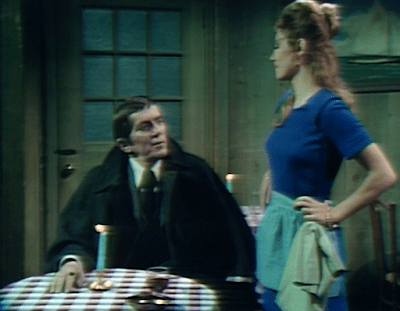
Barnabas is sitting at a table in the Eagle tavern. There is a glass of reddish liquid in front of him. In view of his condition, one wonders what that liquid might be.
Barnabas invites Buffie to sit with him. Since there are no other customers, she agrees. He tells her he is from South America. The son of this universe’s Barnabas Collins whom he claims as his great-grandfather went to Peru; when he introduced himself to the family, he said that his forebear did not die in that country. But evidently his imaginary descendants stayed on the continent, somewhere.
The Eagle is the counterpart of the Blue Whale in the other continuity. In #3, Burke Devlin was sitting at a table in the Blue Whale with hard-working young fisherman Joe Haskell when he said that his success in life began when a strange man picked him up in a bar in Montevideo. That was the show’s only reference to Uruguay, but Burke, the Blue Whale, and Brazil came to be strongly associated with each other. The song “Aquarela do Brasil,” a big hit in the English speaking world in the 1960s under the title “Brazil,” played on the jukebox at the Blue Whale, and it became Burke’s theme song. Ultimately Burke would die on a business trip to Brazil. Barnabas and Burke were enemies; when he sits at this table and claims to have a South American background, longtime viewers may wonder if he is thinking that the new universe is a place where he can try out a new personality and maybe he will start by imitating Burke’s.
Burke was a dashing action hero, attractive to women. Barnabas’ attempt to imitate him breaks down almost immediately. He winds up mimicking another prominent bachelor from his native universe, Professor Timothy Eliot Stokes, when he asks Buffie if she’s ever heard of the theory of “Parallel Time.”
Buffie shakes her head no. Barnabas says that some people believe that there are many universes, and that a copy of each of us can be found in each of them. They may look the same, but they lead different lives because they have made different choices. Buffie laughs and says that she hopes her other selves are having more fun than she is. She hastens to say that she doesn’t mean she isn’t having fun at the moment, sharing a table with Barnabas; she means that her life in Collinsport, as viewed from the most all-encompassing perspective and analyzed in the most thorough philosophic manner, well and truly sucks shit. Barnabas says that the other Buffies in the multiverse might have left Collinsport* and had wonderful adventures.
Longtime viewers saw one of those other Buffies in #951, when we were still in the original continuity. She had a different name; she went by Nelle Gunston. And as befits a mirror universe, she moved in the opposite direction. Rather than leaving Collinsport to look for something new as Buffie wishes she had done, Nelle left her parents’ home in Virginia and went to Collinsport because she had joined a cult dedicated to the destruction of the human race and its replacement by a loathsome breed of Elder Gods known as the Leviathan People. Barnabas had been the leader of the Leviathan cult, and when Nelle came to town she sat with him by the same table where Buffie and Barnabas sit today. They even take the same seats.
Buffie is charmed by Barnabas’ talk; between the suavity that Jonathan Frid brings to his part today and the energy with which Elizabeth Eis presents Buffie’s enthusiasm for him, it is far easier than it usually is to believe that Barnabas is a sexy dude. Maybe we are supposed to think that role-playing as Burke has enabled him to loosen up.
The conversation is really warming up when the bell attached to the front door rings. “Customer,” Buffie ruefully says to Barnabas as she rises. It is Cyrus.
Barnabas invites Cyrus to sit with them. He declines, saying that he came only to ask Buffie if she had seen John Yaeger lately. She tenses up. Yaeger used to beat her up and force her to help him with his crimes. She says that Cyrus himself had told Buffie that Yaeger wouldn’t be back in Collinsport. Cyrus says that he did, but that he is worried he might not be able to predict Yaeger’s movements as well as he thought he could. He offers Barnabas a lift back to Collinwood. That’s a bit surprising, since Cyrus got uptight when he saw Barnabas. As Yaeger, Cyrus discovered that there is a coffin in the basement of Will and Carolyn’s house, and he suspects that Barnabas spends his days there. But longtime viewers can remember the days Barnabas and Burke had conversations at the Blue Whale that were just as tense as the one he and Cyrus have in the Eagle, and Burke never failed to observe the small graces. It’s just the done thing, I suppose.
Cyrus leaves, and Buffie remains standing. She and Barnabas keep talking. He gets close, and goes in for a bite. He stops himself at the last second, to her surprise and disappointment. She was apparently ready for a kiss on the neck. He says he has to go. She is even more disappointed by that, but he promises to come back at closing. He asks to walk her home, and she happily agrees.
Will and Cyrus are in the drawing room at Collinwood. Will urges Cyrus to join him in a drink. When Cyrus declines, Will reminisces about the old days at Collinwood, when the party would just be getting started at this hour. In those days, people would leave the great house in the small hours of the morning and continue their revels at the Eagle. Cyrus says he won’t find much company there tonight. When he says that the only people in the place earlier were “the girl who works there” and Barnabas, Will looks alarmed. All of his mannerisms that suggest drunkenness drop away, and he rushes out.
Will gets to the tavern, and finds Buffie alone. The alcoholic author is obviously one of her favorite and most lucrative customers, so even though she has already blown out the candles she tells him he is in time for last call. To her amazement, he is not interested in a drink. He asks her where Barnabas is. She says he’ll be back and that he is taking her home. He says no, and she asks what’s wrong. Before he can answer, Will hears Barnabas’ voice behind him, echoing Buffie’s question. Laboring under the vampire’s power, Will has no choice but to leave Buffie alone with Barnabas.
Nelle, too, had agreed left the tavern with Barnabas. She expected to meet the leader of the Leviathans at his place, and was unhappy to find that the two of them were alone. Buffie is again an inverted mirror image of her counterpart. She takes Barnabas to her place, and is quite happy to be alone with him. The two close in for an embrace. He bites her neck, and she collapses. He had bitten Nelle, too. At that moment, Cyrus enters the room.
Cyrus does not exactly have a counterpart in the other continuity, but Christopher Pennock did play the Leviathan leader whom Nelle expected to meet. Like Cyrus, that character was a murderous shape-shifter. So Cyrus’ unexpected arrival mirrors the Leviathan leader’s unexpected absence.
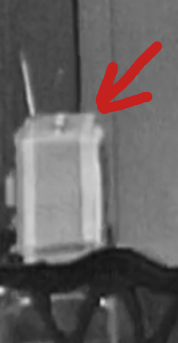
When we first cut to Buffie’s room, the camera lingers for several seconds on an extremely unusual prop. It is a television set. The only other time we have seen a television set on Dark Shadows was in #27, in the other universe, when Burke visited investigator Stuart Bronson in a hotel room in Bangor, Maine where there was a small portable unit. It looks like it might be the same set.
Bronson’s TVBuffie’s TV
The shot goes on so long, and the set is such an odd thing to see in the context of the show, that they must be making some kind of point with it. We have wondered why Buffie submitted to Yaeger’s abuse, when she is such a strong and intelligent person. Her reflection in Nelle suggests a partial answer. Nelle was drawn to the Leviathans, who offered to destroy her and all other humans. We can assume that Buffie, too, was following a self-destructive urge when she went along with Yaeger. Associated with her, the television is a symbol of the annihilation of the self. Turn the idiot box on, turn your mind off. If you aren’t careful, you may even wind up spending your weekdays staring glassy-eyed at ABC’s daytime lineup.
*He actually says “Collinwood.” Which is a blooper, but since Buffie mentioned in her first episode that she used to work at Collinwood it is kind of an interesting one. Maybe when another Buffie left her position as an upstairs maid or whatever she was, she got further than the nearest tavern.
Quentin Collins finds a voodoo doll in his wife Maggie’s suitcase. She tells him she hasn’t seen it before. At length it dawns on him that it is physically possible for a person to place an object in someone else’s suitcase. He remembers that housekeeper Julia Hoffman was in the room for no good reason last night while Maggie was sleeping. Several weeks ago, he was able to see the abundant evidence that Julia was trying to drive Maggie out of the house. He knows that Julia was fanatically devoted to his late wife Angelique and must know that Angelique was involved in black magic, so that Julia would be the obvious suspect in an awkward situation concerning Maggie and a voodoo doll.
The next day, Quentin talks the situation over with Cyrus Longworth, his physician and an expert in black magic. Later, he confronts Julia; she denies leaving anything in the room. He does not have any further evidence to use to challenge her denials, so he leaves it at that.
What Julia knows that Maggie, Quentin, and Cyrus do not is that Angelique has returned from the dead. She murdered her identical twin sister Alexis and took Alexis’ place as Quentin’s houseguest. Julia and Angelique are conspiring to drive Maggie and Quentin apart so that Angelique can resume her place as Quentin’s wife and the mistress of the great house of Collinwood. Julia and Angelique keep congratulating themselves on how upset Maggie is getting, apparently not noticing that Quentin is suspicious of Julia and thinking of firing her.
Angelique, masquerading as Alexis, calls on Maggie in the master bedroom. She says that she realizes her presence in the house has been stressful for Maggie, and offers to leave if she wants her to do so. Maggie says that she is not stressed now, because she realizes that she is Alexis. She describes herself as childish and hysterical in her initial reaction, when she thought she was Angelique returned from the dead, and tells her to stay in the house as long as she likes. “Alexis” takes this statement at face value, and goes on to explain her belief that Angelique was murdered and her determination to find the person responsible.
My wife, Mrs Acilius, pointed out that there is more going on in this scene than Angelique knows. Quentin has a habit of calling Maggie childish and hysterical, and she rejects those labels. So when she applies them to herself, regular viewers know that she is not giving her sincere opinion.
Moreover, being accepted as Alexis is not the winner with Maggie that Angelique believes it is. In #985, Maggie found Quentin and Alexis in Angelique’s old bedroom. Alexis was wearing Angelique’s frilly nightgown, pressing herself to Quentin, stretching her hand to him, looking into his eyes, and saying softly “Perhaps we can comfort each other.” Maggie ran from that sight to the drawing room, followed by Quentin. He tried to tell her she did not see what she saw. She told him that she would no longer be treated like a child, and left to spend the next six weeks at her sister’s place in New York. Angelique was in her grave at that time, and neither Alexis, Quentin, nor Maggie told her about it. So she does not know that by impersonating Alexis she is inviting Maggie’s distrust. She does not understand the warning Maggie is giving her when she tells her that she knows she is Alexis.
Maggie’s view of Alexis as a rival for Quentin also explains why she characterized her decision to go to stay with her sister as motivated solely by her own irrationality. Alexis is the last person with whom she wants to discuss her differences with Quentin, so of course she claims total responsibility for their earlier rift.
Angelique’s resurrection can last only so long as she can keep warm, and she can do that only by draining heat from the bodies of the living. Now the cold comes up on Angelique again. It strikes her during her scene with Maggie. Maggie can see that “Alexis” is ill, and reaches a friendly hand towards her. Angelique says this is just something that happens to her occasionally, and that she has to get under some blankets as soon as possible. She rushes out.
When she is in this condition, all Angelique has to do is touch a person and they will be an icy corpse. It is interesting that she chooses to pass up her chance to kill Maggie. Perhaps she is afraid that doing so would lead to her exposure. Alexis was her first unwilling heat donor; a handyman named Fred, who had the ill fortune to cross Angelique’s path in #1003, was the second. Angelique has concealed Alexis’ death by impersonating her, and Fred was due to leave town anyway. So no one has missed either of them. But there would be no covering up Maggie’s death.
Through the first half of the scene, Lara Parker’s hair and Kathryn Leigh Scott’s keep fluttering. The window on the set is closed, so that just makes us wonder how high the air conditioning was in the studio. After they come back from commercial, that problem is solved, but it was conspicuous enough to add a bad laugh to Angelique’s heat vampire symptoms.
Angelique runs down to the foyer, crying out for Julia. When she comes, Angelique orders her to fetch a victim whose body heat she can consume. Julia refuses, and Angelique tells her that if she doesn’t provide someone else she will herself be the next donor. Julia goes.
A moment later, Angelique feels she is about to succumb to the cold. She sees the doorknob turning, and resolves to claim whoever is about to enter. “Who will it be?” she asks, “Who… will… it… be?” There aren’t many candidates. There have been periods when the show had a bunch of characters in reserve who were not directly connected to any ongoing stories, but there are only a handful of those now, and only one or two would be likely to let himself or herself into Collinwood.
Five and a half years ago, I defended the episode in a comment I left on Danny Horn’s great blog, Dark Shadows Every Day. This segment of Dark Shadows is set in a different universe than the one where the first 196 weeks took place; the show insists on calling it “Parallel Time.” So the letters “PT” are sometimes put in front of the characters’ names to differentiate them from the versions of the characters we met in the original continuity. Danny and many of his commenters were getting impatient with Parallel Time by this point, and some compared it unfavorably to the trips the show took back in time within the main continuity, especially the costume drama segment set in the 1790s that ran from November 1967 to March 1968.
I’m liking it.
PT Angelique’s harebrained scheme isn’t really any worse than were most of Angelique-Prime’s schemes. So the difference between PT Maggie and Quentin on the one hand and 1795 Josette and Jeremiah on the other is that Maggie and Quentin have some brains. They talk to each other about what they’ve seen, confront Miss Hoffman, and consult with the resident Doctor of Spookology. For viewers who had seen 1795, that must have come both as a relief- thank goodness they aren’t going to simply recycle that story- and as a source of suspense- when Angelique sees her first evil plan fail, what other, even more evil plan will she devise?
Comment left by “Acilius,” 12 January 2021, on Danny Horn, “Episode 1019: Peer at a Prop,” Dark Shadows Every Day, 7 May 2017
I would have gone on to talk about all the stuff between Maggie and Angelique, but Mrs Acilius only pointed that out to me this time through. I’m sure that while I was watching the scene I responded emotionally to the nuances in Miss Scott’s performance, but I didn’t have it in mind after the episode was over.
The closing credits still bill Lara Parker as “Alexis Stokes,” a month after Angelique killed Alexis and took her place. Mrs Acilius explains this by reminding me of all the times when actors have strolled onto the set during the credits. She imagines someone walking on, seeing the credit that identifies Angelique, and reacting with shock.
Maggie Evans Collins is staying with her sister Jennifer in New York.* She writes a letter to her estranged husband, Quentin Collins. Maggie says that there is no point in being married if they aren’t going to live together, so she is going to talk with Jennifer’s lawyer. She crumples the letter up and tosses it in the wastebasket. A moment later, the telephone rings. It is Quentin’s sister, Elizabeth Collins Stoddard. Liz tells Maggie that she must come home immediately.
Quentin appears to be having a heart attack. Liz found him writhing in pain in the drawing room. He was accompanied by someone Liz had never seen before. Eventually this person identified himself as Barnabas Collins, a distant cousin of theirs. Barnabas told Liz that Quentin had collapsed with severe chest pains, and urged her to call a doctor. She telephoned Cyrus Longworth, a friend of Quentin’s.** Cyrus doubts that Quentin will recover. Barnabas suggested Liz call Maggie, saying that she could get a flight and be at the great house of Collinwood within hours.***
The source of Quentin’s trouble is his first wife, the late Angelique. Angelique has risen from the dead, murdered her identical twin sister Alexis, and taken Alexis’ place as a houseguest at Collinwood. Angelique wanted Quentin to bring Maggie back to Collinwood so she could make them fall out of love with each other and reclaim her old place as his wife. To that end, she stuck a pin in the heart of a voodoo doll representing him. When that results in a possibly fatal cardiac event, she picks up the doll and cries that “You failed me!” She pulls the pin out. Cyrus’ prognosis that Quentin would die within minutes is thus defeated, but he is still gravely ill.
The camera settles on the clock in the foyer. It is 6:00. The shot lasts for five or ten seconds; they really want us to know it is 6:00. Barnabas has been in the house for several hours. He only exists when it is dark, since he is a vampire. When this episode premiered on 18 May 1970, the sun rose in central Maine at 4:29 AM and set at 8:00 PM. We may be able to believe that the date of broadcast doesn’t match the dramatic date, and accept that Barnabas can still be around at 6:00 AM. But it is not clear why they are asking us to do this.
We cut from the clock’s big closeup to another room, where Liz and Angelique are talking. Liz says that Cyrus was called away to attend another emergency. Angelique asks who is with Quentin. Liz says that Barnabas is. That left us wondering if the writers somehow forgot that Barnabas is a vampire. Why on earth would he agree to keep a vigil at an hour when the roosters are already crowing?
Maggie enters. She assumes Barnabas is the doctor. He tells her he is not. She apologizes; he dismisses it as a logical mistake. He hangs around when Liz and Angelique return and talk with Maggie. He accompanies Maggie when she goes in to the drawing room to see Quentin. He is still there when Quentin regains consciousness. He takes it upon himself to tell Quentin that Maggie is there. Quentin shouts that Maggie must not stay in the house. She does not go anywhere, but neither does Barnabas. He gives a shocked reaction, and is still lingering when the credits roll.
It is understandable that Barnabas would take a risk if it meant he could meet Maggie, and even more understandable that he would be reluctant to part from her once he had. He is not in fact related to anyone in this episode at all, not even as the extremely distant cousin he claims to be. In fact, he is from an alternate universe, which the show insists on calling “Parallel Time.” He knows another Maggie Evans there, one who looks and sounds just like this one but who is not married to Quentin. Barnabas had a long and fraught history with that Maggie. When he left his own continuity to come here in late March, he and the Maggie he knew had been moving towards a romance for several weeks. There was a bit of a bump in the road when Angelique’s counterpart cast a spell causing Maggie to fall in love with Quentin’s counterpart, but that was something that came and went. Barnabas never found out about it. So of course he wants to connect with this Maggie in some way.
*Presumably the city, though they never specify.
**Some in fandom protest that Cyrus is not a medical doctor. But he wrote a prescription for his fiancée, Sabrina Stuart, in #989, and in #1015 he resolved to give up his evil ways and “be a doctor again.” So I think these protests are ill-founded.
***Nowadays the idea of going to the airport in the middle of the night and buying a ticket for the next flight to central Maine seems to be of a piece with the most fantastic elements on Dark Shadows, but it wouldn’t have in 1970. Not that I can remember 1970- it was the year I was born, if you want to know- but well into my adult years it was still possible to show up at an airport gate with a handful of cash and buy a ticket for a plane that was already waiting there. I never did that myself, but I saw it done many times.
Vampire Barnabas Collins has left the universe where the first 196 weeks of Dark Shadows took place and found himself in a universe chiefly populated by counterparts of people he knows. His own counterpart lived a quiet life and died in 1830, so he won’t be running into him.
In his own universe, Barnabas had an affair with wicked witch Angelique Bouchard in the 1790s, dooming his chance to find happiness with his true love, the gracious Josette. We saw the events associated with this disaster from November 1967 to March 1968, when Dark Shadows was a costume drama set in those days.
That Angelique came to the estate of Collinwood as a lady’s maid. In #372, she met much-put-upon indentured servant Ben Stokes. Ben thought Angelique had a romantic interest in him, only to find that she had cast a spell to turn him into her slave in furtherance of her scheme to take Barnabas away from Josette.
In the current universe, it is 1970. Angelique’s counterpart was born in the village of Collinsport in 1939 and died at Collinwood in 1969. Three weeks ago, she came back to life, murdered her identical twin sister Alexis, and took her place as a houseguest at Collinwood. Angelique and Alexis’ maiden name was Stokes; their father is Tim Stokes, counterpart of Professor Timothy Eliot Stokes, who is Ben’s descendant. Today, Barnabas talks with Angelique, who tells him that a Ben Stokes who was an indentured servant at Collinwood and an Angelique who came to the house as a lady’s maid in the 1790s are her ancestors. She also says that the Angelique of the 1790s is buried among the Stokes family. So we learn that we are in a “time-band” where Barnabas left Angelique alone and Ben wound up married to her.
The main event today is that Angelique reveals her true identity to Miss Julia Hoffman, housekeeper at Collinwood and most fanatical member of the cult Angelique built around herself in her lifetime. When Angelique admits she is not Alexis, she addresses Hoffman as “Julia,” the first time anyone has called her this. Julia admits that she is afraid of Angelique, since she is dead. Angelique orders Julia to hold her hand and feel her warmth. When she does, Julia asks how she managed to defeat death. Angelique resists telling her, but Julia insists. She dwells on the lack of sensation during the period when she was physically dead. In response to Julia’s continued prodding, Angelique says that her tomb was opened by her widower, drunken sourpuss Quentin Collins, with assistance from his friend, mad scientist Cyrus Longworth. Finally Julia can’t conceal her jubilation at the resurrection, and they cackle gleefully as they start discussing their plans to reestablish Angelique as Quentin’s wife and therefore as mistress of Collinwood. Angelique manages not to tell Julia that she murdered her sister.
The episode number “1015” signifies that this was the last episode of the 203rd week of Dark Shadows. There were some days in 1966-1971 when no episode of the show premiered on the ABC network. They skipped episode numbers on those days to keep the Friday episodes divisible by five. So far, there have been fifteen of these preemption days. That makes this the one thousandth episode aired. And therefore the one thousandth I have reviewed. A bit of a personal milestone, that.
Wicked witch Angelique has returned from the dead, murdered her twin sister Alexis, and assumed Alexis’ identity. Angelique’s widower Quentin had already welcomed Alexis as a more or less permanent guest at the great house of Collinwood. Quentin’s new wife, the former Maggie Evans, has left him. Angelique wants Quentin back, but has decided that she cannot overcome his obsession with Maggie unless Maggie returns to Collinwood, where she will be able to fight her directly. So she has cast a spell on Quentin to inflame his feelings for Maggie. Angelique expects this will cause him to bring Maggie home. Once she is there, Angelique will be able to complete her evil plan, which the writers don’t seem to have come up with yet.
Angelique’s spell goes awry. At the beginning of the episode, Quentin slashes a portrait of Maggie; at the end, he believes he has killed her, and is getting ready to hang himself so that he can join her in death. In between, he goes off and tells his friend, mad scientist Cyrus Longworth, how miserable he is. Angelique and Cyrus have a conversation about how sad Quentin is.
The performances are all good, but the only one that serves a purpose in the story is Christopher Pennock’s as Cyrus. Cyrus has devised a potion that changes his appearance so drastically that even the people who know him best do not recognize him when he is under its influence. This is supposed to be a Jekyll and Hyde story in which the innocent Cyrus is being consumed by his evil alter ego, “John Yaeger.” But it is all too obvious that Yaeger is just a disguise Cyrus puts on when he has decided to commit acts of rapine and slaughter. Today, Pennock really makes Cyrus seem like a well-intentioned nerd. When he puts the potion back in his safe and resolves never to become Yaeger again, we can believe that he is a better person when his hair is red than he is when it is dark.
Cyrus resolves to break his addiction to “Do Not Touch” juice. Screenshot by Dark Shadows Before I Die.
Also, he and Lara Parker have a fun moment when Cyrus and Angelique are talking about Quentin’s feelings. He gets carried away with a mad scientist rant about the horrible evil that dwells at the base of every human heart, prompting her to give him a puzzled look. It’s an effective comic take.
This episode marks the last appearance of Paula Laurence as Angelique’s aunt, Hannah Stokes. As Hannah, Laurence imitated some of the most recognizable mannerisms Parker incorporated in her portrayal of Angelique. This helped longtime viewers believe she was related to Angelique, and when she had scenes with Alexis the contrast showed us that Parker really was playing a different character. But the show isn’t big enough for two Angeliques, so Hannah’s days have been numbered for a while.


 Dark Shadows Commentary