
When Dark Shadows began in June 1966, its biggest draw was movie star Joan Bennett as reclusive matriarch Elizabeth Collins Stoddard. Liz was highly capable, and Bennett made her compelling to watch. When in #25 Liz’ brother, high-born ne’er-do-well Roger Collins, grudgingly complimented her on her “neat way of managing people,” we could see that he was putting it mildly. But the show didn’t handle Liz’ storyline very well, and she soon became a blocking figure. As the owner of the estate of Collinwood and of the Collins family businesses, as a central player in all the stories they had started with, and as the powerful personality Bennett had created, Liz was such an important part of the show that when she became a brake on the action, there was a constant danger that it would be impossible for anything to happen ever again.
The arrival of Roger’s estranged wife Laura Murdoch Collins in #123 marked Dark Shadows’ transformation into a supernatural thriller. By the time Laura went up in smoke in #191, her story had absorbed two of the four original narrative themes, “The Revenge of Burke Devlin” and well-meaning governess Vicki’s growing friendship with strange and troubled boy David, and had undercut whatever interest we might still have had in the other two, the mystery of Liz’ decision to become a recluse and Vicki’s quest to learn her true identity. The emerging Dark Shadows 2.0 had little room for Liz, and she subsided to the margins. When the show traveled back in time and became a costume drama from November 1967 to March 1968 and again from March to November 1969, Bennett played other characters and was able to make a substantial contribution, but Liz would never again be a suitable vessel for her great talents.
For the last eight weeks, the show has been in another time travel segment. Now it has traveled, not back in time, but sideways. They are in an alternate universe. The show insists on calling this universe “Parallel Time.” It is 1970 here, as it is in the original continuity, but a different 1970 where people with the names and faces we already know are living very different lives.
The Elizabeth Collins Stoddard of Parallel Time is not the mistress of Collinwood or an effective businesswoman. This Liz entrusted her inheritance to her brother Roger, who turned out to be just as feckless as his counterpart in the original continuity. As the penniless Roger we met in 1966 lives in Liz’ house as her guest and works in Liz’ business as her employee, so this Liz and Roger both live at Collinwood as the dependents of their brother, drunken sourpuss Quentin Collins.
In the original continuity, Quentin was not Liz and Roger’s brother, nor did he own anything. We got to know him when Dark Shadows was set in 1897, and he was a charming rogue, the younger brother of Judith and Edward Collins, who like Liz and Roger were played by Joan Bennett and Louis Edmonds. So the parallel lines representing the two versions of 1970 take a bit of a swerve into that other epoch.
Today, Liz is busy organizing a costume ball to be held in the great house of Collinwood. They had such a ball every year at this time when Quentin was married to his first wife, the late Angelique Stokes Collins, and Liz thinks that having another one would be the perfect occasion for Quentin to introduce all of his friends to his new wife, the former Maggie Evans. Liz needs help getting this party going. She comes bustling into the drawing room today and addresses herself to Angelique’s identical twin sister, Alexis Stokes, announcing that the party is tonight and 14 of the guests have failed to RSVP. She bemoans her inability to get anything organized and pleads with Alexis to help her. Alexis agrees to do so and excuses herself from a chess game she had been playing with Barnabas Collins, a man who recently showed up and introduced himself as a distant cousin of the Collinses of Collinwood.
Quentin enters the drawing room and orders Liz to cancel the ball. She says that it is too late to do that. Quentin stalks off and goes outside. Liz turns to Barnabas and asks him to reason with Quentin. Barnabas is unsure that he is the right person, but he goes to the door anyway. He opens it just in time to hear Quentin peeling away in his car. Maggie appears at the head of the stairs and asks if Quentin has gone. Barnabas has to say that he has, and Maggie looks crushed. Liz is unable to help in any way.
Later, Liz returns to the drawing room in the middle of a conversation between Quentin and Maggie. She is carrying an enormous decanter containing some sherry and congratulating herself on calming the cook’s nerves by her bartending. Quentin excuses himself to go get into his costume.
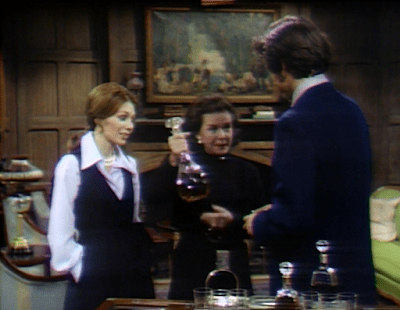
Liz finds that Maggie has not yet chosen a costume. She urges her to do so at once. Maggie says she supposed that Angelique always picked out her costume weeks in advance. Liz knows that Maggie is intimidated living in Angelique’s shadow, and does not know what to say in response to that remark. She quickly changes the subject. She brightens, and says that Alexis has brought many lovely dresses down from the attic. She urges Maggie to go to Alexis’ room and choose one of them.
As the time for the guests to arrive comes near, Liz and Barnabas meet in the foyer. A portrait of the Barnabas Collins who died in 1830 hangs on the spot on the wall next to the front door where earlier this week we had seen a metal doodad that looks like a coat of arms. Barnabas is wearing the same outfit, and looks just like the man in the portrait. Liz is wearing a dress of the same vintage. She is overjoyed, and tells Barnabas that the period suits him. He thanks her, and returns the compliment. Quentin is wearing a blue federal coat; Liz and Barnabas tell him that he, too, is suited to the early 1800s. Alexis comes downstairs in a blue dress, and she receives the same commendation. Lastly Maggie makes her appearance. When Quentin sees her dress, he becomes very tense. He tells her to take it off, orders her never to wear it again, and smashes his glass on the floor. The camera pans from Barnabas’shocked expression to a flickering look of pleasure on Alexis’ face; Liz stands between them, and unfortunately we only see the top of her head.
What Liz does not know is that the person she thinks is Alexis is in fact Angelique risen from the grave. Angelique murdered Alexis, took her place, and is conspiring with housekeeper Julia Hoffman to drive Maggie and Quentin apart. The story is a souped-up version of Daphne Du Maurier’s Rebecca, in which the dead first wife is not only a memory that triggers anxiety in her successor but a supernatural being who rises from the dead to torment her directly. There is a scene with Maggie looking out the window of the drawing room that is an exact recreation of a shot in Alfred Hitchcock’s 1940 film of Rebecca, and when Angelique and Hoffman trick Maggie into wearing the same dress Angelique wore to last year’s ball, prompting Quentin’s outburst, most grownups in the original audience would remember the same thing happening to the second Mrs de Winter in that film.
Angelique is the villain, and Maggie is the heroine. Still, we rather like Angelique. The sister-murdering is bad, of course, but Quentin is such a lousy husband that she is doing Maggie a big favor by trying to bring their intolerable marriage to its end as soon as possible. For example, today Quentin finds Maggie reading his old love letters to Angelique. He might justifiably have objected that those are private and say he wished she’d asked before reading them, but he doesn’t do that or anything else one adult would do when disappointed in another. Instead, he flies into a rage, accuses her of a variety of things she hasn’t done, and orders her to, and I quote, “Go to your room!”
Later, in the room they share, Quentin is still scolding Maggie for failing to admit that she was lying about how she found the letters. We know she had in fact told the truth. When she tells him so, he dismisses her with a shake of the head. When she brings up the fact that it is the anniversary of his wedding to Angelique, he shouts that she is forbidden to discuss the subject, then storms out and slams the door. This is when he goes downstairs, tells Liz to cancel the party, and drives away. We have never seen Maggie have a happy day with Quentin. He sometimes manages to be pleasant in the intervals between his tantrums, but even then he can’t let go of his habit of talking to Maggie as if she were a child and he were her somewhat weary guardian. If Angelique can hasten their final split, Maggie will owe her an enormous debt of gratitude.
Barnabas is not in fact a descendant of the man whose portrait now hangs in the foyer. He is a visitor from the main continuity. Angelique’s counterpart there is his great enemy, so it is fun to see him talking with this Angelique and playing chess with her.
David Selby has a problem with one of his lines, when Quentin winds up saying “I wonder where I got the illusion that an hour or two alone would settle one’s all of problems.” This is a fairly minor stumble by Dark Shadows standards, but it comes when Angelique is in closeup and Lara Parker’s left eyelid twitches when she hears “one’s all of problems.” That reaction is worth a laugh.

