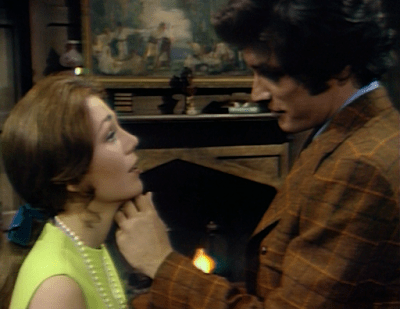
Sixteen weeks ago, Dark Shadows left the universe in which the action had been set up to that point. This is the final day we will spend in the other continuity, which the show insists on calling “Parallel Time.”
The only remaining villain, a wizard known as Tim Stokes, is holding Maggie Collins prisoner in the great house of Collinwood. Stokes telephones Maggie’s husband, foul-tempered sourpuss Quentin, who is in the Old House on the estate. He tells Quentin to come to the great house alone and unarmed. With Quentin are mad scientist Julia Hoffman and a woman named Roxanne, who was apparently born without a personality. Julia suggests Quentin either call the police or wait for their friend, old world gentleman Barnabas Collins. Quentin says that Stokes may kill Maggie if he does not obey his instructions. Julia points out that he may kill them both if he does, but he angrily dismisses this concern and runs off by himself.
Quentin finds Maggie tied to a chair in the drawing room of the great house. Stokes points a gun at him and announces he will now kill both him and Maggie. Quentin had not seen this coming, and tries to talk Stokes out of it. Stokes declines to change his mind, and Quentin hits him, knocking the gun out of his hand.
Barnabas materializes in the window. Quentin and Maggie can’t account for this, but Stokes can. He knows that Barnabas is a vampire. Roxanne enters. Stokes grabs her and threatens to break her neck if Barnabas approaches him. Barnabas does not think to use his vampire powers, and Roxanne does not think to struggle. Barnabas lets Stokes get away with Roxanne.
Barnabas and Julia are wandering around in the woods when Roxanne breaks free of Stokes. He pours gasoline on the floor of the house.
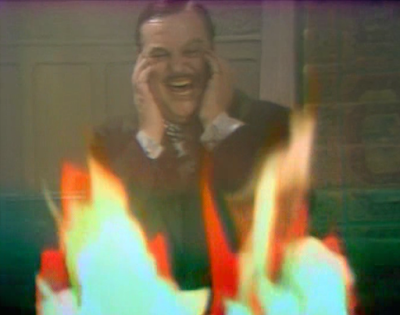
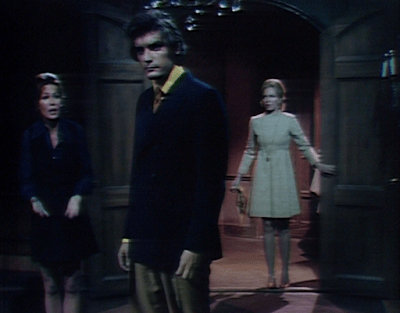
Barnabas and Julia come back to the house to look for Roxanne. They are for some reason in the room in the east wing where the aperture between universes opens when they smell smoke and see Roxanne in the corridor outside. Barnabas is reaching out to Roxanne and calling her name when the smoke suddenly clears. They are back in their own continuity.
Wicked witch Angelique Stokes Collins has cast a spell on Maggie Collins, compelling Maggie to shoot her husband Quentin. Angelique herself dwells among the living because of another spell, one cast by her father, a wizard known as Tim. This spell drains the “life force” from a woman named Roxanne into Angelique, revivifying her after Quentin’s brother Roger drove a hatpin into her brain nine months ago. Angelique has kept her identity secret, in part because Quentin and a friend of his had a panic attack some time ago and destroyed her coffin, keeping the physical evidence from telling its tales. They were two loonies, quelling caskets.
Occasionally Roxanne manages to reclaim enough of her “life force” to make Angelique weak and cold. When this happens, Angelique can perk herself up by hugging a man and kissing him, thereby making all of his body heat flow into her, leaving him an icy corpse. The kiss appears to have become essential to this transfer; her kissing equates coolness. Yesterday she gave Roger this treatment, avenging her own murder.
The spell on Roxanne will break when she speaks, and her pushy ex-boyfriend Claude is about to make her do that. So Angelique has only moments to live. Quentin is on the run from the law, charged with the murder of a man named Bruno. Angelique’s enemy, Barnabas Collins, demands she sign a confession admitting that Bruno was actually killed by a spell she cast using a cravat of his. Quentin is innocent in these loose necktie squallings.
Angelique refuses to sign any such document. Later, Barnabas will tell the whole story to a police inspector whose incredulous response makes it clear that it would not have persuaded anyone had she done so. More urgent is a question he puts to her about the whereabouts of his faithful companion, Julia Hoffman. Angelique has locked Julia in a dungeon and left her to die of thirst. The door to this chamber swings shut silently, and apparently it does not let Julia’s cries for help be heard outside. Many of the places of confinement we have seen on Dark Shadows are the looniest squeaking cells you could imagine, but this one is grimly soundproof.
Roxanne speaks and Angelique dies, defiant to the end. Cloaking queenliest loss, her refusal to bend invests the character with a perverse grandeur.
Barnabas remembers an Angelique who lived on the island of Martinique. For him, all the other Angeliques are just successors to what she brewed up there, Antilles cooking sequels, as it were. Screenshot by Dark Shadows Before I Die.
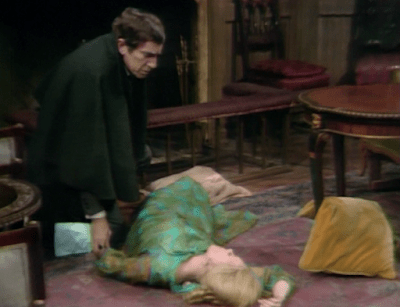
With Angelique’s death, her spell over Maggie breaks. Maggie collapses and drops the revolver she had trained on Quentin. One of the themes of the show has been that a person who casts a spell creates an alternate version of herself and that version takes possession of the person against whom they direct it. Lara Parker and Kathryn Leigh Scott play Angelique and Maggie’s collapses in the same way; seeing these back to back, we cannot miss the point that what we are really seeing is the simultaneous death of two Angeliques. Sometimes the alternate selves created by the spells outlive the spellcaster, and there is no telling where they will drive the victim. The accursed who wander about the earth, whether they became vampires like Barnabas or zombies like his uncle Jeremiah, are lockless antique legions, unrestricted in their physical movement, unlimited in the duration of their afflictions, uncounted in their numbers.
Miffed that Maggie pointed a gun at him, Quentin leaves the room. He finds Barnabas, who explains everything that has been going on. Quentin goes back to Maggie. She says that she realizes he could never love her or any other woman as he loved Angelique when she was alive. He tells her he never loved Angelique, but that he “hated the ground she walked on” and never shared a happy day with her because she was so cruel to him when they were married. When the same scene played out between Maxim de Winter and his second wife in Daphne Du Maurier’s Rebecca and in Alfred Hitchcock’s film based on the novel, we could take it as grounds for hoping that their marriage would take a turn for the better. But Quentin seems never to have loved Maggie, and we have never seen them share a happy day. They speak lovely words as they embrace; kissing allots eloquence. But Quentin’s declaration that he wasn’t any happier in his first marriage than he has been in his second comes only as confirmation of our suspicion that things will only go from bad to worse as long as he and Maggie stay together.
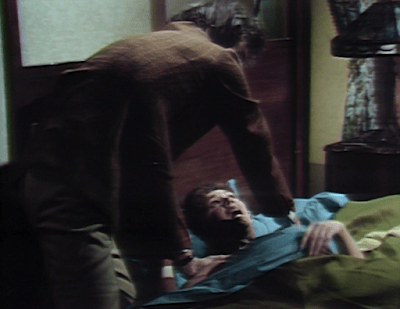
Barnabas and the inspector look for Roxanne. They don’t find her, and the inspector dismisses Barnabas’ whole story. The law moves a lot faster in Soap Opera Land than it does in our world, but only the looniest legal quickness could get Quentin out of trouble in the time that seems to be remaining in this storyline. Later, the inspector catches up to Quentin and arrests him, and Barnabas finds Claude stabbed to death in the woods.
This episode marks the final appearance of Angelique Stokes Collins. Lara Parker, that member of the queenliest looking class, will be back later as another witch named Angelique. It is also the final appearance of actor Brian Sturdivant and of the character Claude North. Sturdivant’s performance has many problems, most obviously his wildly uncertain accent. At times he manages to enunciate a few words in the old “mid-Atlantic accent” stage performers were trained to use in the first half of the twentieth century, but he never keeps it up for a whole line.
Yesterday, Elizabeth Collins Stoddard overheard her brother Roger Collins having a conversation with the portrait of wicked witch Angelique. When Roger told the portrait that he murdered not only Angelique herself but also Liz’ daughter Carolyn, Liz stormed into the room. Roger then strangled Liz and stuffed her corpse under a window seat. Today, he is in the room fretting about what to do with Liz’ body. It strikes him that his brother Quentin is currently a fugitive from justice, suspected of three murders, including those of Angelique and Carolyn. He decides to pin Liz’ murder on Quentin as well.
Angelique has come back from the dead and is impersonating her identical twin sister Alexis, whom she herself murdered in #1001. She has persuaded Quentin that his new wife Maggie, whom he does not seem ever to have liked very much, is a witch, Quentin now believes that Maggie, by use of the black arts, committed all of the murders. Maggie has looked at the publicly available evidence and concluded that Quentin has gone insane. She believes that he, by use of his hands and some sharp objects, committed at least some of the murders.
Roger has figured out that “Alexis” is really Angelique. They have a couple of awkward conversations. He asks the portrait why he can talk so freely to it when he is so stilted in his interactions with “Alexis,” since they are “one and the same.”
Roger cannot be frank with the three dimensional version of Angelique. Screenshot by Dark Shadows Before I Die.
Maggie has started getting everyone to evacuate the house. When she goes to her room to pack, she finds Quentin waiting for her. He is holding a handkerchief monogrammed “ECS.” He tells her it was Liz’. He demands that she tells him where “the doll” is. She has no idea what he is talking about. He looks directly at her and says in a slow, level voice that he will kill her. She runs away, somehow not persuaded of his innocence.
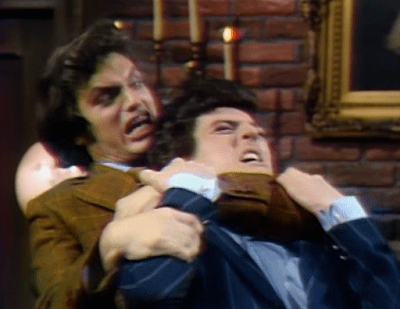
Maggie flees to the room where Roger killed Liz. She finds Roger there, and tells him Quentin is in the house. Roger locks the door to keep him out. There is no telephone in the room; they talk a bit about how to get across the hall so they can call the police. Maggie falls into Roger’s arms and starts crying. He starts burbling about all the terrible things that have happened. He mentions that Liz was killed in the room. Maggie looks up and says Liz was found in a different room, and that the police think she was killed there. Roger tries to say he was just rambling, but Maggie puts two and two together. She realizes Roger is the murderer, and he realizes that she has realized it. We end with his hands on her throat.
Louis Edmonds is simply amazing as Roger today. The rest of the cast gives him first-rate support, but it is a magnificent turn. If the Daytime Emmys had been around in 1970, this was the episode they should have sent to Academy voters to get him his award.
In #969, vampire Barnabas Collins was in the east wing of the great house of Collinwood. He opened a door to a room which, like all other rooms in that long-disused area, was bare and vacant. But he did not see it as it was. Rather, he saw the same space brightly lit, fully furnished, and richly decorated. Women who appeared to be matriarch Elizabeth Collins Stoddard and mad scientist Julia Hoffman were in the room, bickering in a way Liz and Julia never would about matters neither Liz nor Julia knew anything about. After a moment, this apparition dissolved and Barnabas could see the empty room.
Over the next two weeks, Barnabas and others at Collinwood witnessed the same phenomenon a few more times. In #970, Julia told Barnabas that Professor Timothy Eliot Stokes, expert on all topics relevant to whatever needs explaining, had told her about the many worlds hypothesis. She wondered if the room represented a portal between alternate universes, in which similar people lead different lives. Barnabas conceived the hope that he might escape the vampire curse and become human again if he could cross over into the universe that occasionally becomes visible in the east wing. He managed to make the crossing in #980, but found that his curse had followed him to the new continuity.
In #1002 and #1003, we saw that the phenomenon also operates in reverse. In the new continuity, Quentin Collins went to the east wing and opened the door, expecting to find the fully furnished room, but instead saw the bare room as it exists in the main continuity. There, he could see and hear children David Collins and Amy Jennings talking about how “Dr Hoffman” had told them that they should avoid the room because Barnabas got trapped there. Quentin saw the main continuity again in #1007, wicked witch Angelique caught a glimpse of it in #1008, and Barnabas and Quentin saw it together in #1012.
In #1031 and #1032, Barnabas returned to the main continuity for a brief visit. He met Julia in the room where the phenomenon occurs. He neglected to tell her that the people in the other universe can sometimes see and hear what is said in that room, and that he has already had to deal with suspicions from Quentin and Angelique because they have heard her saying that someone named Barnabas has crossed into their universe and that he is under a curse.
In #1035, Julia’s counterpart, the housekeeper in the great house, was looking into the room and heard that Barnabas is a vampire. Since Angelique already regarded Barnabas as an enemy and this Julia Hoffman was Angelique’s most fanatical devotee, she made her way to Barnabas’ coffin with a hammer and stake. She was in the act of bringing the hammer down in #1036 when Julia herself showed up behind her and beat her to death. Julia had crossed over from the main continuity to take her place at Barnabas’ side. She stole Hoffman’s French maid outfit, assumed her identity, and became a double agent, pretending to spy on Barnabas for Angelique when she is really spying on Angelique for Barnabas.
Lately, Angelique has been getting suspicious of Julia. Julia tells Barnabas about this. He urges her to go back to the main continuity. She tells him “I’ll be all right for now.” Later, she tells Barnabas she is going on a covert mission to meet Quentin, who is hiding from the law in a cave. He says this is too risky; she again says “I’ll be all right.” He stares at her silently for a long moment. Even Barnabas knows that a character who says “I’ll be all right” twice in one episode is doomed.
Angelique is in the east wing when she hears voices coming from the room where the phenomenon occurs. She opens the doors and sees the counterparts of Quentin and his wife Maggie. They are talking about Julia’s decision to follow Barnabas out of their native universe. They refer to Julia as “Dr Julia Hoffman” and talk about her extreme devotion to Barnabas.
Julia reaches the cave where Quentin is hiding. She has talked him into going with her when Angelique shows up. Angelique claims that the police are swarming the area and that Quentin will be caught if he tries to leave. He obeys her instructions to take shelter in a tunnel deep in the cave. Julia asks what is going on, and Angelique replies with a question of her own. “First of all, I want you to tell me just exactly where you were going to take Quentin, Dr Hoffman.”
With this line, the “Parallel Time” segment has nowhere to go but its climax. Julia is the heroine of the show and the main audience identification character. This function is usually served by a character who is played by an actress twenty years younger than Grayson Hall was in 1970 and who does not spend as much time as Julia does covering up murders and making a mockery of all that is holy. But that’s who we’ve got, and once the self-pitying vampire for whom she has an all-consuming unrequited love rescues her from the arch-villainess the story will be over.
There are a couple of things today that make me wish “Parallel Time” had started differently and gone on a lot longer. The scene between the Maggie and Quentin of the main continuity includes a moment when Maggie says something Quentin regards as foolish, and he replies by saying “Maggie…” in a slow, irritated voice. This is the hallmark of the Parallel Time version of Quentin with whom we’ve spent the last twelve and a half weeks. The parts the actors take in the costume drama segments tend to influence the characters they play when they come back to a contemporary setting, and the purpose of Parallel Quentin seems to have been to find a new path of development for the original Quentin. But Parallel Quentin’s contempt for his wife has been a dead end, and hearing the charming rascal who took the show by storm in 1969 echo it strikes a sour note. If they had started with several weeks of a relationship between Quentin and his new bride that we could root for and then shown it slowly falling apart under the witch’s malevolent power, there might have been space to find something new in Quentin. But the breakneck pace of story progression to which Dark Shadows has been committed since the end of 1967 precludes anything like that.
Angelique mentions to Quentin that Maggie’s father Sam Evans died under circumstances that have never been fully explained, and that there are reasons to believe that his own father had a guilty secret in connection with it. That might have been an interesting thing to let the audience know before we came within sight of the end of the segment. Not only could it have given Quentin and his new wife something to feel interestingly uncomfortable about, but it would mirror the first 40 weeks of the show, in which the Sam Evans of the main continuity carried the heavy burden of a secret pertaining to an incompletely explained death. Longtime viewers might be excited to see that story turned inside out.
Maggie Collins is unnerved because people keep getting murdered in and around the great house of Collinwood. Her husband Quentin was arrested for one of those murders and is the prime suspect in another. He escaped from jail, just in time to be unable to account for his whereabouts during yet another. Maggie goes downstairs and finds old world gentleman Barnabas Collins in the foyer.
Maggie mentions that Alexis Stokes, identical twin sister of Quentin’s late wife Angelique, has suddenly taken ill and is asking her to call her father, evil barfly Tim Stokes. Maggie does not understand what Stokes can do that a doctor can’t, but this has happened before and Stokes was able to fix the problem. Barnabas excuses himself, saying he has urgent business to attend to at the Old House on the other side of the estate. He promises to be back soon.
Maggie hears footsteps outside her bedroom, which she thinks might be Quentin’s. The only friend she has in the great house at the moment is Elizabeth Collins Stoddard, who is under sedation following the murder of her daughter. So she rushes to the Old House to look for Barnabas. He is not in; she finds a strange man in the parlor. She asks him who he is and what he is doing there. He insists that he will ask the questions. He asks what Barnabas has done with “her.” Maggie has no idea what he is talking about. He demands that she look into his eyes; as soon as she does, he realizes she is telling the truth. He orders her to tell Barnabas that he will be back, but refuses to give his name.
Maggie runs back to the great house. She finds Barnabas in the foyer, and gives him a full report. Barnabas urges Maggie to believe in Quentin’s innocence. That is something she can no longer do. She says that she is afraid that Quentin has lost his mind and that he will kill everyone in the house, one by one. We pan out and see Quentin lurking at the top of the stairs, listening.
Maggie has a dream. Quentin comes home smiling, with a spring in his step, after chairing a meeting of the board of directors of Collinsport Enterprises. He takes her in his arms and tells her he’s neglected her long enough. She says she doesn’t feel neglected. He says he is taking six months off work, and that the two of them will be leaving tomorrow for a trip around the world.
Quentin finds a bouquet of flowers. He instantly becomes extremely hostile. He accuses Maggie of receiving the flowers as a gift from her lover. She is baffled and denies his allegations. He strangles her. She wakes up, and finds Quentin standing over her, his hands on either side of her neck.
We’ve never seen Quentin and Maggie as happy as they are in the opening part of her dream, but we have several times seen his mood abruptly flip from cheerful to violent. He is not entirely guilty of any of the murders, but he does sometimes choke people, and was in fact choking the person he is charged with strangling immediately before a witch cast a spell to complete the killing.
Moreover, we have seen a dream very much like this one before. For its first 196 weeks, Dark Shadows was set in another universe. In that continuity, Maggie’s counterpart dreamed of Quentin’s ghost in #682. That dream began with Quentin taking a delighted Maggie in his arms and dancing with her; all of a sudden, for no discernible reason, he interrupted the dance to strangle her.
That Quentin did not confine his strangulations to dreams. He murdered his wife Jenny by strangulation in #748. Wife-strangling is a pastime the two Quentins have in common. This Quentin is suspected of killing Angelique. His defense against that charge is that he could not have driven the pin into the back of her head that killed her, because he was using both hands to choke her at the time. So it would seem that Maggie’s fears are well-founded.
Late in 1968, the ghost of Quentin Collins began haunting the great house on the estate of Collinwood. The ghost gradually waxed more powerful and more malevolent, killing some people and tormenting others. By March of 1969, the great house had become altogether uninhabitable. Old world gentleman Barnabas Collins, trying to contact Quentin, traveled back in time to 1897, when Quentin was a living being. During the eight months the show was set in that year, we got to know a Quentin who was selfish, cowardly, untrustworthy, cruel, and supremely charming. Barnabas’ interventions changed history. In the revised timeline, Quentin did not become a malevolent ghost. He didn’t even die. A spell was cast on him that immunized him against aging, so that when the show returned to a contemporary setting in November 1969 he was alive, well, and to all appearances 28 years old.
In 1969 and 1970, Quentin still had all the lovableness that came from being played by David Selby. But the writers were stumped when it came time to give Quentin something to do. They kept him in a holding pattern for a month or so with a case of amnesia, and used him and one of his girlfriends to tell a version of the story of Orpheus and Eurydice. When Barnabas and his best friend, mad scientist Julia Hoffman, were doing battle with an unseen race of monsters from beyond space and time, they occasionally turned to Quentin for help. When Barnabas’ old nemesis, wicked witch Angelique, grew jealous of his interest in governess Maggie Evans, she cast a spell to cause Quentin and Maggie to conceive a wild passion for each other, something which came and went and which Barnabas never noticed. None of that activity made an impression on the audience or gave the character room to grow.
The evil but irresistible Quentin of 1897 had a great deal in common with high-born ne’er-do-well Roger Collins, who was in 1966 the show’s first true villain. As played by Louis Edmonds, Roger was so much fun to watch that it was soon out of the question to follow the original plan and kill him off when his crimes were exposed, so they nerfed him. Roger turned into a sarcastic but harmless snob. When in November 1967 the show went back in time to 1795, Edmonds played haughty overlord Joshua Collins, a man as strong as Roger was weak. In a tragic turn Aristotle would have admired, it was Joshua’s virtues that led to disaster for himself and everyone he loved. In the 1897 segment, Edmonds played the stuffy but lovable Edward Collins, who had many faults but was devoted to his family and committed to doing the honorable thing. Under the influence of these roles, Roger himself had by the time the show was done with him transformed into an upright family man.
The makers of the show have apparently decided that if traveling in time and casting Edmonds in other roles could change Roger so profoundly, finding a setting where they can present us with a different version of Quentin might be a path to reinvigorating that character. To that end, they have traveled, not backward in time, but sideways in time. We are now in a different universe than the one where the first 196 weeks of the show took place. The show insists on calling this universe “Parallel Time.”
Here, Quentin is the master of Collinwood and Maggie is his wife. This Quentin is something his counterpart never was, an authority figure. But authority does not come naturally to him, as it did to Joshua and Edward. He holds onto it in his relationship with Maggie by treating her as a child, with the result that their marriage is all but dead. He ignores his son Daniel, caves in to the servants when they stand their ground against him, and throws tantrums and runs away when he encounters serious opposition. In those moments he reminds us of the cowardice Quentin showed in 1897. On occasion, however, he has shown physical courage, as when he stood up to an evil man called John Yaeger. As Joshua suffered from the overgrowth of his virtues, so Quentin’s better deeds seem to be the accidental byproduct of his vices. What we have seen in Parallel Time makes it easy to imagine that when we get back to the main continuity, we will see Quentin as a sometime action hero who must at all costs be kept from taking charge of anything. Had the segment caught on as 1795 and 1897 did and been expanded beyond the bounds originally planned for it, who knows what other paths it might have opened for the character.
Angelique was Quentin’s first wife, who was murdered nine months ago but has risen from the dead, assumed the identity of her identical twin sister Alexis, and set about taking revenge on her killer. She doesn’t know who that was, though for now she is operating on the assumption it was Quentin.
Roger and the matronly Elizabeth Collins Stoddard are Quentin’s siblings. While in the main continuity Liz kept her share of the inheritance as Roger was squandering his, here she entrusted her money to Roger, so that they are both penniless dependents on Quentin.
Barnabas and Julia have crossed over from the main continuity. Barnabas is pretending to be a long-lost cousin of the Collinses, while Julia is impersonating her own counterpart. That other Julia Hoffman was the housekeeper at Collinwood and Angelique’s most fanatical devotee until Julia showed up, beat her to death, and stole her French maid outfit.
At this point, Quentin is on the run from the law, suspected of the murder of sleazy musician Bruno Hess. He was choking Bruno shortly before his death, but is in a sense innocent of the crime, since it was a spell Angelique cast that completed the fatal strangulation. Liz’ daughter Carolyn is in mourning for her husband Will, who found himself caught between Angelique’s magical powers and Barnabas’ and could do nothing but fling himself to his death from a high window. Yesterday Carolyn announced that she knew and could prove who had killed Angelique. She went to the room on top of the tower attached to the great house. A man entered. She greeted him. He drew a knife and she screamed.
Today, Roger tells Liz and Julia that he heard Carolyn’s scream, ran to the tower room, and found her stabbed to death. Presumably the same man killed her who killed Angelique. The three current suspects are Roger himself, Quentin, and butler Mr Trask.
Yesterday’s episode hinted heavily that Trask was the culprit, and Liz says that he has been missing since Carolyn was killed. We had not seen or heard of Trask in more than eight weeks, and in none of the handful of episodes in which he appeared before that hiatus was it suggested he might have killed Angelique. If it does turn out that the butler did it, therefore, it would be obvious that the show had originally planned to pin the crime on a major character and chickened out at the last minute. We do see a man lurking about today who might be Trask and almost certainly is the mysterious and terrible “Claude North” whom we have heard about recently; if Trask and North are one and the same, that might lead somewhere, but it would hardly be a logical culmination of what we have seen so far.
The whole point of the “Parallel Time” segment is to reconceive Quentin. Making him the killer of Angelique might fit with that. The Quentin of the main continuity murdered his wife Jenny in 1897,* and Angelique is much less sympathetic than Jenny was. Quentin does not have to be admirable, or even defensible. He just has to be attractive. If they can find a way to occasionally make his vices into motives for good deeds, all the better. But Carolyn’s counterpart in the main continuity has been a central figure on the show since the first week, and like all characters played by Nancy Barrett she is a fan favorite. If this Quentin deliberately kills Carolyn, especially by hacking her to bits with a kitchen knife, it is hard to see how the Quentin of the main continuity will benefit. It is true the present Quentin is such a gloomy sourpuss and such a miserable failure as a husband to Maggie that he has already alienated the audience, so they might have decided they had nothing to lose by turning him into Jack the Ripper.
That leaves Roger. He has been painted in the colors of his counterpart as he was in 1966, making him a possible murderer. Even at his coldest, the Roger of the main continuity was close to Carolyn, whom he called “Kitten.” But when we first saw the characters from the current universe in #975, they were hostile and impatient with each other, and Roger took a menacing tone with his niece. The only person for whom this iteration of Roger has any affection is Angelique, and all of that flows to a version of her that exists only in his imagination. Roger seems to be describing himself in both universes when he tells Liz that “The sum total of my life seems to be that I can never help anyone.” So we can certainly believe he killed both Angelique and Carolyn, and that he might kill again.
Liz and Roger’s counterparts have been on the fringes of the action in the main continuity for years, and today we see that this Liz and Roger are also excluded from much that is happening. They visit the Collins family mausoleum in the old cemetery north of town scouting out potential resting places for Carolyn. Unknown to them, there is a hidden chamber in the back of this mausoleum, and Claude North is lurking there, a dagger in his hand, while they chat in the publicly visible part. They then go to Carolyn’s home, the Old House on the grounds of Collinwood, to look for anything she might have written that would give a clue as to who killed her. Unknown to them, Julia is in the basement of the house, conducting a mad science procedure to weaken Angelique by reviving a woman named Roxanne on whose “life force” she is feeding. One wonders where else they will stop on their way home, and of what other uncanny doings they will be oblivious while there.
We hear Julia’s thoughts as she is preparing to revive Roxanne. She tells herself that this is the procedure that brought Adam and Eve to life. She is not thinking of some obscure midrash about the book of Genesis, but about two Frankenstein’s monsters she loosed upon the world in 1968.
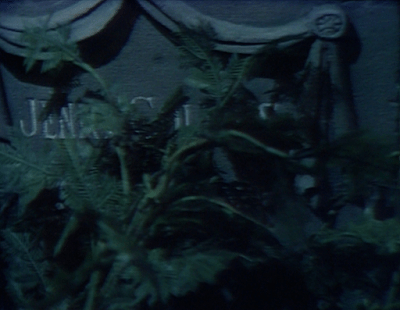
*Jenny must have been in someone’s mind when they were making this episode. We catch a glimpse of a gravestone in her name during a cemetery scene:
Evil wizard Tim Stokes combined medicine with black magic to connect his late daughter Angelique with a woman named Roxanne. The connection drains most of the “life force” from Roxanne into Angelique. This rendered Roxanne comatose and allowed Angelique to move among the living so long as Roxanne neither dies nor gets even a tiny bit better.
Vampire Barnabas Collins and mad scientist Julia Hoffman are interlopers from another dimension. They know what Stokes has done and want to defeat Angelique. They made off with Roxanne and were keeping her in the Old House on the grounds of the estate of Collinwood, planning to use some mad science equipment to revive her. Roxanne did perk up after the first treatment, and Barnabas took her on a date to his favorite place, the old cemetery north of town, where she showed some signs of recognizing her surroundings.
Yesterday, Stokes went to the Old House to search for Roxanne while Barnabas was out. When Barnabas got home, Roxanne was nowhere to be found. We learn today that Stokes does not have her. He turns to a man named Claude North for help in finding her. Yesterday he told Angelique that he was most reluctant to contact North; only after an incantation calling upon all the spiritual forces of darkness fails to solve their problem does he consider turning to him. He told Angelique that North was no ordinary man, and he is evidently more unpleasant to deal with than are Satan and his minions. But he answers when Stokes picks up the telephone and calls him.
Barnabas is also familiar with “Claude North” as the name of someone linked to Roxanne. He found a drawing of her signed by North in the secret chamber in the back room of the mausoleum in the cemetery. He goes back to the cemetery twice tonight. The first time, he goes into the secret chamber and finds evidence that a man with the initials “CN” has been staying there. He takes this as confirmation that it is Claude North’s roost. It does not seem likely that it is North’s only residence, since there is no sign of a telephone there. Stokes is spying on Barnabas while he does this. He is disturbed that Barnabas knows about the secret chamber, and wonders if he has been keeping Roxanne there.
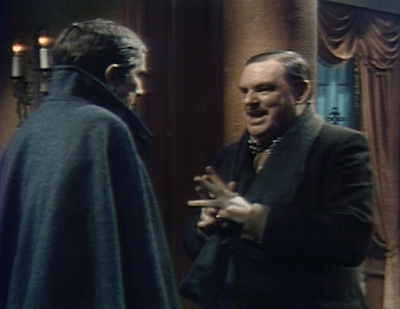
Barnabas goes back to the Old House and finds Stokes talking with the lady of the house, Carolyn Loomis. Angelique killed Carolyn’s husband Will the other day because he would not reveal Barnabas’ secret, and Carolyn has been drinking steadily ever since. Barnabas tells Stokes that since he has extended his condolences to Carolyn, he can leave now. Stokes takes his time about going. He says that Will thought that Barnabas might have a girl someplace. “Is he right, Mr Collins? Do you have a girl someplace?” Thayer David delivers this line with an urgency that elevates it from mildly clever to almost brilliant. Jonathan Frid responds with a slow burn that brings the exchange to perfection. Barnabas knows that Stokes neither has Roxanne nor knows that he does not have her, but he also knows that Stokes, as a native of this universe, is likelier to find her than he is.
“Do you have a girl someplace?” Screenshot by Dark Shadows Before I Die.
Barnabas goes back to the cemetery and finds Roxanne there. She is kneeling at a gravestone. It marks the grave of Claude North, who lived from 1814 to 1866.
In his own world, Barnabas was trapped in the counterpart of the secret chamber in the mausoleum for 171 years. So regular viewers think of that chamber as a place for vampires. North’s tombstone suggests that he might be such a creature.
Moreover, the drawing of Roxanne evokes Charles Delaware Tate, an artist who was a character on the show in 1969. Tate had the magical power to bring people to life by drawing them. He became obsessed with a woman he created in that way. As my wife, Mrs Acilius, points out, Tate’s erotic preoccupation with a product of his own imagination is as much a metaphor for extreme selfishness as is the vampire. So if the answer to the question of Roxanne’s origin is that she sprang into being as the result of North’s drawing of her, it would only be appropriate if North were also a vampire.
There is a scene in the room on top of the tower at the great house of Collinwood. Carolyn goes there and looks at the window from which Will fell to his death. To her surprise, sourpuss Quentin Collins enters the room. Quentin is a fugitive from justice, having assaulted a policeman and fled from jail because he was under arrest for murder. He makes menacing remarks demanding her silence; she’s so drunk that it doesn’t seem likely she will remember he was there. In the other continuity, the Collinses had a habit of using the tower room, which is entirely enclosed in windows that can be seen from every part of the estate, as a hiding place; we can see that their counterparts here maintain the same self-defeating tradition.
Foul-tempered sourpuss Quentin Collins has been charged with murder. He has a visitor in jail. He believes her to be Alexis Stokes, identical twin sister of his late wife Angelique. In fact, she is Angelique herself, come back to life and bent on revenge.
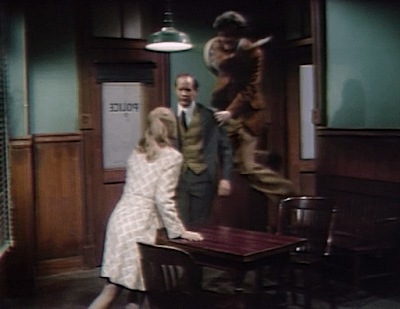
Angelique urges Quentin to escape from jail and set about proving his innocence. Quentin is not the brightest fellow, so this sounds like a good idea to him. When the policeman in charge of the place comes in, he jumps off a chair, delivers a karate chop to his neck, and runs out.
From November 1967 to March 1968, Dark Shadows was a costume drama set in the 1790s. Another iteration of Angelique figured then as a witch. That Angelique deflected suspicion from herself by framing well-meaning governess Victoria Winters for her crimes. Vicki had shown significant brainpower early in the series, but by that point had apparently been eating lead coins for breakfast or something. She reached her absolute nadir when she talked her boyfriend, an insufferable jerk named Peter Bradford, into helping her escape from the Collinsport Gaol so that she could prove her innocence. But dumb as that idea was, at least Vicki was able to come up with it on her own. Quentin is so dense he needs Angelique to suggest it to him.
From its first episode, one of the principal sets on Dark Shadows has been the drawing room of the great house of Collinwood. So every violent death on the show has been pregnant with the possibility of a scene in which the characters gather on that set and a detective says that he supposes they are probably wondering why he asked them to join him there. We come as close to that scene today as we ever will.
The detective is Inspector Hamilton of the Collinsport police. That is itself a disappointment to regular viewers. In #1034, a detective played by Philip R. Allen made an appearance. He had little to do, but Allen was such a dynamic actor that it was gripping to watch him do it. When we heard that the police were on their way, we might have been excited to see Allen again. Inspector Hamilton is played by Colin Hamilton. It’s always a bad sign when the producers don’t trust an actor to answer to any name other than his own, and Hamilton’s performance is a case in point. The only note he strikes today is languid annoyance. Perhaps he had watched the Thin Man movies and been impressed by the use William Powell and Myrna Loy made of that note in their portrayals of Nick and Nora Charles in their drawing room reveals, but if so he had forgotten that Powell and Loy did other things as well.
Making matters worse, Inspector Hamilton does not actually have much to contribute. Sleazy musician Bruno Hess gave him photostats of a couple of pages of the journal of the late Cyrus Longworth, homicidal maniac, in which Cyrus speculates that his friend Quentin Collins murdered Angelique, his first wife. But Cyrus did not see Quentin commit that crime, so the papers are in no sense evidence.
Quentin gets very angry with Bruno. Standing next to Inspector Hamilton, he declares that Bruno will never make trouble for him again and that he will put a stop to him “with my bare hands!” He then rushes out of the house. At length, Inspector Hamilton moseys over to Bruno’s place.
The camera gets there before Inspector Hamilton does. We find Quentin crushing Bruno’s throat in his elbow. He releases him and shouts that he isn’t “worth killing!” A moment later, Bruno starts choking and falls to the floor. Quentin ridicules him, then kneels down and finds that he really seems to be unconscious. Inspector Hamilton then enters and says that he hopes for Quentin’s sake that Bruno isn’t dead. This line is a bit surprising; it would have fit with Colin Hamilton’s lazy performance had Inspector Hamilton said that he hopes Bruno is alive so he won’t have to stay up late doing paperwork.
As it happens, Angelique has returned from the grave and is impersonating her identical twin sister Alexis. None of the other characters in today’s episode are onto her. We see her flash a self-satisfied grin every time Quentin annoys Inspector Hamilton by proclaiming his intention of killing Bruno. We also see her cast the spell that causes Bruno to choke and die.
Bruno’s death is no great shock. He smacked Angelique around yesterday, a sure sign of a short and unhappy future, and had been absent from the action and unmentioned on screen for more than six weeks before he came back on Tuesday. Actor Michael Stroka will be back later as another character.
Angelique could be fairly sure that Quentin was in Bruno’s cottage and that Inspector Hamilton was on his way there when she was casting the spell, but she has no powers of remote viewing. For all she knew, Quentin may have been choking Bruno while she was casting the spell. Had that been the case, we would have been presented with a puzzle in logic. Bruno would have died of strangulation while Quentin was strangling him, but there would be a sense in which we could say that Quentin was not the strangler. That sense might not have made much difference to Quentin’s felony exposure, though Angelique would also be guilty of the killing.
This scenario should remind viewers who have been with the show from the beginning of the first murder mystery on Dark Shadows, the vehicular homicide of a man known only as Hansen. Hansen was walking by the road one night in 1956 when a car hit him and continued on. The owner of the car, Burke Devlin, was convicted of manslaughter and sent to prison for five years. It later turned out that Burke had been blacked out drunk when he started driving the car away from a restaurant, and that he gave the keys to his passenger, Roger Collins, after they had gone some way. Roger was also heavily intoxicated, and he was behind the wheel when the car hit Hansen.
Burke claimed that Roger’s role in Hansen’s death exonerated him of guilt. But since Burke knew that Roger had had as much to drink as he had, handing the keys to him was scarcely more responsible than operating the vehicle himself. Indeed, by the time of the collision Burke had passed out, so if he had kept the keys the car would not have been moving and Hansen would have had nothing to fear. The fact that Roger was also guilty of a crime does nothing to clear Burke. Remembering that, we may wonder whether Angelique’s participation really clears Quentin.
The version of Quentin that became a major breakout hit was the one we saw in 1969, when the show was a costume drama set in the year 1897. That Quentin had all of the vices Roger had in 1966, and like Roger was witty and full of joie de vivre. The easygoing 27 year old David Selby had a sex appeal that reached young viewers who did not respond to Louis Edmonds in that way, and the show was free to make villains into permanent parts of the cast of characters at that point, so Quentin became what Roger might have been.
After the show returned to a contemporary setting in late 1969, it struggled to find a place for Quentin. Now they have crossed over into an alternate universe, and they have dabbled with the idea of turning his counterpart into an action hero like Burke. That hasn’t worked at all, but then Burke’s own arc of development fizzled out, so I suppose we can say that Parallel Quentin really is a mashup of Burke and Roger.
In November 1967, well-meaning governess Victoria Winters participated in a séance. She came unstuck in time and found herself in the year 1795. For the next four months, Dark Shadows was a costume drama set in the late eighteenth century. Viewers made the acquaintance of wicked witch Angelique and learned how old world gentleman Barnabas Collins first became a vampire.
Vicki herself learned nothing from her trip back in time. She spent the first part of it telling the actors about the parts they had played in the first 73 weeks of the show. After that incredibly stupid habit had burned away any goodwill the audience had for the character, Angelique framed Vicki for her own acts of sorcery. Vicki at first refused to take these charges seriously, an inexplicable response given both her knowledge of the period in which she found herself and her extensive experience with the supernatural in her own time, then kept looking for the most idiotic possible means of defending herself until she was sent to the gallows. In the nick of time, she was whisked back to the séance and to the 1960s, rope burns already visible on her neck. Vicki never regained the audience’s sympathy, and was written out later that year. Maggie Evans succeeded Vicki both as governess at Collinwood and as the perpetually imperiled heroine.
Now Barnabas has traveled in time, not backward, but sideways. He is in an alternate universe, which the show insists on calling “Parallel Time.” Here, Maggie’s counterpart is married to foul-tempered sourpuss Quentin Collins, the master of Collinwood. Angelique’s counterpart is Quentin’s late first wife, returned from the grave and scheming to get Maggie out of the way so that she can remarry her widower. Angelique casts a spell today that leads Quentin to confront Maggie and announce that he is certain that she is a witch.
The 1790s segment was in some ways one of the show’s greatest triumphs, but nothing about Vicki’s part in it was very good. So seeing this Angelique reenact the story that culminated in the witchcraft trial will bring a sinking feeling to longtime viewers. It doesn’t help that Maggie has made a number of inexplicably foolish decisions and quailed in the face of opposition she would seem to be able to overcome easily.
Moreover, Quentin is such a miserable husband to Maggie that we have no rooting interest in their marriage. He is being relatively nice to her at the beginning of the episode, because she was just abducted and imprisoned by a madman, and he feels vaguely guilty that he had jumped to the conclusion that she left voluntarily and berated everyone who suggested she might be in trouble. But even in those nice moments he maintains a paternalistic, condescending tone towards Maggie. When she wonders aloud what other crimes her abductor might have committed, he insists that there could not have been any others and becomes exasperated with her for raising the topic. That led my wife to yell at the screen “Quentin, you are the worst husband! There may be others who are also the worst, but you are the worst!”
When Quentin so quickly flips from acting like he is indulging the moods of his silly child-bride to accusing Maggie of witchcraft, he not only confirms Mrs Acilius’ assessment that he is “the worst.” Coming so shortly after the abduction story, he seems to be a man blaming his wife for being raped. Indeed, the man who abducted her had in #1022 and #1023 jumped her and sexually assaulted her in a dark alley, and she explained her decision to keep quiet about that attack by saying she was afraid Quentin would blame her. This is an important theme, but it would be a tricky one to explore on a show about witches and vampires and time travel and parallel universes where the median viewer is about ten years old.
Perhaps it would have been possible to have another take on the themes of the 1790s segment that would not have led us to this particular dead end. I think of a comment left in 2017 on Danny Horn’s great Dark Shadows Every Day:
You know, [Parallel Time] might have had a very different feel with the following changes:
Alexandra [Moltke Isles] takes the role of Quentin’s evil first wife, Victoria Stokes Collins. There is no nice twin. She dabbles in “the black arts” but is not a full-on witch. She and Quentin have a son, David.
Lara Parker takes the role of Quentin’s new wife, Angelique “Angela” Evans. She’s kind-hearted and traditional and a romantic. She has no witchcraft powers. But not quite the pushover as time goes on.
And Kathryn Leigh Scott plays Margaret “Maggie” Evans still, but she’s now Angela’s sister and Cyrus’ lab assistant. She’s a modern woman — middle class, educated, confident, reluctant in matter of love.
Maggie and Angela are different — Maggie is the more confident, assertive, cynical of the two — but they are close and both “good” girls. Maggie doesn’t like Quentin.
Lisa Richards is looking for other work.
So in this version, there was a seance two years ago but instead of a murder, Victoria just simply vanished when the lights went out. They never learned what happened. There is no portrait. No one mentions her by name.
When Barnabas enters parallel time, Quentin has just brought Angela home, with Roger and Hoffman treating her like crap.
After about two weeks of establishing all these new relationships, they recreate the seance.
The lights go out, and when they come back on, there’s Victoria in clothing from the late 1700s. She has no memory of what happened — and doesn’t really care. She wants her rightful place as mistress of Collinwood back. (Explanation for her vanishing and returning: Daddy Stokes playing with I-Ching wands. Victoria kills her father when she learns he did that).
Can you imagine the shock for the audience to have “Vicky” just show up like that? And in the same manner RT Vicky did. And then to be evil?
That really could have been fun.
Comment left 29 July 2017 by “William” on “Episode 1056: The Parallel Sky,” Danny Horn, Dark Shadows Every Day.
I like this idea very much. When she played Angelique’s identical twin Alexis, Lara Parker created a character who was not murderous, but far from a naif, and it is easy to imagine that a person like that would have stood up well enough to the kind of stresses that the wicked witch would bring against her to keep the drama going for some time. And it would be a nice inversion, not only to see the evil Vicki persecuting the innocent Angelique, but also to have his unresolved feelings for Vicki render the time traveler Barnabas as clueless in the evil Vicki’s proper world as the well-meaning Vicki was in Barnabas’ native time.
Moreover, these last two weeks the barrier between the universes has been getting leaky. So when the evil Vicki is finally thwarted here, she might escape into the original continuity and wreak havoc there. That would pick up on a road not taken in #872, when sorcerer Count Petofi escaped from the year 1897 and made his way to the Collinwood of the present day, only to be snatched back to the past after a few minutes.
I can’t wish that all of “William’s” dreams had come true. I like Lisa Blake Richards, so I’d want to leave her in the Jekyll and Hyde story and come up with another storyline to feature Kathryn Leigh Scott, either as Maggie or as another character. And it is a gift to viewers who have been with the show from the beginning that David Henesy’s character in Parallel Time is called Daniel Collins rather than David Collins, the name of his part in the other continuity, since the point was made in #153 and referenced later that David’s name was the result of events that wouldn’t have happened here. And while the séance gimmick is too good not to do, I would still like to see Mrs Isles play twins- the evil Victoria and her non-evil sister Veronica.*
*Mrs Acilius doesn’t like the name “Veronica” for this character. She’d rather call her Vanessa or Vivian.