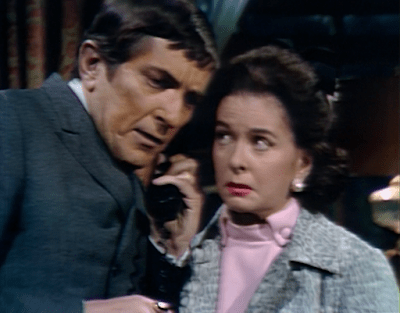
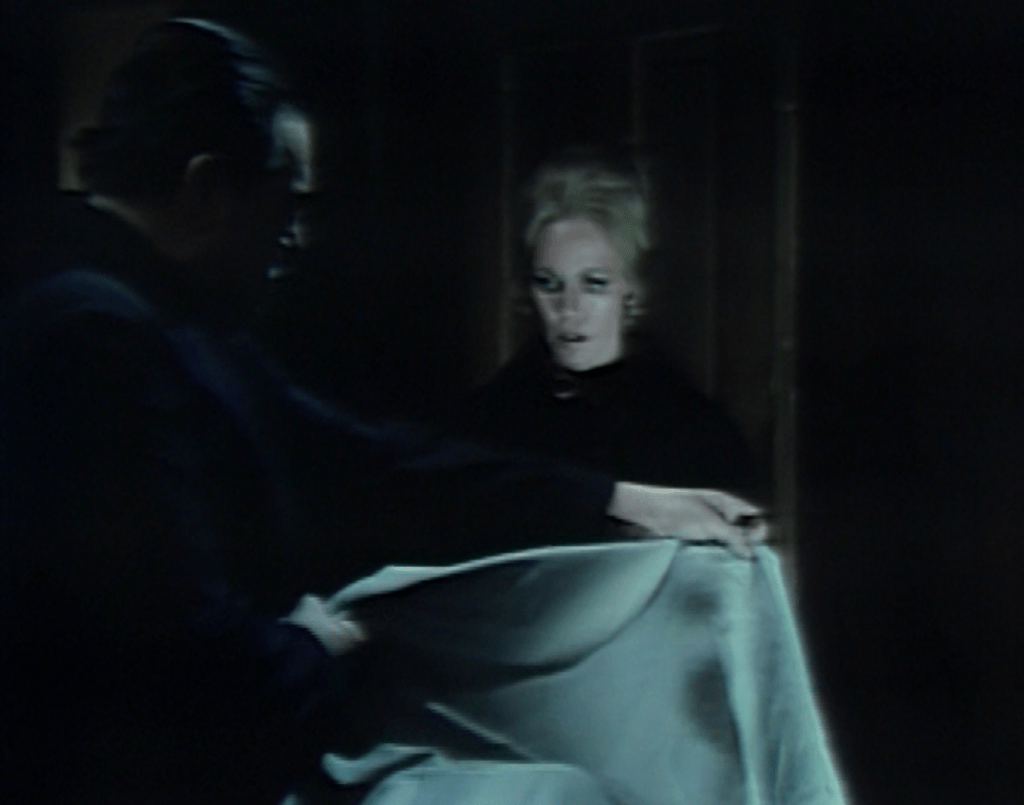
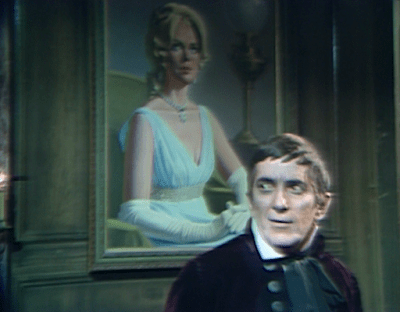
Episode 985: She is not like others

This is the last script that will be credited to writer Violet Welles. Welles had done a substantial amount of rewriting on scripts attributed to her friend Gordon Russell before her name first showed up in the credits with #711, and she will do more ghosting for Russell later.

Danny Horn’s post about this episode on his great Dark Shadows Every Day is a tribute to Welles; I recommend it highly. Welles was far and away the best author of dialogue among the nine writers credited through the show’s 249 weeks, so much so that her uncredited contributions are easy to recognize. I will mention a week very close to the end of the series in 1971, a long time after the wheels came off, when all of a sudden characters start making witty remarks and developing interesting relationships. Then it’s back to the dreariness of a bunch of go-nowhere stories.

Welles rated herself low as an inventor of plot-lines. I don’t know what went on during the long hours she spent in story conferences with Russell and Sam Hall, but it was when she was in the room that the most fertile planning sessions Dark Shadows ever had took place. They sketched out flimsies thirteen weeks at a time, and from the time Welles became a regular part of the staff until thirteen weeks after she left, the show was packed with more lively ideas than at any other time. So if she was correct in that harsh self-assessment of what she did in the writers’ room, it was only in the narrowest sense.

Welles also spoke disparagingly of herself as a designer of dramatic structure at the level of individual episodes, but today’s installment shows that this was simply wrong. There is a tremendous amount happening in these 22 minutes, it is crystal-clear throughout what is happening and why we should care, and the actors get to do some of the best work they ever did do. We see two stories, one a mashup of Daphne Du Maurier’s 1938 novel Rebecca with Edgar Allen Poe’s 1838 short story “Ligeia,”* the other a retelling of Robert Louis Stevenson’s 1886 novella Dr Jekyll and Mr Hyde, also with a dash of “Ligeia.”

The episode is set in a different universe than the one in which the first 196 weeks of Dark Shadows took place, and most of the characters are “Parallel Time” counterparts of those we met in the main continuity. In the Rebecca/ Ligeia mashup, we today see Quentin Collins, master of the estate of Collinwood, owner of Collinsport Enterprises, and gloomy drunkard; Quentin’s new wife, Maggie Evans Collins; housekeeper Julia Hoffman, fanatical devotee of Quentin’s late first wife Angelique; and Alexis Stokes, Angelique’s freshly arrived identical twin sister. The bit from the Jekyll and Hyde story features scientist Cyrus Longworth and attorney Chris Collins. Angelique comes up in Cyrus and Chris’ conversation, and she is emerging in the role of Ligeia. Like the eponymous character in Poe’s story, she is a celebrated beauty who is dead but expected to return. Alexis herself brings up yet another reference. She wears a short bluish gray suit and chignon hairstyle with a tight spiral twist at the back, the look that the mysterious Madeleine wore and her impostor copied in Alfred Hitchcock’s Vertigo.

Jekyll and Hyde Meet Ligeia

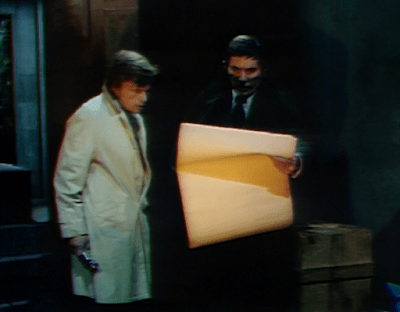
I’ll start with the Jekyll and Hyde story, since it is the simpler one today. Chris is the estate manager at Collinwood, and his responsibilities include custodianship of Angelique’s personal effects. His friend Cyrus has called Chris to his basement laboratory to ask for a favor. Angelique had told him about a chemist in Boston who could help him with some obscure formula he needs for his current experiments. She gave him the man’s contact information, but he lost it, and he wants to look for it in Angelique’s address book.

Before they start talking about the address book, Cyrus tells Chris that he saw Angelique in town today. He tells him he was driving past the drug store and saw her walking down the street. He called to her and she did not answer, but he is certain it was she. Chris does not yet know that Angelique’s identical twin sister is in town, so he does not tell Cyrus about Alexis. He starts with a philosophical approach, then veers towards the explanation medical:

CHRIS: Cyrus, you’re a scientist. A scientist deals in established principle and fact. One thing we have to accept is that death is the end.

CYRUS: I often wonder. People used to believe that the world was flat. They believed that, that the sun revolved around the earth, and these were facts to them.

CHRIS: Uh, what are you saying?

CYRUS: I’m saying that I saw Angelique. I saw her walking down the street.

CHRIS: Well, I wish to submit that there’s an explanation for it. All of this.

CYRUS: What do you mean by that?

CHRIS: You’ve been working yourself too hard. You’ve been locked in this laboratory for over a year. Whatever you’re doing it can’t be worth your health and your peace of mind. It might even damage your mind.

Cyrus tells Chris what he is trying to do:

CYRUS: Let me begin by saying that, that man is chemical in his composition. Now, if the proper compound was distilled, and administered to a human being, this chemical composition could be radically changed, radically altered, and I’ve been working on this composition.

CHRIS: Why, why alter a human being?

CYRUS: Now let me also say this. That man is not one person, he is two. One is good, and the other is, oh, let us say for scientific conversation, the other is evil. Now, these two people are within each of us, and they are always fighting against each other. But if these elements could be separated, just imagine the possibilities. Evil could go its own way, completely free of any aspirations or remorse that are foreign to it. And good, good can have its own life, free of any struggle against, against evil impulses or hostile thoughts. My god, just imagine what a person…

Chris is horrified by this idea, and is glad to be an obstacle to it. Director Lela Swift reinforces Chris’ conviction that Cyrus is destroying himself by placing Christopher Pennock next to a mirror during the most perfervid part of his mad scientist’s programmatic statement, a visual metaphor telling us that Cyrus is splitting himself in two.

Chris is worried that his friend is going to pieces. Screenshot by Dark Shadows Before I Die.

Chris tells Cyrus that he won’t help him bury himself even more deeply in the strictly private world he has created. Cyrus says that it is not private, that it is something he shares with Angelique:

CYRUS: Angelique believed in this theory. She believed it could be done. And she was the one who started me on, on all these experiments. Separating good and evil.

CHRIS: (sourly) There is no doubt in my mind which of the two appealed to her.

Chris tells Cyrus that he has been anxious to see him. He has heard that he presented a paper on black magic to a scientific society, and that the news led him to fear that Cyrus’ mind is becoming unbalanced:

CHRIS: I admire your devotion, Cyrus, but not your direction. It can only lead to trouble.

CYRUS: It can only lead to glory. And it will. Very fast, if you’ll just give me the name of that chemist.

CHRIS: No. I’m sorry to withhold it from you, but it’s the only way I can stop you. And I think I have to stop you. I desperately think that.

Angelique was not only a great beauty and a gracious matron, but was also a scientific mind who inspired Cyrus to pursue his scheme. She could introduce an experimenter to chemists whose specialties are so obscure that they cannot be found in any published directory, and her influence leads to the study of black magic and a skeptical view of the finality of death. In these matters, Angelique recalls Ligeia. The unnamed narrator of Poe’s story, Ligeia’s widower, says of her:

I have spoken of the learning of Ligeia: it was immense –such as I have never known in woman. In the classical tongues was she deeply proficient, and as far as my own acquaintance extended in regard to the modern dialects of Europe, I have never known her at fault. Indeed upon any theme of the most admired, because simply the most abstruse of the boasted erudition of the academy, have I ever found Ligeia at fault? How singularly –how thrillingly, this one point in the nature of my wife has forced itself, at this late period only, upon my attention! I said her knowledge was such as I have never known in woman –but where breathes the man who has traversed, and successfully, all the wide areas of moral, physical, and mathematical science? I saw not then what I now clearly perceive, that the acquisitions of Ligeia were gigantic, were astounding; yet I was sufficiently aware of her infinite supremacy to resign myself, with a child-like confidence, to her guidance through the chaotic world of metaphysical investigation at which I was most busily occupied during the earlier years of our marriage. With how vast a triumph –with how vivid a delight –with how much of all that is ethereal in hope –did I feel, as she bent over me in studies but little sought –but less known –that delicious vista by slow degrees expanding before me, down whose long, gorgeous, and all untrodden path, I might at length pass onward to the goal of a wisdom too divinely precious not to be forbidden!

At the end of Poe’s story, the narrator’s second wife appears to die. Her body is eventually reanimated with the personality and even in the likeness of Ligeia. Cyrus’ un-nuanced belief that the woman he saw was Angelique come to life suggests that he expects her to follow in the footsteps of that other learned woman.

There is a poignancy now in seeing Don Briscoe play Chris’ concern for Cyrus. Briscoe suffered from bipolar disorder, and was at this time trying to self-medicate with street drugs. After he was violently mugged while trying to score a fix late at night in Central Park, he wound up leaving acting and moved into his parents’ house in Tennessee. He died there, morbidly obese, at the age of 64. I suppose what Dr Jekyll wanted was to come up with a drug that could sort the contents of the mind into orderly batches, so that people like Briscoe could live the lives they deserved to live.

Ligeia at Manderley

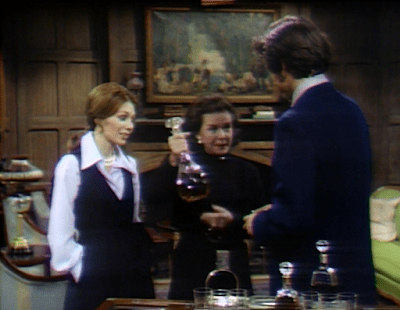
Meanwhile, at Collinwood, Quentin has been extremely stingy with information Maggie should know, and has neglected to tell her that Angelique had an identical twin. Hoffman and others on the estate are convinced that Angelique will somehow come back to life, and in their obsession with this idea they have made Maggie exceedingly uncomfortable in her imposing new home. Making matters worse, night before last Maggie heard a voice that she can believe to have been part of a prank played on her by Quentin’s son, strange and troubled boy Daniel, but which Daniel and we have reason to believe was actually Angelique’s ghost. So when Maggie opens the doors to the drawing room and sees Quentin giving a glass of sherry to a woman who, to all appearances, can only be Angelique, she flees in panic.

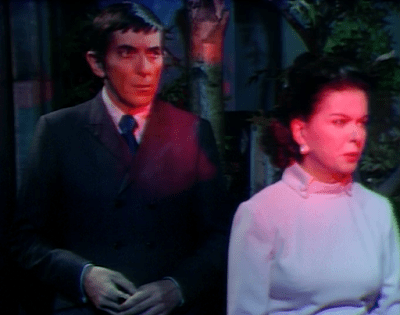
Quentin goes to Maggie in her bedroom. He explains that the woman she has seen is Angelique’s twin Alexis. At first he is relaxed and soothing, as charming as the Quentin of the main continuity has always been, almost as charming as David Selby is. But as Maggie insists on being left alone, his mood darkens. Alexis sticks her head in and suggests they should clear things up right away; Quentin asks her to wait downstairs. When Maggie refuses to be formally introduced to Alexis and play hostess to her, Quentin becomes stiff, grouchy, and patronizing, ordering her to do her duty as mistress of the house. She does not bend, and he leaves the room in a huff.

Back in the drawing room, Alexis tells Quentin she ought to leave rather than go on upsetting Maggie. Quentin dismisses Maggie’s concerns and proclaims that he alone makes decisions at Collinwood. Alexis is visibly startled by Quentin’s claim to autocracy, and doesn’t know where to look or what to do with her hands as she stammers out “Of course… you… make the decisions.” She goes along with Quentin’s decree that she will stay in the house starting tonight, before she can get her luggage back from the inn in the village.

Hoffman enters. At the sight of Alexis, she gasps “It- it’s you!” Hoffman composes herself quickly, and says that Angelique often spoke of her sister. She asks Alexis if she received the letter she sent her when Angelique died. Alexis says she missed it. Hoffman had sent it to her address in Tangier, but Alexis had moved from there to Florence by that time. Alexis does not seem to be in any particular business, and she describes her decision to return to Collinsport as motivated by a vague feeling of personal obligation, so we can assume that her long stays in these famous cities are a sign that she and Angelique have private resources that amount, if not to a fortune, at least to a competence. Hoffman suggests that Alexis stay in Angelique’s old room. Quentin does not object, and Alexis agrees.

Alone in the drawing room, Quentin wishes Alexis did not resemble Angelique so uncannily. In a gruff tone, he tells himself “I’m as bad as Maggie, I’m behaving like a frightened child.” Quentin’s attitude when he was lecturing Maggie about Alexis had indeed been that of an impatient adult ordering a child to stop having an inconvenient emotion. Since he does not believe he handled that exchange badly, it’s jarring to hear him say explicitly that he saw it that way. He pours himself a stiff drink.

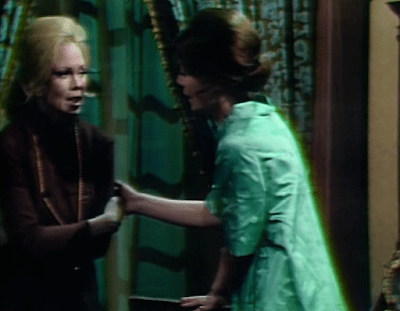
In Angelique’s room, Hoffman tells Alexis she doesn’t have to lie to her. She may have her reasons to pretend with the others, but with her she can talk openly about the fact that she is Angelique risen from the grave. Alexis is thunderstruck by this, and tries to reason with her:

ALEXIS: You thought Angelique would come back? But that’s impossible, she’s dead.

HOFFMAN: She is not like others.

ALEXIS: She certainly wasn’t like anyone else. Nevertheless, she is dead. Do you hear me? She’s dead, and I’m her sister.

Hoffman tries to trip Alexis up by asking which nightgown she would like from Angelique’s dresser. Alexis points out that she has never seen any of them, so she can’t very well answer. Hoffman starts to apologize for her bizarre conduct:

HOFFMAN: I’m sorry, Miss Stokes, I’m sorry if I’ve said anything–

ALEXIS: It’s perfectly all right. I can understand how much you must miss her. But I wouldn’t intimate such a thing to anyone else if I were you. They might be very distressed by it, and so might you.

This exchange is very effective, particularly for regular viewers. Up to this point, Lara Parker has been playing Alexis quite differently than she played Angelique. Even when Angelique had been defeated in a conflict or was trying to seem like a wounded innocent, she always maintained eye contact with her scene partners and found a way to put a little more drama into her voice than any other performer would have thought to do. But Alexis looks down when she is confused, talks in a soft and casual tone when she thinks she understands what’s going on, and asks questions to which she obviously does not already know the answer. We can believe she really is a different character. But her last two sentences to Hoffman are exactly what Angelique would have said. When Alexis lifts her head and delivers them with her right eye fixed on Hoffman, we are suddenly in suspense as to whether Ligeia has already returned.

On her way out of the room, Hoffman passes Maggie. Without turning to face her, she explains that Alexis is staying, at Quentin’s orders. This brief scene is blocked as an homage to Hitchcock, whose 1940 film of Rebecca will have come to mind when Hoffman mentioned Angelique’s nightgowns. The censors tried to prevent the release of that movie, because of a scene in which obsessed housekeeper Mrs Danvers took a nightgown out of a wardrobe positioned in the same spot of the late Rebecca’s room as is the wardrobe in Angelique’s. Mrs Danvers went on and on about how sheer the nightgown was, how “You can see my hand through the material,” etc. Dark Shadows isn’t quite as bold with the homoerotic subtext of Hoffman’s devotion to Angelique as Du Maurier and Hitchcock were with that of Mrs Danvers’ devotion to Rebecca, but the shot is so much in his style and the movie was so famous that a large percentage of the grownups in the audience would likely have picked up on the reference.

Without a Hitch. Screenshot by Dark Shadows Before I Die.

Maggie goes to the drawing room, and finds that the decanter Quentin was drinking from is empty and lying on its side. She goes to Angelique’s room. She arrives just in time to see her obviously intoxicated husband in his first wife’s bedroom, with a woman who looks exactly like that first wife who is wearing a frilly nightgown, putting her hand on his shoulder, and saying in a soft voice “Perhaps we can comfort one another.” When we saw this, my wife, Mrs Acilius, said that she would not be especially pleased if she were to find me in such a situation.

Maggie and Quentin have a showdown about this in the drawing room. It’s a sensational scene, one of the best in the series. Selby plays Quentin as a drunken, condescending grouch, trying to tell Maggie she didn’t see what she clearly saw. Kathryn Leigh Scott is spellbinding as she plays Maggie’s rage. I think it’s her best moment since #265, when the Maggie of the main continuity was a mental patient and went completely nuts while singing “London Bridge.” That, I think, was the scariest scene they ever did, making us think our old pal Maggie was never going to be all right again.

This time Miss Scott doesn’t sound like any character we’ve heard her play before. In fact, she sounds more like a real person than anyone else ever does on Dark Shadows when Quentin has forbidden her to mention Angelique’s name and she responds “You forbid me! Forbid me like a child, and I am not a child, and I refuse to be treated like a child. Not by you or by anyone. I know what I heard and I know what I saw!” At that, Maggie Collins becomes a distinct character and the Parallel Time storyline jumps to a new level.

Quentin whines that Maggie isn’t giving him a chance, and she lets him have it:

MAGGIE: Nobody’s given me a chance. No. This is Angelique’s house, not mine, you’re Angelique’s husband, not mine.

QUENTIN: All right, if that’s the way you feel about it, get out of here!

MAGGIE: All right, Quentin.

QUENTIN: Leave Angelique’s house and leave Angelique’s husband!

MAGGIE: That’s exactly what I’ll do. That is exactly what I will do!

And to Quentin’s bewilderment, that’s exactly what she does. She rushes out the front door. After a bit, Quentin staggers after her. He looks outside. Alexis comes downstairs, in her sister’s frilly nightie, and asks what happened. Quentin frets that “She actually went out that door.” Alexis asks if he is going after her, and he says “No, why should I? She behaved like a child!” He’s still holding onto the idea that it is right and proper for him to regard his wife as a temperamental child. He wonders if perhaps Alexis is right, then hears Maggie drive away and announces that it’s too late to do anything. He wanders back towards the drawing room while Alexis looks on. We are left wondering if she is Angelique masquerading as her sister, or if Alexis, contrary to appearances, was actually the Evil Twin all along.

*I am indebted to Danny Horn’s commenter “Riccardo” for pointing out the connection to “Ligeia.”

Episode 984: A rare person

The protagonist and narrator of Daphne Du Maurier’s novel Rebecca is the second wife of the enigmatic Maxim de Winter. The theme of the story is the protagonist’s timidity. She never introduces herself to us or reports a conversation in which anyone addresses her by name, so that we can call her only “the second Mrs de Winter.” Many people around her have something to say about Maxim’s first wife, the late Rebecca, though Maxim himself never mentions Rebecca and becomes upset when anyone reminds him of her. From this, the second Mrs de Winter concludes that Rebecca was an unsurpassably glamorous being and that Maxim is still in love with her and always will be. She is terrified of housekeeper Mrs Danvers, but since she would be terrified of anyone, this does not constitute evidence that Mrs Danvers actually represents a threat to her. In fact, the main thing about Mrs Danvers is her ambiguity. We have no way of knowing what she is thinking. Nor do we know what she is doing until the end of the book, when it turns out she is more dangerous even than the narrator had feared. It is also at the end that the second Mrs de Winter finds that Maxim’s hang-up is not his unquenched love for Rebecca. He never loved Rebecca, and would have been glad when she drowned were he not afraid of being prosecuted for his role in her death.

Alfred Hitchcock’s 1940 film Rebecca had to make several things definite that the novel could leave unsettled. So, while in the novel Mrs Danvers is a figure we glimpse in the course of her narrator’s confused attempts to remember what happened in her early days in the mansion, in the film she is a major character in several scenes. So we saw from relatively early on that Mrs Danvers was deliberately playing on the second Mrs de Winter’s insecurities in an attempt to get rid of her.

The film deviates even further from the book in showing Mrs Danvers’ motivation. Du Maurier was herself bisexual and may have started Rebecca with a plan to sketch Mrs Danvers as a mind warped by life in the closet, but as the story turned out it did not shed any light on the roots or structure of Mrs Danvers’ very intense feelings for Rebecca. It was just one more item on the endless list of things that the second Mrs de Winter could not hope to understand. But Judith Anderson’s performance of Mrs Danvers’ fixation on Rebecca struck film censor Joseph Breen as providing a “quite inescapable inference of sex perversion.” Anderson would deny then and in later years that she meant to play the character that way, but her body language throughout, most famously in the scene where Mrs Danvers handles Rebecca’s intimate apparel, makes those denials laughable.

Now, the A story of Dark Shadows is an adaptation of Rebecca. We are in an alternate universe, where the counterparts of Maggie Evans, Quentin Collins, Julia Hoffman, and wicked witch Angelique are cast in the roles of, respectively, the second Mrs de Winter, Maxim, Mrs Danvers, and Rebecca.

There is even less ambiguity here than in Hitchcock’s film. So after Miss Hoffman sets up a moment to enrage Quentin and confuse Maggie, Maggie goes to Angelique’s old room and hears Miss Hoffman telling the portrait of Angelique that hangs there how inadequate she had exposed her as being, cackling with glee all the while. Today Miss Hoffman sets up another such moment, suggesting Maggie give Quentin’s son Daniel a particular record that she knows Quentin will fly into a rage upon hearing. Miss Hoffman is so blatant that Quentin catches on to what she is doing and orders her to apologize to Maggie. When she does, she drifts off halfway through into a rhapsody about how irresistibly beautiful Angelique was. Grayson Hall had played lesbian characters in two films, Satan in High Heels (1962,) which became a cult favorite, and Night of the Iguana (1964,) for which she was nominated for the Academy Award for Best Supporting Actress. So she is on familiar ground when Miss Hoffman’s craving for Angelique becomes a spoof of Mrs Danvers’ homoerotic attachment to Rebecca.

Miss Hoffman. Screenshot by Dark Shadows Before I Die.

It is not only in the character of Miss Hoffman that this version of Rebecca is less subtle than were those that preceded it. Maggie is even slower on the uptake than was the second Mrs de Winter. Even after she heard Miss Hoffman cackle about her deficiencies, and even after multiple people have made it clear that they are siding with her against Miss Hoffman, she still takes her advice and buys the record. Quentin is quite reasonable today, but that’s a first- so far, he has been even more miserly with information than Maxim was. And where Rebecca was an intimidating memory that became an inconvenient corpse, we end today’s episode with Maggie opening the doors to the drawing room and seeing Quentin offering a glass of sherry to someone who, for all she sees, can only be Angelique come back to life.

UPDATE: Thanks to FotB Melissa Snyder for pointing out a mistake in the original post. You can get the details in the comments below!

Episode 982: Keep the bottle full

In #210, dangerously unstable ruffian Willie Loomis found a coffin wrapped in chains in an old mausoleum and jumped to the conclusion that it was full of jewels. He broke the chains and opened the coffin, only to find that it actually contained vampire Barnabas Collins. Barnabas bit Willie and enslaved him.

Now, Barnabas has traveled to an alternate universe. In this “Parallel Time,” Willie’s counterpart is a writer, the author of several novels and of a biography of Barnabas’ own counterpart, who died a natural death in 1830. This Will Loomis lives in the Old House on the estate of Collinwood, which corresponds to Barnabas’ home in his own universe. Will’s wife, the former Carolyn Collins Stoddard, was the first person Barnabas met upon arriving in Parallel Time. Barnabas took Carolyn as his blood thrall, and he has shown her a room in the basement of the Old House that she never knew existed. He stashed a coffin there.

Three of Will’s novels were bestsellers made into feature films, but he and Carolyn are now acutely short of funds. We see why today. Carolyn explains to Barnabas that Will won’t be home until the Eagle closes. Barnabas asks what the Eagle is. He should know- that was the name of the tavern in his Collinsport in the 1790s and again in 1897, and he knew it in both eras. The same place was called the Blue Whale in the 1960s in the main continuity, but evidently it kept its old name here.

Will comes staggering home. He recognizes Barnabas’ profile from a sketch of the subject of the biography he wrote. Carolyn explains that Barnabas is that man’s descendant. When Barnabas says that he read Will’s book and admires it, Will brightens, as authors do, and says that the occasion calls for a drink. At first he insists on putting Barnabas up as a houseguest, free of charge, but Carolyn persuades him to let Barnabas pay rent. It’s anyone’s guess how Barnabas will be paying for anything- he stumbled into “Parallel Time” quite inadvertently, without stuffing his pockets or putting on a money belt or making any other preparations. But Will and Carolyn have an extensive discussion about charging Barnabas rent in this scene, and they bring it up again later. Evidently the writers want us to think about it.

The next day, Will suggests that he and Carolyn go to the great house on the estate to meet the new mistress, the bride of Carolyn’s uncle Quentin. Carolyn pleads a migraine, and Will goes by himself. Housekeeper Julia Hoffman is about to introduce him when he cuts her off. He tells the new Mrs Collins that he knew her father. She is the former Maggie Evans. The past tense about her father Sam is news to returning viewers- yesterday Sam was mentioned in terms that left it unclear whether he was still alive, and we might have hoped to see him. In the main continuity, Sam was killed by a Frankenstein’s monster in June 1968, but that monster would not have existed in this universe.

Will says that he and Sam spent many a night drinking together at the Eagle. The new Mrs Collins is not visibly pleased to be reminded of her father’s drinking habit. She offers Will a cup of tea, and he refuses. He avers that tannic acid is bad for the health. Hoffman is at hand with a glass of brandy, and she chuckles when she agrees with him that she can tell Maggie his views about beverages. Hoffman leaves, and Will urgently whispers to Maggie that he must not trust Hoffman.

Will does not approve of tannic acid. Screenshot by Dark Shadows Before I Die.

Later, Maggie will go to Angelique’s old room in the east wing of the house and overhear Hoffman telling the portrait of Angelique that hangs there that she has her on the run. Hoffman cackles with glee at Maggie’s discomfort. Maggie opens the door and asks her what’s going on; Hoffman quickly composes herself and says that the staff hasn’t had a chance to tidy up the east wing sufficiently to welcome the new mistress.

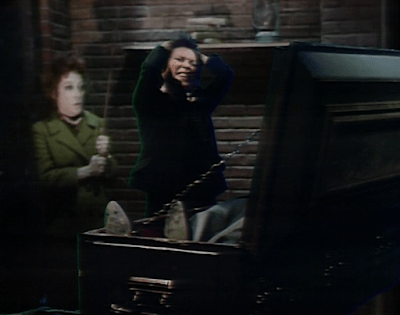
Back in the Old House, Will wonders why Carolyn seems so weak. She passes out, and he sees the puncture wounds on her neck. At daybreak, Will waiting for Barnabas by the coffin. He holds him at bay with a large cross and forces him to explain who he is and where he came from. Barnabas tells Will to let him die. Will says he has other plans. He orders Barnabas to open the coffin. There is an even larger cross mounted inside the lid. He says that he will get a book out of Barnabas, and that that book will be his salvation. He makes Barnabas get in the coffin, and chains it shut. To the extent that this universe is a mirror image of the one we have known, we might have expected that Will would believe he could obtain a fortune by putting chains on the coffin, as Willie thought he could obtain one by smashing them off.

The scene between Will and Maggie brings out several of the problems with the current A story, a reworking of Daphne Du Maurier’s Rebecca in which Maggie is the second Mrs de Winter and Hoffman is Mrs Danvers. Maggie Prime has an iconography that goes back to #1, which makes it hard for us to believe that would be overwhelmed by the subtle intimidations that overwhelm Du Maurier’s anxiety-ridden heroine. When we met the Sam of the original continuity in June 1966, he was an alcoholic. Even after the story that was supposed to make Sam’s alcoholism interesting fizzled out and he was retconned as a social drinker, Maggie retained many Adult Child of an Alcoholic traits, such as beginning each utterance with an irrelevant laugh. So Maggie’s reaction to Will’s reminiscence about boozing it up with Parallel Sam goes a long way to confirming that this is the same ol’ Maggie we’ve known all along and leads us to expect her to be as capable as Maggie would be of meeting the challenges before her.

Also, while Kathryn Leigh Scott is a wonderful actress and a great asset to the show, she makes a bad choice in playing Maggie Collins. In the costume drama segment set in 1897, Miss Scott started out as neurotic intellectual Rachel Drummond. Rachel was terribly fragile, the survivor of an abusive childhood that left her with paralyzingly low self-esteem. Miss Scott went small as Rachel, taking a subtle approach that required us to watch her closely as we tried to figure out what she was feeling and thinking. But as Maggie Collins, Miss Scott cycles through five or six facial expressions per minute and crafts a distinctive emphasis on multiple syllables per sentence. The directors famously didn’t give the actors much guidance on Dark Shadows– John Karlen said that when he first took on the role of Willie, all Lela Swift told him was “Go!” But either Swift or today’s helmsman, Henry Kaplan, should have taken Miss Scott aside and told her she was overacting and giving Maggie Collins too vivid a personality.

Further, Will is only one of many allies who present themselves to Maggie in her showdown with the memory of Quentin’s first wife, the glamorous Angelique. The second Mrs de Winter feels herself all alone at the estate of Manderley, but Maggie can’t very well feel that way at Collinwood. Not only do people who live there keep making it clear they are on her side, she has a sister to whom she starts writing a letter today, who represents support from and connection with the outside world.

Worst of all, Hoffman is absolutely transparent. In the novel, it is not clear until the very end whether Mrs Danvers is even hostile to the second Mrs de Winter. Du Maurier keeps us guessing for 400 pages whether the whole thing is in the protagonist’s fevered imagination. But the cackling Maggie overhears when Hoffman is having her conversation with the portrait is not even the most flagrant sign she has so far given of her plans.

I outlined these and other objections in a long comment on Danny Horn’s post about this episode on his great Dark Shadows Every Day in January 2021. I still agree with most of what I wrote there, and will be coming back to the topic many times over the next few months.

Episode 981: Last night I dreamt I went to Manderley again

When Dark Shadows premiered in June 1966, it was supposed to bring the sensibility of the then-fashionable “Gothic romances” to the small screen. That did not prove to be much of a ratings draw, so six months later they introduced undead blonde fire witch Laura Murdoch Collins, who was at the center of a story that by March 1967 had swallowed up all of the major loose ends and committed the show to becoming a supernatural thriller.

Now, vampire Barnabas Collins has crossed over to an alternate universe. We have seen enough of “Parallel Time” over the last several episodes to know that it will feature a story derived from Daphne Du Maurier’s Rebecca, one of the foundational works of the “Gothic romance” genre. Viewers who have been with the show from the beginning will be intrigued at this return to its starting point.

The first person Barnabas meets is the counterpart of his distant cousin and onetime blood thrall, heiress Carolyn Collins Stoddard. This Carolyn finds him in a room deep in the great house of Collinwood and demands to know who he is and what he is doing there. He starts in on the “cousin from England” jazz that won him his place at Collinwood in the continuity we have been following so far. He cites the portrait of him that hangs in the foyer in the familiar timeline, only to be told that there is no such portrait in this house and that his story does not add up. Carolyn marches off to blow the whistle on the intruder, and Barnabas bites her. We can see that Parallel Time is going to move fast- it took Barnabas 28 weeks to attack Carolyn in the other universe.

Same as the old boss. Screenshot by Dark Shadows Before I Die.

This Carolyn is married to the counterpart of Barnabas’ servant Willie Loomis. While Willie is an uneducated ruffian, Will Loomis is the author of several books, including three bestselling novels and a biography of Barnabas’ late counterpart, who died a natural death in 1830. Will and Carolyn live in the Old House, which corresponds to Barnabas’ own house in the main continuity. Quentin Collins, another distant cousin, is the master of Collinwood here, and widower of Angelique, who corresponds to the wicked witch who made Barnabas a vampire in 1796 but was apparently a mortal woman and a native of the twentieth century here. Other characters we see today include: Julia Hoffman, in the other universe, a mad scientist and Barnabas’ best friend, but here a uniformed domestic and Angelique’s fanatical devotee, Mrs Danvers to her Rebecca; Carolyn’s mother Elizabeth Collins Stoddard, who is not the owner of Collinwood and the Collins family businesses but a guest in Quentin’s house; and Quentin’s new wife, Maggie Evans Collins. We also hear that Angelique’s father is “Tim Stokes,” the counterpart of Barnabas’ sometime ally, occult expert Timothy Eliot Stokes.

What we had seen of “Parallel Time” before Barnabas arrived let us know that Quentin was bringing a new bride home, much to the displeasure of Hoffman and Angelique’s other acolytes. We also knew about the Loomises. So that left us with two candidates to play the part of the intimidated, anxiety ridden “second Mrs de Winter.” Those were Kathryn Leigh Scott, who has been Maggie in the main continuity since episode #1 and has played other parts in time travel segments and as a ghost, and Lisa Blake Richards, who plays Sabrina Stuart, girlfriend of werewolf Chris Jennings.

I love Miss Scott, but I was hoping Miss Richards would be the overpowered new wife. Miss Scott has one of the deepest iconographies of any cast member. No matter how far Miss Scott dials down the big brassy Dark Shadows style of acting, regular viewers simply will not believe that she, answering to the name of Maggie, is going to be reduced to the position that the second Mrs de Winter finds herself in, where she is grateful to her own servants for allowing her a piece of bread and butter when she hasn’t eaten all day. It took all the abuse Barnabas could heap on her, supported by Julia’s magical powers of hypnosis, to break Maggie in 1967. Miss Scott was successful as neurotic intellectual Rachel Drummond when the show was set in 1897, but they went out of their way to show that Rachel was not Maggie. The second Mrs Quentin Collins not only has the same name as the wised-up representative of Collinsport’s working class whom we met long ago, we even hear today that her father was an artist who lived in the village, as our Maggie’s was.

Miss Richards, by contrast, would come in clean. Sabrina, stuck in a dead-end story where her character was a mute for a long time, has made relatively little impression. Miss Richards specialized in a very precise, understated approach. She would be the perfect choice to tackle the job Alfred Hitchcock gave Joan Fontaine in his 1940 feature adaptation of Rebecca and depict a character succumbing to obscure anxieties.

We hear today that this Maggie has a sister, which ours never did. Perhaps Miss Richards will appear as that character. We do not hear whether Sam Evans is still alive. He is dead in the main continuity, but that was the result of an attack by a monster who would not have existed in this one. Longtime fans might get their hopes up that we will see David Ford again as Sam’s counterpart. Carolyn Loomis tells Barnabas today that the idea of widowhood is not as unattractive to her as he seems to imagine; since Nancy Barrett had divorced Ford a few months before this episode was taped, bringing him back into the cast might have helped her add some zest to this aspect of her character.

The blocking does not always take into account the dimensions of the brief outfits Junior Sophisticates provided Miss Scott. So when Quentin carries Maggie into the great house today, the camera looks right up her miniskirt. The ratings were still high during this period, but you can tell no one was watching who worked for either ABC’s Standards and Practices Office or the Federal Communications Commission.

Episode 971: A twist of time

Out With the Old

Vampire Barnabas Collins inadvertently killed his victim Megan Todd the other night, turning her into a creature like himself. Now his chief enabler, mad scientist Julia Hoffman, is browbeating his ex-blood thrall Willie Loomis into destroying Megan. Willie is horrified by the prospect of driving a stake through a woman’s heart, and Julia gives him a pep talk. She says that staking Megan is the only way to free her of the curse and to free her blood thrall, Barnabas’ distant cousin Roger Collins, from bondage. But it is necessary to finish Megan off “most of all, for Barnabas.”

“Most of all, for Barnabas.” Screenshot by Dark Shadows Before I Die.

The premise of Willie’s character at this point in Dark Shadows is that he regards Barnabas as a dear friend and valued patron. When Willie first knew Barnabas, from April to September 1967, Barnabas drank his blood, beat him savagely when he defied his fiendish commands, and framed him for his crimes. Barnabas had Julia fetch Willie back from the mental hospital she controls in May 1968, so he could use him to steal bodies to use in making a Frankenstein’s monster. Barnabas’ vampirism was in remission at that time, so he did not have any supernatural control over Willie. Willie’s attitude towards Barnabas then was rather insouciant, so he and Julia kept threatening to send him back to the ward for the criminally insane unless he obeyed them. Barnabas only seemed happy during this time once. That came in #560, when he saw the agony Willie went through when he persuaded him that it would be his fault if the monster murdered Maggie Evans, The Nicest Girl in Town. I suppose people do rewrite their own pasts to make them bearable, so it is understandable that Willie has chosen to believe that his abuser was really his best buddy. Still, it does seem a bit much for Julia to tell Willie that he should destroy Megan “most of all, for Barnabas.”

Julia accompanies Willie to Megan’s hiding place in the long-disused east wing of the great house of Collinwood. Willie breaks down outside the room where Roger is guarding her coffin, and Julia has to give him another motivational speech. She tells him he “mustn’t think of Megan as a person,” but as “a creature, an evil thing,” and besides that “You must help her to rest” and that staking is “the best thing for her.” While Willie struggles to hold back his tears, she warns him against waking Roger. By the time they enter the room, Roger is awake. He fights Willie and Julia to protect Megan, and Willie defeats him only by breaking a bottle over the back of his head.

Bonkus of the konkus. Screenshot by Dark Shadows Before I Die.

Julia and Willie take Roger out of the room. Julia tends to Roger while we hear Megan’s screams. Once the staking is complete, Roger comes to, with no recollection of how he got to the east wing or what Megan did to him. This recovery tells us Megan is destroyed.

Later, Barnabas will tell Willie to bury Megan and all her belongings in a hole in the ground somewhere out in the woods. This shows longtime viewers that Barnabas has improved his post-murder game considerably. The first time he forced Willie into helping him cover up a killing came in #276. Barnabas had strangled Willie’s sometime friend, seagoing con man Jason McGuire. He had Willie help him bury Jason in the secret room in the old Collins family mausoleum, which would eventually cease to be much of a secret and which several people could connect with Barnabas. He also neglected to do anything about Jason’s belongings. Everyone thought Jason was leaving town and was glad to see him go, so there was no investigation. But in #277, Roger mentioned to his sister, matriarch Elizabeth Collins Stoddard, that all of Jason’s stuff was still in the room he had been occupying at Collinwood. He told Liz that even Jason’s razor was still there. It was strictly a matter of luck that no one asked any questions about Jason- had they done so, Barnabas would have been in trouble almost immediately.

This episode marks, not only the end of Megan’s career as a vampire, but Marie Wallace’s final appearance on Dark Shadows. Miss Wallace was one of the most exuberant practitioners of the Dark Shadows house style of acting, a hyper-vehement manner of performance previously unknown in the history of the dramatic arts. It can take a bit of getting used to. But once Megan became a vampire, she suddenly became quiet and subtle, almost understated. Miss Wallace explains that by saying that the dentures they gave her to wear as fangs didn’t stay in her mouth very well, so she had to go small to keep them from flying across the room. As a result, her last few episodes are a revelation. The first time we watched the show I was impatient with Miss Wallace’s ultra-intense technique; I can appreciate it now, but her miniaturizing approach to Vampire Megan is so very effective that I wish we could have seen a couple hundred more episodes of her doing that kind of thing.

Miss Wallace tells the story of the day they shot this episode. She got a telephone call from her agent that they wanted her for a part on a soap called Somerset. She was thrilled, since there was no new part planned for her after Megan’s demise. From the few surviving bits of video showing her on Somerset, it doesn’t look like she decided to become a miniaturist.

In With the New

Megan is left over from an exhausted story. The new one is starting in another room in the east wing. The Collinses cram all of the deserted rooms in their buildings full of stuff- vases, paintings, books, furniture of all sorts. This room outdoes all the rest, and contains a whole parallel universe.

Barnabas has been peeping in on the doings in the parallel universe room for couple of days, but there is an invisible barrier which prevents him entering it or communicating with the people he sees and hears there. At the opening today, he sees Julia’s counterpart and Liz’ continuing a quarrel they had been having when he observed them before; at the close, he sees Willie’s counterpart and Julia’s having a similar quarrel.

Parallel Julia wears a maid’s uniform, but is full of commands for Parallel Liz and Parallel Willie. Parallel Liz’ response to her commands shows that she is not the mistress of the house, and cannot control Parallel Julia. Parallel Willie wears an ascot and a smoking jacket, and regards Parallel Julia with amused contempt.

Screenshot by Dark Shadows Before I Die.

Parallel Willie finds a book in the room that he wanted; Parallel Julia takes it from him, and tosses it into the hallway. The book passes through the barrier, and lands at Barnabas’ feet. The doors to the room close. Barnabas opens them again, and finds that the room is empty, devoid of the people, furnishings, and lights that had been visible there a moment before. Carrying the book, he goes in.

The title and author of the book stun him. It is titled The Life and Death of Barnabas Collins; its author is William Hollingshead Loomis.

Screenshot by Dark Shadows Before I Die.

In #326, Willie had been shot by the police, who blamed him for some of Barnabas’ crimes. Barnabas grew anxious as the hours passed and Willie failed to die. He complained to Julia of Willie’s “leech-like persistence” in remaining alive. Julia tried to reassure Barnabas that Willie was unlikely to survive much longer, and in response he raged that Willie might just as easily recover from his wounds and “write his memoirs!”

That line found an echo in #464, when we learned that Barnabas’ eighteenth century servant Ben Stokes had indeed written a memoir, though the extant manuscript was missing some parts about Barnabas. In #756, undead blonde fire witch Laura Murdoch Collins heard that Ben had secrets about Barnabas which he “took to his grave,” so she dug the grave up and, by golly, there were the missing passages explaining that Barnabas was a vampire. Now the same line is going to give rise to another William Loomis, one who has written a book about his world’s counterpart of Barnabas.

Episode 970: Another road

Yesterday, Barnabas Collins went to the long-disused east wing of the great house of Collinwood to search for the coffin that vampire Megan Todd occupies during the day. Barnabas is himself the vampire who ended Megan’s human life, passing his curse along to her. When his friend, mad scientist Julia Hoffman, makes a characteristic remark and tells him “you must not feel personally about Megan Todd,” Barnabas asks “How can I feel any other way?” Most of Barnabas’ feelings, in this or any other matter, consist of pity for himself, but there is a trace of sympathy for Megan in there someplace, probably.

Now, Barnabas has taken Julia to a spot that he happened upon while looking for Megan. While Julia was in the carriage house on the estate with matriarch Elizabeth Collins Stoddard, Barnabas saw two women who looked and sounded exactly like them in a brightly lit, fully furnished, heavily decorated room behind a pair of doors in the otherwise dark and empty east wing. Julia’s double was wearing a French maid outfit and giving orders to Liz’, which is probably someone’s fetish but which is totally out of character for the women Barnabas knows.

In #351, Barnabas was without a blood-thrall. Julia offered to guard his coffin during the day. They were not really friends at that point, and he reacted to her offer warily. Among his objections was that it was not suitable for her, as a medical doctor, to fill such a position. She assured him that she was not volunteering “to be your maid.” Longtime viewers might remember that line when they see Parallel Julia in her livery.

There was an invisible barrier in the doorway that Barnabas could not cross, and he was unable to attract the attention of the women who were so near to him, even when he shouted what he supposed to be their names. The doors closed, and when they opened again the barrier was gone, but so were the doubles of Julia and Liz, along with all the furnishings and lights that had surrounded them.

Thinking of what Barnabas has told her about the room, Julia hesitates to enter it with him. She dismisses her concern as “silly.” Regular viewers will perk up at this- labeling a fear as “silly” is the surest way of marking it as the basis of an upcoming major story point. Once inside the bare room, Julia starts thinking out loud:

JULIA: I was at Eliot Stokes’ house one night, oh, last spring. We were having a brandy after dinner and he started talking about time… He was complaining that we all simply accept it. We don’t have much choice, I thought.

But Eliot had been reading a theory. It sounded insane to me. A theory of parallel time… we live on this universe in 1970, right? We accept the fact that our time is the only time that we can truly know. Suppose time is like a road and parallel to it there’s another road. On one we live the lives we know, but on the other road our lives are different because we’re in a different time-band* and we’ve made different choices. For example, in that other band of time I could’ve made a different choice when I was at college. Instead of being a doctor I could’ve married and had children.

Barnabas, you don’t actually think through some warp in the time band that you have actually seen us living other lives?

BARNABAS: I don’t know, there’s got to be a more rational explanation.

JULIA: Must there?

So, now we know that we are about to launch a new kind of time travel story. The show has taken us back in time for long costume drama inserts, most notably from November 1967 to March 1968 when it was set in the 1790s and from March to November 1969 when it was set in 1897. Now they are going to travel sideways in time, and take us to a parallel universe where Julia is a maid and Liz is not the lady of the house.

Time bandits. Screenshot by Dark Shadows Before I Die.

At the end of the episode, Barnabas sees the room change again. Parallel Time Liz and Parallel Time Julia uncover a portrait that hangs there, the portrait of a woman whom PT Liz insists is dead and PT Julia insists is still the rightful mistress of the room. Barnabas recognizes the subject as the Parallel Time counterpart of his ex-wife, wicked witch Angelique.

With this, the behavior of PT Liz and PT Julia falls into place. We’re about to see a story derived from Daphne Du Maurier’s Rebecca. PT Julia is Mrs Danvers, the housekeeper maniacally devoted to Rebecca, the late wife of Maxim de Winter. PT Angelique is the one whose death and continued ownership of the room have been a point of contention between PT Julia and PT Liz. We’ve seen a photograph of Parallel Time counterparts of Barnabas’ distant cousin Quentin Collins and strange and troubled boy David Collins, signed “Your loving husband, Quentin.” PT Quentin is the one whom we have heard Liz say is returning with a new wife. In the main “time-band,” Quentin is a penniless rogue with a long supernatural backstory, but his counterpart is the master of Collinwood, and Liz ranks somewhere below the uniformed domestics in the household hierarchy. The David we know is the son of Liz’ brother Roger and a blonde fire witch named Laura Murdoch, but evidently his Parallel Time counterpart is the son of the counterparts of Quentin and Angelique. We have had no indication of who Quentin’s new wife is to be.

This is not the first reference to Rebecca on the show. When Clarice Blackburn joined the cast as housekeeper Mrs Johnson in September 1966, she was supposed to model the character on Mrs Danvers. Mrs Johnson came to Collinwood as a spy for Collins family nemesis Burke Devlin, driven by her certainty that Roger was responsible for the death of her beloved former employer Bill Malloy. Bill, like Rebecca, had drowned under suspicious circumstances, though he didn’t have much else in common with her. By the time the “Death of Bill Malloy” story played out, Mrs Johnson had taken on a new function as an inveterate gossip who made narrative progression possible by blabbing everything she knew to everyone she met. Blackburn’s outstanding talents made her a significant part of the show for quite some time; it’s a shame she isn’t going to be part of the upcoming segment.

Rebecca was not the only Du Maurier novel to inspire a story on Dark Shadows. Dangerously unstable ruffian Willie Loomis first freed Barnabas to prey upon the living after David and Mrs Johnson told him the plot of Du Maurier’s Frenchman’s Creek and claimed that it happened to one of the Collins ancestors. Searching for the treasure the pirate gave to the lady, Willie stumbled upon Barnabas’ coffin. He opened it, earning a bite that made him the vampire’s slave.

Willie’s mistake was that he did not know what kind of show he was on. When Dark Shadows began, executive producer Dan Curtis and ABC vice president for daytime programming Leonard Goldberg** meant for it to be the television equivalent of the “Gothic romance” novels that were so popular in those days. Du Maurier’s novels were among the cornerstones of the Gothic romance genre, and if it were still that kind of show in April 1967 Willie would have been on solid ground in his expectation that there might be a lot of jewels hidden in an unmarked coffin in the old mausoleum. But when Laura was on the show from December 1966 to March 1967, her story subsumed all the major plot threads into a tale of the supernatural. Willie and his sometime friend, seagoing con man Jason McGuire, were on the show as in-betweeners to sweep up the last non-paranormal odds and ends and help introduce the next uncanny menace.

Now, the show is heading in the opposite direction, and Willie is back to help take us there. In Parallel Time, Dark Shadows will finally do the Daphne Du Maurier adaptation that didn’t work out in the Bill Malloy story and that was never meant to work out for Willie. But Megan has to be destroyed before Barnabas can decamp for Parallel Time, and he and Julia order Willie to destroy her.

It was not a foregone conclusion that Julia and Barnabas would want to stake Megan. At the moment, Julia is giving Barnabas injections meant to relieve him of the effects of the vampire curse. Similar injections had worked in 1968 and again during the 1897 segment. Julia shows Barnabas the cross she wears to ward Megan off, and he does not recoil from it. That suggests the injections are having some effect on him, even though he keeps complaining that they aren’t doing anything to curb his bloodlust. When Julia and Barnabas find Megan in the east wing, she refuses the injections. When they find that she is feeding on Roger, they conclude that she cannot be allowed to see another night.

Willie is horrified by the command to drive a stake through Megan’s heart. He protests that he doesn’t even know her. As Barnabas and Julia tell him of the nightmare that awaits everyone if he doesn’t do as they say, he starts to talk about his fiancée Roxanne and the secrets he has been keeping from her. He worries about the image she will have of him if she finds out that he is the former blood-thrall of one vampire and the destroyer of another. “I mean, she’s gonna be thinkin’ I’m weird or somethin’!” I suppose that would be an occupational hazard for blood-thralls.

Willie is worried Roxanne might get the wrong idea about him. Screenshot by Dark Shadows Before I Die.

There is an odd moment when Julia is asking Liz about the east wing. Liz tells her that Roger knows more about the legends of the house than she does. When Julia was first on the show, she was posing as an historian looking into the old families of New England. In those days, Liz mentioned that Roger knew far less about the Collins past than she did, which fit with the original keynote of Roger’s character, an extreme lack of family feeling. But by this point, Roger has merged with the roles Louis Edmonds played in the 1790s and 1897 segments, both of whom were dedicated to the honor of the Collins name.

*The first appearance of this bit of Collinsport English.

**Not to be confused with his then-boss, network president Leonard Goldenson.

Episode 969: On the same side at last

Wedding Day

On Dark Shadows, weddings are usually stopped when one of the couple makes a decision in the middle of the ceremony that leads to the exhumation of an empty coffin. In #270, the first wedding followed that pattern, when instead of saying her vows matriarch Elizabeth Collins Stoddard announced that she and her intended, seagoing con man Jason McGuire, had killed her first husband, Paul Stoddard. That led the sheriff to dig up the spot in the basement of the great house of Collinwood where Liz said Jason had buried Paul, only to discover an empty box. It turned out Paul wasn’t dead at all.

The next wedding we saw was in #397, set in the year 1796. Scion Barnabas Collins and wicked witch Angelique Bouchard managed to get through the ceremony, but before the night was out Angelique had been abducted by the late Jeremiah Collins, whom she had raised from the dead as a zombie. Jeremiah dug up his own grave, opened his empty coffin, and put Angelique in it.

In #625, well-meaning governess Vicki was supposed to marry an unpleasant man known variously as Peter and Jeff. Peter/ Jeff left the ceremony to dig up another grave, and find another empty coffin.

For sixteen weeks, Dark Shadows was dominated by an effort to take some themes from the tales of H. P. Lovecraft and build them into a story. We kept hearing about the Leviathan People, a race of Elder Gods who were trying to retake the Earth and destroy humankind. The Leviathan material never coalesced into a story, and they gave up on it last week.

The last event in the Leviathan segment was an attempted wedding between Liz’ daughter Carolyn and someone who appears to be a very tall young man, but is in fact a shape-shifting creature from beyond space and time. When he first assumed the form of the tall young man, the creature asked people to call him Jabe. That didn’t come off, so he answers to “Jeb” instead. The Leviathan plan has always called for Jabe to join himself with Carolyn in an unholy ceremony that would cause her to become the same sort of creature he is, and last Friday they stood by an altar in the woods while Nicholas Blair, the high priest of a cult devoted to the service of the Leviathans’ project, called on Jabe to take his place behind the altar. There, Jabe deviated from the rubrics of the ceremony. He smashed a small wooden box and called for Barnabas to rescue Carolyn. The wooden box was empty, but it was not exactly a coffin- it was the matrix from which Jabe first emerged, four months ago, when he was nothing more than a whistling.

After their traditional Collinwood non-wedding in #625, Vicki and Peter/ Jeff had a second ceremony in #637. They completed it, but shortly afterward the supernatural powers that allowed Peter/ Jeff to exist in the 1960s lost their grip and he vanished into a rift in time and space. Today Jabe and Carolyn also complete a second ceremony, but it seems their marriage is approaching a similar crisis. When Jabe smashed the box, Nicholas told him that his humanoid appearance was all that was left of him, and that it was only a projection from a true form that was destroyed with the box. He could not continue to exist as Jabe for very long. As Peter/ Jeff prolonged his time in the 1960s by force of will, Jabe has prolonged his own existence beyond what Nicholas had thought possible, but returning viewers will still expect him to vanish at any moment.

Moreover, Jabe has made many powerful enemies. One of them is Angelique. She has taken a cue from George MacDonald’s 1858 novel Phantastes and plagued him with a shadow that he does not cast but that follows him about. The shadow menaces Jabe a couple of times today, and each time it prompts him to shriek to Carolyn that they must flee. Since he won’t explain to her what is going on, we can only wonder if he will meet his demise before she concludes that he is an abject lunatic and files for an annulment.

Jabe faces his dark shadow. Screenshot by Dark Shadows Before I Die.

Meanwhile, Barnabas and his friend, mad scientist Julia Hoffman, are on a vampire hunt. Barnabas is a vampire himself; Angelique turned him into one when their marriage didn’t work out, Julia and another mad scientist cured him of the effects of that curse in 1968, and then Jabe placed another vampire curse on him more recently. Barnabas has bitten a woman named Megan Todd and accidentally turned her into a vampire. One of Megan’s victims, a man named Sky Rumson, tips Barnabas and Julia off that her coffin is hidden somewhere in the long-disused east wing of the great house. Barnabas conducts a search there while Julia goes with Liz to inspect the carriage house on the estate, where Jabe has been staying.

In the first months of the show, they went back and forth on whether the great house had a vacant west wing or a vacant east wing. They eventually settled on a west wing, and the west wing was an important locale at various points. Once in a while actors would slip and refer to an east wing. It was not until #648 that the show made it unequivocally clear that the house had both east and west wings, and not until #760 that we had a look inside the east wing. This is the first reference to it since then.

Barnabas is walking through a dark, dusty corridor, thinking that no one had been down it in “years.” Double doors open, and Barnabas sees a fully furnished, brightly lit room. He tries to enter, and suddenly turns into a mime struggling to escape from an invisible cage. He sees a framed photograph on a table in the room. The photograph appears to show his distant cousin Quentin sitting next to Liz’ nephew, strange and troubled boy David. It is signed “Your loving husband, Quentin.” Barnabas knows that Quentin and David have not been photographed together, and Quentin’s only marriage ended when he murdered his wife long before David was born, so neither the photograph nor the writing on it make any sense to him.

Barnabas sees Liz enter the room from a doorway on the other side. She is wearing a completely different outfit than she had on when Barnabas saw her shortly before. She does not see Barnabas or hear him, even though he is standing only a few feet away and calling out to her. She opens a closet and examines some clothes.

Julia enters, wearing a French maid outfit. She demands to know what Liz is doing. Since Barnabas knows Liz as the owner of Collinwood and Julia as a houseguest there, albeit one of unlimited tenure and an overpowering nature, her tone is as inexplicable as her attire. She orders Liz to leave the clothes alone. They argue about a person to whom they refer only as “she.” Liz says that “she” is dead, Julia insists that “she” will return. Liz wants to prepare the room for someone else’s use, Julia declares that only “she” will ever possess it.

Hoffman confronts Liz. Screenshot by Dark Shadows Before I Die.

The doors close. Barnabas cries out to Liz and Julia. He opens the doors again, only to find that the room is entirely bare. It has no furniture, no carpeting, no lights, no decoration of any kind. It is as dark and as dusty as the rest of the east wing, and appears to have been unvisited for as long.

Barnabas returns to the main part of the house. He sees Liz and Julia returning through the front door, dressed as they had been before they left for the carriage house and talking to each other in the same relaxed, friendly manner. Flummoxed, he asks Julia if they went anywhere other than the carriage house. She says they did not. He tells her he did not find Megan’s coffin, and tries to explain what he did in fact see.

The Man Who Wasn’t There

It would seem that whatever phenomenon Barnabas is seeing when he looks into this room is going to mark the beginning of the next phase of Dark Shadows. When Jabe smashed the box, he ended the Lovecraft segment. But the show had not set up any story to follow it. For the last few days, we’ve passed the time watching him and some other characters left over from it flounder about helplessly. Peter/ Jeff’s ghost showed up and claimed to have a grudge against Jabe that dated from the 1790s. Since Jabe did not exist in those days, I suspect the tale Peter/ Jeff tells is a remnant of some story they planned long ago but never developed, with Jabe hastily put in the place of some character they projected but did not introduce.

I’m not sure what the untold story and never-introduced character were, but there may be a clue in this episode. Sky Rumson was at one point under the power of the Leviathans. Barnabas tells Sky that Jabe has smashed the box and everyone is now free of their power, which fits with what we have seen and with what Nicholas told his henchman Bruno. Sky is indeed disconnected from the Leviathans- he now figures only as Megan’s victim. But for no reason that has to do with today’s events, he denies that and says “My deal was with Mr Strak.”

In #899 and #900, there was a flashback to the year 1949. We saw that Paul Stoddard unwittingly sold his daughter Carolyn to the Leviathans that year, and that their agent was a Mr Strak. Strak was played by John Harkins, who had played a monster in several episodes not long before. The whole point of Strak as a character seemed to be that he was someone Paul could never find again, so that he was entirely helpless in the face of the deal he had struck. The casting of Hankins reinforced that for viewers who recognized him, since he was pretty obviously there to use up the last two episodes on his contract. It would seem to defeat the purpose to bring his name up again, yet Sky’s reference to Strak marks the second time we have heard his name recently. Doomed Leviathan cultist Nelle Gunston told Barnabas in #951 that Strak had recruited Bruno.

Nicholas’ association with the Leviathans is also hard to explain. He was on the show in 1968 as Angelique’s boss. At that time the show was taking a peculiar sort of Christian turn, and it was very clear that Nicholas was in the employ of Satan. Indeed, just last week he invoked Satan at the ceremony to join Carolyn and Jabe. But the Leviathans are rooted in Lovecraft’s resolutely non-Christian cosmology, and when Jabe himself performed an incantation to raise some dead men to serve him as zombies he called upon multiple “gods of the underworld,” not Satan. Moreover, we know that Nicholas was at Collinwood in 1968, and Nicholas tells Jabe that he has been confined to the underworld since then. It is therefore nonsensical when Sky treats Nicholas as his long-established supervisor in the Leviathan cult.

I suspect that Nicholas’ role, the references to Strak, and Peter/ Jeff’s complaint against Jabe are all traces of a single never-introduced character. They may have intended, in the early stages of planning the Leviathan segment, to bring in a second Leviathan, one who had been lurking on the Earth for a long time and had great powers, though he could not fill Jabe’s intended place as harbinger of the new age. This projected character would have been the main villain of the second half of the Leviathan segment, which would have involved another trip in time back to the late eighteenth century. When the ratings sagged, they often scrapped a lot of what they had written and everything they had planned to get to something fresh. Since the Leviathan segment was a flop, it certainly would not be surprising if they had chucked that new villain, along with the second half of the Leviathan segment and its time-travel story, plugging in Nicholas, the references to Strak, and Peter/Jeff’s complaint to Jabe to cover what they tore out.

Closing Miscellany

The clergyman who marries Jabe and Carolyn is called “the Reverend Brand.” The clergyman who married Barnabas and Angelique in 1796 was called “the Reverend Bland.” Those names are similar enough that I have to suppose there was some point to it. Perhaps an inside joke between writers Gordon Russell and Sam Hall.

The show has been ambiguous about the Collinses’ precise religious affiliation. In the 1790s, we saw that repressed spinster Abigail Collins was a very extreme sort of Congregationalist, but the other members of the family pointedly referred to “Cousin Abigail’s religion” as one of the things that set her apart from the rest of the family. As the name suggests, Congregationalists vary quite a bit from place to place, so the other Collinses’ differences with Abigail do not mean that they were not of that tradition in the 1790s. As upper crust New Englanders of an early vintage, they would likely have been Congregationalists at some point, though by the 1790s, they may well have been Unitarians or Presbyterians. By the 1960s they could have been just about any kind of Protestant without occasioning comment. Today, Liz mentions that the Reverend Brand has a “vestry meeting” to attend. Only Anglicans call the lay leadership of their parishes a “vestry,” and the only Anglican denomination the Collinses could plausibly have belonged to in 1970 was The Episcopal Church.

We see Jabe and Carolyn asleep in bed together on their wedding night. This is the first time we see a couple sharing a bed on Dark Shadows. What’s more, while most sleepers we have seen have been fully clothed under their bedsheets, even wearing shoes, Jabe is wearing only pajama bottoms, and those are tugged down noticeably below his waist when he first gets out of bed. You can say goodbye to the uptight Sixties, it’s the Seventies now, baby.

The Sexual Revolution reaches the Collinses. Screenshot by Dark Shadows Before I Die.

During the joining ceremony between Jabe and Carolyn, Bruno was in the carriage house. There was a magical room there where Jabe changed between his human form and his rugose, paleogean one. When Jabe smashed the box, Bruno saw that room suddenly engulfed in flames. Later, he and Nicholas examined the room, and could not find any sign there had ever been a fire there. Nicholas explained that the fire was a supernatural manifestation, and that what it consumed was not any of the material aspects of the room, but its character as Jabe’s changing station. But Liz tells Julia she is going to the carriage house to inspect fire damage, and when they come back they say that they have seen such damage.

Danny Horn’s post about this episode on his great blog Dark Shadows Every Day is a particular delight. It’s so full of spoilers about the story that begins today that I can’t say much about it. I’ll tell you it is written from the perspective of a person who would be familiar with the versions of Liz and Julia that Barnabas encounters in the east wing, but not with him. Danny is writing from an imaginary world in which actor David Selby went into politics and was elected president of the United States in 2016.

Episode 1044: Weekend at Barney’s

Dark Shadows is not only inconsistent about details of vampire lore, but sometimes tangles itself up in those details in ways that make the show unnecessarily difficult to follow. 

Episode 1044: Weekend at Barney’s