
Episode 1008: One obvious person

From the time he joined the cast of characters in April 1967, vampire Barnabas Collins has been the most famous thing about Dark Shadows. We haven’t seen him in over a month. He passed through a cosmic rift in #980, leaving his native universe behind and arriving in another “time-band” populated largely by counterparts of people he knew. In the original continuity, Barnabas was freed from his coffin when dangerously unstable ruffian Willie Loomis unchained it, believing he would extract from it a treasure in jewels that would make him rich. Here, Barnabas is trapped in his coffin when Willie’s counterpart, author William H. Loomis, chains it, believing he will extract a story from Barnabas that will make him rich.

We haven’t seen any of Will Loomis’ oral history sessions with Barnabas, since John Karlen and Jonathan Frid have both been in Tarrytown, New York. Along with many other key members of the cast, they have been filming their parts in the feature House of Dark Shadows. That production is nearing a wrap, and several other cast members have already come back. Today’s story is all about Barnabas’ impending return.

When Barnabas found himself in “Parallel Time,” the first person he met was Will’s wife, the counterpart of Barnabas’ distant cousin Carolyn Collins Stoddard. He told Carolyn that he was a descendant of the eighteenth century Barnabas Collins, of whom a portrait hangs in the foyer of the great house of Collinwood. In his own universe, that portrait does hang there, and it has been Barnabas’ letter of introduction to the Collinses more than once. But Carolyn told him there was no such portrait there or, so far as she knows, anywhere else. So he bit her and made her his blood thrall.

Indeed, the other day we saw the spot on the wall where Barnabas’ portrait hangs in the main continuity, and it was not there. Instead, there was a metallic decoration reminiscent of a coat of arms. That decoration hung there before Barnabas’ portrait first appeared in #204. So few of the people watching at this point in 1970 had been in the audience in early 1967, and so few of those would have made note of what was hanging on the walls, that I can’t imagine one viewer in ten thousand would have caught the reference during the first broadcast. None of the writers currently with the show was on staff then, nor was line producer Peter Miner. It’s one of those moments when I suspect director Lela Swift and art director Sy Tomashoff were decorating the set for their own amusement.

Today, a portrait of Barnabas has taken the place of the coat of arms. Children Daniel and Amy Collins found it in the attic of Will and Carolyn’s house, and for some reason housekeeper Julia Hoffman and butler Mr Trask decided to hang it up by the front door. It is a copy of the one we have seen over the last three years. It depicts Barnabas’ counterpart in this universe, a man who lived a quiet life and died a natural death in 1830.
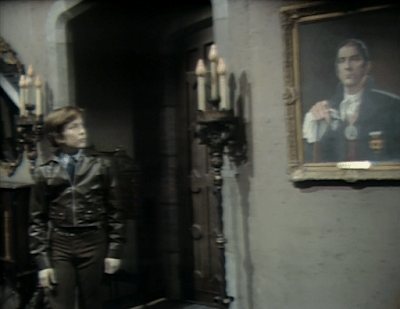
Daniel and the portrait of Barnabas Collins (d. 1830.) Screenshot by Dark Shadows Before I Die.

The master of Collinwood, drunken sourpuss Quentin Collins, is shocked to see the portrait, and orders it to be removed immediately. Daniel’s counterpart, strange and troubled boy David Collins, had been the first to speak Barnabas’ name when he called Willie’s attention to the portrait in #205. Shortly after, Willie heard a heartbeat coming from the portrait, which led him to make his fateful trip to open the coffin. In this continuity, it is Daniel who hears the heartbeat, and he will today try to find and open the coffin.

Quentin has caught two glimpses of the other universe in the room in the east wing that was his late wife Angelique’s bedroom. Unknown to Quentin, Angelique has returned from the dead and murdered her identical twin sister Alexis. Quentin thinks that it is Alexis who is his guest in the great house, staying in her sister’s old room. When he tells her today what he saw, “Alexis” thinks he is losing his mind. But she then sees the phenomenon herself. She sees Hoffman’s counterpart calling for Barnabas, as Quentin had seen her talking about Barnabas’ “terrible curse.” “Alexis” and Quentin decide that they and Hoffman should have a séance to contact the spirit of the Barnabas Collins who died in their universe in 1830, the only Barnabas Collins they know of.

In the main continuity, séances are a frequent occurrence; we have seen fourteen of them there, and heard a detailed account of a fifteenth. In the early days, there was always one participant who tried to break the circle, only to be sternly reproved by the leader. The characters stopped doing that as they got to be familiar with the procedure, but séances are rarer in this universe. As things start to get interesting, Hoffman can’t take it anymore. She breaks the circle and runs out. “Alexis” says that the presence she felt is gone. But then a ghost materializes in the corner of the room.
Episode 67: I was fresh out of arsenic

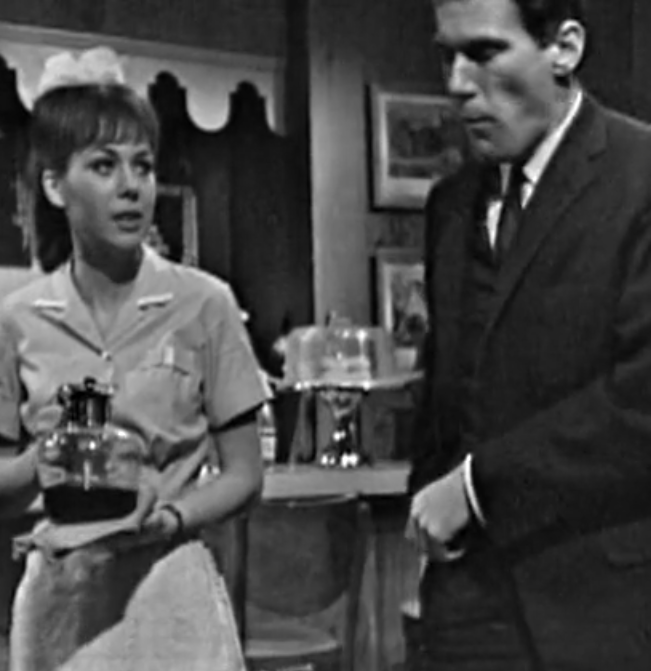
This one belongs to Maggie Evans, the nicest girl in town. We open with her doing some work in the restaurant she runs. She isn’t feeling so nice today- dashing action hero Burke Devlin has accused her father, drunken artist Sam Evans, of various crimes, including the murder of beloved local man Bill Malloy. When flighty heiress Carolyn comes into the restaurant, Maggie tells her that it might be a good idea to flavor Burke’s coffee with rat poison.

Burke does show up. When he complains about the coffee, Maggie picks up on the idea she had floated to Carolyn and apologizes for not adding arsenic.

Maggie apologizing to Burke for failing to give him arsenic
No arsenic today, sorry

Not that she’s going to let her father off without a piece of her mind. When he comes in and tells her some lies, she discards her usual adult-child-of-an-alcoholic manner of exaggerated patience and calmly asks him if he minds that she doesn’t believe him. He mumbles that there’s no reason why she should.

The sheriff comes into the restaurant to ask Maggie if she can confirm her father’s whereabouts at the time of Bill’s death. She gives him a sarcastic answer. When he asks what she is prepared to swear to on the witness stand, she makes it clear that she will swear to whatever she damn well pleases. Sam then tells the sheriff that Maggie doesn’t actually know where he was that night. At that, she declares that Sam has no idea what she does or doesn’t know. If she wants to perjure herself, it will take more than Sam and the sheriff to stop her.

In the sheriff’s office, we meet Mrs Sarah Johnson, housekeeper to the late Bill Malloy. Mrs Johnson is furious with the Collinses, the family in the big dark house on the hill who own half the town. She more or less blames them for Bill’s death. She very much blames them for his life, which he spent doing nothing but working for their interests. Mrs Johnson is even more indignant than Maggie, but the only person she interacts with is the sheriff. So we have a contrast between a character who gives us several distinct shades of outrage, one for each person she puts in their place, and another who spends her time bringing one specific shade of anger into perfect focus.

In between there’s a scene with Sam and the sheriff, and at the end one between Carolyn and Burke. These offset the studies in indignation from Maggie and Mrs Johnson, both giving the audience a bit of a breather and giving their fiery turns time to sink in.

Miscellaneous:

There’s a moment when the sheriff goes to the water cooler and finds the paper cup dispenser empty. He apologizes that he can’t offer Mrs Johnson a drink. All the websites list this as a production fault, but I’m not sure- it goes on for a while, longer than I imagine it would if he were actually drawing two drinks of water and giving her one, and the timing doesn’t seem off afterward. I don’t know if it was in the script- I suppose they might have noticed they were out of cups and improvised the scene before or during dress rehearsal. At any rate, I don’t think actor Dana Elcar was actually surprised by the absence of cups during the taping.

This episode was recorded on the Sunday before it aired. The Dark Shadows wiki quotes Kathryn Leigh Scott (Maggie) explaining that this was because one of her fellow cast members had shown up drunk on the day they were originally supposed to record it. Mitchell Ryan and David Ford both have important parts in it, and they were both alcoholics. After he stopped drinking, Ryan admitted that he showed up on the set of Dark Shadows drunk on more than one occasion. Ford never stopped drinking, and booze was apparently part of the reason he died in 1983 at the age of 57. Also, while Ryan and Ford are the two actors in this period of the show who usually have the most trouble with their lines, they are both nearly letter-perfect today, as if they had been in trouble and knew they had to be good boys or else. So it could have been either of them.

Clarice Blackburn joins the cast as Mrs Johnson today. As Mrs Johnson, Blackburn will be crucial at certain moments in the years ahead, and she will also be cast as other important characters in the later run of the show. When Mrs Johnson was cast, Blackburn was told to model her on Judith Anderson’s performance as Mrs Danvers, the frightening housekeeper in Hitchcock’s Rebecca. That instruction didn’t last very long, and when four years later they actually got round to including an homage to Rebecca, Blackburn didn’t play the Mrs Danvers part.

On his blog Dark Shadows from the Beginning, Marc Masse develops a theory that set designer Sy Tomashoff was influential in casting Dark Shadows. He focuses on a guest spot Clarice Blackburn had on an earlier series where Tomasheff did the sets, a primetime show called East Side, West Side:

The version of Mrs. Johnson we see today in episode 67 is based on an even earlier role as Gert Keller in the critically acclaimed but greatly overlooked groundbreaking series East Side, West Side, in a 1964 episode called The Givers. Perhaps the biggest surprise to those not familiar with the series would be its leading actor, featuring George C. Scott as a… social worker.

It should be noted that both of these earlier productions had Dark Shadows scenic designer Sy Tomashoff as the “art director”; in the East Side, West Side episode The Givers, the cast list even featured Bert Convy, the original early choice for casting as Barnabas Collins on Dark Shadows. Tomashoff held the same production role in For the People. Both of these series are notable for a good many cast member crossovers with Dark Shadows, often several in a single given episode; and because Sy Tomashoff worked so closely with executive producer Dan Curtis on Dark Shadows, it is likely that he played a significant part in a number of the key casting decisions in the early days of Dark Shadows.

Especially curious as noted in the introduction to today’s post is how Mrs. Johnson comes across as the grieving widow, indicating that she may have been more than just a housekeeper to Bill Malloy even if Malloy himself was never aware of this. If you see her as Gert Keller in the East Side, West Side episode, she seems to be reprising this earlier role…

An even more striking parallel between the portrayals of Gert Keller and Sarah Johnson are the similarities in character dialogue between the speech patterns and emotional tone… [I]n each instance, vocal delivery of dialogue as provided by the actress shows a similar shift between the emotional extremes of tearful despair and bitter resentment at the injustice of each character’s passing, first over Arthur Keller in East Side, West Side with an almost identical pattern and tone evident today on Dark Shadows over Bill Malloy.

In East Side, West Side, Art Keller is a business man struggling with elusive opportunities due to a past bankruptcy situation. Despite the best efforts of Neil Brock [George C. Scott] and his resources and contacts, Keller winds up ending his life soon after Brock drops by with the news that despite the availability of a possible deal for work in connection with a local congressional office, he had to intervene on Keller’s behalf because of the shady nature of the congressman’s methods of operation.

Two years later on Dark Shadows, Gert Keller is transplanted from East Side, West Side to make her debut as Bill Malloy’s bereaved housekeeper, Sarah Johnson.

It’s plausible, but not conclusive- after all, both East Side, West Side and Dark Shadows were cast with New York actors at a time when there was already more national television production, and therefore more proven acting talent, in Los Angeles. Many of the relatively well-established actors who were in New York in the 1960s were there because they were busy with specific projects and weren’t in a position to commit the time for a recurring role on a five-day-a-week TV show. So if you’re casting Dark Shadows and you’re looking for someone you can trust to give you a performance with a particular quality, of course you’re going to look at a lot of people who were on East Side, West Side, whether Sy Tomashoff recommended them or not.