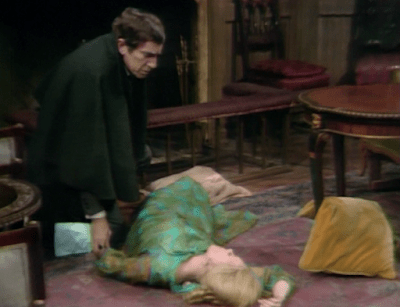
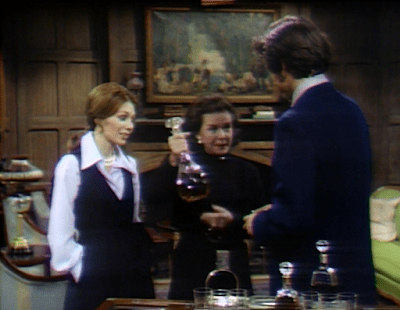
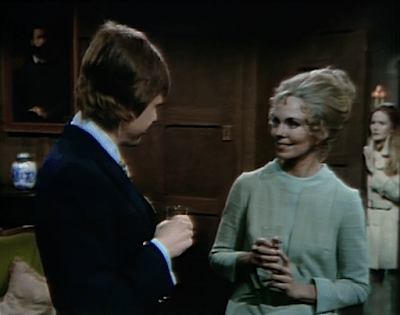
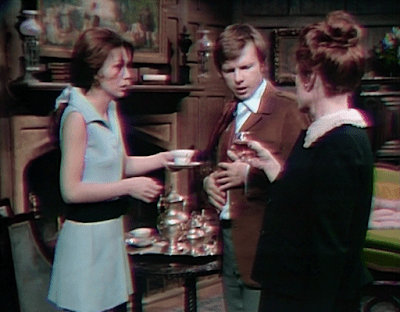
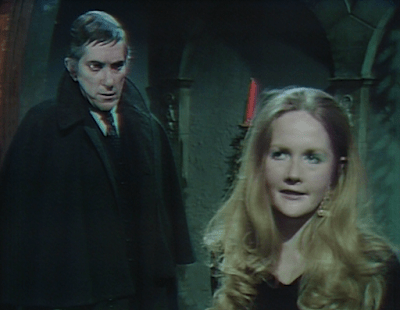
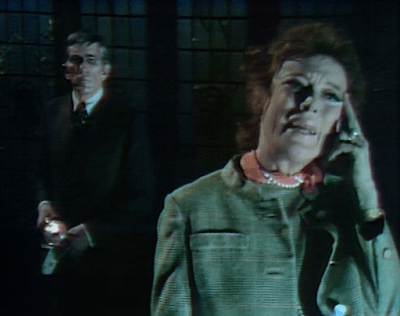
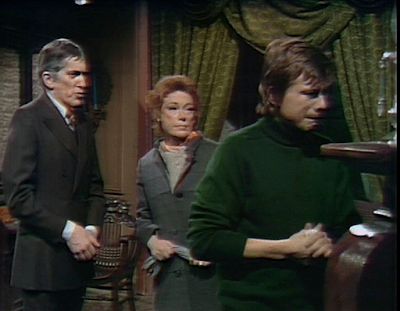
Wicked witch Angelique Stokes Collins has cast a spell on Maggie Collins, compelling Maggie to shoot her husband Quentin. Angelique herself dwells among the living because of another spell, one cast by her father, a wizard known as Tim. This spell drains the “life force” from a woman named Roxanne into Angelique, revivifying her after Quentin’s brother Roger drove a hatpin into her brain nine months ago. Angelique has kept her identity secret, in part because Quentin and a friend of his had a panic attack some time ago and destroyed her coffin, keeping the physical evidence from telling its tales. They were two loonies, quelling caskets.
Occasionally Roxanne manages to reclaim enough of her “life force” to make Angelique weak and cold. When this happens, Angelique can perk herself up by hugging a man and kissing him, thereby making all of his body heat flow into her, leaving him an icy corpse. The kiss appears to have become essential to this transfer; her kissing equates coolness. Yesterday she gave Roger this treatment, avenging her own murder.
The spell on Roxanne will break when she speaks, and her pushy ex-boyfriend Claude is about to make her do that. So Angelique has only moments to live. Quentin is on the run from the law, charged with the murder of a man named Bruno. Angelique’s enemy, Barnabas Collins, demands she sign a confession admitting that Bruno was actually killed by a spell she cast using a cravat of his. Quentin is innocent in these loose necktie squallings.
Angelique refuses to sign any such document. Later, Barnabas will tell the whole story to a police inspector whose incredulous response makes it clear that it would not have persuaded anyone had she done so. More urgent is a question he puts to her about the whereabouts of his faithful companion, Julia Hoffman. Angelique has locked Julia in a dungeon and left her to die of thirst. The door to this chamber swings shut silently, and apparently it does not let Julia’s cries for help be heard outside. Many of the places of confinement we have seen on Dark Shadows are the looniest squeaking cells you could imagine, but this one is grimly soundproof.
Roxanne speaks and Angelique dies, defiant to the end. Cloaking queenliest loss, her refusal to bend invests the character with a perverse grandeur.
Barnabas remembers an Angelique who lived on the island of Martinique. For him, all the other Angeliques are just successors to what she brewed up there, Antilles cooking sequels, as it were. Screenshot by Dark Shadows Before I Die.
With Angelique’s death, her spell over Maggie breaks. Maggie collapses and drops the revolver she had trained on Quentin. One of the themes of the show has been that a person who casts a spell creates an alternate version of herself and that version takes possession of the person against whom they direct it. Lara Parker and Kathryn Leigh Scott play Angelique and Maggie’s collapses in the same way; seeing these back to back, we cannot miss the point that what we are really seeing is the simultaneous death of two Angeliques. Sometimes the alternate selves created by the spells outlive the spellcaster, and there is no telling where they will drive the victim. The accursed who wander about the earth, whether they became vampires like Barnabas or zombies like his uncle Jeremiah, are lockless antique legions, unrestricted in their physical movement, unlimited in the duration of their afflictions, uncounted in their numbers.
Miffed that Maggie pointed a gun at him, Quentin leaves the room. He finds Barnabas, who explains everything that has been going on. Quentin goes back to Maggie. She says that she realizes he could never love her or any other woman as he loved Angelique when she was alive. He tells her he never loved Angelique, but that he “hated the ground she walked on” and never shared a happy day with her because she was so cruel to him when they were married. When the same scene played out between Maxim de Winter and his second wife in Daphne Du Maurier’s Rebecca and in Alfred Hitchcock’s film based on the novel, we could take it as grounds for hoping that their marriage would take a turn for the better. But Quentin seems never to have loved Maggie, and we have never seen them share a happy day. They speak lovely words as they embrace; kissing allots eloquence. But Quentin’s declaration that he wasn’t any happier in his first marriage than he has been in his second comes only as confirmation of our suspicion that things will only go from bad to worse as long as he and Maggie stay together.
Barnabas and the inspector look for Roxanne. They don’t find her, and the inspector dismisses Barnabas’ whole story. The law moves a lot faster in Soap Opera Land than it does in our world, but only the looniest legal quickness could get Quentin out of trouble in the time that seems to be remaining in this storyline. Later, the inspector catches up to Quentin and arrests him, and Barnabas finds Claude stabbed to death in the woods.
This episode marks the final appearance of Angelique Stokes Collins. Lara Parker, that member of the queenliest looking class, will be back later as another witch named Angelique. It is also the final appearance of actor Brian Sturdivant and of the character Claude North. Sturdivant’s performance has many problems, most obviously his wildly uncertain accent. At times he manages to enunciate a few words in the old “mid-Atlantic accent” stage performers were trained to use in the first half of the twentieth century, but he never keeps it up for a whole line.
When Dark Shadows began in June 1966, its biggest draw was movie star Joan Bennett as reclusive matriarch Elizabeth Collins Stoddard. Liz was highly capable, and Bennett made her compelling to watch. When in #25 Liz’ brother, high-born ne’er-do-well Roger Collins, grudgingly complimented her on her “neat way of managing people,” we could see that he was putting it mildly. But the show didn’t handle Liz’ storyline very well, and she soon became a blocking figure. As the owner of the estate of Collinwood and of the Collins family businesses, as a central player in all the stories they had started with, and as the powerful personality Bennett had created, Liz was such an important part of the show that when she became a brake on the action, there was a constant danger that it would be impossible for anything to happen ever again.
The arrival of Roger’s estranged wife Laura Murdoch Collins in #123 marked Dark Shadows’ transformation into a supernatural thriller. By the time Laura went up in smoke in #191, her story had absorbed two of the four original narrative themes, “The Revenge of Burke Devlin” and well-meaning governess Vicki’s growing friendship with strange and troubled boy David, and had undercut whatever interest we might still have had in the other two, the mystery of Liz’ decision to become a recluse and Vicki’s quest to learn her true identity. The emerging Dark Shadows 2.0 had little room for Liz, and she subsided to the margins. When the show traveled back in time and became a costume drama from November 1967 to March 1968 and again from March to November 1969, Bennett played other characters and was able to make a substantial contribution, but Liz would never again be a suitable vessel for her great talents.
For the last eight weeks, the show has been in another time travel segment. Now it has traveled, not back in time, but sideways. They are in an alternate universe. The show insists on calling this universe “Parallel Time.” It is 1970 here, as it is in the original continuity, but a different 1970 where people with the names and faces we already know are living very different lives.
The Elizabeth Collins Stoddard of Parallel Time is not the mistress of Collinwood or an effective businesswoman. This Liz entrusted her inheritance to her brother Roger, who turned out to be just as feckless as his counterpart in the original continuity. As the penniless Roger we met in 1966 lives in Liz’ house as her guest and works in Liz’ business as her employee, so this Liz and Roger both live at Collinwood as the dependents of their brother, drunken sourpuss Quentin Collins.
In the original continuity, Quentin was not Liz and Roger’s brother, nor did he own anything. We got to know him when Dark Shadows was set in 1897, and he was a charming rogue, the younger brother of Judith and Edward Collins, who like Liz and Roger were played by Joan Bennett and Louis Edmonds. So the parallel lines representing the two versions of 1970 take a bit of a swerve into that other epoch.
Today, Liz is busy organizing a costume ball to be held in the great house of Collinwood. They had such a ball every year at this time when Quentin was married to his first wife, the late Angelique Stokes Collins, and Liz thinks that having another one would be the perfect occasion for Quentin to introduce all of his friends to his new wife, the former Maggie Evans. Liz needs help getting this party going. She comes bustling into the drawing room today and addresses herself to Angelique’s identical twin sister, Alexis Stokes, announcing that the party is tonight and 14 of the guests have failed to RSVP. She bemoans her inability to get anything organized and pleads with Alexis to help her. Alexis agrees to do so and excuses herself from a chess game she had been playing with Barnabas Collins, a man who recently showed up and introduced himself as a distant cousin of the Collinses of Collinwood.
Quentin enters the drawing room and orders Liz to cancel the ball. She says that it is too late to do that. Quentin stalks off and goes outside. Liz turns to Barnabas and asks him to reason with Quentin. Barnabas is unsure that he is the right person, but he goes to the door anyway. He opens it just in time to hear Quentin peeling away in his car. Maggie appears at the head of the stairs and asks if Quentin has gone. Barnabas has to say that he has, and Maggie looks crushed. Liz is unable to help in any way.
Later, Liz returns to the drawing room in the middle of a conversation between Quentin and Maggie. She is carrying an enormous decanter containing some sherry and congratulating herself on calming the cook’s nerves by her bartending. Quentin excuses himself to go get into his costume.
Liz finds that Maggie has not yet chosen a costume. She urges her to do so at once. Maggie says she supposed that Angelique always picked out her costume weeks in advance. Liz knows that Maggie is intimidated living in Angelique’s shadow, and does not know what to say in response to that remark. She quickly changes the subject. She brightens, and says that Alexis has brought many lovely dresses down from the attic. She urges Maggie to go to Alexis’ room and choose one of them.
As the time for the guests to arrive comes near, Liz and Barnabas meet in the foyer. A portrait of the Barnabas Collins who died in 1830 hangs on the spot on the wall next to the front door where earlier this week we had seen a metal doodad that looks like a coat of arms. Barnabas is wearing the same outfit, and looks just like the man in the portrait. Liz is wearing a dress of the same vintage. She is overjoyed, and tells Barnabas that the period suits him. He thanks her, and returns the compliment. Quentin is wearing a blue federal coat; Liz and Barnabas tell him that he, too, is suited to the early 1800s. Alexis comes downstairs in a blue dress, and she receives the same commendation. Lastly Maggie makes her appearance. When Quentin sees her dress, he becomes very tense. He tells her to take it off, orders her never to wear it again, and smashes his glass on the floor. The camera pans from Barnabas’shocked expression to a flickering look of pleasure on Alexis’ face; Liz stands between them, and unfortunately we only see the top of her head.
What Liz does not know is that the person she thinks is Alexis is in fact Angelique risen from the grave. Angelique murdered Alexis, took her place, and is conspiring with housekeeper Julia Hoffman to drive Maggie and Quentin apart. The story is a souped-up version of Daphne Du Maurier’s Rebecca, in which the dead first wife is not only a memory that triggers anxiety in her successor but a supernatural being who rises from the dead to torment her directly. There is a scene with Maggie looking out the window of the drawing room that is an exact recreation of a shot in Alfred Hitchcock’s 1940 film of Rebecca, and when Angelique and Hoffman trick Maggie into wearing the same dress Angelique wore to last year’s ball, prompting Quentin’s outburst, most grownups in the original audience would remember the same thing happening to the second Mrs de Winter in that film.
Angelique is the villain, and Maggie is the heroine. Still, we rather like Angelique. The sister-murdering is bad, of course, but Quentin is such a lousy husband that she is doing Maggie a big favor by trying to bring their intolerable marriage to its end as soon as possible. For example, today Quentin finds Maggie reading his old love letters to Angelique. He might justifiably have objected that those are private and say he wished she’d asked before reading them, but he doesn’t do that or anything else one adult would do when disappointed in another. Instead, he flies into a rage, accuses her of a variety of things she hasn’t done, and orders her to, and I quote, “Go to your room!”
Later, in the room they share, Quentin is still scolding Maggie for failing to admit that she was lying about how she found the letters. We know she had in fact told the truth. When she tells him so, he dismisses her with a shake of the head. When she brings up the fact that it is the anniversary of his wedding to Angelique, he shouts that she is forbidden to discuss the subject, then storms out and slams the door. This is when he goes downstairs, tells Liz to cancel the party, and drives away. We have never seen Maggie have a happy day with Quentin. He sometimes manages to be pleasant in the intervals between his tantrums, but even then he can’t let go of his habit of talking to Maggie as if she were a child and he were her somewhat weary guardian. If Angelique can hasten their final split, Maggie will owe her an enormous debt of gratitude.
Barnabas is not in fact a descendant of the man whose portrait now hangs in the foyer. He is a visitor from the main continuity. Angelique’s counterpart there is his great enemy, so it is fun to see him talking with this Angelique and playing chess with her.
David Selby has a problem with one of his lines, when Quentin winds up saying “I wonder where I got the illusion that an hour or two alone would settle one’s all of problems.” This is a fairly minor stumble by Dark Shadows standards, but it comes when Angelique is in closeup and Lara Parker’s left eyelid twitches when she hears “one’s all of problems.” That reaction is worth a laugh.
Dark Shadows has taken us to a parallel universe where the A story is a mashup of Daphne Du Maurier’s 1938 novel Rebecca with Edgar Allan Poe’s 1838 story “Ligeia,” and the B story is a retelling of Robert Louis Stevenson’s 1886 novella Dr Jekyll and Mr Hyde. Today we also get a good look at the C story, another mashup. The ingredients in this one are Dracula and Who’s Afraid of Virginia Woolf.
Drunken novelist William H. Loomis and his disappointed wife, the former Carolyn Collins Stoddard, take the roles of George and Martha. The parts of Nick, of Honey, and of George and Martha’s imaginary son are combined in vampire Barnabas Collins.
Honey is present at two conversations with George and Martha. She flees from each, moved to vomit by their cruelties, and after the second is never seen again. One session with Will and Carolyn was enough for Barnabas. The circumstances of his exit were rather different from those of Honey’s. Barnabas did not become physically ill when he saw Will and Carolyn quarreling, and is willing to keep skulking in and out of their basement when he is not out preying upon the living. But Will has other ideas. He has chained Barnabas in his coffin in the basement of their house and is planning to force him to tell him his life story, which Will thinks he will be able to use as material for a book that will restore his fortunes. In this he is the mirror image of his counterpart in the main continuity, who broke the chains that held Barnabas in his coffin in his own attempt to get rich quick.
As Martha taunts George for the dead end his career has reached, Carolyn is in the habit of taunting Will with his inability to write new books of his own. As Martha flirts aggressively with Nick in front of George, so Carolyn wants Will to release Barnabas so that he can drink her blood again. As George and Martha’s son turns out to be imaginary, not part of their material reality, so Barnabas is a visitor from the main continuity, not a part of this universe. Inasmuch as Jonathan Frid is away for several weeks making the feature House of Dark Shadows, Barnabas is present only as a topic in Will and Carolyn’s quarrels.
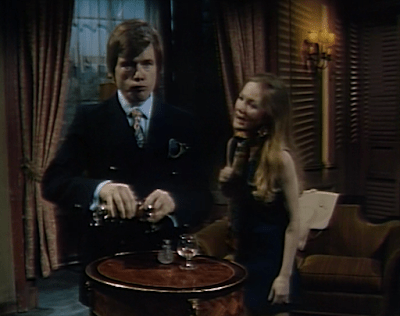
Will pours himself a glass of something, perhaps bergin and water. Screenshot by Dark Shadows Before I Die.
One might wonder if the idea of casting John Karlen as an analogue of George in an adaptation of Who’s Afraid of Virginia Woolf? occurred to the makers of the show around the time of #706. In that episode, Karlen played inveterate prankster Carl Collins, who held a gun at Barnabas’ head and threatened to shoot him. When he pulled the trigger, a flag labeled FIB! sprang out. George fires a rifle at Martha in Act One of the play, only to produce a similar effect with a Chinese parasol.
Later, Carolyn is eavesdropping outside the drawing room in the great house of Collinwood while Will is flirting with a lovely houseguest, a central character in the Rebecca/ Ligeia mashup. Carolyn stands in the doorway, in Will’s line of sight when he tries to make a date with the woman. Will has already rubbed Carolyn’s face in the intimate nature of her connection to Barnabas, and as his victim she can’t very well recreate Martha and Nick’s threat to cuckold George with any other male. So if we are going to have another scene built around that kind of insult, it will have to be Will who plays it with another woman.
Carolyn also spends some time with her friend Sabrina Stuart, who is part of the Jekyll and Hyde story. Sabrina is engaged to Dr Cyrus Longworth, the Jekyll character, and did not recognize him when last night he invaded her home and assaulted her in the persona of John Yaeger, the Mr Hyde character. Cyrus himself is puzzled when he comes to his laboratory in the morning and finds a terrible mess there, along with an IOU from Yaeger. A policeman shows up and asks him some questions, assuring him that he does not match the description of Yaeger. In his post about the episode on his great Dark Shadows Every Day, Danny Horn points out that this scene is recycled beat for beat from Dan Curtis’ 1968 TV movie adaption of Jekyll and Hyde.
Carolyn marches into Cyrus’ lab and tells him Sabrina is missing. She is angry with him for leaving Sabrina alone when the man who attacked her is still at large. He tries to assure her that Sabrina is in no danger, but since he cannot explain why he would believe that he only exasperates her further. She insists they go looking for Sabrina, and he acquiesces. It turns out Sabrina is in the great house of Collinwood, in a trance, trying to reenact the séance at which the Rebecca analogue died.
In the main continuity, Carolyn’s counterpart was married to someone whom she believed to be a man named Jeb. Like Cyrus, he was played by Christopher Pennock. Also like Cyrus, he was a shape-shifter who in his other form committed horrific acts of violence. Carolyn accepted Jeb’s refusal to tell him anything about himself, as Sabrina accepts Cyrus’ refusal to tell her anything that might lead her to suspect the nature of the potion he has developed. It is refreshing to see this Carolyn taking Sabrina’s side and insisting Cyrus do things a reasonable person might do.
Drunken sourpuss Quentin Collins and wealthy socialite Alexis Stokes enter the mausoleum where Angelique, Quentin’s late wife and Angelique’s identical twin sister, is entombed. They find a fancifully dressed man named Bruno Hess driving a chisel into the wall beside Angelique’s nameplate. When they demand to know what Bruno is doing, he explains that he is going to open the vault, show that Angelique’s body is not there, and thereby prove that Alexis is in reality Angelique come back to life.
Quentin says he will call the police if Bruno does not desist from his efforts. Bruno says that he does not believe that Quentin wants to involve the police, since that might raise questions that he would rather leave unasked. In response to this, Quentin looks down, and Alexis asks what on earth he is talking about. Quentin says it is an empty threat. He offers Bruno $25,000 to go away, rather a large amount of money to offer someone who has just made an empty threat. Bruno says he will go away without payment if he is allowed to open the vault and it turns out Angelique’s remains are there. Alexis is horrified by this idea, and she and Quentin manage to run Bruno off.
Returning viewers know that these characters are part of a story mashing up Daphne Du Maurier’s 1938 novel Rebecca with Edgar Allan Poe’s 1838 story Ligeia. Maxim de Winter put up with the presence of Jack Favell, his late wife Rebecca’s lover, on his estate because Maxim knew that Favell was willing to spread the rumor that Maxim had murdered Rebecca, and he feared that Favell might be able to prove that the rumor was true. Bruno was Angelique’s lover, and is ensconced on the estate of Collinwood. Quentin’s look down when Bruno scoffs at the idea of him calling the police suggests that he has the same exposure in regard to Angelique’s death that Maxim had in regard to Rebecca’s.
This part of the show is set in a universe parallel to the one where it spent its first 196 weeks. Angelique’s counterpart in the main continuity is a wicked witch who has returned from the dead many times. Poe’s Ligeia, like Du Maurier’s Rebecca and like the Angelique of the current continuity, was a great beauty who fascinated those who knew her and remained an inescapable presence in her husband’s house after her death and his remarriage. Unlike Rebecca, but like the Angelique of the main continuity, Ligeia was a woman of vast knowledge who could transcend death. At the end of Poe’s story, the unnamed narrator finds that his second wife, who has died, has come back to life, and that both her physical appearance and her personality have been transformed into those of Ligeia. Bruno, like other devotees of Angelique, is unshakably convinced that Alexis is lying when she says that she is not the resurrected Angelique.
Bruno is a subject in an experiment being conducted by aspiring mad scientist Cyrus Longworth. Cyrus was himself an admirer of Angelique’s. When he first saw Alexis, he too believed that she was Angelique risen from the dead. But he has accepted that she is who she says she is, and has immersed himself in his work, an attempt to create a potion that will turn whoever drinks it into a Dr Jekyll and Mr Hyde-like duality. Last week, we learned that this somewhat questionable project was Angelique’s idea.
We see Bruno in Cyrus’ laboratory, telling him about his activities in the mausoleum. Cyrus is amused by the story, and tells Bruno he wishes he had his daring. He makes fun of Bruno for getting caught, and turns back to his notes. Frustrated that he cannot enlist Cyrus in his attempt to prove that Alexis is Angelique redivivus, Bruno exits.
Bruno’s a pretty weird guy, but you’d think even he would hesitate before getting into that outfit. Screenshot by Dark Shadows Before I Die.
Later, Bruno shows up in Angelique’s old bedroom at the great house of Collinwood, where Alexis is staying. She demands he leave, and he demands she admit to being Angelique. She says that if he refuses to go, she will resort to force. He invites her to do so.
The Angelique we know in the main continuity has vast magic powers, and would be hard put to keep herself from turning Bruno into a toadstool. We don’t know if the Angelique who once occupied this room is a match for her, but the widespread belief among people who knew her well that she will transcend death suggests that she does have some kind of extraordinary ability, and a moment yesterday when Bruno believed she had cast a spell to interfere with his breathing confirms that she shared at least some of our Angelique’s talents. Bruno believes he will expose her true identity by provoking her into using them. My wife, Mrs Acilius, says that she found herself torn at this point. Returning viewers have ample reasons to dislike Bruno, and his invasion of Alexis’ personal space reinforces all of them. At the same time, she is very much inclined to believe that Alexis is Angelique. So even while she roots against Bruno, she also hopes he will succeed in this attempt.
Alexis does not cast a spell. Instead, she goes to the drawing room and tells Quentin that Bruno has invaded her room. Our Angelique would probably find it galling to have to turn to some guy and report that a meanie was bothering her, so if Alexis is an impostor we can believe she is an exceptionally well-disciplined one.
Bruno follows her. He and Quentin confront each other. Bruno taunts Quentin, saying that he always knew Angelique better than he did. Quentin reminds Bruno that he is not allowed in the house and forbids him to pester Alexis. Bruno mentions that Angelique died during a séance; this piques Alexis’ interest, and after Bruno leaves she asks Quentin about it. He doesn’t want to answer, and she drops the subject.
Cyrus goes to his laboratory late at night and finds evidence of an intruder. He discovers that the man is still there. Cyrus tells him to come out of the shadows so he can see him face to face. It is Horace Gladstone, a chemist from Boston who formulated an extremely exotic compound Cyrus bought as an ingredient in his potion. Cyrus asks Gladstone if he satisfied his curiosity when he was reading through his notes. Gladstone said he didn’t, because Cyrus’ handwriting is so bad. Gladstone says that if Cyrus will tell him what he is working on, he can be of great assistance to him. Cyrus keeps refusing, and Gladstone warns him that he is about to take “a lonely and dangerous journey.”
When he is alone, Cyrus drinks the potion. He makes noises suggesting acute gastric distress and collapses.
Quentin Collins, master of the estate of Collinwood, is in an even grimmer mood than usual. His new wife, the former Maggie Evans, has left him after only a week in the great house. She had had all she was going to take of his patronizing attitude towards her and of everyone else’s preoccupation with his first wife, the late Angelique Stokes Collins. Maggie was particularly satiated with Quentin’s houseguest, Angelique’ unmarried identical twin sister, Alexis Stokes. Maggie had found Alexis in Angelique’s bedroom, wearing Angelique’s frilly nightgown, and reaching out to Quentin while suggesting in a soft voice that “Perhaps we can comfort each other.” When that sight moved Maggie to voice objections to the situation, Quentin responded by forbidding her, for her own good no less, from mentioning Angelique’s name ever again. He was amazed that this led Maggie to leave the house. Considering the provocation, it is indeed amazing that Quentin did not require medical attention to remove his brandy decanter from whatever part of his anatomy Maggie could reach.
We open today with Quentin and Alexis back in Angelique’s room. She is fully dressed this time, but they are sitting together on the piano bench. They move their heads together, and lock their lips in a passionate kiss.
Returning viewers know that we are visiting a universe parallel to the one in which the action was based for its first 196 weeks of the show. Angelique’s counterpart in the main continuity is a wicked witch who has returned from the dead quite a few times, so when we first crossed over here and heard her devotees saying that they were sure their Angelique would find a way to come back to life we did not doubt that they were right. Maggie wants nothing to do with Angelique or the cult she built up around herself, but she is among those who are convinced that Alexis is in fact Angelique redivivus. The show has done an excellent job keeping us guessing whether she is or isn’t, and we will still be guessing when we come to the end of today’s episode.
Alexis pulls away from Quentin and is visibly upset. He apologizes for kissing her. She says that she is disappointed in him- she had thought that he, of all people would know that she is not Angelique returned from the grave. He says he does not think that she is. We can believe him- his counterpart in the main continuity usually had two or three fiancées at a time, and they were rarely his only love interests. So he wouldn’t have to believe Alexis was Angelique, or indeed that she was anyone in particular, to start a make-out session with her. After they clear the air, she agrees to stay on in the house until she can meet Quentin and Angelique’s son, her nephew Daniel Collins, who is on a trip at the moment.
Bruno, Sabrina, Cyrus, Gladstone, and the Bunny
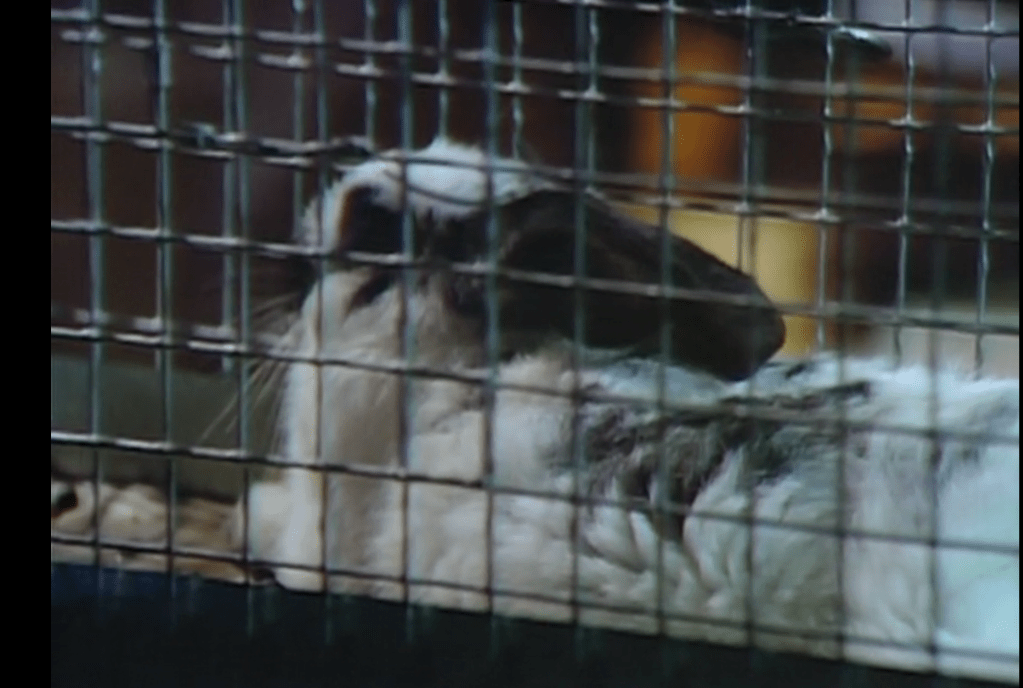
Quentin and Alexis aren’t the only ones dealing with frustrated sexual desire. We cut from them to a closeup of a bunny. This universally recognized symbol of amorous enthusiasm is alone in a cage.
The episode originally aired on the second Tuesday of Easter 1970, maybe the bunny was resting up after his big day.
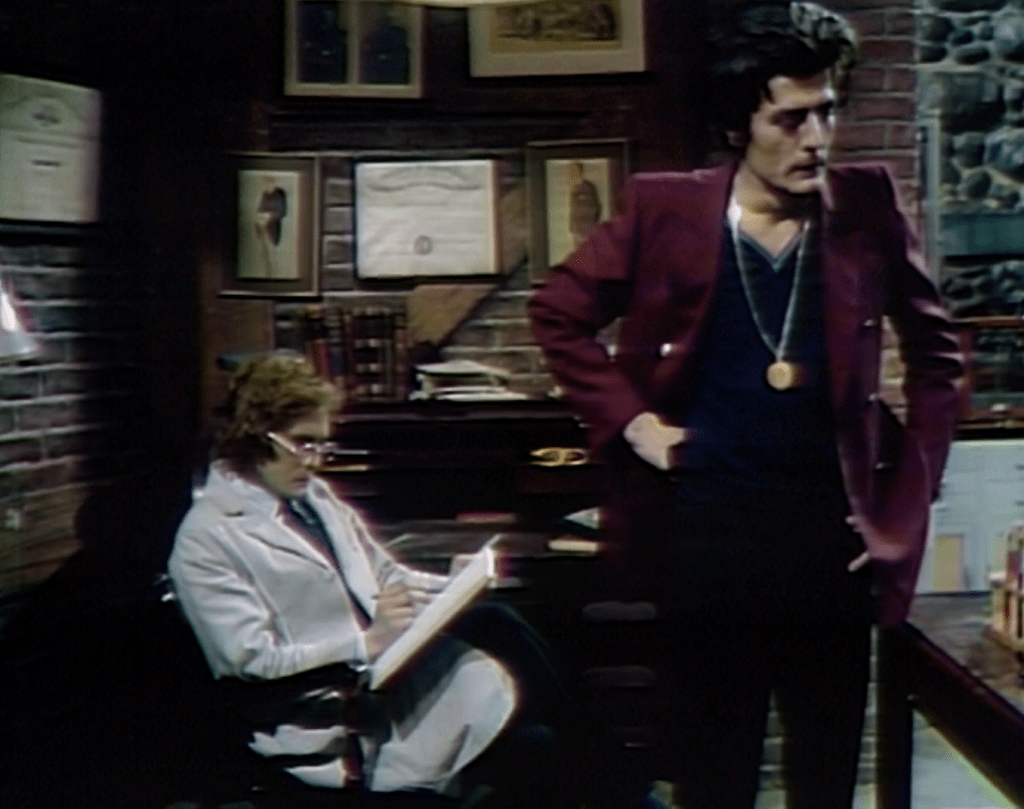
The cage is in a laboratory. A young woman in a lab coat is trying to work on a large apparatus for chemical experimentation while a man wearing a purple suit, a low cut shirt, a large medallion, and a huge bouffant hairdo is pestering her with clumsy attempts at flirting. She keeps laughing off his verbal gambits and swatting away his physical approaches.
A tall young man in a lab coat enters and calls out a booming “Sabrina!” The lounge lizard and the experimenter stand up straighter and step away from each other. Returning viewers know the tall man as aspiring mad scientist Cyrus Longworth and the ill-clad masher as Bruno Hess, musician and hanger-on of the late Angelique. We have not seen the woman before, but we recognize the actress as Lisa Blake Richards, who played another woman named Sabrina in the main continuity. That Sabrina was trapped in a go-nowhere storyline. Before today is done we will have grounds to hope that this one will give Miss Richards a task more in keeping with her considerable talents.
Cyrus sends Sabrina upstairs to wait for a package. Bruno gets ready for his part in Cyrus’ experiment, which involves giving a blood sample. Bruno asks Cyrus why he was so calm when he saw him trying to put the moves on Sabrina. Cyrus replies that he trusts Sabrina too much to worry that Bruno could come between them. He then jabs the syringe into Bruno’s arm with great force and without even looking at the spot from which he is drawing the sample, causing Bruno to jump. He may trust Sabrina, but he wants Bruno to know who’s boss.
Bruno tries to interest Cyrus in his theory that Alexis is Angelique returned from the grave. He eventually manages to get Cyrus to give him a quizzical look, but stops at that point, saying that if Cyrus won’t explain his experiment, he won’t explain his.
Sabrina comes downstairs and says that the package has come and that its bearer insists on meeting Cyrus himself. Cyrus is annoyed by this, but when it develops that the man is Mr Horace Gladstone himself, the very chemist who devised the unusual compound he has brought, Cyrus sends Sabrina back upstairs and Bruno out the basement door so that he can meet with the man alone.
Friday, Cyrus explained to his friend Chris that he is trying to devise a process for separating a human being into two parts, one good and the other evil. His scenes with Chris hit all the obligatory mad scientist notes, right down to disparaging non-mad scientists as unimaginative dolts who may as well believe that the Earth is flat. He won’t tell Gladstone what he is trying to do, perhaps because he has the same last name as did the man who was prime minister of the UK when Dr Jekyll and Mr Hyde was first published and so he reminds him that he is a character in a derivative storyline. But Gladstone does warn Cyrus that the compound he has purchased is a potent and dangerous one. Gladstone hints at the nature of the hazard when he says that he stepped back from active research when he feared that, even within the bounds of chemistry, he was about to uncover truths best left unknown.
Gladstone is played by John Harkins, in his fourth role on Dark Shadows. As before, he is playing a stranger from far away. In #174, he played Lieutenant Costa of the Arizona State Police. We saw him in a scene set in Phoenix, the first time Dark Shadows took us outside the northeastern USA. We did not leave that region again until #877, when sorcerer Count Petofi thought back to an incident in England in 1885, when he first met his henchman Aristide. Like Bruno, Aristide was played by Michael Stroka. The incident in England involved a man named Garth Blackwood, whom Petofi would bring back from the dead to punish Aristide. Blackwood was played by Harkins.
Harkins’ third character came from even further away than Arizona or England. He was Mr Strak, the representative of the Leviathan People, a race of Elder Gods long confined to the underworld. Strak appeared to Paul Stoddard in #899 and #900, and tricked Paul into selling his daughter Carolyn to the Leviathans. So far as Paul was concerned, Strak came from nowhere and disappeared to nowhere, so that he could never hope to explain to anyone what he had done, still less find a way to challenge the terms of the deal.
Gladstone is from Boston. Dark Shadows is set near the real-world location of Bar Harbor, Maine. The characters often mention Boston, but we’ve never had a scene set there. In #363, the ghost of nine year old Sarah Collins was perfectly bland when her friend, strange and troubled boy David, said he had been to China. Sarah said that her father and his business associates were always sailing to China. When David told Sarah that he was joking and he had actually gone to Boston, Sarah was thrilled. She had been to Boston herself once, and considered it a far more exotic place than China could possibly be. Gordon Russell was credited with the script for #363, and Joe Caldwell, the freshly returned author of today’s script, had finished his first tour of duty on the show three weeks before it was taped. But Sarah’s excitement about Boston is so much the kind of character moment Caldwell specialized in that I suspect it was a leftover idea of his that Russell found a place for. Perhaps the casting of Harkins as a Hub man reflects Caldwell’s idea of what Boston would represent to people in a coastal village in central Maine.
Bruno and Alexis
We cut to Bruno, who is on the telephone. He is talking to a person in an office somewhere. He learns that no ships from Genoa have docked in New York in the last week. This information excites him, but his excitement soon gives way to terror as he feels himself choking.
Bruno runs into Angelique’s bedroom, where Alexis is back on the piano bench. He gasps and demands she stop obstructing his breathing. She appears to have no idea what he is talking about.
The Angelique we have known since late 1967 did specialize in casting spells that made her enemies choke. We saw her do that as recently as #955, when her husband tried to set fire to her and she stopped him by twisting a scarf around the neck of a statue. On the other hand, Alexis seems genuinely bewildered by the situation.
When Bruno starts breathing again, he confronts her with the fact that no registered passenger ships from Genoa arrived in New York harbor the week before. She asks him if he considered that she might have been a guest on the yacht of some wealthy friends. He is stumped by this. Again, this keeps the suspense about her true identity alive. Alexis has been established as the sort of person who would be found on someone else’s yacht, but she doesn’t actually say that that is how she got back to the States. She merely asks Bruno if he had thought of the possibility that she may have done so.
Cyrus and Sabrina
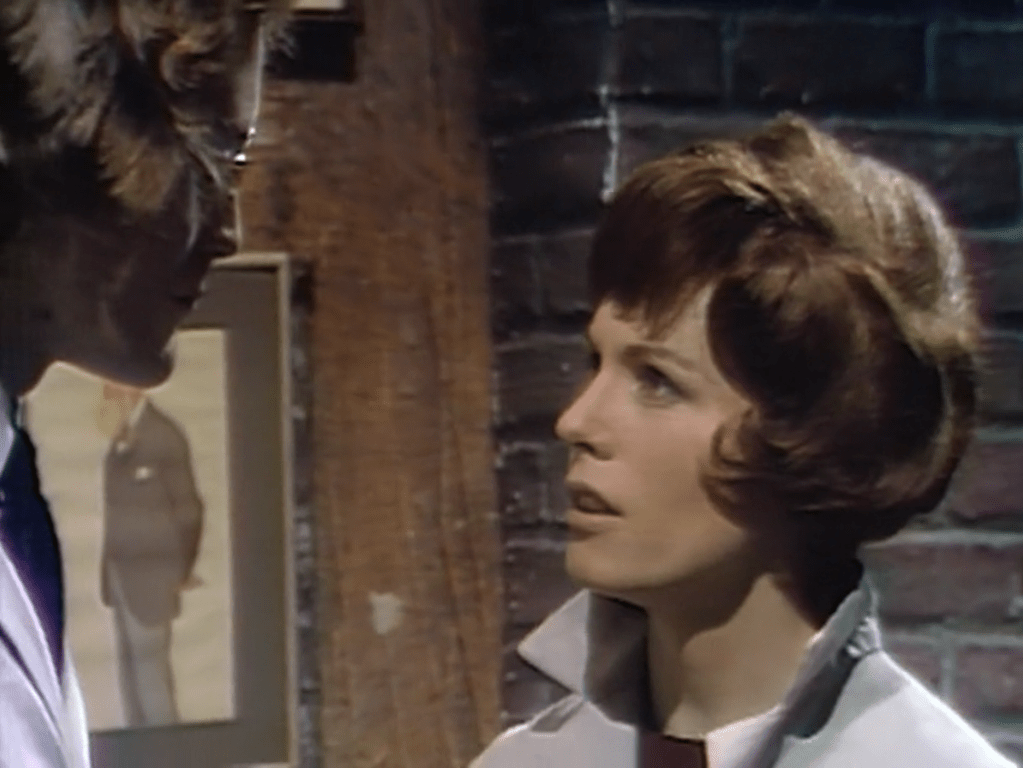
Back in the lab, we see Sabrina collecting some equipment while Cyrus tends to his notes. She finds a small box, and asks him if he put it there for her to find. When he says he did, she opens it and finds a ring. She asks if it is an engagement ring. He says he hopes it is. She throws her arms around him and tells him she loves him. He holds her and does not say that he loves her too. He merely says that she knows how he feels about her, an ill-omen if ever we saw one.
Cyrus tells Sabrina that she knows how completely his work consumes his energies, and she says that is one of the things she admires about him. She asks what exactly he is working on. He is reticent, and she tries to walk the question back. He goes into his mad scientist ravings, and she gives him a stunned look. He tries to reassure her, saying that when he gets carried away he talks in cliches. He says that no one has found good or evil in a test tube… “yet!” The crazed gleam comes back into his eyes.
Sabrina is shocked by Cyrus’ ravings
This scene gives Miss Richards more to work with than she had had in her whole time in the main continuity. The look Sabrina gives at the end of Cyrus’ gust of lunacy is the first time she has had a chance to get a laugh, and she makes the most of it. As for Christopher Pennock, he had just been getting the hang of his previous part, hugely overgrown infant Jeb Hawkes, when he was written out. With Cyrus, he can to some extent pick up where he left off. Pennock had begun to find a way to suggest that there was a real sweetness bottled up inside one-man wrecking crew Jeb, and in Cyrus’ love for Sabrina he can play a character who is Jeb’s mirror image- abundantly sweet, but so deep inside his own head that he is about to become a monster.
Bruno
On Dark Shadows, wedding days usually come and go without anyone actually getting married. Typically, the ceremony is interrupted and someone has to go off and dig up a grave, in which they find an empty coffin.
Bruno has no manners and does not observe any of the recognized customs. So even though today is Sabrina and Cyrus’ engagement day, not their wedding day, he jumps the gun and starts opening Angelique’s grave, in which he believes he will find an empty coffin. We end with him chiseling at the wall of the mausoleum. I suppose you could say that he might be planning to work slowly, so that he won’t finish until the day of the wedding, but even if that were true it would be an outright violation of the accepted norm, and an undeniable sign that he is not the sort of person who can be expected to fit in at Collinwood.
The protagonist and narrator of Daphne Du Maurier’s novel Rebecca is the second wife of the enigmatic Maxim de Winter. The theme of the story is the protagonist’s timidity. She never introduces herself to us or reports a conversation in which anyone addresses her by name, so that we can call her only “the second Mrs de Winter.” Many people around her have something to say about Maxim’s first wife, the late Rebecca, though Maxim himself never mentions Rebecca and becomes upset when anyone reminds him of her. From this, the second Mrs de Winter concludes that Rebecca was an unsurpassably glamorous being and that Maxim is still in love with her and always will be. She is terrified of housekeeper Mrs Danvers, but since she would be terrified of anyone, this does not constitute evidence that Mrs Danvers actually represents a threat to her. In fact, the main thing about Mrs Danvers is her ambiguity. We have no way of knowing what she is thinking. Nor do we know what she is doing until the end of the book, when it turns out she is more dangerous even than the narrator had feared. It is also at the end that the second Mrs de Winter finds that Maxim’s hang-up is not his unquenched love for Rebecca. He never loved Rebecca, and would have been glad when she drowned were he not afraid of being prosecuted for his role in her death.
Alfred Hitchcock’s 1940 film Rebecca had to make several things definite that the novel could leave unsettled. So, while in the novel Mrs Danvers is a figure we glimpse in the course of her narrator’s confused attempts to remember what happened in her early days in the mansion, in the film she is a major character in several scenes. So we saw from relatively early on that Mrs Danvers was deliberately playing on the second Mrs de Winter’s insecurities in an attempt to get rid of her.
The film deviates even further from the book in showing Mrs Danvers’ motivation. Du Maurier was herself bisexual and may have started Rebecca with a plan to sketch Mrs Danvers as a mind warped by life in the closet, but as the story turned out it did not shed any light on the roots or structure of Mrs Danvers’ very intense feelings for Rebecca. It was just one more item on the endless list of things that the second Mrs de Winter could not hope to understand. But Judith Anderson’s performance of Mrs Danvers’ fixation on Rebecca struck film censor Joseph Breen as providing a “quite inescapable inference of sex perversion.” Anderson would deny then and in later years that she meant to play the character that way, but her body language throughout, most famously in the scene where Mrs Danvers handles Rebecca’s intimate apparel, makes those denials laughable.
Now, the A story of Dark Shadows is an adaptation of Rebecca. We are in an alternate universe, where the counterparts of Maggie Evans, Quentin Collins, Julia Hoffman, and wicked witch Angelique are cast in the roles of, respectively, the second Mrs de Winter, Maxim, Mrs Danvers, and Rebecca.
There is even less ambiguity here than in Hitchcock’s film. So after Miss Hoffman sets up a moment to enrage Quentin and confuse Maggie, Maggie goes to Angelique’s old room and hears Miss Hoffman telling the portrait of Angelique that hangs there how inadequate she had exposed her as being, cackling with glee all the while. Today Miss Hoffman sets up another such moment, suggesting Maggie give Quentin’s son Daniel a particular record that she knows Quentin will fly into a rage upon hearing. Miss Hoffman is so blatant that Quentin catches on to what she is doing and orders her to apologize to Maggie. When she does, she drifts off halfway through into a rhapsody about how irresistibly beautiful Angelique was. Grayson Hall had played lesbian characters in two films, Satan in High Heels (1962,) which became a cult favorite, and Night of the Iguana (1964,) for which she was nominated for the Academy Award for Best Supporting Actress. So she is on familiar ground when Miss Hoffman’s craving for Angelique becomes a spoof of Mrs Danvers’ homoerotic attachment to Rebecca.
It is not only in the character of Miss Hoffman that this version of Rebecca is less subtle than were those that preceded it. Maggie is even slower on the uptake than was the second Mrs de Winter. Even after she heard Miss Hoffman cackle about her deficiencies, and even after multiple people have made it clear that they are siding with her against Miss Hoffman, she still takes her advice and buys the record. Quentin is quite reasonable today, but that’s a first- so far, he has been even more miserly with information than Maxim was. And where Rebecca was an intimidating memory that became an inconvenient corpse, we end today’s episode with Maggie opening the doors to the drawing room and seeing Quentin offering a glass of sherry to someone who, for all she sees, can only be Angelique come back to life.
UPDATE: Thanks to FotB Melissa Snyder for pointing out a mistake in the original post. You can get the details in the comments below!
In #210, dangerously unstable ruffian Willie Loomis found a coffin wrapped in chains in an old mausoleum and jumped to the conclusion that it was full of jewels. He broke the chains and opened the coffin, only to find that it actually contained vampire Barnabas Collins. Barnabas bit Willie and enslaved him.
Now, Barnabas has traveled to an alternate universe. In this “Parallel Time,” Willie’s counterpart is a writer, the author of several novels and of a biography of Barnabas’ own counterpart, who died a natural death in 1830. This Will Loomis lives in the Old House on the estate of Collinwood, which corresponds to Barnabas’ home in his own universe. Will’s wife, the former Carolyn Collins Stoddard, was the first person Barnabas met upon arriving in Parallel Time. Barnabas took Carolyn as his blood thrall, and he has shown her a room in the basement of the Old House that she never knew existed. He stashed a coffin there.
Three of Will’s novels were bestsellers made into feature films, but he and Carolyn are now acutely short of funds. We see why today. Carolyn explains to Barnabas that Will won’t be home until the Eagle closes. Barnabas asks what the Eagle is. He should know- that was the name of the tavern in his Collinsport in the 1790s and again in 1897, and he knew it in both eras. The same place was called the Blue Whale in the 1960s in the main continuity, but evidently it kept its old name here.
Will comes staggering home. He recognizes Barnabas’ profile from a sketch of the subject of the biography he wrote. Carolyn explains that Barnabas is that man’s descendant. When Barnabas says that he read Will’s book and admires it, Will brightens, as authors do, and says that the occasion calls for a drink. At first he insists on putting Barnabas up as a houseguest, free of charge, but Carolyn persuades him to let Barnabas pay rent. It’s anyone’s guess how Barnabas will be paying for anything- he stumbled into “Parallel Time” quite inadvertently, without stuffing his pockets or putting on a money belt or making any other preparations. But Will and Carolyn have an extensive discussion about charging Barnabas rent in this scene, and they bring it up again later. Evidently the writers want us to think about it.
The next day, Will suggests that he and Carolyn go to the great house on the estate to meet the new mistress, the bride of Carolyn’s uncle Quentin. Carolyn pleads a migraine, and Will goes by himself. Housekeeper Julia Hoffman is about to introduce him when he cuts her off. He tells the new Mrs Collins that he knew her father. She is the former Maggie Evans. The past tense about her father Sam is news to returning viewers- yesterday Sam was mentioned in terms that left it unclear whether he was still alive, and we might have hoped to see him. In the main continuity, Sam was killed by a Frankenstein’s monster in June 1968, but that monster would not have existed in this universe.
Will says that he and Sam spent many a night drinking together at the Eagle. The new Mrs Collins is not visibly pleased to be reminded of her father’s drinking habit. She offers Will a cup of tea, and he refuses. He avers that tannic acid is bad for the health. Hoffman is at hand with a glass of brandy, and she chuckles when she agrees with him that she can tell Maggie his views about beverages. Hoffman leaves, and Will urgently whispers to Maggie that he must not trust Hoffman.
Later, Maggie will go to Angelique’s old room in the east wing of the house and overhear Hoffman telling the portrait of Angelique that hangs there that she has her on the run. Hoffman cackles with glee at Maggie’s discomfort. Maggie opens the door and asks her what’s going on; Hoffman quickly composes herself and says that the staff hasn’t had a chance to tidy up the east wing sufficiently to welcome the new mistress.
Back in the Old House, Will wonders why Carolyn seems so weak. She passes out, and he sees the puncture wounds on her neck. At daybreak, Will waiting for Barnabas by the coffin. He holds him at bay with a large cross and forces him to explain who he is and where he came from. Barnabas tells Will to let him die. Will says he has other plans. He orders Barnabas to open the coffin. There is an even larger cross mounted inside the lid. He says that he will get a book out of Barnabas, and that that book will be his salvation. He makes Barnabas get in the coffin, and chains it shut. To the extent that this universe is a mirror image of the one we have known, we might have expected that Will would believe he could obtain a fortune by putting chains on the coffin, as Willie thought he could obtain one by smashing them off.
The scene between Will and Maggie brings out several of the problems with the current A story, a reworking of Daphne Du Maurier’s Rebecca in which Maggie is the second Mrs de Winter and Hoffman is Mrs Danvers. Maggie Prime has an iconography that goes back to #1, which makes it hard for us to believe that would be overwhelmed by the subtle intimidations that overwhelm Du Maurier’s anxiety-ridden heroine. When we met the Sam of the original continuity in June 1966, he was an alcoholic. Even after the story that was supposed to make Sam’s alcoholism interesting fizzled out and he was retconned as a social drinker, Maggie retained many Adult Child of an Alcoholic traits, such as beginning each utterance with an irrelevant laugh. So Maggie’s reaction to Will’s reminiscence about boozing it up with Parallel Sam goes a long way to confirming that this is the same ol’ Maggie we’ve known all along and leads us to expect her to be as capable as Maggie would be of meeting the challenges before her.
Also, while Kathryn Leigh Scott is a wonderful actress and a great asset to the show, she makes a bad choice in playing Maggie Collins. In the costume drama segment set in 1897, Miss Scott started out as neurotic intellectual Rachel Drummond. Rachel was terribly fragile, the survivor of an abusive childhood that left her with paralyzingly low self-esteem. Miss Scott went small as Rachel, taking a subtle approach that required us to watch her closely as we tried to figure out what she was feeling and thinking. But as Maggie Collins, Miss Scott cycles through five or six facial expressions per minute and crafts a distinctive emphasis on multiple syllables per sentence. The directors famously didn’t give the actors much guidance on Dark Shadows– John Karlen said that when he first took on the role of Willie, all Lela Swift told him was “Go!” But either Swift or today’s helmsman, Henry Kaplan, should have taken Miss Scott aside and told her she was overacting and giving Maggie Collins too vivid a personality.
Further, Will is only one of many allies who present themselves to Maggie in her showdown with the memory of Quentin’s first wife, the glamorous Angelique. The second Mrs de Winter feels herself all alone at the estate of Manderley, but Maggie can’t very well feel that way at Collinwood. Not only do people who live there keep making it clear they are on her side, she has a sister to whom she starts writing a letter today, who represents support from and connection with the outside world.
Worst of all, Hoffman is absolutely transparent. In the novel, it is not clear until the very end whether Mrs Danvers is even hostile to the second Mrs de Winter. Du Maurier keeps us guessing for 400 pages whether the whole thing is in the protagonist’s fevered imagination. But the cackling Maggie overhears when Hoffman is having her conversation with the portrait is not even the most flagrant sign she has so far given of her plans.
When Dark Shadows premiered in June 1966, it was supposed to bring the sensibility of the then-fashionable “Gothic romances” to the small screen. That did not prove to be much of a ratings draw, so six months later they introduced undead blonde fire witch Laura Murdoch Collins, who was at the center of a story that by March 1967 had swallowed up all of the major loose ends and committed the show to becoming a supernatural thriller.
Now, vampire Barnabas Collins has crossed over to an alternate universe. We have seen enough of “Parallel Time” over the last several episodes to know that it will feature a story derived from Daphne Du Maurier’s Rebecca, one of the foundational works of the “Gothic romance” genre. Viewers who have been with the show from the beginning will be intrigued at this return to its starting point.
The first person Barnabas meets is the counterpart of his distant cousin and onetime blood thrall, heiress Carolyn Collins Stoddard. This Carolyn finds him in a room deep in the great house of Collinwood and demands to know who he is and what he is doing there. He starts in on the “cousin from England” jazz that won him his place at Collinwood in the continuity we have been following so far. He cites the portrait of him that hangs in the foyer in the familiar timeline, only to be told that there is no such portrait in this house and that his story does not add up. Carolyn marches off to blow the whistle on the intruder, and Barnabas bites her. We can see that Parallel Time is going to move fast- it took Barnabas 28 weeks to attack Carolyn in the other universe.
This Carolyn is married to the counterpart of Barnabas’ servant Willie Loomis. While Willie is an uneducated ruffian, Will Loomis is the author of several books, including three bestselling novels and a biography of Barnabas’ late counterpart, who died a natural death in 1830. Will and Carolyn live in the Old House, which corresponds to Barnabas’ own house in the main continuity. Quentin Collins, another distant cousin, is the master of Collinwood here, and widower of Angelique, who corresponds to the wicked witch who made Barnabas a vampire in 1796 but was apparently a mortal woman and a native of the twentieth century here. Other characters we see today include: Julia Hoffman, in the other universe, a mad scientist and Barnabas’ best friend, but here a uniformed domestic and Angelique’s fanatical devotee, Mrs Danvers to her Rebecca; Carolyn’s mother Elizabeth Collins Stoddard, who is not the owner of Collinwood and the Collins family businesses but a guest in Quentin’s house; and Quentin’s new wife, Maggie Evans Collins. We also hear that Angelique’s father is “Tim Stokes,” the counterpart of Barnabas’ sometime ally, occult expert Timothy Eliot Stokes.
What we had seen of “Parallel Time” before Barnabas arrived let us know that Quentin was bringing a new bride home, much to the displeasure of Hoffman and Angelique’s other acolytes. We also knew about the Loomises. So that left us with two candidates to play the part of the intimidated, anxiety ridden “second Mrs de Winter.” Those were Kathryn Leigh Scott, who has been Maggie in the main continuity since episode #1 and has played other parts in time travel segments and as a ghost, and Lisa Blake Richards, who plays Sabrina Stuart, girlfriend of werewolf Chris Jennings.
I love Miss Scott, but I was hoping Miss Richards would be the overpowered new wife. Miss Scott has one of the deepest iconographies of any cast member. No matter how far Miss Scott dials down the big brassy Dark Shadows style of acting, regular viewers simply will not believe that she, answering to the name of Maggie, is going to be reduced to the position that the second Mrs de Winter finds herself in, where she is grateful to her own servants for allowing her a piece of bread and butter when she hasn’t eaten all day. It took all the abuse Barnabas could heap on her, supported by Julia’s magical powers of hypnosis, to break Maggie in 1967. Miss Scott was successful as neurotic intellectual Rachel Drummond when the show was set in 1897, but they went out of their way to show that Rachel was not Maggie. The second Mrs Quentin Collins not only has the same name as the wised-up representative of Collinsport’s working class whom we met long ago, we even hear today that her father was an artist who lived in the village, as our Maggie’s was.
Miss Richards, by contrast, would come in clean. Sabrina, stuck in a dead-end story where her character was a mute for a long time, has made relatively little impression. Miss Richards specialized in a very precise, understated approach. She would be the perfect choice to tackle the job Alfred Hitchcock gave Joan Fontaine in his 1940 feature adaptation of Rebecca and depict a character succumbing to obscure anxieties.
We hear today that this Maggie has a sister, which ours never did. Perhaps Miss Richards will appear as that character. We do not hear whether Sam Evans is still alive. He is dead in the main continuity, but that was the result of an attack by a monster who would not have existed in this one. Longtime fans might get their hopes up that we will see David Ford again as Sam’s counterpart. Carolyn Loomis tells Barnabas today that the idea of widowhood is not as unattractive to her as he seems to imagine; since Nancy Barrett had divorced Ford a few months before this episode was taped, bringing him back into the cast might have helped her add some zest to this aspect of her character.
The blocking does not always take into account the dimensions of the brief outfits Junior Sophisticates provided Miss Scott. So when Quentin carries Maggie into the great house today, the camera looks right up her miniskirt. The ratings were still high during this period, but you can tell no one was watching who worked for either ABC’s Standards and Practices Office or the Federal Communications Commission.
Yesterday, Barnabas Collins went to the long-disused east wing of the great house of Collinwood to search for the coffin that vampire Megan Todd occupies during the day. Barnabas is himself the vampire who ended Megan’s human life, passing his curse along to her. When his friend, mad scientist Julia Hoffman, makes a characteristic remark and tells him “you must not feel personally about Megan Todd,” Barnabas asks “How can I feel any other way?” Most of Barnabas’ feelings, in this or any other matter, consist of pity for himself, but there is a trace of sympathy for Megan in there someplace, probably.
Now, Barnabas has taken Julia to a spot that he happened upon while looking for Megan. While Julia was in the carriage house on the estate with matriarch Elizabeth Collins Stoddard, Barnabas saw two women who looked and sounded exactly like them in a brightly lit, fully furnished, heavily decorated room behind a pair of doors in the otherwise dark and empty east wing. Julia’s double was wearing a French maid outfit and giving orders to Liz’, which is probably someone’s fetish but which is totally out of character for the women Barnabas knows.
In #351, Barnabas was without a blood-thrall. Julia offered to guard his coffin during the day. They were not really friends at that point, and he reacted to her offer warily. Among his objections was that it was not suitable for her, as a medical doctor, to fill such a position. She assured him that she was not volunteering “to be your maid.” Longtime viewers might remember that line when they see Parallel Julia in her livery.
There was an invisible barrier in the doorway that Barnabas could not cross, and he was unable to attract the attention of the women who were so near to him, even when he shouted what he supposed to be their names. The doors closed, and when they opened again the barrier was gone, but so were the doubles of Julia and Liz, along with all the furnishings and lights that had surrounded them.
Thinking of what Barnabas has told her about the room, Julia hesitates to enter it with him. She dismisses her concern as “silly.” Regular viewers will perk up at this- labeling a fear as “silly” is the surest way of marking it as the basis of an upcoming major story point. Once inside the bare room, Julia starts thinking out loud:
JULIA: I was at Eliot Stokes’ house one night, oh, last spring. We were having a brandy after dinner and he started talking about time… He was complaining that we all simply accept it. We don’t have much choice, I thought.
But Eliot had been reading a theory. It sounded insane to me. A theory of parallel time… we live on this universe in 1970, right? We accept the fact that our time is the only time that we can truly know. Suppose time is like a road and parallel to it there’s another road. On one we live the lives we know, but on the other road our lives are different because we’re in a different time-band* and we’ve made different choices. For example, in that other band of time I could’ve made a different choice when I was at college. Instead of being a doctor I could’ve married and had children.
Barnabas, you don’t actually think through some warp in the time band that you have actually seen us living other lives?
BARNABAS: I don’t know, there’s got to be a more rational explanation.
JULIA: Must there?
So, now we know that we are about to launch a new kind of time travel story. The show has taken us back in time for long costume drama inserts, most notably from November 1967 to March 1968 when it was set in the 1790s and from March to November 1969 when it was set in 1897. Now they are going to travel sideways in time, and take us to a parallel universe where Julia is a maid and Liz is not the lady of the house.
At the end of the episode, Barnabas sees the room change again. Parallel Time Liz and Parallel Time Julia uncover a portrait that hangs there, the portrait of a woman whom PT Liz insists is dead and PT Julia insists is still the rightful mistress of the room. Barnabas recognizes the subject as the Parallel Time counterpart of his ex-wife, wicked witch Angelique.
With this, the behavior of PT Liz and PT Julia falls into place. We’re about to see a story derived from Daphne Du Maurier’s Rebecca. PT Julia is Mrs Danvers, the housekeeper maniacally devoted to Rebecca, the late wife of Maxim de Winter. PT Angelique is the one whose death and continued ownership of the room have been a point of contention between PT Julia and PT Liz. We’ve seen a photograph of Parallel Time counterparts of Barnabas’ distant cousin Quentin Collins and strange and troubled boy David Collins, signed “Your loving husband, Quentin.” PT Quentin is the one whom we have heard Liz say is returning with a new wife. In the main “time-band,” Quentin is a penniless rogue with a long supernatural backstory, but his counterpart is the master of Collinwood, and Liz ranks somewhere below the uniformed domestics in the household hierarchy. The David we know is the son of Liz’ brother Roger and a blonde fire witch named Laura Murdoch, but evidently his Parallel Time counterpart is the son of the counterparts of Quentin and Angelique. We have had no indication of who Quentin’s new wife is to be.
This is not the first reference to Rebecca on the show. When Clarice Blackburn joined the cast as housekeeper Mrs Johnson in September 1966, she was supposed to model the character on Mrs Danvers. Mrs Johnson came to Collinwood as a spy for Collins family nemesis Burke Devlin, driven by her certainty that Roger was responsible for the death of her beloved former employer Bill Malloy. Bill, like Rebecca, had drowned under suspicious circumstances, though he didn’t have much else in common with her. By the time the “Death of Bill Malloy” story played out, Mrs Johnson had taken on a new function as an inveterate gossip who made narrative progression possible by blabbing everything she knew to everyone she met. Blackburn’s outstanding talents made her a significant part of the show for quite some time; it’s a shame she isn’t going to be part of the upcoming segment.
Rebecca was not the only Du Maurier novel to inspire a story on Dark Shadows. Dangerously unstable ruffian Willie Loomis first freed Barnabas to prey upon the living after David and Mrs Johnson told him the plot of Du Maurier’s Frenchman’s Creek and claimed that it happened to one of the Collins ancestors. Searching for the treasure the pirate gave to the lady, Willie stumbled upon Barnabas’ coffin. He opened it, earning a bite that made him the vampire’s slave.
Willie’s mistake was that he did not know what kind of show he was on. When Dark Shadows began, executive producer Dan Curtis and ABC vice president for daytime programming Leonard Goldberg** meant for it to be the television equivalent of the “Gothic romance” novels that were so popular in those days. Du Maurier’s novels were among the cornerstones of the Gothic romance genre, and if it were still that kind of show in April 1967 Willie would have been on solid ground in his expectation that there might be a lot of jewels hidden in an unmarked coffin in the old mausoleum. But when Laura was on the show from December 1966 to March 1967, her story subsumed all the major plot threads into a tale of the supernatural. Willie and his sometime friend, seagoing con man Jason McGuire, were on the show as in-betweeners to sweep up the last non-paranormal odds and ends and help introduce the next uncanny menace.
Now, the show is heading in the opposite direction, and Willie is back to help take us there. In Parallel Time, Dark Shadows will finally do the Daphne Du Maurier adaptation that didn’t work out in the Bill Malloy story and that was never meant to work out for Willie. But Megan has to be destroyed before Barnabas can decamp for Parallel Time, and he and Julia order Willie to destroy her.
It was not a foregone conclusion that Julia and Barnabas would want to stake Megan. At the moment, Julia is giving Barnabas injections meant to relieve him of the effects of the vampire curse. Similar injections had worked in 1968 and again during the 1897 segment. Julia shows Barnabas the cross she wears to ward Megan off, and he does not recoil from it. That suggests the injections are having some effect on him, even though he keeps complaining that they aren’t doing anything to curb his bloodlust. When Julia and Barnabas find Megan in the east wing, she refuses the injections. When they find that she is feeding on Roger, they conclude that she cannot be allowed to see another night.
Willie is horrified by the command to drive a stake through Megan’s heart. He protests that he doesn’t even know her. As Barnabas and Julia tell him of the nightmare that awaits everyone if he doesn’t do as they say, he starts to talk about his fiancée Roxanne and the secrets he has been keeping from her. He worries about the image she will have of him if she finds out that he is the former blood-thrall of one vampire and the destroyer of another. “I mean, she’s gonna be thinkin’ I’m weird or somethin’!” I suppose that would be an occupational hazard for blood-thralls.
Willie is worried Roxanne might get the wrong idea about him. Screenshot by Dark Shadows Before I Die.
There is an odd moment when Julia is asking Liz about the east wing. Liz tells her that Roger knows more about the legends of the house than she does. When Julia was first on the show, she was posing as an historian looking into the old families of New England. In those days, Liz mentioned that Roger knew far less about the Collins past than she did, which fit with the original keynote of Roger’s character, an extreme lack of family feeling. But by this point, Roger has merged with the roles Louis Edmonds played in the 1790s and 1897 segments, both of whom were dedicated to the honor of the Collins name.
*The first appearance of this bit of Collinsport English.
**Not to be confused with his then-boss, network president Leonard Goldenson.
In the deserted Old House on the great estate of Collinwood, repressed spinster Abigail Collins has stumbled upon the coffin in which her nephew Barnabas spends his days. She arrives just as he is rising for the evening. Abigail knows that Barnabas is dead, but she has never heard of vampires, so she has no idea what to make of what she sees.
Barnabas taunts Abigail. When she cries that the Devil is trying to touch her, he cynically asks why she thinks that the Devil always wants to touch her. The broadcast date is 1968, when Freudianism was riding high in the circles frequented by the sort of people who wrote and produced Dark Shadows. The dramatic date is 1796, when that school of thought was undreamed of. Still, there were various strands of folk wisdom about the adverse psychological effects of celibacy, so Barnabas’ smirking comment undoubtedly means exactly what the original audience would have taken it to mean.
From the moment Barnabas saw Abigail at the end of yesterday’s episode, we’ve wondered how he would go about killing her. She is his aunt, after all; the vampire’s bite is so widely recognized a metaphor for the sexual act that we could hardly expect the ABC censors to have allowed him to make a meal of her. In the end, he simply bares his fangs and she dies of fright.
Abigail has been a villain; even the opening voiceover refers to her as “a woman who has been responsible for much grief.” During their confrontation, Barnabas tells Abigail many truths that, had she known them earlier, would have kept her from causing that grief. If she accepts them now, she will be remorseful. To the extent that we want Abigail to know what she has done, we identify with Barnabas during this scene. That might lead us to think that her death by fright is a way of letting us see Barnabas as the good guy, since he does not kill her by physical contact. But throughout the confrontation he has been telling her that she is about to die. Before he bares his teeth, he makes a dramatic announcement that clearly tells us that he is bringing matters to their climax, and when he sees her die he does not look the least bit unhappy. He seems to have known that the sight of his teeth had the power to kill his aunt, and to have deliberately used that power.
Abigail is the sister of Barnabas’ father, haughty overlord Joshua Collins. Before he even became a vampire, Barnabas killed Joshua’s brother Jeremiah in a duel. By his clumsiness, Barnabas inadvertently caused the death of his own sister, little Sarah Collins. Things are getting rather lonesome for Joshua.
In the great house on the same estate, young Daniel Collins is trying to slip out into the night. Yesterday, he arranged to meet secretly with much put-upon servant Ben so Ben could give him pointers on how to run away from this depressing house. The lady of the house, Joshua’s wife Naomi, intercepts Daniel. She asks if he plays whist, and he complains that he isn’t allowed to play cards because that is “against cousin Abigail’s religion.” Naomi says that so long as it isn’t against his religion, it’s no problem for her.
This isn’t the first indication that Abigail’s religion is different from that of the rest of the family. As rich New England landowners in the eighteenth century, we can assume they are all Congregationalists, but the loose polity of Congregationalism left room for a lot of variation from one congregation to another. She may well have attended a stricter meeting than did the other members of the family, though she seems to have taken her greatest satisfaction in imposing her austere ways on the other members of the household.
Naomi suggests that Daniel and his older sister Millicent might stay at Collinwood with her and Joshua indefinitely. Daniel is clearly not a fan of this idea, and struggles to find a polite way to say that he is desperate to go back home to New York City. He is still struggling when a knock comes at the door. It is the Rev’d Mr Trask, whom Abigail called in from out of town to find witches. Trask is currently prosecuting Victoria Winters, former governess to Daniel and the late Sarah. Abigail asked Trask to meet her because she thought she would find evidence against Vicki in the Old House. Since she found Barnabas instead, she will not be keeping the appointment.
While Naomi goes to look for Abigail, Trask takes the opportunity to work on Daniel. At first Trask seems to be far more agreeable than we have ever seen him before. So when Daniel apologizes for telling him that he looks like the Devil and that he sees no reason they should exchange any words, Trask smiles and calmly says that he appreciates his honesty. Trask holds Abigail up as an exemplar of Christian virtue; Daniel says that he cannot bring himself to want to emulate Abigail, since she “is always so, so unhappy, as if whatever she has eaten doesn’t agree with her.” Trask takes this remark in good turn.
Daniel keeps insisting that Vicki is not a witch, but is very nice. Trask takes everything he says as evidence against Vicki. For example, when he tells Trask that Vicki extolled the virtues of curiosity, Trask exclaims that “Curiosity is the Devil’s money! What you buy with it is disbelief in everything it is right to believe in!” Even in this portion of their encounter, Trask seems far smoother than the screaming fanatic we’ve seen up to now. Daniel complains that Trask keeps talking about the Devil when “I want nothing to do with him.” At that, Trask leans in and says that if Daniel feels that way, he can still be saved. When Daniel asks how he can be saved, we can see how Trask might have managed to win a new follower, if he hadn’t gone straight to a demand that Daniel testify against his friend Vicki.
Trask finally loses his temper. Naomi returns and is appalled when she hears Trask telling Daniel that he bears the mark of the Devil. Daniel runs out into the night, and Naomi tells Trask he is to blame for that.
Daniel wanders about in the woods, looking for Ben. He quickly concludes that he must have missed Ben, and he thinks of going back to the house. Remembering that Trask is there, he chooses to stay outside.
Naomi is in the woods looking for Daniel; Trask joins her, much to her displeasure. Daniel sees Abigail’s corpse propped against a tree. He shouts for Naomi. She and Trask come, and he points the corpse out to them.
Abigail is the second character Clarice Blackburn has played on Dark Shadows. She joined the cast in #67 as housekeeper Mrs Johnson. In her first months on the show, Mrs Johnson was out to get revenge on the Collins family for their treatment of her former employer and the object of her unrequited love, the late Bill Malloy. Blackburn was told to think of the character as if she were Mrs Danvers, the terrifying housekeeper in Daphne DuMaurier’s Rebecca. After the Death of Bill Malloy storyline ended, Mrs Johnson transformed into a warm-hearted old biddy whose wildly indiscreet chatter gave the other characters just the information they could use to advance the plot.
Mrs Johnson was always fun to watch, and one of the reasons to look forward to the show’s return to a contemporary setting is that she is waiting for us in 1968. But after her first few weeks, her appearances were rare and usually brief. Abigail gave Blackburn her first chance to show viewers of Dark Shadows what she could do when she had the chance to work on a big canvas. In later storylines, she will have more such opportunities, but we will always miss Abigail.