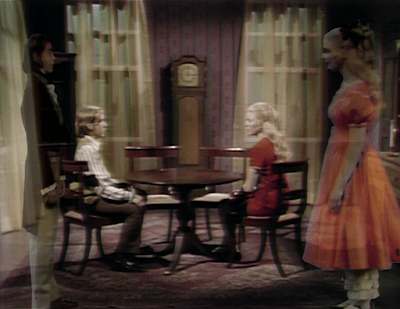
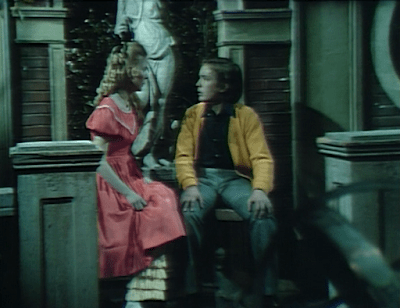
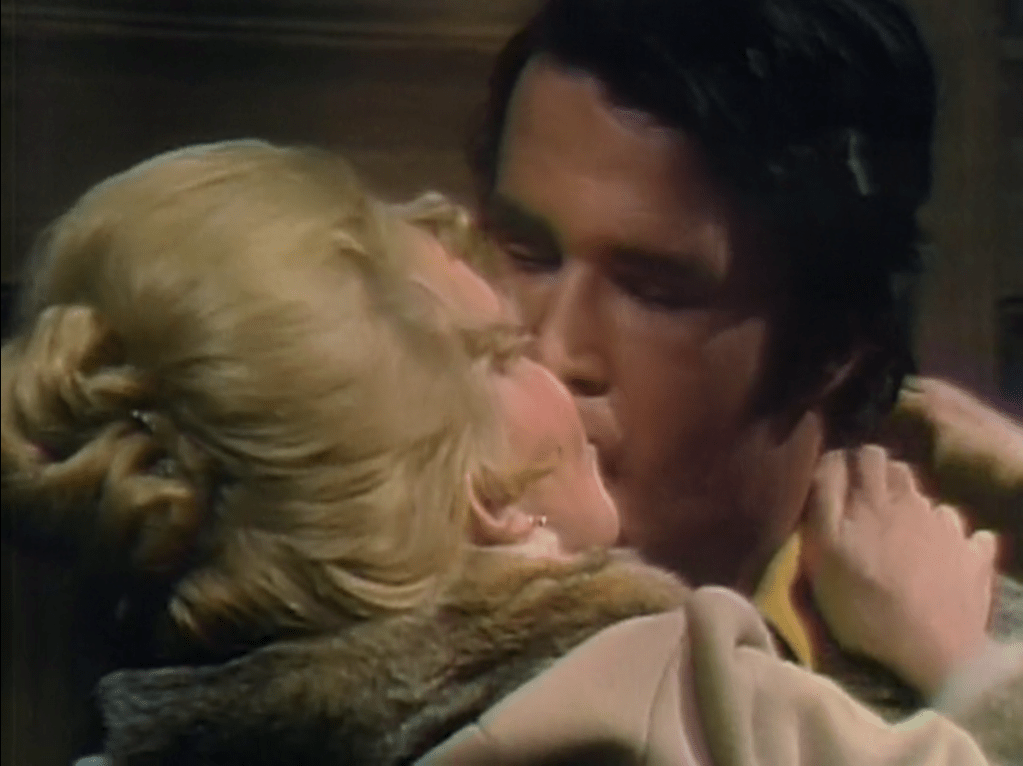
Episode 983: Sing to me again

When Dark Shadows premiered in June 1966, strange and troubled boy David Collins (David Henesy) was obsessed with his absent mother and determined to get rid of his new governess, the well-meaning Victoria Winters. In #15, David had tampered with his father Roger’s car. As he stood at the window and watched Roger drive down the narrow, twisting mountain road away from the great house of Collinwood, he said “He’s going to die, mother, he’s going to die!” When Roger survived and it was discovered that someone had removed the bleeder valve from his braking system, David planted the valve in Vicki’s room in an attempt to frame her for the murder attempt. Later, Roger would come to fear that Vicki was about to expose a dark secret of his own, and would encourage David to try to kill her.

David eventually gave up on homicide, and dropped his hostility to Vicki. One of the more benevolent influences on him was his best friend, the ghost of the gracious Josette. In #102, we saw David in the Old House on the grounds of Collinwood, carrying on a conversation with the portrait of Josette that hung above the mantel. We could not hear Josette’s side of the conversation, but it certainly sounded like David could. We already knew at that point that Josette was real- we saw her emanate from the portrait, walk out of the house, and dance among the columns outside it in #70, when David first took Vicki to the Old House. In #126, we would see and hear Josette when she led the ghosts of Collinwood in rescuing Vicki from crazed handyman Matthew Morgan. That rescue was not only a good deed for Vicki, but also a favor to David, who had stumbled upon Vicki in the secret room where Matthew had her tied up and, in a panic, left her to her fate.

In #153, we learned that David’s mother, the former Laura Murdoch, was the one who chose his name, one which no previous Collins had borne. Roger had wanted to call David “Charles Andrew,” in honor of some Collins ancestors. In #181, Vicki and her allies learned that two previous women given the name Laura Murdoch at birth had died by fire, one in 1867 and the other in 1767, each accompanied by her young son, and that each of those boys was named David. It would eventually become clear that Laura was an undead fire witch, a humanoid Phoenix who went into a pyre with her sons at intervals of exactly 100 years, gaining immortality for herself, though not for the Davids. In #288, they had forgotten the lore about David’s name, and mentioned a previous David Collins, but in #685 and #767, it was back to being a first in the family. Between those two episodes, from #729 to #760, another iteration of Laura was on the show, suggesting that the writers brushed up on their knowledge of her original storyline.

By the time Vicki saved David from Laura, he had moved out of the villain category altogether. When his third cousin Amy Jennings (Denise Nickerson) moved into Collinwood at the end of 1968, David was as pleasant to her as one could expect. But his behavior towards her and others changed when the two of them stirred up the ghost of Quentin Collins, Amy’s great-grandfather and David’s great-great-uncle. As Quentin gathered strength, he intermittently possessed first one child and then the other. While David was under Quentin’s control in #679, he twisted Amy’s arm to force her to go to a secret room and join in their vengeful ancestor’s evil plans for their governess, Vicki’s successor Maggie Evans (Kathryn Leigh Scott.) The camera lingered on that act of bullying, meant to shock us with evidence that Quentin’s dire influence had overwhelmed David’s kindly nature.

The arm-twisting incident made an impression on the viewers. In #813, set in the year 1897 when Quentin was alive, Henesy and Nickerson played brother and sister Jamison and Nora Collins, nephew and niece of Quentin, grandfather and great-aunt to David. Jamison, possessed by sorcerer Count Petofi, twisted Nora’s arm to force her to give him information, a reference which shows that the writers were confident that many viewers would see David Henesy’s character abusing Denise Nickerson’s in that way and read it as a sign that he is under the power of an outside force.

Now, it is 1970, but we are not in the main continuity at all. We have traveled to an alternate universe, which on Dark Shadows is known as “Parallel Time.” In this “time-band,” to use another bit of Collinsport English, Quentin is alive and the master of Collinwood. His first wife, the counterpart of wicked witch Angelique, has died, and he has remarried. The new Mrs Collins is the former Maggie Evans (Kathryn Leigh Scott.) Quentin and Angelique’s son, strange and troubled boy Daniel (David Henesy,) is obsessed with his absent mother and determined to get rid of his new stepmother.

Apparently the writers still remember the connection between David’s name and the first Phoenix story, because Daniel is the only character we have yet seen in Parallel Time answering to a different first name than his counterpart in the main continuity. Angelique and Quentin gave him the name of the Collins ancestor whom Mr Henesy played in early 1968, when the show was set in the year 1796. We know that the timelines diverged in that period, so it follows that it was the counterpart of the eighteenth and nineteenth century Daniel who was this Daniel’s namesake.

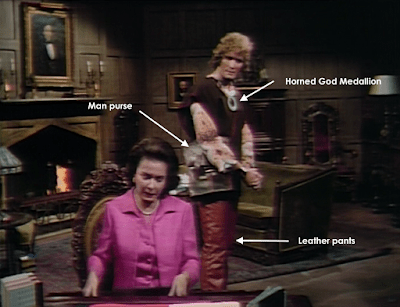
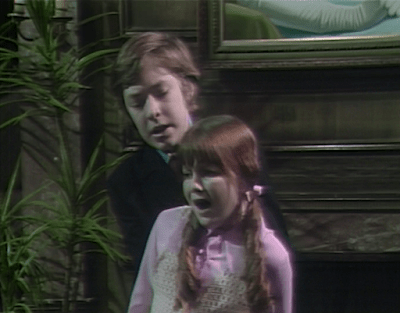
When we first saw Daniel, he was carrying on a one-sided conversation with his mother’s portrait, which hangs in her old bedroom. Today, he devises a plan to use the portrait to frighten Maggie. The plan requires the cooperation of his cousin, Amy Collins (Denise Nickerson.) When Amy refuses, he twists her arm until she agrees to go to a secret room and sing, making Maggie think the portrait is coming to life. This attack is shown only for a few seconds, and Amy’s arm is out of frame. They have already established that Daniel is cruel, and do not need to dwell on the act of abuse.

Daniel twists Amy’s arm. Screenshot by Dark Shadows Before I Die.

Daniel claims that his father often goes to Angelique’s room to meditate and talk to the portrait. That lures Maggie to the room, where Daniel is waiting. They have a confrontation. When she says she wishes she could “make him understand-,” he interrupts her and asks if what she wants him to understand is that his mother is dead and is never coming back. She looks at him and answers with a flat “Yes.” He tells her she is wrong, and pleads with the portrait to sing to him. Maggie says she can’t stand to see him like this, and turns to go. Before she gets out of the room, we hear a woman’s voice singing a lullaby. Maggie and Daniel hear it too. She turns around, shocked, and runs from the room. Daniel laughs that his plan worked so well.

Amy comes rushing into the room. Daniel congratulates her on her performance, and asks how she got in from the secret room so quickly. She explains that she never went to the secret room- her brother Chris intercepted her before she could do so. It wasn’t her voice Daniel and Maggie heard. He absorbs her message, and looks at the portrait in wonderment.

The audience could tell it wasn’t Denise Nickerson singing- she had such a high-pitched voice when she was twelve that she had to work hard to keep it in a range that would sound good on television, while the pre-recorded voice we heard singing was definitely that of a grown woman. Angelique was played by Lara Parker; Parker did some very distinctive things with her voice on Dark Shadows, none of which shows up in the lullaby, so I’m sure it wasn’t her. Several fansites attribute the singing to Joan Bennett, who is in this episode, but I’ve heard Bennett sing and she didn’t get from one note to another the way this voice does. I think the singer must be Kathryn Leigh Scott.

Early in the episode, Daniel and Amy had a scene in his bedroom. David’s bedroom was a frequent set in the first 38 weeks of the show, and was occasionally seen thereafter. Daniel’s room is the same set, with the same furnishings and decorations, but they are arranged in the opposite direction from the pattern we see in David’s. His bed is at stage right rather than stage left, and everything else is also transposed. Seeing this mirror image, regular viewers will appreciate this reminder that we are in a Mirror Universe.

Episode 937: The list of the expendables

A monster from beyond space and time has taken the form of a vicious man-child and asked people to call it “Jabe.” A cult devoted to the Leviathan People, mysterious Elder Gods who brought the monster to Earth, have decided to put up with its murders and depredations, but even they draw the line at calling the monster “Jabe.” It answers to “Jeb” instead.

Jabe’s latest pointless act of cruelty was to break the leg of one of his faithful servants, thirteen year old David Collins. A couple of times today, Jabe is about to explain why he broke David’s leg, and each time they cut away to some other scene. At one point we cut back to Jabe telling David that “Now you know why I had to do that, don’t you?,” to which David agrees that he does. That just lampshades the fact that the writers couldn’t come up with a reason.

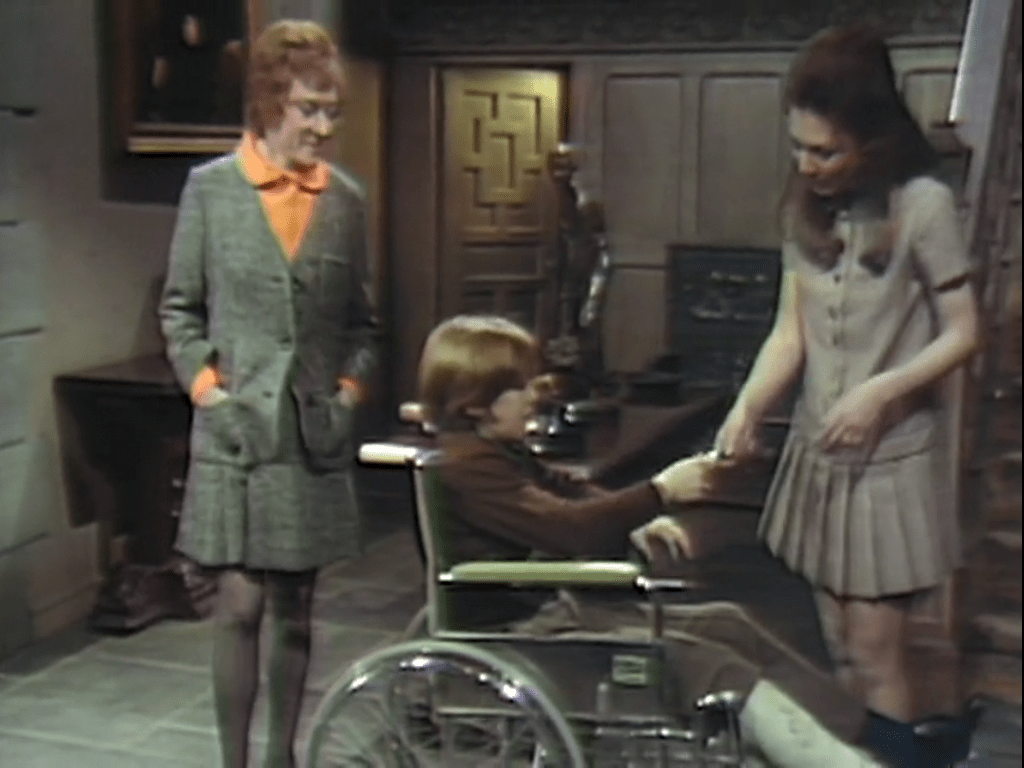
David wants Maggie to be the first to sign his cast.

The actual reason David Collins is wearing a cast and using a wheelchair is that actor David Henesy took a nasty spill on the ice. And since Jabe’s untrammeled violence is the big menace on the show right now, it makes sense that they would have him be at fault. It certainly makes more sense than does the fact that the family insists on David climbing the stairs to his bedroom with crutches, when they have a whole disused wing of servants’ bedrooms on the first floor in any one of which he could stay while he recuperates. On the other hand, that insistence does produce a moment of real hilarity. The instant David begins his ascent, governess Maggie Evans (Kathryn Leigh Scott) and permanent houseguest Julia Hoffman start talking as if he weren’t there. He must be lumbering up the stairs a couple of feet from them the whole time they are carrying on this conversation.

For his part, Jabe doesn’t generate any laughs. Nor is he pursuing any goals that lead us to wonder what he will do next. We just know that if he has a chance to do something nasty, he’ll probably take it.

If they want Jabe to be a character in whom we take an interest, they ought to give him some kind of cockamamie motivation that is intelligible only to him. That’s what they did in 1967, when vampire Barnabas Collins held Maggie prisoner and tortured her. They showed us that Barnabas thought he was going to turn Maggie into his lost love Josette. That idea, borrowed from the 1932 film The Mummy, was so utterly bonkers the show eventually decided to run with it, casting Miss Scott as Josette when they went back in time to explain how Barnabas became a vampire. Meanwhile, the ever-mounting zaniness kept viewers tuning in, wondering if they would ever expose a layer of Barnabas’ psychology that was composed of something other than nonsense.

The opening voiceover today labels Jabe “evil”; that’s no problem, all the most popular characters, including David, started off as appallingly evil, and they have retained their popularity to the extent that they stayed in touch with their roots. But Jabe is not only evil, he is monotonous, and that makes him a deadly threat to the show’s entertainment value.

Barnabas is not currently subject to the effects of the vampire curse, and Julia long ago used her powers as a mad scientist to erase Maggie’s memory of his crimes against her. Barnabas was the original leader of the Leviathan cult, but has become disaffected. Jabe tells Barnabas today that he wants to kill just about everyone at Collinwood, including ten year old Amy Jennings, who is a faithful member of the cult. He also wants to marry heiress Carolyn Collins Stoddard. Barnabas goes to Collinwood and warns Maggie that Carolyn is in danger. He asks her to keep an eye on Carolyn and to urge her to go away. He does not mention Amy. At least Amy’s name comes up in this episode- when she is on camera she is often the best thing in the show, but throughout her long absences she usually goes unmentioned.

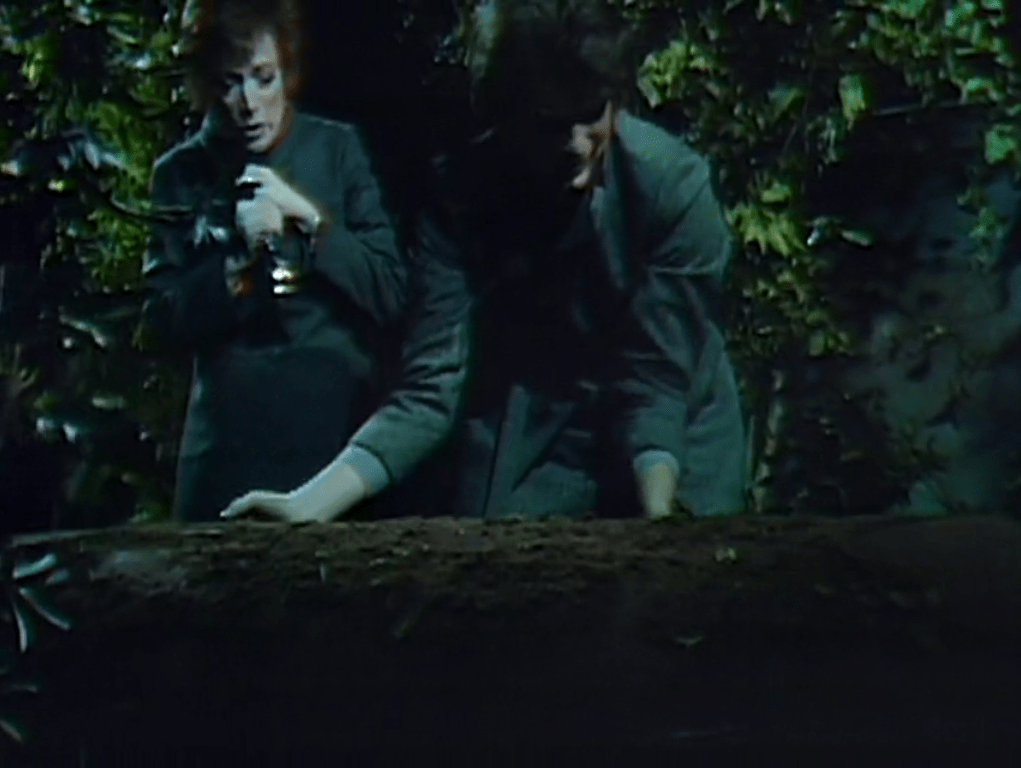
Julia goes to Amy’s great-grandfather, centenarian Quentin Collins, who has recently returned to Collinsport after an absence of many decades and who, because of a series of spells that were cast on him, looks like he is not quite 29 years old. Julia recruits Quentin to dig up the grave of Michael Hackett, Jabe’s previous incarnation. This gives us the first exhumation scene on Dark Shadows since, if I recall correctly, #820. It’s the longest the show has gone without digging up a coffin since the first exhumation scene, in #179. It feels like a homecoming when Quentin sticks his shovel in the plot. Of course they find an empty coffin.

As is usual when digging up a coffin, Quentin wears a three-piece suit with dress shoes, none of which is smudged in the process. Less typically, his coat appears to be somewhat wrinkled.

Afterward, Julia confronts Barnabas. When she tells him how much she already knows, he gives in and says he will tell her everything. With that, we have the promise that Barnabas and Julia will resume the partnership that has been the single most dynamic narrative element on Dark Shadows.

Episode 924: Afraid of the dark

Mad scientist Julia Hoffman finds that wicked witch Angelique has married a businessman who has a house on an island off the coast of central Maine. Angelique tells Julia that her husband’s love has freed her to live as a human being, and that for the sake of that love she has renounced her powers. In #882, set in the year 1897, Angelique said that she would soon have to return to the underworld unless she could find a man who would love her. The show has since returned to a contemporary setting, and she met her husband less than a year before, sometime in 1969. Evidently her time wasn’t running as short as she led us to believe it was.

In the 1897 segment, the show was quite clear that Angelique was aligned with Satan and that the underworld she was talking about was a Hell that Dante or Milton or other Christians would have recognized. The deal she described with her master therefore made little sense then. But Dark Shadows has drawn freely on the mythologies of many cultures and has made up stories about supernatural worlds of its own. The borrowings from the Christian tradition are a relatively minor part of the universe they have been patching together, and they have recently given us reason to suspect it is something they are backing away from. So I don’t think we are under any obligation to reconcile Angelique’s account of the lord of the damned with the teachings of any church.

Angelique is afraid that Julia has come to reenlist her in the cosmic battles surrounding the estate of Collinwood. In fact, Julia had no idea she would find Angelique. She went to the island because she had figured out that a painting she was looking for was there. It is a magical portrait of rakish Quentin Collins, obscured by a landscape painted over it. Quentin has amnesia, and Julia apparently thinks that if she shows him the portrait she will be able to jar some memories loose.

Angelique agrees to let Julia take the painting and expose Quentin’s portrait, on condition that the overpainting be exactly reproduced on another canvas and brought back to the house on the island before her husband knows it was gone. Julia suggests they tell him a lie that will give them more flexibility, but Angelique says he is “a very thorough man” and would ask too many follow-up questions if they gave him any information at all.

Before and after her scene with Julia, we see Angelique with her husband. The first scene begins with some very awkward kissing. The awkwardness is partly due to Geoffrey Scott’s total incompetence as an actor; he stands stiffly while Lara Parker simultaneously kisses him and nudges him to his mark, making it look like she is moving a couch. But part of the blame must rest with director Lela Swift, who set up the shot from an angle that puts the emphasis on the straining muscles in Parker’s neck and back. Perhaps Swift overestimated Scott’s abilities.

“Move three inches back and to the right, dummy, you’re supposed to be in the center of the frame!”

This scene is accompanied by some music for a small string ensemble; I don’t believe we have heard the track since the very early days of the show. It feels jarringly old-fashioned. All of Dark Shadows’ orchestral score strikes 21st century viewers as a relic of an earlier era, but it set it apart from other daytime soaps of the 1960s and early 70s, most of which had an organ playing on the soundtrack. Compared to the organ accompaniment, which today’s audiences would find simply intolerable, I suppose even these creaky old violins are relatively modern.

The second scene ends with a more successful kiss. It is accompanied by a woodwind piece that used to be associated strongly with well-meaning governess Vicki and her doomed love for dashing action hero Burke Devlin. Burke was written out of the show in 1967, Vicki in 1968, and this music cropped up occasionally in 1969 during sentimental moments. It is still noticeably more old-fashioned than the rest of the score, albeit more dynamic than the string serenade that went along with the first kiss.

Meanwhile, in the great house at Collinwood, strange and troubled boy David Collins is coming down with a cold. David’s governess, Vicki’s successor Maggie Evans, is trying to get him to take his schoolwork seriously. A boy known as Michael appears in the house and announces that he and David will be playing now. Maggie explains that it is not a good time, and Michael bullies both her and David into giving him his way.

Michael is not really human, but is a manifestation of a supernatural force that has subjugated David and many other people. Seeing Michael push Maggie around, we might remember May and June of 1967, when Maggie was the prisoner of vampire Barnabas Collins. Those episodes were bleak and at moments painful to watch, but they also drew a new audience and made Dark Shadows, for the first time, a hit.

Barnabas attracted a crowd, not simply because he was cruel to Maggie, but because we wondered how others would react to his evil deeds, because his motives were unbelievably zany, and because actor Jonathan Frid took a visible joy in playing him. He became a breakout star, familiar to millions who never saw a single episode of Dark Shadows or knew anything else about it, because he generated stories that allowed the whole cast to shine, followed his crazy ideas to the point where many of them became the realities of the show’s narrative universe, and had quirks that dovetailed perfectly with Frid’s strengths.

Michael has none of these things going for him. When he is nasty to Maggie, he does not produce any suspense as to what others will do. Not only do most characters assume that as a teacher she will be able to handle an obstreperous child by herself, but most of the people to whom she would likely turn for support are among Michael’s subordinates. There are no crazy ideas bursting out of him- he is just a little tyrant, who at no point seems to have any hidden motives or nuances of feeling. And Michael Maitland seems depressed the whole time he is on screen. As a result, Michael is as straightforward and tedious as Barnabas was luridly intriguing.

When Barnabas was holding Maggie prisoner, his blood-thrall Willie felt sorry for her. He occasionally made efforts to help her, none of which did anything but make her situation even worse. John Karlen’s portrayal of the feckless Willie brought him almost as much fan mail as Jonathan Frid received during that period. Today it is David’s turn to play Willie to Michael’s Barnabas, and he does not disappoint. Thirteen year old David Henesy plays David Collins’ conflicted feelings more subtly than Karlen had played Willie’s, and as a result we watch him very closely. Disappointed as we may be in Michael, Mr Henesy’s triumph in these scenes brings the episode to a strong close.

Episode 908: Mollycoddle that monster

The current phase of Dark Shadows is focused on the threat to the human race posed by the Leviathans, unseen supernatural beings who have taken control of several characters on the show. Among their devoted servants are matriarch Elizabeth Collins Stoddard and her nephew, strange and troubled boy David Collins. Today, Liz and David welcome a boy known as Alexander to the great house of Collinwood. Alexander appears to be an eight year old boy, but is in fact an extreme case of Soap Opera Rapid Aging Syndrome. Last week he was an infant, and a few days before a whistling sound coming from a wooden box. Whatever Alexander may really be, he holds a key position in the Leviathans’ plan.

At times, Dark Shadows becomes so much a kids’ show that it loses much of its adult audience. The Leviathan story so far has gone to the opposite extreme. A scene in which Alexander orders the thirteen year old David to give up the transistor radio he had long wanted and that his father just gave him will probably get similar reactions from viewers of all ages, but when Alexander scolds Liz for asking questions and she apologizes, only those who remember Joan Bennett as the great star she was in the late 1930s and early 1940s will get the full force of the moment. In general, adults will probably feel the distress Alexander’s tyranny is supposed to induce, while the fans who are running home from elementary school to watch the show will likely be either annoyed with the kid or amused to see the grownups getting theirs.

Liz’ ex-husband Paul is being persecuted by the Leviathans and their human agents. Paul is staying at Collinwood, and he is outraged to find Alexander in the house. Paul carries on like a crazy man, prompting Liz to tell him that if he doesn’t compose himself he will end up in a mental hospital. He tells Maggie Evans, David’s governess, about his suspicions; she listens sympathetically until he catches Alexander eavesdropping and roughs the boy up. Maggie then freezes in horror, and Paul goes on shaking Alexander and yelling at him until Liz enters and puts a stop to it. While Liz and Maggie stand in the corridor and talk about Paul’s lunatic behavior, he paces in the drawing room, telling himself that he mustn’t “fly off the handle” again.

David enters and hands Paul a small photo album. He says that it has pictures of Paul and Liz’ daughter Carolyn when she was a child. Since Paul wasn’t around when Carolyn was growing up, David says it occurred to him that Paul might want to look through it. Paul thanks David for his thoughtfulness.

As Paul leafs through the album, we get a look at a picture depicting Carolyn as she was when she was about ten. We haven’t seen the model before. Dark Shadows had such a tight budget that regular viewers will be fairly sure they wouldn’t have brought a girl in only to pose for a single photograph, so we might start wondering when we will meet the ten year old Carolyn.

Child Carolyn. Screenshot by Dark Shadows Before I Die.

We may also be wondering when we will see another girl of about the same age. Denise Nickerson, twelve years old in December 1969, has been in the cast for a year at this point, and has made major contributions every time we’ve seen her. We saw in #893 and #896 that her character Amy Jennings is still living at Collinwood and is still David’s chief playmate. But as is usual in episodes where she does not appear, Amy is unmentioned today. Liz tells Paul that David spends entirely too much time surrounded by adults, as if Amy does not exist. They followed the same pattern during the eight months of 1969 when Dark Shadows was set in 1897 and Nickerson played nine year old Nora Collins. When Nora was in the episode, she was often its brightest spot, but when she wasn’t her name never came up. It’s unnerving that the show does so little to reassure us that it will continue to make use of such a talented and appealing young actress.

Alexander sits on the bench that has been in the foyer at Collinwood throughout the whole series. The Dark Shadows wiki says this is only the second time the bench has been used. I want to say it is the third- I remember David sitting there in #176, when Maggie’s predecessor Vicki told him he could have two desserts, cake and ice cream, but I seem to recall either him or someone else sitting there at some point around that time. I’m not going to go back through those episodes to check, but if you’ve been watching them I’d appreciate it if you’d leave a note in the comments.

Episode 902: I heard breathing

Heiress Carolyn Stoddard is working for her friends, Megan and Philip Todd, in their antique shop. She goes upstairs to tell Megan that Philip has telephoned. Carolyn hears heavy breathing coming from the room where a baby the Todds are taking care of sleeps. Megan comes out of the room and in a most imperious tone demands to know what Carolyn is doing there. She tells her Philip called, and asks about the breathing sounds. Megan sweetens up and says “It’s the radiator!” She says she’ll have to call the plumber about it. Carolyn is unconvinced.

Downstairs in the shop, Carolyn and Megan notice someone looking in the window. The shop is open for business and there is merchandise displayed in the window, but for some reason it unnerves them that they have attracted the notice of a potential customer. All we can see of the man is his clean-shaven upper lip. When Carolyn approaches the window, he runs away. The only sneaky man we have met so far in the current phase of the show is Carolyn’s long-absent and recently returned father Paul. Since Paul wears a mustache, the upper lip is enough to show us that this is a new character, at least new to the ongoing stories.

No mustache. Screenshot by Dark Shadows Before I Die.

Carolyn and her mother Liz live in the great house on the estate of Collinwood. Also among the residents of the great house are Liz’ brother Roger Collins and Roger’s son, strange and troubled boy David. We cut to David’s bedroom, where a book opens by itself. We have seen books do this before on Dark Shadows, but I believe this is the first time I couldn’t see a cord being pulled. They really have come a long way with practical effects.

David reads aloud from the book, something about a child being cloaked in radiant garments. He is interrupted by his Aunt Liz. She asks him to notice that she knocked on the door, and tells him that she is learning to respect his privacy. She says she heard him reading aloud, and asks what it was. He says it was a school book. She starts talking about how terribly cold it is in his room. He brings up her ex-husband, Paul. Liz hadn’t known David was aware of Paul’s return, and gets very uncomfortable. She says he needs friends his own age, and hurries out of the room. Once she is gone, he goes through the room and gathers a lot of cash. Evidently David raised the subject of Paul to get the room to himself.

David does have one friend his own age, Amy Jennings. Amy lives in the great house, down the hall. We just saw Amy in #893 and #896, but she tends to be unmentioned in between appearances. Amy is a favorite of mine, and when they don’t use her name for long stretches I worry they are about to drop her from the show. It would have reassured me if Liz had named Amy as someone David ought to spend more time with.

Joan Bennett tends to do a lot of acting with her eyes when she plays a two-scene with David Henesy, and this is a good example. When Liz is pointing out her own good manners in knocking, it is her eyes that convey her mild amusement at the situation; when she is offering to help David with his schoolwork, her eyes follow him so closely that we notice all of the little movements he makes as he tries to get out of a tutoring session; when she talks about the coldness in the room, she looks from side to side, searching for the open window with increasing consternation; when he asks about Paul, her eyes bulge in their sockets, showing deep alarm. When she tells him he needs friends his own age, she raises her eyebrows, making it sound like a threat. Bennett had been so famous for so long that many of her scene partners would not react to what she was actually doing, but to what they expected her to do, forcing her to add Joan Bennett-isms to her performances. With Mr Henesy, she was free to work simply, and the result was consistently very effective.

Downstairs, Liz answers the telephone. To her disgust, Paul is calling. He tells her that if she doesn’t meet with him for a talk, she is in danger of losing Carolyn. She agrees to go to his hotel. Carolyn enters in time to catch the end of the conversation. Liz doesn’t want to talk about Paul with her any more than she did with David, and she exits.

Carolyn and David have a scene in the drawing room. She tells him he should go to bed; he says he wants to read the newspaper. He asks her if she hasn’t noticed that he has grown. Since the thirteen year old David Henesy was about the same height as Nancy Barrett, this question is worth a chuckle. David gets excited when he sees that Brewster’s Department Store in the village of Collinsport is going to be open nights until Christmas. He tears the Brewster’s ad out of the paper while Carolyn reminds him he can’t leave the house tonight. He says that of course he can’t, it’s late.

In his post about the episode on his great Dark Shadows Every Day, Danny Horn asked if David’s reaction to the Brewster’s ad is the only reference to Christmas in the whole series. His commenters responded that Christmas is also mentioned in #92, #123, #257, #810 (twice,) #887, and #1050. It’s hilarious to read through the thread and see the citations mount up. I sympathize with Danny, though- I tagged my posts about the first couple of episodes on that list with “Christmas,” because I, too, was sure that the holiday was only named once or twice in Dark Shadows.

Carolyn exits, and David sneaks out the front door. As he does, a man in a belted overcoat walks into the house. We see him only from the midsection down. He straightens the portrait of the Collinses’ distant cousin Barnabas that hangs in the foyer of the great house. This suggests that whoever he is, he has some connection with Barnabas. Carolyn comes back, and the man hides behind the curtains in the drawing room. This has been a favored hiding place for the last several months, suggesting that the man knows the house. Carolyn leaves, and the man goes out. If all he wanted to do was straighten that portrait, he could count his journey a success. Otherwise, it’s hard to see what the point of it was.

At the hotel, Paul struggles to explain his concerns to Liz. He is hampered by his own ignorance- he does not know exactly who is after him or what they want to do, but he knows they have some kind of sinister plan for Carolyn. Paul admits that Liz has no reason to believe anything he says, after his total failure as a husband, but he keeps urging her to take Carolyn and go far away, not telling anyone that they are going. She is exasperated with what she takes to be yet another of his scams, and tells him that “I’ll never figure out this latest plot of yours.” Indeed, the story is taking shape slowly enough that some viewers will have been saying the same thing.

Bennett and Dennis Patrick had many scenes together from March to July 1967, when he played seagoing con man Jason McGuire. Liz’ relationship with Jason was one-dimensional, consisting of nothing but a series of blackmail threats from him followed by capitulations from her. As her ex-husband, Paul offers far more for Liz to react against, and this scene is far richer and more satisfying than was anything we saw in the dreary Liz/ Jason story.

Liz goes out of the Collinsport Inn and sees David entering the antique shop across the street. The Inn has been part of the show from episode #1, but this is the first time we see a set representing its outside. Cutting between that set and the set representing the exterior of the antique shop, they make an attempt to create a sense of Collinsport as a place. When the show was in black and white, they would occasionally insert video they had taken at various locations in upstate New York and southern New England to achieve that effect, but they haven’t left 433 West 53rd Street since they went to color in August 1967. This quick cut between minimally decorated parts of the studio doesn’t work as well as that footage did, but it is a valiant effort in its own way.

Liz goes into the antique shop and insists Megan let her search the place for David. Since Liz essentially owns the town, Megan can’t say no. We conclude with Liz outside the door of the room upstairs from which Carolyn heard the breathing when we began. We hear the breathing again. David is inside the room, telling some unseen presence that it will like what he bought for it at Brewster’s. Perhaps he found it in the Unseen Presences section of the store. It’s in Collinsport, after all. David stops talking when he hears Liz’ voice; the breathing cuts out at the same time.

Episode 898: The keeper of the book

A cult devoted to the service of supernatural beings known as “the Leviathan people” is secretly establishing itself in and around Collinsport, Maine. Antique shop owners Megan and Philip Todd are members of the cult. Its acting leader, old world gentleman Barnabas Collins, has entrusted them with several items sacred to the cult. The Todds are responsible for a scroll, a box, a book, and a baby. Now the book has gone missing, and the baby is sick. Yesterday, Barnabas responded to this situation by brainwashing Philip into killing Megan. Today, we open with Philip entering the antique shop and choking Megan.

Megan is Marie Wallace’s third character on Dark Shadows. Her first, fiancée of Frankenstein Eve, was strangled by her intended spouse Adam in #626. Her second, madwoman Jenny Collins, was strangled by her estranged husband Quentin in #748. The murder of Eve came at the end of the Monster Mash period of the show that stretched throughout most of 1968, while the murder of Jenny marked a turning point in the eight-month costume drama segment set in the year 1897. The Leviathan arc is just beginning, and Miss Wallace’s character is already being strangled by her husband. If we were hoping for fresh new story ideas, we couldn’t be more disappointed.

Until, that is, the strangulation is called off. Philip is holding Megan by the neck, reiterating that “There is no margin for error! Punishment is necessary!,” when strange and troubled boy David Collins appears on the staircase and announces “punishment is no longer necessary.” Philip releases Megan, and David informs them that he is now “the keeper of the book, and the protector of the baby.” He gives Megan and Philip medicine that will cure the baby of his illness. He tells them that if they need him, he will know and will appear.

Barnabas was a vampire when he joined the cast of characters in April 1967. As a villain he was unrivaled at giving everyone else things to do, whether as his victims, his accomplices, or his would-be destroyers. In March 1968, his curse was put into abeyance and he became human. He set out to be the good guy, but still had the personality of a metaphor for extreme selfishness. As a result, Barnabas the would-be hero created at least as many disasters as Barnabas the monster ever did. He thus remained the driving force of the show, as well as its star attraction.

While Barnabas can keep things going from day to day, Philip’s attack on Megan suggests that he cannot take the story in new directions. From episode #1, that has been David’s forte. The series began when well-meaning governess Vicki was called to Collinwood to take charge of David’s education, took its first turn towards grisly tales when David tried to murder his father, became a supernatural thriller when David’s mother the undead blonde fire witch came back for him, began its first time travel story when Barnabas was planning to kill David in November 1967, and was launched into both the “Haunting of Collinwood” that dominated the show from December 1968 through February 1969 and the 1897 segment that followed it by David’s involvement with the ghost of Quentin Collins. David was not always a highly active participant in the stories that began with him; indeed, he sometimes disappeared altogether for months at a time. But even from the outside, he is the instrument by which the basic architecture of the show is reshaped. Now that he is, apparently, the leader of the Leviathans, we can renew our hopes that something we haven’t seen before is still in store for us.

David is still in the shop when a gray-haired man enters. David greets him as “Mr Prescott,” the name by which he heard his cousin Carolyn address the man when he met her in the shop the other day. David has a smug look on his face that suggests he knows this is an alias. Indeed, we already know that the man is connected with the Leviathan cult, so the leader of the cult may well recognize him as Paul Stoddard, Carolyn’s long-missing father.

Paul asks the Todds to give a note to Carolyn. David says that he will be going home to the great house of Collinwood in a few minutes, and volunteers to take the note to her there. Paul gladly hands it to him.

At Collinwood, permanent houseguest Julia Hoffman is conferring with mysterious drifter Chris Jennings. Yesterday, Jenny’s ghost appeared to Chris and told him that Quentin could help him with his big problem, which is that he is a werewolf. Jenny did not identify herself, and Chris had no clue who she was.

Julia shows him a Collins family photo album. She shows him a picture of maidservant Beth Chavez and asks if that is who he saw. He says it wasn’t, and they keep turning pages. It is interesting for regular viewers that they take a moment to put Beth’s picture on the screen and to make some remarks about her. Beth appeared several times during the “Haunting of Collinwood” segment, and was a major character during the 1897 flashback. The sight of her picture is the first reason we have had to suspect that either she or actress Terrayne Crawford will be back.

Chris and Julia look through a Collins family photo album. Screenshot by Dark Shadows Before I Die.

When Chris recognizes Jenny’s picture, Julia breaks the news to him that Jenny and Quentin were his great-grandparents, and that Quentin was the first to be afflicted with the werewolf curse. We know that Quentin and Jenny’s daughter was named Lenore, and that she was raised by a Mrs Fillmore. Chris confirms that his grandmother’s maiden name was Lenore Fillmore. Wondering how Quentin could help Chris, Julia decides they will hold a séance and contact Quentin’s spirit.

David enters, looking for Carolyn. Julia asks him to participate in the séance. He agrees, with the blandness appropriate in a house where séances have become almost routine. When Julia tells him that the spirit they are trying to reach is that of Quentin Collins, David becomes alarmed. As well he might- we left 1969 at the beginning of March, but in #839, broadcast and set in September, we saw that the haunting continued in the absence of the audience, and that Quentin’s ghost had killed David. That episode took place on the anniversary of an event in 1897 that was changed by time travelers from the 1960s, and so David came back to life and the haunting ended. But everyone at Collinwood still remembers the ten months that Quentin exercised his reign of terror, and David does not want to return to it.

Julia assures David he has nothing to be afraid of. She says that the past was changed as of September 1897/ September 1969, and that Quentin’s ghost was laid to rest forever. This doesn’t fit very well with her plan to disturb that rest, but David is still ready to go along with the plan.

When they have the séance, David goes into the trance. He speaks, not with Quentin’s voice, but with that of Jamison Collins, his own grandfather and Quentin’s favorite nephew. Jamison says that Quentin’s spirit is no longer available for personal appearances. He doesn’t know more than that, and excuses himself. When David comes to and asks what happened, Julia says she will tell him later and sends him to bed. Once he is gone, she tells Chris that she thinks Quentin may still be alive.

Quentin was a big hit when he was on the show as an unspeaking ghost during the “Haunting of Collinwood,” and became a breakout star to rival Barnabas when he was a living being during the 1897 segment. So the audience is not at all surprised that he will be coming back. But David’s behavior before, during, and after the séance is quite intriguing. He is not simply possessed by some spirit that is part of whatever it is the Leviathan cult serves. He is still David, is still afraid of Quentin’s ghost, and is still fascinated by séances. During the 1897 segment, Jamison was a living being; like David Collins, he was played by David Henesy. That Jamison can speak through his grandson and not express discomfort at the unfamiliarity of the atmosphere suggests that there are sizable expanses inside David which are still recognizably him.

There is a similar moment between Philip and Megan. She smiles at him and in a relaxed voice says she understands why he had to do what he did. Philip has no idea what she is talking about. She reminds him that he tried to strangle her earlier in the evening, and he suddenly becomes highly apologetic. She tells him he has nothing to apologize for, that it was his duty as a servant of their cause. He is still anguished about it. They share a tender embrace. Again, while the force that animates the Leviathan cult may have the final say over what Megan and Philip do, their personalities are still there, and the loving couple we met a not so long ago still exists. There is still something for us to care about concerning them.*

Paul also has a lot of activity today. He goes to the cairn in the woods that is the ceremonial center of the Leviathan cult and that only people associated with it can see. He wonders why he keeps being drawn to it. When he first returned to Collinwood in #887, he was watching when the cairn materialized in its place out of thin air. He didn’t react at all, but merely turned and continued on his stroll. That led us to believe he knew a great deal about the cult, enough that he not only expected to see this extraordinary sight, but knew he need take no action regarding it. But evidently his connection is more subtle, and he does not understand it himself.

In his hotel room, Paul goes into a trance and circles the date 4 December 1969 on his calendar. That was when the episode was first broadcast, so the original audience would have assumed he was merely circling the current date. But when it was taped, the makers of Dark Shadows had expected the episode to be shown on 3 December. In between, there had been a pre-emption when the ABC television network gave its news department the 4:00 PM timeslot to cover the end of the Apollo 12 lunar landing mission. So the intention had been that we would share Paul’s puzzlement as to what was so special about the next day.

Paul is already worked up because some unknown person left him a note at the antique shop reading “Payment Due, 4 December 1969.” By the end of the episode, he notices that a tattoo has appeared on his wrist. It is a symbol that the show refers to simply as “the Naga,” a group of intertwined snakes that represent the Leviathan cult. All of this combines to get him into quite a state.

* I should mention that Danny Horn made the same point in his post about the episode on his great Dark Shadows Every Day: “And then they kiss, and the creepy thing is that I think they’re actually in there… So far, I’ve been critical of Chris Bernau, but he’s the one who pulls this moment together. As far as he’s concerned, the unpleasant incident is entirely forgotten — but when Megan brings up the fact that he was seconds away from killing her, his apology is entirely sincere.” Danny Horn, “Episode 989: Executive Child,” on Dark Shadows Every Day, 12 July 2016.

Episode 896: Those who have been hidden shall show themselves

David and the Book

Strange and troubled boy David Collins has stolen an old book from an antique shop. He didn’t want the book, but had damaged it slightly and was terrified that he would be punished if this was discovered and his father had to pay for the rare volume.

David’s friend and fellow resident of the great house of Collinwood, Amy Jennings, catches him with the book in the drawing room. He tells her he is going to burn it in order to conceal his crime. She points out that this will make a bad situation much worse. As a creature of Soap Opera Land, David can have no higher calling than to make bad situations worse, so this does not deter him.

While Amy offers to take the book to the nearest grownup and to claim that she was the one who stole it, David opens it to a page depicting a group of intertwined snakes, a symbol the show refers to simply as “the Naga.” He is transfixed by the symbol. His whole manner changes. His posture becomes more rigid, his voice grave and authoritative. He tells Amy he no longer wants to burn the book. Instead, he will read it. Since the book is written in a script neither of them has seen before, Amy tells David he cannot read it, but he assures her he can. She asks him to read it to her, and he says that it is forbidden for her to hear any of it. She says that she doesn’t like the game David is playing and would rather turn to another; he says it is no game. She leaves him alone with the book.

The book was not in fact part of the antique shop’s merchandise, though it was on a display table there. The owners of the shop, Megan and Philip Todd, have been inducted into a mysterious cult led by David’s distant cousin, old world gentleman Barnabas Collins, and the book is one of that cult’s most sacred objects. The Todds flew into a panic when they realized the book was missing, and Barnabas told Philip that he faced a severe penalty for losing it. Those reactions make it hard to understand why Philip and Megan left the book on the table in the first place.

Longtime viewers know that many of the major plot-lines on Dark Shadows start with David. So we may suspect that the supernatural forces behind the cult, unknown to Barnabas or the Todds, caused the book to be left on the table and led David to take it so that he could become part of the story. Indeed, once he is alone with the book David intones a statement from it: “And then those who have been hidden so long shall rise and show themselves, and the others will know their time is ended and the time of the people of the Leviathan will begin.” Later, he goes to the mysterious cairn in the woods that is the center of the Leviathan cult’s ceremonial activity, and announces that he is one of them now. The stones at the bottom of the cairn part, revealing a small opening. David crawls into it. The words are solemn, the music melodramatic, the action of the boy stuffing himself into the little hole preposterous. It is the perfect Dark Shadows sequence.

David Henesy was nine years old when the show started, and was thirteen by this time. It would seem no one told the carpenters he had grown in the interval. That gap is such a tight fit for him that he has to wiggle his rear end at the camera for quite a while as he tries to wedge himself into it. Screenshot by Dark Shadows Before I Die.

We Actresses are Vain

As David is leaving to go to the cairn, he has to refuse a request from permanent houseguest Julia Hoffman. Julia wants him to go to the Old House on the estate and give a note to Barnabas. She keeps telling him that it is urgent, but he tells her he is already on his way to do something urgent.

Julia does not know about the Leviathan cult, much less about Barnabas’ connection with it. All she knows is that Barnabas has been her best friend for a year and a half, and when last they had a chance to spend time together they were concerned with the rakish Quentin Collins, whose whereabouts they do not know. Now it is 4:45 PM, and Julia is expecting a Mr Corey to come to the house at 5:00 and look at a painting she bought from the Todds a little while ago. She thinks this Mr Corey might be Quentin, and is keen for Barnabas to meet him.

When David cannot help her, Julia decides to take the note to the Old House herself. The show is usually fairly vague and inconsistent about the geography of Collinwood, but several times they have said that it takes about fifteen minutes to walk between the great house and the Old House. They stick with this today. Julia leaves at 4:45, and returns as the clock is striking 5:15. Barnabas was not at home, so she just turned right around.

Julia hears voices in the drawing room. They are heiress Carolyn Collins Stoddard and another woman. Julia gathers that Mr Corey is actually Ms Olivia Corey. When she enters the room, she sees that Olivia is a dead ringer for Amanda Harris, a woman who lived in 1897. Julia became aware of Amanda in September, when she and Barnabas were traveling in time and met each other in that year. Julia did not meet Amanda, but evidently must have seen at least one of the many portraits of her that magical artist/ dreary goon Charles Delaware Tate painted. She mentions these portraits to Olivia, who claims that Amanda was her grandmother. Amanda was in love with Quentin, and Julia takes an excited breath when she asks Olivia who her grandfather was. Olivia gives his name as Langley. Quentin may well have used an alias, so that doesn’t rule out the possibility that Olivia may be his granddaughter, though Dark Shadows fans looking back in these later days will think of another member of the Collins family when they hear that name.

Olivia is a famous New York actress. Julia tells her that she has seen her on stage and has seen her photograph in the newspapers, but that she never noticed her resemblance to Amanda. Olivia asks where Julia heard about Amanda; she says that she must have read about her somewhere in connection with one of the portraits. She also tells Olivia that she isn’t likely to want the painting, since it is not a portrait. Olivia says that she wants any painting of Tate’s she can get. Julia tells her there is no portrait of Quentin Collins in the house; Olivia pauses for a fraction of a second, then blandly asks if she is supposed to know who that is.

Some of Tate’s paintings had supernatural effects. When Tate painted pictures of his ideal woman, Amanda came into being as their embodiment, like Galatea emerging from Pygmalion’s statue. And when he painted Quentin’s portrait, Quentin was freed of the effects of the werewolf curse. Like a Halloween version of The Picture of Dorian Gray, the portrait turned into a wolf on the nights of the full moon, while Quentin remained human.

As long as the portraits of Amanda and Quentin are intact, they themselves will remain alive and well and youthful. So Julia’s hope that Quentin might still be traveling the world and using false names 72 years after the period when she and Barnabas knew him is not ill-founded, and her surmise that Olivia might be, not Amanda’s granddaughter, but Amanda herself, is also plausible.

Episode 836: The grownup world

It is 8 September 1969, and the ghost of Quentin Collins has rendered the great house of Collinwood uninhabitable. The family, including permanent house guest Julia Hoffman, have been staying at the Old House on the estate while recovering vampire Barnabas Collins is on a trip back in time to 1897, when Quentin was killed and the trouble started. But Julia has received a letter Barnabas wrote to her in September 1897 indicating that, as of that date, his mission was about to end in total failure, and so she decides to take matters into her own hands. First, she must learn exactly how and when Quentin died.

Julia goes to the great house and follows the sound of Quentin’s theme song to the tower room. There, she finds the ghost of maidservant Beth, who was one of Quentin’s many lovers. When Beth is in a shadowy corner, she puts on a ghostly voice and tells Julia that her name would mean nothing to her. As soon as she comes into the light, Julia says that they’ve met several times, and soon she is calling her by name. Along with the fact that, as Beth, Terrayne Crawford is just standing there in the same light as Grayson Hall, with no practical effect whatsoever to suggest ghostliness, this deflates whatever feeling we are supposed to have that we are witnessing an encounter with the supernatural.

Julia insists Beth tell her how Quentin died. When the ghost of Barnabas’ nine year old sister Sarah Collins was on the show from June to November 1967, she would often insist on the Ghost Rules and vanish if people put direct questions to her. But Beth just wanders around a little, moans to Quentin that she has no choice but to tell Julia what she wants to know, and starts dishing. Again, they aren’t making ghosts like they used to.

Beth tells Julia that on 10 September 1897, she found out Quentin was going to marry a woman named Angelique. Quentin did not tell her this news himself; he left it to Angelique to do so, making the blow fall all the more heavily. This will remind longtime viewers of #392, when Barnabas could not bring himself to tell his ex-fiancée Josette that he was engaged to Angelique, leaving Angelique to tell Josette herself in #393. Josette waited until #425 to leap to her death from the cliff at Widows’ Hill, but things move faster now. Beth went straight from her conversation with Angelique to her room, where she had a bottle labeled “Poison.”

Sensible shopper that she is, Beth buys her poison in the Generic section of the murder weapon store. Screenshot by Dark Shadows Before I Die.

Before she could do away with herself, Beth was interrupted by a knock on the door from twelve year old Jamison Collins. Jamison came in to show her a puzzle he had solved, then saw the bottle. He demanded to know what was going on, and she admitted that she was planning to kill herself because Quentin was going to marry Angelique. He stopped her doing that, but after he left to confront Quentin she took a loaded revolver out of her dresser.

Jamison found Quentin in the drawing room, in Angelique’s arms. Angelique at first dismissed Jamison, saying that his uncle was too busy to speak with him, but Jamison held his ground and insisted on seeing Quentin alone. Quentin obliged, but would answer Jamison’s questions only with airy assertions that he is too young to understand the situation. Jamison is so composed and forceful, and Quentin’s behavior is so flagrantly irresponsible, that we might expect Jamison to ask to be spared lectures on maturity from a man so much more childish than he. Instead, Jamison simply becomes angry and tells Quentin that after what he has done to Beth, he wants nothing more to do with him.

In #767, Jamison had a dream in which Quentin’s ghost said that his death was preceded by three events. The first two events happened shortly after. The third event was that Jamison rejected him. This has now happened, and in the dream Quentin said that once that took place “There was almost no time left for Quentin Collins.” Indeed, shortly after Jamison stalks off Beth shows up with her revolver and shoots Quentin. He staggers from the drawing room and goes upstairs. Since the staircase is made of eleven steps and is eight feet tall, that’s some pretty fancy staggering for a man who has just taken a round to the midsection. Quentin keeps staggering all the way to the tower room, where Beth shoots him a few more times.

We cut back to 1969, where Beth tells Julia she killed herself the day after she killed Quentin. She doesn’t seem to be done talking when Julia excuses herself. Say what you will about Sarah, she always left them wanting more.

Julia finds twelve year old David Collins, Jamison’s grandson, in the drawing room with Quentin’s ghost. Since Barnabas took us back in time with him in #701, we’ve got to know the living Quentin quite well, and he is a charming rascal who has very little in common with the silent, family-annihilating ghost we saw late in 1968. Beth’s story does very little to explain how the one turned into the other. The ghost has been draining the life from David; Julia orders David to come away from him, and he does. David lies down on the couch, and Julia examines him. She finds that he is weak, but resting comfortably.

Occult expert Timothy Eliot Stokes enters. Quentin’s ghost has vanished. Stokes calls Julia by her first name, something he had not done prior to this episode, and asks after David. She at first says he will be all right, then checks on him again. She cannot find a pulse, and declares him dead. Julia has performed wonders in her work as a medical doctor, but her death pronouncements are so often wrong that this does not give much grounds for alarm. However, we then hear Quentin’s voice laughing maniacally, darkening David’s prospects.

Terrayne Crawford seems to be such a nice person that it distresses me to point out that she was not a very good actress. But in this one, Beth’s lack of supernatural quality and Julia’s bland reaction to her make it seem like writer Gordon Russell and director Lela Swift were conspiring to vent their exasperation with Miss Crawford’s limits. She can play one emotion at a time, so that when Beth is shocked to learn that Quentin is going to marry someone else she is only and entirely Shocked. When Beth is suicidal, she is only and entirely Sad; when she decides to take Quentin’s life instead of her own, she is only and entirely Gleeful; when she tells Julia that her vengeance did not relieve her sorrow over Quentin, we can see that’s true, because she is only and entirely Sorrowful. The result is like looking at a series of wood block cuts illustrating various emotions. It’s all very clear and quite vivid, but there’s no sense of development from one scene to the next. Had Miss Crawford been able to lay one emotion over another and play two or more of them at a time, the grin on Beth’s face when she kills Quentin would have shown us that all the layers of complexity of feeling had finally been stripped away and only hatred was left. That would have been a tremendous climax for the character. But since there was never any such complexity to start with, it’s just another block cut.

Often when I see disappointing performances on Dark Shadows, I think of other actors in the cast and try to imagine what they would have done with the part. Gail Strickland, like Miss Crawford, is a tall, thin woman whose chin juts out on a horizontal line, and she was on the show as doomed schoolteacher Dorcas Trilling for a couple of episodes in May. Dorcas’ role would have been well within Miss Crawford’s competence, and in her long and distinguished career Miss Strickland proved she could do just about anything. So on a day like this, I envision a different, much more nuanced Beth. The episode in my imagination is really stellar, I wish you could see it.

Today, David Henesy plays both his 1897 character Jamison Collins and his 1960s character David Collins. He is not credited for either of those roles, but for Daniel Collins, whom he played when the show was set in the 1790s back in late 1967 and early 1968.

Episode 816: David Collins, who lives in the year 1969

From December 1968 to through February 1969, strange and troubled boy David Collins (David Henesy) and his friend Amy Jennings (Denise Nickerson) were falling under the power of the malign ghost of Quentin Collins. Occasionally the children were possessed by the spirits of David’s grandfather Jamison and great-aunt Nora; at other times they were possessed by Quentin’s own spirit and that of Quentin’s sometime lover, maidservant Beth. In those same days, Amy’s brother Chris (Don Briscoe) was suffering from a curse that made him a werewolf.

As Quentin’s power over David and Amy grew, so did the frequency and duration of Chris’ spells in lupine form. By #700, Quentin so dominated the great house on the estate of Collinwood that its residents fled to the Old House on the estate, home of their distant cousin Barnabas Collins. David, entirely possessed by Jamison, was close to death. For his part, Chris was stuck in wolf form, apparently permanently, and Barnabas had locked him in a secret room in the old Collins family mausoleum.

Desperate to remedy the situation, Barnabas and his associate, occult expert Timothy Eliot Stokes (Thayer David,) searched Quentin’s old room in the long-deserted west wing of the great house. They found some I Ching wands there. Under Stokes’ direction, Barnabas threw the wands, meditated on them, and found himself transported back in time to 1897. In that year, Quentin, Beth, Jamison, and Nora are alive, and Barnabas is a vampire.

Barnabas had no idea what led Quentin to become a malevolent ghost or what first brought the werewolf curse on Chris, but he had reason to believe that 1897 was an important year in the events leading up to both of those unhappy circumstances. So once he arrived in that period, he spent his nights meddling in all the affairs of the Collins family he found there. Vampires are not problem-solvers; their function in a story is to create problems that other characters will have to solve. So all of Barnabas’ well-intentioned interventions backfired badly. Even disregarding the many murders he committed for his own selfish ends, including the murder of Quentin’s brother Carl Collins, his trip would by any standard have to be considered a disaster.

Now, evil sorcerer Count Petofi (Thayer David) has found that Barnabas is a visitor from the future and is determined to go with him when he returns to 1969. When he demanded Barnabas tell him his secret, Barnabas quite truthfully told him he had no idea what was going on when he found himself transported from one period to another. Petofi did not believe him, and is trying to extort the information he wants by summoning the spirit of David to come from 1969 and possess Jamison (David Henesy) in 1897.

Not only is this an intriguing reversal of the 1968-1969 story in which the ghost of Quentin caused Jamison’s spirit to possess David, it also picks up on some recent hints that they might retcon the whole “Haunting of Collinwood” story to put Quentin’s ghost under the control of Petofi. Even if he can’t hitch a ride with Barnabas, perhaps Petofi will find a way to use Quentin to go back to 1969 with us.

Nora (Denise Nickerson) is with her brother Jamison when the possession takes hold. She is puzzled that he insists on calling her “Amy” and himself “David” and that he tells her to call Quentin on the telephone, even though he is in the house. When Quentin shows up, he recognizes the name David Collins from something Barnabas has told him about the future. But Barnabas has not told Quentin that he is fated to become a family-annihilating ghost, and so Quentin cannot understand how David knows who he is.

Meanwhile, a man named Tim Shaw (Don Briscoe) comes to the house and visits Nora in her room. Tim is Amy’s former teacher, and she considers him a friend. She does not know that since she first knew him, he has lost his moral compass, found the severed Hand of Count Petofi, stolen it, and used its magical powers to make a small fortune in New York City. Evidently all working-class Collinsport boys get rich quick when they go to NYC. In 1961, ex-fisherman Burke Devlin got out of prison and went to that city. By the time he returned to Collinsport in 1966, Burke was a big-time corporate raider who had to think for a moment when David Collins asked him if he’d already made his first $100,000,000. He answered “Not yet.” If he’d had the Hand, no doubt he would have passed that milestone long before.

A couple of days ago, Tim asked Nora to hide a box for him. Unknown to her, the box contained the Hand. Tim asks Nora to return the box to him. She tells him Jamison has it, and he flies into a rage. He gets very rough with her. Briscoe and Nickerson were both good actors, and we’ve seen them share tender moments both as Nora and Tim and as Amy and Chris, so the resulting scene is as uncomfortable as it needs to be to show us that Tim is no longer the long-suffering nice guy we once knew. Moreover, longtime viewers who recognize Tim’s echo of Burke and remember that Burke, though sometimes villainous, was always good with David, will be shocked that Tim does not mirror the earlier character’s consistent soft spot for children.

Tim roughs Nora up. Screenshot by Dark Shadows Before I Die.

Tim goes downstairs and sees Quentin coming out of the drawing room. He demands to see Jamison. Quentin tells him that Jamison is ill, and it will be impossible for anyone to talk to him. Tim starts to get ugly about it, and Quentin cuts him off, saying that Jamison doesn’t have the Hand. Tim is shocked that Quentin knows about the Hand, but recovers sufficiently to ask who does. Quentin cheerfully tells Tim that if he goes to the abandoned mill at the end of the North Road, he will find his onetime acquaintance Aristide, and that Aristide will direct him to the man who has the Hand.

Tim knows Aristide only slightly, but he has a grudge against him. Aristide attacked Tim’s girlfriend Amanda and demanded she tell him where the Hand was. Even after he realized Amanda did not know what he was talking about, he beat her and threatened to kill her, forcing her to tell him whatever she did know that would help him retrace Tim’s steps. When Tim found Amanda, Aristide had left her unconscious, and Tim feared at first she might be dead.

We cut to the hideout in the mill, where Tim is waiting with a pistol and thinking that he would be justified in killing Aristide for what he did to Amanda. When Aristide comes, Tim holds him at gunpoint and demands the Hand be returned to him. Aristide tells him that is not possible. They quarrel until another man enters. It is Petofi, who shows Tim that the Hand has resumed its place at the end of his right arm.

That suffices to show Tim that the Hand is no longer available to him. Petofi tells him he should consider himself lucky that the Hand, which followed no one’s commands, chose to make him rich and happy. Tim says he is not happy, and will not be until he can take revenge on the hypocritical Rev’d Gregory Trask and lawyer/ Satanist Evan Hanley. This again reminds longtime viewers of Burke, whose original goal in returning to Collinsport was to wreak vengeance on Roger Collins. As Trask and Evan involved Tim in a homicide when he was not in his right mind and tried to make him alone pay the legal penalty for it, so Roger killed someone with Burke’s car while Burke was passed out drunk in the back seat and saw to it that the court concluded that Burke was driving.

Petofi laughs and congratulates Tim on his choice of enemies. Tim brightens and asks if Petofi will join with him in bringing Trask and Evan down. Petofi explains that he does nothing without a price. Tim says he has a lot of money, and Petofi says he doesn’t have any use for money. Petofi brings up Amanda, only to say that he doesn’t have a use for her either, at least not at the moment. He sends Tim along his way.

Aristide is talking when Petofi dismisses him. He tells him that two visitors are coming, and that he wants to be alone when they arrive. He will not explain further, and so Aristide is in rather a huff when he leaves.

The visitors are Quentin and Jamison/ David. Quentin is carrying his nephew/ great-great-nephew. He demands that Petofi cure Jamison of the possession, which seems to be killing him. Petofi refuses. When Jamison/ David calls Quentin by name, Petofi asks him how a boy who lives in 1969 knows who he is. Quentin’s bewildered reaction leaves us wondering how he will respond if Barnabas ever tells him just why he went to the past.

In the opening teaser, Petofi stood over the coffin in which he has trapped Barnabas. He told Aristide that he and Barnabas have been at war for what even he, at his immense age, considers to be a very long time. He says that they are now engaged in the final battle of that war.

Petofi’s remarks make absolutely no sense whatever in the context of what we have seen. It has been clear so far that Petofi’s presence at Collinwood is an accident, that Barnabas never heard of him before, and that Petofi only just learned that Barnabas has traveled through time. Many of the oddest dead ends on the show were left over from advance plans that hadn’t worked out; so when they were drawing up broad outlines six months before taping, or when they were writing episode summaries (called “flimsies”) thirteen weeks before, they would often include ideas that depended on story points that they never got around to making happen or characters who never worked out. Once in a while, the writers tasked with filling in the flimsies wouldn’t be able to make up a complete 22 minute script without incorporating some of this irrelevant material. So perhaps at some point in the planning process they meant to have stories about Barnabas going back to the eighteenth century and fighting Petofi there. They may still have been kicking that idea around when they shot this installment.

Danny Horn closes his post about this episode at Dark Shadows Every Day with this little poem, which he attributes to Petofi (though it may remind some of Puck from Shakespeare’s Midsummer Night’s Dream):

If Dark Shadows has offended,
Think but this, and all is mended —
That you have but slumbered here
While these visions did appear.
And now, a word from All Temperature Cheer.

Danny Horn, “Episode 816: Midsummer,” posted 1 February 2016 at Dark Shadows Every Day.

Episode 809: Back from your evening revels

Charity Trask finds Quentin Collins unconscious and disheveled in the woods. She kneels beside him in a show of concern, then notices a woman on the ground near him. The woman’s face is covered with what on a black and white television look like slash marks and her clothing is badly torn. She regains consciousness just long enough to say Quentin’s name. Charity notices that Quentin is holding a scrap of cloth that matches the woman’s dress, and realizes that he is the werewolf who has been terrorizing the area.

Quentin comes to, and Charity tells him they must get help for the injured woman. Quentin’s response is to threaten to kill Charity if she says anything to anyone about what she has seen. He says that he will look after the woman, and repeats his death threats to Charity.

Charity goes home to the great house of Collinwood, where her father, the overbearingly evil Gregory Trask, orders her to marry Quentin by the end of the week. She is horrified and tells him she will not. She cannot explain why. Before Gregory can corner Charity and force her to give him information, twelve year old Jamison Collins enters. Jamison reports seeing the injured woman in the woods, and says that Gregory must go to her at once if she is to survive. Gregory dismisses this as a “tall tale” and says he will not be distracted from punishing Jamison for his long unexplained absence from the house. Charity, on the point of sobbing, urges Trask to take Jamison seriously, and he reluctantly goes to see if there really is a woman in the woods.

We know more than do Charity or Trask. We saw Jamison meet Quentin in the woods next to the woman’s body, and talk to him in an amiable and condescending tone about the possibility of turning this unfortunate incident to their mutual advantage. He also makes it clear that, despite his appearance, he is not simply Jamison. He is a sorcerer named Count Petofi, in possession of Jamison and acting through his body. When Charity asks Jamison/ Petofi if the woman was alone when he found her, he replies that of course she was. Smiling, he asks who she thought he might have seen. Terribly agitated, she soon excuses herself and goes into the foyer. Jamison/ Petofi looks directly into the camera and smiles. David Henesy was the first actor on Dark Shadows to use this technique, back in 1966 when he was playing strange and troubled boy David Collins. He’s been doing it a lot lately, and is still very good at using it to unsettle the audience.

He looks young for 150, but he’s grown quite a bit since 1966. Screenshot by Dark Shadows Before I Die.

Quentin comes down the staircase, wearing a tidy new suit. Charity is shocked that he did nothing to help the injured woman; he resumes his menacing tone and demands to know whether she kept her side of the bargain. He eventually deduces that she did not tell what she saw, and allows her to go upstairs to her bedroom. Quentin is usually charming, often funny, and occasionally aligned with good against evil, but even before he became a monster he was established as a homicidal maniac. When we first met Quentin, he was a ghost haunting Collinwood in the late 1960s and he kept killing people there. The first week of our trip back in time to 1897, we saw him trying to strangle his grandmother in her bed. And his sister-in-law turned him into a werewolf as revenge after he murdered his wife Jenny. Since we are focused on the horror of Charity’s situation as her father is pressuring her to marry Quentin, of course his bloodthirstiness is the aspect of his personality we see most clearly today.

Trask returns, carrying the injured woman. Quentin asks if she was conscious. Trask says she is not conscious. Quentin specifies that he wants to know if she has been conscious at any point while with Trask. This arouses Trask’s suspicions; Quentin protests that it is information he will need when he telephones the doctor. Trask says that she was not, and carries her upstairs.

Quentin goes to the drawing room. Jamison/ Petofi is there, and has some business to discuss. Quentin is too unsettled by the fact of the possession to talk candidly. Jamison/ Petofi decides to humor him. “I’ll become that beautiful child you so want to see… Can we play a game, Uncle Quentin?” Quentin is stunned by Jamison/ Petofi’s sudden change of tone and bearing. It is indeed impressive to see David Henesy drop his mimicry of Thayer David as Petofi and resume his usual approach to the role of Jamison. We’d forgotten just how deeply he had come to inhabit that imitation.

Jamison/ Petofi declares that they will have a treasure hunt. He gives Quentin a series of clues in the form of cryptic rhymes. Quentin is completely stumped by all of them. Finally Jamison/ Petofi just points at the desk drawer he wants Quentin to open and tells him there is a document in it that he can use against Trask. Quentin opens the drawer and pulls out heap after heap of paper, then declares “There’s no paper here!”

Quentin is not especially brainy; much of his appeal comes from the joy David Selby, Ph.D., took in playing a character who at no point says or does anything to demonstrate intellectual prowess. But we are not supposed to believe that he is stupid, at least not so stupid that it is plausible that “There’s no paper here!” was the scripted line. Maybe it was a blooper for “There’s no paper like that here!” or “There’s no paper here I haven’t seen before!” or something like that.

A document bearing a wax seal and a couple of signatures materializes on top of the papers Quentin has pulled out of the desk. He reads it, and sees that it is a full confession to the murder of Trask’s first wife, signed by Trask and lawyer Evan Hanley. All Jamison/ Petofi has to say is “It can be very useful, can’t it? Especially since it’s true… Aren’t games fun, Uncle Quentin?” and Quentin catches on that the document gives him power he can use against Trask.

Meanwhile, the injured woman has briefly regained consciousness in the upstairs bedroom where Trask and Charity are attending her. She spoke Quentin’s name, and Trask sent Charity to fetch him. Trask confronts Quentin about this. Quentin says that the woman’s name is Tessie, that he talked to her a couple of times when they ran into each other at the Blue Whale tavern, and that he knows nothing more about her. He admits he didn’t call the police after he called the doctor; he claims he simply forgot, in the confusion of the moment. Trask says that he will go and make the call. In an accusing tone, he asks “Most unfortunate, isn’t it, that you were the one who forgot?” He leaves Quentin alone with Tessie.

Tessie regains consciousness, looks at Quentin, and reacts with dismay. He tells her he didn’t mean to do it. She moans and dies. As she flops over, her right breast comes perilously close to springing out of her décolletage. When he realizes she has died, Quentin says “Tessie!” with a note of exasperation, as if she’s always doing inconvenient things like that. Mrs Acilius and I laughed out loud.

Downstairs, we see that Trask did not call the police after all. Charity is doing it from the telephone in the drawing room. Quentin enters through the secret panel behind her. We first saw him use this panel in #685, when it was 1969 and he was a silent but peculiarly corporeal ghost. He let himself into the drawing room and strangled silversmith Ezra Braithwaite, played by Abe Vigoda. A bit of an eldritch moment that the killer of Tessie is also the killer of a character played by the actor who would go on to play Tessio in the 1972 film The Godfather.

In Vigoda’s last scene in that movie, Tessio and Corleone Family consigliere Tom Hagen are at pains to assure each other that Tessio’s impending murder and the events that led up to it were strictly business, and that Tessio and his murderers still have the warmest regards for each other. Quentin’s attempt to deny his guilt to Tessie is of that same sort- he didn’t have any hostility towards her, his nature as a werewolf simply required that he kill the nearest person.

By contrast, Quentin’s interaction with Charity is intensely personal and intensely unpleasant. He takes the telephone out of her hand, something that men often do to women on Dark Shadows when they are trapping them, and moves deep into her personal space as he demands to know why she would want to call the police. She tells him her father ordered her to make the call; he says that Tessie will tell the police nothing now, because she is dead. Charity shouts that he killed Tessie, and that she will tell everything.

Danny Horn devotes much of his post about the episode at his great blog Dark Shadows Every Day to the absurdity of Quentin making a date with Tessie on a night when the Moon was full. In a comment, I pointed out that we have no reason to think he did make a date with her:

I don’t think it’s so hard to explain why Tessie was in the woods at dawn, though it does require a little fanfic.

Charity was in Quentin’s room in 806, inviting him to go for a walk on the beach when he’s busy getting drunk and listening to the same dreary little waltz over and over. To get Tessie into the woods, all we have to do is assume that shortly after that scene Quentin ran out of booze before he was drunk enough to stop caring about the upcoming full moon. Not wanting to deal with the Trasks, he didn’t go to the mansion’s liquor pantry, but staggered down to the Blue Whale.

There, Quentin met Tessie. She was upset with him for missing several dates in the last few days. He can’t very well explain what he’s been doing lately, and his refusal to answer Tessie’s questions angers her. She’s about to give Quentin a piece of her mind when he realizes that it will be dark soon, and rushes from the bar.

Now Tessie is really furious. She follows Quentin to the estate. Once there, she sees him change into the werewolf, and hides in terror for most of the night. Shortly before dawn, she thinks he is gone and leaves her hiding place. The werewolf appears and slashes away at her for a few minutes before changing back into human form and collapsing beside her.

And that’s when Charity finally takes her walk, and finds out.

Comment left 17 November 2020 by “Acilius” on Danny Horn, “Episode 808: Twice Burned,” Dark Shadows Every Day, 18 January 2016

Tessie is played by Deborah Loomis, and is the earliest screen credit on her IMDb page. Her next role listed there was in Hercules in New York, a 1970 film which also featured fellow Dark Shadows day player Erica Fitz Mears, who appeared in #594 and #595 as Leona Eltridge. Neither Miss Loomis nor Mrs Mears stuck with acting after the middle of the 1970s, but the two top billed members of the cast worked steadily for some years after. The first name in the credits was comedian Arnold Stang, who was best known at the time for a series of TV commercials for window screens ending with the tag “Arnold Stang says don’t get stung!” Second billed was Arnold Strong, a bodybuilder from Austria making his acting debut. Under his birth name of Arnold Schwarzenegger, Arnold Strong would go on to roles in several later films. I know of no evidence he ever auditioned for a part on Dark Shadows.